Inductively Coupled Mass Spectrometry
(ICP-MS)
Presented by :-
Prof. Anup A. Patil.
(Dept. of Pharmacology)
GIPER,LIMB,SATARA.
Contents:-
 Short about mass spectrometry
 Introduction
 Instrumentation
 Working of ICP- MS
 Limitations
 Applications
What is Mass spectrometry ?
 It is the most accurate method for
determination of Molecular mass of compound
and its elemental composition.
 Which can provide information concerning the
molecular structure of organic and inorganic
compounds.

 The mass spectrometer is an instrument in
which substance in gaseous or vapour state
(pressure between10-7
to 10-5
mm of Hg) is
bombarded with beam of electrons(70ev) to
form a positively charged ions(cations) which
are further sorted to mass to charge ratio to
record their masses and relative abundance.
Mass spectrometry
All mass spectrometers consist of three
basic parts:
 Ion source
 Mass analyzer
 Detector system
Stages within the mass spectrometer
1. Producing ions from the sample
2. Separating ions of differing masses
3. Detecting the number of ions of each mass
produced
4. Collecting the data and generating the mass
spectrum
 Introduction
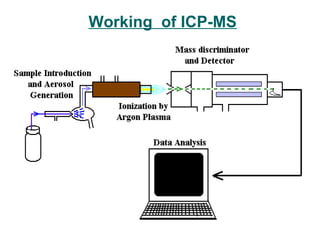
In ICP-MS, a plasma or gas consisting of ions,
electrons and neutral particles is formed from
Argon gas. The plasma is used to atomize and
ionize the elements in a sample. The resulting
ions are then passed through a series of
apertures (cones) into the high vacuum mass
analyzer.
Inductively coupled plasma
 ICP (Inductively Coupled Plasma)
A plasma is a gas that contains a sufficient
concentration of ions and electrons to make
the gas electrically conductive. In these
plasma, the positive ions are almost all
singly-charged and there are few negative
ions, so there are nearly equal numbers of
ions and electrons in each unit volume of
plasma
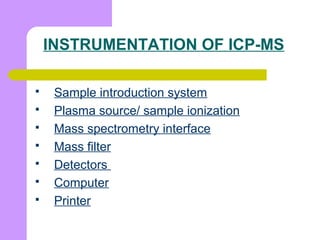
INSTRUMENTATION OF ICP-MS
 Sample introduction system
 Plasma source/ sample ionization
 Mass spectrometry interface
 Mass filter
 Detectors
 Computer
 Printer
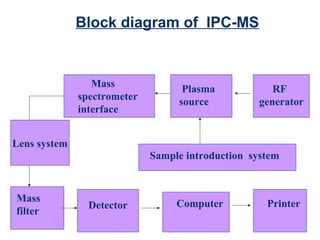
Block diagram of IPC-MS
RF
generator
Plasma
source
Mass
spectrometer
interface
Lens system
Detector Computer Printer
Mass
filter
Sample introduction system
 Sample introduction system:-
Samples are introduced into the plasma with aids
of nebulizer
1) Meinhard nebulizer
2) Pneumatic nebulizer
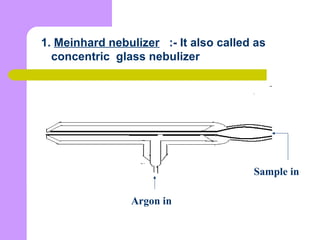
1. Meinhard nebulizer :- It also called as
concentric glass nebulizer
Argon in
Sample in
2) Pneumatic nebulizer:- are less expensive and
most commonly used commercial device
3) Babington nebulizer
4) Ultrasonic nebulizer
5) Desolating nebulizer
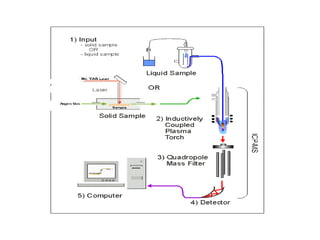
Samples Used in ICP-MS
Liquids
Solids
Airborne materials
Gases
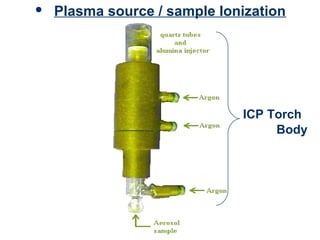
 Plasma source / sample Ionization
ICP Torch
Body
Three argon stream are supplied to torch
 The gas flow rate exert considerable influence
over both absolute and relative sensitivities of
various analytes,this flow rate must be very
precisely controlled, so most instrument use a
mass flow controller to maintain a very
constant sample gas flowrate.
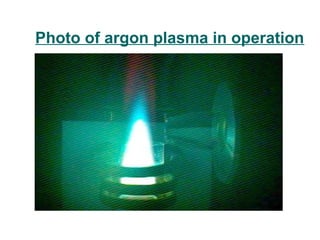
Photo of argon plasma in operation
MASS FILTERS
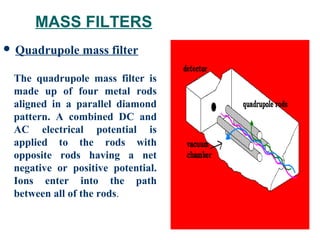
 Quadrupole mass filter
The quadrupole mass filter is
made up of four metal rods
aligned in a parallel diamond
pattern. A combined DC and
AC electrical potential is
applied to the rods with
opposite rods having a net
negative or positive potential.
Ions enter into the path
between all of the rods.
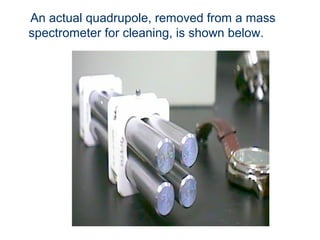
An actual quadrupole, removed from a mass
spectrometer for cleaning, is shown below.
DETECTOR
The most common type of
ion detector found in an
ICP-MS system is the
channeltron electron
multiplier. This cone or
horn shaped tube has a
high voltage applied to it
opposite in charge to that
of the ions being detected
Electron Multiplier
Schematic
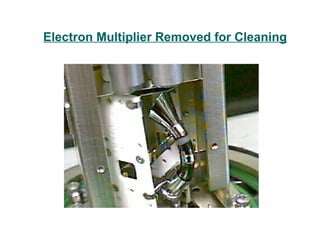
Electron Multiplier Removed for Cleaning

Working of ICP-MS
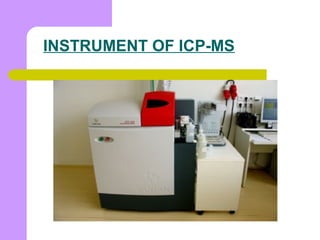
INSTRUMENT OF ICP-MS
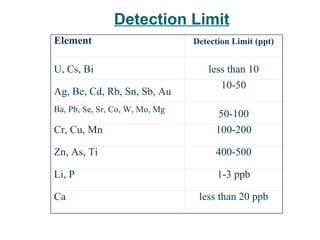
Detection Limit
Element Detection Limit (ppt)
U, Cs, Bi less than 10
Ag, Be, Cd, Rb, Sn, Sb, Au
10-50
Ba, Pb, Se, Sr, Co, W, Mo, Mg
50-100
Cr, Cu, Mn 100-200
Zn, As, Ti 400-500
Li, P 1-3 ppb
Ca less than 20 ppb
Limitations of ICP-MS
 Matrix effect
 Solutions with high conc. May plug orifice
 Detection life time may severely by exposure to more than
a few parts per million of any any isotope.
 Organic solvent required addition of oxygen to plasma or
sample pretreatment to avoid plugging orifice with elemental
carbon.
 Poly atomic interference
 Oxide, argide and double charge species give rise to spectral
interference
 Analyte element must have ionization potential less than that
of argon: 15.8 eV
Applications
 To determine the conc. Of more than 70 element from
low parts-per-trillion to part-per-millions levels in a
single analysis requiring less than 3 min. after
calibration.
 Heavily used in semiconductor and electronic
industries.
 Affords superior resolution for determination of rare –
earth elements(REEs).
 It capable of determining virtually entire periodic table.
 Biological and medical research and Geochemistry.
Applications
 Empirical formulae of chromatographic effluents.
 Determination of isotopic ratios.
 Destructive method, but only a few milligrams or
milliliters of sample are required.
 Very cost effective technique.
 Used in determination of radioactive & transnuric
elements.
 Used for rapid dissolution or digestion of tissues or
fluids.
References
 Frank A,Settle, Handbook of Instrumental
Techniques for Analytical chemistry, page no- 419
 Skoog D.A. Leavy J. Principles of Instrumental
Analysis, 4th
edition;Page no.420
 http://www.cee.vt.edu/ewr/environmental/teach/smprim
 http://en.wikipedia.org/wiki/ICP-MS
Inductively coupled mass spectrometry

Inductively coupled mass spectrometry

  • 1.
    Inductively Coupled MassSpectrometry (ICP-MS) Presented by :- Prof. Anup A. Patil. (Dept. of Pharmacology) GIPER,LIMB,SATARA.
  • 2.
    Contents:-  Short aboutmass spectrometry  Introduction  Instrumentation  Working of ICP- MS  Limitations  Applications
  • 3.
    What is Massspectrometry ?  It is the most accurate method for determination of Molecular mass of compound and its elemental composition.  Which can provide information concerning the molecular structure of organic and inorganic compounds.
  • 4.
      The massspectrometer is an instrument in which substance in gaseous or vapour state (pressure between10-7 to 10-5 mm of Hg) is bombarded with beam of electrons(70ev) to form a positively charged ions(cations) which are further sorted to mass to charge ratio to record their masses and relative abundance. Mass spectrometry
  • 5.
    All mass spectrometersconsist of three basic parts:  Ion source  Mass analyzer  Detector system
  • 6.
    Stages within themass spectrometer 1. Producing ions from the sample 2. Separating ions of differing masses 3. Detecting the number of ions of each mass produced 4. Collecting the data and generating the mass spectrum
  • 7.
     Introduction In ICP-MS,a plasma or gas consisting of ions, electrons and neutral particles is formed from Argon gas. The plasma is used to atomize and ionize the elements in a sample. The resulting ions are then passed through a series of apertures (cones) into the high vacuum mass analyzer.
  • 8.
    Inductively coupled plasma ICP (Inductively Coupled Plasma) A plasma is a gas that contains a sufficient concentration of ions and electrons to make the gas electrically conductive. In these plasma, the positive ions are almost all singly-charged and there are few negative ions, so there are nearly equal numbers of ions and electrons in each unit volume of plasma
  • 9.
    INSTRUMENTATION OF ICP-MS Sample introduction system  Plasma source/ sample ionization  Mass spectrometry interface  Mass filter  Detectors  Computer  Printer
  • 10.
    Block diagram ofIPC-MS RF generator Plasma source Mass spectrometer interface Lens system Detector Computer Printer Mass filter Sample introduction system
  • 11.
     Sample introductionsystem:- Samples are introduced into the plasma with aids of nebulizer 1) Meinhard nebulizer 2) Pneumatic nebulizer
  • 12.
    1. Meinhard nebulizer:- It also called as concentric glass nebulizer Argon in Sample in
  • 13.
    2) Pneumatic nebulizer:-are less expensive and most commonly used commercial device 3) Babington nebulizer 4) Ultrasonic nebulizer 5) Desolating nebulizer
  • 14.
    Samples Used inICP-MS Liquids Solids Airborne materials Gases
  • 15.
     Plasma source/ sample Ionization ICP Torch Body
  • 16.
    Three argon streamare supplied to torch  The gas flow rate exert considerable influence over both absolute and relative sensitivities of various analytes,this flow rate must be very precisely controlled, so most instrument use a mass flow controller to maintain a very constant sample gas flowrate.
  • 17.
    Photo of argonplasma in operation
  • 18.
    MASS FILTERS  Quadrupolemass filter The quadrupole mass filter is made up of four metal rods aligned in a parallel diamond pattern. A combined DC and AC electrical potential is applied to the rods with opposite rods having a net negative or positive potential. Ions enter into the path between all of the rods.
  • 19.
    An actual quadrupole,removed from a mass spectrometer for cleaning, is shown below.
  • 20.
    DETECTOR The most commontype of ion detector found in an ICP-MS system is the channeltron electron multiplier. This cone or horn shaped tube has a high voltage applied to it opposite in charge to that of the ions being detected Electron Multiplier Schematic
  • 21.
  • 22.
  • 24.
  • 25.
    Detection Limit Element DetectionLimit (ppt) U, Cs, Bi less than 10 Ag, Be, Cd, Rb, Sn, Sb, Au 10-50 Ba, Pb, Se, Sr, Co, W, Mo, Mg 50-100 Cr, Cu, Mn 100-200 Zn, As, Ti 400-500 Li, P 1-3 ppb Ca less than 20 ppb
  • 26.
    Limitations of ICP-MS Matrix effect  Solutions with high conc. May plug orifice  Detection life time may severely by exposure to more than a few parts per million of any any isotope.  Organic solvent required addition of oxygen to plasma or sample pretreatment to avoid plugging orifice with elemental carbon.  Poly atomic interference  Oxide, argide and double charge species give rise to spectral interference  Analyte element must have ionization potential less than that of argon: 15.8 eV
  • 27.
    Applications  To determinethe conc. Of more than 70 element from low parts-per-trillion to part-per-millions levels in a single analysis requiring less than 3 min. after calibration.  Heavily used in semiconductor and electronic industries.  Affords superior resolution for determination of rare – earth elements(REEs).  It capable of determining virtually entire periodic table.  Biological and medical research and Geochemistry.
  • 28.
    Applications  Empirical formulaeof chromatographic effluents.  Determination of isotopic ratios.  Destructive method, but only a few milligrams or milliliters of sample are required.  Very cost effective technique.  Used in determination of radioactive & transnuric elements.  Used for rapid dissolution or digestion of tissues or fluids.
  • 29.
    References  Frank A,Settle,Handbook of Instrumental Techniques for Analytical chemistry, page no- 419  Skoog D.A. Leavy J. Principles of Instrumental Analysis, 4th edition;Page no.420  http://www.cee.vt.edu/ewr/environmental/teach/smprim  http://en.wikipedia.org/wiki/ICP-MS