THE LYMPHATIC SYSTEM
REPRESENTED BY WASIM AKRAM
B.SC NURSING
ADWIKA INSTITUTE OF NURSING
INTRODUCTION
 The lymphatic system is a sub-system of circulatory system
and immune system.
It is a type of drainage system of human body which collects all
the tissue fluids (constantly leaking out of the bloodstream)
and takes back to the major veins through a network of lymph
vessels.
The lymphatic system consists of -
Lymph – colourless tissue fluid
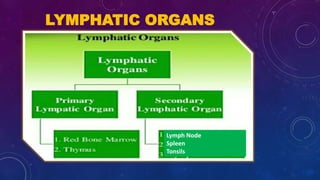
Lymphatic organs – Thymus, Bone Marrow, Lymph nodes,
Spleen, Tonsils.
Lymph vessels – through which lymph circulation takes
place.
FUNCTIONS OF LYMPHATIC SYSTEM
It maintains balance between blood and tissues:
 Blood volume : 5 – 6L
 Interstitial fluid volume: 10 – 11L
 Lymph volume: 2 – 3L.
It helps in Immunity.
It fascilitate absorption of fats and hormones:
 Breakdown products of fat and fat-soluble vitamins are
absorbed into the central lacteals (lymphatic vessels) of the
villi.
LYMPH (TISSUE FLUID)
Definition:
Lymph is a colorless fluid containing specialized lymphocytes which are
responsible for the immune response of the body.
Compositions:
 The lymph is composed of blood plasma, WBCs, platelets, small plasma
proteins etc.
 It has same mineral distribution as that in plasma.
 Dissolved carbon dioxide (CO2).
Lymph Formation:
 The lymph is formed by oozing plasma through the small pores of blood
capillaries into the interstitial tissue.
 WBCs, plasma, platelets, small proteins and antibodies can oozes out
from the blood capillaries and constitutes the fluid lymph.
Functions:
 Exchange of nutrients, gases etc between blood and cells
occurs through this fluid.
 It is important carrier for nutrients, hormones etc.
 It have role in carrying of carbon dioxide (CO2) but not
oxygen (O2).
 Fats are absorbed through lymph in the lacteals present
in the intestinal villi.
 Lymph returns proteins and excess interstitial fluid to the
bloodstream.
 It transport antibodies which kills the foreign bodies.
LYMPH (TISSUE FLUID)
LYMPH VESSELS
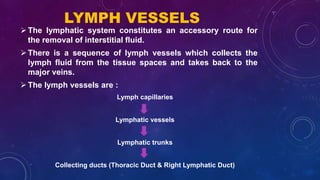
The lymphatic system constitutes an accessory route for
the removal of interstitial fluid.
There is a sequence of lymph vessels which collects the
lymph fluid from the tissue spaces and takes back to the
major veins.
The lymph vessels are :
Lymph capillaries
Lymphatic vessels
Lymphatic trunks
Collecting ducts (Thoracic Duct & Right Lymphatic Duct)
LYMPH CAPILLARIES:
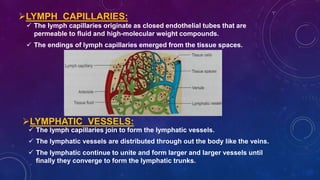
 The lymph capillaries originate as closed endothelial tubes that are
permeable to fluid and high-molecular weight compounds.
 The endings of lymph capillaries emerged from the tissue spaces.
LYMPHATIC VESSELS:
 The lymph capillaries join to form the lymphatic vessels.
 The lymphatic vessels are distributed through out the body like the veins.
 The lymphatic continue to unite and form larger and larger vessels until
finally they converge to form the lymphatic trunks.
LYMPHATIC TRUNKS:
 The lymphatic trunks are larger lymph vessels which drain
lymph from relatively large regions of the body.
 Examples of lymphatic trunks includes –
o Lumbar trunk – it drains lymph from the lower limbs, lower
abdominal wall and the pelvic organs.
o Intestinal trunk – it drains lymph from the various viscera of
abdomen.
o Intercostals trunk – it drains from portions of thorax.
o Bronchomediastinal trunk – it also receives lymph from the
portions of thorax.
o Subclavian trunk – it drains lymph from the upper limb.
o Jugular trunk – it drains lymph from portions of the neck and
head.
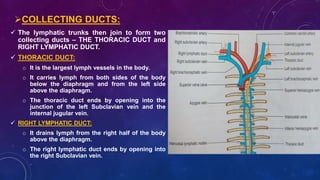
 The lymphatic trunks then join to form two
collecting ducts – THE THORACIC DUCT and
RIGHT LYMPHATIC DUCT.
 THORACIC DUCT:
o It is the largest lymph vessels in the body.
o It carries lymph from both sides of the body
below the diaphragm and from the left side
above the diaphragm.
o The thoracic duct ends by opening into the
junction of the left Subclavian vein and the
internal jugular vein.
 RIGHT LYMPHATIC DUCT:
o It drains lymph from the right half of the body
above the diaphragm.
o The right lymphatic duct ends by opening into
the right Subclavian vein.
COLLECTING DUCTS:
LYMPHATIC ORGANS
Lymph Node
Spleen
Tonsils
 Bone marrow is the soft, flexible connective tissue within bone cavities.
 The red bone marrow is a key element of the lymphatic system, being
one of the primary lymphoid organs that generate lymphocytes from
immature hematopoietic progenitor cells.
 Red bone marrow contains hematopoietic stem cells that produce two
other types of stem cells: myeloid stem cells and lymphoid stem cells.
 Myeloid Stem Cells - develop into red blood cells, platelets, mast cells, or
myeloblast cells. Myeloblast cells develop into granulocyte and
monocyte white blood cells.
 Lymphoid Stem Cells - develop into lymphoblast cells, which produce
other types of white blood cells called lymphocytes. Lymphocytes
include natural killer cells, B lymphocytes, and T lymphocytes.
RED BONE MARROW
 The thymus gland is located in mediastinum just above the heart and behind
the sternum.
 The thymus is composed of two identical lobes and each lobe can be divided
into a central medulla and a peripheral cortex which is surrounded by an outer
capsule.
 Both cortex and medulla contain epithelial cells and thymocytes.
 The thymus produces and secretes THYMOSIN HORMONE.
 The thymus is responsible for producing and maturing Lymphocytes, or
immune cells. These include T cells, a type of white blood cell that defends the
body from infections.
Once fully mature, they help to fight:
o Tumors: Cancerous masses.
o Allergens: Substances that cause allergic reactions.
o Pathogens: Microbes, such as viruses and bacteria, that can cause an infection.
THYMUS
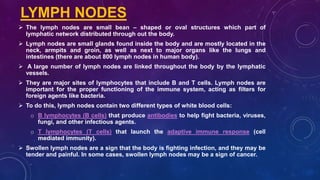
 The lymph nodes are small bean – shaped or oval structures which part of
lymphatic network distributed through out the body.
 Lymph nodes are small glands found inside the body and are mostly located in the
neck, armpits and groin, as well as next to major organs like the lungs and
intestines (there are about 800 lymph nodes in human body).
 A large number of lymph nodes are linked throughout the body by the lymphatic
vessels.
 They are major sites of lymphocytes that include B and T cells. Lymph nodes are
important for the proper functioning of the immune system, acting as filters for
foreign agents like bacteria.
 To do this, lymph nodes contain two different types of white blood cells:
o B lymphocytes (B cells) that produce antibodies to help fight bacteria, viruses,
fungi, and other infectious agents.
o T lymphocytes (T cells) that launch the adaptive immune response (cell
mediated immunity).
 Swollen lymph nodes are a sign that the body is fighting infection, and they may be
tender and painful. In some cases, swollen lymph nodes may be a sign of cancer.
LYMPH NODES
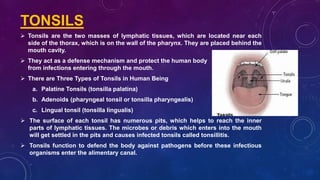
 Tonsils are the two masses of lymphatic tissues, which are located near each
side of the thorax, which is on the wall of the pharynx. They are placed behind the
mouth cavity.
 They act as a defense mechanism and protect the human body
from infections entering through the mouth.
 There are Three Types of Tonsils in Human Being
a. Palatine Tonsils (tonsilla palatina)
b. Adenoids (pharyngeal tonsil or tonsilla pharyngealis)
c. Lingual tonsil (tonsilla lingualis)
 The surface of each tonsil has numerous pits, which helps to reach the inner
parts of lymphatic tissues. The microbes or debris which enters into the mouth
will get settled in the pits and causes infected tonsils called tonsillitis.
 Tonsils function to defend the body against pathogens before these infectious
organisms enter the alimentary canal.
TONSILS
SPLEEN
Introduction:
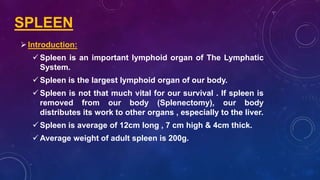
 Spleen is an important lymphoid organ of The Lymphatic
System.
 Spleen is the largest lymphoid organ of our body.
 Spleen is not that much vital for our survival . If spleen is
removed from our body (Splenectomy), our body
distributes its work to other organs , especially to the liver.
 Spleen is average of 12cm long , 7 cm high & 4cm thick.
 Average weight of adult spleen is 200g.
Definition:
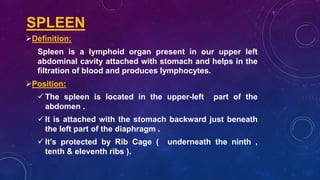
Spleen is a lymphoid organ present in our upper left
abdominal cavity attached with stomach and helps in the
filtration of blood and produces lymphocytes.
Position:
 The spleen is located in the upper-left part of the
abdomen .
 It is attached with the stomach backward just beneath
the left part of the diaphragm .
 It’s protected by Rib Cage ( underneath the ninth ,
tenth & eleventh ribs ).
SPLEEN
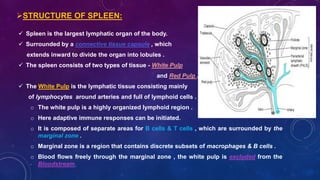
STRUCTURE OF SPLEEN:
 Spleen is the largest lymphatic organ of the body.
 Surrounded by a connective tissue capsule , which
extends inward to divide the organ into lobules .
 The spleen consists of two types of tissue - White Pulp
and Red Pulp .
 The White Pulp is the lymphatic tissue consisting mainly
of lymphocytes around arteries and full of lymphoid cells .
o The white pulp is a highly organized lymphoid region .
o Here adaptive immune responses can be initiated.
o It is composed of separate areas for B cells & T cells , which are surrounded by the
marginal zone .
o Marginal zone is a region that contains discrete subsets of macrophages & B cells .
o Blood flows freely through the marginal zone , the white pulp is excluded from the
Bloodstream.
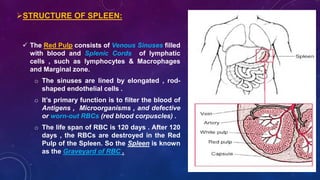
 The Red Pulp consists of Venous Sinuses filled
with blood and Splenic Cords of lymphatic
cells , such as lymphocytes & Macrophages
and Marginal zone.
o The sinuses are lined by elongated , rod-
shaped endothelial cells .
o It’s primary function is to filter the blood of
Antigens , Microorganisms , and defective
or worn-out RBCs (red blood corpuscles) .
o The life span of RBC is 120 days . After 120
days , the RBCs are destroyed in the Red
Pulp of the Spleen. So the Spleen is known
as the Graveyard of RBC .
STRUCTURE OF SPLEEN:
FUNCTIONS OF SPLEEN:
 The spleen serves two main functions :
o It filters the blood to remove the old/damaged RBCs - Red Pulp.
o It serves as a secondary lymphoid organ removing infectious
agents and using them to activate the lymphocytes - White Pulp.
 Spleen plays an active role in the production of IgM antibodies and in
the functional maturation of antibodies .
 The spleen is the site of destruction of autoimmune disease states
(Haemolytic Anaemia).
 During foetal development spleen helps in production of WBCs &
RBCs (Haematopoiesis).
BLOOD AND NERVE SUPPLY:
BLOOD SUPPLY:
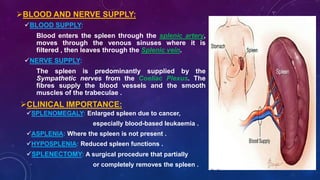
Blood enters the spleen through the splenic artery,
moves through the venous sinuses where it is
filtered , then leaves through the Splenic vein.
NERVE SUPPLY:
The spleen is predominantly supplied by the
Sympathetic nerves from the Coeliac Plexus. The
fibres supply the blood vessels and the smooth
muscles of the trabeculae .
CLINICAL IMPORTANCE:
SPLENOMEGALY: Enlarged spleen due to cancer,
especially blood-based leukaemia .
ASPLENIA: Where the spleen is not present .
HYPOSPLENIA: Reduced spleen functions .
SPLENECTOMY: A surgical procedure that partially
or completely removes the spleen .
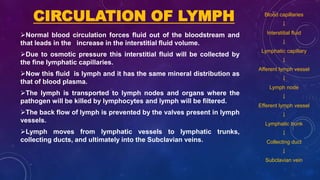
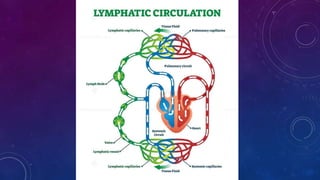
CIRCULATION OF LYMPH
Normal blood circulation forces fluid out of the bloodstream and
that leads in the increase in the interstitial fluid volume.
Due to osmotic pressure this interstitial fluid will be collected by
the fine lymphatic capillaries.
Now this fluid is lymph and it has the same mineral distribution as
that of blood plasma.
The lymph is transported to lymph nodes and organs where the
pathogen will be killed by lymphocytes and lymph will be filtered.
The back flow of lymph is prevented by the valves present in lymph
vessels.
Lymph moves from lymphatic vessels to lymphatic trunks,
collecting ducts, and ultimately into the Subclavian veins.
Blood capillaries
ïżŹ
Interstitial fluid
ïżŹ
Lymphatic capillary
ïżŹ
Afferent lymph vessel
ïżŹ
Lymph node
ïżŹ
Efferent lymph vessel
ïżŹ
Lymphatic trunk
ïżŹ
Collecting duct
ïżŹ
Subclavian vein
THE LYMPHATIC SYSTEM// LYMPH CIRCULATION//LYMPH VESSELS// LYMPH ORGANS

THE LYMPHATIC SYSTEM// LYMPH CIRCULATION//LYMPH VESSELS// LYMPH ORGANS

  • 1.
    THE LYMPHATIC SYSTEM REPRESENTEDBY WASIM AKRAM B.SC NURSING ADWIKA INSTITUTE OF NURSING
  • 2.
    INTRODUCTION  The lymphaticsystem is a sub-system of circulatory system and immune system. It is a type of drainage system of human body which collects all the tissue fluids (constantly leaking out of the bloodstream) and takes back to the major veins through a network of lymph vessels. The lymphatic system consists of - Lymph – colourless tissue fluid Lymphatic organs – Thymus, Bone Marrow, Lymph nodes, Spleen, Tonsils. Lymph vessels – through which lymph circulation takes place.
  • 3.
    FUNCTIONS OF LYMPHATICSYSTEM It maintains balance between blood and tissues:  Blood volume : 5 – 6L  Interstitial fluid volume: 10 – 11L  Lymph volume: 2 – 3L. It helps in Immunity. It fascilitate absorption of fats and hormones:  Breakdown products of fat and fat-soluble vitamins are absorbed into the central lacteals (lymphatic vessels) of the villi.
  • 4.
    LYMPH (TISSUE FLUID) Definition: Lymphis a colorless fluid containing specialized lymphocytes which are responsible for the immune response of the body. Compositions:  The lymph is composed of blood plasma, WBCs, platelets, small plasma proteins etc.  It has same mineral distribution as that in plasma.  Dissolved carbon dioxide (CO2). Lymph Formation:  The lymph is formed by oozing plasma through the small pores of blood capillaries into the interstitial tissue.  WBCs, plasma, platelets, small proteins and antibodies can oozes out from the blood capillaries and constitutes the fluid lymph.
  • 5.
    Functions:  Exchange ofnutrients, gases etc between blood and cells occurs through this fluid.  It is important carrier for nutrients, hormones etc.  It have role in carrying of carbon dioxide (CO2) but not oxygen (O2).  Fats are absorbed through lymph in the lacteals present in the intestinal villi.  Lymph returns proteins and excess interstitial fluid to the bloodstream.  It transport antibodies which kills the foreign bodies. LYMPH (TISSUE FLUID)
  • 6.
    LYMPH VESSELS The lymphaticsystem constitutes an accessory route for the removal of interstitial fluid. There is a sequence of lymph vessels which collects the lymph fluid from the tissue spaces and takes back to the major veins. The lymph vessels are : Lymph capillaries Lymphatic vessels Lymphatic trunks Collecting ducts (Thoracic Duct & Right Lymphatic Duct)
  • 7.
    LYMPH CAPILLARIES:  Thelymph capillaries originate as closed endothelial tubes that are permeable to fluid and high-molecular weight compounds.  The endings of lymph capillaries emerged from the tissue spaces. LYMPHATIC VESSELS:  The lymph capillaries join to form the lymphatic vessels.  The lymphatic vessels are distributed through out the body like the veins.  The lymphatic continue to unite and form larger and larger vessels until finally they converge to form the lymphatic trunks.
  • 8.
    LYMPHATIC TRUNKS:  Thelymphatic trunks are larger lymph vessels which drain lymph from relatively large regions of the body.  Examples of lymphatic trunks includes – o Lumbar trunk – it drains lymph from the lower limbs, lower abdominal wall and the pelvic organs. o Intestinal trunk – it drains lymph from the various viscera of abdomen. o Intercostals trunk – it drains from portions of thorax. o Bronchomediastinal trunk – it also receives lymph from the portions of thorax. o Subclavian trunk – it drains lymph from the upper limb. o Jugular trunk – it drains lymph from portions of the neck and head.
  • 9.
     The lymphatictrunks then join to form two collecting ducts – THE THORACIC DUCT and RIGHT LYMPHATIC DUCT.  THORACIC DUCT: o It is the largest lymph vessels in the body. o It carries lymph from both sides of the body below the diaphragm and from the left side above the diaphragm. o The thoracic duct ends by opening into the junction of the left Subclavian vein and the internal jugular vein.  RIGHT LYMPHATIC DUCT: o It drains lymph from the right half of the body above the diaphragm. o The right lymphatic duct ends by opening into the right Subclavian vein. COLLECTING DUCTS:
  • 10.
  • 11.
     Bone marrowis the soft, flexible connective tissue within bone cavities.  The red bone marrow is a key element of the lymphatic system, being one of the primary lymphoid organs that generate lymphocytes from immature hematopoietic progenitor cells.  Red bone marrow contains hematopoietic stem cells that produce two other types of stem cells: myeloid stem cells and lymphoid stem cells.  Myeloid Stem Cells - develop into red blood cells, platelets, mast cells, or myeloblast cells. Myeloblast cells develop into granulocyte and monocyte white blood cells.  Lymphoid Stem Cells - develop into lymphoblast cells, which produce other types of white blood cells called lymphocytes. Lymphocytes include natural killer cells, B lymphocytes, and T lymphocytes. RED BONE MARROW
  • 12.
     The thymusgland is located in mediastinum just above the heart and behind the sternum.  The thymus is composed of two identical lobes and each lobe can be divided into a central medulla and a peripheral cortex which is surrounded by an outer capsule.  Both cortex and medulla contain epithelial cells and thymocytes.  The thymus produces and secretes THYMOSIN HORMONE.  The thymus is responsible for producing and maturing Lymphocytes, or immune cells. These include T cells, a type of white blood cell that defends the body from infections. Once fully mature, they help to fight: o Tumors: Cancerous masses. o Allergens: Substances that cause allergic reactions. o Pathogens: Microbes, such as viruses and bacteria, that can cause an infection. THYMUS
  • 13.
     The lymphnodes are small bean – shaped or oval structures which part of lymphatic network distributed through out the body.  Lymph nodes are small glands found inside the body and are mostly located in the neck, armpits and groin, as well as next to major organs like the lungs and intestines (there are about 800 lymph nodes in human body).  A large number of lymph nodes are linked throughout the body by the lymphatic vessels.  They are major sites of lymphocytes that include B and T cells. Lymph nodes are important for the proper functioning of the immune system, acting as filters for foreign agents like bacteria.  To do this, lymph nodes contain two different types of white blood cells: o B lymphocytes (B cells) that produce antibodies to help fight bacteria, viruses, fungi, and other infectious agents. o T lymphocytes (T cells) that launch the adaptive immune response (cell mediated immunity).  Swollen lymph nodes are a sign that the body is fighting infection, and they may be tender and painful. In some cases, swollen lymph nodes may be a sign of cancer. LYMPH NODES
  • 14.
     Tonsils arethe two masses of lymphatic tissues, which are located near each side of the thorax, which is on the wall of the pharynx. They are placed behind the mouth cavity.  They act as a defense mechanism and protect the human body from infections entering through the mouth.  There are Three Types of Tonsils in Human Being a. Palatine Tonsils (tonsilla palatina) b. Adenoids (pharyngeal tonsil or tonsilla pharyngealis) c. Lingual tonsil (tonsilla lingualis)  The surface of each tonsil has numerous pits, which helps to reach the inner parts of lymphatic tissues. The microbes or debris which enters into the mouth will get settled in the pits and causes infected tonsils called tonsillitis.  Tonsils function to defend the body against pathogens before these infectious organisms enter the alimentary canal. TONSILS
  • 15.
    SPLEEN Introduction:  Spleen isan important lymphoid organ of The Lymphatic System.  Spleen is the largest lymphoid organ of our body.  Spleen is not that much vital for our survival . If spleen is removed from our body (Splenectomy), our body distributes its work to other organs , especially to the liver.  Spleen is average of 12cm long , 7 cm high & 4cm thick.  Average weight of adult spleen is 200g.
  • 16.
    Definition: Spleen is alymphoid organ present in our upper left abdominal cavity attached with stomach and helps in the filtration of blood and produces lymphocytes. Position:  The spleen is located in the upper-left part of the abdomen .  It is attached with the stomach backward just beneath the left part of the diaphragm .  It’s protected by Rib Cage ( underneath the ninth , tenth & eleventh ribs ). SPLEEN
  • 17.
    STRUCTURE OF SPLEEN: Spleen is the largest lymphatic organ of the body.  Surrounded by a connective tissue capsule , which extends inward to divide the organ into lobules .  The spleen consists of two types of tissue - White Pulp and Red Pulp .  The White Pulp is the lymphatic tissue consisting mainly of lymphocytes around arteries and full of lymphoid cells . o The white pulp is a highly organized lymphoid region . o Here adaptive immune responses can be initiated. o It is composed of separate areas for B cells & T cells , which are surrounded by the marginal zone . o Marginal zone is a region that contains discrete subsets of macrophages & B cells . o Blood flows freely through the marginal zone , the white pulp is excluded from the Bloodstream.
  • 18.
     The RedPulp consists of Venous Sinuses filled with blood and Splenic Cords of lymphatic cells , such as lymphocytes & Macrophages and Marginal zone. o The sinuses are lined by elongated , rod- shaped endothelial cells . o It’s primary function is to filter the blood of Antigens , Microorganisms , and defective or worn-out RBCs (red blood corpuscles) . o The life span of RBC is 120 days . After 120 days , the RBCs are destroyed in the Red Pulp of the Spleen. So the Spleen is known as the Graveyard of RBC . STRUCTURE OF SPLEEN:
  • 19.
    FUNCTIONS OF SPLEEN: The spleen serves two main functions : o It filters the blood to remove the old/damaged RBCs - Red Pulp. o It serves as a secondary lymphoid organ removing infectious agents and using them to activate the lymphocytes - White Pulp.  Spleen plays an active role in the production of IgM antibodies and in the functional maturation of antibodies .  The spleen is the site of destruction of autoimmune disease states (Haemolytic Anaemia).  During foetal development spleen helps in production of WBCs & RBCs (Haematopoiesis).
  • 20.
    BLOOD AND NERVESUPPLY: BLOOD SUPPLY: Blood enters the spleen through the splenic artery, moves through the venous sinuses where it is filtered , then leaves through the Splenic vein. NERVE SUPPLY: The spleen is predominantly supplied by the Sympathetic nerves from the Coeliac Plexus. The fibres supply the blood vessels and the smooth muscles of the trabeculae . CLINICAL IMPORTANCE: SPLENOMEGALY: Enlarged spleen due to cancer, especially blood-based leukaemia . ASPLENIA: Where the spleen is not present . HYPOSPLENIA: Reduced spleen functions . SPLENECTOMY: A surgical procedure that partially or completely removes the spleen .
  • 21.
    CIRCULATION OF LYMPH Normalblood circulation forces fluid out of the bloodstream and that leads in the increase in the interstitial fluid volume. Due to osmotic pressure this interstitial fluid will be collected by the fine lymphatic capillaries. Now this fluid is lymph and it has the same mineral distribution as that of blood plasma. The lymph is transported to lymph nodes and organs where the pathogen will be killed by lymphocytes and lymph will be filtered. The back flow of lymph is prevented by the valves present in lymph vessels. Lymph moves from lymphatic vessels to lymphatic trunks, collecting ducts, and ultimately into the Subclavian veins. Blood capillaries ïżŹ Interstitial fluid ïżŹ Lymphatic capillary ïżŹ Afferent lymph vessel ïżŹ Lymph node ïżŹ Efferent lymph vessel ïżŹ Lymphatic trunk ïżŹ Collecting duct ïżŹ Subclavian vein