THE LYMPHATIC SYSTEM/
Lymphoid system or Immune system.
NAC 16
Objectives
• At the end of this lecture, student should be able
to:
• Describe the composition and the main functions
of the lymphatic system
• Describe how lymph or tissue fluid is produced.
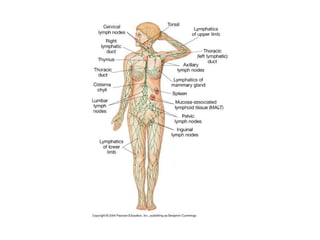
• Identify the locations of the main lymphatic vessels
of the body
• Describe the lymph node.
• Identify some lymphoid tissue in the body.
Introduction
• The body cells are bathed in interstitial (tissue)
fluid, which leaks constantly out of the bloodstream
through the permeable walls of blood capillaries.
• It is therefore very similar in composition to blood
plasma.
• Most of the fluid escaping from the bloodstream is
reabsorbed into the venous ends of the blood
capillaries, but the excess, along with any
particulate matter including cell debris and
bacteria, is removed by a network of thin-walled
lymphatic capillaries.
Introduction
• This prevents the tissues from becoming
swollen but as the drained fluids are filtered
through lymph nodes, which are packed with
immune cells, it also fulfills an important
defense function, monitoring the health of the
tissues and alerting the immune system to
invaders
Introduction
• Like blood capillaries, the lymphatic capillaries
merge to form progressively larger and larger
lymphatic vessels, which eventually empty
into a major vein, returning the escaped fluids
to the bloodstream.
Introduction
• Most components of blood plasma filter through
blood capillary walls to form interstitial fluid.
• After interstitial fluid passes into lymphatic
vessels, it is called lymph ( clear fluid).
• The major difference between interstitial fluid
and lymph is location:
• Interstitial fluid is found between cells, and
lymph is located within lymphatic vessels and
lymphatic tissue.
Components of the lymphatic system
The lymphatic system consists of:
 lymph, the fluid flowing in a lymphatic vessel
 lymph vessels
 lymph nodes
lymph organs, e.g. spleen and thymus
 diffuse lymphoid tissue, e.g. tonsils
 bone marrow.
Functions of the Lymphatic System
• The lymphatic system has three primary functions:
• 1. Drains excess interstitial fluid. Lymphatic
vessels drain excess interstitial fluid from tissue
spaces and return it to the blood.
• 2. Transports dietary lipids. Lymphatic vessels
transport lipids and lipid-soluble vitamins (A, D, E,
and K) absorbed by the gastrointestinal tract.
• 3. Carries out immune responses. Lymphatic
tissue initiates highly specific responses directed
against particular microbes or abnormal cells.
Tissue drainage
• Every day, around 21 litres of fluid from plasma carrying
dissolved substances and some plasma protein escape
from the arterial end of the capillaries and into the
tissues.
• Most of this fluid is returned directly to the bloodstream
via the capillary at its venous end but the excess, about 3-
4 litres of fluid, is drained away by the lymphatic vessels.
• If this did not happen, the tissues would rapidly become
waterlogged, and the cardiovascular system would begin
to fail as the blood volume fell
Absorption in the small intestine
• Breakdown products of fat and fat- soluble
materials, e.g. the fat-soluble vitamins, are
absorbed into the central lacteals (lymphatic
vessels) of the villi.
Immunity
• The lymphatic organs are concerned with the
production and maturation of lymphocytes,
the white blood cells responsible for
immunity.
• Bone marrow is therefore considered to be
lymphatic tissue, since lymphocytes are
produced there.
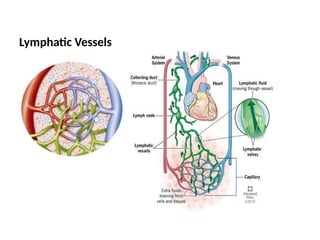
Lymphatic Vessels
• Lymphatic capillaries -small lymphatic vessels -major lymphatic vessels
(deep).
• Lymphatic capillaries are present in almost every tissue in the body,
*except in the CNS, cornea of the eye, bones and superficial layers of the
skin.
• They have the same structure as blood capillaries but have larger
diameters, originate as pockets instead of tubes, inner lining of cells
overlap.
• Larger lymphatic vessels contain valves to ensure unidirectional flow of
lymph. They run alongside the arteries and veins.
• Lymph vessels become larger as they join together, eventually forming two
large ducts, the thoracic ductand right lymphatic duct which empty into
the rightand leftsubclavianveins.
Lymphatic Vessels
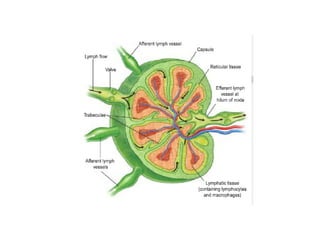
Lymph Nodes
• Oval or bean-shaped organs that lie, often in groups, along
the length of lymph vessels.
• Lymph drains and is ‘purified’ through a number of nodes (8
to 10) before returning to venous circulation.
• Found mostly around the neck, armpits, groin.
• Lymph nodes consist of reticular and lymphatic tissue i.e.
lymphocytes and macrophages. There are reticular cells
which produce a network of fibres that provides internal
structure within the node.
• Four or five afferent lymph vessels may enter a lymph node
while only one efferent vessel carries lymph away from the
node.
Functions of Lymph Nodes
• Filtering and phagocytosis
• Proliferation of lymphocytes.
Tonsils
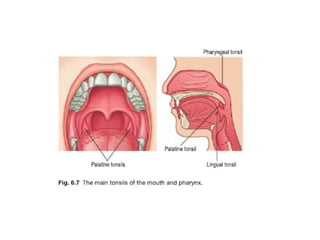
• Tonsils are uncapsulated collections of
lymphoid tissue located strategically in the back
of the mouth and the throat, ideally placed to
intercept swallowed or inhaled antigens.
• They are generally largest in childhood and
regress with age.
• Their structure features deep pits or clefts to
trap bacteria, which are then destroyed by the
defence cells packed into the tonsil.
• There are three main groups of tonsils.
Groups of Tonsils
1. Pharyngeal tonsils (adenoids)
• These lie at the back of the nasal cavity, on the
upper posterior wall of the pharynx.
• In childhood, they can swell as a result of
respiratory infections and partially block the
nasal passageways, interfering with breathing.
• For this reason they may be removed
(tonsillectomy).
2. Palatine tonsils
• These lie on the pharyngeal wall at the back of
the mouth.
• They too can swell causing troublesome
obstruction of the airways, and may have to
be removed.
3. Lingual tonsils
• These are collections of lymphoid tissue at the
back and sides of the tongue.
Lymph
• Clear watery fluid, similar in composition to plasma.
Plasma without proteins. Identical in composition to
interstitial fluid.
• Lymph transports plasma proteins that seep out of the
capillary beds back to the blood stream.
• It carries away larger particles e.g. bacteria and cell
debris from damaged tissues.
• Lymph contains lymphocytes which circulate in the
lymphatic system allowing for patrol in the different
regions of the body.
• Fat absorbed into the lymphaticsgive the lymph (chyle)
a milky appearance.
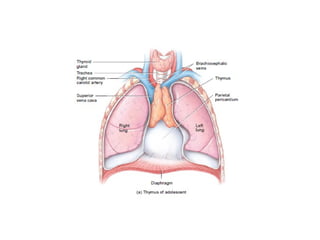
Lymphoid organs: Thymus
• Thymus: Found in the mediastinum, posterior to
the sternum.
• Lymphocytes originate from stem cells in bone
marrow. Those that enter the thymus develop into
T –lymphocytes.
• T -Lymphocytes divide in the cortex and migrate to
the medulla to mature. In 3 weeks they are ready
to leave into circulation.
• Hormones from the thymus (thymosin) promote
maturation of lymphocytes.
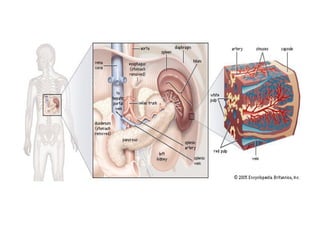
Lymphoid organs: Spleen
• The largest lymph organ
• Contains reticular and lymphatic tissue.
• Deep dark red or purplish in colour, 12 cm long, 7
cm wide and 2.5 cm thick, 200 grams
• The spleen has no afferent lymphatic vessels.
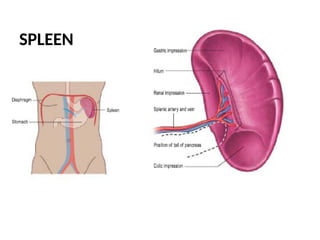
• The spleen is located in the upper left quadrant of
the abdominal cavity, just below the diaphragm,
behind the stomach.
• The lower rib cage protects the spleen from
physical trauma
SPLEEN
Functions of the Spleen
• Phagocytosis: old and abnormal RBCs are mainly destroyed in
the spleen, and the breakdown products, bilirubin and iron
are transported to the liver via the splenic and portal veins.
• Leucocytes, platelets and bacteria are phagocytosed in the
spleen.
• Storage of blood: 350 ml of blood.
• Immune response: contains T-and B-lymphocytes which are
activated by the presence of antigens.
• Splenomegaly???
• Erythropoiesis: the spleen with the liver are important sites of
fetal blood cell production. In times of great need, the spleen
can resume this function in adults.
Mucosa-Associated Lymphatic Tissue (MALT).
• Lymphatic nodules are scattered throughout
the mucosa of the gastrointestinal, respiratory,
urinary, and reproductive tracts.
• This lymphatic tissue is termed mucosa-
associated lymphatic tissue (MALT).
REVIEW QUESTIONS
• Describe the system of lymph vessels. Explain how lymph is kept
moving in these vessels. Into which veins is lymph emptied?
• State the locations of the major groups of lymph nodes, and
explain their functions.
• State the locations of lymph nodules, and explain their
functions.
• Describe the location of the spleen and explain its functions. If
the spleen is removed, what organs will compensate for its
functions?
Explain the function of the thymus, and state when (age). this
function is most important.
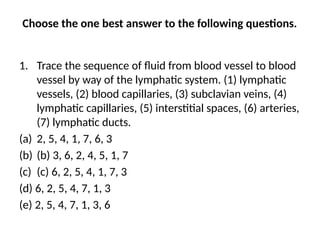
Choose the one best answer to the following questions.
1. Trace the sequence of fluid from blood vessel to blood
vessel by way of the lymphatic system. (1) lymphatic
vessels, (2) blood capillaries, (3) subclavian veins, (4)
lymphatic capillaries, (5) interstitial spaces, (6) arteries,
(7) lymphatic ducts.
(a) 2, 5, 4, 1, 7, 6, 3
(b) (b) 3, 6, 2, 4, 5, 1, 7
(c) (c) 6, 2, 5, 4, 1, 7, 3
(d) 6, 2, 5, 4, 7, 1, 3
(e) 2, 5, 4, 7, 1, 3, 6
QUESTION
• The lymphatic system has three primary
functions. Describe them.

THE LYMPHATIC SYSTEM human anatomy .pptx

  • 1.
    THE LYMPHATIC SYSTEM/ Lymphoidsystem or Immune system. NAC 16
  • 2.
    Objectives • At theend of this lecture, student should be able to: • Describe the composition and the main functions of the lymphatic system • Describe how lymph or tissue fluid is produced. • Identify the locations of the main lymphatic vessels of the body • Describe the lymph node. • Identify some lymphoid tissue in the body.
  • 3.
    Introduction • The bodycells are bathed in interstitial (tissue) fluid, which leaks constantly out of the bloodstream through the permeable walls of blood capillaries. • It is therefore very similar in composition to blood plasma. • Most of the fluid escaping from the bloodstream is reabsorbed into the venous ends of the blood capillaries, but the excess, along with any particulate matter including cell debris and bacteria, is removed by a network of thin-walled lymphatic capillaries.
  • 4.
    Introduction • This preventsthe tissues from becoming swollen but as the drained fluids are filtered through lymph nodes, which are packed with immune cells, it also fulfills an important defense function, monitoring the health of the tissues and alerting the immune system to invaders
  • 5.
    Introduction • Like bloodcapillaries, the lymphatic capillaries merge to form progressively larger and larger lymphatic vessels, which eventually empty into a major vein, returning the escaped fluids to the bloodstream.
  • 6.
    Introduction • Most componentsof blood plasma filter through blood capillary walls to form interstitial fluid. • After interstitial fluid passes into lymphatic vessels, it is called lymph ( clear fluid). • The major difference between interstitial fluid and lymph is location: • Interstitial fluid is found between cells, and lymph is located within lymphatic vessels and lymphatic tissue.
  • 7.
    Components of thelymphatic system The lymphatic system consists of:  lymph, the fluid flowing in a lymphatic vessel  lymph vessels  lymph nodes lymph organs, e.g. spleen and thymus  diffuse lymphoid tissue, e.g. tonsils  bone marrow.
  • 8.
    Functions of theLymphatic System • The lymphatic system has three primary functions: • 1. Drains excess interstitial fluid. Lymphatic vessels drain excess interstitial fluid from tissue spaces and return it to the blood. • 2. Transports dietary lipids. Lymphatic vessels transport lipids and lipid-soluble vitamins (A, D, E, and K) absorbed by the gastrointestinal tract. • 3. Carries out immune responses. Lymphatic tissue initiates highly specific responses directed against particular microbes or abnormal cells.
  • 9.
    Tissue drainage • Everyday, around 21 litres of fluid from plasma carrying dissolved substances and some plasma protein escape from the arterial end of the capillaries and into the tissues. • Most of this fluid is returned directly to the bloodstream via the capillary at its venous end but the excess, about 3- 4 litres of fluid, is drained away by the lymphatic vessels. • If this did not happen, the tissues would rapidly become waterlogged, and the cardiovascular system would begin to fail as the blood volume fell
  • 10.
    Absorption in thesmall intestine • Breakdown products of fat and fat- soluble materials, e.g. the fat-soluble vitamins, are absorbed into the central lacteals (lymphatic vessels) of the villi.
  • 11.
    Immunity • The lymphaticorgans are concerned with the production and maturation of lymphocytes, the white blood cells responsible for immunity. • Bone marrow is therefore considered to be lymphatic tissue, since lymphocytes are produced there.
  • 13.
    Lymphatic Vessels • Lymphaticcapillaries -small lymphatic vessels -major lymphatic vessels (deep). • Lymphatic capillaries are present in almost every tissue in the body, *except in the CNS, cornea of the eye, bones and superficial layers of the skin. • They have the same structure as blood capillaries but have larger diameters, originate as pockets instead of tubes, inner lining of cells overlap. • Larger lymphatic vessels contain valves to ensure unidirectional flow of lymph. They run alongside the arteries and veins. • Lymph vessels become larger as they join together, eventually forming two large ducts, the thoracic ductand right lymphatic duct which empty into the rightand leftsubclavianveins.
  • 14.
  • 15.
    Lymph Nodes • Ovalor bean-shaped organs that lie, often in groups, along the length of lymph vessels. • Lymph drains and is ‘purified’ through a number of nodes (8 to 10) before returning to venous circulation. • Found mostly around the neck, armpits, groin. • Lymph nodes consist of reticular and lymphatic tissue i.e. lymphocytes and macrophages. There are reticular cells which produce a network of fibres that provides internal structure within the node. • Four or five afferent lymph vessels may enter a lymph node while only one efferent vessel carries lymph away from the node.
  • 17.
    Functions of LymphNodes • Filtering and phagocytosis • Proliferation of lymphocytes.
  • 18.
    Tonsils • Tonsils areuncapsulated collections of lymphoid tissue located strategically in the back of the mouth and the throat, ideally placed to intercept swallowed or inhaled antigens. • They are generally largest in childhood and regress with age. • Their structure features deep pits or clefts to trap bacteria, which are then destroyed by the defence cells packed into the tonsil. • There are three main groups of tonsils.
  • 19.
    Groups of Tonsils 1.Pharyngeal tonsils (adenoids) • These lie at the back of the nasal cavity, on the upper posterior wall of the pharynx. • In childhood, they can swell as a result of respiratory infections and partially block the nasal passageways, interfering with breathing. • For this reason they may be removed (tonsillectomy).
  • 21.
    2. Palatine tonsils •These lie on the pharyngeal wall at the back of the mouth. • They too can swell causing troublesome obstruction of the airways, and may have to be removed.
  • 22.
    3. Lingual tonsils •These are collections of lymphoid tissue at the back and sides of the tongue.
  • 23.
    Lymph • Clear wateryfluid, similar in composition to plasma. Plasma without proteins. Identical in composition to interstitial fluid. • Lymph transports plasma proteins that seep out of the capillary beds back to the blood stream. • It carries away larger particles e.g. bacteria and cell debris from damaged tissues. • Lymph contains lymphocytes which circulate in the lymphatic system allowing for patrol in the different regions of the body. • Fat absorbed into the lymphaticsgive the lymph (chyle) a milky appearance.
  • 24.
    Lymphoid organs: Thymus •Thymus: Found in the mediastinum, posterior to the sternum. • Lymphocytes originate from stem cells in bone marrow. Those that enter the thymus develop into T –lymphocytes. • T -Lymphocytes divide in the cortex and migrate to the medulla to mature. In 3 weeks they are ready to leave into circulation. • Hormones from the thymus (thymosin) promote maturation of lymphocytes.
  • 26.
    Lymphoid organs: Spleen •The largest lymph organ • Contains reticular and lymphatic tissue. • Deep dark red or purplish in colour, 12 cm long, 7 cm wide and 2.5 cm thick, 200 grams • The spleen has no afferent lymphatic vessels. • The spleen is located in the upper left quadrant of the abdominal cavity, just below the diaphragm, behind the stomach. • The lower rib cage protects the spleen from physical trauma
  • 27.
  • 29.
    Functions of theSpleen • Phagocytosis: old and abnormal RBCs are mainly destroyed in the spleen, and the breakdown products, bilirubin and iron are transported to the liver via the splenic and portal veins. • Leucocytes, platelets and bacteria are phagocytosed in the spleen. • Storage of blood: 350 ml of blood. • Immune response: contains T-and B-lymphocytes which are activated by the presence of antigens. • Splenomegaly??? • Erythropoiesis: the spleen with the liver are important sites of fetal blood cell production. In times of great need, the spleen can resume this function in adults.
  • 30.
    Mucosa-Associated Lymphatic Tissue(MALT). • Lymphatic nodules are scattered throughout the mucosa of the gastrointestinal, respiratory, urinary, and reproductive tracts. • This lymphatic tissue is termed mucosa- associated lymphatic tissue (MALT).
  • 31.
    REVIEW QUESTIONS • Describethe system of lymph vessels. Explain how lymph is kept moving in these vessels. Into which veins is lymph emptied? • State the locations of the major groups of lymph nodes, and explain their functions. • State the locations of lymph nodules, and explain their functions. • Describe the location of the spleen and explain its functions. If the spleen is removed, what organs will compensate for its functions? Explain the function of the thymus, and state when (age). this function is most important.
  • 32.
    Choose the onebest answer to the following questions. 1. Trace the sequence of fluid from blood vessel to blood vessel by way of the lymphatic system. (1) lymphatic vessels, (2) blood capillaries, (3) subclavian veins, (4) lymphatic capillaries, (5) interstitial spaces, (6) arteries, (7) lymphatic ducts. (a) 2, 5, 4, 1, 7, 6, 3 (b) (b) 3, 6, 2, 4, 5, 1, 7 (c) (c) 6, 2, 5, 4, 1, 7, 3 (d) 6, 2, 5, 4, 7, 1, 3 (e) 2, 5, 4, 7, 1, 3, 6
  • 33.
    QUESTION • The lymphaticsystem has three primary functions. Describe them.