LYMPHATIC SYSTEM.
Miss Mercia
kanai, MSC(N)
Lecturer.
INTRODUCTION.
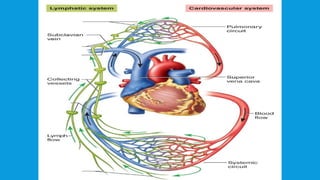
A Lymphatic system is also known as a sub- system of both CIRCULATORY
and IMMUNE system. Lymphatic system comprising a network of lymphatic
vessels that carry a clear fluids called lymph from the body directed towards
the heart.
The lymphatic system is a network of delicate tubes throughout the body. It
drains fluids that has leaked from the blood vessels into the tissues and
empties it back into the blood stream via the lymph nodes.
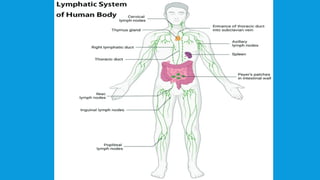
Various lymphoid organs are LYMPH NODES, THYMUS,SPLEEN, TONSILS.
Aggregations of lymphocytes are present in the gastrointestinal tract. Most of
the tissues contain lymphatics except BRAIN, SPINAL CORD, EYE AND EAR.
Lymphatic system helps in protect the body against infection, maintain fluid
LYMPH AND LYMPHATIC VESSELS.
LYMPH is a fluid that flows through the lymphatic system. Lymph is
generally blood plasma, which is a fluid component of blood.
Lymph is composed of interstitial fluid with variables amount of
lymphocytes, bacteria, cellular debris, plasma proteins and other cells.
The composition of lymph is similar to that of plasma but the constituents
have some additional substances that are too large to pass through blood
capillary walls.
LYMPHATIC VESSELS.
LYMPHATIC VESSELS are part of body’s lymphatic system. Lymphatic
vessels are tube-like structures that carry fluid away from the tissues and
deliver it back to the blood circulation. Unless blood vessels that circulate
blood in a continuous, closed-loop system, lymphatics carry fluids in one
direction.
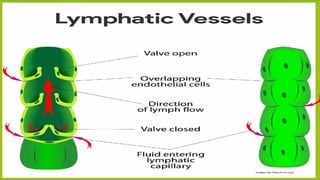
Lymph vessels have numerous cup shaped valves made up of overlapping cells
this arrangement help to prevent back flow of lymph in vessels.
lymphatic pathway begins with lymphatic capillaries, the smallest
type of vessel.. Lymphatic capillaries merge to form larger lymphatic vessels
known as
1) The thoracic duct
2) the right lymphatic duct
FUNCTIONS
1. FLUID BALANCE : As blood circulates, fluid leaks out of blood capillaries
and surrounds tissue cells. The fluid located around the cells is called
interstitial fluid. Most fluid flows back to the blood stream, but some is left
behind. The remaining fluids is taken up by the lymphatic capillaries and is
now referred to as lymph. The lymphatic system transport back the lymph
to the blood circulation thus prevent complication like edema, and helps to
maintain blood pressure.
2. FAT ABSORBTION : The absorption of nutrients from the digestive track
happens in the small intestine. The lining of the intestine is covered with
hair like projection known as the villi, in the centre of each villus there is
lymphatic capillaries, these capillaries help in absorbing fats and vitamins
and make their way to the lymphatic system.
3. IMMUNE FUNCTIONS : As lymph travels through the lymphatic
pathway. It passes through structure called lymph nodes. Lymph nodes are
responsible for filtering the lymph and killing any microorganisms or
LYMPH NODES.
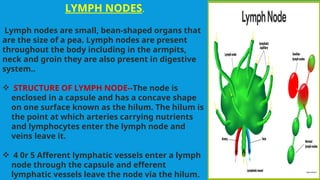
Lymph nodes are small, bean-shaped organs that
are the size of a pea. Lymph nodes are present
throughout the body including in the armpits,
neck and groin they are also present in digestive
system..
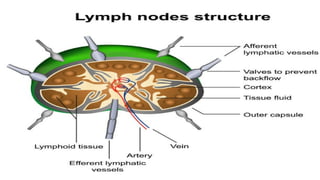
 STRUCTURE OF LYMPH NODE--The node is
enclosed in a capsule and has a concave shape
on one surface known as the hilum. The hilum is
the point at which arteries carrying nutrients
and lymphocytes enter the lymph node and
veins leave it.
 4 0r 5 Afferent lymphatic vessels enter a lymph
node through the capsule and efferent
lymphatic vessels leave the node via the hilum.
Function of lymph node
Lymph nodes works as a filter of foreign substances and they contain
lymphocytes that fight against infection such as germs that are carried in
through the lymph fluid
• Organic materials are destroyed by macrophages and antibodies
• Insoluble particles are engulfed by the macrophages
THYMUS.
STRUCTURE OF THYMUS
The thymus gland is a soft bilobed lymphatic gland, The two lobes are
surrounded by a capsule and broken down into lobules these lobules has an
outer cortex occupied by immature T-cells and a medulla occupied by matured
T-cells. It is usually pinkish-grey in color. The thymus gland is about 15grm in
babies and grow up as age and reach its maximum in puberty, and began to
shrink in older adults and its largely replaced with fat.
Thymus LOCATION
Anterior – Sternum
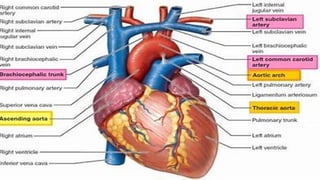
Posterior – Arch of aorta
Lateral – lungs enclosed in pleura in both sides
FUNCTION OF THYMUS
1. Development and maturation of T-cell. ( T- cells are the cells that are mature
in thymus cell these cells are the direct fighters of foreign invaders)
2. Produce hormones like thymosin to program lymphocytes
3. Act as a school of T- cells as it teach the lymphocytes to differentiate the
body’s own and allied immune cells.
TONSILS.
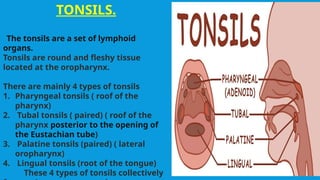
The tonsils are a set of lymphoid
organs.
Tonsils are round and fleshy tissue
located at the oropharynx.
There are mainly 4 types of tonsils
1. Pharyngeal tonsils ( roof of the
pharynx)
2. Tubal tonsils ( paired) ( roof of the
pharynx posterior to the opening of
the Eustachian tube)
3. Palatine tonsils (paired) ( lateral
oropharynx)
4. Lingual tonsils (root of the tongue)
These 4 types of tonsils collectively
Waldeyer’s
Ring
FUNCTION OF TONSIL
The main function of tonsils is to fight against infection. Tonsils contain a lot
of WBC which helps in kill germs or CATCH germs that enter the body from the
nose or mouth.
SPLEEN.
A spleen is a largest lymphoid organs, it is usually soft and highly vascular, it is
dark purple in color.
-Spleen is 12cm in length, 7cm wide and 3cm deep and weight about 200grm.
-Spleen is the only lymphatic organ that filter blood.
-Splenic artery supply oxygenated blood to the spleen
• A spleen is covered by an outer cover known as the capsule and the
connective tissue which is present in the capsule extent itself toward the
parenchymal of the spleen known as TRABECULAE
• the spleen is made up of two tissue
1. Red pulp- it is made up of connective tissue and splenic sinuses filled with
blood. this make up 76 -79 % of the spleen, it is made up of blood cells
including platelets, plasma and red blood cells. Usually help in filtration of
blood.
2. White pulp – make up of 25% of splenic tissue, this is made up of just
lymphocytes, these lymphocytes transform into plasma cells and produce
antibodies and immunoglobulin.
cont..
The interior surface of a spleen is
divided into a VISCERAL SURFACE
and DIAPHRAMATIC SURFACE.
Visceral surface is the one that
touches the abdomen, it is irregular
and concave
The diaphragmatic surface is the
area that touches the diaphragm
and the rib cage, it is smooth and
convex.
Location.
The spleen is located in between the 9th
, 10th
and
11th
rib cage
Anterior- fundus of stomach
Superior- diaphragm
Inferior- large intestine
Medially- pancreas, left kidney.
FUNCTION.
1. PHAGOCYTOSIS- The spleen help in removed debris,
old and unhealthy RBC’s and microorganisms,
therefore filtering the blood.
2. STORAGE OF BLOOD- the spleen contain upto 350ml
of blood and return back to the circulatory system in
case of trauma
3. IMMUNE RESPONSE – spleen contain both B- cells
and T-cells which helps to fight against infection
4. ERYTHROPOIESIS- formation of RBC’s in fetal life

Lymphatic system ppt[1].pptx .

  • 1.
  • 4.
    INTRODUCTION. A Lymphatic systemis also known as a sub- system of both CIRCULATORY and IMMUNE system. Lymphatic system comprising a network of lymphatic vessels that carry a clear fluids called lymph from the body directed towards the heart. The lymphatic system is a network of delicate tubes throughout the body. It drains fluids that has leaked from the blood vessels into the tissues and empties it back into the blood stream via the lymph nodes. Various lymphoid organs are LYMPH NODES, THYMUS,SPLEEN, TONSILS. Aggregations of lymphocytes are present in the gastrointestinal tract. Most of the tissues contain lymphatics except BRAIN, SPINAL CORD, EYE AND EAR. Lymphatic system helps in protect the body against infection, maintain fluid
  • 5.
    LYMPH AND LYMPHATICVESSELS. LYMPH is a fluid that flows through the lymphatic system. Lymph is generally blood plasma, which is a fluid component of blood. Lymph is composed of interstitial fluid with variables amount of lymphocytes, bacteria, cellular debris, plasma proteins and other cells. The composition of lymph is similar to that of plasma but the constituents have some additional substances that are too large to pass through blood capillary walls.
  • 6.
    LYMPHATIC VESSELS. LYMPHATIC VESSELSare part of body’s lymphatic system. Lymphatic vessels are tube-like structures that carry fluid away from the tissues and deliver it back to the blood circulation. Unless blood vessels that circulate blood in a continuous, closed-loop system, lymphatics carry fluids in one direction. Lymph vessels have numerous cup shaped valves made up of overlapping cells this arrangement help to prevent back flow of lymph in vessels. lymphatic pathway begins with lymphatic capillaries, the smallest type of vessel.. Lymphatic capillaries merge to form larger lymphatic vessels known as 1) The thoracic duct 2) the right lymphatic duct
  • 9.
    FUNCTIONS 1. FLUID BALANCE: As blood circulates, fluid leaks out of blood capillaries and surrounds tissue cells. The fluid located around the cells is called interstitial fluid. Most fluid flows back to the blood stream, but some is left behind. The remaining fluids is taken up by the lymphatic capillaries and is now referred to as lymph. The lymphatic system transport back the lymph to the blood circulation thus prevent complication like edema, and helps to maintain blood pressure. 2. FAT ABSORBTION : The absorption of nutrients from the digestive track happens in the small intestine. The lining of the intestine is covered with hair like projection known as the villi, in the centre of each villus there is lymphatic capillaries, these capillaries help in absorbing fats and vitamins and make their way to the lymphatic system. 3. IMMUNE FUNCTIONS : As lymph travels through the lymphatic pathway. It passes through structure called lymph nodes. Lymph nodes are responsible for filtering the lymph and killing any microorganisms or
  • 10.
    LYMPH NODES. Lymph nodesare small, bean-shaped organs that are the size of a pea. Lymph nodes are present throughout the body including in the armpits, neck and groin they are also present in digestive system..  STRUCTURE OF LYMPH NODE--The node is enclosed in a capsule and has a concave shape on one surface known as the hilum. The hilum is the point at which arteries carrying nutrients and lymphocytes enter the lymph node and veins leave it.  4 0r 5 Afferent lymphatic vessels enter a lymph node through the capsule and efferent lymphatic vessels leave the node via the hilum.
  • 12.
    Function of lymphnode Lymph nodes works as a filter of foreign substances and they contain lymphocytes that fight against infection such as germs that are carried in through the lymph fluid • Organic materials are destroyed by macrophages and antibodies • Insoluble particles are engulfed by the macrophages
  • 14.
    THYMUS. STRUCTURE OF THYMUS Thethymus gland is a soft bilobed lymphatic gland, The two lobes are surrounded by a capsule and broken down into lobules these lobules has an outer cortex occupied by immature T-cells and a medulla occupied by matured T-cells. It is usually pinkish-grey in color. The thymus gland is about 15grm in babies and grow up as age and reach its maximum in puberty, and began to shrink in older adults and its largely replaced with fat. Thymus LOCATION Anterior – Sternum Posterior – Arch of aorta Lateral – lungs enclosed in pleura in both sides
  • 17.
    FUNCTION OF THYMUS 1.Development and maturation of T-cell. ( T- cells are the cells that are mature in thymus cell these cells are the direct fighters of foreign invaders) 2. Produce hormones like thymosin to program lymphocytes 3. Act as a school of T- cells as it teach the lymphocytes to differentiate the body’s own and allied immune cells.
  • 18.
    TONSILS. The tonsils area set of lymphoid organs. Tonsils are round and fleshy tissue located at the oropharynx. There are mainly 4 types of tonsils 1. Pharyngeal tonsils ( roof of the pharynx) 2. Tubal tonsils ( paired) ( roof of the pharynx posterior to the opening of the Eustachian tube) 3. Palatine tonsils (paired) ( lateral oropharynx) 4. Lingual tonsils (root of the tongue) These 4 types of tonsils collectively
  • 19.
  • 20.
    FUNCTION OF TONSIL Themain function of tonsils is to fight against infection. Tonsils contain a lot of WBC which helps in kill germs or CATCH germs that enter the body from the nose or mouth.
  • 21.
    SPLEEN. A spleen isa largest lymphoid organs, it is usually soft and highly vascular, it is dark purple in color. -Spleen is 12cm in length, 7cm wide and 3cm deep and weight about 200grm. -Spleen is the only lymphatic organ that filter blood. -Splenic artery supply oxygenated blood to the spleen • A spleen is covered by an outer cover known as the capsule and the connective tissue which is present in the capsule extent itself toward the parenchymal of the spleen known as TRABECULAE • the spleen is made up of two tissue 1. Red pulp- it is made up of connective tissue and splenic sinuses filled with blood. this make up 76 -79 % of the spleen, it is made up of blood cells including platelets, plasma and red blood cells. Usually help in filtration of blood. 2. White pulp – make up of 25% of splenic tissue, this is made up of just lymphocytes, these lymphocytes transform into plasma cells and produce antibodies and immunoglobulin.
  • 22.
    cont.. The interior surfaceof a spleen is divided into a VISCERAL SURFACE and DIAPHRAMATIC SURFACE. Visceral surface is the one that touches the abdomen, it is irregular and concave The diaphragmatic surface is the area that touches the diaphragm and the rib cage, it is smooth and convex.
  • 24.
    Location. The spleen islocated in between the 9th , 10th and 11th rib cage Anterior- fundus of stomach Superior- diaphragm Inferior- large intestine Medially- pancreas, left kidney. FUNCTION. 1. PHAGOCYTOSIS- The spleen help in removed debris, old and unhealthy RBC’s and microorganisms, therefore filtering the blood. 2. STORAGE OF BLOOD- the spleen contain upto 350ml of blood and return back to the circulatory system in case of trauma 3. IMMUNE RESPONSE – spleen contain both B- cells and T-cells which helps to fight against infection 4. ERYTHROPOIESIS- formation of RBC’s in fetal life