BLOOD
BLOOD
INTRODUCTION
Blood is fluid connective tissue.
It circulates continually around the body, allowing
constant communication between tissues distant
from other.
It is composed of :
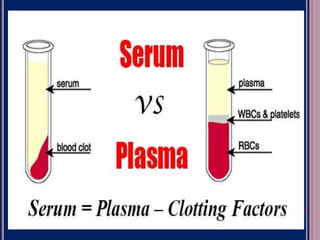
Clear, straw coloured , watery fluid called plasma,
in which several blood cells are suspended.
 blood is consists of 55% of plasma & 45% of blood
cells.
 Blood makes 7% of body weight & about 5-6 litres
in adult.
 Blood is composed of plasma and blood cells.
 Blood cells are
 Red blood cells( erythrocytes)
 White blood cells(thrombocytes)
 Platelets(leuckocytes)
PLASMA:
 Plasma constitutes: water (90-92%) and dissolved
and suspended substances, including:
 Plasma portions
 Inorganic salts
 Nutrients
 Waste materials
 Hormones
 gases
PLASMA PROTEINS:
 Which make up about 7 % of plasma are
normally retained within the blood.
 They are responsible for creating osmotic
pressure.
 Albumins: this are most plasma proteins in blood
and their main function is to maintain normal
plasma osmotic pressure.
 Globulin:
 Main functions are:
 Act as antibodies, immunoglobulin which are
complete proteins produce by lymphocytes that
play an important role in immunity. E.g. Ig G,
Ig M
 Transportation of some hormones and mineral
salts
 Inhibition of some proteolytic enzymes
(eg.Trypsin).
 Clotting factors:
 Responsible for blood coagulations.
 Electrolytes:
 Ca2+, Na+, K+
 Main functions:
 Calcium: muscle contraction
 Calcium and sodium: transmission of nerve
 Maintenance of blood pH and acid base balance
 Blood pH is 7.35-7.45.
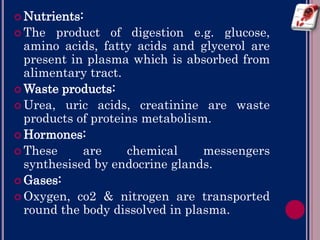
 Nutrients:
 The product of digestion e.g. glucose,
amino acids, fatty acids and glycerol are
present in plasma which is absorbed from
alimentary tract.
 Waste products:
 Urea, uric acids, creatinine are waste
products of proteins metabolism.
 Hormones:
 These are chemical messengers
synthesised by endocrine glands.
 Gases:
 Oxygen, co2 & nitrogen are transported
round the body dissolved in plasma.
BLOOD CELLS
 There are three types of blood cells.
 1. erythrocytes –RBC
 2. thrombocytes – platelets
 3. leukocytes - WBC
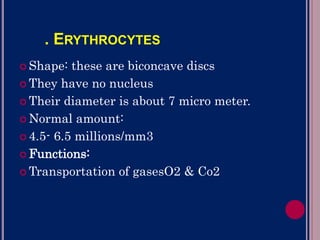
1. ERYTHROCYTES –RED BLOOD CELLS
 Shape: these are biconcave discs
 They have no nucleus
 Their diameter is about 7 micro meter.
 Normal amount:
 4.5- 6.5 millions/mm3
 Functions:
 Transportation of gasesO2 & Co2
HAEMOGLOBIN
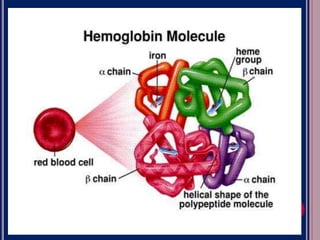
 It is large, complex protein containing a globin(
protein) and a pigmented iron containing
complex called haem.
 Each haemoglobin molecule contains four globin
chains and four haem units.
 Each Hb molecule can carry up to four
molecules of oxygen.
 An average RBCs carries 280 millions Hb,
which carries billions of O2.
 Normal amount of Hb in blood it is
 Male: 13-18 mg/dl
 Female: 12-16 mg/dl
ERYTHROPOIESIS:
 The process of development of RBCs from stem
cells is called erythropoiesis , it takes 7 days.
Haemolysis( break down of RBC) occurs in
spleen , bone marrow, liver.
 Erythrocytes are produced in red bone marrow
which is present in the ends of long bones and
in flat and irregular bones.
 Their life span in blood circulation is about 120
days.
 Vitamin B12 and folic acid is required for red
blood cell synthesis.
CONTROL OF ERYTHROPOIESIS:
 The hormone that regulates red blood cell
production is erythropoietin, produced by
mainly kidney.
 Hypoxia increases erythrocytye formation
by stimulatating erythopoietin production.
 Erythropoietin stimulates increase in
production of proerythoblasts.
 And release of increased number of
reticulocytes into the blood.
 It also speed up RBC maturation .
 When the tissue hypoxia is overcome,
erythropoietin production declines.
DESTRUCTION OF RBC
 Haemolysis is carried out by phagocytic
reticuloendothelium cells. These cells are found in
mainly liver, bone marrow and spleen.
 By haemolysis iron is released and retained in to
body to reuse in the bone marrow.
 The other part of haemoglobin completely reused to
the yellow pigment bilirubin and transported to the
liver.
 In liver it changed from fat soluble to water soluble
and excreted as constituent of bile.
2. LEUKOCYTES: ( WHITE BLOOD CELLS)
 Leukocytes are largest blood cells but they
account for only about 1 % of the blood
volume.
 They contains nuclei & some have granules in
their cytoplasm.
 There are main two types:
 1. granulocytes- neutrophils, eosinophil and
basophils
 2. agreanulocytes- monocytes and
lymphocytes
 Rising white cells numbers in the blood
stream usually indicate physiological
problem, e.g. infection, trauma
NEUTROPHILS:
 These small, fast and active scavegers (person
who search and collect discarded
items)protect the body against bacteria and
remove dead cells and debris from damaged
tissues.
 Neutrophils are highly mobile and squeeze
through the capillary walls in the affected
area by diapedesis (passage of blood cells
through the intact blood vessels).
 Having nuclei,complex with granules,
lysosomes containing enzymes.
 Normal value: 40-75%
 Neutrophils live on average 6-9 hours in the
blood stream.
EOSINOPHIL:
 Less active then neutrophils
 They are equipped with certain toxic chemicals,
stored in their granules, which they release when
the eosinophil binds to an infecting organism.
 Normal value: 1-6%
BASOPHILS:
 It contains cytoplasmic granules packed
with heparin ( anti coagulant), histamine (
inflammatory agent) and other substance
that promote inflammation.
 Normal value < 1 %
AGRANULOCYTES:
The monocytes and lymphocytes make
up 25 – 50% of the total leukocytes
count.
Monocytes:
These are the largest of the white blood
cells & develops into macrophages
which produces interleukin 1.
Stimulates the production of some
globulins by the liver
 Enhances the production of activated T
lymphocytes.
 Normal value: 2-10 %
MONOCYTES MACROPHAGES SYSTEM:
 This is also known as reticulo- endothelial system.
 It consist of the body’s complement of monocytes &
macrophages.
 They are actively phagocytic( big eater).
 Collections of fixed macrophages include:
 Synovial cells in joint
 Langerhans cells in skin
 Hepatic macrophages( kupffer cells) in liver
 Alveolar macrophages in lungs
LYMPHOCYTES:
 Lymphocytes are smaller than monocytes and have
large nuclei.
 It will be present & circulate as lymphatic tissue
such as lymph nodes & spleen.
 There are two types of lymphocytes
 T - lymphocytes
 B- lymphocytes
 Normal value: 20-50%
PLATELETS ( THROMBOCYTES)
 These are very small discs, 2-4 um in diameter,
derived from the cytoplasm of megakaryocytes in
red bone marrow.
 It contains variety of substances that promote blood
clotting, which causes haemostasis.
 Normal value: 2-3.5 lacs/mm3
 Life spans of platelets is between 8-11 days.
BLOOD CLOTTING( HAEMOSTASIS)
 When blood vessel is damaged , loss of blood is
stopped and healing occurs in a series of
overlapping processes in which platelets play a vital
part.
 Quickly after 15 seconds of bleeding, coagulation
process will begins.
1. vasoconstriction:
When bleeding occurs
Platelet will comes in contact with blood vessels
Blood vessels secrets serotonin
Which causes vasoconstriction( narrowing of blood
vessels)
2. platelets plug formation
 the adherent platelets clumps to each and
release other substance including
adenosine diphosphate (ADP) , which
attract more platelets to the site.
 Passing platelets stick to those already at
the damaged vessels and release chemicals
 Quickly platelets arrives that sites and
temporary seal the platelet plug.
 Platelets plug formation usually complete by
6 minutes after injury.
3. coagulation (blood clotting)
 This is complex process that also involves feedback
system & only few stages are included here.
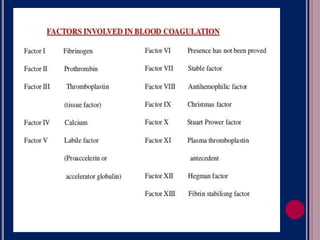
 Blood clotting factors:
I- fibrinogen
II- prothrombin
III- tissue factors ( thromboplastin)
IV- calcium
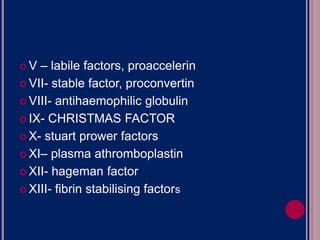
 V – labile factors, proaccelerin
 VII- stable factor, proconvertin
 VIII- antihaemophilic globulin
 IX- CHRISTMAS FACTOR
 X- stuart prower factors
 XI– plasma athromboplastin
 XII- hageman factor
 XIII- fibrin stabilising factors
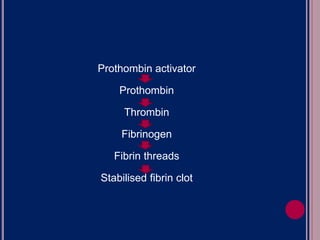
Prothombin activator
Prothombin
Thrombin
Fibrinogen
Fibrin threads
Stabilised fibrin clot
4. FIBRINOLYSIS
 After clot formation , the clot has to be removed
 Breakdown of the fibrin clots are known as
fibrinolysis.
plasminogen present in clot
Activators convert it into plasmin
Plasmin initiates the breakdown of fibrin to
soluble products that are treated as waste
material and removed by phagocytosis
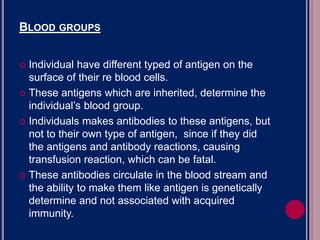
BLOOD GROUPS
BLOOD GROUPS
 Individual have different typed of antigen on the
surface of their re blood cells.
 These antigens which are inherited, determine the
individual’s blood group.
 Individuals makes antibodies to these antigens, but
not to their own type of antigen, since if they did
the antigens and antibody reactions, causing
transfusion reaction, which can be fatal.
 These antibodies circulate in the blood stream and
the ability to make them like antigen is genetically
determine and not associated with acquired
immunity.
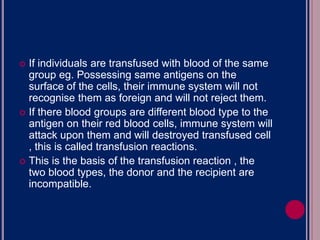
 If individuals are transfused with blood of the same
group eg. Possessing same antigens on the
surface of the cells, their immune system will not
recognise them as foreign and will not reject them.
 If there blood groups are different blood type to the
antigen on their red blood cells, immune system will
attack upon them and will destroyed transfused cell
, this is called transfusion reactions.
 This is the basis of the transfusion reaction , the
two blood types, the donor and the recipient are
incompatible.
 There are different collections of red surface
antigens but the most important are the ABO and
the Rhesus systems.

1. THE ABO SYSTEM:
 About 55% of the population has either A type
antigens( blood group A) , B type antigens (blood
group B) or both blood group AB on their red blood
cells.
 The remaining 45% have neither A nor B type
antigens( blood group O) . The corresponding
antibodies are called anti A and anti –B.
 Blood group -A individuals cannot make anti –A,
they make anti B antibody. Blood group B
individuals make only anti A. blood group AB make
neither and blood group O make both anti A and
anti B.
 Because blood group And people make neither anti
A nor anti B antibodies they are knows as universal
recipient.
 Group O people have neither A AND B antigens on
their red cells membranes and their blood may
safety transfused into A,B, AB OR O is known as
universal donor.
 Therefore prior to transfusion blood group cross
matching is still required to ensure that there is no
reaction between donor and recipient bloods.
RHESUS SYSTEM:
 The red blood cell membrane antigen important
here is the rhesus antigen factor. About 85% of
people have this antigen, they are rhesus positive
RH + and do not make therefore anti rhesus
antibodies.
 Remaining 15% have no rhesus antigen they are
rhesus negative RH – Antibodies.
Blood

Blood

  • 1.
  • 2.
    INTRODUCTION Blood is fluidconnective tissue. It circulates continually around the body, allowing constant communication between tissues distant from other. It is composed of : Clear, straw coloured , watery fluid called plasma, in which several blood cells are suspended.
  • 3.
     blood isconsists of 55% of plasma & 45% of blood cells.  Blood makes 7% of body weight & about 5-6 litres in adult.  Blood is composed of plasma and blood cells.
  • 5.
     Blood cellsare  Red blood cells( erythrocytes)  White blood cells(thrombocytes)  Platelets(leuckocytes)
  • 6.
    PLASMA:  Plasma constitutes:water (90-92%) and dissolved and suspended substances, including:  Plasma portions  Inorganic salts  Nutrients  Waste materials  Hormones  gases
  • 7.
    PLASMA PROTEINS:  Whichmake up about 7 % of plasma are normally retained within the blood.  They are responsible for creating osmotic pressure.  Albumins: this are most plasma proteins in blood and their main function is to maintain normal plasma osmotic pressure.
  • 8.
     Globulin:  Mainfunctions are:  Act as antibodies, immunoglobulin which are complete proteins produce by lymphocytes that play an important role in immunity. E.g. Ig G, Ig M  Transportation of some hormones and mineral salts  Inhibition of some proteolytic enzymes (eg.Trypsin).  Clotting factors:  Responsible for blood coagulations.
  • 10.
     Electrolytes:  Ca2+,Na+, K+  Main functions:  Calcium: muscle contraction  Calcium and sodium: transmission of nerve  Maintenance of blood pH and acid base balance  Blood pH is 7.35-7.45.
  • 11.
     Nutrients:  Theproduct of digestion e.g. glucose, amino acids, fatty acids and glycerol are present in plasma which is absorbed from alimentary tract.  Waste products:  Urea, uric acids, creatinine are waste products of proteins metabolism.  Hormones:  These are chemical messengers synthesised by endocrine glands.  Gases:  Oxygen, co2 & nitrogen are transported round the body dissolved in plasma.
  • 13.
    BLOOD CELLS  Thereare three types of blood cells.  1. erythrocytes –RBC  2. thrombocytes – platelets  3. leukocytes - WBC
  • 14.
    1. ERYTHROCYTES –REDBLOOD CELLS  Shape: these are biconcave discs  They have no nucleus  Their diameter is about 7 micro meter.  Normal amount:  4.5- 6.5 millions/mm3  Functions:  Transportation of gasesO2 & Co2
  • 15.
    HAEMOGLOBIN  It islarge, complex protein containing a globin( protein) and a pigmented iron containing complex called haem.  Each haemoglobin molecule contains four globin chains and four haem units.  Each Hb molecule can carry up to four molecules of oxygen.  An average RBCs carries 280 millions Hb, which carries billions of O2.  Normal amount of Hb in blood it is  Male: 13-18 mg/dl  Female: 12-16 mg/dl
  • 17.
    ERYTHROPOIESIS:  The processof development of RBCs from stem cells is called erythropoiesis , it takes 7 days. Haemolysis( break down of RBC) occurs in spleen , bone marrow, liver.  Erythrocytes are produced in red bone marrow which is present in the ends of long bones and in flat and irregular bones.  Their life span in blood circulation is about 120 days.  Vitamin B12 and folic acid is required for red blood cell synthesis.
  • 18.
    CONTROL OF ERYTHROPOIESIS: The hormone that regulates red blood cell production is erythropoietin, produced by mainly kidney.  Hypoxia increases erythrocytye formation by stimulatating erythopoietin production.  Erythropoietin stimulates increase in production of proerythoblasts.  And release of increased number of reticulocytes into the blood.
  • 19.
     It alsospeed up RBC maturation .  When the tissue hypoxia is overcome, erythropoietin production declines.
  • 20.
    DESTRUCTION OF RBC Haemolysis is carried out by phagocytic reticuloendothelium cells. These cells are found in mainly liver, bone marrow and spleen.  By haemolysis iron is released and retained in to body to reuse in the bone marrow.  The other part of haemoglobin completely reused to the yellow pigment bilirubin and transported to the liver.  In liver it changed from fat soluble to water soluble and excreted as constituent of bile.
  • 21.
    2. LEUKOCYTES: (WHITE BLOOD CELLS)  Leukocytes are largest blood cells but they account for only about 1 % of the blood volume.  They contains nuclei & some have granules in their cytoplasm.  There are main two types:  1. granulocytes- neutrophils, eosinophil and basophils  2. agreanulocytes- monocytes and lymphocytes  Rising white cells numbers in the blood stream usually indicate physiological problem, e.g. infection, trauma
  • 24.
    NEUTROPHILS:  These small,fast and active scavegers (person who search and collect discarded items)protect the body against bacteria and remove dead cells and debris from damaged tissues.  Neutrophils are highly mobile and squeeze through the capillary walls in the affected area by diapedesis (passage of blood cells through the intact blood vessels).  Having nuclei,complex with granules, lysosomes containing enzymes.  Normal value: 40-75%  Neutrophils live on average 6-9 hours in the blood stream.
  • 25.
    EOSINOPHIL:  Less activethen neutrophils  They are equipped with certain toxic chemicals, stored in their granules, which they release when the eosinophil binds to an infecting organism.  Normal value: 1-6%
  • 26.
    BASOPHILS:  It containscytoplasmic granules packed with heparin ( anti coagulant), histamine ( inflammatory agent) and other substance that promote inflammation.  Normal value < 1 %
  • 28.
    AGRANULOCYTES: The monocytes andlymphocytes make up 25 – 50% of the total leukocytes count. Monocytes: These are the largest of the white blood cells & develops into macrophages which produces interleukin 1. Stimulates the production of some globulins by the liver
  • 29.
     Enhances theproduction of activated T lymphocytes.  Normal value: 2-10 %
  • 30.
    MONOCYTES MACROPHAGES SYSTEM: This is also known as reticulo- endothelial system.  It consist of the body’s complement of monocytes & macrophages.  They are actively phagocytic( big eater).  Collections of fixed macrophages include:  Synovial cells in joint  Langerhans cells in skin  Hepatic macrophages( kupffer cells) in liver  Alveolar macrophages in lungs
  • 31.
    LYMPHOCYTES:  Lymphocytes aresmaller than monocytes and have large nuclei.  It will be present & circulate as lymphatic tissue such as lymph nodes & spleen.  There are two types of lymphocytes  T - lymphocytes  B- lymphocytes  Normal value: 20-50%
  • 32.
    PLATELETS ( THROMBOCYTES) These are very small discs, 2-4 um in diameter, derived from the cytoplasm of megakaryocytes in red bone marrow.  It contains variety of substances that promote blood clotting, which causes haemostasis.  Normal value: 2-3.5 lacs/mm3  Life spans of platelets is between 8-11 days.
  • 33.
    BLOOD CLOTTING( HAEMOSTASIS) When blood vessel is damaged , loss of blood is stopped and healing occurs in a series of overlapping processes in which platelets play a vital part.  Quickly after 15 seconds of bleeding, coagulation process will begins.
  • 36.
    1. vasoconstriction: When bleedingoccurs Platelet will comes in contact with blood vessels Blood vessels secrets serotonin Which causes vasoconstriction( narrowing of blood vessels)
  • 38.
    2. platelets plugformation  the adherent platelets clumps to each and release other substance including adenosine diphosphate (ADP) , which attract more platelets to the site.  Passing platelets stick to those already at the damaged vessels and release chemicals  Quickly platelets arrives that sites and temporary seal the platelet plug.  Platelets plug formation usually complete by 6 minutes after injury.
  • 39.
    3. coagulation (bloodclotting)  This is complex process that also involves feedback system & only few stages are included here.  Blood clotting factors: I- fibrinogen II- prothrombin III- tissue factors ( thromboplastin) IV- calcium
  • 40.
     V –labile factors, proaccelerin  VII- stable factor, proconvertin  VIII- antihaemophilic globulin  IX- CHRISTMAS FACTOR  X- stuart prower factors  XI– plasma athromboplastin  XII- hageman factor  XIII- fibrin stabilising factors
  • 41.
  • 42.
    4. FIBRINOLYSIS  Afterclot formation , the clot has to be removed  Breakdown of the fibrin clots are known as fibrinolysis. plasminogen present in clot Activators convert it into plasmin Plasmin initiates the breakdown of fibrin to soluble products that are treated as waste material and removed by phagocytosis
  • 43.
    BLOOD GROUPS BLOOD GROUPS Individual have different typed of antigen on the surface of their re blood cells.  These antigens which are inherited, determine the individual’s blood group.  Individuals makes antibodies to these antigens, but not to their own type of antigen, since if they did the antigens and antibody reactions, causing transfusion reaction, which can be fatal.  These antibodies circulate in the blood stream and the ability to make them like antigen is genetically determine and not associated with acquired immunity.
  • 44.
     If individualsare transfused with blood of the same group eg. Possessing same antigens on the surface of the cells, their immune system will not recognise them as foreign and will not reject them.  If there blood groups are different blood type to the antigen on their red blood cells, immune system will attack upon them and will destroyed transfused cell , this is called transfusion reactions.  This is the basis of the transfusion reaction , the two blood types, the donor and the recipient are incompatible.
  • 45.
     There aredifferent collections of red surface antigens but the most important are the ABO and the Rhesus systems. 
  • 46.
    1. THE ABOSYSTEM:  About 55% of the population has either A type antigens( blood group A) , B type antigens (blood group B) or both blood group AB on their red blood cells.  The remaining 45% have neither A nor B type antigens( blood group O) . The corresponding antibodies are called anti A and anti –B.  Blood group -A individuals cannot make anti –A, they make anti B antibody. Blood group B individuals make only anti A. blood group AB make neither and blood group O make both anti A and anti B.
  • 47.
     Because bloodgroup And people make neither anti A nor anti B antibodies they are knows as universal recipient.  Group O people have neither A AND B antigens on their red cells membranes and their blood may safety transfused into A,B, AB OR O is known as universal donor.  Therefore prior to transfusion blood group cross matching is still required to ensure that there is no reaction between donor and recipient bloods.
  • 48.
    RHESUS SYSTEM:  Thered blood cell membrane antigen important here is the rhesus antigen factor. About 85% of people have this antigen, they are rhesus positive RH + and do not make therefore anti rhesus antibodies.  Remaining 15% have no rhesus antigen they are rhesus negative RH – Antibodies.