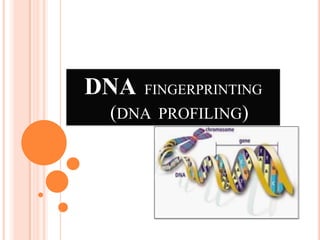
DNAFINGERPRINTING(DNA  PROFILING)
Table Of ContentIntroduction of DNA Fingerprinting.Stages involved.Principle of DNA Fingerprinting.4.	Importance of DNA Fingerprinting.5.	Diagram.DNA Profiling Process.Applications of DNA Fingerprinting.8.	Advantages and Disadvantages of DNA Fingerprinting.9.	Uses of DNA Fingerprinting.Benefits and limits of DNA Fingerprinting.DNA Fingerprinting in plants.12.Uses of DNA Fingerprinting in Forensic Science13.	Centers for DNA Fingerprinting.14.	Conclusion.
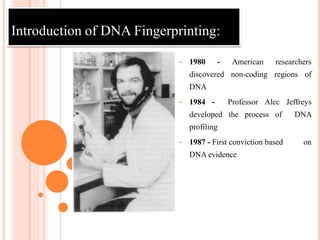
Introduction of DNA Fingerprinting:1980- American researchers  discovered non-coding regions of  DNA
1984-  Professor Alec Jeffreys developed the process of  DNA profiling
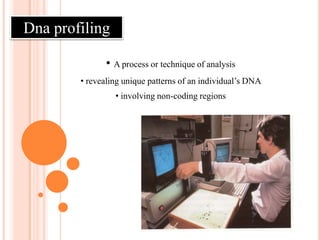
1987 - First conviction based          on DNA evidence Dna profilingA process or technique of analysis
 revealing unique patterns of an individual’s DNA
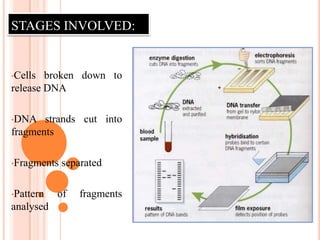
 involving non-coding regionsSTAGES INVOLVED:Cells broken down to release DNA
DNA strands cut into fragments
Fragments separated
Pattern of fragments analysedDNA  FINGERPRINTING( DNA  PROFILING )
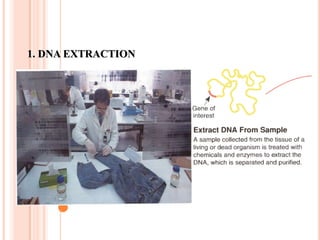
1. DNA EXTRACTION
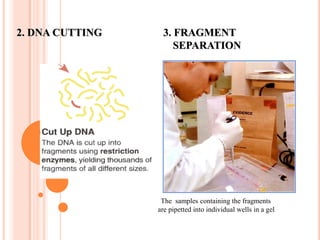
2. DNA CUTTING3. FRAGMENT SEPARATIONDNA  FINGERPRINTINGThe  samples containing the fragments are pipetted into individual wells in a gel
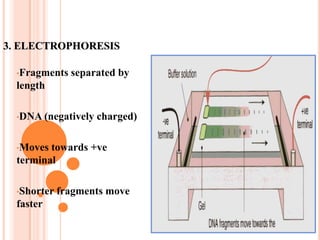
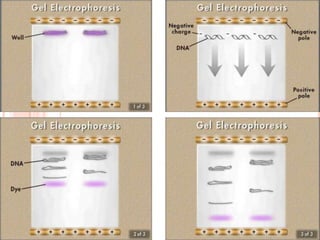
3. ELECTROPHORESISFragments separated by length
DNA (negatively charged)
Moves towards +ve terminal
Shorter fragments move fasterDNA  FINGERPRINTING
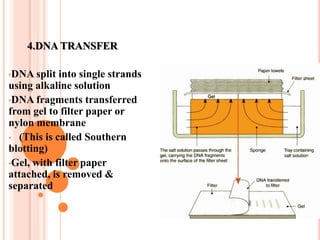
4.DNA TRANSFERDNA split into single strands using alkaline solution
DNA fragments transferred from gel to filter paper or nylon membrane
   (This is called Southern blotting)
Gel, with filter paper attached, is removed & separatedDNA  FINGERPRINTING
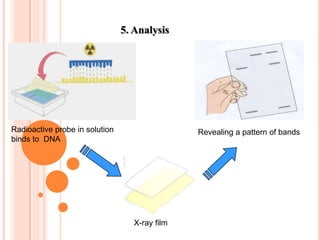
5. AnalysisRadioactive probe in solution binds to  DNARevealing a pattern of bandsX-ray film
Principle of DNA Fingerprinting:Base pairing of AT (AU) & GC is the BASIC PRINCIPLE of this procedure.
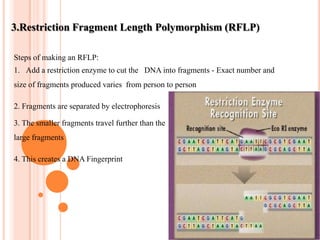
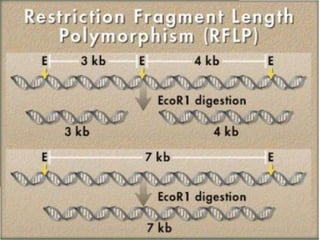
 Specificity of enzyme activity is the second CRUCIAL principle to understanding DNA fingerprinting. This refers to the cutting of DNA by specific RESTRICTION ENZYMES at UNIQUE palindrome sequences.
The recognition that a CHANGE in a SINGLE BASE PAIR (mutation) can either MAKE a restriction enzyme-site where one did not exist previously or it can REMOVEor ELIMINATE a restriction enzyme site from a gene. An analogy would be to "mutate" your phone number by one letter; callers would get a different person. DNA  FINGERPRINTING( DNA  PROFILING )
Importance of DNA Fingerprinting:1. LineageDNA fingerprinting can be used to figure out if two people are related which aids tremendulously in maternity or paternity tests to show that a person is a mother or father to a specific child. DNA fingerprinting can also be used to trace heritage back for generations. This means that not only can you figure out who your mother and father are, but also siblings, aunts, uncles, grandparents, great grandparents, and even further back. DNA fingerprinting has been able to show relations to people today with bone remnants of people that have been dead for centuries, when bones have been preserved.
2. Law EnforcementDNA fingerprinting has aided in law enforcement since its discovery. Forensics teams can analyze DNA found at a crime scene, whether it be blood, hair, semen, or skin particles, and compare it with DNA samples found in a DNA database to find out who committed a crime. DNA fingerprinting can also be used to identify a victim even if the person is disfigured beyond recognition and dental records cannot be established. DNA fingerprinting has been used to prove suspects guilty of a crime and has set innocent people free when earlier evidence has proven them guilty. DNA fingerprinting is not perfect and there is still much controversy over whether it can be used in a court of law, but regardless, it remains an essential part of our criminal justice system.DNA  FINGERPRINTING( DNA  PROFILING )
3. Personal IdentificationDNA fingerprinting has also been thought of as a future method of identification. The way it would work is that a sample of DNA could be analyzed on spot and compared to a database of specific DNA belonging to authorized personnel. While DNA is the ultimate bar code, it would be too expensive and impractical to use DNA fingerprinting for personal identification while other means of identification such as picture ID and social security numbers (although both can be faked) are available.DNA  FINGERPRINTING( DNA  PROFILING )
DNA Profiling Process:Variable Number Of Tandem Repeats(VNTRs)
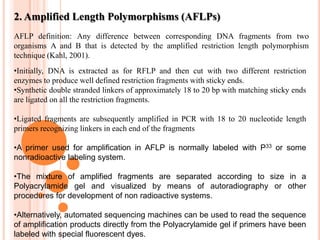
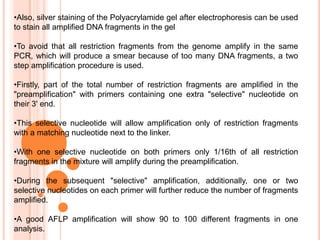
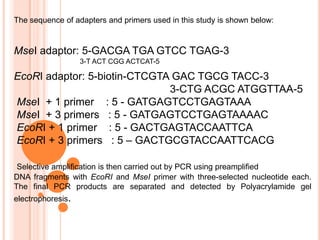
 Amplified Length Polymorphisms (AFLPs)
Restriction Fragment Length Polymorphism (RFLP)DNA  FINGERPRINTING( DNA  PROFILING )
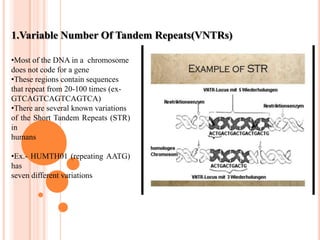
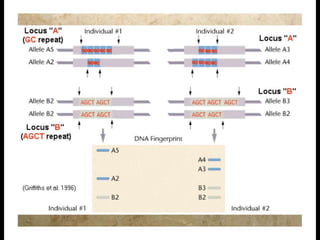
1.Variable Number Of Tandem Repeats(VNTRs)Most of the DNA in a  chromosome does not code for a gene These regions contain sequences that repeat from 20-100 times (ex- GTCAGTCAGTCAGTCA) There are several known variations of the Short Tandem Repeats (STR) in humans Ex.- HUMTH01 (repeating AATG) has seven different variationsDNA  FINGERPRINTING( DNA  PROFILING )
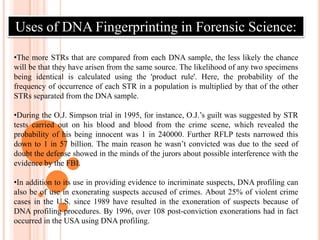
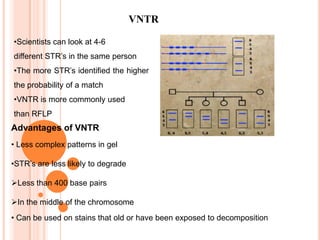
VNTRScientists can look at 4-6 different STR’s in the same person  The more STR’s identified the higher the probability of a match
VNTR is more commonly used than RFLPAdvantages of VNTR   Less complex patterns in gel
STR’s are less likely to degrade
Less than 400 base pairs
In the middle of the chromosome
 Can be used on stains that old or have been exposed to decompositionDNA  FINGERPRINTING( DNA  PROFILING )

DNA Fingerprinting

  • 1.
  • 2.
    Table Of ContentIntroductionof DNA Fingerprinting.Stages involved.Principle of DNA Fingerprinting.4. Importance of DNA Fingerprinting.5. Diagram.DNA Profiling Process.Applications of DNA Fingerprinting.8. Advantages and Disadvantages of DNA Fingerprinting.9. Uses of DNA Fingerprinting.Benefits and limits of DNA Fingerprinting.DNA Fingerprinting in plants.12.Uses of DNA Fingerprinting in Forensic Science13. Centers for DNA Fingerprinting.14. Conclusion.
  • 3.
    Introduction of DNAFingerprinting:1980- American researchers discovered non-coding regions of DNA
  • 4.
    1984- ProfessorAlec Jeffreys developed the process of DNA profiling
  • 5.
    1987 - Firstconviction based on DNA evidence Dna profilingA process or technique of analysis
  • 6.
    revealing uniquepatterns of an individual’s DNA
  • 7.
    involving non-codingregionsSTAGES INVOLVED:Cells broken down to release DNA
  • 8.
    DNA strands cutinto fragments
  • 9.
  • 10.
    Pattern of fragmentsanalysedDNA FINGERPRINTING( DNA PROFILING )
  • 11.
  • 12.
    2. DNA CUTTING3.FRAGMENT SEPARATIONDNA FINGERPRINTINGThe samples containing the fragments are pipetted into individual wells in a gel
  • 13.
  • 14.
  • 15.
  • 16.
    Shorter fragments movefasterDNA FINGERPRINTING
  • 17.
    4.DNA TRANSFERDNA splitinto single strands using alkaline solution
  • 18.
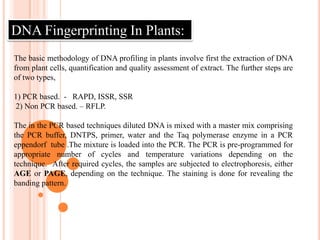
    DNA fragments transferredfrom gel to filter paper or nylon membrane
  • 19.
    (This is called Southern blotting)
  • 20.
    Gel, with filterpaper attached, is removed & separatedDNA FINGERPRINTING
  • 21.
    5. AnalysisRadioactive probein solution binds to DNARevealing a pattern of bandsX-ray film
  • 22.
    Principle of DNAFingerprinting:Base pairing of AT (AU) & GC is the BASIC PRINCIPLE of this procedure.
  • 23.
    Specificity ofenzyme activity is the second CRUCIAL principle to understanding DNA fingerprinting. This refers to the cutting of DNA by specific RESTRICTION ENZYMES at UNIQUE palindrome sequences.
  • 24.
    The recognition thata CHANGE in a SINGLE BASE PAIR (mutation) can either MAKE a restriction enzyme-site where one did not exist previously or it can REMOVEor ELIMINATE a restriction enzyme site from a gene. An analogy would be to "mutate" your phone number by one letter; callers would get a different person. DNA FINGERPRINTING( DNA PROFILING )
  • 25.
    Importance of DNAFingerprinting:1. LineageDNA fingerprinting can be used to figure out if two people are related which aids tremendulously in maternity or paternity tests to show that a person is a mother or father to a specific child. DNA fingerprinting can also be used to trace heritage back for generations. This means that not only can you figure out who your mother and father are, but also siblings, aunts, uncles, grandparents, great grandparents, and even further back. DNA fingerprinting has been able to show relations to people today with bone remnants of people that have been dead for centuries, when bones have been preserved.
  • 26.
    2. Law EnforcementDNAfingerprinting has aided in law enforcement since its discovery. Forensics teams can analyze DNA found at a crime scene, whether it be blood, hair, semen, or skin particles, and compare it with DNA samples found in a DNA database to find out who committed a crime. DNA fingerprinting can also be used to identify a victim even if the person is disfigured beyond recognition and dental records cannot be established. DNA fingerprinting has been used to prove suspects guilty of a crime and has set innocent people free when earlier evidence has proven them guilty. DNA fingerprinting is not perfect and there is still much controversy over whether it can be used in a court of law, but regardless, it remains an essential part of our criminal justice system.DNA FINGERPRINTING( DNA PROFILING )
  • 27.
    3. Personal IdentificationDNAfingerprinting has also been thought of as a future method of identification. The way it would work is that a sample of DNA could be analyzed on spot and compared to a database of specific DNA belonging to authorized personnel. While DNA is the ultimate bar code, it would be too expensive and impractical to use DNA fingerprinting for personal identification while other means of identification such as picture ID and social security numbers (although both can be faked) are available.DNA FINGERPRINTING( DNA PROFILING )
  • 28.
    DNA Profiling Process:VariableNumber Of Tandem Repeats(VNTRs)
  • 29.
    Amplified LengthPolymorphisms (AFLPs)
  • 30.
    Restriction Fragment LengthPolymorphism (RFLP)DNA FINGERPRINTING( DNA PROFILING )
  • 31.
    1.Variable Number OfTandem Repeats(VNTRs)Most of the DNA in a chromosome does not code for a gene These regions contain sequences that repeat from 20-100 times (ex- GTCAGTCAGTCAGTCA) There are several known variations of the Short Tandem Repeats (STR) in humans Ex.- HUMTH01 (repeating AATG) has seven different variationsDNA FINGERPRINTING( DNA PROFILING )
  • 32.
    VNTRScientists can lookat 4-6 different STR’s in the same person The more STR’s identified the higher the probability of a match
  • 33.
    VNTR is morecommonly used than RFLPAdvantages of VNTR Less complex patterns in gel
  • 34.
    STR’s are lesslikely to degrade
  • 35.
    Less than 400base pairs
  • 36.
    In the middleof the chromosome
  • 37.
    Can beused on stains that old or have been exposed to decompositionDNA FINGERPRINTING( DNA PROFILING )