JAWAHAR NAVODAYA VIDYALAYA
FATEHPUR
SESSION – 2022-23
BIOLOGY PROJECT WORK
SUBMITTED BY --- SUBMITTED TO ----
SUGHRA FATMA MRS.KALPNA SAGAR
ROLL NO. ___________ (P.G.T. BIOLOGY)
CLASS XII
BIODATA
NAME – SUGHRA FATMA
FATHER’S NAME – MR. SHAFIQ ALI
MOTHER’S NAME – MRS.RAZIA JAMAL
D.O.B. – 04/07/2006
SCHOOL – JAWAHAE NAVODAYA VIDYALAYA
FATEHPUR(U.P)
ROLL NO. - ________________
SESSION – 2022-23
CERTIFICATE
This is to certify that SUGHRA FATMA
“XIIth Science” has completed her project in
biology for academic year 2022-23 as per the
term and condition of CBSE syllabus. She has
perform the entire practical and project under
the guidance of Mrs. Kalpna Sagar (P.G.T
Biology)
Certified By-__________________
AIM
DNA
FINGERPRINTING
INDEX
SR. CONTENTS
1.
ACKNOWLEDGEMENT
2.
INTRODUCTION
3.
HISTORY OF DNA FINGERPRINTING
4. WHAT IS DNA FINGERPRINTING
5. DNA FINGERPRINTING TECHNOLOGY
6. BIOLOGICAL MATERIAL USED FOR
DNA FINGERPRINTING
7. STAGE OF DNA FINGERPRINTING
8. DNA fingerprinting: Methods
9. DNA FINGERPRINTING :
APPLICATIONS
10. CONCLUSION
ACKNOWLEDGEMENT
I AM THANKFUL TO MRS. KALPNA SAGAR
WHO PROVIDE ME AN INTRESTING PROJECT.
I AM INDEBTED TO FACULITY BY J.N.V.
FATEHPUR FOR IT’S CONTINUOS
SUPERVISION AND GUIDANCE DURING THE
PREPARATION OF MY PROJECT.
I AM ALSO THANKFUL TO MY FRIEND’S WHO
HAVE CO-OPERATED IN THE COMPLETION OF
THIS PROJECT.
IN THE LAST BUT NOT LEAST.
I AM THANKFUL TO MRS.NEETA UPADHYAY,
PRINCIPAL OF J.N.V. FATEHPUR FOR
PROVIDING ME ON REQUIRED FACILITIES
DURING THE PREPARATION OF MY PROJECT.
INTRODUCTION
The process of DNA fingerprinting was invented
by Alec Jeffreys at the University of Leicester
in 1985. He was knighted in 1994.
DNA fingerprinting or DNA profiling, any of
several similar techniques for analyzing and
comparing DNA from separate sources, used
especially in law enforcement to identify
suspects from hair, blood, semen, or other
biological materials found at the scene of a
violent crime. It depends on the fact that no two
people, save identical twins, have exactly the
same DNA sequence, and that although only
limited segments of a person's DNA are
scrutinized in the procedure, those segments
will be statistically unique.
HISTORY OF DNA FINGERPRINTING
Up to 1948, the only method of establishing and
authenticating personal identification was by
the fingerprint process.
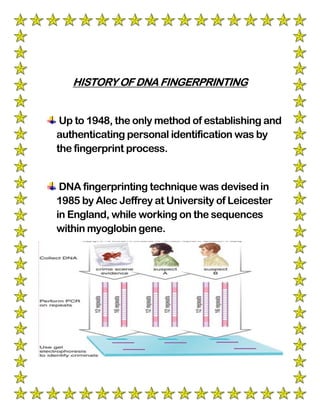
DNA fingerprinting technique was devised in
1985 by Alec Jeffrey at University of Leicester
in England, while working on the sequences
within myoglobin gene.
WHAT IS DNA FINGERPRINTING
It is a technique, by which an individual can be
identified at molecular level. With the
advancement of science and technology STR
analysis has become very popular in forensic
laboratories. Scientists have chosen repeating
sequences in the DNA, which are present in all
individuals on different chromosomes, and are
known to vary from individual to individual
except in identical twins. These are used as
genetic markers to identify the Individual.
DNA FINGERPRINTING TECHNOLOGY
DNA fingerprinting technology has made it
possible to identify the source of biological
samples found at scenes of crime. This will
resolve disputes of maternity/paternity,
identification of mutilated remains,
identification of rape/murder, identification of
missing child , exchange of babies in hospital
wards, forensic wildlife, protection of farmers
right and biodiversity. This remarkable
technology provides exclusion as well as
positive identification with virtually 100%
precision.
BIOLOGICAL MATERIAL USED FOR
DNA FINGERPRINTING
Blood
Hair
Saliva
Semen
Body tissue cells
DNA samples have been obtained from
vaginal cells transferred to the outside of a
condom during sexual intercourse
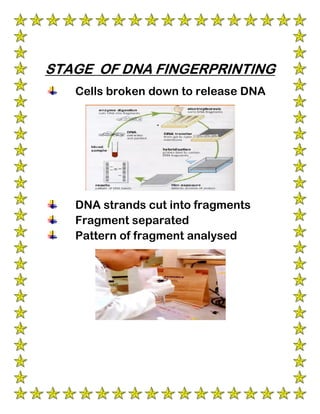
STAGE OF DNA FINGERPRINTING
Cells broken down to release DNA
DNA strands cut into fragments
Fragment separated
Pattern of fragment analysed
DNA fingerprinting: Methods
A common procedure for DNA fingerprinting is
restriction fragment length polymorphism (RFLP). In
this method, DNA is extracted from a sample and
cut into segments using special restriction enzymes.
RFLP focuses on contain sequences of repeated DNA
bases, which vary widely from person to
person. The segments are separated using a
laboratory technique called electrophoresis, which
sorts the fragments by length. The segments are
radioactively tagged to produce a visual pattern
known as an
autoradiograph, or DNA fingerprint, on X-
ray film. A newer method known as short
tandem repeats (STR) analyzes DNA segments for
the number of repeats at 13 specific DNA sites.
The chance of misidentification in this procedure is
one in several billion. Yet another
process, polymerase chain reaction, is used to
produce multiple copies of segments from a very
limited amount of DNA (as little as 50 molecules),
enabling a DNA fingerprint to be made from a single
hair. Once a sufficient sample has been produced, the
pattern of the alleles (see genetics) from a limited
number of genes is compared with the pattern from the
reference sample. A non match is conclusive, but the
technique provides less certainty when a match occurs
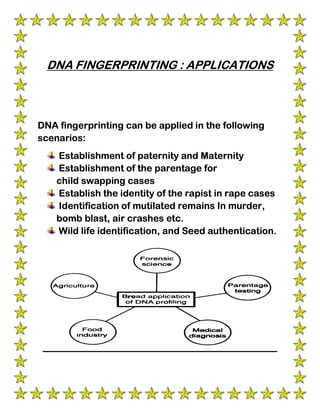
DNA FINGERPRINTING : APPLICATIONS
DNA fingerprinting can be applied in the following
scenarios:
Establishment of paternity and Maternity
Establishment of the parentage for
child swapping cases
Establish the identity of the rapist in rape cases
Identification of mutilated remains In murder,
bomb blast, air crashes etc.
Wild life identification, and Seed authentication.
CONCLUSION
In conclusion, while evidences can
be tampered with and witnesses can
turn hostile, DNA will never lie. It will
indeed, unravel the truth even
several decades after a crime has
been committed. Such are the
powers of DNA Fingerprinting.

dna fingerprinting.pdf

  • 1.
    JAWAHAR NAVODAYA VIDYALAYA FATEHPUR SESSION– 2022-23 BIOLOGY PROJECT WORK SUBMITTED BY --- SUBMITTED TO ---- SUGHRA FATMA MRS.KALPNA SAGAR ROLL NO. ___________ (P.G.T. BIOLOGY) CLASS XII
  • 2.
    BIODATA NAME – SUGHRAFATMA FATHER’S NAME – MR. SHAFIQ ALI MOTHER’S NAME – MRS.RAZIA JAMAL D.O.B. – 04/07/2006 SCHOOL – JAWAHAE NAVODAYA VIDYALAYA FATEHPUR(U.P) ROLL NO. - ________________ SESSION – 2022-23
  • 3.
    CERTIFICATE This is tocertify that SUGHRA FATMA “XIIth Science” has completed her project in biology for academic year 2022-23 as per the term and condition of CBSE syllabus. She has perform the entire practical and project under the guidance of Mrs. Kalpna Sagar (P.G.T Biology) Certified By-__________________
  • 4.
  • 5.
    INDEX SR. CONTENTS 1. ACKNOWLEDGEMENT 2. INTRODUCTION 3. HISTORY OFDNA FINGERPRINTING 4. WHAT IS DNA FINGERPRINTING 5. DNA FINGERPRINTING TECHNOLOGY 6. BIOLOGICAL MATERIAL USED FOR DNA FINGERPRINTING 7. STAGE OF DNA FINGERPRINTING 8. DNA fingerprinting: Methods 9. DNA FINGERPRINTING : APPLICATIONS 10. CONCLUSION
  • 6.
    ACKNOWLEDGEMENT I AM THANKFULTO MRS. KALPNA SAGAR WHO PROVIDE ME AN INTRESTING PROJECT. I AM INDEBTED TO FACULITY BY J.N.V. FATEHPUR FOR IT’S CONTINUOS SUPERVISION AND GUIDANCE DURING THE PREPARATION OF MY PROJECT. I AM ALSO THANKFUL TO MY FRIEND’S WHO HAVE CO-OPERATED IN THE COMPLETION OF THIS PROJECT. IN THE LAST BUT NOT LEAST. I AM THANKFUL TO MRS.NEETA UPADHYAY, PRINCIPAL OF J.N.V. FATEHPUR FOR PROVIDING ME ON REQUIRED FACILITIES DURING THE PREPARATION OF MY PROJECT.
  • 7.
    INTRODUCTION The process ofDNA fingerprinting was invented by Alec Jeffreys at the University of Leicester in 1985. He was knighted in 1994. DNA fingerprinting or DNA profiling, any of several similar techniques for analyzing and comparing DNA from separate sources, used especially in law enforcement to identify suspects from hair, blood, semen, or other biological materials found at the scene of a violent crime. It depends on the fact that no two people, save identical twins, have exactly the same DNA sequence, and that although only limited segments of a person's DNA are scrutinized in the procedure, those segments will be statistically unique.
  • 8.
    HISTORY OF DNAFINGERPRINTING Up to 1948, the only method of establishing and authenticating personal identification was by the fingerprint process. DNA fingerprinting technique was devised in 1985 by Alec Jeffrey at University of Leicester in England, while working on the sequences within myoglobin gene.
  • 9.
    WHAT IS DNAFINGERPRINTING It is a technique, by which an individual can be identified at molecular level. With the advancement of science and technology STR analysis has become very popular in forensic laboratories. Scientists have chosen repeating sequences in the DNA, which are present in all individuals on different chromosomes, and are known to vary from individual to individual except in identical twins. These are used as genetic markers to identify the Individual.
  • 10.
    DNA FINGERPRINTING TECHNOLOGY DNAfingerprinting technology has made it possible to identify the source of biological samples found at scenes of crime. This will resolve disputes of maternity/paternity, identification of mutilated remains, identification of rape/murder, identification of missing child , exchange of babies in hospital wards, forensic wildlife, protection of farmers right and biodiversity. This remarkable technology provides exclusion as well as positive identification with virtually 100% precision.
  • 11.
    BIOLOGICAL MATERIAL USEDFOR DNA FINGERPRINTING Blood Hair Saliva Semen Body tissue cells DNA samples have been obtained from vaginal cells transferred to the outside of a condom during sexual intercourse
  • 12.
    STAGE OF DNAFINGERPRINTING Cells broken down to release DNA DNA strands cut into fragments Fragment separated Pattern of fragment analysed
  • 13.
    DNA fingerprinting: Methods Acommon procedure for DNA fingerprinting is restriction fragment length polymorphism (RFLP). In this method, DNA is extracted from a sample and cut into segments using special restriction enzymes. RFLP focuses on contain sequences of repeated DNA bases, which vary widely from person to person. The segments are separated using a laboratory technique called electrophoresis, which sorts the fragments by length. The segments are radioactively tagged to produce a visual pattern known as an autoradiograph, or DNA fingerprint, on X- ray film. A newer method known as short tandem repeats (STR) analyzes DNA segments for the number of repeats at 13 specific DNA sites. The chance of misidentification in this procedure is one in several billion. Yet another process, polymerase chain reaction, is used to produce multiple copies of segments from a very limited amount of DNA (as little as 50 molecules), enabling a DNA fingerprint to be made from a single
  • 14.
    hair. Once asufficient sample has been produced, the pattern of the alleles (see genetics) from a limited number of genes is compared with the pattern from the reference sample. A non match is conclusive, but the technique provides less certainty when a match occurs
  • 15.
    DNA FINGERPRINTING :APPLICATIONS DNA fingerprinting can be applied in the following scenarios: Establishment of paternity and Maternity Establishment of the parentage for child swapping cases Establish the identity of the rapist in rape cases Identification of mutilated remains In murder, bomb blast, air crashes etc. Wild life identification, and Seed authentication.
  • 16.
    CONCLUSION In conclusion, whileevidences can be tampered with and witnesses can turn hostile, DNA will never lie. It will indeed, unravel the truth even several decades after a crime has been committed. Such are the powers of DNA Fingerprinting.