DNA Fingerprinting
What is DNA Fingerprinting?
• DNA fingerprints (DNA testing) identify living organisms at the molecular
level.
• DNA fragments show unique patterns from one person to the next.
• It is also called a DNA profile.
• Uses:
• Analysts use the DNA profile from potential suspects and compare it
against DNA found at a crime scene.
• DNA profiling for paternity tests. These days you can send a sample of DNA
and find out your ancestry to learn more about your origins. This is a very
conclusive test because DNA is specific to each individual (unless you are
an identical twin).
Human Genome
About 20% genes
(code for proteins)
About 80% junk
(code for nothing
or unknown…)
Highly repetitive
nucleotides
Random
nucleotides
Principle of DNA Fingerprinting
• The DNA of every human being on the planet is 99.9% same.
However, about 0.1% or 3 x 10⁶base pairs (out of 3 x 10⁹ bp) of
DNA is unique in every individual.
• Human genome possesses numerous small non-coding but
inheritable sequences of bases which are repeated many times.
They do not code for proteins but make-up 95% of our genetic
DNA and therefore called the ―junk DNA.
• They can be separated as satellite from the bulk DNA during
density gradient centrifugation and hence called satellite DNA.
• In satellite DNA, repetition of bases is in tandem. Depending
upon length, base composition and numbers of tandemly re-
petitive units, satellite DNAs have subcategories like
microsatellites and mini-satellites.
• Satellite DNAs show polymorphism. The term polymorphism is
used when a variant at a locus is present with a frequency of
more than 0.01 population.
• Variations occur due to mutations. These mutations in the non-
coding sequences have piled up with time and form the basis of
DNA polymorphism (variation at genetic level arises due to
mutations).
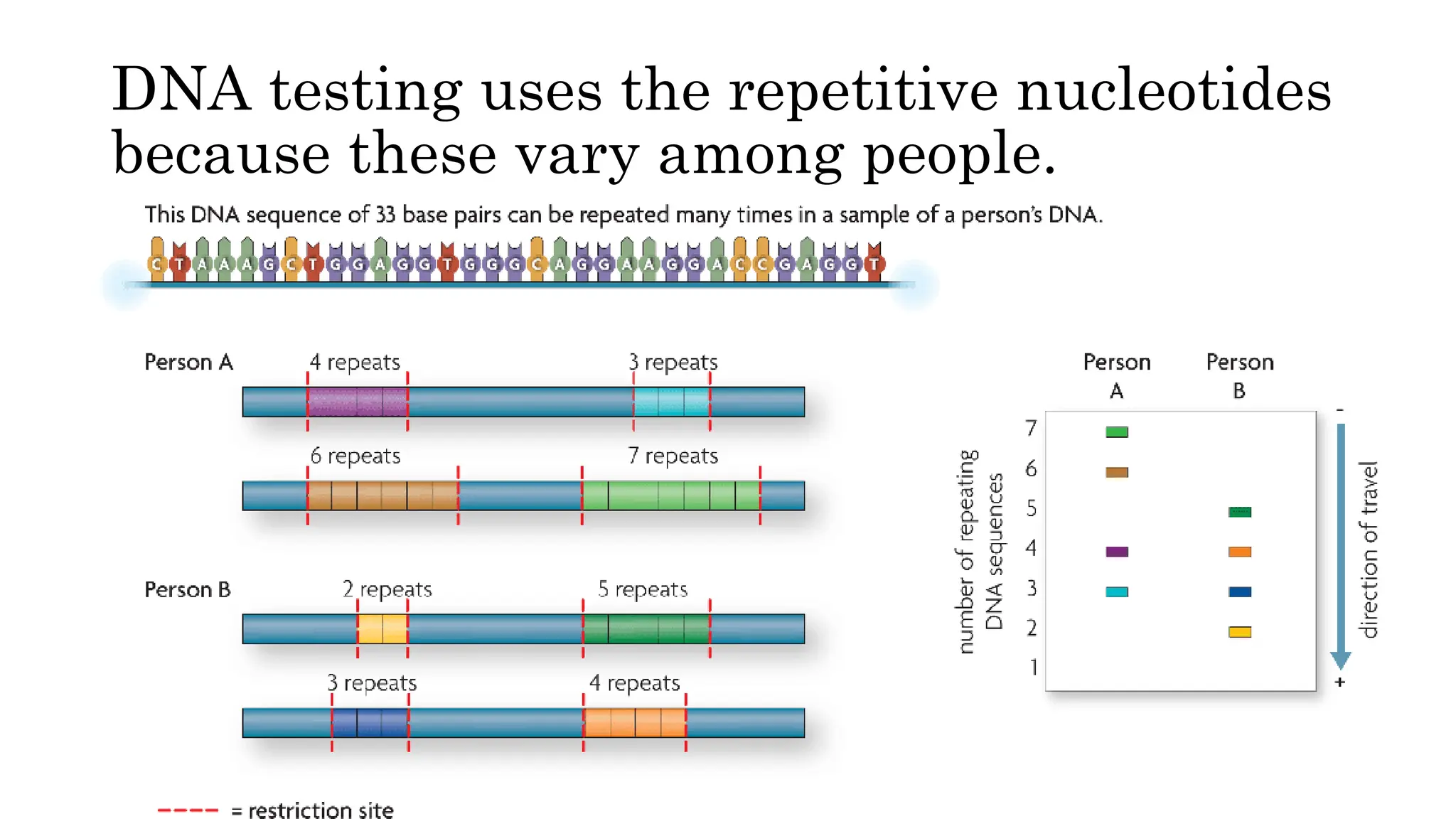
The junk DNA regions are thus made-up of length polymorphisms, which show
variations in the physical length of the DNA molecule. At specific loci on the
chromosome the number of tandem repeats varies between individuals. There will
be a certain number of repeats for any specific loci on the chromosome. Depending
on the size of the repeat, the repeat regions are classified into two groups.
• Short tandem repeats (STRs) contain 2-5 base pair repeats and
• variable number of tandem repeats (VNTRs) have repeats of 9-80 base pairs.
• Since a child receive 50% of the DNA from its father and the other 50% from his
mother, so the number VNTRs at a particular area of the DNA of the child will be
different may be due to insertion, deletion or mutation in the base pairs.
• As a result, every individual has a distinct composition of VNTRs and this is the
main principle of DNA fingerprinting.
• As single change in nucleotide may make a few more cleavage site of a given
nucleotide or might abolish some existing cleavage site.
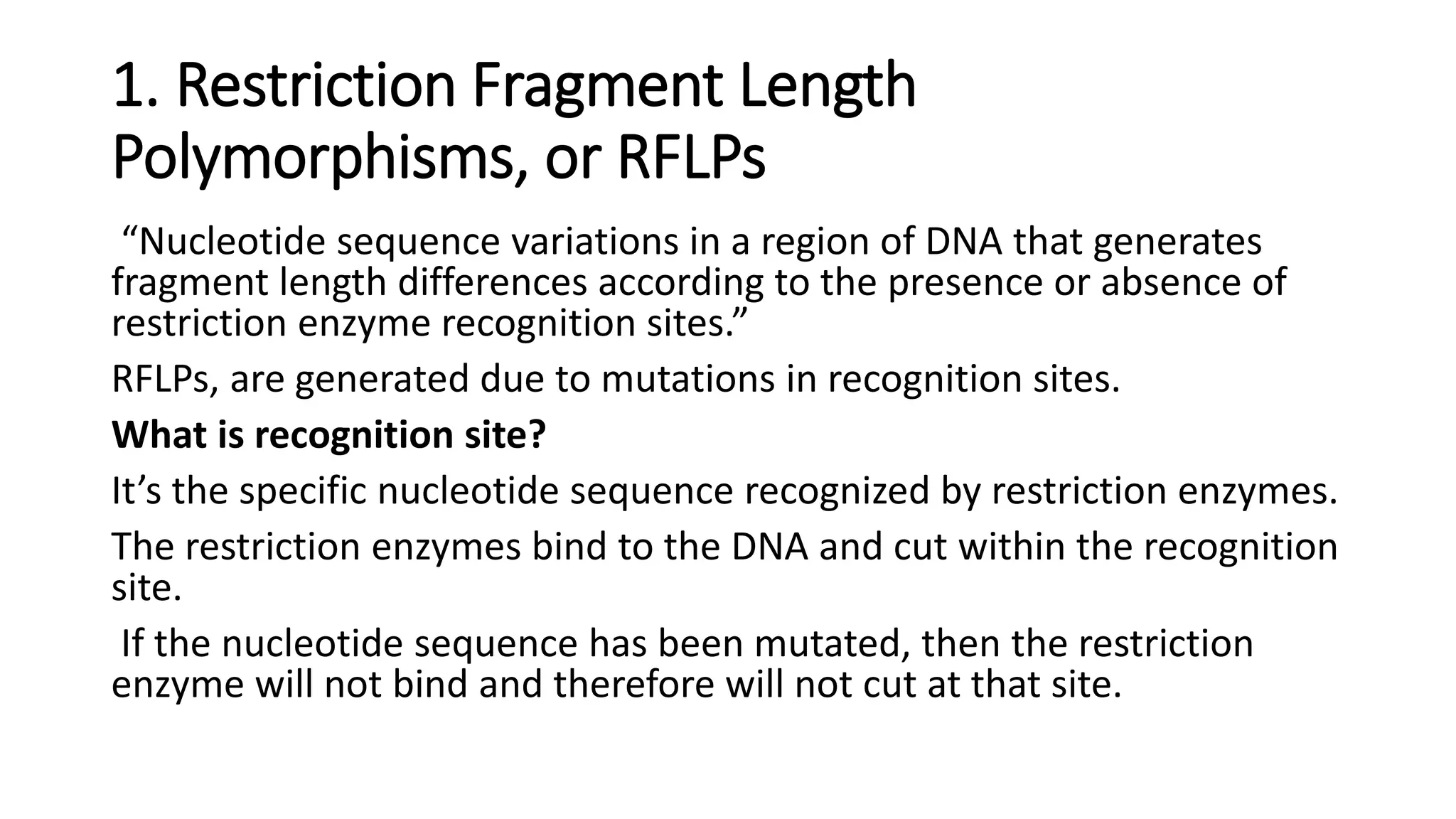
• Thus, if DNA of any individual is digested with a restriction enzyme, fragments
pattern (sizes) will be produced and will be different in cleavage site position. This
is the basics of DNA fingerprinting.
1. Restriction Fragment Length
Polymorphisms, or RFLPs
“Nucleotide sequence variations in a region of DNA that generates
fragment length differences according to the presence or absence of
restriction enzyme recognition sites.”
RFLPs, are generated due to mutations in recognition sites.
What is recognition site?
It’s the specific nucleotide sequence recognized by restriction enzymes.
The restriction enzymes bind to the DNA and cut within the recognition
site.
If the nucleotide sequence has been mutated, then the restriction
enzyme will not bind and therefore will not cut at that site.
DNA testing uses the repetitive nucleotides
because these vary among people.
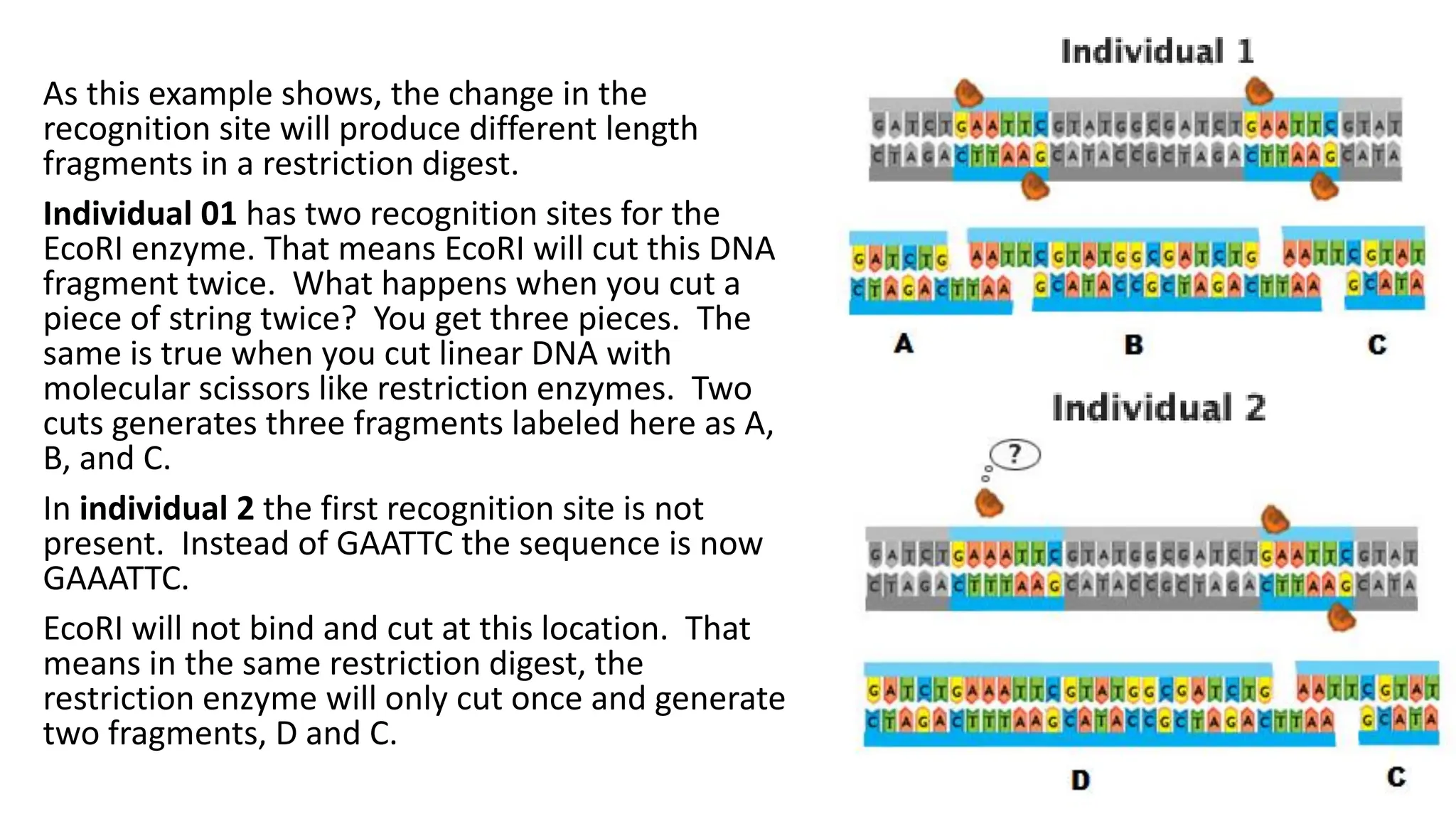
As this example shows, the change in the
recognition site will produce different length
fragments in a restriction digest.
Individual 01 has two recognition sites for the
EcoRI enzyme. That means EcoRI will cut this DNA
fragment twice. What happens when you cut a
piece of string twice? You get three pieces. The
same is true when you cut linear DNA with
molecular scissors like restriction enzymes. Two
cuts generates three fragments labeled here as A,
B, and C.
In individual 2 the first recognition site is not
present. Instead of GAATTC the sequence is now
GAAATTC.
EcoRI will not bind and cut at this location. That
means in the same restriction digest, the
restriction enzyme will only cut once and generate
two fragments, D and C.
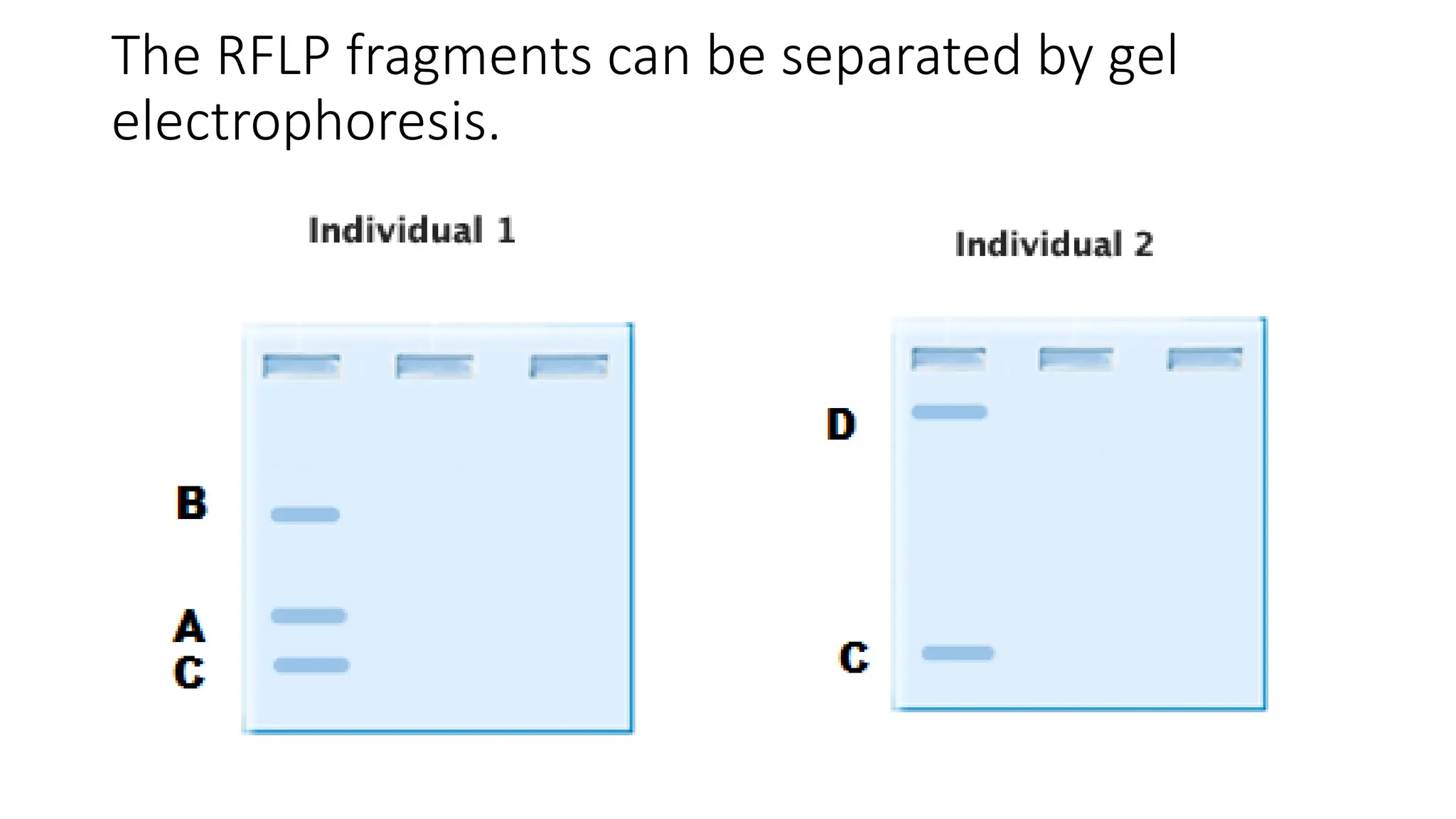
The RFLP fragments can be separated by gel
electrophoresis.
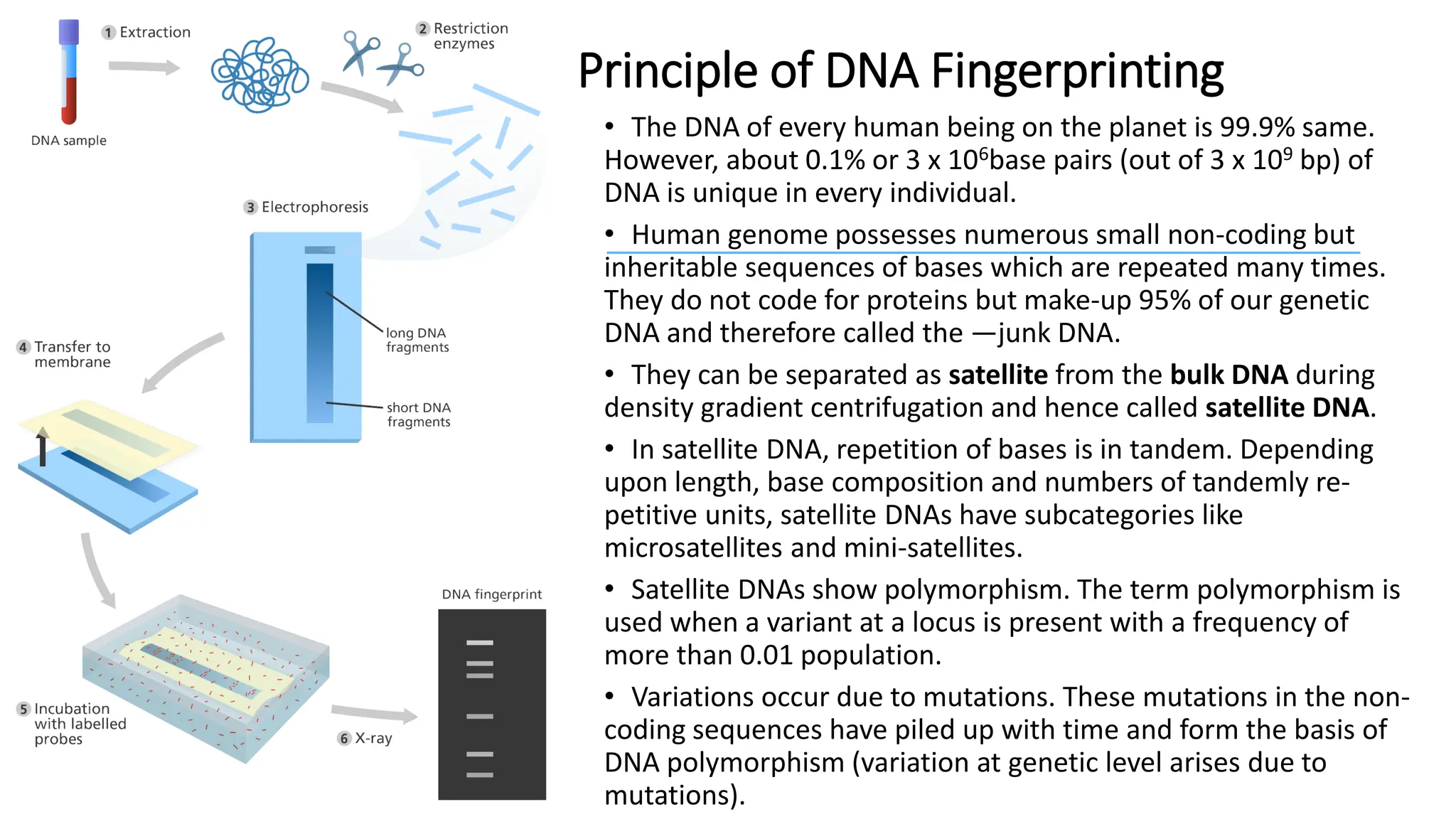
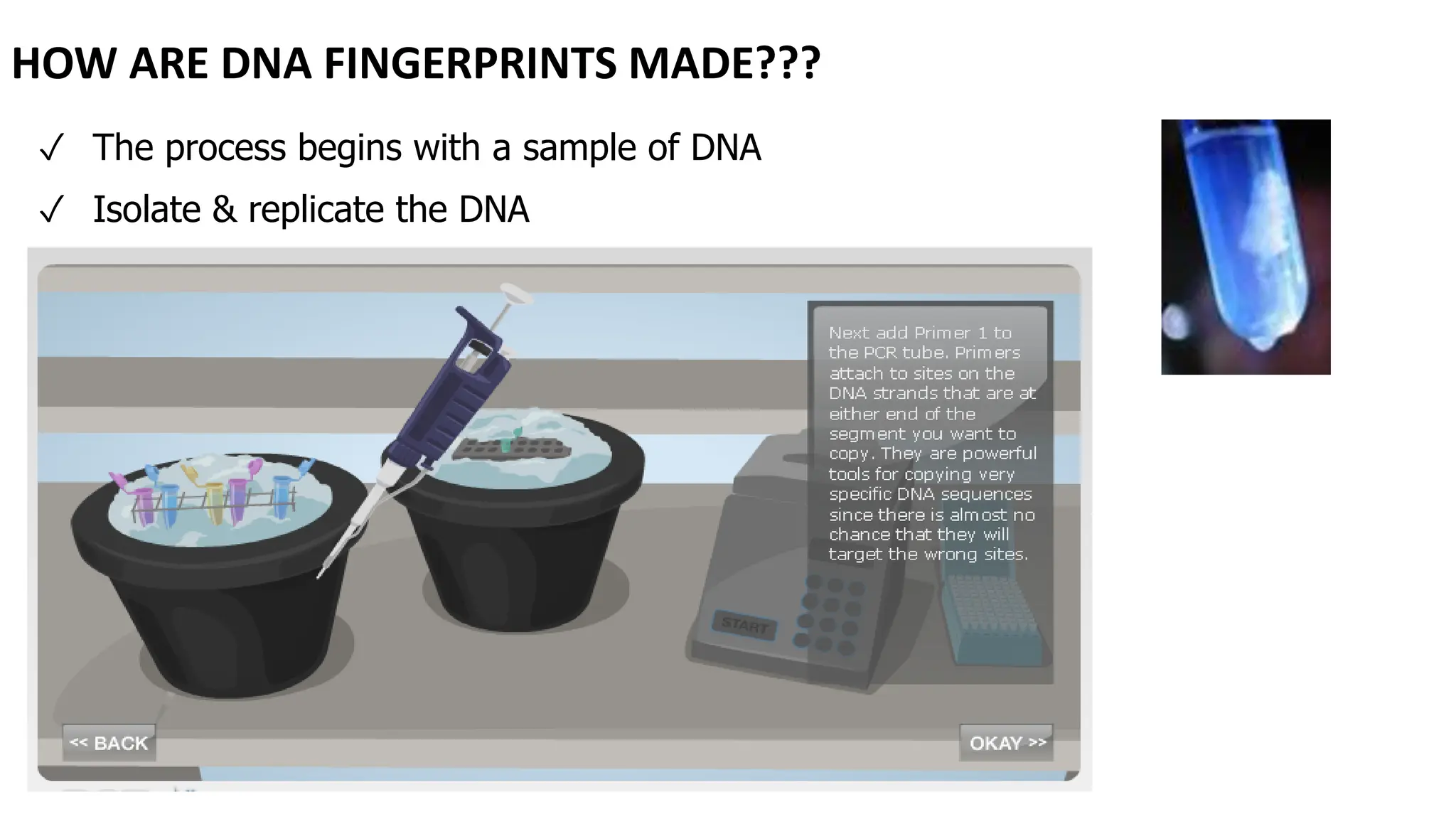
HOW ARE DNA FINGERPRINTS MADE???
✓ The process begins with a sample of DNA
✓ Isolate & replicate the DNA
✓Cut the DNA with restriction enzymes (each enzyme
looks for a specific pattern)
✓Place fragmented DNA in the wells of a polyacrylamide
gel and electrophoresis is performed (negative charge on
top by wells and positive charge on bottom)
+
-
•DNA has a negative charge,
so the fragments of DNA are
attracted toward the positive
charge (bottom of gel).
•The smaller fragments of
DNA will be able to move
quicker toward the bottom
than the larger pieces.
•Thus, DNA is separated by
size (smaller pieces toward
the bottom and the larger
pieces toward the top).
HOW DOES IT WORK???
+
-
10
9
8
7
6
5
4
3
2
1
Southern Blot
❖Molecular technique where DNA is transferred onto a membrane
from an agarose gel and a probe is hybridized.
Southern Blot
❖The first step in preparing a Southern Blot is to cut
genomic DNA and run on an agarose gel.
Southern Blot
❖The next step is to blot or transfer single stranded DNA
fragments on to a nylon membrane.
❖The next step is to hybridize a radioactively labeled DNA probe to
specific sequences on the membrane.
Southern Blot
Southern Blot
❖The last step is to expose
the radioactively labeled
membrane to a large sheet
of film.
❖You will only visualize bands
where the probe hybridized
to the DNA.
Southern Blot

DNA Fingerprinting.pdf principles, working

  • 1.
  • 2.
    What is DNAFingerprinting? • DNA fingerprints (DNA testing) identify living organisms at the molecular level. • DNA fragments show unique patterns from one person to the next. • It is also called a DNA profile. • Uses: • Analysts use the DNA profile from potential suspects and compare it against DNA found at a crime scene. • DNA profiling for paternity tests. These days you can send a sample of DNA and find out your ancestry to learn more about your origins. This is a very conclusive test because DNA is specific to each individual (unless you are an identical twin).
  • 3.
    Human Genome About 20%genes (code for proteins) About 80% junk (code for nothing or unknown…) Highly repetitive nucleotides Random nucleotides
  • 4.
    Principle of DNAFingerprinting • The DNA of every human being on the planet is 99.9% same. However, about 0.1% or 3 x 10⁶base pairs (out of 3 x 10⁹ bp) of DNA is unique in every individual. • Human genome possesses numerous small non-coding but inheritable sequences of bases which are repeated many times. They do not code for proteins but make-up 95% of our genetic DNA and therefore called the ―junk DNA. • They can be separated as satellite from the bulk DNA during density gradient centrifugation and hence called satellite DNA. • In satellite DNA, repetition of bases is in tandem. Depending upon length, base composition and numbers of tandemly re- petitive units, satellite DNAs have subcategories like microsatellites and mini-satellites. • Satellite DNAs show polymorphism. The term polymorphism is used when a variant at a locus is present with a frequency of more than 0.01 population. • Variations occur due to mutations. These mutations in the non- coding sequences have piled up with time and form the basis of DNA polymorphism (variation at genetic level arises due to mutations).
  • 5.
    The junk DNAregions are thus made-up of length polymorphisms, which show variations in the physical length of the DNA molecule. At specific loci on the chromosome the number of tandem repeats varies between individuals. There will be a certain number of repeats for any specific loci on the chromosome. Depending on the size of the repeat, the repeat regions are classified into two groups. • Short tandem repeats (STRs) contain 2-5 base pair repeats and • variable number of tandem repeats (VNTRs) have repeats of 9-80 base pairs. • Since a child receive 50% of the DNA from its father and the other 50% from his mother, so the number VNTRs at a particular area of the DNA of the child will be different may be due to insertion, deletion or mutation in the base pairs. • As a result, every individual has a distinct composition of VNTRs and this is the main principle of DNA fingerprinting. • As single change in nucleotide may make a few more cleavage site of a given nucleotide or might abolish some existing cleavage site. • Thus, if DNA of any individual is digested with a restriction enzyme, fragments pattern (sizes) will be produced and will be different in cleavage site position. This is the basics of DNA fingerprinting.
  • 6.
    1. Restriction FragmentLength Polymorphisms, or RFLPs “Nucleotide sequence variations in a region of DNA that generates fragment length differences according to the presence or absence of restriction enzyme recognition sites.” RFLPs, are generated due to mutations in recognition sites. What is recognition site? It’s the specific nucleotide sequence recognized by restriction enzymes. The restriction enzymes bind to the DNA and cut within the recognition site. If the nucleotide sequence has been mutated, then the restriction enzyme will not bind and therefore will not cut at that site.
  • 7.
    DNA testing usesthe repetitive nucleotides because these vary among people.
  • 8.
    As this exampleshows, the change in the recognition site will produce different length fragments in a restriction digest. Individual 01 has two recognition sites for the EcoRI enzyme. That means EcoRI will cut this DNA fragment twice. What happens when you cut a piece of string twice? You get three pieces. The same is true when you cut linear DNA with molecular scissors like restriction enzymes. Two cuts generates three fragments labeled here as A, B, and C. In individual 2 the first recognition site is not present. Instead of GAATTC the sequence is now GAAATTC. EcoRI will not bind and cut at this location. That means in the same restriction digest, the restriction enzyme will only cut once and generate two fragments, D and C.
  • 9.
    The RFLP fragmentscan be separated by gel electrophoresis.
  • 10.
    HOW ARE DNAFINGERPRINTS MADE??? ✓ The process begins with a sample of DNA ✓ Isolate & replicate the DNA
  • 11.
    ✓Cut the DNAwith restriction enzymes (each enzyme looks for a specific pattern) ✓Place fragmented DNA in the wells of a polyacrylamide gel and electrophoresis is performed (negative charge on top by wells and positive charge on bottom) + -
  • 12.
    •DNA has anegative charge, so the fragments of DNA are attracted toward the positive charge (bottom of gel). •The smaller fragments of DNA will be able to move quicker toward the bottom than the larger pieces. •Thus, DNA is separated by size (smaller pieces toward the bottom and the larger pieces toward the top). HOW DOES IT WORK??? + - 10 9 8 7 6 5 4 3 2 1
  • 13.
    Southern Blot ❖Molecular techniquewhere DNA is transferred onto a membrane from an agarose gel and a probe is hybridized.
  • 14.
    Southern Blot ❖The firststep in preparing a Southern Blot is to cut genomic DNA and run on an agarose gel.
  • 15.
    Southern Blot ❖The nextstep is to blot or transfer single stranded DNA fragments on to a nylon membrane.
  • 16.
    ❖The next stepis to hybridize a radioactively labeled DNA probe to specific sequences on the membrane. Southern Blot
  • 17.
    Southern Blot ❖The laststep is to expose the radioactively labeled membrane to a large sheet of film. ❖You will only visualize bands where the probe hybridized to the DNA.
  • 18.