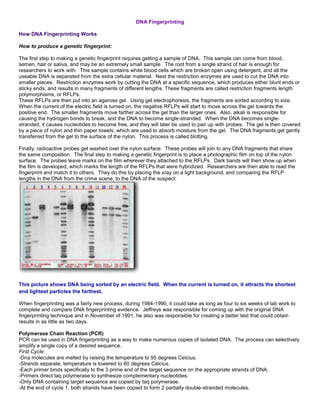
DNA fingerprinting is a process for identifying individuals based on their unique DNA patterns. It involves isolating DNA from a sample, cutting the DNA into fragments using restriction enzymes, sorting the fragments by size through gel electrophoresis, transferring the fragments to a membrane, and using radioactive probes to detect matching fragments and produce a fingerprint pattern for identification purposes. DNA fingerprinting is widely used in forensic investigations and criminal cases to identify suspects, as well as in diagnosing genetic disorders and researching cures due to its ability to distinguish individuals based on their DNA sequences.
![An additional benefit of DNA fingerprint technology is the diagnosis of inherited disorders in adults, children, and unborn
babies. Even bloodstained clothing from Abraham Lincoln has been analyzed for evidence of a genetic disorder called
Marfan's Syndrome.
[Topics]
The Structure of DNA
The characteristics of all living organisms, including humans, are essentially determined by information contained within
DNA that they inherit from their parents. The molecular structure of DNA can be imagined as a zipper with each tooth
represented by one of four letters (A, C, G, or T) and with opposite teeth forming one of two pairs, either AT or GC (Figure
2).
The information contained in DNA is the sequence of letters along the zipper. For example, the sequence ACGCT
represents different information than the sequence AGTCC in the same way that the word "POST" has a different
meaning from "STOP" or "POTS," even though they use the same letters. The traits of a human being are the result of
information contained in the DNA code.
Living organisms that look different or have different characteristics also have different DNA sequences. The more
different the organisms, the more different are the DNA sequences. DNA fingerprinting is a very quick way to compare the
DNA sequences of any two living organisms.
[Topics]
Making DNA Fingerprints
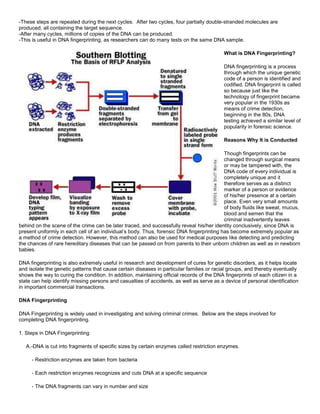
DNA fingerprinting is a laboratory procedure that requires six steps (Figure 3):](https://image.slidesharecdn.com/dnafingerprinting-140312010714-phpapp02/85/Dna-fingerprinting-4-320.jpg)
![1) Isolation of DNA. DNA must be recovered from the cells or tissues of the body. Only a small amount of tissue, like
blood, hair, or skin, is needed. For example, the amount of DNA found at the root of one hair is usually sufficient.
2) Cutting, sizing, and sorting. Special enzymes called restriction enzymes are used to cut the DNA at specific places.
For example, an enzyme called EcoR1, found in bacteria, will cut DNA only when the sequence GAATTC occurs.
The DNA pieces are sorted according to size by a sieving technique called electrophoresis. The DNA pieces are passed
through a gel made from seaweed agarose (a jelly-like product made from seaweed). This technique is the DNA
equivalent of screening sand through progressively finer mesh screens to determine particle sizes.
3) Transfer of DNA to nylon. The distribution of DNA pieces is transferred to a nylon sheet by placing the sheet on the
gel and soaking them overnight.
4-5) Probing. Adding radioactive or colored probes to the nylon sheet produces a pattern called the DNA fingerprint. Each
probe typically sticks in only one or two specific places on the nylon sheet.
6) DNA fingerprint. The final DNA fingerprint is built by using several probes (5-10 or more) simultaneously. It resembles
the bar codes used by grocery store scanners.
[Topics]
Uses of DNA Fingerprints](https://image.slidesharecdn.com/dnafingerprinting-140312010714-phpapp02/85/Dna-fingerprinting-5-320.jpg)
![DNA fingerprints are useful in several areas of society. They are used by professionals in human health and the justice
system.
Diagnosis of inherited disorders
DNA fingerprinting is used to diagnose inherited disorders in both prenatal and newborn babies in hospitals around the
world. These disorders may include cystic fibrosis, hemophilia, Huntington's disease, familial Alzheimer's, sickle cell
anemia, thalassemia, and many others. Early detection of such disorders enables the medical staff to prepare themselves
and the parents for proper treatment of the child. In some programs, genetic counselors use DNA fingerprint information
to help prospective parents understand the risk of having an affected child. In other programs, prospective parents use
DNA fingerprint information in their decisions concerning affected pregnancies.
Developing cures for inherited disorders
Research programs to locate inherited disorders on the chromosomes depend on the information contained in DNA
fingerprints. By studying the DNA fingerprints of relatives who have a history of some particular disorder, or by comparing
large groups of people with and without the disorder, it is possible to identify DNA patterns associated with the disease in
question. This work is a necessary first step in designing an eventual genetic cure for these disorders.
Forensic or criminal
FBI and police labs around the U.S. have begun to use DNA fingerprints to link suspects to biological evidence-blood or
semen stains, hair, or items of clothing-found at the scene of a crime. Since 1987, more than 150 cases have been
decided with the assistance of DNA fingerprint evidence.
Another important use of DNA fingerprints in the court system is to establish paternity in custody and child support
litigation. In these applications, DNA fingerprints bring an unprecedented, nearly perfect accuracy to the determination.
Southern blot
From Wikipedia, the free encyclopedia
Jump to: navigation, search
A Southern blot is a method routinely used in molecular biology for detection of a specific DNA sequence in DNA
samples. Southern blotting combines transfer of electrophoresis-separated DNA fragments to a filter membrane and
subsequent fragment detection by probe hybridization. The method is named after its inventor, the British biologist Edwin
Southern.
[1]
Other blotting methods (i.e., western blot,
[2]
northern blot, eastern blot, southwestern blot) that employ similar
principles, but using RNA or protein, have later been named in reference to Edwin Southern's name. As the technique
was eponymously named, Southern blot is capitalized as is conventional for proper nouns. The names for other blotting
methods may follow this convention, by analogy.
[3]
Method
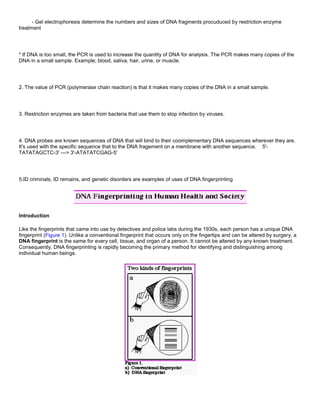
1. Restriction endonucleases are used to cut high-molecular-weight DNA strands into smaller fragments.
2. The DNA fragments are then electrophoresed on an agarose gel to separate them by size.
3. If some of the DNA fragments are larger than 15 kb, then prior to blotting, the gel may be treated with an acid,
such as dilute HCl, which depurinates the DNA fragments, breaking the DNA into smaller pieces, thus allowing
more efficient transfer from the gel to membrane.
4. If alkaline transfer methods are used, the DNA gel is placed into an alkaline solution (typically containing sodium
hydroxide) to denature the double-stranded DNA. The denaturation in an alkaline environment may improve
binding of the negatively charged thymine residues of DNA to a positively charged amino groups of membrane,
separating it into single DNA strands for later hybridization to the probe (see below), and destroys any residual
RNA that may still be present in the DNA. The choice of alkaline over neutral transfer methods, however, is often
empirical and may result in equivalent results.
[citation needed]](https://image.slidesharecdn.com/dnafingerprinting-140312010714-phpapp02/85/Dna-fingerprinting-6-320.jpg)
![5. A sheet of nitrocellulose (or, alternatively, nylon) membrane is placed on top of (or below, depending on the
direction of the transfer) the gel. Pressure is applied evenly to the gel (either using suction, or by placing a stack
of paper towels and a weight on top of the membrane and gel), to ensure good and even contact between gel and
membrane. If transferring by suction 20X SSC buffer is used to ensure a seal and prevent drying of the gel. Buffer
transfer by capillary action from a region of high water potential to a region of low water potential (usually filter
paper and paper tissues) is then used to move the DNA from the gel on to the membrane; ion exchange
interactions bind the DNA to the membrane due to the negative charge of the DNA and positive charge of the
membrane.
6. The membrane is then baked in a vacuum or regular oven at 80 °C for 2 hours (standard conditions; nitrocellulose
or nylon membrane) or exposed to ultraviolet radiation (nylon membrane) to permanently attach the transferred
DNA to the membrane.
7. The membrane is then exposed to a hybridization probe—a single DNA fragment with a specific sequence whose
presence in the target DNA is to be determined. The probe DNA is labelled so that it can be detected, usually by
incorporating radioactivity or tagging the molecule with a fluorescent or chromogenic dye. In some cases, the
hybridization probe may be made from RNA, rather than DNA. To ensure the specificity of the binding of the
probe to the sample DNA, most common hybridization methods use salmon or herring sperm DNA for blocking of
the membrane surface and target DNA, deionized formamide, and detergents such as SDS to reduce non-specific
binding of the probe.
8. After hybridization, excess probe is washed from the membrane (typically using SSC buffer), and the pattern of
hybridization is visualized on X-ray film by autoradiography in the case of a radioactive or fluorescent probe, or by
development of color on the membrane if a chromogenic detection method is used.
Western blot
From Wikipedia, the free encyclopedia
Jump to: navigation, search
Western blot using an antibody that recognizes proteins modified with lipoic acid.
The western blot (sometimes called the protein immunoblot) is a widely accepted analytical technique used to detect
specific proteins in the given sample of tissue homogenate or extract. It uses gel electrophoresis to separate native
proteins by 3-D structure or denatured proteins by the length of the polypeptide. The proteins are then transferred to a
membrane (typically nitrocellulose or PVDF), where they are stained with antibodies specific to the target protein.
[1][2]
There are now many reagent companies that specialize in providing antibodies (both monoclonal and polyclonal
antibodies) against tens of thousands of different proteins.
[3]
Commercial antibodies can be expensive, although the
unbound antibody can be reused between experiments. This method is used in the fields of molecular biology,
biochemistry, immunogenetics and other molecular biology disciplines.
Other related techniques include using antibodies to detect proteins in tissues and cells by immunostaining and enzyme-
linked immunosorbent assay (ELISA).](https://image.slidesharecdn.com/dnafingerprinting-140312010714-phpapp02/85/Dna-fingerprinting-7-320.jpg)
![The method originated in the laboratory of Harry Towbin at the Friedrich Miescher Institute
[1]
. The name Western blot was
given to the technique by W. Neal Burnette
[4]
and is a play on the name Southern blot, a technique for DNA detection
developed earlier by Edwin Southern. Detection of RNA is termed northern blot and was developed by George Stark at
Stanford
[5]
.
Steps
Tissue preparation
Samples can be taken from whole tissue or from cell culture. Solid tissues are first broken down mechanically using a
blender (for larger sample volumes), using a homogenizer (smaller volumes), or by sonication. Cells may also be broken
open by one of the above mechanical methods. However, virus or environmental samples can be the source of protein
and thus western blotting is not restricted to cellular studies only.
Assorted detergents, salts, and buffers may be employed to encourage lysis of cells and to solubilize proteins. Protease
and phosphatase inhibitors are often added to prevent the digestion of the sample by its own enzymes. Tissue
preparation is often done at cold temperatures to avoid protein denaturing and degradation.
A combination of biochemical and mechanical techniques – comprising various types of filtration and centrifugation – can
be used to separate different cell compartments and organelles.
Gel electrophoresis
Main article: Gel electrophoresis
The proteins of the sample are separated using gel electrophoresis. Separation of proteins may be by isoelectric point
(pI), molecular weight, electric charge, or a combination of these factors. The nature of the separation depends on the
treatment of the sample and the nature of the gel. This is a very useful way to identify a protein.
By far the most common type of gel electrophoresis employs polyacrylamide gels and buffers loaded with sodium dodecyl
sulfate (SDS). SDS-PAGE (SDS polyacrylamide gel electrophoresis) maintains polypeptides in a denatured state once
they have been treated with strong reducing agents to remove secondary and tertiary structure (e.g. disulfide bonds [S-S]
to sulfhydryl groups [SH and SH]) and thus allows separation of proteins by their molecular weight. Sampled proteins
become covered in the negatively charged SDS and move to the positively charged electrode through the acrylamide
mesh of the gel. Smaller proteins migrate faster through this mesh and the proteins are thus separated according to size
(usually measured in kilodaltons, kDa). The concentration of acrylamide determines the resolution of the gel - the greater
the acrylamide concentration the better the resolution of lower molecular weight proteins. The lower the acrylamide
concentration the better the resolution of higher molecular weight proteins. Proteins travel only in one dimension along the
gel for most blots.
Samples are loaded into wells in the gel. One lane is usually reserved for a marker or ladder, a commercially available
mixture of proteins having defined molecular weights, typically stained so as to form visible, coloured bands. When
voltage is applied along the gel, proteins migrate through it at different speeds dependent on their size. These different
rates of advancement (different electrophoretic mobilities) separate into bands within each lane.](https://image.slidesharecdn.com/dnafingerprinting-140312010714-phpapp02/85/Dna-fingerprinting-8-320.jpg)
![It is also possible to use a two-dimensional (2-D) gel which spreads the proteins from a single sample out in two
dimensions. Proteins are separated according to isoelectric point (pH at which they have neutral net charge) in the first
dimension, and according to their molecular weight in the second dimension.
Transfer
In order to make the proteins accessible to antibody detection they are moved from within the gel onto a membrane made
of nitrocellulose or polyvinylidene difluoride (PVDF). The primary method for transferring the proteins is called
electroblotting and uses an electric current to pull proteins from the gel into the PVDF or nitrocellulose membrane. The
proteins move from within the gel onto the membrane while maintaining the organization they had within the gel. An older
method of transfer involves placing a membrane on top of the gel, and a stack of filter papers on top of that. The entire
stack is placed in a buffer solution which moves up the paper by capillary action, bringing the proteins with it. In practice
this method is not used as it takes too much time; electroblotting is preferred. As a result of either "blotting" process, the
proteins are exposed on a thin surface layer for detection (see below). Both varieties of membrane are chosen for their
non-specific protein binding properties (i.e. binds all proteins equally well). Protein binding is based upon hydrophobic
interactions, as well as charged interactions between the membrane and protein. Nitrocellulose membranes are cheaper
than PVDF, but are far more fragile and do not stand up well to repeated probings.
The uniformity and overall effectiveness of transfer of protein from the gel to the membrane can be checked by staining
the membrane with Coomassie Brilliant Blue or Ponceau S dyes. Ponceau S is the more common of the two, due to its
higher sensitivity and water solubility, the latter making it easier to subsequently destain and probe the membrane, as
described below.
[6]](https://image.slidesharecdn.com/dnafingerprinting-140312010714-phpapp02/85/Dna-fingerprinting-9-320.jpg)
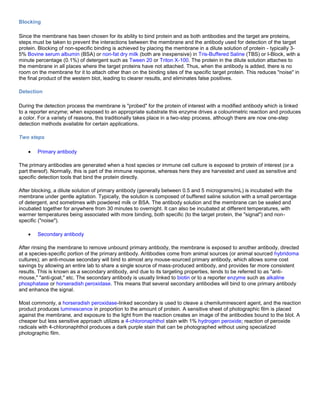
![As with the ELISPOT and ELISA procedures, the enzyme can be provided with a substrate molecule that will be
converted by the enzyme to a colored reaction product that will be visible on the membrane (see the figure below with
blue bands).
Another method of secondary antibody detection utilizes a near-infrared (NIR) fluorophore-linked antibody. Light produced
from the excitation of a fluorescent dye is static, making fluorescent detection a more precise and accurate measure of the
difference in signal produced by labeled antibodies bound to proteins on a western blot. Proteins can be accurately
quantified because the signal generated by the different amounts of proteins on the membranes is measured in a static
state, as compared to chemiluminescence, in which light is measured in a dynamic state.
[7]
A third alternative is to use a radioactive label rather than an enzyme coupled to the secondary antibody, such as labeling
an antibody-binding protein like Staphylococcus Protein A or Streptavidin with a radioactive isotope of iodine. Since other
methods are safer, quicker, and cheaper, this method is now rarely used; however, an advantage of this approach is the
sensitivity of auto-radiography based imaging, which enables highly accurate protein quantification when combined with
optical software (e.g. Optiquant).
One step
Historically, the probing process was performed in two steps because of the relative ease of producing primary and
secondary antibodies in separate processes. This gives researchers and corporations huge advantages in terms of
flexibility, and adds an amplification step to the detection process. Given the advent of high-throughput protein analysis
and lower limits of detection, however, there has been interest in developing one-step probing systems that would allow
the process to occur faster and with less consumables. This requires a probe antibody which both recognizes the protein
of interest and contains a detectable label, probes which are often available for known protein tags. The primary probe is
incubated with the membrane in a manner similar to that for the primary antibody in a two-step process, and then is ready
for direct detection after a series of wash steps.
Western blot using radioactive detection system
Analysis
After the unbound probes are washed away, the western blot is ready for detection of the probes that are labeled and
bound to the protein of interest. In practical terms, not all westerns reveal protein only at one band in a membrane. Size
approximations are taken by comparing the stained bands to that of the marker or ladder loaded during electrophoresis.](https://image.slidesharecdn.com/dnafingerprinting-140312010714-phpapp02/85/Dna-fingerprinting-11-320.jpg)
![The process is repeated for a structural protein, such as actin or tubulin, that should not change between samples. The
amount of target protein is normalized to the structural protein to control between groups. This practice ensures correction
for the amount of total protein on the membrane in case of errors or incomplete transfers.
Colorimetric detection
The colorimetric detection method depends on incubation of the western blot with a substrate that reacts with the reporter
enzyme (such as peroxidase) that is bound to the secondary antibody. This converts the soluble dye into an insoluble
form of a different color that precipitates next to the enzyme and thereby stains the membrane. Development of the blot is
then stopped by washing away the soluble dye. Protein levels are evaluated through densitometry (how intense the stain
is) or spectrophotometry.
Chemiluminescent detection
Chemiluminescent detection methods depend on incubation of the western blot with a substrate that will luminesce when
exposed to the reporter on the secondary antibody. The light is then detected by photographic film, and more recently by
CCD cameras which capture a digital image of the western blot. The image is analysed by densitometry, which evaluates
the relative amount of protein staining and quantifies the results in terms of optical density. Newer software allows further
data analysis such as molecular weight analysis if appropriate standards are used.
Radioactive detection
Radioactive labels do not require enzyme substrates, but rather allow the placement of medical X-ray film directly against
the western blot which develops as it is exposed to the label and creates dark regions which correspond to the protein
bands of interest (see image to the right). The importance of radioactive detections methods is declining due to its
hazardous radiation
[citation needed]
, because it is very expensive, health and safety risks are high, and ECL (enhanced
chemiluminescence) provides a useful alternative.
Fluorescent detection
The fluorescently labeled probe is excited by light and the emission of the excitation is then detected by a photosensor
such as CCD camera equipped with appropriate emission filters which captures a digital image of the western blot and
allows further data analysis such as molecular weight analysis and a quantitative western blot analysis. Fluorescence is
considered to be one of the best methods for quantification, but is less sensitive than chemiluminescence.
[8]
Secondary probing
One major difference between nitrocellulose and PVDF membranes relates to the ability of each to support "stripping"
antibodies off and reusing the membrane for subsequent antibody probes. While there are well-established protocols
available for stripping nitrocellulose membranes, the sturdier PVDF allows for easier stripping, and for more reuse before
background noise limits experiments. Another difference is that, unlike nitrocellulose, PVDF must be soaked in 95%
ethanol, isopropanol or methanol before use. PVDF membranes also tend to be thicker and more resistant to damage
during use.](https://image.slidesharecdn.com/dnafingerprinting-140312010714-phpapp02/85/Dna-fingerprinting-12-320.jpg)


![K-12 Module in Science Grade 8 [All Gradings]](https://cdn.slidesharecdn.com/ss_thumbnails/sciencelearnermodule-130708064905-phpapp01-140819100549-phpapp01-thumbnail.jpg?width=640&height=640&fit=bounds)


