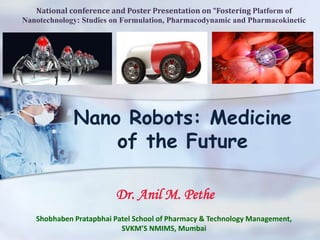
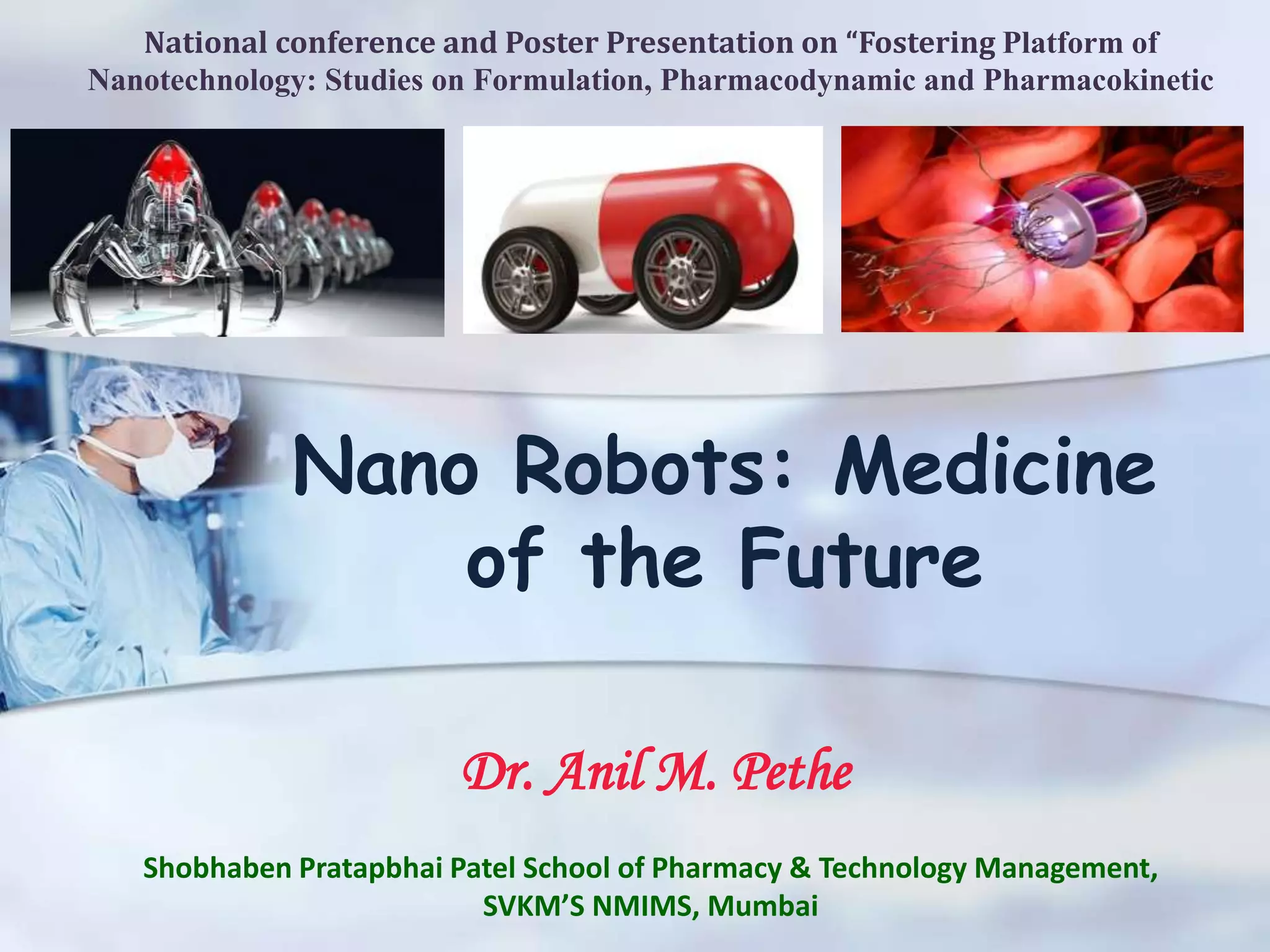
Nano Robots: Medicine
of the Future
Dr. Anil M. Pethe
Shobhaben Pratapbhai Patel School of Pharmacy & Technology Management,
SVKM’S NMIMS, Mumbai
National conference and Poster Presentation on “Fostering Platform of
Nanotechnology: Studies on Formulation, Pharmacodynamic and Pharmacokinetic
CONTENTS
 Introduction
 Structure of nanorobots
 Types of nanorobots
 Advantages
 Disadvantages
 Applications of nanorobots
 Conclusion
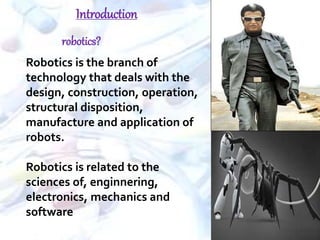
 Robotics is the branch of
technology that deals with the
design, construction, operation,
structural disposition,
manufacture and application of
robots.
 Robotics is related to the
sciences of, enginnering,
electronics, mechanics and
software
Introduction
robotics?
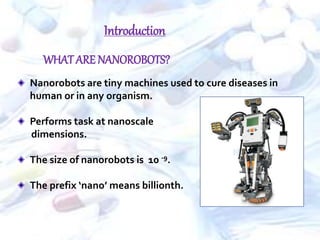
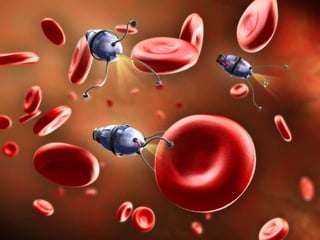
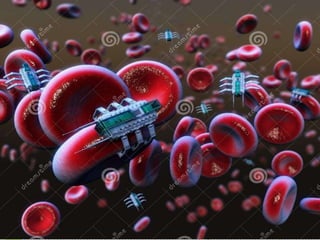
Nanorobots are tiny machines used to cure diseases in
human or in any organism.
Performs task at nanoscale
dimensions.
The size of nanorobots is 10 -9.
The prefix ‘nano’ means billionth.
WHATARE NANOROBOTS?
Introduction
History of Nanorobotics
• It was first proposed by Richard Feynman in 1959.
According to Richard Feynman, it was his former
graduate student and collaborator Albert Hibbs who
originally suggested to him the idea of a medical use for
Feynman's theoretical micromachines.
• In the 1980's, Eric Drexler elaborated this concept in his
popular book Engines of Creation
• Over the years, nanotechnology researcher Robert
Freitas has built up an impressive and detailed body of
work on how to build real, working nanorobots for
medical and human enhancement purposes.
Components of Nanorobots
The various components in nanorobot include power supply, fuel tank,
sensors, motors, manipulators, onboard computers, pumps, pressure
tanks and structural support. The structures include:
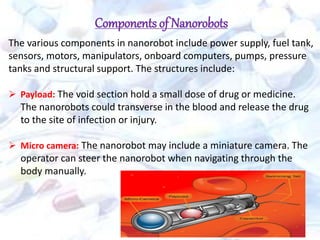
 Payload: The void section hold a small dose of drug or medicine.
The nanorobots could transverse in the blood and release the drug
to the site of infection or injury.
 Micro camera: The nanorobot may include a miniature camera. The
operator can steer the nanorobot when navigating through the
body manually.
Components of Nanorobots (Cont.)
 Electrodes: The electrodes mounted on the nanorobot could
form the battery using the electrolytes in the blood. These
protruding electrodes could also kill the cancer cells by
generating an electric current and heating the cell up to death.
 Lasers: These lasers could burn the harmful material like
arterial plaque, blood clots or cancer cells.
 Ultra sonic signal generators: These generators are used when
the nanorobots are used to target and destroy kidney stones.
 Swimming tail: The Nano robot will require a means of
propulsion to get into the body as they travel against the flow
of blood in the body.
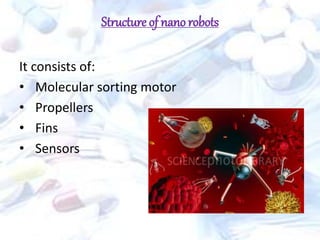
Structure of nano robots
It consists of:
• Molecular sorting motor
• Propellers
• Fins
• Sensors
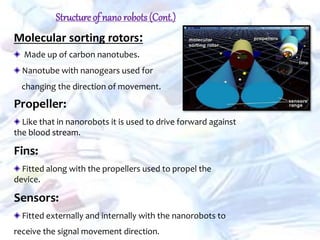
Molecular sorting rotors:
Made up of carbon nanotubes.
Nanotube with nanogears used for
changing the direction of movement.
Propeller:
Like that in nanorobots it is used to drive forward against
the blood stream.
Fins:
Fitted along with the propellers used to propel the
device.
Sensors:
Fitted externally and internally with the nanorobots to
receive the signal movement direction.
Structure of nano robots(Cont.)
SIZE & SHAPES of nano robots
Nanobots
Nanoids
Nanites
Nanomachines
Nanomites
Nano spiders
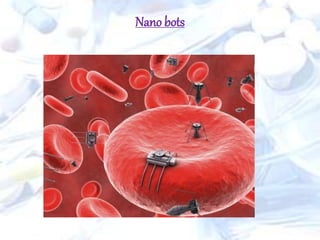
Nano bots
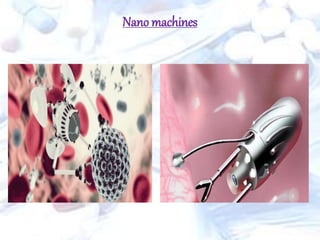
Nano machines
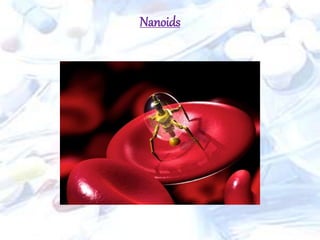
Nanoids
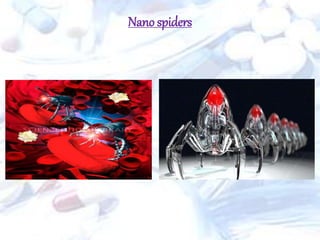
Nano spiders
nanites
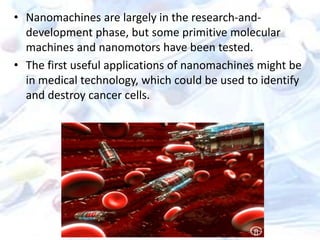
• Nanomachines are largely in the research-and-
development phase, but some primitive molecular
machines and nanomotors have been tested.
• The first useful applications of nanomachines might be
in medical technology, which could be used to identify
and destroy cancer cells.
ADVANTAGES OF NANOROBOTS
 Rapid elimination of disease.
 Nanorobot might function at the atomic and molecular level
to build devices, machines or circuits known as molecular
manufacturing.
 Nanorobots might also produce copies of themselves to
replace worn-out units, a process called self-replication.
 The major advantage of nanorobots is thought to be their
durability, in theory, they can remain operational for years,
decades or centuries.
DISADVANTAGES
 The nanorobot should be very accurate otherwise
harmful events may occur.
 The initial design cost is very high.
 The design of this robot is very complicated
 Hard to design.
 Regulatory Issues
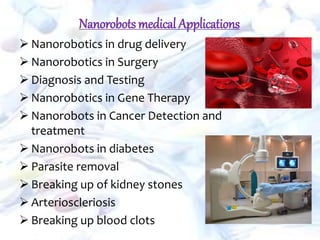
Nanorobots medical Applications
 Nanorobotics in drug delivery
 Nanorobotics in Surgery
 Diagnosis and Testing
 Nanorobotics in Gene Therapy
 Nanorobots in Cancer Detection and
treatment
 Nanorobots in diabetes
 Parasite removal
 Breaking up of kidney stones
 Arterioscleriosis
 Breaking up blood clots
Nanorobots in drug delivery
• Nanorobort can be useful tool in drug delivery applications.
• A study, by researchers at the Interdisciplinary Centre, in Herzliya,
and Bar Ilan University, in Ramat Gan, Israel, solved those problems
by building a nanorobot that could be switched on and off to release
drugs within the body when needed.
• The team built the nanorobot out of DNA folded in such a way that
drugs could be tethered inside. The nanorobot also has a gate,
controlled by exposure to electromagnetic energy, that opens and
closes to release the drug into the surrounding environment – in this
case, the body of a West Indian leaf cockroach.
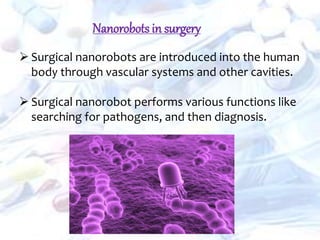
 Surgical nanorobots are introduced into the human
body through vascular systems and other cavities.
 Surgical nanorobot performs various functions like
searching for pathogens, and then diagnosis.
Nanorobots in surgery
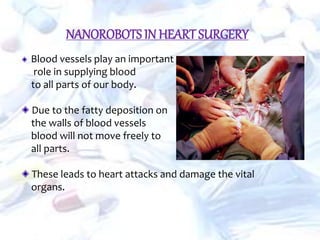
NANOROBOTS IN HEART SURGERY
Blood vessels play an important
role in supplying blood
to all parts of our body.
Due to the fatty deposition on
the walls of blood vessels
blood will not move freely to
all parts.
These leads to heart attacks and damage the vital
organs.
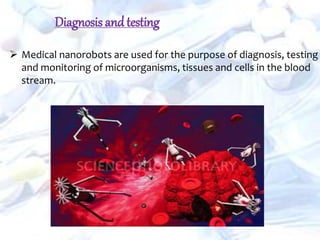
 Medical nanorobots are used for the purpose of diagnosis, testing
and monitoring of microorganisms, tissues and cells in the blood
stream.
Diagnosis andtesting
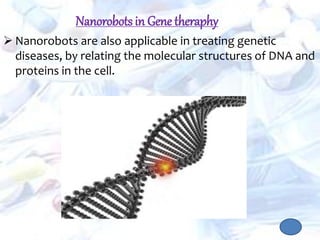
 Nanorobots are also applicable in treating genetic
diseases, by relating the molecular structures of DNA and
proteins in the cell.
Nanorobots in Gene theraphy
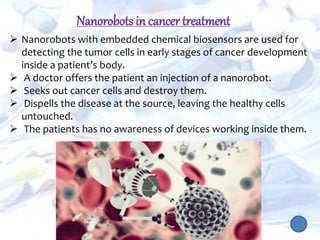
 Nanorobots with embedded chemical biosensors are used for
detecting the tumor cells in early stages of cancer development
inside a patient’s body.
 A doctor offers the patient an injection of a nanorobot.
 Seeks out cancer cells and destroy them.
 Dispells the disease at the source, leaving the healthy cells
untouched.
 The patients has no awareness of devices working inside them.
Nanorobots in cancer treatment
Nanorobots in diabetes monitoring
• Nowadays patients with diabetes must take small blood
samples many times a day to control their glucose levels. Such
procedures are uncomfortable and extremely inconvenient.
• To solve this problem, Adriano Cavalcanti and his colleagues
published for the first time the detailed work describing a
medical nano robot hardware architecture for blood sugar
level monitoring.
• The nanorobots may use embedded nanobiosensors to
monitor blood glucose levels, and transmit every two hours
this information through RF signals for mobile phones carried
with the patient.
• If the glucose is eventually not inside the desired levels,
the nanorobots activate a pre-programmed tune in the cellular
phone, which may alert the patient to take any necessary
action regarding the diabetes control with prescribed
medicaments
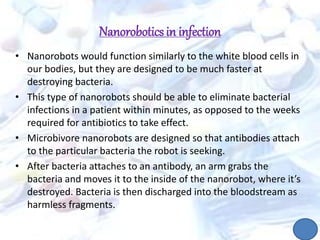
Nanoroboticsin infection
• Nanorobots would function similarly to the white blood cells in
our bodies, but they are designed to be much faster at
destroying bacteria.
• This type of nanorobots should be able to eliminate bacterial
infections in a patient within minutes, as opposed to the weeks
required for antibiotics to take effect.
• Microbivore nanorobots are designed so that antibodies attach
to the particular bacteria the robot is seeking.
• After bacteria attaches to an antibody, an arm grabs the
bacteria and moves it to the inside of the nanorobot, where it’s
destroyed. Bacteria is then discharged into the bloodstream as
harmless fragments.
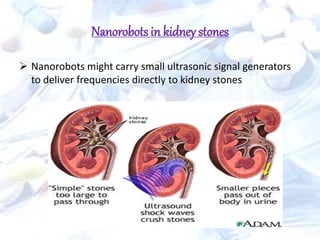
 Nanorobots might carry small ultrasonic signal generators
to deliver frequencies directly to kidney stones
Nanorobots in kidney stones
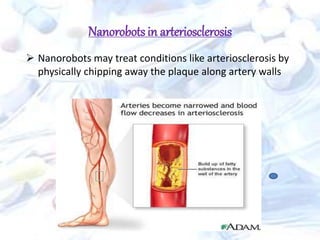
 Nanorobots may treat conditions like arteriosclerosis by
physically chipping away the plaque along artery walls
Nanorobotsin arteriosclerosis
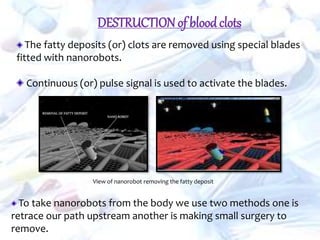
DESTRUCTIONof blood clots
The fatty deposits (or) clots are removed using special blades
fitted with nanorobots.
Continuous (or) pulse signal is used to activate the blades.
View of nanorobot removing the fatty deposit
To take nanorobots from the body we use two methods one is
retrace our path upstream another is making small surgery to
remove.
Conclusion
 The most challenging task to create a nano robot is to be able to
create a whole set of specialized machine tools in order to speed
up the process of nano robot building.
 Although the nano robot production is still at a nascent stage,
scientists are working hard to develop these tiny systems and
hopefully come up with functional autonomous nano robots
sometime in the next two decades.
 These are used to cure many diseases which are not possible
from ancient methods.
 Nanorobots are going to revolutionize the medical industry in
future.
 Technology may rule us !
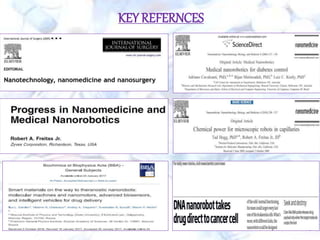
KEY REFERNCES
SAVE GIRL CHILD

Nano robotics future medicine

  • 1.
    Nano Robots: Medicine ofthe Future Dr. Anil M. Pethe Shobhaben Pratapbhai Patel School of Pharmacy & Technology Management, SVKM’S NMIMS, Mumbai National conference and Poster Presentation on “Fostering Platform of Nanotechnology: Studies on Formulation, Pharmacodynamic and Pharmacokinetic
  • 2.
    CONTENTS  Introduction  Structureof nanorobots  Types of nanorobots  Advantages  Disadvantages  Applications of nanorobots  Conclusion
  • 3.
     Robotics isthe branch of technology that deals with the design, construction, operation, structural disposition, manufacture and application of robots.  Robotics is related to the sciences of, enginnering, electronics, mechanics and software Introduction robotics?
  • 4.
    Nanorobots are tinymachines used to cure diseases in human or in any organism. Performs task at nanoscale dimensions. The size of nanorobots is 10 -9. The prefix ‘nano’ means billionth. WHATARE NANOROBOTS? Introduction
  • 5.
    History of Nanorobotics •It was first proposed by Richard Feynman in 1959. According to Richard Feynman, it was his former graduate student and collaborator Albert Hibbs who originally suggested to him the idea of a medical use for Feynman's theoretical micromachines. • In the 1980's, Eric Drexler elaborated this concept in his popular book Engines of Creation • Over the years, nanotechnology researcher Robert Freitas has built up an impressive and detailed body of work on how to build real, working nanorobots for medical and human enhancement purposes.
  • 6.
    Components of Nanorobots Thevarious components in nanorobot include power supply, fuel tank, sensors, motors, manipulators, onboard computers, pumps, pressure tanks and structural support. The structures include:  Payload: The void section hold a small dose of drug or medicine. The nanorobots could transverse in the blood and release the drug to the site of infection or injury.  Micro camera: The nanorobot may include a miniature camera. The operator can steer the nanorobot when navigating through the body manually.
  • 7.
    Components of Nanorobots(Cont.)  Electrodes: The electrodes mounted on the nanorobot could form the battery using the electrolytes in the blood. These protruding electrodes could also kill the cancer cells by generating an electric current and heating the cell up to death.  Lasers: These lasers could burn the harmful material like arterial plaque, blood clots or cancer cells.  Ultra sonic signal generators: These generators are used when the nanorobots are used to target and destroy kidney stones.  Swimming tail: The Nano robot will require a means of propulsion to get into the body as they travel against the flow of blood in the body.
  • 9.
    Structure of nanorobots It consists of: • Molecular sorting motor • Propellers • Fins • Sensors
  • 10.
    Molecular sorting rotors: Madeup of carbon nanotubes. Nanotube with nanogears used for changing the direction of movement. Propeller: Like that in nanorobots it is used to drive forward against the blood stream. Fins: Fitted along with the propellers used to propel the device. Sensors: Fitted externally and internally with the nanorobots to receive the signal movement direction. Structure of nano robots(Cont.)
  • 11.
    SIZE & SHAPESof nano robots Nanobots Nanoids Nanites Nanomachines Nanomites Nano spiders
  • 12.
  • 13.
  • 14.
  • 15.
  • 16.
  • 17.
    • Nanomachines arelargely in the research-and- development phase, but some primitive molecular machines and nanomotors have been tested. • The first useful applications of nanomachines might be in medical technology, which could be used to identify and destroy cancer cells.
  • 18.
    ADVANTAGES OF NANOROBOTS Rapid elimination of disease.  Nanorobot might function at the atomic and molecular level to build devices, machines or circuits known as molecular manufacturing.  Nanorobots might also produce copies of themselves to replace worn-out units, a process called self-replication.  The major advantage of nanorobots is thought to be their durability, in theory, they can remain operational for years, decades or centuries.
  • 19.
    DISADVANTAGES  The nanorobotshould be very accurate otherwise harmful events may occur.  The initial design cost is very high.  The design of this robot is very complicated  Hard to design.  Regulatory Issues
  • 20.
    Nanorobots medical Applications Nanorobotics in drug delivery  Nanorobotics in Surgery  Diagnosis and Testing  Nanorobotics in Gene Therapy  Nanorobots in Cancer Detection and treatment  Nanorobots in diabetes  Parasite removal  Breaking up of kidney stones  Arterioscleriosis  Breaking up blood clots
  • 22.
    Nanorobots in drugdelivery • Nanorobort can be useful tool in drug delivery applications. • A study, by researchers at the Interdisciplinary Centre, in Herzliya, and Bar Ilan University, in Ramat Gan, Israel, solved those problems by building a nanorobot that could be switched on and off to release drugs within the body when needed. • The team built the nanorobot out of DNA folded in such a way that drugs could be tethered inside. The nanorobot also has a gate, controlled by exposure to electromagnetic energy, that opens and closes to release the drug into the surrounding environment – in this case, the body of a West Indian leaf cockroach.
  • 23.
     Surgical nanorobotsare introduced into the human body through vascular systems and other cavities.  Surgical nanorobot performs various functions like searching for pathogens, and then diagnosis. Nanorobots in surgery
  • 24.
    NANOROBOTS IN HEARTSURGERY Blood vessels play an important role in supplying blood to all parts of our body. Due to the fatty deposition on the walls of blood vessels blood will not move freely to all parts. These leads to heart attacks and damage the vital organs.
  • 25.
     Medical nanorobotsare used for the purpose of diagnosis, testing and monitoring of microorganisms, tissues and cells in the blood stream. Diagnosis andtesting
  • 26.
     Nanorobots arealso applicable in treating genetic diseases, by relating the molecular structures of DNA and proteins in the cell. Nanorobots in Gene theraphy
  • 27.
     Nanorobots withembedded chemical biosensors are used for detecting the tumor cells in early stages of cancer development inside a patient’s body.  A doctor offers the patient an injection of a nanorobot.  Seeks out cancer cells and destroy them.  Dispells the disease at the source, leaving the healthy cells untouched.  The patients has no awareness of devices working inside them. Nanorobots in cancer treatment
  • 28.
    Nanorobots in diabetesmonitoring • Nowadays patients with diabetes must take small blood samples many times a day to control their glucose levels. Such procedures are uncomfortable and extremely inconvenient. • To solve this problem, Adriano Cavalcanti and his colleagues published for the first time the detailed work describing a medical nano robot hardware architecture for blood sugar level monitoring. • The nanorobots may use embedded nanobiosensors to monitor blood glucose levels, and transmit every two hours this information through RF signals for mobile phones carried with the patient. • If the glucose is eventually not inside the desired levels, the nanorobots activate a pre-programmed tune in the cellular phone, which may alert the patient to take any necessary action regarding the diabetes control with prescribed medicaments
  • 29.
    Nanoroboticsin infection • Nanorobotswould function similarly to the white blood cells in our bodies, but they are designed to be much faster at destroying bacteria. • This type of nanorobots should be able to eliminate bacterial infections in a patient within minutes, as opposed to the weeks required for antibiotics to take effect. • Microbivore nanorobots are designed so that antibodies attach to the particular bacteria the robot is seeking. • After bacteria attaches to an antibody, an arm grabs the bacteria and moves it to the inside of the nanorobot, where it’s destroyed. Bacteria is then discharged into the bloodstream as harmless fragments.
  • 30.
     Nanorobots mightcarry small ultrasonic signal generators to deliver frequencies directly to kidney stones Nanorobots in kidney stones
  • 31.
     Nanorobots maytreat conditions like arteriosclerosis by physically chipping away the plaque along artery walls Nanorobotsin arteriosclerosis
  • 32.
    DESTRUCTIONof blood clots Thefatty deposits (or) clots are removed using special blades fitted with nanorobots. Continuous (or) pulse signal is used to activate the blades. View of nanorobot removing the fatty deposit To take nanorobots from the body we use two methods one is retrace our path upstream another is making small surgery to remove.
  • 33.
    Conclusion  The mostchallenging task to create a nano robot is to be able to create a whole set of specialized machine tools in order to speed up the process of nano robot building.  Although the nano robot production is still at a nascent stage, scientists are working hard to develop these tiny systems and hopefully come up with functional autonomous nano robots sometime in the next two decades.  These are used to cure many diseases which are not possible from ancient methods.  Nanorobots are going to revolutionize the medical industry in future.  Technology may rule us !
  • 35.
  • 36.