Pilferproof Packaging
Dr. Anil Pethe
Shobhaben Pratapbhai Patel School of Pharmacy &
Technology Management, SVKM’S NMIMS, Mumbai
Pilferage
• Pilferage is the theft of part of the contents of a
package.
• It may also include theft of the contents but leaving
the package, perhaps resealed with bogus contents.
• Small packages can be pilfered from a larger package
such as a shipping container.
• Broader aspects of theft may include taking the
entire package, pallet load, truck load, shoplifting,
etc.
Solutions
• Solutions may involve all phases of product
production, packaging, distribution, logistics, sale,
and use.
• No single solution can be considered as "pilfer
proof". Often multiple levels of security need to be
addressed to reduce the risk of pilfering.
Solutions
1. Use extra strong and secure packaging: A weak or
damaged package is an invitation to pilferage.
2. Consider unique custom seals and labels (change
regularly because these are subject to
counterfeiting)
3. Improve the pilfer resistance to make pilfering
more difficult, time-consuming, etc.
4. Conceal the identity and value of a pilferable
item. Do not bring attention to the item, its
package, addresses, names, etc.
5. Add pilfer-evident features to help indicate the
existence of pilfering.
6. Choose a logistics provider who can reduce the risks
of pilferage.
7. Educate people to watch for evidence of pilfering.
8. Use a wider and stronger closure tape, 3 inch or 72
mm, reinforced gummed tape or
pressure sensitive tape.
9. Use a tamper evident tape or seal that leaves a
message or warning if removed
Tampering
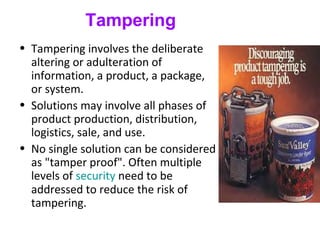
• Tampering involves the deliberate
altering or adulteration of
information, a product, a package,
or system.
• Solutions may involve all phases of
product production, distribution,
logistics, sale, and use.
• No single solution can be considered
as "tamper proof". Often multiple
levels of security need to be
addressed to reduce the risk of
tampering.
Some considerations for tampering:
1. Identify who a potential tamperer might be and what
level of knowledge, materials, tools, etc. might they
have.
2. Identify all feasible methods of unauthorized access
into a product, package, or system. In addition to the
primary means of entry, also consider secondary or
"back door" methods.
3. Control or limit access to products or systems of
interest.
4. Improve the tamper resistance by making tampering
more difficult, time-consuming, etc.
5. Add tamper-evident features to help indicate the
existence of tampering.
6. Educate people to watch for evidence of tampering
• Tamper-evident describes a device or process
that makes unauthorized access to the
protected object easily detected. Seals,
markings or other techniques may be tamper
indicating.
• Tamper resistance is resistance to tampering
by either the normal users of a product,
package, or system or others with physical
access to it. There are many reasons for
employing tamper resistance.
The Chicago Tylenol murders
• occurred when seven people died after taking pain-
relief capsules that had been poisoned.
• The Tylenol poisonings, code-named TYMURS by the
FBI, took place in the autumn of 1982 in the
Chicago area of the United States.
• These poisonings involved Extra-Strength Tylenol
medicine capsules which had been laced with
potassium cyanide.
• The incident led to reforms in the packaging of
over-the-counter substances and to federal anti-
tampering laws.
• The case remains unsolved and no suspects have been
charged. A $100,000 reward, offered by Johnson &
Johnson for the capture and conviction of the "Tylenol
Killer," has never been claimed.
Pilferproof Packaging
• Blister Pack
• Strip Pack
• Alu - Alu Pack
• Bubble pack
• Shrink banding
• Pouches
• Bottle seals
• Tape seals
• Breakable caps
• Sealed tubes
• Aerosol containers
• Sealed cartons
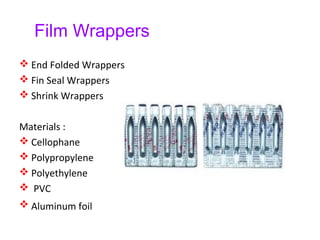
Film Wrappers
 End Folded Wrappers
 Fin Seal Wrappers
 Shrink Wrappers
Materials :
 Cellophane
 Polypropylene
 Polyethylene
 PVC
 Aluminum foil
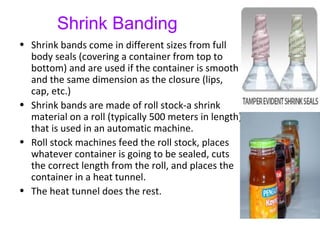
Shrink Banding
• Shrink bands come in different sizes from full
body seals (covering a container from top to
bottom) and are used if the container is smooth
and the same dimension as the closure (lips,
cap, etc.)
• Shrink bands are made of roll stock-a shrink
material on a roll (typically 500 meters in length)
that is used in an automatic machine.
• Roll stock machines feed the roll stock, places
whatever container is going to be sealed, cuts
the correct length from the roll, and places the
container in a heat tunnel.
• The heat tunnel does the rest.
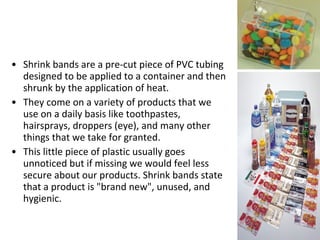
• Shrink bands are a pre-cut piece of PVC tubing
designed to be applied to a container and then
shrunk by the application of heat.
• They come on a variety of products that we
use on a daily basis like toothpastes,
hairsprays, droppers (eye), and many other
things that we take for granted.
• This little piece of plastic usually goes
unnoticed but if missing we would feel less
secure about our products. Shrink bands state
that a product is "brand new", unused, and
hygienic.
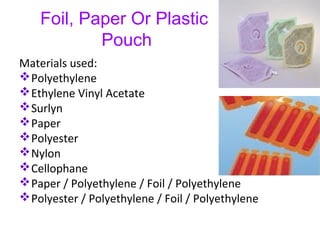
Foil, Paper Or Plastic
Pouch
Materials used:
Polyethylene
Ethylene Vinyl Acetate
Surlyn
Paper
Polyester
Nylon
Cellophane
Paper / Polyethylene / Foil / Polyethylene
Polyester / Polyethylene / Foil / Polyethylene
Bubble Pack
• In this type of packing the product is
sandwiched between a thermoformable,
extensible or heat shrinkable plastic film
like blister and a rigid backing material like
paperboard. This is somewhat similar to
blister pack.
•
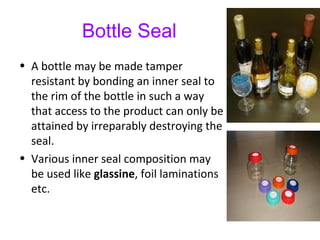
Bottle Seal
• A bottle may be made tamper
resistant by bonding an inner seal to
the rim of the bottle in such a way
that access to the product can only be
attained by irreparably destroying the
seal.
• Various inner seal composition may
be used like glassine, foil laminations
etc.
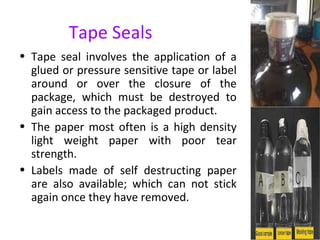
Tape Seals
• Tape seal involves the application of a
glued or pressure sensitive tape or label
around or over the closure of the
package, which must be destroyed to
gain access to the packaged product.
• The paper most often is a high density
light weight paper with poor tear
strength.
• Labels made of self destructing paper
are also available; which can not stick
again once they have removed.
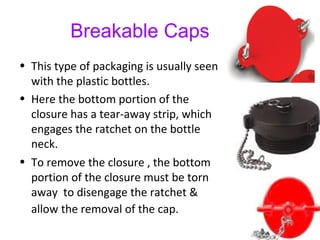
Breakable Caps
• This type of packaging is usually seen
with the plastic bottles.
• Here the bottom portion of the
closure has a tear-away strip, which
engages the ratchet on the bottle
neck.
• To remove the closure , the bottom
portion of the closure must be torn
away to disengage the ratchet &
allow the removal of the cap.
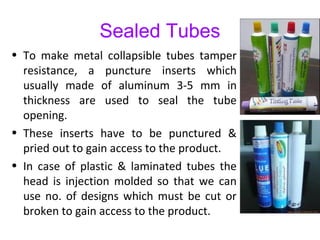
Sealed Tubes
• To make metal collapsible tubes tamper
resistance, a puncture inserts which
usually made of aluminum 3-5 mm in
thickness are used to seal the tube
opening.
• These inserts have to be punctured &
pried out to gain access to the product.
• In case of plastic & laminated tubes the
head is injection molded so that we can
use no. of designs which must be cut or
broken to gain access to the product.
References
Pharma Times, Vol. 39, Aug-2007,pg.57-60
The Theory & Practice Of Industrial Pharmacy By Leon
Lachman, Herbert A. Liberman, Joseph L.Kanig, 3rd
ed. Pg.
711-732
www.alibaba.com/showroom/Pharmaceutical_Packa...
products.ec21.com/manufacturers/glass_bottle.html
http://www.pharmaceutical-
technology.com/contractors/packaging/gallery.html

Pilferproof packaging

  • 1.
    Pilferproof Packaging Dr. AnilPethe Shobhaben Pratapbhai Patel School of Pharmacy & Technology Management, SVKM’S NMIMS, Mumbai
  • 2.
    Pilferage • Pilferage isthe theft of part of the contents of a package. • It may also include theft of the contents but leaving the package, perhaps resealed with bogus contents. • Small packages can be pilfered from a larger package such as a shipping container. • Broader aspects of theft may include taking the entire package, pallet load, truck load, shoplifting, etc.
  • 3.
    Solutions • Solutions mayinvolve all phases of product production, packaging, distribution, logistics, sale, and use. • No single solution can be considered as "pilfer proof". Often multiple levels of security need to be addressed to reduce the risk of pilfering.
  • 4.
    Solutions 1. Use extrastrong and secure packaging: A weak or damaged package is an invitation to pilferage. 2. Consider unique custom seals and labels (change regularly because these are subject to counterfeiting) 3. Improve the pilfer resistance to make pilfering more difficult, time-consuming, etc. 4. Conceal the identity and value of a pilferable item. Do not bring attention to the item, its package, addresses, names, etc.
  • 5.
    5. Add pilfer-evidentfeatures to help indicate the existence of pilfering. 6. Choose a logistics provider who can reduce the risks of pilferage. 7. Educate people to watch for evidence of pilfering. 8. Use a wider and stronger closure tape, 3 inch or 72 mm, reinforced gummed tape or pressure sensitive tape. 9. Use a tamper evident tape or seal that leaves a message or warning if removed
  • 6.
    Tampering • Tampering involvesthe deliberate altering or adulteration of information, a product, a package, or system. • Solutions may involve all phases of product production, distribution, logistics, sale, and use. • No single solution can be considered as "tamper proof". Often multiple levels of security need to be addressed to reduce the risk of tampering.
  • 7.
    Some considerations fortampering: 1. Identify who a potential tamperer might be and what level of knowledge, materials, tools, etc. might they have. 2. Identify all feasible methods of unauthorized access into a product, package, or system. In addition to the primary means of entry, also consider secondary or "back door" methods. 3. Control or limit access to products or systems of interest. 4. Improve the tamper resistance by making tampering more difficult, time-consuming, etc. 5. Add tamper-evident features to help indicate the existence of tampering. 6. Educate people to watch for evidence of tampering
  • 8.
    • Tamper-evident describesa device or process that makes unauthorized access to the protected object easily detected. Seals, markings or other techniques may be tamper indicating. • Tamper resistance is resistance to tampering by either the normal users of a product, package, or system or others with physical access to it. There are many reasons for employing tamper resistance.
  • 9.
    The Chicago Tylenolmurders • occurred when seven people died after taking pain- relief capsules that had been poisoned. • The Tylenol poisonings, code-named TYMURS by the FBI, took place in the autumn of 1982 in the Chicago area of the United States. • These poisonings involved Extra-Strength Tylenol medicine capsules which had been laced with potassium cyanide. • The incident led to reforms in the packaging of over-the-counter substances and to federal anti- tampering laws. • The case remains unsolved and no suspects have been charged. A $100,000 reward, offered by Johnson & Johnson for the capture and conviction of the "Tylenol Killer," has never been claimed.
  • 10.
    Pilferproof Packaging • BlisterPack • Strip Pack • Alu - Alu Pack • Bubble pack • Shrink banding • Pouches • Bottle seals • Tape seals • Breakable caps • Sealed tubes • Aerosol containers • Sealed cartons
  • 11.
    Film Wrappers  EndFolded Wrappers  Fin Seal Wrappers  Shrink Wrappers Materials :  Cellophane  Polypropylene  Polyethylene  PVC  Aluminum foil
  • 12.
    Shrink Banding • Shrinkbands come in different sizes from full body seals (covering a container from top to bottom) and are used if the container is smooth and the same dimension as the closure (lips, cap, etc.) • Shrink bands are made of roll stock-a shrink material on a roll (typically 500 meters in length) that is used in an automatic machine. • Roll stock machines feed the roll stock, places whatever container is going to be sealed, cuts the correct length from the roll, and places the container in a heat tunnel. • The heat tunnel does the rest.
  • 13.
    • Shrink bandsare a pre-cut piece of PVC tubing designed to be applied to a container and then shrunk by the application of heat. • They come on a variety of products that we use on a daily basis like toothpastes, hairsprays, droppers (eye), and many other things that we take for granted. • This little piece of plastic usually goes unnoticed but if missing we would feel less secure about our products. Shrink bands state that a product is "brand new", unused, and hygienic.
  • 14.
    Foil, Paper OrPlastic Pouch Materials used: Polyethylene Ethylene Vinyl Acetate Surlyn Paper Polyester Nylon Cellophane Paper / Polyethylene / Foil / Polyethylene Polyester / Polyethylene / Foil / Polyethylene
  • 15.
    Bubble Pack • Inthis type of packing the product is sandwiched between a thermoformable, extensible or heat shrinkable plastic film like blister and a rigid backing material like paperboard. This is somewhat similar to blister pack. •
  • 16.
    Bottle Seal • Abottle may be made tamper resistant by bonding an inner seal to the rim of the bottle in such a way that access to the product can only be attained by irreparably destroying the seal. • Various inner seal composition may be used like glassine, foil laminations etc.
  • 17.
    Tape Seals • Tapeseal involves the application of a glued or pressure sensitive tape or label around or over the closure of the package, which must be destroyed to gain access to the packaged product. • The paper most often is a high density light weight paper with poor tear strength. • Labels made of self destructing paper are also available; which can not stick again once they have removed.
  • 18.
    Breakable Caps • Thistype of packaging is usually seen with the plastic bottles. • Here the bottom portion of the closure has a tear-away strip, which engages the ratchet on the bottle neck. • To remove the closure , the bottom portion of the closure must be torn away to disengage the ratchet & allow the removal of the cap.
  • 19.
    Sealed Tubes • Tomake metal collapsible tubes tamper resistance, a puncture inserts which usually made of aluminum 3-5 mm in thickness are used to seal the tube opening. • These inserts have to be punctured & pried out to gain access to the product. • In case of plastic & laminated tubes the head is injection molded so that we can use no. of designs which must be cut or broken to gain access to the product.
  • 20.
    References Pharma Times, Vol.39, Aug-2007,pg.57-60 The Theory & Practice Of Industrial Pharmacy By Leon Lachman, Herbert A. Liberman, Joseph L.Kanig, 3rd ed. Pg. 711-732 www.alibaba.com/showroom/Pharmaceutical_Packa... products.ec21.com/manufacturers/glass_bottle.html http://www.pharmaceutical- technology.com/contractors/packaging/gallery.html