1
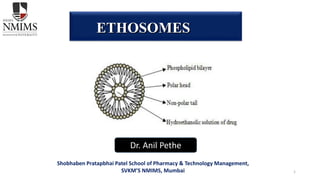
ETHOSOMES
Dr. Anil Pethe
Shobhaben Pratapbhai Patel School of Pharmacy & Technology Management,
SVKM’S NMIMS, Mumbai
Introduction
Types
Composition
Mechanism of Action
Advantages & Disadvantages
Characterization
Methods of Preparation
Application
Contents
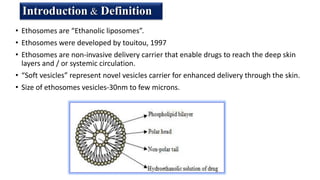
• Ethosomes are “Ethanolic liposomes”.
• Ethosomes were developed by touitou, 1997
• Ethosomes are non-invasive delivery carrier that enable drugs to reach the deep skin
layers and / or systemic circulation.
• “Soft vesicles” represent novel vesicles carrier for enhanced delivery through the skin.
• Size of ethosomes vesicles-30nm to few microns.
Introduction & Definition
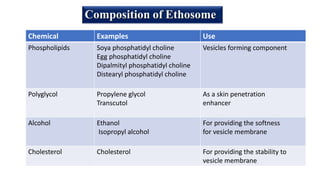
Composition of Ethosome
Chemical Examples Use
Phospholipids Soya phosphatidyl choline
Egg phosphatidyl choline
Dipalmityl phosphatidyl choline
Distearyl phosphatidyl choline
Vesicles forming component
Polyglycol Propylene glycol
Transcutol
As a skin penetration
enhancer
Alcohol Ethanol
Isopropyl alcohol
For providing the softness
for vesicle membrane
Cholesterol Cholesterol For providing the stability to
vesicle membrane
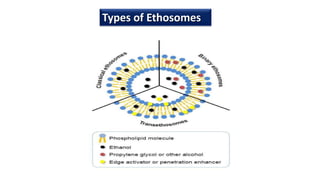
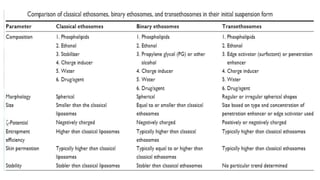
Types of Ethosomes
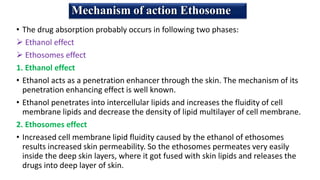
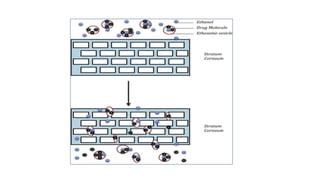
• The drug absorption probably occurs in following two phases:
 Ethanol effect
 Ethosomes effect
1. Ethanol effect
• Ethanol acts as a penetration enhancer through the skin. The mechanism of its
penetration enhancing effect is well known.
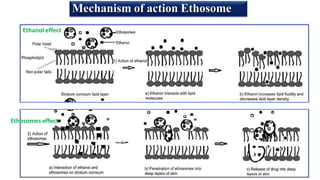
• Ethanol penetrates into intercellular lipids and increases the fluidity of cell
membrane lipids and decrease the density of lipid multilayer of cell membrane.
2. Ethosomes effect
• Increased cell membrane lipid fluidity caused by the ethanol of ethosomes
results increased skin permeability. So the ethosomes permeates very easily
inside the deep skin layers, where it got fused with skin lipids and releases the
drugs into deep layer of skin.
Mechanism of action Ethosome
Ethanol effect
Ethosomes effect
• Ethosomes enhance permeation of the drug through skin transdermal & dermal delivery.
• Ethosomes are platforms for the delivery of large & diverse groups of drugs (peptides,
protein molecules)
• Ethosomal systems are much more efficient at delivering a fluorescent probe (quantum
dots) to the skin in terms of quantity & depth.
• Low risk profile- the technology has no large scale drug development risk, as the
toxicological profiles of the ethosomes components are well documented in the scientific
literature.
• High patient compliance- the ethosomes drugs are administered in a semisolid form
(gel/cream), producing high patient compliance. In contrast, iontophoresis & phonophoresis
are relatively complicated to use, which will affect patient compliance.
• High market attractiveness for products with proprietary technology.
• Relatively simple to manufacture with no complicated technical investments required for
the production of ethosomes.
• The ethosomes system is passive, non-passive & available for immediate commercialization.
Advantages
Disadvantages
 Poor yield.
 In case if shell locking is ineffective then the ethosomes may
coalescence and fall apart on transfer into water.
 Loss of product during transfer form organic to water media.
• In this method Phospholipids, drug and other lipid materials are dissolved in
ethanol in a covered vessel at room temperature by vigorous stirring with the
use of mixer.
• Propylene glycol or other polyol is added at 40°C during stirring.
• This mixture is heated to 30°C on a water bath.
• The water heated to 30°C in a separate vessel is added to the mixture, which is
then stirred for 5 min in a covered vessel.
• The vesicle size of ethosomal formulation can be decreased to the desire extent
using probe sonication or extrusion method.
• Finally, the formulation is stored under refrigeration.
Method of Preparation of Ethosomes
Cold Method
Store under refrigeration
Size reduction by sonication or extrusion
Stir for 5 minuets in covered vessel
Add water at 30°C
Heat mix upto 30°C
Add Propylene Glycol at 40°C during stirring
Dissolve in Ethanol in covered vessel with vigorous stirring at RT
Phospholipid + Drug + Other lipid material
Cold Method
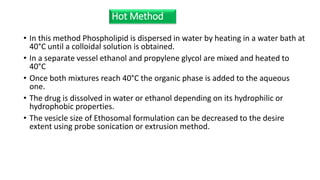
• In this method Phospholipid is dispersed in water by heating in a water bath at
40°C until a colloidal solution is obtained.
• In a separate vessel ethanol and propylene glycol are mixed and heated to
40°C
• Once both mixtures reach 40°C the organic phase is added to the aqueous
one.
• The drug is dissolved in water or ethanol depending on its hydrophilic or
hydrophobic properties.
• The vesicle size of Ethosomal formulation can be decreased to the desire
extent using probe sonication or extrusion method.
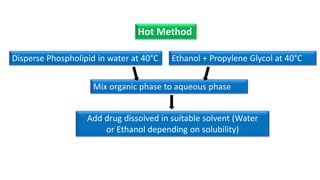
Hot Method
Disperse Phospholipid in water at 40°C Ethanol + Propylene Glycol at 40°C
Mix organic phase to aqueous phase
Add drug dissolved in suitable solvent (Water
or Ethanol depending on solubility)
Hot Method
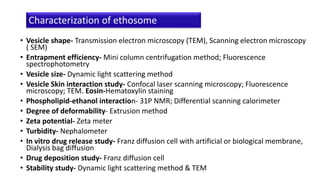
• Vesicle shape- Transmission electron microscopy (TEM), Scanning electron microscopy
( SEM)
• Entrapment efficiency- Mini column centrifugation method; Fluorescence
spectrophotometry
• Vesicle size- Dynamic light scattering method
• Vesicle Skin interaction study- Confocal laser scanning microscopy; Fluorescence
microscopy; TEM. Eosin-Hematoxylin staining
• Phospholipid-ethanol interaction- 31P NMR; Differential scanning calorimeter
• Degree of deformability- Extrusion method
• Zeta potential- Zeta meter
• Turbidity- Nephalometer
• In vitro drug release study- Franz diffusion cell with artificial or biological membrane,
Dialysis bag diffusion
• Drug deposition study- Franz diffusion cell
• Stability study- Dynamic light scattering method & TEM
Characterization of ethosome
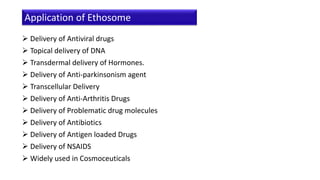
 Delivery of Antiviral drugs
 Topical delivery of DNA
 Transdermal delivery of Hormones.
 Delivery of Anti-parkinsonism agent
 Transcellular Delivery
 Delivery of Anti-Arthritis Drugs
 Delivery of Problematic drug molecules
 Delivery of Antibiotics
 Delivery of Antigen loaded Drugs
 Delivery of NSAIDS
 Widely used in Cosmoceuticals
Application of Ethosome
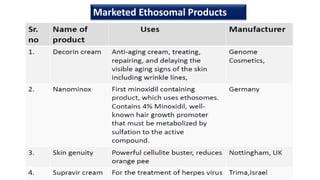
Marketed Ethosomal Products
• Introduction of ethosomes has initiated new area in transdermal drug
delivery
• Further research in this area will allow better control over drug release
in vivo allowing physicians to make therapy more efficient.
• It offers good opportunity for non-invasive delivery of small-,medium-
& large-sized drug molecules.
• Special emphasis given to skin delivery of proteins & other
macromolecules & for transcutaneous immunization.
Future Prospective

Ethosomes

  • 1.
    1 ETHOSOMES Dr. Anil Pethe ShobhabenPratapbhai Patel School of Pharmacy & Technology Management, SVKM’S NMIMS, Mumbai
  • 2.
    Introduction Types Composition Mechanism of Action Advantages& Disadvantages Characterization Methods of Preparation Application Contents
  • 3.
    • Ethosomes are“Ethanolic liposomes”. • Ethosomes were developed by touitou, 1997 • Ethosomes are non-invasive delivery carrier that enable drugs to reach the deep skin layers and / or systemic circulation. • “Soft vesicles” represent novel vesicles carrier for enhanced delivery through the skin. • Size of ethosomes vesicles-30nm to few microns. Introduction & Definition
  • 4.
    Composition of Ethosome ChemicalExamples Use Phospholipids Soya phosphatidyl choline Egg phosphatidyl choline Dipalmityl phosphatidyl choline Distearyl phosphatidyl choline Vesicles forming component Polyglycol Propylene glycol Transcutol As a skin penetration enhancer Alcohol Ethanol Isopropyl alcohol For providing the softness for vesicle membrane Cholesterol Cholesterol For providing the stability to vesicle membrane
  • 5.
  • 7.
    • The drugabsorption probably occurs in following two phases:  Ethanol effect  Ethosomes effect 1. Ethanol effect • Ethanol acts as a penetration enhancer through the skin. The mechanism of its penetration enhancing effect is well known. • Ethanol penetrates into intercellular lipids and increases the fluidity of cell membrane lipids and decrease the density of lipid multilayer of cell membrane. 2. Ethosomes effect • Increased cell membrane lipid fluidity caused by the ethanol of ethosomes results increased skin permeability. So the ethosomes permeates very easily inside the deep skin layers, where it got fused with skin lipids and releases the drugs into deep layer of skin. Mechanism of action Ethosome
  • 8.
    Mechanism of actionEthosome Ethanol effect Ethosomes effect
  • 10.
    • Ethosomes enhancepermeation of the drug through skin transdermal & dermal delivery. • Ethosomes are platforms for the delivery of large & diverse groups of drugs (peptides, protein molecules) • Ethosomal systems are much more efficient at delivering a fluorescent probe (quantum dots) to the skin in terms of quantity & depth. • Low risk profile- the technology has no large scale drug development risk, as the toxicological profiles of the ethosomes components are well documented in the scientific literature. • High patient compliance- the ethosomes drugs are administered in a semisolid form (gel/cream), producing high patient compliance. In contrast, iontophoresis & phonophoresis are relatively complicated to use, which will affect patient compliance. • High market attractiveness for products with proprietary technology. • Relatively simple to manufacture with no complicated technical investments required for the production of ethosomes. • The ethosomes system is passive, non-passive & available for immediate commercialization. Advantages
  • 11.
    Disadvantages  Poor yield. In case if shell locking is ineffective then the ethosomes may coalescence and fall apart on transfer into water.  Loss of product during transfer form organic to water media.
  • 12.
    • In thismethod Phospholipids, drug and other lipid materials are dissolved in ethanol in a covered vessel at room temperature by vigorous stirring with the use of mixer. • Propylene glycol or other polyol is added at 40°C during stirring. • This mixture is heated to 30°C on a water bath. • The water heated to 30°C in a separate vessel is added to the mixture, which is then stirred for 5 min in a covered vessel. • The vesicle size of ethosomal formulation can be decreased to the desire extent using probe sonication or extrusion method. • Finally, the formulation is stored under refrigeration. Method of Preparation of Ethosomes Cold Method
  • 13.
    Store under refrigeration Sizereduction by sonication or extrusion Stir for 5 minuets in covered vessel Add water at 30°C Heat mix upto 30°C Add Propylene Glycol at 40°C during stirring Dissolve in Ethanol in covered vessel with vigorous stirring at RT Phospholipid + Drug + Other lipid material Cold Method
  • 14.
    • In thismethod Phospholipid is dispersed in water by heating in a water bath at 40°C until a colloidal solution is obtained. • In a separate vessel ethanol and propylene glycol are mixed and heated to 40°C • Once both mixtures reach 40°C the organic phase is added to the aqueous one. • The drug is dissolved in water or ethanol depending on its hydrophilic or hydrophobic properties. • The vesicle size of Ethosomal formulation can be decreased to the desire extent using probe sonication or extrusion method. Hot Method
  • 15.
    Disperse Phospholipid inwater at 40°C Ethanol + Propylene Glycol at 40°C Mix organic phase to aqueous phase Add drug dissolved in suitable solvent (Water or Ethanol depending on solubility) Hot Method
  • 16.
    • Vesicle shape-Transmission electron microscopy (TEM), Scanning electron microscopy ( SEM) • Entrapment efficiency- Mini column centrifugation method; Fluorescence spectrophotometry • Vesicle size- Dynamic light scattering method • Vesicle Skin interaction study- Confocal laser scanning microscopy; Fluorescence microscopy; TEM. Eosin-Hematoxylin staining • Phospholipid-ethanol interaction- 31P NMR; Differential scanning calorimeter • Degree of deformability- Extrusion method • Zeta potential- Zeta meter • Turbidity- Nephalometer • In vitro drug release study- Franz diffusion cell with artificial or biological membrane, Dialysis bag diffusion • Drug deposition study- Franz diffusion cell • Stability study- Dynamic light scattering method & TEM Characterization of ethosome
  • 17.
     Delivery ofAntiviral drugs  Topical delivery of DNA  Transdermal delivery of Hormones.  Delivery of Anti-parkinsonism agent  Transcellular Delivery  Delivery of Anti-Arthritis Drugs  Delivery of Problematic drug molecules  Delivery of Antibiotics  Delivery of Antigen loaded Drugs  Delivery of NSAIDS  Widely used in Cosmoceuticals Application of Ethosome
  • 18.
  • 19.
    • Introduction ofethosomes has initiated new area in transdermal drug delivery • Further research in this area will allow better control over drug release in vivo allowing physicians to make therapy more efficient. • It offers good opportunity for non-invasive delivery of small-,medium- & large-sized drug molecules. • Special emphasis given to skin delivery of proteins & other macromolecules & for transcutaneous immunization. Future Prospective