Shobhaben Pratapbhai Patel School of Pharmacy & Technology Management,
SVKM’S NMIMS, Mumbai
Dr. Anil Pethe
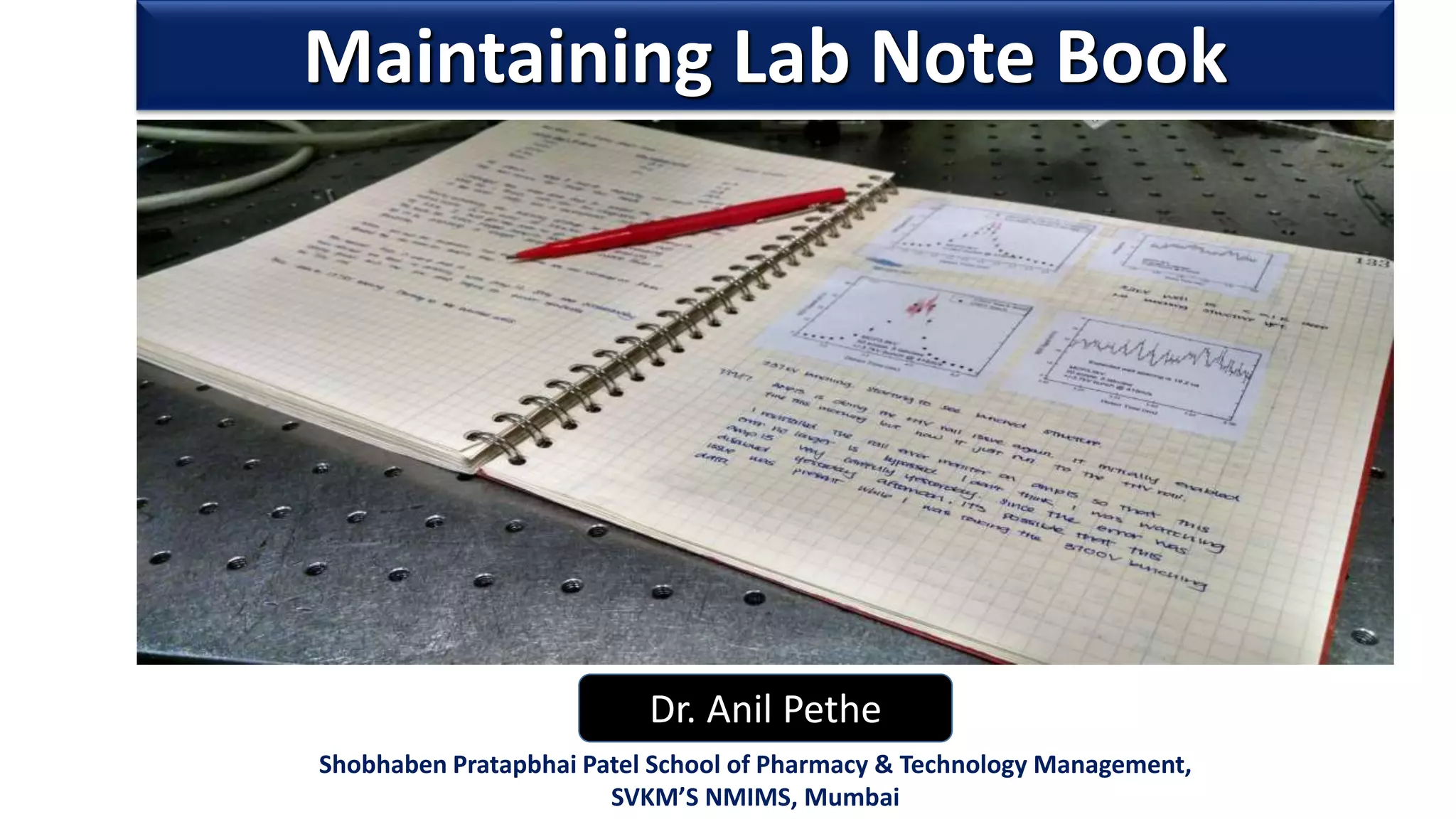
Maintaining Lab Note Book
Lab Note Book: Introduction
• One of the purposes of a lab notebook is to allow other people to gain a
clear picture of your work.
• Any researcher with a basic knowledge of common laboratory
techniques should be able to reproduce your results from your
notebook pages.
• A properly maintained notebook can help you with your own research
(you often need to reproduce your own results) and can save you money
(notebooks are used as evidence when granting patents).
• Lab notebook will be used during lab discussions, and it is expected that
it should be well maintained during such discussions.
Guidelines for maintaining lab note book
1. Most of the writing in the notebook should be during lab time and
not afterwards.
As Lab note books will be collected from the previous lab, you will have an
opportunity to do post-lab work if necessary.
This includes performing calculations or writing short (1-3 sentence)
summaries or conclusions.
You may also do pre-lab writing to help you prepare for the next lab. Both
post-lab and pre-lab writing must be clearly labelled as such.
It is not necessary to ā€œpretty upā€ your notebooks. Your notebook should be
clear and organized, but it is not a lab report.
2. Include everything in your notebook. Do not use separate scraps of
paper,
3. Write legibly in pen (no erasing or white-out).
ļ‚§ Draw a line through any mistakes; don’t scribble them out. Cross out all empty
spaces on a notebook page. If it is absolutely necessary to make a change or add a
comment to a notebook page after lab, clearly indicate what was added and when,
and sign your name near the new section.
4. At the top of each page, write the date and title of the experiment.
ļ‚§ If you are continuing from another page, write ā€œcontinued from p. #.ā€
At the bottom of each page, include your signature and the date.
ļ‚§ If your signature is not legible, please print your name clearly on the first page of your carbon
copies before giving them to us.
5. Before starting a protocol, include a short summary of what you are
trying to do and why.
ļ‚§ 2-3 sentences are usually enough.
Guidelines for maintaining lab note book
6. Include detailed descriptions of your experimental protocols and
observations. This will be the bulk of your notebook.
When making buffers and solutions, document how you made them, including
masses, moles, volumes, concentrations, type of container, reagent company
and lot number, etc.
When recording and analyzing data, pay attention to the significance of your
numbers. For example, if you are making a salt solution and the measurement
of the solution volume is limited to 2 significant digits, write the concentration
as 0.45 M and not 0.4521352 M.
Guidelines for maintaining lab note book
Describe all equipment you are using (e.g. ā€œShimadzu spectrophotometerā€).
When following a written protocol, you do not have to rewrite every word. It is
sufficient to reference where the protocol is written (e.g. ā€œI ran an SDS-PAGE gel
using the protocol from the J. Cont. Rel. 184 Reader, 2010 vol II, p.620ā€).
When referring to something that you have previously written in your notebook,
you can reference the previous page instead of rewriting the information (e.g. ā€œsee
the description on the bottom of p.027 of this notebookā€).
Pictures can be an effective way of recording your observations.
When collecting or analysing data on a computer, print out the result and tape the
data into your notebook. On the carbon copy of the page, briefly describe what is
taped to the page (e.g. ā€œPlot of absorbance at 254 nm versus time for the
Paracetamolā€).
If there are computer files associated with your data, write down the program
used, the computer and directory where the file is located, and the file name.
Guidelines for maintaining lab note book
7. Include a conclusion (2-4 sentences) at the end of each day.
Possible questions to address include:
ļ‚§ What have you learned from the day’s experiments?
ļ‚§ Was anything particularly difficult, easy, confusing, interesting, useful?
ļ‚§ How did your work get you closer to your final goal?
ļ‚§ Use this section to step back from the day’s work and look at your larger goals for the lab.
8. Be aware of the verb tense of your writing.
ļ‚§ If you are writing about a protocol that you have not done yet, use the future tense.
ļ‚§ If you are writing about a protocol you have just completed, use the past tense.
ļ‚§ Avoid the passive voice. Wording such as: ā€œthe column is equilibrated in Loading
Bufferā€ will create confusion as to whether you plan to perform this equilibration step
or whether you already have.
Guidelines for maintaining lab note book
Maintaining lab note book

Maintaining lab note book

  • 1.
    Shobhaben Pratapbhai PatelSchool of Pharmacy & Technology Management, SVKM’S NMIMS, Mumbai Dr. Anil Pethe Maintaining Lab Note Book
  • 2.
    Lab Note Book:Introduction • One of the purposes of a lab notebook is to allow other people to gain a clear picture of your work. • Any researcher with a basic knowledge of common laboratory techniques should be able to reproduce your results from your notebook pages. • A properly maintained notebook can help you with your own research (you often need to reproduce your own results) and can save you money (notebooks are used as evidence when granting patents). • Lab notebook will be used during lab discussions, and it is expected that it should be well maintained during such discussions.
  • 3.
    Guidelines for maintaininglab note book 1. Most of the writing in the notebook should be during lab time and not afterwards. As Lab note books will be collected from the previous lab, you will have an opportunity to do post-lab work if necessary. This includes performing calculations or writing short (1-3 sentence) summaries or conclusions. You may also do pre-lab writing to help you prepare for the next lab. Both post-lab and pre-lab writing must be clearly labelled as such. It is not necessary to ā€œpretty upā€ your notebooks. Your notebook should be clear and organized, but it is not a lab report. 2. Include everything in your notebook. Do not use separate scraps of paper,
  • 4.
    3. Write legiblyin pen (no erasing or white-out). ļ‚§ Draw a line through any mistakes; don’t scribble them out. Cross out all empty spaces on a notebook page. If it is absolutely necessary to make a change or add a comment to a notebook page after lab, clearly indicate what was added and when, and sign your name near the new section. 4. At the top of each page, write the date and title of the experiment. ļ‚§ If you are continuing from another page, write ā€œcontinued from p. #.ā€ At the bottom of each page, include your signature and the date. ļ‚§ If your signature is not legible, please print your name clearly on the first page of your carbon copies before giving them to us. 5. Before starting a protocol, include a short summary of what you are trying to do and why. ļ‚§ 2-3 sentences are usually enough. Guidelines for maintaining lab note book
  • 5.
    6. Include detaileddescriptions of your experimental protocols and observations. This will be the bulk of your notebook. When making buffers and solutions, document how you made them, including masses, moles, volumes, concentrations, type of container, reagent company and lot number, etc. When recording and analyzing data, pay attention to the significance of your numbers. For example, if you are making a salt solution and the measurement of the solution volume is limited to 2 significant digits, write the concentration as 0.45 M and not 0.4521352 M. Guidelines for maintaining lab note book
  • 6.
    Describe all equipmentyou are using (e.g. ā€œShimadzu spectrophotometerā€). When following a written protocol, you do not have to rewrite every word. It is sufficient to reference where the protocol is written (e.g. ā€œI ran an SDS-PAGE gel using the protocol from the J. Cont. Rel. 184 Reader, 2010 vol II, p.620ā€). When referring to something that you have previously written in your notebook, you can reference the previous page instead of rewriting the information (e.g. ā€œsee the description on the bottom of p.027 of this notebookā€). Pictures can be an effective way of recording your observations. When collecting or analysing data on a computer, print out the result and tape the data into your notebook. On the carbon copy of the page, briefly describe what is taped to the page (e.g. ā€œPlot of absorbance at 254 nm versus time for the Paracetamolā€). If there are computer files associated with your data, write down the program used, the computer and directory where the file is located, and the file name. Guidelines for maintaining lab note book
  • 7.
    7. Include aconclusion (2-4 sentences) at the end of each day. Possible questions to address include: ļ‚§ What have you learned from the day’s experiments? ļ‚§ Was anything particularly difficult, easy, confusing, interesting, useful? ļ‚§ How did your work get you closer to your final goal? ļ‚§ Use this section to step back from the day’s work and look at your larger goals for the lab. 8. Be aware of the verb tense of your writing. ļ‚§ If you are writing about a protocol that you have not done yet, use the future tense. ļ‚§ If you are writing about a protocol you have just completed, use the past tense. ļ‚§ Avoid the passive voice. Wording such as: ā€œthe column is equilibrated in Loading Bufferā€ will create confusion as to whether you plan to perform this equilibration step or whether you already have. Guidelines for maintaining lab note book