Seminar 
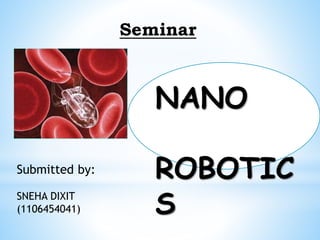
NANO 
ROBOTIC 
S 
Submitted by: 
SNEHA DIXIT 
(1106454041)
CONTENTS 
• Introduction 
• Few words about Nanorobotics 
• Design & Control of Nanorobotics 
• Applications of Nanorobotics 
• Benefits & Limitations of Nanorobotics 
• Future of Nanorobotics 
• Conclusion
Definition of 
nanotechnology 
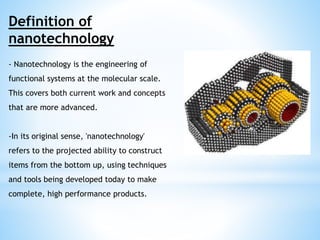
- Nanotechnology is the engineering of 
functional systems at the molecular scale. 
This covers both current work and concepts 
that are more advanced. 
-In its original sense, 'nanotechnology' 
refers to the projected ability to construct 
items from the bottom up, using techniques 
and tools being developed today to make 
complete, high performance products.
Definition of Nano-robotics 
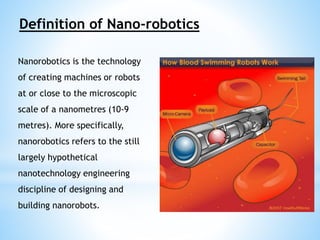
Nanorobotics is the technology 
of creating machines or robots 
at or close to the microscopic 
scale of a nanometres (10-9 
metres). More specifically, 
nanorobotics refers to the still 
largely hypothetical 
nanotechnology engineering 
discipline of designing and 
building nanorobots.
Few Words About Nanorobotics : 
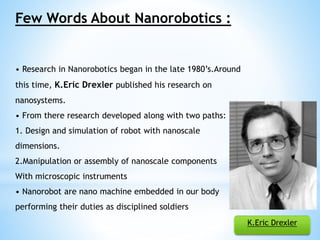
• Research in Nanorobotics began in the late 1980’s.Around 
this time, K.Eric Drexler published his research on 
nanosystems. 
• From there research developed along with two paths: 
1. Design and simulation of robot with nanoscale 
dimensions. 
2.Manipulation or assembly of nanoscale components 
With microscopic instruments 
• Nanorobot are nano machine embedded in our body 
performing their duties as disciplined soldiers 
K.Eric Drexler
Control And Design of Nanorobots 
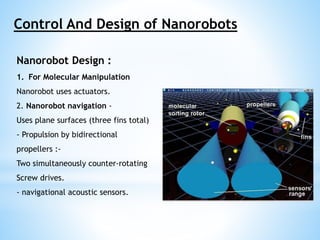
Nanorobot Design : 
1. For Molecular Manipulation 
Nanorobot uses actuators. 
2. Nanorobot navigation - 
Uses plane surfaces (three fins total) 
- Propulsion by bidirectional 
propellers :- 
Two simultaneously counter-rotating 
Screw drives. 
- navigational acoustic sensors.
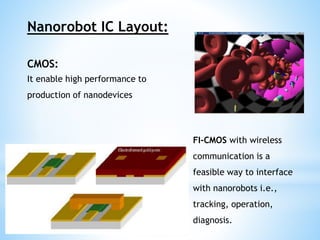
Nanorobot IC Layout: 
CMOS: 
It enable high performance to 
production of nanodevices 
FI-CMOS with wireless 
communication is a 
feasible way to interface 
with nanorobots i.e., 
tracking, operation, 
diagnosis.
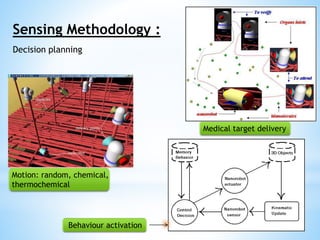
Sensing Methodology : 
Decision planning 
Motion: random, chemical, 
thermochemical 
Medical target delivery 
Behaviour activation
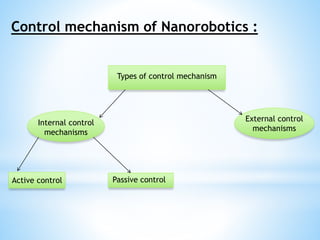
Control mechanism of Nanorobotics : 
Active control 
Types of control mechanism 
Internal control 
mechanisms 
External control 
mechanisms 
Passive control
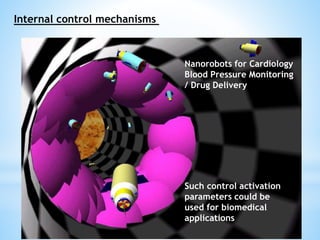
Internal control mechanisms 
Nanorobots for Cardiology 
Blood Pressure Monitoring 
/ Drug Delivery 
Such control activation 
parameters could be 
used for biomedical 
applications
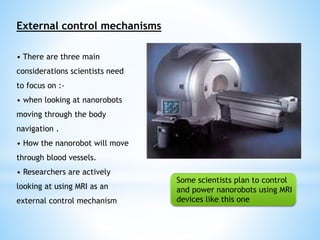
External control mechanisms 
• There are three main 
considerations scientists need 
to focus on :- 
• when looking at nanorobots 
moving through the body 
navigation . 
• How the nanorobot will move 
through blood vessels. 
• Researchers are actively 
looking at using MRI as an 
external control mechanism 
Some scientists plan to control 
and power nanorobots using MRI 
devices like this one
Applications Of Nanorobotics 
1. In Medical Area 
- Tumors 
- Arteriosclerosis 
- Kidney Stones 
- Burn and wound debriding 
- Blood clots 
- Diabetes 
2. In Space-ship
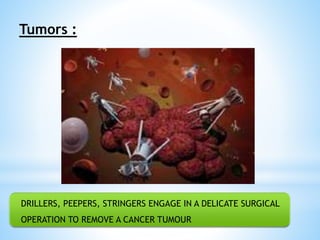
Tumors : 
DRILLERS, PEEPERS, STRINGERS ENGAGE IN A DELICATE SURGICAL 
OPERATION TO REMOVE A CANCER TUMOUR
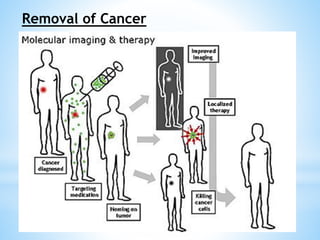
Removal of Cancer
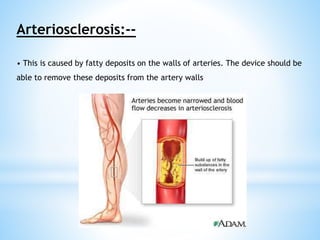
Arteriosclerosis:-- 
• This is caused by fatty deposits on the walls of arteries. The device should be 
able to remove these deposits from the artery walls
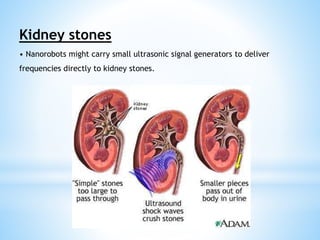
Kidney stones 
• Nanorobots might carry small ultrasonic signal generators to deliver 
frequencies directly to kidney stones.
Burn and wound debriding :-- 
• The nanorobots can also be used to clean wounds and burns. 
Blood clots:-- 
• By using a nanorobot in the body to break up such clots into 
smaller pieces before they have a chance to break free and move 
on their own.
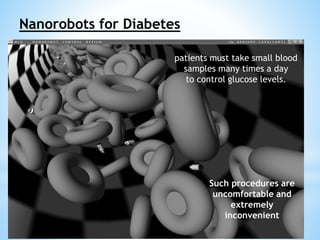
Nanorobots for Diabetes 
patients must take small blood 
samples many times a day 
to control glucose levels. 
Such procedures are 
uncomfortable and 
extremely 
inconvenient
In Space-ship 
• Nanorobots could improve the performance of spaceships, spacesuits 
and equipment used to explore planets and moons. 
• Protecting the astronauts by including layers of bio-nano robots in 
their spacesuits. The outer layer of bio-nano robots would respond to 
damages to the spacesuit, for example to seal up punctures. An inner 
layer of bio-nano robots could respond if the astronaut was in trouble, 
for example by providing drugs in a medical emergency.
Benefits of Nanorobotics 
• Speed up of Medical Treatment. 
• Faster and More Precise Diagnosis. 
• Verification of Progress and Treatment. 
• Minimum Side Effects. 
• Nano-structuring is expected to bring about lighter, stronger 
and programmable materials. 
• Non-degradation of Treatment Agents.
Benefits of Nanorobotics 
• In medical field we will have microscopic robots floating in our 
blood streams fighting against cancer cells, AIDS HIV virus, 
genetic disorders or even ageing. 
• Some of the novel inventions like airplanes, space crafts and 
other transport made from lightweight material are possible 
with nano-techniques. 
• Computers billions of times faster and with massive memory 
but with minuscule storage devices.
Limitations of Nanorobotics 
• Nano particles will penetrate living cells and accumulate in animal 
organs, and can perhaps enter the food chain. 
• There is no regulatory body dedicated to check this potent and 
powerful invasion. 
• Their impact on environment is unknown e.g. Nanotubes of carbon use 
gallium & arsenic and minute traces of gallium arsenide in the body could 
prove toxic.
Limitations of Nanorobotics 
• Changes in the proteins due to the presence of nano particles in the 
blood stream could trigger dangerous effects like blood clotting. 
• A whole new class of toxins or the environmental problems 
may be created due to nanotechnology. 
• Reaction of humans and existing environment to these nanoparticles 
and nanobots and their acceptance is not known.
Future Of Nanorobotics …. 
1. In Industry and Manufacturing 
2. In supercomputer 
3. In Brain Augmentation 
4. To Improve Healthcare
In Industry and Manufacturing 
• To replace heavy machinery with nano-devices. 
• To replace employees with many nano-robots. 
• To change view of industry in their possible capabilities, 
their new ideas, their research trend ,also mentality of 
the industrial man.
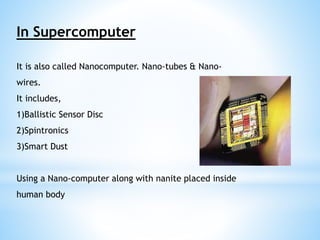
In Supercomputer 
It is also called Nanocomputer. Nano-tubes & Nano-wires. 
It includes, 
1)Ballistic Sensor Disc 
2)Spintronics 
3)Smart Dust 
Using a Nano-computer along with nanite placed inside 
human body
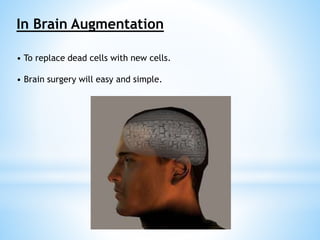
In Brain Augmentation 
• To replace dead cells with new cells. 
• Brain surgery will easy and simple.
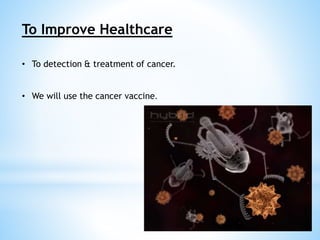
To Improve Healthcare 
• To detection & treatment of cancer. 
• We will use the cancer vaccine.
Conclusion 
• From these types of inventions, it will be useful for man to cure many 
diseases & to lead a fantastic life. 
• The same technique is used in various treatments like cancer, breaking 
kidney stones, brain surgery, heart surgery .With in ten year several 
advancement technologies. 
• However, finally we wish all the best for all scientists, who are going to 
implement the nano-robots in future. 
• One day will be come thousands of microscopic robots in human 
surroundings.
ANY QUESTIONS…
Biorobots

Biorobots

  • 1.
    Seminar NANO ROBOTIC S Submitted by: SNEHA DIXIT (1106454041)
  • 2.
    CONTENTS • Introduction • Few words about Nanorobotics • Design & Control of Nanorobotics • Applications of Nanorobotics • Benefits & Limitations of Nanorobotics • Future of Nanorobotics • Conclusion
  • 3.
    Definition of nanotechnology - Nanotechnology is the engineering of functional systems at the molecular scale. This covers both current work and concepts that are more advanced. -In its original sense, 'nanotechnology' refers to the projected ability to construct items from the bottom up, using techniques and tools being developed today to make complete, high performance products.
  • 4.
    Definition of Nano-robotics Nanorobotics is the technology of creating machines or robots at or close to the microscopic scale of a nanometres (10-9 metres). More specifically, nanorobotics refers to the still largely hypothetical nanotechnology engineering discipline of designing and building nanorobots.
  • 5.
    Few Words AboutNanorobotics : • Research in Nanorobotics began in the late 1980’s.Around this time, K.Eric Drexler published his research on nanosystems. • From there research developed along with two paths: 1. Design and simulation of robot with nanoscale dimensions. 2.Manipulation or assembly of nanoscale components With microscopic instruments • Nanorobot are nano machine embedded in our body performing their duties as disciplined soldiers K.Eric Drexler
  • 6.
    Control And Designof Nanorobots Nanorobot Design : 1. For Molecular Manipulation Nanorobot uses actuators. 2. Nanorobot navigation - Uses plane surfaces (three fins total) - Propulsion by bidirectional propellers :- Two simultaneously counter-rotating Screw drives. - navigational acoustic sensors.
  • 7.
    Nanorobot IC Layout: CMOS: It enable high performance to production of nanodevices FI-CMOS with wireless communication is a feasible way to interface with nanorobots i.e., tracking, operation, diagnosis.
  • 8.
    Sensing Methodology : Decision planning Motion: random, chemical, thermochemical Medical target delivery Behaviour activation
  • 9.
    Control mechanism ofNanorobotics : Active control Types of control mechanism Internal control mechanisms External control mechanisms Passive control
  • 10.
    Internal control mechanisms Nanorobots for Cardiology Blood Pressure Monitoring / Drug Delivery Such control activation parameters could be used for biomedical applications
  • 11.
    External control mechanisms • There are three main considerations scientists need to focus on :- • when looking at nanorobots moving through the body navigation . • How the nanorobot will move through blood vessels. • Researchers are actively looking at using MRI as an external control mechanism Some scientists plan to control and power nanorobots using MRI devices like this one
  • 12.
    Applications Of Nanorobotics 1. In Medical Area - Tumors - Arteriosclerosis - Kidney Stones - Burn and wound debriding - Blood clots - Diabetes 2. In Space-ship
  • 13.
    Tumors : DRILLERS,PEEPERS, STRINGERS ENGAGE IN A DELICATE SURGICAL OPERATION TO REMOVE A CANCER TUMOUR
  • 14.
  • 15.
    Arteriosclerosis:-- • Thisis caused by fatty deposits on the walls of arteries. The device should be able to remove these deposits from the artery walls
  • 16.
    Kidney stones •Nanorobots might carry small ultrasonic signal generators to deliver frequencies directly to kidney stones.
  • 17.
    Burn and wounddebriding :-- • The nanorobots can also be used to clean wounds and burns. Blood clots:-- • By using a nanorobot in the body to break up such clots into smaller pieces before they have a chance to break free and move on their own.
  • 18.
    Nanorobots for Diabetes patients must take small blood samples many times a day to control glucose levels. Such procedures are uncomfortable and extremely inconvenient
  • 19.
    In Space-ship •Nanorobots could improve the performance of spaceships, spacesuits and equipment used to explore planets and moons. • Protecting the astronauts by including layers of bio-nano robots in their spacesuits. The outer layer of bio-nano robots would respond to damages to the spacesuit, for example to seal up punctures. An inner layer of bio-nano robots could respond if the astronaut was in trouble, for example by providing drugs in a medical emergency.
  • 20.
    Benefits of Nanorobotics • Speed up of Medical Treatment. • Faster and More Precise Diagnosis. • Verification of Progress and Treatment. • Minimum Side Effects. • Nano-structuring is expected to bring about lighter, stronger and programmable materials. • Non-degradation of Treatment Agents.
  • 21.
    Benefits of Nanorobotics • In medical field we will have microscopic robots floating in our blood streams fighting against cancer cells, AIDS HIV virus, genetic disorders or even ageing. • Some of the novel inventions like airplanes, space crafts and other transport made from lightweight material are possible with nano-techniques. • Computers billions of times faster and with massive memory but with minuscule storage devices.
  • 22.
    Limitations of Nanorobotics • Nano particles will penetrate living cells and accumulate in animal organs, and can perhaps enter the food chain. • There is no regulatory body dedicated to check this potent and powerful invasion. • Their impact on environment is unknown e.g. Nanotubes of carbon use gallium & arsenic and minute traces of gallium arsenide in the body could prove toxic.
  • 23.
    Limitations of Nanorobotics • Changes in the proteins due to the presence of nano particles in the blood stream could trigger dangerous effects like blood clotting. • A whole new class of toxins or the environmental problems may be created due to nanotechnology. • Reaction of humans and existing environment to these nanoparticles and nanobots and their acceptance is not known.
  • 24.
    Future Of Nanorobotics…. 1. In Industry and Manufacturing 2. In supercomputer 3. In Brain Augmentation 4. To Improve Healthcare
  • 25.
    In Industry andManufacturing • To replace heavy machinery with nano-devices. • To replace employees with many nano-robots. • To change view of industry in their possible capabilities, their new ideas, their research trend ,also mentality of the industrial man.
  • 26.
    In Supercomputer Itis also called Nanocomputer. Nano-tubes & Nano-wires. It includes, 1)Ballistic Sensor Disc 2)Spintronics 3)Smart Dust Using a Nano-computer along with nanite placed inside human body
  • 27.
    In Brain Augmentation • To replace dead cells with new cells. • Brain surgery will easy and simple.
  • 28.
    To Improve Healthcare • To detection & treatment of cancer. • We will use the cancer vaccine.
  • 29.
    Conclusion • Fromthese types of inventions, it will be useful for man to cure many diseases & to lead a fantastic life. • The same technique is used in various treatments like cancer, breaking kidney stones, brain surgery, heart surgery .With in ten year several advancement technologies. • However, finally we wish all the best for all scientists, who are going to implement the nano-robots in future. • One day will be come thousands of microscopic robots in human surroundings.
  • 30.