AHA Scientific Statement

 Management of Massive &
 Submassive Pulmonary Embolism,
 Iliofemoral Deep Vein Thrombosis,
 and Chronic Thromboembolic
 Pulmonary Hypertension

       Circulation. 2011;123:1788-1830
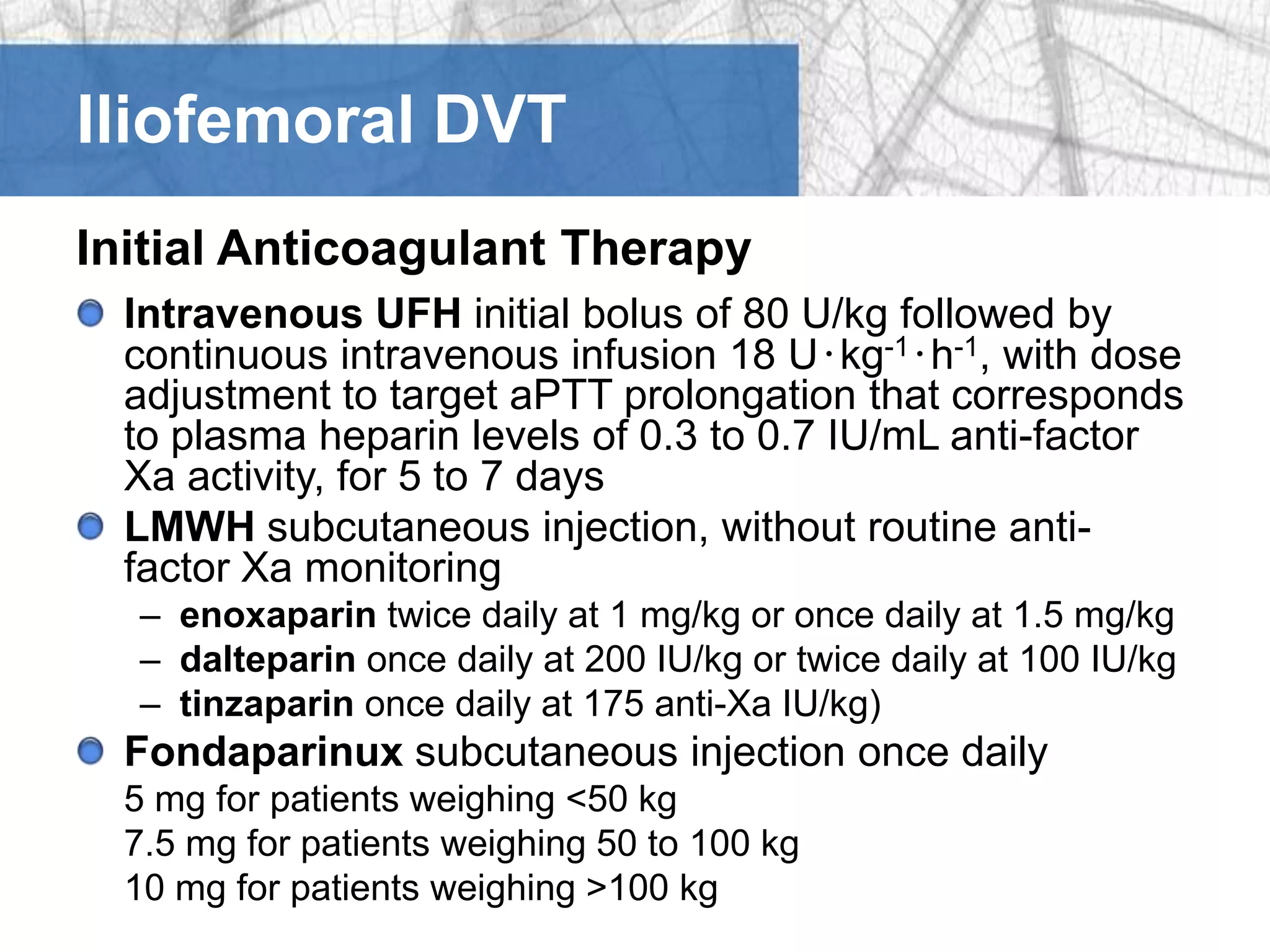
Iliofemoral DVT
Initial Anticoagulant Therapy
  Intravenous UFH initial bolus of 80 U/kg followed by
  continuous intravenous infusion 18 U‧kg-1‧h-1, with dose
  adjustment to target aPTT prolongation that corresponds
  to plasma heparin levels of 0.3 to 0.7 IU/mL anti-factor
  Xa activity, for 5 to 7 days
  LMWH subcutaneous injection, without routine anti-
  factor Xa monitoring
  – enoxaparin twice daily at 1 mg/kg or once daily at 1.5 mg/kg
  – dalteparin once daily at 200 IU/kg or twice daily at 100 IU/kg
  – tinzaparin once daily at 175 anti-Xa IU/kg)
  Fondaparinux subcutaneous injection once daily
  5 mg for patients weighing <50 kg
  7.5 mg for patients weighing 50 to 100 kg
  10 mg for patients weighing >100 kg
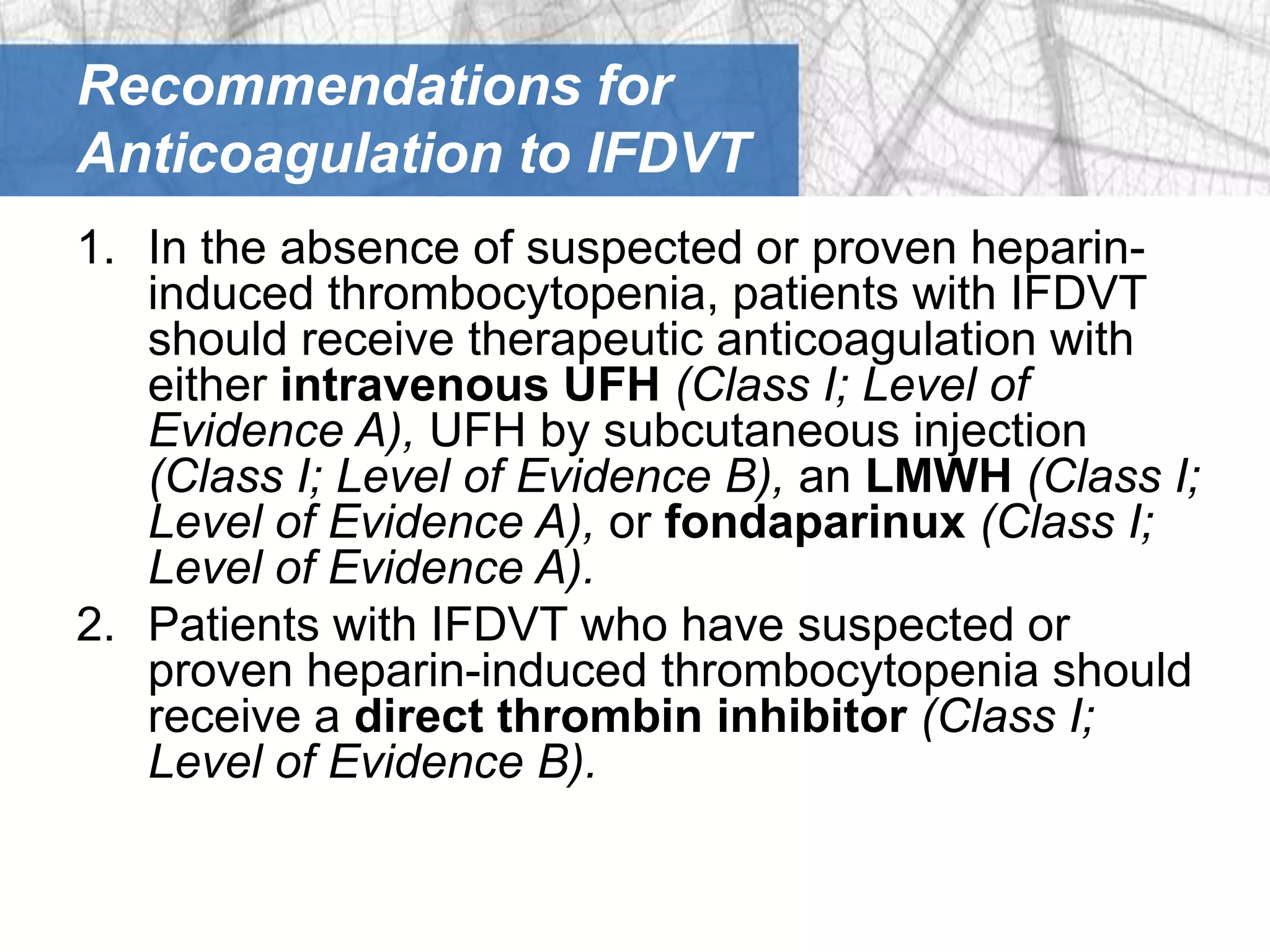
Recommendations for
Anticoagulation to IFDVT
1. In the absence of suspected or proven heparin-
   induced thrombocytopenia, patients with IFDVT
   should receive therapeutic anticoagulation with
   either intravenous UFH (Class I; Level of
   Evidence A), UFH by subcutaneous injection
   (Class I; Level of Evidence B), an LMWH (Class I;
   Level of Evidence A), or fondaparinux (Class I;
   Level of Evidence A).
2. Patients with IFDVT who have suspected or
   proven heparin-induced thrombocytopenia should
   receive a direct thrombin inhibitor (Class I;
   Level of Evidence B).
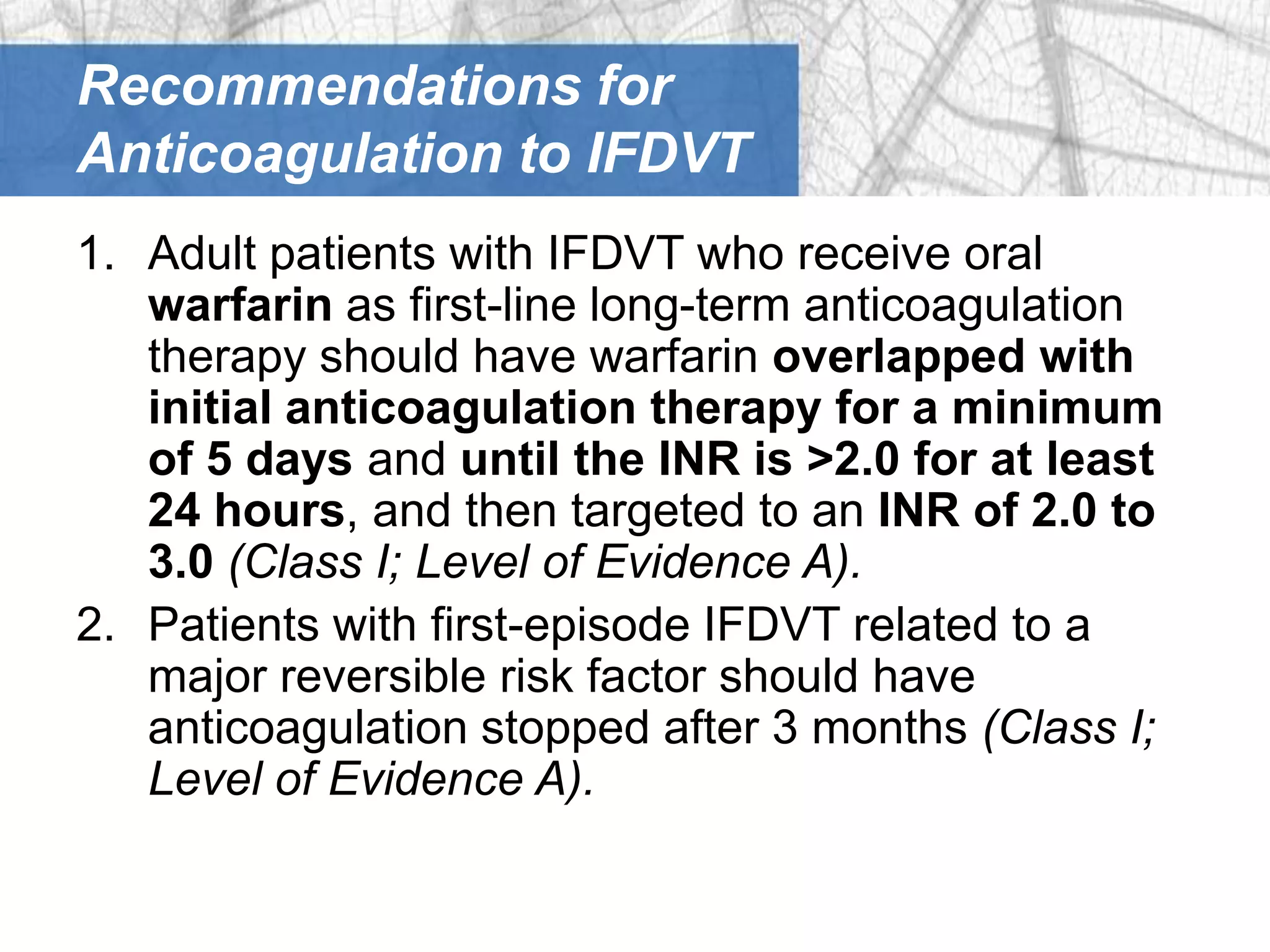
Recommendations for
Anticoagulation to IFDVT
1. Adult patients with IFDVT who receive oral
   warfarin as first-line long-term anticoagulation
   therapy should have warfarin overlapped with
   initial anticoagulation therapy for a minimum
   of 5 days and until the INR is >2.0 for at least
   24 hours, and then targeted to an INR of 2.0 to
   3.0 (Class I; Level of Evidence A).
2. Patients with first-episode IFDVT related to a
   major reversible risk factor should have
   anticoagulation stopped after 3 months (Class I;
   Level of Evidence A).
Recommendations for
Anticoagulation to IFDVT
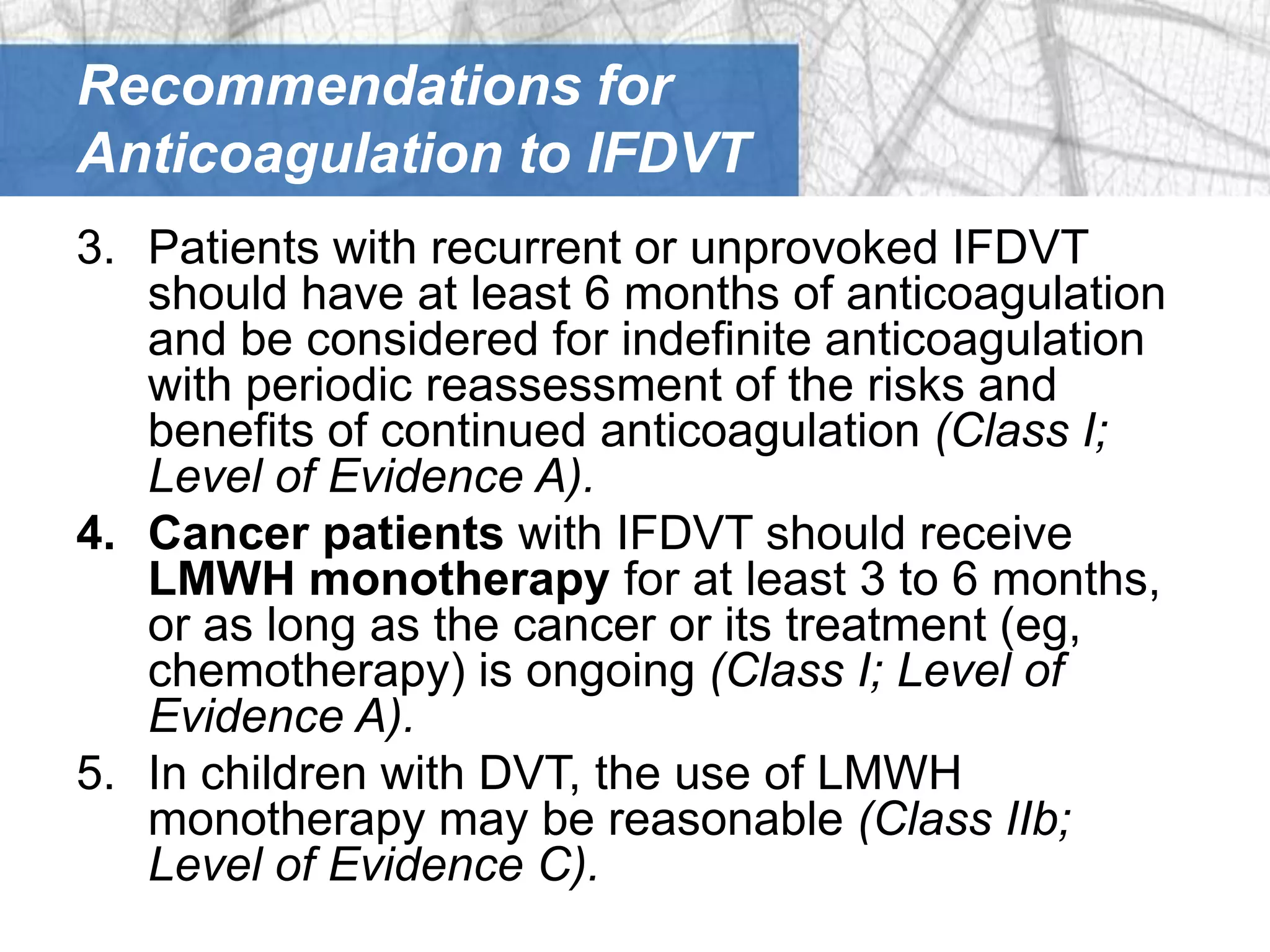
3. Patients with recurrent or unprovoked IFDVT
   should have at least 6 months of anticoagulation
   and be considered for indefinite anticoagulation
   with periodic reassessment of the risks and
   benefits of continued anticoagulation (Class I;
   Level of Evidence A).
4. Cancer patients with IFDVT should receive
   LMWH monotherapy for at least 3 to 6 months,
   or as long as the cancer or its treatment (eg,
   chemotherapy) is ongoing (Class I; Level of
   Evidence A).
5. In children with DVT, the use of LMWH
   monotherapy may be reasonable (Class IIb;
   Level of Evidence C).
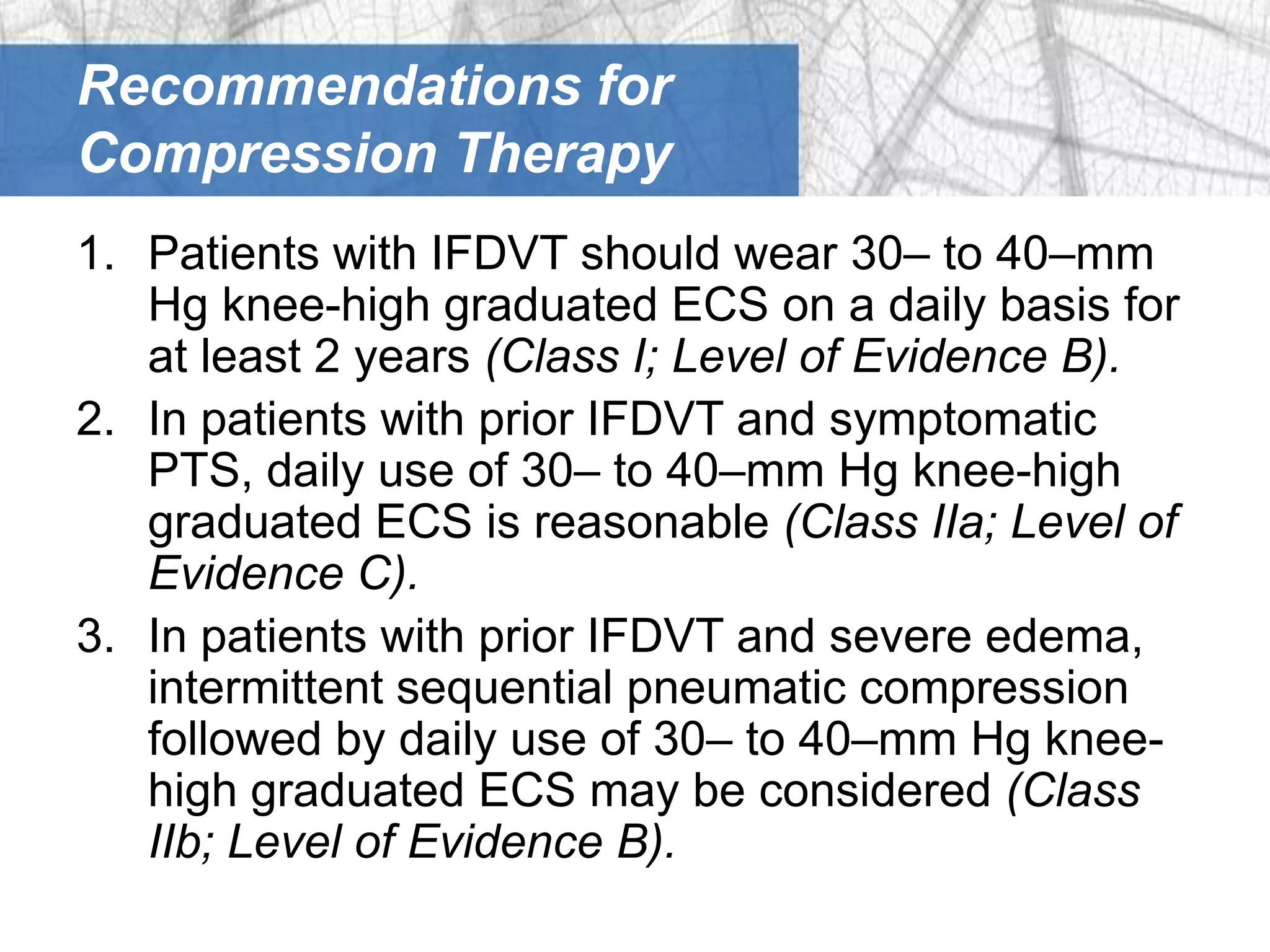
Recommendations for
Compression Therapy
1. Patients with IFDVT should wear 30– to 40–mm
   Hg knee-high graduated ECS on a daily basis for
   at least 2 years (Class I; Level of Evidence B).
2. In patients with prior IFDVT and symptomatic
   PTS, daily use of 30– to 40–mm Hg knee-high
   graduated ECS is reasonable (Class IIa; Level of
   Evidence C).
3. In patients with prior IFDVT and severe edema,
   intermittent sequential pneumatic compression
   followed by daily use of 30– to 40–mm Hg knee-
   high graduated ECS may be considered (Class
   IIb; Level of Evidence B).
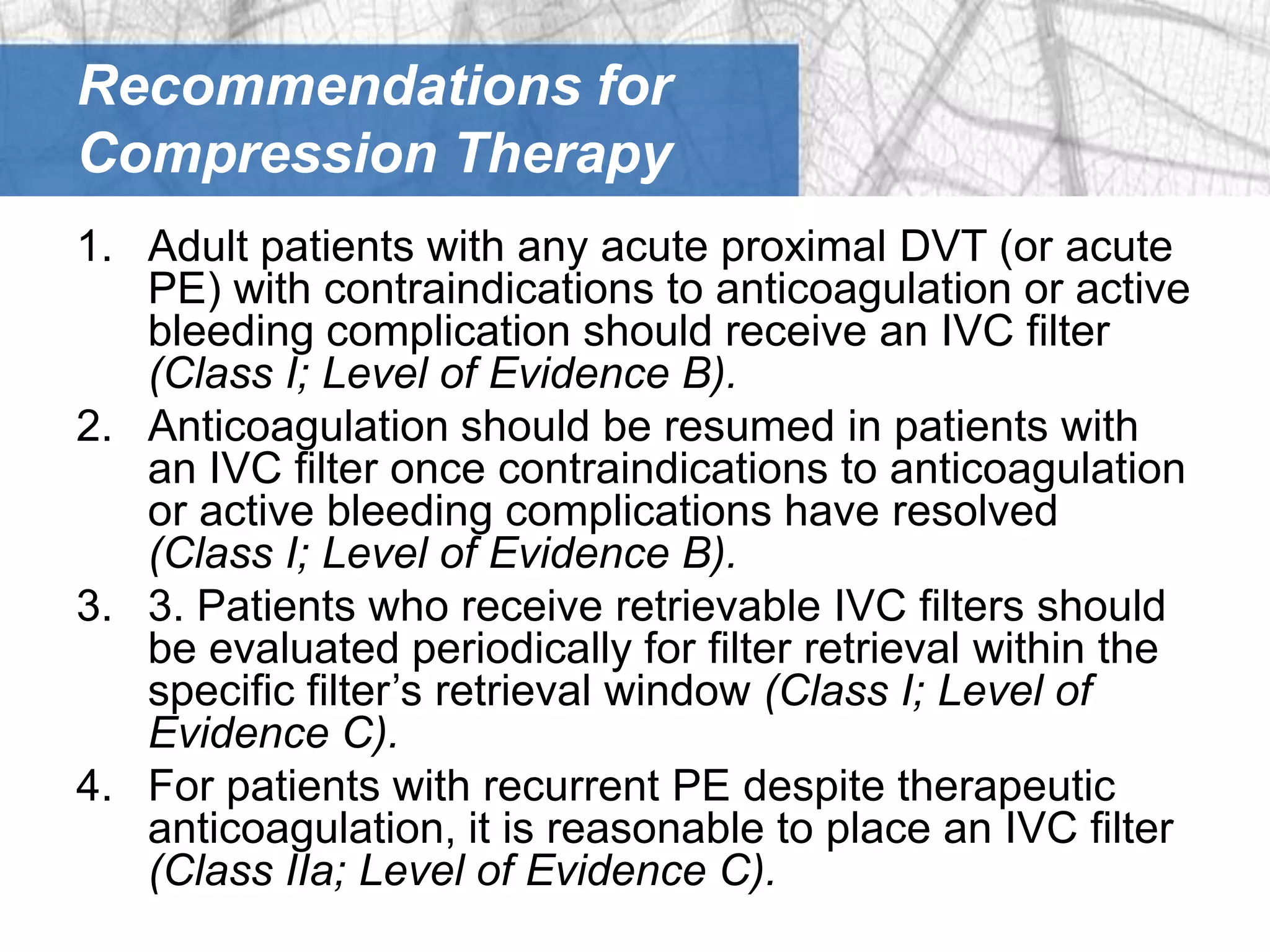
Recommendations for
Compression Therapy
1. Adult patients with any acute proximal DVT (or acute
   PE) with contraindications to anticoagulation or active
   bleeding complication should receive an IVC filter
   (Class I; Level of Evidence B).
2. Anticoagulation should be resumed in patients with
   an IVC filter once contraindications to anticoagulation
   or active bleeding complications have resolved
   (Class I; Level of Evidence B).
3. 3. Patients who receive retrievable IVC filters should
   be evaluated periodically for filter retrieval within the
   specific filter’s retrieval window (Class I; Level of
   Evidence C).
4. For patients with recurrent PE despite therapeutic
   anticoagulation, it is reasonable to place an IVC filter
   (Class IIa; Level of Evidence C).
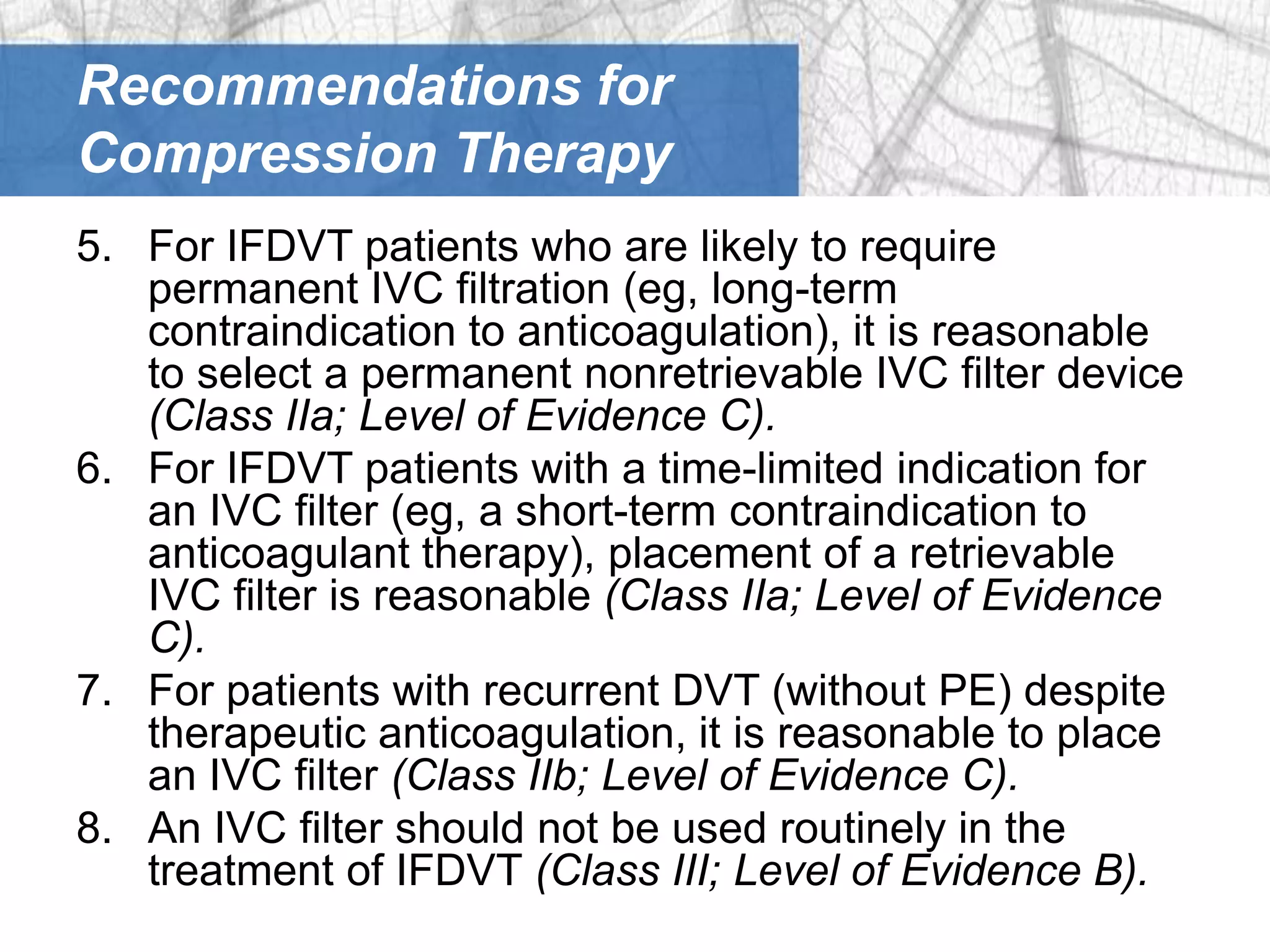
Recommendations for
Compression Therapy
5. For IFDVT patients who are likely to require
   permanent IVC filtration (eg, long-term
   contraindication to anticoagulation), it is reasonable
   to select a permanent nonretrievable IVC filter device
   (Class IIa; Level of Evidence C).
6. For IFDVT patients with a time-limited indication for
   an IVC filter (eg, a short-term contraindication to
   anticoagulant therapy), placement of a retrievable
   IVC filter is reasonable (Class IIa; Level of Evidence
   C).
7. For patients with recurrent DVT (without PE) despite
   therapeutic anticoagulation, it is reasonable to place
   an IVC filter (Class IIb; Level of Evidence C).
8. An IVC filter should not be used routinely in the
   treatment of IFDVT (Class III; Level of Evidence B).
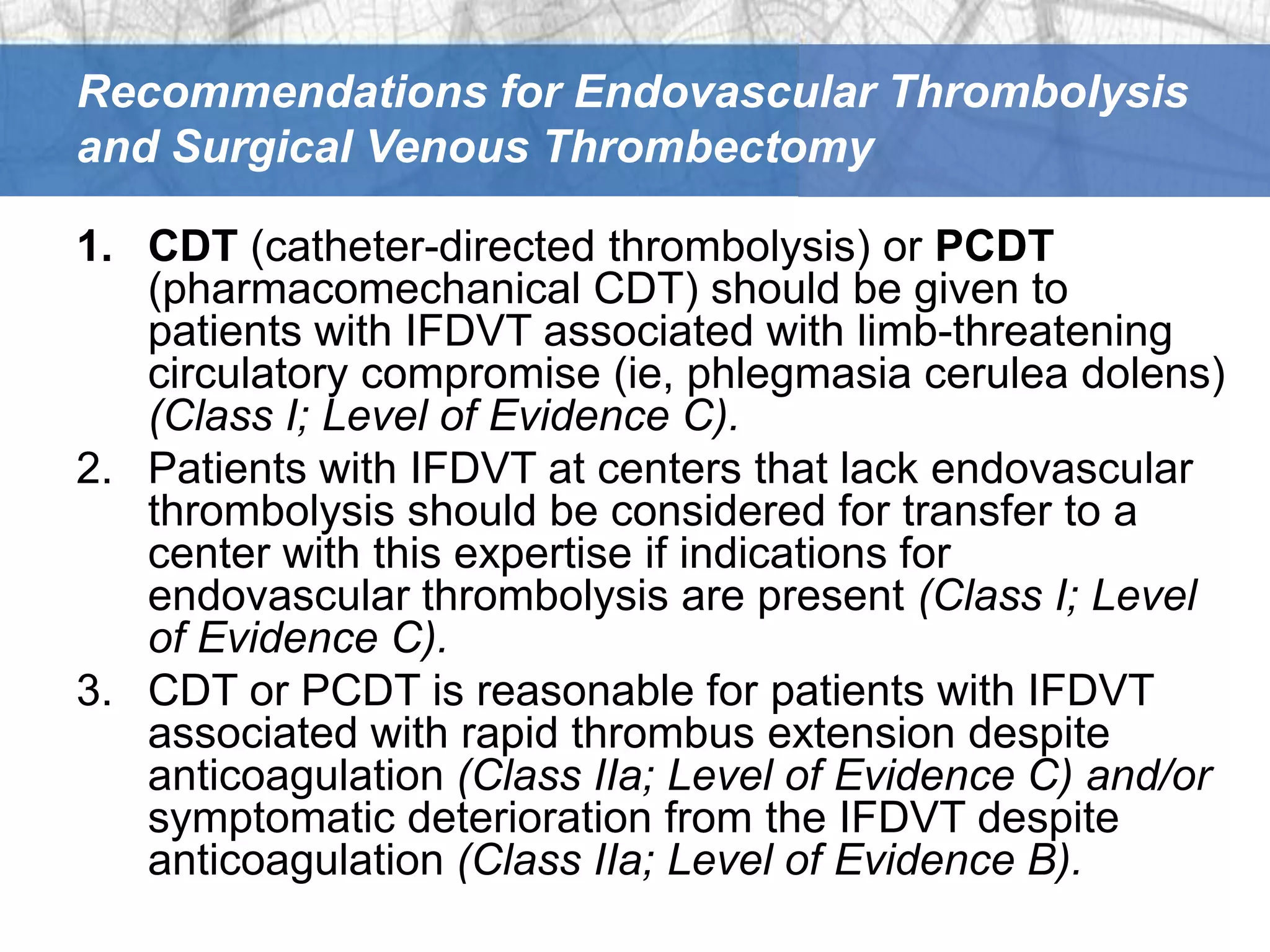
Recommendations for Endovascular Thrombolysis
and Surgical Venous Thrombectomy

1. CDT (catheter-directed thrombolysis) or PCDT
   (pharmacomechanical CDT) should be given to
   patients with IFDVT associated with limb-threatening
   circulatory compromise (ie, phlegmasia cerulea dolens)
   (Class I; Level of Evidence C).
2. Patients with IFDVT at centers that lack endovascular
   thrombolysis should be considered for transfer to a
   center with this expertise if indications for
   endovascular thrombolysis are present (Class I; Level
   of Evidence C).
3. CDT or PCDT is reasonable for patients with IFDVT
   associated with rapid thrombus extension despite
   anticoagulation (Class IIa; Level of Evidence C) and/or
   symptomatic deterioration from the IFDVT despite
   anticoagulation (Class IIa; Level of Evidence B).
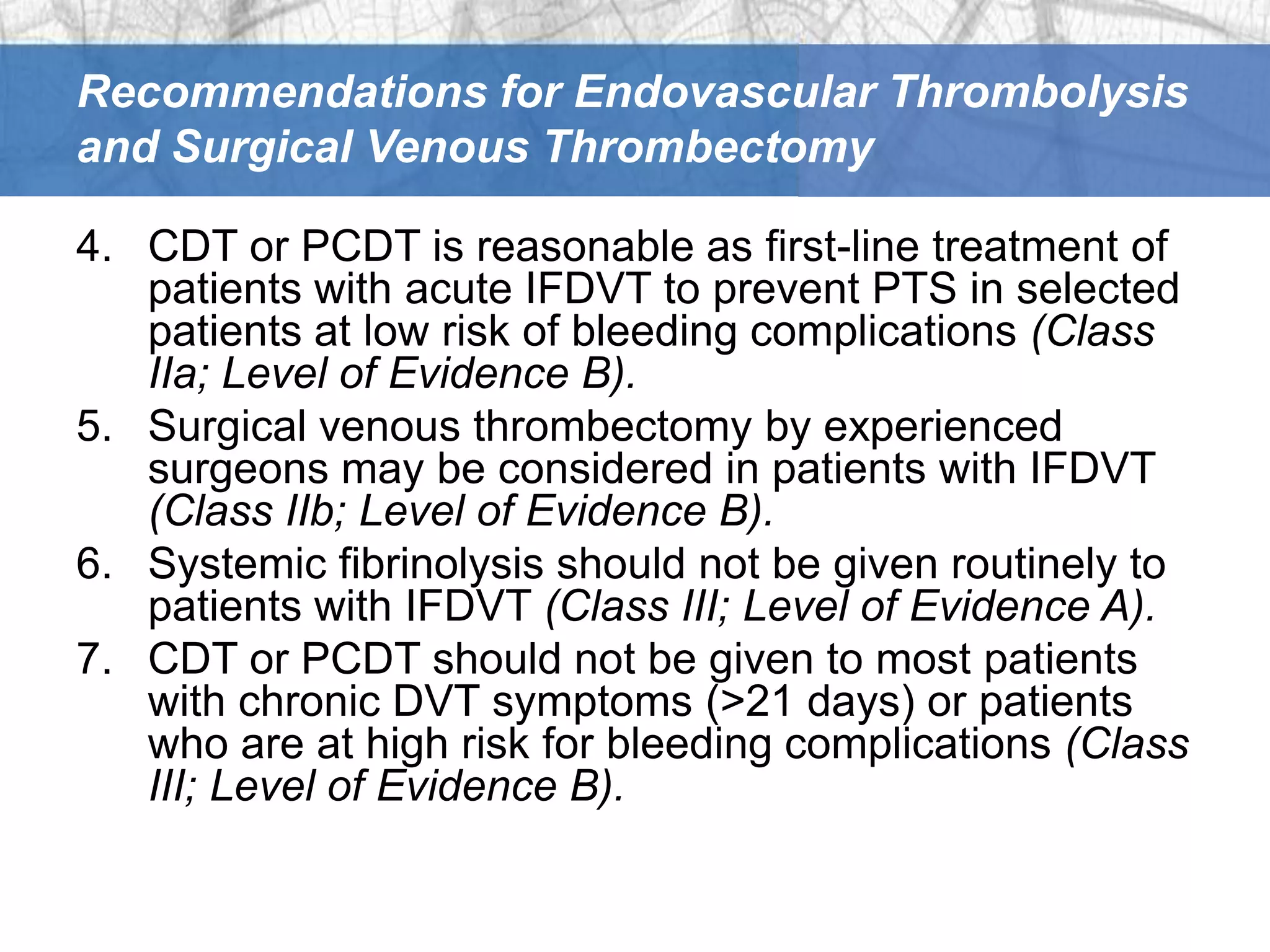
Recommendations for Endovascular Thrombolysis
and Surgical Venous Thrombectomy

4. CDT or PCDT is reasonable as first-line treatment of
   patients with acute IFDVT to prevent PTS in selected
   patients at low risk of bleeding complications (Class
   IIa; Level of Evidence B).
5. Surgical venous thrombectomy by experienced
   surgeons may be considered in patients with IFDVT
   (Class IIb; Level of Evidence B).
6. Systemic fibrinolysis should not be given routinely to
   patients with IFDVT (Class III; Level of Evidence A).
7. CDT or PCDT should not be given to most patients
   with chronic DVT symptoms (>21 days) or patients
   who are at high risk for bleeding complications (Class
   III; Level of Evidence B).
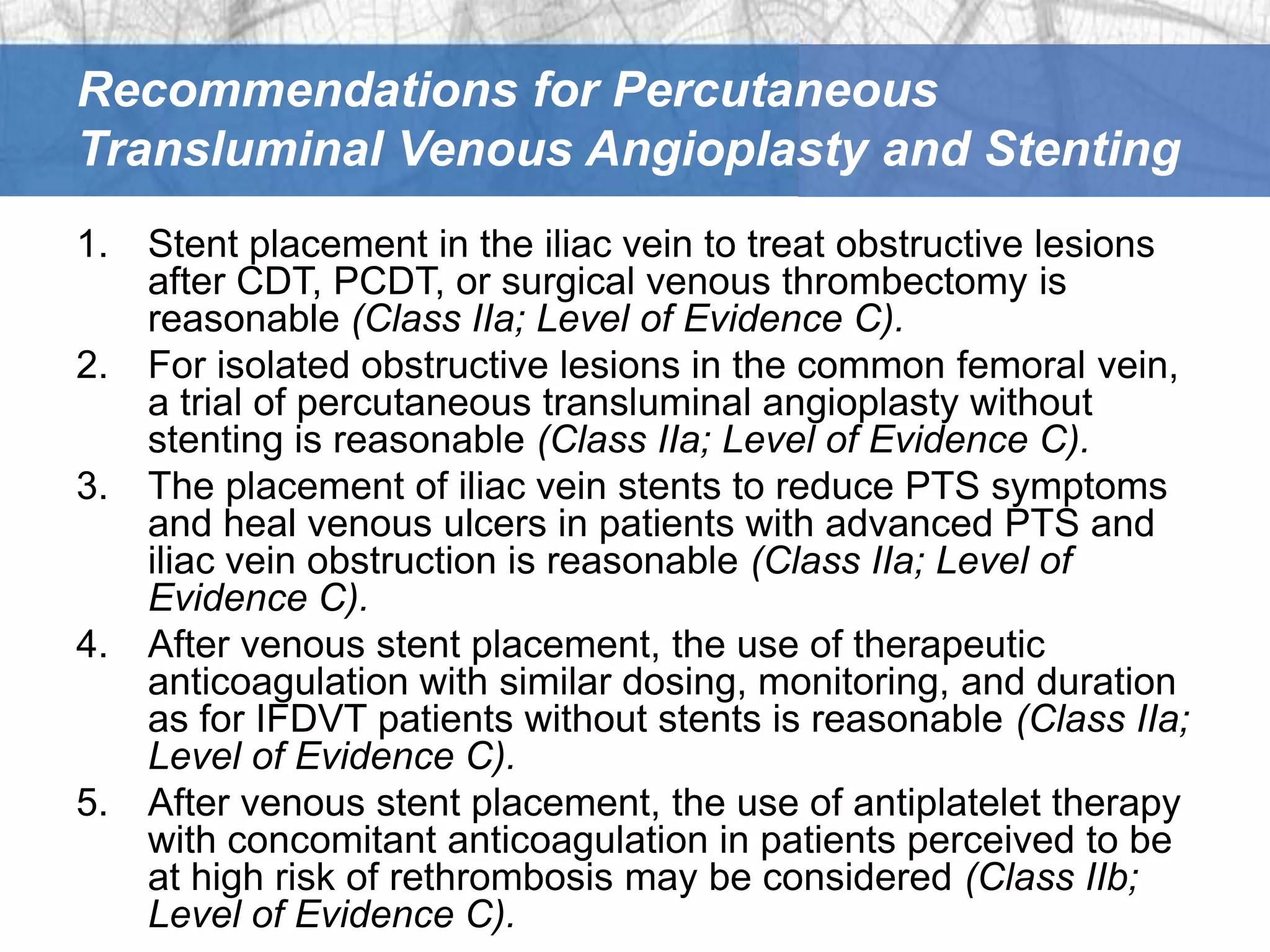
Recommendations for Percutaneous
Transluminal Venous Angioplasty and Stenting
1.   Stent placement in the iliac vein to treat obstructive lesions
     after CDT, PCDT, or surgical venous thrombectomy is
     reasonable (Class IIa; Level of Evidence C).
2.   For isolated obstructive lesions in the common femoral vein,
     a trial of percutaneous transluminal angioplasty without
     stenting is reasonable (Class IIa; Level of Evidence C).
3.   The placement of iliac vein stents to reduce PTS symptoms
     and heal venous ulcers in patients with advanced PTS and
     iliac vein obstruction is reasonable (Class IIa; Level of
     Evidence C).
4.   After venous stent placement, the use of therapeutic
     anticoagulation with similar dosing, monitoring, and duration
     as for IFDVT patients without stents is reasonable (Class IIa;
     Level of Evidence C).
5.   After venous stent placement, the use of antiplatelet therapy
     with concomitant anticoagulation in patients perceived to be
     at high risk of rethrombosis may be considered (Class IIb;
     Level of Evidence C).

Management of IlioFemoral Deep Vein Thrombosis

  • 1.
    AHA Scientific Statement Management of Massive & Submassive Pulmonary Embolism, Iliofemoral Deep Vein Thrombosis, and Chronic Thromboembolic Pulmonary Hypertension Circulation. 2011;123:1788-1830
  • 2.
    Iliofemoral DVT Initial AnticoagulantTherapy Intravenous UFH initial bolus of 80 U/kg followed by continuous intravenous infusion 18 U‧kg-1‧h-1, with dose adjustment to target aPTT prolongation that corresponds to plasma heparin levels of 0.3 to 0.7 IU/mL anti-factor Xa activity, for 5 to 7 days LMWH subcutaneous injection, without routine anti- factor Xa monitoring – enoxaparin twice daily at 1 mg/kg or once daily at 1.5 mg/kg – dalteparin once daily at 200 IU/kg or twice daily at 100 IU/kg – tinzaparin once daily at 175 anti-Xa IU/kg) Fondaparinux subcutaneous injection once daily 5 mg for patients weighing <50 kg 7.5 mg for patients weighing 50 to 100 kg 10 mg for patients weighing >100 kg
  • 3.
    Recommendations for Anticoagulation toIFDVT 1. In the absence of suspected or proven heparin- induced thrombocytopenia, patients with IFDVT should receive therapeutic anticoagulation with either intravenous UFH (Class I; Level of Evidence A), UFH by subcutaneous injection (Class I; Level of Evidence B), an LMWH (Class I; Level of Evidence A), or fondaparinux (Class I; Level of Evidence A). 2. Patients with IFDVT who have suspected or proven heparin-induced thrombocytopenia should receive a direct thrombin inhibitor (Class I; Level of Evidence B).
  • 4.
    Recommendations for Anticoagulation toIFDVT 1. Adult patients with IFDVT who receive oral warfarin as first-line long-term anticoagulation therapy should have warfarin overlapped with initial anticoagulation therapy for a minimum of 5 days and until the INR is >2.0 for at least 24 hours, and then targeted to an INR of 2.0 to 3.0 (Class I; Level of Evidence A). 2. Patients with first-episode IFDVT related to a major reversible risk factor should have anticoagulation stopped after 3 months (Class I; Level of Evidence A).
  • 5.
    Recommendations for Anticoagulation toIFDVT 3. Patients with recurrent or unprovoked IFDVT should have at least 6 months of anticoagulation and be considered for indefinite anticoagulation with periodic reassessment of the risks and benefits of continued anticoagulation (Class I; Level of Evidence A). 4. Cancer patients with IFDVT should receive LMWH monotherapy for at least 3 to 6 months, or as long as the cancer or its treatment (eg, chemotherapy) is ongoing (Class I; Level of Evidence A). 5. In children with DVT, the use of LMWH monotherapy may be reasonable (Class IIb; Level of Evidence C).
  • 6.
    Recommendations for Compression Therapy 1.Patients with IFDVT should wear 30– to 40–mm Hg knee-high graduated ECS on a daily basis for at least 2 years (Class I; Level of Evidence B). 2. In patients with prior IFDVT and symptomatic PTS, daily use of 30– to 40–mm Hg knee-high graduated ECS is reasonable (Class IIa; Level of Evidence C). 3. In patients with prior IFDVT and severe edema, intermittent sequential pneumatic compression followed by daily use of 30– to 40–mm Hg knee- high graduated ECS may be considered (Class IIb; Level of Evidence B).
  • 7.
    Recommendations for Compression Therapy 1.Adult patients with any acute proximal DVT (or acute PE) with contraindications to anticoagulation or active bleeding complication should receive an IVC filter (Class I; Level of Evidence B). 2. Anticoagulation should be resumed in patients with an IVC filter once contraindications to anticoagulation or active bleeding complications have resolved (Class I; Level of Evidence B). 3. 3. Patients who receive retrievable IVC filters should be evaluated periodically for filter retrieval within the specific filter’s retrieval window (Class I; Level of Evidence C). 4. For patients with recurrent PE despite therapeutic anticoagulation, it is reasonable to place an IVC filter (Class IIa; Level of Evidence C).
  • 8.
    Recommendations for Compression Therapy 5.For IFDVT patients who are likely to require permanent IVC filtration (eg, long-term contraindication to anticoagulation), it is reasonable to select a permanent nonretrievable IVC filter device (Class IIa; Level of Evidence C). 6. For IFDVT patients with a time-limited indication for an IVC filter (eg, a short-term contraindication to anticoagulant therapy), placement of a retrievable IVC filter is reasonable (Class IIa; Level of Evidence C). 7. For patients with recurrent DVT (without PE) despite therapeutic anticoagulation, it is reasonable to place an IVC filter (Class IIb; Level of Evidence C). 8. An IVC filter should not be used routinely in the treatment of IFDVT (Class III; Level of Evidence B).
  • 9.
    Recommendations for EndovascularThrombolysis and Surgical Venous Thrombectomy 1. CDT (catheter-directed thrombolysis) or PCDT (pharmacomechanical CDT) should be given to patients with IFDVT associated with limb-threatening circulatory compromise (ie, phlegmasia cerulea dolens) (Class I; Level of Evidence C). 2. Patients with IFDVT at centers that lack endovascular thrombolysis should be considered for transfer to a center with this expertise if indications for endovascular thrombolysis are present (Class I; Level of Evidence C). 3. CDT or PCDT is reasonable for patients with IFDVT associated with rapid thrombus extension despite anticoagulation (Class IIa; Level of Evidence C) and/or symptomatic deterioration from the IFDVT despite anticoagulation (Class IIa; Level of Evidence B).
  • 10.
    Recommendations for EndovascularThrombolysis and Surgical Venous Thrombectomy 4. CDT or PCDT is reasonable as first-line treatment of patients with acute IFDVT to prevent PTS in selected patients at low risk of bleeding complications (Class IIa; Level of Evidence B). 5. Surgical venous thrombectomy by experienced surgeons may be considered in patients with IFDVT (Class IIb; Level of Evidence B). 6. Systemic fibrinolysis should not be given routinely to patients with IFDVT (Class III; Level of Evidence A). 7. CDT or PCDT should not be given to most patients with chronic DVT symptoms (>21 days) or patients who are at high risk for bleeding complications (Class III; Level of Evidence B).
  • 11.
    Recommendations for Percutaneous TransluminalVenous Angioplasty and Stenting 1. Stent placement in the iliac vein to treat obstructive lesions after CDT, PCDT, or surgical venous thrombectomy is reasonable (Class IIa; Level of Evidence C). 2. For isolated obstructive lesions in the common femoral vein, a trial of percutaneous transluminal angioplasty without stenting is reasonable (Class IIa; Level of Evidence C). 3. The placement of iliac vein stents to reduce PTS symptoms and heal venous ulcers in patients with advanced PTS and iliac vein obstruction is reasonable (Class IIa; Level of Evidence C). 4. After venous stent placement, the use of therapeutic anticoagulation with similar dosing, monitoring, and duration as for IFDVT patients without stents is reasonable (Class IIa; Level of Evidence C). 5. After venous stent placement, the use of antiplatelet therapy with concomitant anticoagulation in patients perceived to be at high risk of rethrombosis may be considered (Class IIb; Level of Evidence C).