DAWN and
DEFUSE 3
trial
Diffusion-weighted imaging or
computerized tomography
perfusion assessment with clinical
mismatch in the triage of wake up
and late presenting strokes
undergoing neurointervention with
Trevo (DAWN) trial methods
Int J Stroke.
2017 Aug;12(6):641-652. 2017, Vol. 12(6)
641–652
General inclusion criteria
1. Clinical signs and symptoms consistent with the diagnosis of an
acute ischemic stroke, and subject belongs to one of the following
subgroups:
a. Subject has failed IV t-PA therapy (defined as a confirmed
persistent occlusion 60 min after administration)
b. Subject is contraindicated for IV t-PA administration
2. Age ≥18
3. Baseline NIHSS ≥10
4. Subject can be randomized between with 6 to 24 h after time last
known well
5. No significant pre-stroke disability (pre-stroke mRS must be 0 or 1)
6. Anticipated life expectancy of at least 6 months
7. Subject willing/able to return for protocol required follow-up visits
8. Subject or subject’s legally authorized representative (LAR) has
signed the study informed consent form
Imaging inclusion
criteria
1. <1/3 MCA territory involved, as evidenced by
CT or MRI
2. Occlusion of the intracranial ICA and/or MCA-
M1 as evidenced by MRA or CTA
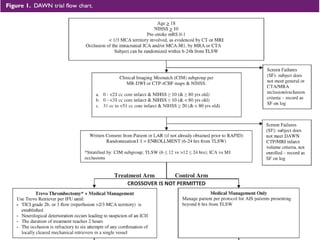
3. Clinical imaging mismatch (CIM) defined as
one of the following on MR-DWI or CTP-rCBF
maps:
a. ≥ 80 y/o, NIHSS ≥10 + core <21 mL
b. < 80 y/o, NIHSS ≥10 + core <31 mL
c. < 80 y/o, NIHSS ≥20 + core <51 mL
Thrombectomy 6 to 24 Hours
after Stroke with a Mismatch
between Deficit and Infarct
N Engl J Med.
2018 Jan 4;378(1):11-21.
A multicenter randomized
controlled trial of endovascular
therapy following imaging
evaluation for ischemic stroke
(DEFUSE 3)
Int J Stroke.
2017 Oct;12(8):896-905.
Clinical inclusion criteria
1. Signs and symptoms consistent with the diagnosis of
an acute anterior circulation ischemic stroke
2. Age 18–90 years
3. Baseline NIHSS score ≥6
4. Endovascular treatment can be initiated (femoral
puncture) between 6 and 16 h of stroke onset. Stroke
onset is defined as the time the patient was last known
to be at their neurologic baseline (wake-up strokes are
eligible if they meet the above time limits)
5. Modified Rankin Scale ≤2 prior to qualifying stroke
6. Patient/Legally authorized representative has signed
the informed consent form
Neuroimaging inclusion
criteria
1. ICA or MCA-M1 occlusion (carotid occlusions
can be cervical or intracranial; with or without
tandem MCA lesions) by MRA or CTA
2. Target Mismatch Profile on CT perfusion or
MRI (ischemic core volume is <70 ml,
mismatch ratio is ≥1.8 and mismatch volume is
≥15 ml)
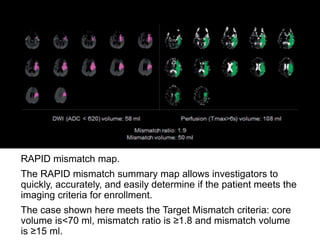
RAPID mismatch map.
The RAPID mismatch summary map allows investigators to
quickly, accurately, and easily determine if the patient meets the
imaging criteria for enrollment.
The case shown here meets the Target Mismatch criteria: core
volume is<70 ml, mismatch ratio is ≥1.8 and mismatch volume
is ≥15 ml.
Thrombectomy for Stroke at 6
to 16 Hours with Selection by
Perfusion Imaging
N Engl J Med.
2018 Feb 22;378(8):708-718.
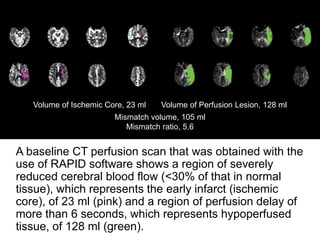
A baseline CT perfusion scan that was obtained with the
use of RAPID software shows a region of severely
reduced cerebral blood flow (<30% of that in normal
tissue), which represents the early infarct (ischemic
core), of 23 ml (pink) and a region of perfusion delay of
more than 6 seconds, which represents hypoperfused
tissue, of 128 ml (green).
Volume of Ischemic Core, 23 ml Volume of Perfusion Lesion, 128 ml
Mismatch volume, 105 ml
Mismatch ratio, 5.6
DAWN and DEFUSE 3 trial

DAWN and DEFUSE 3 trial

  • 1.
  • 2.
    Diffusion-weighted imaging or computerizedtomography perfusion assessment with clinical mismatch in the triage of wake up and late presenting strokes undergoing neurointervention with Trevo (DAWN) trial methods Int J Stroke. 2017 Aug;12(6):641-652. 2017, Vol. 12(6) 641–652
  • 3.
    General inclusion criteria 1.Clinical signs and symptoms consistent with the diagnosis of an acute ischemic stroke, and subject belongs to one of the following subgroups: a. Subject has failed IV t-PA therapy (defined as a confirmed persistent occlusion 60 min after administration) b. Subject is contraindicated for IV t-PA administration 2. Age ≥18 3. Baseline NIHSS ≥10 4. Subject can be randomized between with 6 to 24 h after time last known well 5. No significant pre-stroke disability (pre-stroke mRS must be 0 or 1) 6. Anticipated life expectancy of at least 6 months 7. Subject willing/able to return for protocol required follow-up visits 8. Subject or subject’s legally authorized representative (LAR) has signed the study informed consent form
  • 4.
    Imaging inclusion criteria 1. <1/3MCA territory involved, as evidenced by CT or MRI 2. Occlusion of the intracranial ICA and/or MCA- M1 as evidenced by MRA or CTA 3. Clinical imaging mismatch (CIM) defined as one of the following on MR-DWI or CTP-rCBF maps: a. ≥ 80 y/o, NIHSS ≥10 + core <21 mL b. < 80 y/o, NIHSS ≥10 + core <31 mL c. < 80 y/o, NIHSS ≥20 + core <51 mL
  • 6.
    Thrombectomy 6 to24 Hours after Stroke with a Mismatch between Deficit and Infarct N Engl J Med. 2018 Jan 4;378(1):11-21.
  • 10.
    A multicenter randomized controlledtrial of endovascular therapy following imaging evaluation for ischemic stroke (DEFUSE 3) Int J Stroke. 2017 Oct;12(8):896-905.
  • 11.
    Clinical inclusion criteria 1.Signs and symptoms consistent with the diagnosis of an acute anterior circulation ischemic stroke 2. Age 18–90 years 3. Baseline NIHSS score ≥6 4. Endovascular treatment can be initiated (femoral puncture) between 6 and 16 h of stroke onset. Stroke onset is defined as the time the patient was last known to be at their neurologic baseline (wake-up strokes are eligible if they meet the above time limits) 5. Modified Rankin Scale ≤2 prior to qualifying stroke 6. Patient/Legally authorized representative has signed the informed consent form
  • 12.
    Neuroimaging inclusion criteria 1. ICAor MCA-M1 occlusion (carotid occlusions can be cervical or intracranial; with or without tandem MCA lesions) by MRA or CTA 2. Target Mismatch Profile on CT perfusion or MRI (ischemic core volume is <70 ml, mismatch ratio is ≥1.8 and mismatch volume is ≥15 ml)
  • 13.
    RAPID mismatch map. TheRAPID mismatch summary map allows investigators to quickly, accurately, and easily determine if the patient meets the imaging criteria for enrollment. The case shown here meets the Target Mismatch criteria: core volume is<70 ml, mismatch ratio is ≥1.8 and mismatch volume is ≥15 ml.
  • 14.
    Thrombectomy for Strokeat 6 to 16 Hours with Selection by Perfusion Imaging N Engl J Med. 2018 Feb 22;378(8):708-718.
  • 15.
    A baseline CTperfusion scan that was obtained with the use of RAPID software shows a region of severely reduced cerebral blood flow (<30% of that in normal tissue), which represents the early infarct (ischemic core), of 23 ml (pink) and a region of perfusion delay of more than 6 seconds, which represents hypoperfused tissue, of 128 ml (green). Volume of Ischemic Core, 23 ml Volume of Perfusion Lesion, 128 ml Mismatch volume, 105 ml Mismatch ratio, 5.6