2018
Stroke
Guidelines
2018 Guidelines for the
Early Management of Patients
With Acute Ischemic Stroke
Stroke.
2018 Mar;49(3):e46-e110
PREHOSPITAL STROKE
MANAGEMENT AND SYSTEMS
OF CARE
EMS Assessment
and Management
EMS personnel should provide prehospital
notification to the receiving hospital that a
suspected stroke patient is en route so that
the appropriate hospital resources may be
mobilized before patient arrival. (Class I;
LOE B-NR)
EMS Systems
Patients with a positive stroke screen and/or
a strong suspicion of stroke should be
transported rapidly to the closest healthcare
facilities that can capably administer IV
alteplase. (Class I; LOE B-NR)
Hospital Stroke Teams
It is recommended that door-to-needle (DTN)
time goals be established. A primary goal of
achieving DTN times within 60 minutes in
≥50% of AIS patients treated with IV
alteplase should be established. (Class I;
LOE B-NR)
Hospital Stroke Teams
It may be reasonable to establish a
secondary DTN time goal of achieving DTN
times within 45 minutes in ≥50% of patients
with AIS who were treated with IV alteplase.
(Class IIb; LOE C-EO)
Organization and
Integration of Components
It may be useful for primary stroke centers
and other healthcare facilities that provide
initial emergency care, including
administration of IV alteplase, to develop
the capability of performing emergency non-
invasive intracranial vascular imaging to
most appropriately select patients for
transfer for endovascular therapy (EVT)
and to reduce the time to EVT. (Class IIb;
LOE C-LD)
Organization and
Integration of Components
Mechanical thrombectomy requires the patient to be
at an experienced stroke center with rapid access to
cerebral angiography, qualified neuro-
interventionalists, and a comprehensive
periprocedural care team.
Systems should be designed, executed, and
monitored to emphasize expeditious assessment
and treatment.
Outcomes for all patients should be tracked.
Facilities are encouraged to define criteria that can
be used to credential individuals who can perform
safe and timely intra-arterial revascularization
procedures. (Class I; LOE C-EO)
EMERGENCY EVALUATION
AND TREATMENT
Brain Imaging
All patients admitted to hospital with
suspected acute stroke should receive brain
imaging evaluation on arrival to hospital. In
most cases, non-contrast CT will provide
the necessary information to make decisions
about acute management. (Class I; LOE B-
NR)
Brain Imaging
Systems should be established so that brain
imaging studies can be performed within 20
minutes of arrival in the ED in at least 50%
of patients who may be candidates for IV
alteplase and/or mechanical thrombectomy.
(Class I; LOE B-NR)
Brain Imaging
There remains insufficient evidence to
identify a threshold of acute CT hypo-
attenuation severity or extent that affects
treatment response to IV alteplase.
The extent and severity of acute hypo-
attenuation or early ischemic changes
should not be used as a criterion to withhold
therapy for such patients who otherwise
qualify. (Class III: No benefit; LOE B-R)
Brain Imaging
For patients who otherwise meet criteria for EVT, a
noninvasive intracranial vascular study is
recommended during the initial imaging evaluation of
the acute stroke patient, but should not delay IV
alteplase if indicated. For patients who qualify for IV
alteplase according to guidelines from professional
medical societies, initiating IV alteplase before
noninvasive vascular imaging is recommended for
patients who have not had noninvasive vascular
imaging as part of their initial imaging assessment
for stroke. Noninvasive intracranial vascular imaging
should then be obtained as quickly as possible.
(Class I; LOE A)
Brain Imaging
For patients who otherwise meet criteria for
EVT, it is reasonable to proceed with CTA if
indicated in patients with suspected
intracranial large vessel occlusion (LVO)
before obtaining a serum creatinine
concentration in patients without a history of
renal impairment. (Class IIa; LOE B-NR)
Brain Imaging
In patients who are potential candidates for
mechanical thrombectomy, imaging of the
extracranial carotid and vertebral arteries, in
addition to the intracranial circulation, is
reasonable to provide useful information on
patient eligibility and endovascular
procedural planning. (Class IIa; LOE C-EO)
Brain Imaging
In selected patients with AIS within 6 to 24
hours of last known normal who have LVO
in the anterior circulation, obtaining CTP,
DW-MRI, or MRI perfusion is
recommended to aid in patient selection for
mechanical thrombectomy, but only when
imaging and other eligibility criteria from
RCTs showing benefit are being strictly
applied in selecting patients for mechanical
thrombectomy. (Class I; LOE A)
Other Diagnostic Tests
Only the assessment of blood glucose
must precede the initiation of IV alteplase in
all patients. (Class I; LOE B-R)
Other Diagnostic Tests
Baseline ECG assessment is
recommended in patients presenting with
AIS, but should not delay initiation of IV
alteplase. (Class I; LOE B-NR)
Other Diagnostic Tests
Baseline troponin assessment is
recommended in patients presenting with
AIS, but should not delay initiation of IV
alteplase. (Class I; LOE B-NR)
Other Diagnostic Tests
Usefulness of CXR in the hyper-acute stroke
setting in the absence of evidence of acute
pulmonary, cardiac, or pulmonary vascular
disease is unclear.
If obtained, they should not unnecessarily
delay administration of IV alteplase. (Class
IIb; LOE B-NR)
GENERAL SUPPORTIVE CARE
AND EMERGENCY
TREATMENT
Airway, Breathing,
and Oxygenation
Airway support and ventilatory assistance
are recommended for the treatment of
patients with acute stroke who have
decreased consciousness or who have
bulbar dysfunction that causes compromise
of the airway. (Class I; LOE C-EO)
Airway, Breathing,
and Oxygenation
Supplemental oxygen should be provided to
maintain oxygen saturation >94%. (Class I;
LOE C-LD)
Blood Pressure
Hypotension and hypovolemia should be
corrected to maintain systemic perfusion
levels necessary to support organ function.
(Class I; LOE C-EO)
Blood Pressure
In patients with BP ≥220/120 mmHg who
did not receive IV alteplase or EVT and
have no comorbid conditions requiring acute
antihypertensive treatment, the benefit of
initiating or reinitiating treatment of
hypertension within the first 48 to 72 hours is
uncertain. It might be reasonable to lower
BP by 15% during the first 24 hours after
onset of stroke. (Class IIb; LOE C-EO)
Blood Pressure
Patients who have elevated BP and are
otherwise eligible for treatment with IV
alteplase should have their BP carefully
lowered so that their BP is <185/110 mmHg
before IV fibrinolytic therapy is initiated.
(Class I; LOE B-NR)
Blood Glucose
Evidence indicates that persistent in-hospital
hyperglycemia during the first 24 hours after
AIS is associated with worse outcomes than
normo-glycemia and thus, it is reasonable to
treat hyperglycemia to achieve blood
glucose levels in a range of 140 to 180
mg/dL and to closely monitor to prevent
hypoglycemia in patients with AIS. (Class IIa;
LOE C-LD)
Blood Glucose
Hypoglycemia (blood glucose <60 mg/dL)
should be treated in patients with AIS.
(Class I; LOE C-LD)
ELIGIBILITY
RECOMMENDATIONS FOR IV
ALTEPLASE IN PATIENTS
WITH AIS (CLASS I)
❶
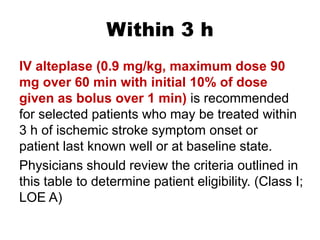
Within 3 h
IV alteplase (0.9 mg/kg, maximum dose 90
mg over 60 min with initial 10% of dose
given as bolus over 1 min) is recommended
for selected patients who may be treated within
3 h of ischemic stroke symptom onset or
patient last known well or at baseline state.
Physicians should review the criteria outlined in
this table to determine patient eligibility. (Class I;
LOE A)
Severity
For severe stroke symptoms, IV alteplase is indicated
within 3 h from symptom onset of ischemic stroke.
Despite increased risk of hemorrhagic transformation,
there is still proven clinical benefit for patients with
severe stroke symptoms. (Class I; LOE A)
For patients with mild but disabling stroke symptoms, IV
alteplase is indicated within 3 h from symptom onset of
ischemic stroke. There should be no exclusion for
patients with mild but nonetheless disabling stroke
symptoms, in the opinion of the treating physician, from
treatment with IV alteplase because there is proven
clinical benefit for those patients. (Class I; LOE B-R)
3–4.5 h
IV alteplase is also recommended for
selected patients who can be treated within
3 and 4.5 h of ischemic stroke symptom
onset or patient last known well. Physicians
should review the criteria outlined in this
table to determine patient eligibility. (Class I;
LOE B-R)
Age, DM, Prior stroke,
Severity, OACs, Imaging
IV alteplase treatment in the 3- to 4.5-h time
window is recommended for those patients
≤80 y of age, without a history of both DM
and prior stroke, NIHSS score ≤25, not
taking any OACs, and without imaging
evidence of ischemic injury involving
more than one third of the MCA territory.
(Class I; LOE B-R)
BP
IV alteplase is recommended in patients
whose BP can be lowered safely (to
<185/110 mmHg) with antihypertensive
agents, with the physician assessing the
stability of the BP before starting IV
alteplase. (Class I; LOE B-NR)
Blood glucose
IV alteplase is recommended in otherwise
eligible patients with initial glucose levels
>50 mg/dL. (Class I; LOE A)
Prior antiplatelet therapy
IV alteplase is recommended for patients taking
antiplatelet drug monotherapy before stroke on
the basis of evidence that the benefit of
alteplase outweighs a possible small increased
risk of sICH. (Class I; LOE A)
IV alteplase is recommended for patients taking
antiplatelet drug combination therapy (eg,
aspirin and clopidogrel) before stroke on the
basis of evidence that the benefit of alteplase
outweighs a probable increased risk of sICH.
(Class I; LOE B-NR)
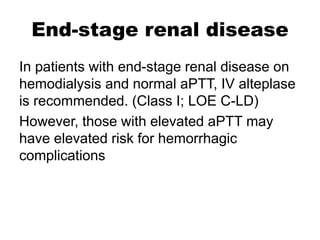
End-stage renal disease
In patients with end-stage renal disease on
hemodialysis and normal aPTT, IV alteplase
is recommended. (Class I; LOE C-LD)
However, those with elevated aPTT may
have elevated risk for hemorrhagic
complications
ADDITIONAL RECOMMENDATIONS
FOR TREATMENT WITH IV
ALTEPLASE FOR PATIENTS WITH
AIS (CLASS II)
❷
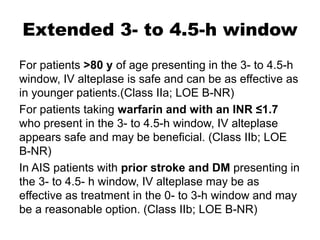
Extended 3- to 4.5-h window
For patients >80 y of age presenting in the 3- to 4.5-h
window, IV alteplase is safe and can be as effective as
in younger patients.(Class IIa; LOE B-NR)
For patients taking warfarin and with an INR ≤1.7
who present in the 3- to 4.5-h window, IV alteplase
appears safe and may be beneficial. (Class IIb; LOE
B-NR)
In AIS patients with prior stroke and DM presenting in
the 3- to 4.5- h window, IV alteplase may be as
effective as treatment in the 0- to 3-h window and may
be a reasonable option. (Class IIb; LOE B-NR)
Preexisting disability
Preexisting disability does not seem to
independently increase the risk of sICH after IV
alteplase, but it may be associated with less
neurological improvement and higher
mortality. Thrombolytic therapy with IV
alteplase for acute stroke patients with
preexisting disability (mRS score ≥2) may be
reasonable, but decisions should take into
account relevant factors, including quality of life,
social support, place of residence, need for a
caregiver, patients’ and families’ preferences,
and goals of care. (Class IIb; LOE B-NR)
Seizure at onset
IV alteplase is reasonable in patients with a
seizure at the time of onset of acute stroke if
evidence suggests that residual impairments
are secondary to stroke and not a postictal
phenomenon. (Class IIa; LOE C-LD)
Blood glucose
Treatment with IV alteplase in patients with
AIS who present with initial glucose levels
<50 or >400 mg/dL that are subsequently
normalized and who are otherwise eligible
may be reasonable. (Class IIb; LOE C-LD)
IV Alteplase
In patients undergoing fibrinolytic therapy,
physicians should be prepared to treat
potential emergent adverse effects, including
bleeding complications and angioedema
that may cause partial airway obstruction.
(Class I; LOE B-NR)
IV Alteplase
BP should be maintained <180/105 mmHg
for at least the first 24 hours after IV
alteplase treatment. (Class I; LOE B-NR)
MECHANICAL
THROMBECTOMY
Patients eligible for IV alteplase should
receive IV alteplase even if EVTs are being
considered. (Class I; LOE A)
In patients under consideration for
mechanical thrombectomy, observation after
IV alteplase to assess for clinical response
should not be performed. (Class III: Harm;
LOE B-R)
Patients should receive mechanical
thrombectomy with a stent retriever if they meet
all the following criteria:
1) pre-stroke mRS score of 0 to 1
2) causative occlusion of the ICA or MCA-M1
3) age ≥18 years
4) NIHSS ≥6
5) Alberta Stroke Program Early CT Score
(ASPECTS) ≥6
6) treatment can be initiated (groin puncture)
within 6 hours of symptom onset
(Class I; LOE A)
In selected patients with AIS within 6 to 16
hours of last known normal who have LVO
in the anterior circulation and meet other
DAWN or DEFUSE 3 eligibility criteria,
mechanical thrombectomy is recommended.
(Class I; LOE A)
In selected patients with AIS within 6 to 24
hours of last known normal who have LVO
in the anterior circulation and meet other
DAWN eligibility criteria, mechanical
thrombectomy is recommended. (Class IIa;
LOE B-R)
ANTIPLATELET
TREATMENT
Administration of aspirin is recommended in
patients with AIS within 24 to 48 hours after
onset.
For those treated with IV alteplase, aspirin
administration is generally delayed until 24
hours later but might be considered in the
presence of concomitant conditions for
which such treatment given in the absence
of IV alteplase. (Class I; LOE A)
In patients presenting with minor stroke,
treatment for 21 days with dual antiplatelet
therapy (aspirin and clopidogrel) begun
within 24 hours can be beneficial for early
secondary stroke prevention for a period of
up to 90 days from symptom onset. (Class
IIa; LOE B-R)
ANTICOAGULANTS
Urgent anticoagulation, with the goal of
preventing early recurrent stroke, halting
neurological worsening, or improving
outcomes after AIS, is not recommended for
treatment of patients with AIS. (Class III: No
benefit; LOE A)
2018
Stroke
Guidelines
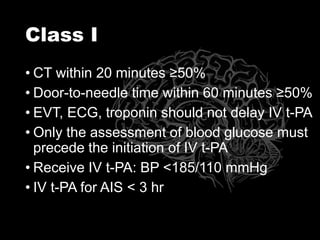
Class I
• CT within 20 minutes ≥50%
• Door-to-needle time within 60 minutes ≥50%
• EVT, ECG, troponin should not delay IV t-PA
• Only the assessment of blood glucose must
precede the initiation of IV t-PA
• Receive IV t-PA: BP <185/110 mmHg
• IV t-PA for AIS < 3 hr
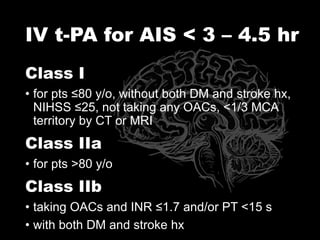
IV t-PA for AIS < 3 – 4.5 hr
Class I
• for pts ≤80 y/o, without both DM and stroke hx,
NIHSS ≤25, not taking any OACs, <1/3 MCA
territory by CT or MRI
Class IIa
• for pts >80 y/o
Class IIb
• taking OACs and INR ≤1.7 and/or PT <15 s
• with both DM and stroke hx
Endovascular Therapy
Class I
• AIS < 6 hr
• AIS < 6-16 hr: DAWN or DEFUSE 3 criteria
Class IIa
• AIS < 6-24 hr: DAWN criteria

2018 Stroke Guidelines

  • 1.
  • 2.
    2018 Guidelines forthe Early Management of Patients With Acute Ischemic Stroke Stroke. 2018 Mar;49(3):e46-e110
  • 4.
  • 5.
    EMS Assessment and Management EMSpersonnel should provide prehospital notification to the receiving hospital that a suspected stroke patient is en route so that the appropriate hospital resources may be mobilized before patient arrival. (Class I; LOE B-NR)
  • 6.
    EMS Systems Patients witha positive stroke screen and/or a strong suspicion of stroke should be transported rapidly to the closest healthcare facilities that can capably administer IV alteplase. (Class I; LOE B-NR)
  • 7.
    Hospital Stroke Teams Itis recommended that door-to-needle (DTN) time goals be established. A primary goal of achieving DTN times within 60 minutes in ≥50% of AIS patients treated with IV alteplase should be established. (Class I; LOE B-NR)
  • 8.
    Hospital Stroke Teams Itmay be reasonable to establish a secondary DTN time goal of achieving DTN times within 45 minutes in ≥50% of patients with AIS who were treated with IV alteplase. (Class IIb; LOE C-EO)
  • 9.
    Organization and Integration ofComponents It may be useful for primary stroke centers and other healthcare facilities that provide initial emergency care, including administration of IV alteplase, to develop the capability of performing emergency non- invasive intracranial vascular imaging to most appropriately select patients for transfer for endovascular therapy (EVT) and to reduce the time to EVT. (Class IIb; LOE C-LD)
  • 10.
    Organization and Integration ofComponents Mechanical thrombectomy requires the patient to be at an experienced stroke center with rapid access to cerebral angiography, qualified neuro- interventionalists, and a comprehensive periprocedural care team. Systems should be designed, executed, and monitored to emphasize expeditious assessment and treatment. Outcomes for all patients should be tracked. Facilities are encouraged to define criteria that can be used to credential individuals who can perform safe and timely intra-arterial revascularization procedures. (Class I; LOE C-EO)
  • 11.
  • 12.
    Brain Imaging All patientsadmitted to hospital with suspected acute stroke should receive brain imaging evaluation on arrival to hospital. In most cases, non-contrast CT will provide the necessary information to make decisions about acute management. (Class I; LOE B- NR)
  • 13.
    Brain Imaging Systems shouldbe established so that brain imaging studies can be performed within 20 minutes of arrival in the ED in at least 50% of patients who may be candidates for IV alteplase and/or mechanical thrombectomy. (Class I; LOE B-NR)
  • 14.
    Brain Imaging There remainsinsufficient evidence to identify a threshold of acute CT hypo- attenuation severity or extent that affects treatment response to IV alteplase. The extent and severity of acute hypo- attenuation or early ischemic changes should not be used as a criterion to withhold therapy for such patients who otherwise qualify. (Class III: No benefit; LOE B-R)
  • 15.
    Brain Imaging For patientswho otherwise meet criteria for EVT, a noninvasive intracranial vascular study is recommended during the initial imaging evaluation of the acute stroke patient, but should not delay IV alteplase if indicated. For patients who qualify for IV alteplase according to guidelines from professional medical societies, initiating IV alteplase before noninvasive vascular imaging is recommended for patients who have not had noninvasive vascular imaging as part of their initial imaging assessment for stroke. Noninvasive intracranial vascular imaging should then be obtained as quickly as possible. (Class I; LOE A)
  • 16.
    Brain Imaging For patientswho otherwise meet criteria for EVT, it is reasonable to proceed with CTA if indicated in patients with suspected intracranial large vessel occlusion (LVO) before obtaining a serum creatinine concentration in patients without a history of renal impairment. (Class IIa; LOE B-NR)
  • 17.
    Brain Imaging In patientswho are potential candidates for mechanical thrombectomy, imaging of the extracranial carotid and vertebral arteries, in addition to the intracranial circulation, is reasonable to provide useful information on patient eligibility and endovascular procedural planning. (Class IIa; LOE C-EO)
  • 18.
    Brain Imaging In selectedpatients with AIS within 6 to 24 hours of last known normal who have LVO in the anterior circulation, obtaining CTP, DW-MRI, or MRI perfusion is recommended to aid in patient selection for mechanical thrombectomy, but only when imaging and other eligibility criteria from RCTs showing benefit are being strictly applied in selecting patients for mechanical thrombectomy. (Class I; LOE A)
  • 19.
    Other Diagnostic Tests Onlythe assessment of blood glucose must precede the initiation of IV alteplase in all patients. (Class I; LOE B-R)
  • 20.
    Other Diagnostic Tests BaselineECG assessment is recommended in patients presenting with AIS, but should not delay initiation of IV alteplase. (Class I; LOE B-NR)
  • 21.
    Other Diagnostic Tests Baselinetroponin assessment is recommended in patients presenting with AIS, but should not delay initiation of IV alteplase. (Class I; LOE B-NR)
  • 22.
    Other Diagnostic Tests Usefulnessof CXR in the hyper-acute stroke setting in the absence of evidence of acute pulmonary, cardiac, or pulmonary vascular disease is unclear. If obtained, they should not unnecessarily delay administration of IV alteplase. (Class IIb; LOE B-NR)
  • 23.
    GENERAL SUPPORTIVE CARE ANDEMERGENCY TREATMENT
  • 24.
    Airway, Breathing, and Oxygenation Airwaysupport and ventilatory assistance are recommended for the treatment of patients with acute stroke who have decreased consciousness or who have bulbar dysfunction that causes compromise of the airway. (Class I; LOE C-EO)
  • 25.
    Airway, Breathing, and Oxygenation Supplementaloxygen should be provided to maintain oxygen saturation >94%. (Class I; LOE C-LD)
  • 26.
    Blood Pressure Hypotension andhypovolemia should be corrected to maintain systemic perfusion levels necessary to support organ function. (Class I; LOE C-EO)
  • 27.
    Blood Pressure In patientswith BP ≥220/120 mmHg who did not receive IV alteplase or EVT and have no comorbid conditions requiring acute antihypertensive treatment, the benefit of initiating or reinitiating treatment of hypertension within the first 48 to 72 hours is uncertain. It might be reasonable to lower BP by 15% during the first 24 hours after onset of stroke. (Class IIb; LOE C-EO)
  • 28.
    Blood Pressure Patients whohave elevated BP and are otherwise eligible for treatment with IV alteplase should have their BP carefully lowered so that their BP is <185/110 mmHg before IV fibrinolytic therapy is initiated. (Class I; LOE B-NR)
  • 29.
    Blood Glucose Evidence indicatesthat persistent in-hospital hyperglycemia during the first 24 hours after AIS is associated with worse outcomes than normo-glycemia and thus, it is reasonable to treat hyperglycemia to achieve blood glucose levels in a range of 140 to 180 mg/dL and to closely monitor to prevent hypoglycemia in patients with AIS. (Class IIa; LOE C-LD)
  • 30.
    Blood Glucose Hypoglycemia (bloodglucose <60 mg/dL) should be treated in patients with AIS. (Class I; LOE C-LD)
  • 31.
    ELIGIBILITY RECOMMENDATIONS FOR IV ALTEPLASEIN PATIENTS WITH AIS (CLASS I) ❶
  • 32.
    Within 3 h IValteplase (0.9 mg/kg, maximum dose 90 mg over 60 min with initial 10% of dose given as bolus over 1 min) is recommended for selected patients who may be treated within 3 h of ischemic stroke symptom onset or patient last known well or at baseline state. Physicians should review the criteria outlined in this table to determine patient eligibility. (Class I; LOE A)
  • 33.
    Severity For severe strokesymptoms, IV alteplase is indicated within 3 h from symptom onset of ischemic stroke. Despite increased risk of hemorrhagic transformation, there is still proven clinical benefit for patients with severe stroke symptoms. (Class I; LOE A) For patients with mild but disabling stroke symptoms, IV alteplase is indicated within 3 h from symptom onset of ischemic stroke. There should be no exclusion for patients with mild but nonetheless disabling stroke symptoms, in the opinion of the treating physician, from treatment with IV alteplase because there is proven clinical benefit for those patients. (Class I; LOE B-R)
  • 34.
    3–4.5 h IV alteplaseis also recommended for selected patients who can be treated within 3 and 4.5 h of ischemic stroke symptom onset or patient last known well. Physicians should review the criteria outlined in this table to determine patient eligibility. (Class I; LOE B-R)
  • 35.
    Age, DM, Priorstroke, Severity, OACs, Imaging IV alteplase treatment in the 3- to 4.5-h time window is recommended for those patients ≤80 y of age, without a history of both DM and prior stroke, NIHSS score ≤25, not taking any OACs, and without imaging evidence of ischemic injury involving more than one third of the MCA territory. (Class I; LOE B-R)
  • 36.
    BP IV alteplase isrecommended in patients whose BP can be lowered safely (to <185/110 mmHg) with antihypertensive agents, with the physician assessing the stability of the BP before starting IV alteplase. (Class I; LOE B-NR)
  • 37.
    Blood glucose IV alteplaseis recommended in otherwise eligible patients with initial glucose levels >50 mg/dL. (Class I; LOE A)
  • 38.
    Prior antiplatelet therapy IValteplase is recommended for patients taking antiplatelet drug monotherapy before stroke on the basis of evidence that the benefit of alteplase outweighs a possible small increased risk of sICH. (Class I; LOE A) IV alteplase is recommended for patients taking antiplatelet drug combination therapy (eg, aspirin and clopidogrel) before stroke on the basis of evidence that the benefit of alteplase outweighs a probable increased risk of sICH. (Class I; LOE B-NR)
  • 39.
    End-stage renal disease Inpatients with end-stage renal disease on hemodialysis and normal aPTT, IV alteplase is recommended. (Class I; LOE C-LD) However, those with elevated aPTT may have elevated risk for hemorrhagic complications
  • 40.
    ADDITIONAL RECOMMENDATIONS FOR TREATMENTWITH IV ALTEPLASE FOR PATIENTS WITH AIS (CLASS II) ❷
  • 41.
    Extended 3- to4.5-h window For patients >80 y of age presenting in the 3- to 4.5-h window, IV alteplase is safe and can be as effective as in younger patients.(Class IIa; LOE B-NR) For patients taking warfarin and with an INR ≤1.7 who present in the 3- to 4.5-h window, IV alteplase appears safe and may be beneficial. (Class IIb; LOE B-NR) In AIS patients with prior stroke and DM presenting in the 3- to 4.5- h window, IV alteplase may be as effective as treatment in the 0- to 3-h window and may be a reasonable option. (Class IIb; LOE B-NR)
  • 42.
    Preexisting disability Preexisting disabilitydoes not seem to independently increase the risk of sICH after IV alteplase, but it may be associated with less neurological improvement and higher mortality. Thrombolytic therapy with IV alteplase for acute stroke patients with preexisting disability (mRS score ≥2) may be reasonable, but decisions should take into account relevant factors, including quality of life, social support, place of residence, need for a caregiver, patients’ and families’ preferences, and goals of care. (Class IIb; LOE B-NR)
  • 43.
    Seizure at onset IValteplase is reasonable in patients with a seizure at the time of onset of acute stroke if evidence suggests that residual impairments are secondary to stroke and not a postictal phenomenon. (Class IIa; LOE C-LD)
  • 44.
    Blood glucose Treatment withIV alteplase in patients with AIS who present with initial glucose levels <50 or >400 mg/dL that are subsequently normalized and who are otherwise eligible may be reasonable. (Class IIb; LOE C-LD)
  • 45.
    IV Alteplase In patientsundergoing fibrinolytic therapy, physicians should be prepared to treat potential emergent adverse effects, including bleeding complications and angioedema that may cause partial airway obstruction. (Class I; LOE B-NR)
  • 46.
    IV Alteplase BP shouldbe maintained <180/105 mmHg for at least the first 24 hours after IV alteplase treatment. (Class I; LOE B-NR)
  • 47.
  • 48.
    Patients eligible forIV alteplase should receive IV alteplase even if EVTs are being considered. (Class I; LOE A)
  • 49.
    In patients underconsideration for mechanical thrombectomy, observation after IV alteplase to assess for clinical response should not be performed. (Class III: Harm; LOE B-R)
  • 50.
    Patients should receivemechanical thrombectomy with a stent retriever if they meet all the following criteria: 1) pre-stroke mRS score of 0 to 1 2) causative occlusion of the ICA or MCA-M1 3) age ≥18 years 4) NIHSS ≥6 5) Alberta Stroke Program Early CT Score (ASPECTS) ≥6 6) treatment can be initiated (groin puncture) within 6 hours of symptom onset (Class I; LOE A)
  • 51.
    In selected patientswith AIS within 6 to 16 hours of last known normal who have LVO in the anterior circulation and meet other DAWN or DEFUSE 3 eligibility criteria, mechanical thrombectomy is recommended. (Class I; LOE A)
  • 52.
    In selected patientswith AIS within 6 to 24 hours of last known normal who have LVO in the anterior circulation and meet other DAWN eligibility criteria, mechanical thrombectomy is recommended. (Class IIa; LOE B-R)
  • 53.
  • 54.
    Administration of aspirinis recommended in patients with AIS within 24 to 48 hours after onset. For those treated with IV alteplase, aspirin administration is generally delayed until 24 hours later but might be considered in the presence of concomitant conditions for which such treatment given in the absence of IV alteplase. (Class I; LOE A)
  • 55.
    In patients presentingwith minor stroke, treatment for 21 days with dual antiplatelet therapy (aspirin and clopidogrel) begun within 24 hours can be beneficial for early secondary stroke prevention for a period of up to 90 days from symptom onset. (Class IIa; LOE B-R)
  • 56.
  • 57.
    Urgent anticoagulation, withthe goal of preventing early recurrent stroke, halting neurological worsening, or improving outcomes after AIS, is not recommended for treatment of patients with AIS. (Class III: No benefit; LOE A)
  • 58.
  • 59.
    Class I • CTwithin 20 minutes ≥50% • Door-to-needle time within 60 minutes ≥50% • EVT, ECG, troponin should not delay IV t-PA • Only the assessment of blood glucose must precede the initiation of IV t-PA • Receive IV t-PA: BP <185/110 mmHg • IV t-PA for AIS < 3 hr
  • 60.
    IV t-PA forAIS < 3 – 4.5 hr Class I • for pts ≤80 y/o, without both DM and stroke hx, NIHSS ≤25, not taking any OACs, <1/3 MCA territory by CT or MRI Class IIa • for pts >80 y/o Class IIb • taking OACs and INR ≤1.7 and/or PT <15 s • with both DM and stroke hx
  • 61.
    Endovascular Therapy Class I •AIS < 6 hr • AIS < 6-16 hr: DAWN or DEFUSE 3 criteria Class IIa • AIS < 6-24 hr: DAWN criteria