Inflammatory Breast
Cancer
What you need to know
1
Outline
• IBC definition - how is it different from locally
advanced breast cancers (LABC)
• IBC clinical diagnosis
• Imaging
• Pathology
• IBC treatment protocols - order of treatment!
• FAQs
2
IBC has been described for 200 years
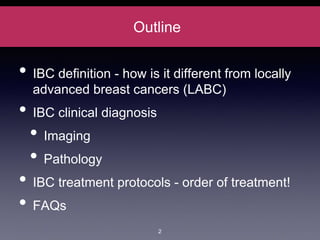
• First described in 1814 by Sir Charles Bell as
“a purple color on the skin over the tumor,
accompanied by shooting pain”
• The term “IBC” was proposed by Lee and
Tannenbaum in 1924, after this disease had
many previous names
• lactation cancer, carcinoma mastitoides,
mastitis carcinomatosa, acute encephaloid
cancer, acute mammary carcinoma, acute
brawny cancer, acute scirrhous carcinoma,
and carcinoma telangiectaticum
3
What is inflammatory breast cancer?
• An aggressive subset of breast cancer diagnosed clinically (no
current molecular definition!)
• 2-5% of total BC incidence, but ~10% of mortality
• 2 types of IBC
• Primary IBC - IBC developing in a previously normal breast
(MOST CASES)
• Secondary IBC - IBC features (and biopsy-proven invasive
cancer) on the chest wall post mastectomy for non-IBC or a
recurrence with inflammatory features in a breast that already had
cancer
• A palpable lump is present in only a third of IBC patients at diagnosis
• Hence the IBC Network’s slogan -“No lump still cancer” slogan
4
How is IBC different from
other locally advanced
breast cancers?
5
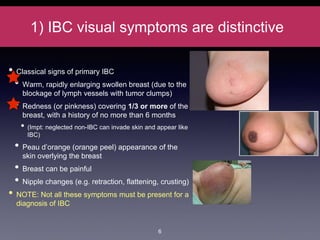
1) IBC visual symptoms are distinctive
• Classical signs of primary IBC
• Warm, rapidly enlarging swollen breast (due to the
blockage of lymph vessels with tumor clumps)
• Redness (or pinkness) covering 1/3 or more of the
breast, with a history of no more than 6 months
• (Impt: neglected non-IBC can invade skin and appear like
IBC)
• Peau d’orange (orange peel) appearance of the
skin overlying the breast
• Breast can be painful
• Nipple changes (e.g. retraction, flattening, crusting)
• NOTE: Not all these symptoms must be present for a
diagnosis of IBC
6
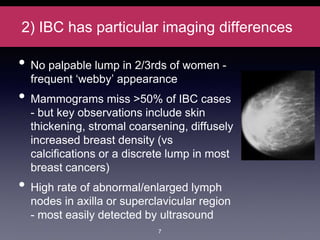
2) IBC has particular imaging differences
• No palpable lump in 2/3rds of women -
frequent ‘webby’ appearance
• Mammograms miss >50% of IBC cases
- but key observations include skin
thickening, stromal coarsening, diffusely
increased breast density (vs
calcifications or a discrete lump in most
breast cancers)
• High rate of abnormal/enlarged lymph
nodes in axilla or superclavicular region
- most easily detected by ultrasound
7
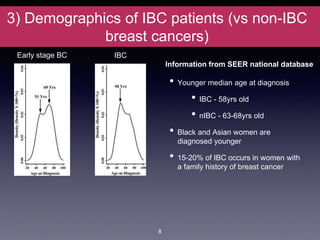
3) Demographics of IBC patients (vs non-IBC
breast cancers)
• Younger median age at diagnosis
• IBC - 58yrs old
• nIBC - 63-68yrs old
• Black and Asian women are
diagnosed younger
• 15-20% of IBC occurs in women with
a family history of breast cancer
8
Early stage BC IBC
Information from SEER national database
IBC vs LABC Differences Summary
• IBC is different because:
1. It presents & behaves differently - must be aware of
symptoms and rapidly changing breast appearance
2. It is more difficult to detect by routine imaging
(mammograms), and...
3. Often presents in young women prior to the
recommended age for beginning screening
mammography.
4. Requires multidisciplinary specialty care by expert team
- several critical differences in management (see later
section).
9
Reasons for IBC misdiagnosis
• Possible IBC mimics:
• Infection (“that may heal itself”)
• Mastitis, breast abscess, TB, syphilis...
• Post radiation dermatitis
• Other cancers (leukemia, lymphoma, sarcoma), cysts
• Insect bites
• Duct ectasia
• Trauma e.g. a bruise
• Normal calcifications
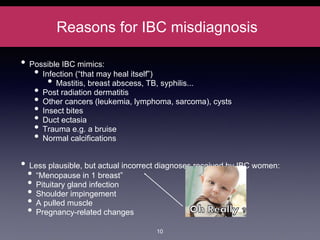
• Less plausible, but actual incorrect diagnoses received by IBC women:
• “Menopause in 1 breast”
• Pituitary gland infection
• Shoulder impingement
• A pulled muscle
• Pregnancy-related changes
10
IBC Clinical
Diagnosis
11
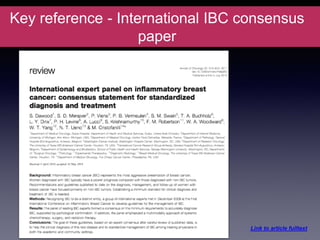
Key reference - International IBC consensus
paper
12
Link to article fulltext
Imaging used in IBC diagnosis
• Breast
• Diagnostic mammogram (may not observe a lump) - only 43% of
IBC detected on a mammogram (Dushkin & Cristofanilli, JNCCN, 2011)
• Most common finding = skin thickening
• Ultrasound of breast and nodes
• MRI
• Metastatic Workup - done because of substantial risk of regional and
distant metastatic disease
• PET/CT highly recommended if not possible then CT of chest,
abdomen, pelvis
• Bone scan
13
IBC pathology concepts
• IBC must be confirmed by a core biopsy so that enough tissue is
obtained for biomarker analysis (ER, PR, HER2)
• Recommend at least 2 skin punch biopsies to determine
presence of lymphovascular emboli (see later slides). Try to
sample the areas that are most discolored.
• ER, PR, and HER2
• Testing must be done to determine potential treatment
• ER and PR tested via immunohistochemistry (IHC)
• HER2 tests either by IHC or FISH (fluorescence in situ
hybridization).If results fall inside of a ‘grey’ zone, then the other
test is performed by reflex.
14
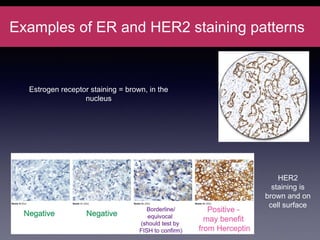
Examples of ER and HER2 staining patterns
15
HER2
staining is
brown and on
cell surface
Estrogen receptor staining = brown, in the
nucleus
IBC pathology concepts
• IBC is not a histologic subtype of breast cancer!
• Pathology report may not state “inflammatory
breast cancer” since pathologically it is not
possible to differentiate IBC from other invasive
breast cancers
• Potential histologies include invasive ductal
carcinoma (~75%), lobular, mixed ductal +
lobular, medullary, small cell, large cell
• So: IBC = invasive breast cancer in the setting of
the clinical symptoms described previously
16
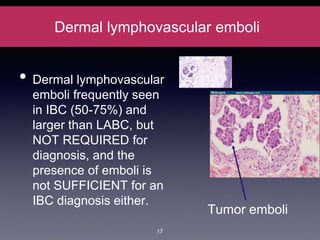
Dermal lymphovascular emboli
• Dermal lymphovascular
emboli frequently seen
in IBC (50-75%) and
larger than LABC, but
NOT REQUIRED for
diagnosis, and the
presence of emboli is
not SUFFICIENT for an
IBC diagnosis either.
17
Tumor emboli
IBC staging per AJCC guidelines - TNM
• IBC staging uses the established AJCC criteria for
breast cancer
• TNM system
• T = tumor size. IBC is always T4d regardless of
size of redness
• N = nodal status. N1-N3 depending on the
number and location of clinically positive nodes.
• M = distant metastatic sites (eg lung, liver, bone,
brain etc)
18
IBC staging specifics
• By definition, T4 tumors (including IBC) are stage III.
• Non-metastatic IBC (ie breast and lymph nodes only) is
always stage IIIB or IIIC (IIB = T4N0M0, T4N1M0, or
T4N2M0, IIIC = T4N3M0)
• De novo metastatic IBC is stage IV
• Stage IIIB/C patients who later develop distant metastases are
not technically stage IV in cancer statistics.
• However, many clinicians tell patients they are now stage IV
when discussing the goals and duration of treatment
(palliative/controlling disease vs “curative intent”)
19
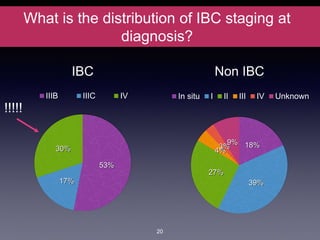
What is the distribution of IBC staging at
diagnosis?
20
53%
17%
30%
IIIB IIIC IV
IBC
18%
39%
27%
4%
3%
9%
In situ I II III IV Unknown
Non IBC
!!!!!
IBC molecular subtypes
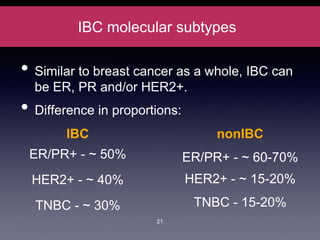
• Similar to breast cancer as a whole, IBC can
be ER, PR and/or HER2+.
• Difference in proportions:
21
IBC
ER/PR+ - ~ 50%
HER2+ - ~ 40%
TNBC - ~ 30%
nonIBC
ER/PR+ - ~ 60-70%
HER2+ - ~ 15-20%
TNBC - 15-20%
Hormone receptor subtypes have different
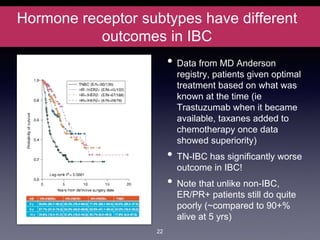
outcomes in IBC
• Data from MD Anderson
registry, patients given optimal
treatment based on what was
known at the time (ie
Trastuzumab when it became
available, taxanes added to
chemotherapy once data
showed superiority)
• TN-IBC has significantly worse
outcome in IBC!
• Note that unlike non-IBC,
ER/PR+ patients still do quite
poorly (~compared to 90+%
alive at 5 yrs)
22
TNBC subtypes are all present in similar ratios in
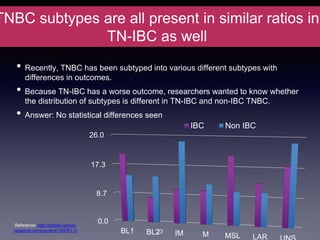
TN-IBC as well
• Recently, TNBC has been subtyped into various different subtypes with
differences in outcomes.
• Because TN-IBC has a worse outcome, researchers wanted to know whether
the distribution of subtypes is different in TN-IBC and non-IBC TNBC.
• Answer: No statistical differences seen
23
0.0
8.7
17.3
26.0
BL1 BL2 IM M MSL LAR
IBC Non IBC
Reference: http://breast-cancer-
research.com/content/15/6/R112
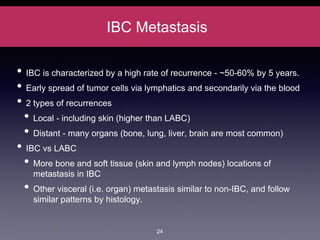
IBC Metastasis
• IBC is characterized by a high rate of recurrence - ~50-60% by 5 years.
• Early spread of tumor cells via lymphatics and secondarily via the blood
• 2 types of recurrences
• Local - including skin (higher than LABC)
• Distant - many organs (bone, lung, liver, brain are most common)
• IBC vs LABC
• More bone and soft tissue (skin and lymph nodes) locations of
metastasis in IBC
• Other visceral (i.e. organ) metastasis similar to non-IBC, and follow
similar patterns by histology.
24
IBC Treatment
Protocols
25
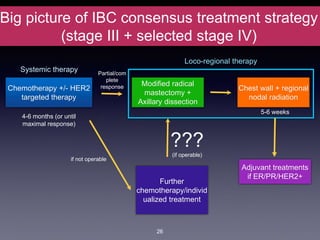
Big picture of IBC consensus treatment strategy
(stage III + selected stage IV)
Chemotherapy +/- HER2
targeted therapy
Modified radical
mastectomy +
Axillary dissection
4-6 months (or until
maximal response)
Partial/com
plete
response
5-6 weeks
Chest wall + regional
nodal radiation
???
(if operable)
if not operable
Further
chemotherapy/individ
ualized treatment
Loco-regional therapy
Systemic therapy
Adjuvant treatments
if ER/PR/HER2+
26
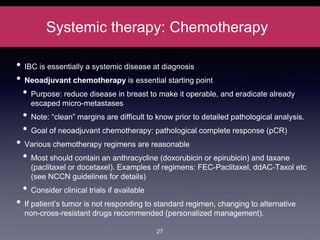
Systemic therapy: Chemotherapy
• IBC is essentially a systemic disease at diagnosis
• Neoadjuvant chemotherapy is essential starting point
• Purpose: reduce disease in breast to make it operable, and eradicate already
escaped micro-metastases
• Note: “clean” margins are difficult to know prior to detailed pathological analysis.
• Goal of neoadjuvant chemotherapy: pathological complete response (pCR)
• Various chemotherapy regimens are reasonable
• Most should contain an anthracycline (doxorubicin or epirubicin) and taxane
(paclitaxel or docetaxel). Examples of regimens: FEC-Paclitaxel, ddAC-Taxol etc
(see NCCN guidelines for details)
• Consider clinical trials if available
• If patient’s tumor is not responding to standard regimen, changing to alternative
non-cross-resistant drugs recommended (personalized management).
27
Systemic therapy: HER2 targeted therapy (for
HER2+ patients ONLY!)
• HER2-overexpressing patients, defined as IHC3+
or FISH >2.2 should receive Trastuzumab +
Pertuzumab in combination with a taxane. (2013
FDA approval)
• TCH-P (Taxotere, Carboplatin, Herceptin,
Pertuzumab) is an effective anthracycline-free
option that has been shown to have benefit in
IBC and nonIBC patients
• After surgery, patients should continue
Trastuzumab for a total of 1 year
28
Loco-regional treatment: Surgery
• After completion of chemotherapy, stage III and selected stage IV patients undergo surgery
to remove any residual disease in the breast and nodes
• Stage IV patients with detectable/uncontrolled distant metastases still present after
chemotherapy may not benefit from surgery. Personalized treatment is necessary in this
situation.
• If surgery is planned, it should be performed ideally within 4-6 weeks of last chemotherapy
dose.
• Surgery - non skin-sparing modified radical mastectomy
• Breast conservation (e.g. lumpectomy) is not recommended. IBC involves the skin, so it
must be removed. The entire breast may contain dispersed disease so it must be carefully
examined pathologically.
• Axillary dissection must be done for adequate staging and removal of any resistant
disease. Note: Sentinel node biopsy is not recommended and frequently fails in IBC
patients due to the involvement of regional lymphatics.
29
Reconstruction considerations
• Immediate reconstruction is not recommended for various reasons
• Elevated recurrence rate - optimal treatment involves radiation in a timely manner.
• Expanders and non-skin-sparing mastectomies do not go together! Skin must be left behind to
cover an expander, and this skin might harbor residual IBC, leading to rapid recurrence.
• Placing expanders at time of mastectomy dictates a schedule for filling and future surgeries to
complete reconstruction. This schedule compromises the overall care for several
potential reasons:
• Poor radiation coverage of the chest wall and nodes is a consequence of expanders being
in place.
• Complications from larger surgery such as poor wound healing/failed reconstruction can
unnecessarily delay radiation (a key component of local control)
• Delayed reconstruction (by autologous methods) may be considered in IBC patients who are still
disease-free 2 years post surgery. Implants are not usually possible due to skin changes post-
radiation.
30
Loco-regional treatment: Radiation
• Post-mastectomy radiation is important component of multidisciplinary care.
• At minimum, 60Gy standard fractionation is used. MD Anderson data has
shown that increasing the total dose to 66Gy has benefit in IBC patients.
• Modulating intensity of radiation via daily vs twice-a-day schedule:
• Twice a day schedule worth considering in patients with above-average
recurrence risk (poor response to chemotherapy, younger than 50yrs of
age, triple negative disease)
• Alternatively, use of chemotherapy as a radiosensitizer (such as Xeloda) or
a clinical trial may be warranted in this setting
• Use of bolus to deposit dose in skin is useful.
• Patients should be discouraged from using creams that have sunscreen -
rather they should be given guidance on appropriate skin care throughout
radiation.
31
Adjuvant treatments
• HER2+ patients - should receive Trastuzumab for the remainder of 1 year total
duration
• ER+/PR+ patients - highly recommended endocrine therapy
• Various choices as in non-IBC breast cancer:
• Pre-menopausal - 10 years of tamoxifen OR aromatase inhibitor + ovarian
suppression (or removal) for 5+ years (longer treatment with AIs not supported
by long-term data yet).
• Post-menopausal - Aromatase inhibitors for 5 years (or tamoxifen if AIs are not
tolerated)
• Menopausal status should be confirmed in women who were pre/peri-
menopausal prior to chemotherapy by hormone testing, since chemotherapy
induced amenorrhea can persist in spite of functioning ovaries.
• Important reason: Aromatase inhibitors are ineffective if the ovaries are still
functional (regardless of menstrual cycling status)
32
FAQs
• Is there a link to BRCA1/2 mutation? Should IBC patients be
tested for one of these mutations?
• Answer: Yes, BRCA1/2 mutations are found in IBC, at a
similar rate as non-IBC. Genetic counseling is highly
recommended to make testing decisions, using similar
criteria as non-IBC (info —>
https://www.healthpartners.com/public/coverage-
criteria/brca-testing/).
• Can men get IBC?
• Answer: Yes. There is not a large literature, but ~0.5% of
male breast cancer is IBC.
33
IBC Research Themes - Basic/translational
• Basic/translational laboratory research
• In depth genomic, transcriptomic, proteomic analysis by subtypes
• Investigation into microenvironmental factors that contribute to risk/outcomes
• e.g. normal tissue/stromal/immune factors; role of pregnancy and breast-
feeding
• Novel targets especially in TN-IBC; stem-cell biology; anti-metastatic strategies
• Ways to radio/chemo-sensitize IBC cells
34
IBC Research Themes - Clinical/Epidemiological
• Clinical
• What to do for chemo-resistant disease?
• Is there a role for anti-angiogenic therapies?
• Recurrence prevention strategies in stage 3 NED patients after trimodality
therapy
• Peptide vaccines/immunotherapy?
• Statins?
• Epidemiology
• Who is at risk? Lifestyle factors? Geographic issues
35
FAQs (cont.)
• Can you look at my biopsy and tell me if I have IBC?
• Answer: Unfortunately not. Your doctor should use
the clinical criteria discussed in the consensus
paper mentioned, and confirm the presence of
invasive breast cancer to make a diagnosis of IBC.
• Can you get IBC on both breasts at once?
• Answer: Yes, there have been some cases of
bilateral IBC at the same time.
36
FAQs (cont.)
• Can recurrences of IBC change hormone receptor status? Why?
• Answer: Yes, it does happen perhaps 20-40% of the time in breast cancer.
There are a few potential reasons including testing inaccuracy and
underlying biology. Biological reasons include initial tumor heterogeneity
(ie ER+ just means >= 1% of cells are positive) and differential response to
chemotherapy/targeted therapy of different clones.
• Is IBC caused by a virus?
• Answer: The role of viruses is unclear. There have been reports of viral
DNA found in various breast cancers, but causality is difficult to prove.
Some of the viruses (eg EBV) are highly prevalent in the US population,
and yet only 1-5% of breast cancers are IBC. IBC development is likely
multi-factorial, so viral infection is unlikely to be a major driver.
37
Resources for more information
• University of Texas MD Anderson Morgan Welch
Inflammatory Breast Cancer Clinic -
http://www.mdanderson.org/patient-and-cancer-
information/cancer-information/cancer-types/inflammatory-
breast-cancer/index.html
• National Cancer Institute -
http://www.cancer.gov/cancertopics/factsheet/Sites-
Types/IBC
• Mayo Clinic - http://www.mayoclinic.org/diseases-
conditions/inflammatory-breast-cancer/basics/definition/con-
20035052
• The IBC Network Foundation - www.theibcnetwork.org
38
How to contact us
• The IBC Network Foundation
• Terry Arnold - terry@theibcnetwork.org
• Angela Alexander - thecancergeek@gmail.com
• Social media accounts
• Twitter: @TalkIBC
• Facebook: www.facebook.com/TalkIBC
• Facebook support group for patients/survivors:
https://www.facebook.com/groups/inflammatorybrea
stcancer
39

Inflammatory Breast Cancer (IBC) Information

  • 1.
  • 2.
    Outline • IBC definition- how is it different from locally advanced breast cancers (LABC) • IBC clinical diagnosis • Imaging • Pathology • IBC treatment protocols - order of treatment! • FAQs 2
  • 3.
    IBC has beendescribed for 200 years • First described in 1814 by Sir Charles Bell as “a purple color on the skin over the tumor, accompanied by shooting pain” • The term “IBC” was proposed by Lee and Tannenbaum in 1924, after this disease had many previous names • lactation cancer, carcinoma mastitoides, mastitis carcinomatosa, acute encephaloid cancer, acute mammary carcinoma, acute brawny cancer, acute scirrhous carcinoma, and carcinoma telangiectaticum 3
  • 4.
    What is inflammatorybreast cancer? • An aggressive subset of breast cancer diagnosed clinically (no current molecular definition!) • 2-5% of total BC incidence, but ~10% of mortality • 2 types of IBC • Primary IBC - IBC developing in a previously normal breast (MOST CASES) • Secondary IBC - IBC features (and biopsy-proven invasive cancer) on the chest wall post mastectomy for non-IBC or a recurrence with inflammatory features in a breast that already had cancer • A palpable lump is present in only a third of IBC patients at diagnosis • Hence the IBC Network’s slogan -“No lump still cancer” slogan 4
  • 5.
    How is IBCdifferent from other locally advanced breast cancers? 5
  • 6.
    1) IBC visualsymptoms are distinctive • Classical signs of primary IBC • Warm, rapidly enlarging swollen breast (due to the blockage of lymph vessels with tumor clumps) • Redness (or pinkness) covering 1/3 or more of the breast, with a history of no more than 6 months • (Impt: neglected non-IBC can invade skin and appear like IBC) • Peau d’orange (orange peel) appearance of the skin overlying the breast • Breast can be painful • Nipple changes (e.g. retraction, flattening, crusting) • NOTE: Not all these symptoms must be present for a diagnosis of IBC 6
  • 7.
    2) IBC hasparticular imaging differences • No palpable lump in 2/3rds of women - frequent ‘webby’ appearance • Mammograms miss >50% of IBC cases - but key observations include skin thickening, stromal coarsening, diffusely increased breast density (vs calcifications or a discrete lump in most breast cancers) • High rate of abnormal/enlarged lymph nodes in axilla or superclavicular region - most easily detected by ultrasound 7
  • 8.
    3) Demographics ofIBC patients (vs non-IBC breast cancers) • Younger median age at diagnosis • IBC - 58yrs old • nIBC - 63-68yrs old • Black and Asian women are diagnosed younger • 15-20% of IBC occurs in women with a family history of breast cancer 8 Early stage BC IBC Information from SEER national database
  • 9.
    IBC vs LABCDifferences Summary • IBC is different because: 1. It presents & behaves differently - must be aware of symptoms and rapidly changing breast appearance 2. It is more difficult to detect by routine imaging (mammograms), and... 3. Often presents in young women prior to the recommended age for beginning screening mammography. 4. Requires multidisciplinary specialty care by expert team - several critical differences in management (see later section). 9
  • 10.
    Reasons for IBCmisdiagnosis • Possible IBC mimics: • Infection (“that may heal itself”) • Mastitis, breast abscess, TB, syphilis... • Post radiation dermatitis • Other cancers (leukemia, lymphoma, sarcoma), cysts • Insect bites • Duct ectasia • Trauma e.g. a bruise • Normal calcifications • Less plausible, but actual incorrect diagnoses received by IBC women: • “Menopause in 1 breast” • Pituitary gland infection • Shoulder impingement • A pulled muscle • Pregnancy-related changes 10
  • 11.
  • 12.
    Key reference -International IBC consensus paper 12 Link to article fulltext
  • 13.
    Imaging used inIBC diagnosis • Breast • Diagnostic mammogram (may not observe a lump) - only 43% of IBC detected on a mammogram (Dushkin & Cristofanilli, JNCCN, 2011) • Most common finding = skin thickening • Ultrasound of breast and nodes • MRI • Metastatic Workup - done because of substantial risk of regional and distant metastatic disease • PET/CT highly recommended if not possible then CT of chest, abdomen, pelvis • Bone scan 13
  • 14.
    IBC pathology concepts •IBC must be confirmed by a core biopsy so that enough tissue is obtained for biomarker analysis (ER, PR, HER2) • Recommend at least 2 skin punch biopsies to determine presence of lymphovascular emboli (see later slides). Try to sample the areas that are most discolored. • ER, PR, and HER2 • Testing must be done to determine potential treatment • ER and PR tested via immunohistochemistry (IHC) • HER2 tests either by IHC or FISH (fluorescence in situ hybridization).If results fall inside of a ‘grey’ zone, then the other test is performed by reflex. 14
  • 15.
    Examples of ERand HER2 staining patterns 15 HER2 staining is brown and on cell surface Estrogen receptor staining = brown, in the nucleus
  • 16.
    IBC pathology concepts •IBC is not a histologic subtype of breast cancer! • Pathology report may not state “inflammatory breast cancer” since pathologically it is not possible to differentiate IBC from other invasive breast cancers • Potential histologies include invasive ductal carcinoma (~75%), lobular, mixed ductal + lobular, medullary, small cell, large cell • So: IBC = invasive breast cancer in the setting of the clinical symptoms described previously 16
  • 17.
    Dermal lymphovascular emboli •Dermal lymphovascular emboli frequently seen in IBC (50-75%) and larger than LABC, but NOT REQUIRED for diagnosis, and the presence of emboli is not SUFFICIENT for an IBC diagnosis either. 17 Tumor emboli
  • 18.
    IBC staging perAJCC guidelines - TNM • IBC staging uses the established AJCC criteria for breast cancer • TNM system • T = tumor size. IBC is always T4d regardless of size of redness • N = nodal status. N1-N3 depending on the number and location of clinically positive nodes. • M = distant metastatic sites (eg lung, liver, bone, brain etc) 18
  • 19.
    IBC staging specifics •By definition, T4 tumors (including IBC) are stage III. • Non-metastatic IBC (ie breast and lymph nodes only) is always stage IIIB or IIIC (IIB = T4N0M0, T4N1M0, or T4N2M0, IIIC = T4N3M0) • De novo metastatic IBC is stage IV • Stage IIIB/C patients who later develop distant metastases are not technically stage IV in cancer statistics. • However, many clinicians tell patients they are now stage IV when discussing the goals and duration of treatment (palliative/controlling disease vs “curative intent”) 19
  • 20.
    What is thedistribution of IBC staging at diagnosis? 20 53% 17% 30% IIIB IIIC IV IBC 18% 39% 27% 4% 3% 9% In situ I II III IV Unknown Non IBC !!!!!
  • 21.
    IBC molecular subtypes •Similar to breast cancer as a whole, IBC can be ER, PR and/or HER2+. • Difference in proportions: 21 IBC ER/PR+ - ~ 50% HER2+ - ~ 40% TNBC - ~ 30% nonIBC ER/PR+ - ~ 60-70% HER2+ - ~ 15-20% TNBC - 15-20%
  • 22.
    Hormone receptor subtypeshave different outcomes in IBC • Data from MD Anderson registry, patients given optimal treatment based on what was known at the time (ie Trastuzumab when it became available, taxanes added to chemotherapy once data showed superiority) • TN-IBC has significantly worse outcome in IBC! • Note that unlike non-IBC, ER/PR+ patients still do quite poorly (~compared to 90+% alive at 5 yrs) 22
  • 23.
    TNBC subtypes areall present in similar ratios in TN-IBC as well • Recently, TNBC has been subtyped into various different subtypes with differences in outcomes. • Because TN-IBC has a worse outcome, researchers wanted to know whether the distribution of subtypes is different in TN-IBC and non-IBC TNBC. • Answer: No statistical differences seen 23 0.0 8.7 17.3 26.0 BL1 BL2 IM M MSL LAR IBC Non IBC Reference: http://breast-cancer- research.com/content/15/6/R112
  • 24.
    IBC Metastasis • IBCis characterized by a high rate of recurrence - ~50-60% by 5 years. • Early spread of tumor cells via lymphatics and secondarily via the blood • 2 types of recurrences • Local - including skin (higher than LABC) • Distant - many organs (bone, lung, liver, brain are most common) • IBC vs LABC • More bone and soft tissue (skin and lymph nodes) locations of metastasis in IBC • Other visceral (i.e. organ) metastasis similar to non-IBC, and follow similar patterns by histology. 24
  • 25.
  • 26.
    Big picture ofIBC consensus treatment strategy (stage III + selected stage IV) Chemotherapy +/- HER2 targeted therapy Modified radical mastectomy + Axillary dissection 4-6 months (or until maximal response) Partial/com plete response 5-6 weeks Chest wall + regional nodal radiation ??? (if operable) if not operable Further chemotherapy/individ ualized treatment Loco-regional therapy Systemic therapy Adjuvant treatments if ER/PR/HER2+ 26
  • 27.
    Systemic therapy: Chemotherapy •IBC is essentially a systemic disease at diagnosis • Neoadjuvant chemotherapy is essential starting point • Purpose: reduce disease in breast to make it operable, and eradicate already escaped micro-metastases • Note: “clean” margins are difficult to know prior to detailed pathological analysis. • Goal of neoadjuvant chemotherapy: pathological complete response (pCR) • Various chemotherapy regimens are reasonable • Most should contain an anthracycline (doxorubicin or epirubicin) and taxane (paclitaxel or docetaxel). Examples of regimens: FEC-Paclitaxel, ddAC-Taxol etc (see NCCN guidelines for details) • Consider clinical trials if available • If patient’s tumor is not responding to standard regimen, changing to alternative non-cross-resistant drugs recommended (personalized management). 27
  • 28.
    Systemic therapy: HER2targeted therapy (for HER2+ patients ONLY!) • HER2-overexpressing patients, defined as IHC3+ or FISH >2.2 should receive Trastuzumab + Pertuzumab in combination with a taxane. (2013 FDA approval) • TCH-P (Taxotere, Carboplatin, Herceptin, Pertuzumab) is an effective anthracycline-free option that has been shown to have benefit in IBC and nonIBC patients • After surgery, patients should continue Trastuzumab for a total of 1 year 28
  • 29.
    Loco-regional treatment: Surgery •After completion of chemotherapy, stage III and selected stage IV patients undergo surgery to remove any residual disease in the breast and nodes • Stage IV patients with detectable/uncontrolled distant metastases still present after chemotherapy may not benefit from surgery. Personalized treatment is necessary in this situation. • If surgery is planned, it should be performed ideally within 4-6 weeks of last chemotherapy dose. • Surgery - non skin-sparing modified radical mastectomy • Breast conservation (e.g. lumpectomy) is not recommended. IBC involves the skin, so it must be removed. The entire breast may contain dispersed disease so it must be carefully examined pathologically. • Axillary dissection must be done for adequate staging and removal of any resistant disease. Note: Sentinel node biopsy is not recommended and frequently fails in IBC patients due to the involvement of regional lymphatics. 29
  • 30.
    Reconstruction considerations • Immediatereconstruction is not recommended for various reasons • Elevated recurrence rate - optimal treatment involves radiation in a timely manner. • Expanders and non-skin-sparing mastectomies do not go together! Skin must be left behind to cover an expander, and this skin might harbor residual IBC, leading to rapid recurrence. • Placing expanders at time of mastectomy dictates a schedule for filling and future surgeries to complete reconstruction. This schedule compromises the overall care for several potential reasons: • Poor radiation coverage of the chest wall and nodes is a consequence of expanders being in place. • Complications from larger surgery such as poor wound healing/failed reconstruction can unnecessarily delay radiation (a key component of local control) • Delayed reconstruction (by autologous methods) may be considered in IBC patients who are still disease-free 2 years post surgery. Implants are not usually possible due to skin changes post- radiation. 30
  • 31.
    Loco-regional treatment: Radiation •Post-mastectomy radiation is important component of multidisciplinary care. • At minimum, 60Gy standard fractionation is used. MD Anderson data has shown that increasing the total dose to 66Gy has benefit in IBC patients. • Modulating intensity of radiation via daily vs twice-a-day schedule: • Twice a day schedule worth considering in patients with above-average recurrence risk (poor response to chemotherapy, younger than 50yrs of age, triple negative disease) • Alternatively, use of chemotherapy as a radiosensitizer (such as Xeloda) or a clinical trial may be warranted in this setting • Use of bolus to deposit dose in skin is useful. • Patients should be discouraged from using creams that have sunscreen - rather they should be given guidance on appropriate skin care throughout radiation. 31
  • 32.
    Adjuvant treatments • HER2+patients - should receive Trastuzumab for the remainder of 1 year total duration • ER+/PR+ patients - highly recommended endocrine therapy • Various choices as in non-IBC breast cancer: • Pre-menopausal - 10 years of tamoxifen OR aromatase inhibitor + ovarian suppression (or removal) for 5+ years (longer treatment with AIs not supported by long-term data yet). • Post-menopausal - Aromatase inhibitors for 5 years (or tamoxifen if AIs are not tolerated) • Menopausal status should be confirmed in women who were pre/peri- menopausal prior to chemotherapy by hormone testing, since chemotherapy induced amenorrhea can persist in spite of functioning ovaries. • Important reason: Aromatase inhibitors are ineffective if the ovaries are still functional (regardless of menstrual cycling status) 32
  • 33.
    FAQs • Is therea link to BRCA1/2 mutation? Should IBC patients be tested for one of these mutations? • Answer: Yes, BRCA1/2 mutations are found in IBC, at a similar rate as non-IBC. Genetic counseling is highly recommended to make testing decisions, using similar criteria as non-IBC (info —> https://www.healthpartners.com/public/coverage- criteria/brca-testing/). • Can men get IBC? • Answer: Yes. There is not a large literature, but ~0.5% of male breast cancer is IBC. 33
  • 34.
    IBC Research Themes- Basic/translational • Basic/translational laboratory research • In depth genomic, transcriptomic, proteomic analysis by subtypes • Investigation into microenvironmental factors that contribute to risk/outcomes • e.g. normal tissue/stromal/immune factors; role of pregnancy and breast- feeding • Novel targets especially in TN-IBC; stem-cell biology; anti-metastatic strategies • Ways to radio/chemo-sensitize IBC cells 34
  • 35.
    IBC Research Themes- Clinical/Epidemiological • Clinical • What to do for chemo-resistant disease? • Is there a role for anti-angiogenic therapies? • Recurrence prevention strategies in stage 3 NED patients after trimodality therapy • Peptide vaccines/immunotherapy? • Statins? • Epidemiology • Who is at risk? Lifestyle factors? Geographic issues 35
  • 36.
    FAQs (cont.) • Canyou look at my biopsy and tell me if I have IBC? • Answer: Unfortunately not. Your doctor should use the clinical criteria discussed in the consensus paper mentioned, and confirm the presence of invasive breast cancer to make a diagnosis of IBC. • Can you get IBC on both breasts at once? • Answer: Yes, there have been some cases of bilateral IBC at the same time. 36
  • 37.
    FAQs (cont.) • Canrecurrences of IBC change hormone receptor status? Why? • Answer: Yes, it does happen perhaps 20-40% of the time in breast cancer. There are a few potential reasons including testing inaccuracy and underlying biology. Biological reasons include initial tumor heterogeneity (ie ER+ just means >= 1% of cells are positive) and differential response to chemotherapy/targeted therapy of different clones. • Is IBC caused by a virus? • Answer: The role of viruses is unclear. There have been reports of viral DNA found in various breast cancers, but causality is difficult to prove. Some of the viruses (eg EBV) are highly prevalent in the US population, and yet only 1-5% of breast cancers are IBC. IBC development is likely multi-factorial, so viral infection is unlikely to be a major driver. 37
  • 38.
    Resources for moreinformation • University of Texas MD Anderson Morgan Welch Inflammatory Breast Cancer Clinic - http://www.mdanderson.org/patient-and-cancer- information/cancer-information/cancer-types/inflammatory- breast-cancer/index.html • National Cancer Institute - http://www.cancer.gov/cancertopics/factsheet/Sites- Types/IBC • Mayo Clinic - http://www.mayoclinic.org/diseases- conditions/inflammatory-breast-cancer/basics/definition/con- 20035052 • The IBC Network Foundation - www.theibcnetwork.org 38
  • 39.
    How to contactus • The IBC Network Foundation • Terry Arnold - terry@theibcnetwork.org • Angela Alexander - thecancergeek@gmail.com • Social media accounts • Twitter: @TalkIBC • Facebook: www.facebook.com/TalkIBC • Facebook support group for patients/survivors: https://www.facebook.com/groups/inflammatorybrea stcancer 39