Dhaval Mangukiya
 Length of hospital stay
 Morbidity
 Mortality
 Length of time to return to full function (work
or activities of daily living) and
 Patient satisfaction
(Ann Surg2008;248: 189 –198)
 Multimodal approach incorporates surgeons,
anesthesiologists, nurses, and physical
therapists as active participants of the care
team.
 Focuses on ERAS implementing evidence in
the fields of anesthesia, analgesia, reduction
of surgical stress, fluid management, minimal
invasive surgery, nutrition, and ambulation
 INITIAL DESCRIPTION OF SYSTEMIC
INJURY RESPONSES
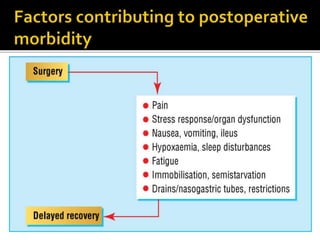
 The stress response in surgical patients is
associated with tissue catabolism, organ
failure, and prolonged recovery
DouglasW.Wilmore From Cuthbertson to Fast-Track Surgery:
70Years of Progress in Reducing Stress in Surgical Patients;
Ann Surg. 2002 November; 236(5): 643–648.
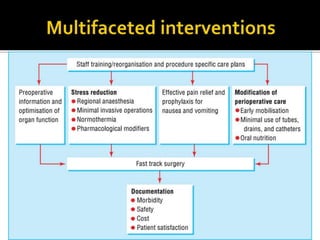
 Reducing the body’s stress response after
surgery reduces the time needed to
recuperate.
 Achieved by
 Interventions around the operation
 Involving good information
 Better feeding before the operation
 Better pain treatment
 Fast track surgery combines various
techniques used in the care of patients
undergoing elective operations
 epidural or regional anesthesia
 minimally invasive techniques
 optimal pain control
 aggressive postoperative rehabilitation
[early enteral (oral) nutrition and ambulation]
 Management of patients in fast track surgery
BMJ Volume 322 February 24, 2001
 Evidence-Based Surgical Care and the Evolution of
Fast-Track Surgery Annals of Surgery Volume 248,
Number 2, August 2008
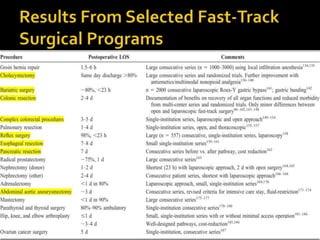
 Multimodal approach to postoperative recovery
Current Opinion in Critical Care 2009, 15:355–358
 H. Kehlet and K. Slim The future of fast-track surgery
British Journal of Surgery August 2012 Volume
99, Issue 8 Pages 1025–1168
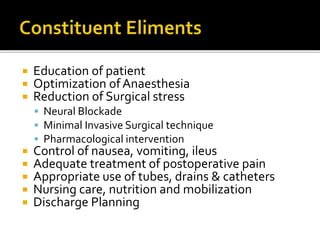
 Education of patient
 Optimization ofAnaesthesia
 Reduction of Surgical stress
 Neural Blockade
 Minimal Invasive Surgical technique
 Pharmacological intervention
 Control of nausea, vomiting, ileus
 Adequate treatment of postoperative pain
 Appropriate use of tubes, drains & catheters
 Nursing care, nutrition and mobilization
 Discharge Planning
 Thromboprophylaxis reduces morbidity
 Perioperative use of oxygen therapy to decrease wound
and anastomotic complications requires further study
 Studies do not support the routine use of drains,
nasogastric tubes in a variety of abdominal operations
including gastric and hepatic surgery but necessary after
esophagectomy
 Routine use of bowel clearance procedures before colonic
surgery and prolonged use of urinary catheters are not
recommended
 The use of transverse abdominal incision may reduce pain
and pulmonary compromise and may be preferred to a
vertical incision provided sufficient exposure can be
achieved.
 Goal: “stress and pain free operation”
 Reduces sympathetic responses, undesirable
cardiac events, and wound morbidity
 “goal-directed fluid therapy”
 Requires individualized pre and postoperative
optimization of stroke volume determined by
providing small challenges of colloid and
assessing cardiac function by the esophageal
Doppler or other techniques
 Improvement in post-operative outcome
(reduced morbidity and hospital stay)
 Local anesthetic blocks
 Reduce the endocrine catabolic response
leading to attenuated protein loss
 In major abdominal procedures continuous
thoracic epidural analgesia with local
anesthetics has also been demonstrated to be
the most efficient technique to reduce
postoperative ileus
 Opioid sparing multimodal analgesia to facilitate
recovery
 decreasing the undesirable inflammatory
responses, pain, and catabolism
 Advantage in certain procedures
 No obvious clinical advantages after colonic
surgery, appendectomy, and hip
replacement
 Reducing insulin resistance and attenuating
catabolism
 Preliminary evidence
 Requires more large-scale randomized
studies in major procedures before final
recommendations
 Glucocorticoids: role in minor procedures to
reduce pain, nausea, and vomiting
 Anabolic agents in certain high-risk patients
 Insulin may serve as a future important
component for stress reduction
 Statins and beta blocker may be of advantage in
certain high-risk patients
 Early oral nutrition facilitated by antiemetics and
antiileus interventions (epidural analgesia, mild
laxatives, peripheral opioid-antago-nists) may
reduce catabolism
 Opioid sparing reduces nausea, vomiting, and
sedation
 Several agents demonstrate effectiveness
(nonsteroidal anti-inflammatory drugs, COX-
2 inhibitors, ketamine, gabapentin, local
anesthetic techniques).
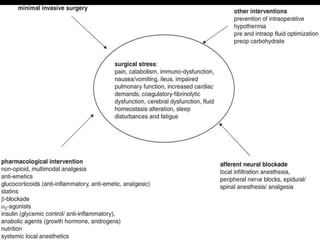
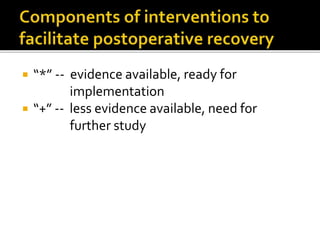
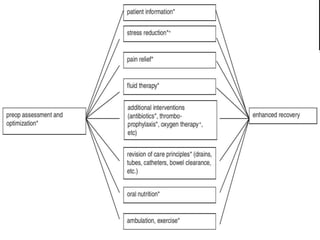
 “*” -- evidence available, ready for
implementation
 “+” -- less evidence available, need for
further study
 Multimodal approach to postoperative
recovery Current Opinion in Critical Care
2009, 15:355–358
 Fast-track colonic surgery is well tolerated and
feasible and with supportive data of reduced
postoperative morbidity in addition to reduction
of hospital stay
 Recent data have also shown enhanced recovery
after ileostomy closure with fast-track programs
 Schwenk W et al. ‘Fast-track’ rehabilitation for elective colonic surgery in
Germany-prospective observational data from a multicentre quality
assurance programme. Int J Colorectal Dis 2008; 23:93–99.
 JohYG et al.Standardized postoperative path-way: accelerating recovery
after ileostomy closure. Dis Colon Rectum 2008; 51:1786– 1789
 Evidence-based care programs to improve
outcome have been further supported by
fast-track clinical pathways
 Low DE. Evolution in perioperative management of patients undergoing oesophagectomy.
Br J Surg 2007; 94:655 –656.
 Jiang K, Cheng L, Wang JJ,et al.Fast track clinical pathway implications in
esophagogastrectomy. World J Gastroenterol 2009; 15:496 –501
 Pancreaticoduodenectomy with significant reductions
in length of stay as well as a potential to reduce
morbidity
 Further studies in which surgical technique, use of
drains, tubes, stents, fluid management, early oral
nutrition and so on are reconsidered and adjusted to
recent evidence
 Berberat PO, Ingold H, Gulbinas A,et al.Fast track: different implications in
pancreatic surgery. J Gastrointest Surg 2007; 11:880 –887.
 Balzano G, Zerbi A, Braga M,et al.Fast-track recovery programme after
pancreatico-duodenectomy reduces delayed gastric emptying. Br J Surg 2008;
95:1387 –1393
 Limited published in liver resection with
positive results stimulating for future
research and documentation of the concept.
 van Dam RM, Hendry PO, Coolsen MM, et al. Initial experience with a multimodal enhanced
recovery programme in patients undergoing liver re-section. Br J Surg 2008; 95:969 –975.
Fast track surgery versus conventional
recovery strategies for colorectal surgery
Willem R Spanjersberg et al
2011, Issue 2
(Art. No.:CD007635. DOI: 10.1002/14651858.CD007635.pub2)
 Mortality (both early and late), with early
mortality defined as death within 30 days
 Overall complications
 Major (including abdominal sepsis, anastomotic
leakage, need for reoperation, persistent ileus,
intra-abdominal abscesses, bleeding, burst
abdomen, late incisional hernia and adhesions)
 Minor (pneumonia, wound infection, deep vein
thrombosis, and urinary tract infection)
 length of hospital stay
 Operative time
 Economical evaluation
 Quality of life
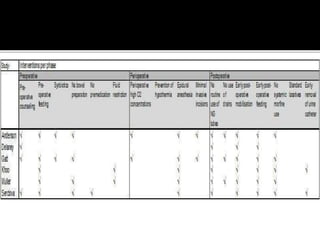
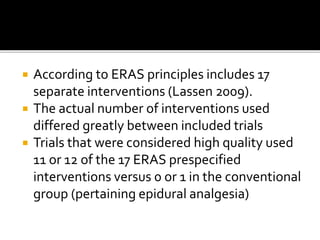
 According to ERAS principles includes 17
separate interventions (Lassen 2009).
 The actual number of interventions used
differed greatly between included trials
 Trials that were considered high quality used
11 or 12 of the 17 ERAS prespecified
interventions versus 0 or 1 in the conventional
group (pertaining epidural analgesia)
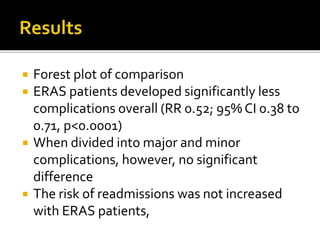
 Forest plot of comparison
 ERAS patients developed significantly less
complications overall (RR 0.52; 95% CI 0.38 to
0.71, p<0.0001)
 When divided into major and minor
complications, however, no significant
difference
 The risk of readmissions was not increased
with ERAS patients,
 Length of hospital stay was significantly
reduced in the ERAS group
 The use of analgesics and especially the use
of epidural analgesia was studied in two
trials, with contradictory results.
 Implementation of the ERAS protocol are not available in
literature
 Long term outcome parameters like oncological survival,
quality of life after surgery are not investigated yet
 Economical effects of the intervention have not been
investigated prospectively
 Evidence on the effects of ERAS with different operative
techniques like laparoscopy have not been analysed
 The effect of separate interventions in the ERAS protocol
have not been independently studied
 Exact knowledge on separate effects could also aid in
making ERAS programs more (cost-) efficient and
effective.
 The quantity and especially quality of data are low.
Analysis shows a reduction in overall complications,
but major complications were not reduced. Length of
stay was reduced significantly.
 ERAS seems safe, but the quality of trials and lack of
sufficient other outcome parameters do not justify
implementation of ERAS as the standard of care.
 Within ERAS protocols included, no answer regarding
the role for minimally invasive surgery (i.e.
laparoscopy) was found
 Protocol compliance within ERAS programs has not
been investigated
 More specific and large RCT’s are needed
Fast track

Fast track

  • 1.
  • 2.
     Length ofhospital stay  Morbidity  Mortality  Length of time to return to full function (work or activities of daily living) and  Patient satisfaction (Ann Surg2008;248: 189 –198)
  • 3.
     Multimodal approachincorporates surgeons, anesthesiologists, nurses, and physical therapists as active participants of the care team.  Focuses on ERAS implementing evidence in the fields of anesthesia, analgesia, reduction of surgical stress, fluid management, minimal invasive surgery, nutrition, and ambulation
  • 4.
     INITIAL DESCRIPTIONOF SYSTEMIC INJURY RESPONSES  The stress response in surgical patients is associated with tissue catabolism, organ failure, and prolonged recovery DouglasW.Wilmore From Cuthbertson to Fast-Track Surgery: 70Years of Progress in Reducing Stress in Surgical Patients; Ann Surg. 2002 November; 236(5): 643–648.
  • 5.
     Reducing thebody’s stress response after surgery reduces the time needed to recuperate.  Achieved by  Interventions around the operation  Involving good information  Better feeding before the operation  Better pain treatment
  • 6.
     Fast tracksurgery combines various techniques used in the care of patients undergoing elective operations  epidural or regional anesthesia  minimally invasive techniques  optimal pain control  aggressive postoperative rehabilitation [early enteral (oral) nutrition and ambulation]
  • 7.
     Management ofpatients in fast track surgery BMJ Volume 322 February 24, 2001  Evidence-Based Surgical Care and the Evolution of Fast-Track Surgery Annals of Surgery Volume 248, Number 2, August 2008  Multimodal approach to postoperative recovery Current Opinion in Critical Care 2009, 15:355–358  H. Kehlet and K. Slim The future of fast-track surgery British Journal of Surgery August 2012 Volume 99, Issue 8 Pages 1025–1168
  • 10.
     Education ofpatient  Optimization ofAnaesthesia  Reduction of Surgical stress  Neural Blockade  Minimal Invasive Surgical technique  Pharmacological intervention  Control of nausea, vomiting, ileus  Adequate treatment of postoperative pain  Appropriate use of tubes, drains & catheters  Nursing care, nutrition and mobilization  Discharge Planning
  • 11.
     Thromboprophylaxis reducesmorbidity  Perioperative use of oxygen therapy to decrease wound and anastomotic complications requires further study  Studies do not support the routine use of drains, nasogastric tubes in a variety of abdominal operations including gastric and hepatic surgery but necessary after esophagectomy  Routine use of bowel clearance procedures before colonic surgery and prolonged use of urinary catheters are not recommended  The use of transverse abdominal incision may reduce pain and pulmonary compromise and may be preferred to a vertical incision provided sufficient exposure can be achieved.
  • 12.
     Goal: “stressand pain free operation”
  • 14.
     Reduces sympatheticresponses, undesirable cardiac events, and wound morbidity
  • 15.
     “goal-directed fluidtherapy”  Requires individualized pre and postoperative optimization of stroke volume determined by providing small challenges of colloid and assessing cardiac function by the esophageal Doppler or other techniques  Improvement in post-operative outcome (reduced morbidity and hospital stay)
  • 16.
     Local anestheticblocks  Reduce the endocrine catabolic response leading to attenuated protein loss  In major abdominal procedures continuous thoracic epidural analgesia with local anesthetics has also been demonstrated to be the most efficient technique to reduce postoperative ileus  Opioid sparing multimodal analgesia to facilitate recovery
  • 17.
     decreasing theundesirable inflammatory responses, pain, and catabolism  Advantage in certain procedures  No obvious clinical advantages after colonic surgery, appendectomy, and hip replacement
  • 18.
     Reducing insulinresistance and attenuating catabolism  Preliminary evidence  Requires more large-scale randomized studies in major procedures before final recommendations
  • 19.
     Glucocorticoids: rolein minor procedures to reduce pain, nausea, and vomiting  Anabolic agents in certain high-risk patients  Insulin may serve as a future important component for stress reduction  Statins and beta blocker may be of advantage in certain high-risk patients  Early oral nutrition facilitated by antiemetics and antiileus interventions (epidural analgesia, mild laxatives, peripheral opioid-antago-nists) may reduce catabolism
  • 20.
     Opioid sparingreduces nausea, vomiting, and sedation  Several agents demonstrate effectiveness (nonsteroidal anti-inflammatory drugs, COX- 2 inhibitors, ketamine, gabapentin, local anesthetic techniques).
  • 21.
     “*” --evidence available, ready for implementation  “+” -- less evidence available, need for further study
  • 24.
     Multimodal approachto postoperative recovery Current Opinion in Critical Care 2009, 15:355–358
  • 25.
     Fast-track colonicsurgery is well tolerated and feasible and with supportive data of reduced postoperative morbidity in addition to reduction of hospital stay  Recent data have also shown enhanced recovery after ileostomy closure with fast-track programs  Schwenk W et al. ‘Fast-track’ rehabilitation for elective colonic surgery in Germany-prospective observational data from a multicentre quality assurance programme. Int J Colorectal Dis 2008; 23:93–99.  JohYG et al.Standardized postoperative path-way: accelerating recovery after ileostomy closure. Dis Colon Rectum 2008; 51:1786– 1789
  • 26.
     Evidence-based careprograms to improve outcome have been further supported by fast-track clinical pathways  Low DE. Evolution in perioperative management of patients undergoing oesophagectomy. Br J Surg 2007; 94:655 –656.  Jiang K, Cheng L, Wang JJ,et al.Fast track clinical pathway implications in esophagogastrectomy. World J Gastroenterol 2009; 15:496 –501
  • 27.
     Pancreaticoduodenectomy withsignificant reductions in length of stay as well as a potential to reduce morbidity  Further studies in which surgical technique, use of drains, tubes, stents, fluid management, early oral nutrition and so on are reconsidered and adjusted to recent evidence  Berberat PO, Ingold H, Gulbinas A,et al.Fast track: different implications in pancreatic surgery. J Gastrointest Surg 2007; 11:880 –887.  Balzano G, Zerbi A, Braga M,et al.Fast-track recovery programme after pancreatico-duodenectomy reduces delayed gastric emptying. Br J Surg 2008; 95:1387 –1393
  • 28.
     Limited publishedin liver resection with positive results stimulating for future research and documentation of the concept.  van Dam RM, Hendry PO, Coolsen MM, et al. Initial experience with a multimodal enhanced recovery programme in patients undergoing liver re-section. Br J Surg 2008; 95:969 –975.
  • 29.
    Fast track surgeryversus conventional recovery strategies for colorectal surgery Willem R Spanjersberg et al 2011, Issue 2 (Art. No.:CD007635. DOI: 10.1002/14651858.CD007635.pub2)
  • 30.
     Mortality (bothearly and late), with early mortality defined as death within 30 days  Overall complications  Major (including abdominal sepsis, anastomotic leakage, need for reoperation, persistent ileus, intra-abdominal abscesses, bleeding, burst abdomen, late incisional hernia and adhesions)  Minor (pneumonia, wound infection, deep vein thrombosis, and urinary tract infection)  length of hospital stay
  • 31.
     Operative time Economical evaluation  Quality of life
  • 33.
     According toERAS principles includes 17 separate interventions (Lassen 2009).  The actual number of interventions used differed greatly between included trials  Trials that were considered high quality used 11 or 12 of the 17 ERAS prespecified interventions versus 0 or 1 in the conventional group (pertaining epidural analgesia)
  • 34.
     Forest plotof comparison  ERAS patients developed significantly less complications overall (RR 0.52; 95% CI 0.38 to 0.71, p<0.0001)  When divided into major and minor complications, however, no significant difference  The risk of readmissions was not increased with ERAS patients,
  • 35.
     Length ofhospital stay was significantly reduced in the ERAS group  The use of analgesics and especially the use of epidural analgesia was studied in two trials, with contradictory results.
  • 36.
     Implementation ofthe ERAS protocol are not available in literature  Long term outcome parameters like oncological survival, quality of life after surgery are not investigated yet  Economical effects of the intervention have not been investigated prospectively  Evidence on the effects of ERAS with different operative techniques like laparoscopy have not been analysed  The effect of separate interventions in the ERAS protocol have not been independently studied  Exact knowledge on separate effects could also aid in making ERAS programs more (cost-) efficient and effective.
  • 37.
     The quantityand especially quality of data are low. Analysis shows a reduction in overall complications, but major complications were not reduced. Length of stay was reduced significantly.  ERAS seems safe, but the quality of trials and lack of sufficient other outcome parameters do not justify implementation of ERAS as the standard of care.  Within ERAS protocols included, no answer regarding the role for minimally invasive surgery (i.e. laparoscopy) was found  Protocol compliance within ERAS programs has not been investigated  More specific and large RCT’s are needed