Post–Cardiac Arrest Care
Circulation. 2015;132[suppl 1]:S465–S482.
CARDIOVASCULAR
CARE
Acute Cardiovascular Interventions
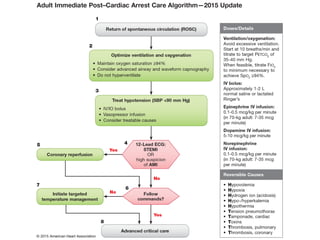
 Coronary angiography should be performed emergently
(rather than later in the hospital stay or not at all) for
OHCA patients with suspected cardiac etiology of arrest
and ST elevation on ECG (Class I)
 Emergency coronary angiography is reasonable for
select (eg, electrically or hemodynamically unstable)
adult patients who are comatose after OHCA of
suspected cardiac origin but without ST elevation on
ECG (Class IIa)
 Coronary angiography is reasonable in post–cardiac
arrest patients for whom coronary angiography is
indicated regardless of whether the patient is comatose
or awake (Class IIa)
Hemodynamic Goals
Avoiding and immediately correcting
hypotension (SBP less than 90 mmHg,
MAP less than 65 mmHg) during post-
resuscitation care may be reasonable
(Class IIb)
TARGETED
TEMPERATURE
MANAGEMENT
Induced Hypothermia
We recommend that comatose adult
patients with ROSC after cardiac arrest
have TTM (Class I for VF/pVT OHCA; non-
VF/pVT (ie, “non-shockable”) and IHCA)
We recommend selecting and maintaining
a constant temperature between 32oC and
36oC during TTM (Class I)
It is reasonable that TTM be maintained
for at least 24 hours after achieving target
temperature (Class IIa).
Avoidance of Hyperthermia
It may be reasonable to actively prevent
fever in comatose patients after TTM
(Class IIb)
RESPIRATORY
CARE
Ventilation
Maintaining the PaCO2 within a normal
physiological range, taking into account
any temperature correction, may be
reasonable (Class IIb).
Oxygenation
 To avoid hypoxia in adults with ROSC after
cardiac arrest, it is reasonable to use the
highest available oxygen concentration until
the arterial oxyhemoglobin saturation or the
partial pressure of arterial oxygen can be
measured (Class IIa).
 When resources are available to titrate the
FiO2 and to monitor oxyhemoglobin saturation,
it is reasonable to decrease the FiO2 when
oxyhemoglobin saturation is 100%, provided
the oxyhemoglobin saturation can be
maintained at 94% or greater (Class IIa).
PROGNOSTICATION
OF OUTCOME
Timing of Outcome Prediction
 The earliest time for prognostication using clinical
examination in patients treated with TTM, where
sedation or paralysis could be a confounder, may
be 72 hours after return to normothermia (Class
IIb)
 We recommend the earliest time to prognosticate
a poor neurologic outcome using clinical
examination in patients not treated with TTM is 72
hours after cardiac arrest (Class I).
 This time until prognostication can be even longer
than 72 hours after cardiac arrest if the residual
effect of sedation or paralysis confounds the
clinical examination (Class IIa)
Clinical Findings That Predict
Poor Neurologic Outcome
 Absence of pupillary reflex to light at 72 hours or more
after cardiac arrest
 Presence of status myoclonus during the first 72 hours
after cardiac arrest
 Absence of the N20 somatosensory evoked potential
cortical wave 24 to 72 hours after cardiac arrest or after
rewarming
 Presence of a marked reduction of the gray-white ratio
on brain CT obtained within 2 hours after cardiac arrest
 Extensive restriction of diffusion on brain MRI at 2 to 6
days after cardiac arrest
 Persistent absence of EEG reactivity to external stimuli
at 72 hours after cardiac arrest
 Persistent burst suppression or intractable status
epilepticus on EEG after rewarming
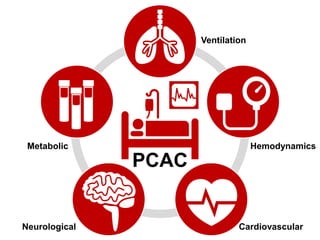
PCAC
Ventilation
Hemodynamics
CardiovascularNeurological
Metabolic
VENTILATION
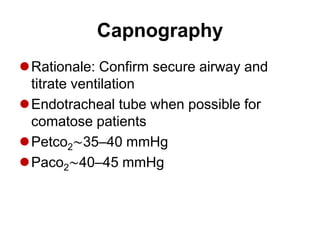
Capnography
Rationale: Confirm secure airway and
titrate ventilation
Endotracheal tube when possible for
comatose patients
Petco2∼35–40 mmHg
Paco2∼40–45 mmHg
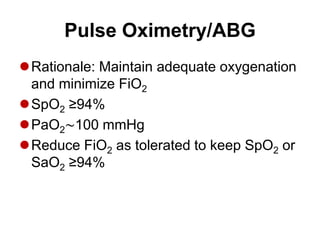
Pulse Oximetry/ABG
Rationale: Maintain adequate oxygenation
and minimize FiO2
SpO2 ≥94%
PaO2∼100 mmHg
Reduce FiO2 as tolerated to keep SpO2 or
SaO2 ≥94%
HEMODYNAMICS
Frequent BP Monitoring/A-line
Rationale: Maintain perfusion and prevent
recurrent hypotension
MAP ≥65 mmHg or SBP ≥90 mmHg
Treat Hypotension
Rationale: Maintain perfusion
Fluid bolus if tolerated
Dopamine 5–10 mcg/kg per min
Norepinephrine 0.1–0.5 mcg/kg per min
Epinephrine 0.1–0.5 mcg/kg per min
CARDIOVASCULAR
12-lead ECG/Troponin
Rationale: Detect ACS/STEMI; Assess QT
interval
Treat ACS
Aspirin/heparin
Transfer to acute coronary treatment center
Consider emergent PCI or fibrinolysis
NEUROLOGICAL
EEG Monitoring If Comatose
Rationale: Exclude seizures
Anti-convulsants if seizing
Core Temperature Measurement
If Comatose
Rationale: Minimize brain injury and
improve outcome
Prevent hyperpyrexia >37.7°C
Surface or endovascular cooling for 32°C–
34°C × 24 hours
After 24 hours, slow re-warming 0.25°C/hr
METABOLIC
Serial Lactate
Rationale: Confirm adequate perfusion
Serum Potassium
Rationale: Avoid hypokalemia which
promotes arrhythmias
Replace to maintain K >3.5 mEq/L
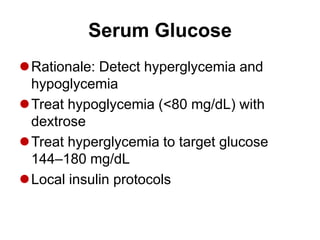
Serum Glucose
Rationale: Detect hyperglycemia and
hypoglycemia
Treat hypoglycemia (<80 mg/dL) with
dextrose
Treat hyperglycemia to target glucose
144–180 mg/dL
Local insulin protocols
Post–Cardiac Arrest Care

Post–Cardiac Arrest Care

  • 1.
    Post–Cardiac Arrest Care Circulation.2015;132[suppl 1]:S465–S482.
  • 2.
  • 3.
    Acute Cardiovascular Interventions Coronary angiography should be performed emergently (rather than later in the hospital stay or not at all) for OHCA patients with suspected cardiac etiology of arrest and ST elevation on ECG (Class I)  Emergency coronary angiography is reasonable for select (eg, electrically or hemodynamically unstable) adult patients who are comatose after OHCA of suspected cardiac origin but without ST elevation on ECG (Class IIa)  Coronary angiography is reasonable in post–cardiac arrest patients for whom coronary angiography is indicated regardless of whether the patient is comatose or awake (Class IIa)
  • 4.
    Hemodynamic Goals Avoiding andimmediately correcting hypotension (SBP less than 90 mmHg, MAP less than 65 mmHg) during post- resuscitation care may be reasonable (Class IIb)
  • 5.
  • 6.
    Induced Hypothermia We recommendthat comatose adult patients with ROSC after cardiac arrest have TTM (Class I for VF/pVT OHCA; non- VF/pVT (ie, “non-shockable”) and IHCA) We recommend selecting and maintaining a constant temperature between 32oC and 36oC during TTM (Class I) It is reasonable that TTM be maintained for at least 24 hours after achieving target temperature (Class IIa).
  • 7.
    Avoidance of Hyperthermia Itmay be reasonable to actively prevent fever in comatose patients after TTM (Class IIb)
  • 8.
  • 9.
    Ventilation Maintaining the PaCO2within a normal physiological range, taking into account any temperature correction, may be reasonable (Class IIb).
  • 10.
    Oxygenation  To avoidhypoxia in adults with ROSC after cardiac arrest, it is reasonable to use the highest available oxygen concentration until the arterial oxyhemoglobin saturation or the partial pressure of arterial oxygen can be measured (Class IIa).  When resources are available to titrate the FiO2 and to monitor oxyhemoglobin saturation, it is reasonable to decrease the FiO2 when oxyhemoglobin saturation is 100%, provided the oxyhemoglobin saturation can be maintained at 94% or greater (Class IIa).
  • 11.
  • 12.
    Timing of OutcomePrediction  The earliest time for prognostication using clinical examination in patients treated with TTM, where sedation or paralysis could be a confounder, may be 72 hours after return to normothermia (Class IIb)  We recommend the earliest time to prognosticate a poor neurologic outcome using clinical examination in patients not treated with TTM is 72 hours after cardiac arrest (Class I).  This time until prognostication can be even longer than 72 hours after cardiac arrest if the residual effect of sedation or paralysis confounds the clinical examination (Class IIa)
  • 13.
    Clinical Findings ThatPredict Poor Neurologic Outcome  Absence of pupillary reflex to light at 72 hours or more after cardiac arrest  Presence of status myoclonus during the first 72 hours after cardiac arrest  Absence of the N20 somatosensory evoked potential cortical wave 24 to 72 hours after cardiac arrest or after rewarming  Presence of a marked reduction of the gray-white ratio on brain CT obtained within 2 hours after cardiac arrest  Extensive restriction of diffusion on brain MRI at 2 to 6 days after cardiac arrest  Persistent absence of EEG reactivity to external stimuli at 72 hours after cardiac arrest  Persistent burst suppression or intractable status epilepticus on EEG after rewarming
  • 15.
  • 16.
  • 17.
    Capnography Rationale: Confirm secureairway and titrate ventilation Endotracheal tube when possible for comatose patients Petco2∼35–40 mmHg Paco2∼40–45 mmHg
  • 18.
    Pulse Oximetry/ABG Rationale: Maintainadequate oxygenation and minimize FiO2 SpO2 ≥94% PaO2∼100 mmHg Reduce FiO2 as tolerated to keep SpO2 or SaO2 ≥94%
  • 19.
  • 20.
    Frequent BP Monitoring/A-line Rationale:Maintain perfusion and prevent recurrent hypotension MAP ≥65 mmHg or SBP ≥90 mmHg
  • 21.
    Treat Hypotension Rationale: Maintainperfusion Fluid bolus if tolerated Dopamine 5–10 mcg/kg per min Norepinephrine 0.1–0.5 mcg/kg per min Epinephrine 0.1–0.5 mcg/kg per min
  • 22.
  • 23.
    12-lead ECG/Troponin Rationale: DetectACS/STEMI; Assess QT interval
  • 24.
    Treat ACS Aspirin/heparin Transfer toacute coronary treatment center Consider emergent PCI or fibrinolysis
  • 25.
  • 26.
    EEG Monitoring IfComatose Rationale: Exclude seizures Anti-convulsants if seizing
  • 27.
    Core Temperature Measurement IfComatose Rationale: Minimize brain injury and improve outcome Prevent hyperpyrexia >37.7°C Surface or endovascular cooling for 32°C– 34°C × 24 hours After 24 hours, slow re-warming 0.25°C/hr
  • 28.
  • 29.
  • 30.
    Serum Potassium Rationale: Avoidhypokalemia which promotes arrhythmias Replace to maintain K >3.5 mEq/L
  • 31.
    Serum Glucose Rationale: Detecthyperglycemia and hypoglycemia Treat hypoglycemia (<80 mg/dL) with dextrose Treat hyperglycemia to target glucose 144–180 mg/dL Local insulin protocols