Announcements


     If anyone has not been able to access the class website please
     email me at pgeorge3@mtu.edu
     Two corrections made to Tuesday's lecture slides (Jan 12).
     See slides 27, 28 (I had written R3-R1 instead of R3-2R1) and
     39 (I didn't make it completely RREF before saving).
     If you spot any typos in the slides any time, please bring it to
     my attention asap.
     Lst day to drop this class with refund is tomorrow.
Denition
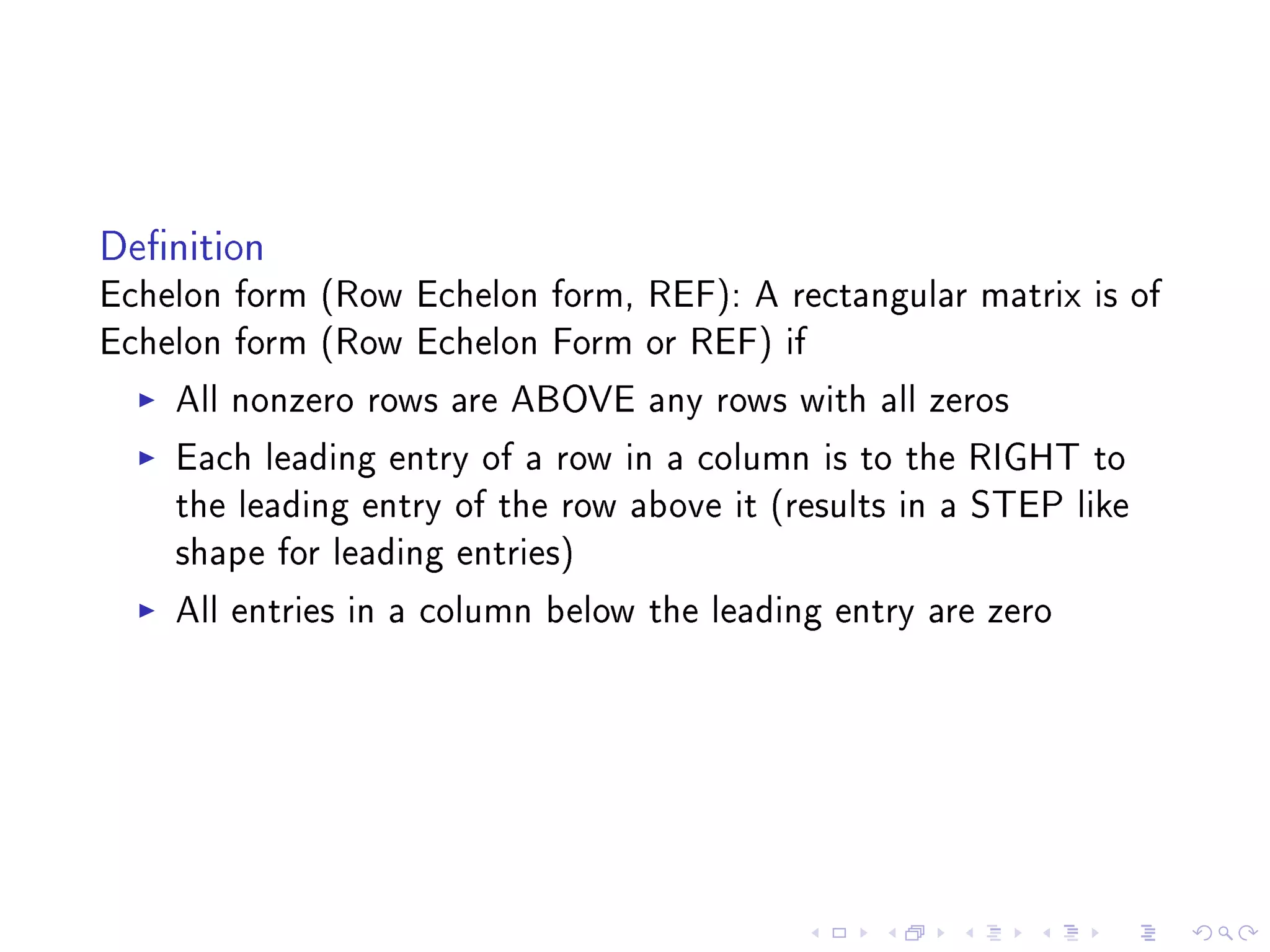
Echelon form (Row Echelon form, REF): A rectangular matrix is of
Echelon form (Row Echelon Form or REF) if
    All nonzero rows are ABOVE any rows with all zeros
    Each leading entry of a row in a column is to the RIGHT to
    the leading entry of the row above it (results in a STEP like
    shape for leading entries)
    All entries in a column below the leading entry are zero
Denition
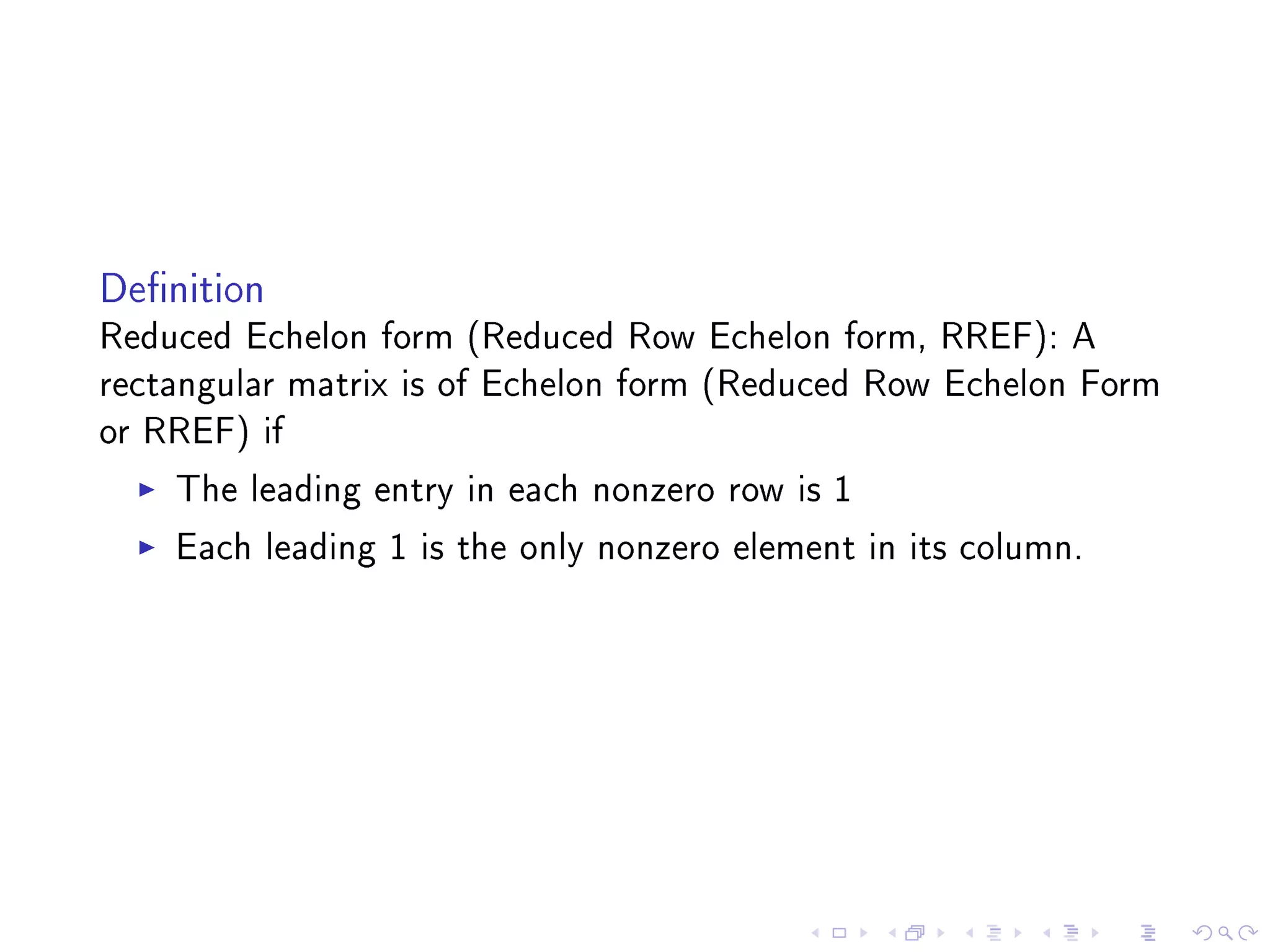
Reduced Echelon form (Reduced Row Echelon form, RREF): A
rectangular matrix is of Echelon form (Reduced Row Echelon Form
or RREF) if
     The leading entry in each nonzero row is 1
     Each leading 1 is the only nonzero element in its column.
Important


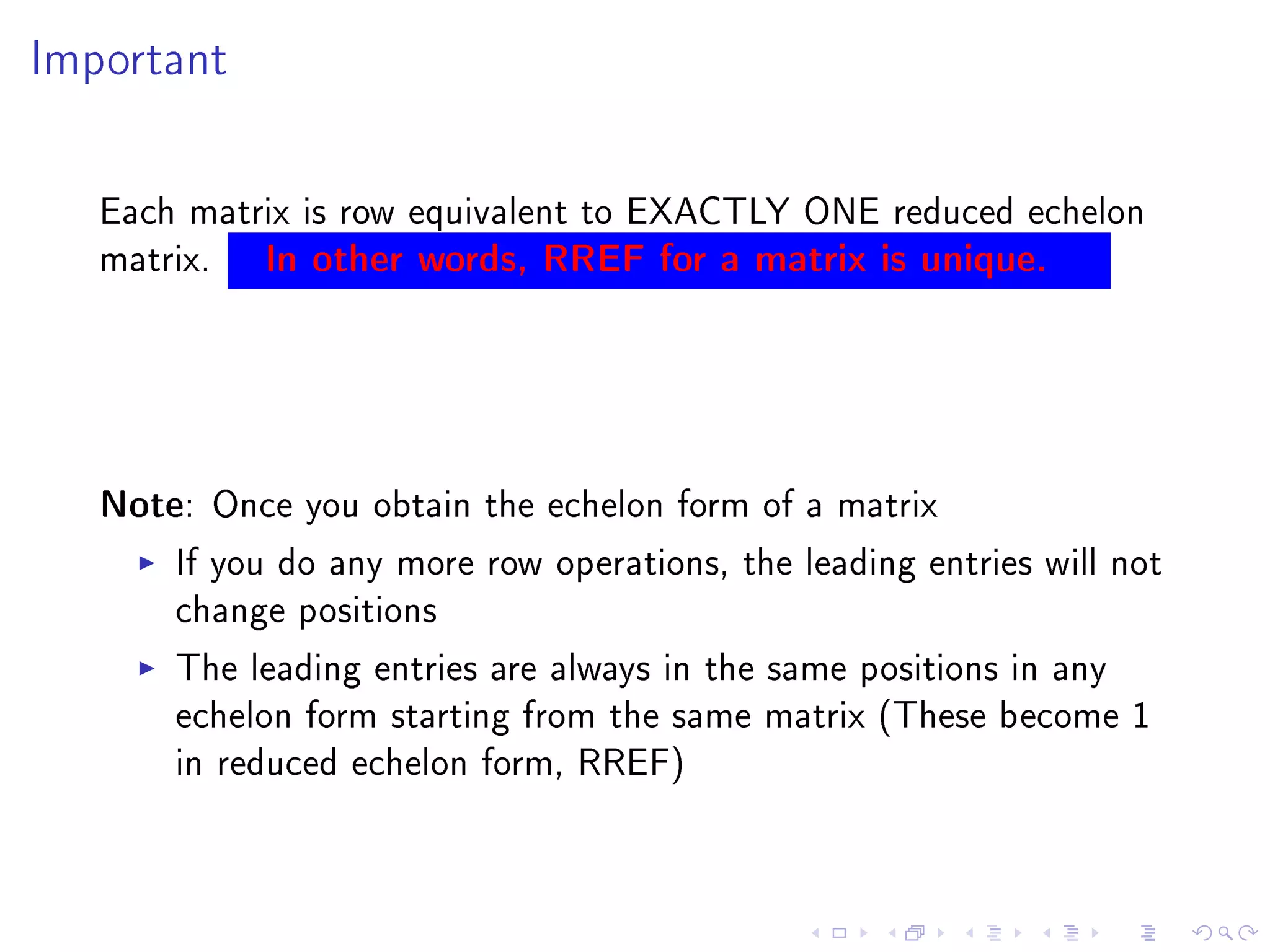
   Each matrix is row equivalent to EXACTLY ONE reduced echelon
   matrix. In other words, RREF for a matrix is unique.


   Note: Once you obtain the echelon form of a matrix
       If you do any more row operations, the leading entries will not
       change positions
       The leading entries are always in the same positions in any
       echelon form starting from the same matrix (These become 1
       in reduced echelon form, RREF)
Pivot Position, Pivot Column

   Denition
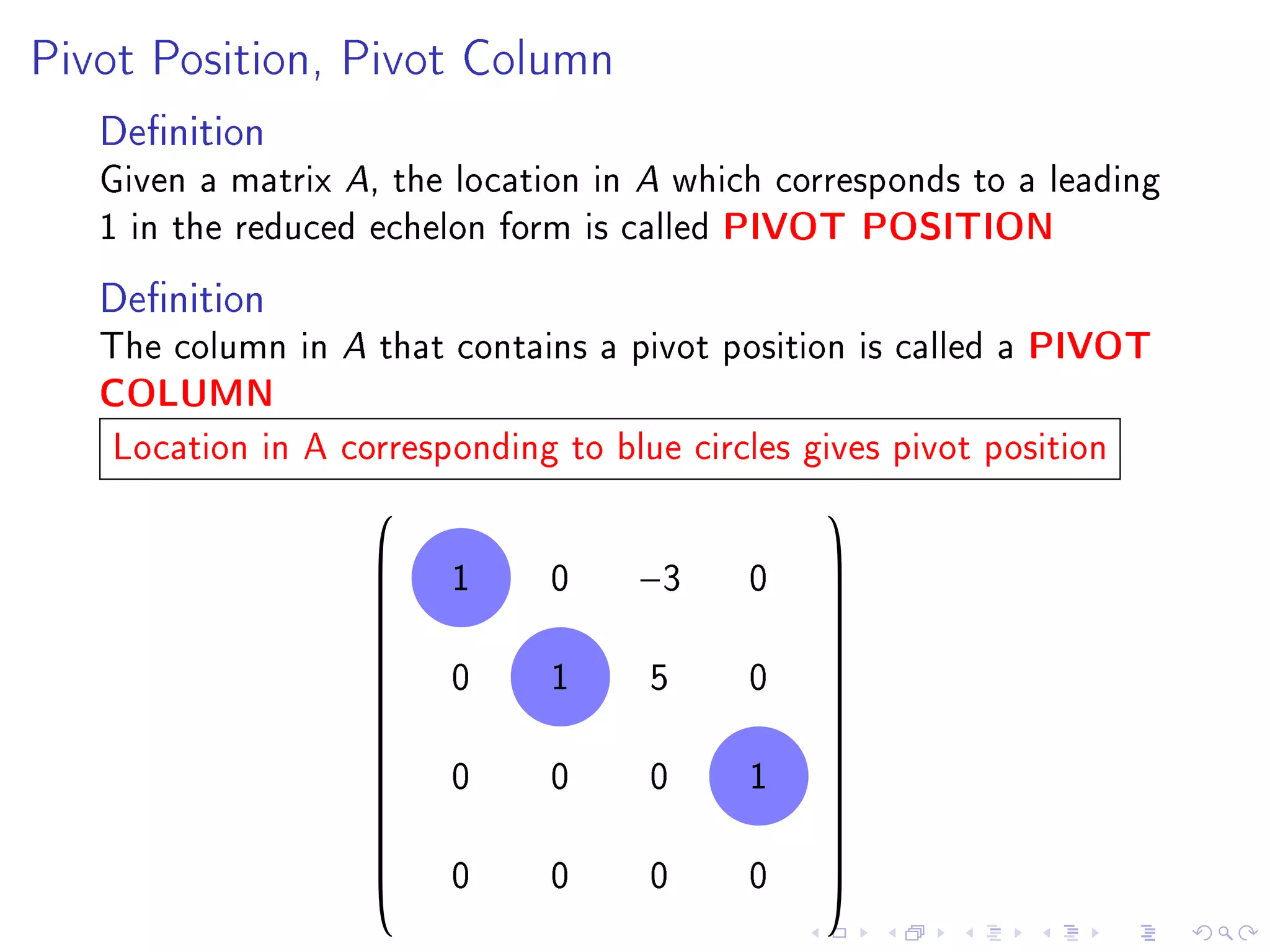
   Given a matrix A, the location in A which corresponds to a leading
   1 in the reduced echelon form is called PIVOT POSITION
   Denition
   The column in A that contains a pivot position is called a PIVOT
   COLUMN
   Location in A corresponding to blue circles gives pivot position
                                               
                    
                       1      0    −3     0    
                                                
                                               
                                               
                        0      1     5     0
                                               
                                               
                                               
                                               
                                               
                    
                       0      0     0     1    
                                                
                                               
                                               
                        0      0     0     0
                                               
                                               
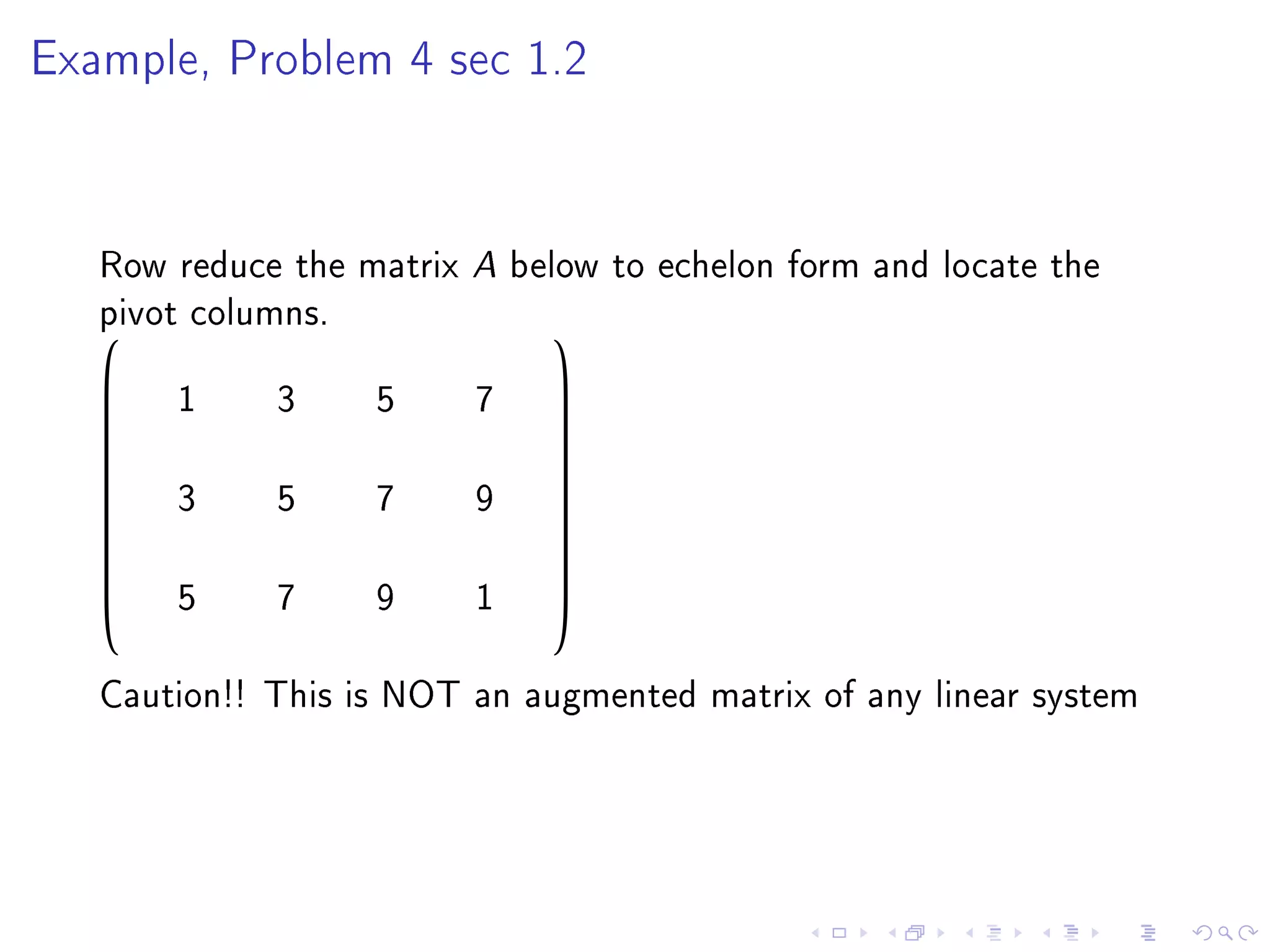
Example, Problem 4 sec 1.2


   Row reduce the matrix A below to echelon form and locate the
   pivot columns.
                             
   
      1     3     5     7    
                              
                             
                             
       3     5     7     9
                             
                             
                             
                             
       5     7     9     1
                             
                             


   Caution!! This is NOT an augmented matrix of any linear system
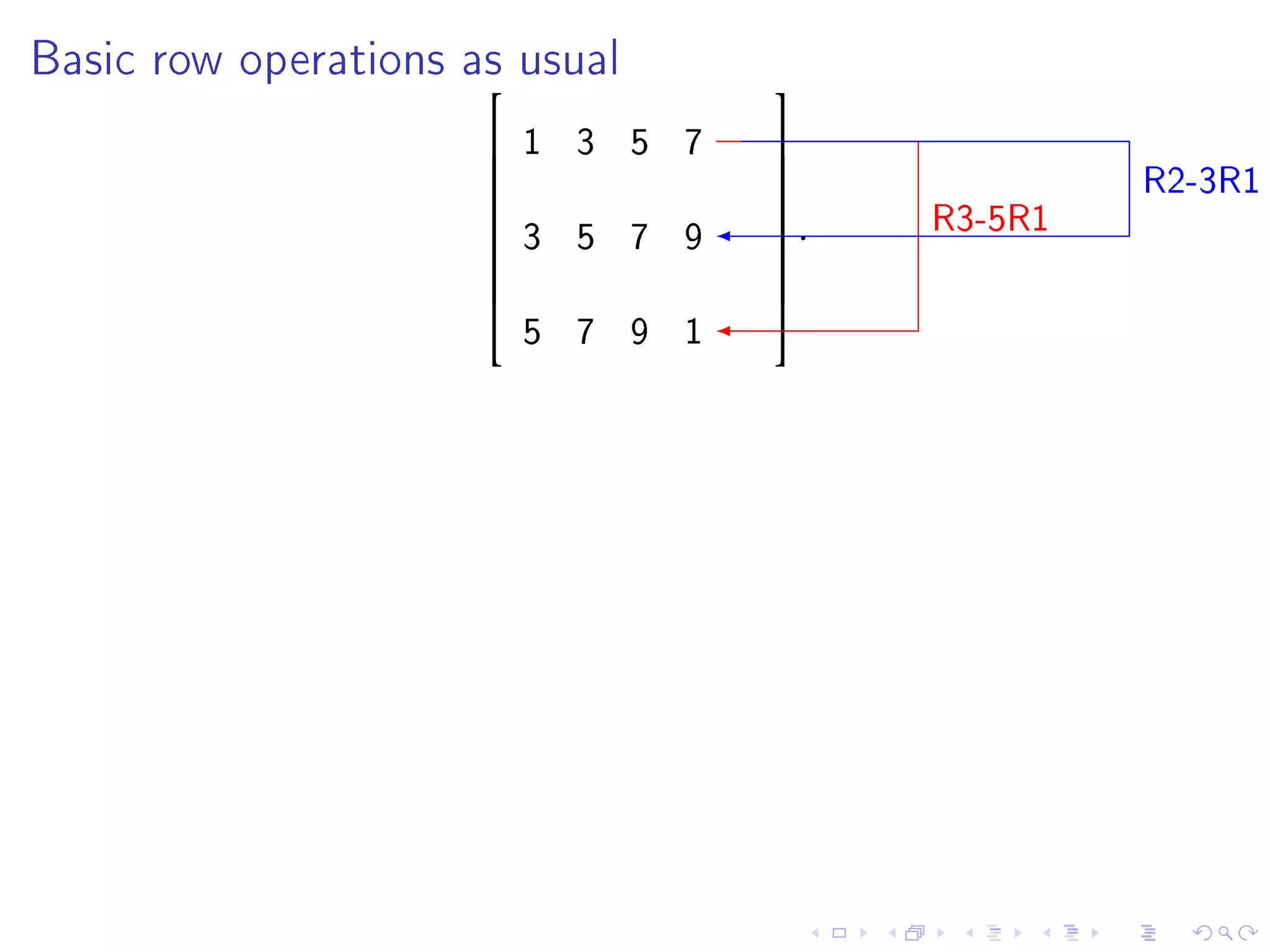
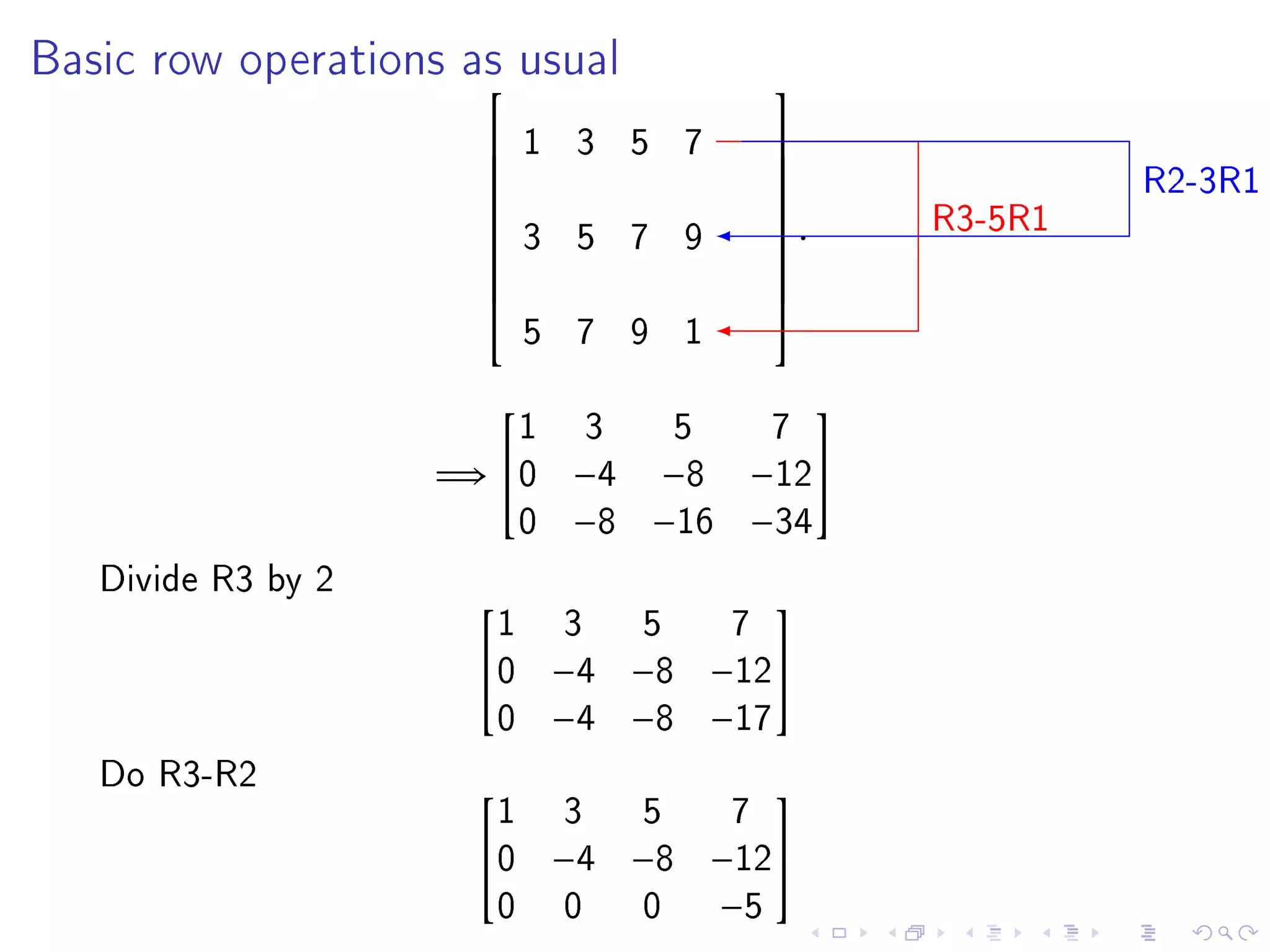
Basic row operations as usual
                                   
                          1 3 5 7
                                                  R2-3R1
                                   
                                   
                                         R3-5R1
                                   
                          3 5 7 9   .
                                   
                      
                                   
                                   
                          5 7 9 1
                                   
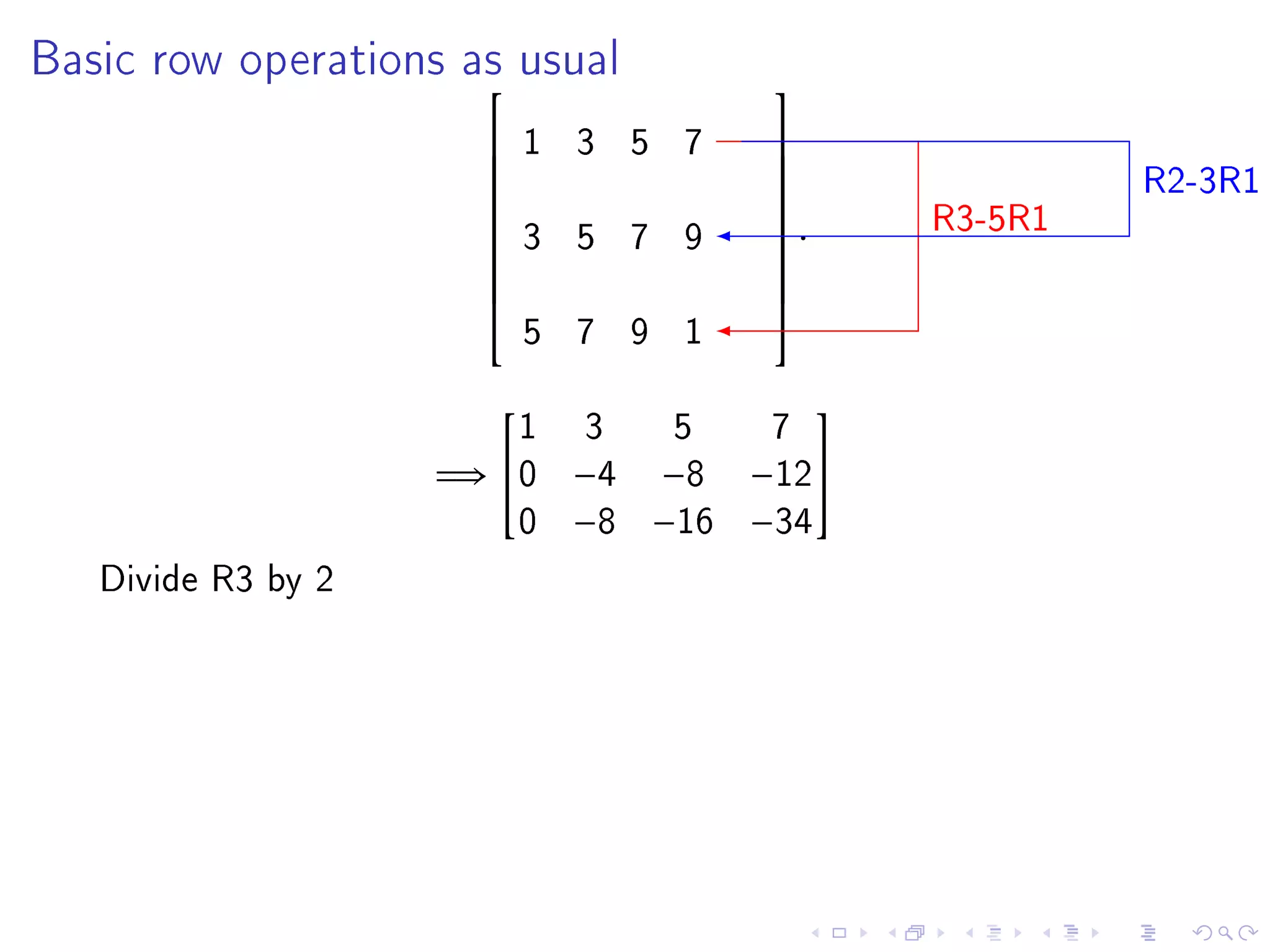
Basic row operations as usual
                                       
                          1 3 5 7
                                                          R2-3R1
                                       
                                       
                                                 R3-5R1
                                       
                          3 5 7 9       .
                                       
                      
                                       
                                       
                          5 7 9 1
                                       


                        1   3     5     7
                                            

                    =⇒ 0   −4   −8    −12
                        0   −8   −16   −34
   Divide R3 by 2
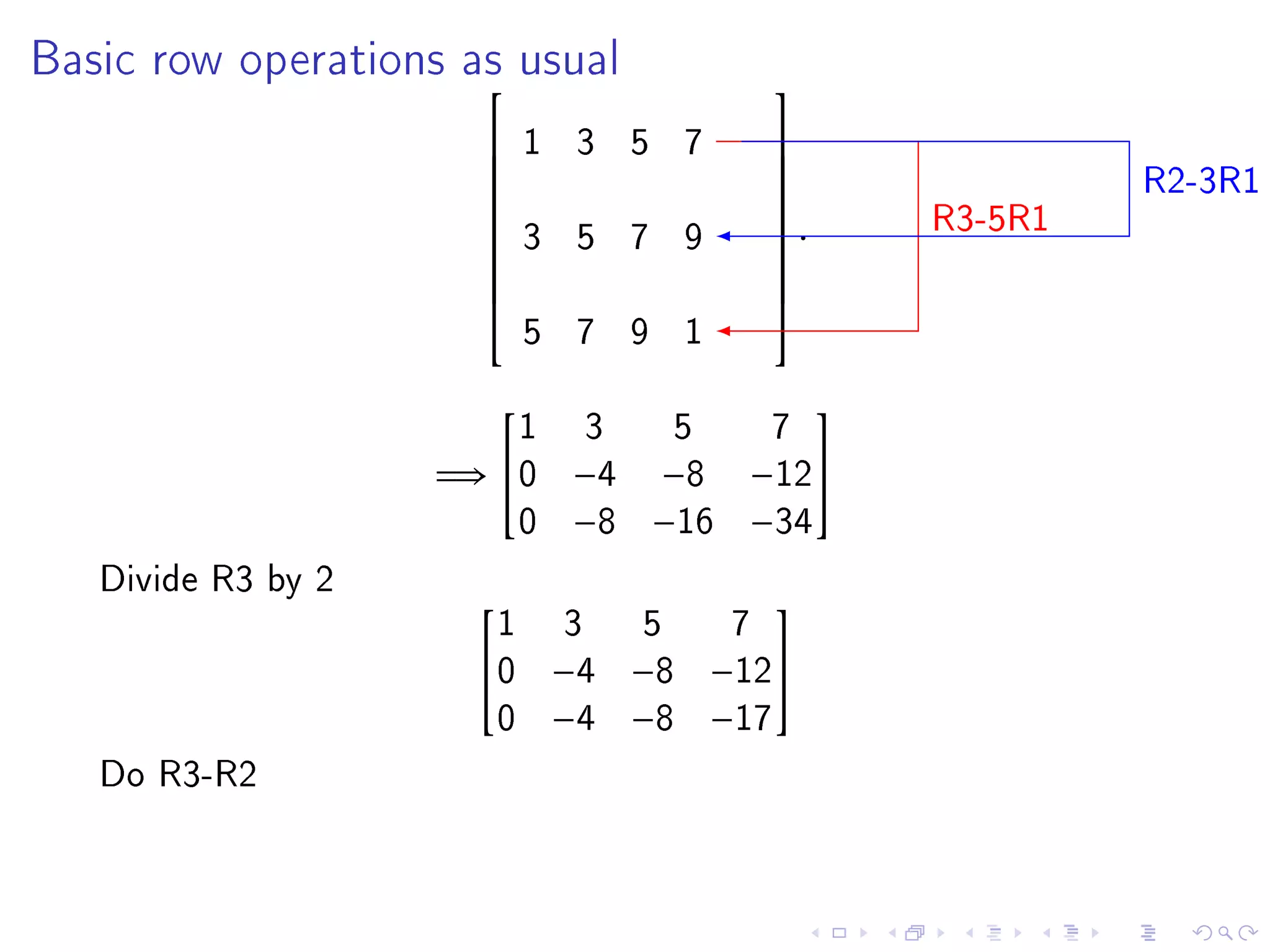
Basic row operations as usual
                                       
                          1 3 5 7
                                                          R2-3R1
                                       
                                       
                                                 R3-5R1
                                       
                          3 5 7 9       .
                                       
                      
                                       
                                       
                          5 7 9 1
                                       


                        1   3     5     7
                                            

                    =⇒ 0   −4   −8    −12
                        0   −8   −16   −34
   Divide R3 by 2
                      1     3     5    7
                                       
                     0     −4   −8   −12
                      0     −4   −8   −17
   Do R3-R2
Basic row operations as usual
                                       
                          1 3 5 7
                                                          R2-3R1
                                       
                                       
                                                 R3-5R1
                                       
                          3 5 7 9       .
                                       
                      
                                       
                                       
                          5 7 9 1
                                       


                        1   3     5     7
                                            

                    =⇒ 0   −4   −8    −12
                        0   −8   −16   −34
   Divide R3 by 2
                      1     3     5    7
                                       
                     0     −4   −8   −12
                      0     −4   −8   −17
   Do R3-R2
                      1     3     5    7
                                       
                     0     −4   −8   −12
                      0     0     0   −5
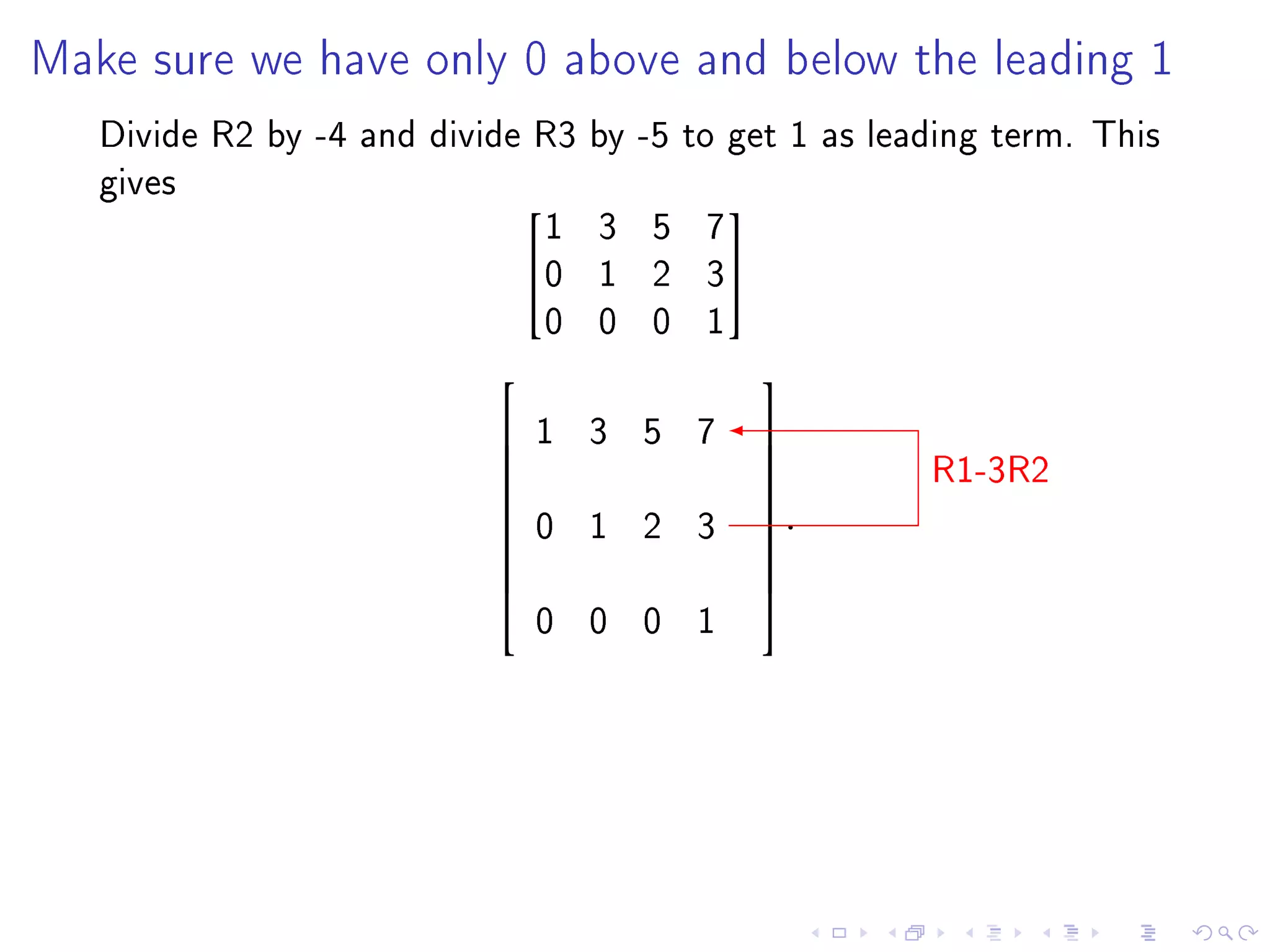
Make sure we have only 0 above and below the leading 1

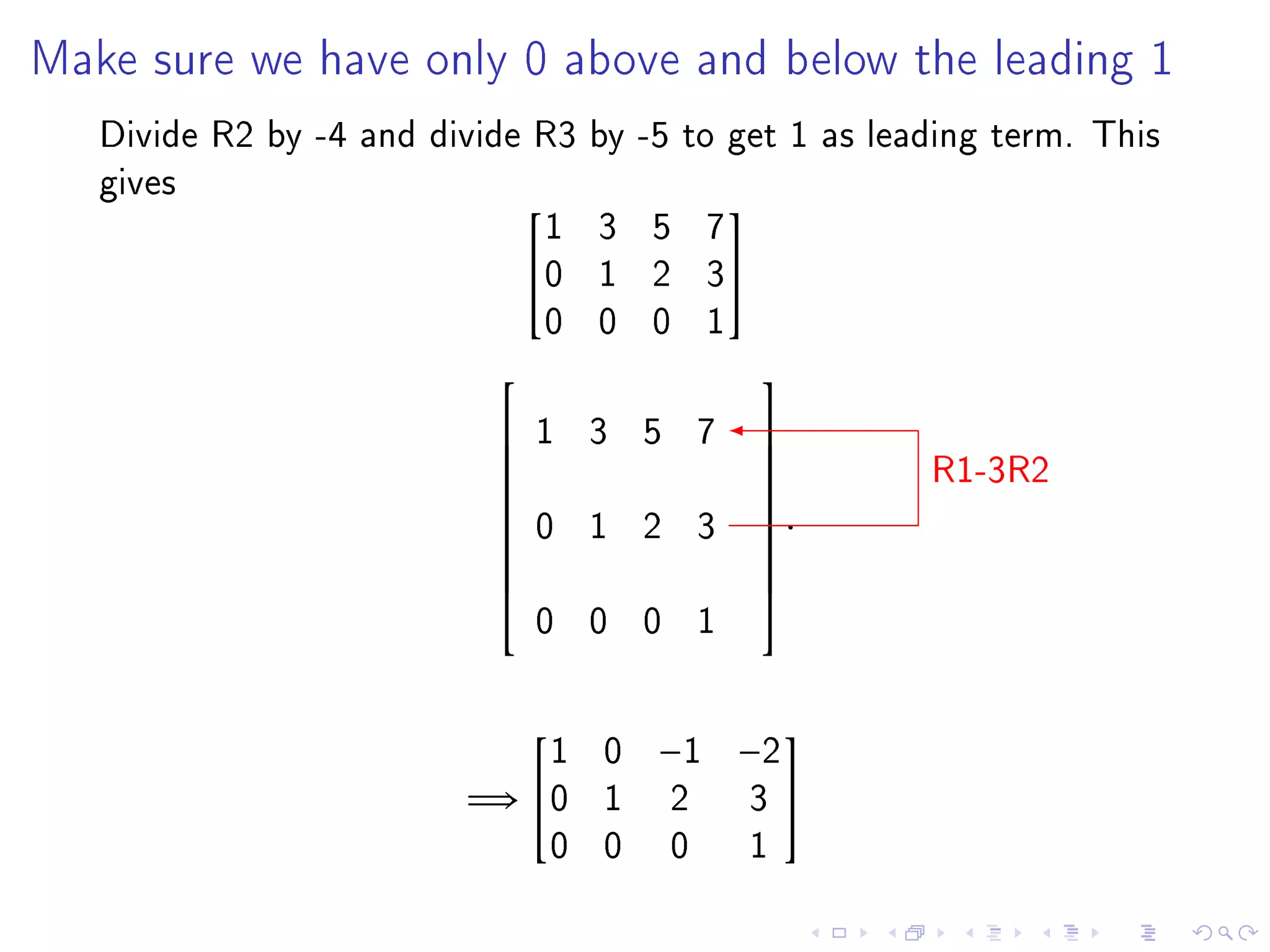
   Divide R2 by -4 and divide R3 by -5 to get 1 as leading term. This
   gives
Make sure we have only 0 above and below the leading 1

   Divide R2 by -4 and divide R3 by -5 to get 1 as leading term. This
   gives
                              1 3 5 7
                                         
                             0 1 2 3
                              0 0 0 1
                                           
                               1 3 5 7
                                                      R1-3R2
                                           
                                           
                                           
                               0 1 2 3      .
                                           
                           
                                           
                                           
                               0 0 0 1
                                           
Make sure we have only 0 above and below the leading 1

   Divide R2 by -4 and divide R3 by -5 to get 1 as leading term. This
   gives
                              1 3 5 7
                                         
                             0 1 2 3
                              0 0 0 1
                                           
                               1 3 5 7
                                                      R1-3R2
                                           
                                           
                                           
                               0 1 2 3      .
                                           
                           
                                           
                                           
                               0 0 0 1
                                           


                             1 0     −1 −2
                                            

                         =⇒ 0 1      2    3
                             0 0      0    1
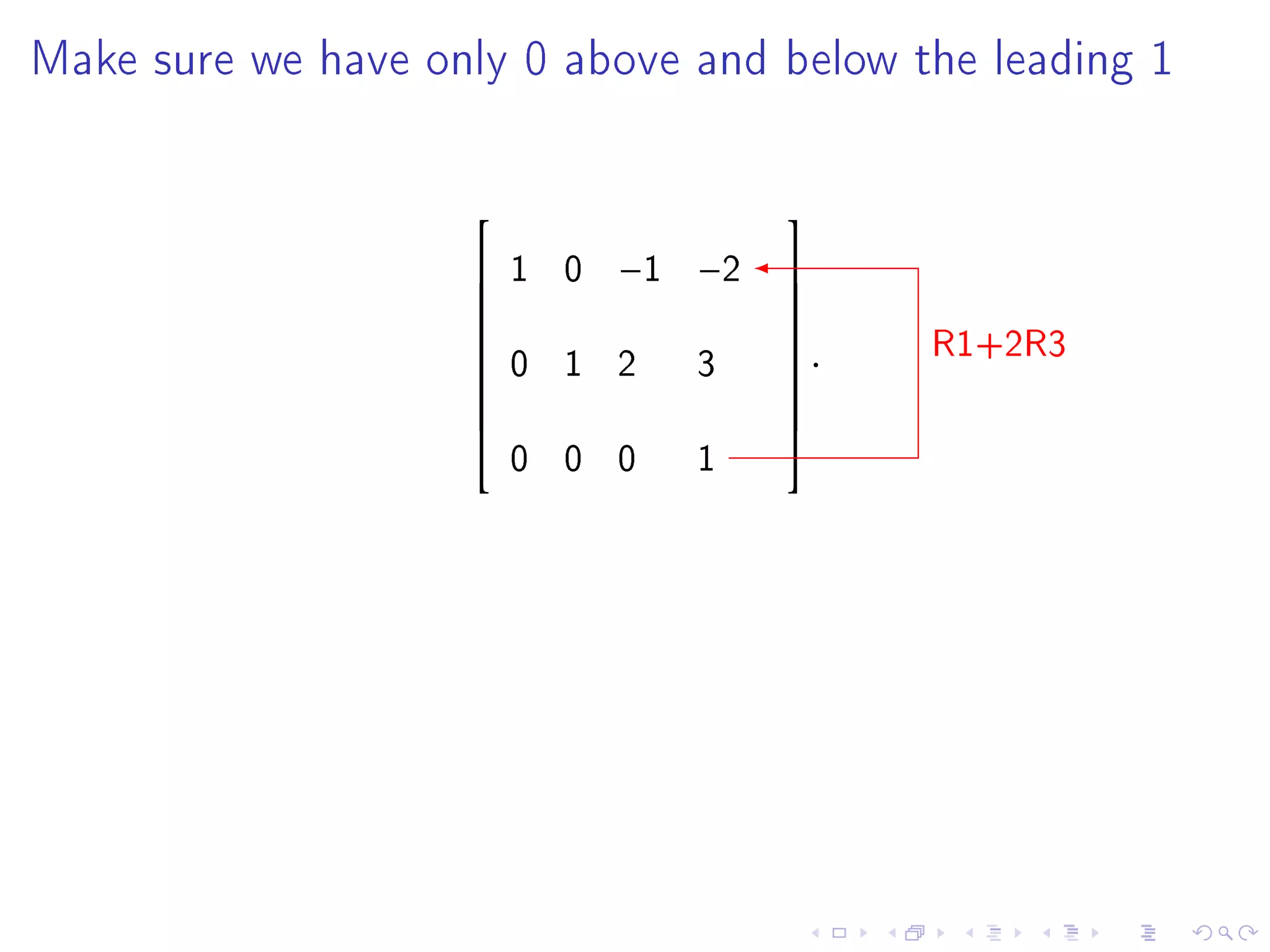
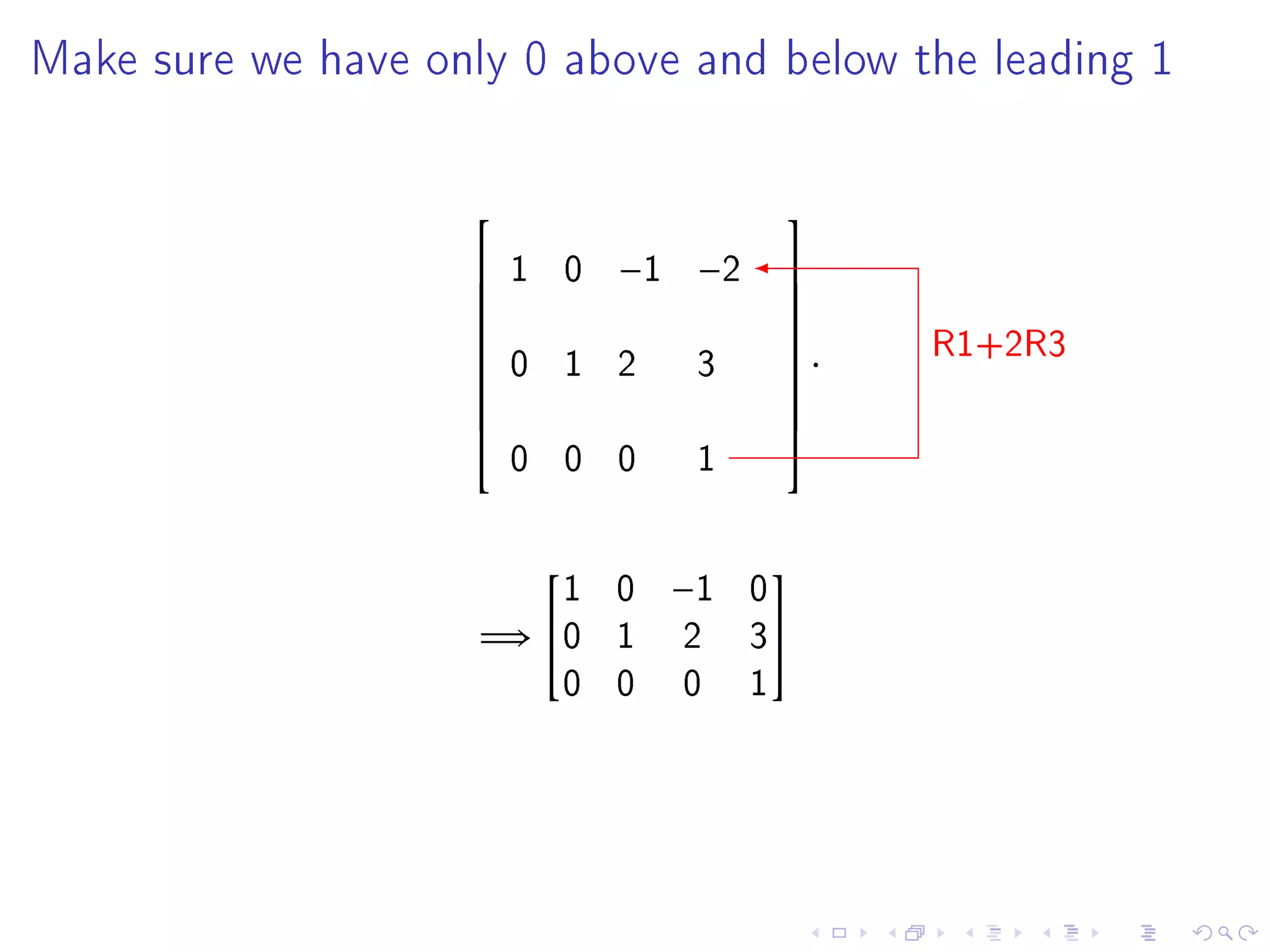
Make sure we have only 0 above and below the leading 1


                                     
                       1 0   −1 −2   
                                     
                                           R1+2R3
                                     
                        0 1 2    3    .
                                     
                    
                                     
                                     
                        0 0 0    1
                                     
Make sure we have only 0 above and below the leading 1


                                      
                       1 0   −1 −2    
                                      
                                            R1+2R3
                                      
                        0 1 2    3     .
                                      
                    
                                      
                                      
                        0 0 0    1
                                      


                         1 0    −1    0
                                     

                     =⇒ 0 1    2     3
                         0 0    0     1
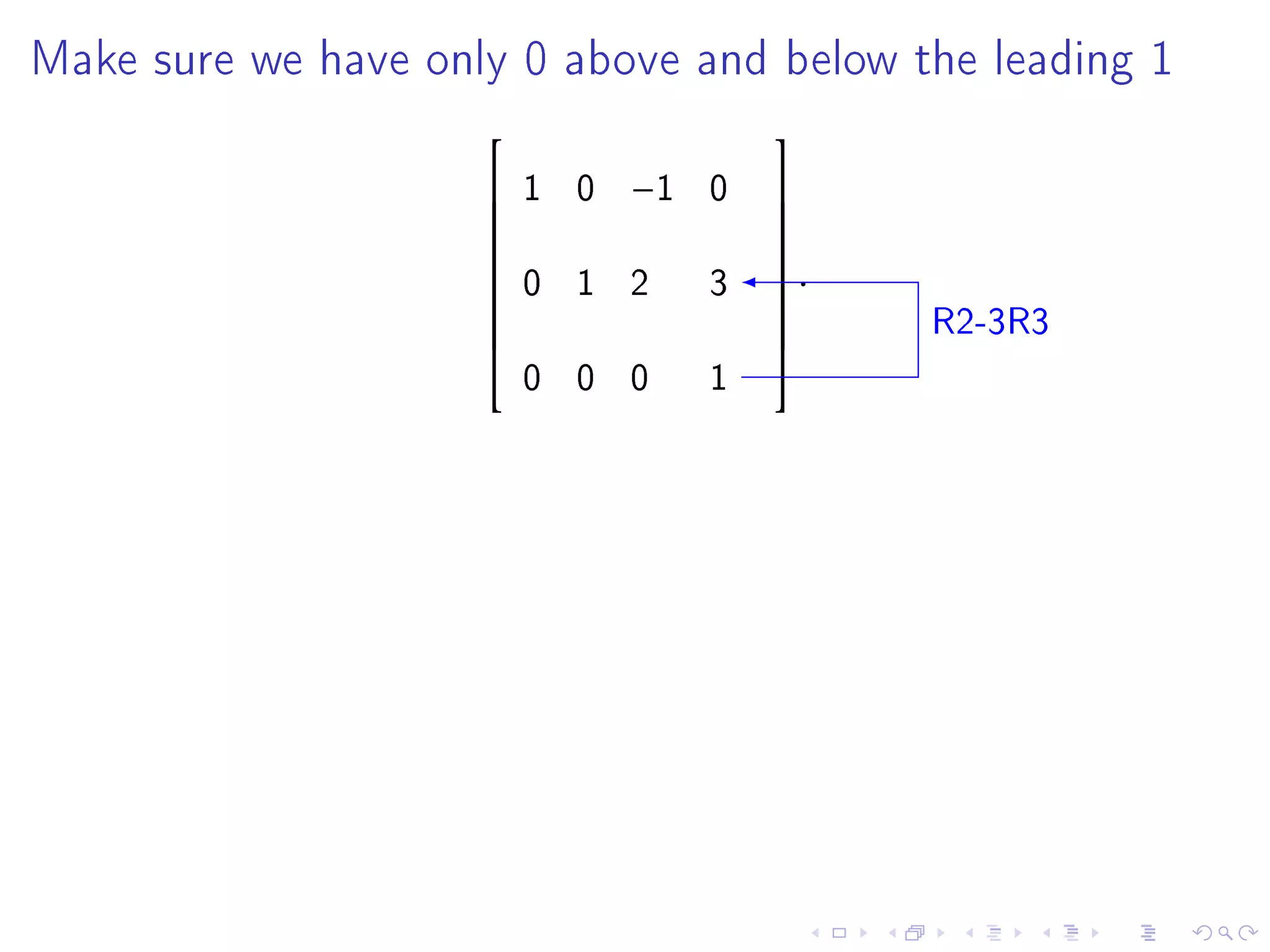
Make sure we have only 0 above and below the leading 1

                                       
                        1 0   −1   0   
                                       
                                       
                         0 1 2      3   .
                                       
                     
                                             R2-3R3
                                       
                                       
                         0 0 0      1
                                       
Make sure we have only 0 above and below the leading 1

                                             
                              1 0   −1   0   
                                             
                                             
                               0 1 2      3   .
                                             
                           
                                                   R2-3R3
                                             
                                             
                               0 0 0      1
                                             


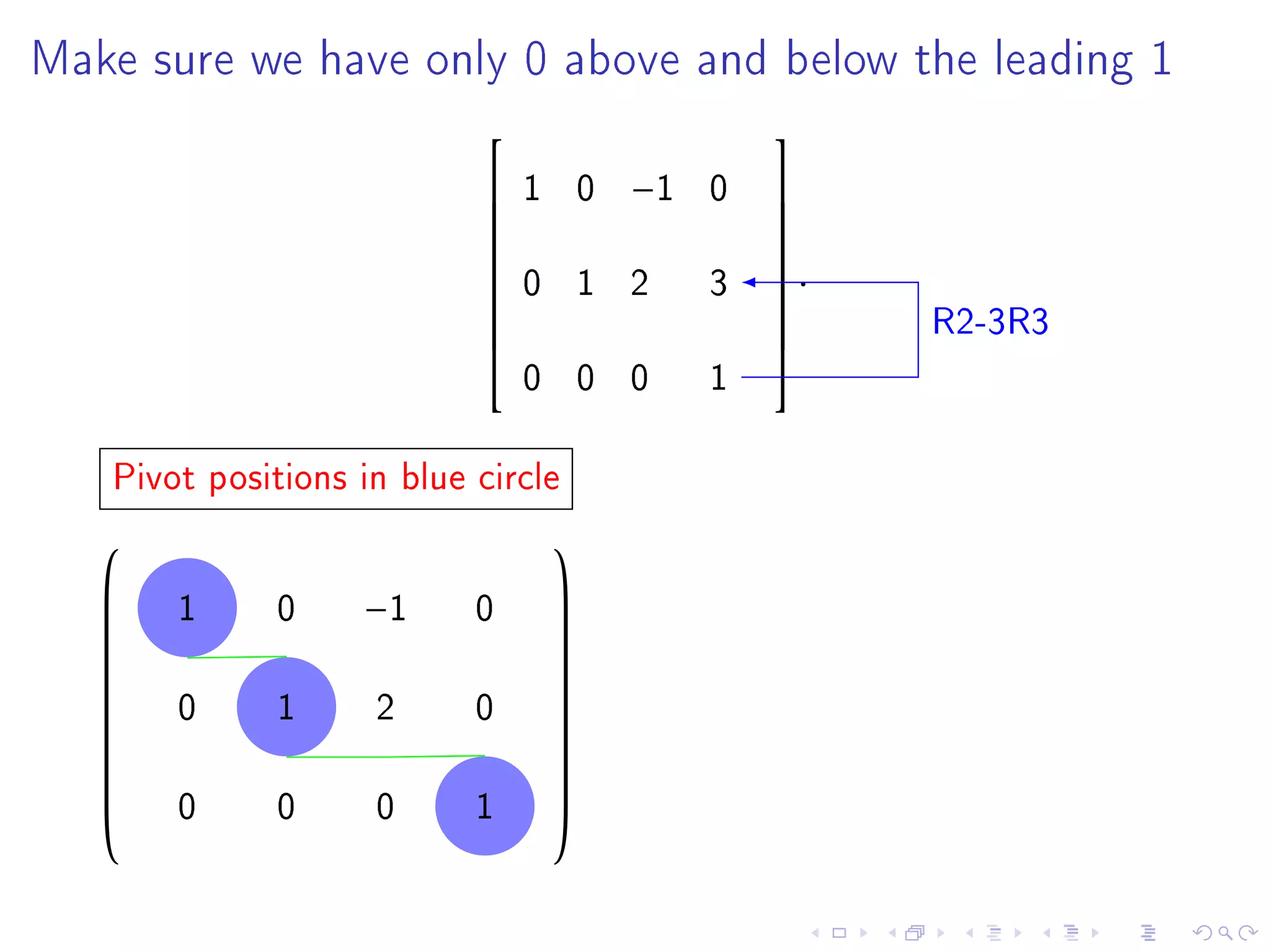
   Pivot positions in blue circle
                               
   
      1      0    −1      0    
                                
                               
                               
       0      1     2      0
                               
                               
                               
                               
       0      0     0      1
                               
                               
Answer


         We have pivot positions at the blue circles
         We need to nd the pivot columns
Answer


         We have pivot positions at the blue circles
         We need to nd the pivot columns
         These are the corresponding columns in the original matrix,
         that is Column 1, Column 2 and Column 4 in A (not the
         columns in RREF)
Solutions of Linear systems

   The row reduction steps gives solution of linear system when
   applied to augmented matrix of the linear system
Solutions of Linear systems

   The row reduction steps gives solution of linear system when
   applied to augmented matrix of the linear system
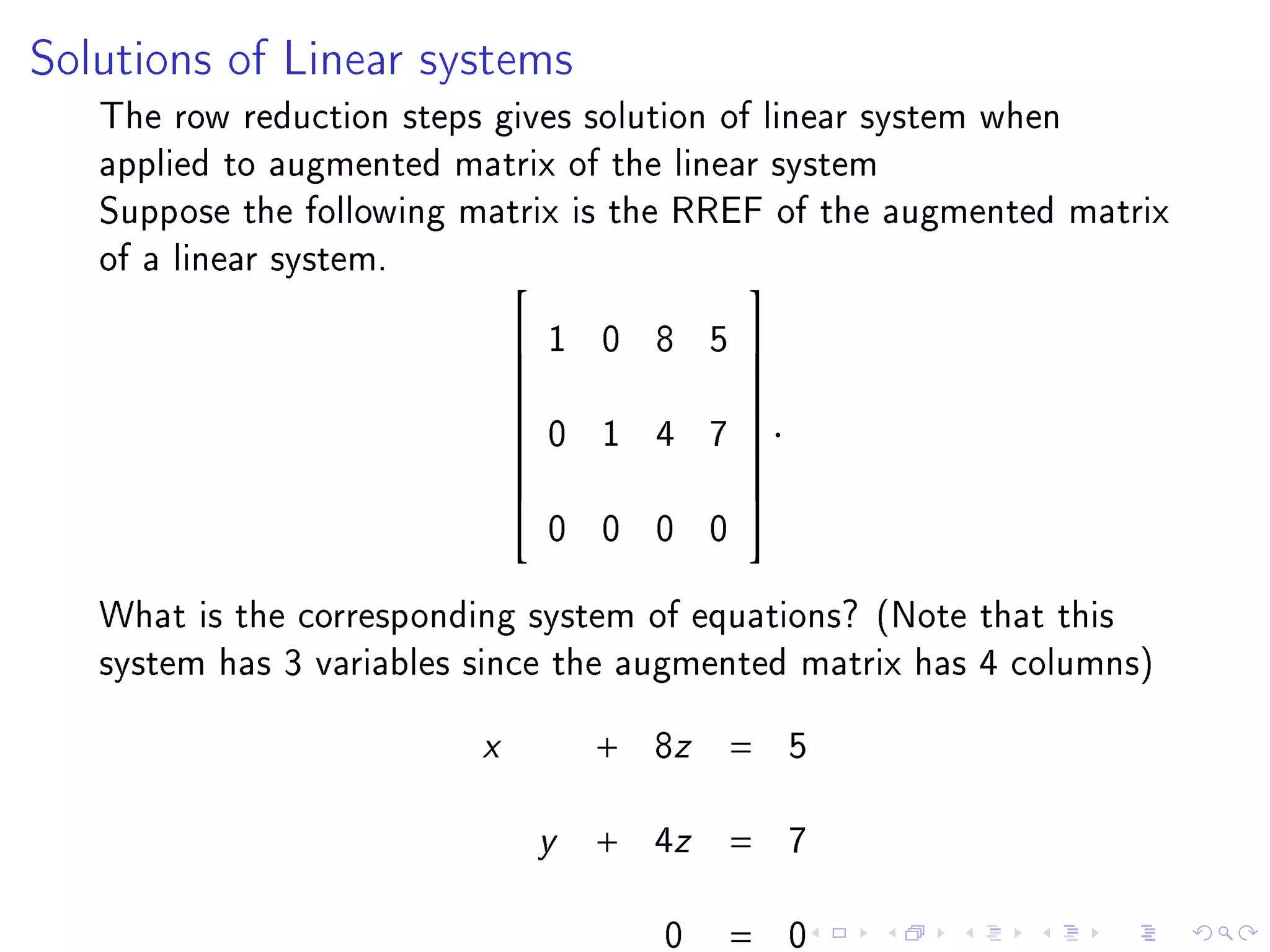
   Suppose the following matrix is the RREF of the augmented matrix
   of a linear system.                     
                                 1 0 8 5      
                                              
                                              
                                  0 1 4 7      .
                                              
                              
                                              
                                              
                                  0 0 0 0
                                              


   What is the corresponding system of equations? (Note that this
   system has 3 variables since the augmented matrix has 4 columns)
                          x           +   8z   =    5

                                  y   +   4z   =    7

                                          0    =    0
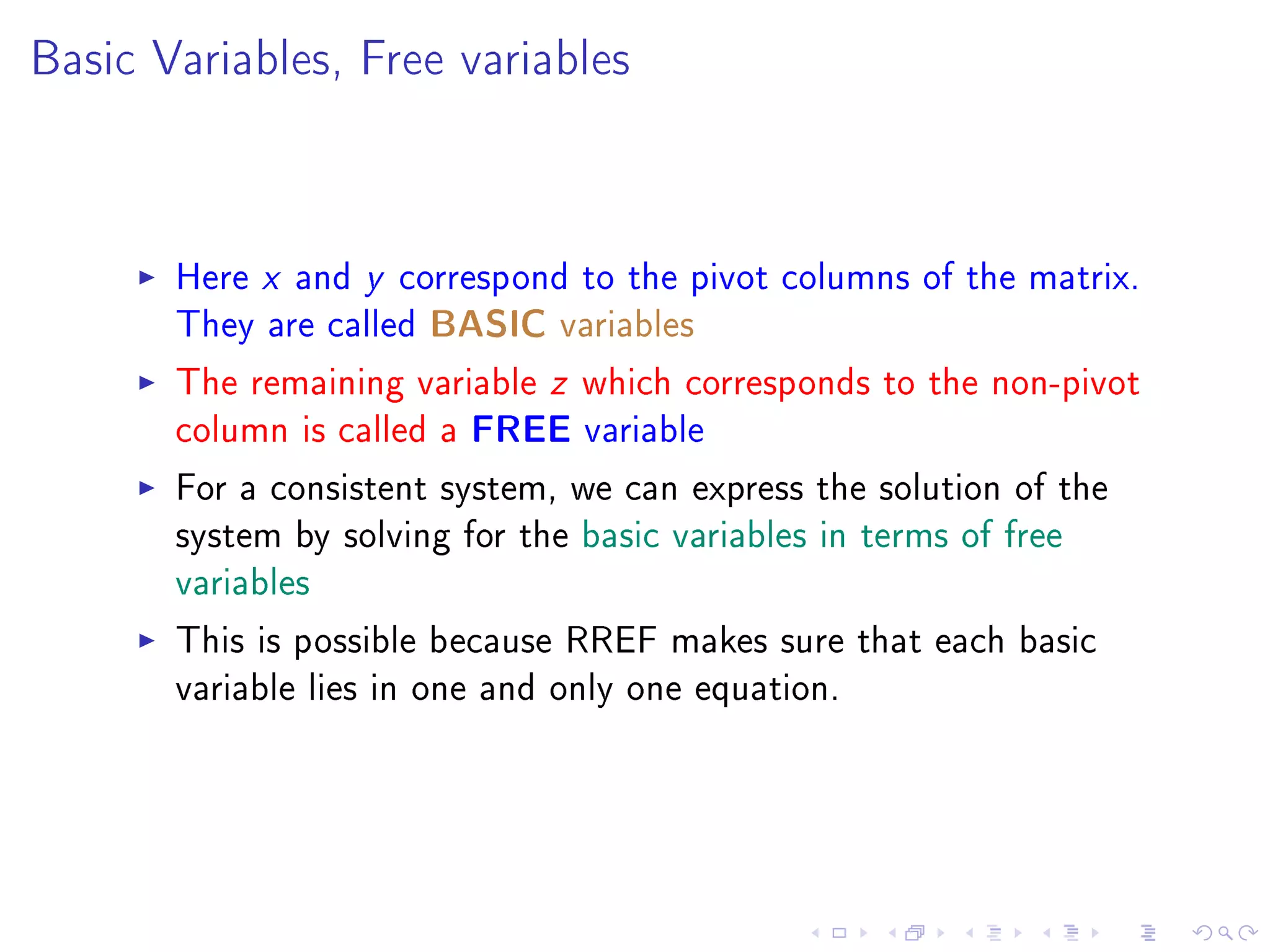
Basic Variables, Free variables


       Here x and y correspond to the pivot columns of the matrix.
       They are called BASIC variables
       The remaining variable z which corresponds to the non-pivot
       column is called a FREE variable
       For a consistent system, we can express the solution of the
       system by solving for the basic variables in terms of free
       variables
       This is possible because RREF makes sure that each basic
       variable lies in one and only one equation.
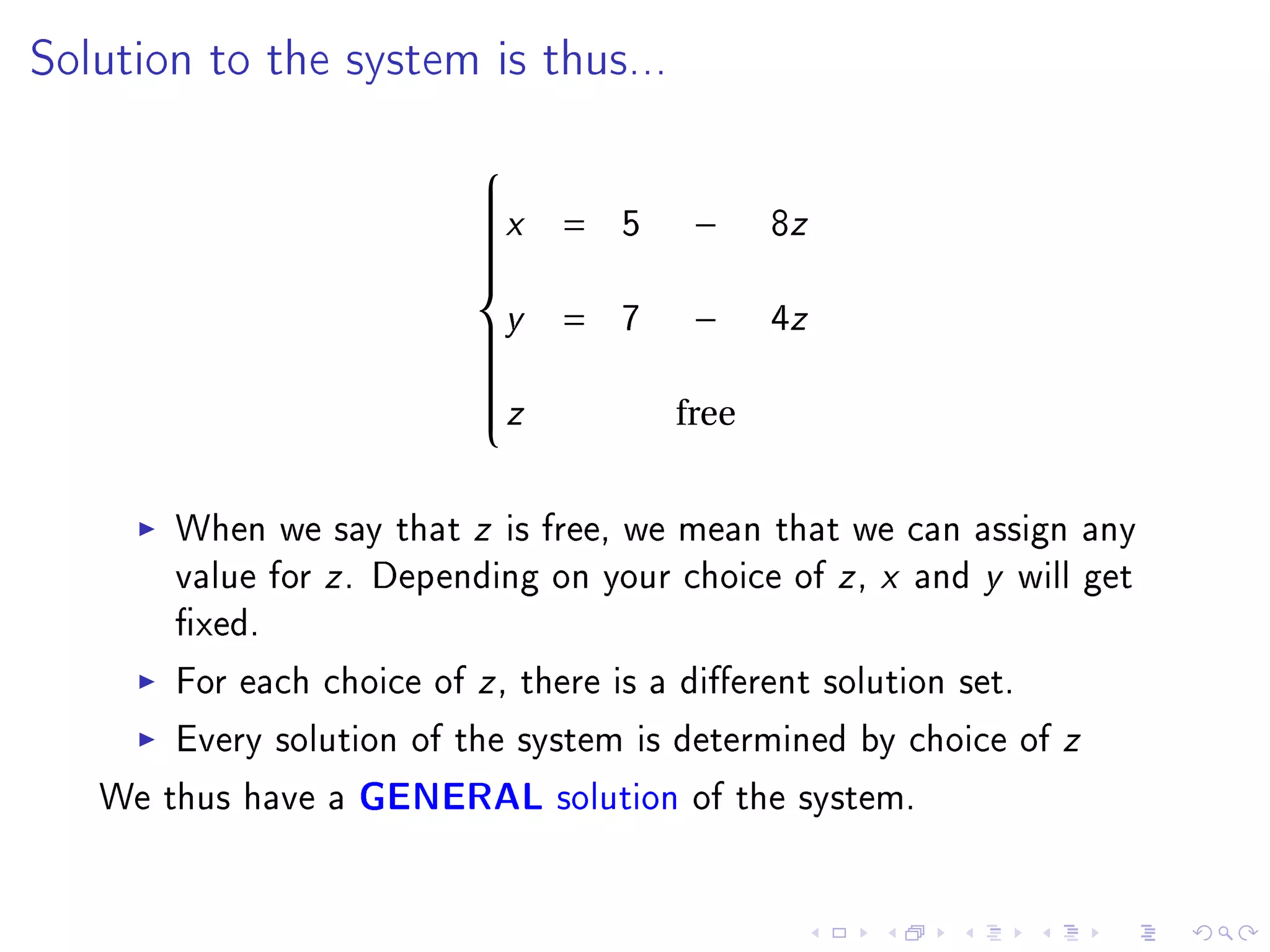
Solution to the system is thus...


                          
                          x        5          8z
                          
                                =        −
                          
                          
                          
                          
                          
                          
                          y
                          
                                =   7    −     4z
                          
                          
                          z
                          
                          
                                        free
                          


       When we say that z is free, we mean that we can assign any
       value for z . Depending on your choice of z , x and y will get
       xed.
       For each choice of z , there is a dierent solution set.
       Every solution of the system is determined by choice of z
   We thus have a GENERAL solution of the system.
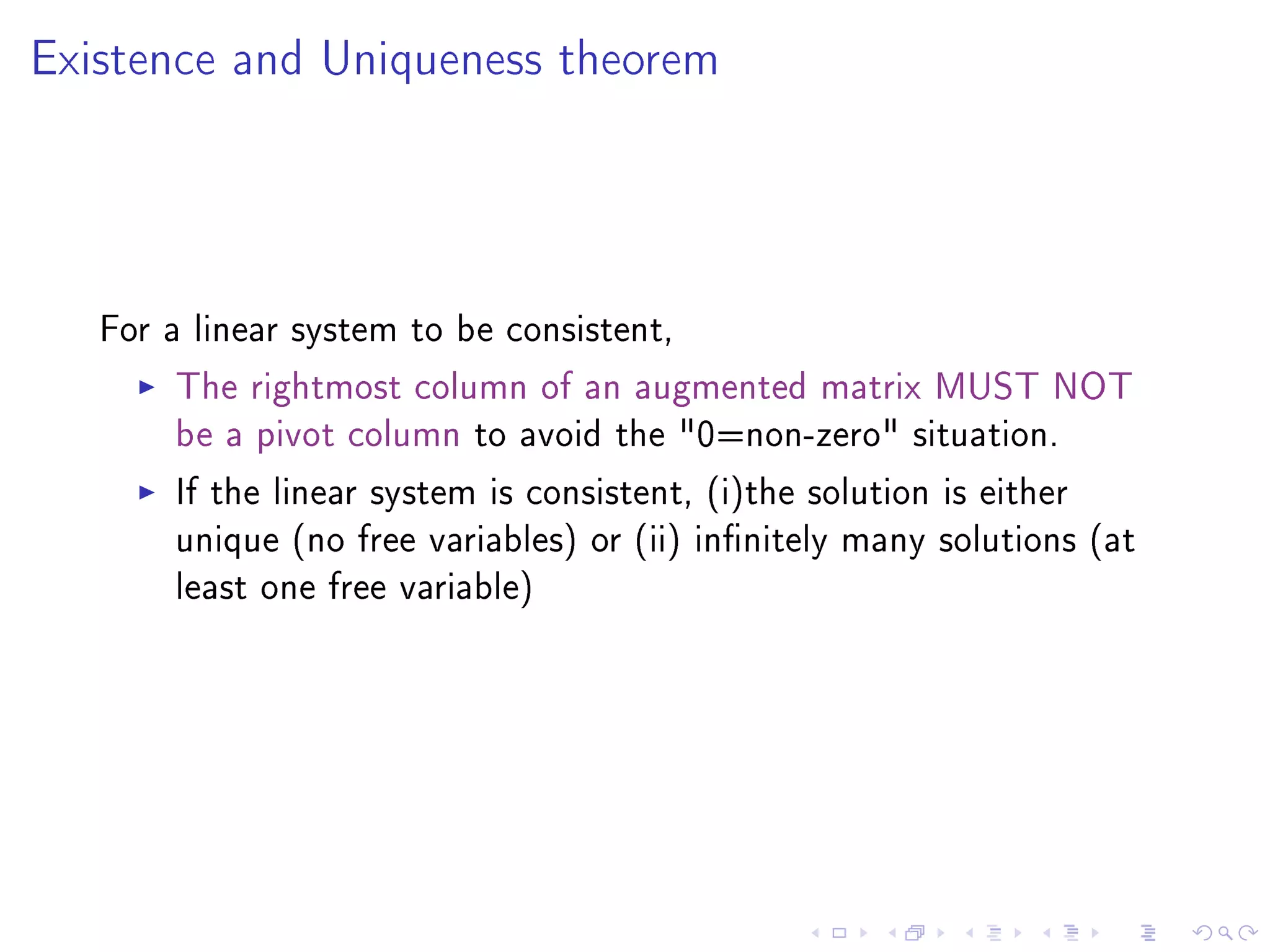
Existence and Uniqueness theorem


   For a linear system to be consistent,
        The rightmost column of an augmented matrix MUST NOT
        be a pivot column to avoid the 0=non-zero situation.
        If the linear system is consistent, (i)the solution is either
        unique (no free variables) or (ii) innitely many solutions (at
        least one free variable)
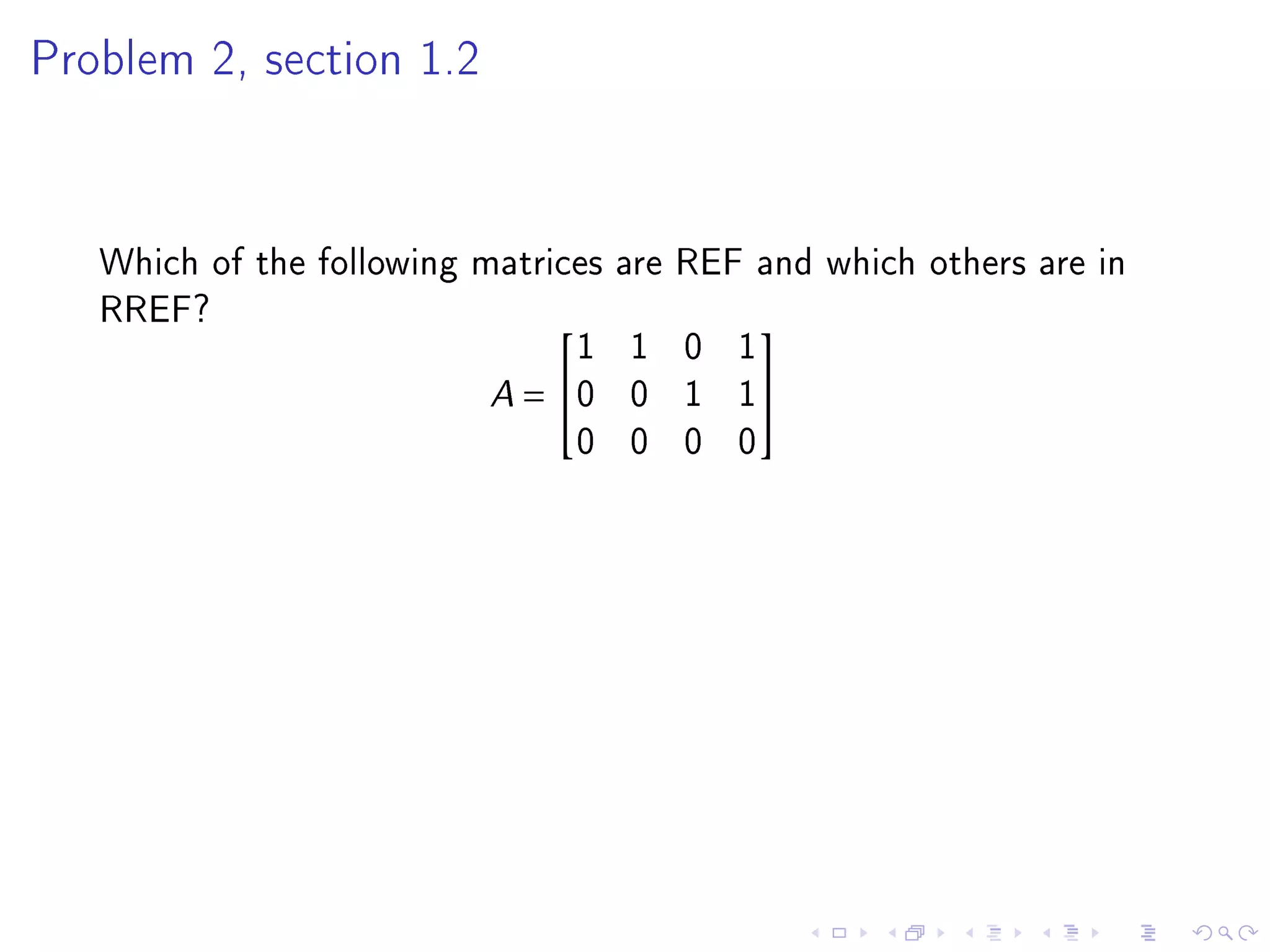
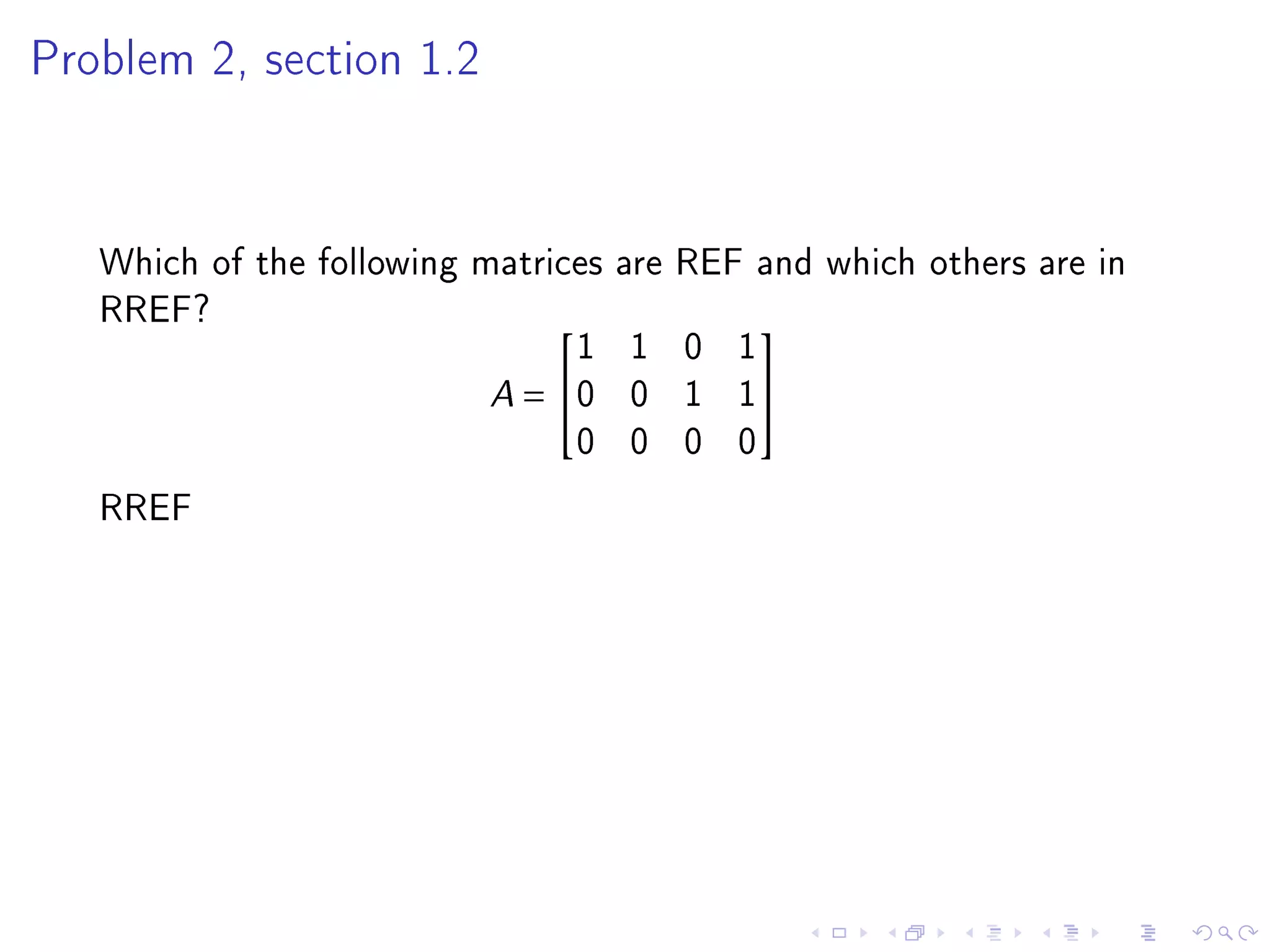
Problem 2, section 1.2


   Which of the following matrices are REF and which others are in
   RREF?
                                1 1 0 1
                                          

                           A = 0 0 1 1
                                0 0 0 0
Problem 2, section 1.2


   Which of the following matrices are REF and which others are in
   RREF?
                                1 1 0 1
                                          

                           A = 0 0 1 1
                                0 0 0 0
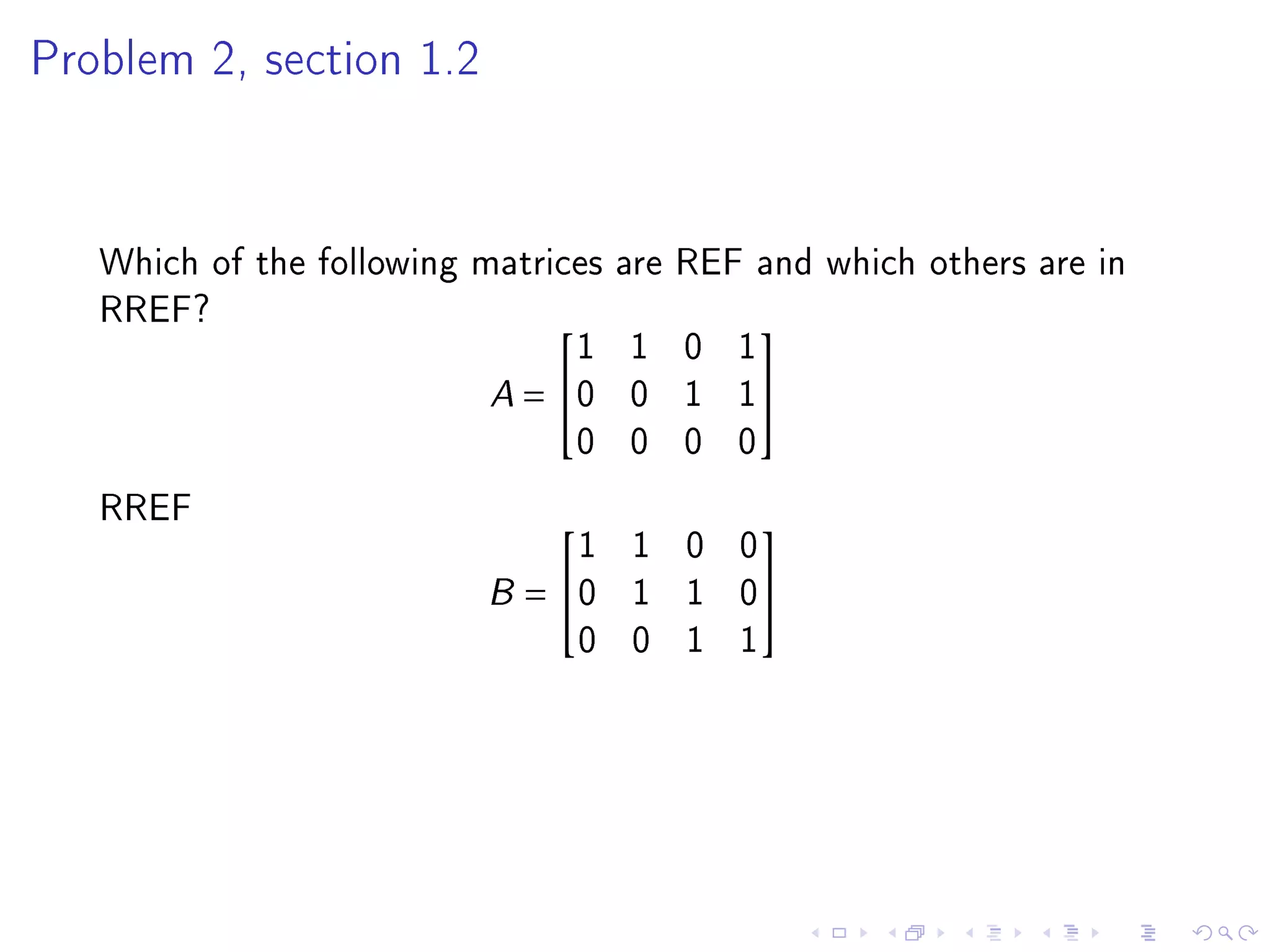
   RREF
Problem 2, section 1.2


   Which of the following matrices are REF and which others are in
   RREF?
                                1 1 0 1
                                          

                           A = 0 0 1 1
                                0 0 0 0
   RREF
                              1 1 0 0
                                          

                          B= 0 1 1 0
                              0 0 1 1
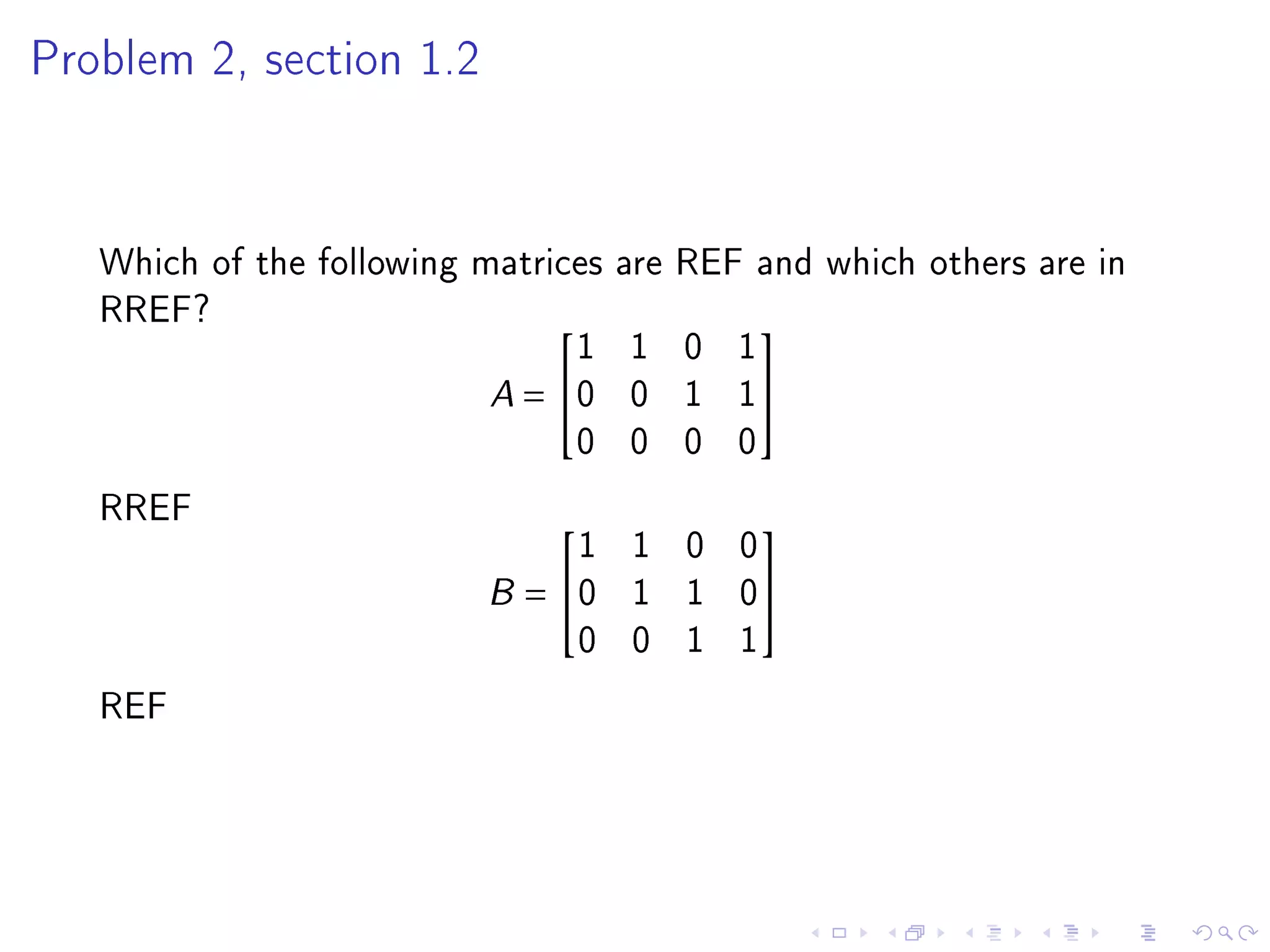
Problem 2, section 1.2


   Which of the following matrices are REF and which others are in
   RREF?
                                1 1 0 1
                                          

                           A = 0 0 1 1
                                0 0 0 0
   RREF
                              1 1 0 0
                                          

                          B= 0 1 1 0
                              0 0 1 1
   REF
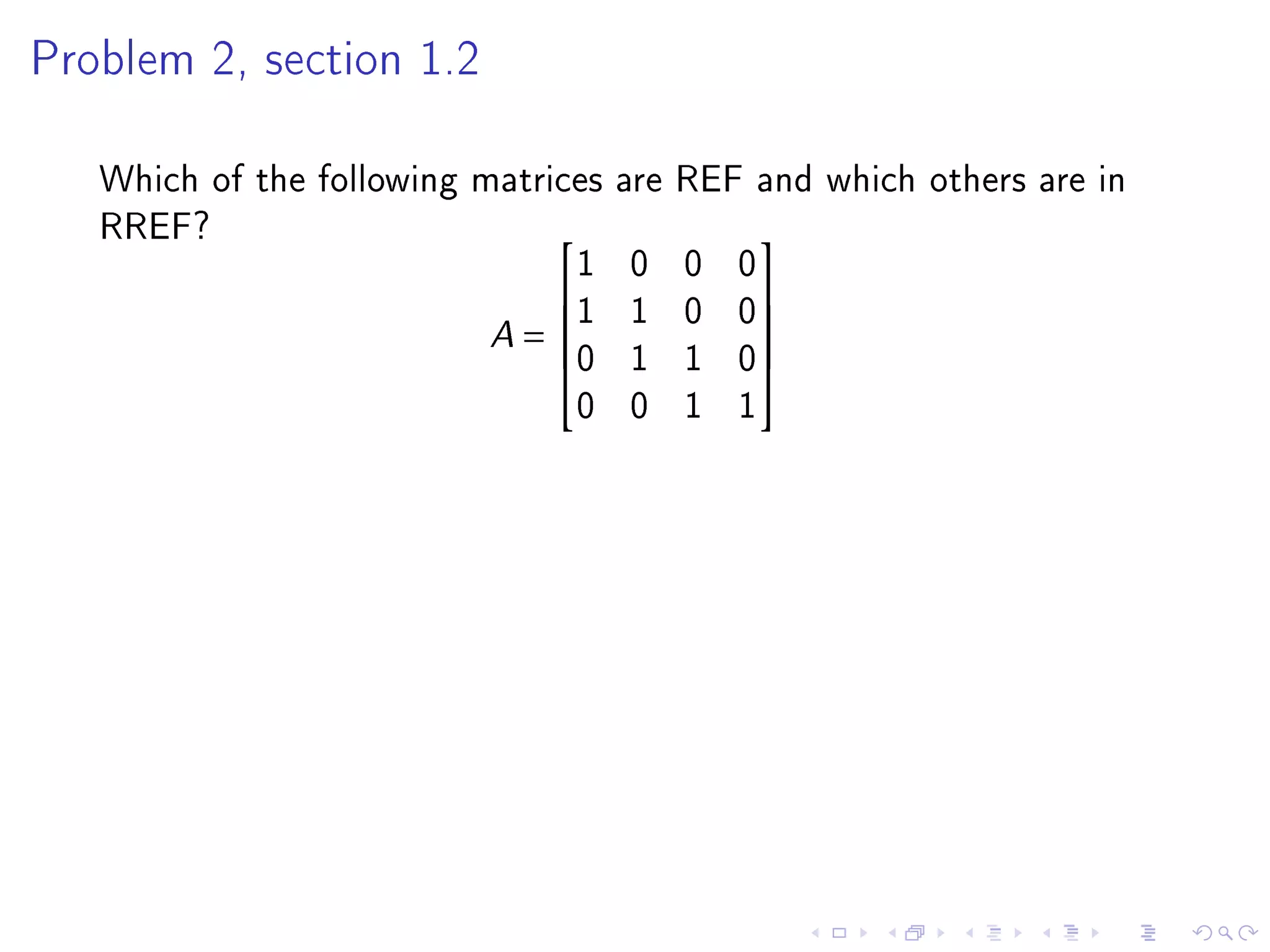
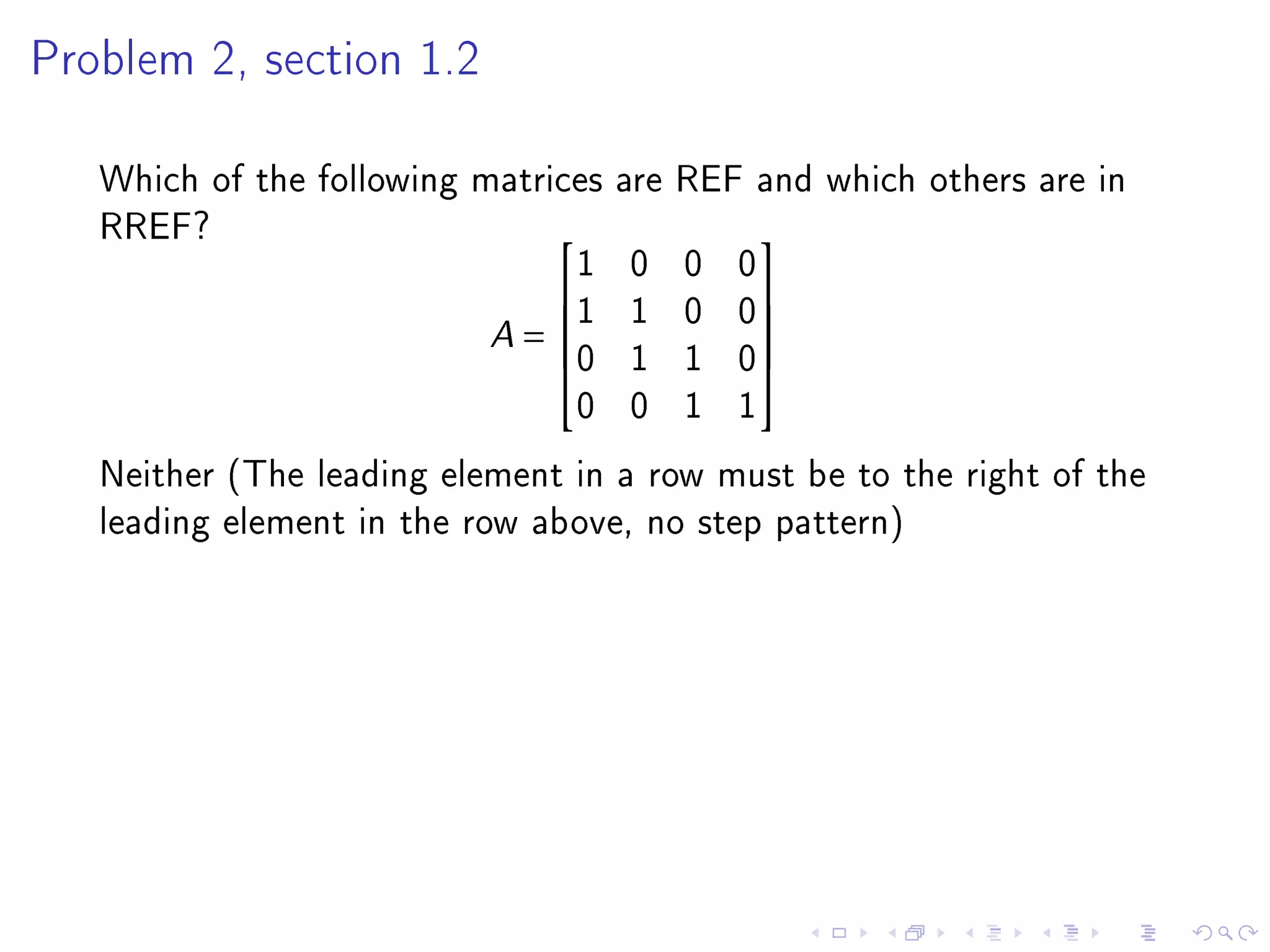
Problem 2, section 1.2


   Which of the following matrices are REF and which others are in
   RREF?
                                1 0 0 0
                                          

                           A = 1 1 0 0
                                          
                               0 1 1 0
                                          
                                0 0 1 1
Problem 2, section 1.2


   Which of the following matrices are REF and which others are in
   RREF?
                                1 0 0 0
                                          

                           A = 1 1 0 0
                                          
                               0 1 1 0
                                          
                                0 0 1 1
   Neither (The leading element in a row must be to the right of the
   leading element in the row above, no step pattern)
Problem 2, section 1.2


   Which of the following matrices are REF and which others are in
   RREF?
                                1 0 0 0
                                          

                           A = 1 1 0 0
                                          
                               0 1 1 0
                                          
                                0 0 1 1
   Neither (The leading element in a row must be to the right of the
   leading element in the row above, no step pattern)
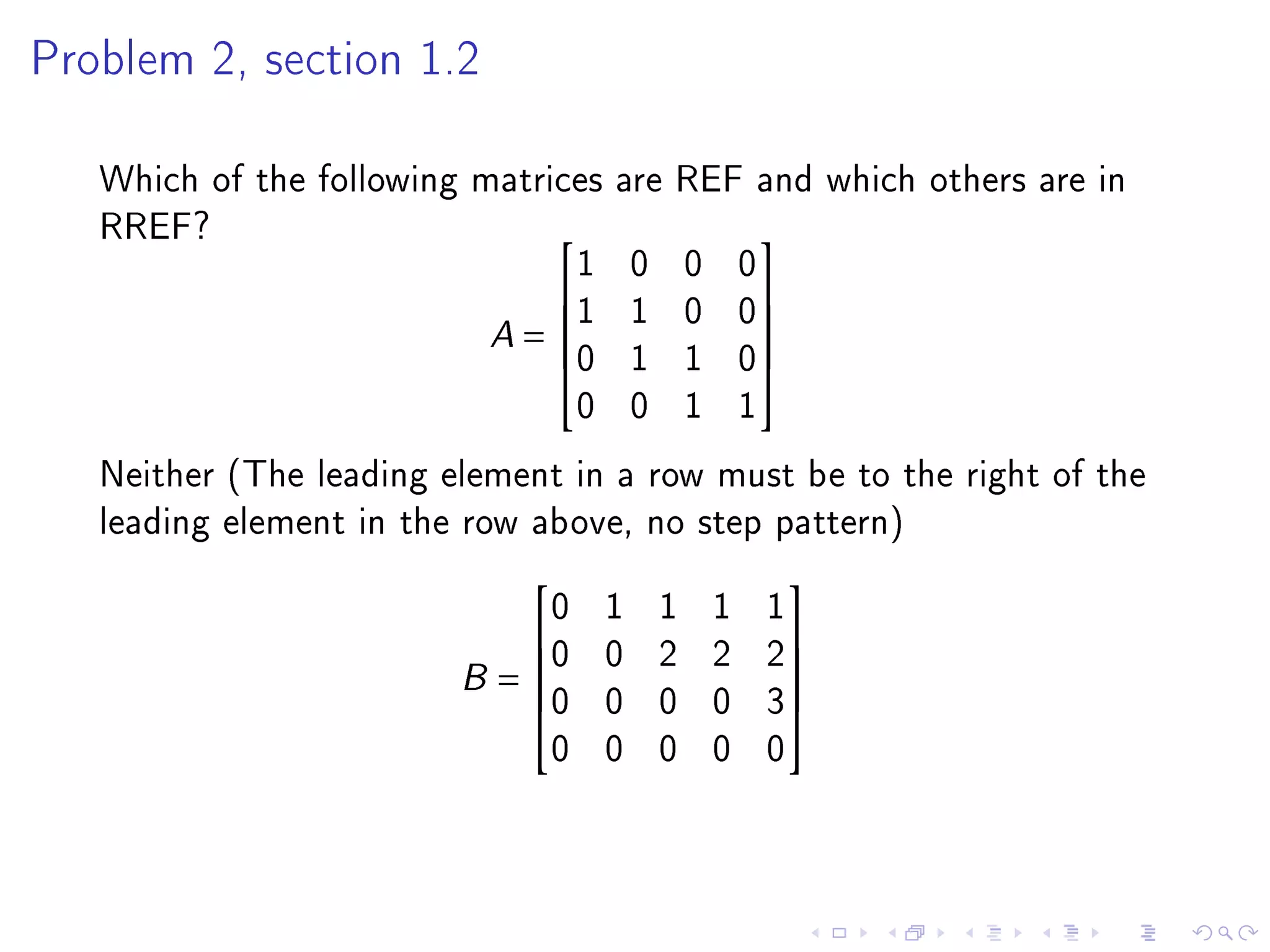
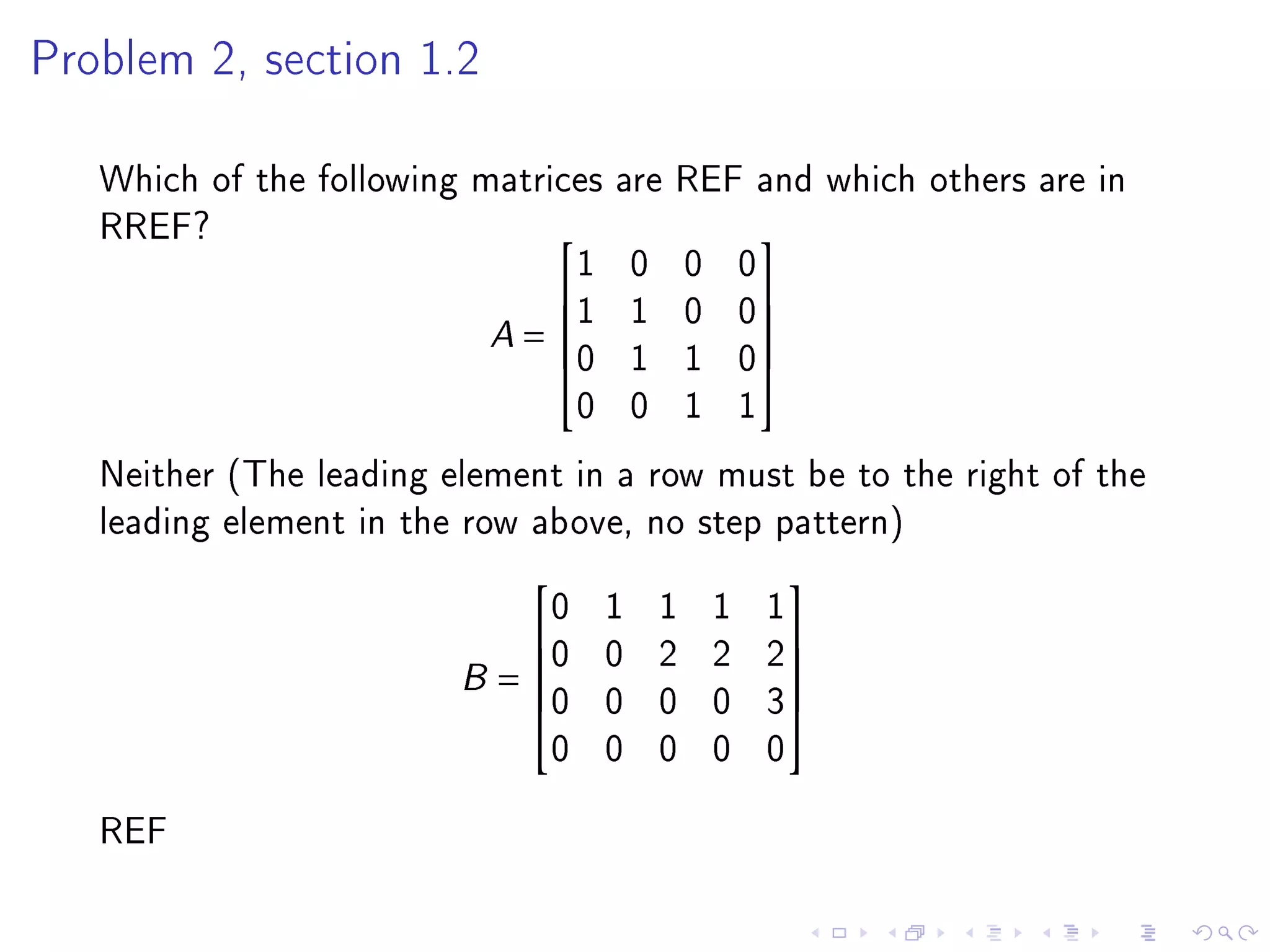
                              0   1   1   1   1
                                              
                             0   0   2   2   2
                         B = 0
                             
                                 0   0   0   3
                                                
                                                
                              0   0   0   0   0
Problem 2, section 1.2


   Which of the following matrices are REF and which others are in
   RREF?
                                1 0 0 0
                                          

                           A = 1 1 0 0
                                          
                               0 1 1 0
                                          
                                0 0 1 1
   Neither (The leading element in a row must be to the right of the
   leading element in the row above, no step pattern)
                              0   1   1   1   1
                                              
                             0   0   2   2   2
                         B = 0
                             
                                 0   0   0   3
                                                
                                                
                              0   0   0   0   0
   REF
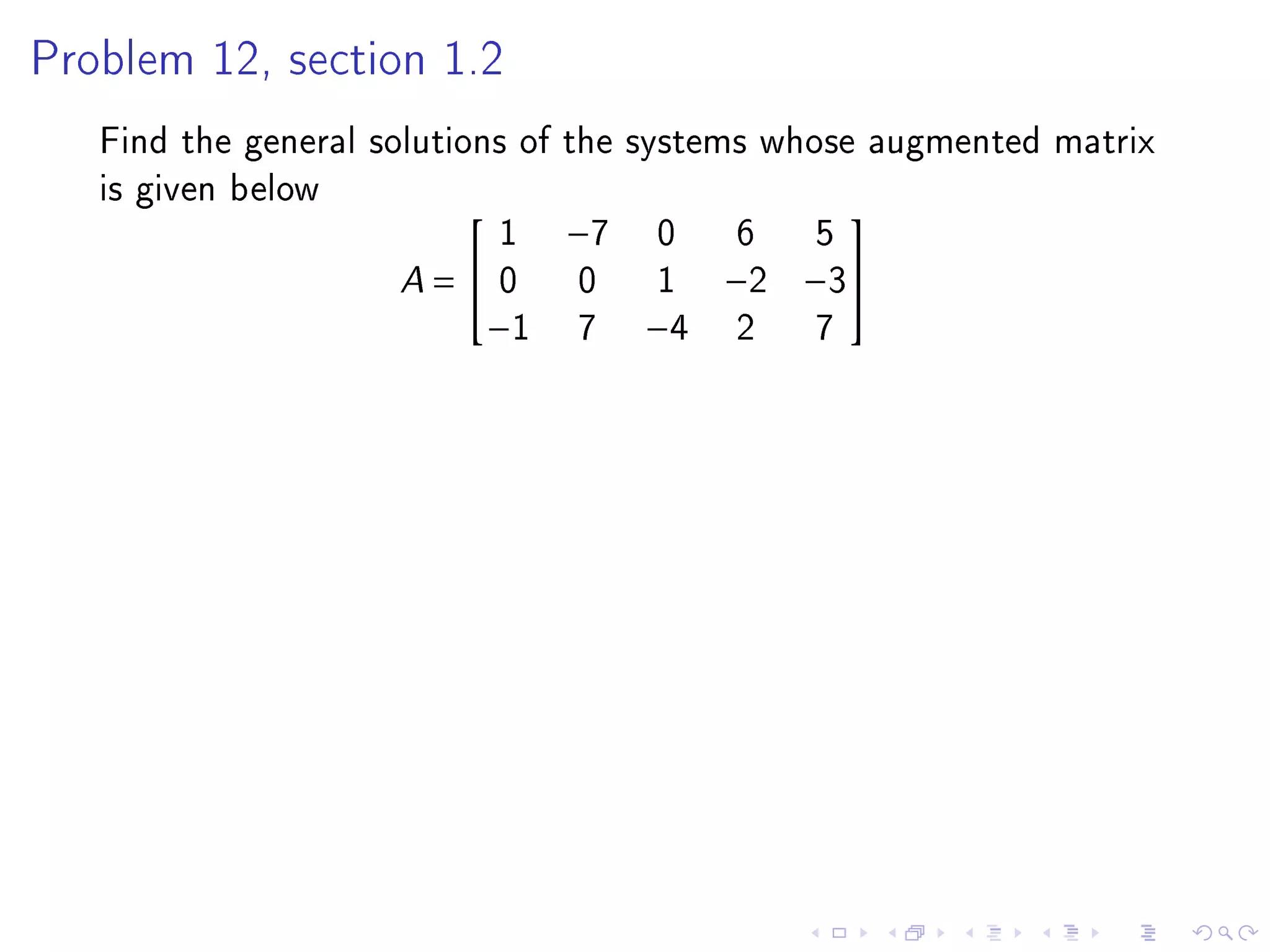
Problem 12, section 1.2

   Find the general solutions of the systems whose augmented matrix
   is given below
                             1 −7 0 6 5
                                                 

                      A =  0 0 1 −2 −3
                            −1 7 −4 2           7
Problem 12, section 1.2

   Find the general solutions of the systems whose augmented matrix
   is given below
                             1 −7 0 6 5
                                                 

                      A =  0 0 1 −2 −3
                            −1 7 −4 2           7
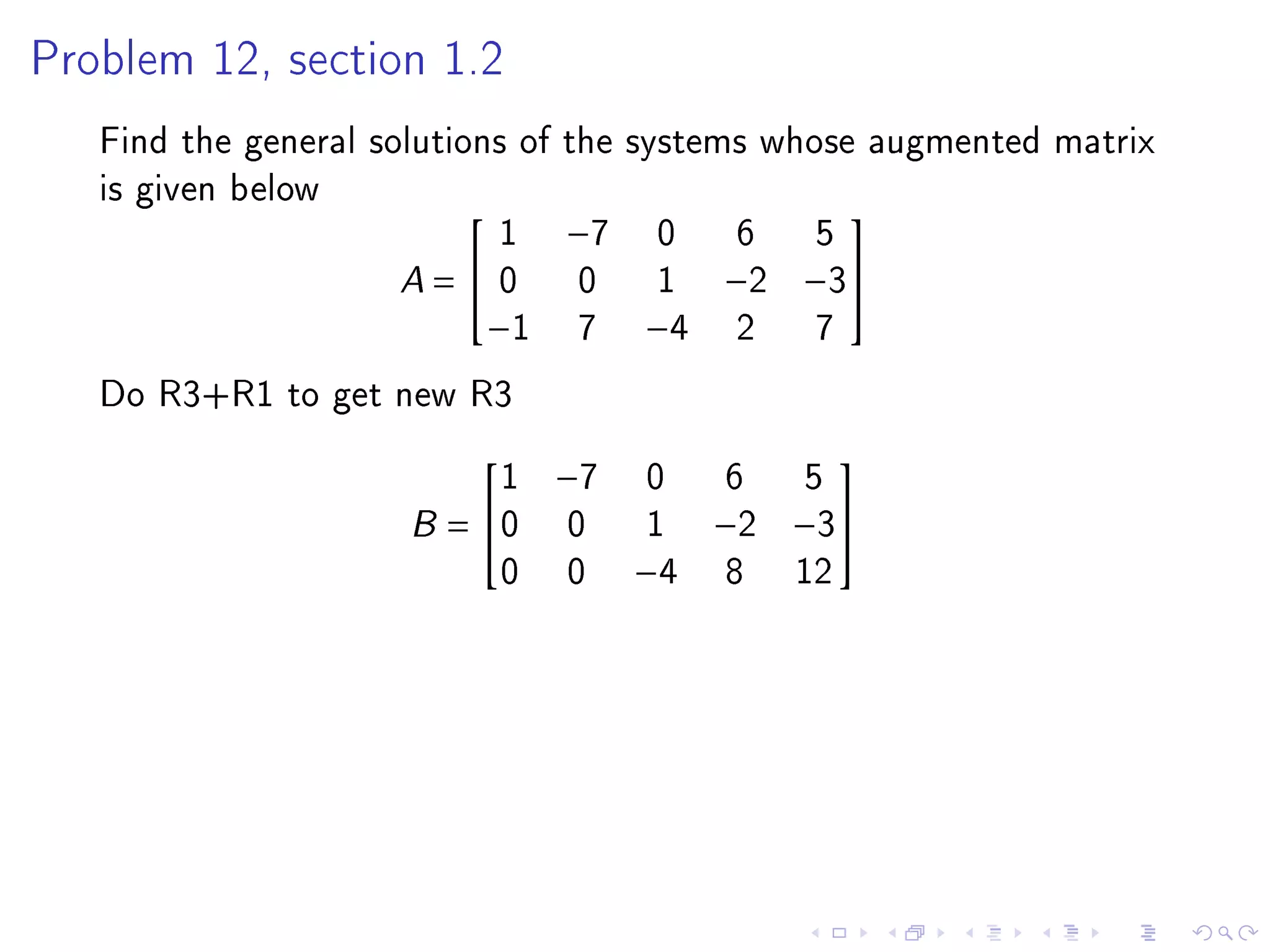
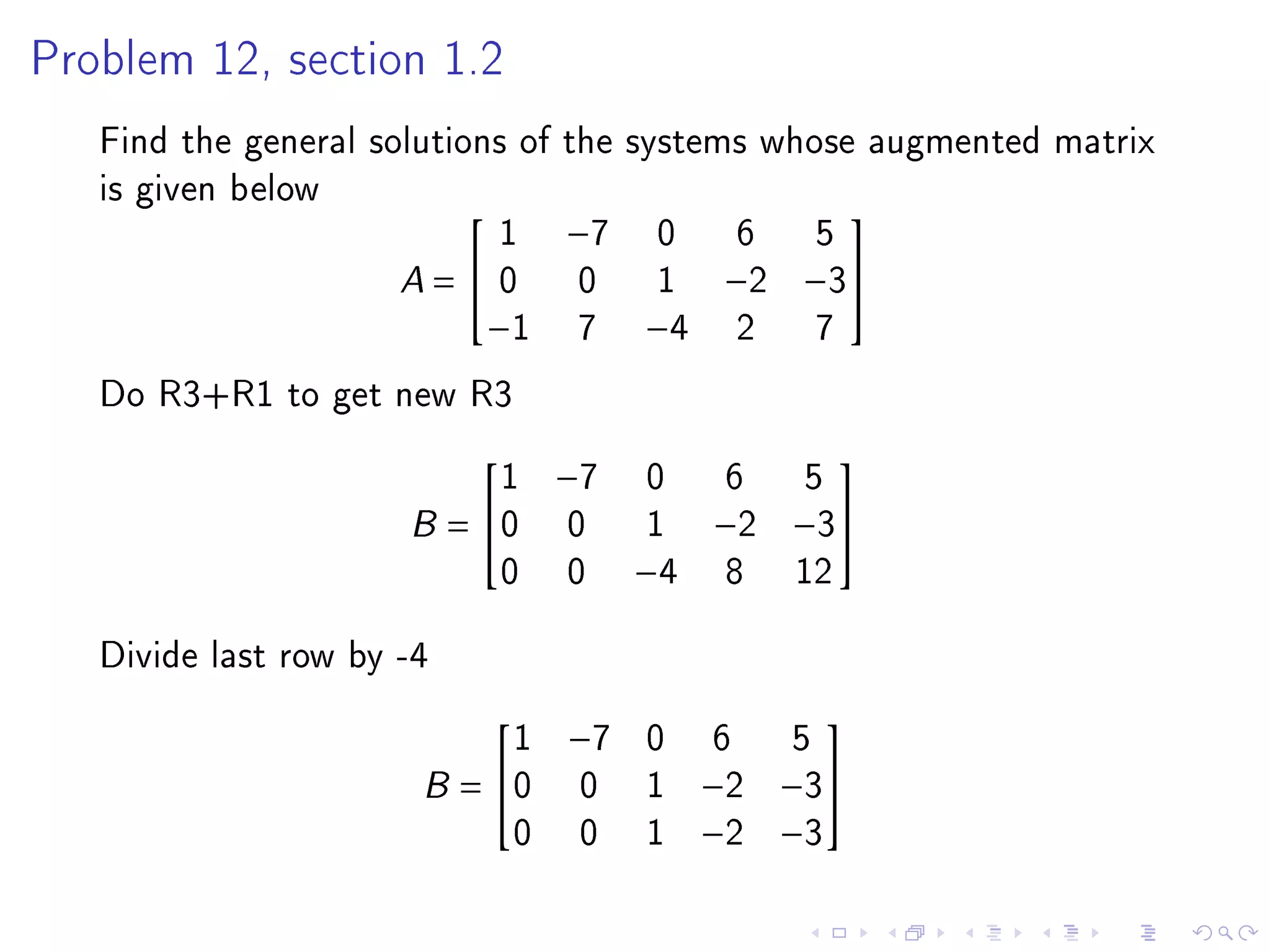
   Do R3+R1 to get new R3
                         1    −7   0     6 5
                                              

                     B= 0     0    1   −2 −3
                         0     0   −4   8 12
Problem 12, section 1.2

   Find the general solutions of the systems whose augmented matrix
   is given below
                             1 −7 0 6 5
                                                 

                      A =  0 0 1 −2 −3
                            −1 7 −4 2           7
   Do R3+R1 to get new R3
                          1     −7   0     6 5
                                                

                      B= 0     0     1   −2 −3
                          0     0    −4   8 12
   Divide last row by -4
                            1   −7   0     6    5
                                               

                       B = 0    0   1    −2   −3
                            0    0   1    −2   −3
Problem 12, section 1.2


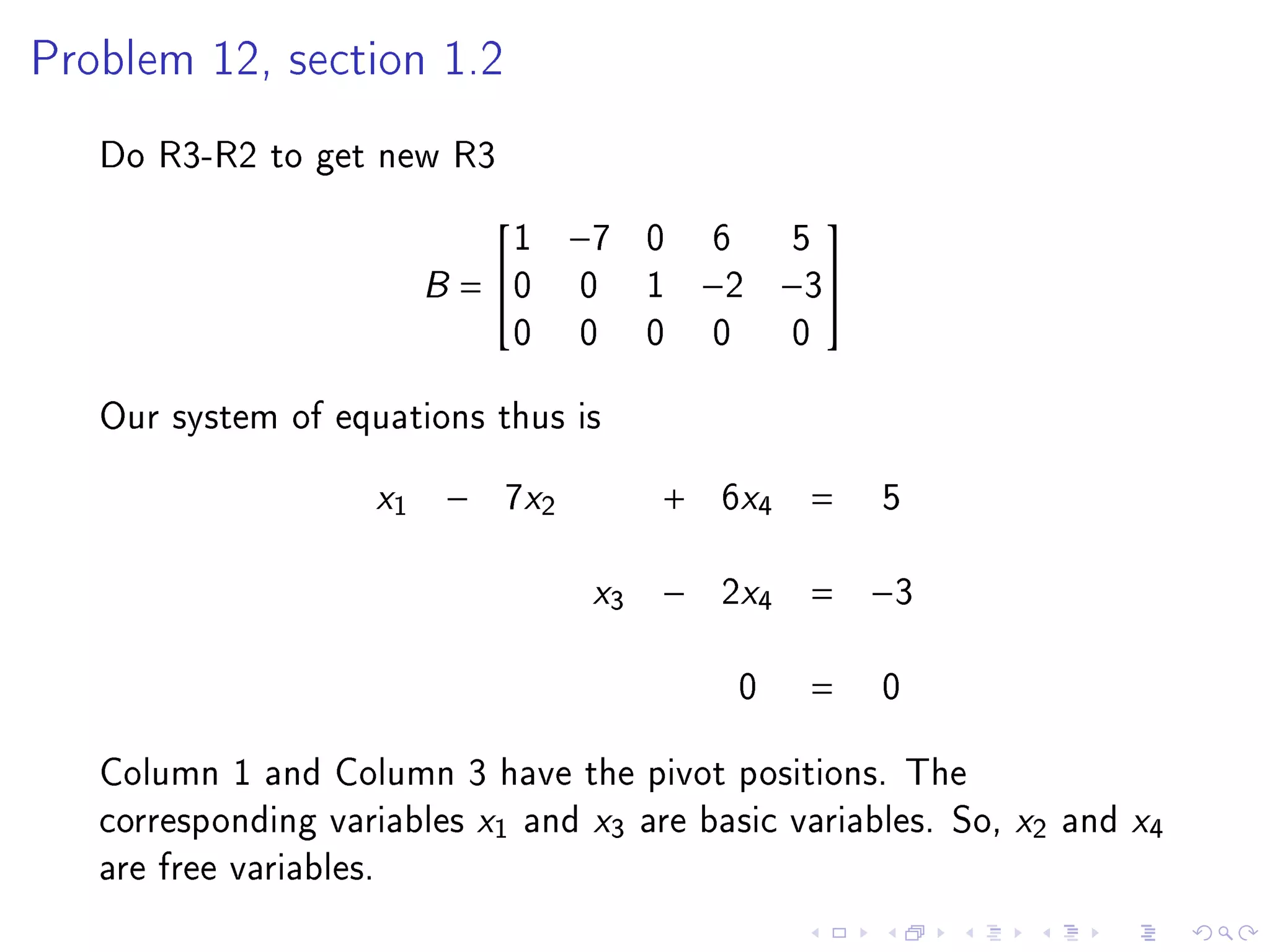
   Do R3-R2 to get new R3
                             1     −7    0    6     5
                                                   

                         B= 0     0     1   −2    −3
                             0     0     0    0    0
   Our system of equations thus is
                    x1   −   7x2         +   6x4    =    5

                                    x3   −   2x4    = −3

                                              0     =    0
   Column 1 and Column 3 have the pivot positions. The
   corresponding variables x1 and x3 are basic variables. So, x2 and x4
   are free variables.
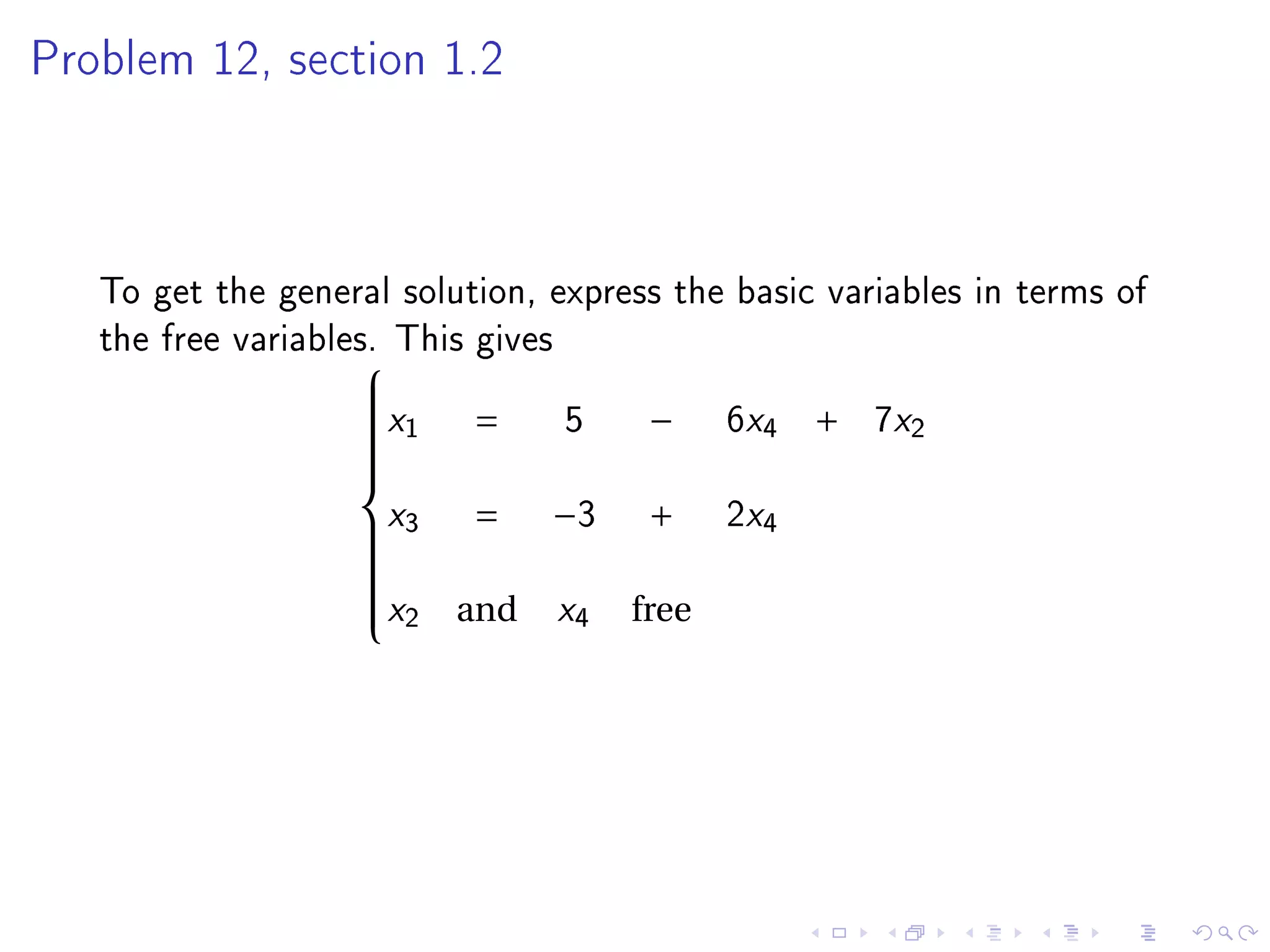
Problem 12, section 1.2


   To get the general solution, express the basic variables in terms of
   the free variables. This gives
                    
                   x1           5          6x4       7x2
                   
                           =          −           +
                   
                   
                   
                   
                   
                   
                   x3
                   
                           =    −3    +     2x4
                   
                   
                   x2          x4
                   
                   
                          and        free
                   
Problem 20, section 1.2


   Choose h and k such that the system has (a) no solution (b)
   exactly one solution and (c) innitely many solutions
                            x1    +   3x2   =   2

                            3x1   +   hx2   =   k
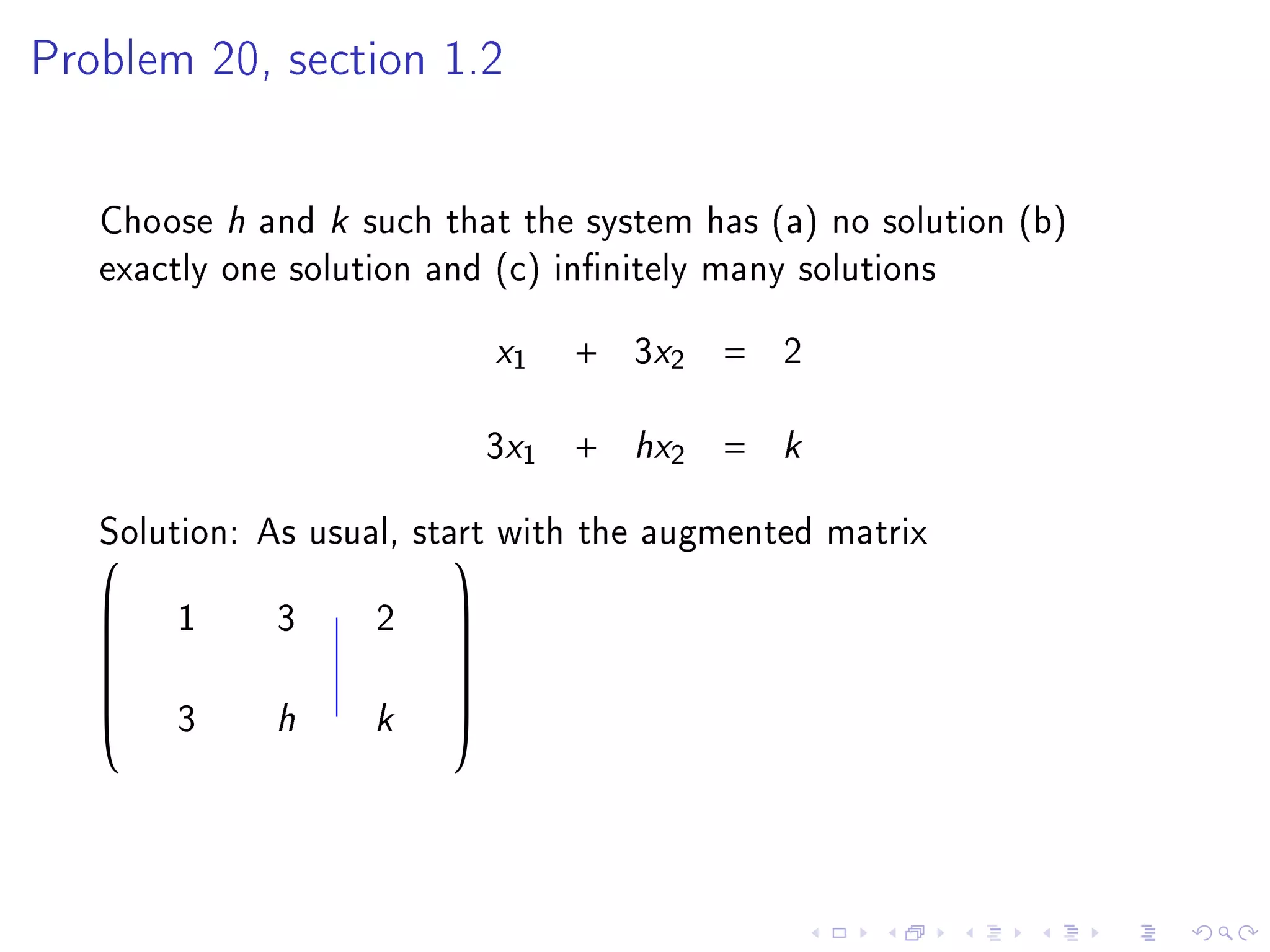
   Solution: As usual, start with the augmented matrix
                         
   
      1     3      2   
                        
                       
             h     k
                       
   
       3                
Problem 20, section 1.2


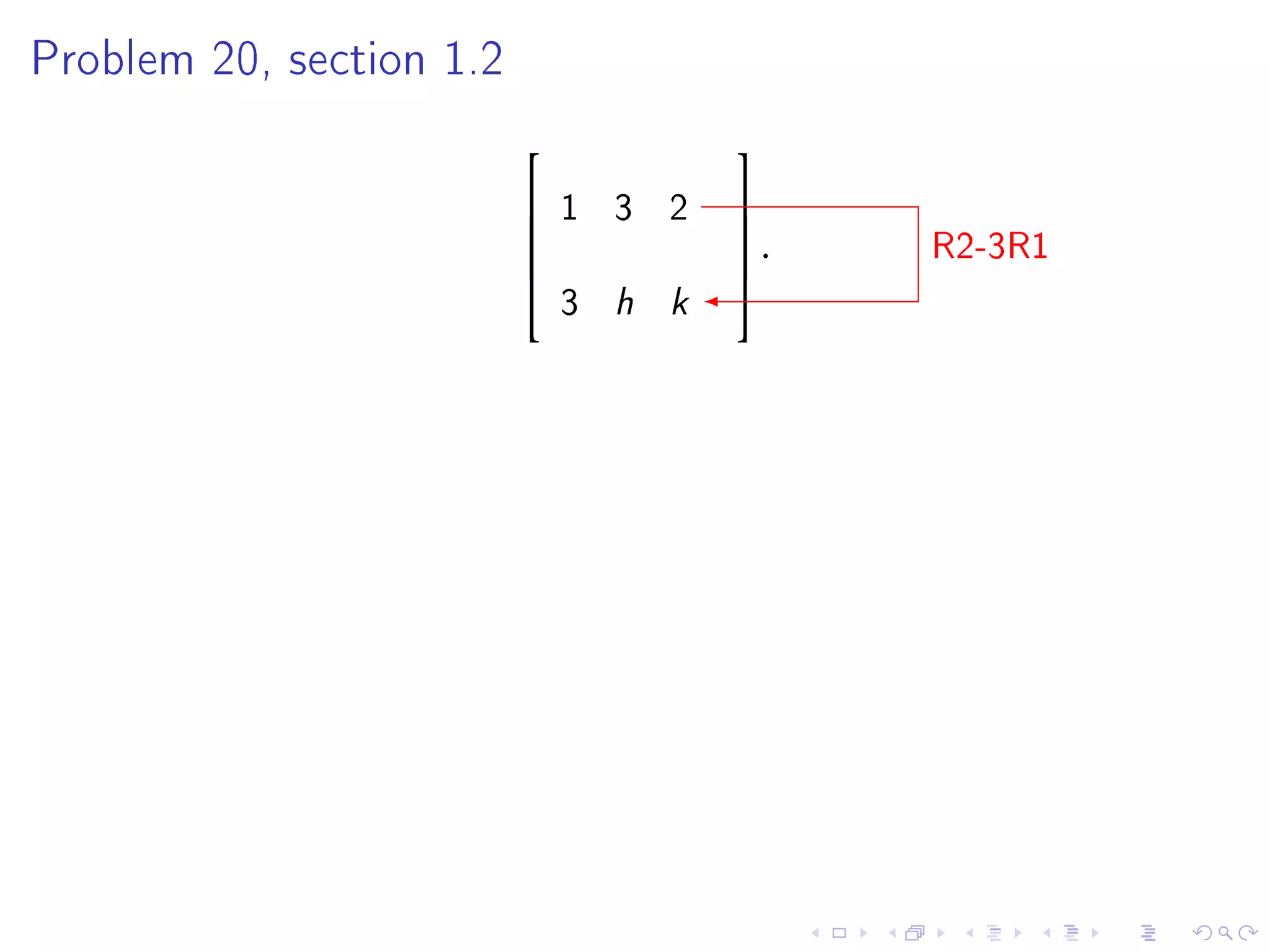
                                     
                             1 3 2   
                          
                                     .
                                      
                                           R2-3R1
                              3 h k
                                     
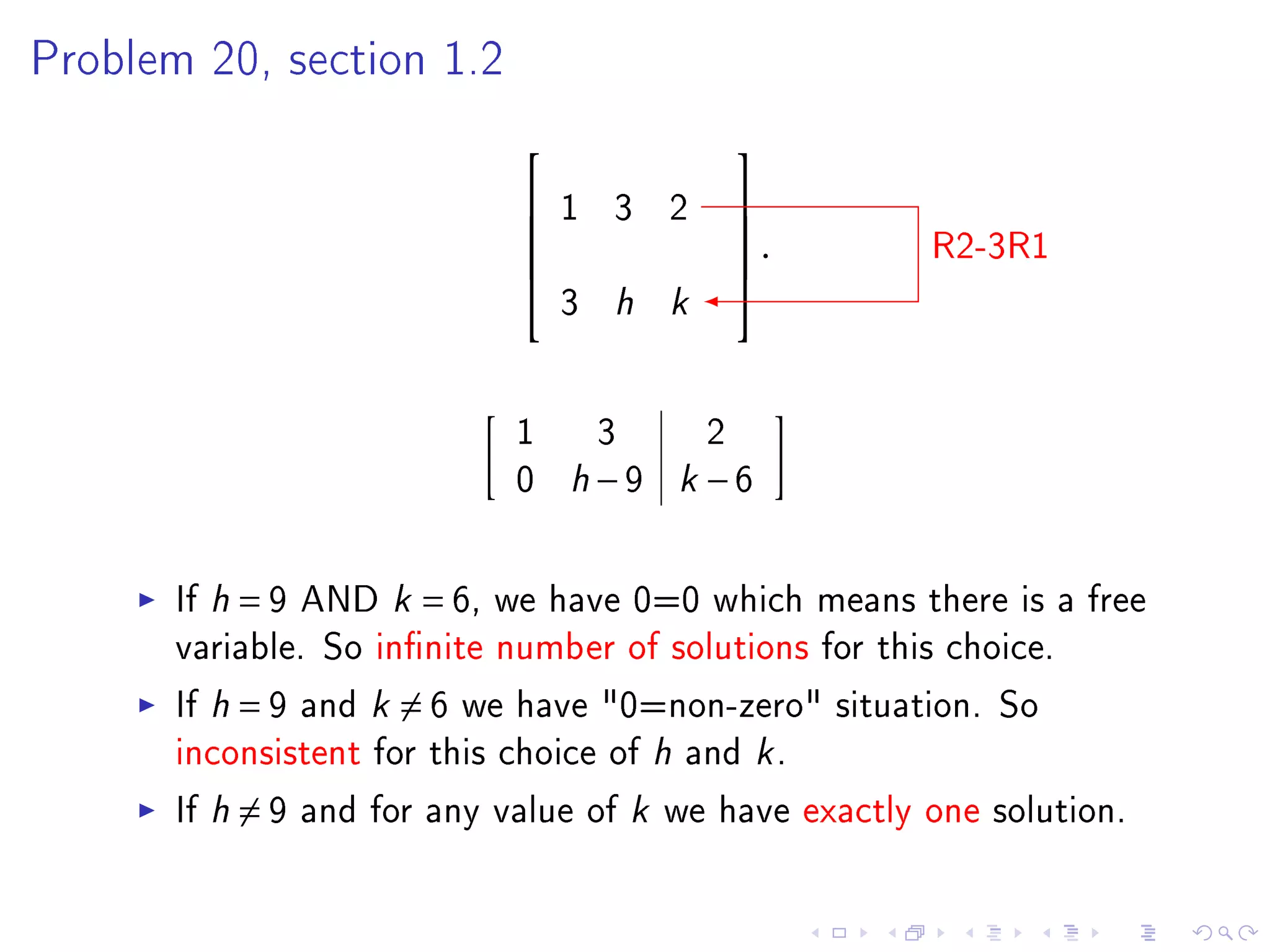
Problem 20, section 1.2


                                         
                               1 3 2     
                            
                                         .
                                          
                                                      R2-3R1
                                3 h k
                                         


                            1 3     2
                            0 h−9 k −6

       If h = 9 AND k = 6, we have 0=0 which means there is a free
       variable. So innite number of solutions for this choice.
       If h = 9 and k = 6 we have 0=non-zero situation. So
       inconsistent for this choice of h and k .
       If h = 9 and for any value of k we have exactly one solution.
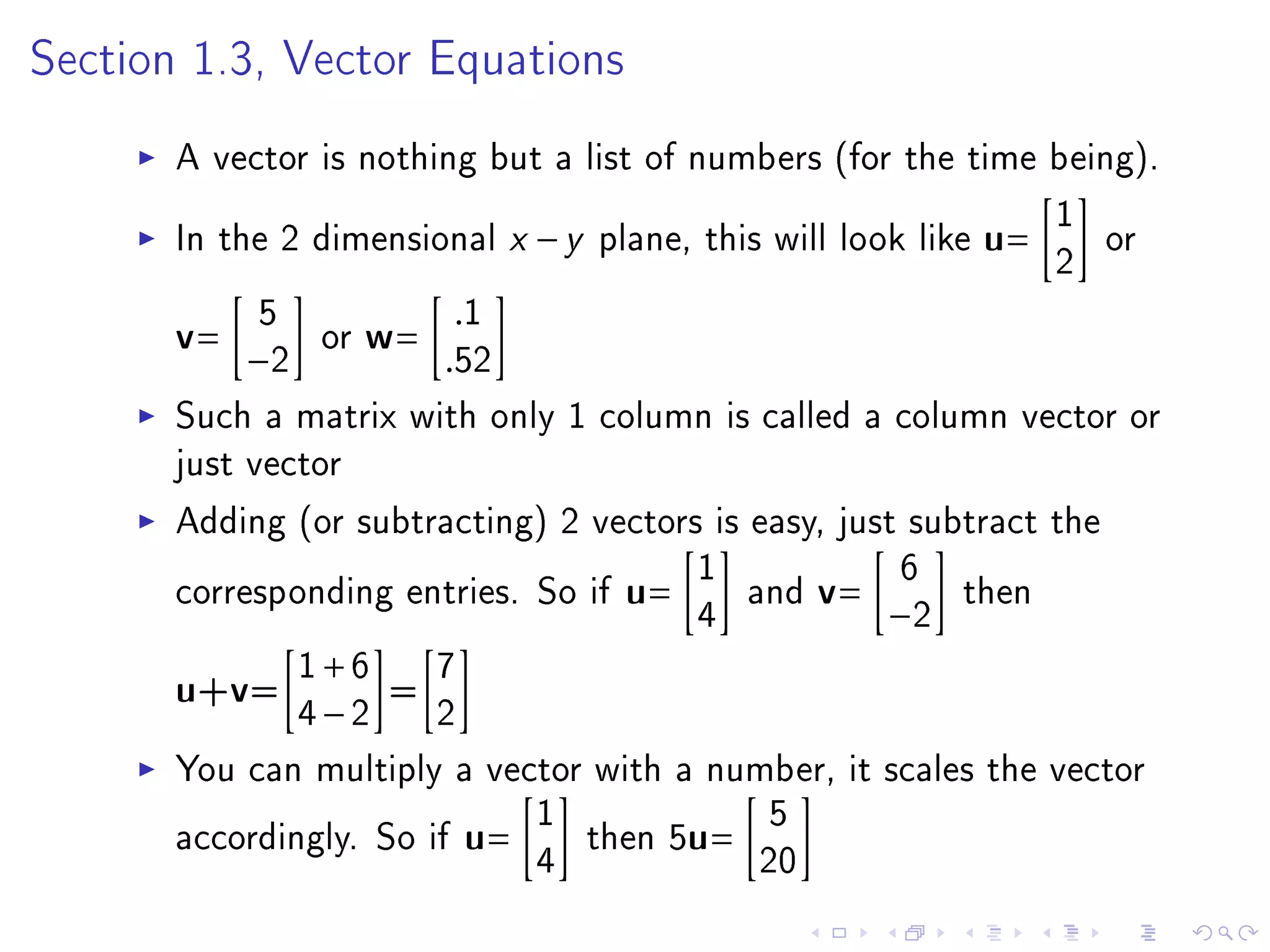
Section 1.3, Vector Equations


       A vector is nothing but a list of numbers (for the time being).
                                                                 1
       In the 2 dimensional x − y plane, this will look like u=     or
                                                                 2
       v= −52 or w= .52  .1

       Such a matrix with only 1 column is called a column vector or
       just vector
       Adding (or subtracting) 2 vectors is easy, just subtract the
                                         1             6
       corresponding entries. So if u=      and v=          then
                                         4            −2

       u+v= 1 + 6 = 7
               4−2      2
       You can multiply a vector with a number, it scales the vector
                              1               5
       accordingly. So if u=     then 5u=
                              4              20
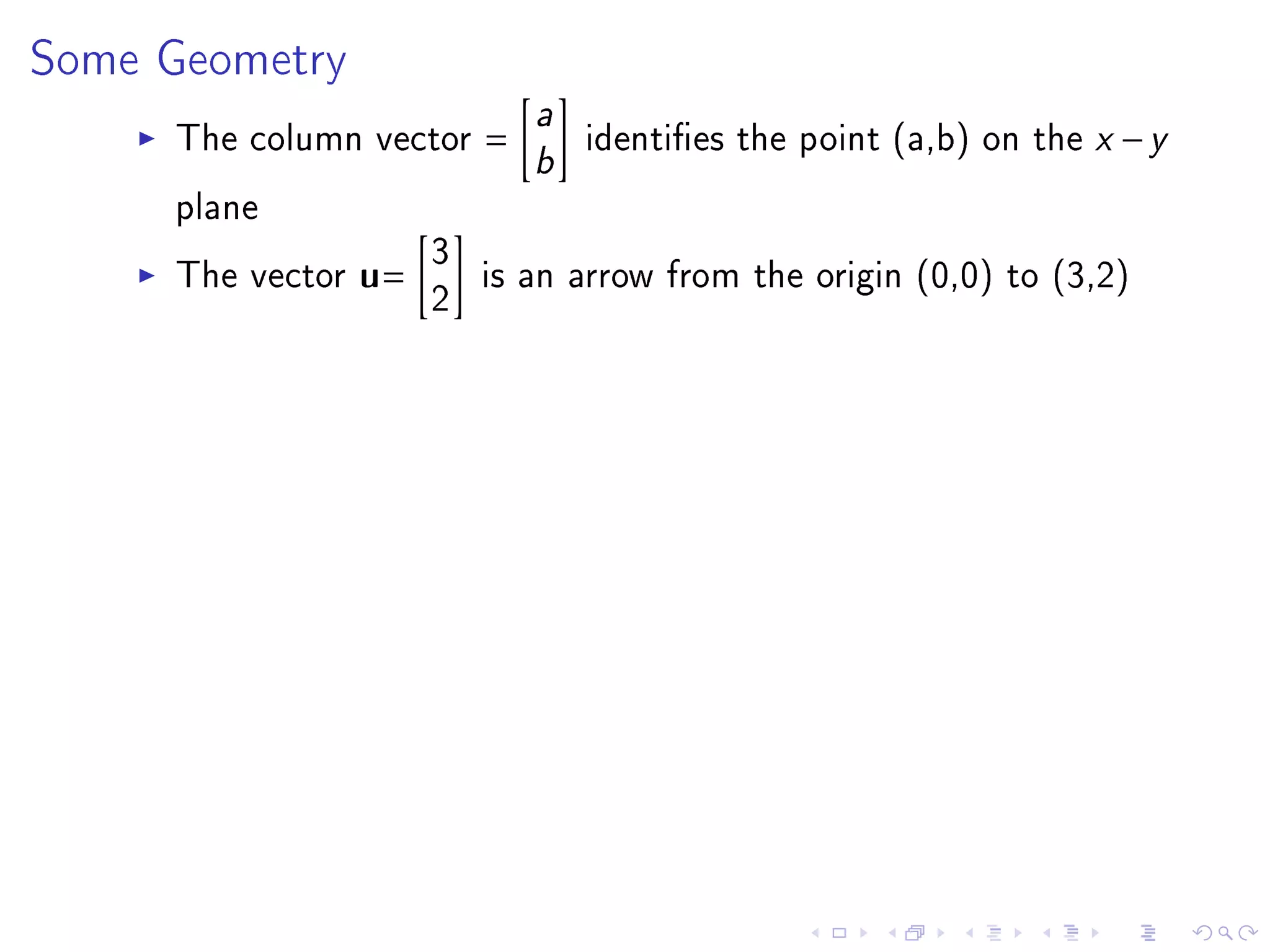
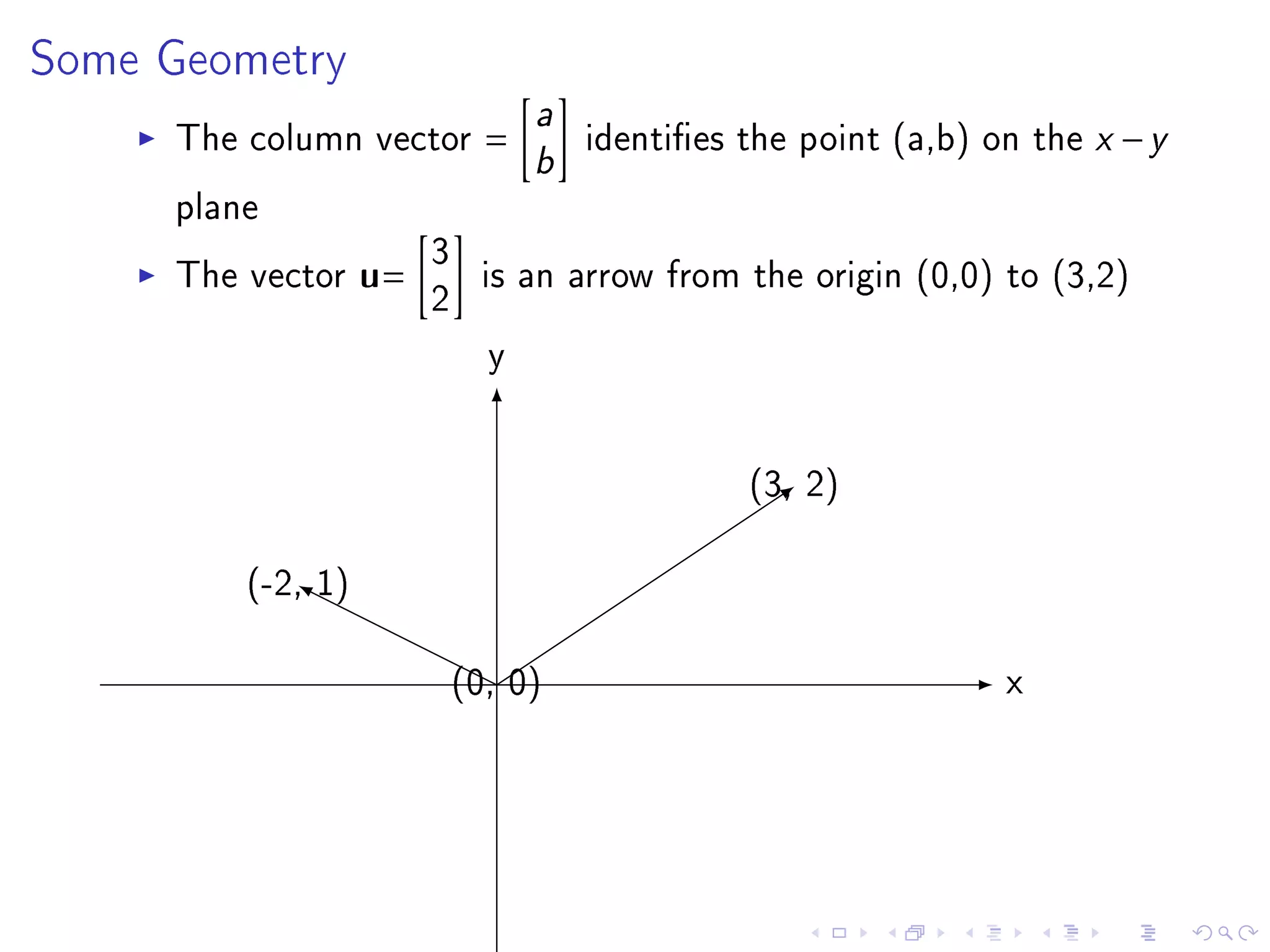
Some Geometry
                           a
     The column vector =
                           b identies the point (a,b) on the x − y
     plane
                     3
     The vector u=     is an arrow from the origin (0,0) to (3,2)
                     2
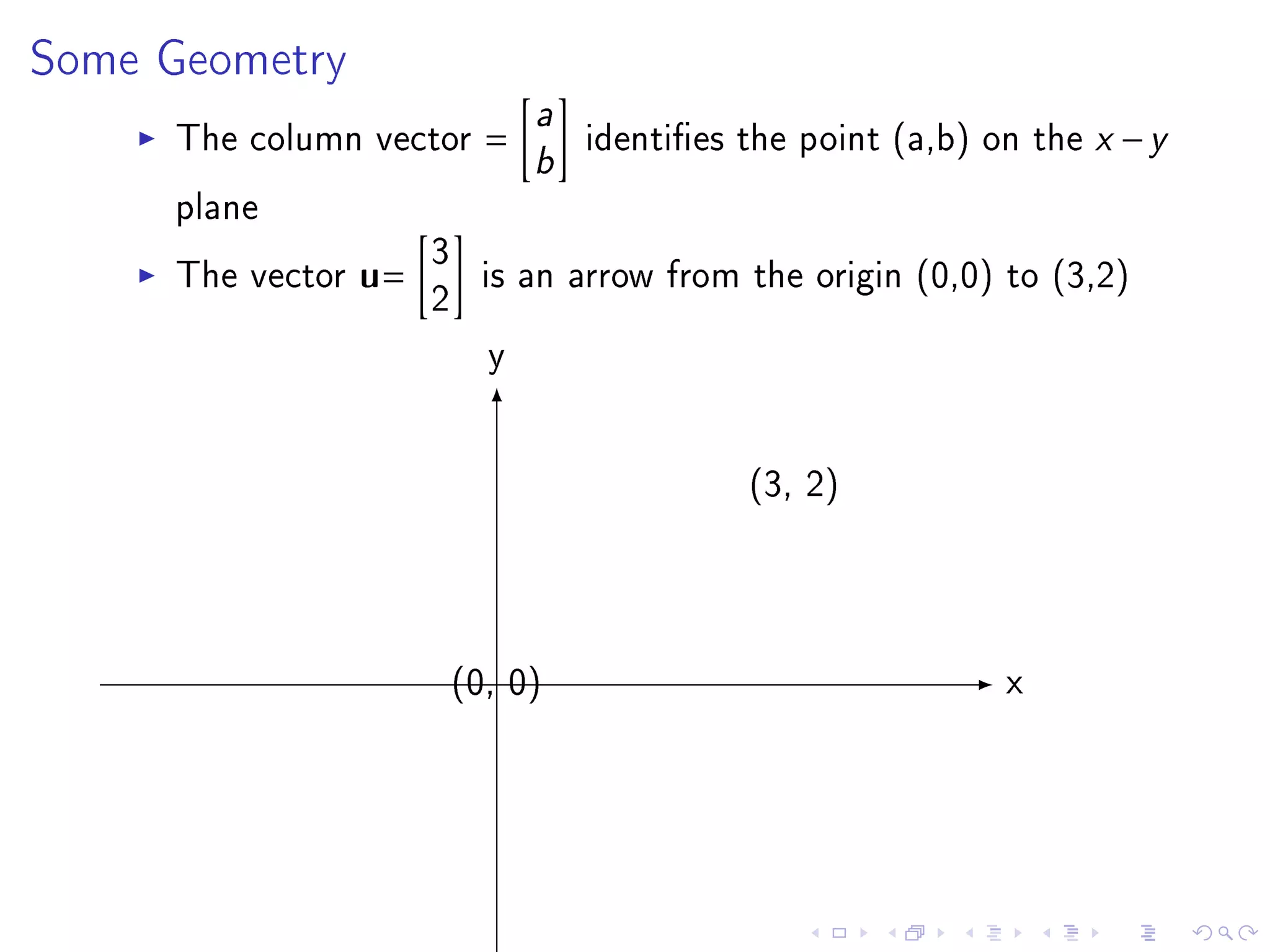
Some Geometry
                           a
     The column vector =
                           b identies the point (a,b) on the x − y
     plane
                     3
     The vector u=     is an arrow from the origin (0,0) to (3,2)
                     2
                        y

                                         (3, 2)


                      (0, 0)                             x
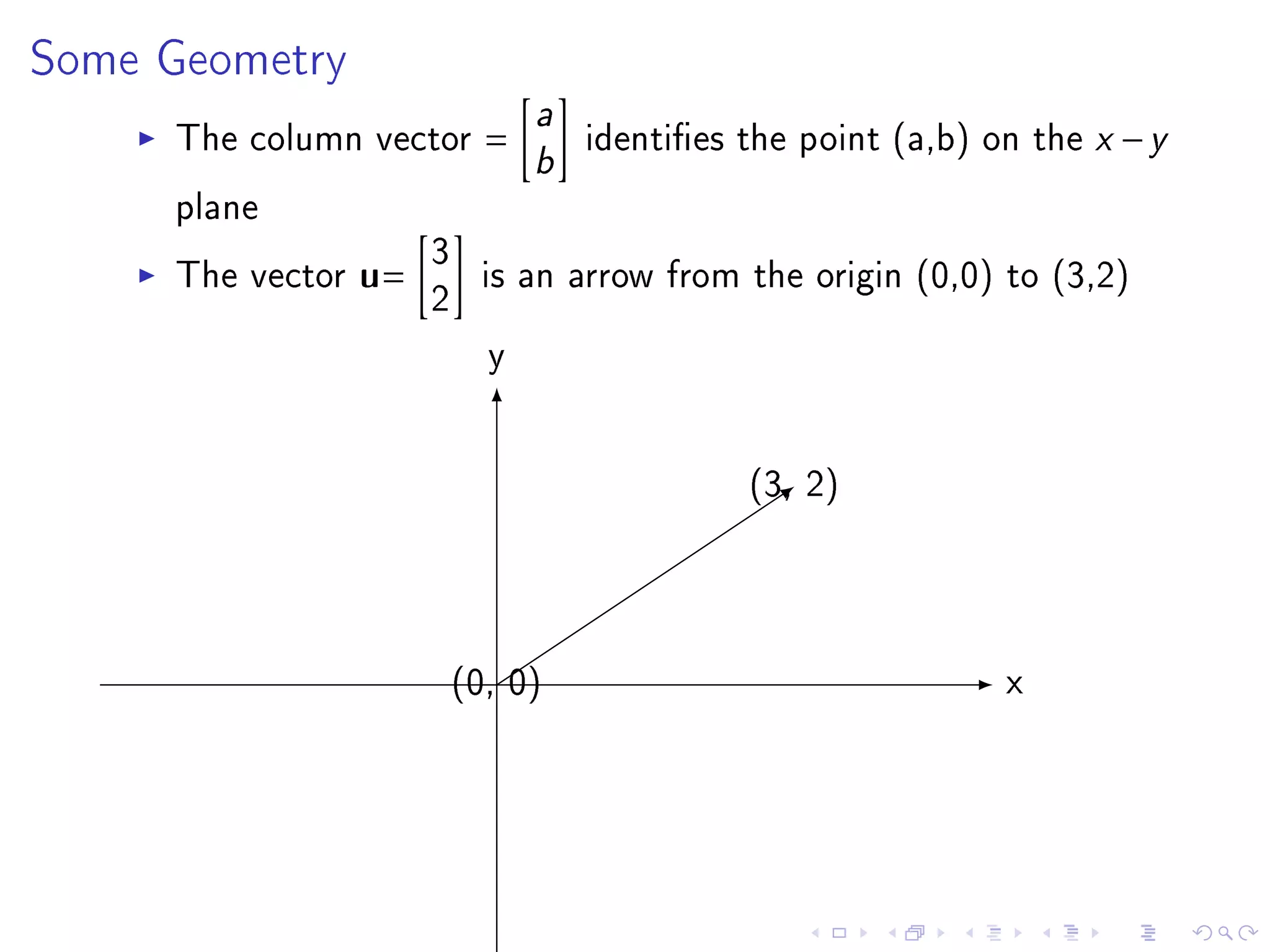
Some Geometry
                           a
     The column vector =
                           b identies the point (a,b) on the x − y
     plane
                     3
     The vector u=     is an arrow from the origin (0,0) to (3,2)
                     2
                        y

                                         (3, 2)


                      (0, 0)                             x
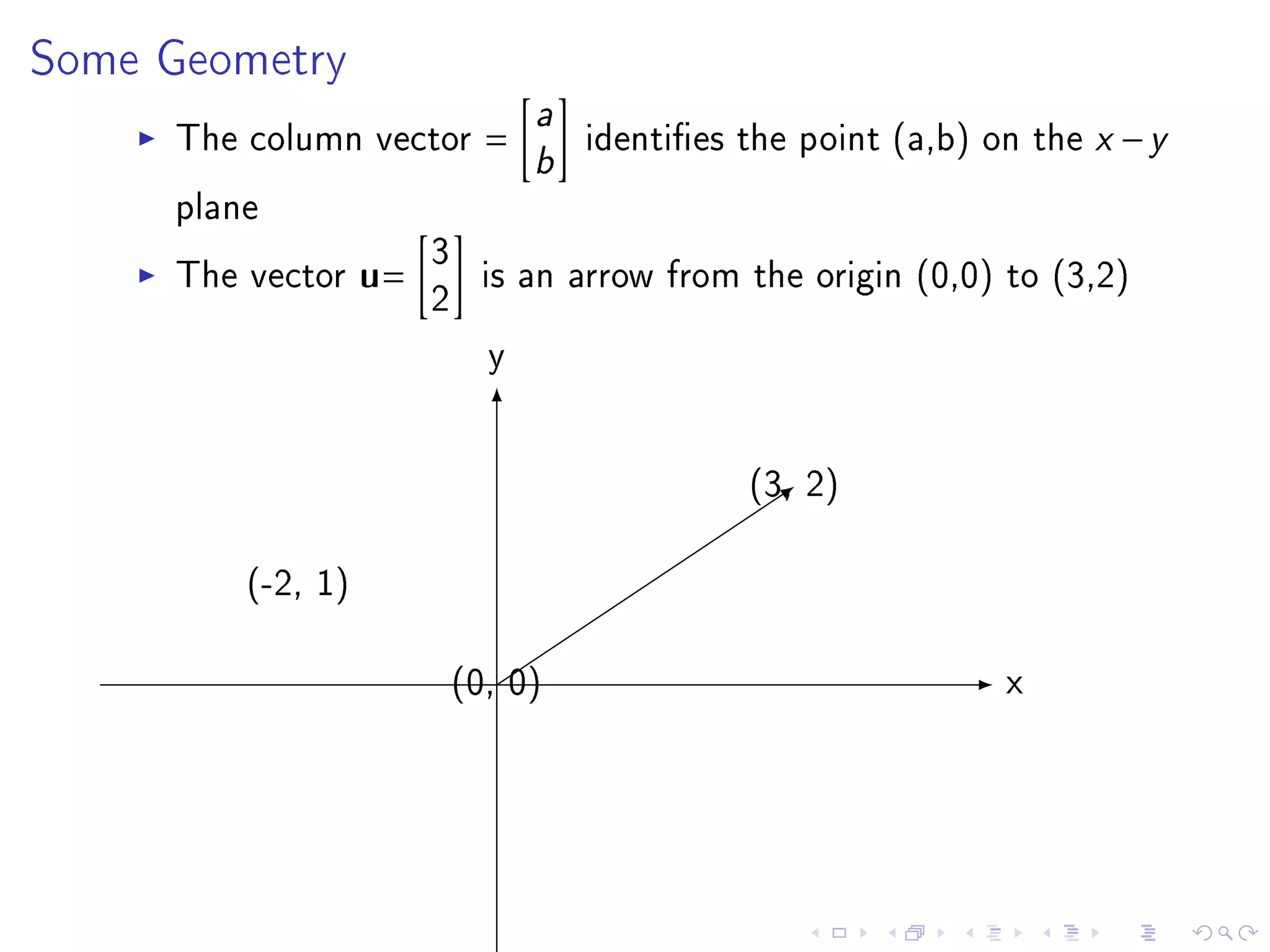
Some Geometry
                           a
     The column vector =
                           b identies the point (a,b) on the x − y
     plane
                     3
     The vector u=     is an arrow from the origin (0,0) to (3,2)
                     2
                        y

                                         (3, 2)

         (-2, 1)

                      (0, 0)                             x
Some Geometry
                           a
     The column vector =
                           b identies the point (a,b) on the x − y
     plane
                     3
     The vector u=     is an arrow from the origin (0,0) to (3,2)
                     2
                        y

                                         (3, 2)

         (-2, 1)

                      (0, 0)                             x
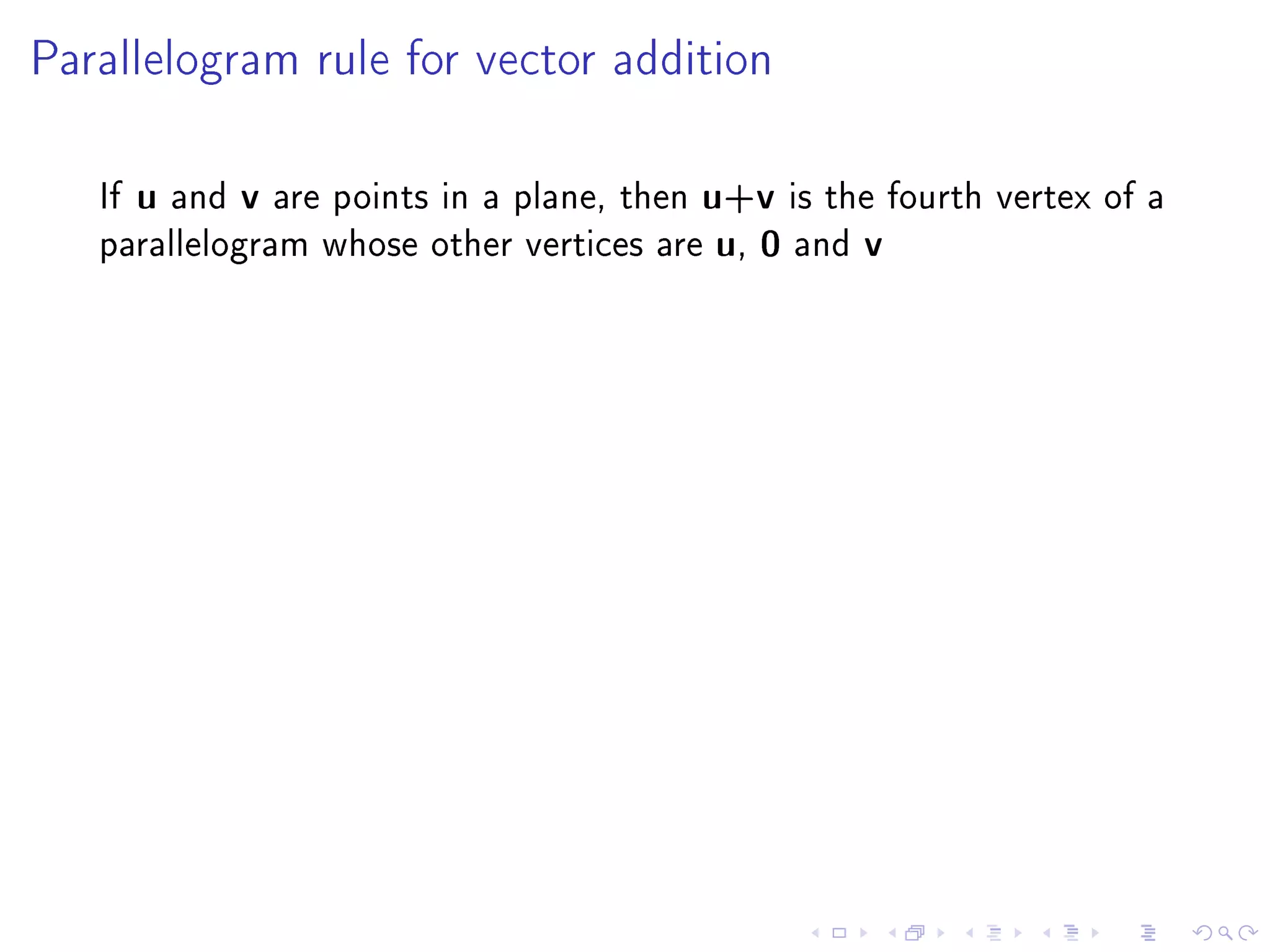
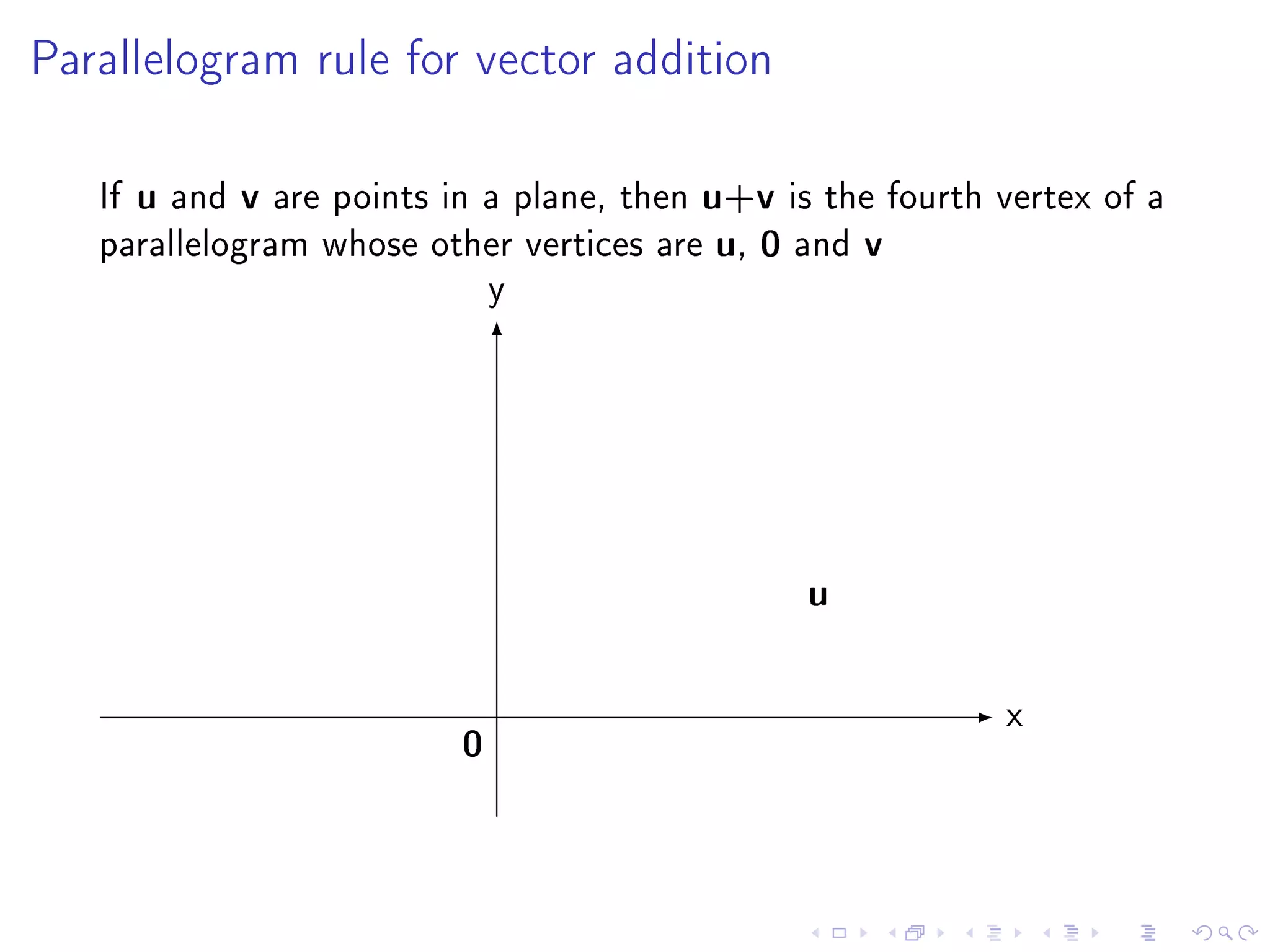
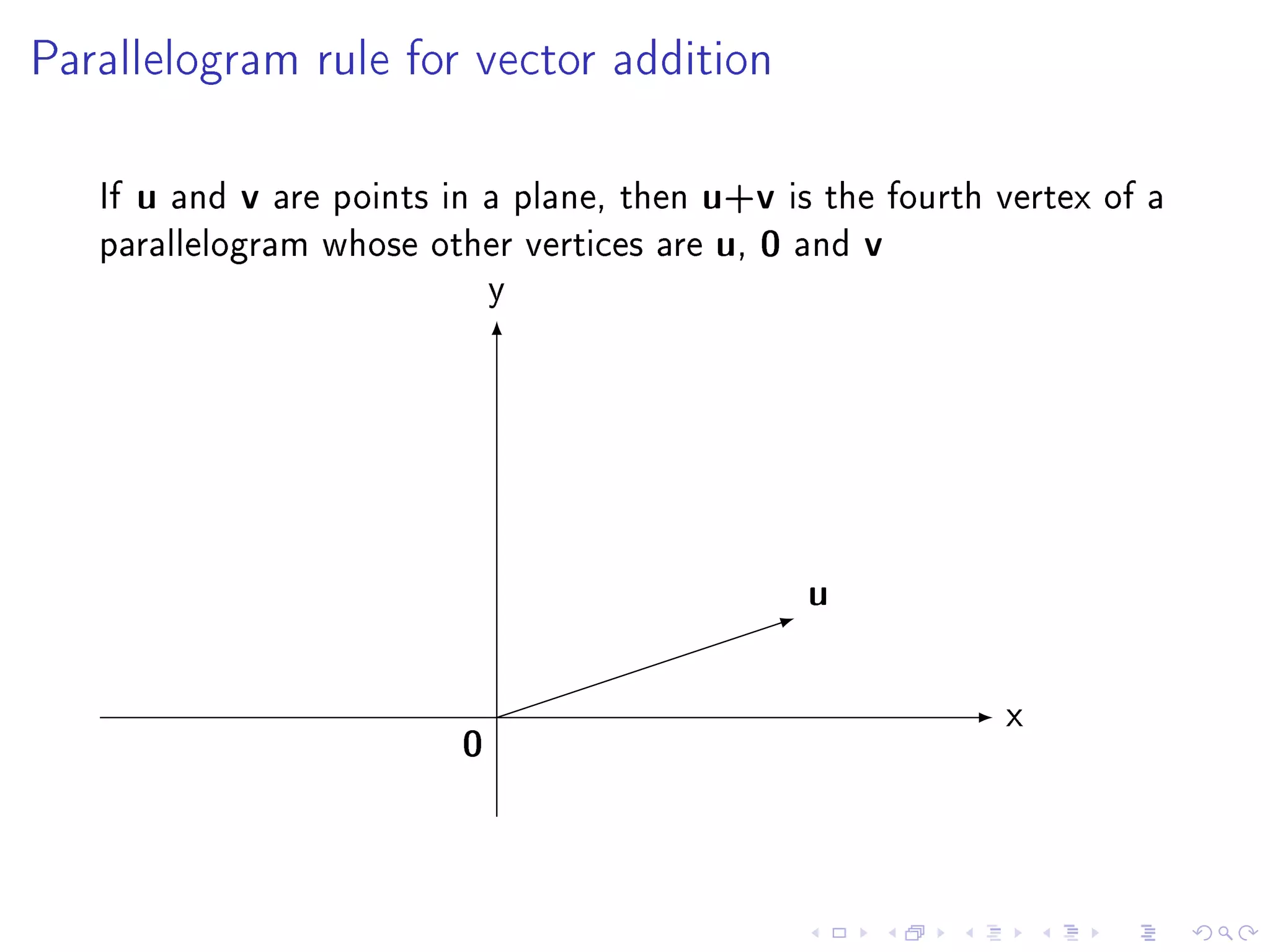
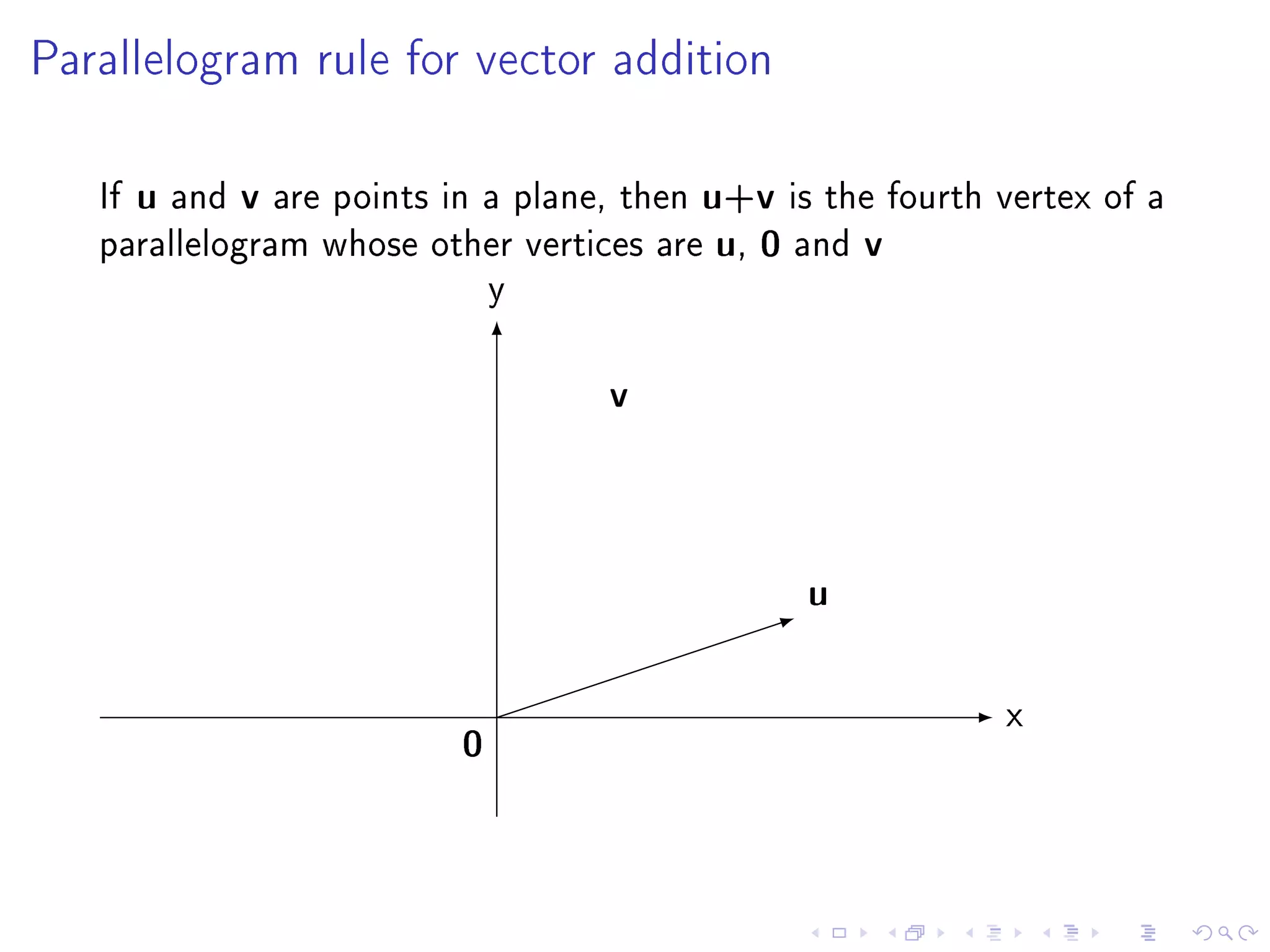
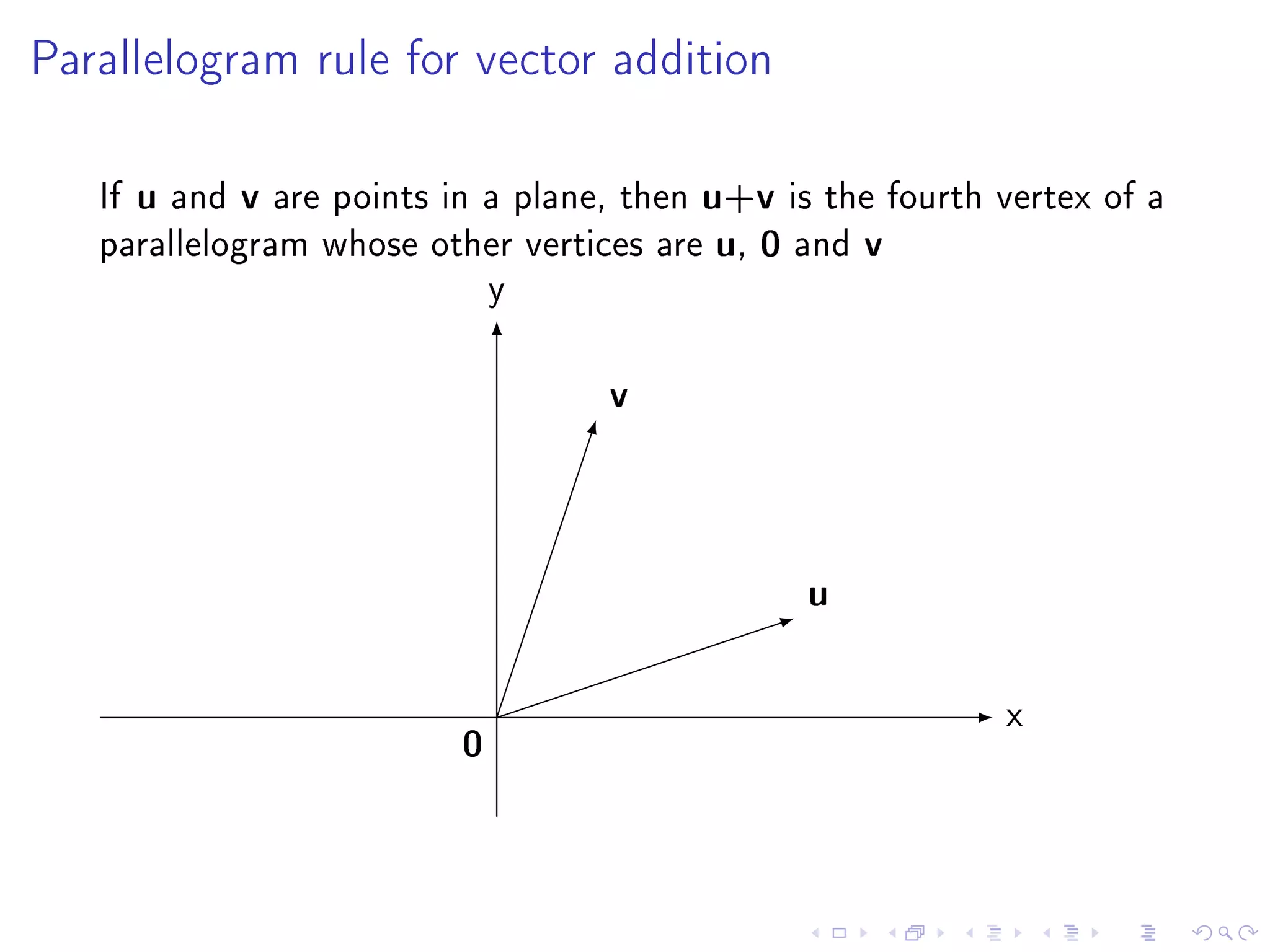
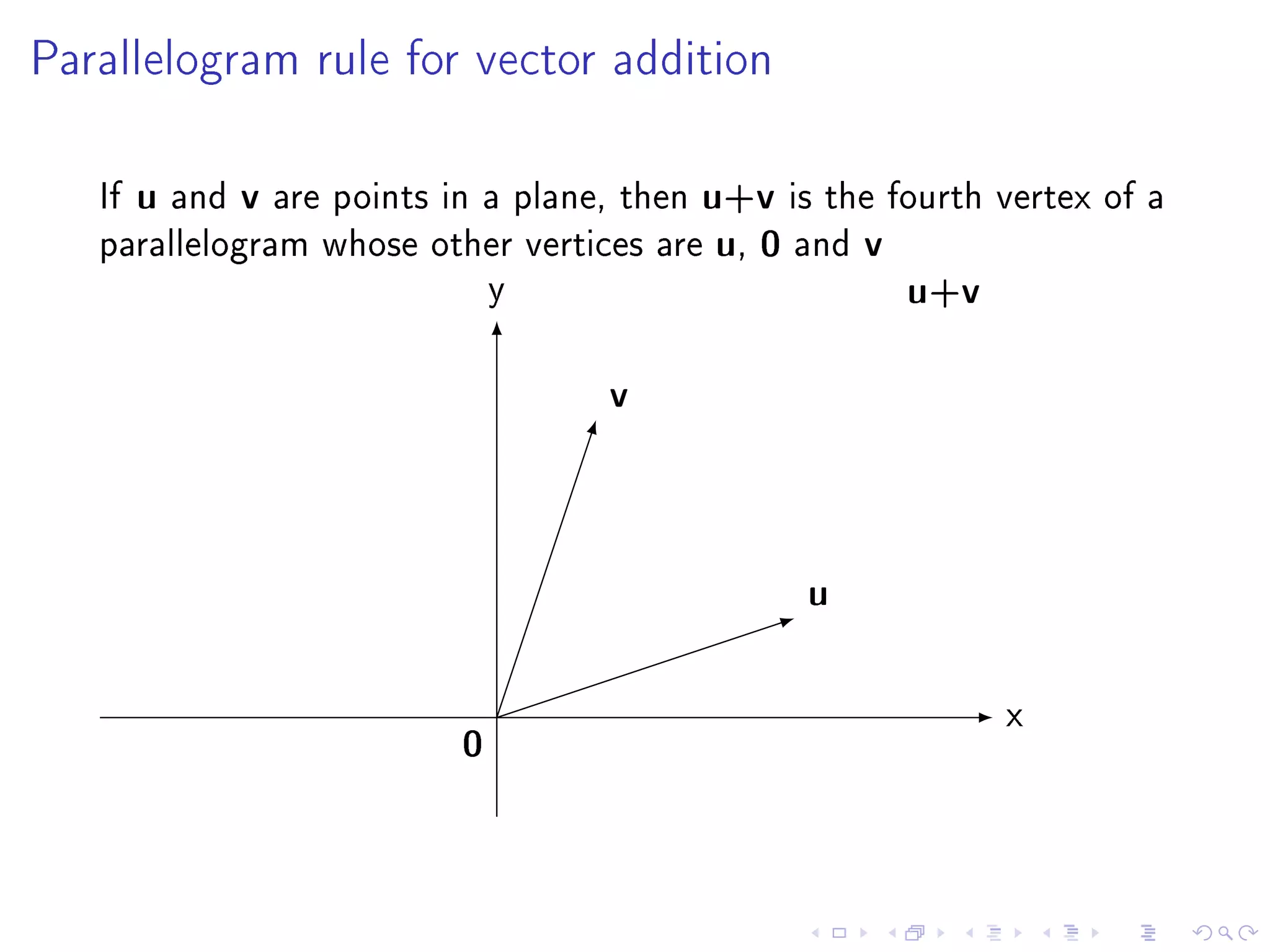
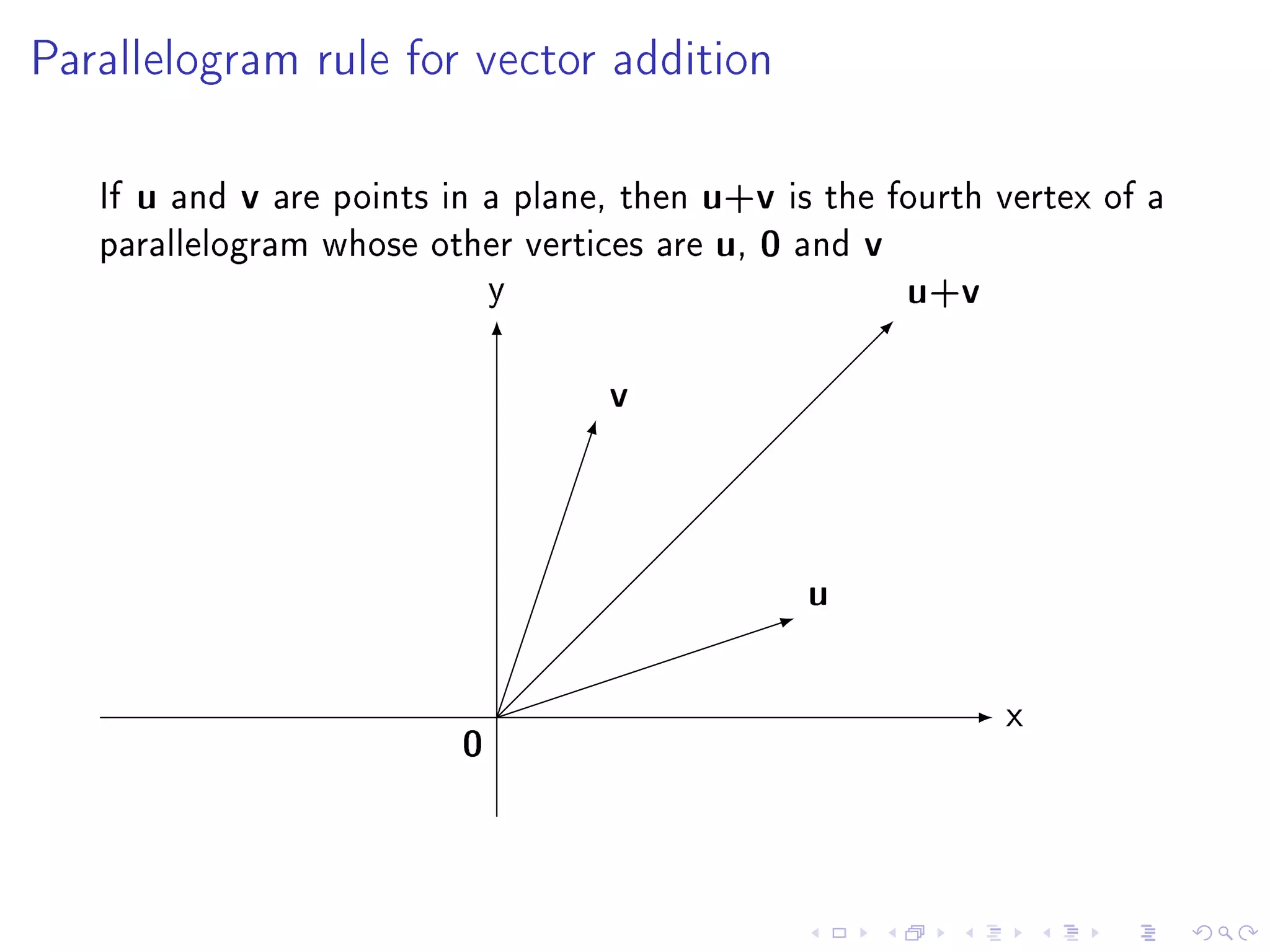
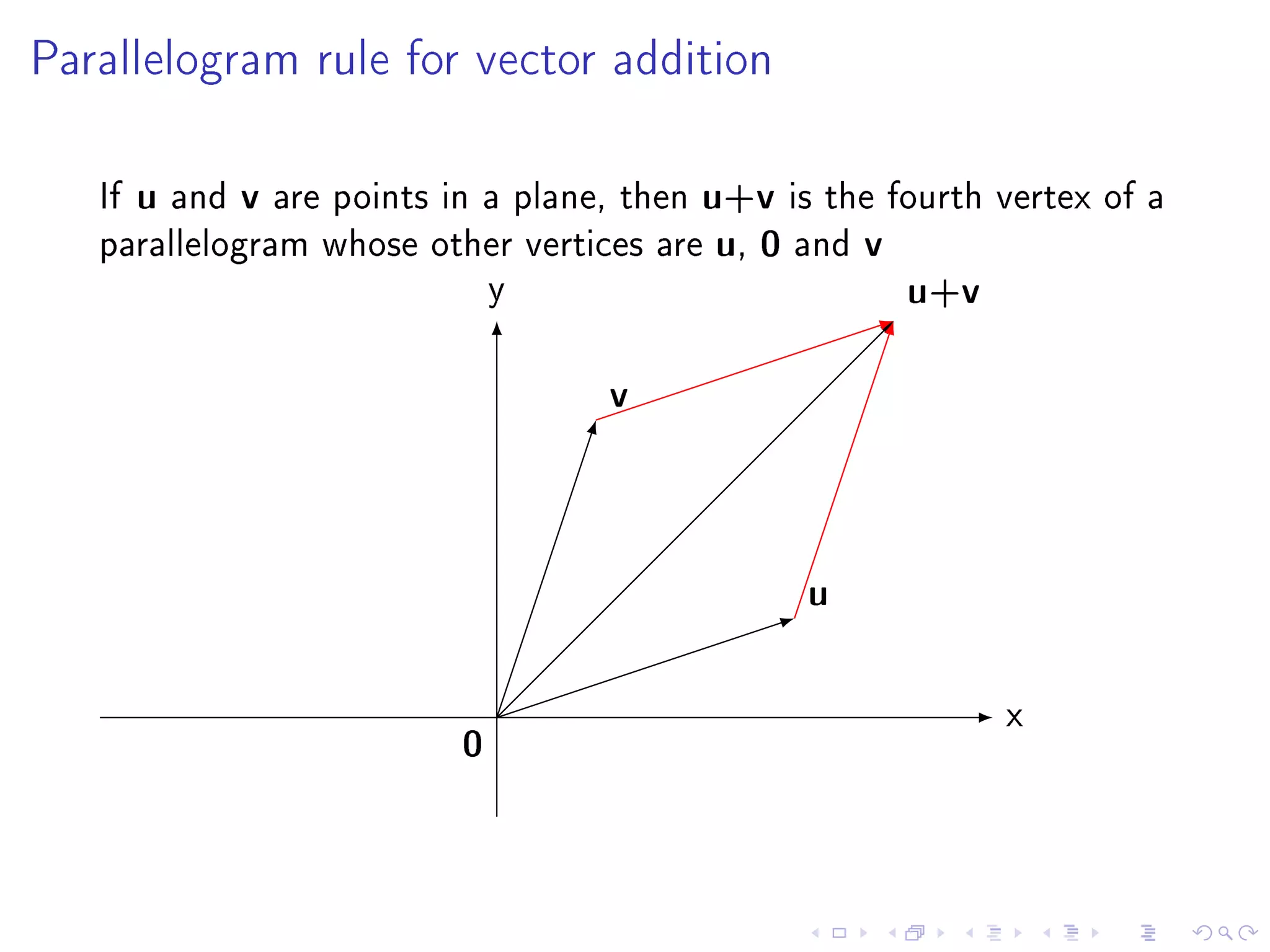
Parallelogram rule for vector addition


   If u and v are points in a plane, then u+v is the fourth vertex of a
   parallelogram whose other vertices are u, 0 and v
Parallelogram rule for vector addition


   If u and v are points in a plane, then u+v is the fourth vertex of a
   parallelogram whose other vertices are u, 0 and v
                            y


                                                u
                                                            x
                          0
Parallelogram rule for vector addition


   If u and v are points in a plane, then u+v is the fourth vertex of a
   parallelogram whose other vertices are u, 0 and v
                            y


                                                u
                                                            x
                          0
Parallelogram rule for vector addition


   If u and v are points in a plane, then u+v is the fourth vertex of a
   parallelogram whose other vertices are u, 0 and v
                            y

                                   v


                                                u
                                                            x
                          0
Parallelogram rule for vector addition


   If u and v are points in a plane, then u+v is the fourth vertex of a
   parallelogram whose other vertices are u, 0 and v
                            y

                                   v


                                                u
                                                            x
                          0
Parallelogram rule for vector addition


   If u and v are points in a plane, then u+v is the fourth vertex of a
   parallelogram whose other vertices are u, 0 and v
                            y                         u+v
                                   v


                                                u
                                                            x
                          0
Parallelogram rule for vector addition


   If u and v are points in a plane, then u+v is the fourth vertex of a
   parallelogram whose other vertices are u, 0 and v
                            y                         u+v
                                   v


                                                u
                                                            x
                          0
Parallelogram rule for vector addition


   If u and v are points in a plane, then u+v is the fourth vertex of a
   parallelogram whose other vertices are u, 0 and v
                            y                         u+v
                                   v


                                                u
                                                            x
                          0
Scalar Multiplication


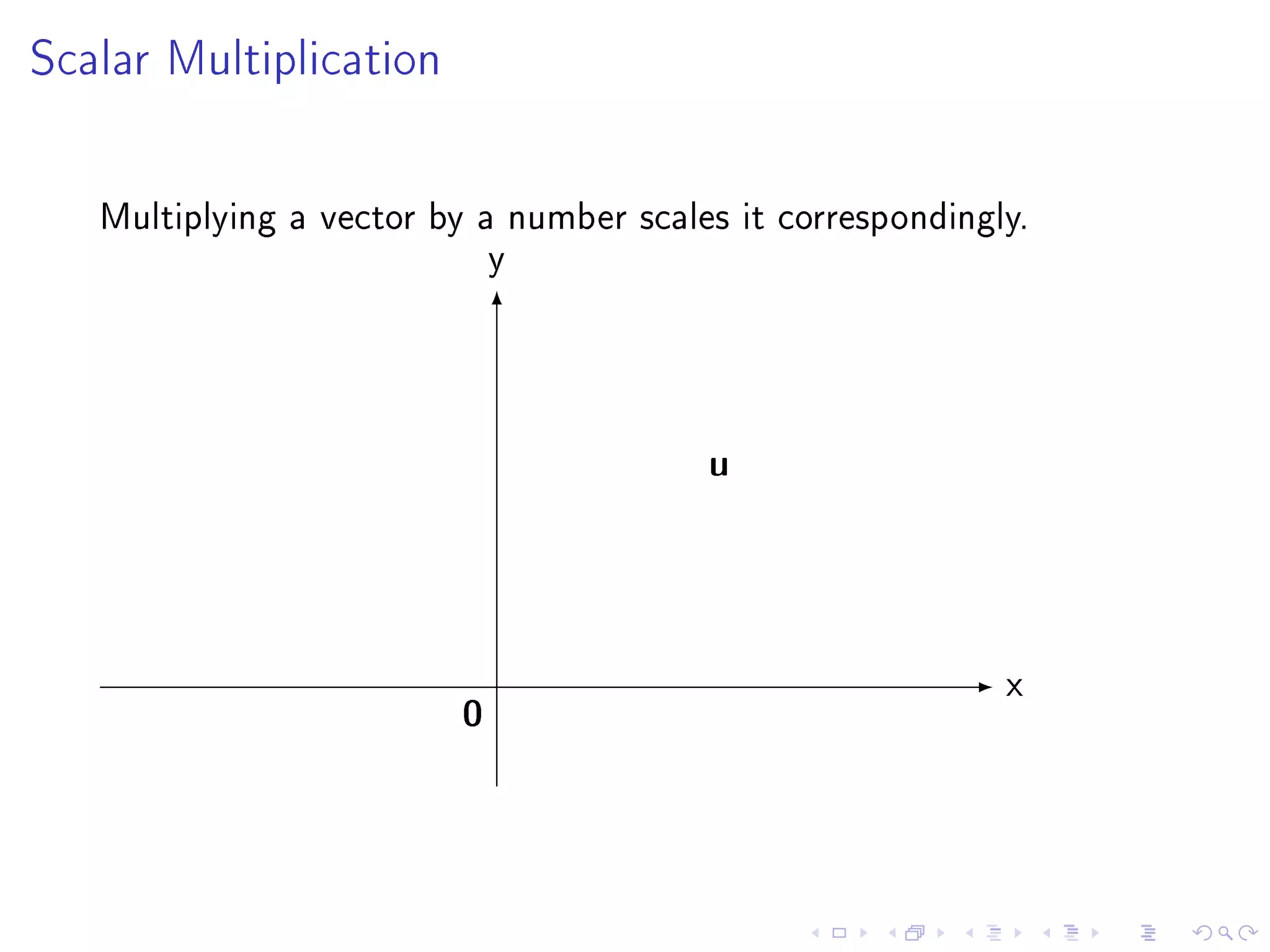
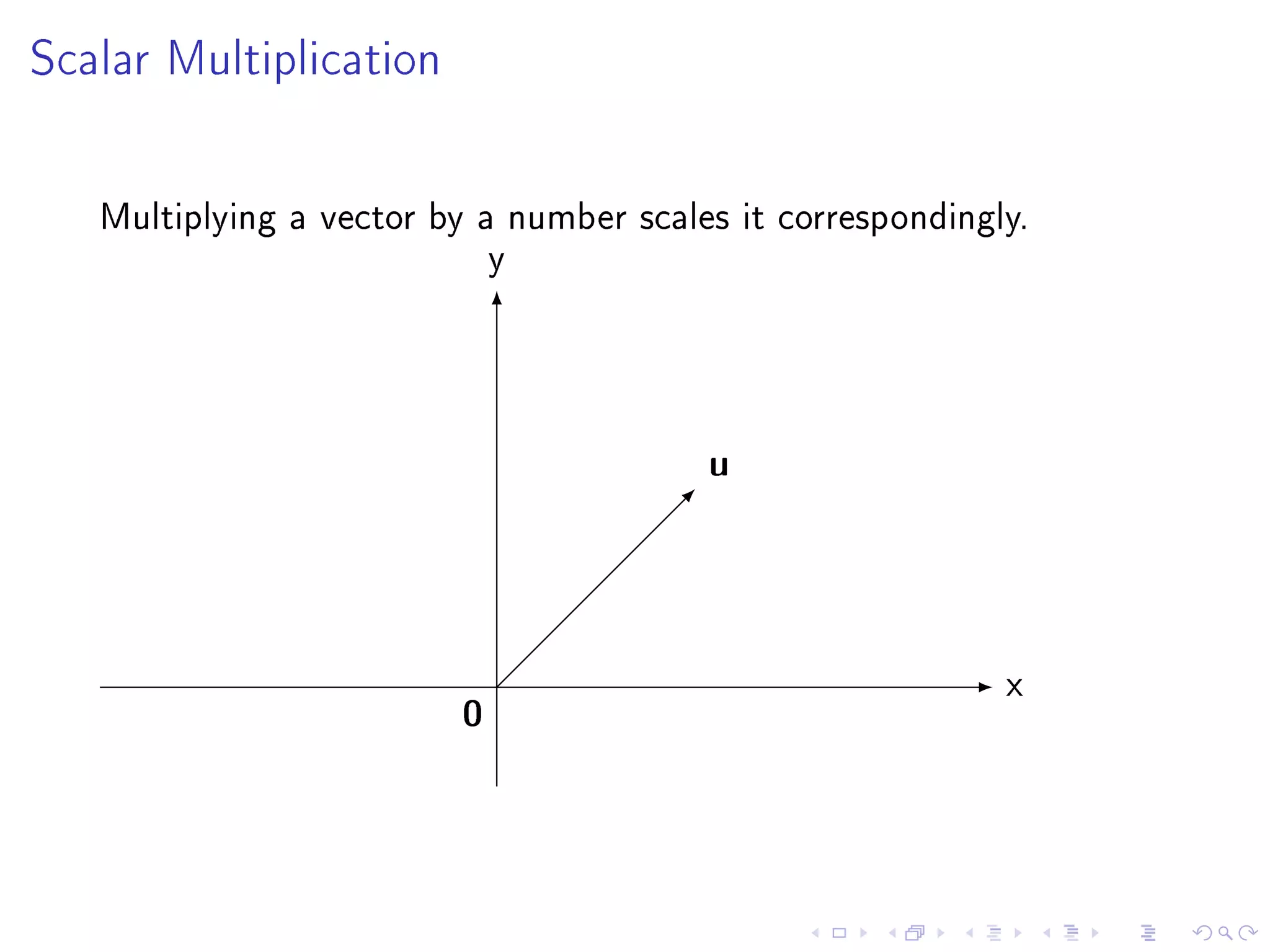
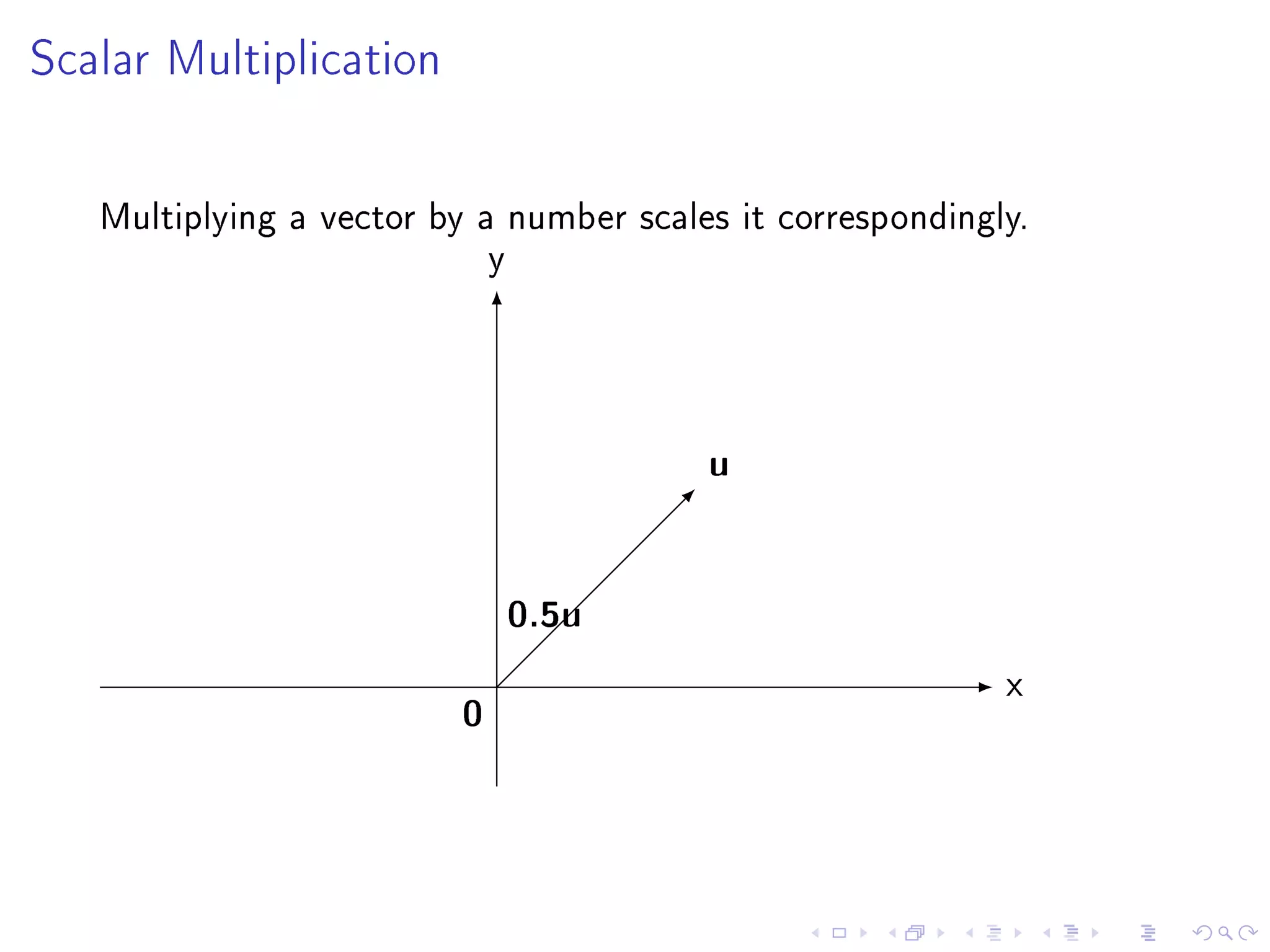
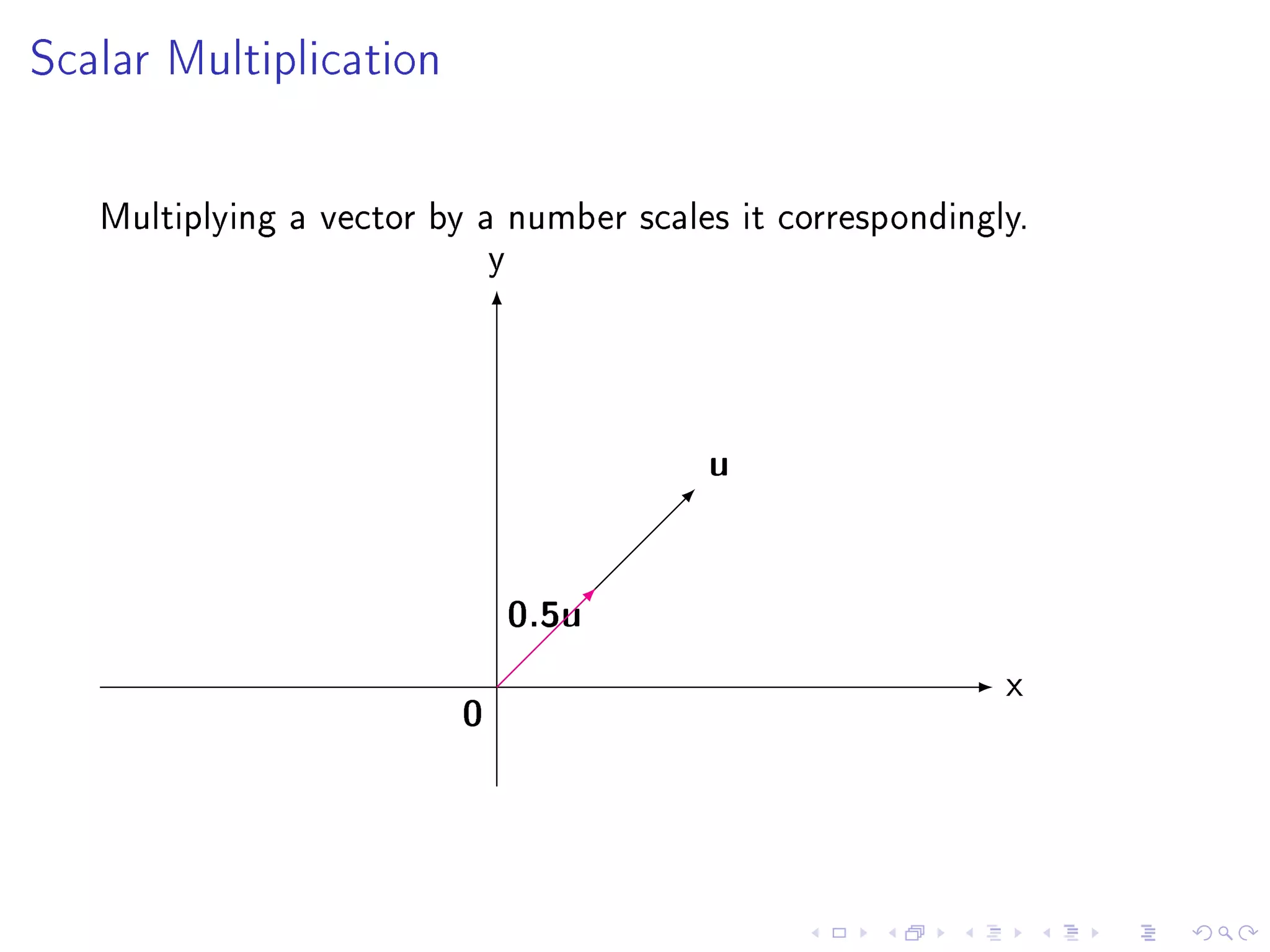
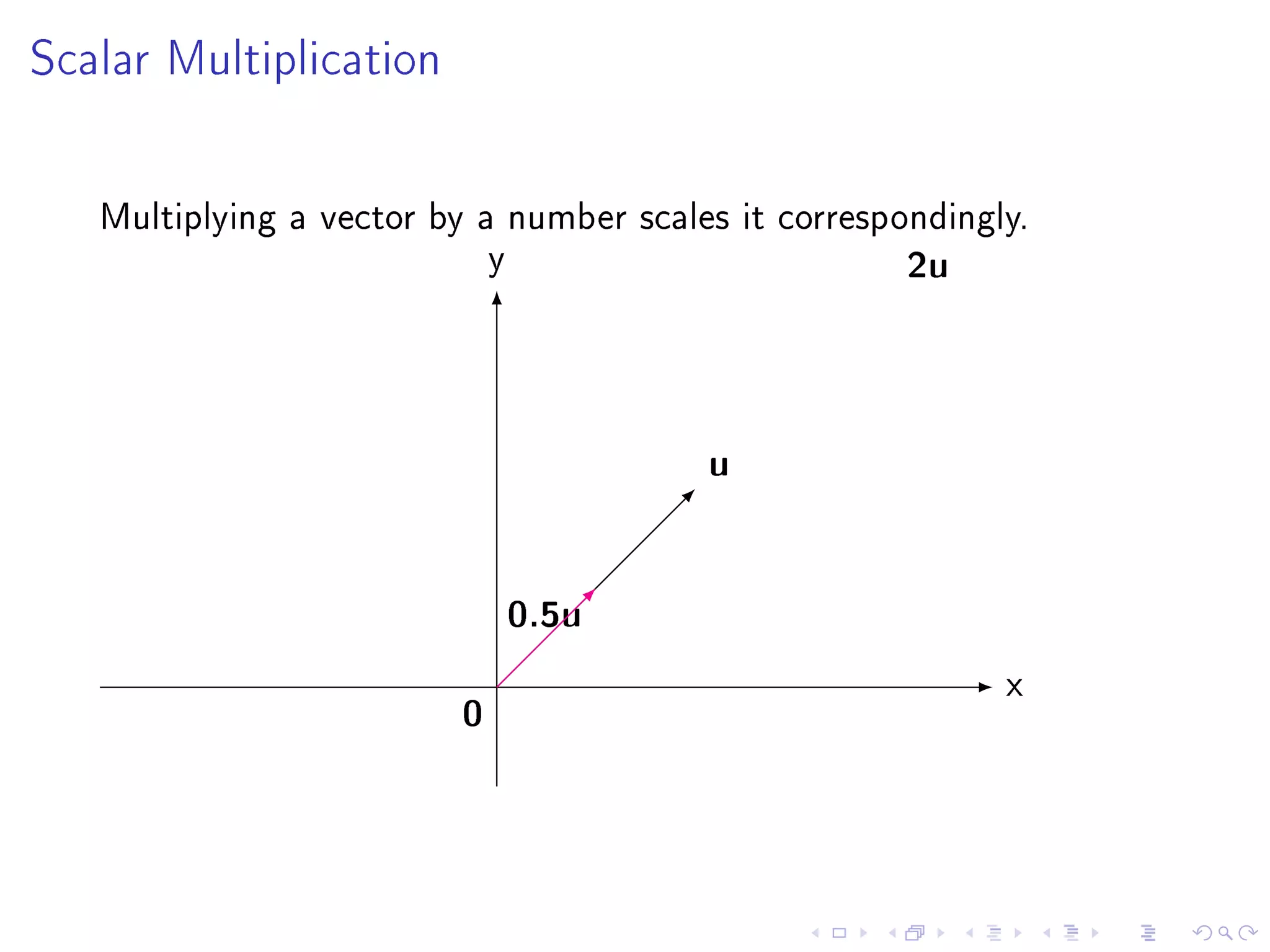
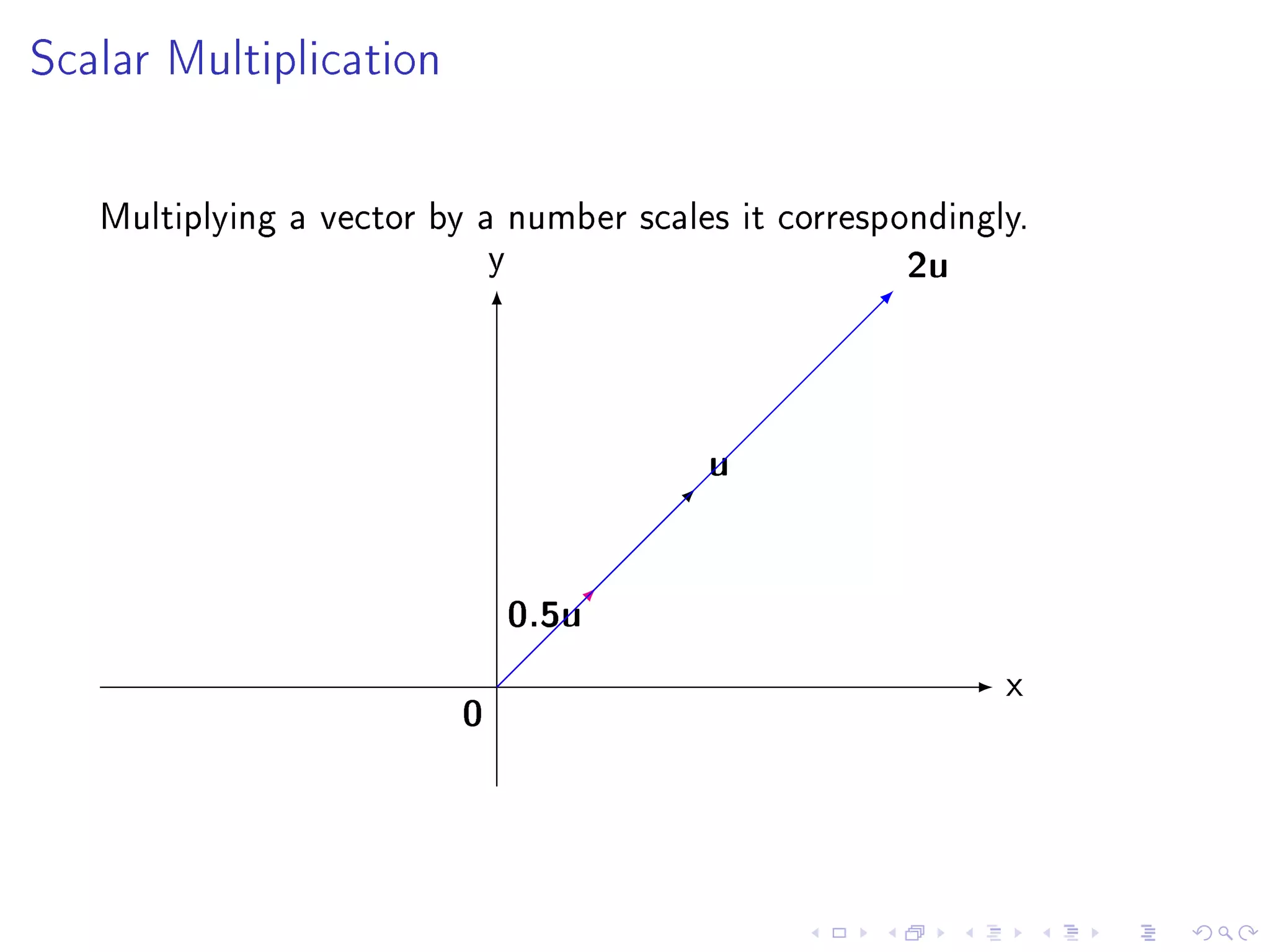
   Multiplying a vector by a number scales it correspondingly.
Scalar Multiplication


   Multiplying a vector by a number scales it correspondingly.
                            y


                                         u


                                                            x
                          0
Scalar Multiplication


   Multiplying a vector by a number scales it correspondingly.
                            y


                                         u


                                                            x
                          0
Scalar Multiplication


   Multiplying a vector by a number scales it correspondingly.
                            y


                                         u

                              0.5u
                                                            x
                          0
Scalar Multiplication


   Multiplying a vector by a number scales it correspondingly.
                            y


                                         u

                              0.5u
                                                            x
                          0
Scalar Multiplication


   Multiplying a vector by a number scales it correspondingly.
                            y                         2u


                                         u

                              0.5u
                                                            x
                          0
Scalar Multiplication


   Multiplying a vector by a number scales it correspondingly.
                            y                         2u


                                         u

                              0.5u
                                                            x
                          0
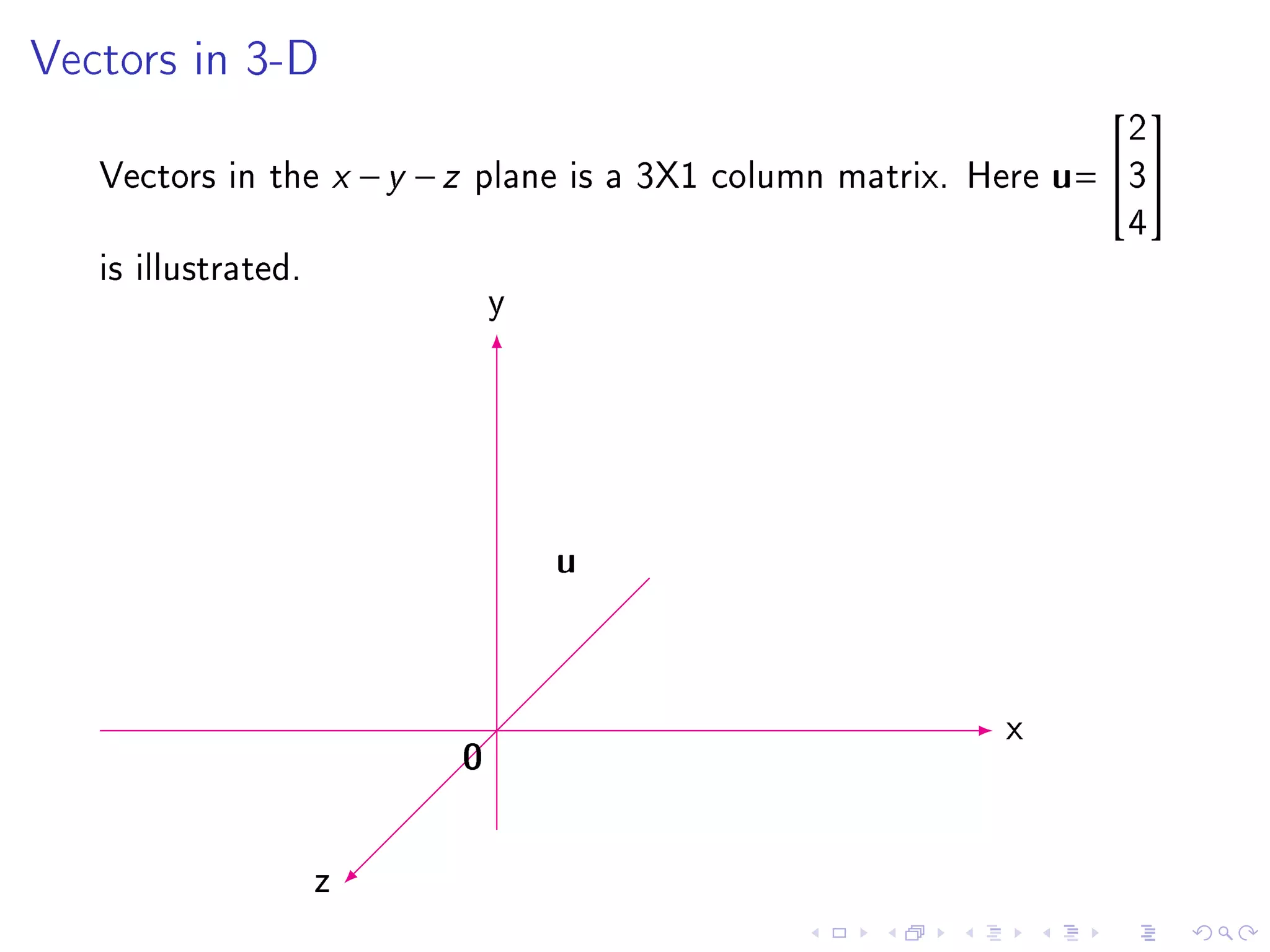
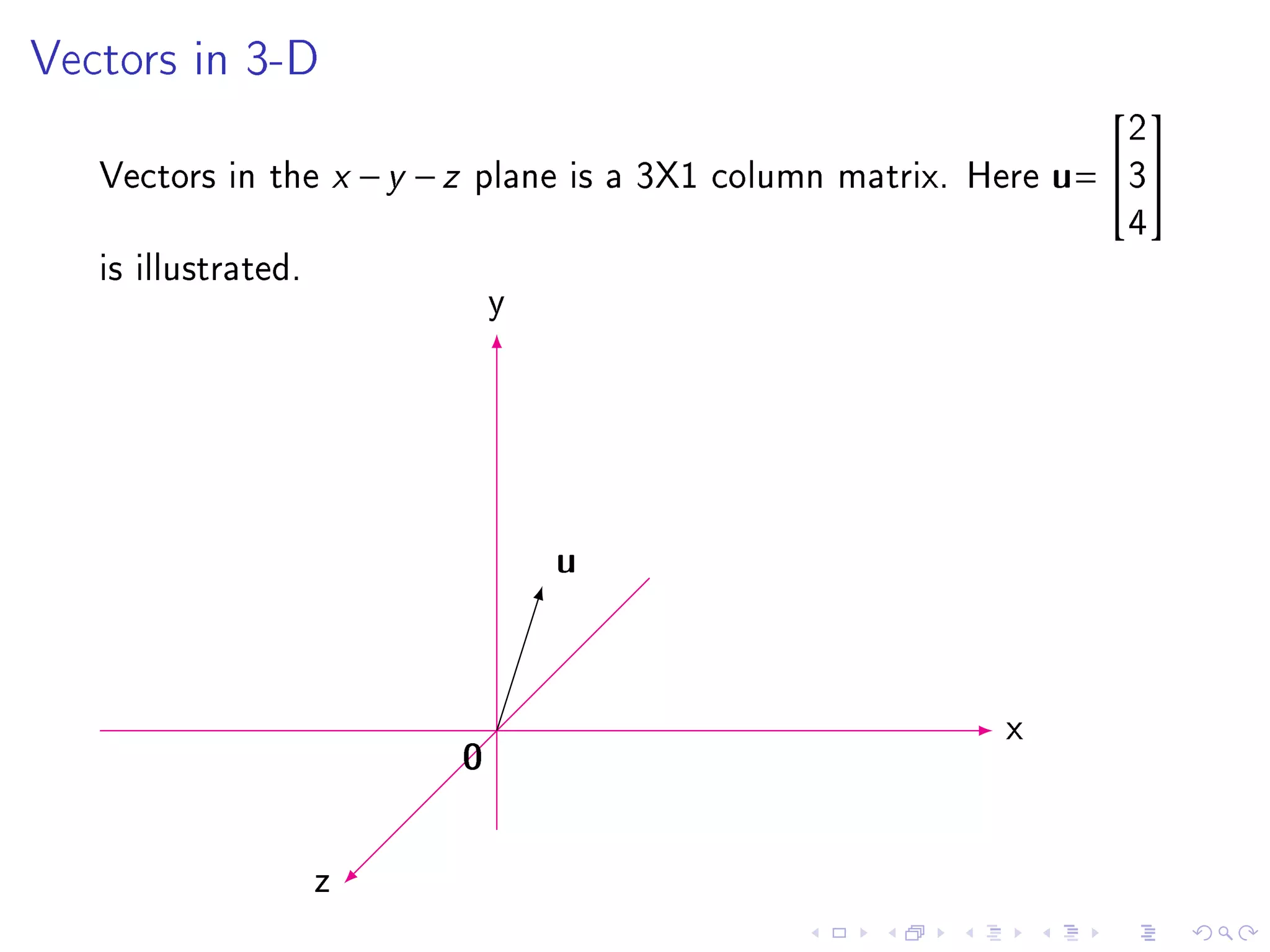
Vectors in 3-D

                                                                    2
                                                                    

   Vectors in the x − y − z plane is a 3X1 column matrix. Here u
                                                               = 3
                                                                    4
   is illustrated.
Vectors in 3-D

                                                                    2
                                                                    

   Vectors in the x − y − z plane is a 3X1 column matrix. Here u
                                                               = 3
                                                                    4
   is illustrated.
                             y


                                 u

                                                           x
                         0
                     z
Vectors in 3-D

                                                                    2
                                                                    

   Vectors in the x − y − z plane is a 3X1 column matrix. Here u
                                                               = 3
                                                                    4
   is illustrated.
                             y


                                 u

                                                           x
                         0
                     z

Systems of Linear Equations, RREF

  • 1.
    Announcements If anyone has not been able to access the class website please email me at pgeorge3@mtu.edu Two corrections made to Tuesday's lecture slides (Jan 12). See slides 27, 28 (I had written R3-R1 instead of R3-2R1) and 39 (I didn't make it completely RREF before saving). If you spot any typos in the slides any time, please bring it to my attention asap. Lst day to drop this class with refund is tomorrow.
  • 2.
    Denition Echelon form (RowEchelon form, REF): A rectangular matrix is of Echelon form (Row Echelon Form or REF) if All nonzero rows are ABOVE any rows with all zeros Each leading entry of a row in a column is to the RIGHT to the leading entry of the row above it (results in a STEP like shape for leading entries) All entries in a column below the leading entry are zero
  • 3.
    Denition Reduced Echelon form(Reduced Row Echelon form, RREF): A rectangular matrix is of Echelon form (Reduced Row Echelon Form or RREF) if The leading entry in each nonzero row is 1 Each leading 1 is the only nonzero element in its column.
  • 4.
    Important Each matrix is row equivalent to EXACTLY ONE reduced echelon matrix. In other words, RREF for a matrix is unique. Note: Once you obtain the echelon form of a matrix If you do any more row operations, the leading entries will not change positions The leading entries are always in the same positions in any echelon form starting from the same matrix (These become 1 in reduced echelon form, RREF)
  • 5.
    Pivot Position, PivotColumn Denition Given a matrix A, the location in A which corresponds to a leading 1 in the reduced echelon form is called PIVOT POSITION Denition The column in A that contains a pivot position is called a PIVOT COLUMN Location in A corresponding to blue circles gives pivot position     1 0 −3 0       0 1 5 0             0 0 0 1       0 0 0 0    
  • 6.
    Example, Problem 4sec 1.2 Row reduce the matrix A below to echelon form and locate the pivot columns.     1 3 5 7       3 5 7 9         5 7 9 1     Caution!! This is NOT an augmented matrix of any linear system
  • 7.
    Basic row operationsas usual   1 3 5 7 R2-3R1     R3-5R1   3 5 7 9 .        5 7 9 1  
  • 8.
    Basic row operationsas usual   1 3 5 7 R2-3R1     R3-5R1   3 5 7 9 .        5 7 9 1   1 3 5 7   =⇒ 0 −4 −8 −12 0 −8 −16 −34 Divide R3 by 2
  • 9.
    Basic row operationsas usual   1 3 5 7 R2-3R1     R3-5R1   3 5 7 9 .        5 7 9 1   1 3 5 7   =⇒ 0 −4 −8 −12 0 −8 −16 −34 Divide R3 by 2 1 3 5 7   0 −4 −8 −12 0 −4 −8 −17 Do R3-R2
  • 10.
    Basic row operationsas usual   1 3 5 7 R2-3R1     R3-5R1   3 5 7 9 .        5 7 9 1   1 3 5 7   =⇒ 0 −4 −8 −12 0 −8 −16 −34 Divide R3 by 2 1 3 5 7   0 −4 −8 −12 0 −4 −8 −17 Do R3-R2 1 3 5 7   0 −4 −8 −12 0 0 0 −5
  • 11.
    Make sure wehave only 0 above and below the leading 1 Divide R2 by -4 and divide R3 by -5 to get 1 as leading term. This gives
  • 12.
    Make sure wehave only 0 above and below the leading 1 Divide R2 by -4 and divide R3 by -5 to get 1 as leading term. This gives 1 3 5 7   0 1 2 3 0 0 0 1   1 3 5 7 R1-3R2       0 1 2 3 .        0 0 0 1  
  • 13.
    Make sure wehave only 0 above and below the leading 1 Divide R2 by -4 and divide R3 by -5 to get 1 as leading term. This gives 1 3 5 7   0 1 2 3 0 0 0 1   1 3 5 7 R1-3R2       0 1 2 3 .        0 0 0 1   1 0 −1 −2   =⇒ 0 1 2 3 0 0 0 1
  • 14.
    Make sure wehave only 0 above and below the leading 1    1 0 −1 −2    R1+2R3   0 1 2 3 .        0 0 0 1  
  • 15.
    Make sure wehave only 0 above and below the leading 1    1 0 −1 −2    R1+2R3   0 1 2 3 .        0 0 0 1   1 0 −1 0   =⇒ 0 1 2 3 0 0 0 1
  • 16.
    Make sure wehave only 0 above and below the leading 1    1 0 −1 0      0 1 2 3 .    R2-3R3     0 0 0 1  
  • 17.
    Make sure wehave only 0 above and below the leading 1    1 0 −1 0      0 1 2 3 .    R2-3R3     0 0 0 1   Pivot positions in blue circle     1 0 −1 0       0 1 2 0         0 0 0 1    
  • 18.
    Answer We have pivot positions at the blue circles We need to nd the pivot columns
  • 19.
    Answer We have pivot positions at the blue circles We need to nd the pivot columns These are the corresponding columns in the original matrix, that is Column 1, Column 2 and Column 4 in A (not the columns in RREF)
  • 20.
    Solutions of Linearsystems The row reduction steps gives solution of linear system when applied to augmented matrix of the linear system
  • 21.
    Solutions of Linearsystems The row reduction steps gives solution of linear system when applied to augmented matrix of the linear system Suppose the following matrix is the RREF of the augmented matrix of a linear system.    1 0 8 5      0 1 4 7 .        0 0 0 0   What is the corresponding system of equations? (Note that this system has 3 variables since the augmented matrix has 4 columns) x + 8z = 5 y + 4z = 7 0 = 0
  • 22.
    Basic Variables, Freevariables Here x and y correspond to the pivot columns of the matrix. They are called BASIC variables The remaining variable z which corresponds to the non-pivot column is called a FREE variable For a consistent system, we can express the solution of the system by solving for the basic variables in terms of free variables This is possible because RREF makes sure that each basic variable lies in one and only one equation.
  • 23.
    Solution to thesystem is thus...  x 5 8z  = −       y  = 7 − 4z   z   free  When we say that z is free, we mean that we can assign any value for z . Depending on your choice of z , x and y will get xed. For each choice of z , there is a dierent solution set. Every solution of the system is determined by choice of z We thus have a GENERAL solution of the system.
  • 24.
    Existence and Uniquenesstheorem For a linear system to be consistent, The rightmost column of an augmented matrix MUST NOT be a pivot column to avoid the 0=non-zero situation. If the linear system is consistent, (i)the solution is either unique (no free variables) or (ii) innitely many solutions (at least one free variable)
  • 25.
    Problem 2, section1.2 Which of the following matrices are REF and which others are in RREF? 1 1 0 1   A = 0 0 1 1 0 0 0 0
  • 26.
    Problem 2, section1.2 Which of the following matrices are REF and which others are in RREF? 1 1 0 1   A = 0 0 1 1 0 0 0 0 RREF
  • 27.
    Problem 2, section1.2 Which of the following matrices are REF and which others are in RREF? 1 1 0 1   A = 0 0 1 1 0 0 0 0 RREF 1 1 0 0   B= 0 1 1 0 0 0 1 1
  • 28.
    Problem 2, section1.2 Which of the following matrices are REF and which others are in RREF? 1 1 0 1   A = 0 0 1 1 0 0 0 0 RREF 1 1 0 0   B= 0 1 1 0 0 0 1 1 REF
  • 29.
    Problem 2, section1.2 Which of the following matrices are REF and which others are in RREF? 1 0 0 0   A = 1 1 0 0   0 1 1 0   0 0 1 1
  • 30.
    Problem 2, section1.2 Which of the following matrices are REF and which others are in RREF? 1 0 0 0   A = 1 1 0 0   0 1 1 0   0 0 1 1 Neither (The leading element in a row must be to the right of the leading element in the row above, no step pattern)
  • 31.
    Problem 2, section1.2 Which of the following matrices are REF and which others are in RREF? 1 0 0 0   A = 1 1 0 0   0 1 1 0   0 0 1 1 Neither (The leading element in a row must be to the right of the leading element in the row above, no step pattern) 0 1 1 1 1   0 0 2 2 2 B = 0   0 0 0 3   0 0 0 0 0
  • 32.
    Problem 2, section1.2 Which of the following matrices are REF and which others are in RREF? 1 0 0 0   A = 1 1 0 0   0 1 1 0   0 0 1 1 Neither (The leading element in a row must be to the right of the leading element in the row above, no step pattern) 0 1 1 1 1   0 0 2 2 2 B = 0   0 0 0 3   0 0 0 0 0 REF
  • 33.
    Problem 12, section1.2 Find the general solutions of the systems whose augmented matrix is given below 1 −7 0 6 5   A =  0 0 1 −2 −3 −1 7 −4 2 7
  • 34.
    Problem 12, section1.2 Find the general solutions of the systems whose augmented matrix is given below 1 −7 0 6 5   A =  0 0 1 −2 −3 −1 7 −4 2 7 Do R3+R1 to get new R3 1 −7 0 6 5   B= 0 0 1 −2 −3 0 0 −4 8 12
  • 35.
    Problem 12, section1.2 Find the general solutions of the systems whose augmented matrix is given below 1 −7 0 6 5   A =  0 0 1 −2 −3 −1 7 −4 2 7 Do R3+R1 to get new R3 1 −7 0 6 5   B= 0 0 1 −2 −3 0 0 −4 8 12 Divide last row by -4 1 −7 0 6 5   B = 0 0 1 −2 −3 0 0 1 −2 −3
  • 36.
    Problem 12, section1.2 Do R3-R2 to get new R3 1 −7 0 6 5   B= 0 0 1 −2 −3 0 0 0 0 0 Our system of equations thus is x1 − 7x2 + 6x4 = 5 x3 − 2x4 = −3 0 = 0 Column 1 and Column 3 have the pivot positions. The corresponding variables x1 and x3 are basic variables. So, x2 and x4 are free variables.
  • 37.
    Problem 12, section1.2 To get the general solution, express the basic variables in terms of the free variables. This gives  x1 5 6x4 7x2  = − +       x3  = −3 + 2x4   x2 x4   and free 
  • 38.
    Problem 20, section1.2 Choose h and k such that the system has (a) no solution (b) exactly one solution and (c) innitely many solutions x1 + 3x2 = 2 3x1 + hx2 = k Solution: As usual, start with the augmented matrix     1 3 2     h k    3 
  • 39.
    Problem 20, section1.2    1 3 2    .  R2-3R1 3 h k  
  • 40.
    Problem 20, section1.2    1 3 2    .  R2-3R1 3 h k   1 3 2 0 h−9 k −6 If h = 9 AND k = 6, we have 0=0 which means there is a free variable. So innite number of solutions for this choice. If h = 9 and k = 6 we have 0=non-zero situation. So inconsistent for this choice of h and k . If h = 9 and for any value of k we have exactly one solution.
  • 41.
    Section 1.3, VectorEquations A vector is nothing but a list of numbers (for the time being). 1 In the 2 dimensional x − y plane, this will look like u= or 2 v= −52 or w= .52 .1 Such a matrix with only 1 column is called a column vector or just vector Adding (or subtracting) 2 vectors is easy, just subtract the 1 6 corresponding entries. So if u= and v= then 4 −2 u+v= 1 + 6 = 7 4−2 2 You can multiply a vector with a number, it scales the vector 1 5 accordingly. So if u= then 5u= 4 20
  • 42.
    Some Geometry a The column vector = b identies the point (a,b) on the x − y plane 3 The vector u= is an arrow from the origin (0,0) to (3,2) 2
  • 43.
    Some Geometry a The column vector = b identies the point (a,b) on the x − y plane 3 The vector u= is an arrow from the origin (0,0) to (3,2) 2 y (3, 2) (0, 0) x
  • 44.
    Some Geometry a The column vector = b identies the point (a,b) on the x − y plane 3 The vector u= is an arrow from the origin (0,0) to (3,2) 2 y (3, 2) (0, 0) x
  • 45.
    Some Geometry a The column vector = b identies the point (a,b) on the x − y plane 3 The vector u= is an arrow from the origin (0,0) to (3,2) 2 y (3, 2) (-2, 1) (0, 0) x
  • 46.
    Some Geometry a The column vector = b identies the point (a,b) on the x − y plane 3 The vector u= is an arrow from the origin (0,0) to (3,2) 2 y (3, 2) (-2, 1) (0, 0) x
  • 47.
    Parallelogram rule forvector addition If u and v are points in a plane, then u+v is the fourth vertex of a parallelogram whose other vertices are u, 0 and v
  • 48.
    Parallelogram rule forvector addition If u and v are points in a plane, then u+v is the fourth vertex of a parallelogram whose other vertices are u, 0 and v y u x 0
  • 49.
    Parallelogram rule forvector addition If u and v are points in a plane, then u+v is the fourth vertex of a parallelogram whose other vertices are u, 0 and v y u x 0
  • 50.
    Parallelogram rule forvector addition If u and v are points in a plane, then u+v is the fourth vertex of a parallelogram whose other vertices are u, 0 and v y v u x 0
  • 51.
    Parallelogram rule forvector addition If u and v are points in a plane, then u+v is the fourth vertex of a parallelogram whose other vertices are u, 0 and v y v u x 0
  • 52.
    Parallelogram rule forvector addition If u and v are points in a plane, then u+v is the fourth vertex of a parallelogram whose other vertices are u, 0 and v y u+v v u x 0
  • 53.
    Parallelogram rule forvector addition If u and v are points in a plane, then u+v is the fourth vertex of a parallelogram whose other vertices are u, 0 and v y u+v v u x 0
  • 54.
    Parallelogram rule forvector addition If u and v are points in a plane, then u+v is the fourth vertex of a parallelogram whose other vertices are u, 0 and v y u+v v u x 0
  • 55.
    Scalar Multiplication Multiplying a vector by a number scales it correspondingly.
  • 56.
    Scalar Multiplication Multiplying a vector by a number scales it correspondingly. y u x 0
  • 57.
    Scalar Multiplication Multiplying a vector by a number scales it correspondingly. y u x 0
  • 58.
    Scalar Multiplication Multiplying a vector by a number scales it correspondingly. y u 0.5u x 0
  • 59.
    Scalar Multiplication Multiplying a vector by a number scales it correspondingly. y u 0.5u x 0
  • 60.
    Scalar Multiplication Multiplying a vector by a number scales it correspondingly. y 2u u 0.5u x 0
  • 61.
    Scalar Multiplication Multiplying a vector by a number scales it correspondingly. y 2u u 0.5u x 0
  • 62.
    Vectors in 3-D 2   Vectors in the x − y − z plane is a 3X1 column matrix. Here u = 3 4 is illustrated.
  • 63.
    Vectors in 3-D 2   Vectors in the x − y − z plane is a 3X1 column matrix. Here u = 3 4 is illustrated. y u x 0 z
  • 64.
    Vectors in 3-D 2   Vectors in the x − y − z plane is a 3X1 column matrix. Here u = 3 4 is illustrated. y u x 0 z