Introduction to Graph Theory
Yosuke Mizutani Presents
2018/09/21@RTP Kinyo Kai
WHAT ARE
GRAPHS?
What are graphs?
Graphs in Graph Theory
▸ G = (V, E)
▸ V := Set of vertices (nodes)
▸ E := Set of edges
▸ Model relationships between pairs of objects
What are graphs?
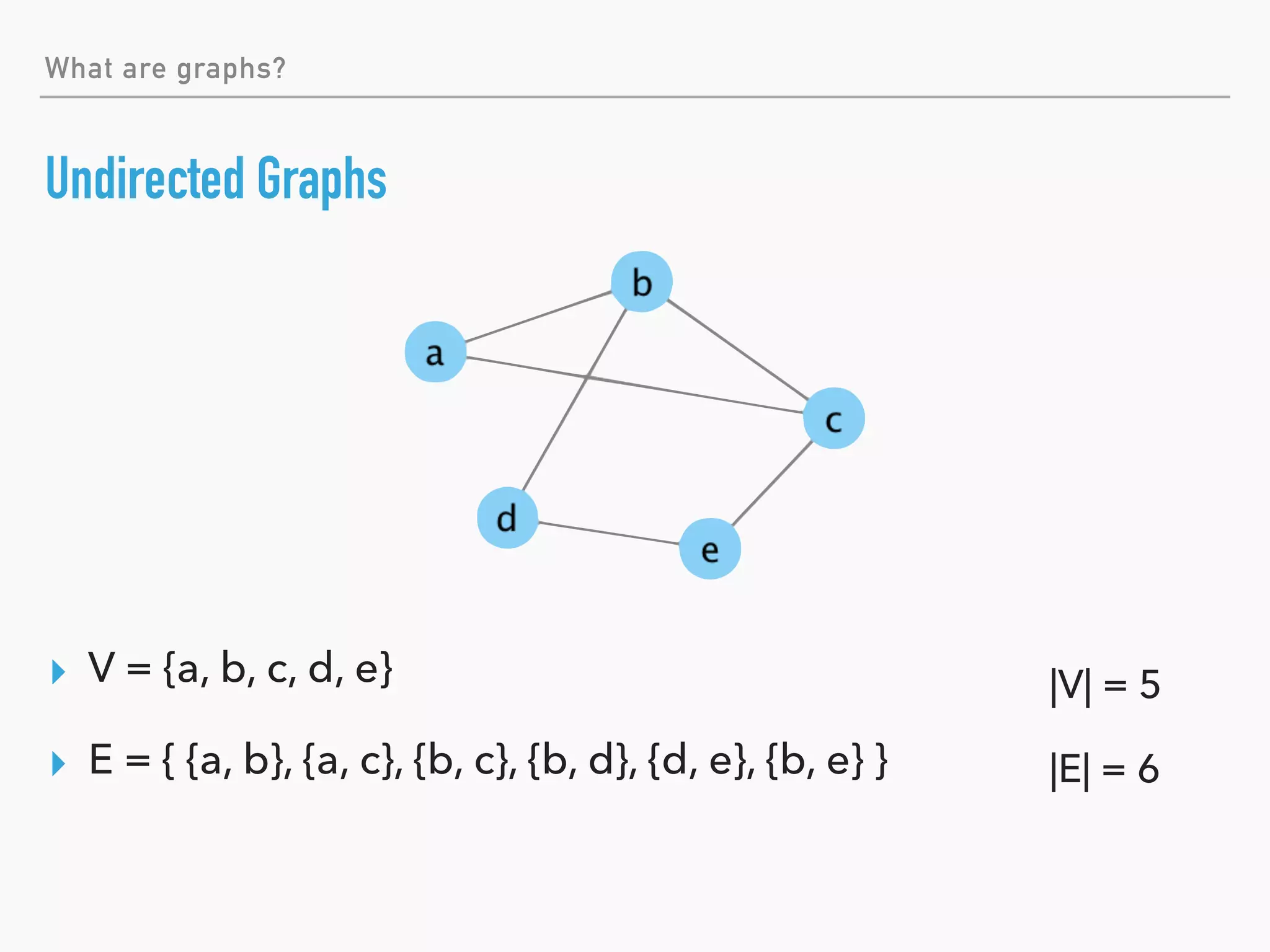
Undirected Graphs
▸ V = {a, b, c, d, e}
▸ E = { {a, b}, {a, c}, {b, c}, {b, d}, {d, e}, {b, e} }
|V| = 5
|E| = 6
What are graphs?
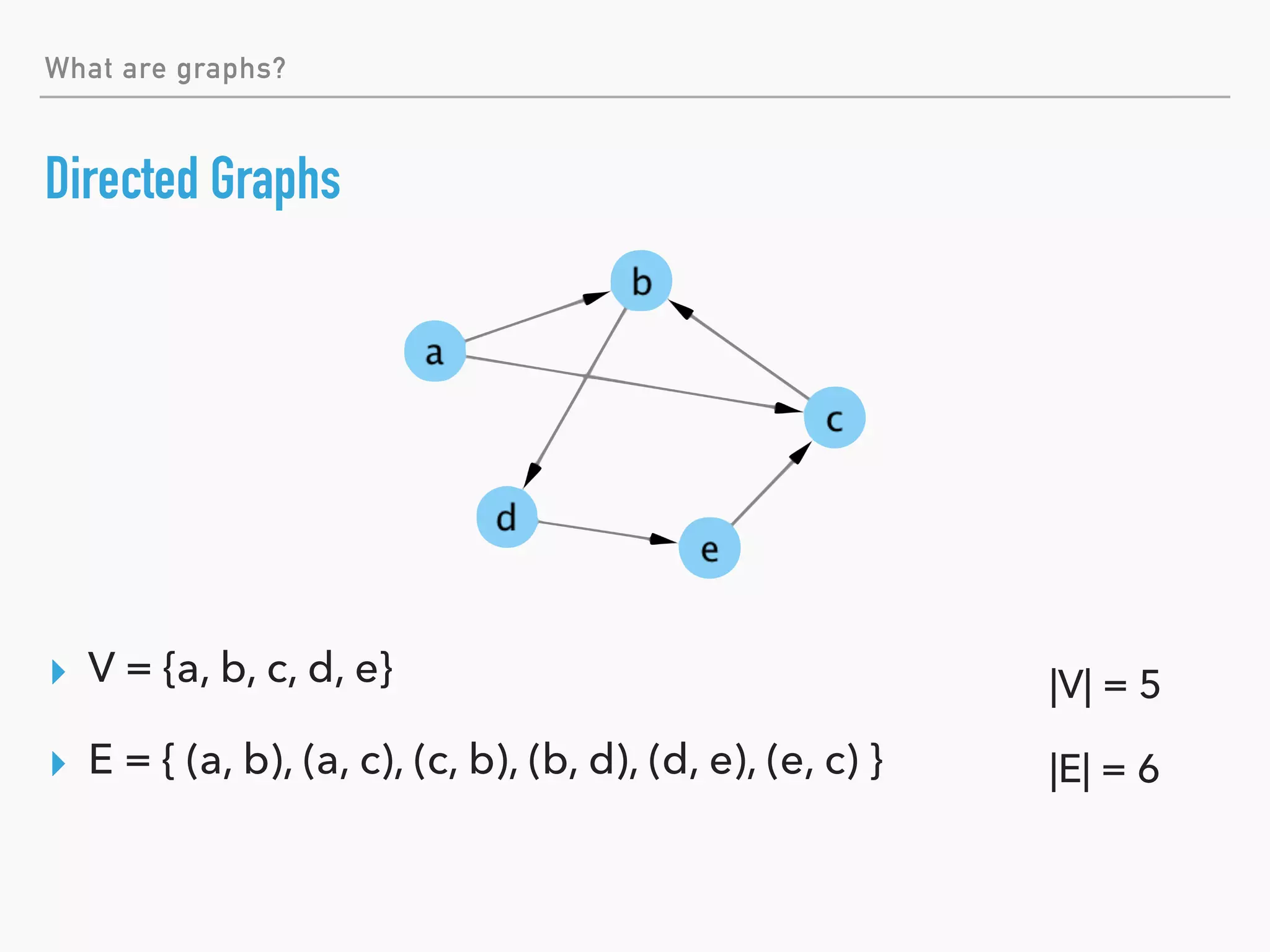
Directed Graphs
▸ V = {a, b, c, d, e}
▸ E = { (a, b), (a, c), (c, b), (b, d), (d, e), (e, c) }
|V| = 5
|E| = 6
What are graphs?
Directed Graphs
▸ Can we traverse this graph from a to e?
▸ Can we traverse this graph from e to a?
EXAMPLES OF
GRAPHS
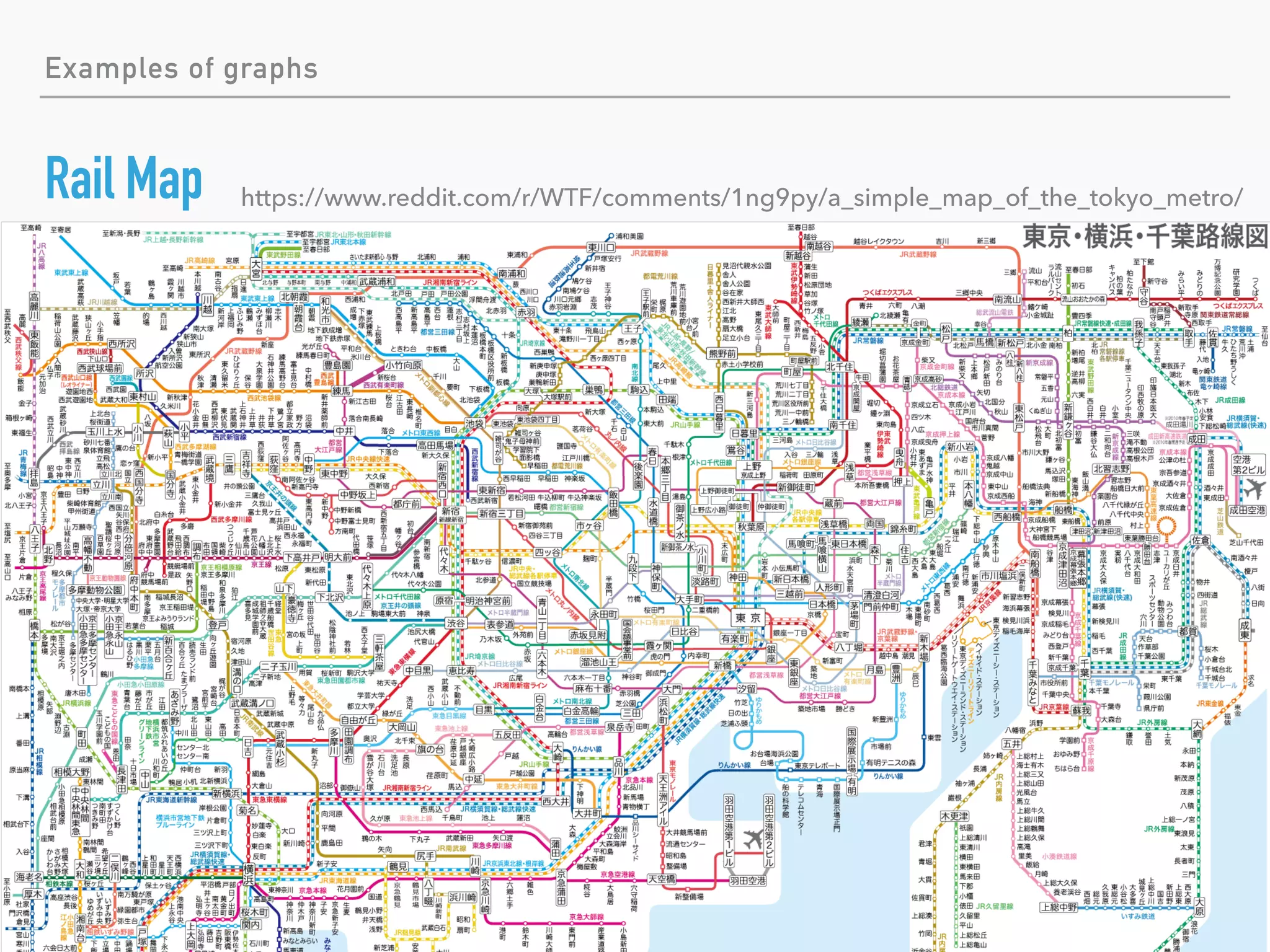
Examples of graphs
Rail Map https://www.reddit.com/r/WTF/comments/1ng9py/a_simple_map_of_the_tokyo_metro/
Examples of graphs
Road Map
http://ontheworldmap.com/usa/state/north-carolina/north-carolina-highway-map.jpg
Examples of graphs
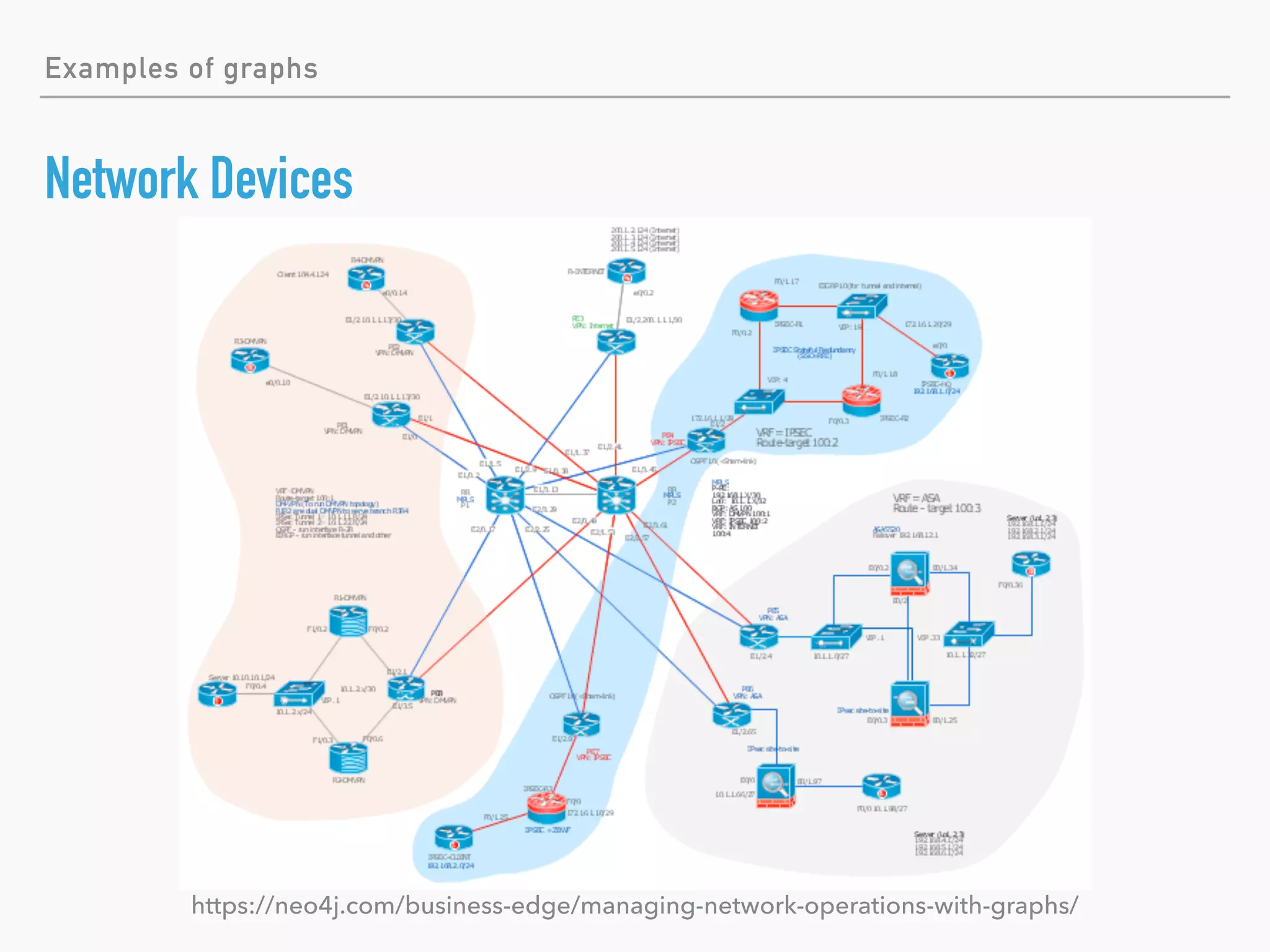
Network Devices
https://neo4j.com/business-edge/managing-network-operations-with-graphs/
Examples of graphs
Social Network https://www.flickr.com/photos/clintjcl/4126188232/
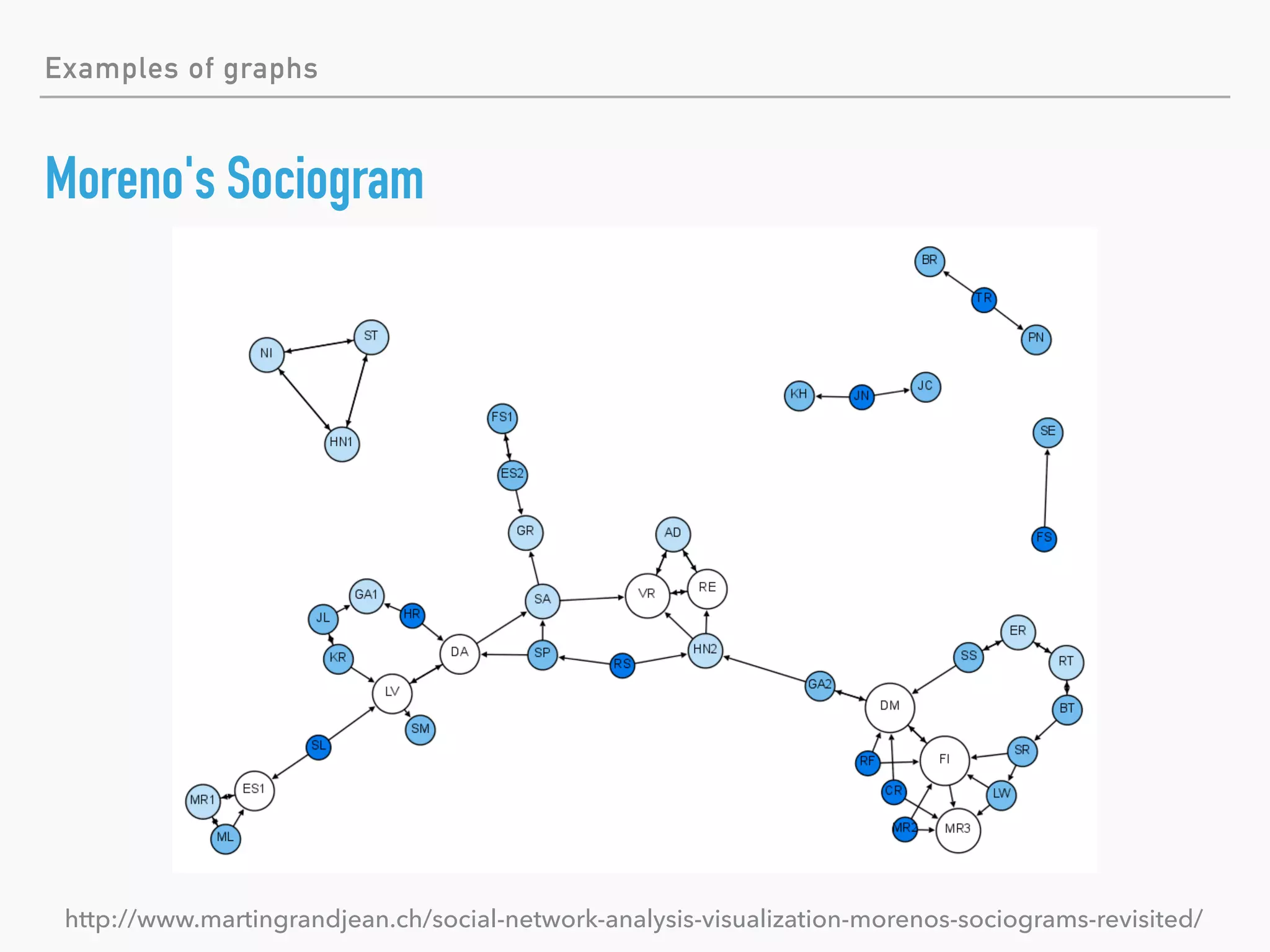
Examples of graphs
Moreno's Sociogram
http://www.martingrandjean.ch/social-network-analysis-visualization-morenos-sociograms-revisited/
Examples of graphs
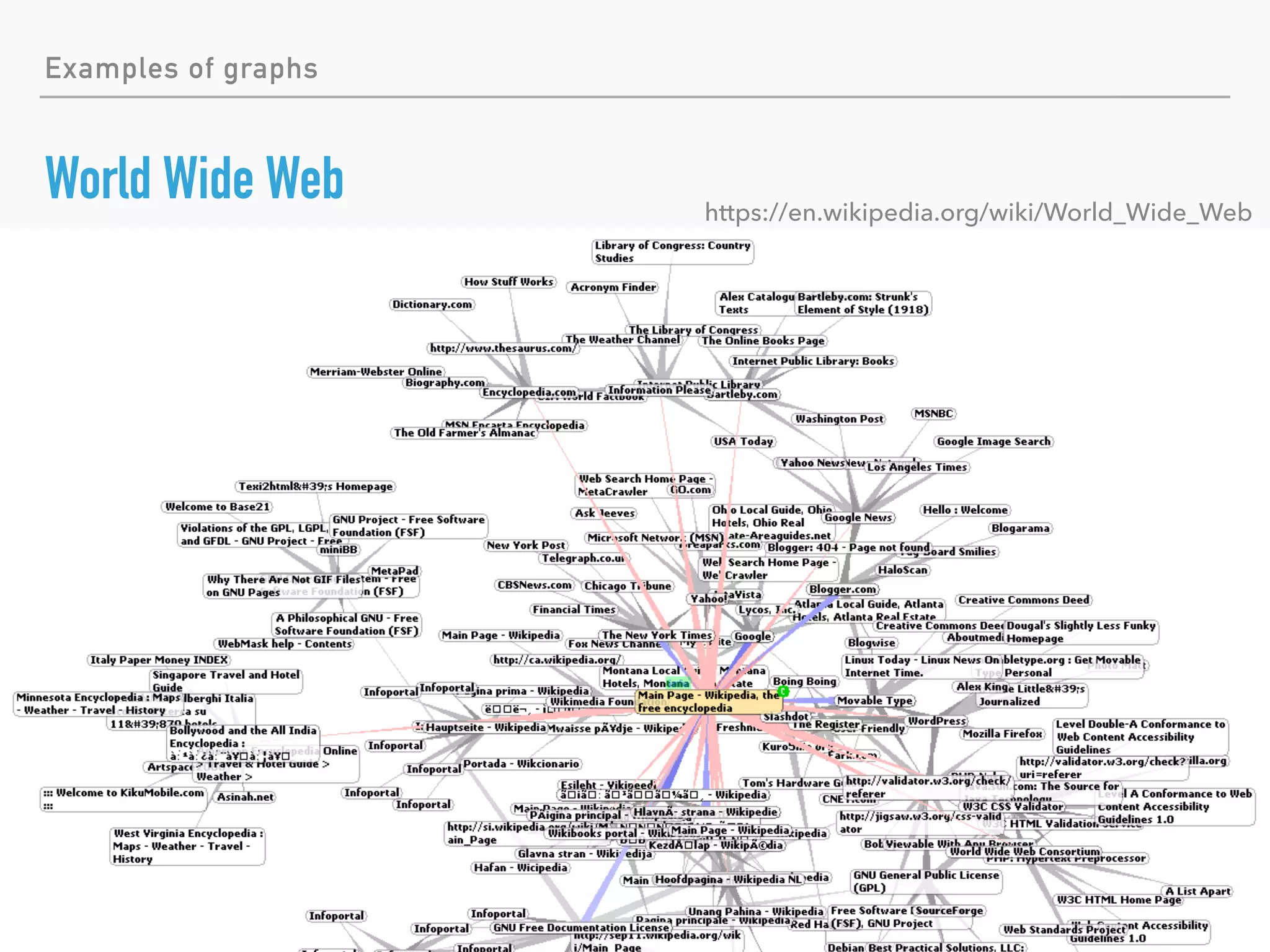
World Wide Web https://en.wikipedia.org/wiki/World_Wide_Web
Examples of graphs
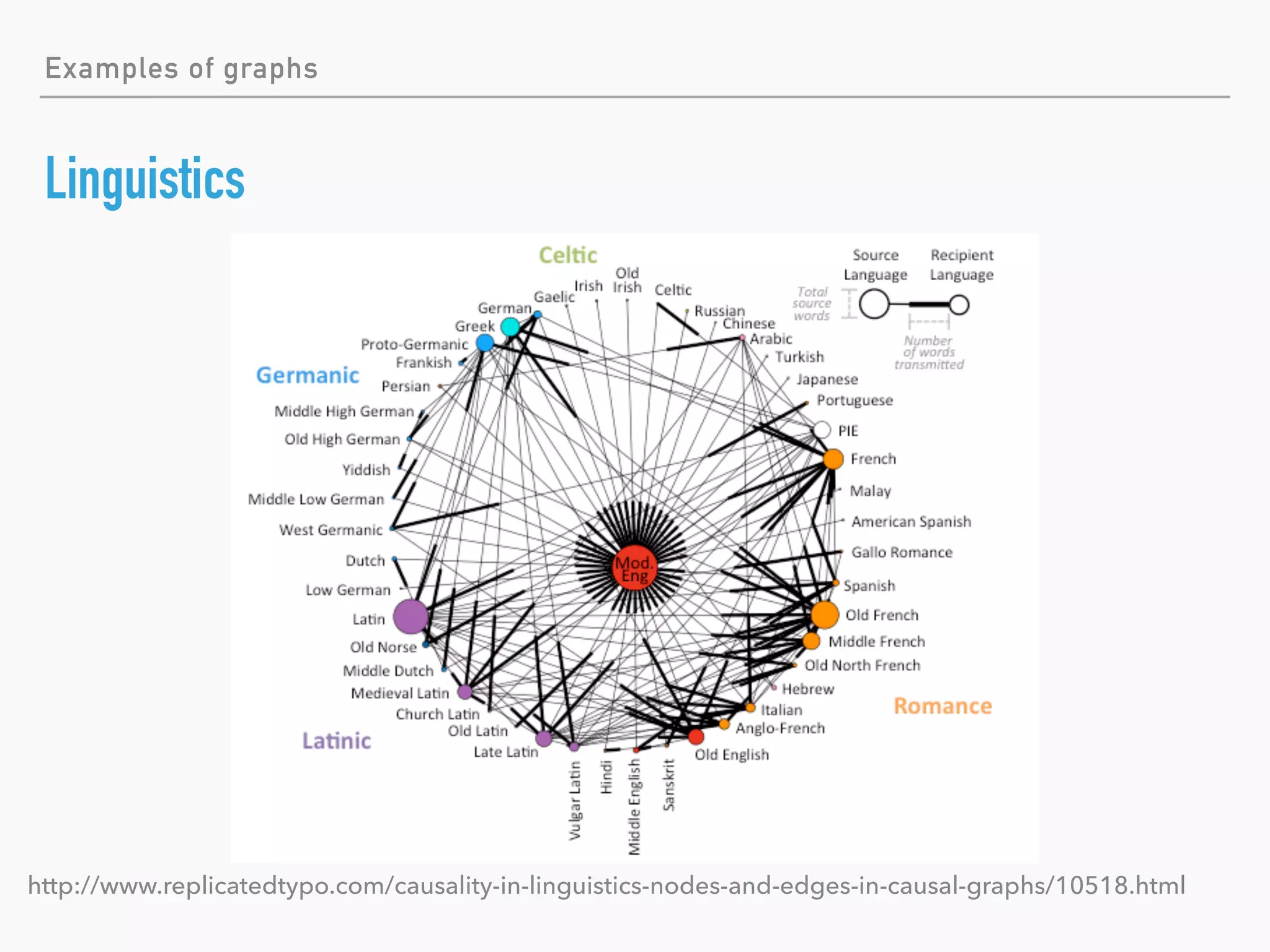
Linguistics
http://www.replicatedtypo.com/causality-in-linguistics-nodes-and-edges-in-causal-graphs/10518.html
Examples of graphs
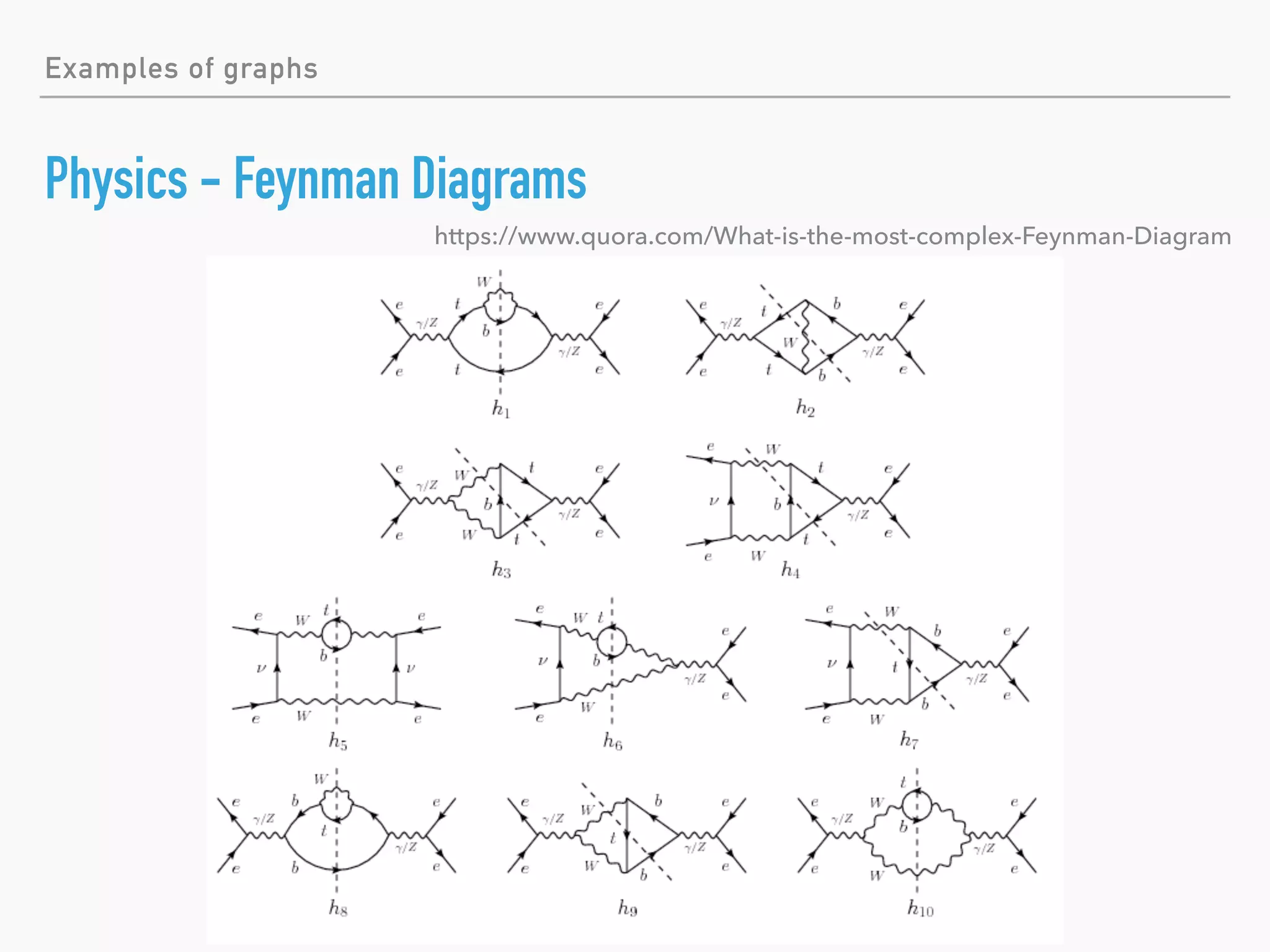
Physics - Feynman Diagrams
https://www.quora.com/What-is-the-most-complex-Feynman-Diagram
Examples of graphs
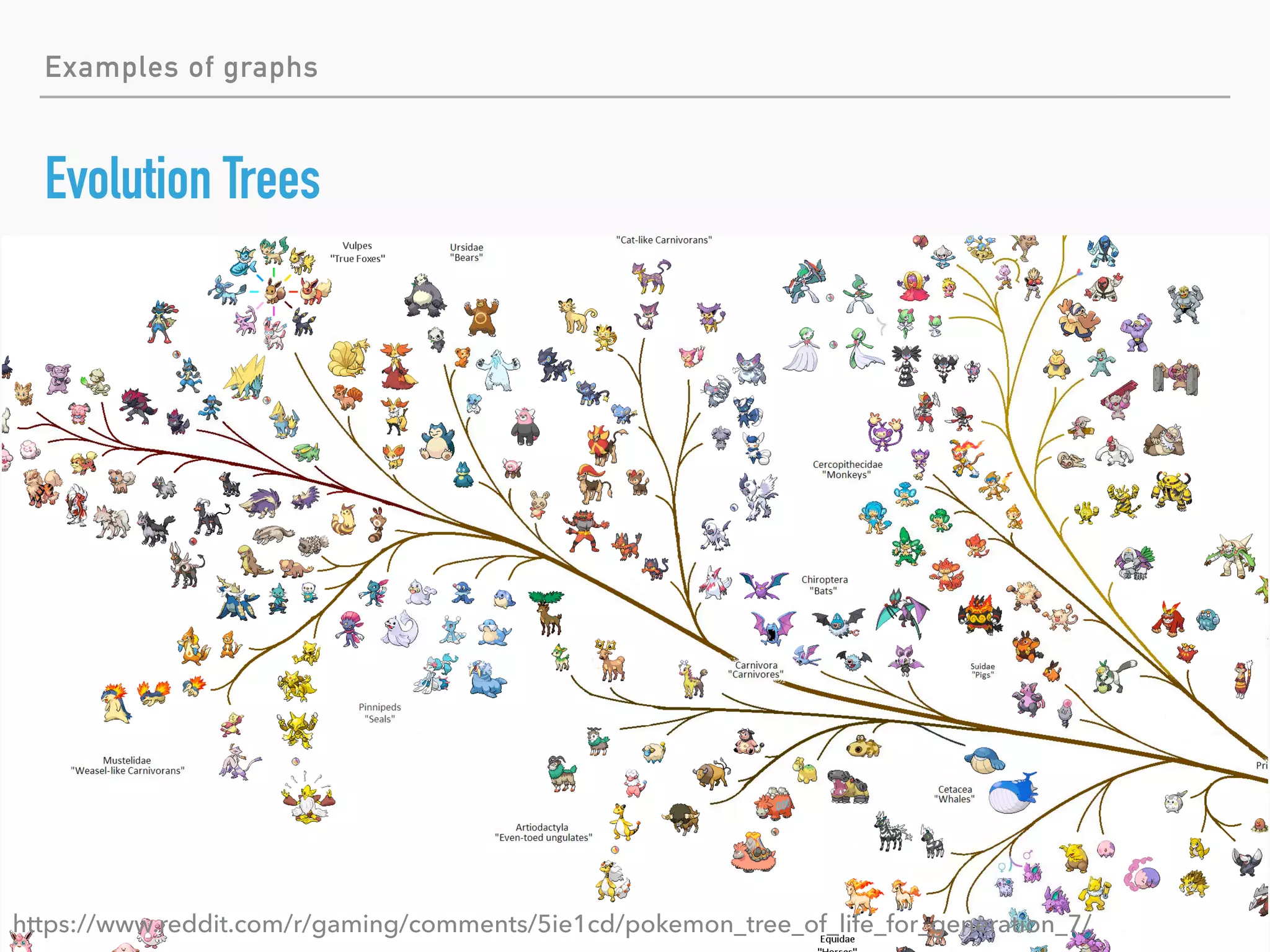
Evolution Trees
https://www.reddit.com/r/gaming/comments/5ie1cd/pokemon_tree_of_life_for_generation_7/
Examples of graphs
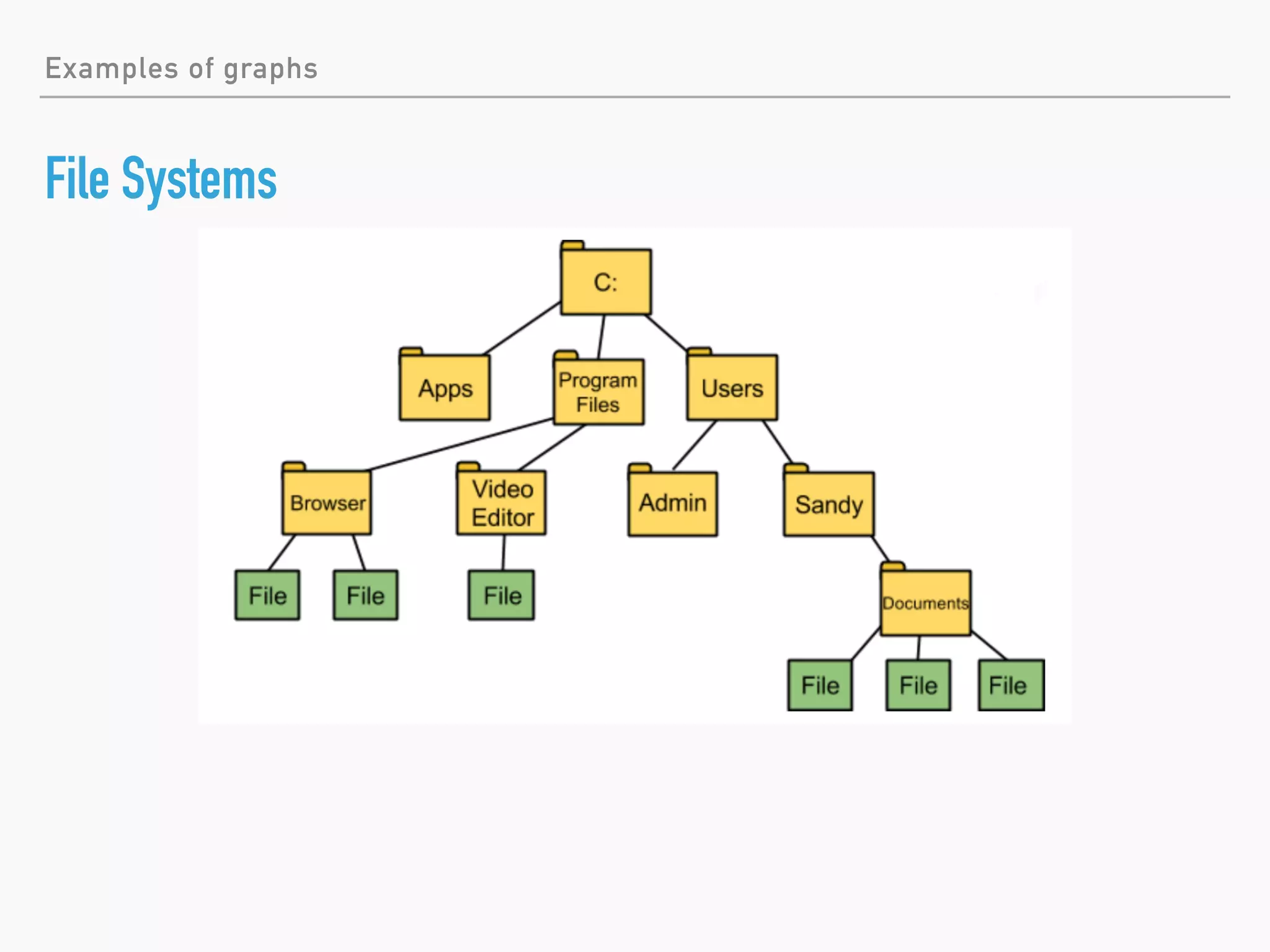
File Systems
Examples of graphs
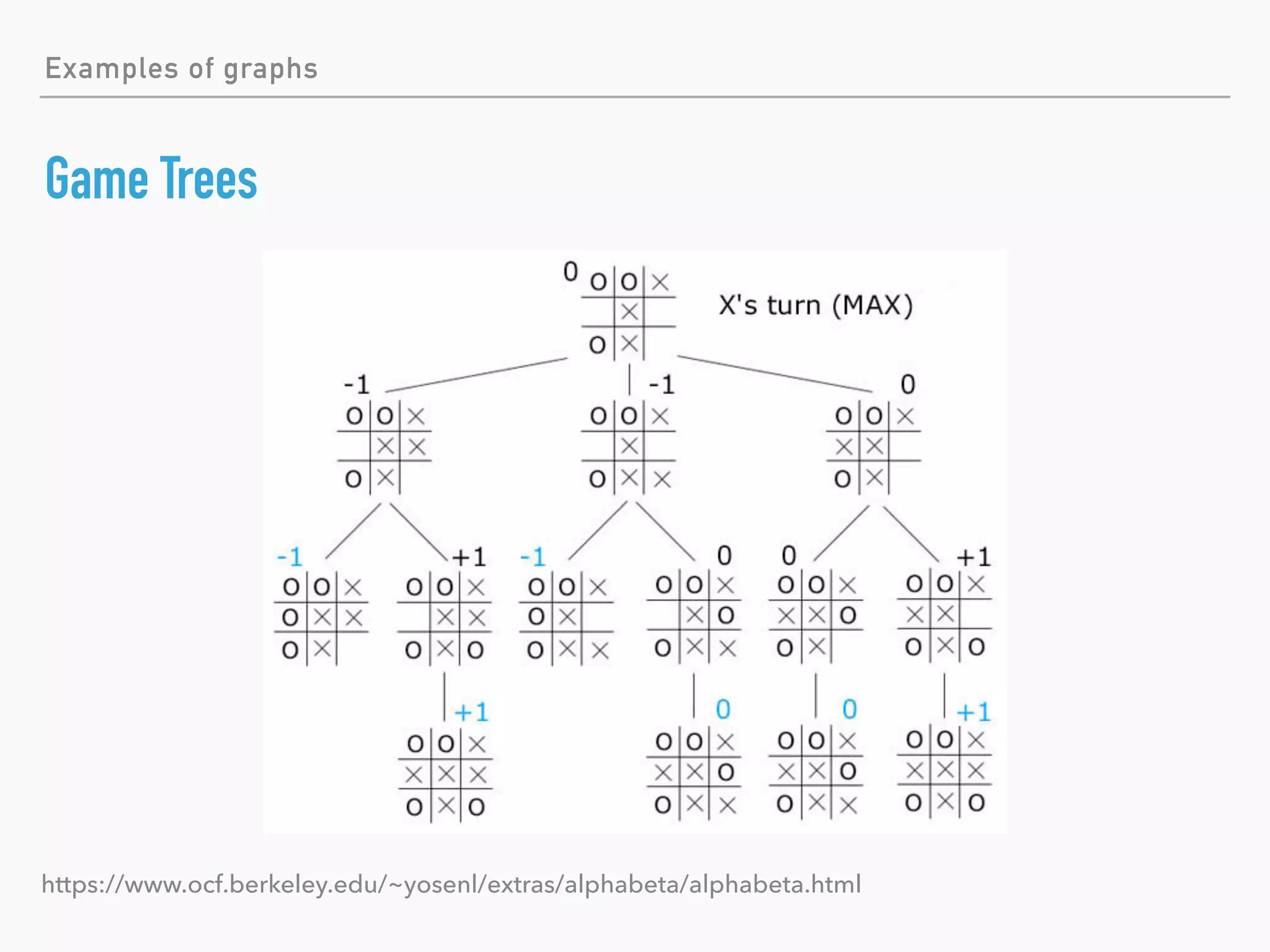
Game Trees
https://www.ocf.berkeley.edu/~yosenl/extras/alphabeta/alphabeta.html
Examples of graphs
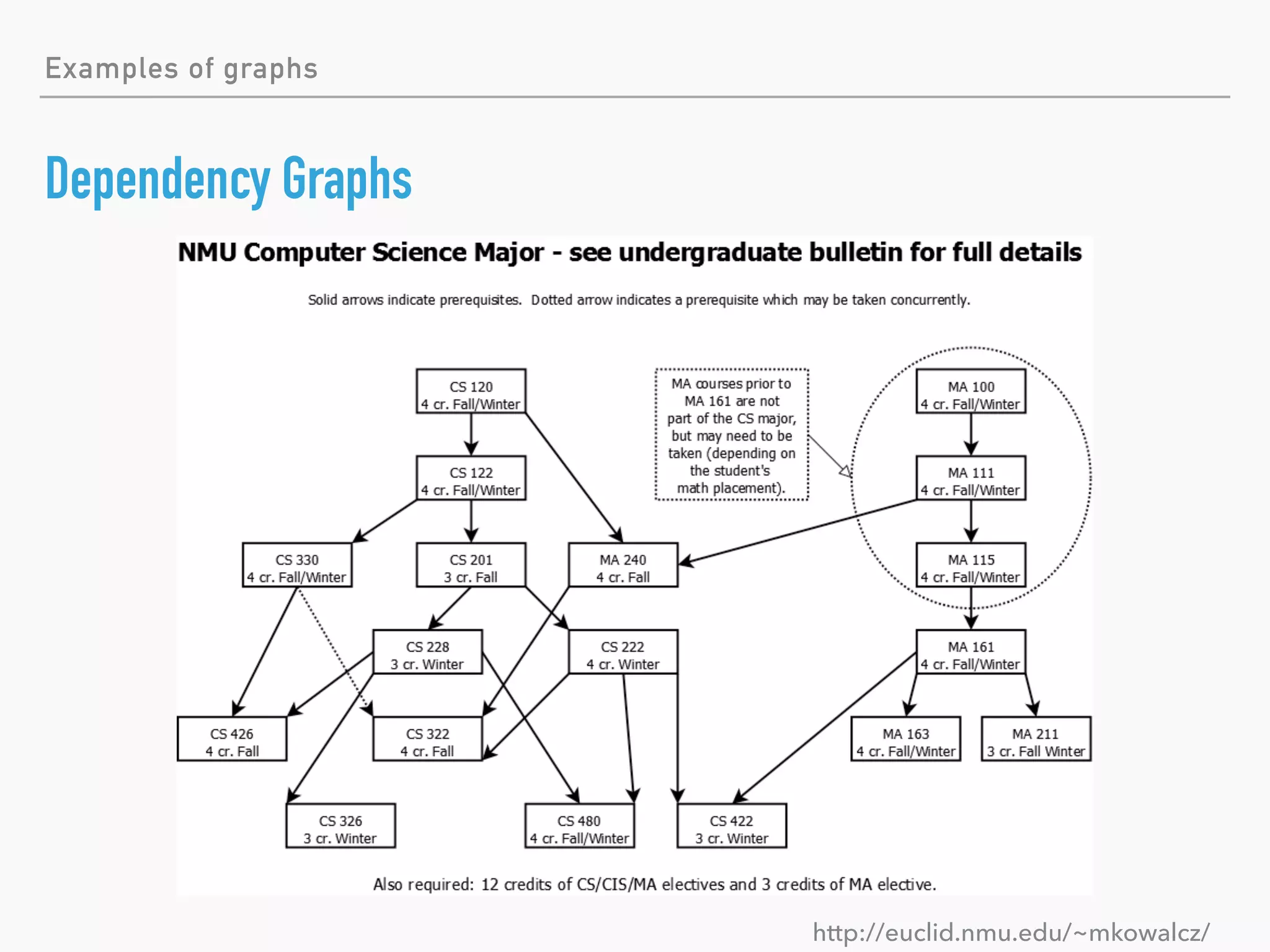
Dependency Graphs
http://euclid.nmu.edu/~mkowalcz/
Examples of graphs
Mindmaps
BASIC
TERMINOLOGY
Basic Terminology
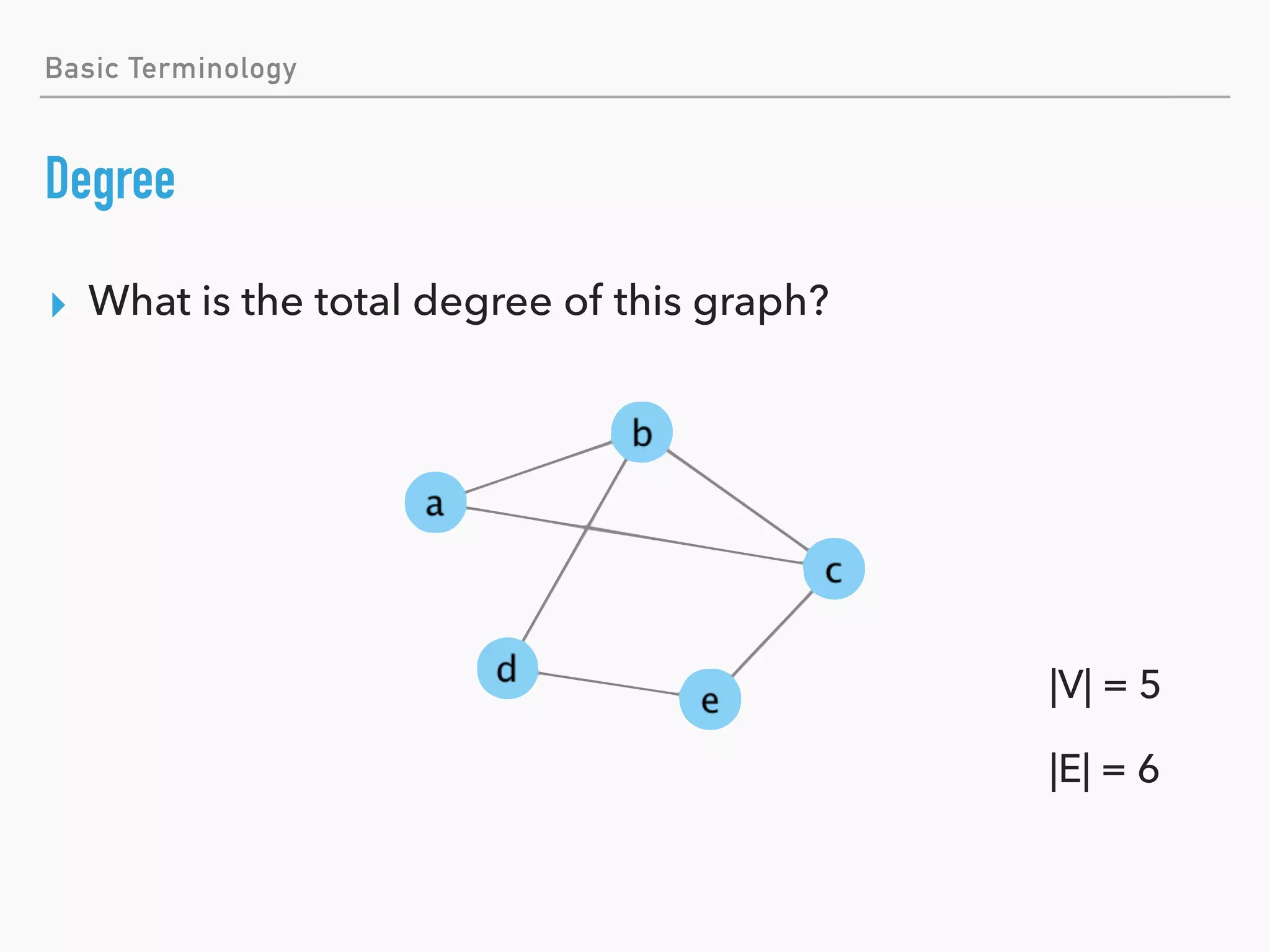
Degree
▸ Total number of edges connected to a vertex
▸ Total degree of a graph:
▸ Sum of the degrees of all of the vertices.
Basic Terminology
Degree
▸ What is the total degree of this graph?
|V| = 5
|E| = 6
Basic Terminology
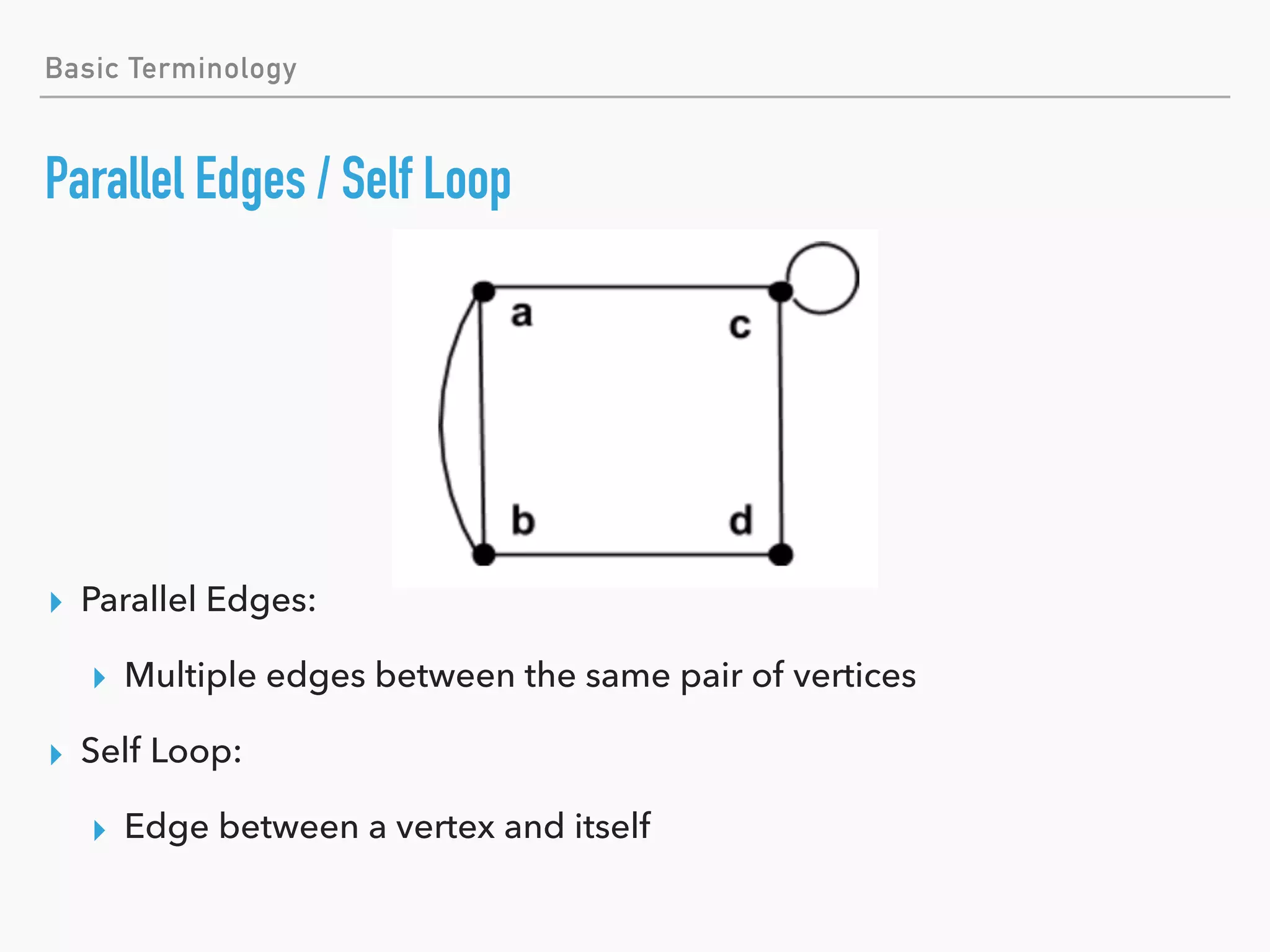
Parallel Edges / Self Loop
▸ Parallel Edges:
▸ Multiple edges between the same pair of vertices
▸ Self Loop:
▸ Edge between a vertex and itself
Basic Terminology
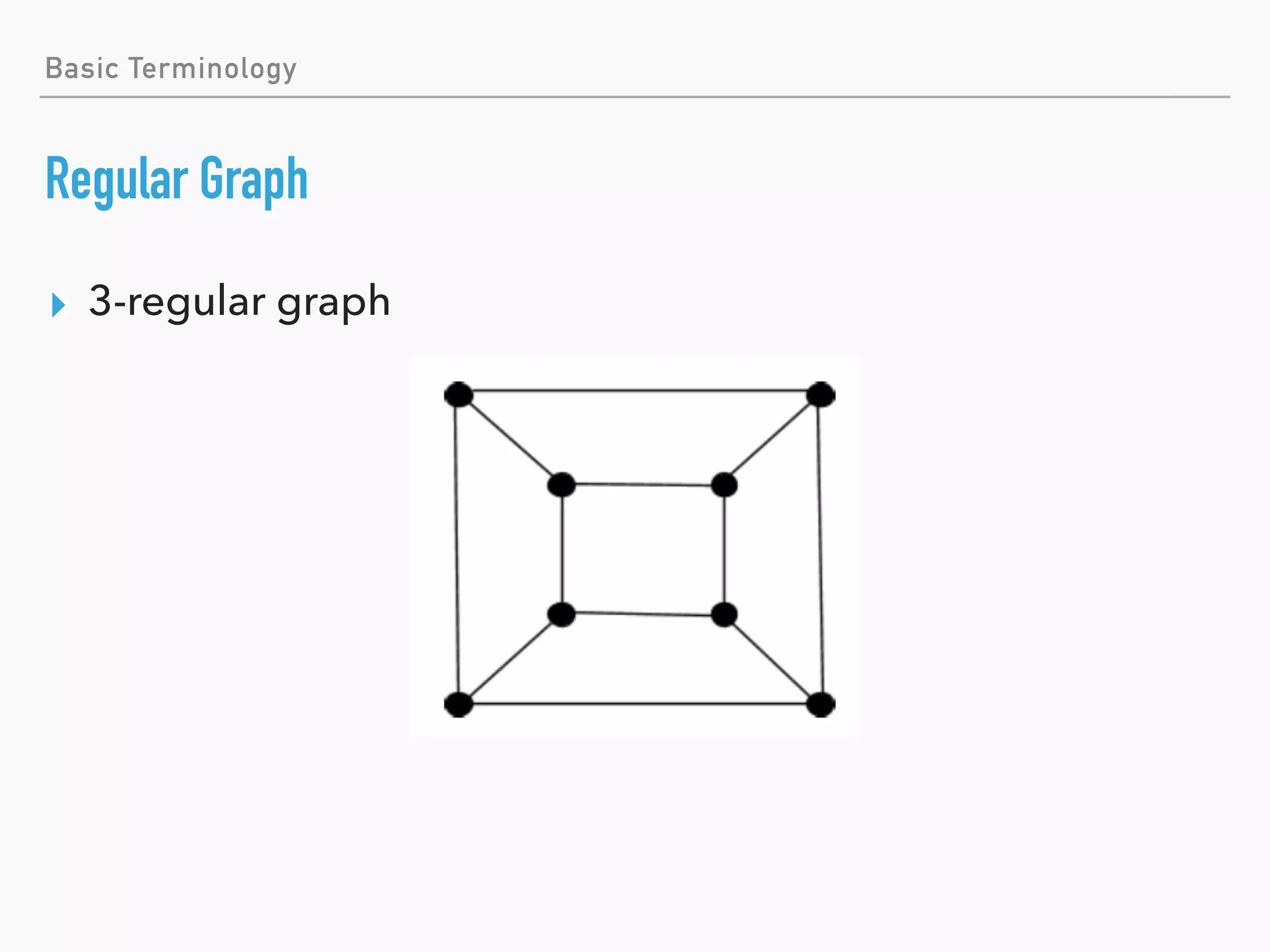
Regular Graph
▸ All the vertices have the same degree.
▸ D-regular graph:
▸ All the vertices have degree d.
▸ [Question] Draw a 3-regular undirected graph

with 8 vertices.
Basic Terminology
Regular Graph
▸ 3-regular graph
Basic Terminology
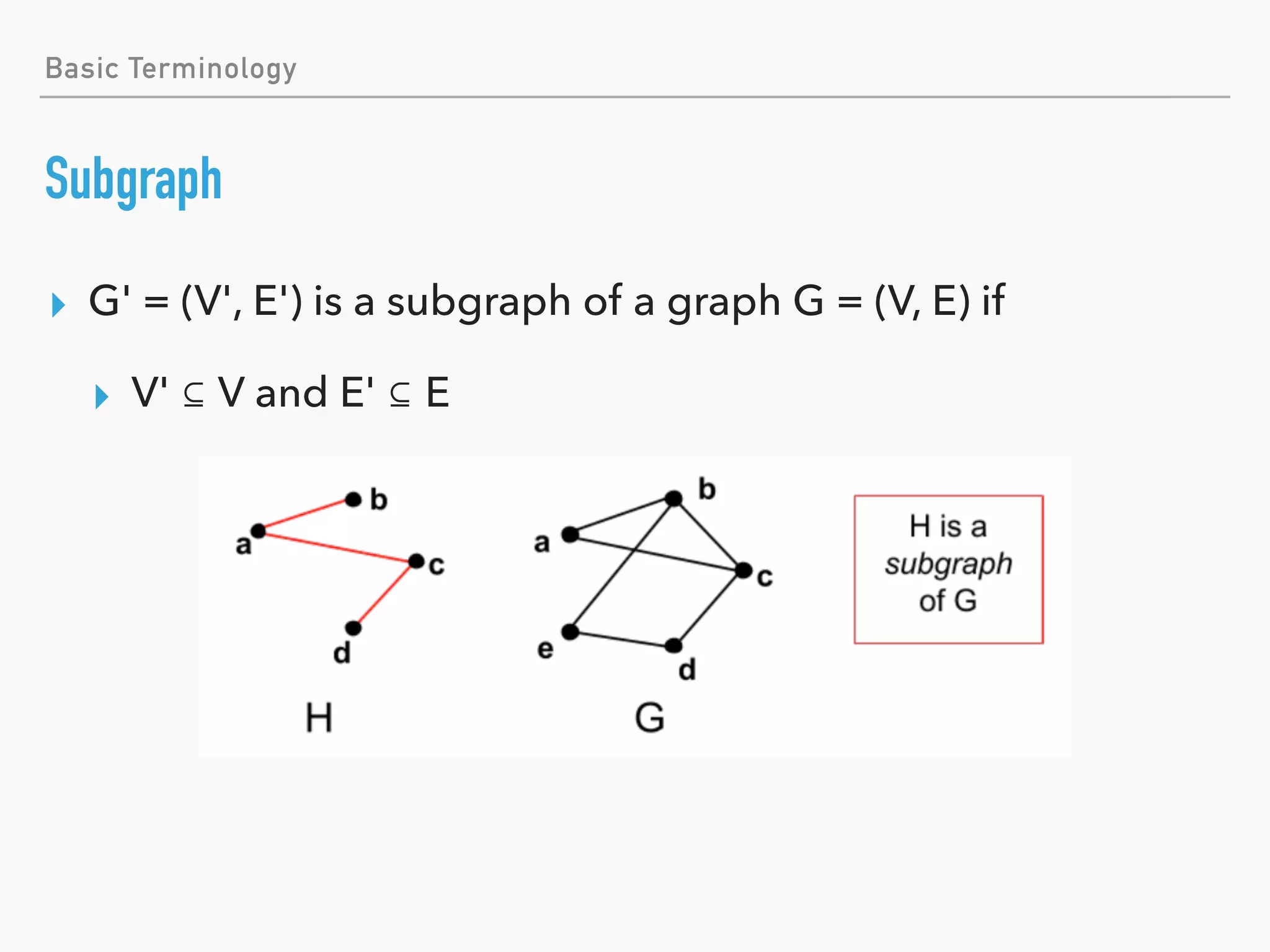
Subgraph
▸ G' = (V', E') is a subgraph of a graph G = (V, E) if
▸ V' ⊆ V and E' ⊆ E
Basic Terminology
Walk
▸ From v0 to vl
▸ Ex. <a, b, d, b, c>
▸ Can repeat a vertex or edge
Basic Terminology
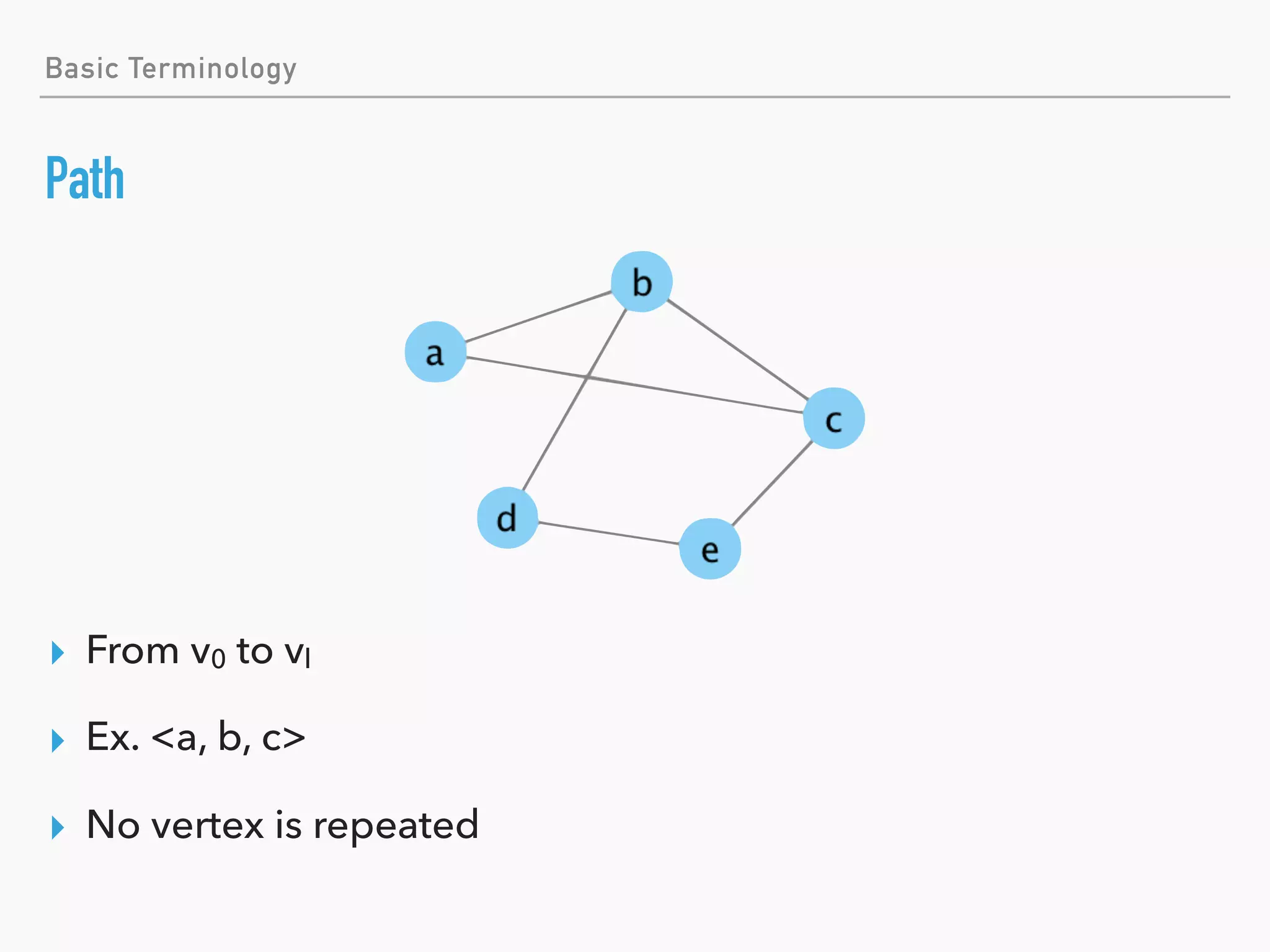
Path
▸ From v0 to vl
▸ Ex. <a, b, c>
▸ No vertex is repeated
Basic Terminology
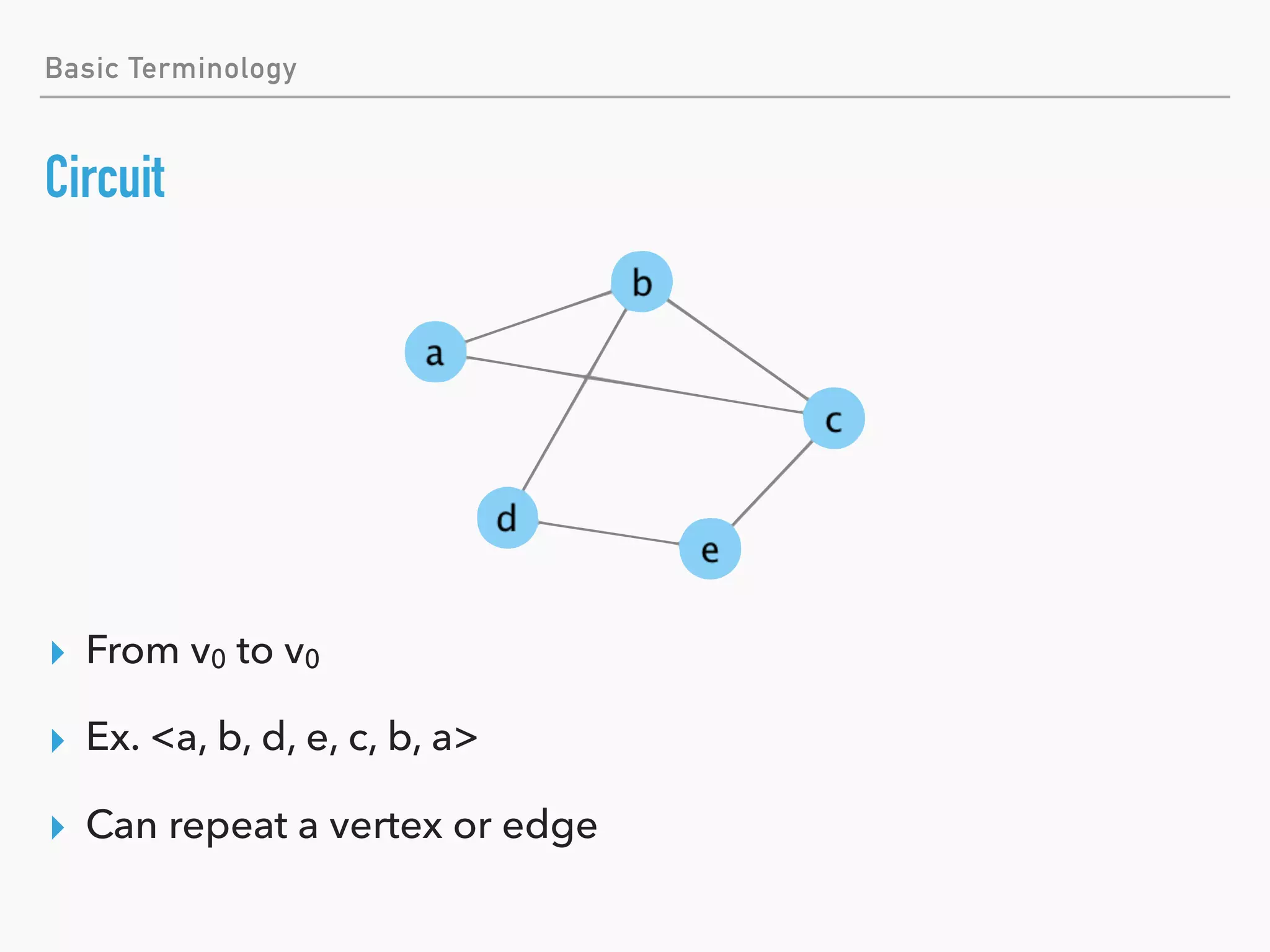
Circuit
▸ From v0 to v0
▸ Ex. <a, b, d, e, c, b, a>
▸ Can repeat a vertex or edge
Basic Terminology
Cycle
▸ From v0 to v0
▸ Ex. <a, b, c, a>
▸ Length: at least three
▸ No vertex is repeated except the first and last
Basic Terminology
[Question] Walk / Path / Circuit / Cycle?
▸ 1) <a, b, a>
▸ 2) <a, b, d, e, c>
▸ 3) <a, b, d, e, c, b>
▸ 4) <a, b, d, e, c, a>
GRAPH CLASSES
Graph Classes
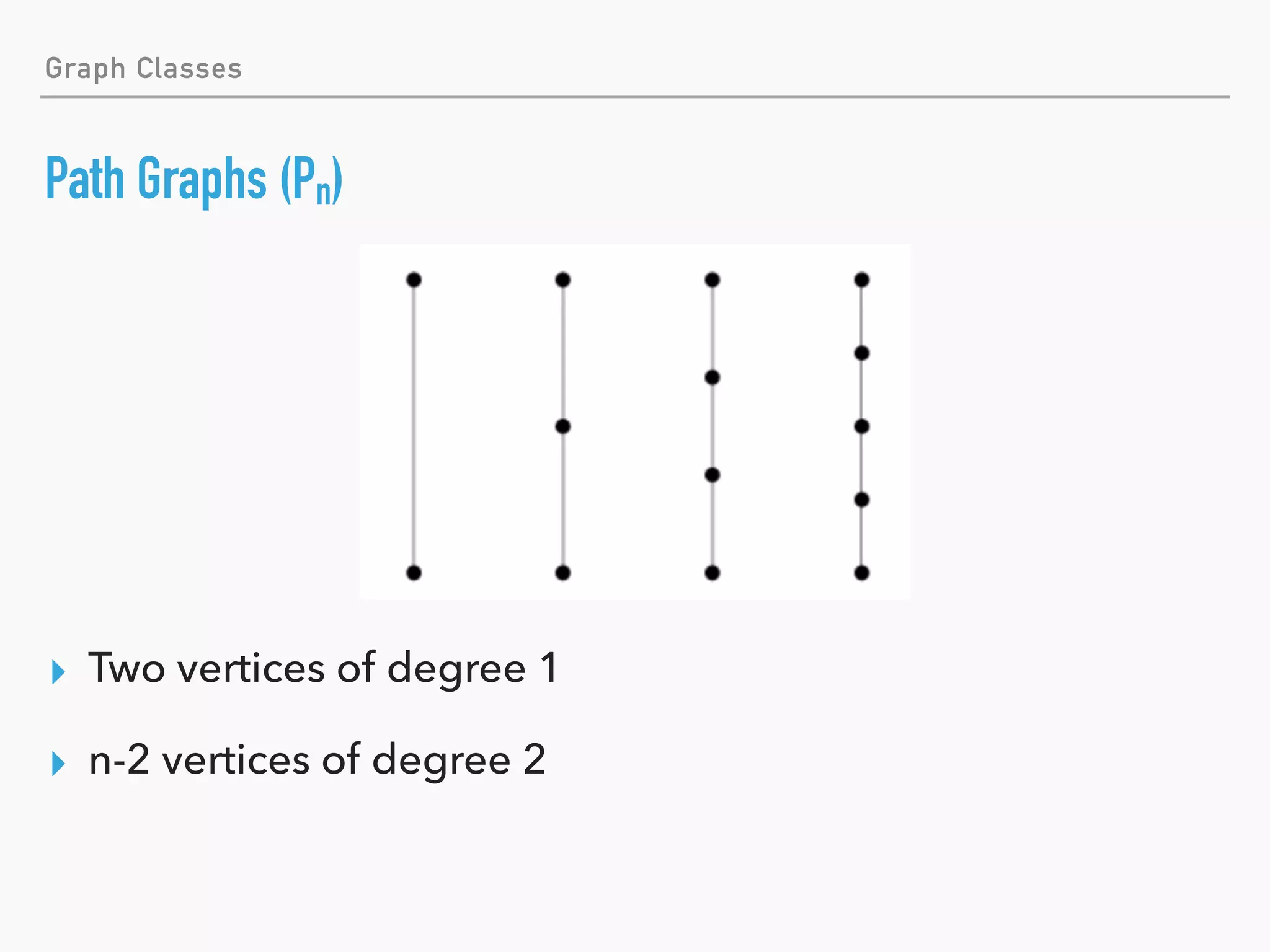
Path Graphs (Pn)
▸ Two vertices of degree 1
▸ n-2 vertices of degree 2
Graph Classes
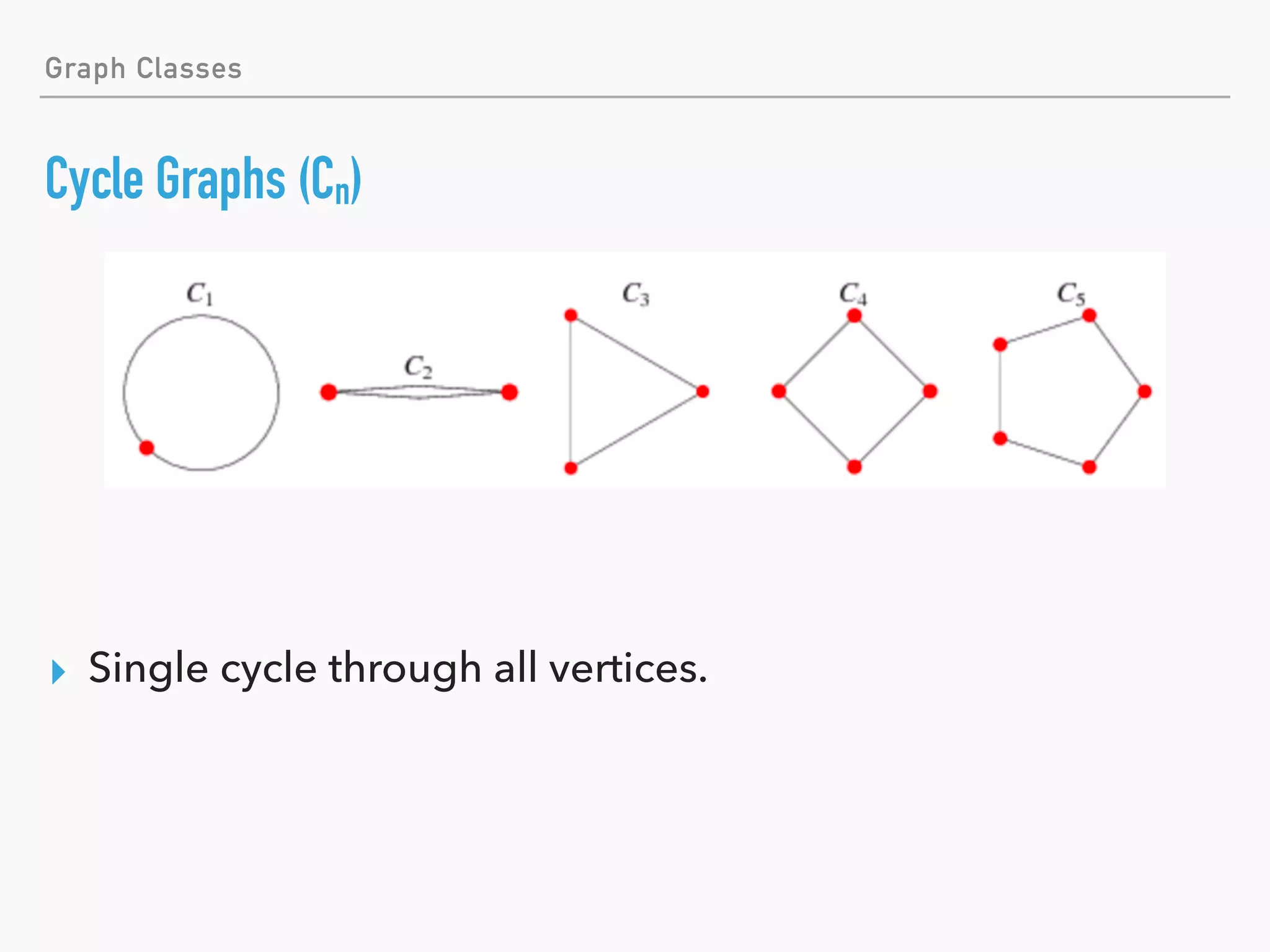
Cycle Graphs (Cn)
▸ Single cycle through all vertices.
Graph Classes
Complete Graphs (Kn)
▸ Each vertex pair is connected by an edge.
▸ [Question] How many edges does Kn have?
Graph Classes
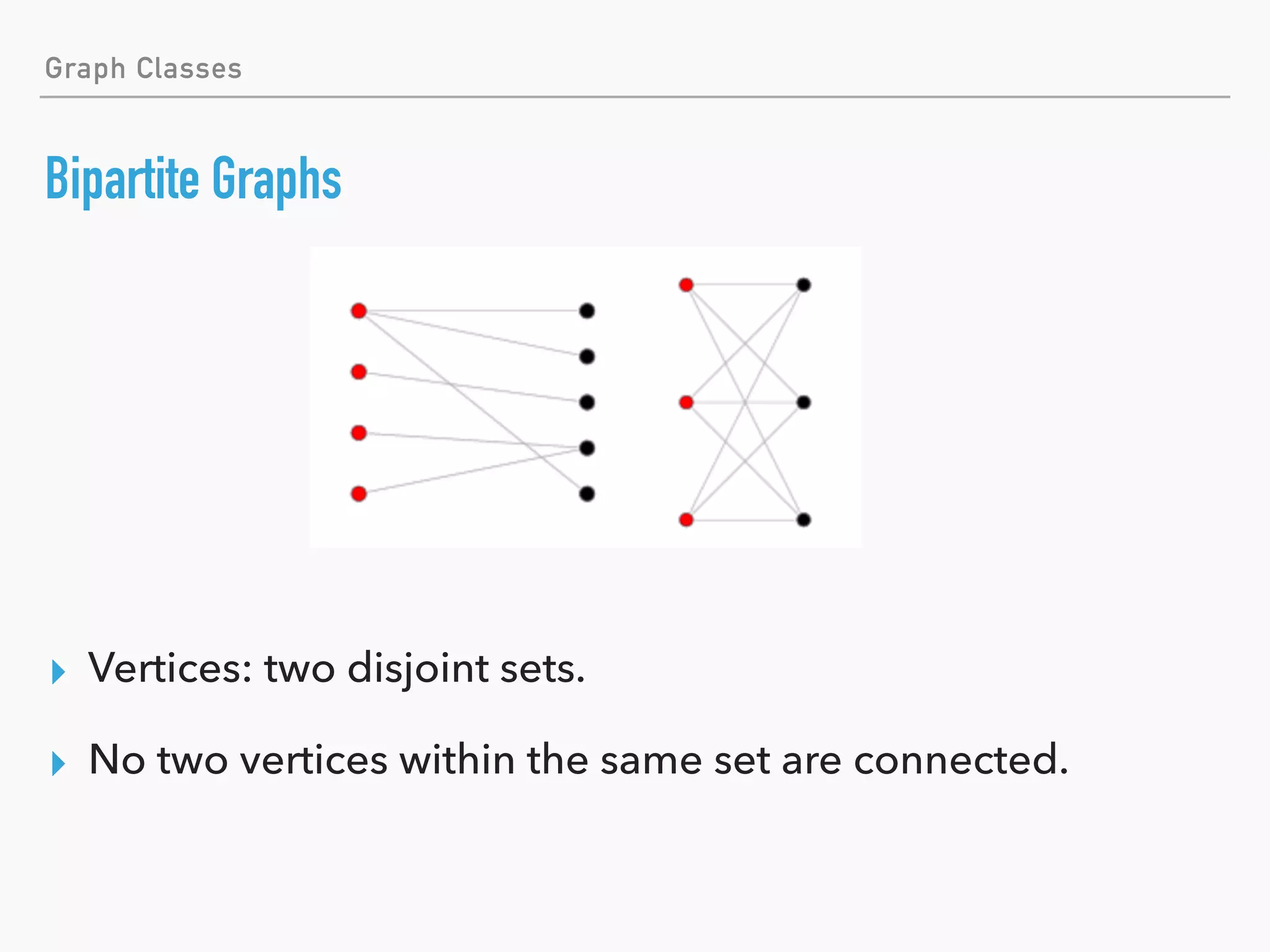
Bipartite Graphs
▸ Vertices: two disjoint sets.
▸ No two vertices within the same set are connected.
Graph Classes
Bipartite Graphs
▸ Is this a bipartite graph?
Graph Classes
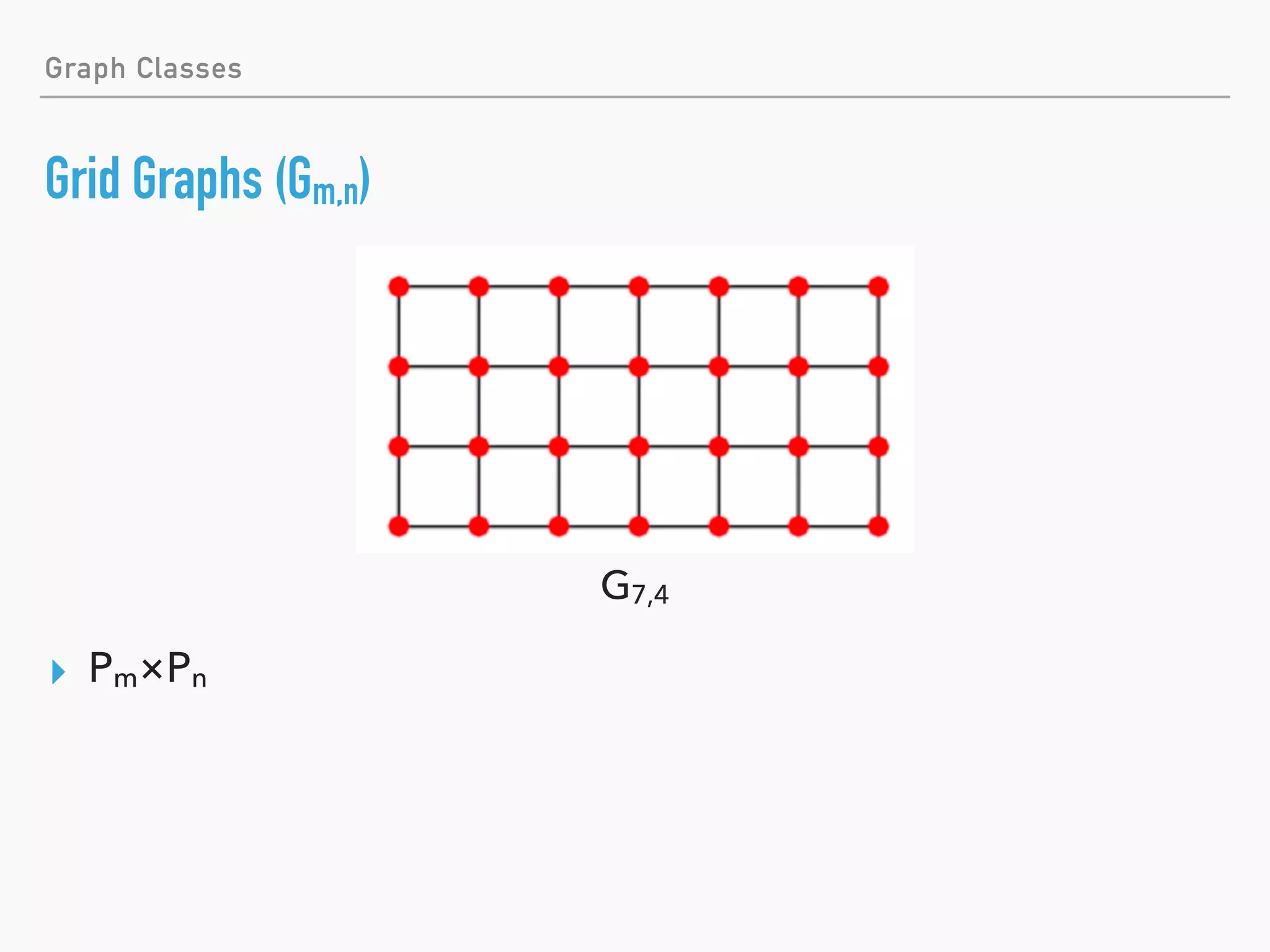
Grid Graphs (Gm,n)
▸ Pm×Pn
G7,4
Graph Classes
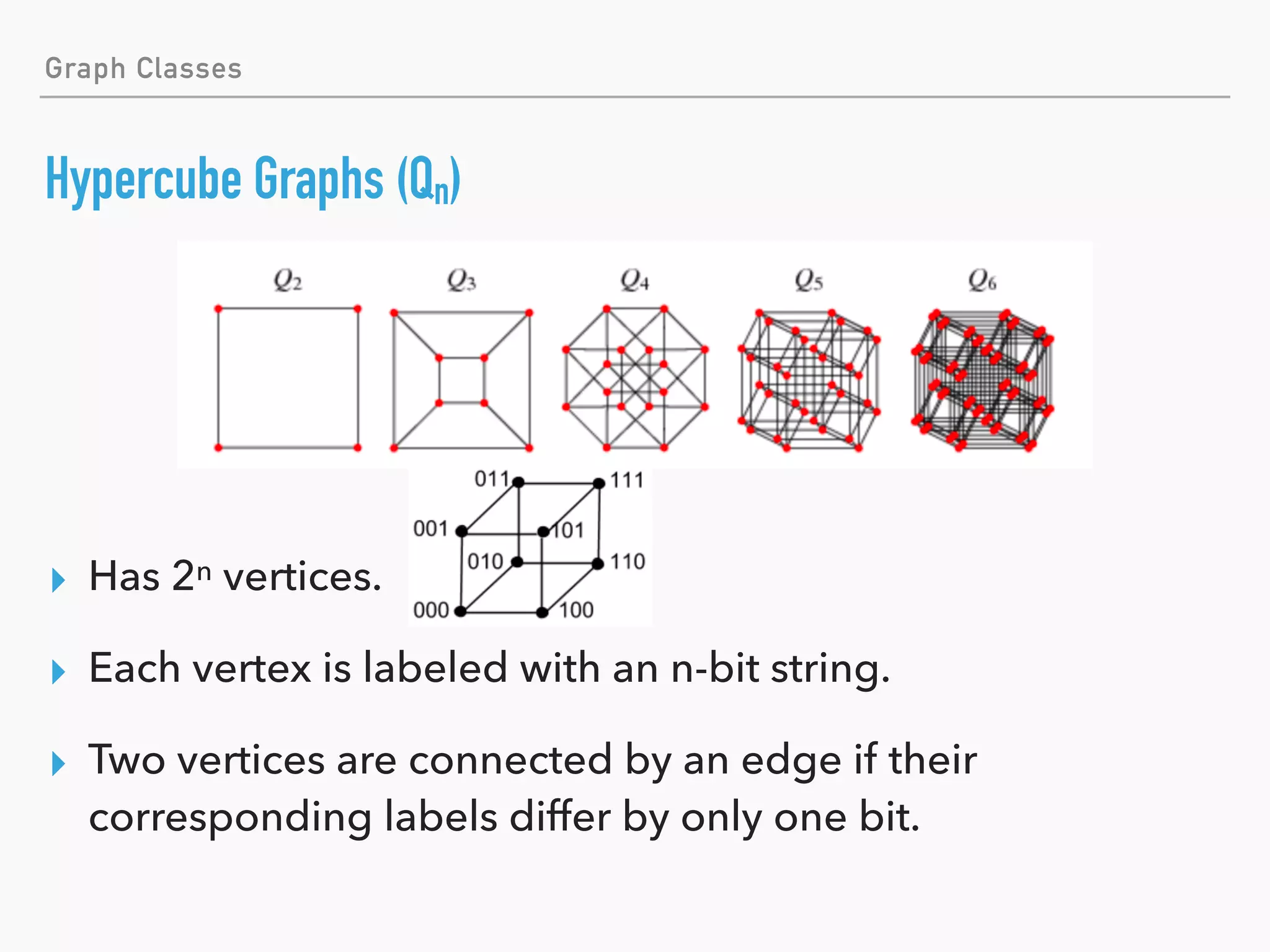
Hypercube Graphs (Qn)
▸ Has 2n vertices.
▸ Each vertex is labeled with an n-bit string.
▸ Two vertices are connected by an edge if their
corresponding labels differ by only one bit.
HISTORICAL
PROBLEMS
Historical Problems
Seven Bridges of Königsberg (1736)
▸ Find a walk through the city that would cross each of the
bridges once and only once
https://www.amusingplanet.com/2018/08/the-seven-bridges-of-konigsberg.html
Historical Problems
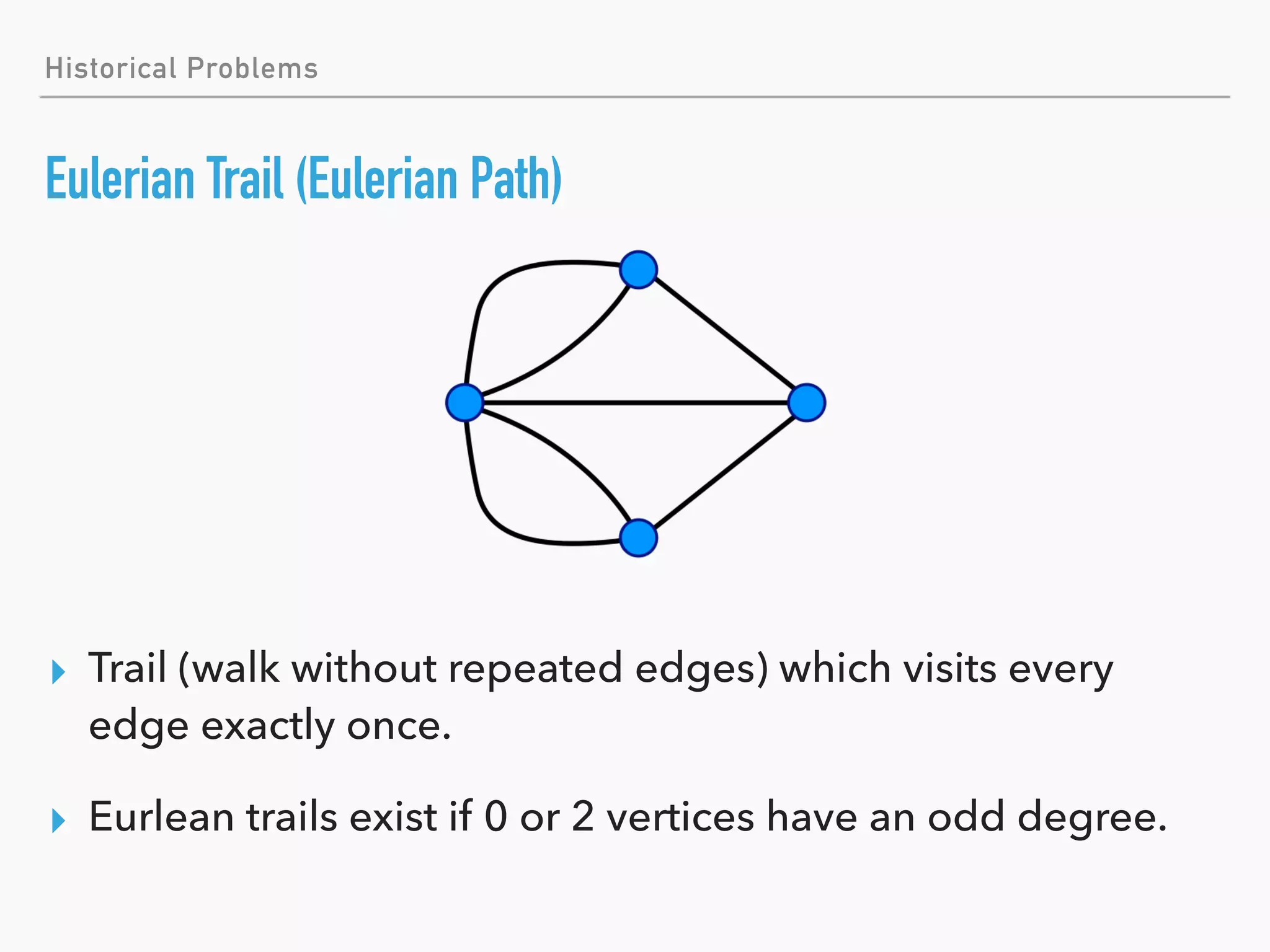
Eulerian Trail (Eulerian Path)
▸ Trail (walk without repeated edges) which visits every
edge exactly once.
▸ Eurlean trails exist if 0 or 2 vertices have an odd degree.
Historical Problems
Eulerian Trail (Eulerian Path)
▸ [Question] Find an Eulerian trail.
▸ There are effective algorithms to construct Eulerian trais.
▸ Fleury's algorithm (1883)
▸ Hierholzer's algorithm (1873)
https://courses.lumenlearning.com/wmopen-mathforliberalarts/chapter/introduction-euler-paths/
Historical Problems
Hamiltonian Path / Cycle
▸ Path / cycle which visits every vertex exactly once.
▸ No effective algorithm to construct Hamiltonian paths.
▸ [Question] Draw a graph that does not have any Hamiltonian paths.
Historical Problems
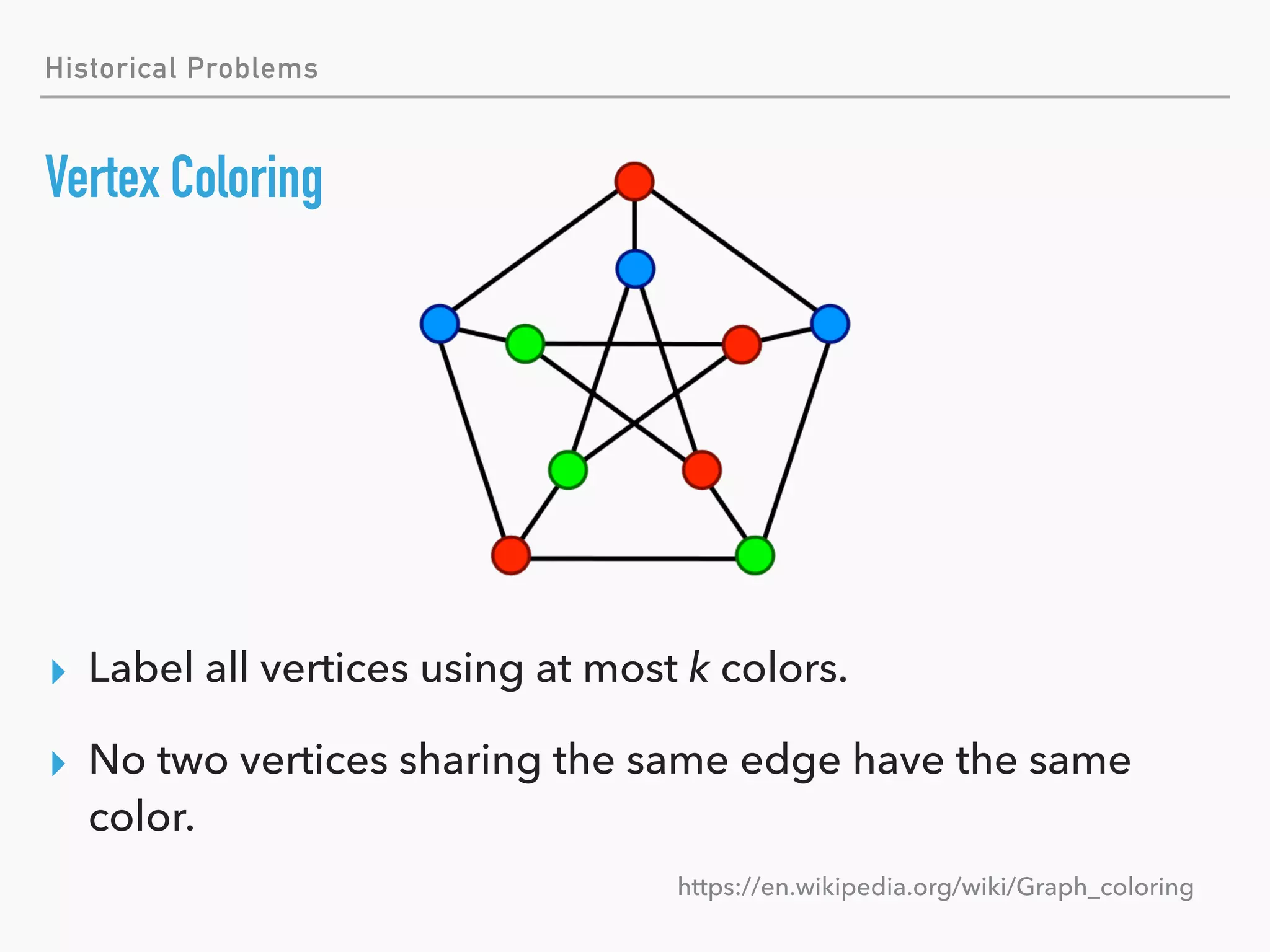
Vertex Coloring
▸ Label all vertices using at most k colors.
▸ No two vertices sharing the same edge have the same
color.
https://en.wikipedia.org/wiki/Graph_coloring
Historical Problems
Traveling Salesman Problem (TSP)
▸ Given a list of cities and the distances between each pair
of cities, what is the shortest possible route that visits each
city and returns to the origin city?
http://mathgifs.blogspot.com/2014/03/the-traveling-salesman.html
Historical Problems
Traveling Salesman Problem (TSP)
▸ What is the shortest TSP route starting from c1?
▸ How much time would you take to compute the route if
the number of cities is 10 / 100 / 1000?
Dr. Jason King, CSC 316 Course Material
COMPLEXITY
ANALYSIS
Complexity Analysis
The Random Access Machine (RAM) Model
▸ A computer consists of:
▸ A CPU
▸ A bank with an unlimited number of memory cells
▸ Assumptions
▸ Accessing any cell in memory takes constant time
▸ Each "simple" operation takes 1 time step
Dr. Jason King, CSC 316 Course Material
Complexity Analysis
The Random Access Machine (RAM) Model
▸ Example: one "simple" operation takes 1 ns (10-9 seconds)
▸ How much time would it take if the number of "simple"
operations are:
▸ 109
▸ 1010
▸ 1011
Complexity Analysis
Growth of Functions
▸ The larger input size, the longer the computation would
take.
▸ Let T(n) be the computation time of an algorithm for some
input n.
▸ Changing hardware/software environment affects T(n)

by a constant factor. (At least for today's computers...)
Dr. Jason King, CSC 316 Course Material
Complexity Analysis
Growth of Functions
n=10 n=20 n=100 n=1000 n=106 n=109 n=1012
T(log2 n) 3 ns 4 ns 7 ns 10 ns 20 ns 30 ns 40 ns
T(√n) 3 ns 4 ns 10 ns 32 ns 1 μs 32 μs 1 ms
T(n) 10 ns 20 ns 100 ns 1 μs 1 ms 1 s 17 min
T(n log2 n) 33 ns 86 ns 660 ns 10 μs 20 ms 30 s 11 h
T(n2) 100 ns 400 ns 10 μs 1 ms 17 min 32 yrs 3×10⁷ yrs
T(n3) 1 μs 8 μs 1 ms 1 s 32 yrs 3×10¹⁰ yrs 3×10¹⁹ yrs
T(2n) 1 μs 1 ms 4×10¹³ yrs 3×10284 yrs - - -
T(n!) 4 ms 77 yrs 9×10157 yrs - - - -
When T(1) = 1 ns
Our universe: 1.3×10¹⁰ yrs old
Complexity Analysis
Growth of Functions
n=10 n=20 n=100 n=1000 n=106 n=109 n=1012
T(log2 n) <1 ns <1 ns <1 ns <1 ns <1 ns <1 ns <1 ns
T(√n) <1 ns <1 ns <1 ns <1 ns <1 ns <1 ns <1 ns
T(n) <1 ns <1 ns <1 ns <1 ns 10 ns 10 μs 10 ms
T(n log2 n) <1 ns <1 ns <1 ns <1 ns 200 ns 300 μs 400 ms
T(n2) <1 ns <1 ns <1 ns 10 ns 10 ms 3 h 300 yrs
T(n3) <1 ns <1 ns 10 ns 10 μs 3 h 3×10⁵ yrs 3×10¹⁴ yrs
T(2n) <1 ns 10 ns 4×10⁸ yrs 3×10279 yrs - - -
T(n!) 40 ns 7 h 9×10152 yrs - - - -
When we have a supercomputer and assume T(1) = 1×10-14 s
Our universe: 1.3×10¹⁰ yrs old
Complexity Analysis
Growth of Functions
Dr. Jason King, CSC 316 Course Material
Complexity Analysis
Big-Oh Notation
▸ Defines asymptotic upper bound
▸ Given functions f(n) and g(n), we say that f(n) is O(g(n))

if there are positive constants c and n0 such that

0 ≤ f(n) ≤ c g(n) for all n ≥ n0
Dr. Jason King, CSC 316 Course Material
Complexity Analysis
Big-Oh Notation
▸ Example:
▸ f(n) = 3n2 + 2n + 10000 is O(n2)
▸ f(n) = n100 + 1.01n is O(1.01n)
▸ Finding Eulerian trails: O(|E|)
▸ Solving the traveling salesman problem: O(n2・2n)
▸ Categorized as

NP (Non-deterministic Polynomial-time) -hard
CENTRALITY
ANALYSIS
Centrality Analysis
Degree Centrality
▸ Degree of the vertex (very simple!)
5 5
2
4
4
4
4
4
4
4
4
Centrality Analysis
Closeness Centrality
▸ Reciprocal of the average of the shortest distances from
the vertex to all other vertices.
10/19
10/18
Centrality Analysis
Betweenness Centrality
▸ Calculate all pairs shortest paths.
▸ Count how many times the vertex is in between the
shortest paths.
▸ Useful for finding "mediators"
Centrality Analysis
Application: Analysis on Research Papers (2015)
▸ Joined a research project of the Institute of Statistical
Mathematics in Japan.
▸ They do institutional research (IR) using governmental
budgets.
▸ They wanted to develop new indices to measure
researchers' productivity other than existing ones

(i.e. the impact factor)
Centrality Analysis
Application: Analysis on Research Papers (2015)
Centrality Analysis
Application: Analysis on Research Papers (2015)
Centrality Analysis
Application: Analysis on Research Papers (2015)
FACILITY LOCATION
PROBLEMS
Facility Location Problems
P-median Problem
▸ Numbers represent transportation costs.
▸ We want to minimize total transportation costs with a fixed number
of warehouses (p).
Dr. Matt Stallmann Lightning Talk on 1/12/2018
Facility Location Problems
P-median Problem
▸ A possible solution. Total cost = (5+3+3) + (3+4+5) = 23
▸ Can you find a better solution?
Dr. Matt Stallmann Lightning Talk on 1/12/2018
Facility Location Problems
P-median Problem
▸ Complexity
▸ O(np) in general, making this NP-hard
▸ O(p2n2) for trees
▸ O(pn) for path graphs
Facility Location Problems
Undergrad Research Project (Spring 2018)
▸ Developed research framework
▸ Graph generation
▸ Solving (for smaller input)
▸ Visualization
▸ Found interesting properties on trees / grids
▸ Applied linear programming to help

approximation
Thank you!
▸ References
▸ Wikipedia
▸ https://en.wikipedia.org/wiki/Graph_theory
▸ https://en.wikipedia.org/wiki/Eulerian_path
▸ https://en.wikipedia.org/wiki/Hamiltonian_path
▸ https://en.wikipedia.org/wiki/Graph_coloring
▸ Wolfram MathWorld
▸ http://mathworld.wolfram.com/PathGraph.html
▸ http://mathworld.wolfram.com/CycleGraph.html
▸ http://mathworld.wolfram.com/CompleteGraph.html
▸ http://mathworld.wolfram.com/BipartiteGraph.html
▸ http://mathworld.wolfram.com/GridGraph.html
▸ http://mathworld.wolfram.com/HypercubeGraph.html
▸ zyBooks: Discrete Mathematics
▸ https://www.zybooks.com/catalog/discrete-mathematics/

Introduction to Graph Theory