Algebra I Midterm Review
                                              Chapters 1 - 6
Name:

Chapter 1: §1.4 - §1.6 (pg. 21 - 36)
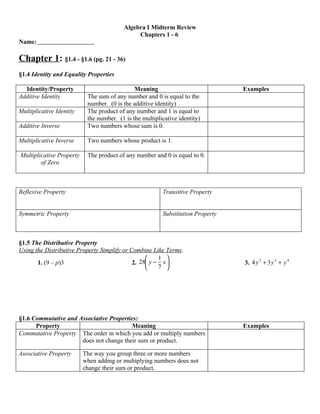
§1.4 Identity and Equality Properties

  Identity/Property                           Meaning                            Examples
Additive Identity          The sum of any number and 0 is equal to the
                           number. (0 is the additive identity)
Multiplicative Identity    The product of any number and 1 is equal to
                           the number. (1 is the multiplicative identity)
Additive Inverse           Two numbers whose sum is 0.

Multiplicative Inverse     Two numbers whose product is 1.

Multiplicative Property    The product of any number and 0 is equal to 0.
        of Zero


Reflexive Property                                       Transitive Property


Symmetric Property                                       Substitution Property


§1.5 The Distributive Property
Using the Distributive Property Simplify or Combine Like Terms.
                                                      1 
       1. (9 – p)3                           2. 28 y − x                       3. 4 y 3 + 3 y 3 + y 4
                                                      7 


§1.6 Commutative and Associative Properties:
      Property                            Meaning                                Examples
Commutative Property The order in which you add or multiply numbers
                      does not change their sum or product.

Associative Property      The way you group three or more numbers
                          when adding or multiplying numbers does not
                          change their sum or product.
Chapter 2: §2.1 - §2.4 (pg. 68 - 87)

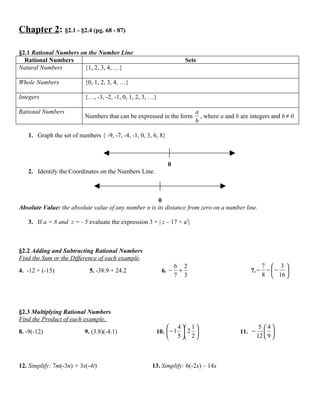
§2.1 Rational Numbers on the Number Line
  Rational Numbers                                                   Sets
Natural Numbers        {1, 2, 3, 4, …}

Whole Numbers             {0, 1, 2, 3, 4, …}

Integers                  {…, -3, -2, -1, 0, 1, 2, 3, …}

Rational Numbers                                                         a
                          Numbers that can be expressed in the form        , where a and b are integers and b ≠ 0
                                                                         b

   1. Graph the set of numbers { -9, -7, -4, -1, 0, 3, 6, 8}


                                                               0
   2. Identify the Coordinates on the Numbers Line.


                                                       0
Absolute Value: the absolute value of any number n is its distance from zero on a number line.

   3. If a = 8 and z = - 5 evaluate the expression 3 + | z – 17 + a2|


§2.2 Adding and Subtracting Rational Numbers
Find the Sum or the Difference of each example.
                                                                   6 2                                7  3
4. -12 + (-15)              5. -38.9 + 24.2                6. −     +                          7. −    − − 
                                                                   7 3                                8  16 


§2.3 Multiplying Rational Numbers
Find the Product of each example.
                                                             4  1                               5 4
8. -9(-12)                9. (3.8)(-4.1)                10.  − 1  2                    11. −       
                                                             5  2                              12  9 


12. Simplify: 7m(-3n) + 3s(-4t)                       13. Simplify: 6(-2x) – 14x
§2.4 Dividing Rational Numbers
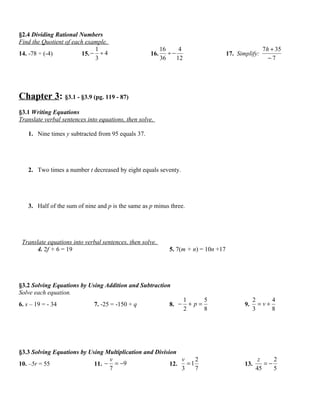
Find the Quotient of each example.
                             1                            16     4                                   7 h + 35
14. -78 ÷ (-4)          15. − ÷ 4                   16.      ÷−                      17. Simplify:
                             3                            36    12                                      −7


Chapter 3: §3.1 - §3.9 (pg. 119 - 87)
§3.1 Writing Equations
Translate verbal sentences into equations, then solve.

   1. Nine times y subtracted from 95 equals 37.


   2. Two times a number t decreased by eight equals seventy.


   3. Half of the sum of nine and p is the same as p minus three.


 Translate equations into verbal sentences, then solve.
       4. 2f + 6 = 19                                        5. 7(m + n) = 10n +17


§3.2 Solving Equations by Using Addition and Subtraction
Solve each equation.
                                                                     1     5                     2     4
6. s – 19 = - 34              7. -25 = -150 + q              8. −      +p=                  9.     =v+
                                                                     2     8                     3     8


§3.3 Solving Equations by Using Multiplication and Division
                                 v                           v    2                                z    2
10. –5r = 55                11. − = −9                   12.   =1                           13.      =−
                                 7                           3    7                               45    5
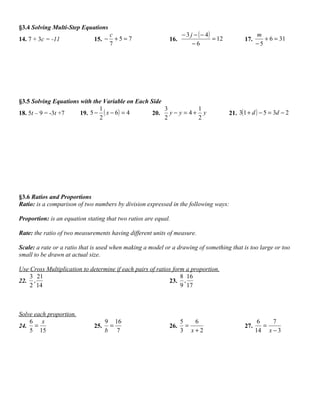
§3.4 Solving Multi-Step Equations
                                      c                           − 3 j − ( − 4)                    m
14. 7 + 3c = -11              15. −     +5= 7               16.                  = 12         17.      + 6 = 31
                                      7                                −6                           −5


§3.5 Solving Equations with the Variable on Each Side
                              1                       3          1
18. 5t – 9 = -3t +7    19. 5 − ( x − 6 ) = 4      20.   y− y = 4+ y                     21. 3(1 + d ) − 5 = 3d − 2
                              2                       2          2


§3.6 Ratios and Proportions
Ratio: is a comparison of two numbers by division expressed in the following ways:

Proportion: is an equation stating that two ratios are equal.

Rate: the ratio of two measurements having different units of measure.

Scale: a rate or a ratio that is used when making a model or a drawing of something that is too large or too
small to be drawn at actual size.

Use Cross Multiplication to determine if each pairs of ratios form a proportion.
    3 21                                                         8 16
22. ,                                                       23. ,
    2 14                                                         9 17


Solve each proportion.
    6 x                             9 16                          5   6                              6   7
24. =                         25.    =                      26.     =                         27.      =
    5 15                            b 7                           3 x+2                             14 x − 3
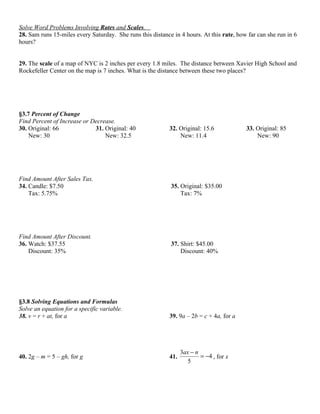
Solve Word Problems Involving Rates and Scales.
28. Sam runs 15-miles every Saturday. She runs this distance in 4 hours. At this rate, how far can she run in 6
hours?


29. The scale of a map of NYC is 2 inches per every 1.8 miles. The distance between Xavier High School and
Rockefeller Center on the map is 7 inches. What is the distance between these two places?


§3.7 Percent of Change
Find Percent of Increase or Decrease.
30. Original: 66             31. Original: 40               32. Original: 15.6            33. Original: 85
    New: 30                      New: 32.5                      New: 11.4                     New: 90


Find Amount After Sales Tax.
34. Candle: $7.50                                           35. Original: $35.00
    Tax: 5.75%                                                  Tax: 7%


Find Amount After Discount.
36. Watch: $37.55                                           37. Shirt: $45.00
    Discount: 35%                                               Discount: 40%


§3.8 Solving Equations and Formulas
Solve an equation for a specific variable.
38. v = r + at, for a                                       39. 9a – 2b = c + 4a, for a


                                                                  3ax − n
40. 2g – m = 5 – gh, for g                                  41.           = −4 , for x
                                                                     5
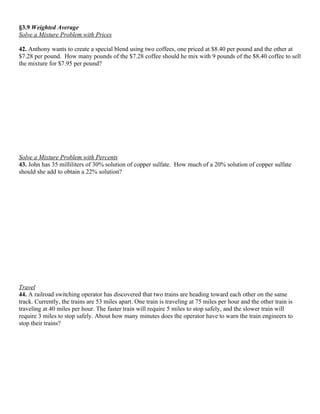
§3.9 Weighted Average
Solve a Mixture Problem with Prices

42. Anthony wants to create a special blend using two coffees, one priced at $8.40 per pound and the other at
$7.28 per pound. How many pounds of the $7.28 coffee should he mix with 9 pounds of the $8.40 coffee to sell
the mixture for $7.95 per pound?


Solve a Mixture Problem with Percents
43. John has 35 milliliters of 30% solution of copper sulfate. How much of a 20% solution of copper sulfate
should she add to obtain a 22% solution?


Travel
44. A railroad switching operator has discovered that two trains are heading toward each other on the same
track. Currently, the trains are 53 miles apart. One train is traveling at 75 miles per hour and the other train is
traveling at 40 miles per hour. The faster train will require 5 miles to stop safely, and the slower train will
require 3 miles to stop safely. About how many minutes does the operator have to warn the train engineers to
stop their trains?
Chapter 4: §4.1 - §4.6 (pg. 192 - 231)
§4.1 The Coordinate Plane
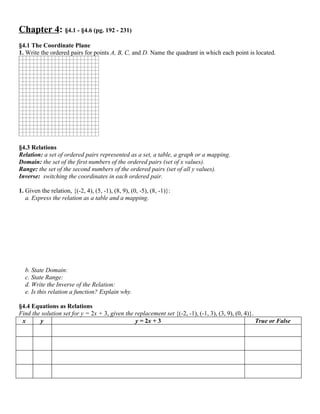
1. Write the ordered pairs for points A, B, C, and D. Name the quadrant in which each point is located.


§4.3 Relations
Relation: a set of ordered pairs represented as a set, a table, a graph or a mapping.
Domain: the set of the first numbers of the ordered pairs (set of x values).
Range: the set of the second numbers of the ordered pairs (set of all y values).
Inverse: switching the coordinates in each ordered pair.

1. Given the relation, {(-2, 4), (5, -1), (8, 9), (0, -5), (8, -1)}:
   a. Express the relation as a table and a mapping.


  b. State Domain:
  c. State Range:
  d. Write the Inverse of the Relation:
  e. Is this relation a function? Explain why.

§4.4 Equations as Relations
Find the solution set for y = 2x + 3, given the replacement set {(-2, -1), (-1, 3), (3, 9), (0, 4)}.
 x      y                                       y = 2x + 3                                           True or False
Solve 6x – y = -3 if the domain is {-2, -1, 1, 3, 4}.
 x                                        6x – y = -3                                      y           (x, y)


§4.5 Graphing Linear Equations
Linear Equations in Standard Form: Ax + By = C, where A is greater than or equal to 0, A and B are not both
zero, and A, B, and C are integers whose greatest common factor is 1.

Intercepts: the point at which is crosses a particular axis.
To find x-intercepts:                                        To find y-intercepts:


Find the x and y intercepts for each equation.
                                  x       2y
3. 2x = 6 - y                  4. = 10 +                      5. 4x + 6y = 8                         6. 3x - 2y = 15
                                  2        3


§4.6 Functions
Functions: a relation in which each element of the domain is paired with exactly one element of the range.
Vertical Line Test: if a vertical line can be drawn so that it intersects the graph more than once, then the graph
is not a function.

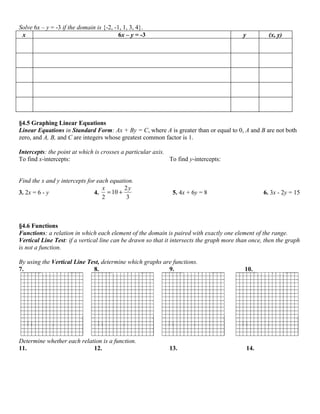
By using the Vertical Line Test, determine which graphs are functions.
7.                           8.                           9.                               10.


Determine whether each relation is a function.
11.                         12.                              13.                               14.
Equations that are functions can be written in function notation.
                       y = 2x + 3                          f(x) = 2x + 3

If f(x) = 2x - 6 and g(x) = x – 2x2, find each value.
        1
15. f  −                                      16. g ( − 1)                         17. f ( h + 9 )
        2


18. 2[ g ( b ) + 1]                              19. f ( 3 y )                       20. g ( − 3) + 13


Chapter 5: §5.1 - §5.6 (pg. 256 - 297)
§5.1 Slope
                      y 2 − y1
Formula: m =
                      x 2 − x1

Find the slope of the line that passes through the given points and identify what type of slope it is:
1. (-1, 2) & (3, 4)             2. (1, 2) & (1, 3)            3. (-1, -2) & (-4, 1)            4. (1, 2) & (-1, 2)


Find the coordinates given the slope of the line: (Find the value of r)
                            3                                          4
5. (r, 6) & (10, -3), m = −                   6. (-2, 7) & (r, 3), m =                7. (4, -5) & (3, r), m = 8
                            2                                          3
§5.2 Slope and Direct Variation
Direct Variation equation:                                   In words: “y varies directly with x.”
Graph the following Equations:
       1
8. y = x                                                             9. y = −3x
       2


Write and Solve a Direct Variation Equation:
10. Suppose y varies directly with x, and y = 28 when x = 7. Write a direct variation equation that relates x and
y. Then use the equation to find x when y = 52.


11. Suppose y varies directly with x, and y = -7 when x = -14. Write a direct variation equation that relates x and
y. Then use the equation to find x when x = 20.


§5.3 Slope-Intercept Form
Slope-Intercept Form:
Identify the slope and y-intercept in each equation.
12. -2y = 6x - 4               13. 4 x − y = −3               14. 5x - 3y = 15              15. 3x - 2y = 6
§5.4 Writing Equations in Slope-Intercept Form

Write an equation given slope and one point, in slope-intercept form.
Steps:
1. Substitute the values of m, x, and y into the slope-intercept form and solve for b.
2. Write the slope-intercept form using the values of m and b.
                                                   1                                                           2
16. (1, 5), m = 2              17. (4, -5), m = −               18. (1, -4), m = -6      19. (-3, -1), m = −
                                                   2                                                           3


Write an equation given two points.
Steps:
1. Find the slope.
2. Choose one of the points to use.
3. Substitute the values of m, x, and y into the slope-intercept form and solve for b.
4. Write the slope-intercept form using the values of m and b.
20. (-3, -1) & (6, -4)                                         21. (2, -2) & (3, 2)


22. (1, 1) & (7, 4)                                             23. (7, -2) & (-4, -2)


§5.5 Writing Equations in Point-Intercept Form
Point-Slope Form:

Write an equation in point-slope form given the slope and one point.
                                              2                                                               5
24. (-6, 1), m = -4           25. (9, 1), m =               26. (-4, -3), m = 1          27. (1, -3), m = −
                                              3                                                               8
Write each equation in slope-intercept form.
                                         2                                    1                            3
28. y + 2 = -2(x + 6)         29. y - 1 = (x + 9)             30. y + 3 = −     (x + 2)      31. y - 5 =     (x + 4)
                                         3                                    4                            2


§5.6 Geometry: Parallel and Perpendicular Lines
Parallel Lines:
Write the slope-intercept form of an equation of the line that passes through the given point and is parallel to
the graph of each equation.
                                                                            2
32. (-3, 2), y = x – 6                                       33. (3, 3), y = x – 1
                                                                            3


                    1
34. (-5, -4), y =     x+1                                     35. (2, -1), y = 2x + 2
                    2


Perpendicular Lines:
Write the slope-intercept form of an equation of the line that passes through the given point and is
perpendicular to the graph of each equation.
                1
36. (1, -3), y = x + 4                                       37. (-3, 1), y = -3x + 7
                2
38. (-2, 7), 2x - 5y = 3                                   39. (2, 4), x – 6y = 2


Chapter 6: §65.1 - §6.6 (pg. 318 - 358)
§6.1 Solving Inequalities by Addition and Subtraction
Page 359 #’s (9 – 15) ODD ONLY

§6.2 Solving Inequalities by Multiplication and Division
Page 360 #’s (19 – 25) ODD ONLY

§6.3 Solving Multi-Step Inequalities
Page 361 #’s (27 – 33) ODD ONLY

§6.4 Solving Compound Inequalities
Page 361 #’s (37 – 41) ODD ONLY

§6.5 Solving Open Sentences Involving Absolute Value
Page 362 #’s (43 – 49) ODD ONLY

§6.6 Graphing Inequalities in Two Variables
Page 362 #’s (51 – 57) ODD ONLY

Check your answers in the back of the book.

Algebra I Midterm Review

  • 1.
    Algebra I MidtermReview Chapters 1 - 6 Name: Chapter 1: §1.4 - §1.6 (pg. 21 - 36) §1.4 Identity and Equality Properties Identity/Property Meaning Examples Additive Identity The sum of any number and 0 is equal to the number. (0 is the additive identity) Multiplicative Identity The product of any number and 1 is equal to the number. (1 is the multiplicative identity) Additive Inverse Two numbers whose sum is 0. Multiplicative Inverse Two numbers whose product is 1. Multiplicative Property The product of any number and 0 is equal to 0. of Zero Reflexive Property Transitive Property Symmetric Property Substitution Property §1.5 The Distributive Property Using the Distributive Property Simplify or Combine Like Terms.  1  1. (9 – p)3 2. 28 y − x  3. 4 y 3 + 3 y 3 + y 4  7  §1.6 Commutative and Associative Properties: Property Meaning Examples Commutative Property The order in which you add or multiply numbers does not change their sum or product. Associative Property The way you group three or more numbers when adding or multiplying numbers does not change their sum or product.
  • 2.
    Chapter 2: §2.1- §2.4 (pg. 68 - 87) §2.1 Rational Numbers on the Number Line Rational Numbers Sets Natural Numbers {1, 2, 3, 4, …} Whole Numbers {0, 1, 2, 3, 4, …} Integers {…, -3, -2, -1, 0, 1, 2, 3, …} Rational Numbers a Numbers that can be expressed in the form , where a and b are integers and b ≠ 0 b 1. Graph the set of numbers { -9, -7, -4, -1, 0, 3, 6, 8} 0 2. Identify the Coordinates on the Numbers Line. 0 Absolute Value: the absolute value of any number n is its distance from zero on a number line. 3. If a = 8 and z = - 5 evaluate the expression 3 + | z – 17 + a2| §2.2 Adding and Subtracting Rational Numbers Find the Sum or the Difference of each example. 6 2 7  3 4. -12 + (-15) 5. -38.9 + 24.2 6. − + 7. − − −  7 3 8  16  §2.3 Multiplying Rational Numbers Find the Product of each example.  4  1  5 4 8. -9(-12) 9. (3.8)(-4.1) 10.  − 1  2  11. −    5  2  12  9  12. Simplify: 7m(-3n) + 3s(-4t) 13. Simplify: 6(-2x) – 14x
  • 3.
    §2.4 Dividing RationalNumbers Find the Quotient of each example. 1 16 4 7 h + 35 14. -78 ÷ (-4) 15. − ÷ 4 16. ÷− 17. Simplify: 3 36 12 −7 Chapter 3: §3.1 - §3.9 (pg. 119 - 87) §3.1 Writing Equations Translate verbal sentences into equations, then solve. 1. Nine times y subtracted from 95 equals 37. 2. Two times a number t decreased by eight equals seventy. 3. Half of the sum of nine and p is the same as p minus three. Translate equations into verbal sentences, then solve. 4. 2f + 6 = 19 5. 7(m + n) = 10n +17 §3.2 Solving Equations by Using Addition and Subtraction Solve each equation. 1 5 2 4 6. s – 19 = - 34 7. -25 = -150 + q 8. − +p= 9. =v+ 2 8 3 8 §3.3 Solving Equations by Using Multiplication and Division v v 2 z 2 10. –5r = 55 11. − = −9 12. =1 13. =− 7 3 7 45 5
  • 4.
    §3.4 Solving Multi-StepEquations c − 3 j − ( − 4) m 14. 7 + 3c = -11 15. − +5= 7 16. = 12 17. + 6 = 31 7 −6 −5 §3.5 Solving Equations with the Variable on Each Side 1 3 1 18. 5t – 9 = -3t +7 19. 5 − ( x − 6 ) = 4 20. y− y = 4+ y 21. 3(1 + d ) − 5 = 3d − 2 2 2 2 §3.6 Ratios and Proportions Ratio: is a comparison of two numbers by division expressed in the following ways: Proportion: is an equation stating that two ratios are equal. Rate: the ratio of two measurements having different units of measure. Scale: a rate or a ratio that is used when making a model or a drawing of something that is too large or too small to be drawn at actual size. Use Cross Multiplication to determine if each pairs of ratios form a proportion. 3 21 8 16 22. , 23. , 2 14 9 17 Solve each proportion. 6 x 9 16 5 6 6 7 24. = 25. = 26. = 27. = 5 15 b 7 3 x+2 14 x − 3
  • 5.
    Solve Word ProblemsInvolving Rates and Scales. 28. Sam runs 15-miles every Saturday. She runs this distance in 4 hours. At this rate, how far can she run in 6 hours? 29. The scale of a map of NYC is 2 inches per every 1.8 miles. The distance between Xavier High School and Rockefeller Center on the map is 7 inches. What is the distance between these two places? §3.7 Percent of Change Find Percent of Increase or Decrease. 30. Original: 66 31. Original: 40 32. Original: 15.6 33. Original: 85 New: 30 New: 32.5 New: 11.4 New: 90 Find Amount After Sales Tax. 34. Candle: $7.50 35. Original: $35.00 Tax: 5.75% Tax: 7% Find Amount After Discount. 36. Watch: $37.55 37. Shirt: $45.00 Discount: 35% Discount: 40% §3.8 Solving Equations and Formulas Solve an equation for a specific variable. 38. v = r + at, for a 39. 9a – 2b = c + 4a, for a 3ax − n 40. 2g – m = 5 – gh, for g 41. = −4 , for x 5
  • 6.
    §3.9 Weighted Average Solvea Mixture Problem with Prices 42. Anthony wants to create a special blend using two coffees, one priced at $8.40 per pound and the other at $7.28 per pound. How many pounds of the $7.28 coffee should he mix with 9 pounds of the $8.40 coffee to sell the mixture for $7.95 per pound? Solve a Mixture Problem with Percents 43. John has 35 milliliters of 30% solution of copper sulfate. How much of a 20% solution of copper sulfate should she add to obtain a 22% solution? Travel 44. A railroad switching operator has discovered that two trains are heading toward each other on the same track. Currently, the trains are 53 miles apart. One train is traveling at 75 miles per hour and the other train is traveling at 40 miles per hour. The faster train will require 5 miles to stop safely, and the slower train will require 3 miles to stop safely. About how many minutes does the operator have to warn the train engineers to stop their trains?
  • 7.
    Chapter 4: §4.1- §4.6 (pg. 192 - 231) §4.1 The Coordinate Plane 1. Write the ordered pairs for points A, B, C, and D. Name the quadrant in which each point is located. §4.3 Relations Relation: a set of ordered pairs represented as a set, a table, a graph or a mapping. Domain: the set of the first numbers of the ordered pairs (set of x values). Range: the set of the second numbers of the ordered pairs (set of all y values). Inverse: switching the coordinates in each ordered pair. 1. Given the relation, {(-2, 4), (5, -1), (8, 9), (0, -5), (8, -1)}: a. Express the relation as a table and a mapping. b. State Domain: c. State Range: d. Write the Inverse of the Relation: e. Is this relation a function? Explain why. §4.4 Equations as Relations Find the solution set for y = 2x + 3, given the replacement set {(-2, -1), (-1, 3), (3, 9), (0, 4)}. x y y = 2x + 3 True or False
  • 8.
    Solve 6x –y = -3 if the domain is {-2, -1, 1, 3, 4}. x 6x – y = -3 y (x, y) §4.5 Graphing Linear Equations Linear Equations in Standard Form: Ax + By = C, where A is greater than or equal to 0, A and B are not both zero, and A, B, and C are integers whose greatest common factor is 1. Intercepts: the point at which is crosses a particular axis. To find x-intercepts: To find y-intercepts: Find the x and y intercepts for each equation. x 2y 3. 2x = 6 - y 4. = 10 + 5. 4x + 6y = 8 6. 3x - 2y = 15 2 3 §4.6 Functions Functions: a relation in which each element of the domain is paired with exactly one element of the range. Vertical Line Test: if a vertical line can be drawn so that it intersects the graph more than once, then the graph is not a function. By using the Vertical Line Test, determine which graphs are functions. 7. 8. 9. 10. Determine whether each relation is a function. 11. 12. 13. 14.
  • 9.
    Equations that arefunctions can be written in function notation. y = 2x + 3  f(x) = 2x + 3 If f(x) = 2x - 6 and g(x) = x – 2x2, find each value.  1 15. f  −  16. g ( − 1) 17. f ( h + 9 )  2 18. 2[ g ( b ) + 1] 19. f ( 3 y ) 20. g ( − 3) + 13 Chapter 5: §5.1 - §5.6 (pg. 256 - 297) §5.1 Slope y 2 − y1 Formula: m = x 2 − x1 Find the slope of the line that passes through the given points and identify what type of slope it is: 1. (-1, 2) & (3, 4) 2. (1, 2) & (1, 3) 3. (-1, -2) & (-4, 1) 4. (1, 2) & (-1, 2) Find the coordinates given the slope of the line: (Find the value of r) 3 4 5. (r, 6) & (10, -3), m = − 6. (-2, 7) & (r, 3), m = 7. (4, -5) & (3, r), m = 8 2 3
  • 10.
    §5.2 Slope andDirect Variation Direct Variation equation: In words: “y varies directly with x.” Graph the following Equations: 1 8. y = x 9. y = −3x 2 Write and Solve a Direct Variation Equation: 10. Suppose y varies directly with x, and y = 28 when x = 7. Write a direct variation equation that relates x and y. Then use the equation to find x when y = 52. 11. Suppose y varies directly with x, and y = -7 when x = -14. Write a direct variation equation that relates x and y. Then use the equation to find x when x = 20. §5.3 Slope-Intercept Form Slope-Intercept Form: Identify the slope and y-intercept in each equation. 12. -2y = 6x - 4 13. 4 x − y = −3 14. 5x - 3y = 15 15. 3x - 2y = 6
  • 11.
    §5.4 Writing Equationsin Slope-Intercept Form Write an equation given slope and one point, in slope-intercept form. Steps: 1. Substitute the values of m, x, and y into the slope-intercept form and solve for b. 2. Write the slope-intercept form using the values of m and b. 1 2 16. (1, 5), m = 2 17. (4, -5), m = − 18. (1, -4), m = -6 19. (-3, -1), m = − 2 3 Write an equation given two points. Steps: 1. Find the slope. 2. Choose one of the points to use. 3. Substitute the values of m, x, and y into the slope-intercept form and solve for b. 4. Write the slope-intercept form using the values of m and b. 20. (-3, -1) & (6, -4) 21. (2, -2) & (3, 2) 22. (1, 1) & (7, 4) 23. (7, -2) & (-4, -2) §5.5 Writing Equations in Point-Intercept Form Point-Slope Form: Write an equation in point-slope form given the slope and one point. 2 5 24. (-6, 1), m = -4 25. (9, 1), m = 26. (-4, -3), m = 1 27. (1, -3), m = − 3 8
  • 12.
    Write each equationin slope-intercept form. 2 1 3 28. y + 2 = -2(x + 6) 29. y - 1 = (x + 9) 30. y + 3 = − (x + 2) 31. y - 5 = (x + 4) 3 4 2 §5.6 Geometry: Parallel and Perpendicular Lines Parallel Lines: Write the slope-intercept form of an equation of the line that passes through the given point and is parallel to the graph of each equation. 2 32. (-3, 2), y = x – 6 33. (3, 3), y = x – 1 3 1 34. (-5, -4), y = x+1 35. (2, -1), y = 2x + 2 2 Perpendicular Lines: Write the slope-intercept form of an equation of the line that passes through the given point and is perpendicular to the graph of each equation. 1 36. (1, -3), y = x + 4 37. (-3, 1), y = -3x + 7 2
  • 13.
    38. (-2, 7),2x - 5y = 3 39. (2, 4), x – 6y = 2 Chapter 6: §65.1 - §6.6 (pg. 318 - 358) §6.1 Solving Inequalities by Addition and Subtraction Page 359 #’s (9 – 15) ODD ONLY §6.2 Solving Inequalities by Multiplication and Division Page 360 #’s (19 – 25) ODD ONLY §6.3 Solving Multi-Step Inequalities Page 361 #’s (27 – 33) ODD ONLY §6.4 Solving Compound Inequalities Page 361 #’s (37 – 41) ODD ONLY §6.5 Solving Open Sentences Involving Absolute Value Page 362 #’s (43 – 49) ODD ONLY §6.6 Graphing Inequalities in Two Variables Page 362 #’s (51 – 57) ODD ONLY Check your answers in the back of the book.