1


RECURSION
            Prashasti Kanikar   10/24/2011
2


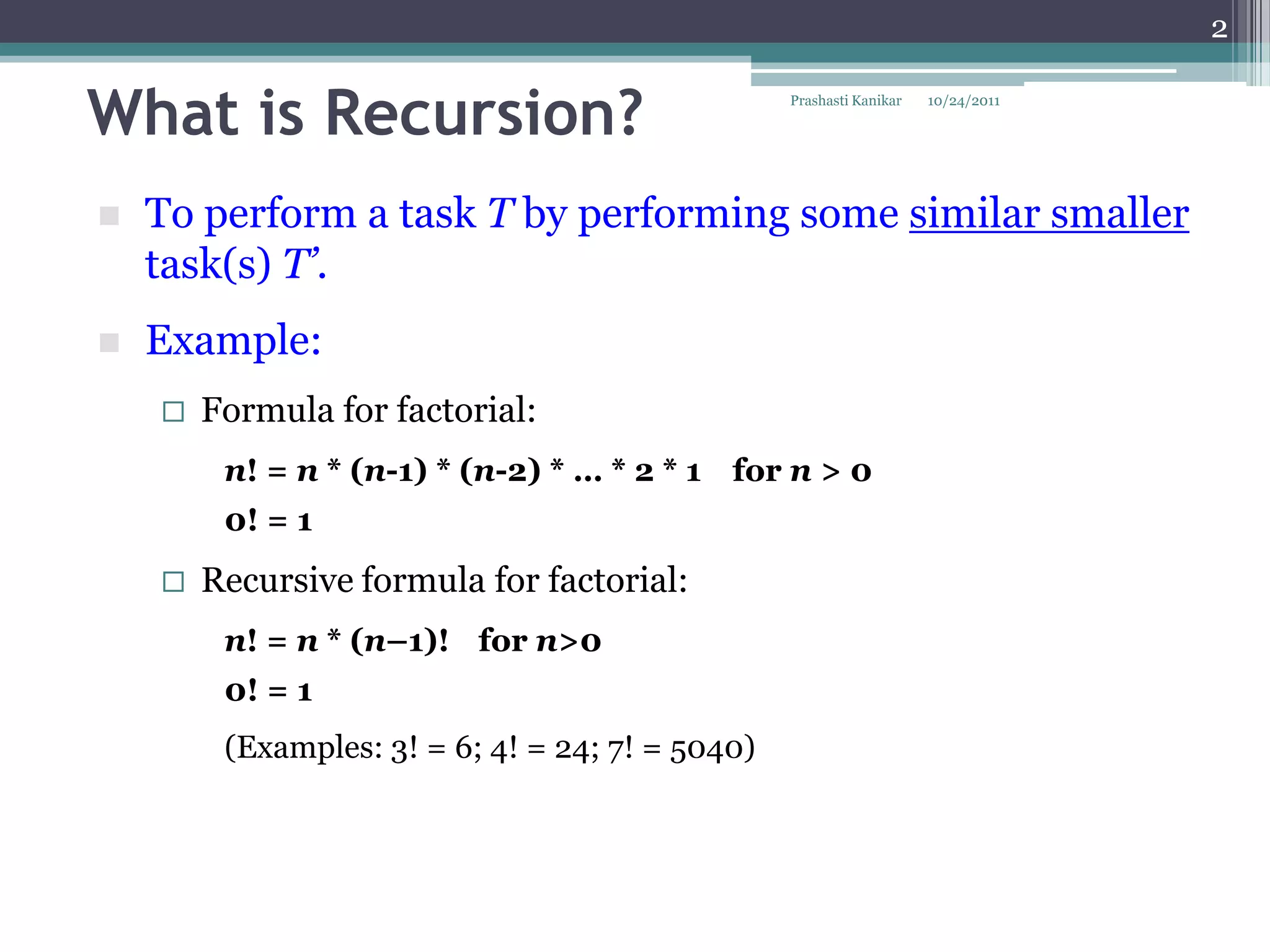
What is Recursion?                                Prashasti Kanikar   10/24/2011


   To perform a task T by performing some similar smaller
    task(s) T’.
   Example:
       Formula for factorial:
         n! = n * (n-1) * (n-2) * … * 2 * 1 for n > 0
         0! = 1
       Recursive formula for factorial:
         n! = n * (n–1)! for n>0
         0! = 1
         (Examples: 3! = 6; 4! = 24; 7! = 5040)
3


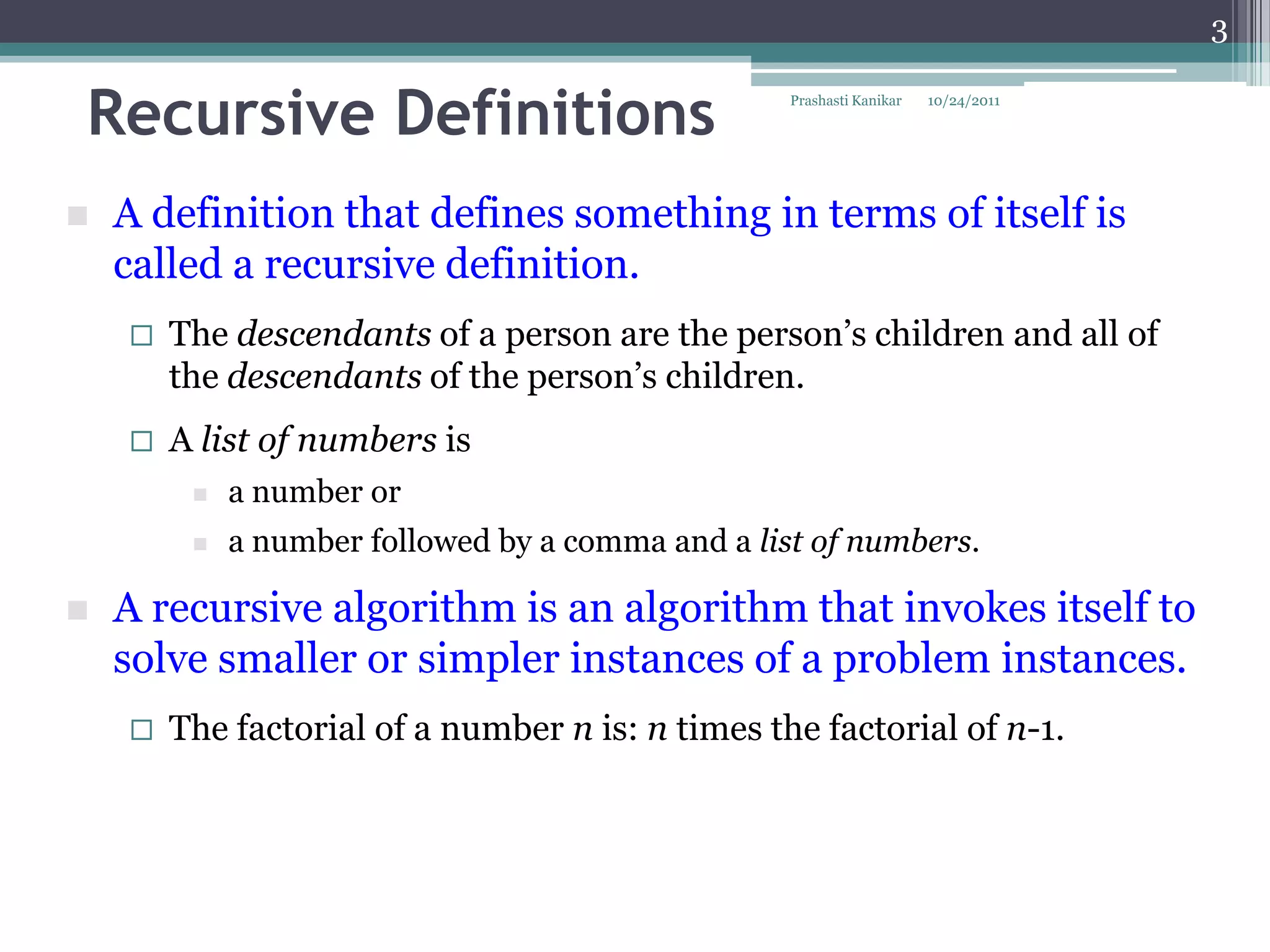
Recursive Definitions                              Prashasti Kanikar   10/24/2011


   A definition that defines something in terms of itself is
    called a recursive definition.
       The descendants of a person are the person‟s children and all of
        the descendants of the person‟s children.
       A list of numbers is
            a number or
            a number followed by a comma and a list of numbers.

   A recursive algorithm is an algorithm that invokes itself to
    solve smaller or simpler instances of a problem instances.
       The factorial of a number n is: n times the factorial of n-1.
4


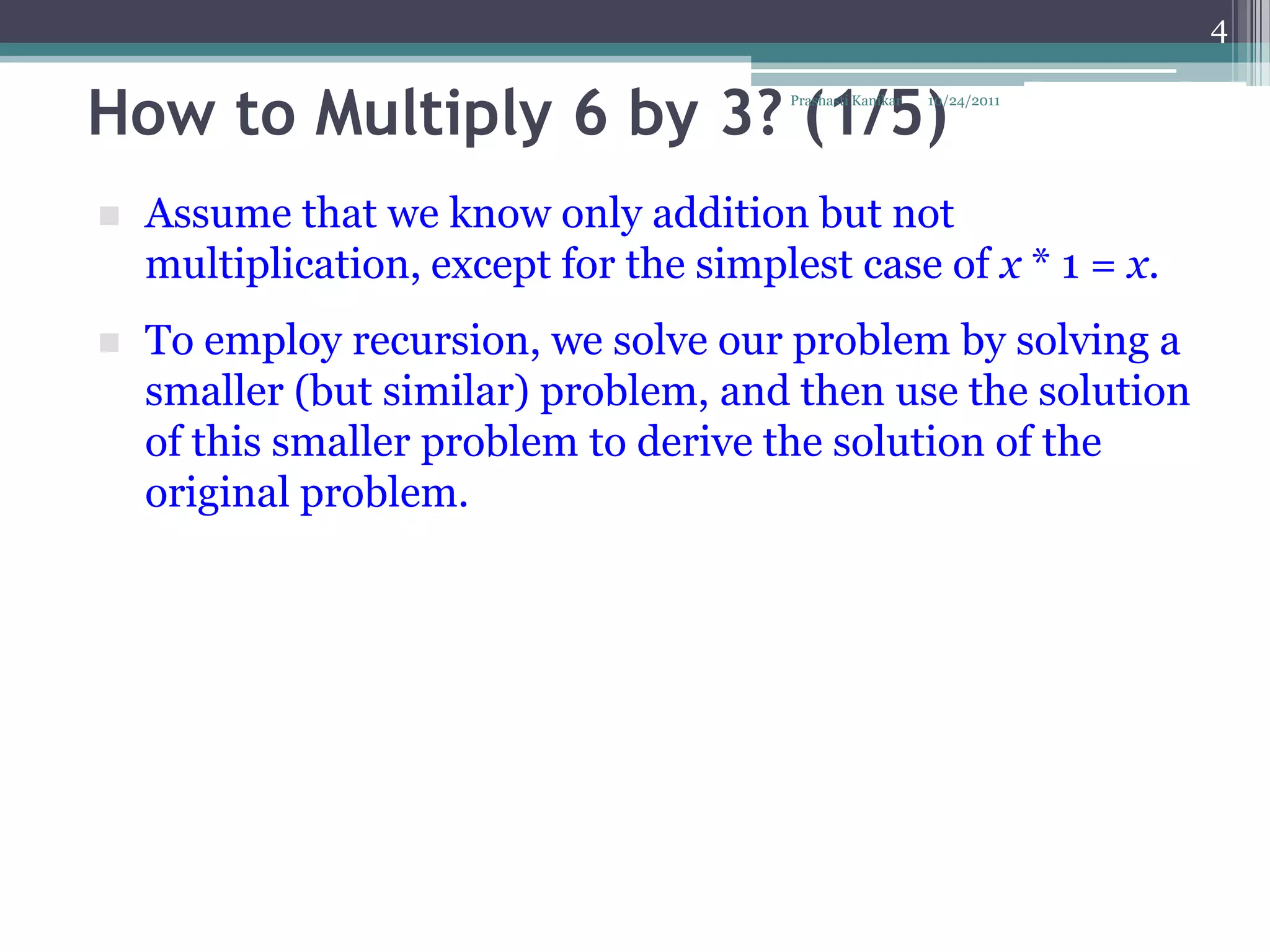
How to Multiply 6 by 3? (1/5)           Prashasti Kanikar   10/24/2011


   Assume that we know only addition but not
    multiplication, except for the simplest case of x * 1 = x.
   To employ recursion, we solve our problem by solving a
    smaller (but similar) problem, and then use the solution
    of this smaller problem to derive the solution of the
    original problem.
5


How to Multiply 6 by 3? (2/5)                 Prashasti Kanikar   10/24/2011


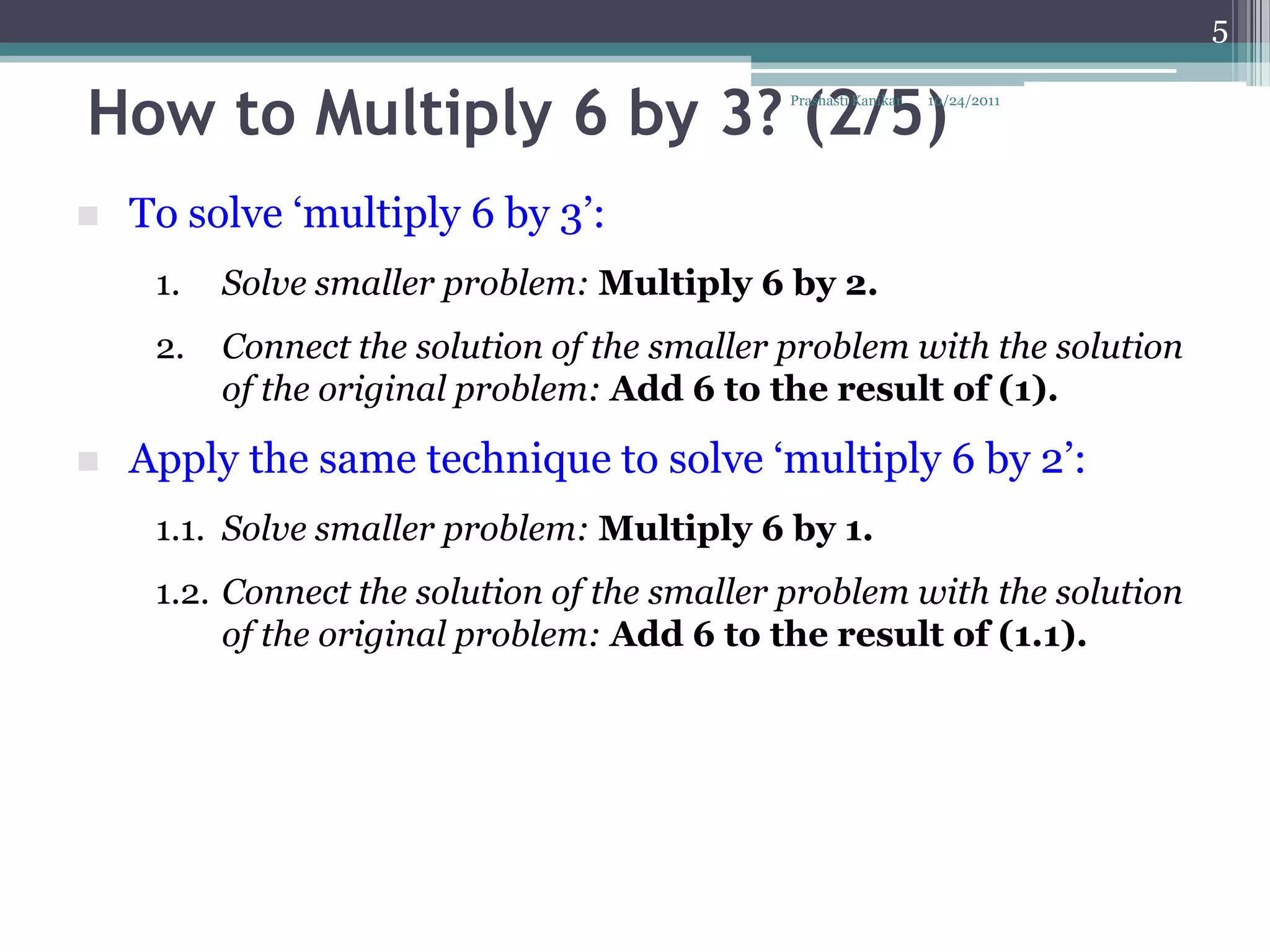
   To solve „multiply 6 by 3‟:
     1.   Solve smaller problem: Multiply 6 by 2.
     2.   Connect the solution of the smaller problem with the solution
          of the original problem: Add 6 to the result of (1).

   Apply the same technique to solve „multiply 6 by 2‟:
     1.1. Solve smaller problem: Multiply 6 by 1.
     1.2. Connect the solution of the smaller problem with the solution
          of the original problem: Add 6 to the result of (1.1).
6


How to Multiply 6 by 3? (3/5)                    Prashasti Kanikar   10/24/2011


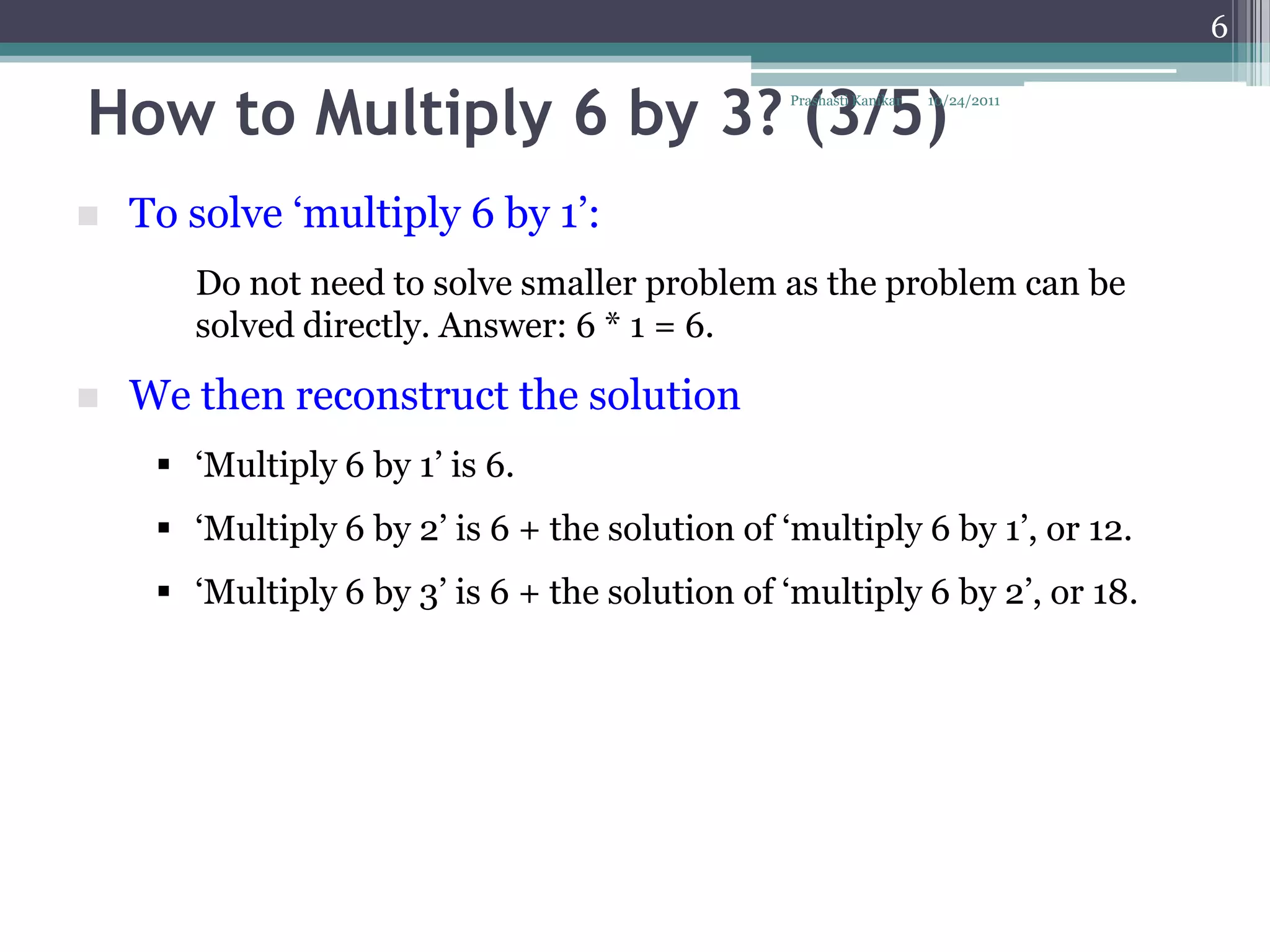
   To solve „multiply 6 by 1‟:
       Do not need to solve smaller problem as the problem can be
       solved directly. Answer: 6 * 1 = 6.

   We then reconstruct the solution
      „Multiply 6 by 1‟ is 6.
      „Multiply 6 by 2‟ is 6 + the solution of „multiply 6 by 1‟, or 12.
      „Multiply 6 by 3‟ is 6 + the solution of „multiply 6 by 2‟, or 18.
7


 How to Multiply 6 by 3? (4/5)           Prashasti Kanikar   10/24/2011


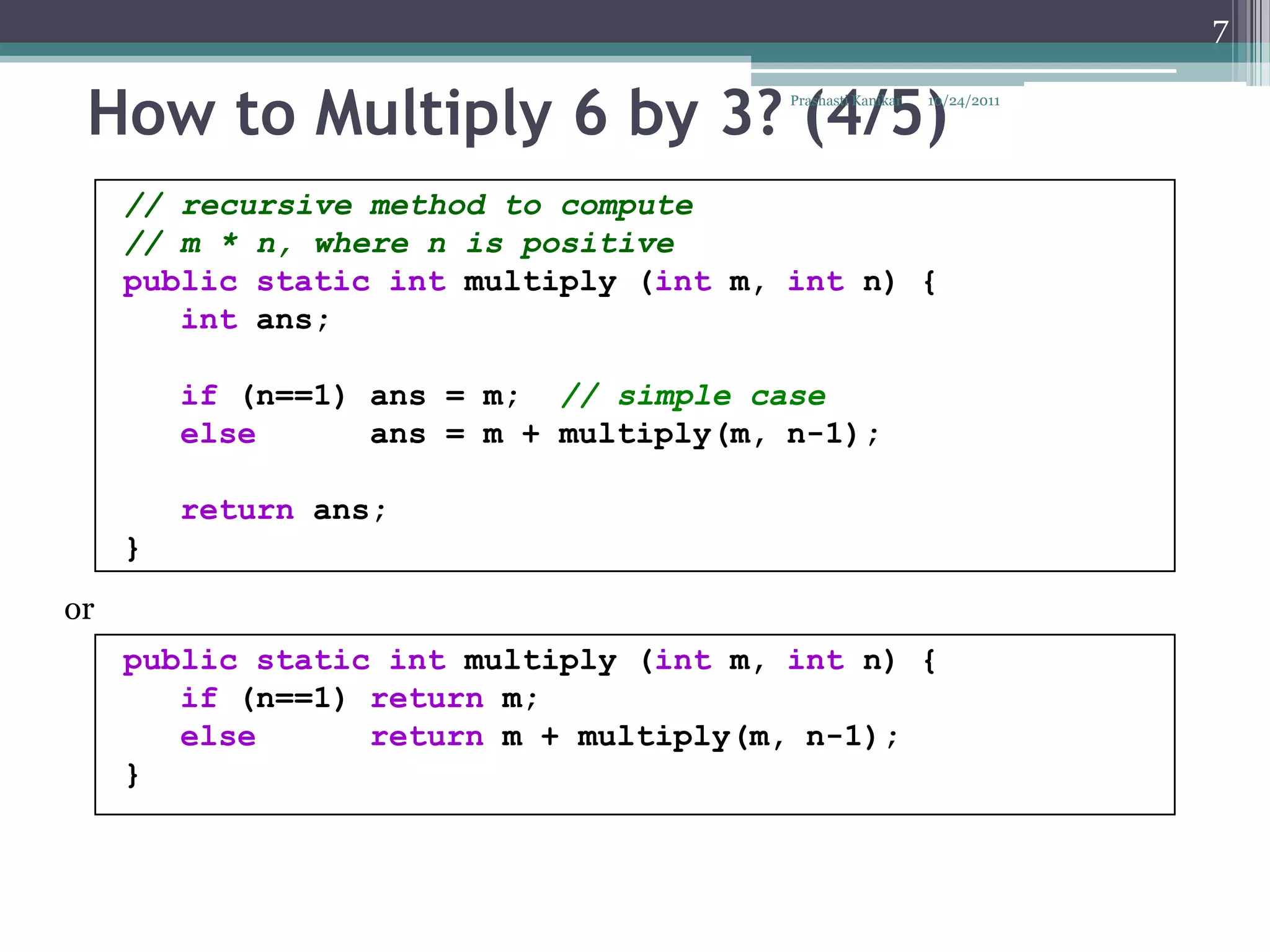
     // recursive method to compute
     // m * n, where n is positive
     public static int multiply (int m, int n) {
        int ans;

         if (n==1) ans = m; // simple case
         else      ans = m + multiply(m, n-1);

         return ans;
     }
or
     public static int multiply (int m, int n) {
        if (n==1) return m;
        else      return m + multiply(m, n-1);
     }
8


 How to Multiply 6 by 3? (5/5)         Prashasti Kanikar   10/24/2011


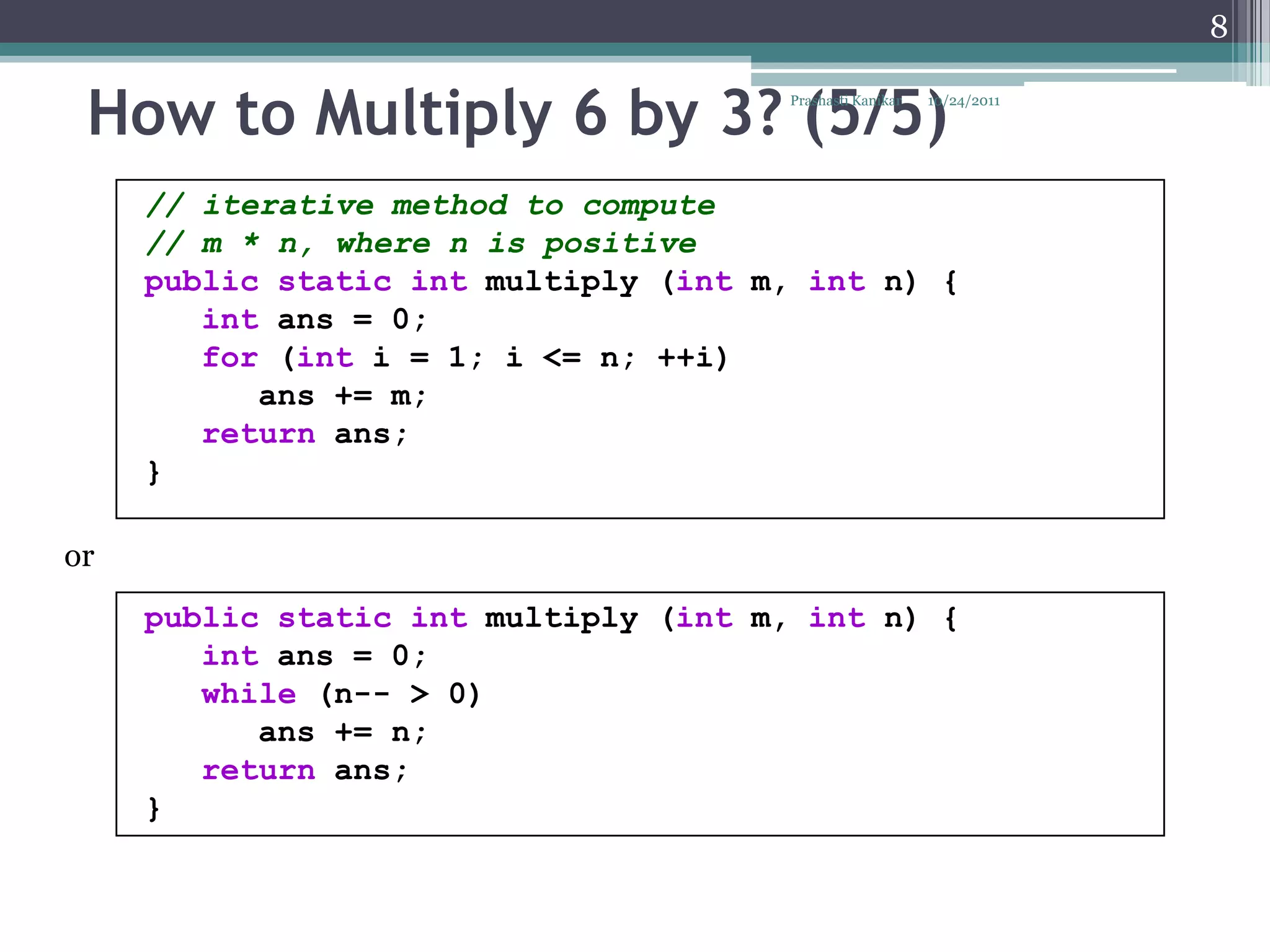
     // iterative method to compute
     // m * n, where n is positive
     public static int multiply (int m, int n) {
        int ans = 0;
        for (int i = 1; i <= n; ++i)
           ans += m;
        return ans;
     }

or
     public static int multiply (int m, int n) {
        int ans = 0;
        while (n-- > 0)
           ans += n;
        return ans;
     }
9


Count Occurrences of Character    Prashasti Kanikar   10/24/2011


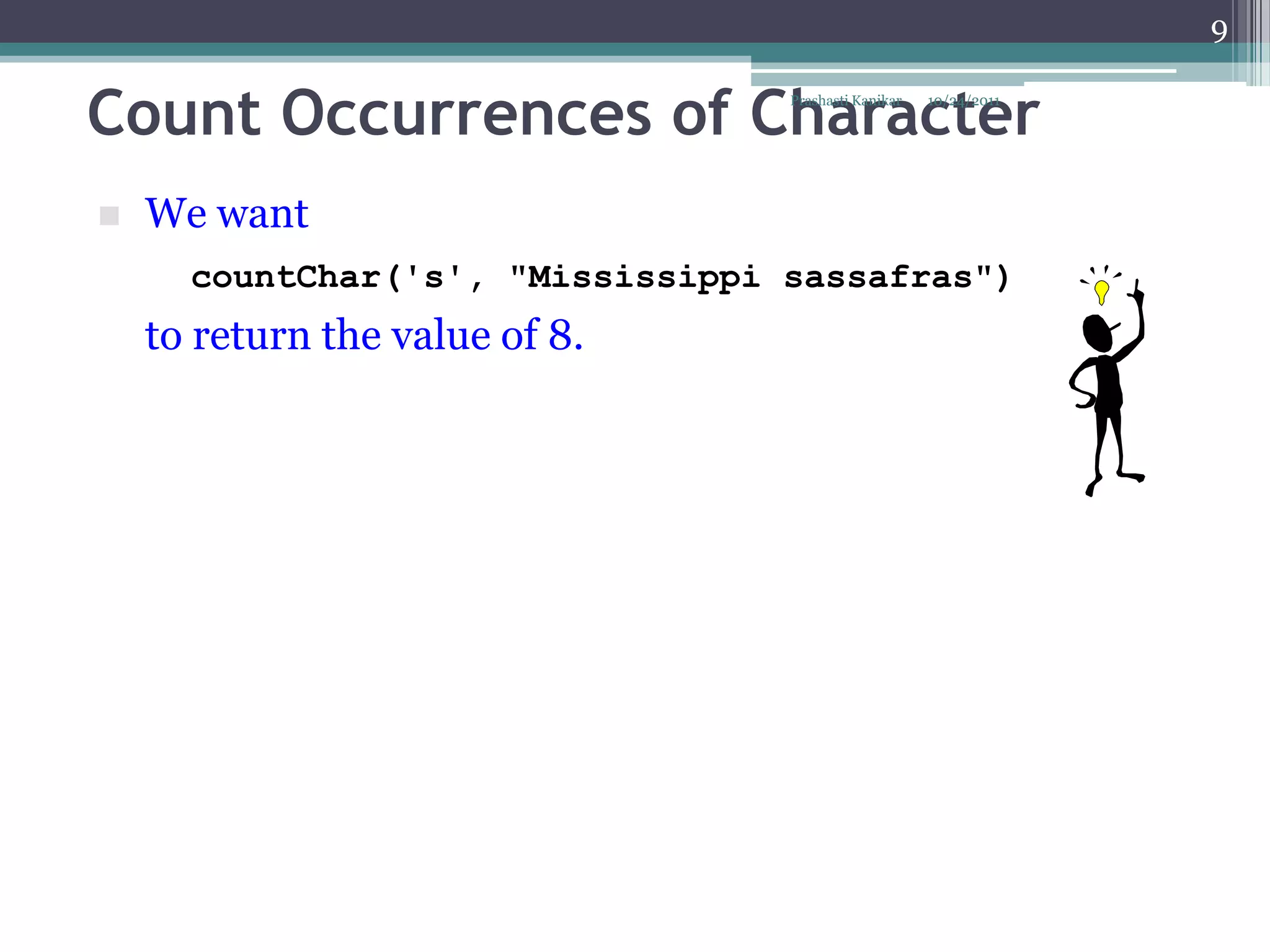
   We want
      countChar('s', "Mississippi sassafras")
    to return the value of 8.
10


Count Occurrences of Character   Prashasti Kanikar   10/24/2011


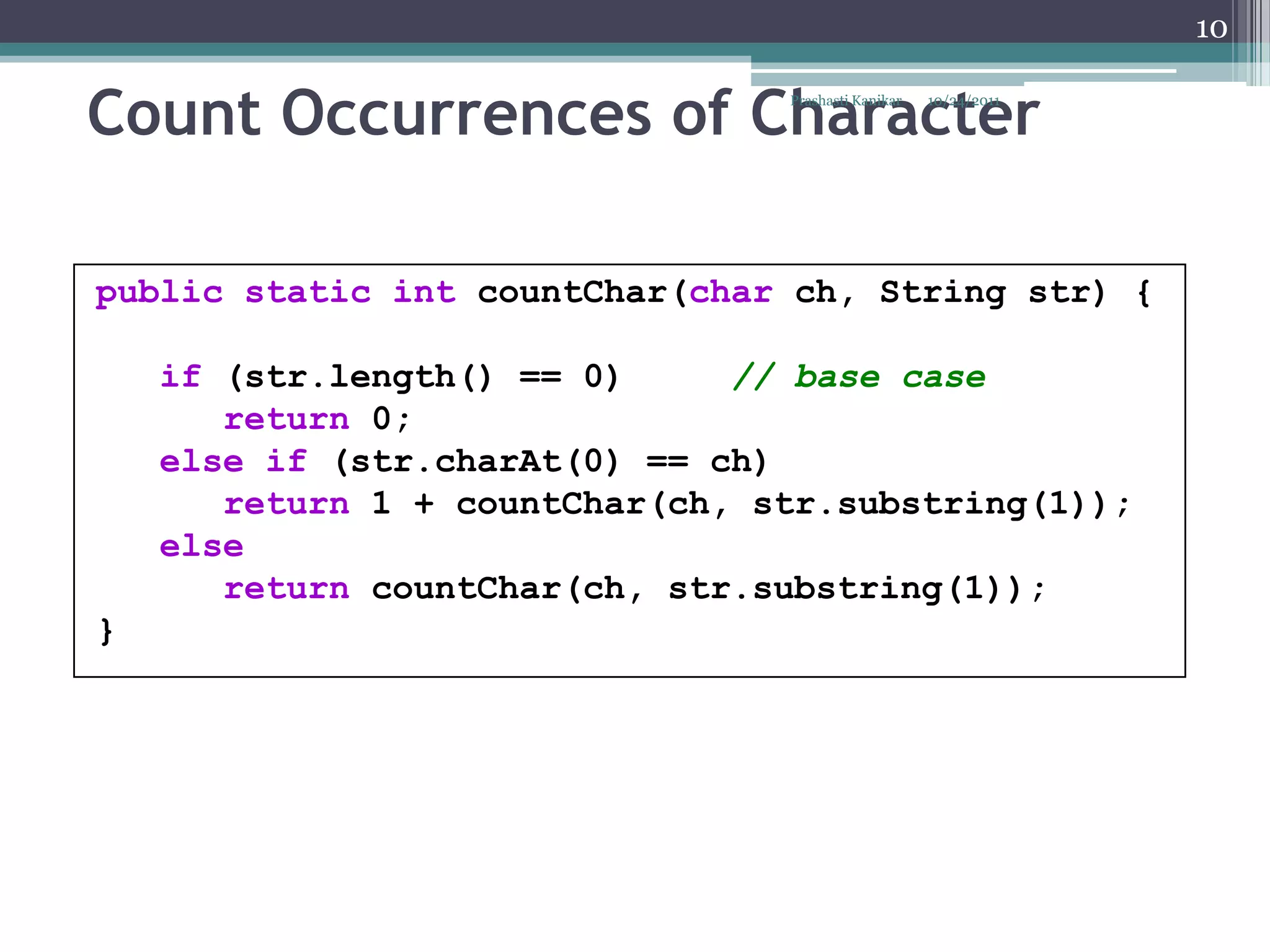
public static int countChar(char ch, String str) {

    if (str.length() == 0)     // base case
       return 0;
    else if (str.charAt(0) == ch)
       return 1 + countChar(ch, str.substring(1));
    else
       return countChar(ch, str.substring(1));
}
11


Count Occurrences of Character    Prashasti Kanikar   10/24/2011


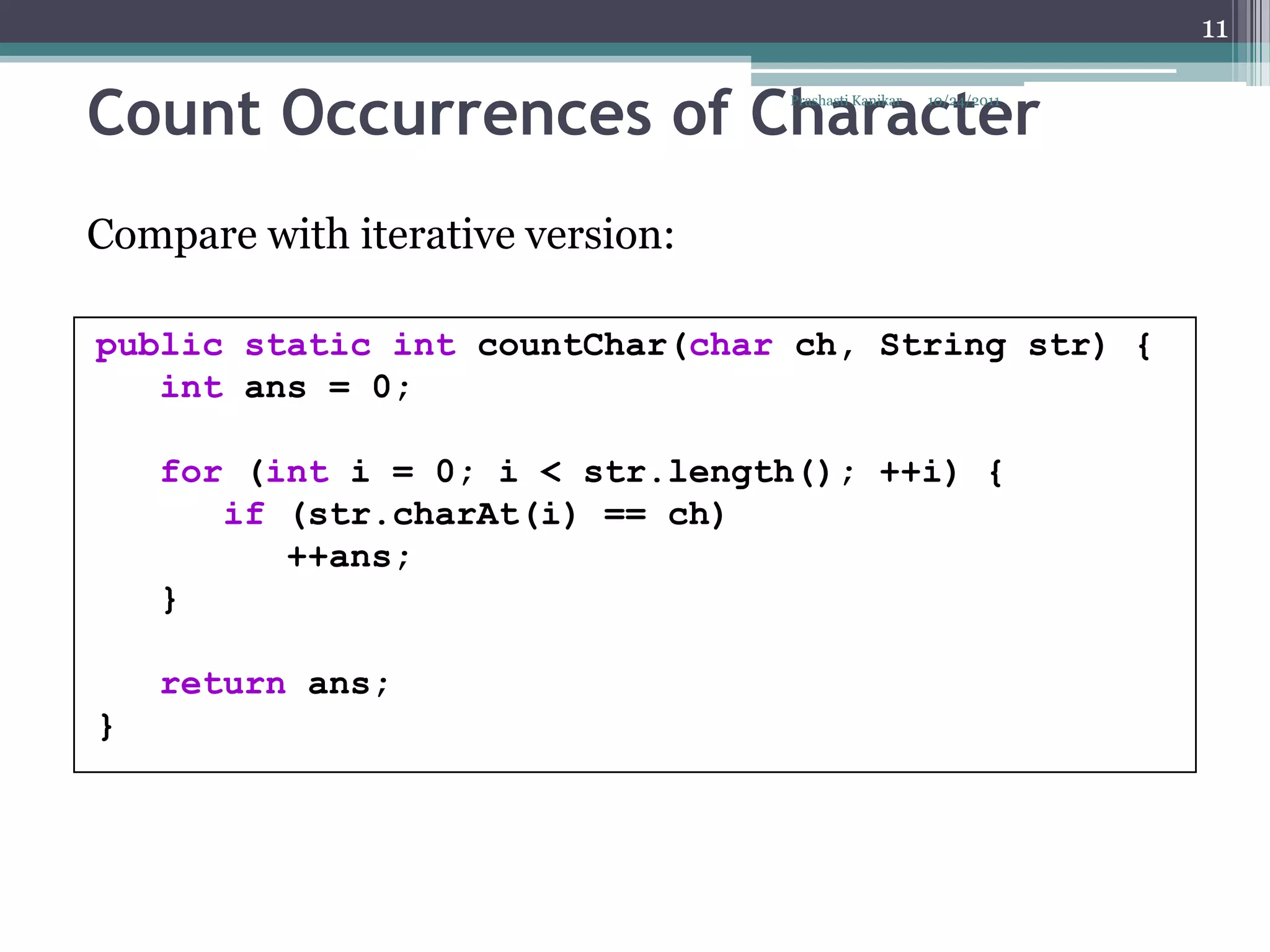
Compare with iterative version:

public static int countChar(char ch, String str) {
   int ans = 0;

    for (int i = 0; i < str.length(); ++i) {
       if (str.charAt(i) == ch)
          ++ans;
    }

    return ans;
}
12


Factorial: Definition                 Prashasti Kanikar   10/24/2011


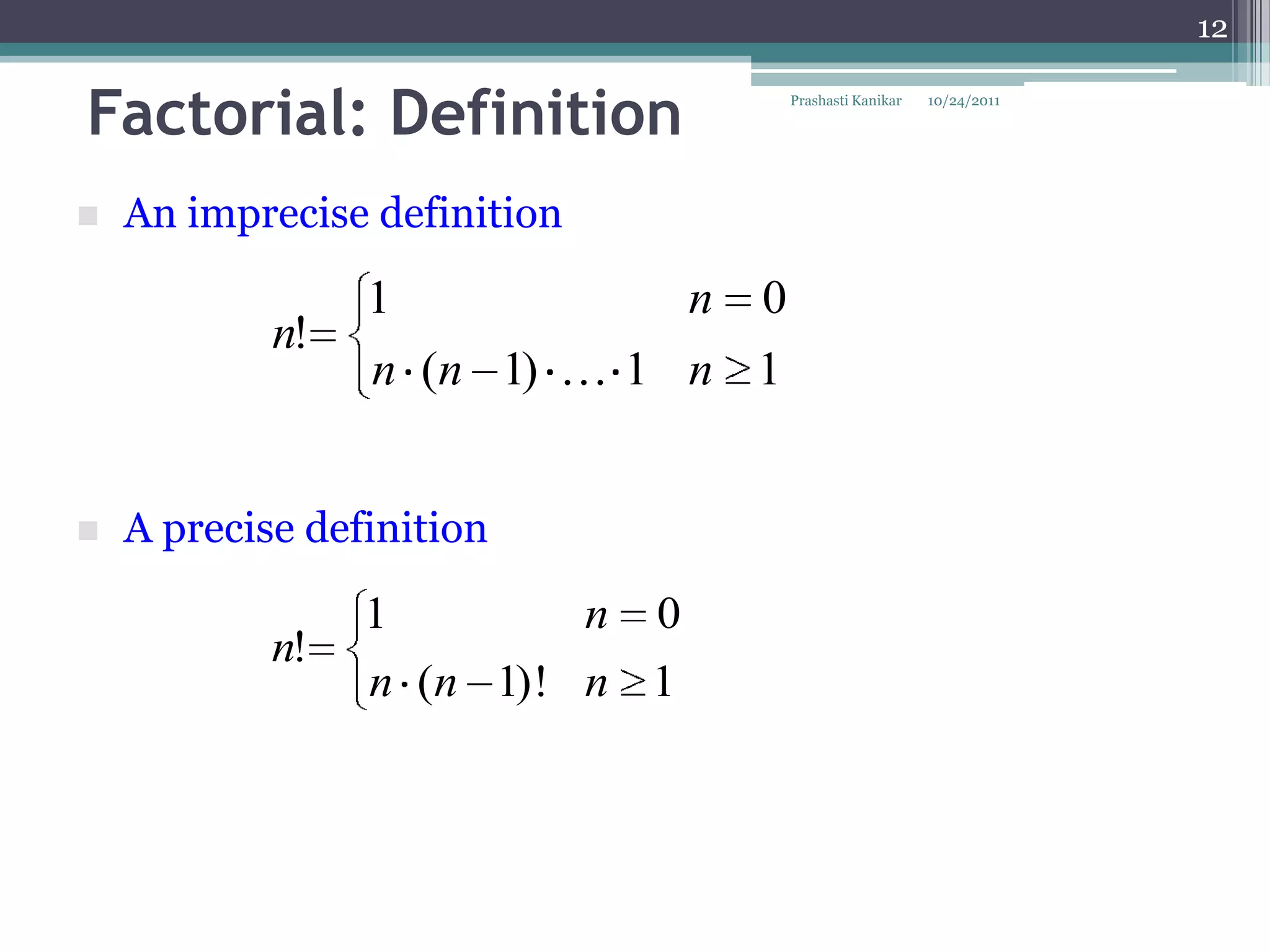
   An imprecise definition

                 1           n 0
            n!
                 n (n 1)  1 n 1


   A precise definition

                 1            n   0
            n!
                 n (n 1)! n 1
13


Recursive Methods                              Prashasti Kanikar   10/24/2011


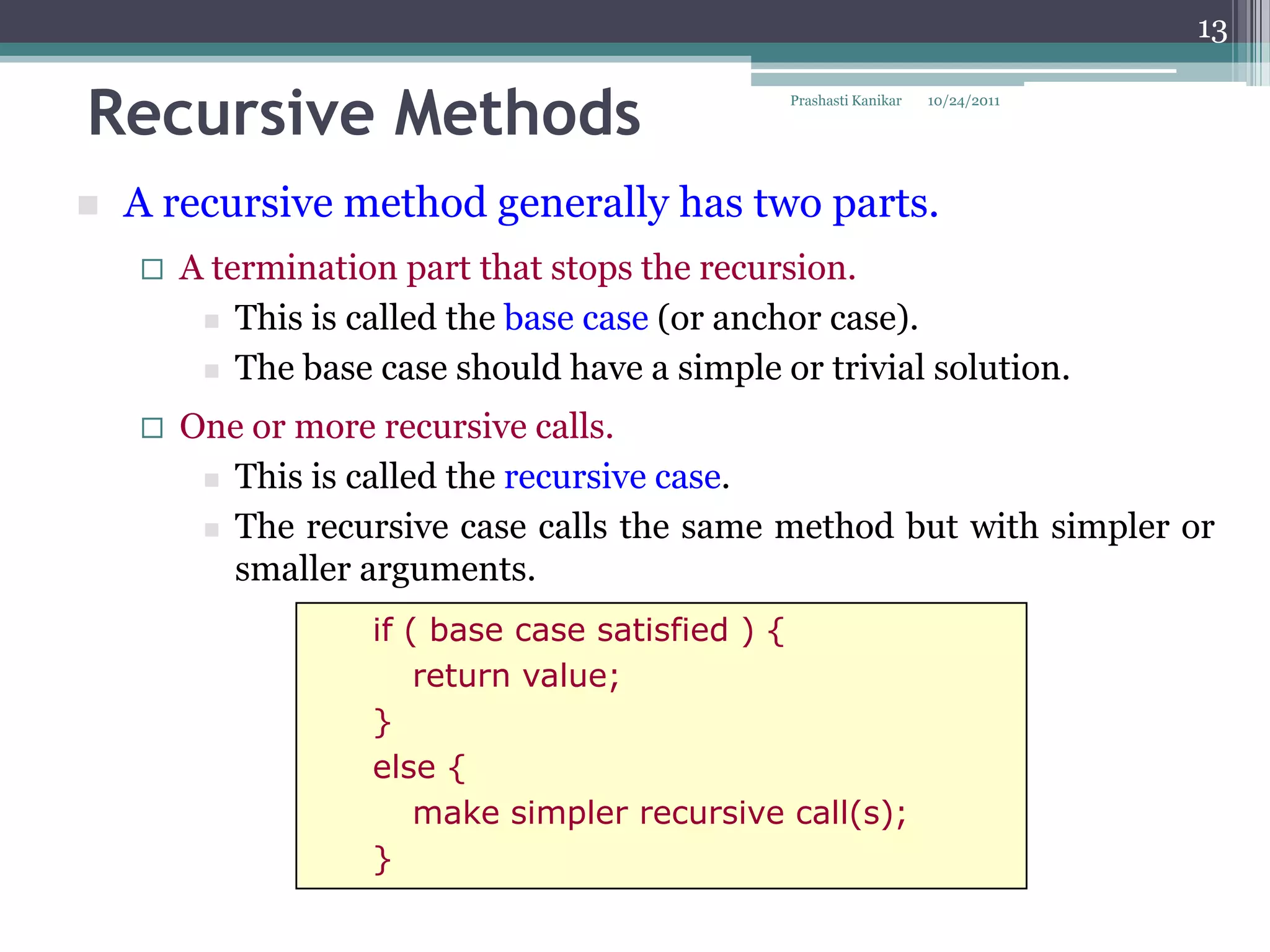
   A recursive method generally has two parts.
       A termination part that stops the recursion.
          This is called the base case (or anchor case).

          The base case should have a simple or trivial solution.

       One or more recursive calls.
          This is called the recursive case.

          The recursive case calls the same method but with simpler or
           smaller arguments.
                    if ( base case satisfied ) {
                        return value;
                    }
                    else {
                        make simpler recursive call(s);
                    }
14


factorial()                  Prashasti Kanikar   10/24/2011


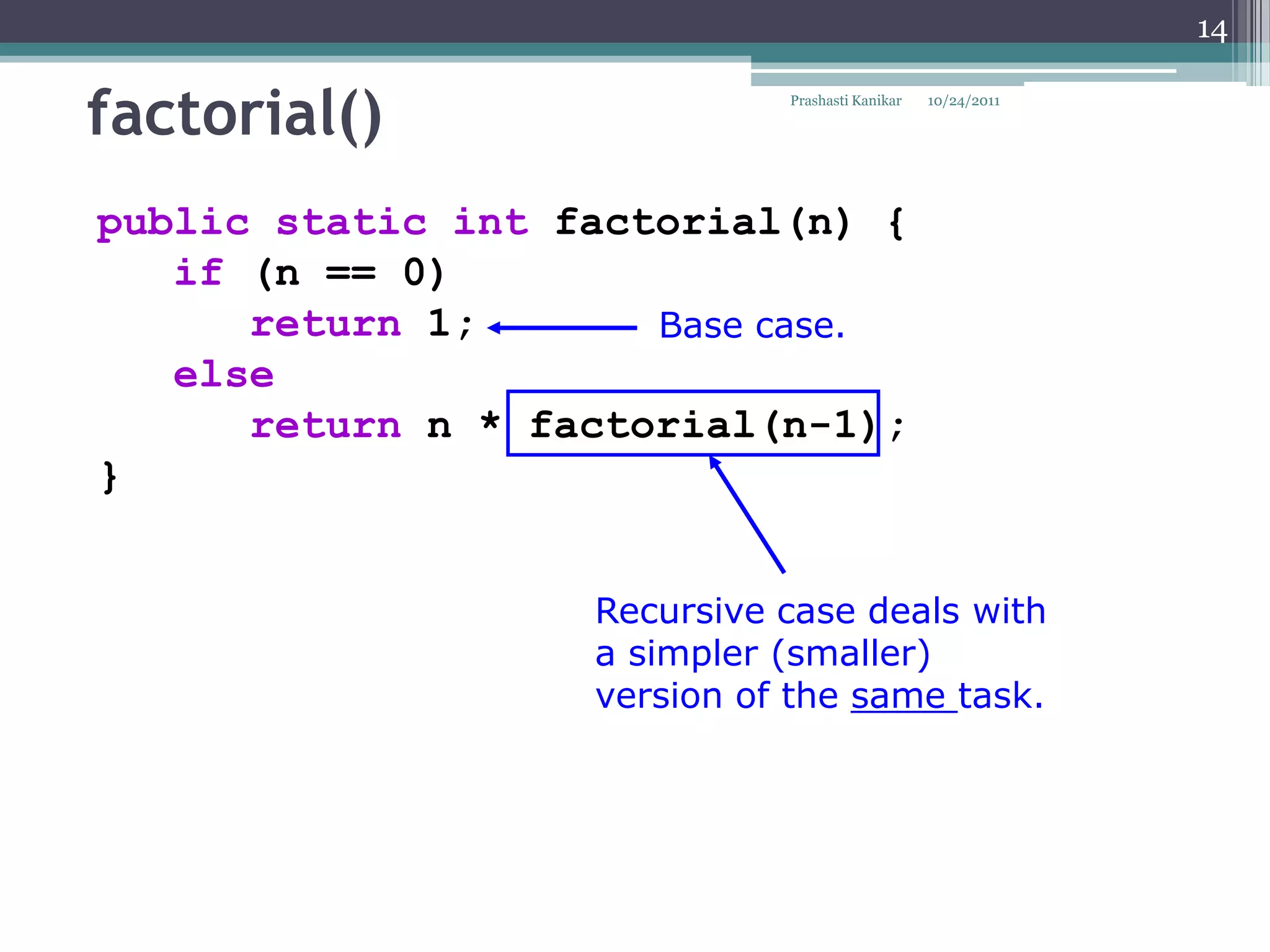
public static int factorial(n) {
   if (n == 0)
      return 1;       Base case.
   else
      return n * factorial(n-1);
}


                   Recursive case deals with
                   a simpler (smaller)
                   version of the same task.
15


Factorial: Recursive Invocation              Prashasti Kanikar   10/24/2011


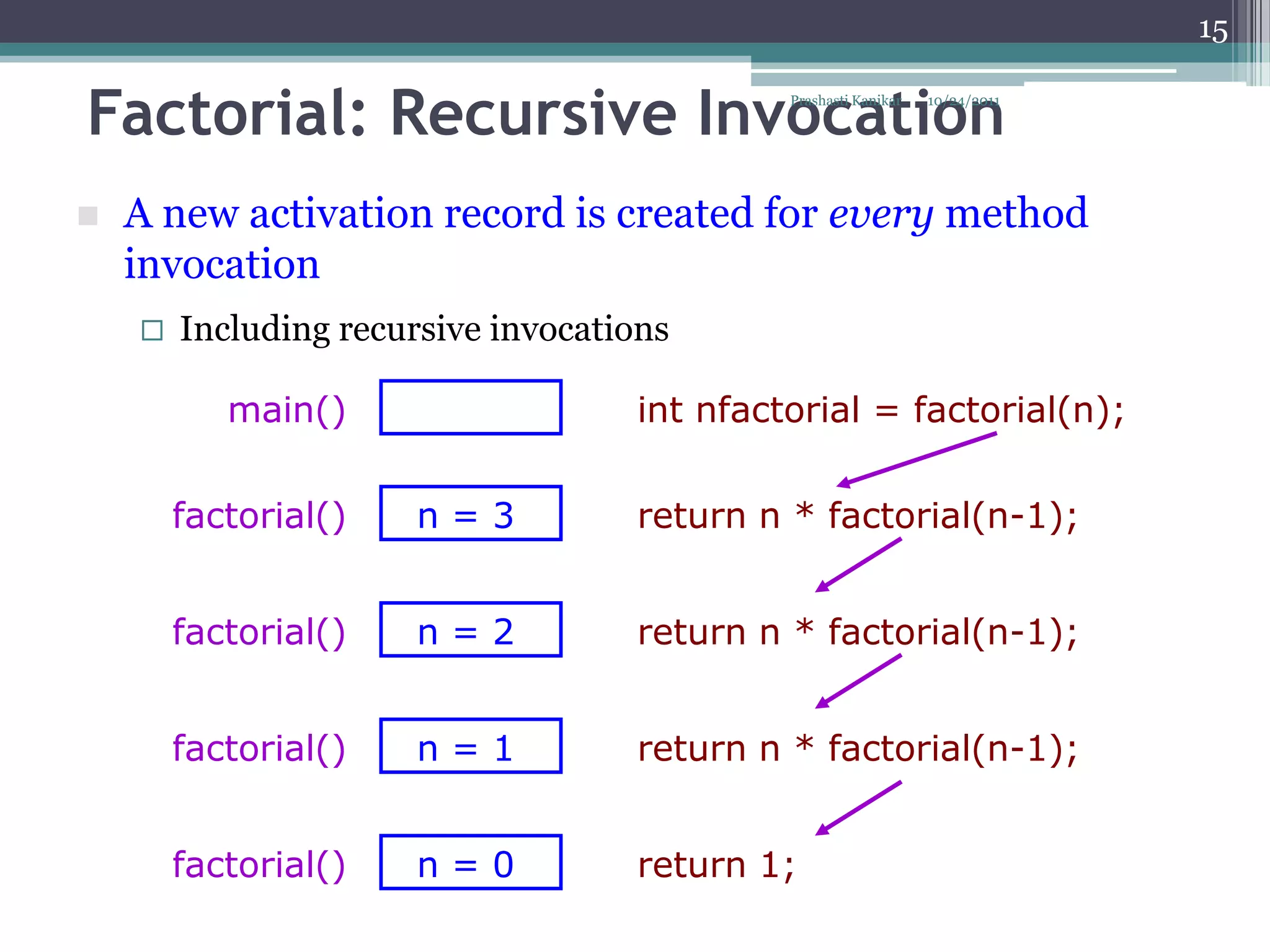
   A new activation record is created for every method
    invocation
       Including recursive invocations

           main()                   int nfactorial = factorial(n);

        factorial()    n=3          return n * factorial(n-1);


        factorial()    n=2          return n * factorial(n-1);


        factorial()    n=1          return n * factorial(n-1);


        factorial()    n=0          return 1;
16


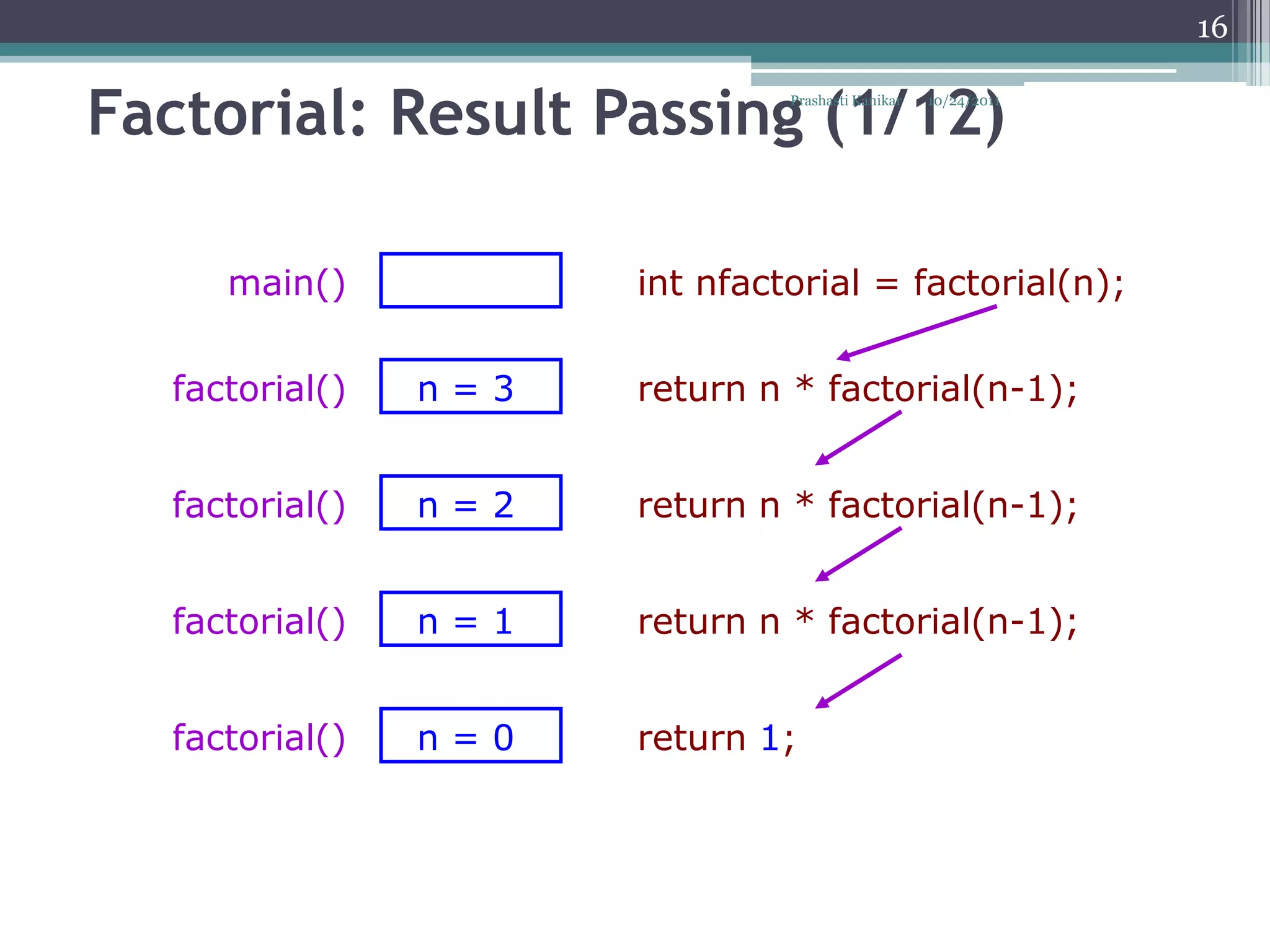
Factorial: Result Passing (1/12)
                               Prashasti Kanikar   10/24/2011


     main()           int nfactorial = factorial(n);

  factorial()   n=3   return n * factorial(n-1);


  factorial()   n=2   return n * factorial(n-1);


  factorial()   n=1   return n * factorial(n-1);


  factorial()   n=0   return 1;
17


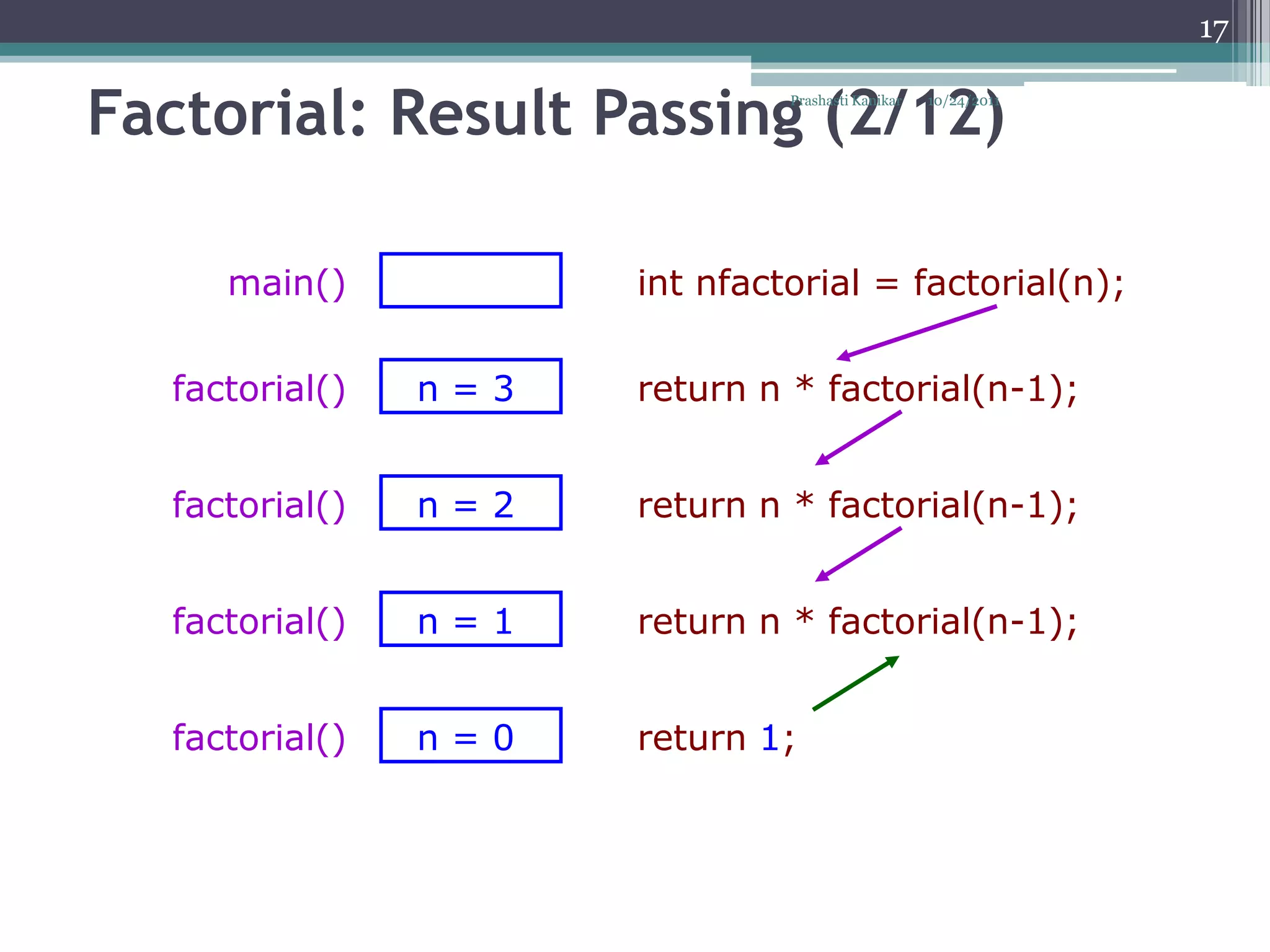
Factorial: Result Passing (2/12)
                               Prashasti Kanikar   10/24/2011


     main()           int nfactorial = factorial(n);

  factorial()   n=3   return n * factorial(n-1);


  factorial()   n=2   return n * factorial(n-1);


  factorial()   n=1   return n * factorial(n-1);


  factorial()   n=0   return 1;
18


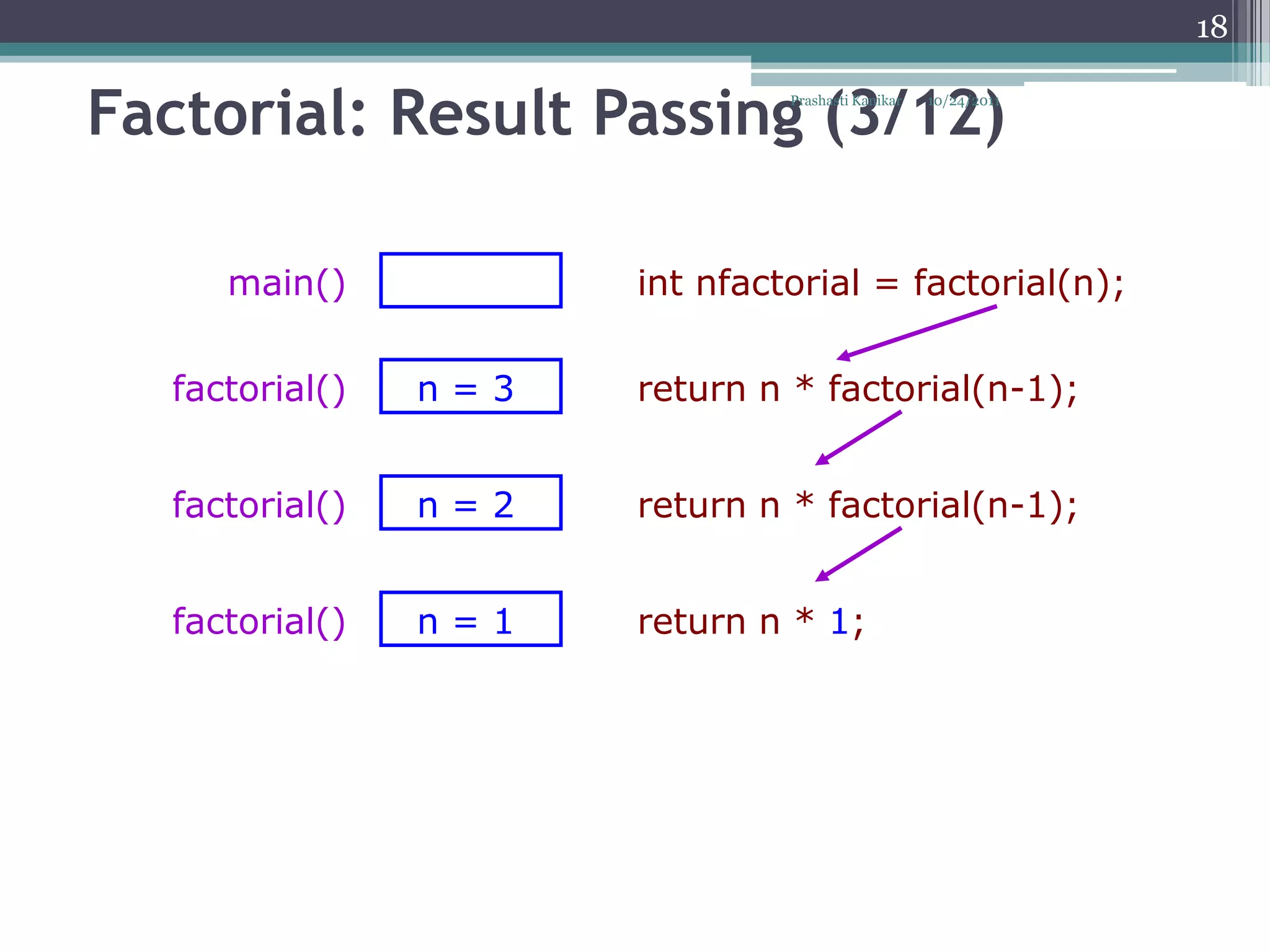
Factorial: Result Passing (3/12)
                               Prashasti Kanikar   10/24/2011


     main()           int nfactorial = factorial(n);

  factorial()   n=3   return n * factorial(n-1);


  factorial()   n=2   return n * factorial(n-1);


  factorial()   n=1   return n * 1;
19


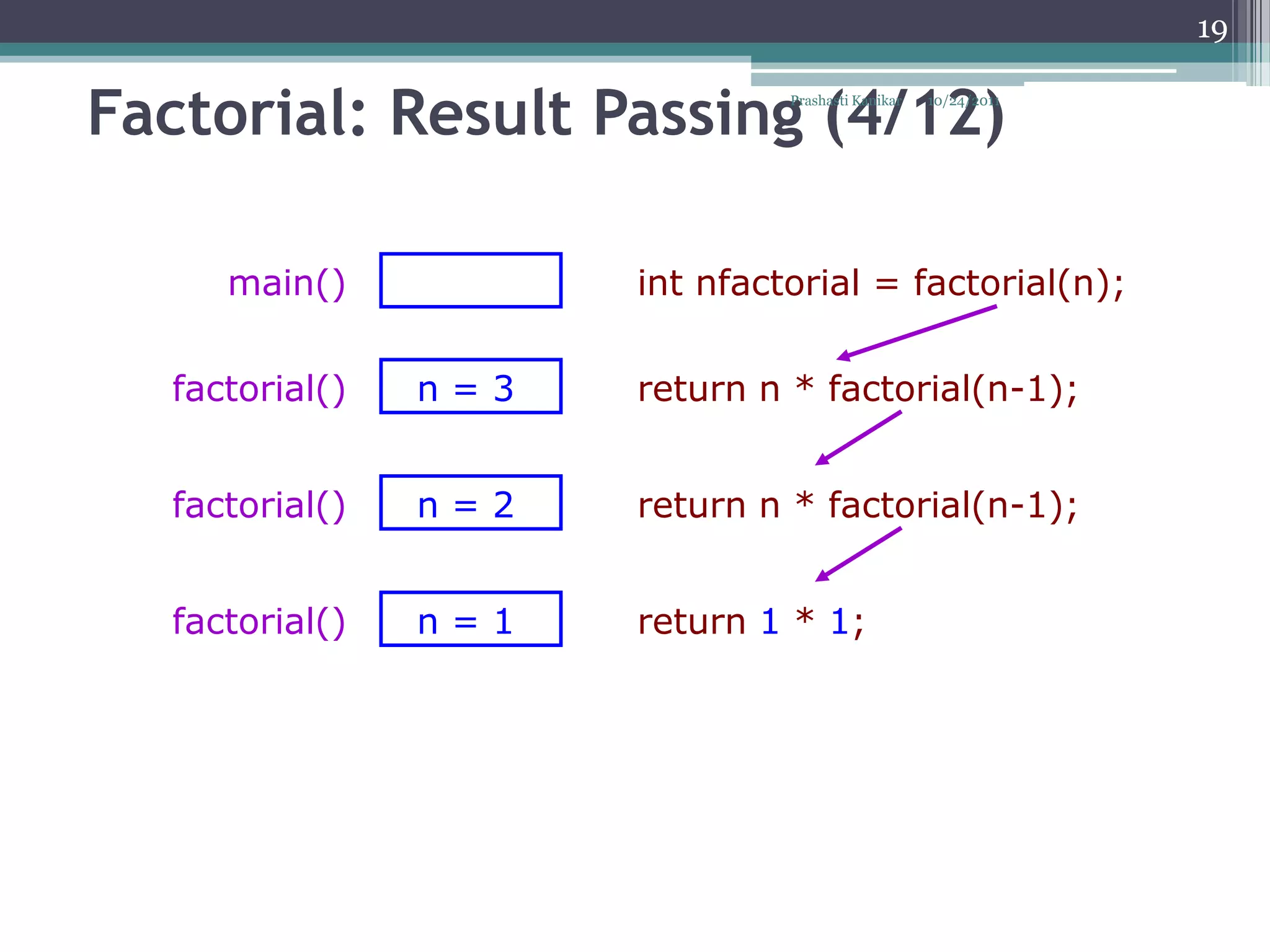
Factorial: Result Passing (4/12)
                               Prashasti Kanikar   10/24/2011


     main()           int nfactorial = factorial(n);

  factorial()   n=3   return n * factorial(n-1);


  factorial()   n=2   return n * factorial(n-1);


  factorial()   n=1   return 1 * 1;
20


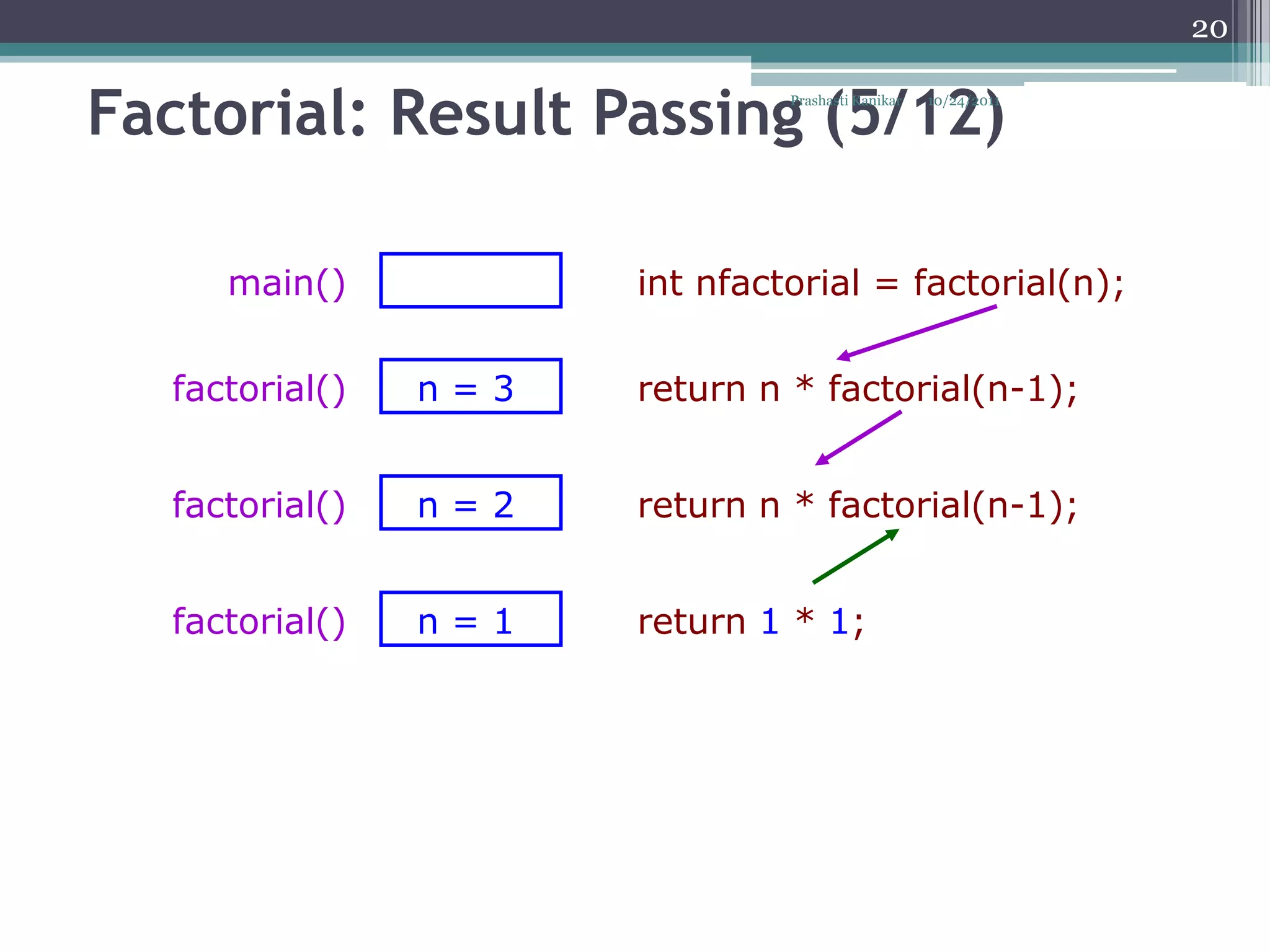
Factorial: Result Passing (5/12)
                               Prashasti Kanikar   10/24/2011


     main()           int nfactorial = factorial(n);

  factorial()   n=3   return n * factorial(n-1);


  factorial()   n=2   return n * factorial(n-1);


  factorial()   n=1   return 1 * 1;
21


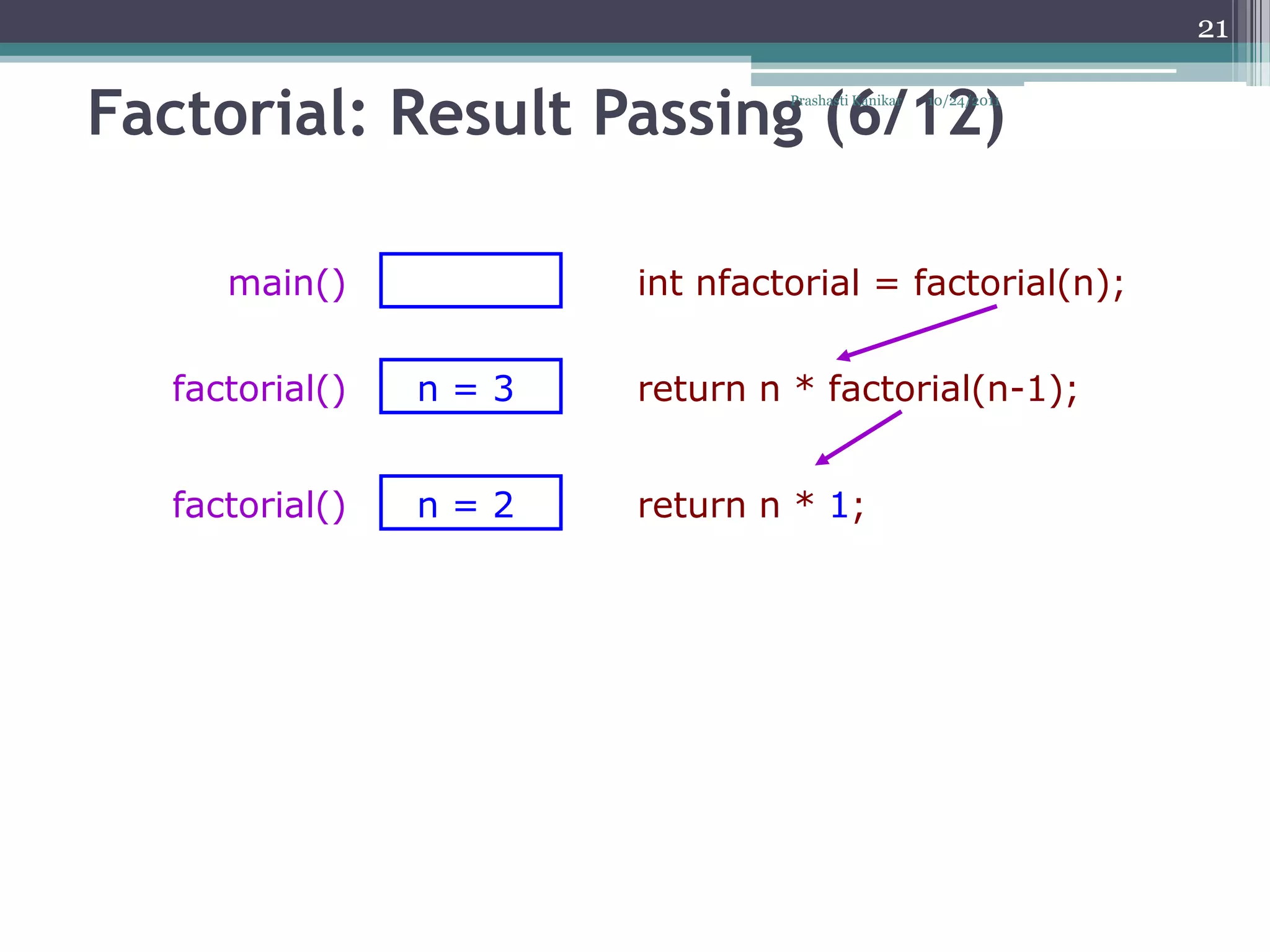
Factorial: Result Passing (6/12)
                               Prashasti Kanikar   10/24/2011


     main()           int nfactorial = factorial(n);

  factorial()   n=3   return n * factorial(n-1);


  factorial()   n=2   return n * 1;
22


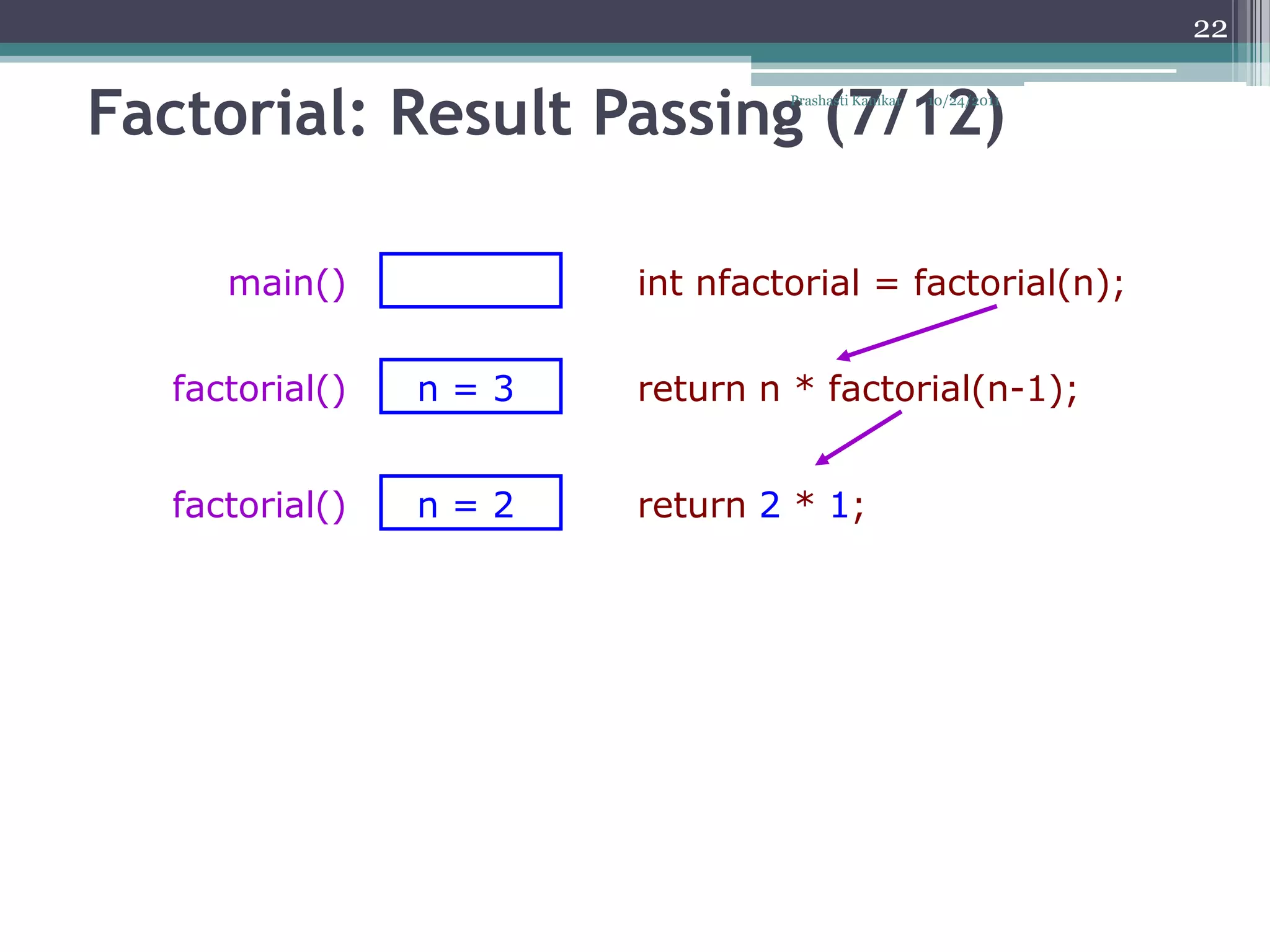
Factorial: Result Passing (7/12)
                               Prashasti Kanikar   10/24/2011


     main()           int nfactorial = factorial(n);

  factorial()   n=3   return n * factorial(n-1);


  factorial()   n=2   return 2 * 1;
23


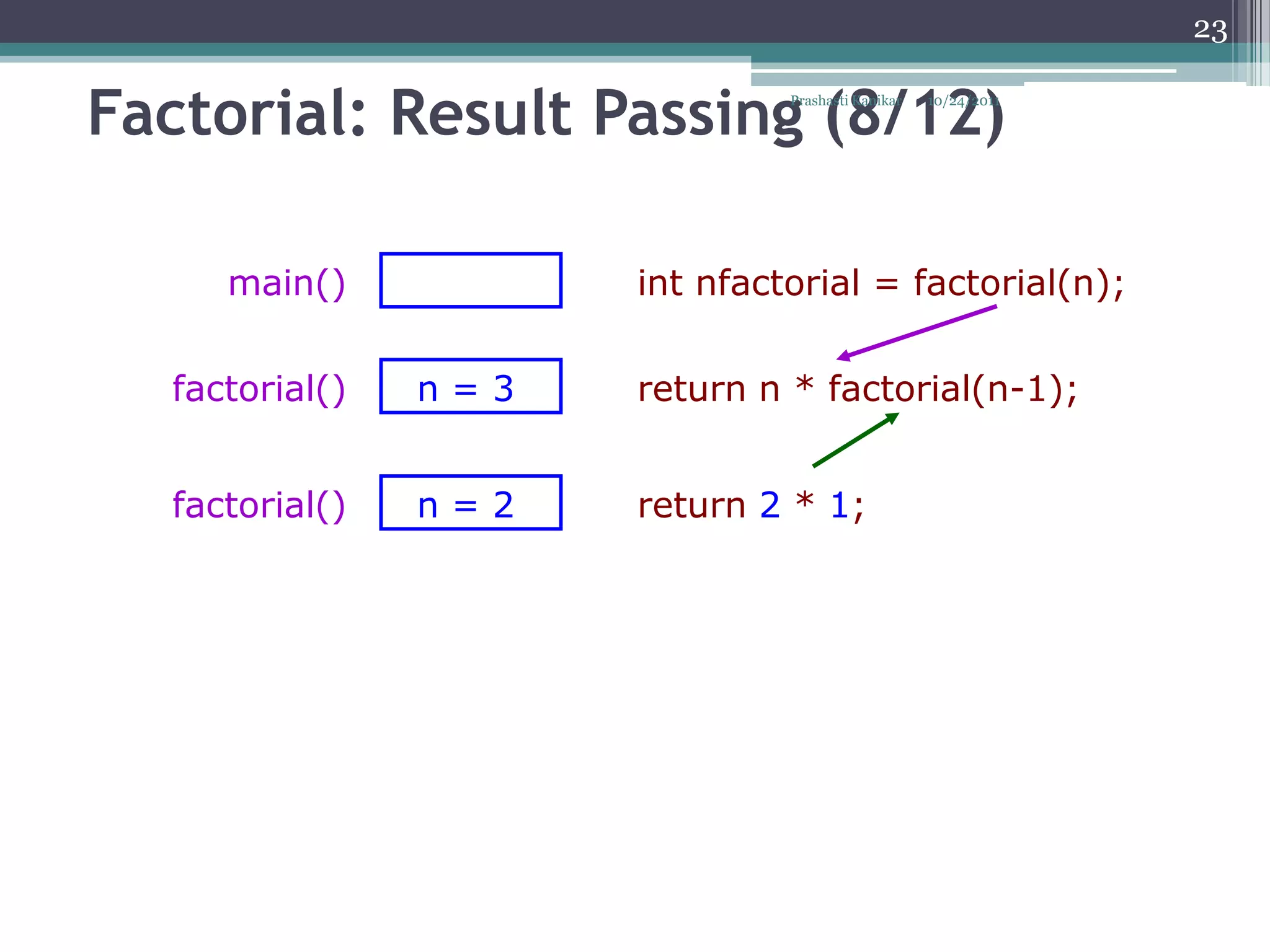
Factorial: Result Passing (8/12)
                               Prashasti Kanikar   10/24/2011


     main()           int nfactorial = factorial(n);

  factorial()   n=3   return n * factorial(n-1);


  factorial()   n=2   return 2 * 1;
24


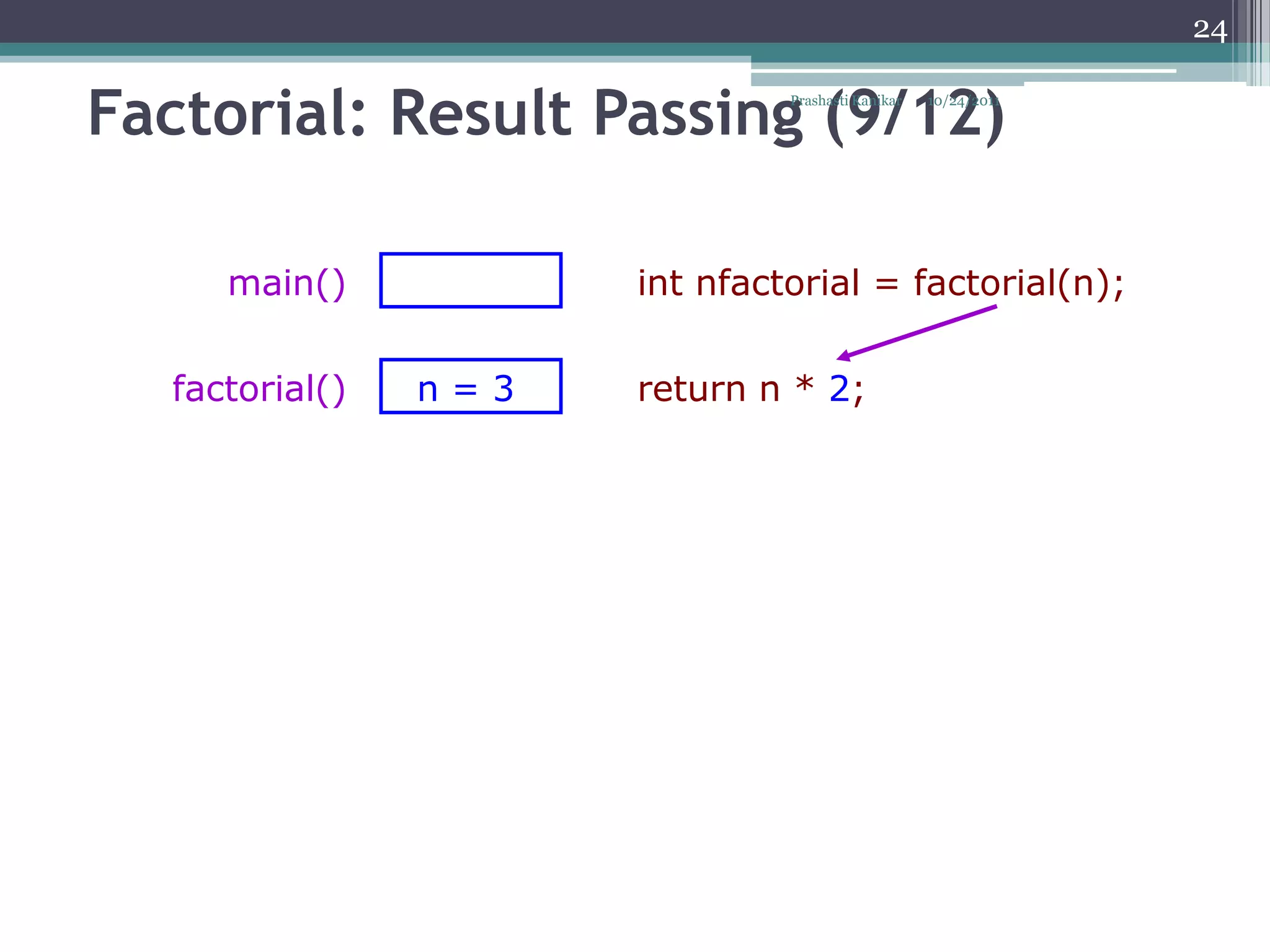
Factorial: Result Passing (9/12)
                               Prashasti Kanikar   10/24/2011


     main()           int nfactorial = factorial(n);

  factorial()   n=3   return n * 2;
25


Factorial: Result Passing (10/12)
                               Prashasti Kanikar   10/24/2011


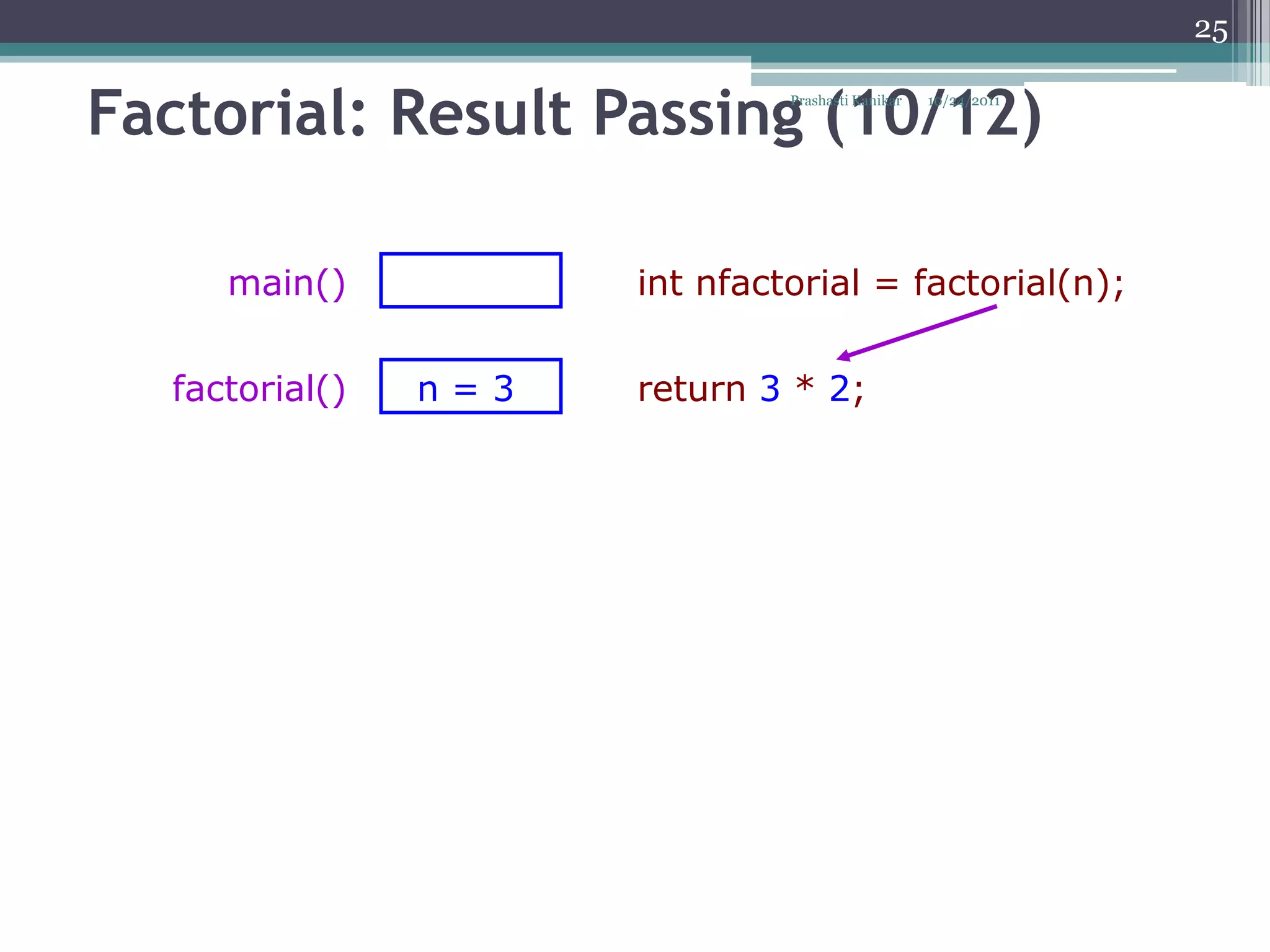
     main()           int nfactorial = factorial(n);

  factorial()   n=3   return 3 * 2;
26


Factorial: Result Passing (11/12)
                               Prashasti Kanikar   10/24/2011


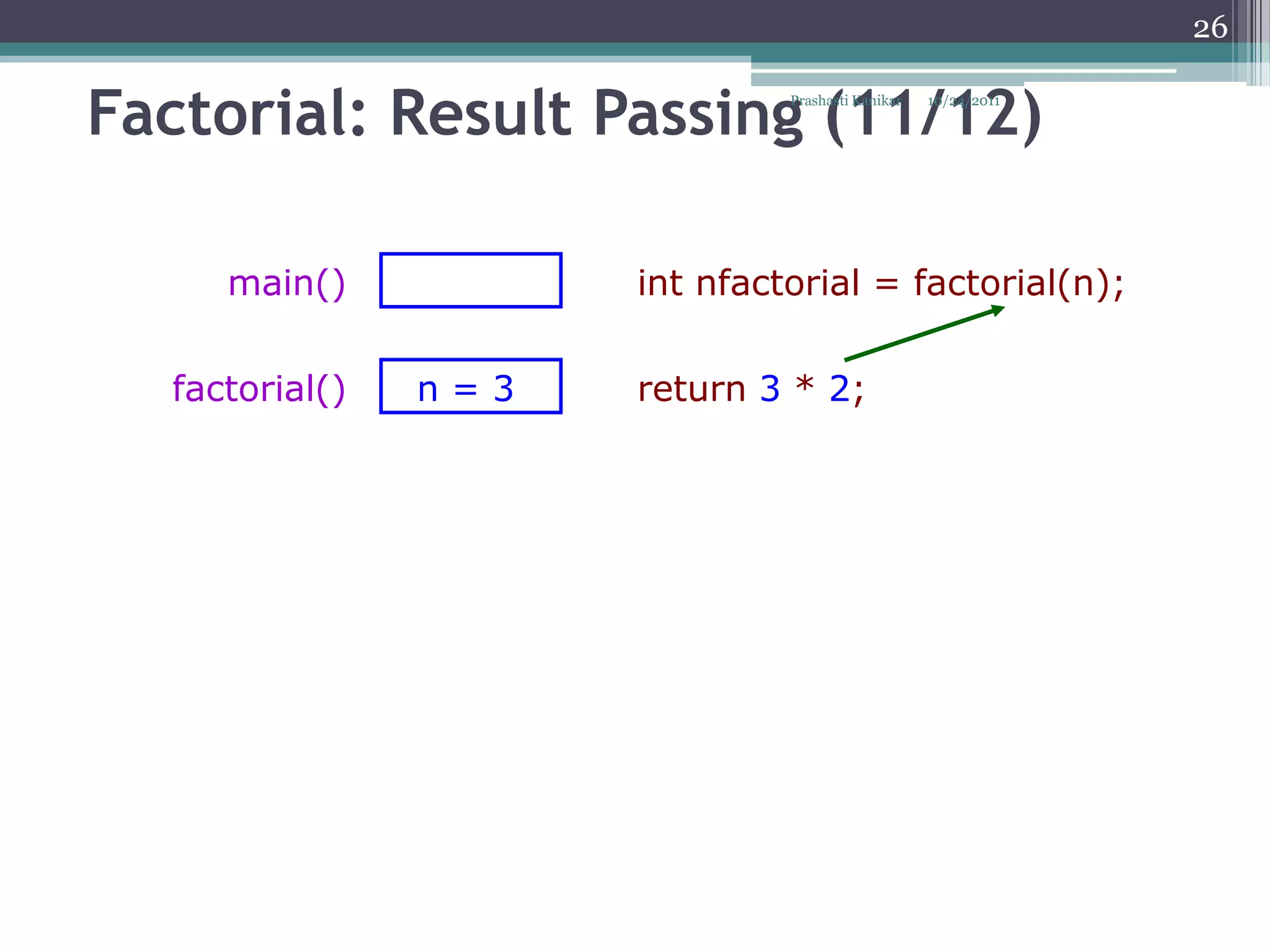
     main()           int nfactorial = factorial(n);

  factorial()   n=3   return 3 * 2;
27


Factorial: Result Passing (12/12)
                           Prashasti Kanikar   10/24/2011


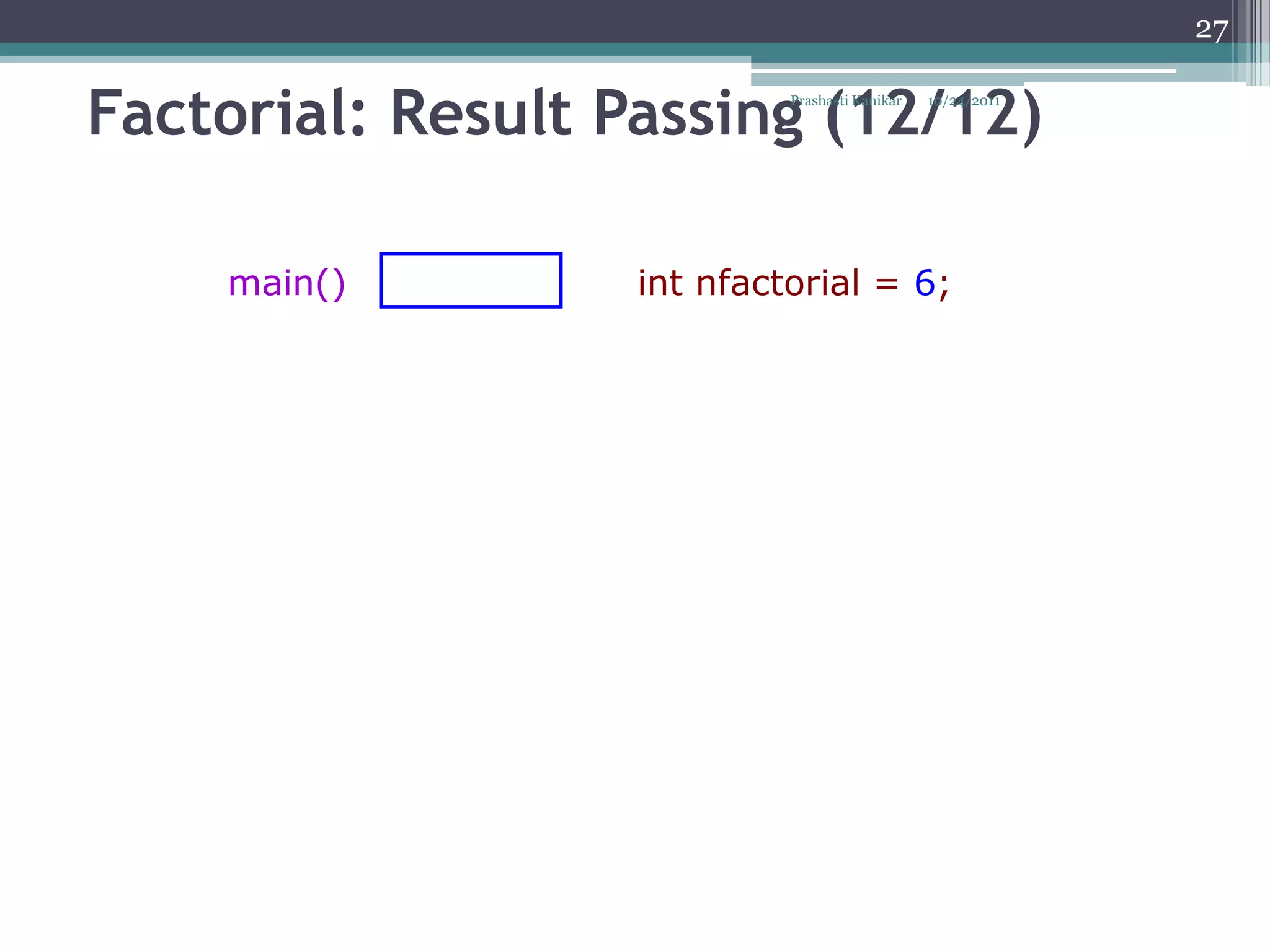
    main()        int nfactorial = 6;
28


Infinite Recursion                          Prashasti Kanikar   10/24/2011


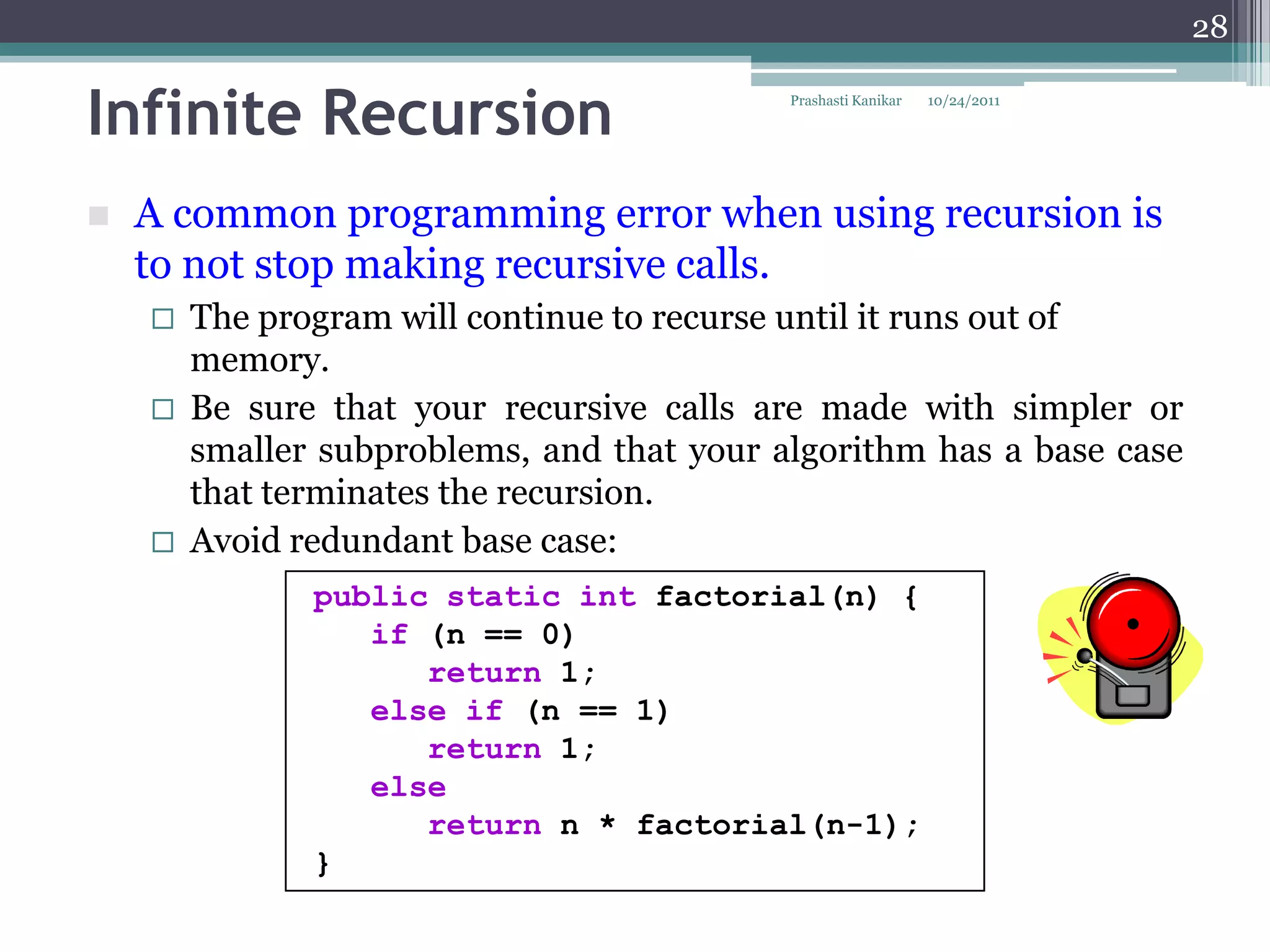
   A common programming error when using recursion is
    to not stop making recursive calls.
       The program will continue to recurse until it runs out of
        memory.
       Be sure that your recursive calls are made with simpler or
        smaller subproblems, and that your algorithm has a base case
        that terminates the recursion.
       Avoid redundant base case:
               public static int factorial(n) {
                  if (n == 0)
                     return 1;
                  else if (n == 1)
                     return 1;
                  else
                     return n * factorial(n-1);
               }
29


    Computing GCD (1/7)                  Prashasti Kanikar   10/24/2011


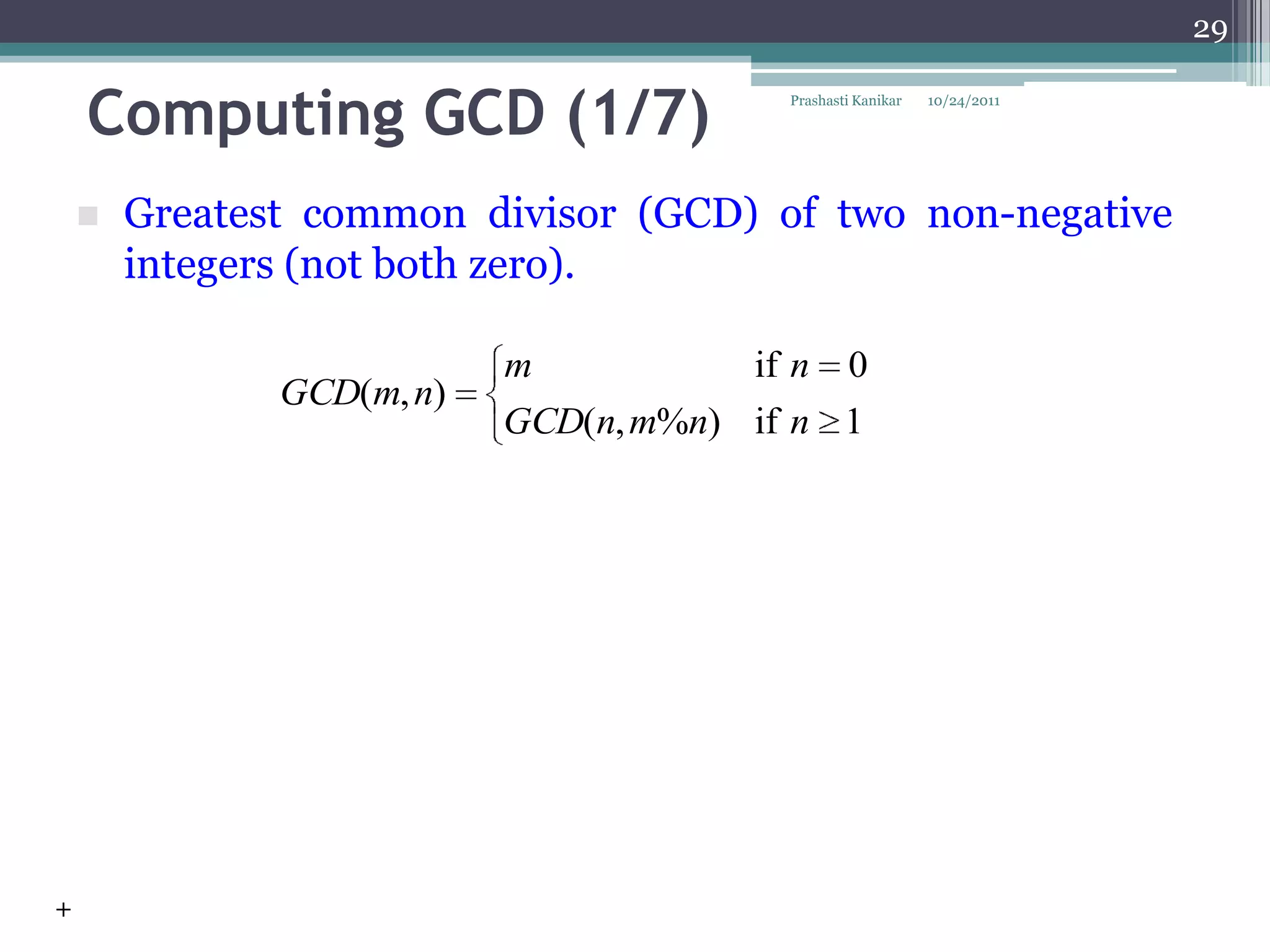
       Greatest common divisor (GCD) of two non-negative
        integers (not both zero).

                           m           if n 0
               GCD(m, n)
                           GCD(n, m%n) if n 1


+
30


Computing GCD (2/7)                  Prashasti Kanikar   10/24/2011


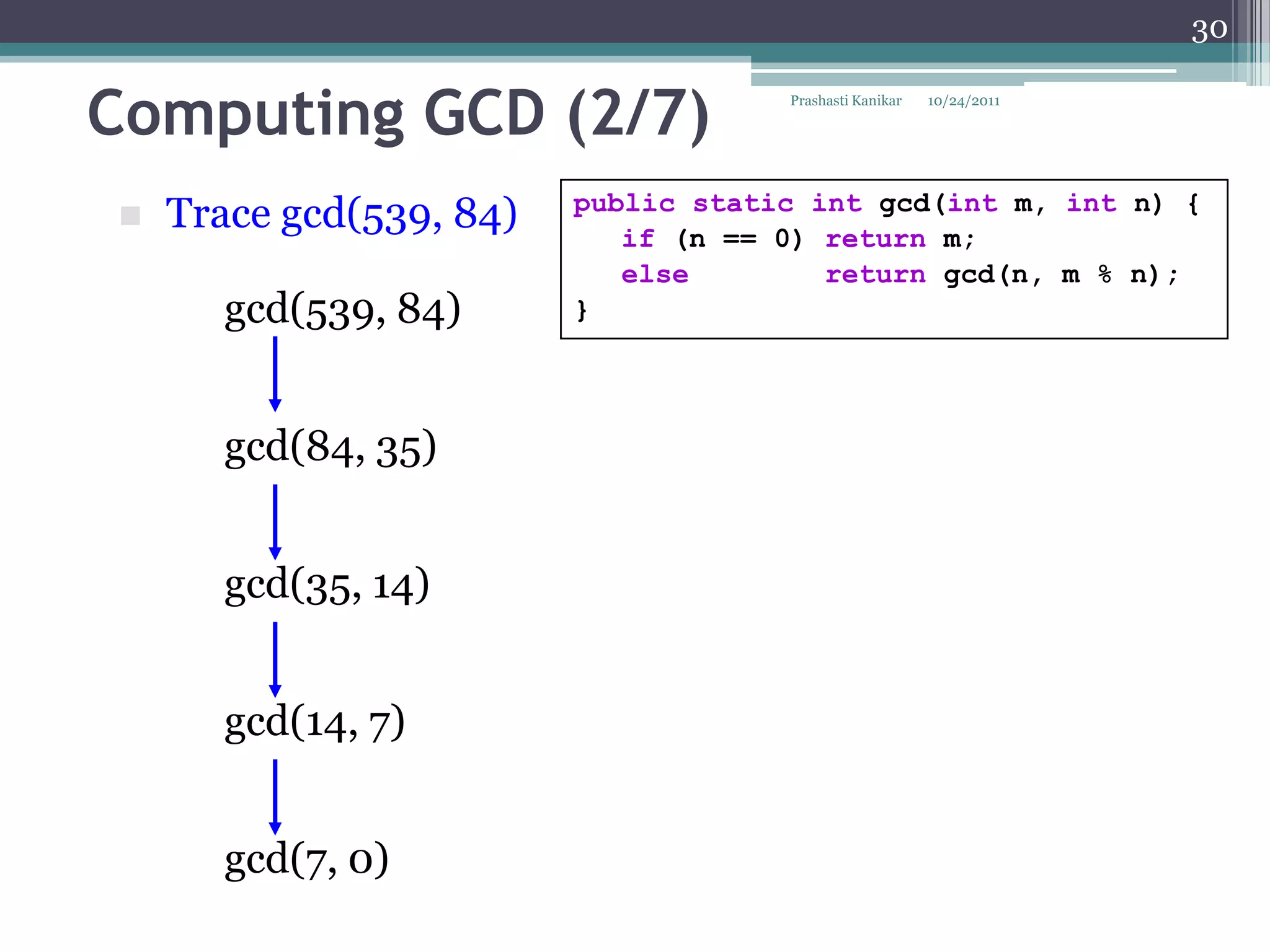
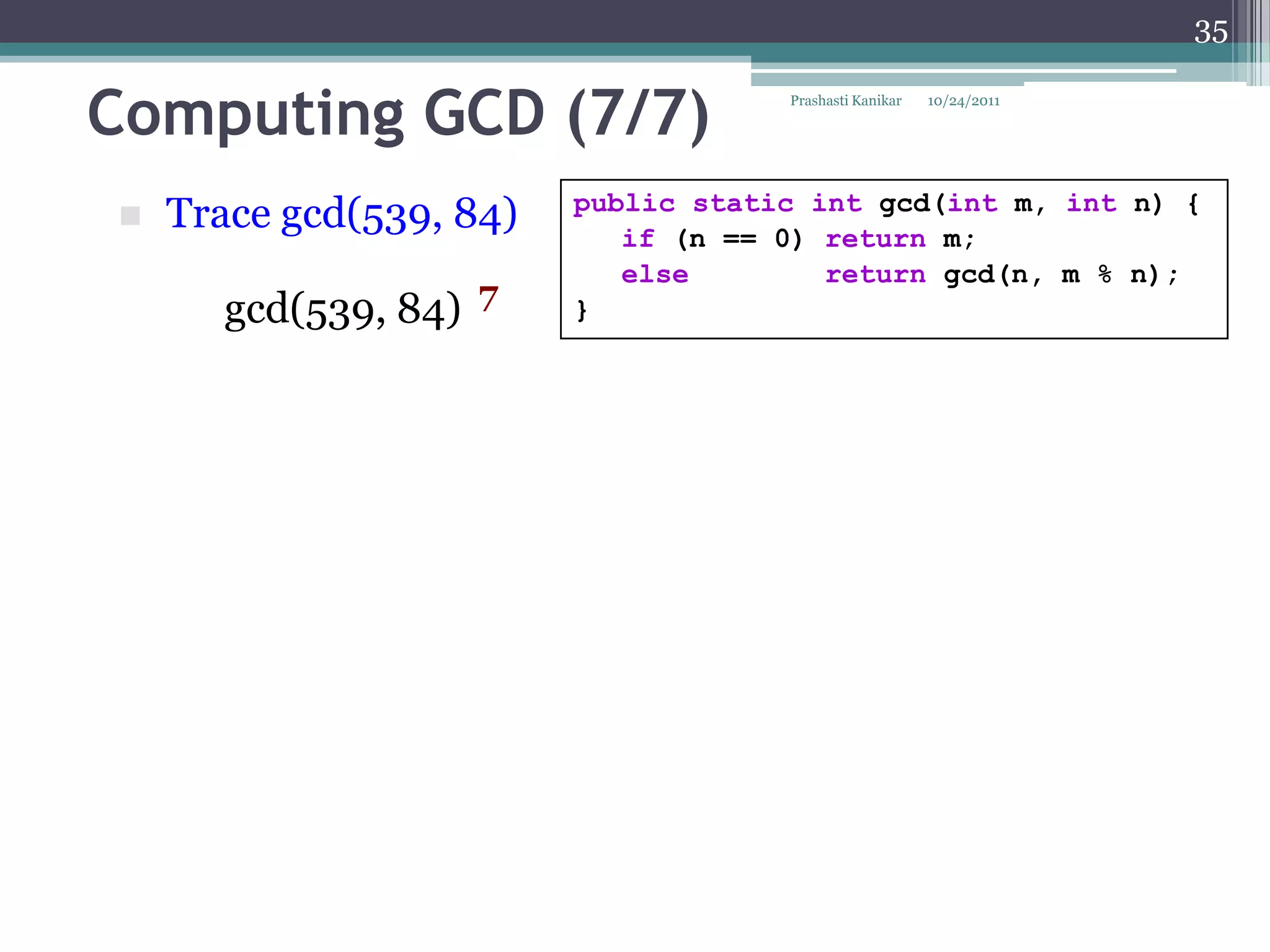
                         public static int gcd(int m, int n) {
   Trace gcd(539, 84)      if (n == 0) return m;
                            else        return gcd(n, m % n);
      gcd(539, 84)       }


      gcd(84, 35)


      gcd(35, 14)


      gcd(14, 7)


      gcd(7, 0)
31


Computing GCD (3/7)                  Prashasti Kanikar   10/24/2011


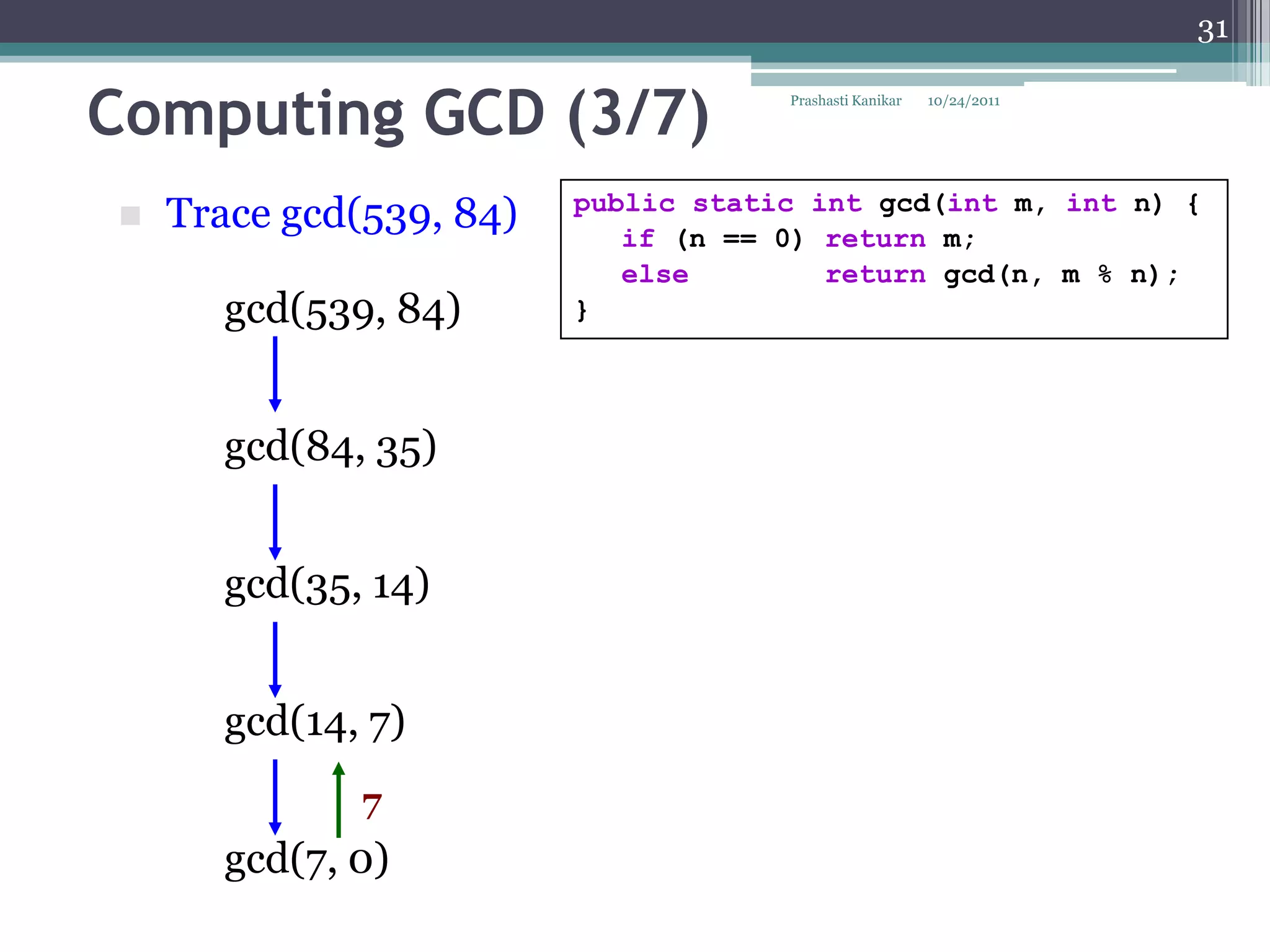
                         public static int gcd(int m, int n) {
   Trace gcd(539, 84)      if (n == 0) return m;
                            else        return gcd(n, m % n);
      gcd(539, 84)       }


      gcd(84, 35)


      gcd(35, 14)


      gcd(14, 7)
              7
      gcd(7, 0)
32


Computing GCD (4/7)                  Prashasti Kanikar   10/24/2011


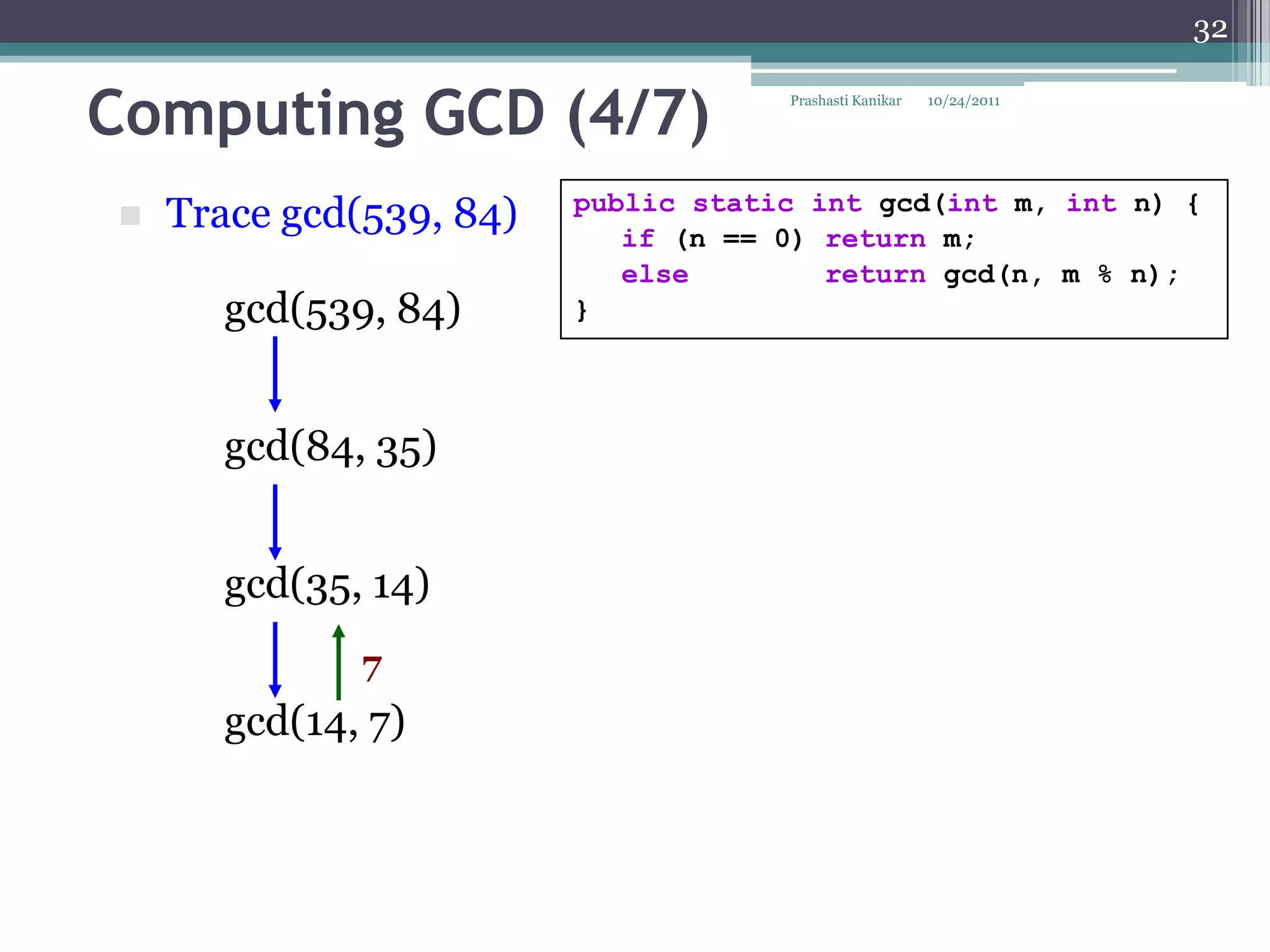
                         public static int gcd(int m, int n) {
   Trace gcd(539, 84)      if (n == 0) return m;
                            else        return gcd(n, m % n);
      gcd(539, 84)       }


      gcd(84, 35)


      gcd(35, 14)
              7
      gcd(14, 7)
33


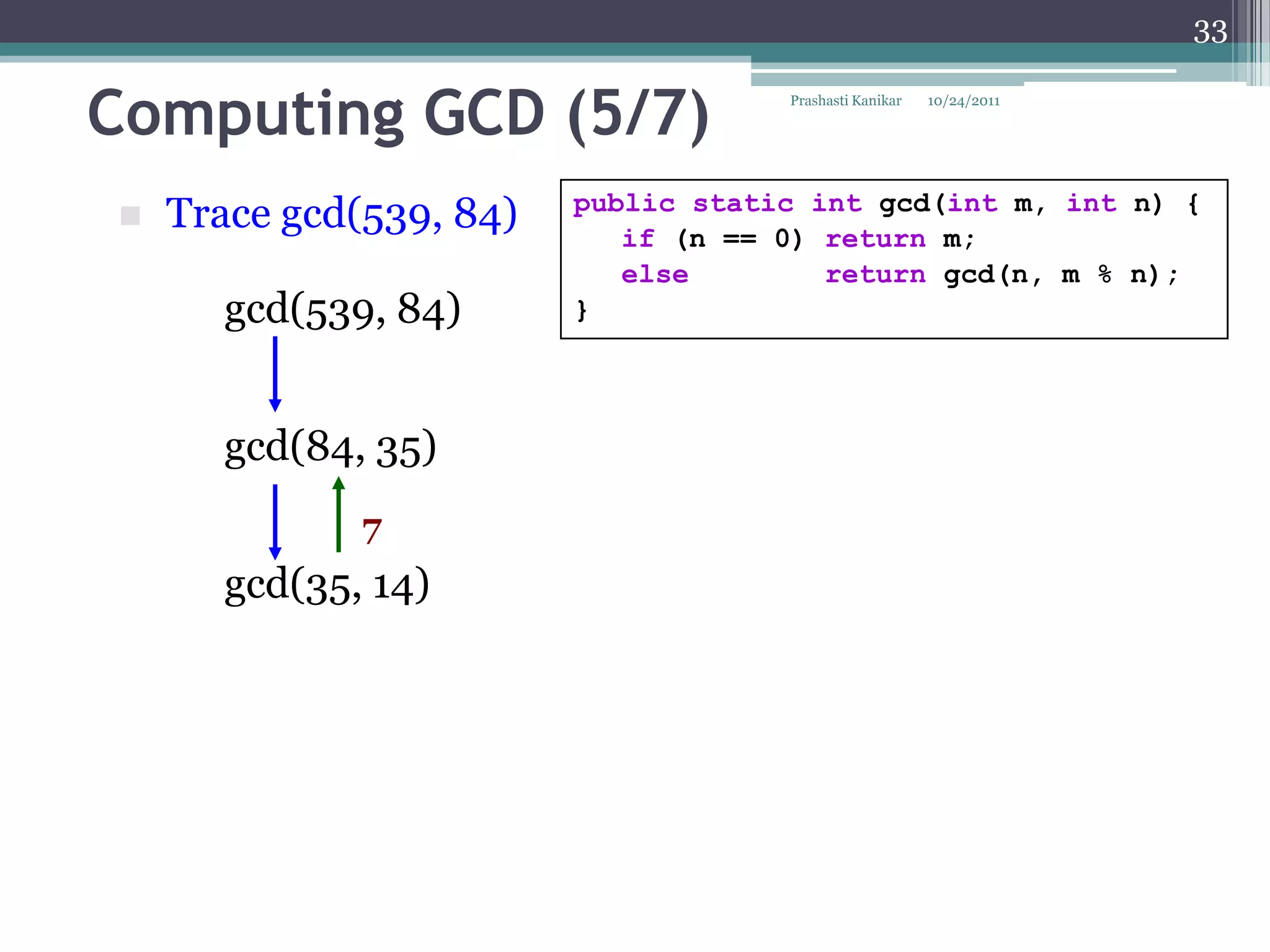
Computing GCD (5/7)                  Prashasti Kanikar   10/24/2011


                         public static int gcd(int m, int n) {
   Trace gcd(539, 84)      if (n == 0) return m;
                            else        return gcd(n, m % n);
      gcd(539, 84)       }


      gcd(84, 35)
              7
      gcd(35, 14)
34


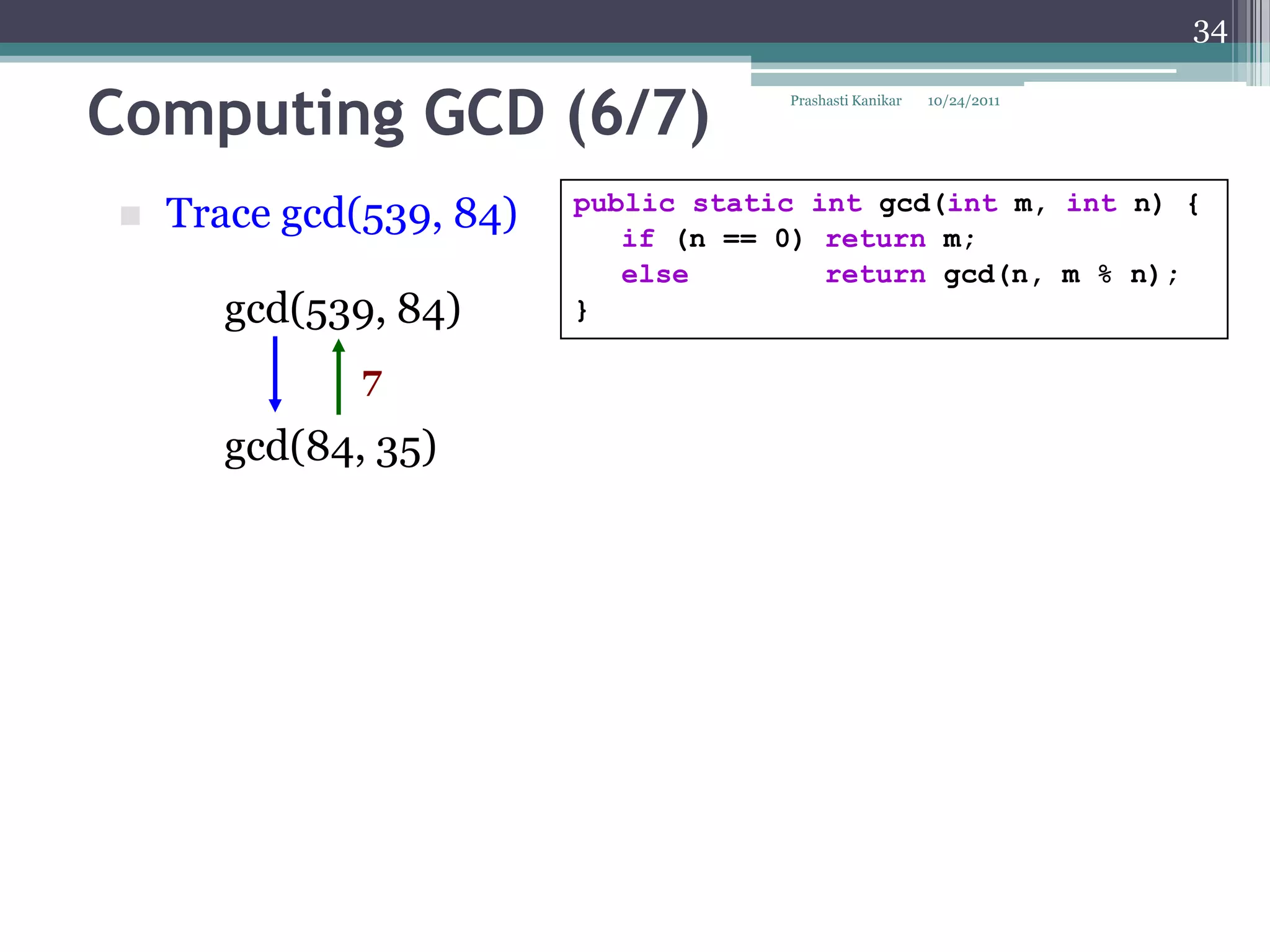
Computing GCD (6/7)                  Prashasti Kanikar   10/24/2011


                         public static int gcd(int m, int n) {
   Trace gcd(539, 84)      if (n == 0) return m;
                            else        return gcd(n, m % n);
      gcd(539, 84)       }

              7
      gcd(84, 35)
35


Computing GCD (7/7)                  Prashasti Kanikar   10/24/2011


                         public static int gcd(int m, int n) {
   Trace gcd(539, 84)      if (n == 0) return m;
                            else        return gcd(n, m % n);
      gcd(539, 84) 7     }
36


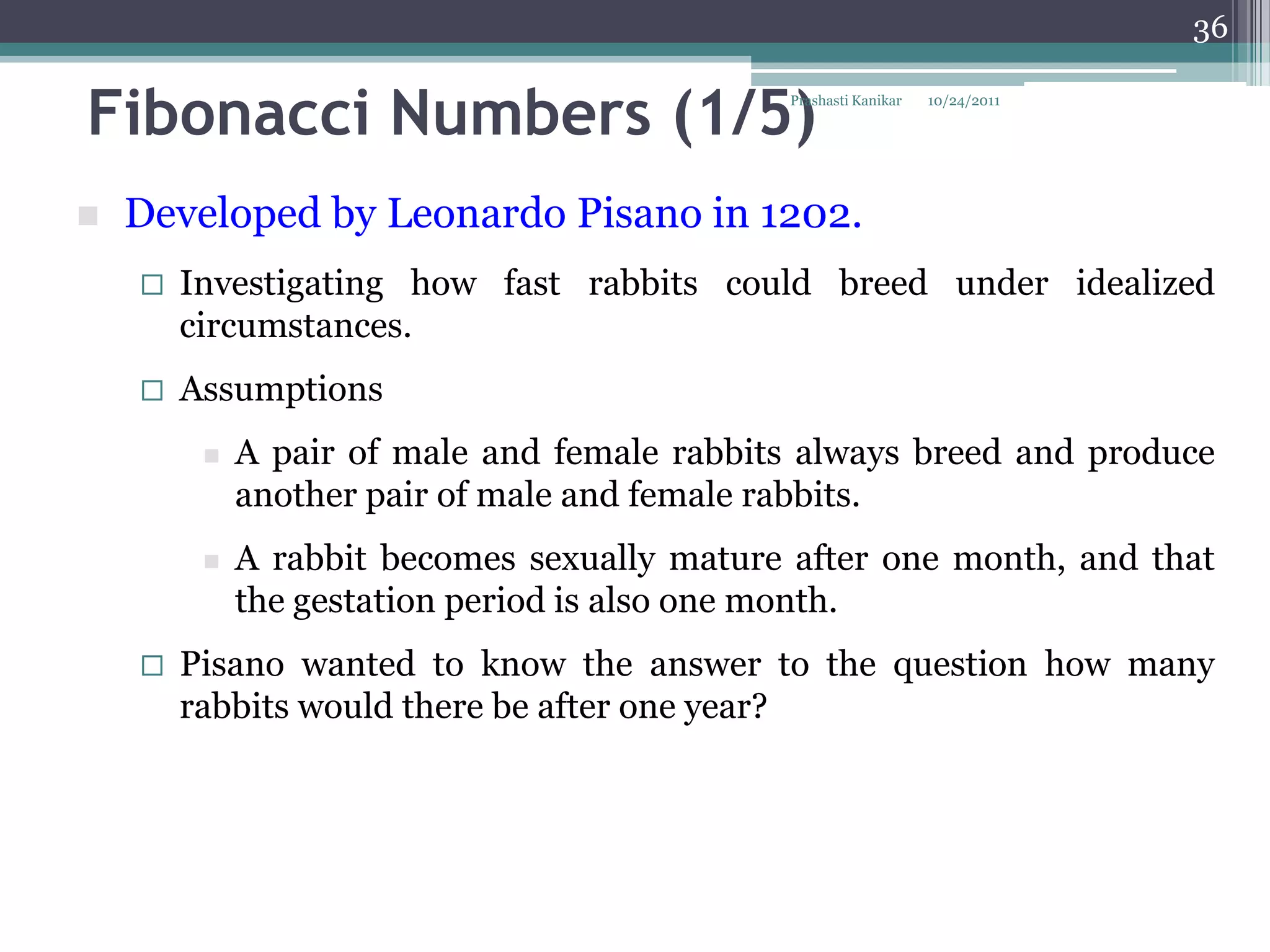
Fibonacci Numbers (1/5)                      Prashasti Kanikar   10/24/2011


   Developed by Leonardo Pisano in 1202.
       Investigating how fast rabbits could breed under idealized
        circumstances.
       Assumptions
            A pair of male and female rabbits always breed and produce
             another pair of male and female rabbits.
            A rabbit becomes sexually mature after one month, and that
             the gestation period is also one month.
       Pisano wanted to know the answer to the question how many
        rabbits would there be after one year?
37


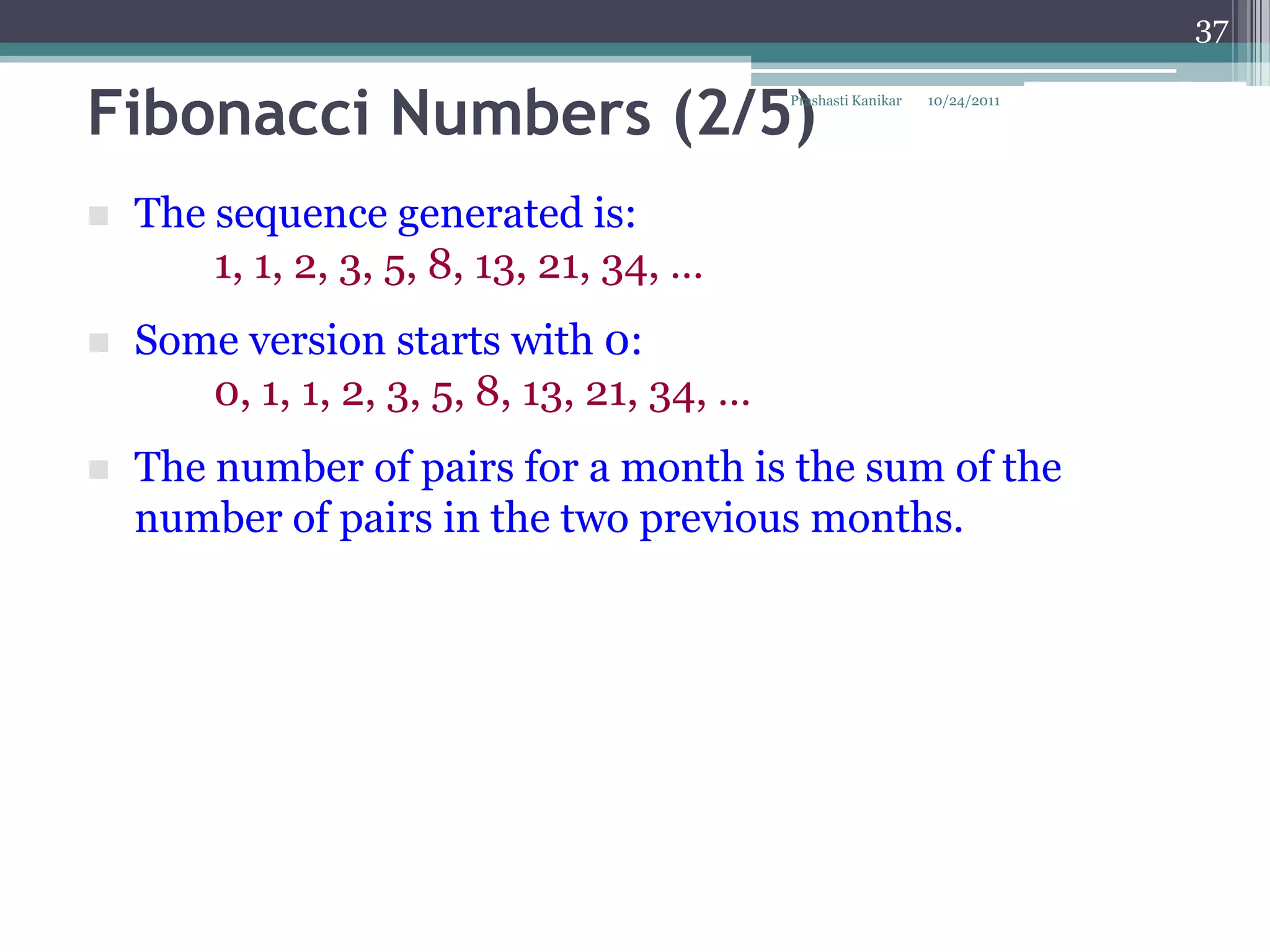
Fibonacci Numbers (2/5)                     Prashasti Kanikar   10/24/2011


   The sequence generated is:
        1, 1, 2, 3, 5, 8, 13, 21, 34, …
   Some version starts with 0:
       0, 1, 1, 2, 3, 5, 8, 13, 21, 34, …
   The number of pairs for a month is the sum of the
    number of pairs in the two previous months.
38


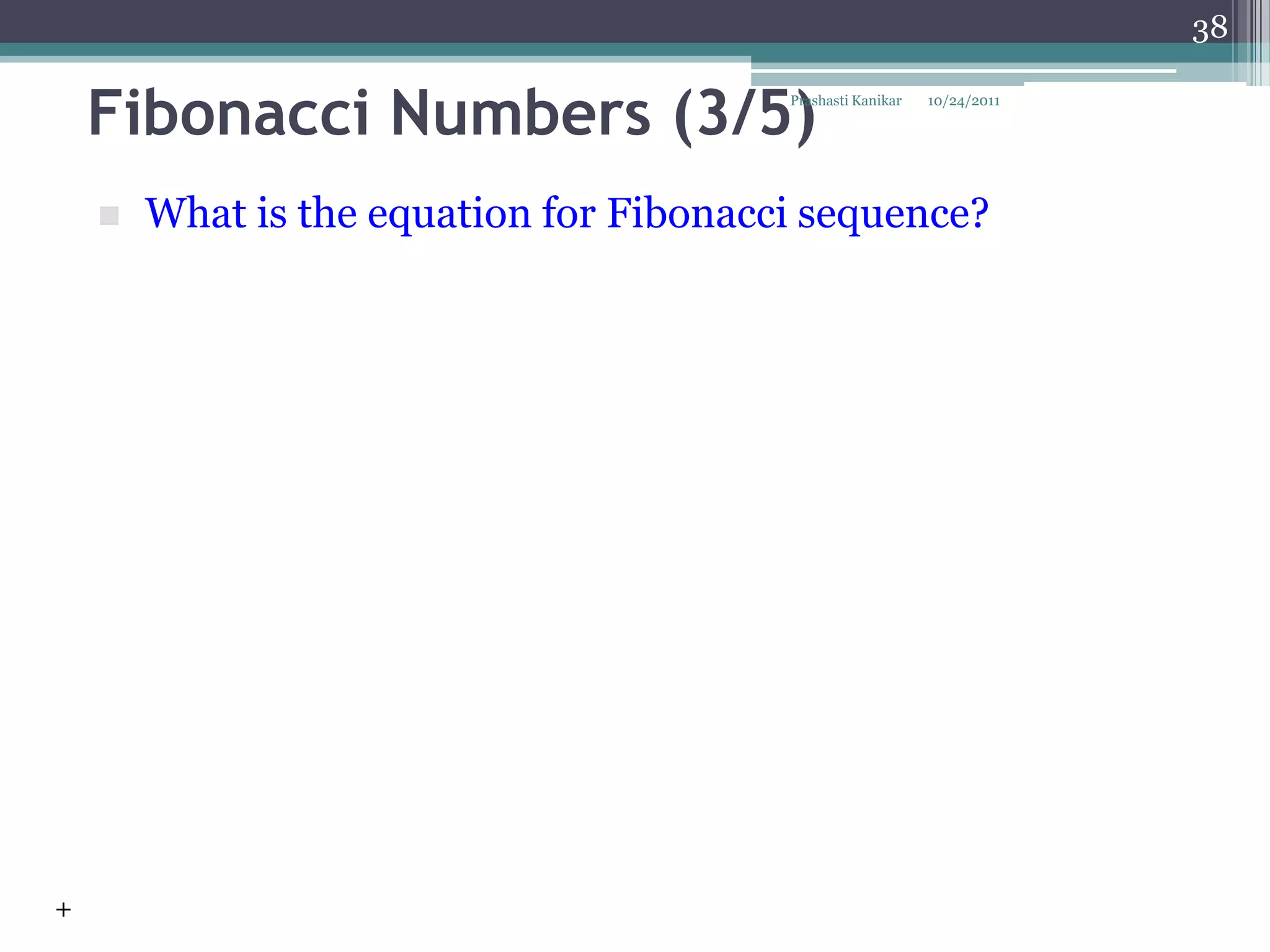
    Fibonacci Numbers (3/5)              Prashasti Kanikar   10/24/2011


       What is the equation for Fibonacci sequence?


+
39


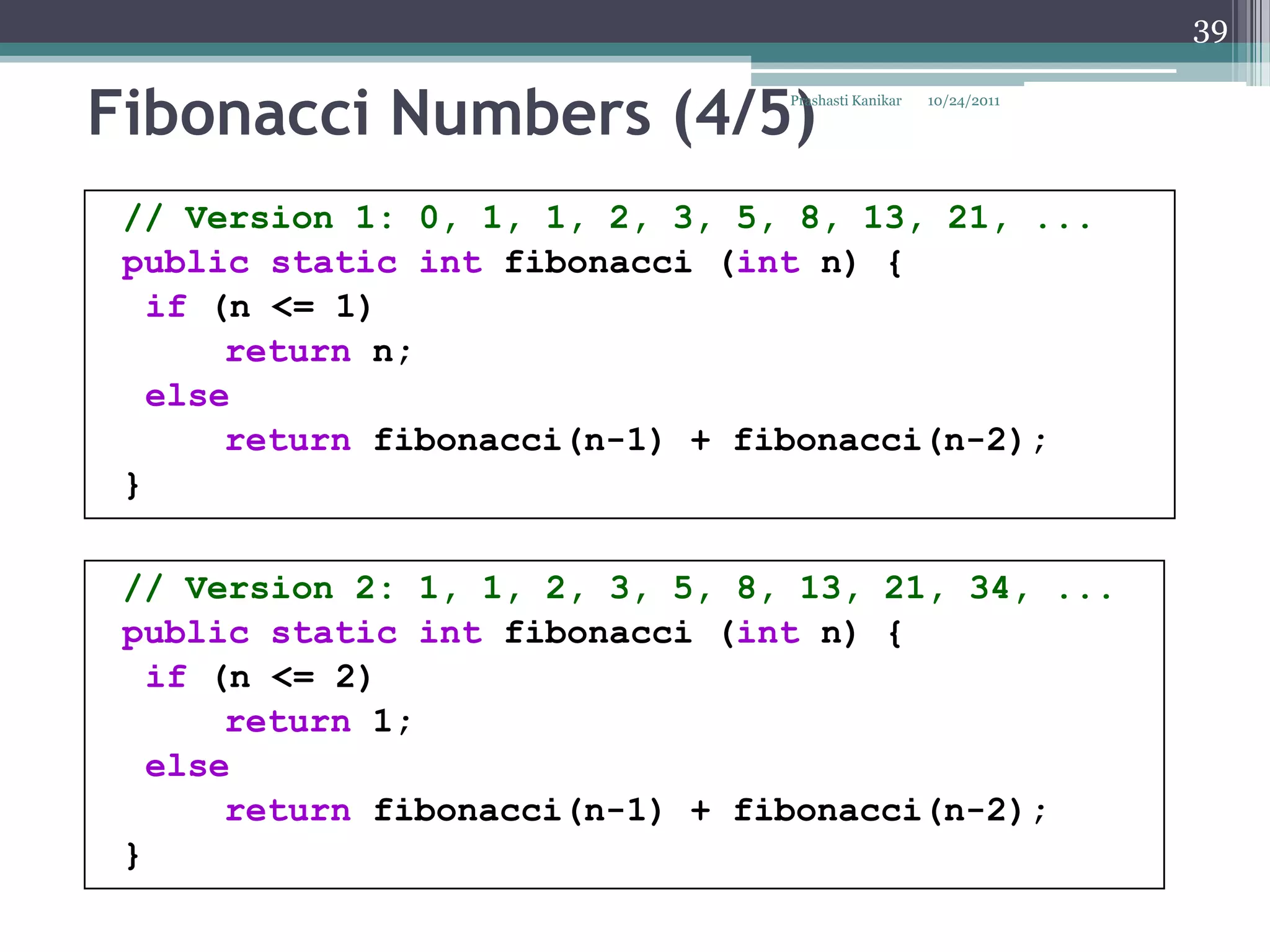
Fibonacci Numbers (4/5)         Prashasti Kanikar   10/24/2011


 // Version 1: 0, 1, 1, 2, 3, 5, 8, 13, 21, ...
 public static int fibonacci (int n) {
   if (n <= 1)
       return n;
   else
       return fibonacci(n-1) + fibonacci(n-2);
 }

 // Version 2: 1, 1, 2, 3, 5, 8, 13, 21, 34, ...
 public static int fibonacci (int n) {
   if (n <= 2)
       return 1;
   else
       return fibonacci(n-1) + fibonacci(n-2);
 }
40


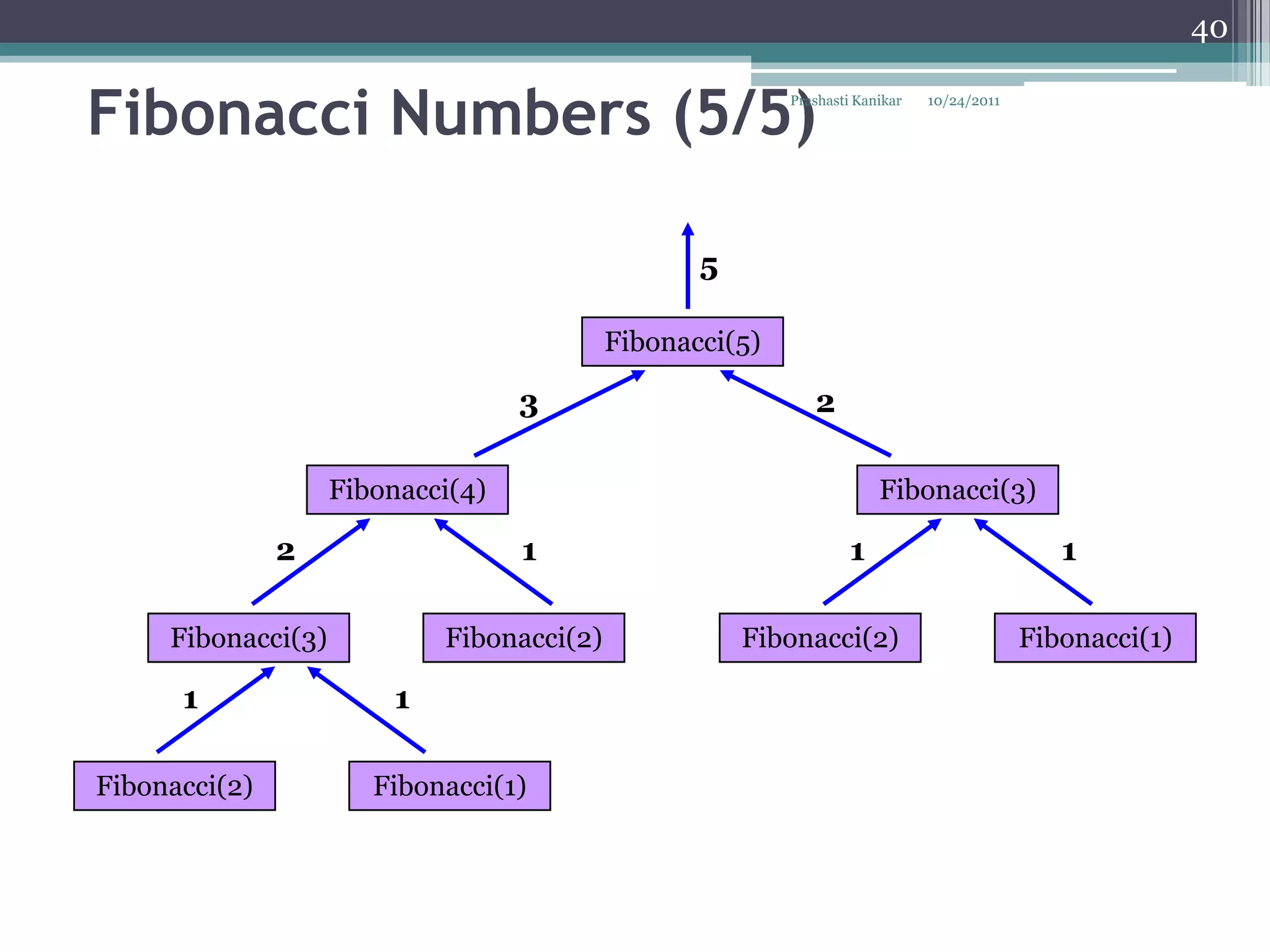
Fibonacci Numbers (5/5)                                    Prashasti Kanikar   10/24/2011


                                                   5

                                            Fibonacci(5)

                                   3                          2

                    Fibonacci(4)                                        Fibonacci(3)

               2                   1                                1                          1

     Fibonacci(3)            Fibonacci(2)              Fibonacci(2)                         Fibonacci(1)

      1                  1

Fibonacci(2)           Fibonacci(1)
41


Recursion versus Iteration (1/2)                  Prashasti Kanikar   10/24/2011


   Iteration can be more efficient
       Replaces method calls with looping
       Less memory is used (no activation record for each call)
   If a problem can be done easily with iteration, then do it
    with iteration.
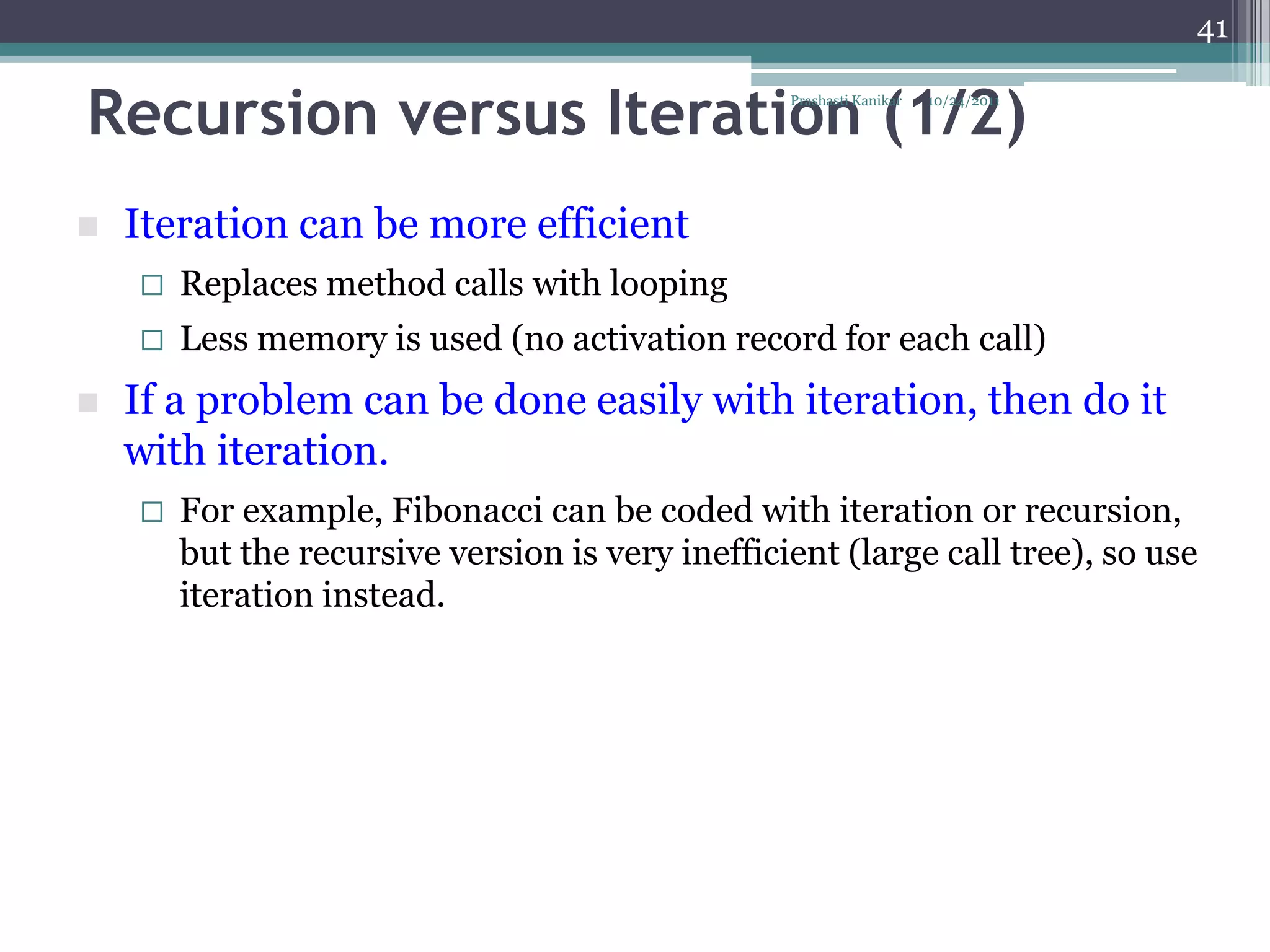
       For example, Fibonacci can be coded with iteration or recursion,
        but the recursive version is very inefficient (large call tree), so use
        iteration instead.
42


Recursion versus Iteration (2/2)                Prashasti Kanikar   10/24/2011


   Many problems are more naturally solved with recursion,
    which can provide elegant solution.
       Towers of Hanoi
       Mergesort
   Conclusion: choice depends on problem and the solution
    context. In general, use recursion if
       A recursive solution is natural and easy to understand.
       A recursive soluition does not result in excessive duplicate
        computation.
       The equivalent iterative solution is too complex.
43


Towers of Hanoi (1/12)                          Prashasti Kanikar   10/24/2011


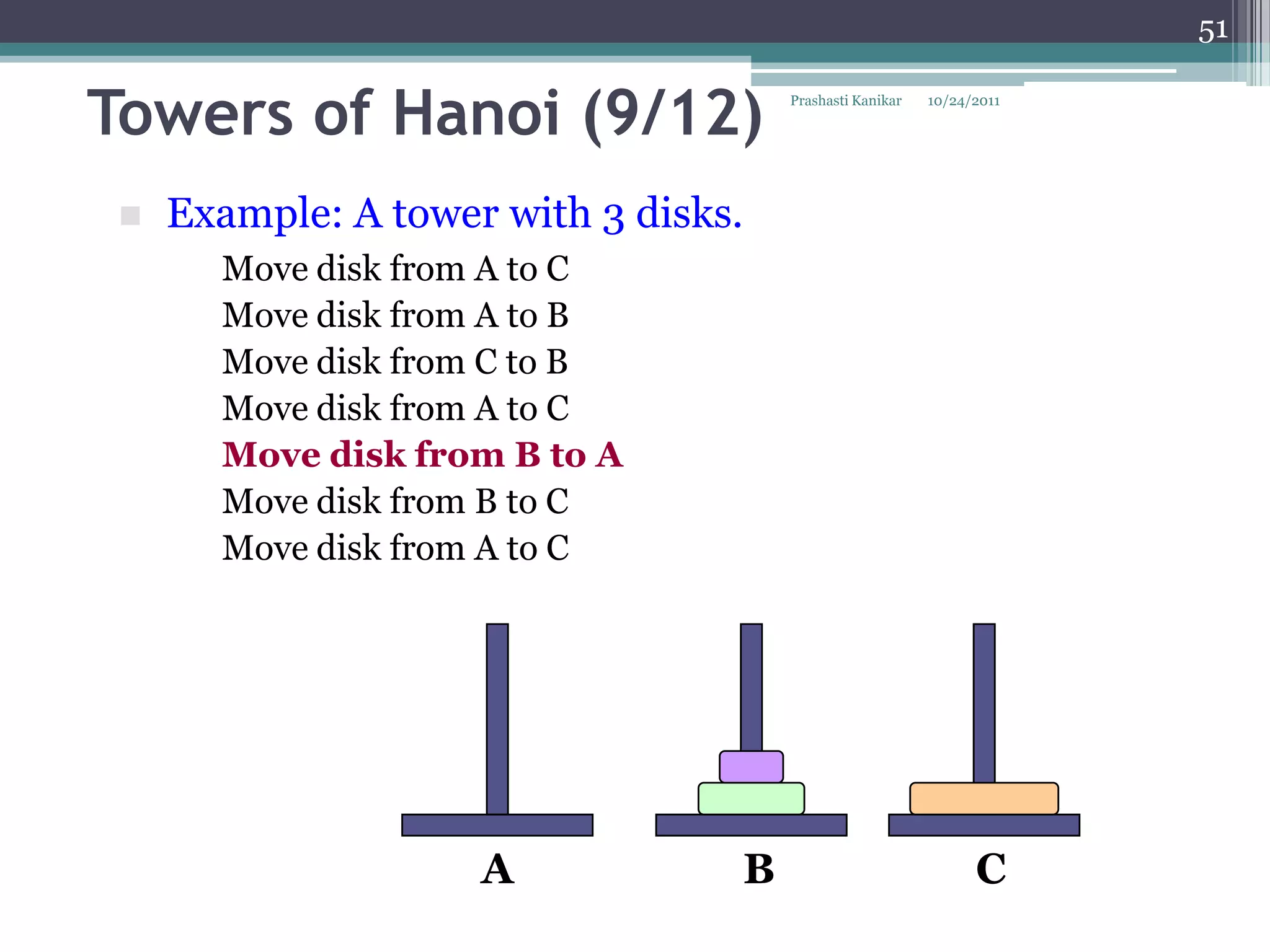
   This classical “Towers of Hanoi” puzzle has attracted the
    attention of computer scientists more than any other
    puzzles.
   Invented by Edouard Lucas, a French mathematician,
    in1883.
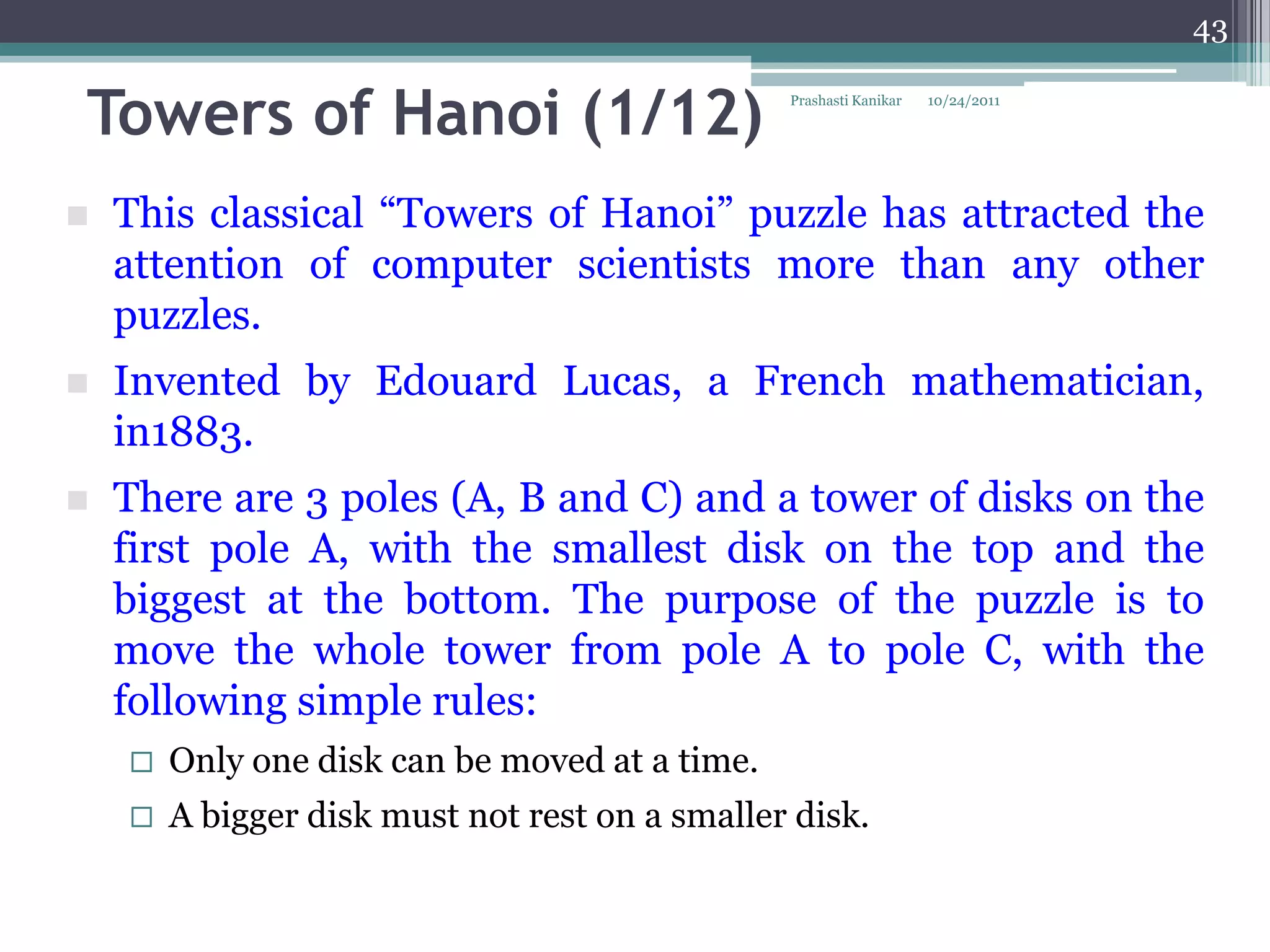
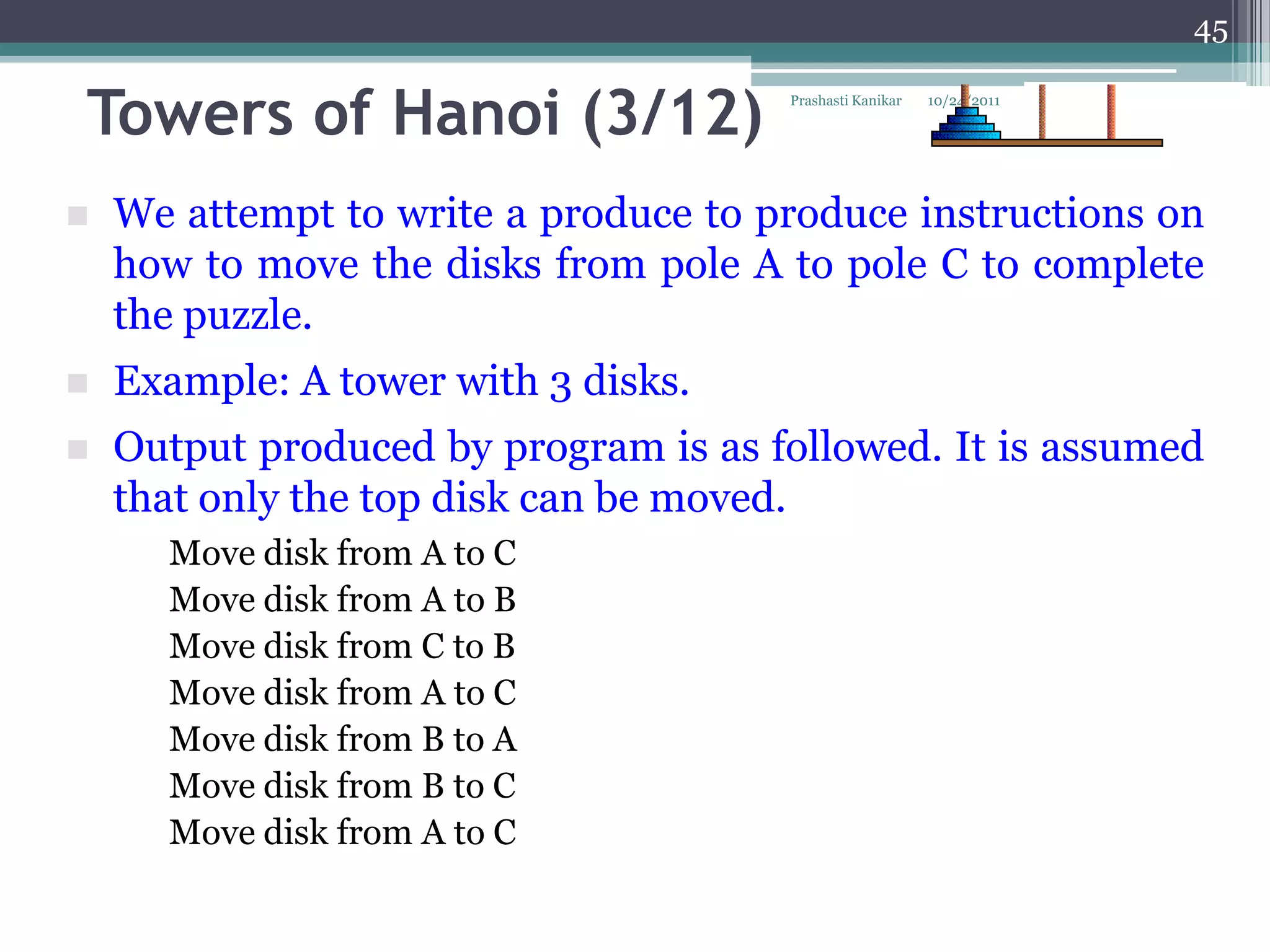
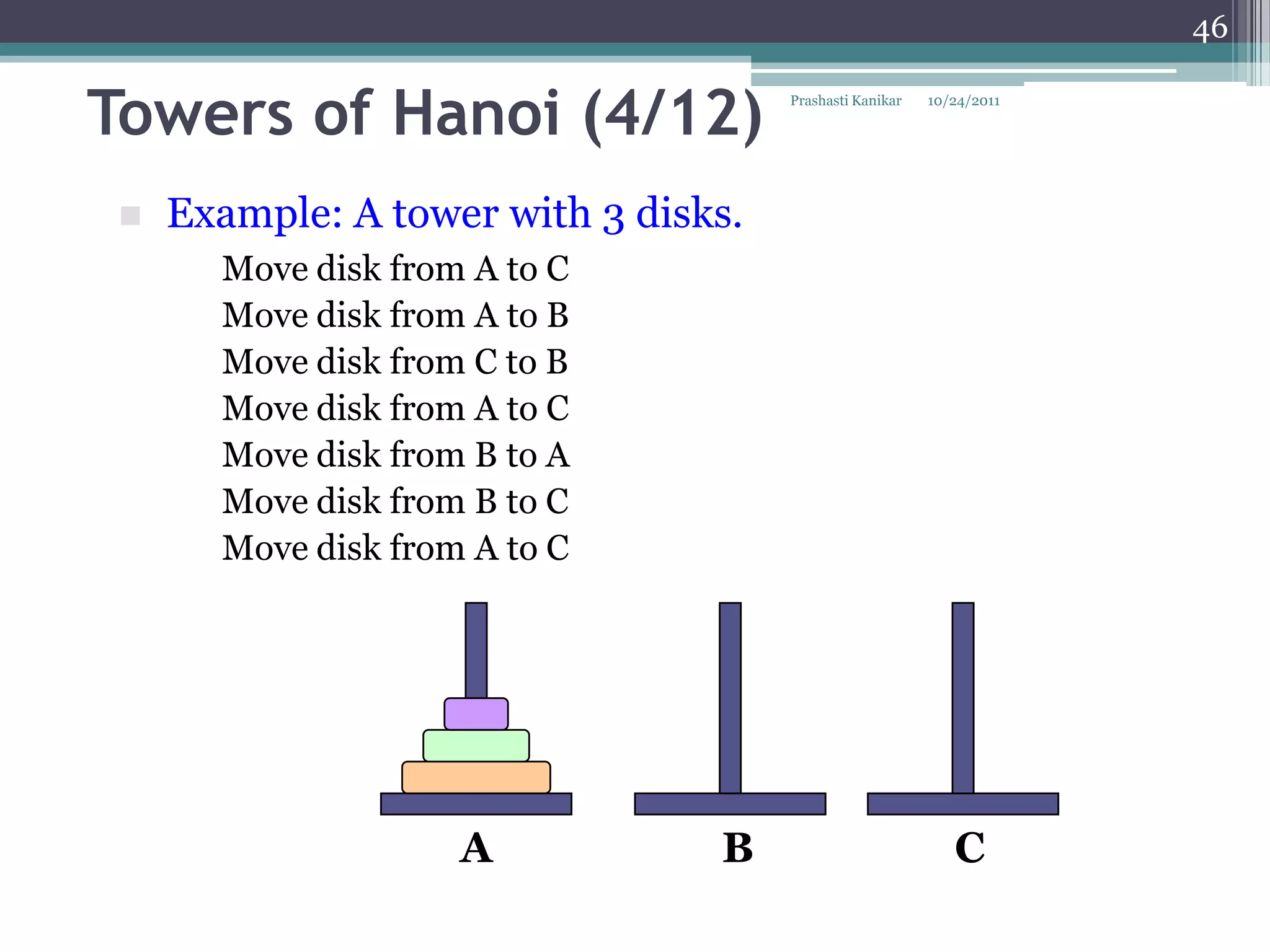
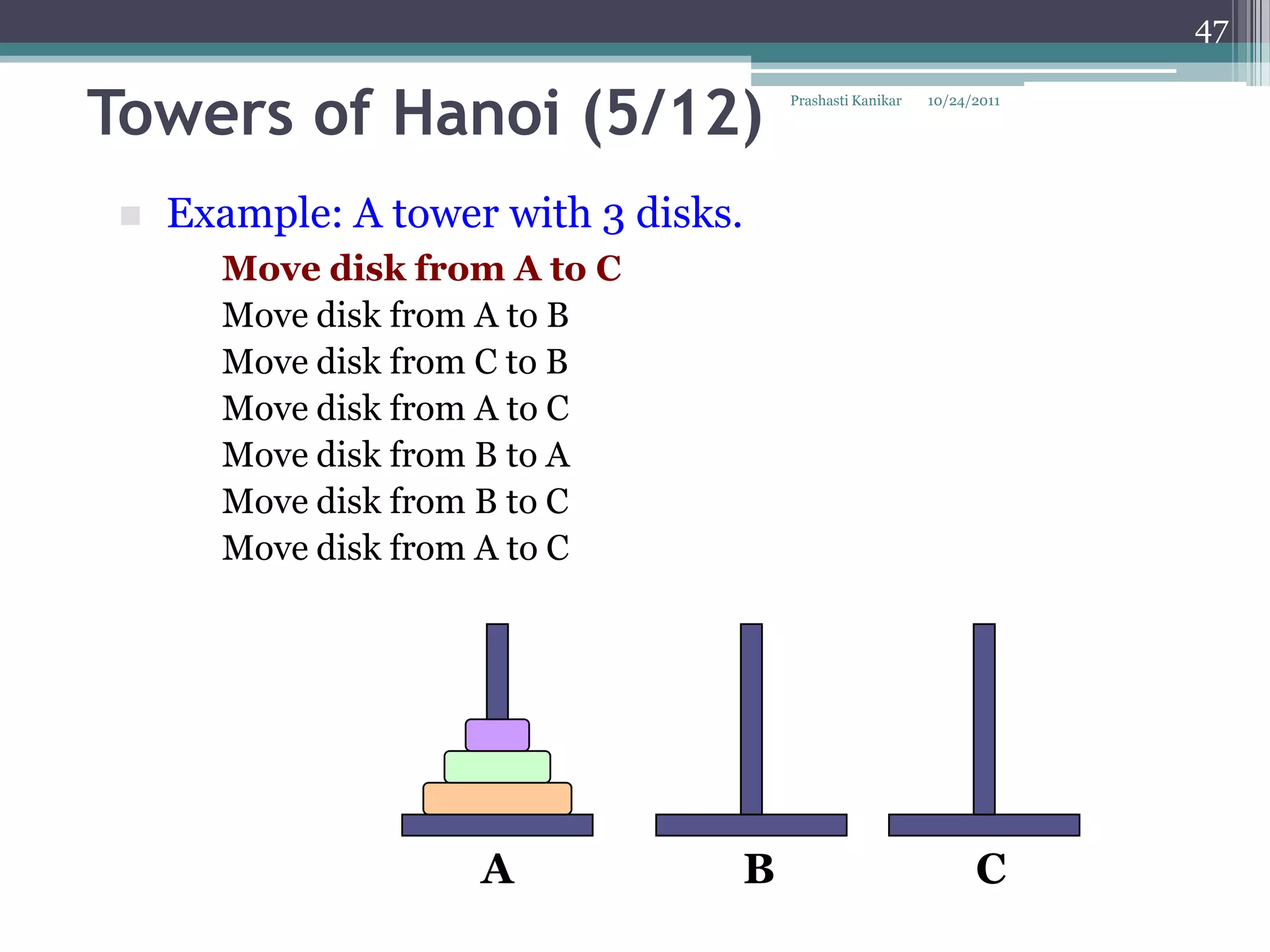
   There are 3 poles (A, B and C) and a tower of disks on the
    first pole A, with the smallest disk on the top and the
    biggest at the bottom. The purpose of the puzzle is to
    move the whole tower from pole A to pole C, with the
    following simple rules:
       Only one disk can be moved at a time.
       A bigger disk must not rest on a smaller disk.
44


Towers of Hanoi (2/12)                         Prashasti Kanikar   10/24/2011


   Legend:
       In the great temple of Brahma in Benares, on a brass plate under
        the dome that marks the center of the world, there are 64 disks of
        pure gold that the priests carry one at a time between these
        diamond needles according to Brahma's immutable law: No disk
        may be placed on a smaller disk. In the begging of the world all
        64 disks formed the Tower of Brahma on one needle. Now,
        however, the process of transfer of the tower from one needle to
        another is in mid course. When the last disk is finally in place,
        once again forming the Tower of Brahma but on a different
        needle, then will come the end of the world and all will turn to
        dust.
       Reference: R. Douglas Hofstadter. Metamagical themas. Scientific
        American, 248(2):16-22, March 1983.
   Demo: Tower of Hanoi
45


Towers of Hanoi (3/12)                Prashasti Kanikar   10/24/2011


   We attempt to write a produce to produce instructions on
    how to move the disks from pole A to pole C to complete
    the puzzle.
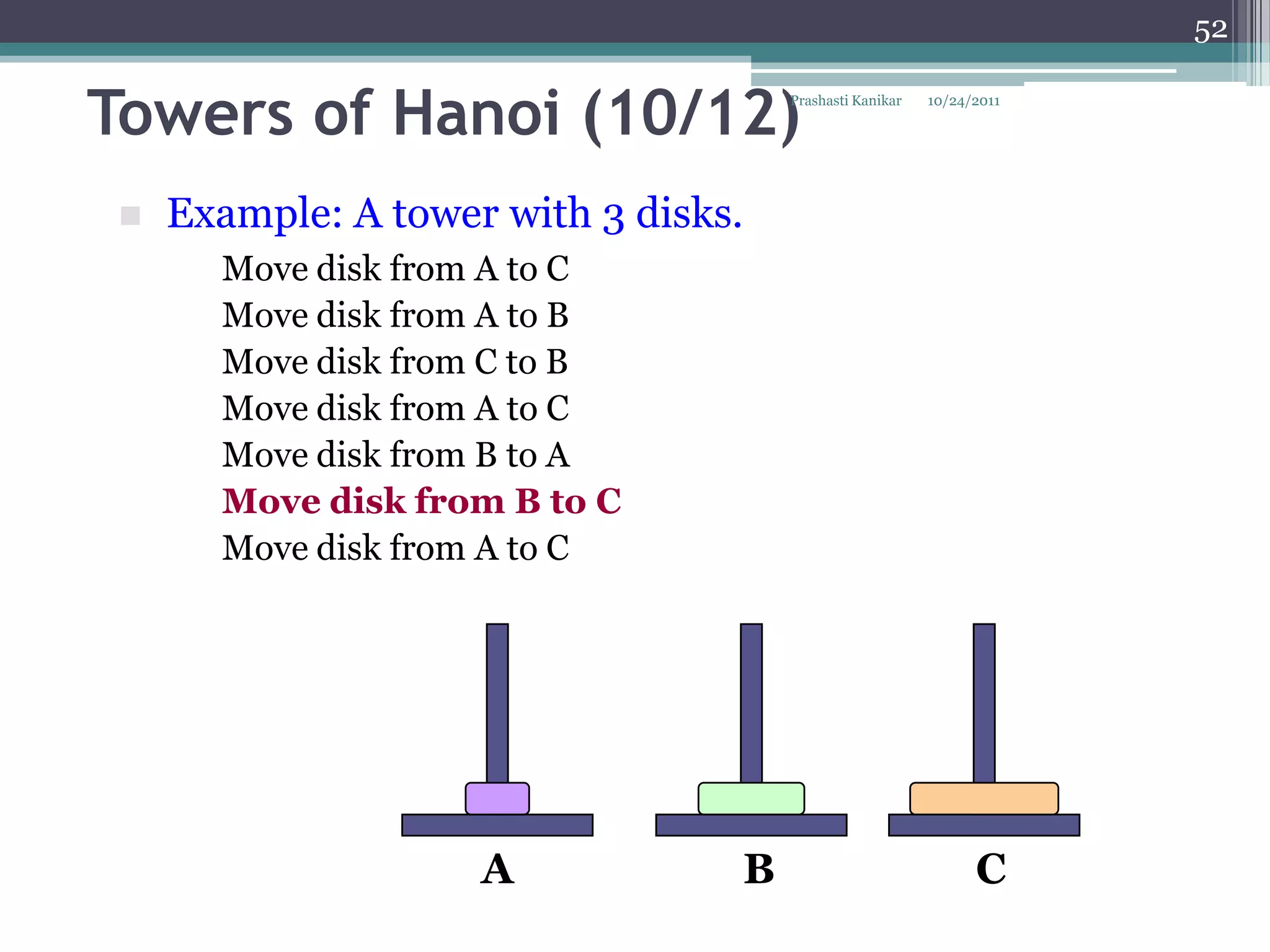
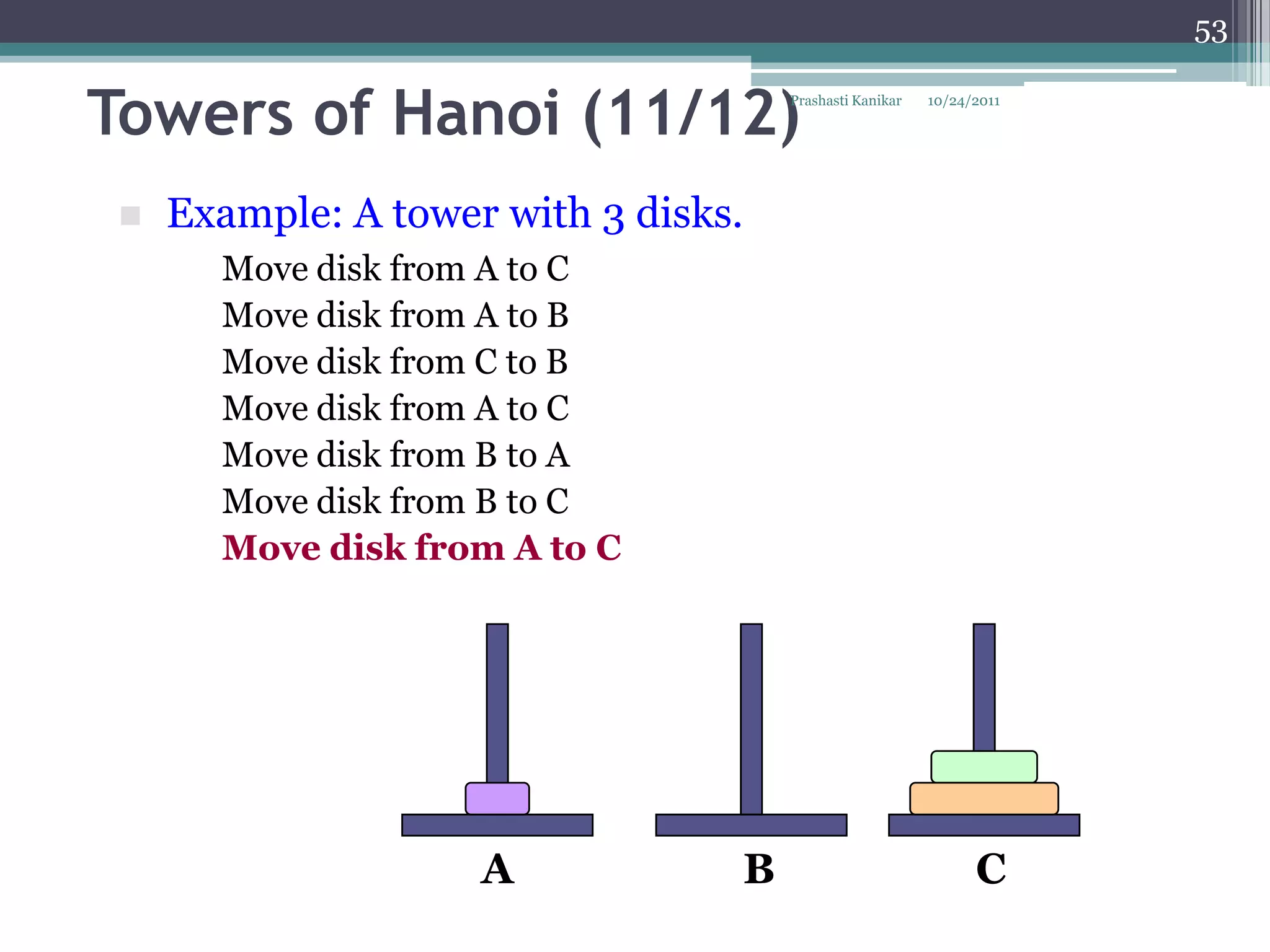
   Example: A tower with 3 disks.
   Output produced by program is as followed. It is assumed
    that only the top disk can be moved.
      Move disk from A to C
      Move disk from A to B
      Move disk from C to B
      Move disk from A to C
      Move disk from B to A
      Move disk from B to C
      Move disk from A to C
46


Towers of Hanoi (4/12)                Prashasti Kanikar   10/24/2011


    Example: A tower with 3 disks.
       Move disk from A to C
       Move disk from A to B
       Move disk from C to B
       Move disk from A to C
       Move disk from B to A
       Move disk from B to C
       Move disk from A to C


                     A           B                           C
47


Towers of Hanoi (5/12)                Prashasti Kanikar   10/24/2011


    Example: A tower with 3 disks.
       Move disk from A to C
       Move disk from A to B
       Move disk from C to B
       Move disk from A to C
       Move disk from B to A
       Move disk from B to C
       Move disk from A to C


                     A            B                             C
48


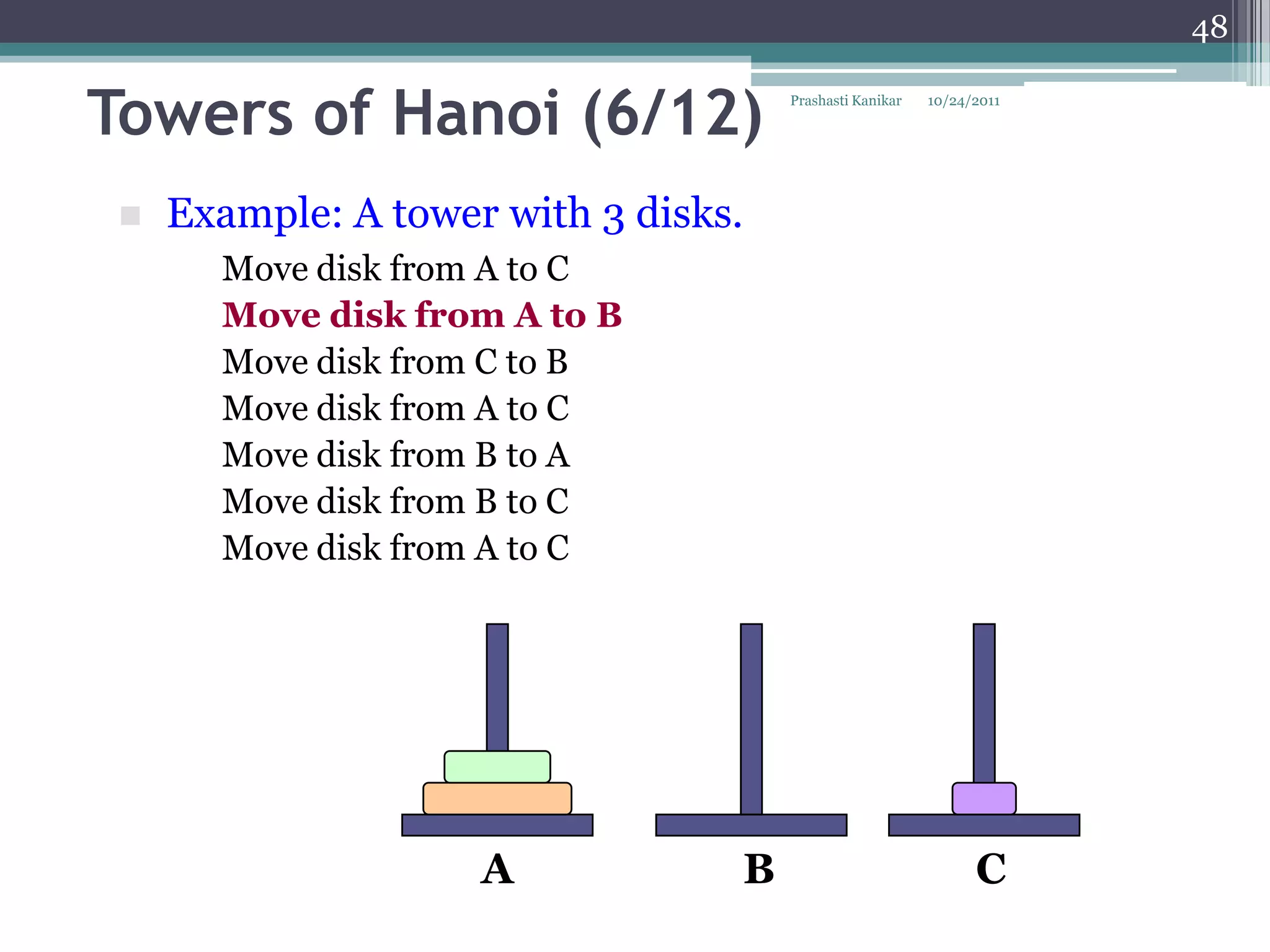
Towers of Hanoi (6/12)                Prashasti Kanikar   10/24/2011


    Example: A tower with 3 disks.
       Move disk from A to C
       Move disk from A to B
       Move disk from C to B
       Move disk from A to C
       Move disk from B to A
       Move disk from B to C
       Move disk from A to C


                     A            B                             C
49


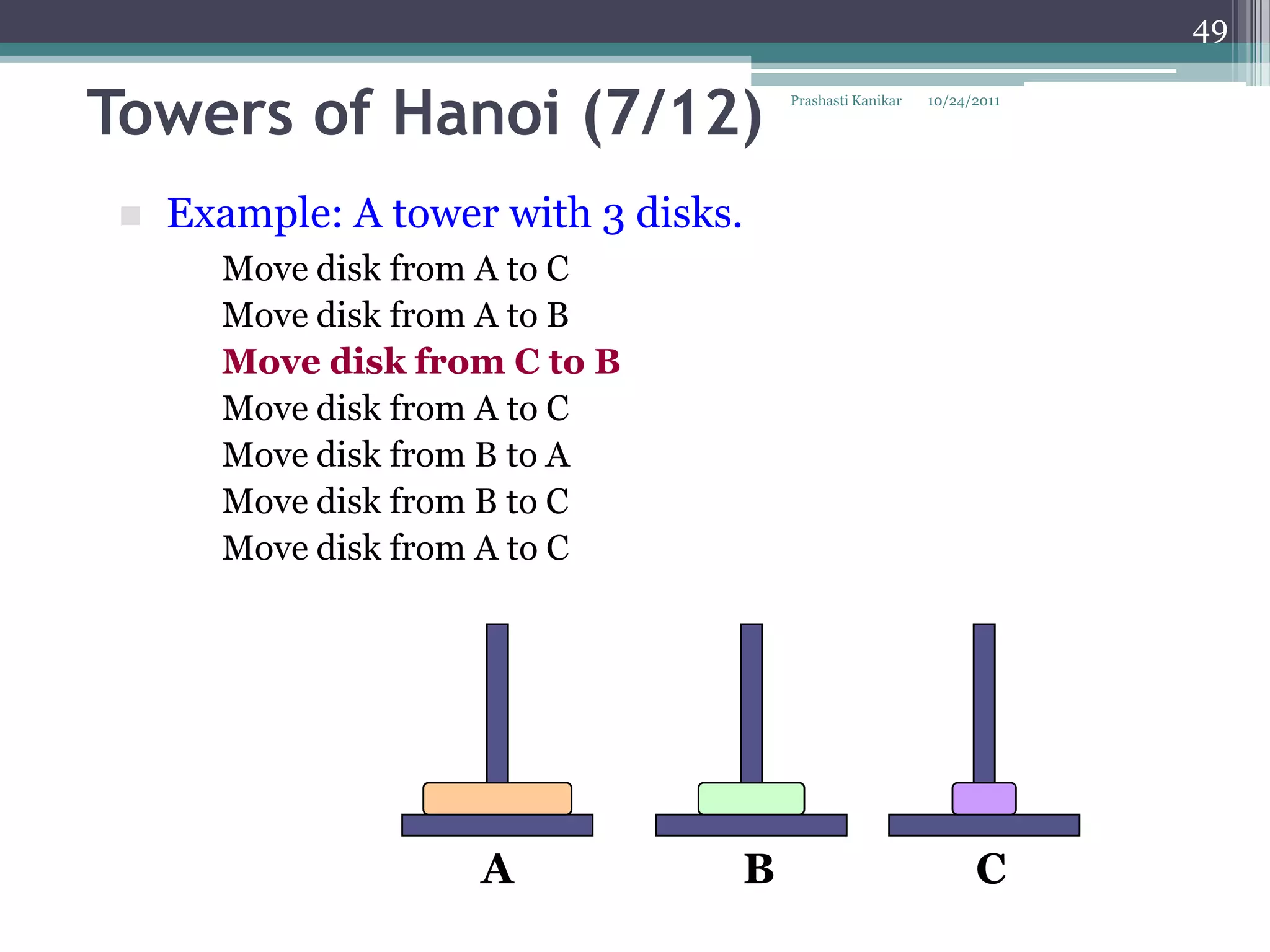
Towers of Hanoi (7/12)                Prashasti Kanikar   10/24/2011


    Example: A tower with 3 disks.
       Move disk from A to C
       Move disk from A to B
       Move disk from C to B
       Move disk from A to C
       Move disk from B to A
       Move disk from B to C
       Move disk from A to C


                     A            B                             C
50


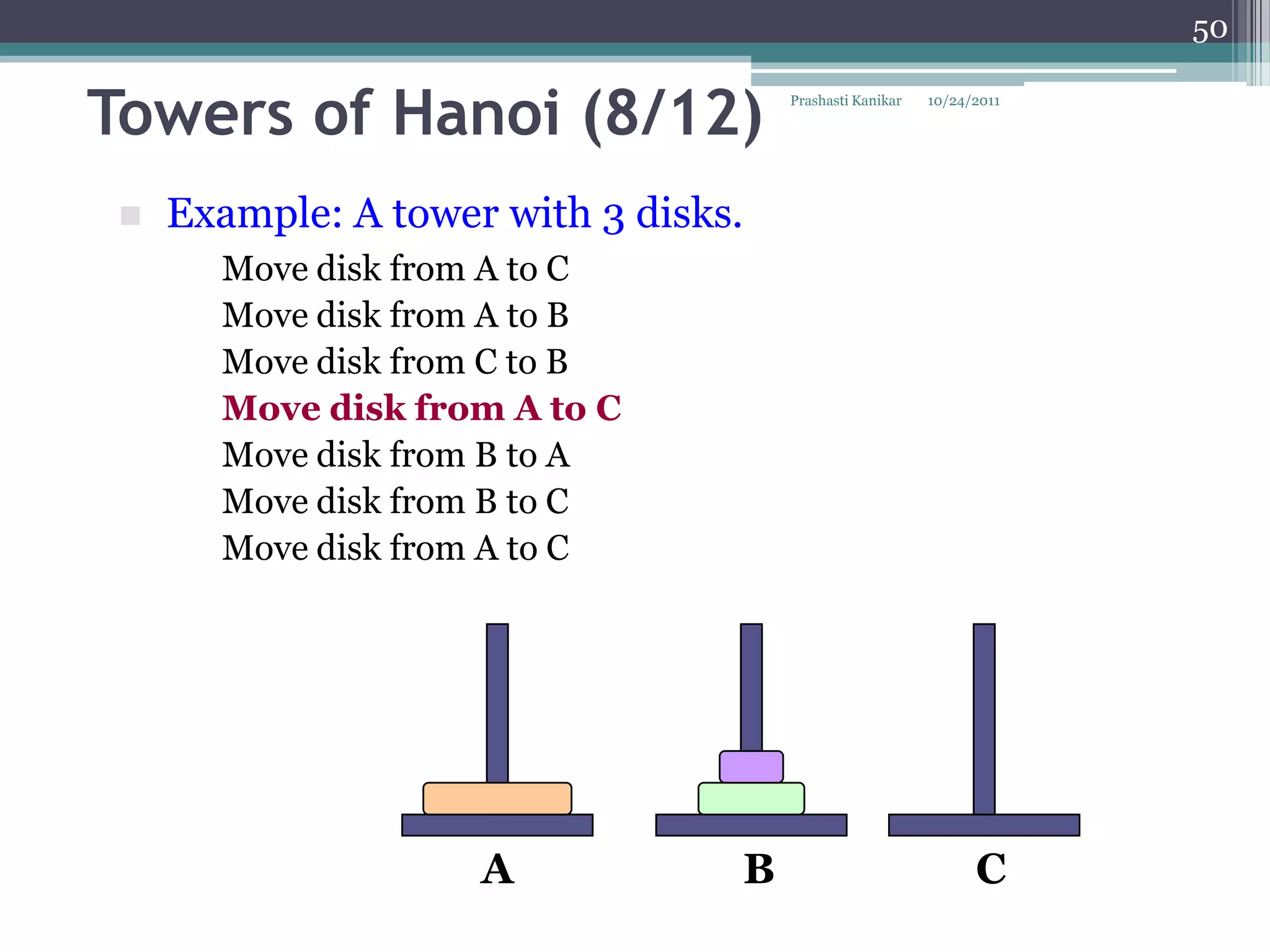
Towers of Hanoi (8/12)                Prashasti Kanikar   10/24/2011


    Example: A tower with 3 disks.
       Move disk from A to C
       Move disk from A to B
       Move disk from C to B
       Move disk from A to C
       Move disk from B to A
       Move disk from B to C
       Move disk from A to C


                     A            B                             C
51


Towers of Hanoi (9/12)                Prashasti Kanikar   10/24/2011


    Example: A tower with 3 disks.
       Move disk from A to C
       Move disk from A to B
       Move disk from C to B
       Move disk from A to C
       Move disk from B to A
       Move disk from B to C
       Move disk from A to C


                     A            B                             C
52


Towers of Hanoi (10/12)               Prashasti Kanikar   10/24/2011


    Example: A tower with 3 disks.
       Move disk from A to C
       Move disk from A to B
       Move disk from C to B
       Move disk from A to C
       Move disk from B to A
       Move disk from B to C
       Move disk from A to C


                     A            B                             C
53


Towers of Hanoi (11/12)               Prashasti Kanikar   10/24/2011


    Example: A tower with 3 disks.
       Move disk from A to C
       Move disk from A to B
       Move disk from C to B
       Move disk from A to C
       Move disk from B to A
       Move disk from B to C
       Move disk from A to C


                     A            B                             C
54


Binary Search (1/6)                        Prashasti Kanikar   10/24/2011


   Compare the search value to the middle element of the
    list. If the search value matches the middle element, the
    desired value has been located and the search is over.
   If the search value doesn‟t match, then if it is in the list it
    must be either to the left or right of the middle element.
   The correct sublist can be searched using the same
    strategy – divide and conquer.
55


Binary Search (2/6)                          Prashasti Kanikar   10/24/2011


         [0]   [1]   [2]   [3]   [4]   [5]    [6]        [7]         [8]      [9]
  data    3     6     8    12    17    20     21          32          33      45


   Compare search value to this element. If the search
   value matches, the search is successful. If the
   search value is less than this element (data[4]),
   then the search value, if it is in the list, must be to
   the left of data[4]. If the search value is greater than
   this element (data[4]), then if it is in the list, it must
   be to the right of data[4].
56


Binary Search (3/6)                             Prashasti Kanikar   10/24/2011


   Example: Search for 20 in this list
            [0]   [1]   [2]   [3]   [4]   [5]   [6]        [7]         [8]       [9]
     data    3     6     8    12    17    20    21          32         33        45


       Go to middle of list.
       Compare this element                           Go to middle of
       with our search value.                         remaining list.
       17 is smaller than 20,                         Compare this element
       so left half is ignored.                       with our search value.
                                                      32 is larger than 20, so
                                                      right half is ignored.

                              Go to middle of remaining
                              list. Compare this element
                              with our search value.
                              Found!
57


Binary Search (4/6)                  Prashasti Kanikar   10/24/2011


   Iterative version:
// binarySearch(): examine sorted list for a key
public static int binarySearch(int[] data, int key) {
   int left = 0;
   int right = data.length – 1;
   while (left <= right) {
      int mid = (left + right)/2;
      if (data[mid] == key)
         return mid;
      else if (data[mid] < key)
         left = mid + 1;
      else
         right = mid – 1;
   }
   return -1;
}
58


    Binary Search (5/6)      Prashasti Kanikar   10/24/2011


       Recursive version:


+
59


Binary Search (6/6)                        Prashasti Kanikar   10/24/2011


       Calling the recursive binary search method.
    public static void main(String[] args) {
       Scanner scanner = new Scanner(System.in);

         int[] intArray = {3, 6, 8, 12, 17, 20, 21, 32, 33, 45};
         System.out.print("Enter search key: ");
         int searchKey = scanner.nextInt();

         int index = binarysearch(intArray, searchKey,
                                  0, intArray.length - 1);
         System.out.println("Key found at index " + index);
    }
60


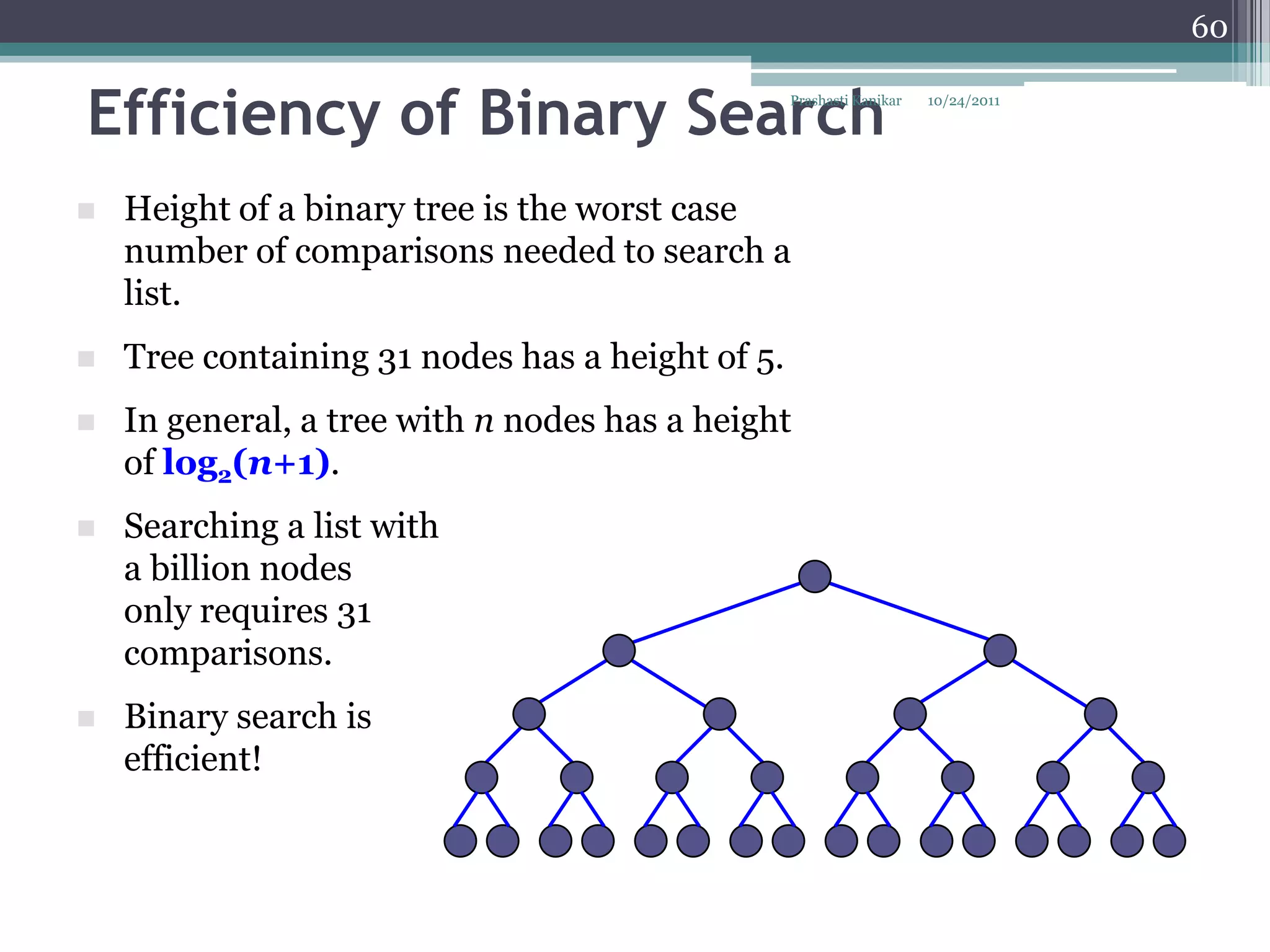
Efficiency of Binary Search                       Prashasti Kanikar   10/24/2011


   Height of a binary tree is the worst case
    number of comparisons needed to search a
    list.
   Tree containing 31 nodes has a height of 5.
   In general, a tree with n nodes has a height
    of log2(n+1).
   Searching a list with
    a billion nodes
    only requires 31
    comparisons.
   Binary search is
    efficient!
61

                                  Prashasti Kanikar   10/24/2011


Efficiency of Recursion
• Recursive methods often have slower execution
  times when compared to their iterative
  counterparts
• The overhead for loop repetition is smaller than
  the overhead for a method call and return
• If it is easier to conceptualize an algorithm using
  recursion, then you should code it as a recursive
  method
  ▫ The reduction in efficiency does not outweigh the
    advantage of readable code that is easy to debug

Recursion

  • 1.
    1 RECURSION Prashasti Kanikar 10/24/2011
  • 2.
    2 What is Recursion? Prashasti Kanikar 10/24/2011  To perform a task T by performing some similar smaller task(s) T’.  Example:  Formula for factorial: n! = n * (n-1) * (n-2) * … * 2 * 1 for n > 0 0! = 1  Recursive formula for factorial: n! = n * (n–1)! for n>0 0! = 1 (Examples: 3! = 6; 4! = 24; 7! = 5040)
  • 3.
    3 Recursive Definitions Prashasti Kanikar 10/24/2011  A definition that defines something in terms of itself is called a recursive definition.  The descendants of a person are the person‟s children and all of the descendants of the person‟s children.  A list of numbers is  a number or  a number followed by a comma and a list of numbers.  A recursive algorithm is an algorithm that invokes itself to solve smaller or simpler instances of a problem instances.  The factorial of a number n is: n times the factorial of n-1.
  • 4.
    4 How to Multiply6 by 3? (1/5) Prashasti Kanikar 10/24/2011  Assume that we know only addition but not multiplication, except for the simplest case of x * 1 = x.  To employ recursion, we solve our problem by solving a smaller (but similar) problem, and then use the solution of this smaller problem to derive the solution of the original problem.
  • 5.
    5 How to Multiply6 by 3? (2/5) Prashasti Kanikar 10/24/2011  To solve „multiply 6 by 3‟: 1. Solve smaller problem: Multiply 6 by 2. 2. Connect the solution of the smaller problem with the solution of the original problem: Add 6 to the result of (1).  Apply the same technique to solve „multiply 6 by 2‟: 1.1. Solve smaller problem: Multiply 6 by 1. 1.2. Connect the solution of the smaller problem with the solution of the original problem: Add 6 to the result of (1.1).
  • 6.
    6 How to Multiply6 by 3? (3/5) Prashasti Kanikar 10/24/2011  To solve „multiply 6 by 1‟: Do not need to solve smaller problem as the problem can be solved directly. Answer: 6 * 1 = 6.  We then reconstruct the solution  „Multiply 6 by 1‟ is 6.  „Multiply 6 by 2‟ is 6 + the solution of „multiply 6 by 1‟, or 12.  „Multiply 6 by 3‟ is 6 + the solution of „multiply 6 by 2‟, or 18.
  • 7.
    7 How toMultiply 6 by 3? (4/5) Prashasti Kanikar 10/24/2011 // recursive method to compute // m * n, where n is positive public static int multiply (int m, int n) { int ans; if (n==1) ans = m; // simple case else ans = m + multiply(m, n-1); return ans; } or public static int multiply (int m, int n) { if (n==1) return m; else return m + multiply(m, n-1); }
  • 8.
    8 How toMultiply 6 by 3? (5/5) Prashasti Kanikar 10/24/2011 // iterative method to compute // m * n, where n is positive public static int multiply (int m, int n) { int ans = 0; for (int i = 1; i <= n; ++i) ans += m; return ans; } or public static int multiply (int m, int n) { int ans = 0; while (n-- > 0) ans += n; return ans; }
  • 9.
    9 Count Occurrences ofCharacter Prashasti Kanikar 10/24/2011  We want countChar('s', "Mississippi sassafras") to return the value of 8.
  • 10.
    10 Count Occurrences ofCharacter Prashasti Kanikar 10/24/2011 public static int countChar(char ch, String str) { if (str.length() == 0) // base case return 0; else if (str.charAt(0) == ch) return 1 + countChar(ch, str.substring(1)); else return countChar(ch, str.substring(1)); }
  • 11.
    11 Count Occurrences ofCharacter Prashasti Kanikar 10/24/2011 Compare with iterative version: public static int countChar(char ch, String str) { int ans = 0; for (int i = 0; i < str.length(); ++i) { if (str.charAt(i) == ch) ++ans; } return ans; }
  • 12.
    12 Factorial: Definition Prashasti Kanikar 10/24/2011  An imprecise definition 1 n 0 n! n (n 1)  1 n 1  A precise definition 1 n 0 n! n (n 1)! n 1
  • 13.
    13 Recursive Methods Prashasti Kanikar 10/24/2011  A recursive method generally has two parts.  A termination part that stops the recursion.  This is called the base case (or anchor case).  The base case should have a simple or trivial solution.  One or more recursive calls.  This is called the recursive case.  The recursive case calls the same method but with simpler or smaller arguments. if ( base case satisfied ) { return value; } else { make simpler recursive call(s); }
  • 14.
    14 factorial() Prashasti Kanikar 10/24/2011 public static int factorial(n) { if (n == 0) return 1; Base case. else return n * factorial(n-1); } Recursive case deals with a simpler (smaller) version of the same task.
  • 15.
    15 Factorial: Recursive Invocation Prashasti Kanikar 10/24/2011  A new activation record is created for every method invocation  Including recursive invocations main() int nfactorial = factorial(n); factorial() n=3 return n * factorial(n-1); factorial() n=2 return n * factorial(n-1); factorial() n=1 return n * factorial(n-1); factorial() n=0 return 1;
  • 16.
    16 Factorial: Result Passing(1/12) Prashasti Kanikar 10/24/2011 main() int nfactorial = factorial(n); factorial() n=3 return n * factorial(n-1); factorial() n=2 return n * factorial(n-1); factorial() n=1 return n * factorial(n-1); factorial() n=0 return 1;
  • 17.
    17 Factorial: Result Passing(2/12) Prashasti Kanikar 10/24/2011 main() int nfactorial = factorial(n); factorial() n=3 return n * factorial(n-1); factorial() n=2 return n * factorial(n-1); factorial() n=1 return n * factorial(n-1); factorial() n=0 return 1;
  • 18.
    18 Factorial: Result Passing(3/12) Prashasti Kanikar 10/24/2011 main() int nfactorial = factorial(n); factorial() n=3 return n * factorial(n-1); factorial() n=2 return n * factorial(n-1); factorial() n=1 return n * 1;
  • 19.
    19 Factorial: Result Passing(4/12) Prashasti Kanikar 10/24/2011 main() int nfactorial = factorial(n); factorial() n=3 return n * factorial(n-1); factorial() n=2 return n * factorial(n-1); factorial() n=1 return 1 * 1;
  • 20.
    20 Factorial: Result Passing(5/12) Prashasti Kanikar 10/24/2011 main() int nfactorial = factorial(n); factorial() n=3 return n * factorial(n-1); factorial() n=2 return n * factorial(n-1); factorial() n=1 return 1 * 1;
  • 21.
    21 Factorial: Result Passing(6/12) Prashasti Kanikar 10/24/2011 main() int nfactorial = factorial(n); factorial() n=3 return n * factorial(n-1); factorial() n=2 return n * 1;
  • 22.
    22 Factorial: Result Passing(7/12) Prashasti Kanikar 10/24/2011 main() int nfactorial = factorial(n); factorial() n=3 return n * factorial(n-1); factorial() n=2 return 2 * 1;
  • 23.
    23 Factorial: Result Passing(8/12) Prashasti Kanikar 10/24/2011 main() int nfactorial = factorial(n); factorial() n=3 return n * factorial(n-1); factorial() n=2 return 2 * 1;
  • 24.
    24 Factorial: Result Passing(9/12) Prashasti Kanikar 10/24/2011 main() int nfactorial = factorial(n); factorial() n=3 return n * 2;
  • 25.
    25 Factorial: Result Passing(10/12) Prashasti Kanikar 10/24/2011 main() int nfactorial = factorial(n); factorial() n=3 return 3 * 2;
  • 26.
    26 Factorial: Result Passing(11/12) Prashasti Kanikar 10/24/2011 main() int nfactorial = factorial(n); factorial() n=3 return 3 * 2;
  • 27.
    27 Factorial: Result Passing(12/12) Prashasti Kanikar 10/24/2011 main() int nfactorial = 6;
  • 28.
    28 Infinite Recursion Prashasti Kanikar 10/24/2011  A common programming error when using recursion is to not stop making recursive calls.  The program will continue to recurse until it runs out of memory.  Be sure that your recursive calls are made with simpler or smaller subproblems, and that your algorithm has a base case that terminates the recursion.  Avoid redundant base case: public static int factorial(n) { if (n == 0) return 1; else if (n == 1) return 1; else return n * factorial(n-1); }
  • 29.
    29 Computing GCD (1/7) Prashasti Kanikar 10/24/2011  Greatest common divisor (GCD) of two non-negative integers (not both zero). m if n 0 GCD(m, n) GCD(n, m%n) if n 1 +
  • 30.
    30 Computing GCD (2/7) Prashasti Kanikar 10/24/2011 public static int gcd(int m, int n) {  Trace gcd(539, 84) if (n == 0) return m; else return gcd(n, m % n); gcd(539, 84) } gcd(84, 35) gcd(35, 14) gcd(14, 7) gcd(7, 0)
  • 31.
    31 Computing GCD (3/7) Prashasti Kanikar 10/24/2011 public static int gcd(int m, int n) {  Trace gcd(539, 84) if (n == 0) return m; else return gcd(n, m % n); gcd(539, 84) } gcd(84, 35) gcd(35, 14) gcd(14, 7) 7 gcd(7, 0)
  • 32.
    32 Computing GCD (4/7) Prashasti Kanikar 10/24/2011 public static int gcd(int m, int n) {  Trace gcd(539, 84) if (n == 0) return m; else return gcd(n, m % n); gcd(539, 84) } gcd(84, 35) gcd(35, 14) 7 gcd(14, 7)
  • 33.
    33 Computing GCD (5/7) Prashasti Kanikar 10/24/2011 public static int gcd(int m, int n) {  Trace gcd(539, 84) if (n == 0) return m; else return gcd(n, m % n); gcd(539, 84) } gcd(84, 35) 7 gcd(35, 14)
  • 34.
    34 Computing GCD (6/7) Prashasti Kanikar 10/24/2011 public static int gcd(int m, int n) {  Trace gcd(539, 84) if (n == 0) return m; else return gcd(n, m % n); gcd(539, 84) } 7 gcd(84, 35)
  • 35.
    35 Computing GCD (7/7) Prashasti Kanikar 10/24/2011 public static int gcd(int m, int n) {  Trace gcd(539, 84) if (n == 0) return m; else return gcd(n, m % n); gcd(539, 84) 7 }
  • 36.
    36 Fibonacci Numbers (1/5) Prashasti Kanikar 10/24/2011  Developed by Leonardo Pisano in 1202.  Investigating how fast rabbits could breed under idealized circumstances.  Assumptions  A pair of male and female rabbits always breed and produce another pair of male and female rabbits.  A rabbit becomes sexually mature after one month, and that the gestation period is also one month.  Pisano wanted to know the answer to the question how many rabbits would there be after one year?
  • 37.
    37 Fibonacci Numbers (2/5) Prashasti Kanikar 10/24/2011  The sequence generated is: 1, 1, 2, 3, 5, 8, 13, 21, 34, …  Some version starts with 0: 0, 1, 1, 2, 3, 5, 8, 13, 21, 34, …  The number of pairs for a month is the sum of the number of pairs in the two previous months.
  • 38.
    38 Fibonacci Numbers (3/5) Prashasti Kanikar 10/24/2011  What is the equation for Fibonacci sequence? +
  • 39.
    39 Fibonacci Numbers (4/5) Prashasti Kanikar 10/24/2011 // Version 1: 0, 1, 1, 2, 3, 5, 8, 13, 21, ... public static int fibonacci (int n) { if (n <= 1) return n; else return fibonacci(n-1) + fibonacci(n-2); } // Version 2: 1, 1, 2, 3, 5, 8, 13, 21, 34, ... public static int fibonacci (int n) { if (n <= 2) return 1; else return fibonacci(n-1) + fibonacci(n-2); }
  • 40.
    40 Fibonacci Numbers (5/5) Prashasti Kanikar 10/24/2011 5 Fibonacci(5) 3 2 Fibonacci(4) Fibonacci(3) 2 1 1 1 Fibonacci(3) Fibonacci(2) Fibonacci(2) Fibonacci(1) 1 1 Fibonacci(2) Fibonacci(1)
  • 41.
    41 Recursion versus Iteration(1/2) Prashasti Kanikar 10/24/2011  Iteration can be more efficient  Replaces method calls with looping  Less memory is used (no activation record for each call)  If a problem can be done easily with iteration, then do it with iteration.  For example, Fibonacci can be coded with iteration or recursion, but the recursive version is very inefficient (large call tree), so use iteration instead.
  • 42.
    42 Recursion versus Iteration(2/2) Prashasti Kanikar 10/24/2011  Many problems are more naturally solved with recursion, which can provide elegant solution.  Towers of Hanoi  Mergesort  Conclusion: choice depends on problem and the solution context. In general, use recursion if  A recursive solution is natural and easy to understand.  A recursive soluition does not result in excessive duplicate computation.  The equivalent iterative solution is too complex.
  • 43.
    43 Towers of Hanoi(1/12) Prashasti Kanikar 10/24/2011  This classical “Towers of Hanoi” puzzle has attracted the attention of computer scientists more than any other puzzles.  Invented by Edouard Lucas, a French mathematician, in1883.  There are 3 poles (A, B and C) and a tower of disks on the first pole A, with the smallest disk on the top and the biggest at the bottom. The purpose of the puzzle is to move the whole tower from pole A to pole C, with the following simple rules:  Only one disk can be moved at a time.  A bigger disk must not rest on a smaller disk.
  • 44.
    44 Towers of Hanoi(2/12) Prashasti Kanikar 10/24/2011  Legend:  In the great temple of Brahma in Benares, on a brass plate under the dome that marks the center of the world, there are 64 disks of pure gold that the priests carry one at a time between these diamond needles according to Brahma's immutable law: No disk may be placed on a smaller disk. In the begging of the world all 64 disks formed the Tower of Brahma on one needle. Now, however, the process of transfer of the tower from one needle to another is in mid course. When the last disk is finally in place, once again forming the Tower of Brahma but on a different needle, then will come the end of the world and all will turn to dust.  Reference: R. Douglas Hofstadter. Metamagical themas. Scientific American, 248(2):16-22, March 1983.  Demo: Tower of Hanoi
  • 45.
    45 Towers of Hanoi(3/12) Prashasti Kanikar 10/24/2011  We attempt to write a produce to produce instructions on how to move the disks from pole A to pole C to complete the puzzle.  Example: A tower with 3 disks.  Output produced by program is as followed. It is assumed that only the top disk can be moved. Move disk from A to C Move disk from A to B Move disk from C to B Move disk from A to C Move disk from B to A Move disk from B to C Move disk from A to C
  • 46.
    46 Towers of Hanoi(4/12) Prashasti Kanikar 10/24/2011  Example: A tower with 3 disks. Move disk from A to C Move disk from A to B Move disk from C to B Move disk from A to C Move disk from B to A Move disk from B to C Move disk from A to C A B C
  • 47.
    47 Towers of Hanoi(5/12) Prashasti Kanikar 10/24/2011  Example: A tower with 3 disks. Move disk from A to C Move disk from A to B Move disk from C to B Move disk from A to C Move disk from B to A Move disk from B to C Move disk from A to C A B C
  • 48.
    48 Towers of Hanoi(6/12) Prashasti Kanikar 10/24/2011  Example: A tower with 3 disks. Move disk from A to C Move disk from A to B Move disk from C to B Move disk from A to C Move disk from B to A Move disk from B to C Move disk from A to C A B C
  • 49.
    49 Towers of Hanoi(7/12) Prashasti Kanikar 10/24/2011  Example: A tower with 3 disks. Move disk from A to C Move disk from A to B Move disk from C to B Move disk from A to C Move disk from B to A Move disk from B to C Move disk from A to C A B C
  • 50.
    50 Towers of Hanoi(8/12) Prashasti Kanikar 10/24/2011  Example: A tower with 3 disks. Move disk from A to C Move disk from A to B Move disk from C to B Move disk from A to C Move disk from B to A Move disk from B to C Move disk from A to C A B C
  • 51.
    51 Towers of Hanoi(9/12) Prashasti Kanikar 10/24/2011  Example: A tower with 3 disks. Move disk from A to C Move disk from A to B Move disk from C to B Move disk from A to C Move disk from B to A Move disk from B to C Move disk from A to C A B C
  • 52.
    52 Towers of Hanoi(10/12) Prashasti Kanikar 10/24/2011  Example: A tower with 3 disks. Move disk from A to C Move disk from A to B Move disk from C to B Move disk from A to C Move disk from B to A Move disk from B to C Move disk from A to C A B C
  • 53.
    53 Towers of Hanoi(11/12) Prashasti Kanikar 10/24/2011  Example: A tower with 3 disks. Move disk from A to C Move disk from A to B Move disk from C to B Move disk from A to C Move disk from B to A Move disk from B to C Move disk from A to C A B C
  • 54.
    54 Binary Search (1/6) Prashasti Kanikar 10/24/2011  Compare the search value to the middle element of the list. If the search value matches the middle element, the desired value has been located and the search is over.  If the search value doesn‟t match, then if it is in the list it must be either to the left or right of the middle element.  The correct sublist can be searched using the same strategy – divide and conquer.
  • 55.
    55 Binary Search (2/6) Prashasti Kanikar 10/24/2011 [0] [1] [2] [3] [4] [5] [6] [7] [8] [9] data 3 6 8 12 17 20 21 32 33 45 Compare search value to this element. If the search value matches, the search is successful. If the search value is less than this element (data[4]), then the search value, if it is in the list, must be to the left of data[4]. If the search value is greater than this element (data[4]), then if it is in the list, it must be to the right of data[4].
  • 56.
    56 Binary Search (3/6) Prashasti Kanikar 10/24/2011  Example: Search for 20 in this list [0] [1] [2] [3] [4] [5] [6] [7] [8] [9] data 3 6 8 12 17 20 21 32 33 45 Go to middle of list. Compare this element Go to middle of with our search value. remaining list. 17 is smaller than 20, Compare this element so left half is ignored. with our search value. 32 is larger than 20, so right half is ignored. Go to middle of remaining list. Compare this element with our search value. Found!
  • 57.
    57 Binary Search (4/6) Prashasti Kanikar 10/24/2011  Iterative version: // binarySearch(): examine sorted list for a key public static int binarySearch(int[] data, int key) { int left = 0; int right = data.length – 1; while (left <= right) { int mid = (left + right)/2; if (data[mid] == key) return mid; else if (data[mid] < key) left = mid + 1; else right = mid – 1; } return -1; }
  • 58.
    58 Binary Search (5/6) Prashasti Kanikar 10/24/2011  Recursive version: +
  • 59.
    59 Binary Search (6/6) Prashasti Kanikar 10/24/2011  Calling the recursive binary search method. public static void main(String[] args) { Scanner scanner = new Scanner(System.in); int[] intArray = {3, 6, 8, 12, 17, 20, 21, 32, 33, 45}; System.out.print("Enter search key: "); int searchKey = scanner.nextInt(); int index = binarysearch(intArray, searchKey, 0, intArray.length - 1); System.out.println("Key found at index " + index); }
  • 60.
    60 Efficiency of BinarySearch Prashasti Kanikar 10/24/2011  Height of a binary tree is the worst case number of comparisons needed to search a list.  Tree containing 31 nodes has a height of 5.  In general, a tree with n nodes has a height of log2(n+1).  Searching a list with a billion nodes only requires 31 comparisons.  Binary search is efficient!
  • 61.
    61 Prashasti Kanikar 10/24/2011 Efficiency of Recursion • Recursive methods often have slower execution times when compared to their iterative counterparts • The overhead for loop repetition is smaller than the overhead for a method call and return • If it is easier to conceptualize an algorithm using recursion, then you should code it as a recursive method ▫ The reduction in efficiency does not outweigh the advantage of readable code that is easy to debug