P. Raveena Lakshmi, M.Sc.,M.Phil.,
Assistant Professor, V.V.Vanniaperumal College For Women
Tree Definition
 Tree: a set of elements that either
 it is empty
 or, it has a distinguished element called
the root and zero or more trees (called
subtrees of the root)
 What kind of definition is this?
 What is the base case?
 What is the recursive part?
Tree Definition
Subtrees of
the root
Root
Tree Terminology
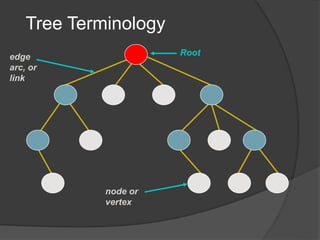
 Nodes: the elements in the tree
 Edges: connections between nodes
 Root: the distinguished element that is the
origin of the tree
 There is only one root node in a tree
 Empty tree has no nodes and no edges
Tree Terminology
node or
vertex
Rootedge
arc, or
link
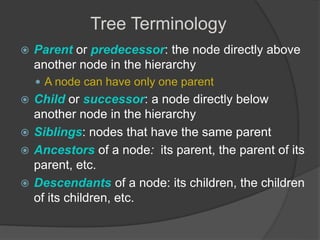
 Parent or predecessor: the node directly above
another node in the hierarchy
 A node can have only one parent
 Child or successor: a node directly below
another node in the hierarchy
 Siblings: nodes that have the same parent
 Ancestors of a node: its parent, the parent of its
parent, etc.
 Descendants of a node: its children, the children
of its children, etc.
Tree Terminology
Tree Terminology
 Leaf node: a node without children
 Internal node: a node that is not a leaf node
Tree Terminology
Leaf
nodes or
external
nodes
Root
Interior or
internal
nodes
Discussion
 Does a leaf node have any children?
 Does the root node have a parent?
 How many parents does every node
other than the root node have?
Height of a Tree
 A path is a sequence of edges leading
from one node to another
 Length of a path: number of edges on
the path
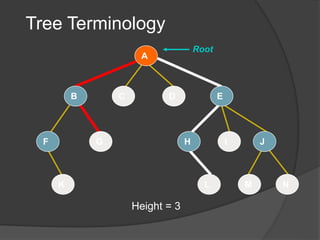
 Height of a (non-empty) tree : length of
the longest path from the root to a leaf
 What is the height of a tree that has only a
root node?
 By convention, the height of an empty tree
is -1
Tree Terminology
Root
A
B
F H
E
J
C D
I
L M N
G
K
Height = 3
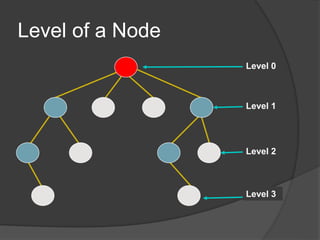
Level of a Node
 Level of a node: number of edges
between root and the node
 It can be defined recursively:
 Level of root node is 0
 Level of a node that is not the root node is
level of its parent + 1
 Question: What is the level of a node in
terms of path length?
 Question: What is the height of a tree in
terms of levels?
Level of a Node
Level 0
Level 1
Level 2
Level 3
Subtrees
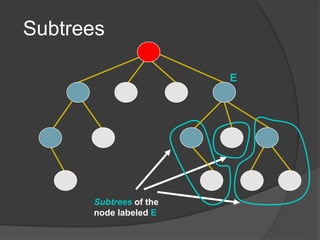
 Subtree of a node: consists of a child
node and all its descendants
 A subtree is itself a tree
 A node may have many subtrees
Subtrees
Subtrees of the
node labeled E
E
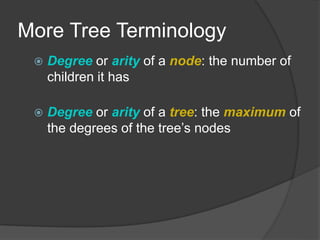
More Tree Terminology
 Degree or arity of a node: the number of
children it has
 Degree or arity of a tree: the maximum of
the degrees of the tree’s nodes
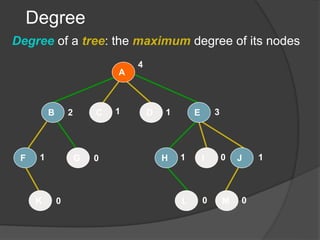
Degree
A
B
F H
E
J
C D
I
L M
G
K
4
2 1 1 3
1
0
0 1 0 1
0 0
Degree of a tree: the maximum degree of its nodes
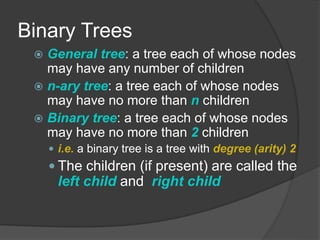
Binary Trees
 General tree: a tree each of whose nodes
may have any number of children
 n-ary tree: a tree each of whose nodes
may have no more than n children
 Binary tree: a tree each of whose nodes
may have no more than 2 children
 i.e. a binary tree is a tree with degree (arity) 2
 The children (if present) are called the
left child and right child
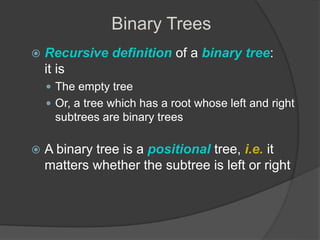
 Recursive definition of a binary tree:
it is
 The empty tree
 Or, a tree which has a root whose left and right
subtrees are binary trees
 A binary tree is a positional tree, i.e. it
matters whether the subtree is left or right
Binary Trees
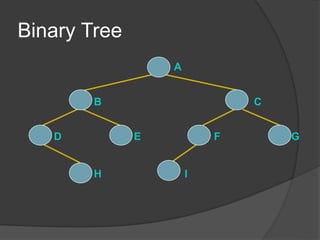
Binary Tree
A
IH
D E
B
F
C
G
Tree Traversals
 A traversal of a tree requires that each
node of the tree be visited once
 Example: a typical reason to traverse a tree is
to display the data stored at each node of the
tree
 Standard traversal orderings:
 preorder
 inorder
 postorder
 level-order
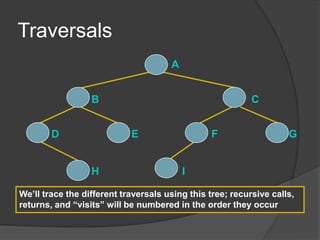
Traversals
We’ll trace the different traversals using this tree; recursive calls,
returns, and “visits” will be numbered in the order they occur
A
IH
D E
B
F
C
G
Preorder Traversal
 Start at the root
 Visit each node, followed by its children; we will
choose to visit left child before right
 Recursive algorithm for preorder traversal:
 If tree is not empty,
○ Visit root node of tree
○ Perform preorder traversal of its left subtree
○ Perform preorder traversal of its right subtree
 What is the base case?
 What is the recursive part?
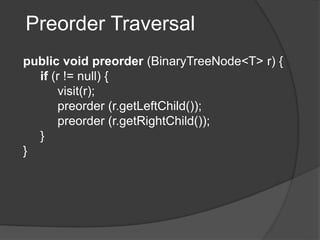
Preorder Traversal
public void preorder (BinaryTreeNode<T> r) {
if (r != null) {
visit(r);
preorder (r.getLeftChild());
preorder (r.getRightChild());
}
}
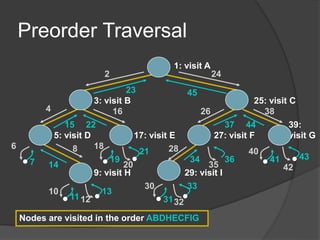
Preorder Traversal
1: visit A
29: visit I9: visit H
5: visit D 17: visit E
3: visit B
27: visit F
25: visit C
39:
visit G
Nodes are visited in the order ABDHECFIG
. .
.
.. .
. ..
6
4
2
11
10
8
7
16
15
14
13
12
21
20
19
18 28
26
24
23
22
34
33
3231
30
38
37
45
44
43
42
41
40
35
36
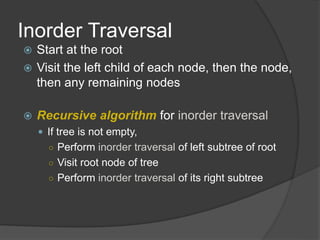
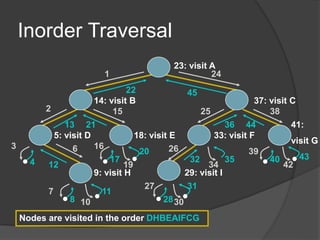
Inorder Traversal
 Start at the root
 Visit the left child of each node, then the node,
then any remaining nodes
 Recursive algorithm for inorder traversal
 If tree is not empty,
○ Perform inorder traversal of left subtree of root
○ Visit root node of tree
○ Perform inorder traversal of its right subtree
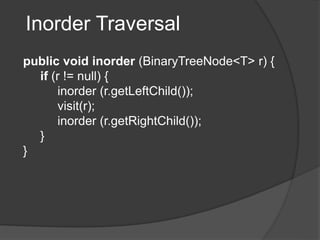
Inorder Traversal
public void inorder (BinaryTreeNode<T> r) {
if (r != null) {
inorder (r.getLeftChild());
visit(r);
inorder (r.getRightChild());
}
}
Inorder Traversal
23: visit A
29: visit I9: visit H
5: visit D 18: visit E
14: visit B
33: visit F
37: visit C
41:
visit G
Nodes are visited in the order DHBEAIFCG
. .
.
.. .
. ..
3
2
1
8
7
6
4
15
13
12
11
10
20
19
17
16 26
25
24
22
21
32
31
3028
27
38
36
45
44
43
42
40
39
34
35
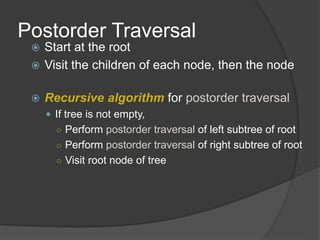
Postorder Traversal
 Start at the root
 Visit the children of each node, then the node
 Recursive algorithm for postorder traversal
 If tree is not empty,
○ Perform postorder traversal of left subtree of root
○ Perform postorder traversal of right subtree of root
○ Visit root node of tree
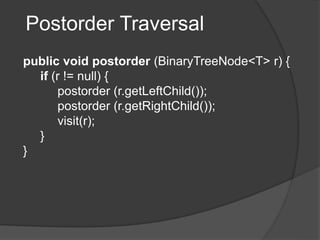
Postorder Traversal
public void postorder (BinaryTreeNode<T> r) {
if (r != null) {
postorder (r.getLeftChild());
postorder (r.getRightChild());
visit(r);
}
}
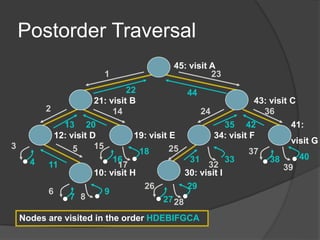
Postorder Traversal
45: visit A
30: visit I10: visit H
12: visit D 19: visit E
21: visit B
34: visit F
43: visit C
41:
visit G
Nodes are visited in the order HDEBIFGCA
. .
.
.. .
. ..
3
2
1
7
6
5
4
14
13
11
9
8
18
17
16
15 25
24
23
22
20
31
29
2827
26
36
35
44
42
40
39
38
37
32
33

Binary tree traversal ppt - 02.03.2020

  • 1.
    P. Raveena Lakshmi,M.Sc.,M.Phil., Assistant Professor, V.V.Vanniaperumal College For Women
  • 2.
    Tree Definition  Tree:a set of elements that either  it is empty  or, it has a distinguished element called the root and zero or more trees (called subtrees of the root)  What kind of definition is this?  What is the base case?  What is the recursive part?
  • 3.
  • 4.
    Tree Terminology  Nodes:the elements in the tree  Edges: connections between nodes  Root: the distinguished element that is the origin of the tree  There is only one root node in a tree  Empty tree has no nodes and no edges
  • 5.
  • 6.
     Parent orpredecessor: the node directly above another node in the hierarchy  A node can have only one parent  Child or successor: a node directly below another node in the hierarchy  Siblings: nodes that have the same parent  Ancestors of a node: its parent, the parent of its parent, etc.  Descendants of a node: its children, the children of its children, etc. Tree Terminology
  • 7.
    Tree Terminology  Leafnode: a node without children  Internal node: a node that is not a leaf node
  • 8.
  • 9.
    Discussion  Does aleaf node have any children?  Does the root node have a parent?  How many parents does every node other than the root node have?
  • 10.
    Height of aTree  A path is a sequence of edges leading from one node to another  Length of a path: number of edges on the path  Height of a (non-empty) tree : length of the longest path from the root to a leaf  What is the height of a tree that has only a root node?  By convention, the height of an empty tree is -1
  • 11.
    Tree Terminology Root A B F H E J CD I L M N G K Height = 3
  • 12.
    Level of aNode  Level of a node: number of edges between root and the node  It can be defined recursively:  Level of root node is 0  Level of a node that is not the root node is level of its parent + 1  Question: What is the level of a node in terms of path length?  Question: What is the height of a tree in terms of levels?
  • 13.
    Level of aNode Level 0 Level 1 Level 2 Level 3
  • 14.
    Subtrees  Subtree ofa node: consists of a child node and all its descendants  A subtree is itself a tree  A node may have many subtrees
  • 15.
  • 16.
    More Tree Terminology Degree or arity of a node: the number of children it has  Degree or arity of a tree: the maximum of the degrees of the tree’s nodes
  • 17.
    Degree A B F H E J C D I LM G K 4 2 1 1 3 1 0 0 1 0 1 0 0 Degree of a tree: the maximum degree of its nodes
  • 18.
    Binary Trees  Generaltree: a tree each of whose nodes may have any number of children  n-ary tree: a tree each of whose nodes may have no more than n children  Binary tree: a tree each of whose nodes may have no more than 2 children  i.e. a binary tree is a tree with degree (arity) 2  The children (if present) are called the left child and right child
  • 19.
     Recursive definitionof a binary tree: it is  The empty tree  Or, a tree which has a root whose left and right subtrees are binary trees  A binary tree is a positional tree, i.e. it matters whether the subtree is left or right Binary Trees
  • 20.
  • 21.
    Tree Traversals  Atraversal of a tree requires that each node of the tree be visited once  Example: a typical reason to traverse a tree is to display the data stored at each node of the tree  Standard traversal orderings:  preorder  inorder  postorder  level-order
  • 22.
    Traversals We’ll trace thedifferent traversals using this tree; recursive calls, returns, and “visits” will be numbered in the order they occur A IH D E B F C G
  • 23.
    Preorder Traversal  Startat the root  Visit each node, followed by its children; we will choose to visit left child before right  Recursive algorithm for preorder traversal:  If tree is not empty, ○ Visit root node of tree ○ Perform preorder traversal of its left subtree ○ Perform preorder traversal of its right subtree  What is the base case?  What is the recursive part?
  • 24.
    Preorder Traversal public voidpreorder (BinaryTreeNode<T> r) { if (r != null) { visit(r); preorder (r.getLeftChild()); preorder (r.getRightChild()); } }
  • 25.
    Preorder Traversal 1: visitA 29: visit I9: visit H 5: visit D 17: visit E 3: visit B 27: visit F 25: visit C 39: visit G Nodes are visited in the order ABDHECFIG . . . .. . . .. 6 4 2 11 10 8 7 16 15 14 13 12 21 20 19 18 28 26 24 23 22 34 33 3231 30 38 37 45 44 43 42 41 40 35 36
  • 26.
    Inorder Traversal  Startat the root  Visit the left child of each node, then the node, then any remaining nodes  Recursive algorithm for inorder traversal  If tree is not empty, ○ Perform inorder traversal of left subtree of root ○ Visit root node of tree ○ Perform inorder traversal of its right subtree
  • 27.
    Inorder Traversal public voidinorder (BinaryTreeNode<T> r) { if (r != null) { inorder (r.getLeftChild()); visit(r); inorder (r.getRightChild()); } }
  • 28.
    Inorder Traversal 23: visitA 29: visit I9: visit H 5: visit D 18: visit E 14: visit B 33: visit F 37: visit C 41: visit G Nodes are visited in the order DHBEAIFCG . . . .. . . .. 3 2 1 8 7 6 4 15 13 12 11 10 20 19 17 16 26 25 24 22 21 32 31 3028 27 38 36 45 44 43 42 40 39 34 35
  • 29.
    Postorder Traversal  Startat the root  Visit the children of each node, then the node  Recursive algorithm for postorder traversal  If tree is not empty, ○ Perform postorder traversal of left subtree of root ○ Perform postorder traversal of right subtree of root ○ Visit root node of tree
  • 30.
    Postorder Traversal public voidpostorder (BinaryTreeNode<T> r) { if (r != null) { postorder (r.getLeftChild()); postorder (r.getRightChild()); visit(r); } }
  • 31.
    Postorder Traversal 45: visitA 30: visit I10: visit H 12: visit D 19: visit E 21: visit B 34: visit F 43: visit C 41: visit G Nodes are visited in the order HDEBIFGCA . . . .. . . .. 3 2 1 7 6 5 4 14 13 11 9 8 18 17 16 15 25 24 23 22 20 31 29 2827 26 36 35 44 42 40 39 38 37 32 33