WAVE QUANTUM MECHANIC
MODEL
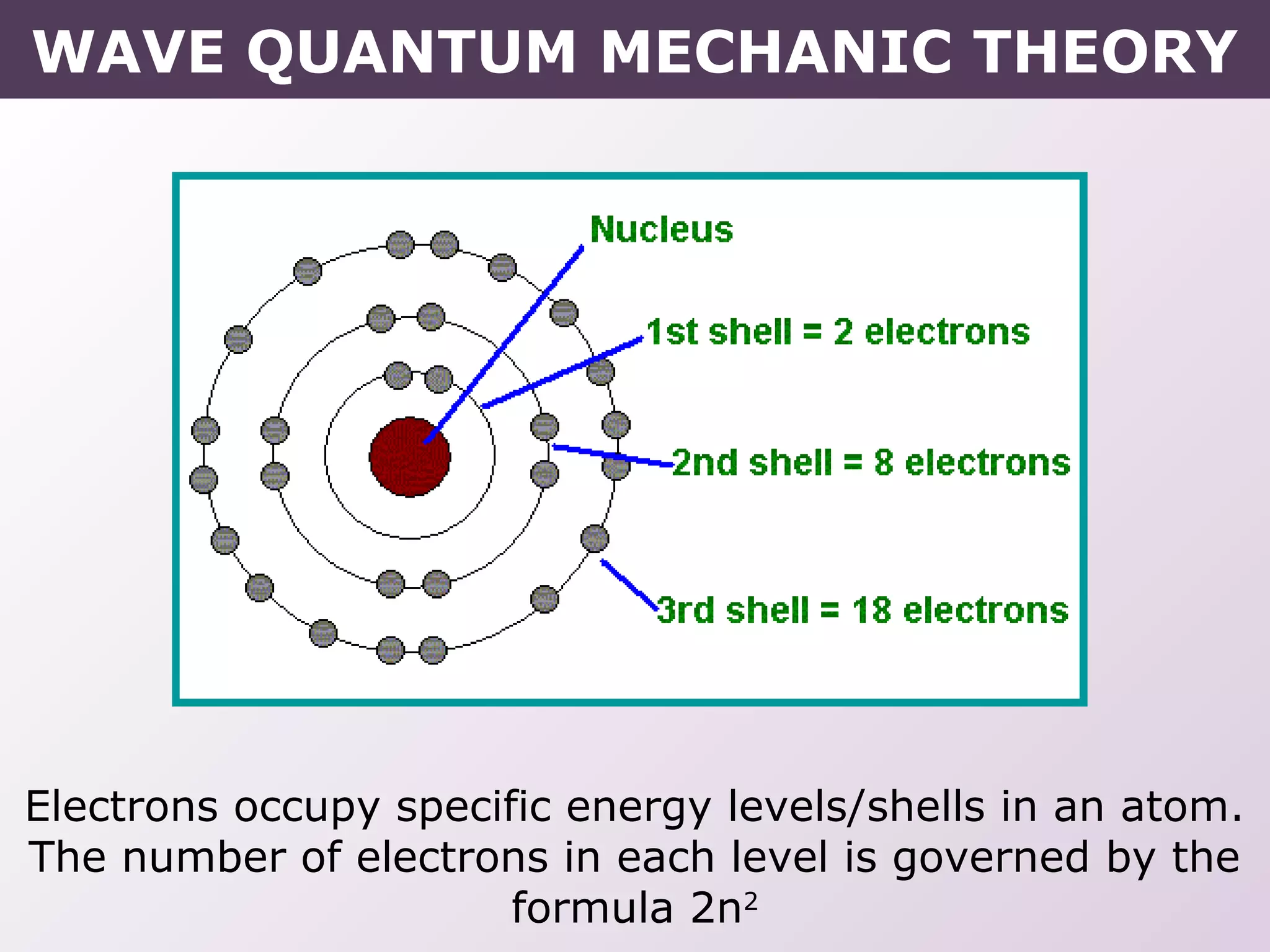
Electrons occupy specific energy levels/shells in an atom.
The number of electrons in each level is governed by the
formula 2n2
WAVE QUANTUM MECHANIC THEORY
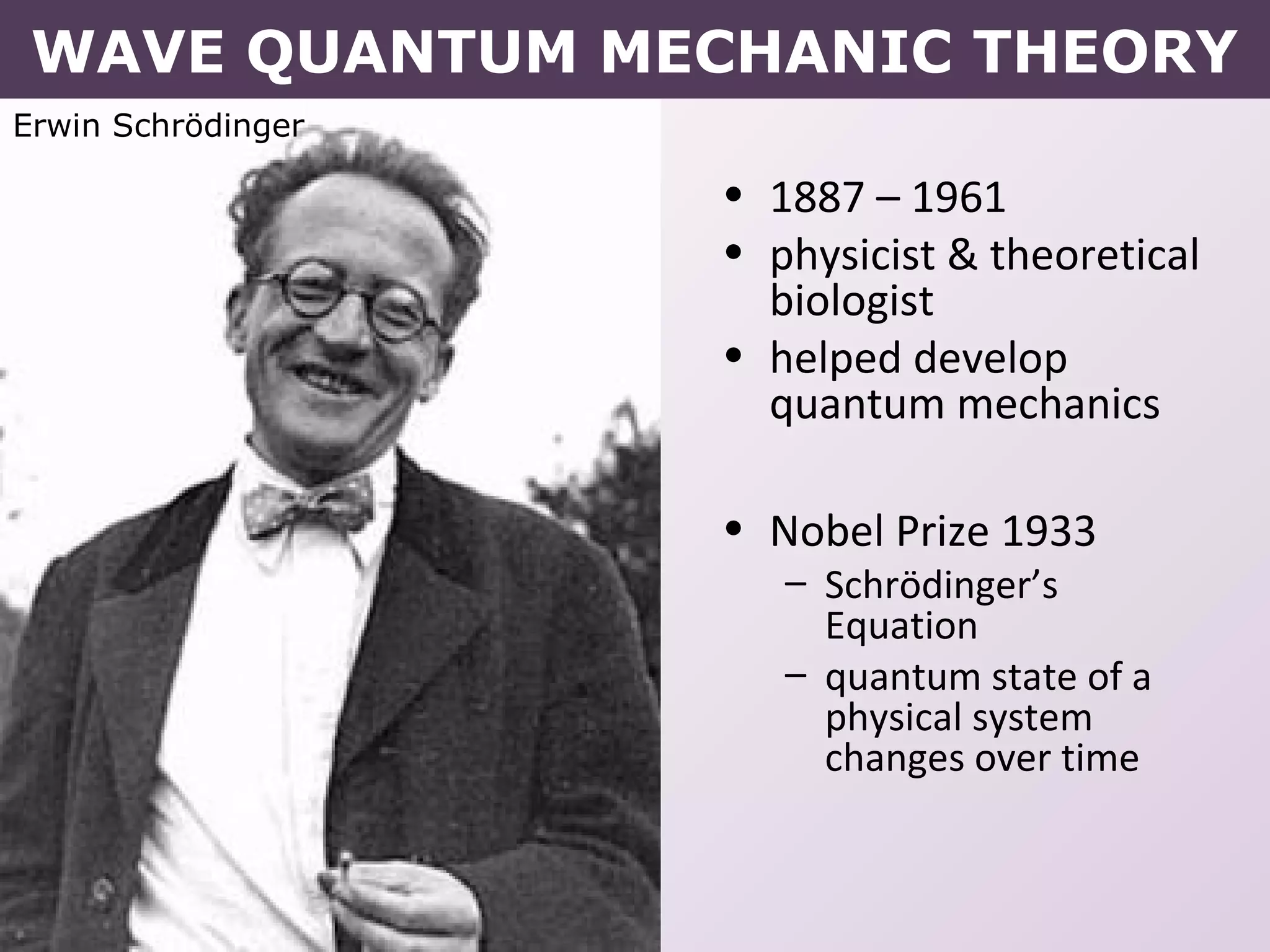
Erwin Schrödinger
• 1887 – 1961
• physicist & theoretical
biologist
• helped develop
quantum mechanics
• Nobel Prize 1933
– Schrödinger’s
Equation
– quantum state of a
physical system
changes over time
WAVE QUANTUM MECHANIC THEORY
Erwin Schrödinger
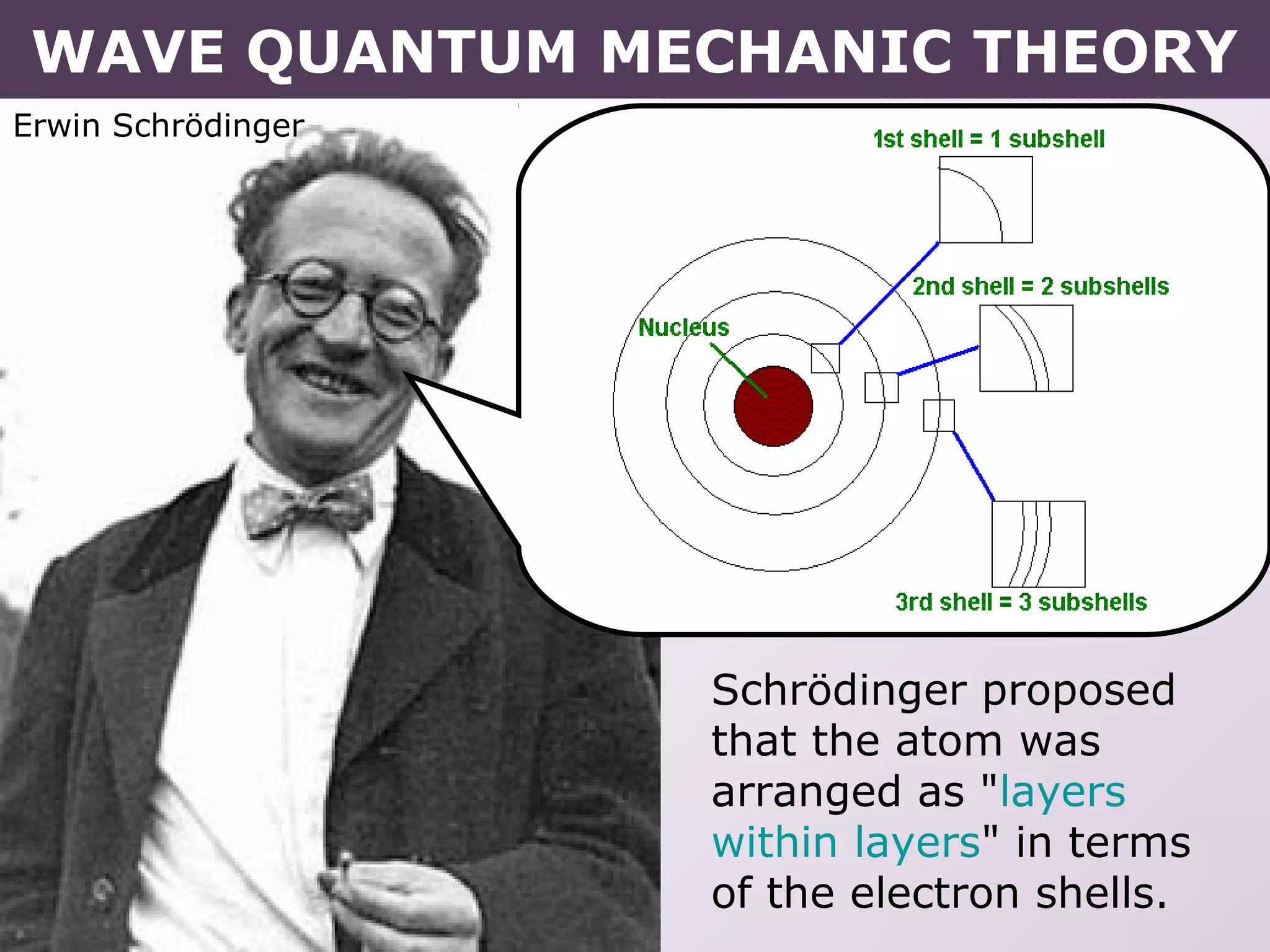
Schrödinger proposed
that the atom was
arranged as "layers
within layers" in terms
of the electron shells.
WAVE QUANTUM MECHANIC THEORY
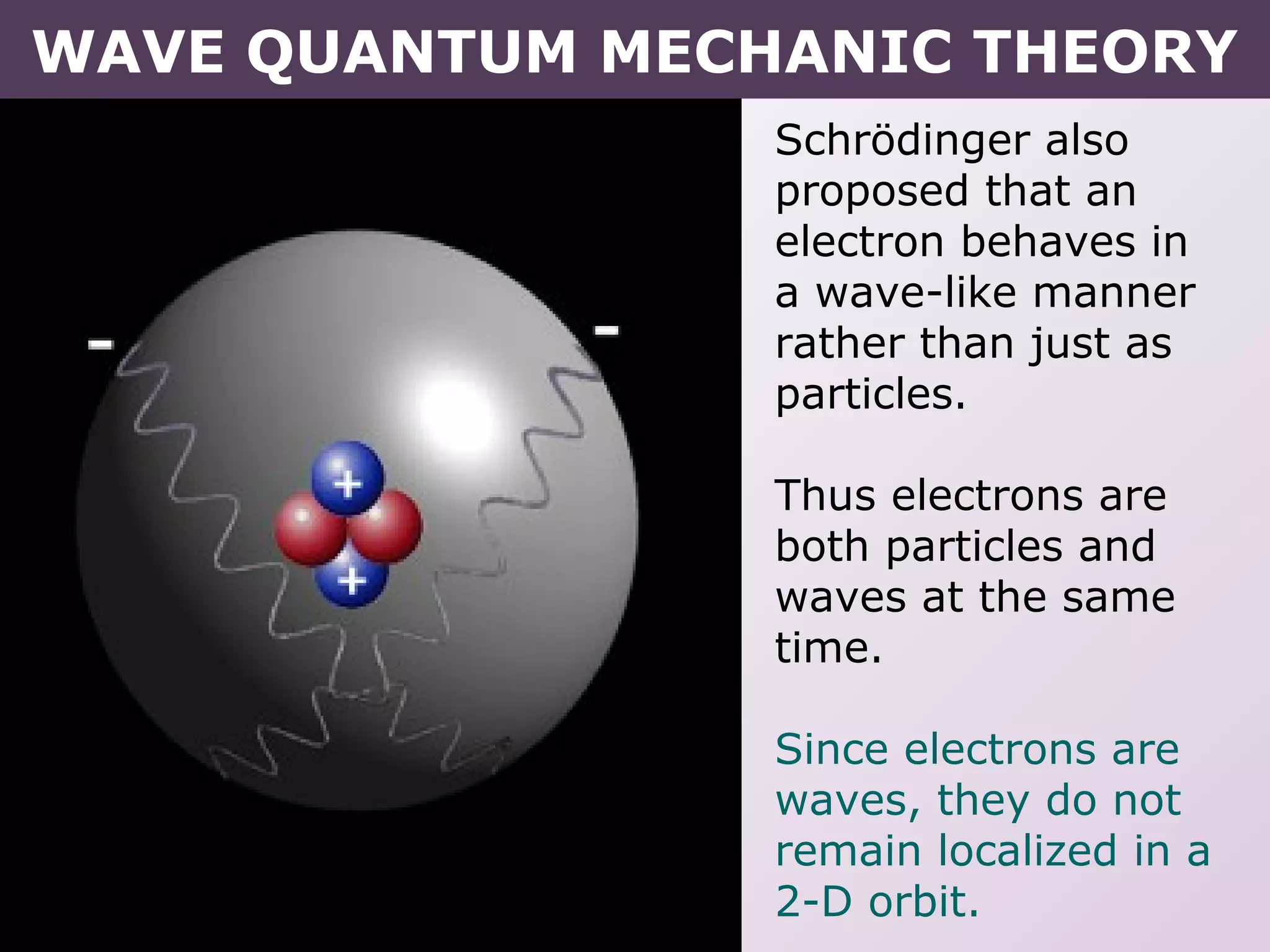
Schrödinger also
proposed that an
electron behaves in
a wave-like manner
rather than just as
particles.
Thus electrons are
both particles and
waves at the same
time.
Since electrons are
waves, they do not
remain localized in a
2-D orbit.
WAVE QUANTUM MECHANIC THEORY
quantum mechanics – mathematical description of
wave-particle duality of energy / matter
Schrodinger’s Wave Equation:
Electrons do not travel in defined paths around the
nucleus. Rather they occupy a space defined by
the “wave equation”.
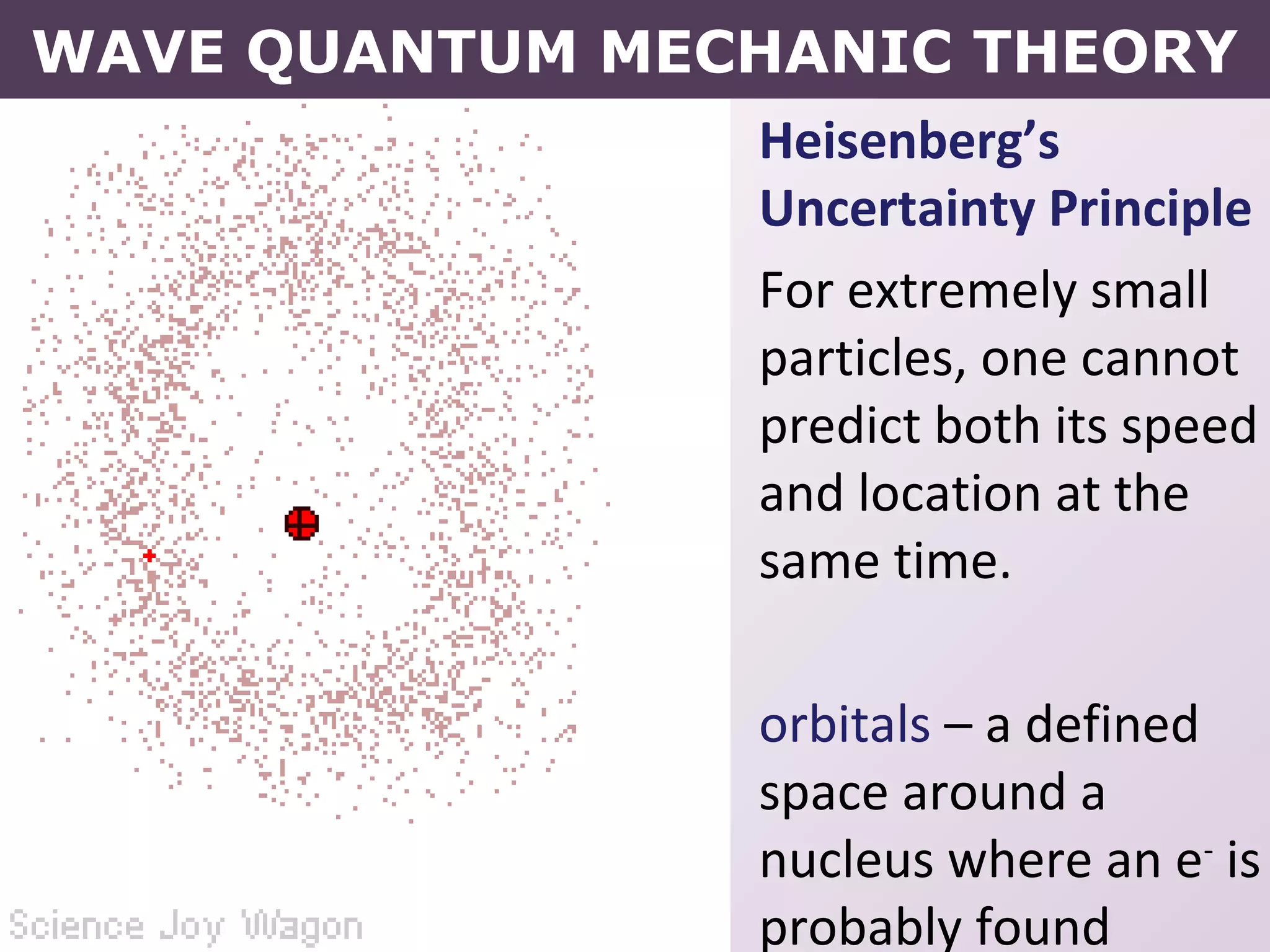
Heisenberg’s
Uncertainty Principle
For extremely small
particles, one cannot
predict both its speed
and location at the
same time.
orbitals – a defined
space around a
nucleus where an e-
is
probably found
WAVE QUANTUM MECHANIC THEORY
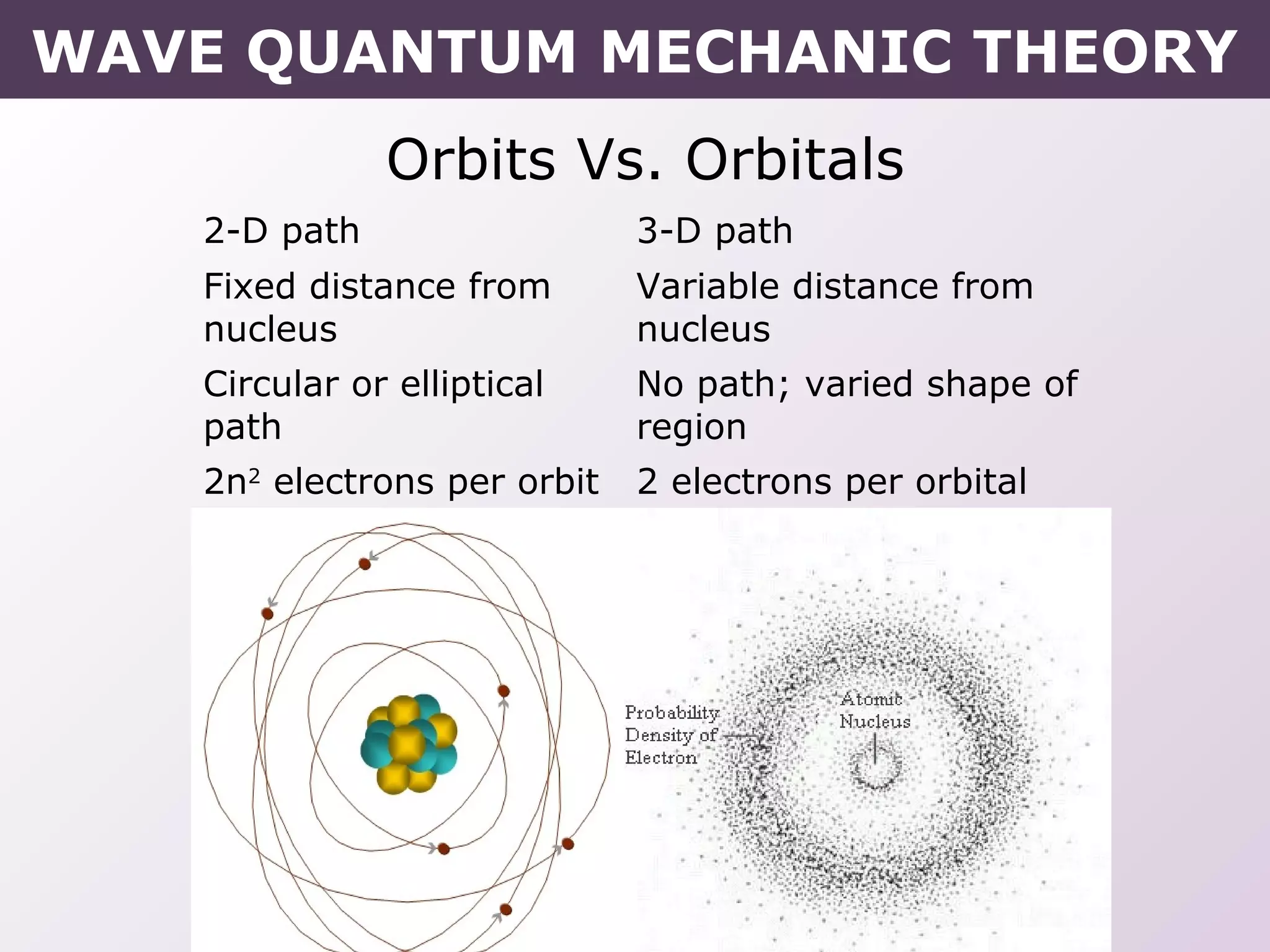
Orbits Vs. Orbitals
2-D path 3-D path
Fixed distance from
nucleus
Variable distance from
nucleus
Circular or elliptical
path
No path; varied shape of
region
2n2
electrons per orbit 2 electrons per orbital
WAVE QUANTUM MECHANIC THEORY
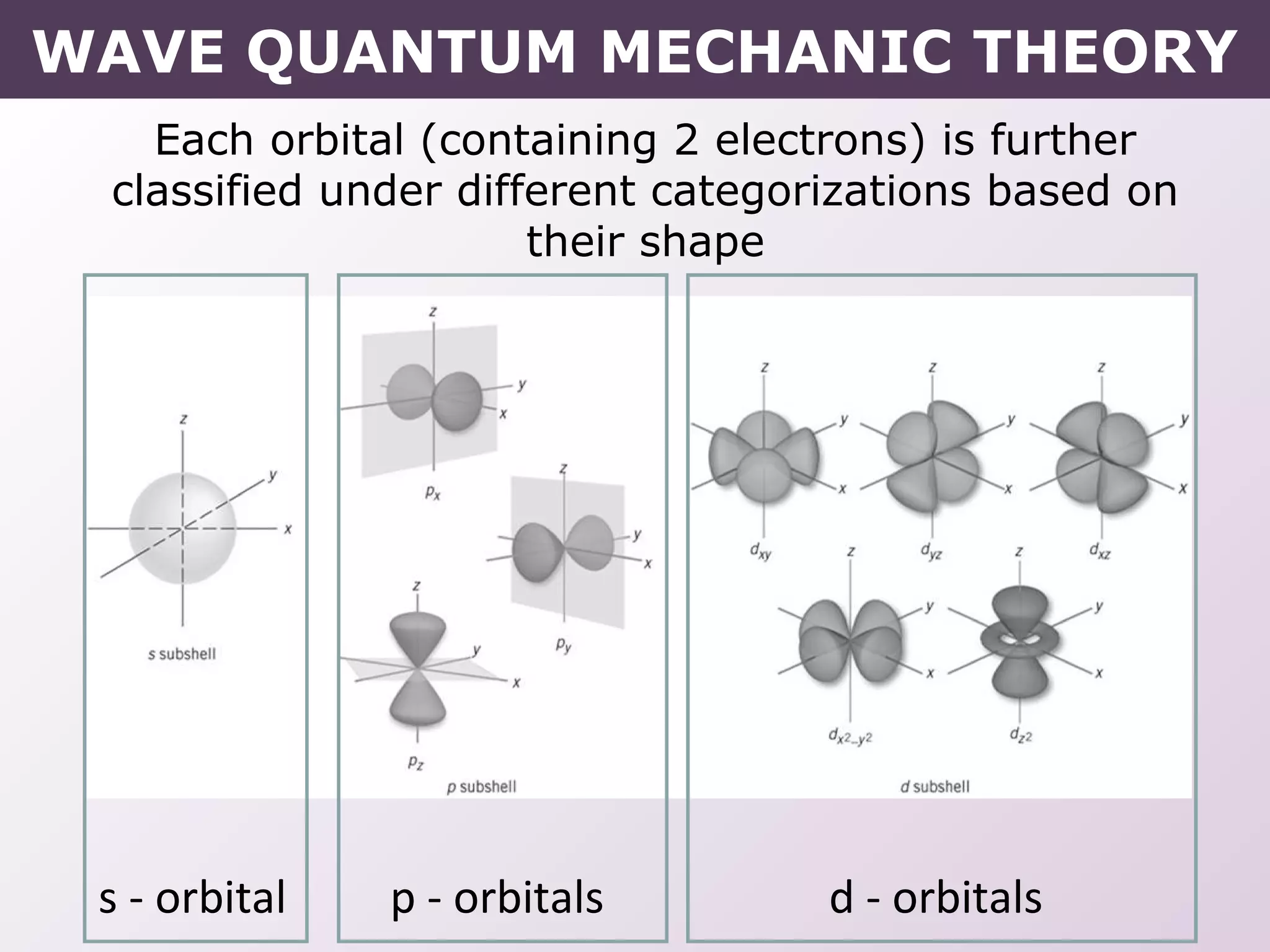
Each orbital (containing 2 electrons) is further
classified under different categorizations based on
their shape
WAVE QUANTUM MECHANIC THEORY
s - orbital p - orbitals d - orbitals
WAVE QUANTUM MECHANIC THEORY
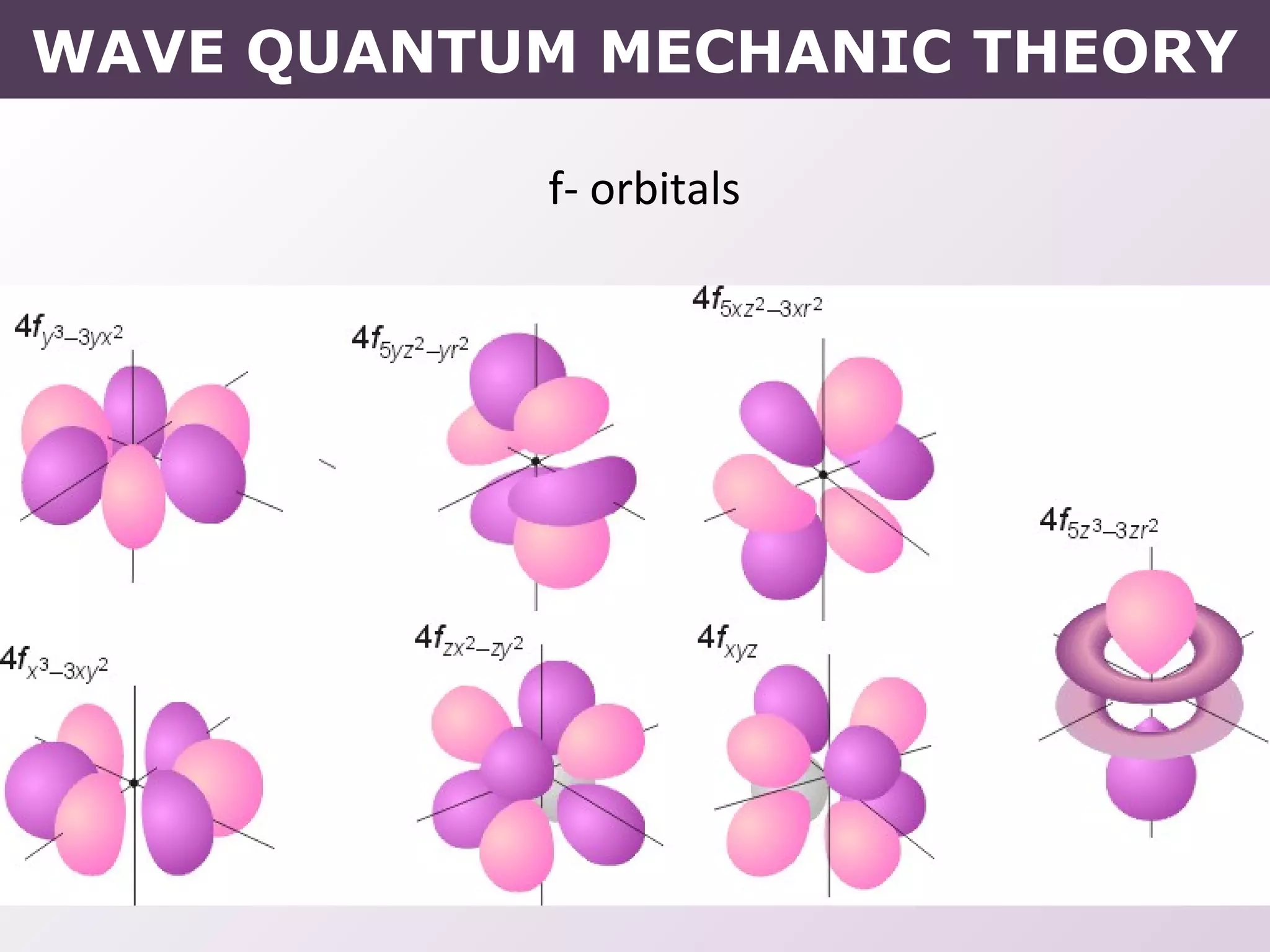
f- orbitals
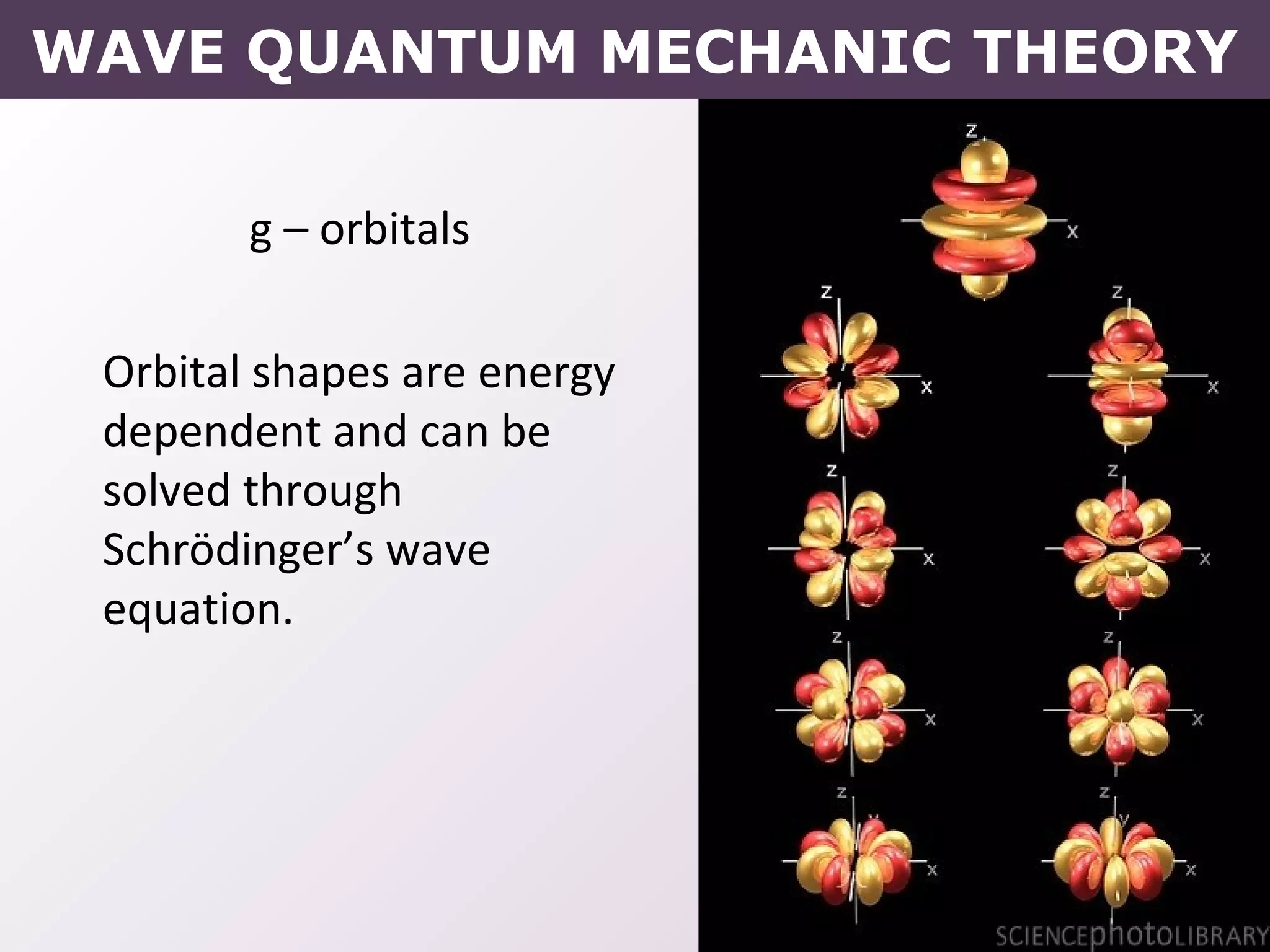
g – orbitals
Orbital shapes are energy
dependent and can be
solved through
Schrödinger’s wave
equation.
WAVE QUANTUM MECHANIC THEORY
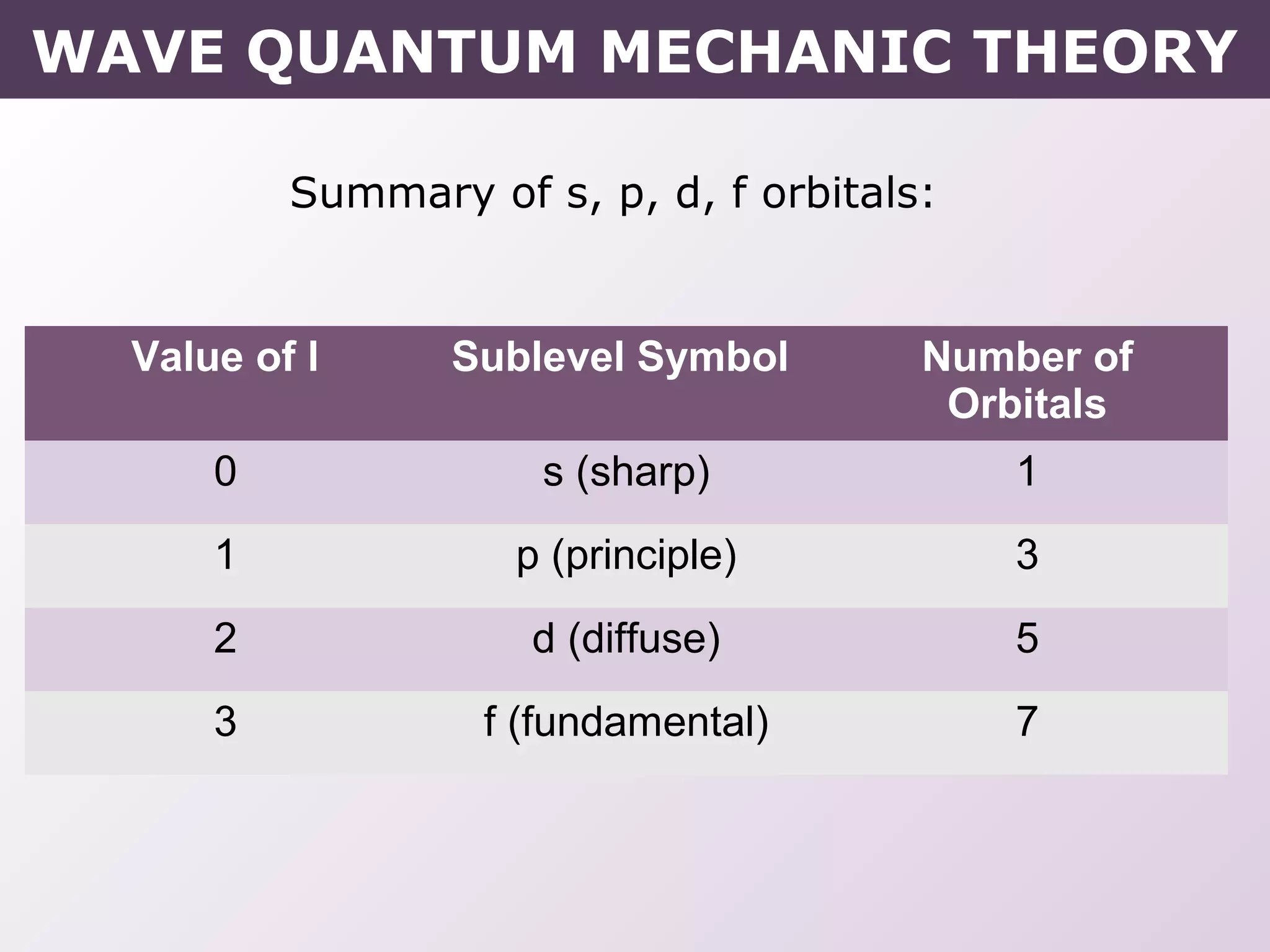
Value of l Sublevel Symbol Number of
Orbitals
0 s (sharp) 1
1 p (principle) 3
2 d (diffuse) 5
3 f (fundamental) 7
Summary of s, p, d, f orbitals:
WAVE QUANTUM MECHANIC THEORY
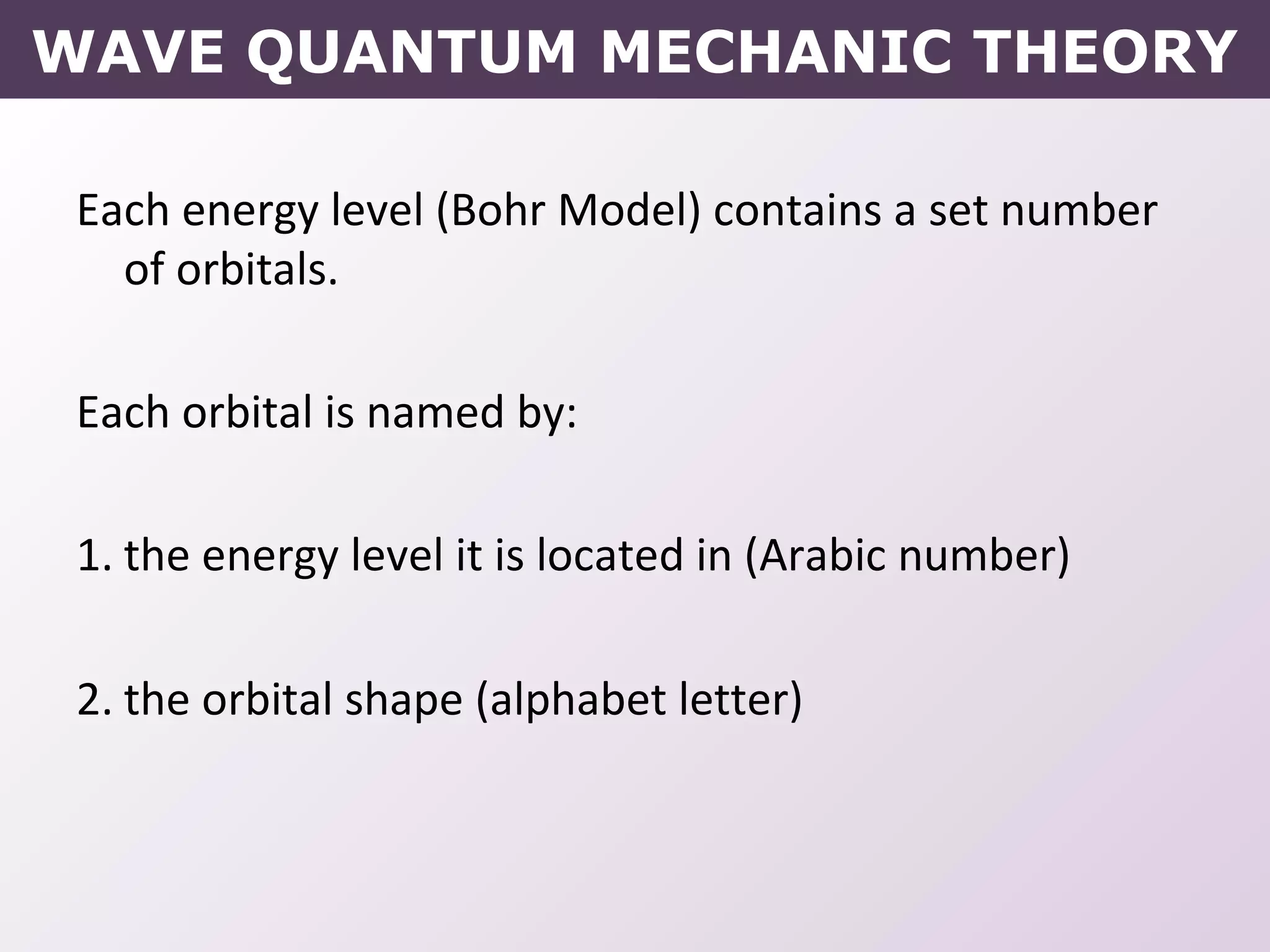
Each energy level (Bohr Model) contains a set number
of orbitals.
Each orbital is named by:
1. the energy level it is located in (Arabic number)
2. the orbital shape (alphabet letter)
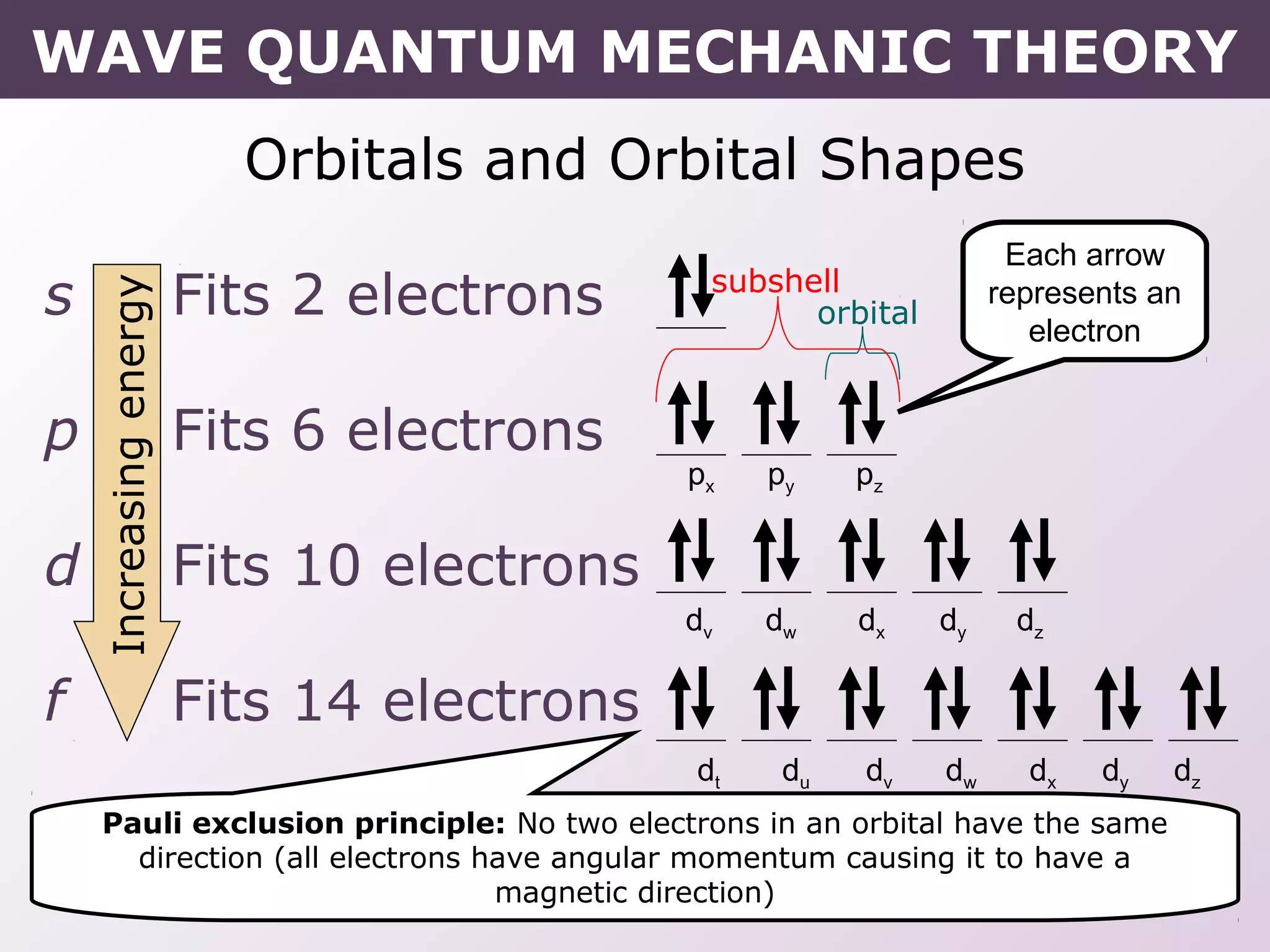
Orbitals and Orbital Shapes
s Fits 2 electrons
p Fits 6 electrons
d Fits 10 electrons
f Fits 14 electrons
px py pz
dv dw dx dy dz
dt du dv dw dx dy dz
Increasingenergy
orbital
subshell
Each arrow
represents an
electron
Pauli exclusion principle: No two electrons in an orbital have the same
direction (all electrons have angular momentum causing it to have a
magnetic direction)
WAVE QUANTUM MECHANIC THEORY
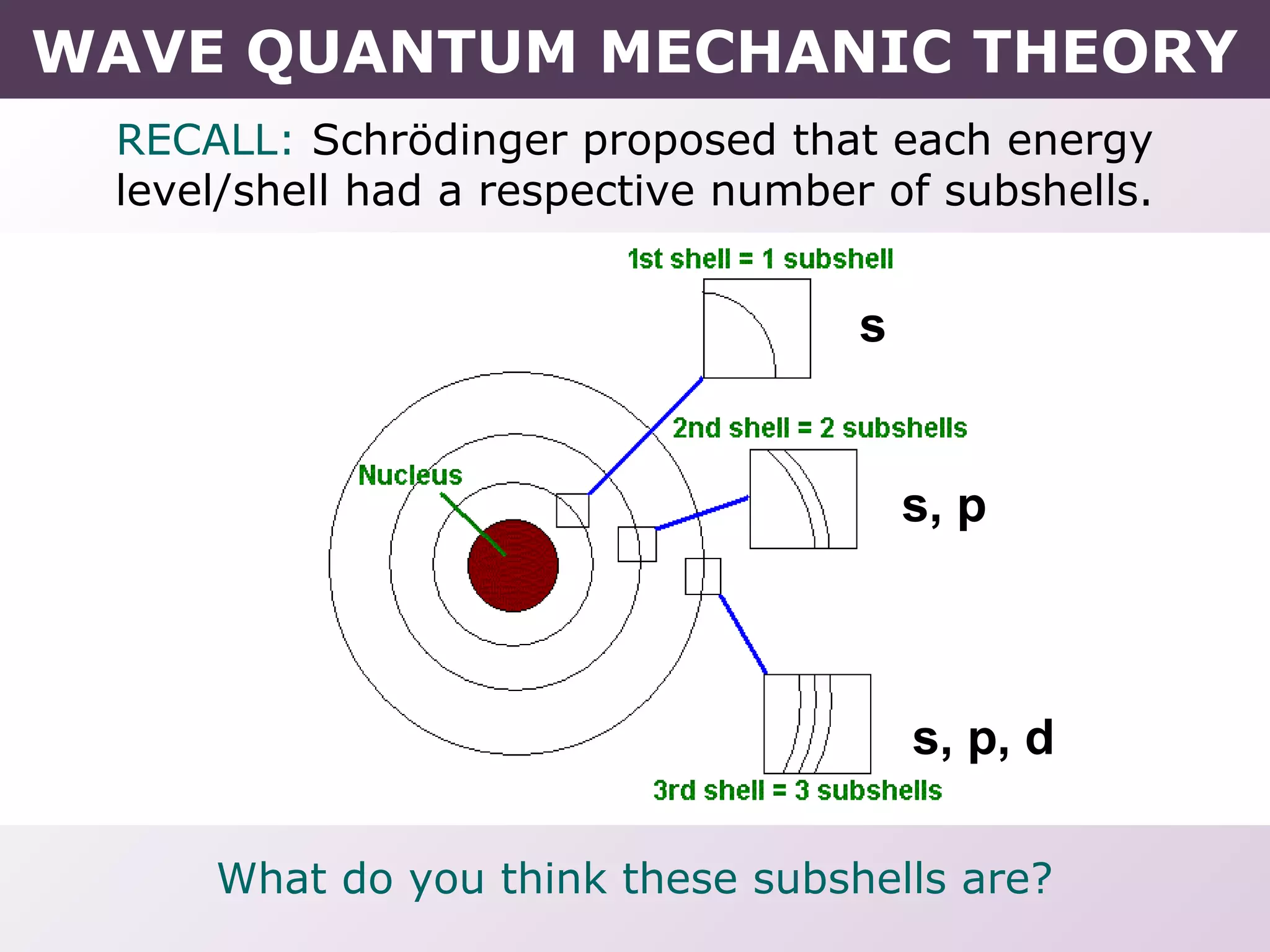
RECALL: Schrödinger proposed that each energy
level/shell had a respective number of subshells.
What do you think these subshells are?
s
s, p
s, p, d
WAVE QUANTUM MECHANIC THEORY
Electron distribution:
Energy Level Sublevel Maximum #
of Electrons
in Energy
Level (2n2
)
Number of
Each Orbital
Maximum #
of Electrons
in Orbital
Type
1 s 2 1 2
2 s
p
8 1
3
2
6
3 s
p
d
18 1
3
5
2
6
10
4 s
p
d
f
32 1
3
5
7
2
6
10
14
WAVE QUANTUM MECHANIC THEORY
Summary of “building” atoms:
1. Each higher energy level can “hold” one more type
of orbital. (s, p, d, f, g)
2. For any orbital at an energy level, the number of
each orbital type increases by two.
• 1 s-orbital
• 3 p-orbitals
• 5 d-orbitals
3. Electrons fill each orbital, in order, from the
lowest energy orbital.
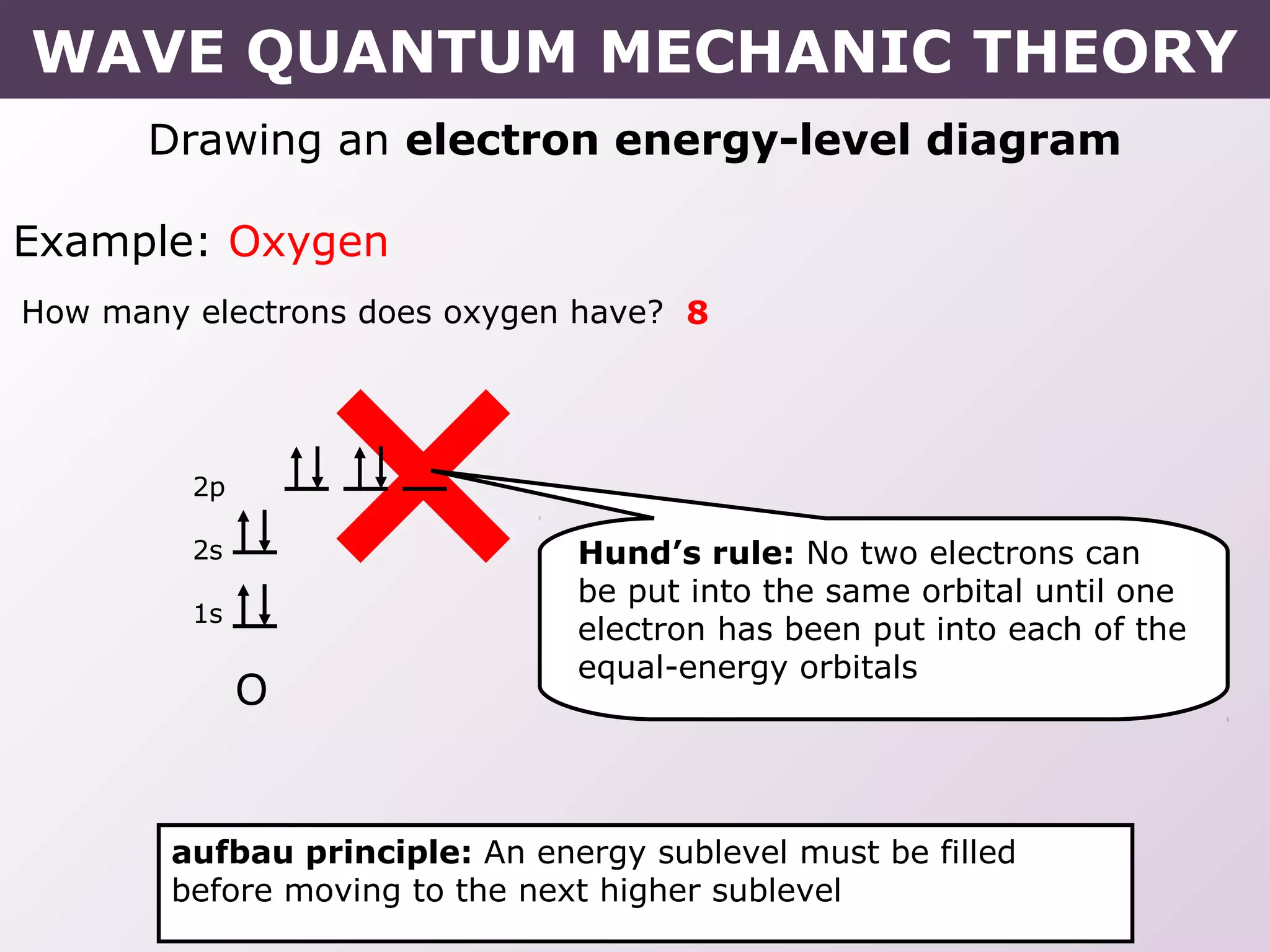
Drawing an electron energy-level diagram
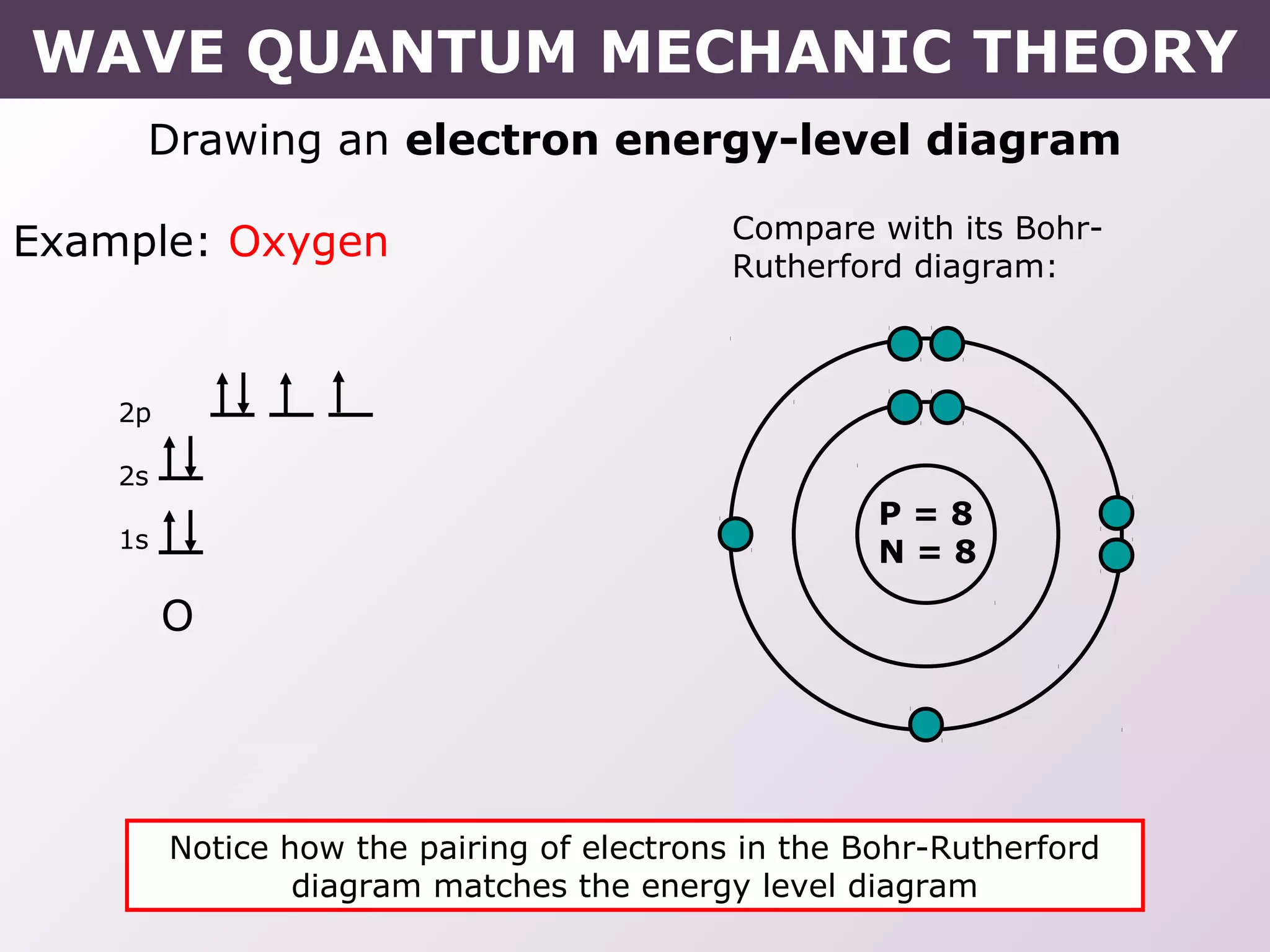
Example: Oxygen
How many electrons does oxygen have? 8
O
aufbau principle: An energy sublevel must be filled
before moving to the next higher sublevel
2p
2s
1s
Hund’s rule: No two electrons can
be put into the same orbital until one
electron has been put into each of the
equal-energy orbitals
WAVE QUANTUM MECHANIC THEORY
Drawing an electron energy-level diagram
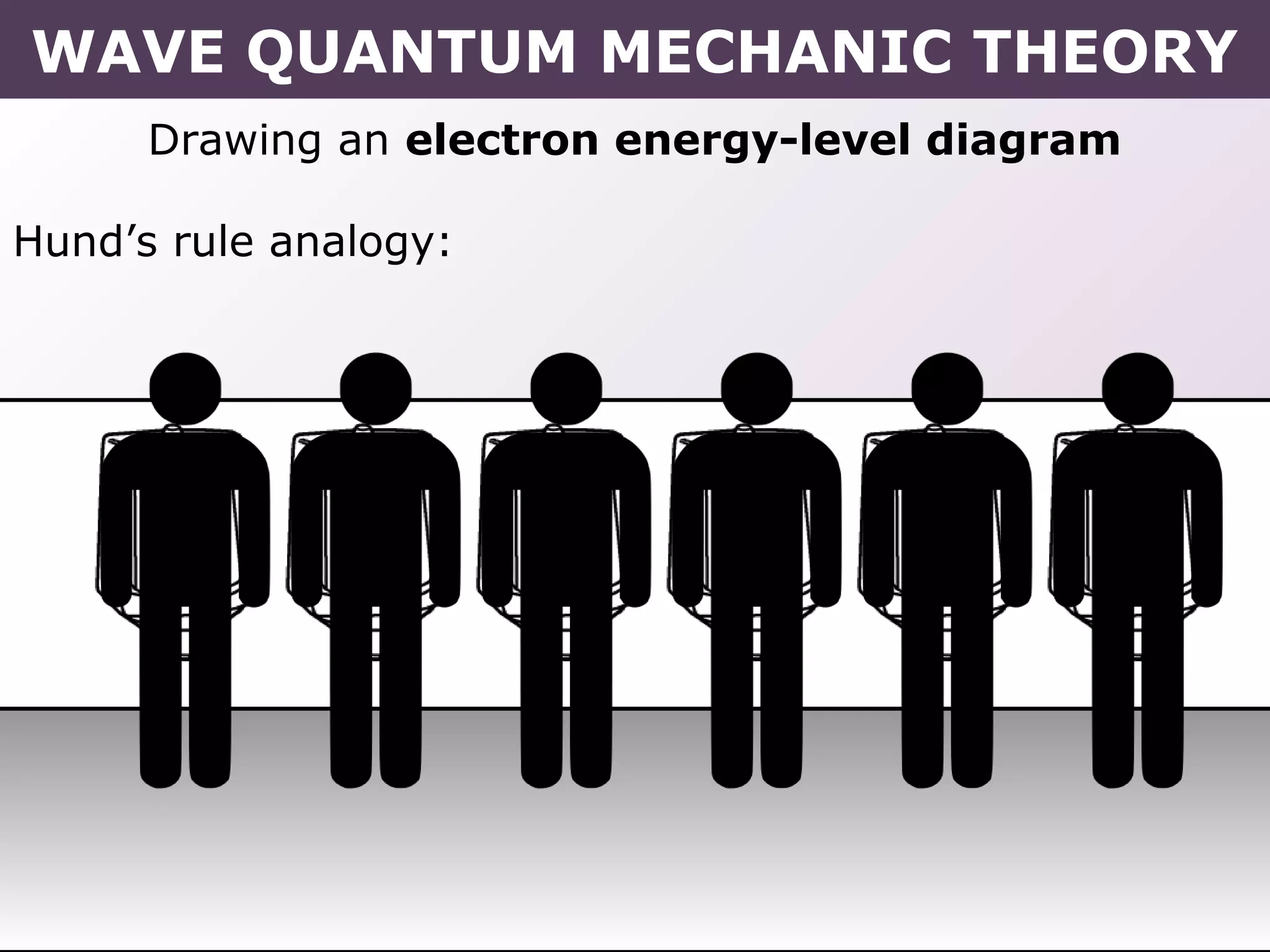
Hund’s rule analogy:
WAVE QUANTUM MECHANIC THEORY
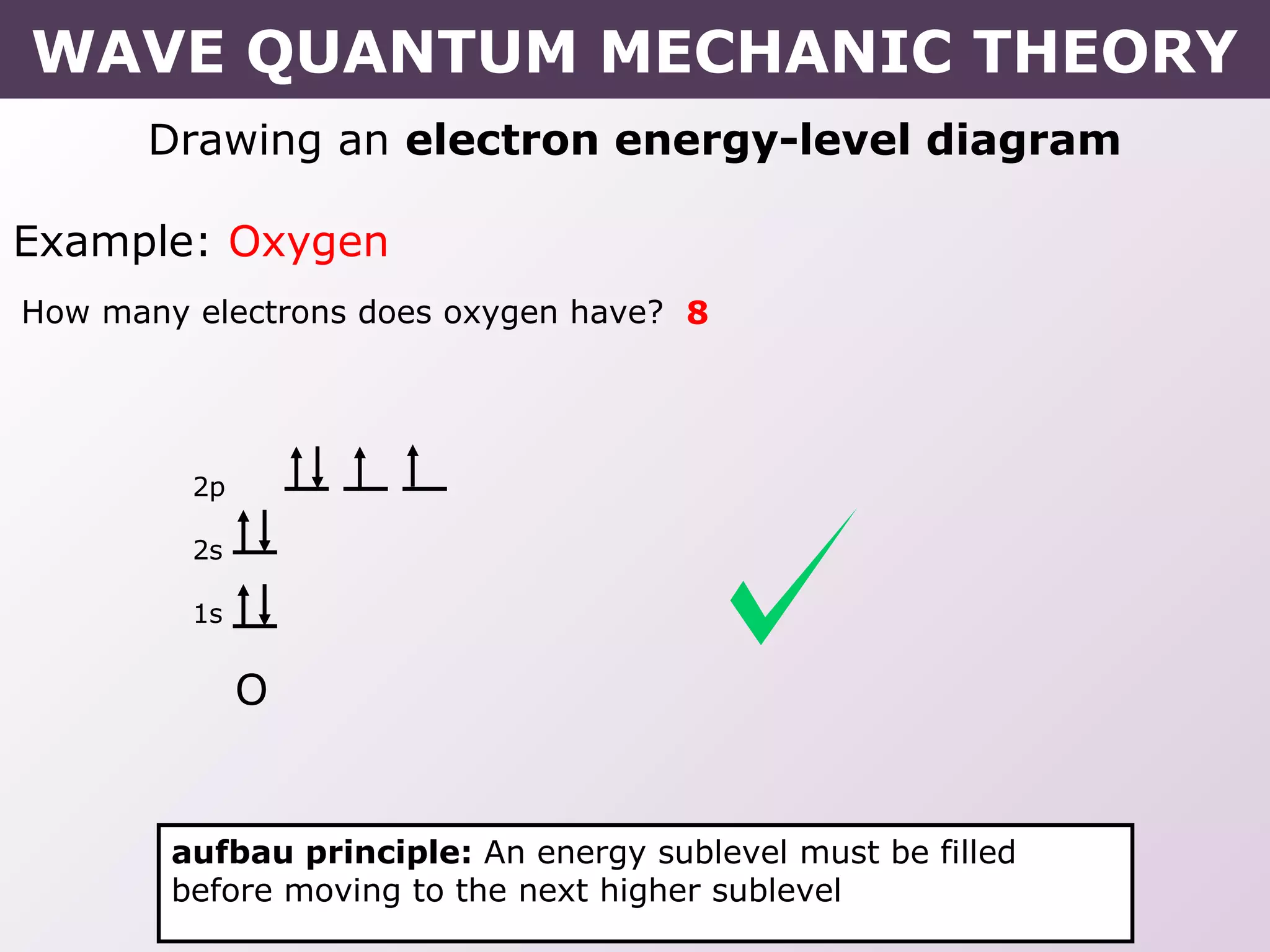
Drawing an electron energy-level diagram
Example: Oxygen
How many electrons does oxygen have? 8
O
aufbau principle: An energy sublevel must be filled
before moving to the next higher sublevel
2p
2s
1s
WAVE QUANTUM MECHANIC THEORY
Drawing an electron energy-level diagram
Example: Oxygen
O
2p
2s
1s
Compare with its Bohr-
Rutherford diagram:
P = 8
N = 8
Notice how the pairing of electrons in the Bohr-Rutherford
diagram matches the energy level diagram
WAVE QUANTUM MECHANIC THEORY
Drawing an electron energy-level diagram
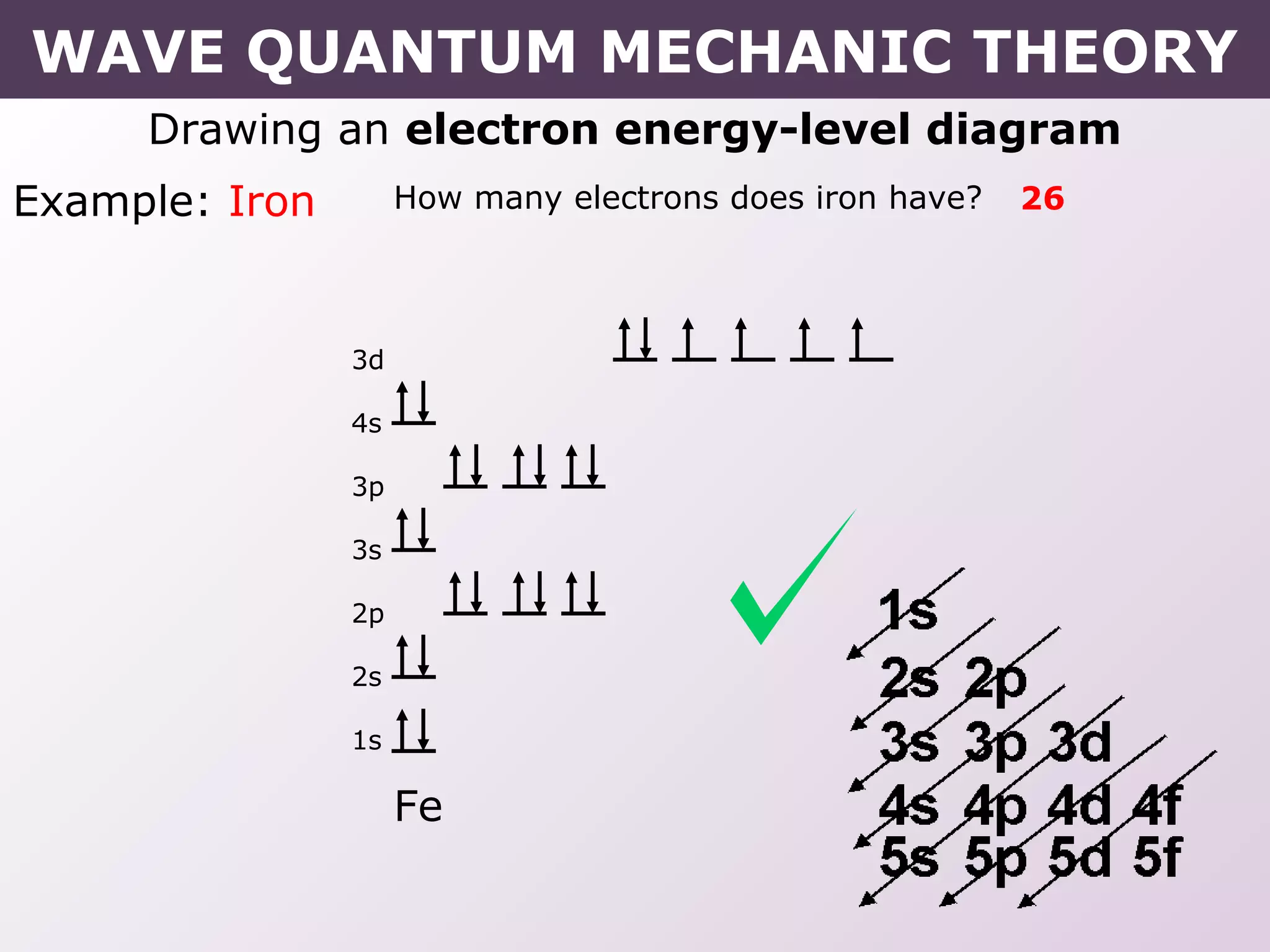
Example: Iron How many electrons does iron have? 26
Although the 3rd
energy level
has 3 subshells, the “electron
filling” order is not as such
Fe
3d
3p
3s
2p
2s
1s
WAVE QUANTUM MECHANIC THEORY
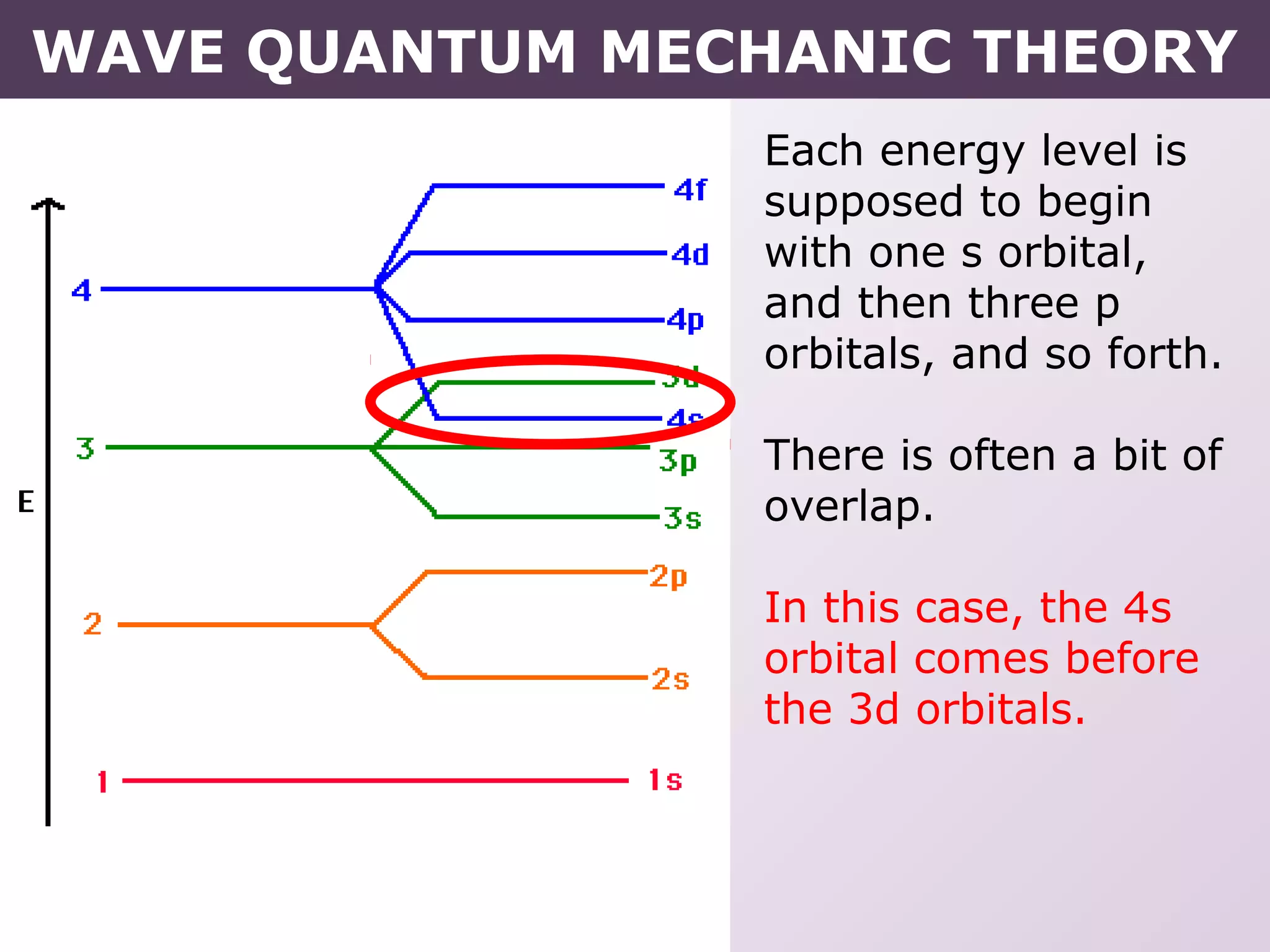
Each energy level is
supposed to begin
with one s orbital,
and then three p
orbitals, and so forth.
There is often a bit of
overlap.
In this case, the 4s
orbital comes before
the 3d orbitals.
WAVE QUANTUM MECHANIC THEORY
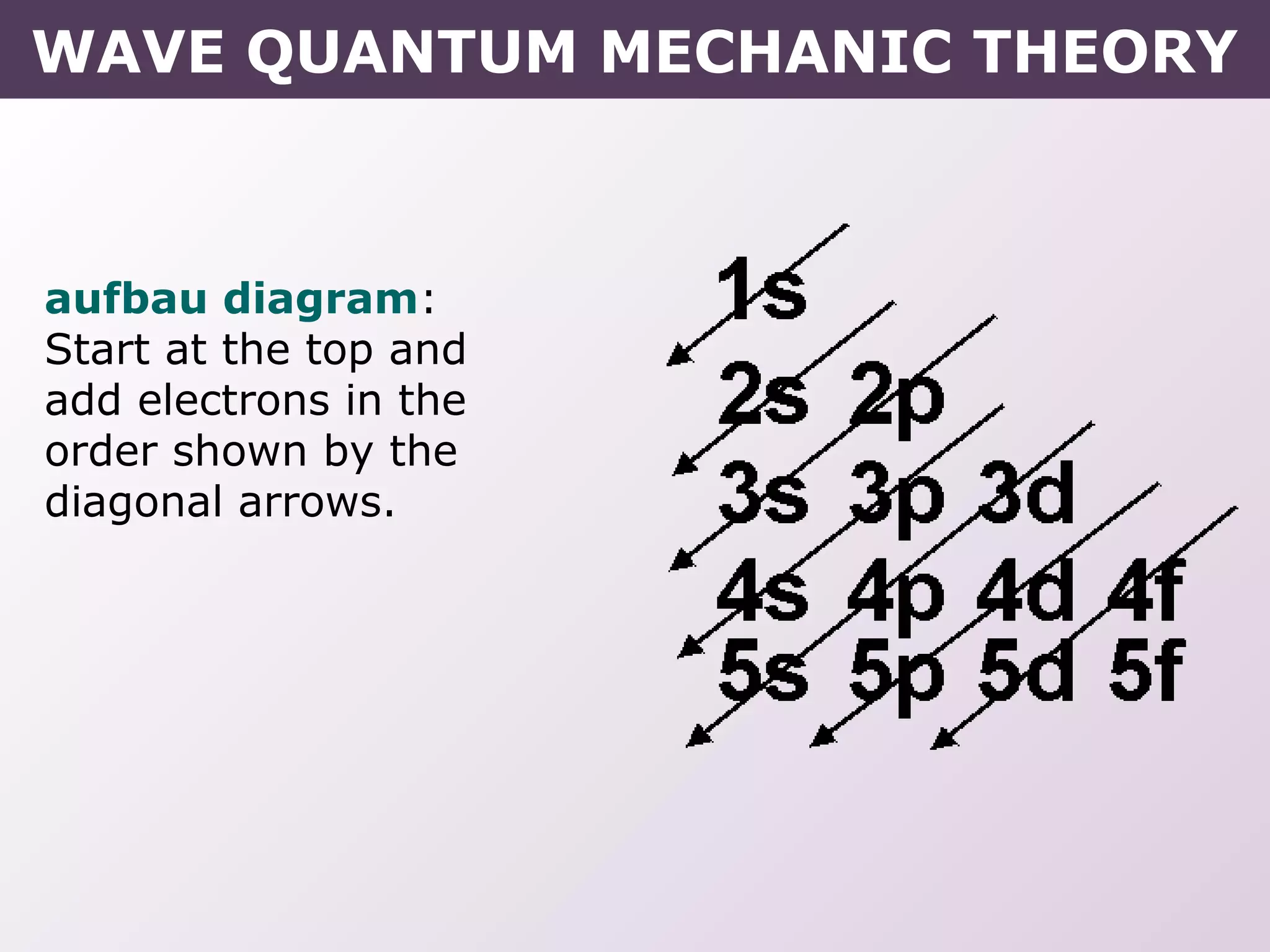
aufbau diagram:
Start at the top and
add electrons in the
order shown by the
diagonal arrows.
WAVE QUANTUM MECHANIC THEORY
Drawing an electron energy-level diagram
Example: Iron How many electrons does iron have? 26
Fe
3d
4s
3p
3s
2p
2s
1s
WAVE QUANTUM MECHANIC THEORY
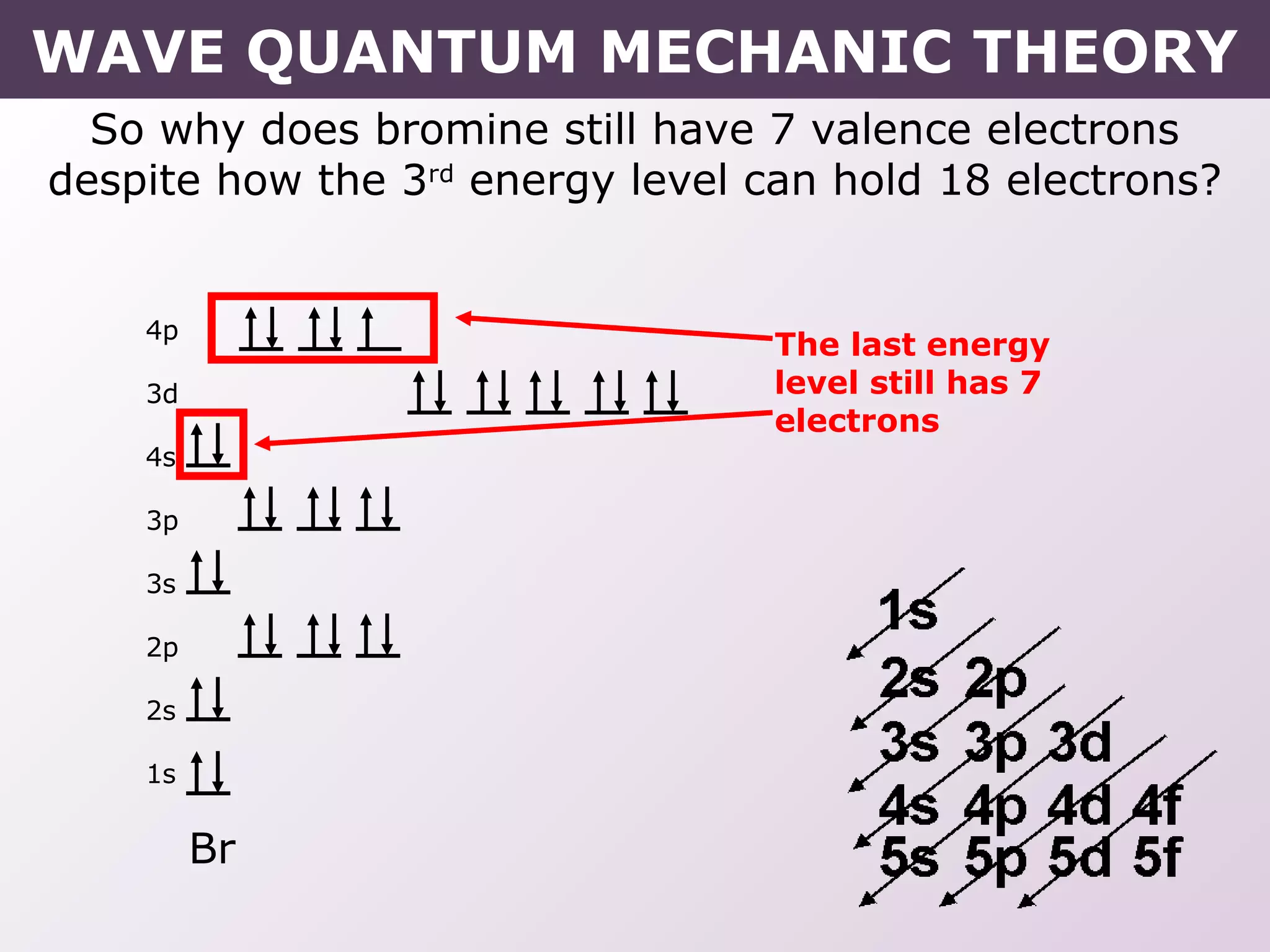
So why does bromine still have 7 valence electrons
despite how the 3rd
energy level can hold 18 electrons?
The last energy
level still has 7
electrons
Br
4p
3d
4s
3p
3s
2p
2s
1s
WAVE QUANTUM MECHANIC THEORY
Drawing an electron energy-level diagram
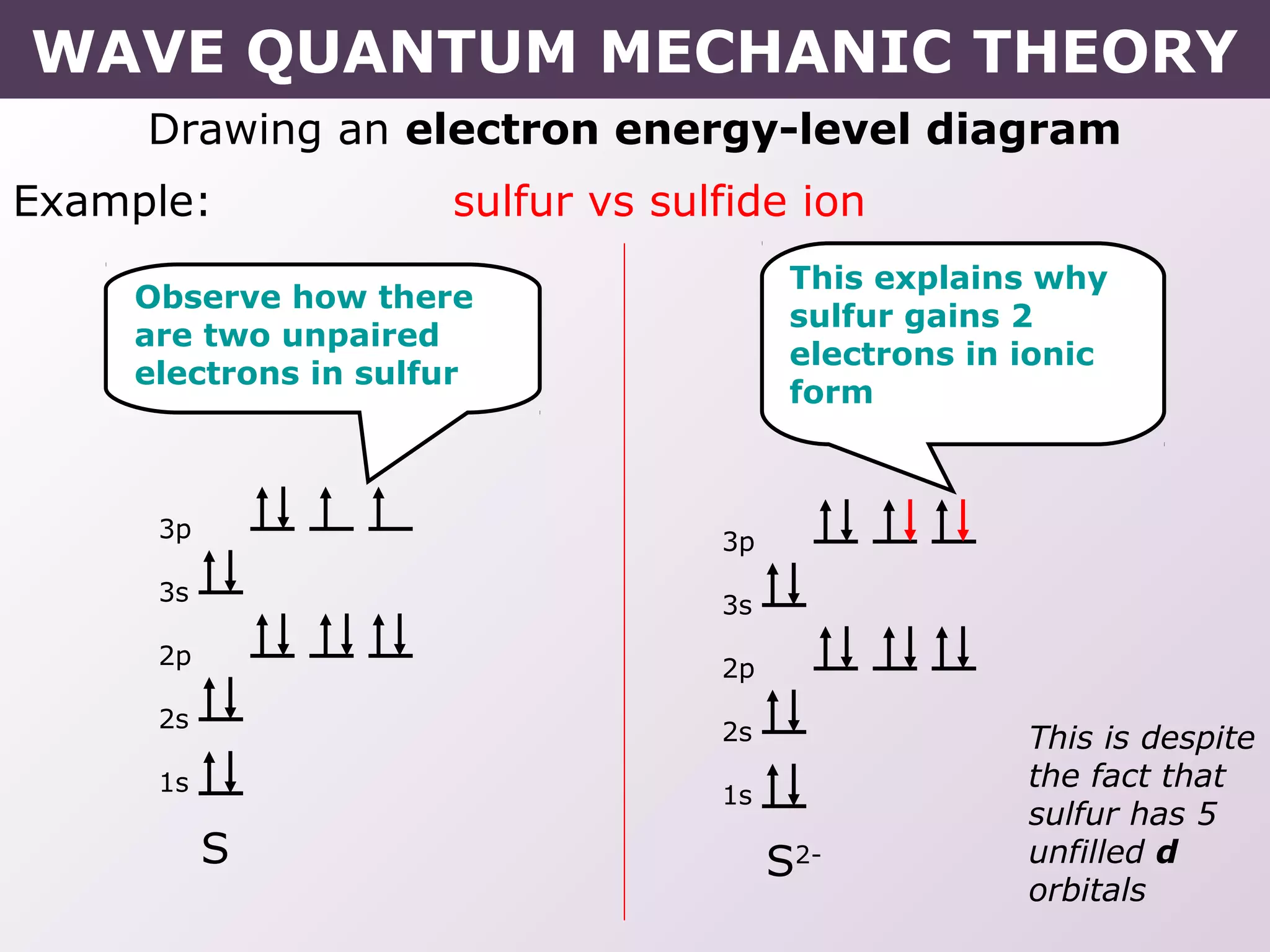
Example: sulfur vs sulfide ion
Observe how there
are two unpaired
electrons in sulfur
This explains why
sulfur gains 2
electrons in ionic
form
This is despite
the fact that
sulfur has 5
unfilled d
orbitals
S
3p
3s
2p
2s
1s
S2-
3p
3s
2p
2s
1s
WAVE QUANTUM MECHANIC THEORY
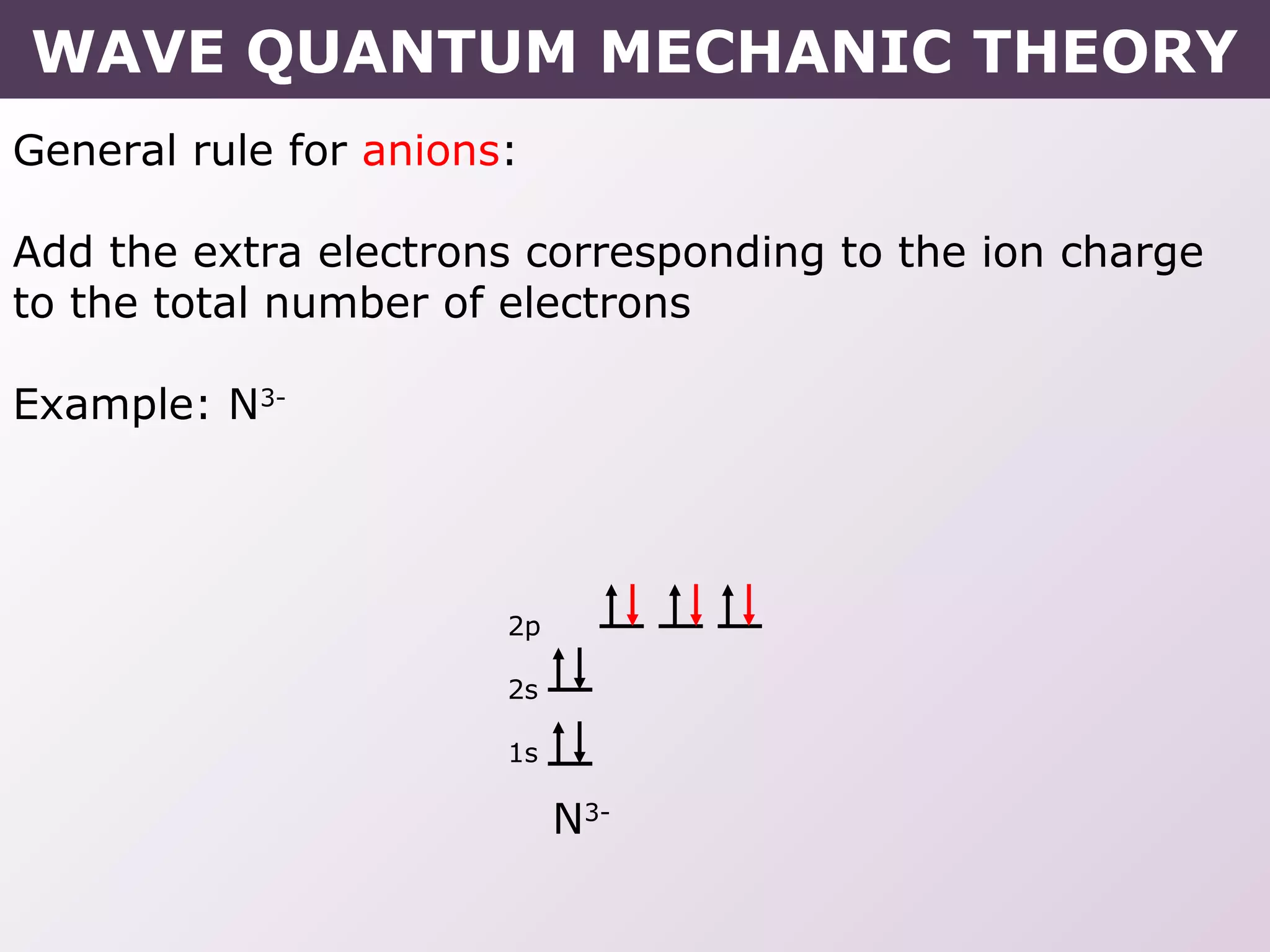
General rule for anions:
Add the extra electrons corresponding to the ion charge
to the total number of electrons
Example: N3-
N3-
2p
2s
1s
WAVE QUANTUM MECHANIC THEORY
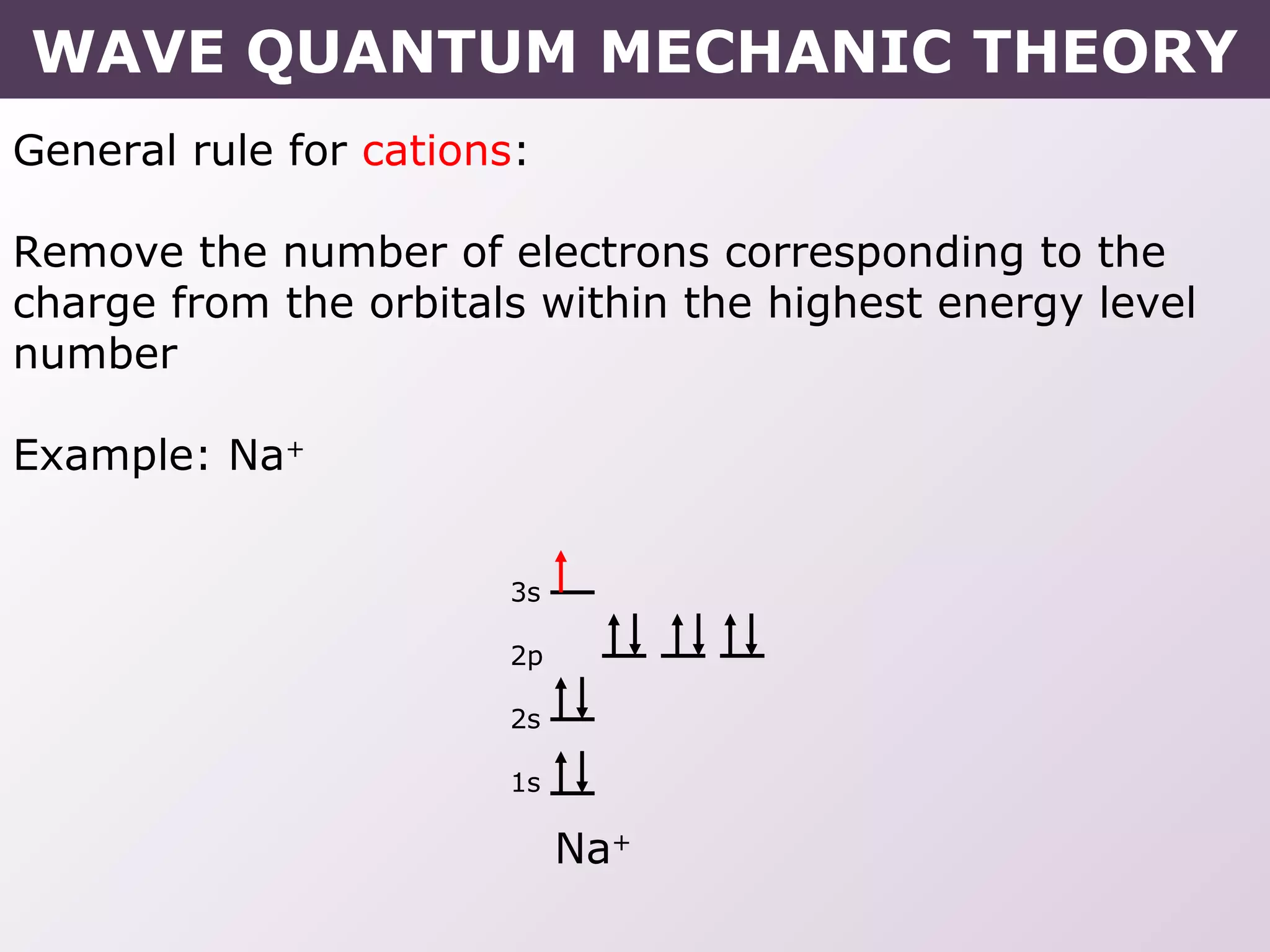
General rule for cations:
Remove the number of electrons corresponding to the
charge from the orbitals within the highest energy level
number
Example: Na+
Na+
3s
2p
2s
1s
WAVE QUANTUM MECHANIC THEORY
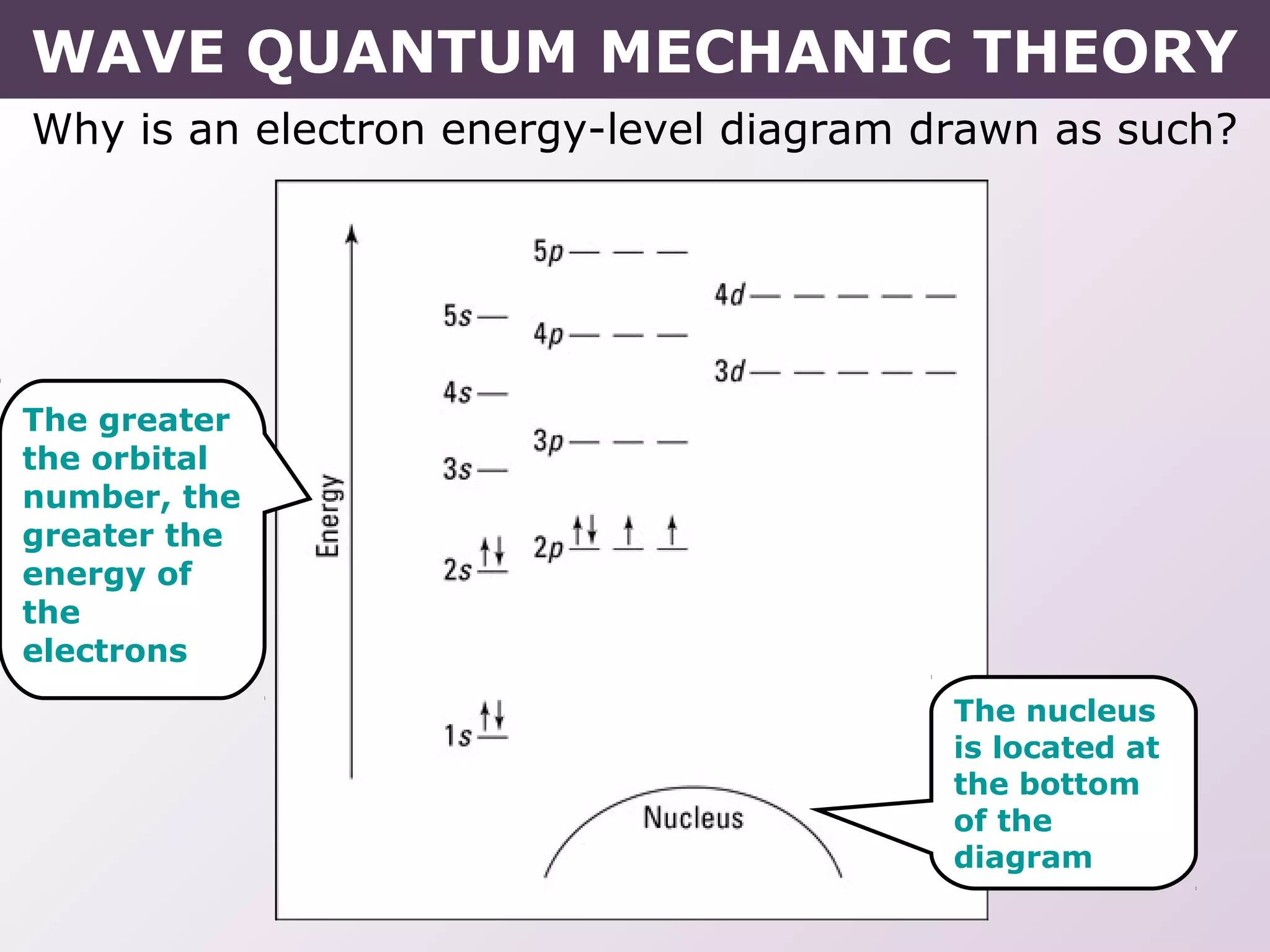
Why is an electron energy-level diagram drawn as such?
The greater
the orbital
number, the
greater the
energy of
the
electrons
The nucleus
is located at
the bottom
of the
diagram
WAVE QUANTUM MECHANIC THEORY
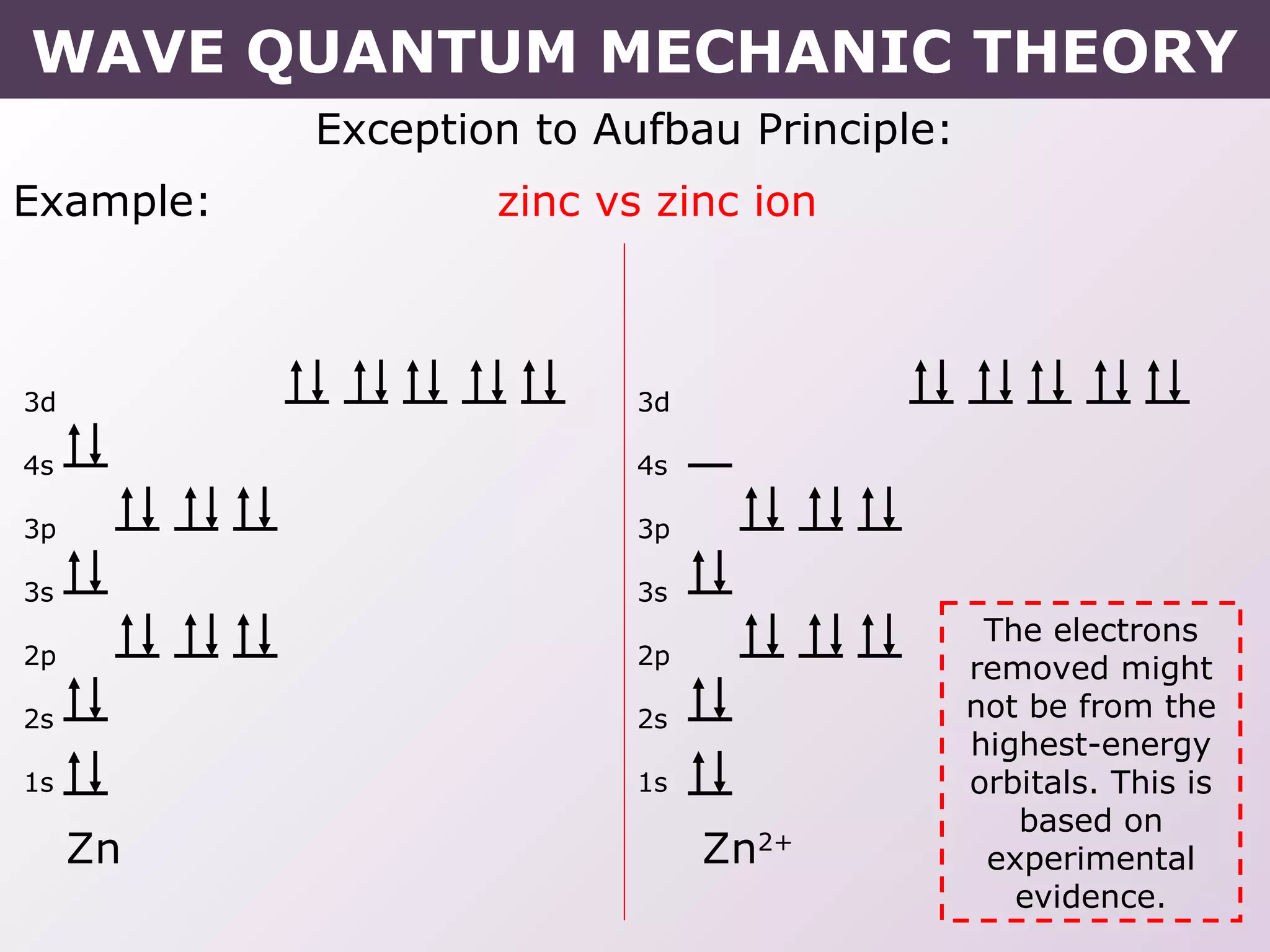
Exception to Aufbau Principle:
Example: zinc vs zinc ion
Zn
3d
4s
3p
3s
2p
2s
1s
Zn2+
3d
4s
3p
3s
2p
2s
1s
The electrons
removed might
not be from the
highest-energy
orbitals. This is
based on
experimental
evidence.
WAVE QUANTUM MECHANIC THEORY
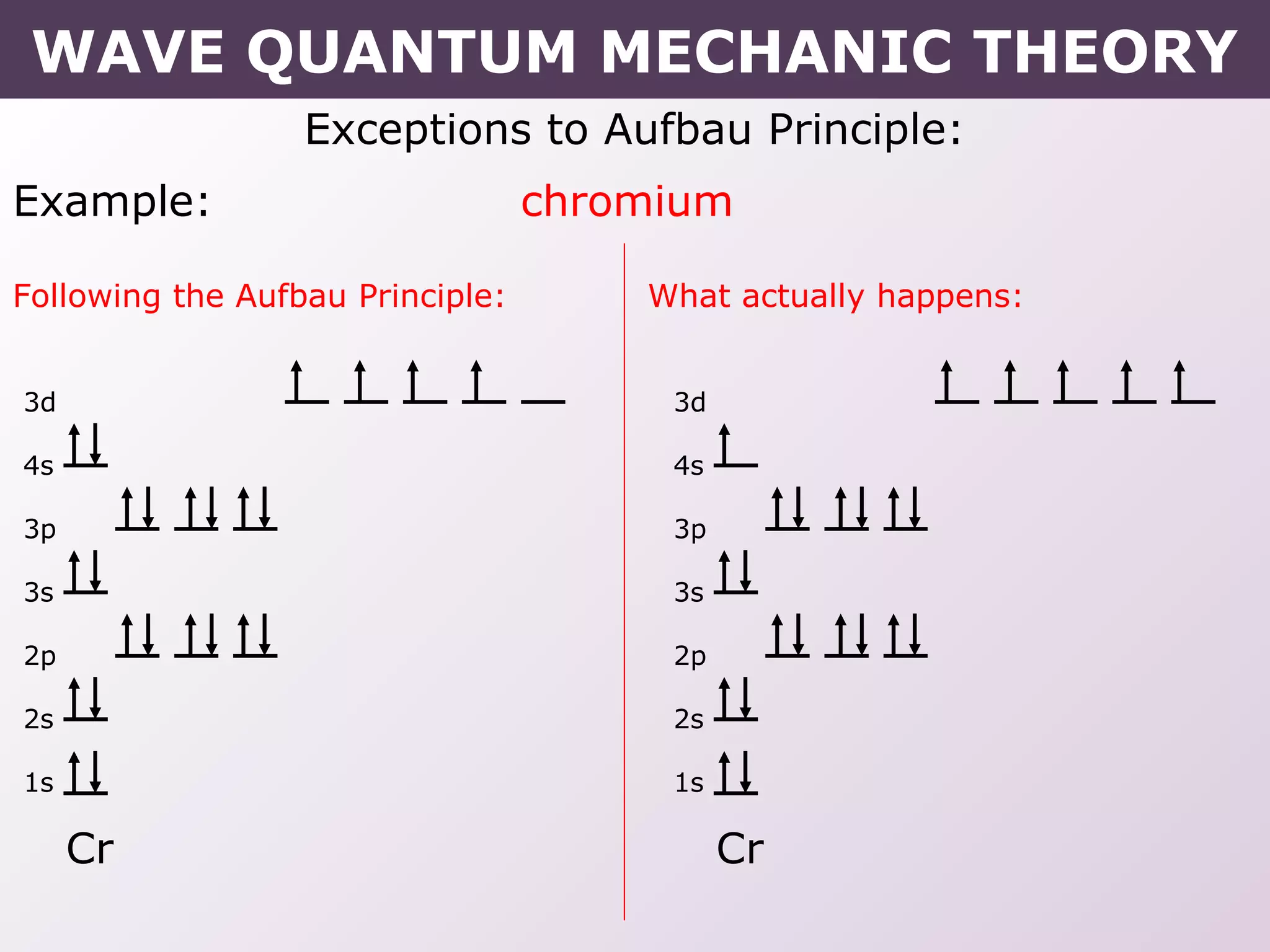
Exceptions to Aufbau Principle:
Example: chromium
Following the Aufbau Principle: What actually happens:
Cr
3d
4s
3p
3s
2p
2s
1s
Cr
3d
4s
3p
3s
2p
2s
1s
WAVE QUANTUM MECHANIC THEORY
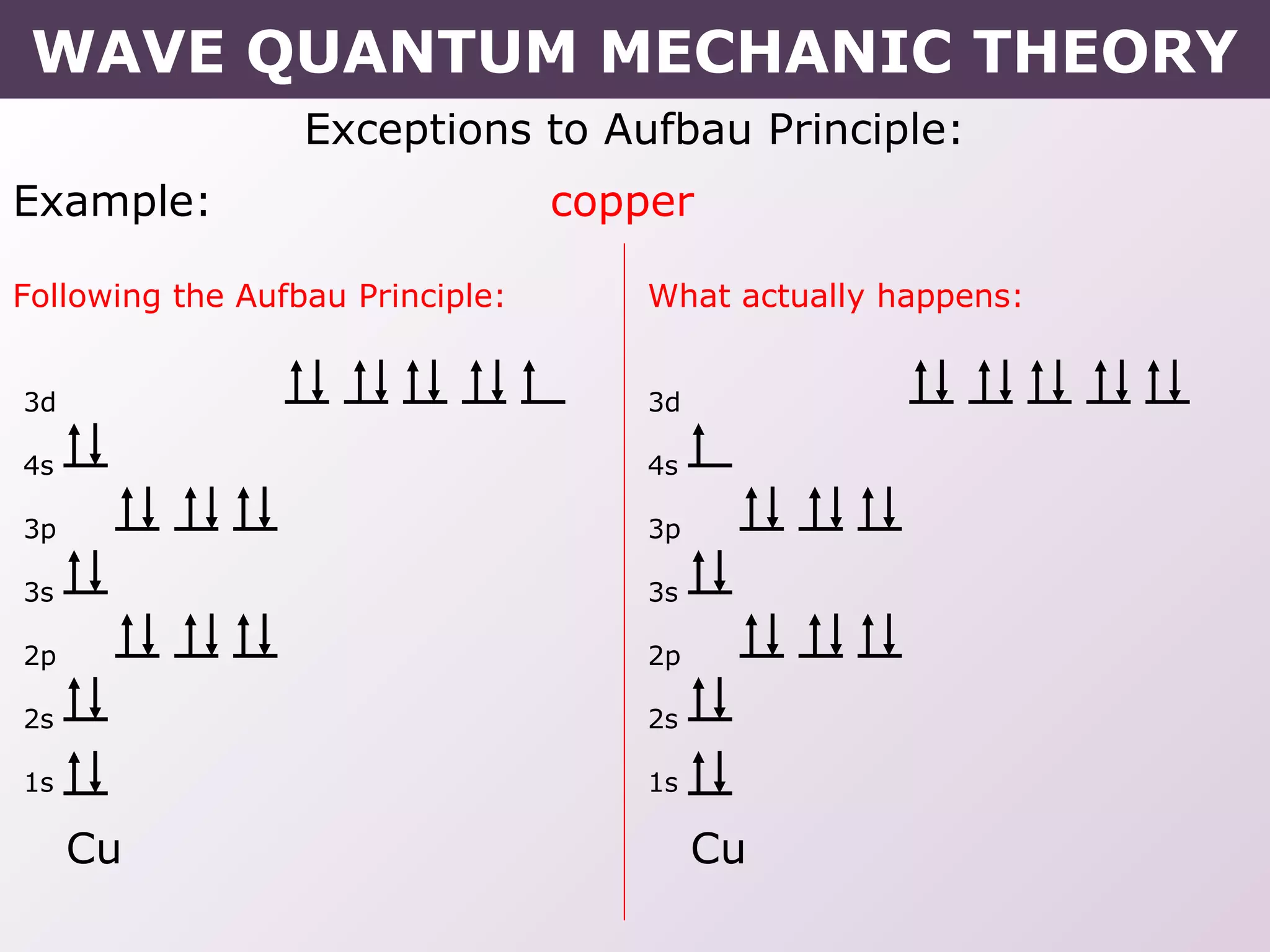
Exceptions to Aufbau Principle:
Example: copper
Following the Aufbau Principle: What actually happens:
Cu
3d
4s
3p
3s
2p
2s
1s
Cu
3d
4s
3p
3s
2p
2s
1s
WAVE QUANTUM MECHANIC THEORY
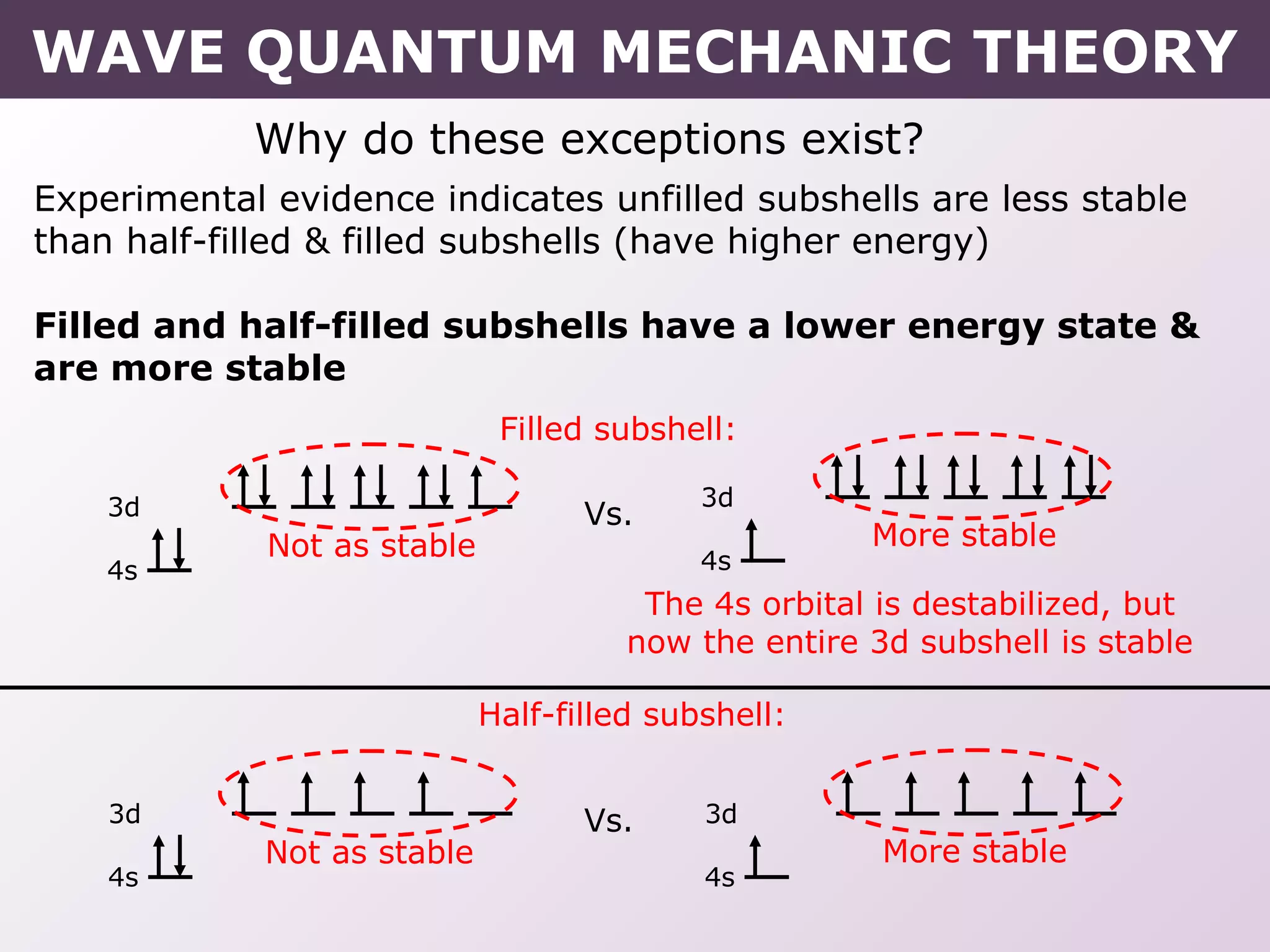
Why do these exceptions exist?
3d
4s
3d
4s
Vs.
Not as stable More stable
The 4s orbital is destabilized, but
now the entire 3d subshell is stable
3d
4s
3d
4s
Not as stable More stable
Filled subshell:
Half-filled subshell:
Experimental evidence indicates unfilled subshells are less stable
than half-filled & filled subshells (have higher energy)
Filled and half-filled subshells have a lower energy state &
are more stable
Vs.
WAVE QUANTUM MECHANIC THEORY
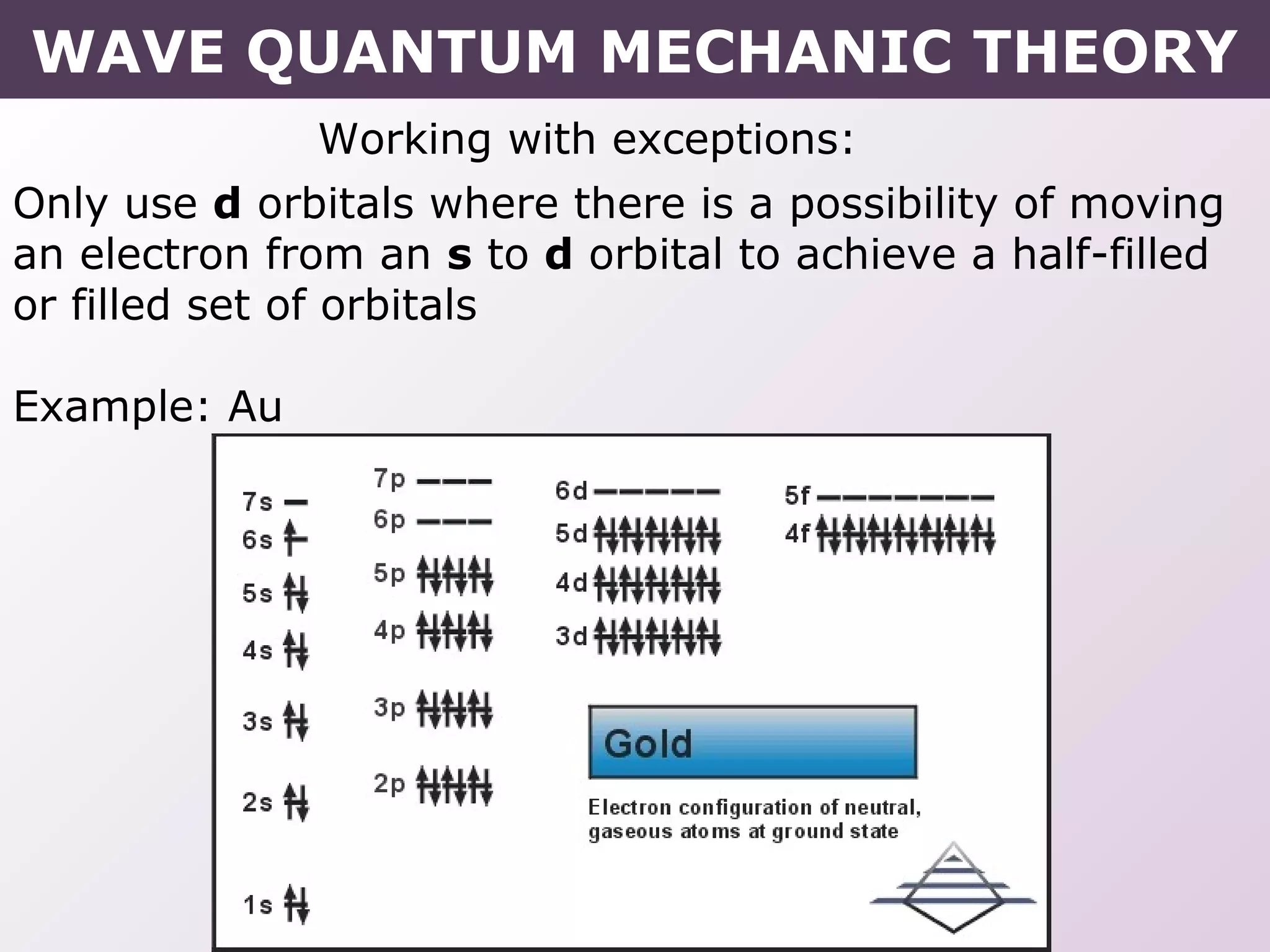
Working with exceptions:
Only use d orbitals where there is a possibility of moving
an electron from an s to d orbital to achieve a half-filled
or filled set of orbitals
Example: Au
WAVE QUANTUM MECHANIC THEORY
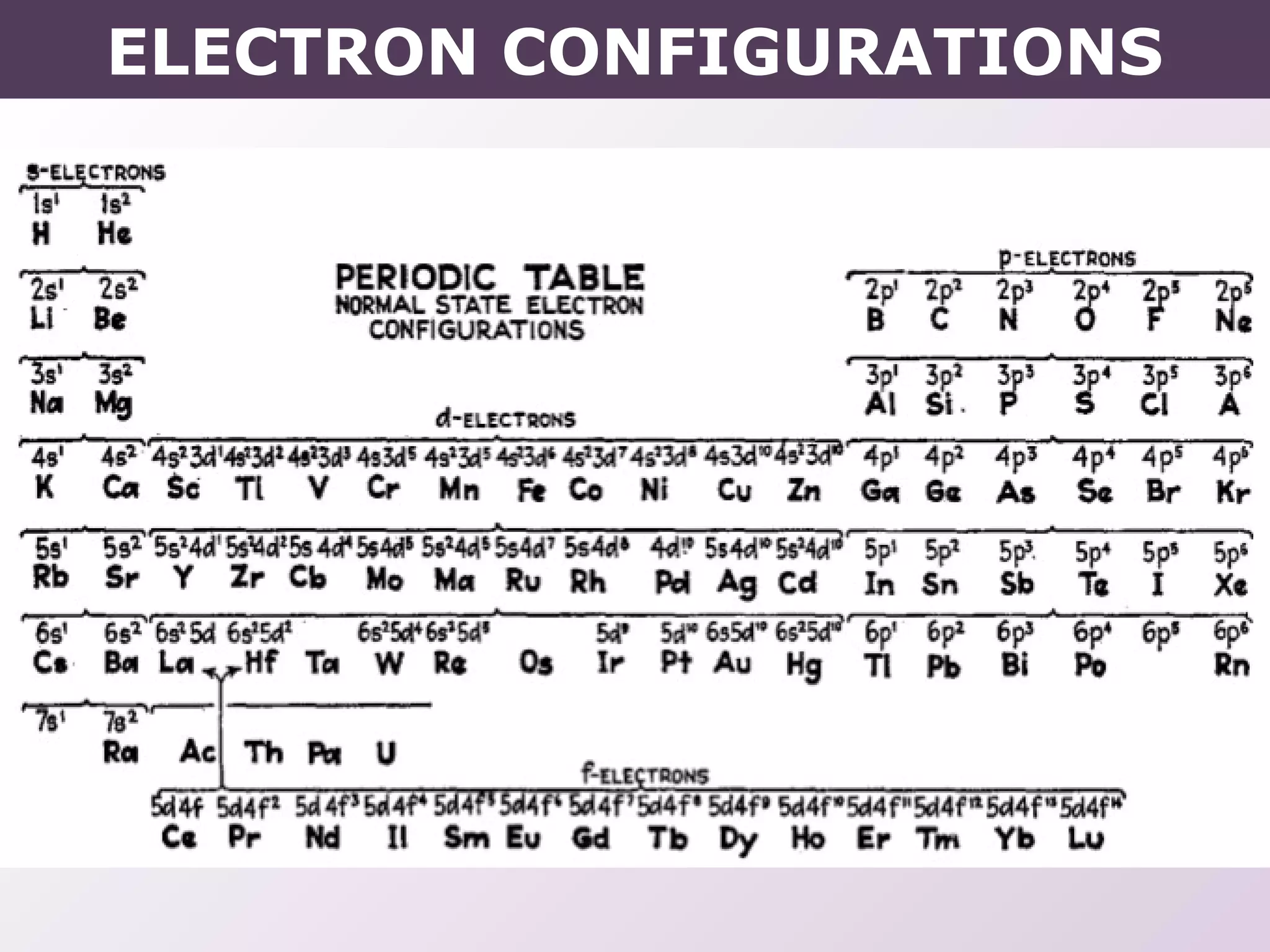
Writing Electron Configurations
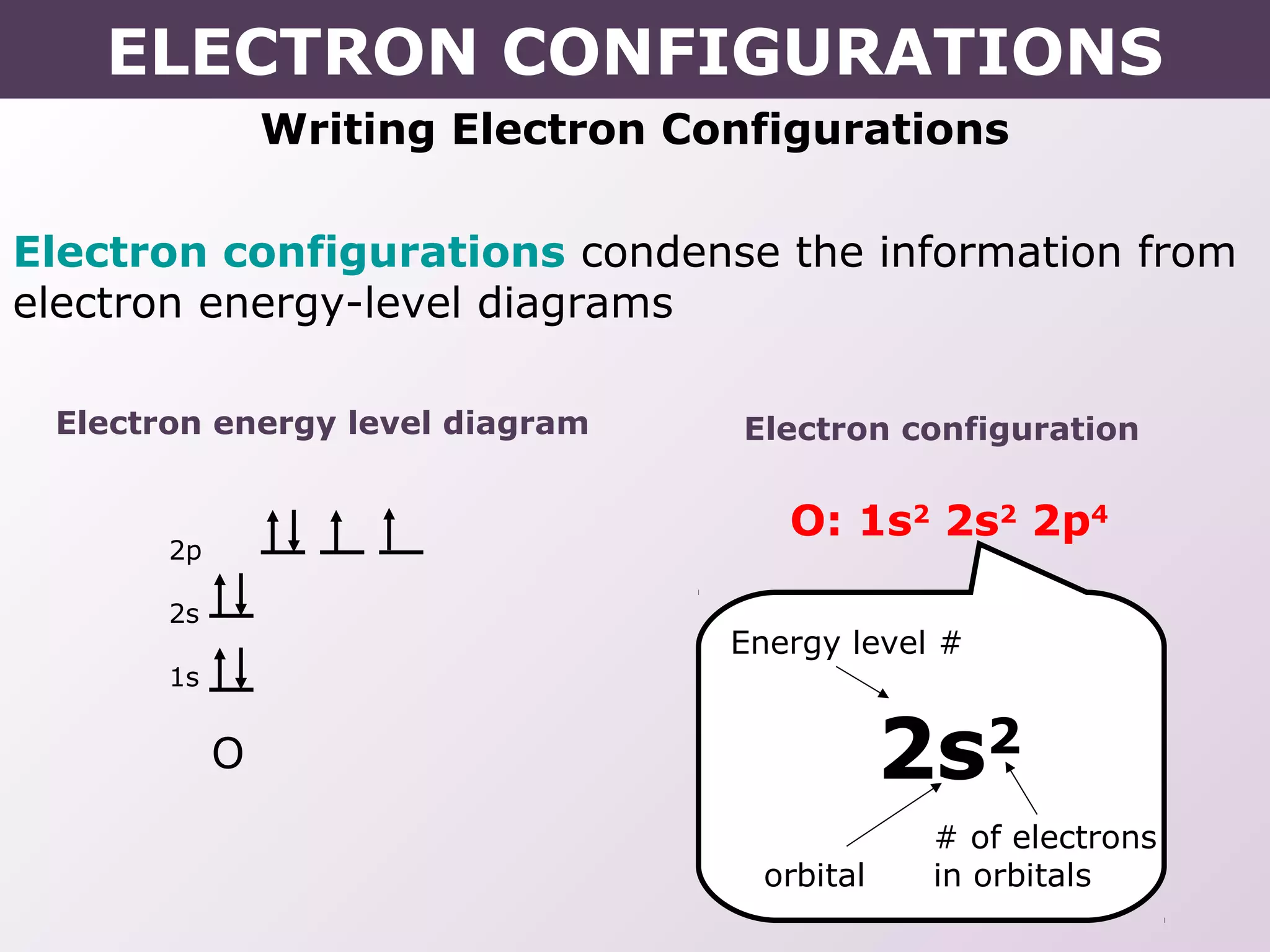
Electron configurations condense the information from
electron energy-level diagrams
Electron energy level diagram Electron configuration
O: 1s2
2s2
2p4
2s2
Energy level #
orbital
# of electrons
in orbitals
O
2p
2s
1s
ELECTRON CONFIGURATIONS
Writing Electron Configurations
Electron configurations:
Cl: 1s2
2s2
2p6
3s2
3p5
Sn: 1s2
2s2
2p6
3s2
3p6
4s2
3d10
4p6
5s2
4d10
5p2
S2-
: 1s2
2s2
2p6
3s2
3p6
Fe: 1s2
2s2
2p6
3s2
3p6
4s2
3d6
ELECTRON CONFIGURATIONS
Writing Electron Configurations
Shorthand form of Electron configurations:
Cl: 1s2
2s2
2p6
3s2
3p5
Sn: 1s2
2s2
2p6
3s2
3p6
4s2
3d10
4p6
5s2
4d10
5p2
Cl: [Ne] 3s2
3p5
Sn: [Kr] 5s2
4d10
5p2
Same configuration as Neon
Same configuration as krypton
In the shorthand version, the “core electrons” of an
atom are represented by the preceding noble gas
ELECTRON CONFIGURATIONS
Writing Electron Configurations
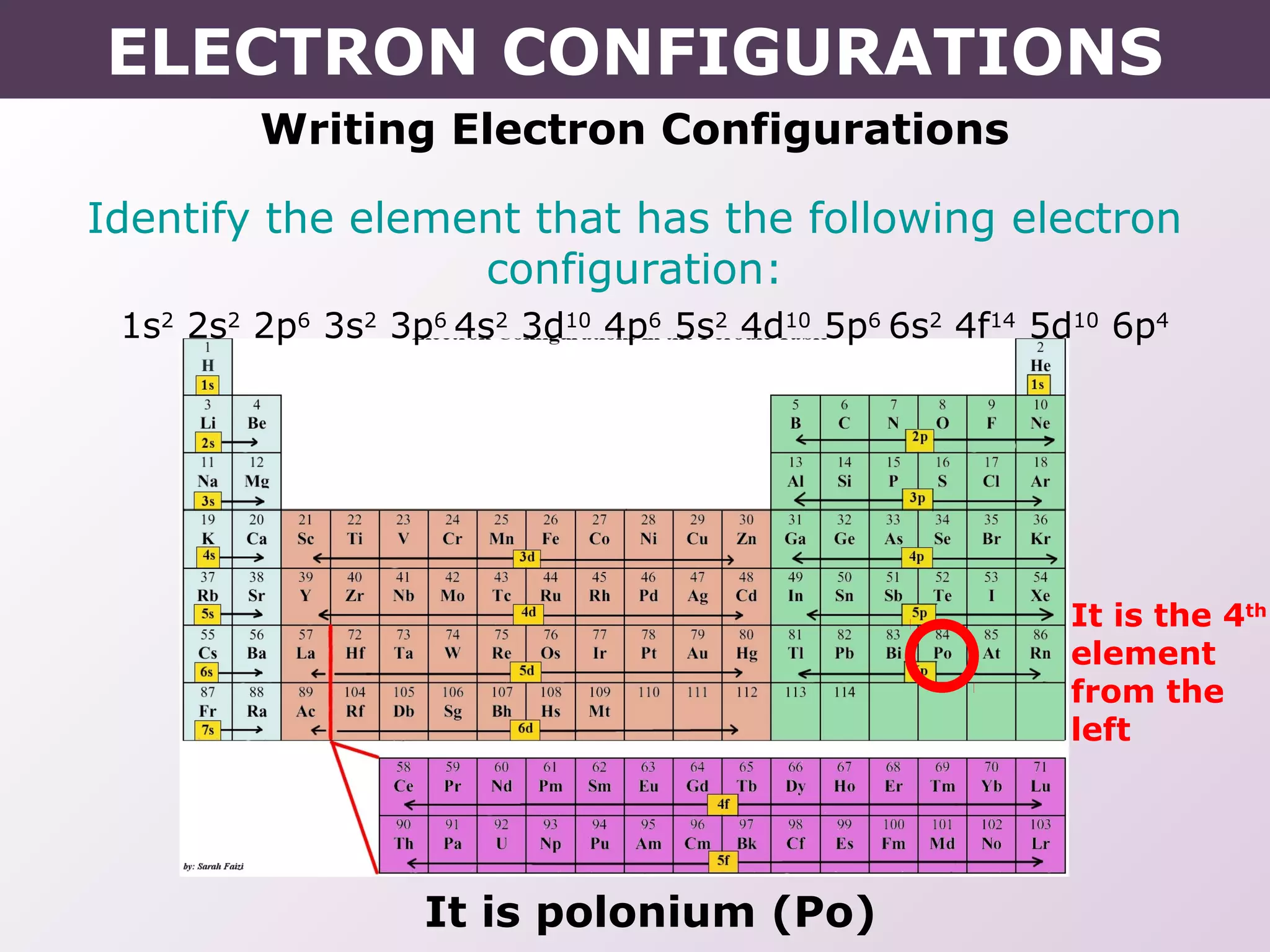
Identify the element that has the following electron
configuration:
1s2
2s2
2p6
3s2
3p6
4s2
3d10
4p6
5s2
4d10
5p6
6s2
4f14
5d10
6p4
It is the 4th
element
from the
left
It is polonium (Po)
ELECTRON CONFIGURATIONS
Explaining multivalent metals:
Electrons are lost to achieve stability:
Cd: [Kr]5s2
4d10
becomes Cd2+
We can now explain why some transition metals can form
multiple ions:
Pb: [Xe]6s2
4f14
5d10
6p2
becomes Pb2+
or Pb4+
Fe: [Ar]4s2
3d6
becomes Fe2+
or Fe3+
3d
4s
3d
4s
ELECTRON CONFIGURATIONS
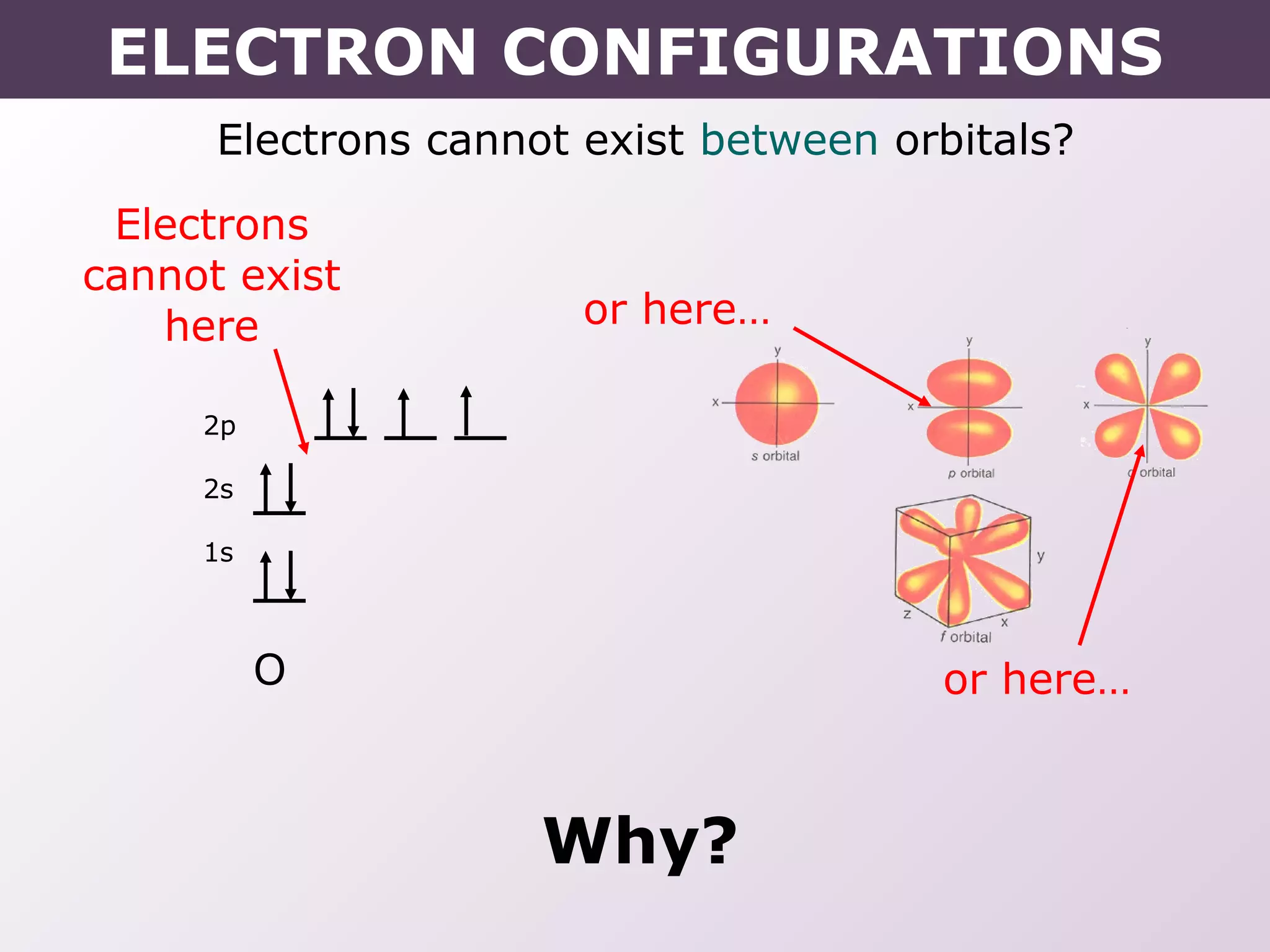
Electrons cannot exist between orbitals?
O
2p
2s
1s
Electrons
cannot exist
here or here…
or here…
Why?
ELECTRON CONFIGURATIONS
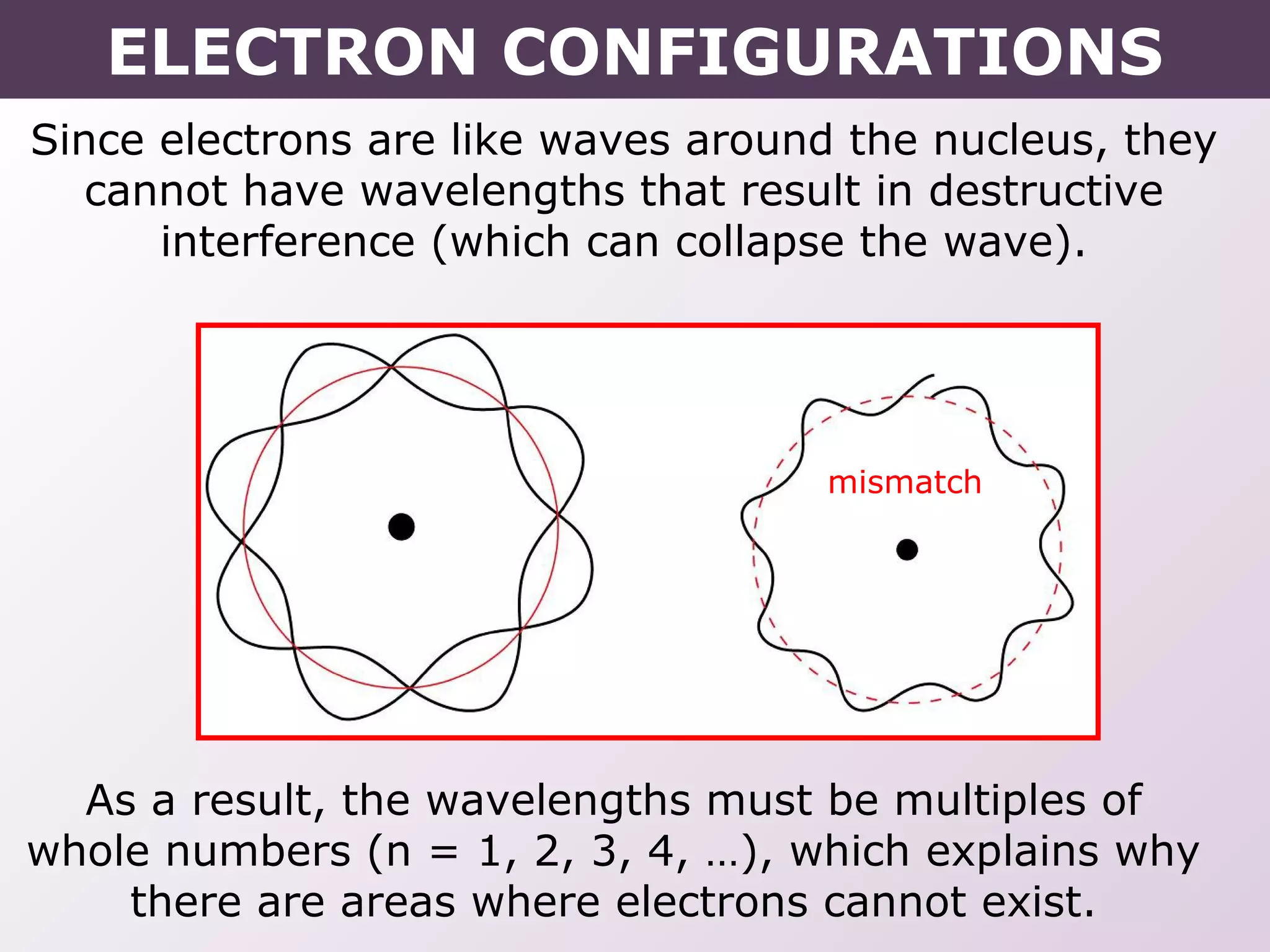
Since electrons are like waves around the nucleus, they
cannot have wavelengths that result in destructive
interference (which can collapse the wave).
As a result, the wavelengths must be multiples of
whole numbers (n = 1, 2, 3, 4, …), which explains why
there are areas where electrons cannot exist.
mismatch
ELECTRON CONFIGURATIONS
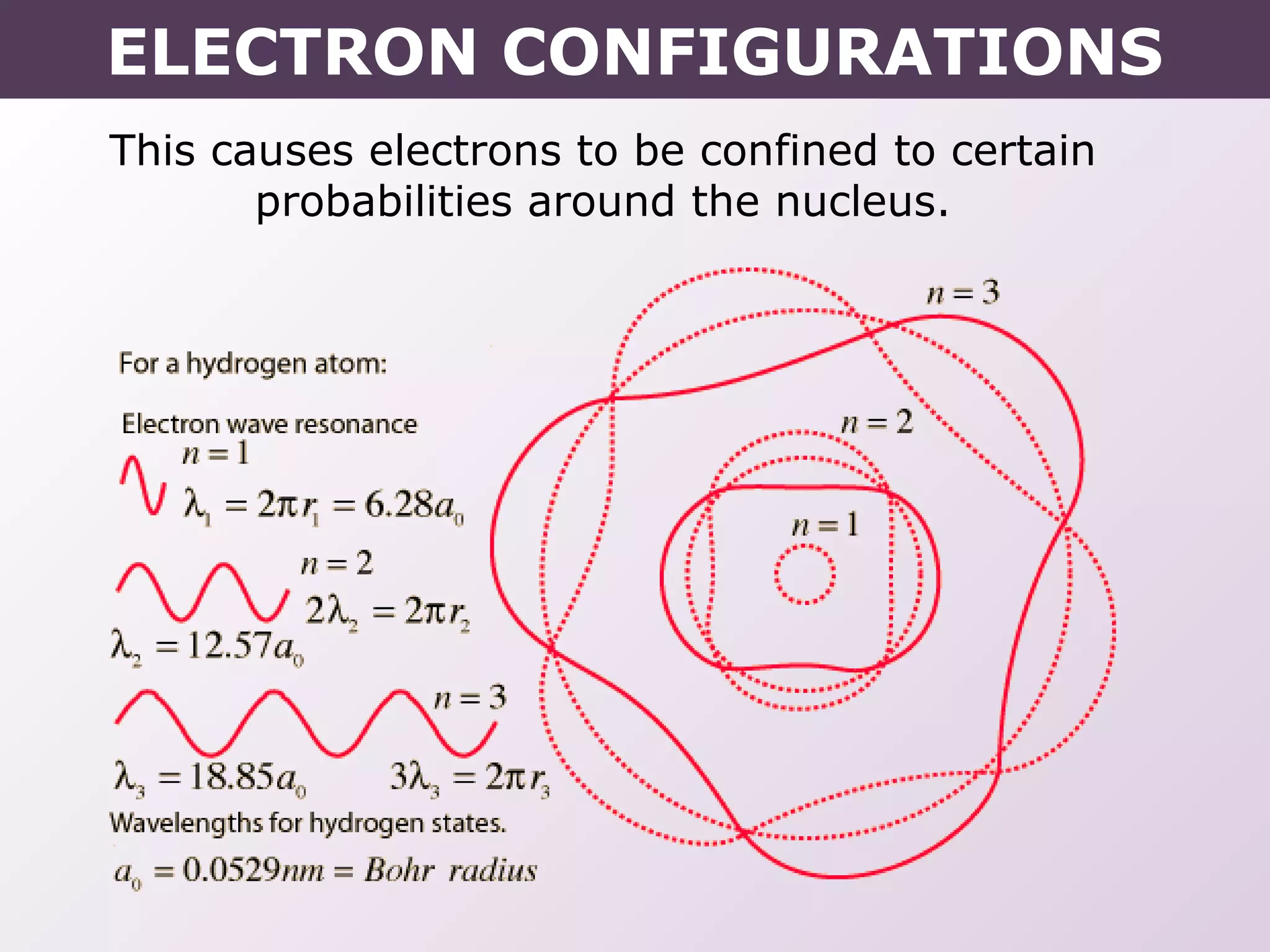
This causes electrons to be confined to certain
probabilities around the nucleus.
ELECTRON CONFIGURATIONS
Homework:
-Read page 171 on magnetism
- Complete page 172 #3 and 10
ELECTRON CONFIGURATIONS

Tang 02 wave quantum mechanic model

  • 1.
  • 2.
    Electrons occupy specificenergy levels/shells in an atom. The number of electrons in each level is governed by the formula 2n2 WAVE QUANTUM MECHANIC THEORY
  • 3.
    Erwin Schrödinger • 1887– 1961 • physicist & theoretical biologist • helped develop quantum mechanics • Nobel Prize 1933 – Schrödinger’s Equation – quantum state of a physical system changes over time WAVE QUANTUM MECHANIC THEORY
  • 4.
    Erwin Schrödinger Schrödinger proposed thatthe atom was arranged as "layers within layers" in terms of the electron shells. WAVE QUANTUM MECHANIC THEORY
  • 5.
    Schrödinger also proposed thatan electron behaves in a wave-like manner rather than just as particles. Thus electrons are both particles and waves at the same time. Since electrons are waves, they do not remain localized in a 2-D orbit. WAVE QUANTUM MECHANIC THEORY
  • 6.
    WAVE QUANTUM MECHANICTHEORY quantum mechanics – mathematical description of wave-particle duality of energy / matter Schrodinger’s Wave Equation: Electrons do not travel in defined paths around the nucleus. Rather they occupy a space defined by the “wave equation”.
  • 7.
    Heisenberg’s Uncertainty Principle For extremelysmall particles, one cannot predict both its speed and location at the same time. orbitals – a defined space around a nucleus where an e- is probably found WAVE QUANTUM MECHANIC THEORY
  • 8.
    Orbits Vs. Orbitals 2-Dpath 3-D path Fixed distance from nucleus Variable distance from nucleus Circular or elliptical path No path; varied shape of region 2n2 electrons per orbit 2 electrons per orbital WAVE QUANTUM MECHANIC THEORY
  • 9.
    Each orbital (containing2 electrons) is further classified under different categorizations based on their shape WAVE QUANTUM MECHANIC THEORY s - orbital p - orbitals d - orbitals
  • 10.
    WAVE QUANTUM MECHANICTHEORY f- orbitals
  • 11.
    g – orbitals Orbitalshapes are energy dependent and can be solved through Schrödinger’s wave equation. WAVE QUANTUM MECHANIC THEORY
  • 12.
    Value of lSublevel Symbol Number of Orbitals 0 s (sharp) 1 1 p (principle) 3 2 d (diffuse) 5 3 f (fundamental) 7 Summary of s, p, d, f orbitals: WAVE QUANTUM MECHANIC THEORY
  • 13.
    WAVE QUANTUM MECHANICTHEORY Each energy level (Bohr Model) contains a set number of orbitals. Each orbital is named by: 1. the energy level it is located in (Arabic number) 2. the orbital shape (alphabet letter)
  • 14.
    Orbitals and OrbitalShapes s Fits 2 electrons p Fits 6 electrons d Fits 10 electrons f Fits 14 electrons px py pz dv dw dx dy dz dt du dv dw dx dy dz Increasingenergy orbital subshell Each arrow represents an electron Pauli exclusion principle: No two electrons in an orbital have the same direction (all electrons have angular momentum causing it to have a magnetic direction) WAVE QUANTUM MECHANIC THEORY
  • 15.
    RECALL: Schrödinger proposedthat each energy level/shell had a respective number of subshells. What do you think these subshells are? s s, p s, p, d WAVE QUANTUM MECHANIC THEORY
  • 16.
    Electron distribution: Energy LevelSublevel Maximum # of Electrons in Energy Level (2n2 ) Number of Each Orbital Maximum # of Electrons in Orbital Type 1 s 2 1 2 2 s p 8 1 3 2 6 3 s p d 18 1 3 5 2 6 10 4 s p d f 32 1 3 5 7 2 6 10 14 WAVE QUANTUM MECHANIC THEORY
  • 17.
    WAVE QUANTUM MECHANICTHEORY Summary of “building” atoms: 1. Each higher energy level can “hold” one more type of orbital. (s, p, d, f, g) 2. For any orbital at an energy level, the number of each orbital type increases by two. • 1 s-orbital • 3 p-orbitals • 5 d-orbitals 3. Electrons fill each orbital, in order, from the lowest energy orbital.
  • 18.
    Drawing an electronenergy-level diagram Example: Oxygen How many electrons does oxygen have? 8 O aufbau principle: An energy sublevel must be filled before moving to the next higher sublevel 2p 2s 1s Hund’s rule: No two electrons can be put into the same orbital until one electron has been put into each of the equal-energy orbitals WAVE QUANTUM MECHANIC THEORY
  • 19.
    Drawing an electronenergy-level diagram Hund’s rule analogy: WAVE QUANTUM MECHANIC THEORY
  • 20.
    Drawing an electronenergy-level diagram Example: Oxygen How many electrons does oxygen have? 8 O aufbau principle: An energy sublevel must be filled before moving to the next higher sublevel 2p 2s 1s WAVE QUANTUM MECHANIC THEORY
  • 21.
    Drawing an electronenergy-level diagram Example: Oxygen O 2p 2s 1s Compare with its Bohr- Rutherford diagram: P = 8 N = 8 Notice how the pairing of electrons in the Bohr-Rutherford diagram matches the energy level diagram WAVE QUANTUM MECHANIC THEORY
  • 22.
    Drawing an electronenergy-level diagram Example: Iron How many electrons does iron have? 26 Although the 3rd energy level has 3 subshells, the “electron filling” order is not as such Fe 3d 3p 3s 2p 2s 1s WAVE QUANTUM MECHANIC THEORY
  • 23.
    Each energy levelis supposed to begin with one s orbital, and then three p orbitals, and so forth. There is often a bit of overlap. In this case, the 4s orbital comes before the 3d orbitals. WAVE QUANTUM MECHANIC THEORY
  • 24.
    aufbau diagram: Start atthe top and add electrons in the order shown by the diagonal arrows. WAVE QUANTUM MECHANIC THEORY
  • 25.
    Drawing an electronenergy-level diagram Example: Iron How many electrons does iron have? 26 Fe 3d 4s 3p 3s 2p 2s 1s WAVE QUANTUM MECHANIC THEORY
  • 26.
    So why doesbromine still have 7 valence electrons despite how the 3rd energy level can hold 18 electrons? The last energy level still has 7 electrons Br 4p 3d 4s 3p 3s 2p 2s 1s WAVE QUANTUM MECHANIC THEORY
  • 27.
    Drawing an electronenergy-level diagram Example: sulfur vs sulfide ion Observe how there are two unpaired electrons in sulfur This explains why sulfur gains 2 electrons in ionic form This is despite the fact that sulfur has 5 unfilled d orbitals S 3p 3s 2p 2s 1s S2- 3p 3s 2p 2s 1s WAVE QUANTUM MECHANIC THEORY
  • 28.
    General rule foranions: Add the extra electrons corresponding to the ion charge to the total number of electrons Example: N3- N3- 2p 2s 1s WAVE QUANTUM MECHANIC THEORY
  • 29.
    General rule forcations: Remove the number of electrons corresponding to the charge from the orbitals within the highest energy level number Example: Na+ Na+ 3s 2p 2s 1s WAVE QUANTUM MECHANIC THEORY
  • 30.
    Why is anelectron energy-level diagram drawn as such? The greater the orbital number, the greater the energy of the electrons The nucleus is located at the bottom of the diagram WAVE QUANTUM MECHANIC THEORY
  • 31.
    Exception to AufbauPrinciple: Example: zinc vs zinc ion Zn 3d 4s 3p 3s 2p 2s 1s Zn2+ 3d 4s 3p 3s 2p 2s 1s The electrons removed might not be from the highest-energy orbitals. This is based on experimental evidence. WAVE QUANTUM MECHANIC THEORY
  • 32.
    Exceptions to AufbauPrinciple: Example: chromium Following the Aufbau Principle: What actually happens: Cr 3d 4s 3p 3s 2p 2s 1s Cr 3d 4s 3p 3s 2p 2s 1s WAVE QUANTUM MECHANIC THEORY
  • 33.
    Exceptions to AufbauPrinciple: Example: copper Following the Aufbau Principle: What actually happens: Cu 3d 4s 3p 3s 2p 2s 1s Cu 3d 4s 3p 3s 2p 2s 1s WAVE QUANTUM MECHANIC THEORY
  • 34.
    Why do theseexceptions exist? 3d 4s 3d 4s Vs. Not as stable More stable The 4s orbital is destabilized, but now the entire 3d subshell is stable 3d 4s 3d 4s Not as stable More stable Filled subshell: Half-filled subshell: Experimental evidence indicates unfilled subshells are less stable than half-filled & filled subshells (have higher energy) Filled and half-filled subshells have a lower energy state & are more stable Vs. WAVE QUANTUM MECHANIC THEORY
  • 35.
    Working with exceptions: Onlyuse d orbitals where there is a possibility of moving an electron from an s to d orbital to achieve a half-filled or filled set of orbitals Example: Au WAVE QUANTUM MECHANIC THEORY
  • 36.
    Writing Electron Configurations Electronconfigurations condense the information from electron energy-level diagrams Electron energy level diagram Electron configuration O: 1s2 2s2 2p4 2s2 Energy level # orbital # of electrons in orbitals O 2p 2s 1s ELECTRON CONFIGURATIONS
  • 37.
    Writing Electron Configurations Electronconfigurations: Cl: 1s2 2s2 2p6 3s2 3p5 Sn: 1s2 2s2 2p6 3s2 3p6 4s2 3d10 4p6 5s2 4d10 5p2 S2- : 1s2 2s2 2p6 3s2 3p6 Fe: 1s2 2s2 2p6 3s2 3p6 4s2 3d6 ELECTRON CONFIGURATIONS
  • 38.
    Writing Electron Configurations Shorthandform of Electron configurations: Cl: 1s2 2s2 2p6 3s2 3p5 Sn: 1s2 2s2 2p6 3s2 3p6 4s2 3d10 4p6 5s2 4d10 5p2 Cl: [Ne] 3s2 3p5 Sn: [Kr] 5s2 4d10 5p2 Same configuration as Neon Same configuration as krypton In the shorthand version, the “core electrons” of an atom are represented by the preceding noble gas ELECTRON CONFIGURATIONS
  • 39.
    Writing Electron Configurations Identifythe element that has the following electron configuration: 1s2 2s2 2p6 3s2 3p6 4s2 3d10 4p6 5s2 4d10 5p6 6s2 4f14 5d10 6p4 It is the 4th element from the left It is polonium (Po) ELECTRON CONFIGURATIONS
  • 40.
  • 41.
    Explaining multivalent metals: Electronsare lost to achieve stability: Cd: [Kr]5s2 4d10 becomes Cd2+ We can now explain why some transition metals can form multiple ions: Pb: [Xe]6s2 4f14 5d10 6p2 becomes Pb2+ or Pb4+ Fe: [Ar]4s2 3d6 becomes Fe2+ or Fe3+ 3d 4s 3d 4s ELECTRON CONFIGURATIONS
  • 42.
    Electrons cannot existbetween orbitals? O 2p 2s 1s Electrons cannot exist here or here… or here… Why? ELECTRON CONFIGURATIONS
  • 43.
    Since electrons arelike waves around the nucleus, they cannot have wavelengths that result in destructive interference (which can collapse the wave). As a result, the wavelengths must be multiples of whole numbers (n = 1, 2, 3, 4, …), which explains why there are areas where electrons cannot exist. mismatch ELECTRON CONFIGURATIONS
  • 44.
    This causes electronsto be confined to certain probabilities around the nucleus. ELECTRON CONFIGURATIONS
  • 45.
    Homework: -Read page 171on magnetism - Complete page 172 #3 and 10 ELECTRON CONFIGURATIONS

Editor's Notes

  • #6 http://www.youtube.com/watch?v=DfPeprQ7oGc
  • #7 http://www.youtube.com/watch?v=DfPeprQ7oGc
  • #8 http://www.youtube.com/watch?v=DfPeprQ7oGc
  • #10 http://www.youtube.com/watch?v=K-jNgq16jEY
  • #11 http://www.youtube.com/watch?v=K-jNgq16jEY
  • #12 http://www.youtube.com/watch?v=K-jNgq16jEY
  • #15 http://www.youtube.com/watch?v=sMt5Dcex0kg (of scandium)
  • #36 Examples: Mo, Ag, Au
  • #45 Homework: Read page 171 on magnetism, and page 172 #3 and 10
  • #46 Homework: Read page 171 on magnetism, and page 172 #3 and 10