DATA COLLECTION
{TOOLS, TECHNIQUES,
METHODS}
Mira K. Desai
Associate Professor
University Department of Extension Education
SNDT Women’s University
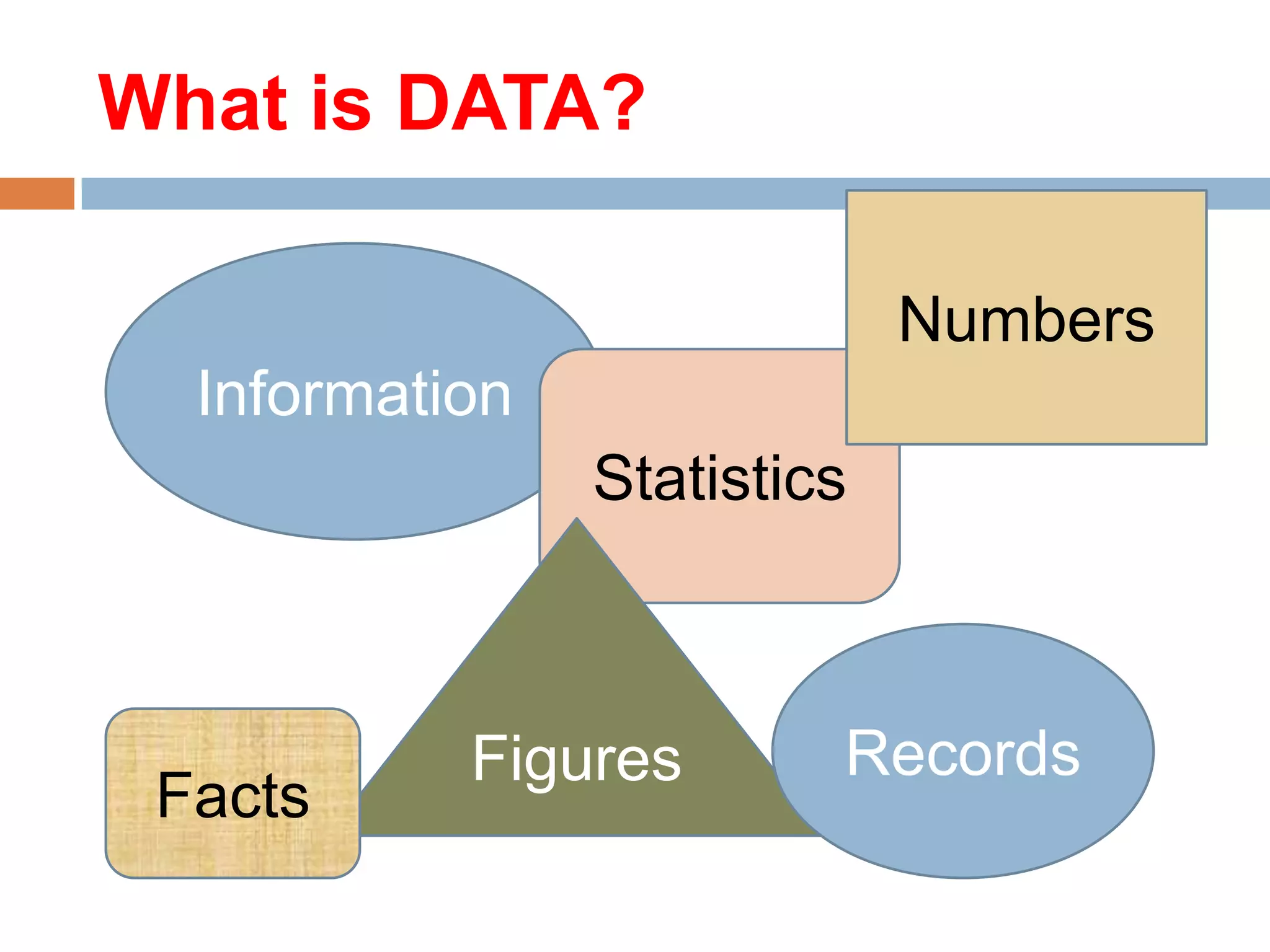
What is DATA?
Numbers
Information
Statistics

Facts

Figures

Records
What does web say about data??








a collection of facts from which conclusions may be
drawn; "statistical data”
(wordnetweb.princeton.edu/perl/webwn)
The term data means groups of information that
represent the qualitative or quantitative attributes of
a variable or set of variables(en.wikipedia.org/wiki)
information; A collection of object-units that are
distinct from one another. (en.wiktionary.org/wiki/data)
Data is Information that has been organised and
categorised for a pre-determined purpose.
(news.miuegypt.edu.eg/index.php)
What does web say about data??




In computer science, data is anything in a form
suitable for use with a computer. Data is often
distinguished from programs. A program is a set of
instructions that detail a task for the computer to
perform. In this sense, data is thus everything that is not
program code. (en.wikipedia.org/wiki/Data_(computing))
are the smallest units of measure. The word is
technically the plural of datum but often used as a
singular. Data are the components of information. They
may be the 1's and 0's of computer memory, names and
addresses in a demographic file, or the raw facts and
figures before interpretation.
(home.earthlink.net/~ddstuhlman/defin1.htm)
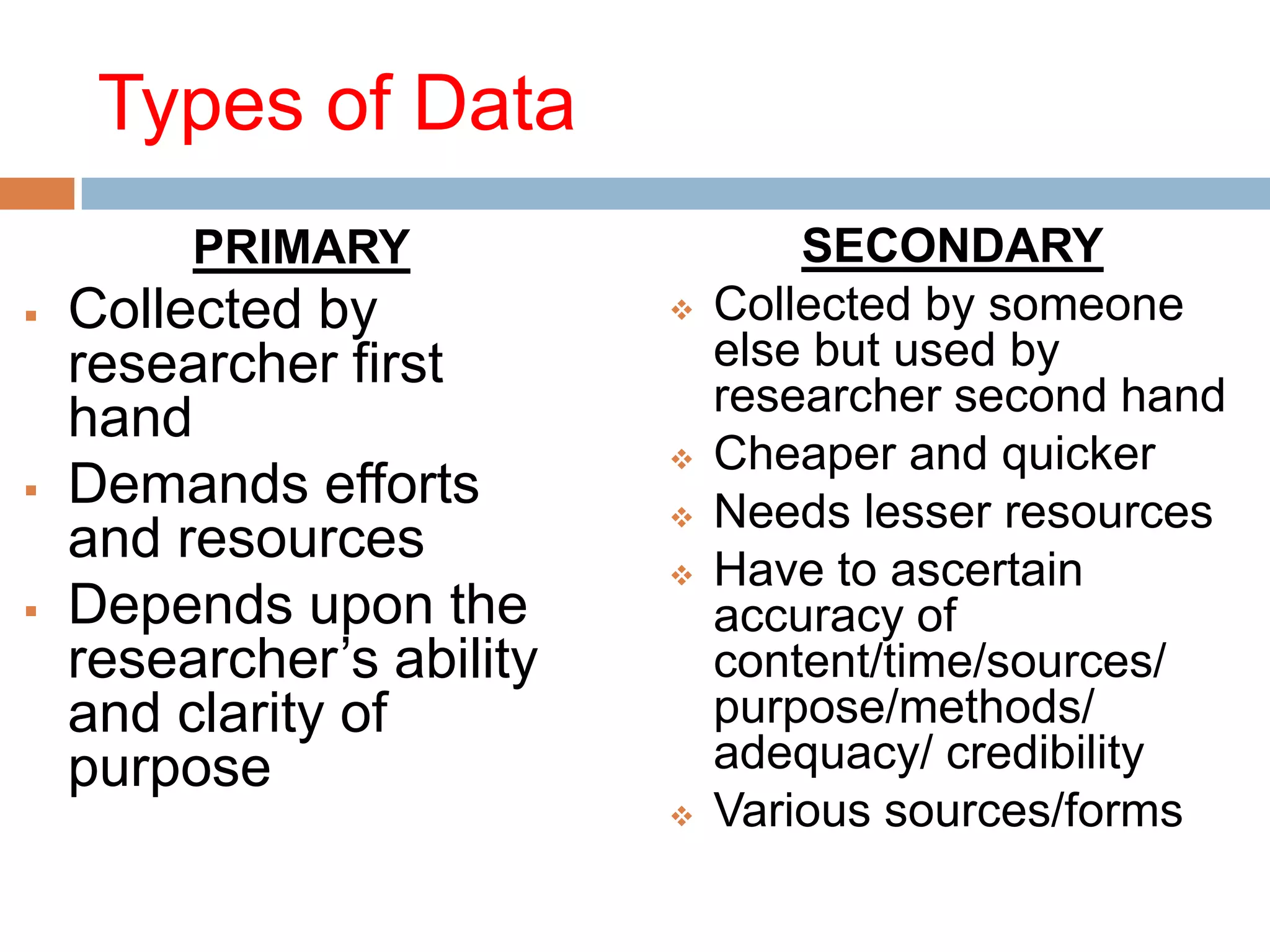
Types of Data
PRIMARY





Collected by
researcher first
hand
Demands efforts
and resources
Depends upon the
researcher’s ability
and clarity of
purpose









SECONDARY
Collected by someone
else but used by
researcher second hand
Cheaper and quicker
Needs lesser resources
Have to ascertain
accuracy of
content/time/sources/
purpose/methods/
adequacy/ credibility
Various sources/forms
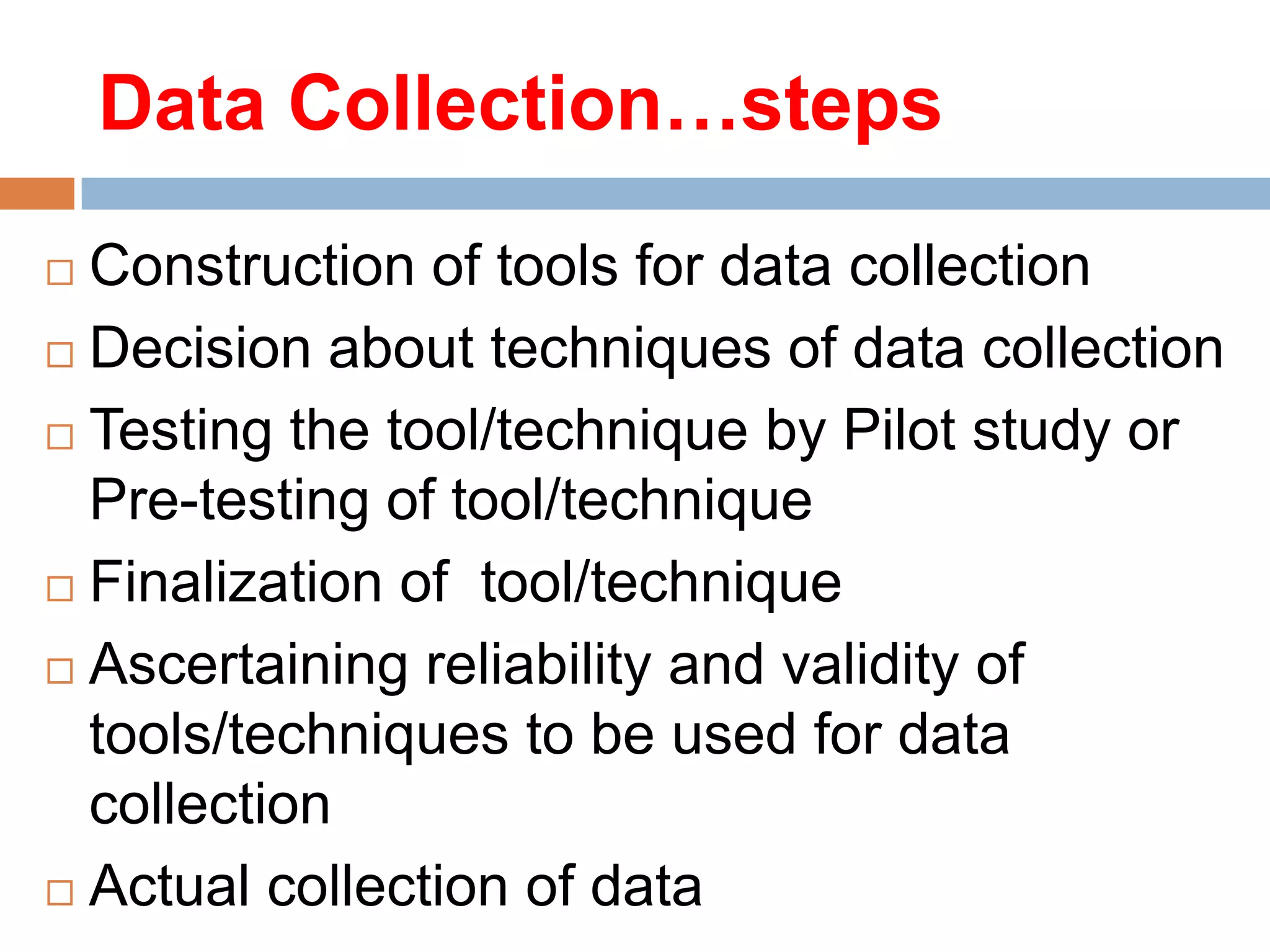
Data Collection…steps
Construction of tools for data collection
 Decision about techniques of data collection
 Testing the tool/technique by Pilot study or
Pre-testing of tool/technique
 Finalization of tool/technique
 Ascertaining reliability and validity of
tools/techniques to be used for data
collection
 Actual collection of data

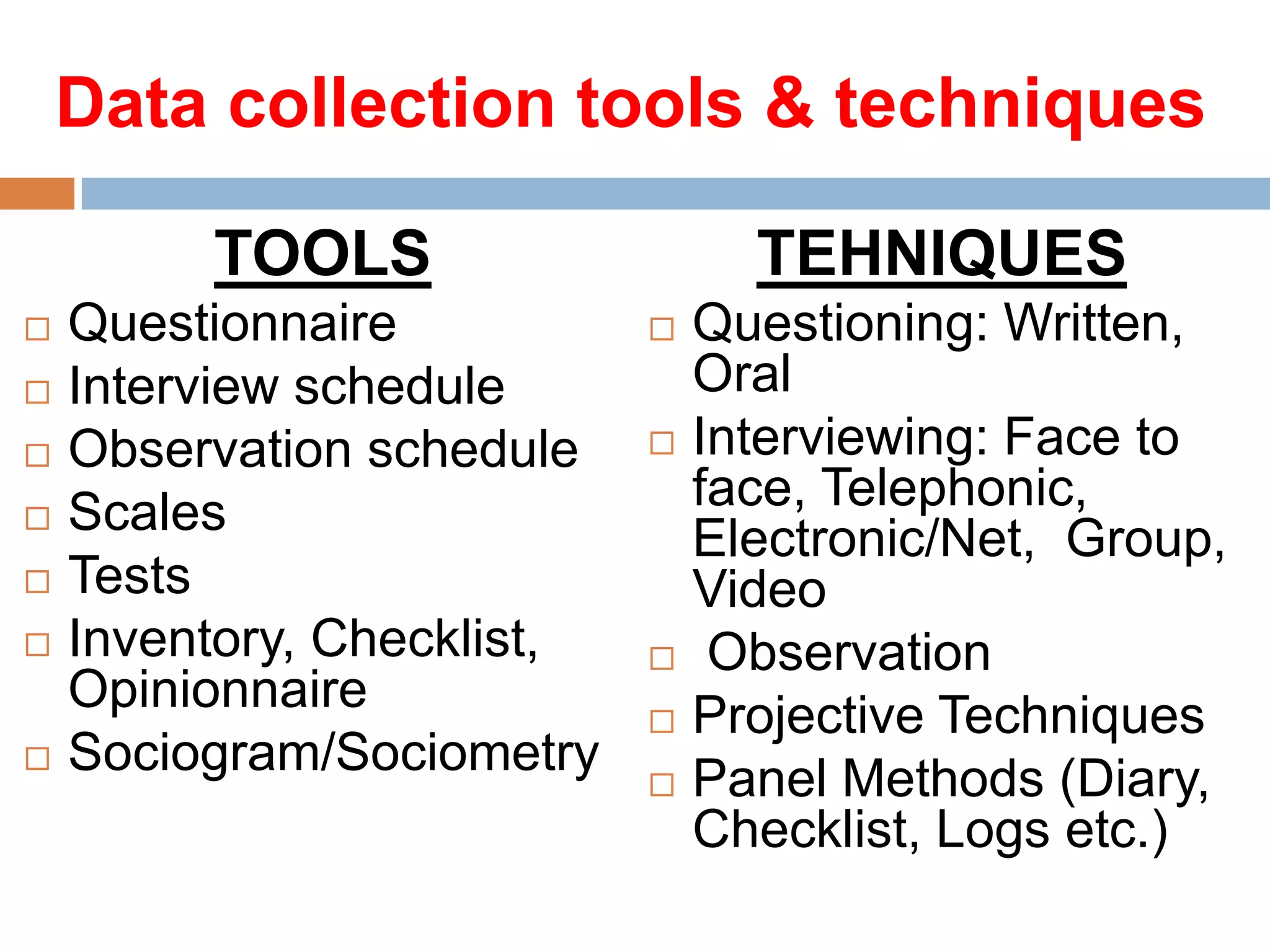
Data collection tools & techniques
TOOLS








Questionnaire
Interview schedule
Observation schedule
Scales
Tests
Inventory, Checklist,
Opinionnaire
Sociogram/Sociometry

TEHNIQUES








Questioning: Written,
Oral
Interviewing: Face to
face, Telephonic,
Electronic/Net, Group,
Video
Observation
Projective Techniques
Panel Methods (Diary,
Checklist, Logs etc.)
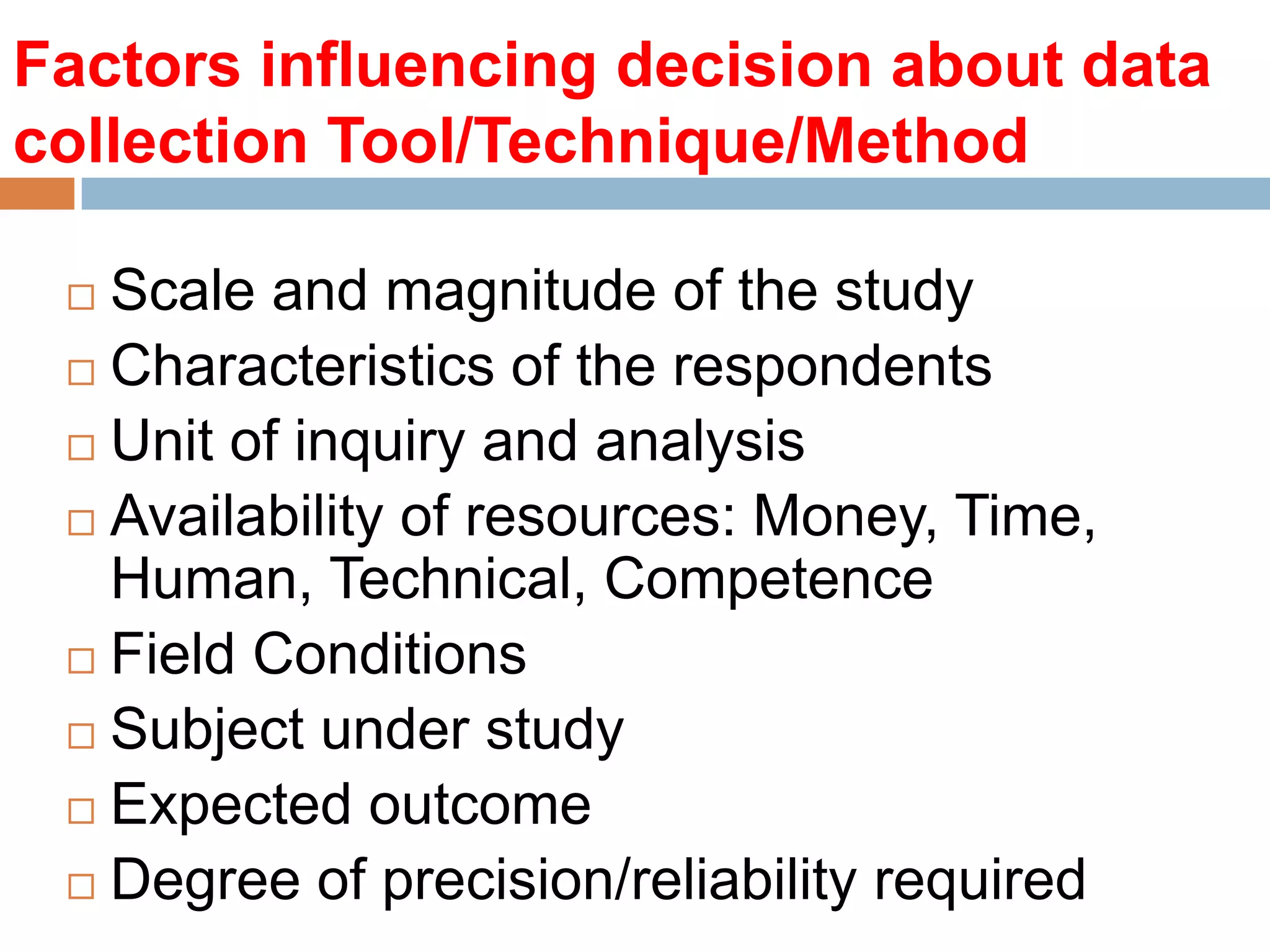
Factors influencing decision about data
collection Tool/Technique/Method
Scale and magnitude of the study
 Characteristics of the respondents
 Unit of inquiry and analysis
 Availability of resources: Money, Time,
Human, Technical, Competence
 Field Conditions
 Subject under study
 Expected outcome
 Degree of precision/reliability required

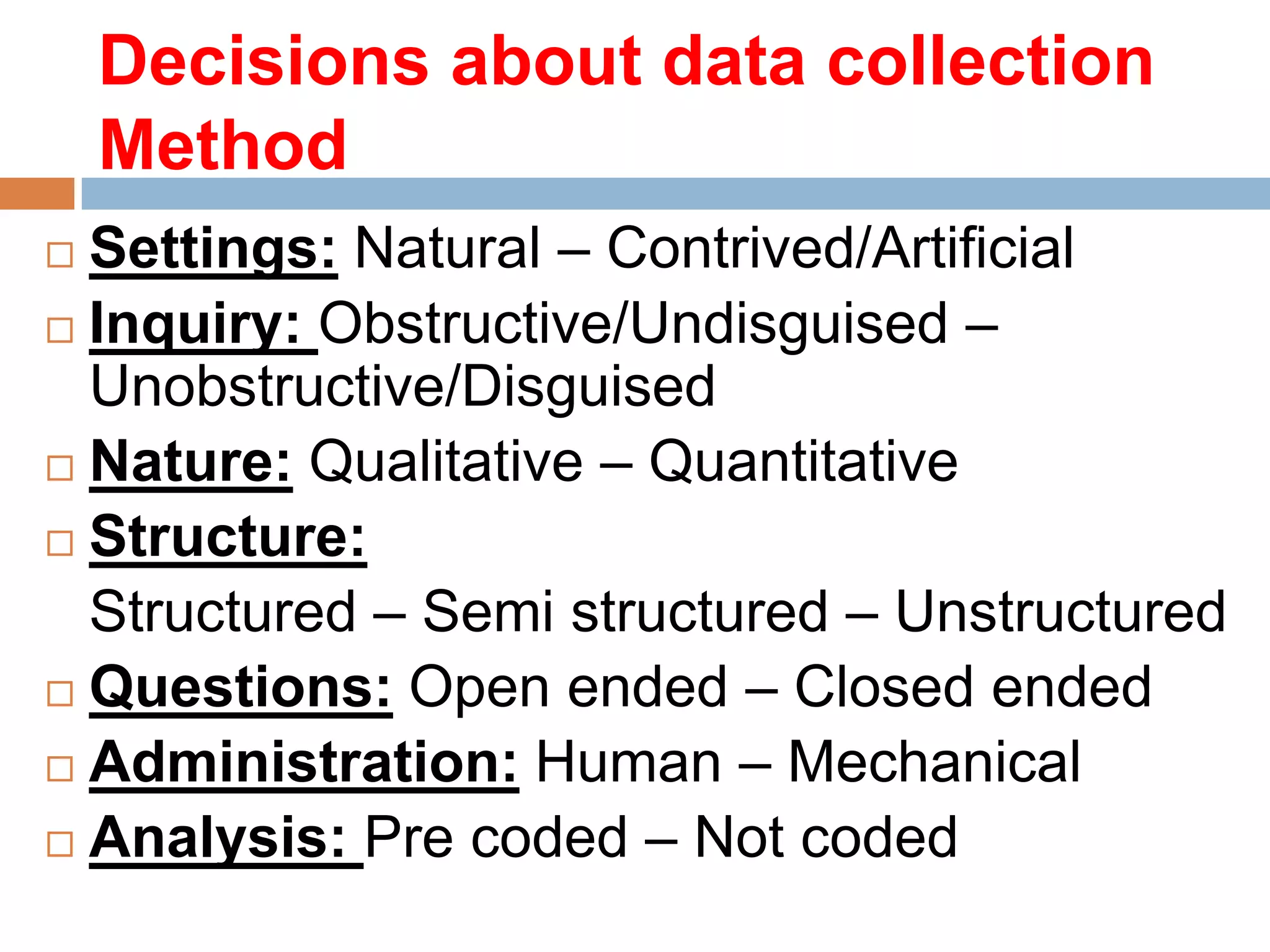
Decisions about data collection
Method
Settings: Natural – Contrived/Artificial
 Inquiry: Obstructive/Undisguised –
Unobstructive/Disguised
 Nature: Qualitative – Quantitative
 Structure:
Structured – Semi structured – Unstructured
 Questions: Open ended – Closed ended
 Administration: Human – Mechanical
 Analysis: Pre coded – Not coded

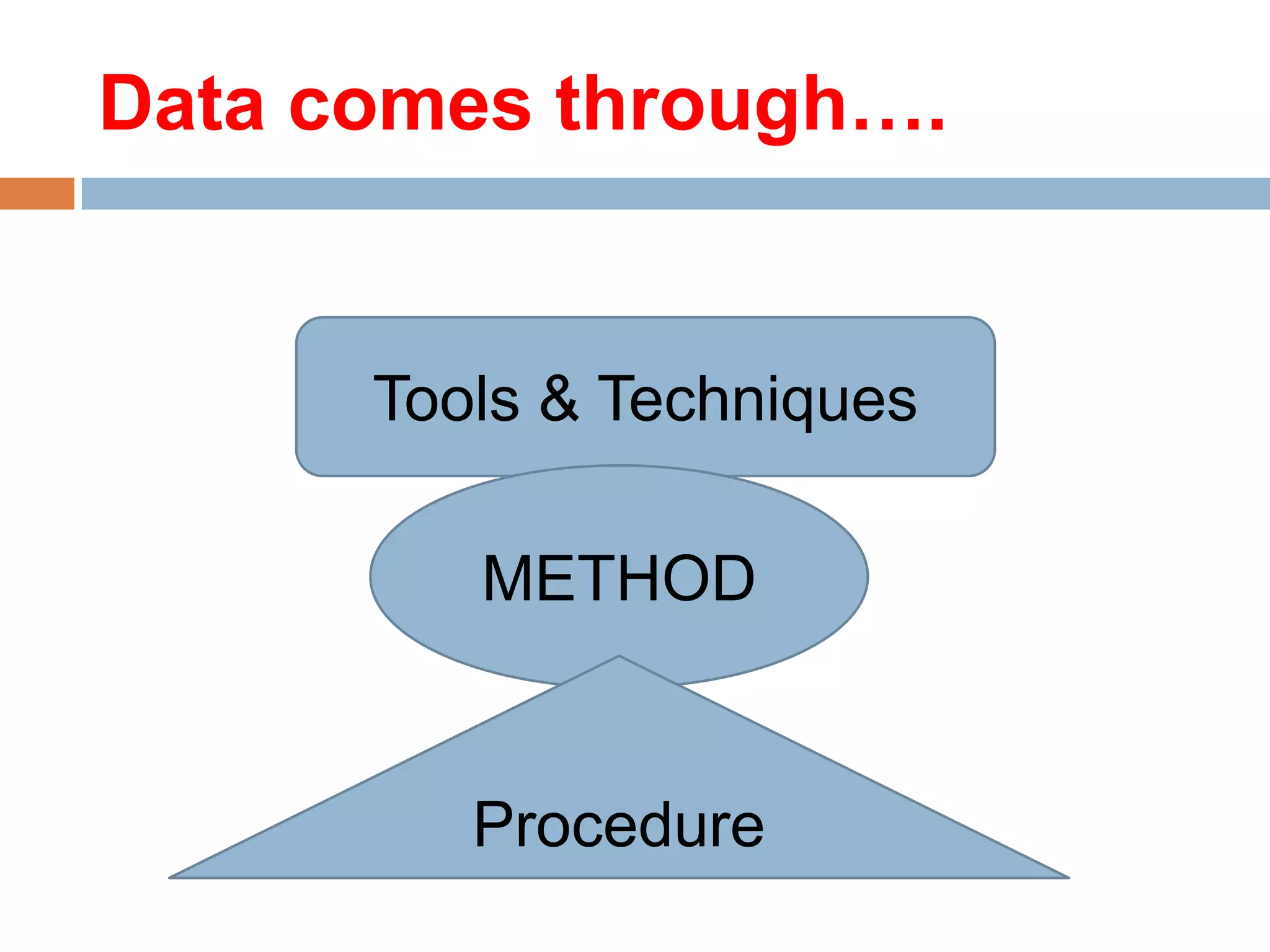
Data comes through….

Tools & Techniques
METHOD

Procedure
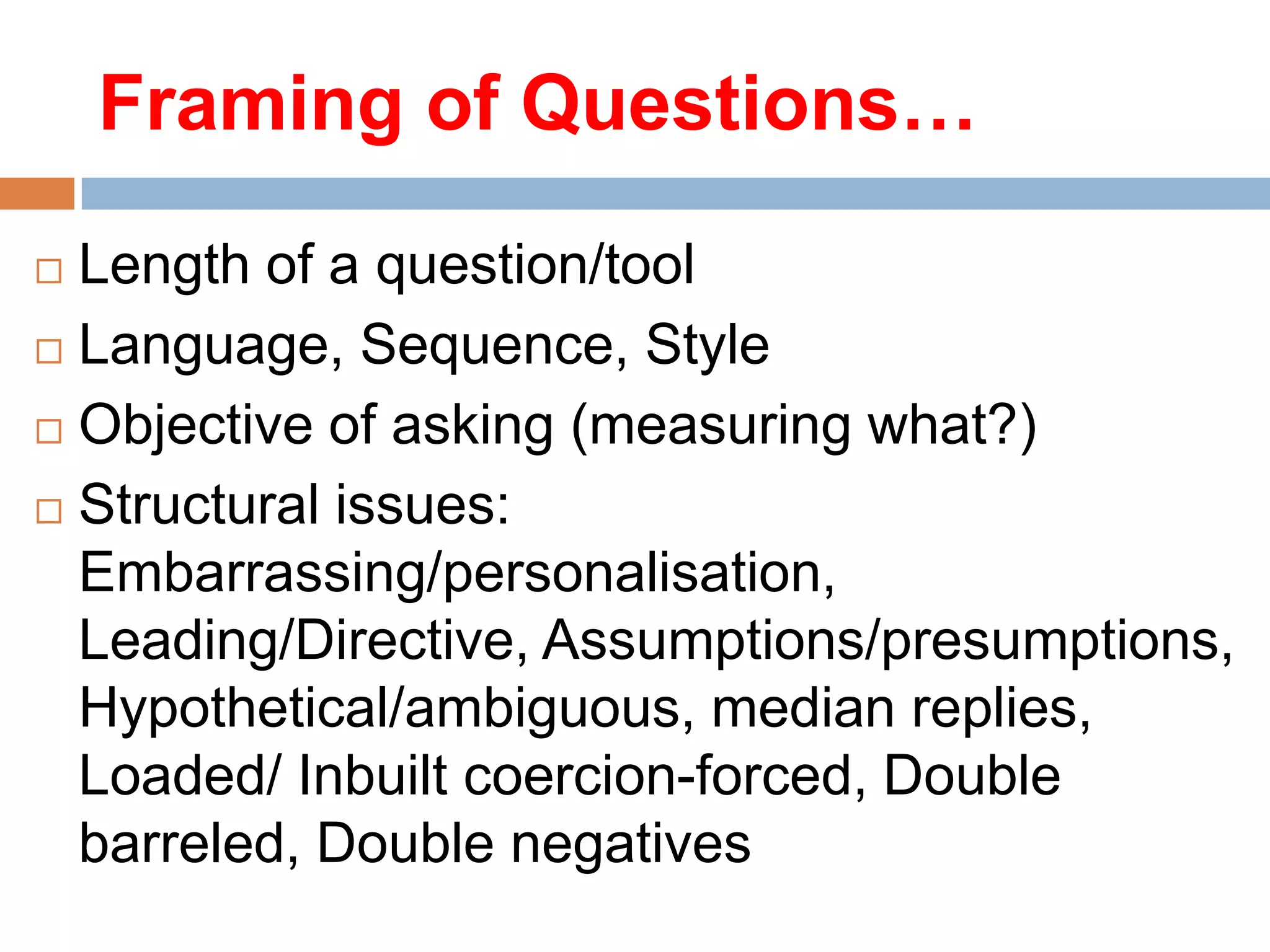
Framing of Questions…
Length of a question/tool
 Language, Sequence, Style
 Objective of asking (measuring what?)
 Structural issues:
Embarrassing/personalisation,
Leading/Directive, Assumptions/presumptions,
Hypothetical/ambiguous, median replies,
Loaded/ Inbuilt coercion-forced, Double
barreled, Double negatives

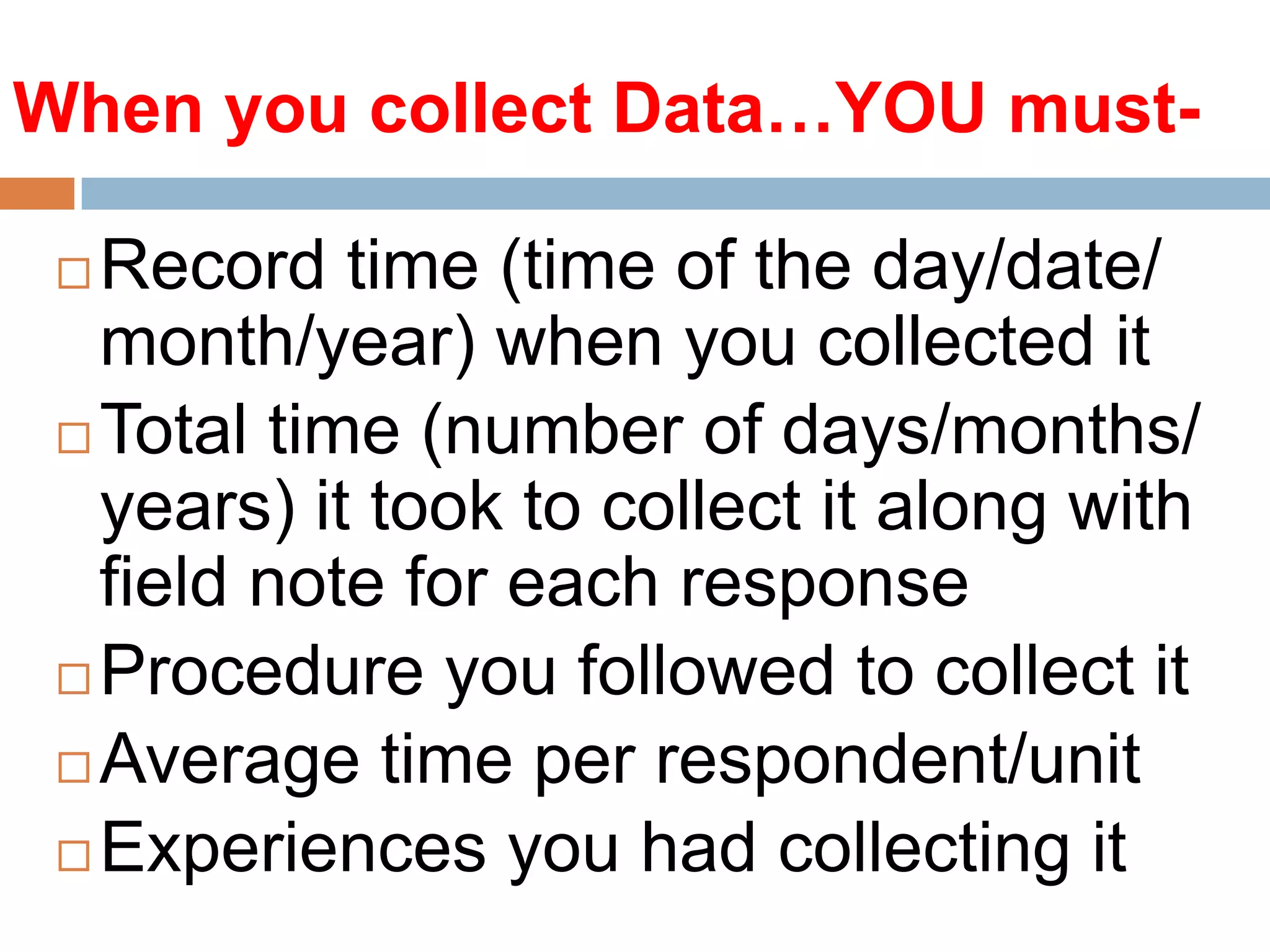
When you collect Data…YOU mustRecord time (time of the day/date/
month/year) when you collected it
 Total time (number of days/months/
years) it took to collect it along with
field note for each response
 Procedure you followed to collect it
 Average time per respondent/unit
 Experiences you had collecting it

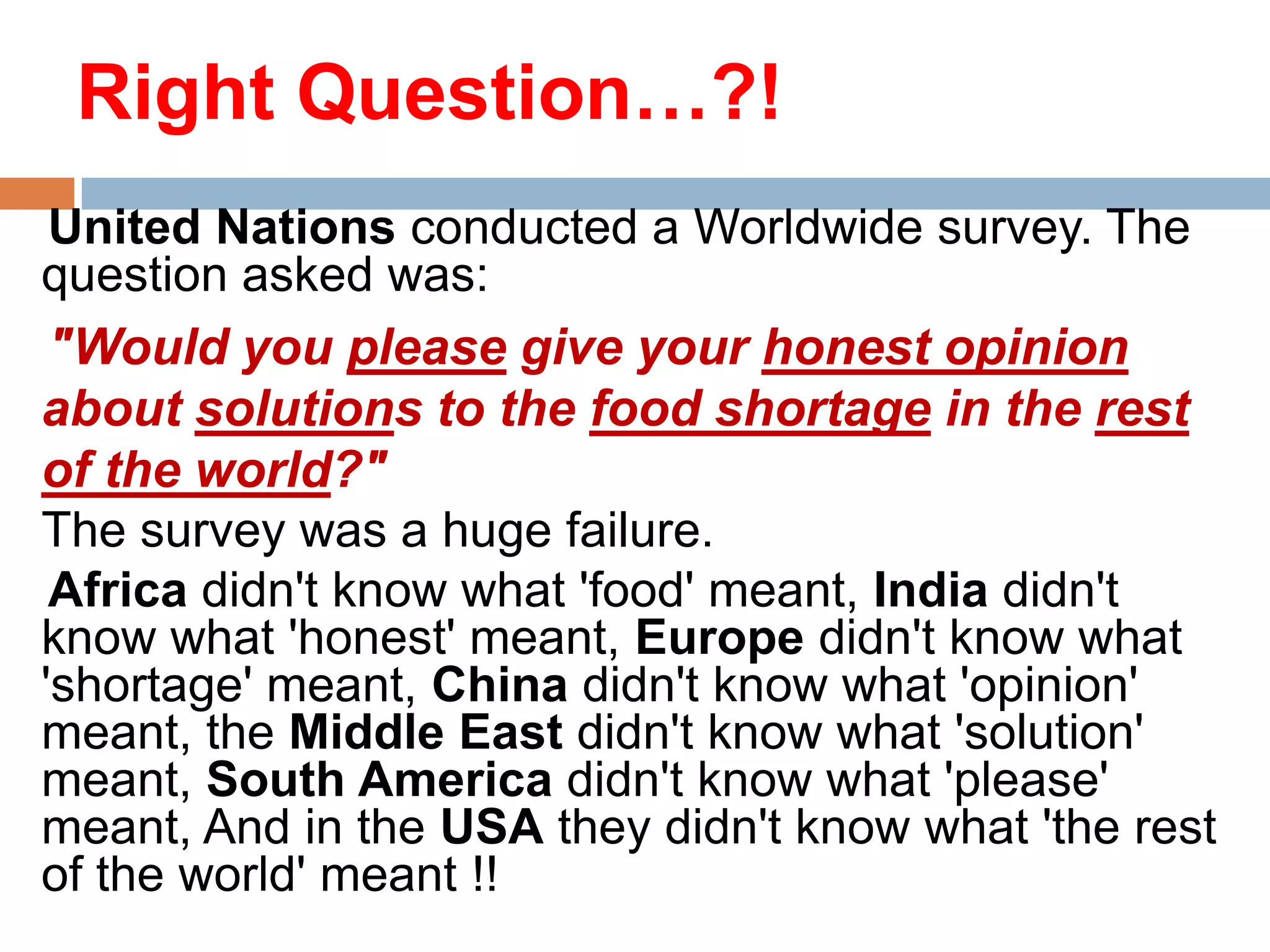
Right Question…?!
United Nations conducted a Worldwide survey. The
question asked was:
"Would you please give your honest opinion
about solutions to the food shortage in the rest
of the world?"
The survey was a huge failure.
Africa didn't know what 'food' meant, India didn't
know what 'honest' meant, Europe didn't know what
'shortage' meant, China didn't know what 'opinion'
meant, the Middle East didn't know what 'solution'
meant, South America didn't know what 'please'
meant, And in the USA they didn't know what 'the rest
of the world' meant !!
Good DATA depends upon…
Clarity of purpose/objectives of the study
 Appropriateness of tool/technique
 Sharpness of the tool and abilities of
investigator/researcher in using the
techniques
 Cooperation/rapport with the respondents
 Decisions about utilization at analysis stage


Data collection

  • 1.
    DATA COLLECTION {TOOLS, TECHNIQUES, METHODS} MiraK. Desai Associate Professor University Department of Extension Education SNDT Women’s University
  • 2.
  • 3.
    What does websay about data??     a collection of facts from which conclusions may be drawn; "statistical data” (wordnetweb.princeton.edu/perl/webwn) The term data means groups of information that represent the qualitative or quantitative attributes of a variable or set of variables(en.wikipedia.org/wiki) information; A collection of object-units that are distinct from one another. (en.wiktionary.org/wiki/data) Data is Information that has been organised and categorised for a pre-determined purpose. (news.miuegypt.edu.eg/index.php)
  • 4.
    What does websay about data??   In computer science, data is anything in a form suitable for use with a computer. Data is often distinguished from programs. A program is a set of instructions that detail a task for the computer to perform. In this sense, data is thus everything that is not program code. (en.wikipedia.org/wiki/Data_(computing)) are the smallest units of measure. The word is technically the plural of datum but often used as a singular. Data are the components of information. They may be the 1's and 0's of computer memory, names and addresses in a demographic file, or the raw facts and figures before interpretation. (home.earthlink.net/~ddstuhlman/defin1.htm)
  • 5.
    Types of Data PRIMARY    Collectedby researcher first hand Demands efforts and resources Depends upon the researcher’s ability and clarity of purpose      SECONDARY Collected by someone else but used by researcher second hand Cheaper and quicker Needs lesser resources Have to ascertain accuracy of content/time/sources/ purpose/methods/ adequacy/ credibility Various sources/forms
  • 6.
    Data Collection…steps Construction oftools for data collection  Decision about techniques of data collection  Testing the tool/technique by Pilot study or Pre-testing of tool/technique  Finalization of tool/technique  Ascertaining reliability and validity of tools/techniques to be used for data collection  Actual collection of data 
  • 7.
    Data collection tools& techniques TOOLS        Questionnaire Interview schedule Observation schedule Scales Tests Inventory, Checklist, Opinionnaire Sociogram/Sociometry TEHNIQUES      Questioning: Written, Oral Interviewing: Face to face, Telephonic, Electronic/Net, Group, Video Observation Projective Techniques Panel Methods (Diary, Checklist, Logs etc.)
  • 8.
    Factors influencing decisionabout data collection Tool/Technique/Method Scale and magnitude of the study  Characteristics of the respondents  Unit of inquiry and analysis  Availability of resources: Money, Time, Human, Technical, Competence  Field Conditions  Subject under study  Expected outcome  Degree of precision/reliability required 
  • 9.
    Decisions about datacollection Method Settings: Natural – Contrived/Artificial  Inquiry: Obstructive/Undisguised – Unobstructive/Disguised  Nature: Qualitative – Quantitative  Structure: Structured – Semi structured – Unstructured  Questions: Open ended – Closed ended  Administration: Human – Mechanical  Analysis: Pre coded – Not coded 
  • 10.
    Data comes through…. Tools& Techniques METHOD Procedure
  • 11.
    Framing of Questions… Lengthof a question/tool  Language, Sequence, Style  Objective of asking (measuring what?)  Structural issues: Embarrassing/personalisation, Leading/Directive, Assumptions/presumptions, Hypothetical/ambiguous, median replies, Loaded/ Inbuilt coercion-forced, Double barreled, Double negatives 
  • 12.
    When you collectData…YOU mustRecord time (time of the day/date/ month/year) when you collected it  Total time (number of days/months/ years) it took to collect it along with field note for each response  Procedure you followed to collect it  Average time per respondent/unit  Experiences you had collecting it 
  • 13.
    Right Question…?! United Nationsconducted a Worldwide survey. The question asked was: "Would you please give your honest opinion about solutions to the food shortage in the rest of the world?" The survey was a huge failure. Africa didn't know what 'food' meant, India didn't know what 'honest' meant, Europe didn't know what 'shortage' meant, China didn't know what 'opinion' meant, the Middle East didn't know what 'solution' meant, South America didn't know what 'please' meant, And in the USA they didn't know what 'the rest of the world' meant !!
  • 14.
    Good DATA dependsupon… Clarity of purpose/objectives of the study  Appropriateness of tool/technique  Sharpness of the tool and abilities of investigator/researcher in using the techniques  Cooperation/rapport with the respondents  Decisions about utilization at analysis stage 