Prof. (DR.) Virendra Singh Choudhary
Introduction :-
Problem statement identified
Research design selected
Data collection begins
(so appropriate data collection method chosen to draw
accurate conclusions )
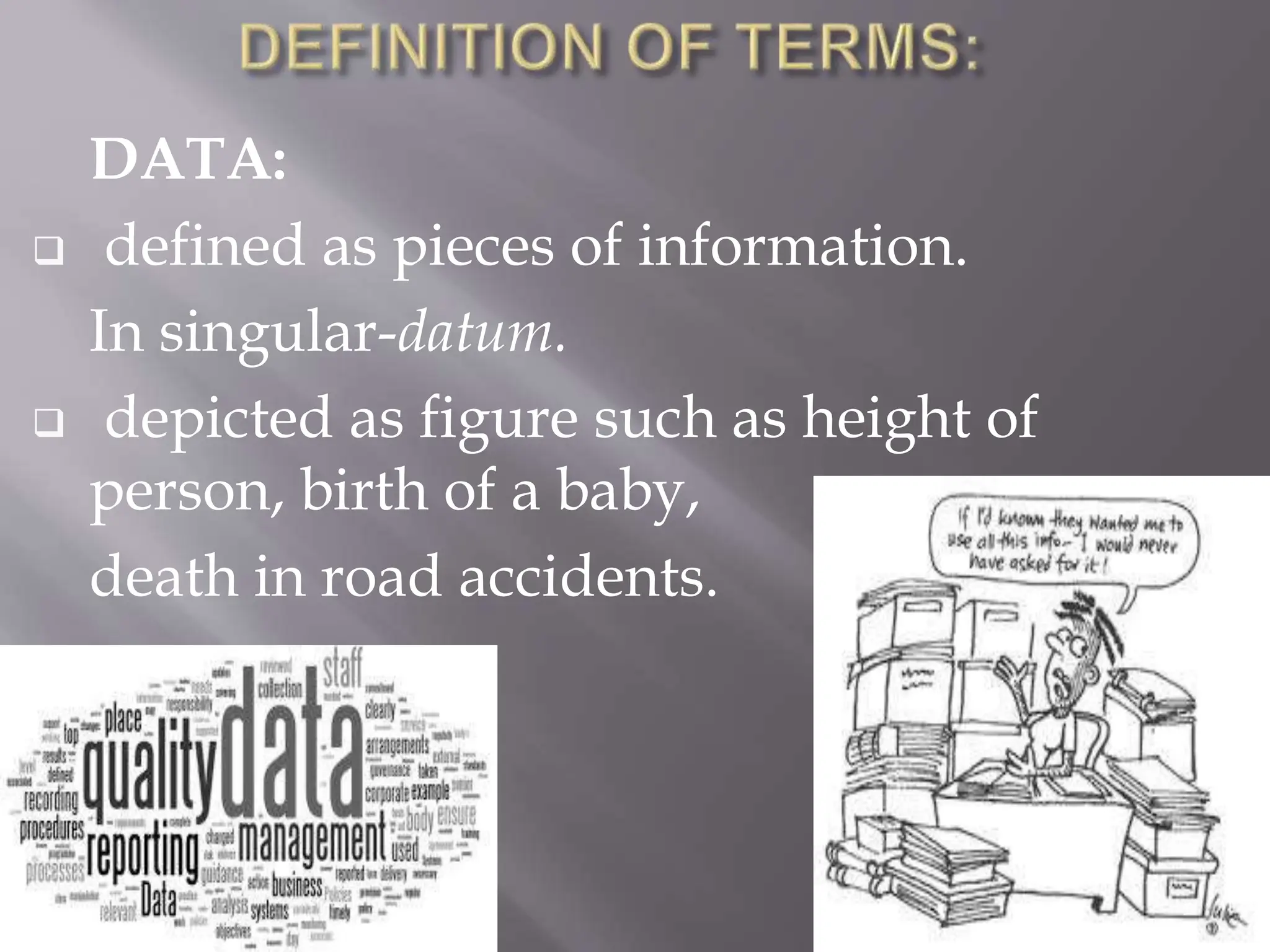
DATA:
 defined as pieces of information.
In singular-datum.
 depicted as figure such as height of
person, birth of a baby,
death in road accidents.
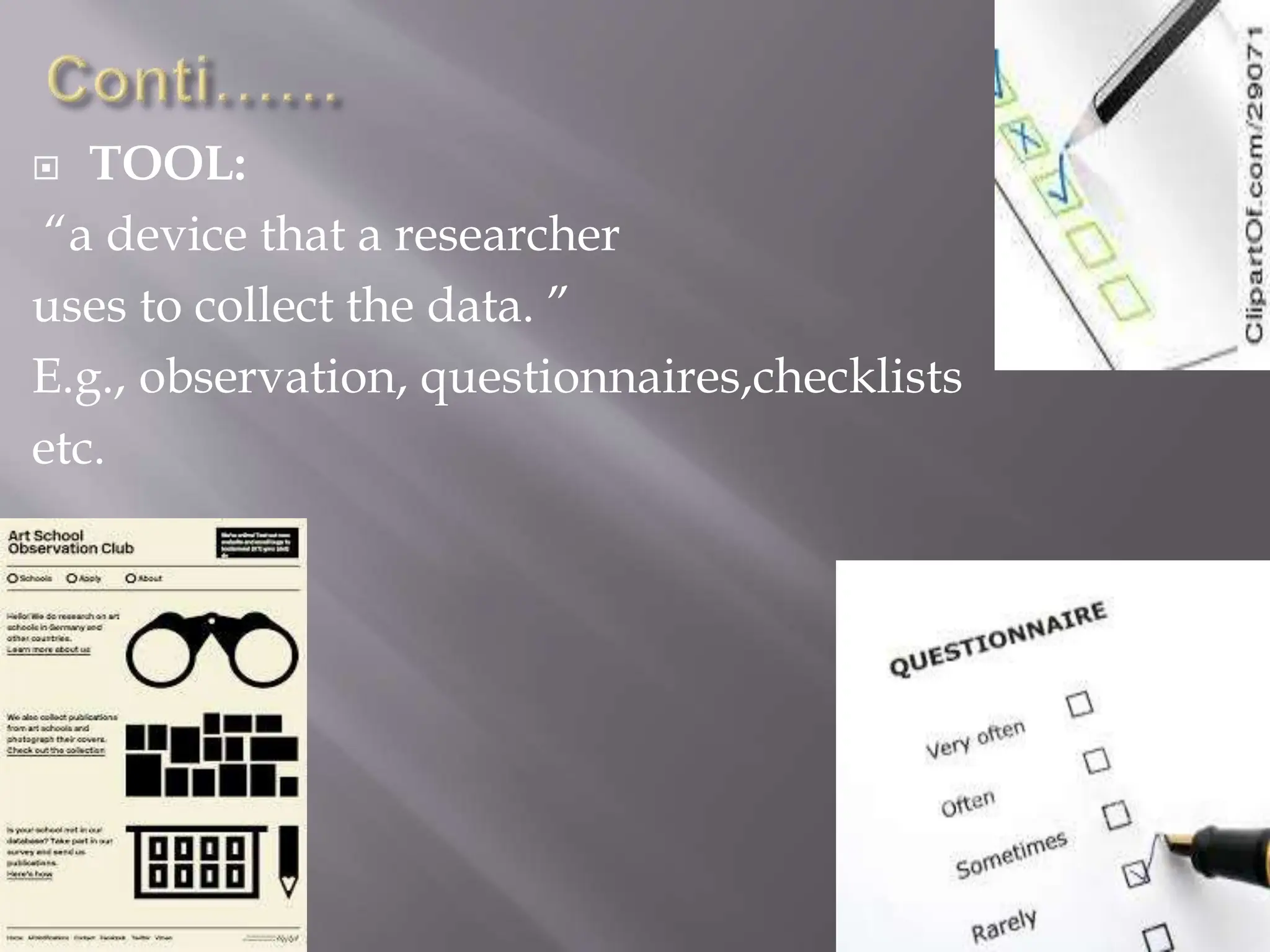
 TOOL:
“a device that a researcher
uses to collect the data. ”
E.g., observation, questionnaires,checklists
etc.
 TECHNIQUE :
“way or path of doing the
research study.
 METHODS OF DATA
COLLECTION:
various steps and
strategies
used for gathering
and analyzing
data in a research
investigation
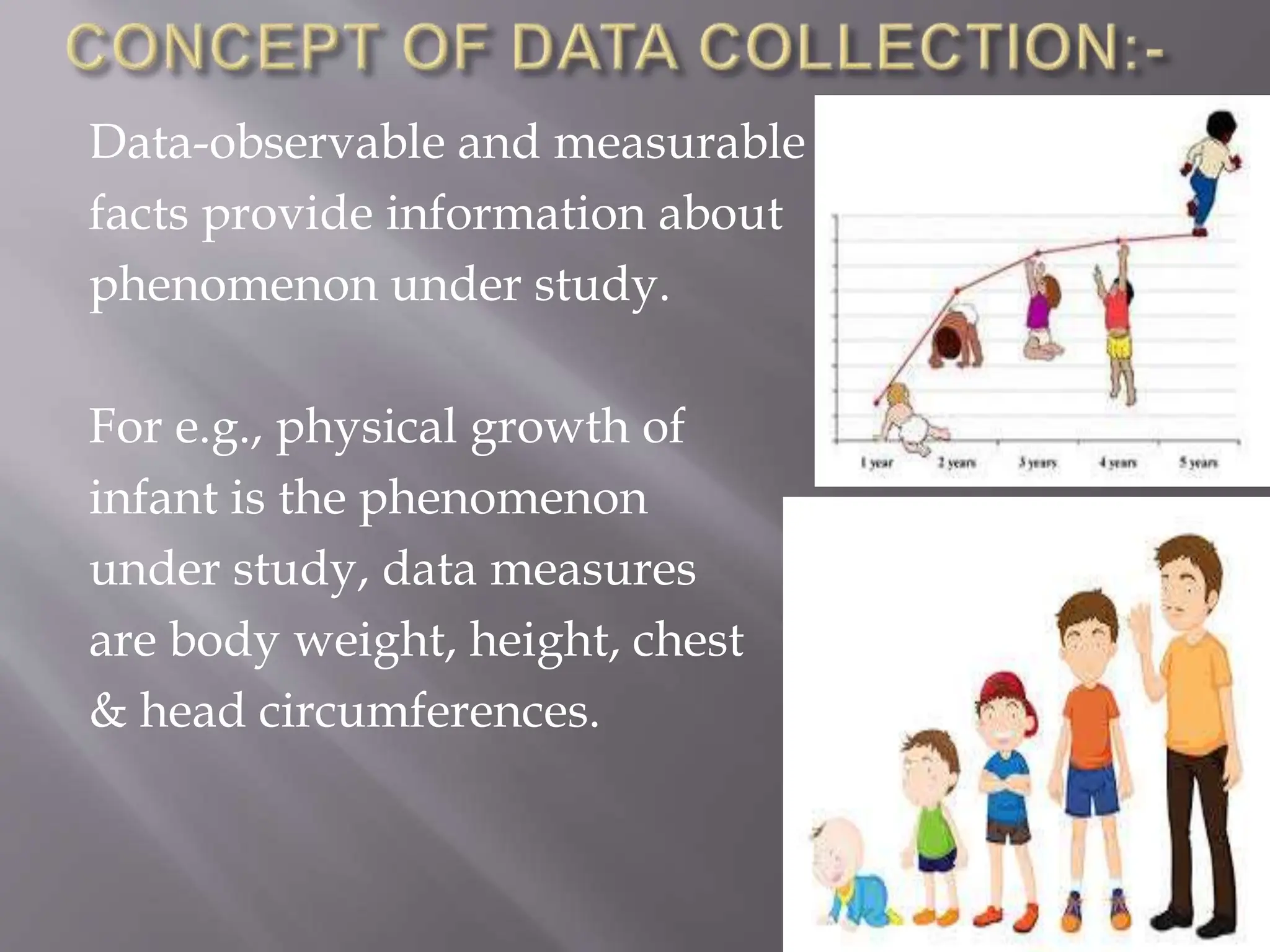
Data-observable and measurable
facts provide information about
phenomenon under study.
For e.g., physical growth of
infant is the phenomenon
under study, data measures
are body weight, height, chest
& head circumferences.
The five ‘Ws’ of the data collection are:
 What data is to be collected?
 From whom data is to be collected?
 Who will collect data?
 From where the data will be
collected?
 When is the data to be collected?
 PRIMARY
SOURCES
 SECONDARY
SOURCES
Individuals, objects, programmes, or
institutions.etc.
first-hand information from the respondents
or the situations,
By interviews, questioning,
observation, biochemical measurements,
and psychosocial measurement scales.
 Internal or external secondary sources.
Internal secondary sources
(private documents)
 Biographies
 Personal Diaries
 Letters
 Memoires
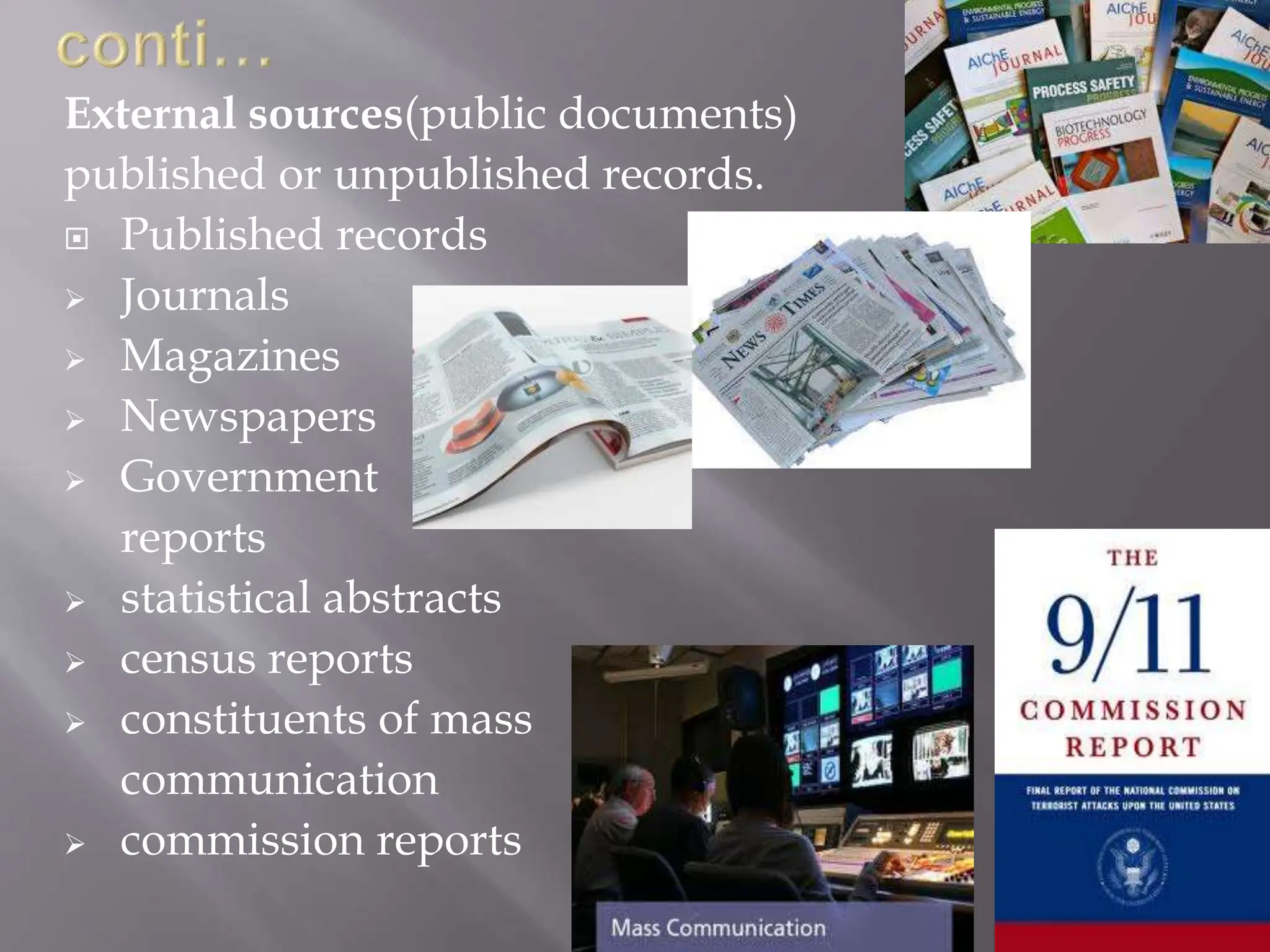
External sources(public documents)
published or unpublished records.
 Published records
 Journals
 Magazines
 Newspapers
 Government
reports
 statistical abstracts
 census reports
 constituents of mass
communication
 commission reports
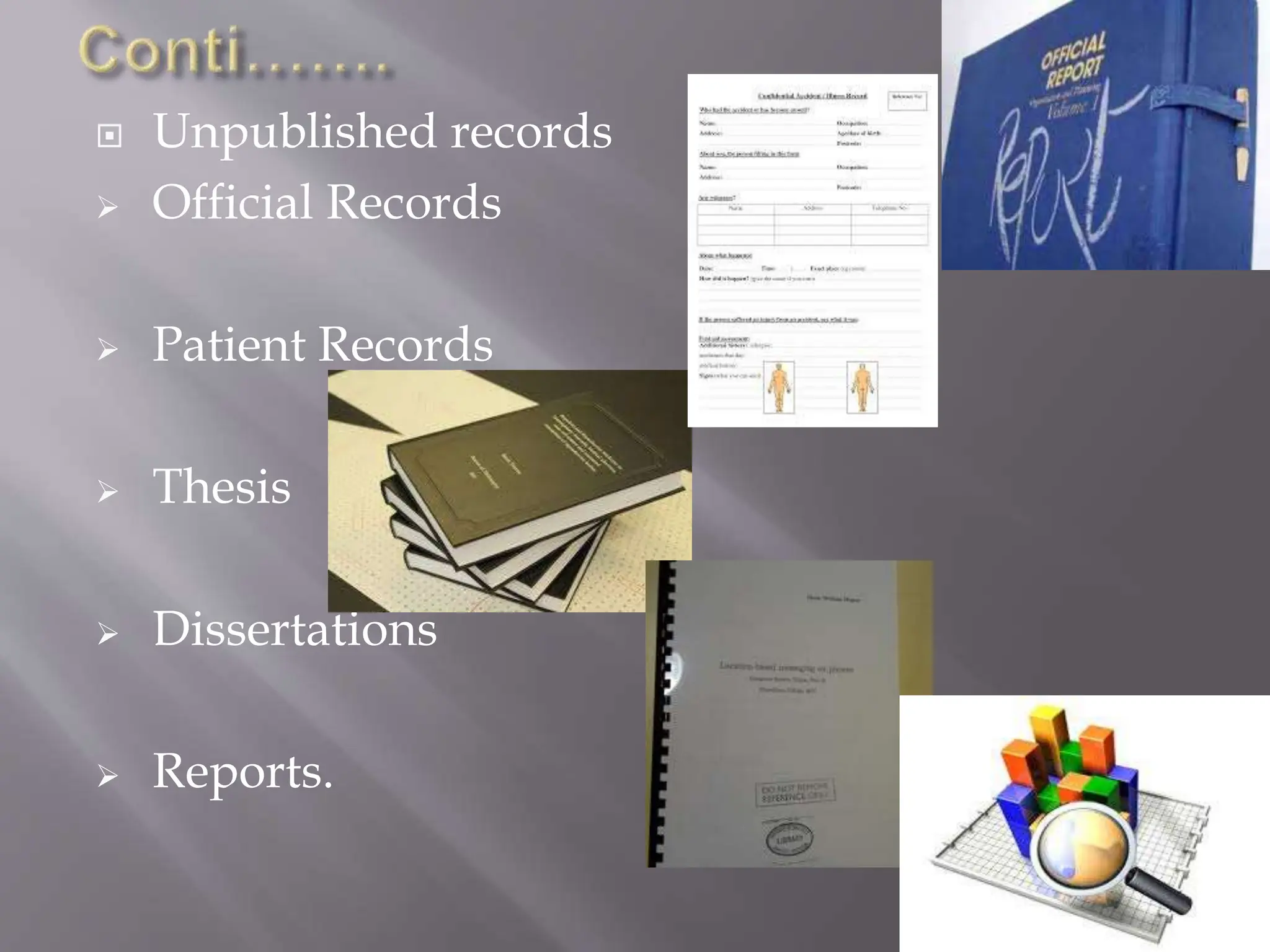
 Unpublished records
 Official Records
 Patient Records
 Thesis
 Dissertations
 Reports.
METHODS
AND
TOOLS
OF DATA
COLLECTION
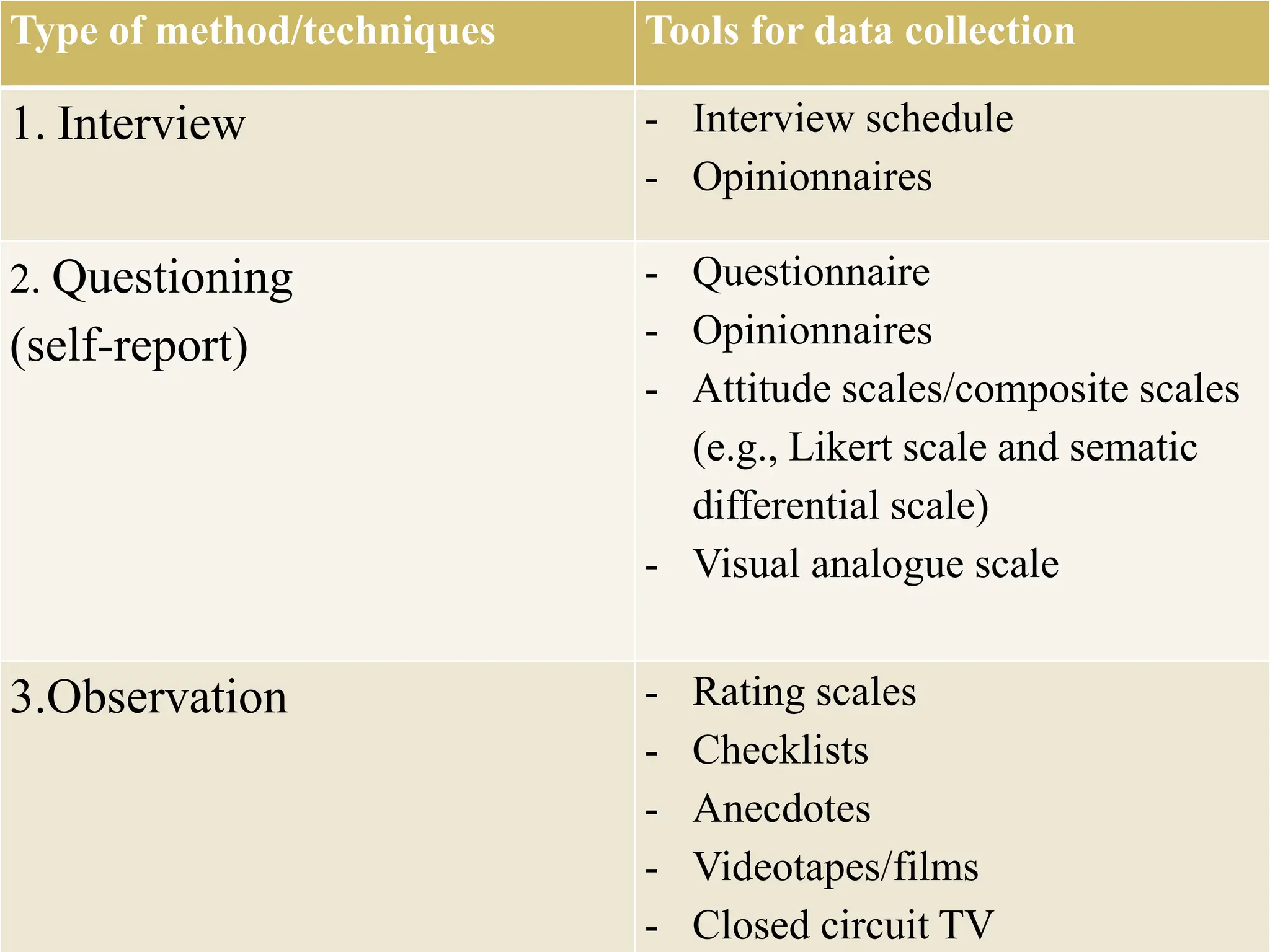
Type of method/techniques Tools for data collection
1. Interview - Interview schedule
- Opinionnaires
2. Questioning
(self-report)
- Questionnaire
- Opinionnaires
- Attitude scales/composite scales
(e.g., Likert scale and sematic
differential scale)
- Visual analogue scale
3.Observation - Rating scales
- Checklists
- Anecdotes
- Videotapes/films
- Closed circuit TV
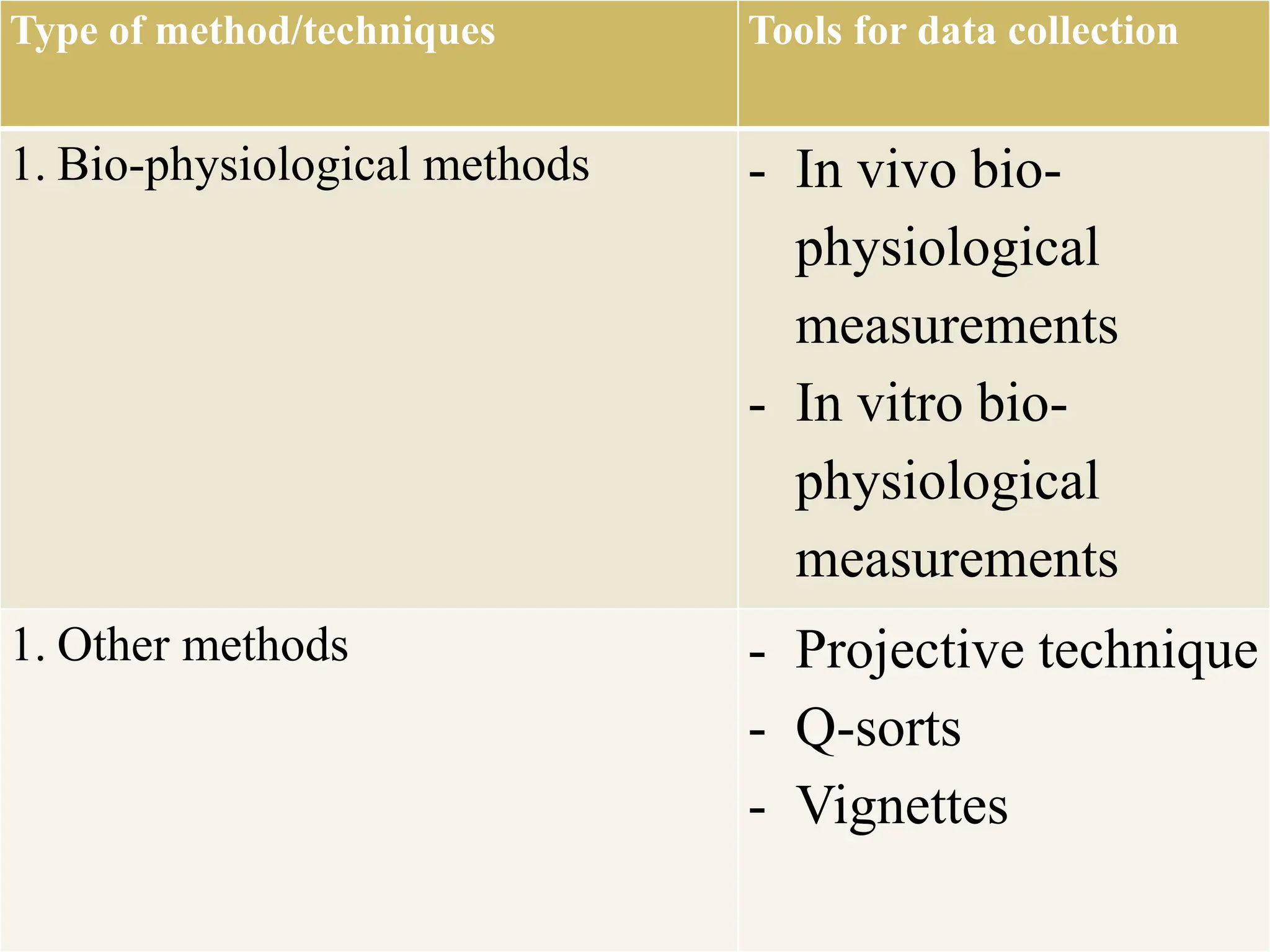
Type of method/techniques Tools for data collection
1. Bio-physiological methods - In vivo bio-
physiological
measurements
- In vitro bio-
physiological
measurements
1. Other methods - Projective technique
- Q-sorts
- Vignettes
SELECTION OF METHODS OF
DATA COLLECTION:
several factors influencing method of data
collection :
The nature of phenomenon under study:-
For example,only
 observation such as
clinical practices or processes
in a particular nursing
procedure.
 & knowledge
of group of nurses
through
questioning or interviews.
 Type of research subjects:-
 For example,
physically or psychologically
disabled subjects by interviews
or through observation.
from objects or institutions,
by observation
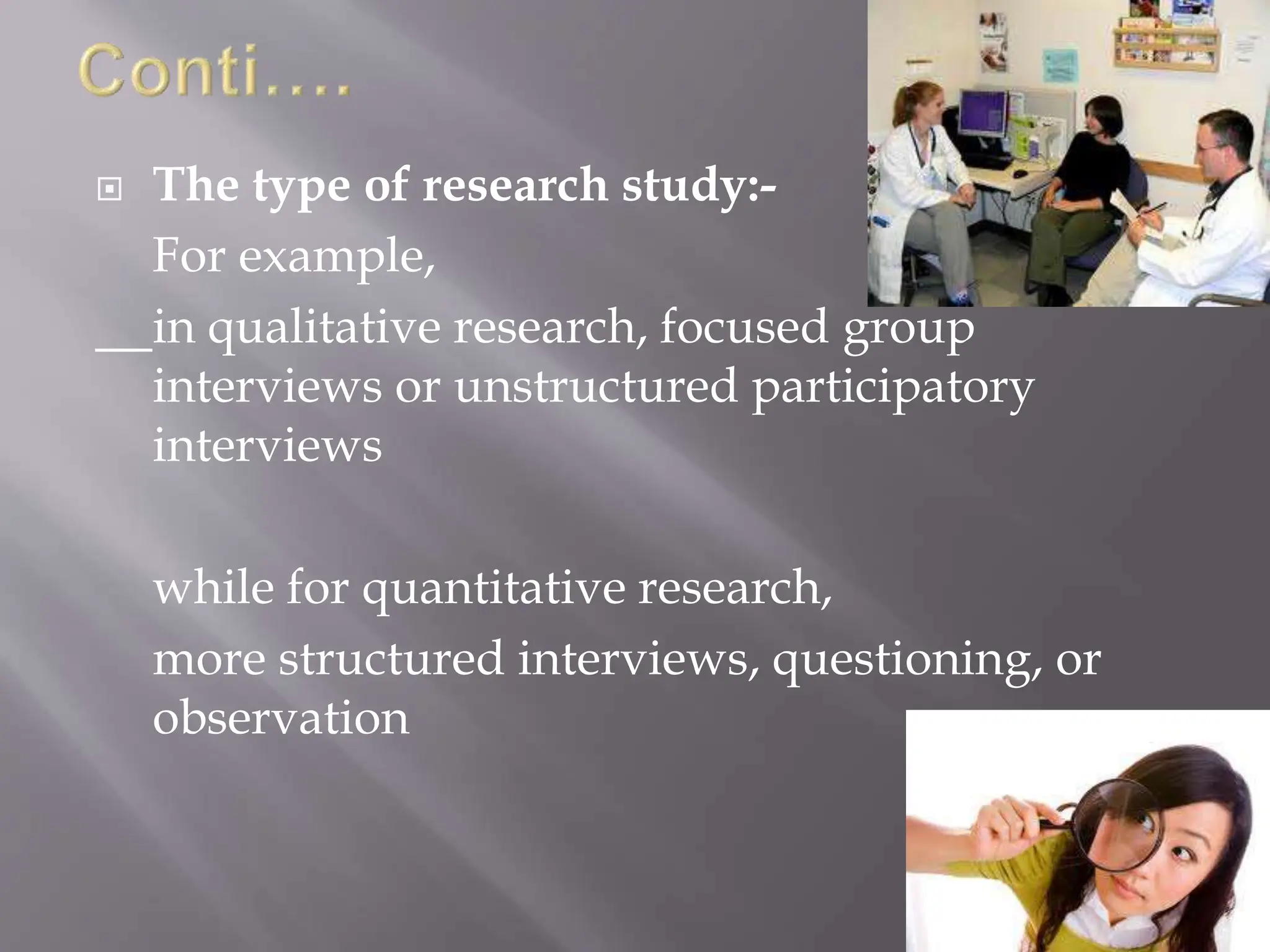
 The type of research study:-
For example,
in qualitative research, focused group
interviews or unstructured participatory
interviews
while for quantitative research,
more structured interviews, questioning, or
observation
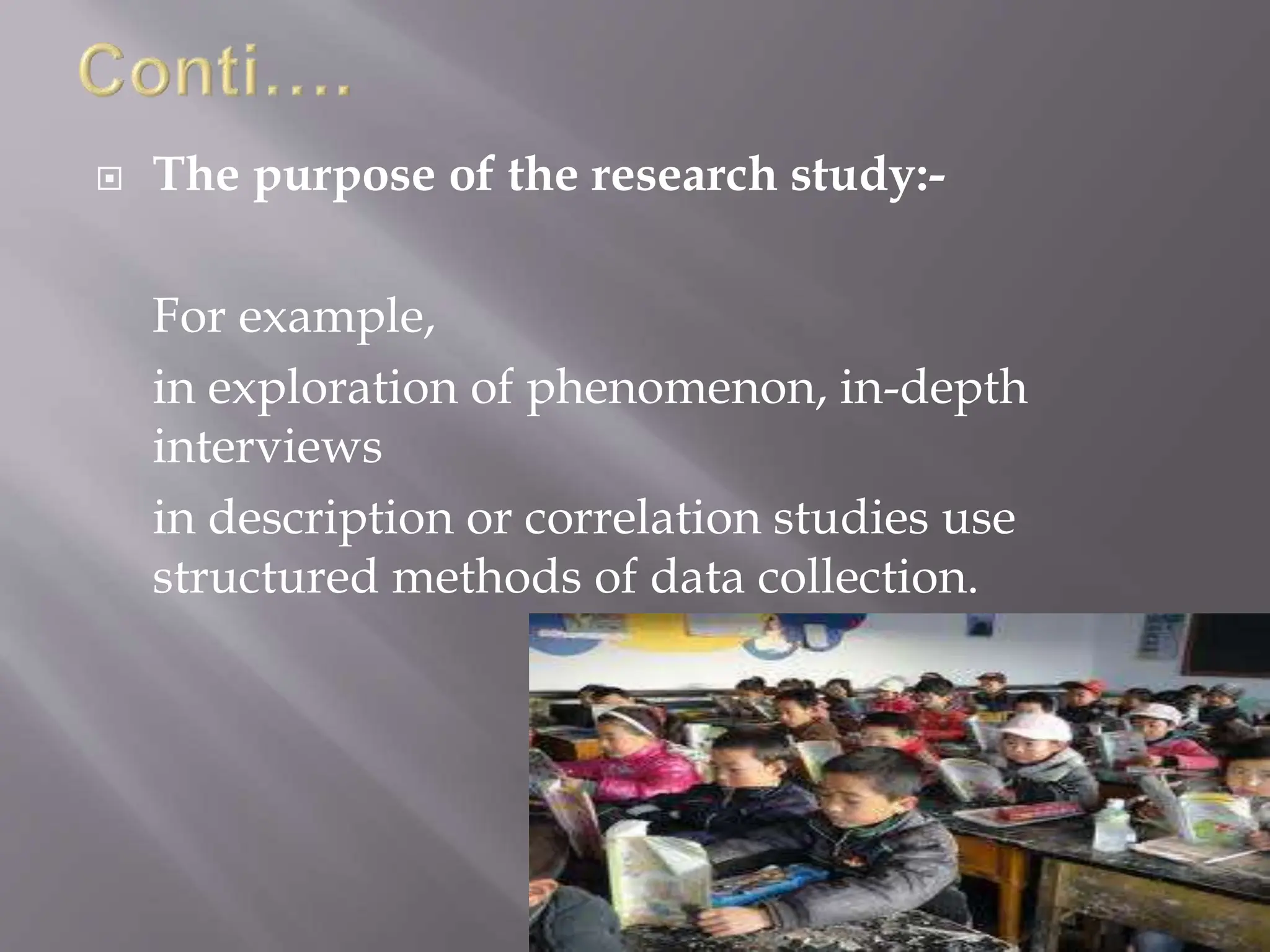
 The purpose of the research study:-
For example,
in exploration of phenomenon, in-depth
interviews
in description or correlation studies use
structured methods of data collection.
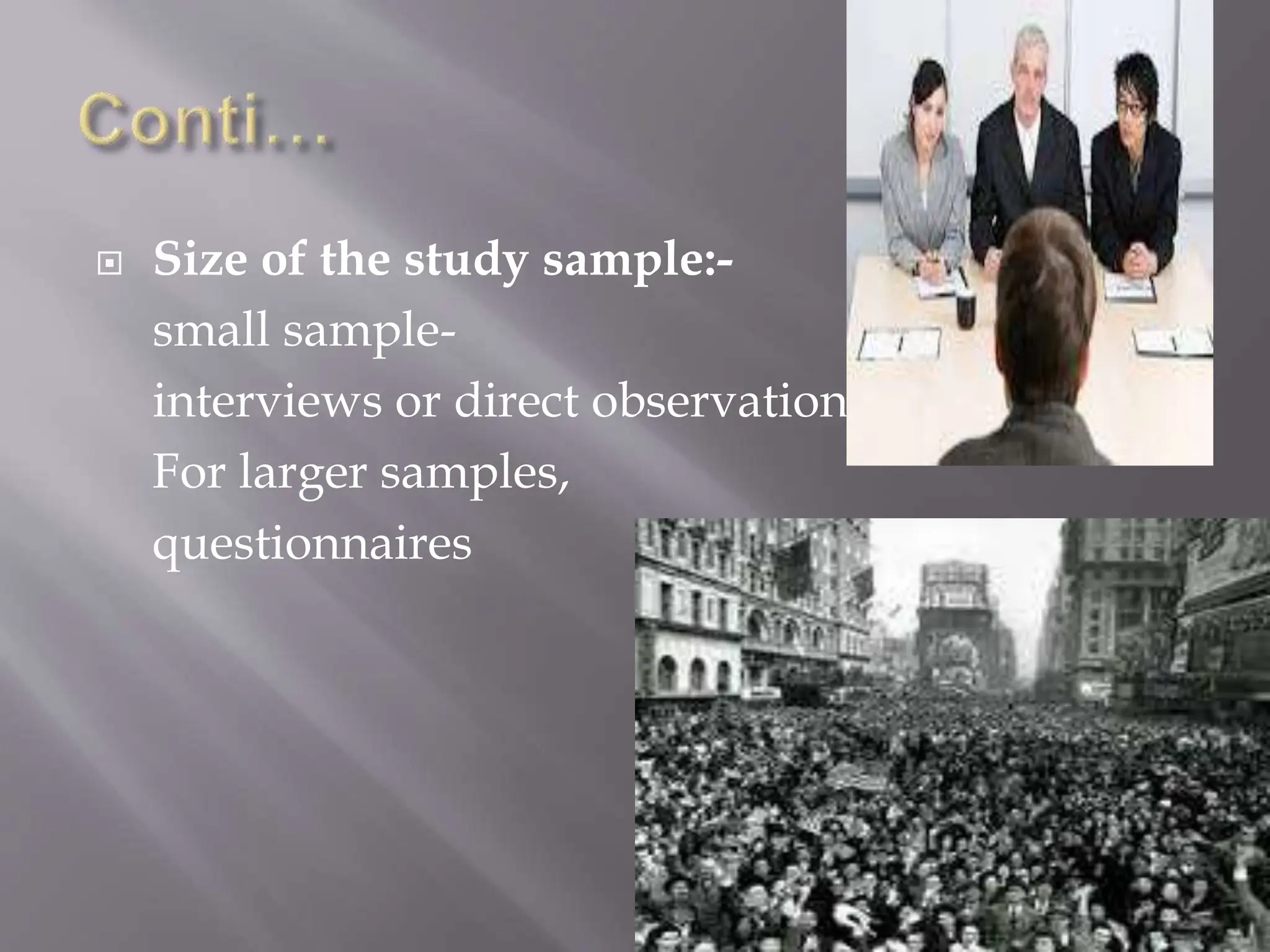
 Size of the study sample:-
small sample-
interviews or direct observation
For larger samples,
questionnaires
 Distribution of the target population:-
In large geographical area-
mailed questionnaires better option, more
convenient and cost-effective
 Time frame of the study:-
for a long time-use the less-structured methods
for short time-frame studies -short-term
research designs.
 Literacy level of the subjects:-
for illiterate subjects,
interviews conducted in native language.
 Availability of resources and manpower:-
interviews and observation
require more quantities of resources and
manpower
compared to questionnaires.
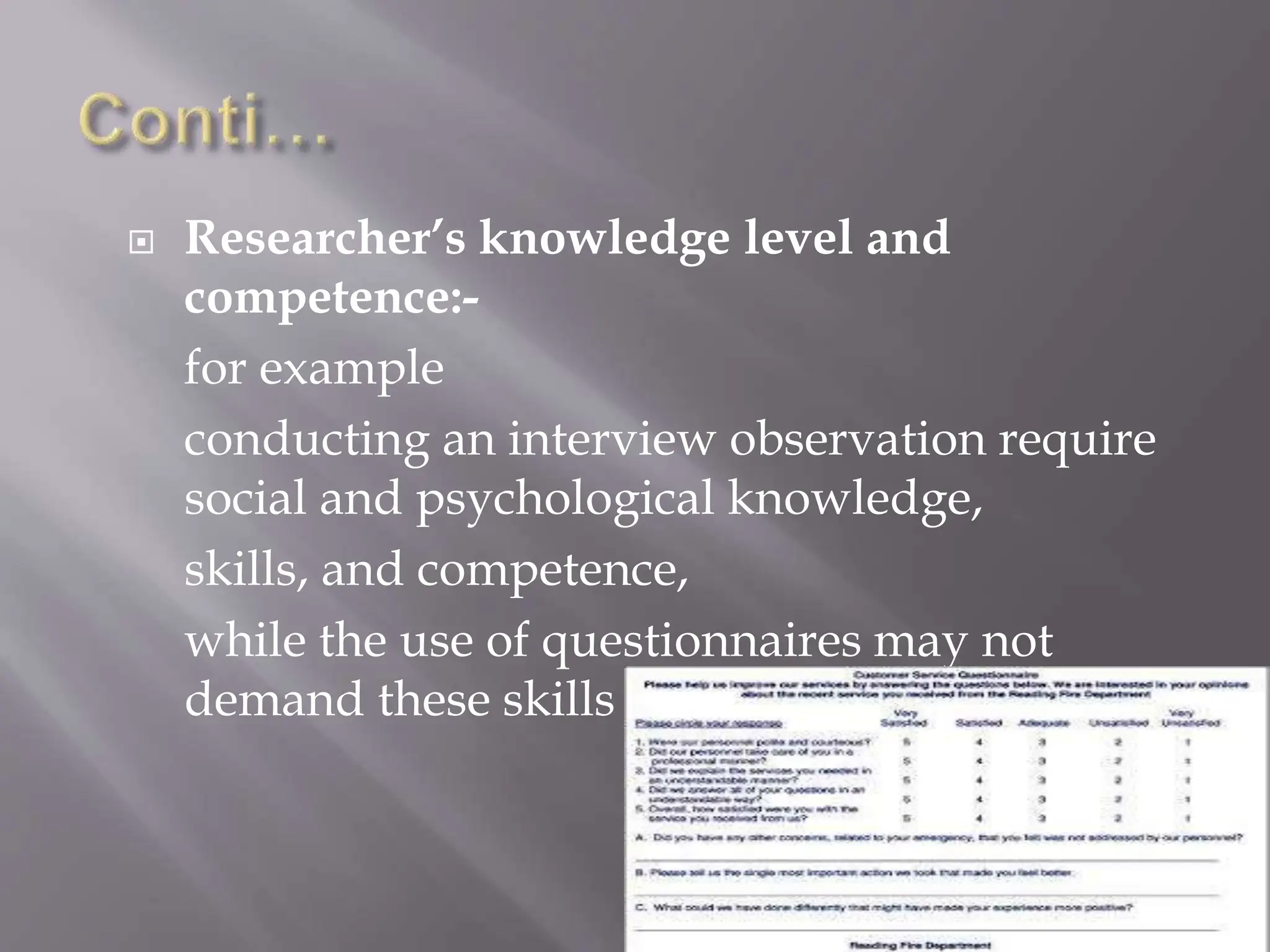
 Researcher’s knowledge level and
competence:-
for example
conducting an interview observation require
social and psychological knowledge,
skills, and competence,
while the use of questionnaires may not
demand these skills
 Accuracy and completeness of data
collection
 Compatible with subjects.
 Cost-effectiveness & speed in
 In accordance with nature of
phenomenon, type, purpose, time-
frame & resources available.
 Further, criteria while evaluating or
assessing the method for data collection:
-Is data collection method complete in all the
aspects to study the study variables?
 Are data collection methods thoroughly
described?
 Are data collection methods in accordance
to research questions/hypotheses to be
tested?
 Are validity and reliability of data
collection methods established?
 Are the number of methods used for data
collection sufficient for complete coverage
of research data or additional methods
required for data collection?
 Are anonymity and confidentiality
assured?
 Are instruments described in detail?
 Were the criterion measures or scoring
methods clearly established?
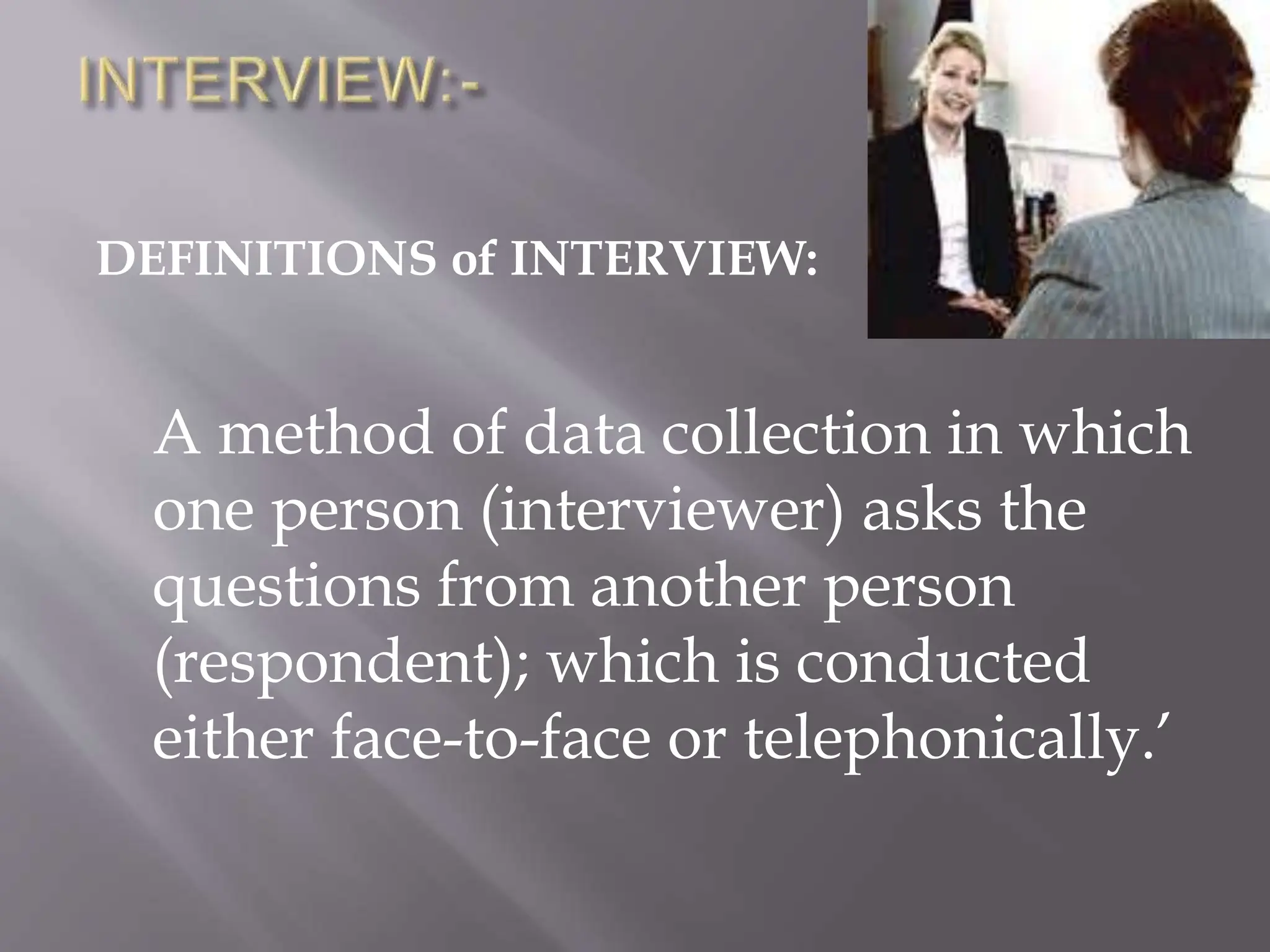
DEFINITIONS of INTERVIEW:
A method of data collection in which
one person (interviewer) asks the
questions from another person
(respondent); which is conducted
either face-to-face or telephonically.’
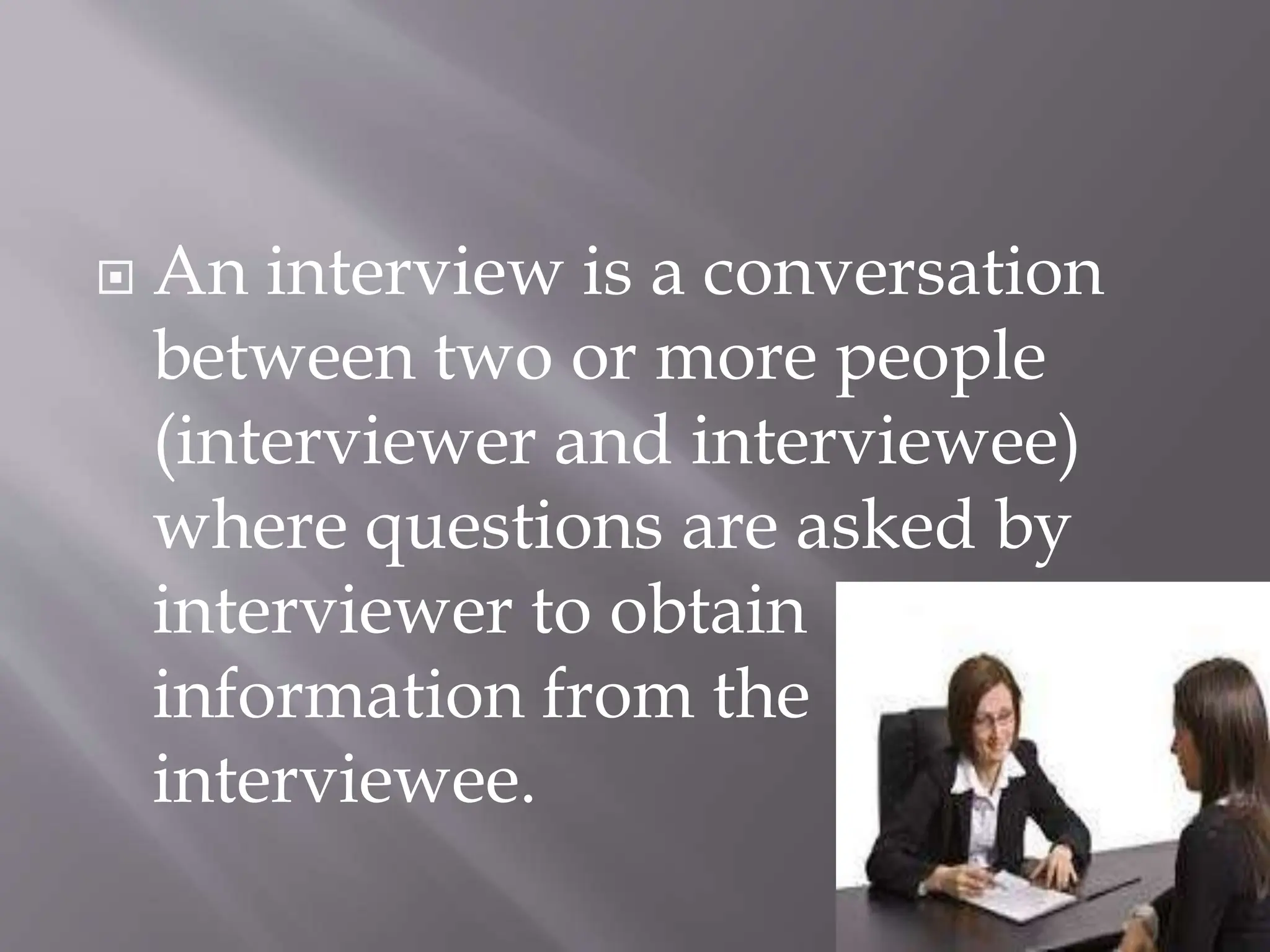
 An interview is a conversation
between two or more people
(interviewer and interviewee)
where questions are asked by
interviewer to obtain
information from the
interviewee.
 It may be defined as a two-way
systematic conversation between an
investigator and an informant, initiated
for obtaining information relevant to a
specific study. It involves not only
conversations, but also learning from
respondent’s gestures, facial expressions
and pauses, and his or her environment.
 The participants, the interviewer,
and the respondent are strangers.
 Relationship is transitory one.
 Mode of obtaining verbal answers.
 Investigator records information
 Not casual conversational exchange
 face-to-face or telephonically
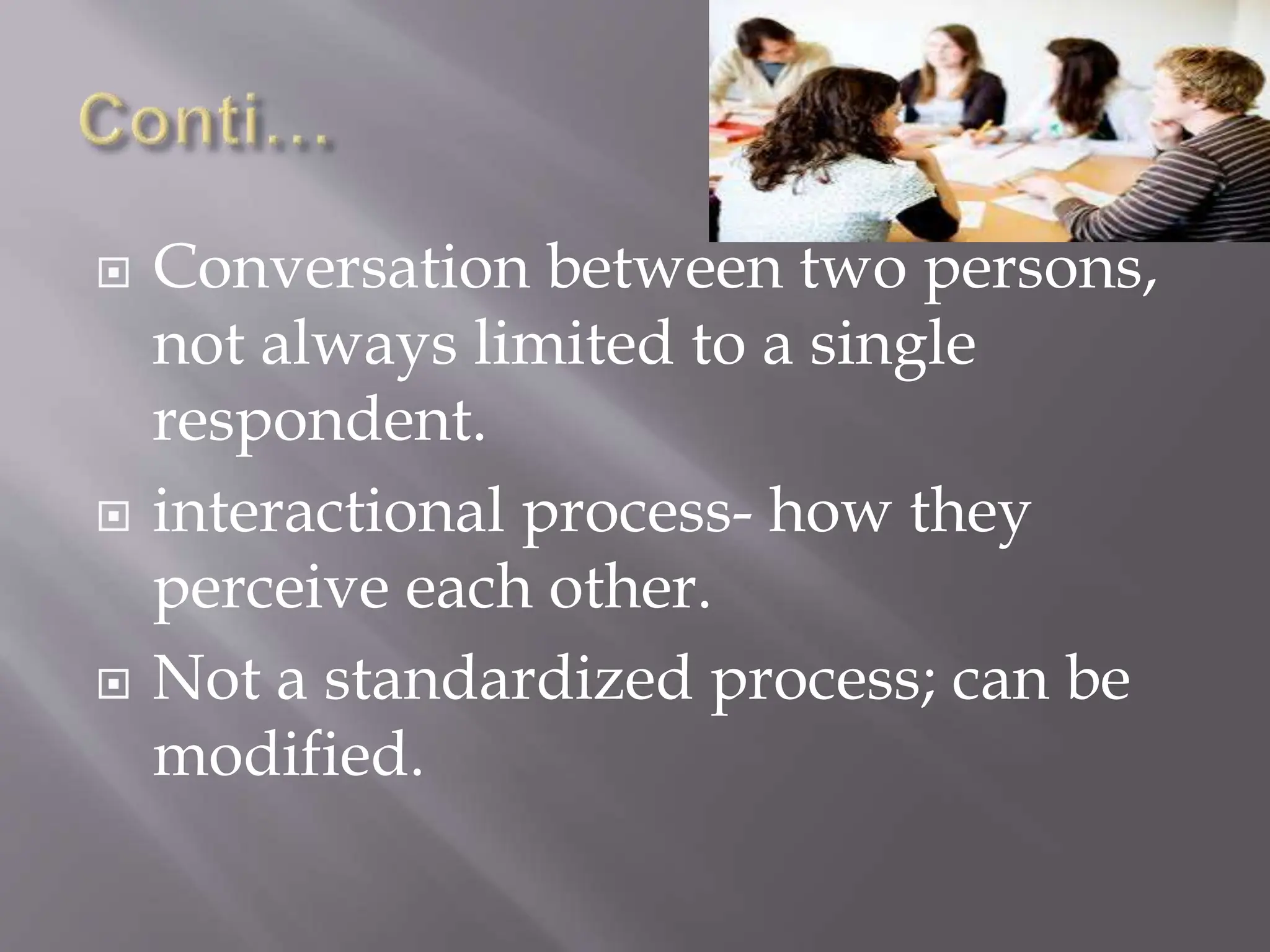
 Conversation between two persons,
not always limited to a single
respondent.
 interactional process- how they
perceive each other.
 Not a standardized process; can be
modified.
 Provide in-depth and detailed information
 Permits greater depth of response
 Data from illiterate subjects
 Higher response
 Clarify misunderstandings
 Ask questions at several levels
 Helps to gather other supplementary information
 Use of special devices
 Accuracy can be checked
 Flexible and adaptable
 People unable to write
Basically interview can be classified in
following six broad categories.
 STRUCTURED INTERVIEW
 UNSTRUCTURED INTERVIEW
 SEMI-STRUCTURED INTERVIEW
 IN-DEPTH INTERVIEW
 FOCUSED GROUP INTERVIEW
 TELEPHONE INTERVIEW
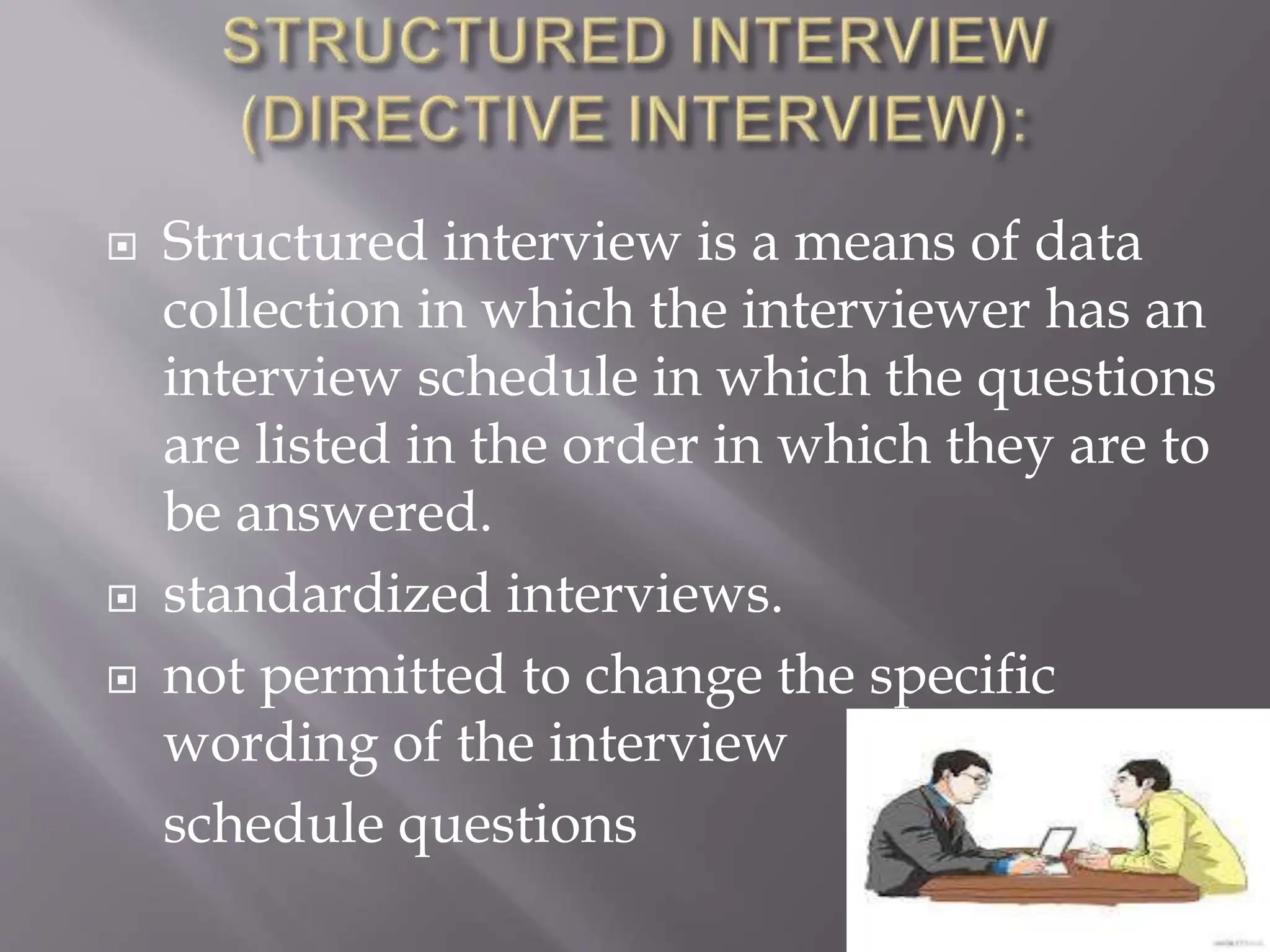
 Structured interview is a means of data
collection in which the interviewer has an
interview schedule in which the questions
are listed in the order in which they are to
be answered.
 standardized interviews.
 not permitted to change the specific
wording of the interview
schedule questions
 Limited set of questions.
 Present exactly the same questions
in the same order.
 It increases the reliability and
credibility of research data.
 It minimizes context effects
 Data easily comparable.
 Recording and coding data
 not diverted to irrelevant and
time consuming conversation.
 lose the spontaneity of natural
conversation.
 respondent’s views are minimized
and investigators own biases
 exploration of information limited.
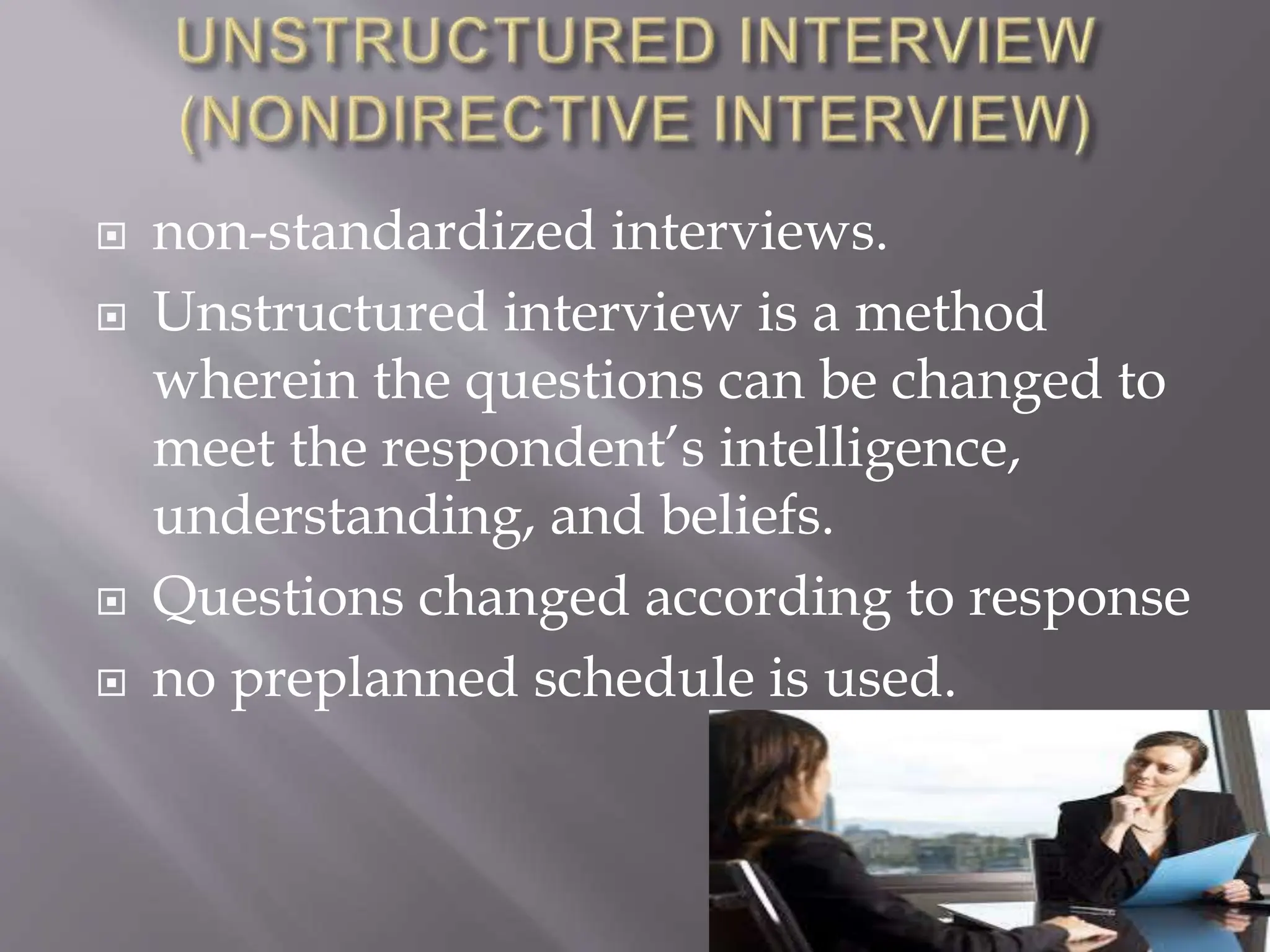
 non-standardized interviews.
 Unstructured interview is a method
wherein the questions can be changed to
meet the respondent’s intelligence,
understanding, and beliefs.
 Questions changed according to response
 no preplanned schedule is used.
 open-ended questions, opportunity
to ask unplanned questions .
 explore the information from the
respondents.
 It increases the reliability and
credibility of research data.
 It facilitates the natural unobstructed
proceedings.
 less prone to interviewer’s
bias.
 Great opportunity to explore the
problem
 gathering information on
sensitive topics
 like divorce, social
discrimination, drug addiction,
etc.
 Data not comparable
 Time may be wasted in
unproductive conversation.
 No order or sequence in this
interview.
 Requires more skills of researcher.
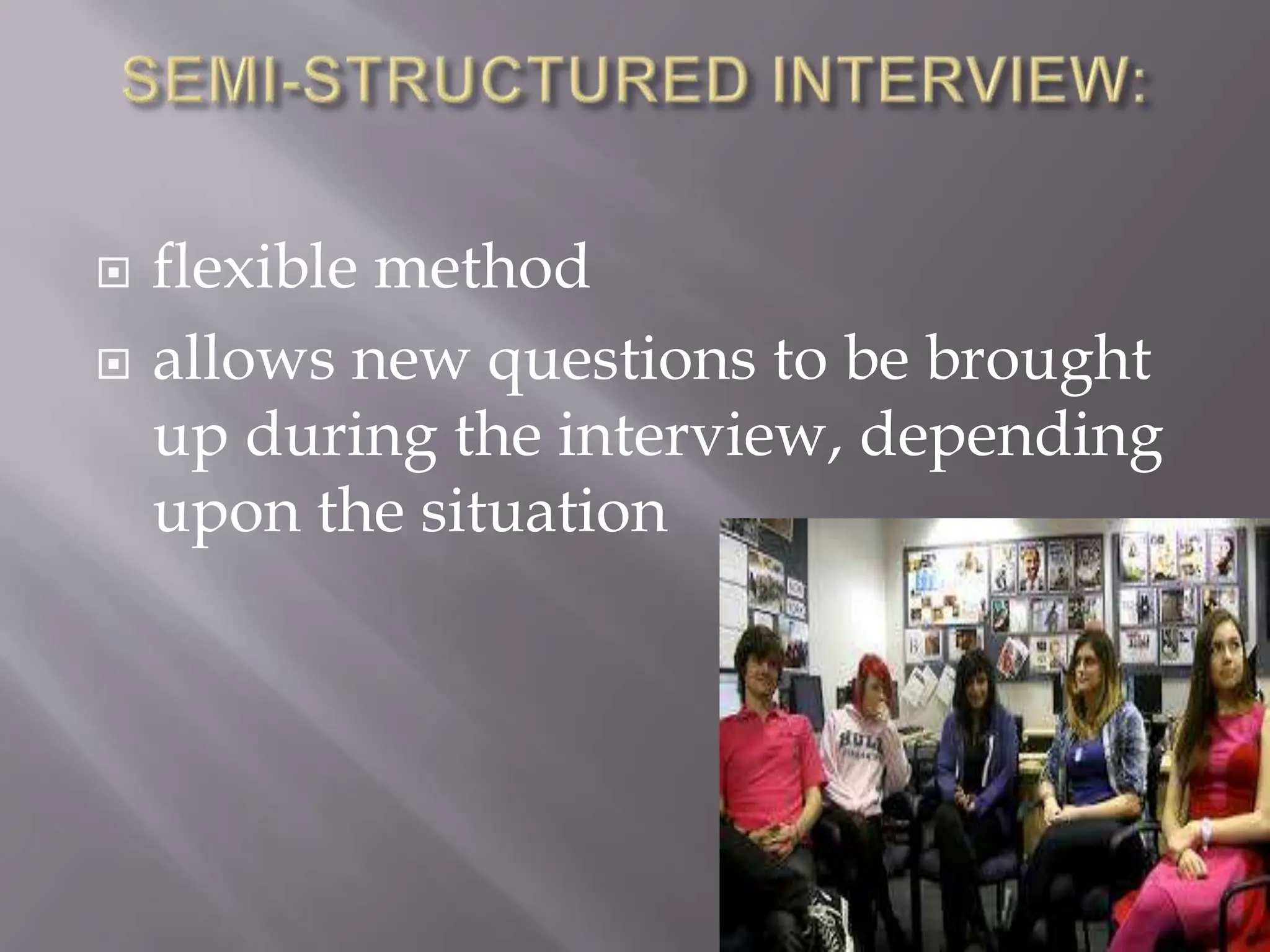
 flexible method
 allows new questions to be brought
up during the interview, depending
upon the situation
 Interviewer prepares an interview guide
 informal list of topics and questions
 interviewer ask ques in different ways
from the different participants.
 Interview guide helps the researcher to
focus on the topics at hand without
constraining them to a particular
format.
 intensive and investigative interview
 study the respondent’s opinion and
emotions on the basis of interview
guide.
 requires more training and
interpersonal skills.
 aims to elicit unconscious & personal
feelings and emotions.
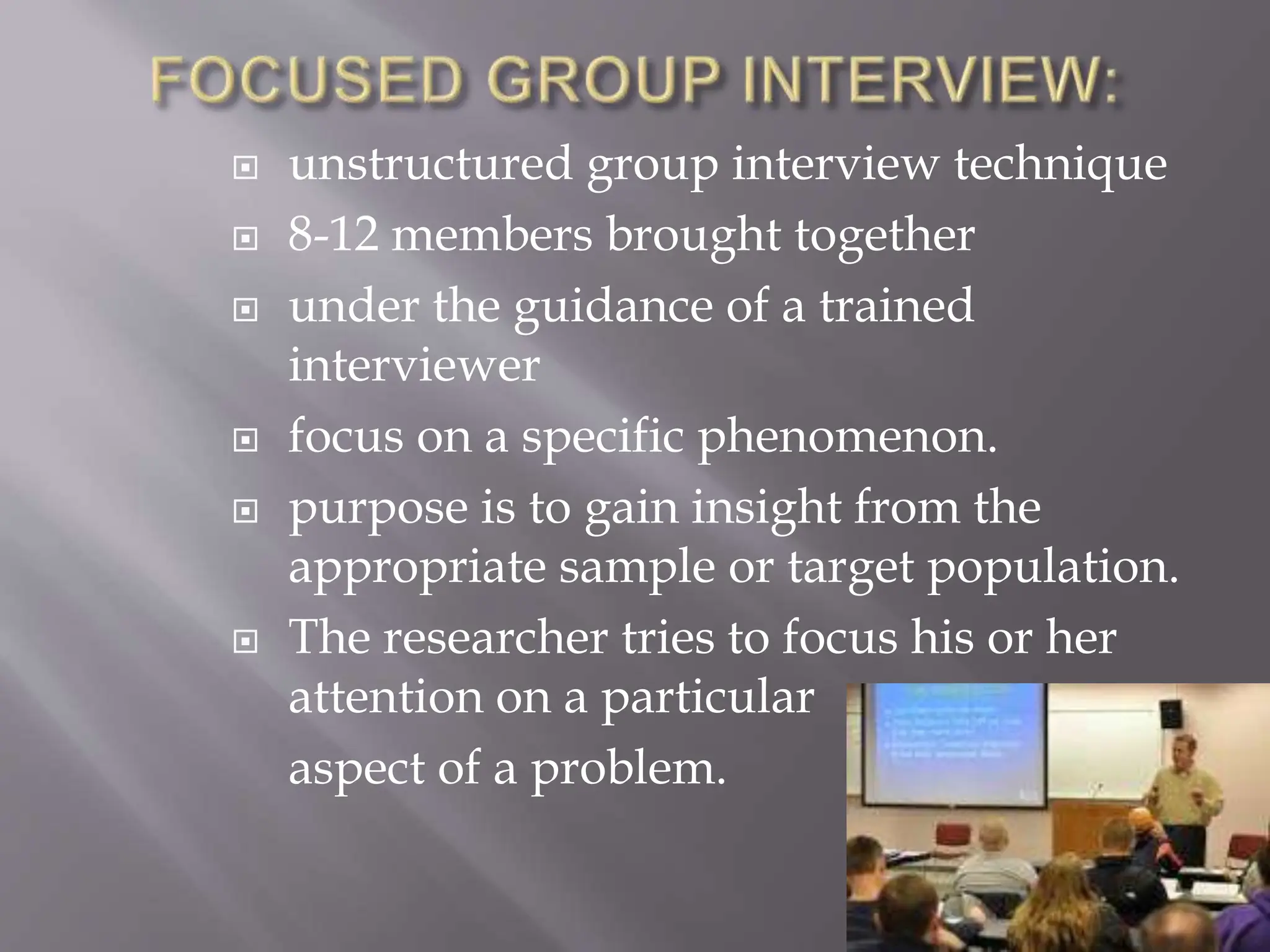
 unstructured group interview technique
 8-12 members brought together
 under the guidance of a trained
interviewer
 focus on a specific phenomenon.
 purpose is to gain insight from the
appropriate sample or target population.
 The researcher tries to focus his or her
attention on a particular
aspect of a problem.
 carefully planned discussion
 interviewer guides the discussion
according to written set of questions or
topics to be covered.
 special attention given to specific topics or
ideas.
 focus the discussion on the actual effects of
a given experience.
 focused on the subjective experience of the
respondent i.e.his or her opinion or
emotional response to the topic of
research.
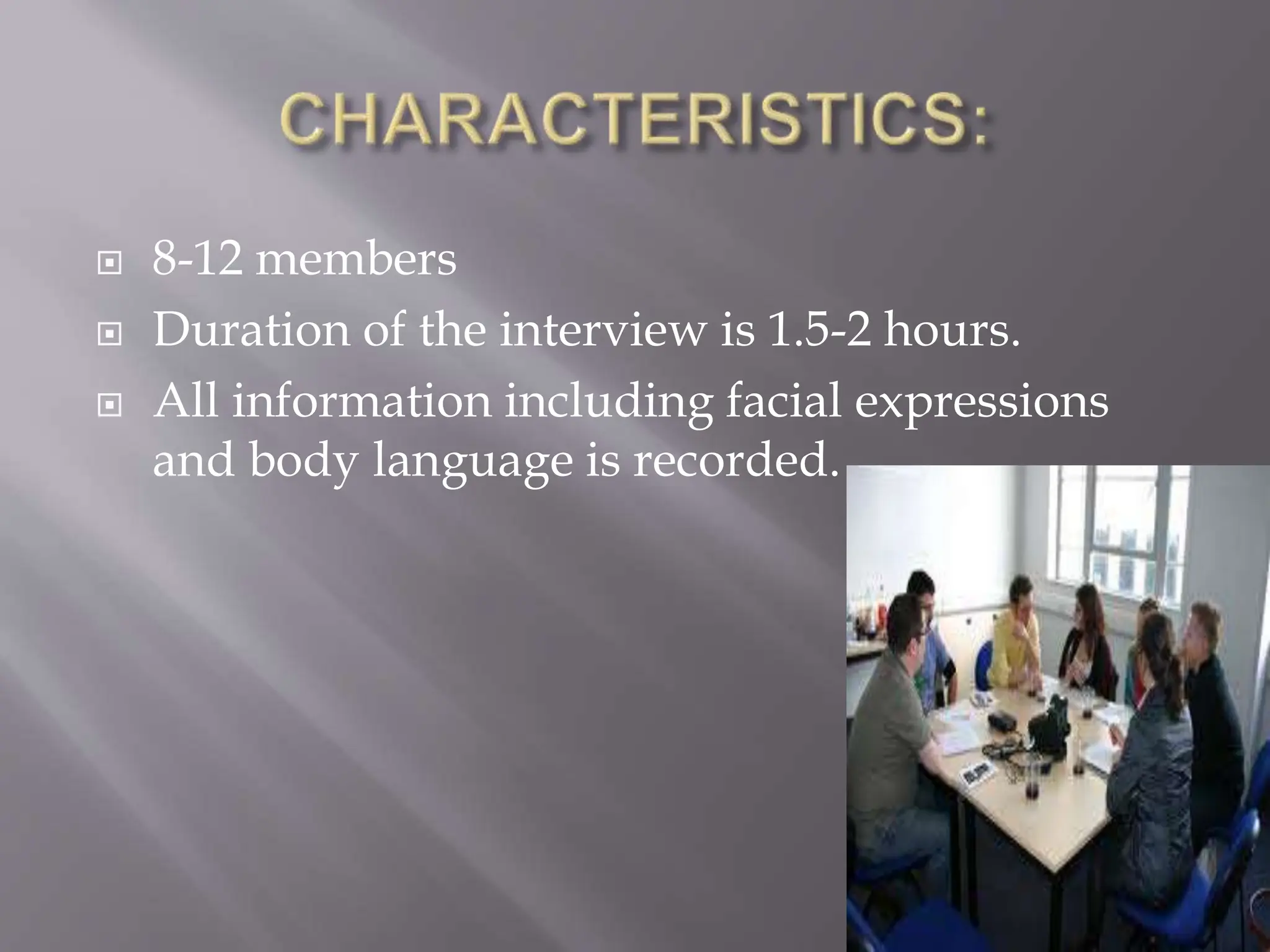
 8-12 members
 Duration of the interview is 1.5-2 hours.
 All information including facial expressions
and body language is recorded.
 moderator to lead the discussion.
 permits to obtain details of personal reactions
to an experience.
 free from inflexibility of formal methods.
 interviewer is free to choose the sequence of
questions.
 Wide range of information collected.
 stimulates new ideas and creative concepts.
 One person’s comments may trigger a response
from another person, leading to in-depth
discussion on the topic.
 increases excitements in a group.
 Participants feel more comfortable to answer in
a group with similar interests.
 involves many participants at one time.
 chances of client and researcher bias.
 It is difficult to moderate.
 It is difficult to code, analyze and interpret.
 non personal method of data collection.
 consists in contacting respondents on
telephone itself.
 used widely in industrial surveys particularly
in developed regions.
 More flexible and quick way.
 Less Cost & high response.
 Easy to Access through a telephone directory.
 No field, staff required
 wider coverage of sample is possible.
 Difficult to establish rapport between
respondent and interviewer.
 Surveys are limited to respondents who have
telephone facilities.
 Respondent’s characteristics, facial expressions,
and environment cannot be observed.
 Possibility of bias of interviewer is more.
Preparation for interview:-
 Fix up appointment
 Appearance and dress
 Familiarity with interview
schedule
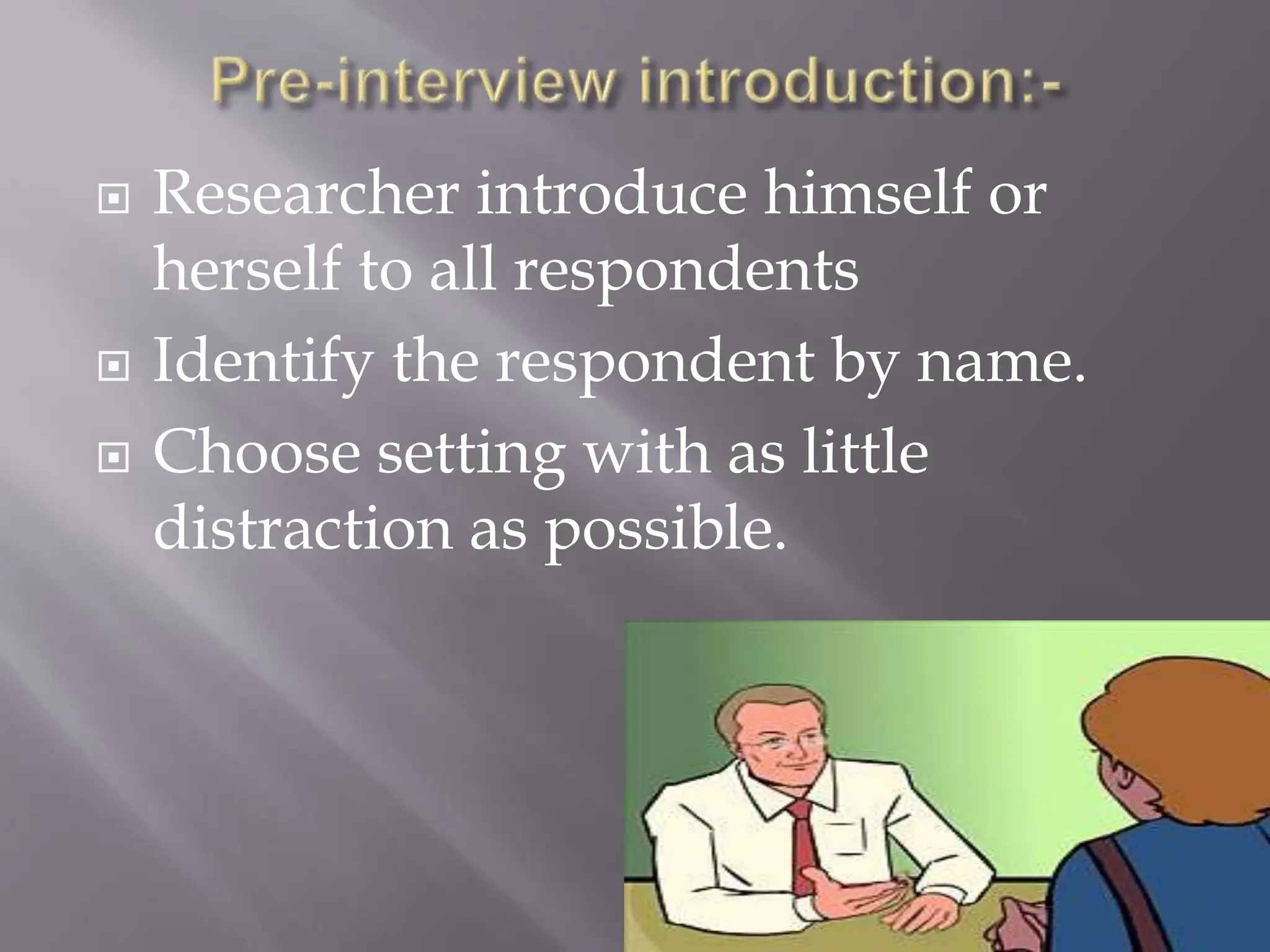
 Researcher introduce himself or
herself to all respondents
 Identify the respondent by name.
 Choose setting with as little
distraction as possible.
 Explain purpose of interview.
 Address terms of confidentiality.
 Explain format of the interview.
 Indicate how long the interview
usually takes.
 Ask them if they have any questions.
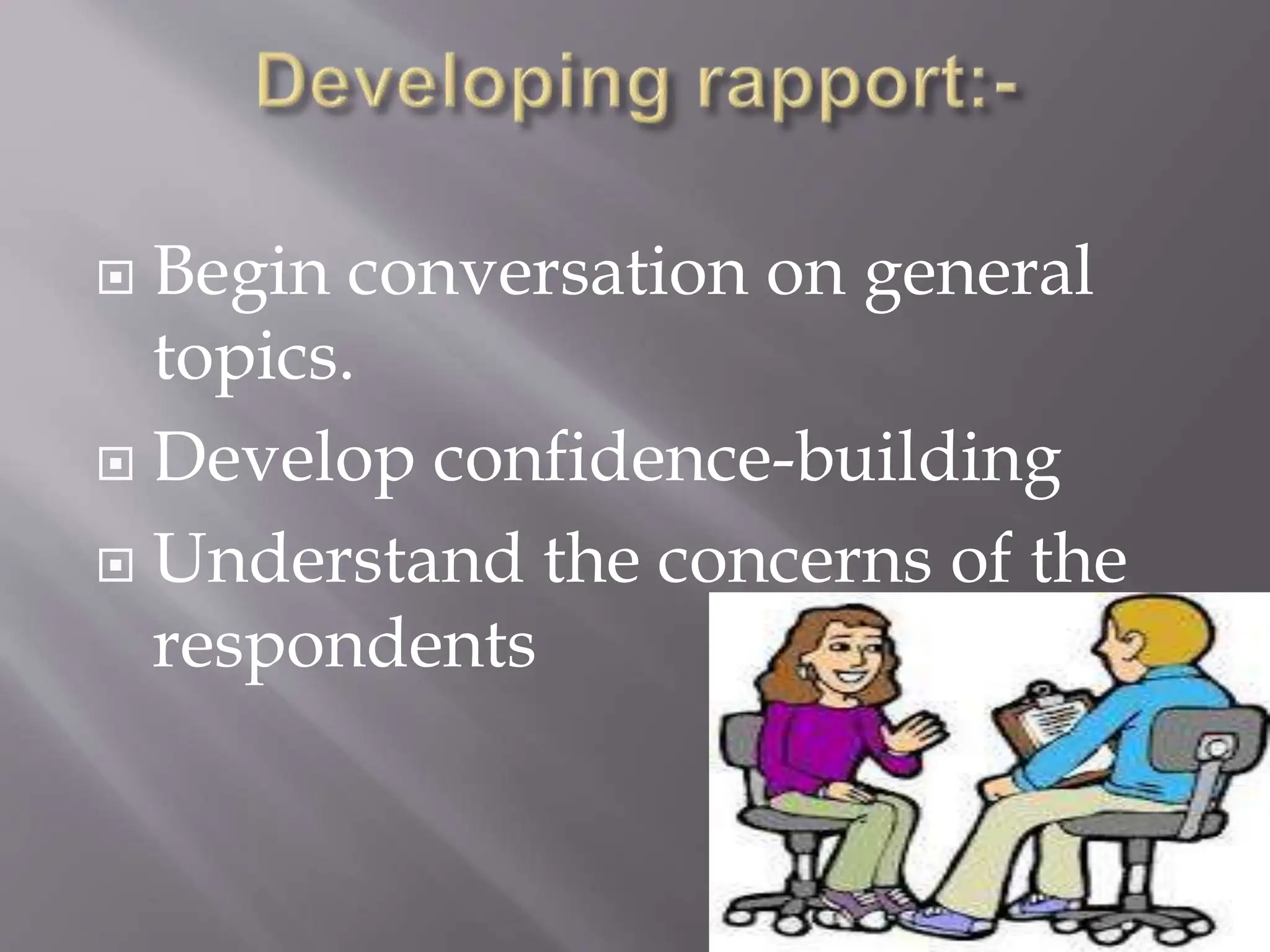
 Begin conversation on general
topics.
 Develop confidence-building
 Understand the concerns of the
respondents
 Start the interview.
 Ask only one question at a time.
 Repeat a question if necessary.
 Make sure subject understands
the questions.
 Listen carefully Subjects answer.
 Observe the inverbal responses.
 Give sufficient time to answer the
questions.
 Do not show signs of surprise,
shock, or anger.
 Maintain a neutral attitude with
the respect to controversial issues.
 Take note of answers if vague or
ambiguous.
 Ask additional questions to follow
up clues .
 Do not hurry the interview.
 If silence is too prolonged,
introduce a stimulus.
 Record responses as they take place.
 Note-making.
 A tape recorder used to record
 Shorthand used to record responses.
 After the interview is over
 Polite leave of the respondent
taken
 Thanking him or her & saying
goodbye.
 Used to obtain information about
people’s feelings, perceptions, and
opinions.
 Allow more detailed questions to be
asked.
 High response rate
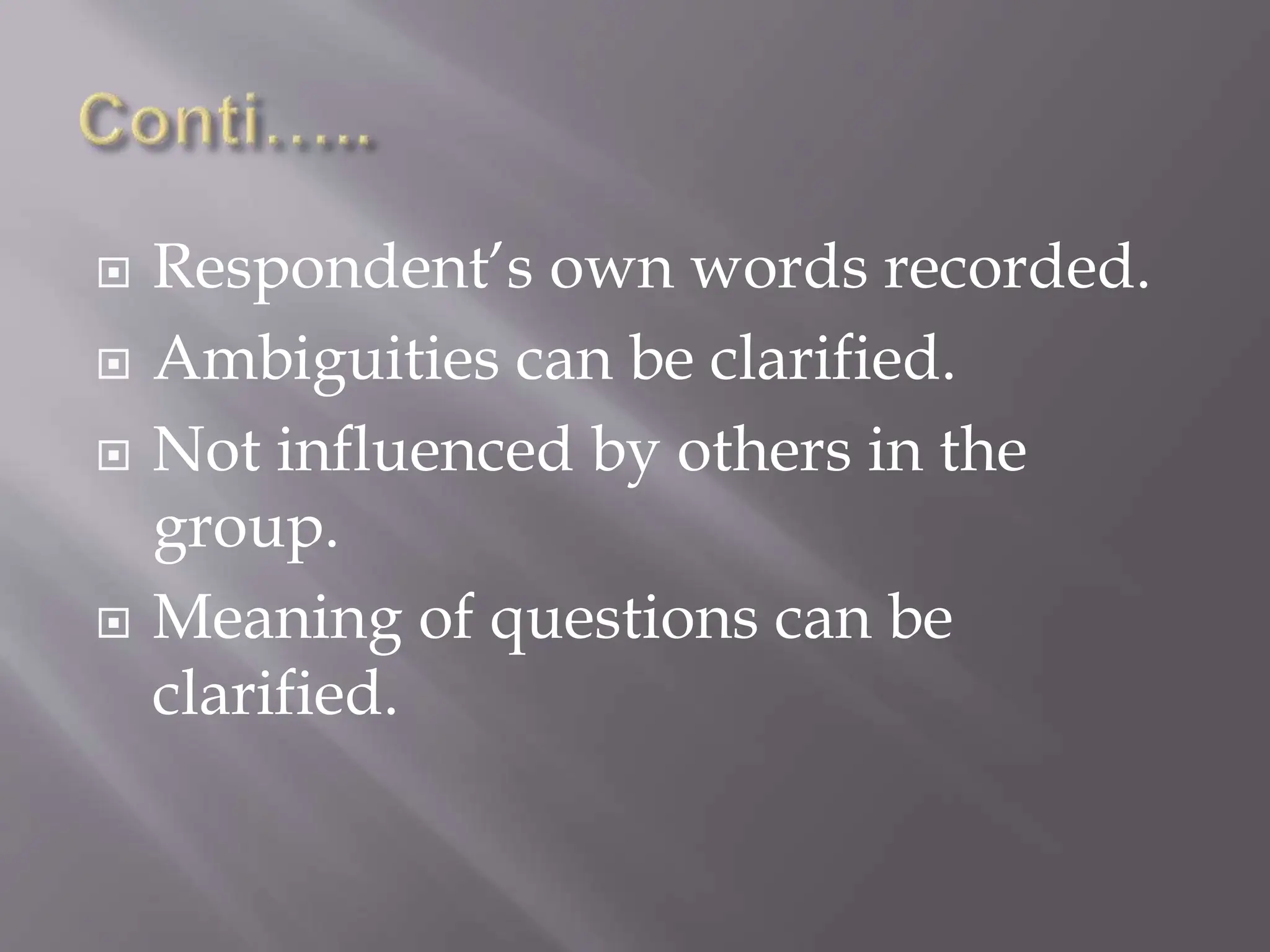
 Respondent’s own words recorded.
 Ambiguities can be clarified.
 Not influenced by others in the
group.
 Meaning of questions can be
clarified.
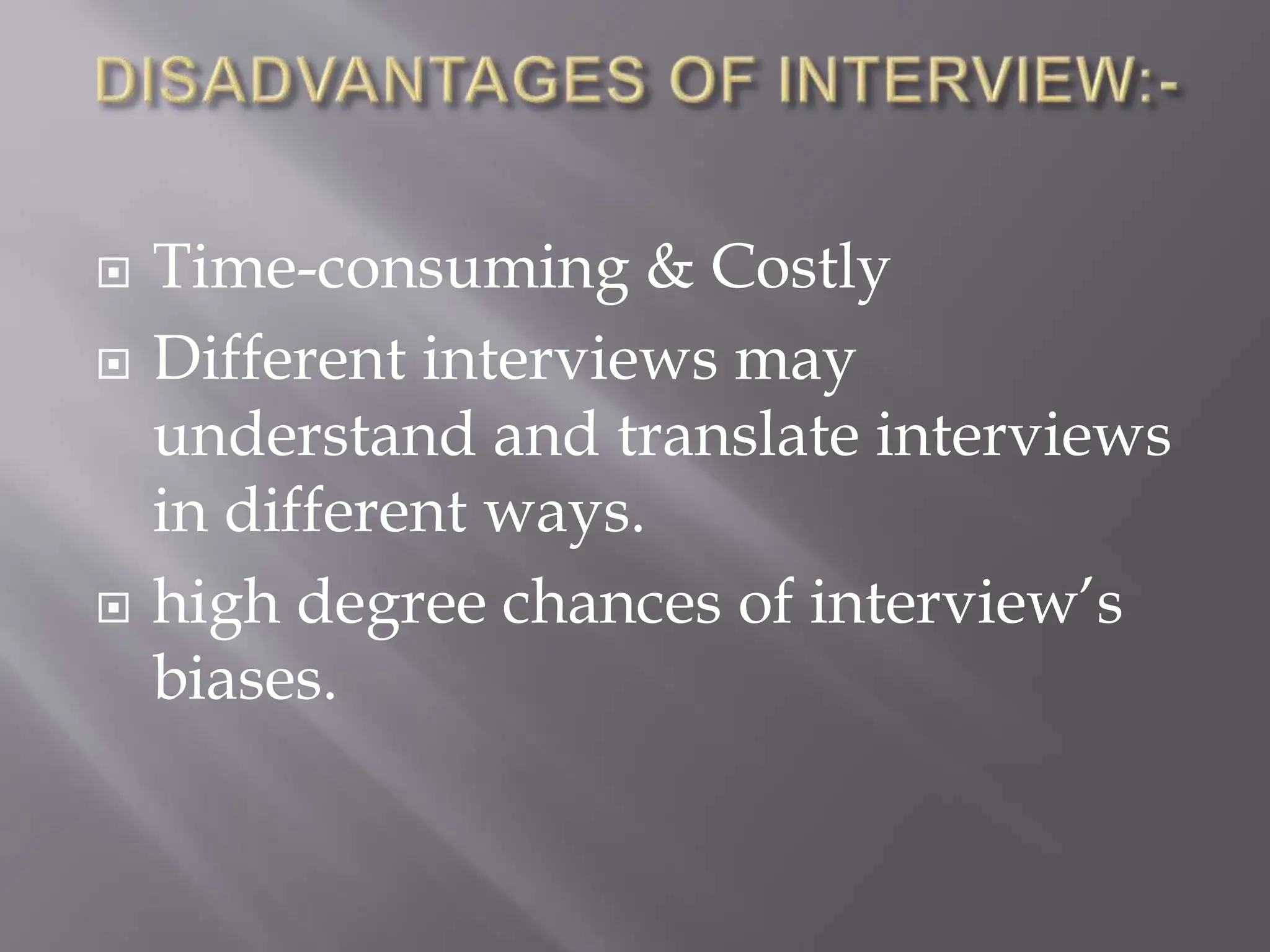
 Time-consuming & Costly
 Different interviews may
understand and translate interviews
in different ways.
 high degree chances of interview’s
biases.
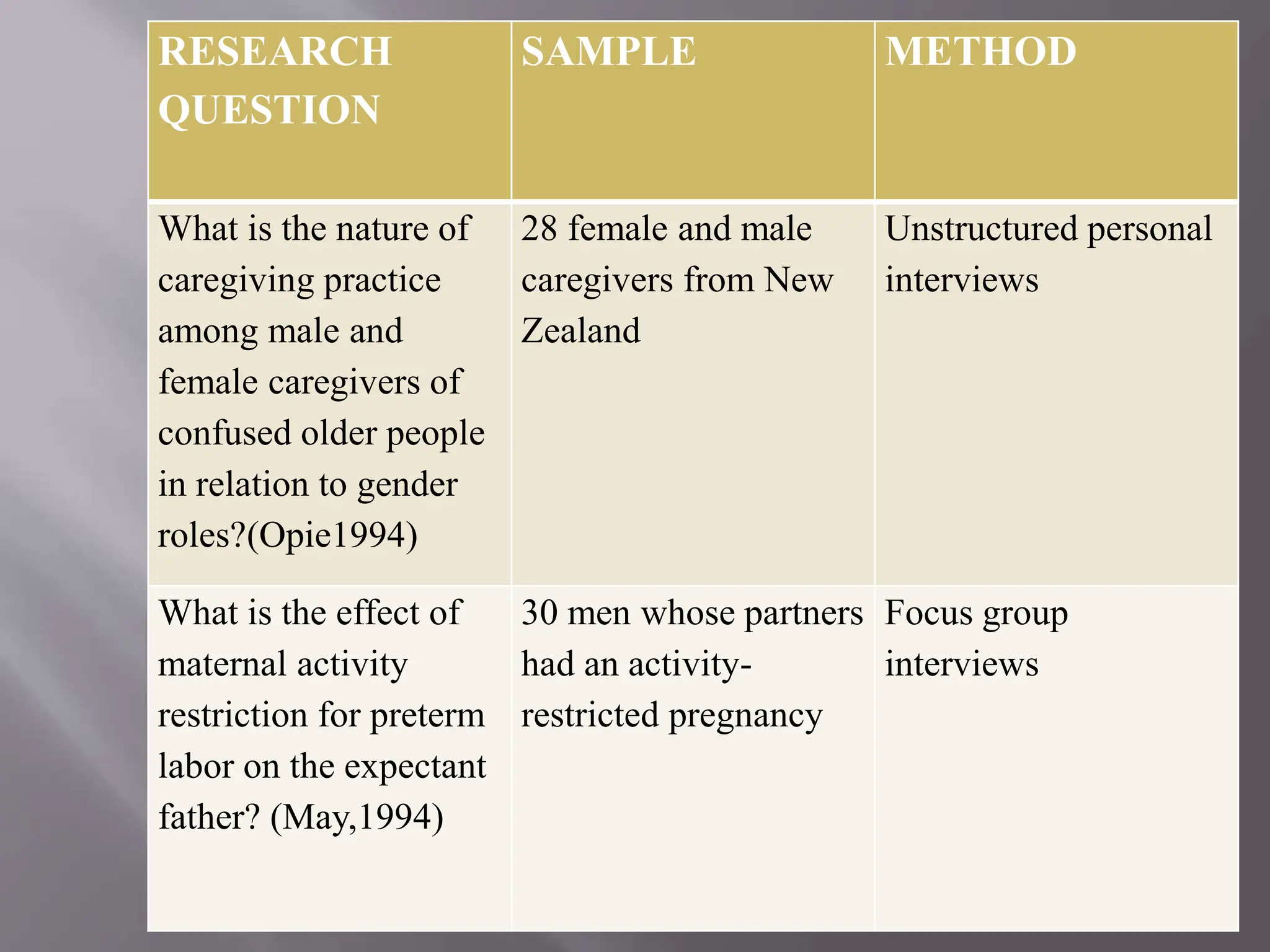
RESEARCH
QUESTION
SAMPLE METHOD
What is the nature of
caregiving practice
among male and
female caregivers of
confused older people
in relation to gender
roles?(Opie1994)
28 female and male
caregivers from New
Zealand
Unstructured personal
interviews
What is the effect of
maternal activity
restriction for preterm
labor on the expectant
father? (May,1994)
30 men whose partners
had an activity-
restricted pregnancy
Focus group
interviews
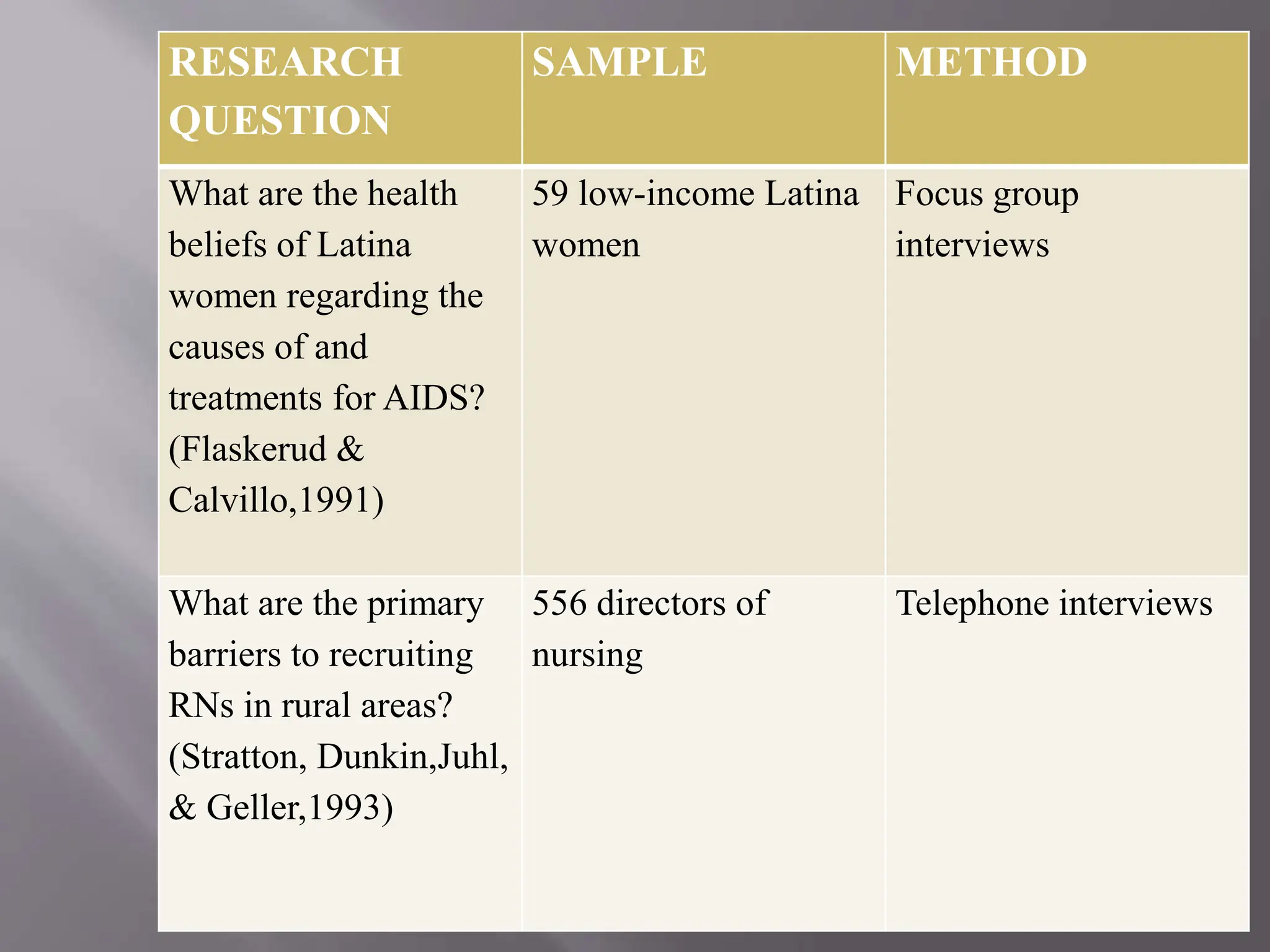
RESEARCH
QUESTION
SAMPLE METHOD
What are the health
beliefs of Latina
women regarding the
causes of and
treatments for AIDS?
(Flaskerud &
Calvillo,1991)
59 low-income Latina
women
Focus group
interviews
What are the primary
barriers to recruiting
RNs in rural areas?
(Stratton, Dunkin,Juhl,
& Geller,1993)
556 directors of
nursing
Telephone interviews
RESEARCH
QUESTION
SAMPLE METHOD
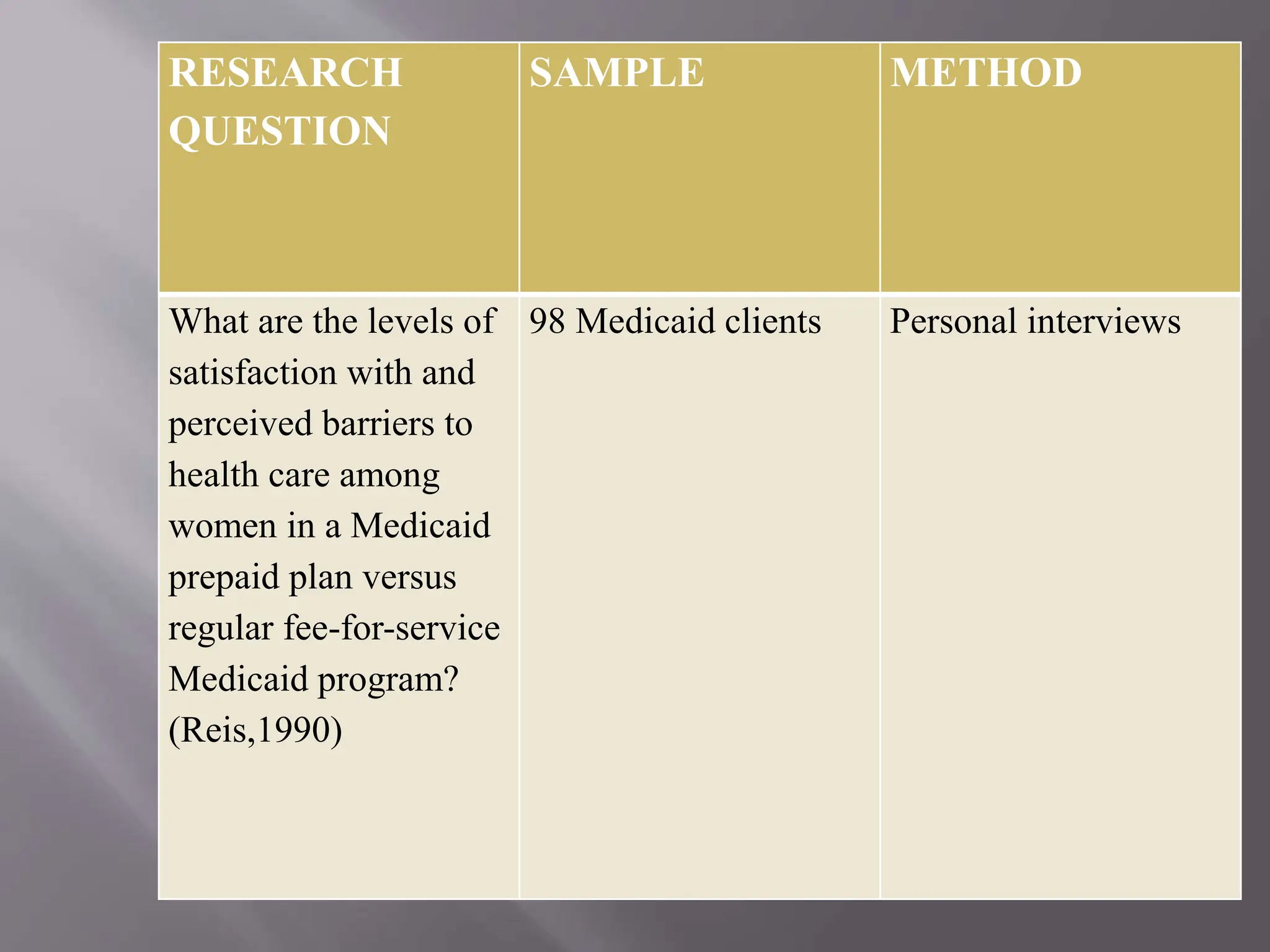
What are the levels of
satisfaction with and
perceived barriers to
health care among
women in a Medicaid
prepaid plan versus
regular fee-for-service
Medicaid program?
(Reis,1990)
98 Medicaid clients Personal interviews
 Hungler Bernadette P., Polit Denise F.
Nursing Research principles & methods.5th
ed.Philadeiphia: J.B. Lippincott
Company;1995.
 Sharma SK. Nursing research & statistics.
India : Elsevier publication company; 2012
 Pareek Bharat, Sharma Shivani. A textbook of
Nursing Research & Statistics. Jalandhar: Pee
Vee publishers; 2009.
 Basanvanthappa BT. “Nursing Research”. 2nd
ed. New Delhi: jaypee brothers medical
publishers.
 Yadav M K .Textbook of nursing research ans
statistics with nursing theories and models.
Lotus publishers jalandhar 2014.
TOOLS AND METHODS OF DATA COLLECTION(Nursing Research & Statistics)

TOOLS AND METHODS OF DATA COLLECTION (Nursing Research & Statistics)

  • 1.
    Prof. (DR.) VirendraSingh Choudhary
  • 2.
    Introduction :- Problem statementidentified Research design selected Data collection begins (so appropriate data collection method chosen to draw accurate conclusions )
  • 3.
    DATA:  defined aspieces of information. In singular-datum.  depicted as figure such as height of person, birth of a baby, death in road accidents.
  • 4.
     TOOL: “a devicethat a researcher uses to collect the data. ” E.g., observation, questionnaires,checklists etc.
  • 5.
     TECHNIQUE : “wayor path of doing the research study.  METHODS OF DATA COLLECTION: various steps and strategies used for gathering and analyzing data in a research investigation
  • 6.
    Data-observable and measurable factsprovide information about phenomenon under study. For e.g., physical growth of infant is the phenomenon under study, data measures are body weight, height, chest & head circumferences.
  • 7.
    The five ‘Ws’of the data collection are:  What data is to be collected?  From whom data is to be collected?  Who will collect data?  From where the data will be collected?  When is the data to be collected?
  • 8.
  • 9.
    Individuals, objects, programmes,or institutions.etc. first-hand information from the respondents or the situations, By interviews, questioning, observation, biochemical measurements, and psychosocial measurement scales.
  • 10.
     Internal orexternal secondary sources. Internal secondary sources (private documents)  Biographies  Personal Diaries  Letters  Memoires
  • 11.
    External sources(public documents) publishedor unpublished records.  Published records  Journals  Magazines  Newspapers  Government reports  statistical abstracts  census reports  constituents of mass communication  commission reports
  • 12.
     Unpublished records Official Records  Patient Records  Thesis  Dissertations  Reports.
  • 13.
  • 14.
    Type of method/techniquesTools for data collection 1. Interview - Interview schedule - Opinionnaires 2. Questioning (self-report) - Questionnaire - Opinionnaires - Attitude scales/composite scales (e.g., Likert scale and sematic differential scale) - Visual analogue scale 3.Observation - Rating scales - Checklists - Anecdotes - Videotapes/films - Closed circuit TV
  • 15.
    Type of method/techniquesTools for data collection 1. Bio-physiological methods - In vivo bio- physiological measurements - In vitro bio- physiological measurements 1. Other methods - Projective technique - Q-sorts - Vignettes
  • 16.
    SELECTION OF METHODSOF DATA COLLECTION:
  • 17.
    several factors influencingmethod of data collection : The nature of phenomenon under study:- For example,only  observation such as clinical practices or processes in a particular nursing procedure.  & knowledge of group of nurses through questioning or interviews.
  • 18.
     Type ofresearch subjects:-  For example, physically or psychologically disabled subjects by interviews or through observation. from objects or institutions, by observation
  • 19.
     The typeof research study:- For example, in qualitative research, focused group interviews or unstructured participatory interviews while for quantitative research, more structured interviews, questioning, or observation
  • 20.
     The purposeof the research study:- For example, in exploration of phenomenon, in-depth interviews in description or correlation studies use structured methods of data collection.
  • 21.
     Size ofthe study sample:- small sample- interviews or direct observation For larger samples, questionnaires
  • 22.
     Distribution ofthe target population:- In large geographical area- mailed questionnaires better option, more convenient and cost-effective
  • 23.
     Time frameof the study:- for a long time-use the less-structured methods for short time-frame studies -short-term research designs.
  • 24.
     Literacy levelof the subjects:- for illiterate subjects, interviews conducted in native language.
  • 25.
     Availability ofresources and manpower:- interviews and observation require more quantities of resources and manpower compared to questionnaires.
  • 26.
     Researcher’s knowledgelevel and competence:- for example conducting an interview observation require social and psychological knowledge, skills, and competence, while the use of questionnaires may not demand these skills
  • 27.
     Accuracy andcompleteness of data collection  Compatible with subjects.  Cost-effectiveness & speed in  In accordance with nature of phenomenon, type, purpose, time- frame & resources available.
  • 28.
     Further, criteriawhile evaluating or assessing the method for data collection: -Is data collection method complete in all the aspects to study the study variables?  Are data collection methods thoroughly described?  Are data collection methods in accordance to research questions/hypotheses to be tested?
  • 29.
     Are validityand reliability of data collection methods established?  Are the number of methods used for data collection sufficient for complete coverage of research data or additional methods required for data collection?  Are anonymity and confidentiality assured?  Are instruments described in detail?  Were the criterion measures or scoring methods clearly established?
  • 30.
    DEFINITIONS of INTERVIEW: Amethod of data collection in which one person (interviewer) asks the questions from another person (respondent); which is conducted either face-to-face or telephonically.’
  • 31.
     An interviewis a conversation between two or more people (interviewer and interviewee) where questions are asked by interviewer to obtain information from the interviewee.
  • 32.
     It maybe defined as a two-way systematic conversation between an investigator and an informant, initiated for obtaining information relevant to a specific study. It involves not only conversations, but also learning from respondent’s gestures, facial expressions and pauses, and his or her environment.
  • 33.
     The participants,the interviewer, and the respondent are strangers.  Relationship is transitory one.  Mode of obtaining verbal answers.  Investigator records information  Not casual conversational exchange  face-to-face or telephonically
  • 34.
     Conversation betweentwo persons, not always limited to a single respondent.  interactional process- how they perceive each other.  Not a standardized process; can be modified.
  • 35.
     Provide in-depthand detailed information  Permits greater depth of response  Data from illiterate subjects  Higher response  Clarify misunderstandings  Ask questions at several levels  Helps to gather other supplementary information  Use of special devices  Accuracy can be checked  Flexible and adaptable  People unable to write
  • 36.
    Basically interview canbe classified in following six broad categories.  STRUCTURED INTERVIEW  UNSTRUCTURED INTERVIEW  SEMI-STRUCTURED INTERVIEW  IN-DEPTH INTERVIEW  FOCUSED GROUP INTERVIEW  TELEPHONE INTERVIEW
  • 37.
     Structured interviewis a means of data collection in which the interviewer has an interview schedule in which the questions are listed in the order in which they are to be answered.  standardized interviews.  not permitted to change the specific wording of the interview schedule questions
  • 38.
     Limited setof questions.  Present exactly the same questions in the same order.  It increases the reliability and credibility of research data.  It minimizes context effects
  • 39.
     Data easilycomparable.  Recording and coding data  not diverted to irrelevant and time consuming conversation.
  • 40.
     lose thespontaneity of natural conversation.  respondent’s views are minimized and investigators own biases  exploration of information limited.
  • 41.
     non-standardized interviews. Unstructured interview is a method wherein the questions can be changed to meet the respondent’s intelligence, understanding, and beliefs.  Questions changed according to response  no preplanned schedule is used.
  • 42.
     open-ended questions,opportunity to ask unplanned questions .  explore the information from the respondents.  It increases the reliability and credibility of research data.  It facilitates the natural unobstructed proceedings.
  • 43.
     less proneto interviewer’s bias.  Great opportunity to explore the problem  gathering information on sensitive topics  like divorce, social discrimination, drug addiction, etc.
  • 44.
     Data notcomparable  Time may be wasted in unproductive conversation.  No order or sequence in this interview.  Requires more skills of researcher.
  • 45.
     flexible method allows new questions to be brought up during the interview, depending upon the situation
  • 46.
     Interviewer preparesan interview guide  informal list of topics and questions  interviewer ask ques in different ways from the different participants.  Interview guide helps the researcher to focus on the topics at hand without constraining them to a particular format.
  • 47.
     intensive andinvestigative interview  study the respondent’s opinion and emotions on the basis of interview guide.  requires more training and interpersonal skills.  aims to elicit unconscious & personal feelings and emotions.
  • 48.
     unstructured groupinterview technique  8-12 members brought together  under the guidance of a trained interviewer  focus on a specific phenomenon.  purpose is to gain insight from the appropriate sample or target population.  The researcher tries to focus his or her attention on a particular aspect of a problem.
  • 49.
     carefully planneddiscussion  interviewer guides the discussion according to written set of questions or topics to be covered.  special attention given to specific topics or ideas.  focus the discussion on the actual effects of a given experience.  focused on the subjective experience of the respondent i.e.his or her opinion or emotional response to the topic of research.
  • 50.
     8-12 members Duration of the interview is 1.5-2 hours.  All information including facial expressions and body language is recorded.
  • 51.
     moderator tolead the discussion.  permits to obtain details of personal reactions to an experience.  free from inflexibility of formal methods.  interviewer is free to choose the sequence of questions.
  • 52.
     Wide rangeof information collected.  stimulates new ideas and creative concepts.  One person’s comments may trigger a response from another person, leading to in-depth discussion on the topic.  increases excitements in a group.  Participants feel more comfortable to answer in a group with similar interests.  involves many participants at one time.
  • 53.
     chances ofclient and researcher bias.  It is difficult to moderate.  It is difficult to code, analyze and interpret.
  • 54.
     non personalmethod of data collection.  consists in contacting respondents on telephone itself.  used widely in industrial surveys particularly in developed regions.
  • 55.
     More flexibleand quick way.  Less Cost & high response.  Easy to Access through a telephone directory.  No field, staff required  wider coverage of sample is possible.
  • 56.
     Difficult toestablish rapport between respondent and interviewer.  Surveys are limited to respondents who have telephone facilities.  Respondent’s characteristics, facial expressions, and environment cannot be observed.  Possibility of bias of interviewer is more.
  • 57.
    Preparation for interview:- Fix up appointment  Appearance and dress  Familiarity with interview schedule
  • 58.
     Researcher introducehimself or herself to all respondents  Identify the respondent by name.  Choose setting with as little distraction as possible.
  • 59.
     Explain purposeof interview.  Address terms of confidentiality.  Explain format of the interview.  Indicate how long the interview usually takes.  Ask them if they have any questions.
  • 60.
     Begin conversationon general topics.  Develop confidence-building  Understand the concerns of the respondents
  • 61.
     Start theinterview.  Ask only one question at a time.  Repeat a question if necessary.  Make sure subject understands the questions.
  • 62.
     Listen carefullySubjects answer.  Observe the inverbal responses.  Give sufficient time to answer the questions.  Do not show signs of surprise, shock, or anger.
  • 63.
     Maintain aneutral attitude with the respect to controversial issues.  Take note of answers if vague or ambiguous.  Ask additional questions to follow up clues .  Do not hurry the interview.  If silence is too prolonged, introduce a stimulus.
  • 64.
     Record responsesas they take place.  Note-making.  A tape recorder used to record  Shorthand used to record responses.
  • 65.
     After theinterview is over  Polite leave of the respondent taken  Thanking him or her & saying goodbye.
  • 66.
     Used toobtain information about people’s feelings, perceptions, and opinions.  Allow more detailed questions to be asked.  High response rate
  • 67.
     Respondent’s ownwords recorded.  Ambiguities can be clarified.  Not influenced by others in the group.  Meaning of questions can be clarified.
  • 68.
     Time-consuming &Costly  Different interviews may understand and translate interviews in different ways.  high degree chances of interview’s biases.
  • 69.
    RESEARCH QUESTION SAMPLE METHOD What isthe nature of caregiving practice among male and female caregivers of confused older people in relation to gender roles?(Opie1994) 28 female and male caregivers from New Zealand Unstructured personal interviews What is the effect of maternal activity restriction for preterm labor on the expectant father? (May,1994) 30 men whose partners had an activity- restricted pregnancy Focus group interviews
  • 70.
    RESEARCH QUESTION SAMPLE METHOD What arethe health beliefs of Latina women regarding the causes of and treatments for AIDS? (Flaskerud & Calvillo,1991) 59 low-income Latina women Focus group interviews What are the primary barriers to recruiting RNs in rural areas? (Stratton, Dunkin,Juhl, & Geller,1993) 556 directors of nursing Telephone interviews
  • 71.
    RESEARCH QUESTION SAMPLE METHOD What arethe levels of satisfaction with and perceived barriers to health care among women in a Medicaid prepaid plan versus regular fee-for-service Medicaid program? (Reis,1990) 98 Medicaid clients Personal interviews
  • 72.
     Hungler BernadetteP., Polit Denise F. Nursing Research principles & methods.5th ed.Philadeiphia: J.B. Lippincott Company;1995.  Sharma SK. Nursing research & statistics. India : Elsevier publication company; 2012  Pareek Bharat, Sharma Shivani. A textbook of Nursing Research & Statistics. Jalandhar: Pee Vee publishers; 2009.  Basanvanthappa BT. “Nursing Research”. 2nd ed. New Delhi: jaypee brothers medical publishers.  Yadav M K .Textbook of nursing research ans statistics with nursing theories and models. Lotus publishers jalandhar 2014.