Nutritional Assessment
(Method, Clinical, Biochemical, Dietary, Functional and Anthropometric)


                       Dr. Rajan Bikram Rayamajhi
              School of Public Health and Community Medicine
                  B. P. Koirala Institute of Health Sciences
                                                                   1
                                Dharan, Nepal
2
The nutritional status of an individual if often the
result of interrelated factors. It is influenced by
the adequacy of the food intake both in terms of
quantity and quality and also by the physical
health of the individual.


                                                   3
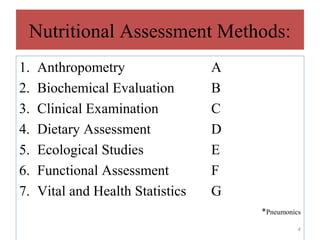
Nutritional Assessment Methods:
1.   Anthropometry                 A
2.   Biochemical Evaluation        B
3.   Clinical Examination          C
4.   Dietary Assessment            D
5.   Ecological Studies            E
6.   Functional Assessment         F
7.   Vital and Health Statistics   G
                                       *Pneumonics
                                                 4
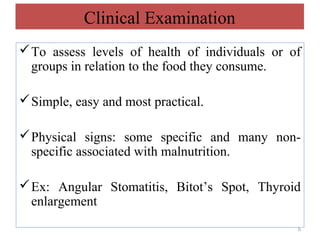
Clinical Examination
 To assess levels of health of individuals or of
  groups in relation to the food they consume.

 Simple, easy and most practical.

 Physical signs: some specific and many non-
  specific associated with malnutrition.

 Ex: Angular Stomatitis, Bitot’s Spot, Thyroid
  enlargement
                                                5
6
 The chief drawbacks are many deficiencies are
  unaccompanied by physical signs, malnutrition
  cannot be quantified on the basis of clinical signs
  and biasness of the observer and observed.

 When two or more nut. deficiency signs are
  present, the diagnostic significance is enhanced.

 The drawback are mal nut. can’t be identified
  only on the basis of clinical signs and lack of
  specificity of most signs.
                                                    7
Anthropometry

 Height, weight, skin fold thickness and arm
  circumference are valuable indicators of
  nutritional status.
 In young children chest and head circumference
  are measured too.
 If recordings are made for a long time then they
  reflect the pattern of growth and development.
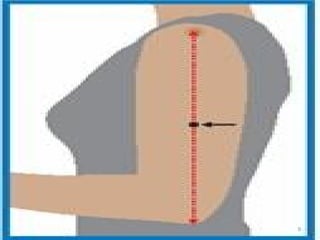
 Ex: Mid arm circumference, Growth monitoring

                                                 8
9
Laboratory and Biochemical Evaluation

I. Lab Tests:-
   i) Haemoglobin, RBC, Haemotocrit
      Hb level is an useful index of the overall state of
            nutrition irrespective of its significance in
      anemia.

  ii)Stool : for intestinal parasites, history of parasitic
     infestation, chronic dysentery

  iii) Urine: for albumin and sugar
                                                              10
II.     Biochemical Tests:-
      – Expensive and time consuming.
      – They reveal current nutritional status.
      – Some of the test are protein, Folate, vitamin A and
        Niacin

      With increase knowledge of metabolic functions of
       vitamins and minerals, assessment of nutritional
       status by clinical signs has been given to more
       precise biochemical tests.


                                                         11
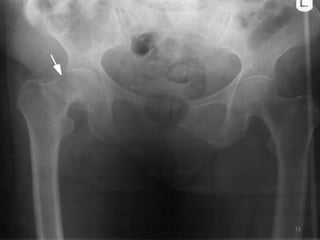
Radiological Examination
• Routinely not carried out.

• If the clinical signs indicate appreciable
  incidence of rickets, osteomalacia, infantile
  scurvy, beriberi, fluorosis and PCM then only
  such tests are carried out.

• Such study will reveal the degree of incidence
  of mild forms.
                                               12
13
Functional Assessment

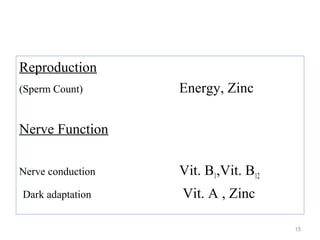
• The main purpose of these tests are to assess
  the degree of alteration in physiological
  functions associated with under and
  malnutrition

• Functional indices of nutritional status are
  emerging as an important class of diagnostic
  tools

                                              14
Reproduction
(Sperm Count)      Energy, Zinc

Nerve Function

Nerve conduction   Vit. B1,Vit. B12
Dark adaptation    Vit. A , Zinc

                                      15
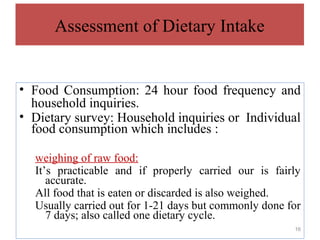
Assessment of Dietary Intake


• Food Consumption: 24 hour food frequency and
  household inquiries.
• Dietary survey: Household inquiries or Individual
  food consumption which includes :

  weighing of raw food:
  It’s practicable and if properly carried our is fairly
     accurate.
  All food that is eaten or discarded is also weighed.
  Usually carried out for 1-21 days but commonly done for
     7 days; also called one dietary cycle.
                                                       16
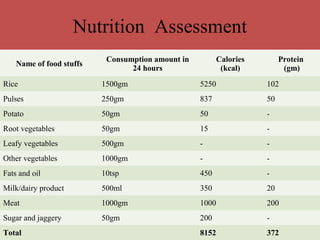
Nutrition Assessment
                           Consumption amount in         Calories        Protein
    Name of food stuffs
                                 24 hours                 (kcal)          (gm)
Rice                      1500gm                   5250             102
Pulses                    250gm                    837              50
Potato                    50gm                     50               -
Root vegetables           50gm                     15               -
Leafy vegetables          500gm                    -                -
Other vegetables          1000gm                   -                -
Fats and oil              10tsp                    450              -
Milk/dairy product        500ml                    350              20
Meat                      1000gm                   1000             200
Sugar and jaggery         50gm                     200              -
Total                                              8152             372
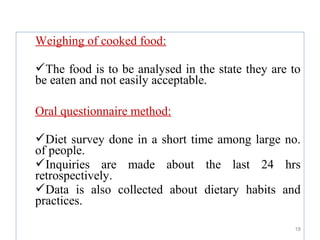
Weighing of cooked food:

The food is to be analysed in the state they are to
be eaten and not easily acceptable.

Oral questionnaire method:

Diet survey done in a short time among large no.
of people.
Inquiries are made about the last 24 hrs
retrospectively.
Data is also collected about dietary habits and
practices.

                                                  18
 Data collected is translated into mean intake of food
  materials and nutrients per adult man value or
  “consumption unit”

 Diet survey gives dietary intake patterns, specific
  food consumed, nutrient intake.

 It also indicates relative dietary inadequacies as
  judged by the present standards.

                                                     19
Vital and health statistics
Analysis of mortality and morbidity data will
 identify groups at high risk and indicate the
 extent of risk to the community.
 Mortality in age grp. 1—4 yrs. related to
 malnutrition.
Data on morbidity ( Hospital data or data from
 community ) in relation to PEM, anemia,
 xeropthalmia can be of value to provide
 additional information about the nutritional
 status of the community
                                              20
Ecological Studies
Food Balance Sheet:
 Supplies are related to census population to
derive levels of food consumption in terms of
per capita supply availability.

It gives an indication of the general pattern of
food consumption in the country


                                                    21
Health and Education Services:
Primary health care services, feeding and
  immunization program.

Conditioning Influences:
Parasitic, bacterial & viral infections which
  precipitate    mal-nutrition  among    that
  community.


                                           22
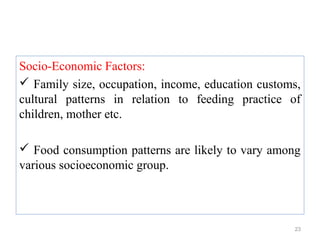
Socio-Economic Factors:
 Family size, occupation, income, education customs,
cultural patterns in relation to feeding practice of
children, mother etc.

 Food consumption patterns are likely to vary among
various socioeconomic group.


                                                   23
Thank You


            24

Nutritional assessment by Dr. Rajan Bikram Rayamajhi

  • 1.
    Nutritional Assessment (Method, Clinical,Biochemical, Dietary, Functional and Anthropometric) Dr. Rajan Bikram Rayamajhi School of Public Health and Community Medicine B. P. Koirala Institute of Health Sciences 1 Dharan, Nepal
  • 2.
  • 3.
    The nutritional statusof an individual if often the result of interrelated factors. It is influenced by the adequacy of the food intake both in terms of quantity and quality and also by the physical health of the individual. 3
  • 4.
    Nutritional Assessment Methods: 1. Anthropometry A 2. Biochemical Evaluation B 3. Clinical Examination C 4. Dietary Assessment D 5. Ecological Studies E 6. Functional Assessment F 7. Vital and Health Statistics G *Pneumonics 4
  • 5.
    Clinical Examination  Toassess levels of health of individuals or of groups in relation to the food they consume.  Simple, easy and most practical.  Physical signs: some specific and many non- specific associated with malnutrition.  Ex: Angular Stomatitis, Bitot’s Spot, Thyroid enlargement 5
  • 6.
  • 7.
     The chiefdrawbacks are many deficiencies are unaccompanied by physical signs, malnutrition cannot be quantified on the basis of clinical signs and biasness of the observer and observed.  When two or more nut. deficiency signs are present, the diagnostic significance is enhanced.  The drawback are mal nut. can’t be identified only on the basis of clinical signs and lack of specificity of most signs. 7
  • 8.
    Anthropometry  Height, weight,skin fold thickness and arm circumference are valuable indicators of nutritional status.  In young children chest and head circumference are measured too.  If recordings are made for a long time then they reflect the pattern of growth and development.  Ex: Mid arm circumference, Growth monitoring 8
  • 9.
  • 10.
    Laboratory and BiochemicalEvaluation I. Lab Tests:- i) Haemoglobin, RBC, Haemotocrit Hb level is an useful index of the overall state of nutrition irrespective of its significance in anemia. ii)Stool : for intestinal parasites, history of parasitic infestation, chronic dysentery iii) Urine: for albumin and sugar 10
  • 11.
    II. Biochemical Tests:- – Expensive and time consuming. – They reveal current nutritional status. – Some of the test are protein, Folate, vitamin A and Niacin With increase knowledge of metabolic functions of vitamins and minerals, assessment of nutritional status by clinical signs has been given to more precise biochemical tests. 11
  • 12.
    Radiological Examination • Routinelynot carried out. • If the clinical signs indicate appreciable incidence of rickets, osteomalacia, infantile scurvy, beriberi, fluorosis and PCM then only such tests are carried out. • Such study will reveal the degree of incidence of mild forms. 12
  • 13.
  • 14.
    Functional Assessment • Themain purpose of these tests are to assess the degree of alteration in physiological functions associated with under and malnutrition • Functional indices of nutritional status are emerging as an important class of diagnostic tools 14
  • 15.
    Reproduction (Sperm Count) Energy, Zinc Nerve Function Nerve conduction Vit. B1,Vit. B12 Dark adaptation Vit. A , Zinc 15
  • 16.
    Assessment of DietaryIntake • Food Consumption: 24 hour food frequency and household inquiries. • Dietary survey: Household inquiries or Individual food consumption which includes : weighing of raw food: It’s practicable and if properly carried our is fairly accurate. All food that is eaten or discarded is also weighed. Usually carried out for 1-21 days but commonly done for 7 days; also called one dietary cycle. 16
  • 17.
    Nutrition Assessment Consumption amount in Calories Protein Name of food stuffs 24 hours (kcal) (gm) Rice 1500gm 5250 102 Pulses 250gm 837 50 Potato 50gm 50 - Root vegetables 50gm 15 - Leafy vegetables 500gm - - Other vegetables 1000gm - - Fats and oil 10tsp 450 - Milk/dairy product 500ml 350 20 Meat 1000gm 1000 200 Sugar and jaggery 50gm 200 - Total 8152 372
  • 18.
    Weighing of cookedfood: The food is to be analysed in the state they are to be eaten and not easily acceptable. Oral questionnaire method: Diet survey done in a short time among large no. of people. Inquiries are made about the last 24 hrs retrospectively. Data is also collected about dietary habits and practices. 18
  • 19.
     Data collectedis translated into mean intake of food materials and nutrients per adult man value or “consumption unit”  Diet survey gives dietary intake patterns, specific food consumed, nutrient intake.  It also indicates relative dietary inadequacies as judged by the present standards. 19
  • 20.
    Vital and healthstatistics Analysis of mortality and morbidity data will identify groups at high risk and indicate the extent of risk to the community.  Mortality in age grp. 1—4 yrs. related to malnutrition. Data on morbidity ( Hospital data or data from community ) in relation to PEM, anemia, xeropthalmia can be of value to provide additional information about the nutritional status of the community 20
  • 21.
    Ecological Studies Food BalanceSheet:  Supplies are related to census population to derive levels of food consumption in terms of per capita supply availability. It gives an indication of the general pattern of food consumption in the country 21
  • 22.
    Health and EducationServices: Primary health care services, feeding and immunization program. Conditioning Influences: Parasitic, bacterial & viral infections which precipitate mal-nutrition among that community. 22
  • 23.
    Socio-Economic Factors:  Familysize, occupation, income, education customs, cultural patterns in relation to feeding practice of children, mother etc.  Food consumption patterns are likely to vary among various socioeconomic group. 23
  • 24.