Lecture 1
Survey Research & Design in Psychology
James Neill, 2017
Creative Commons Attribution 4.0
Introduction to
Survey Research
2
Overview
1. Readings
2. Scientific paradigm
3. Types of research
4. What is a survey?
5. History of survey research
6. Survey research examples
7. Survey research characteristics
8. Purposes of survey research
9. Pros and cons
10. Summary
Readings
Recommended readings
for Module 1
(Lectures 1 and 2)
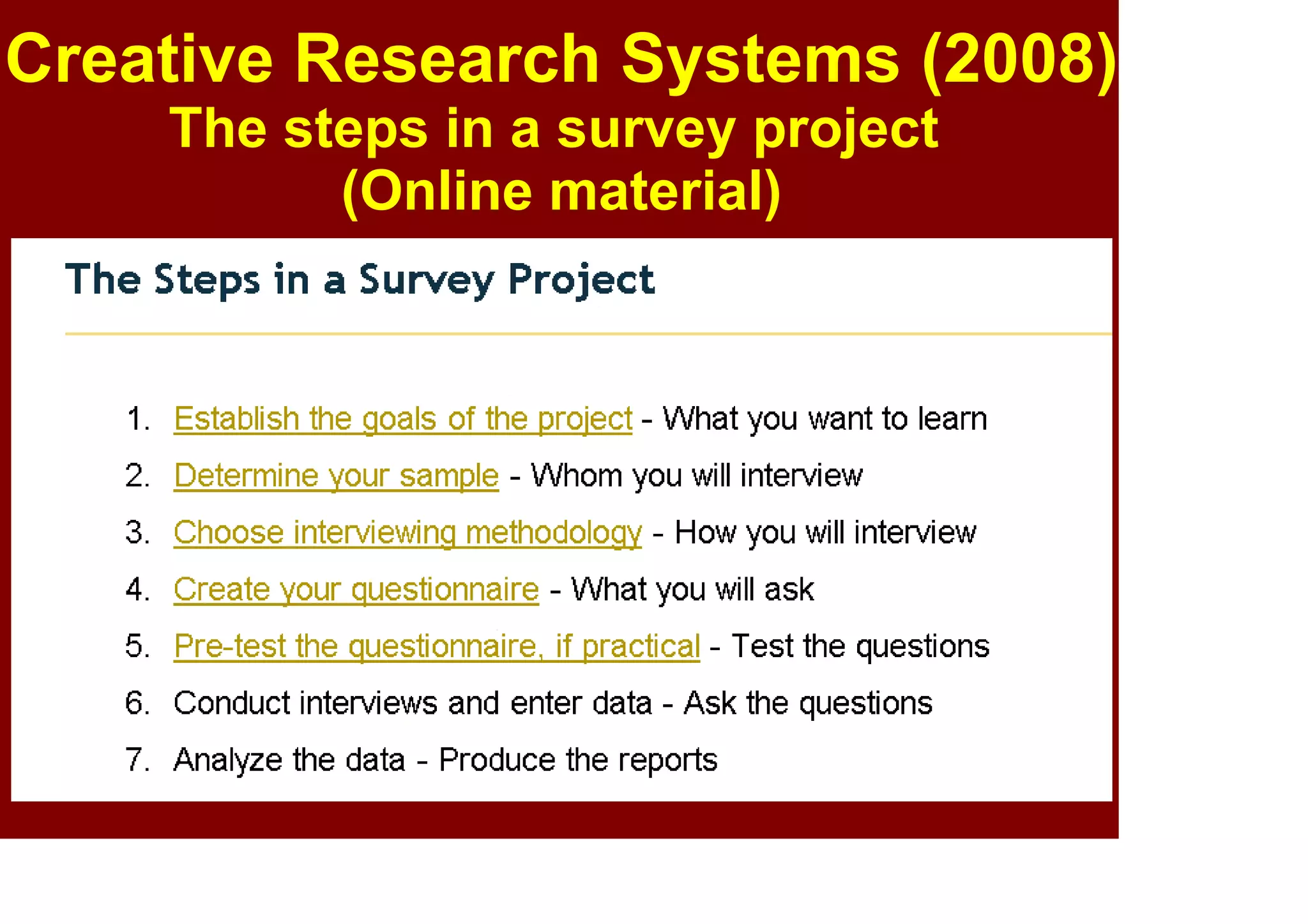
Creative Research Systems (2008)
The steps in a survey project
(Online article)
http://www.surveysystem.com/sdesign.htm
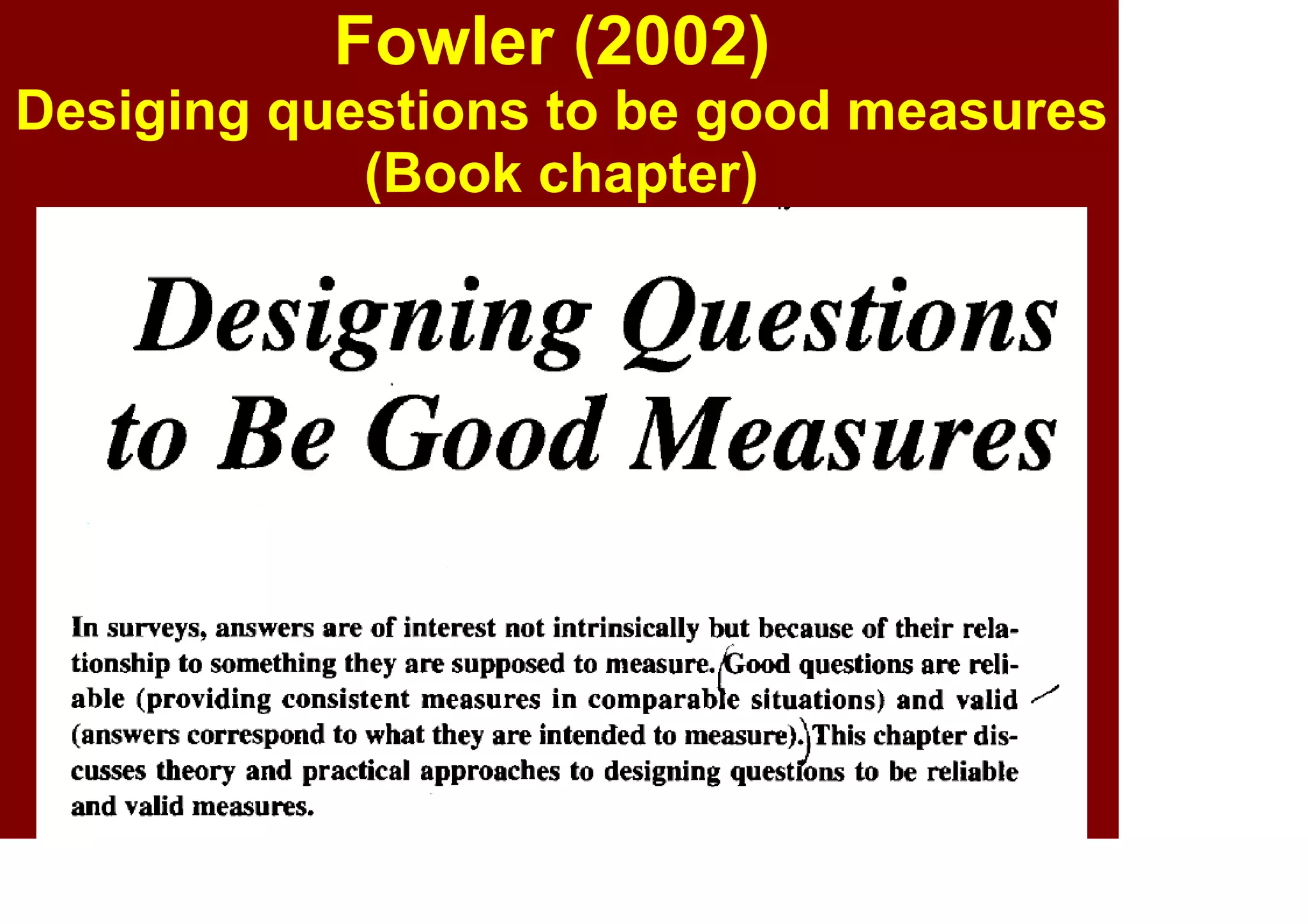
Fowler (2002)
Designing questions to be good measures
(Book chapter)
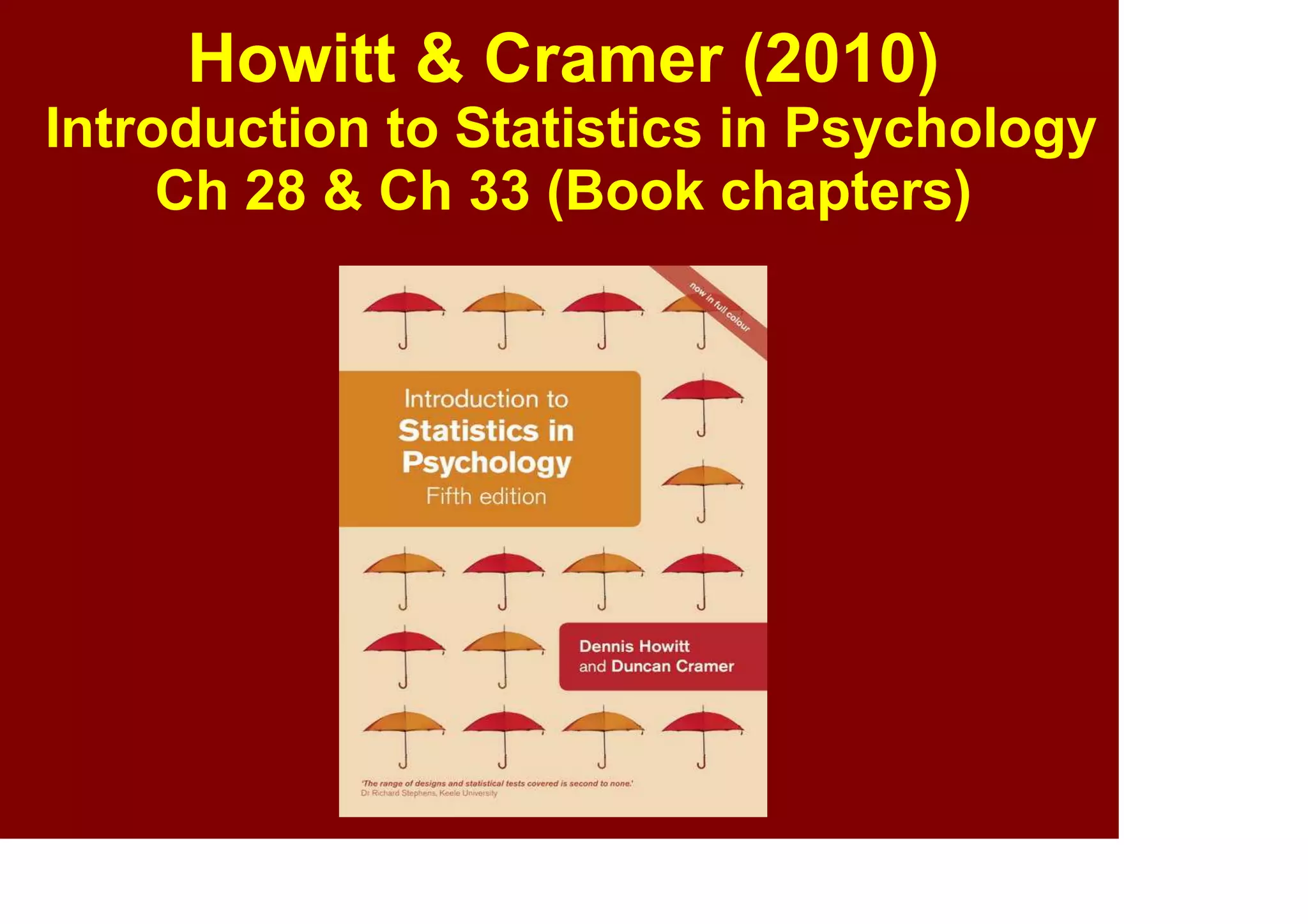
Howitt & Cramer (2014)
Introduction to Statistics in Psychology
(Book chapters)
Ch 29 Statistics and the analysis of experiments
Ch 34 The analysis of a questionnaire/survey project
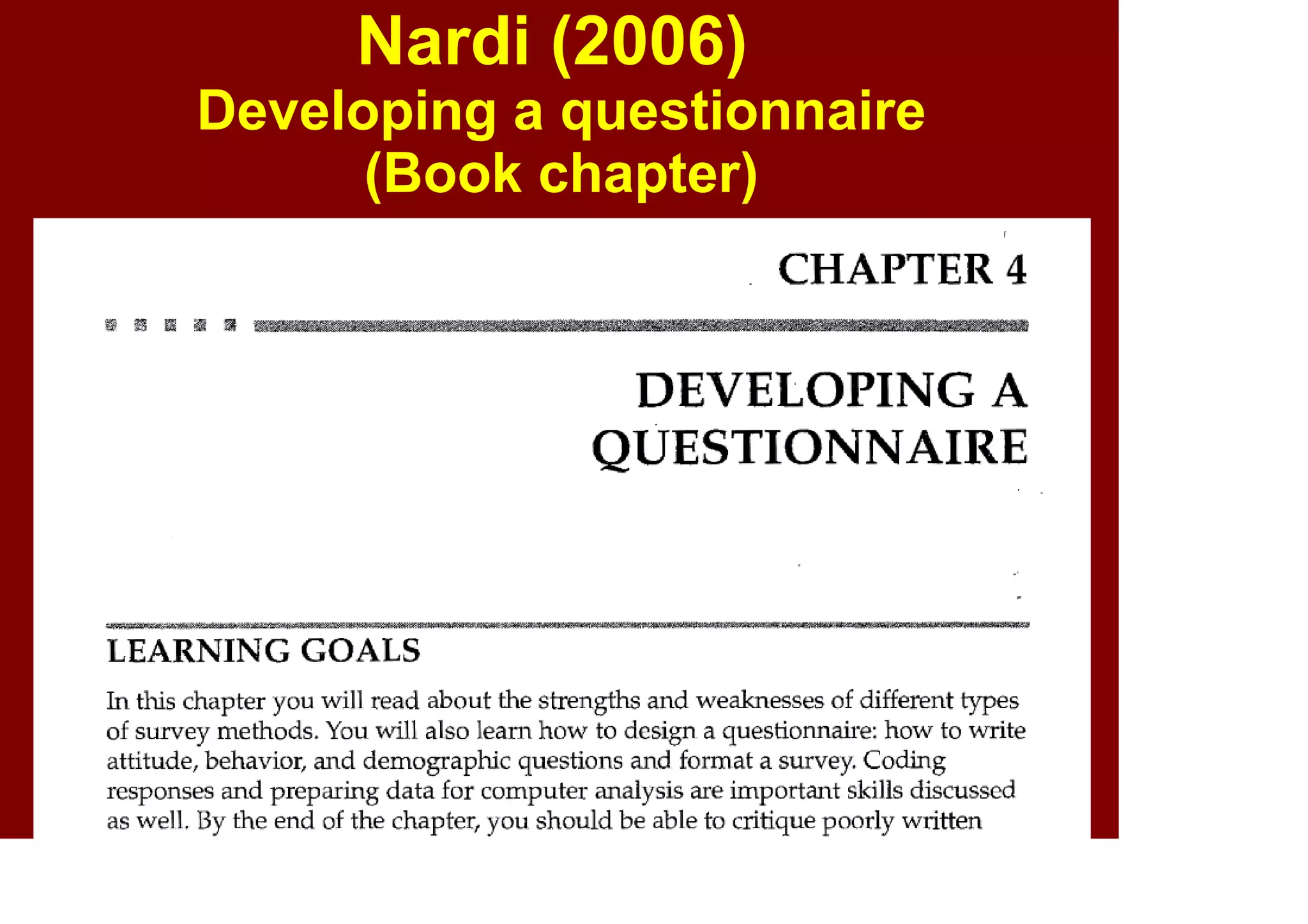
Nardi (2006)
Developing a questionnaire
(Book chapter)
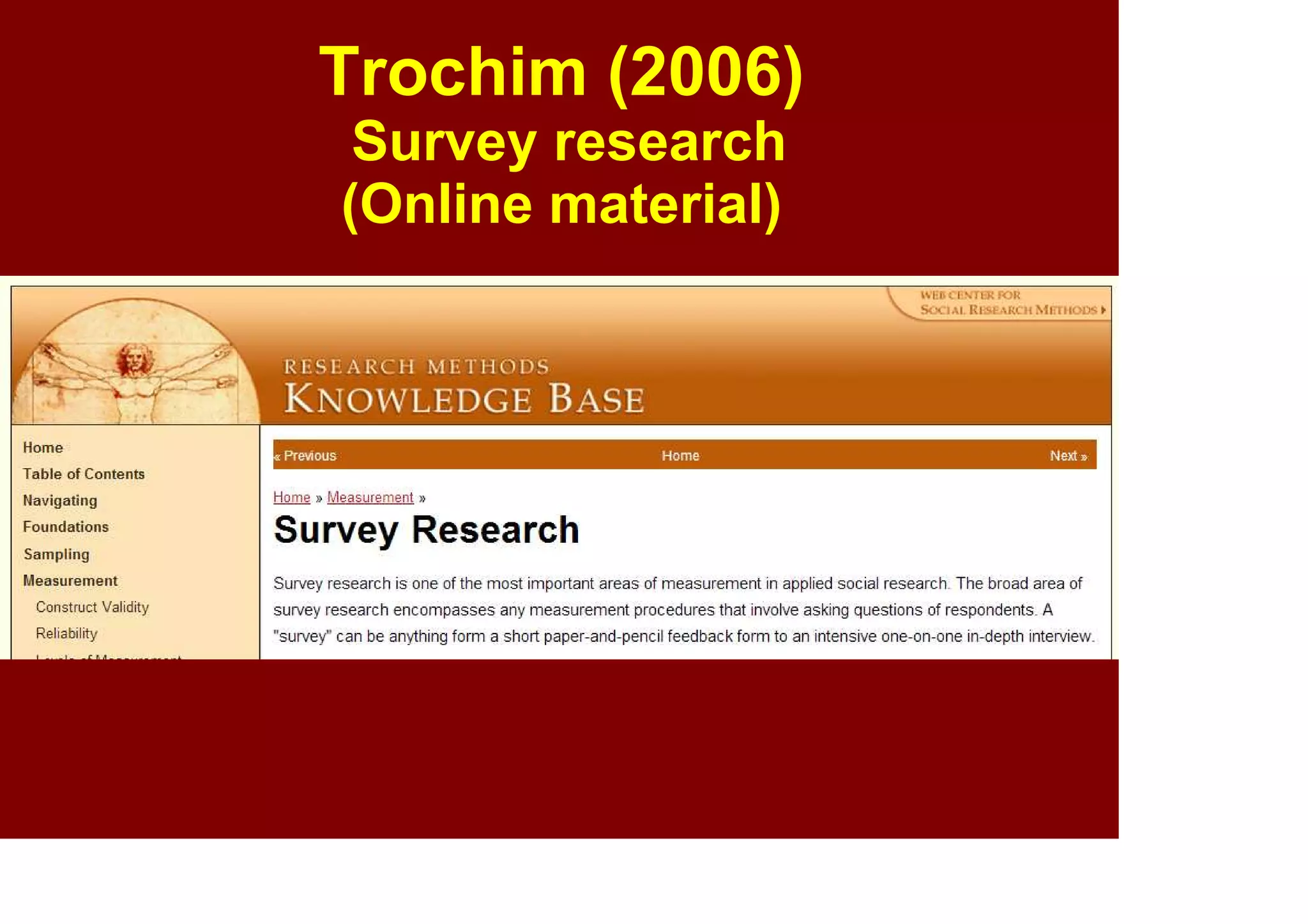
Trochim (2006)
Survey research
(Online article)
http://www.socialresearchmethods.net/kb/survey.php
9
Scientific
Paradigm
10
Positivism
• A philosophy of science that confines
itself to the data of experience
(empirical evidence)
• Excludes a priori or metaphysical
speculations
• Emphasises the achievements of science
• Recurrent theme in the history of
Western thought
• Sources:
Encyclopedia Brittanica, Wikipedia
11
Empirical approach to
psychosocial research
assume that:
1. the world is made up of
phenomena which have properties
that are measurable
2. psychological phenomena can be
measured, recorded, and analysed
3. interpretation of analysis can lead
to valid insights about how people
think, feel, and behave
12
Scientific method
Observe phenomenon
Ask questions e.g., why
Make hypothesis
Conduct experiment
Collect data
Analyse data
Interpret and conclude
Apply findings
13
Types of
Research
14
Types of Research
Three main research methods:
1. Experimental
2. Quasi-experimental
3. Non-experimental
Note: Surveys are widely used in
non-experimental research, but also in
quasi-experimental and experimental
research.
15
Types of Research -
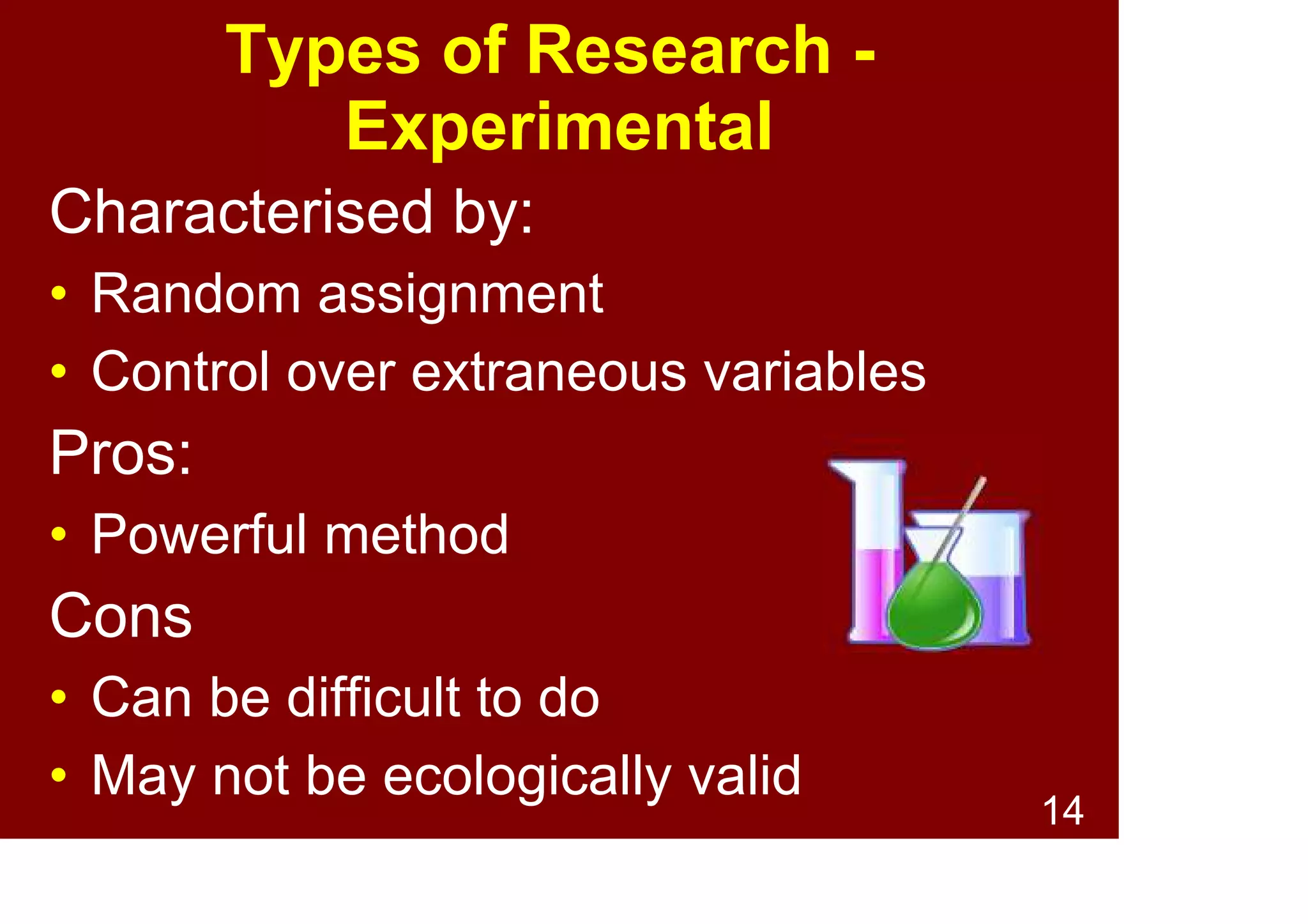
Experimental
Characterised by:
• Random assignment to groups
• Control over extraneous variables
Pros:
• Powerful method
Cons
• Can be difficult to conduct
• May not be ecologically valid
16
Types of Research -
Quasi-experimental
Characterised by:
• Use of “naturally occurring” groups
– e.g., diseased vs. healthy
• Assignment to groups is non-random
• Some control over extraneous variables
– e.g., match participants for age and lifestyle
Pros:
• Balances rigour of experimental and lack
of control of non-experimental
17
Types of Research -
Non-experimental
Characterised by:
• No “groups” or “conditions” are used
– e.g., students at a specific university
Pros
• Ecological validity
Cons
• Minimal control over extraneous
variables
18
Quiz question 1
What type of research is the following?
A researcher surveys Australian
community attitudes to eating
non-traditional meats
(e.g. venison, kangaroo).
• Experimental
• Quasi-experimental
• Non-experimental
19
Quiz question 2
What type of research is the following?
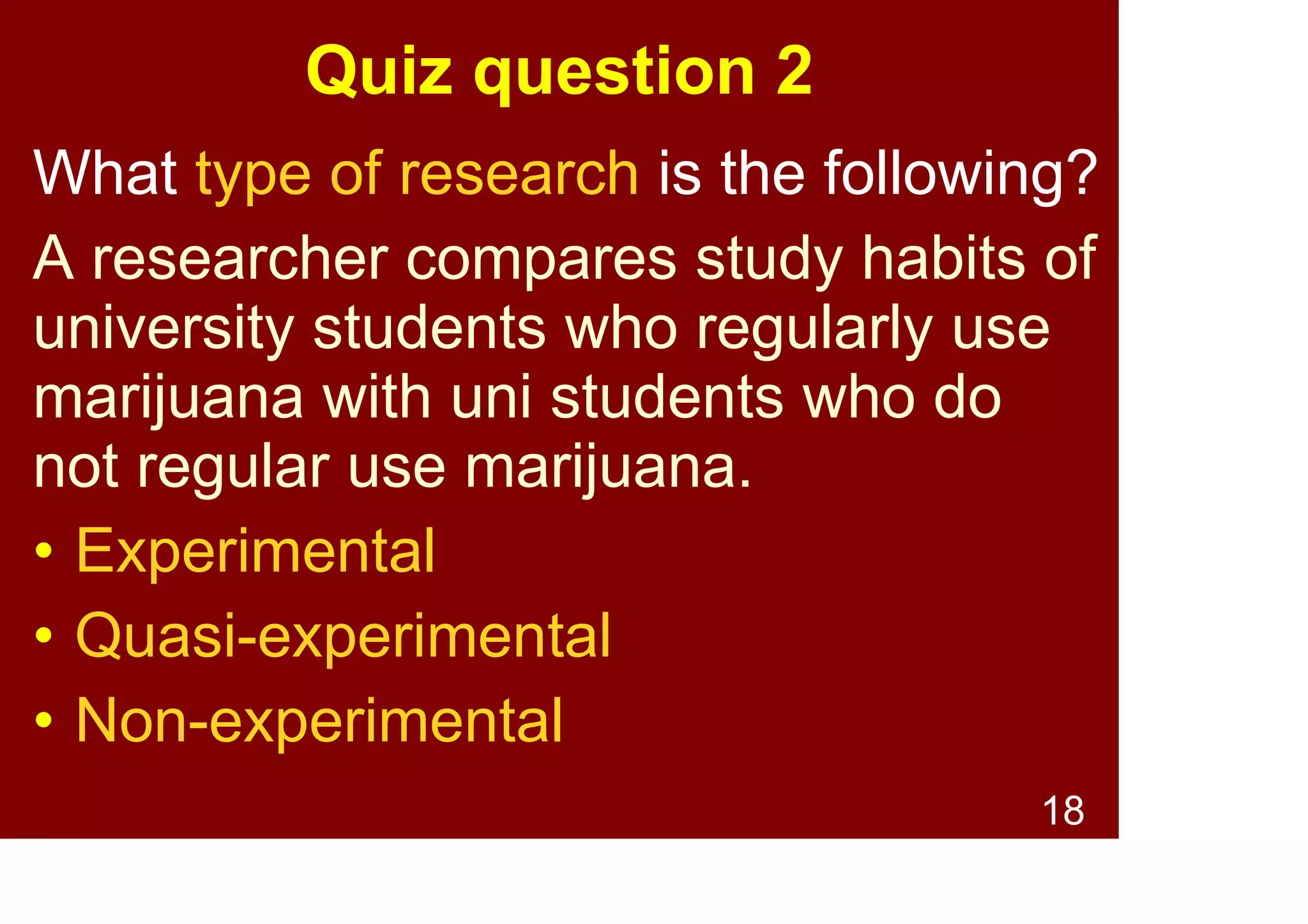
A researcher compares study habits of
university students who regularly use
caffeine with uni students who do not
regularly use caffeine.
• Experimental
• Quasi-experimental
• Non-experimental
20
Quiz question 3
What type of research is the following?
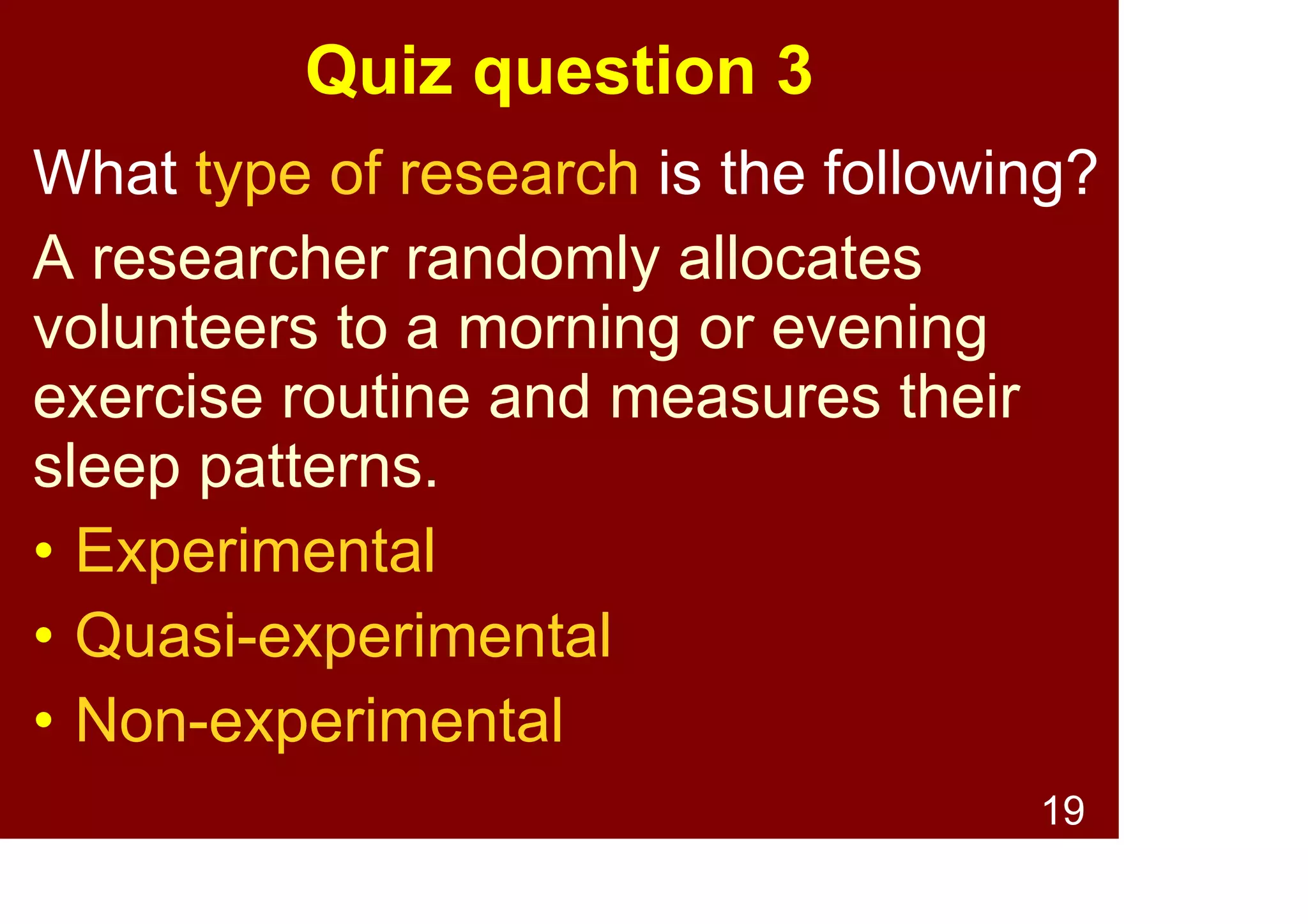
A researcher randomly allocates
participants to a morning or evening
exercise routine and then compares
the sleep patterns of the two groups.
• Experimental
• Quasi-experimental
• Non-experimental
21
What is a Survey?
22
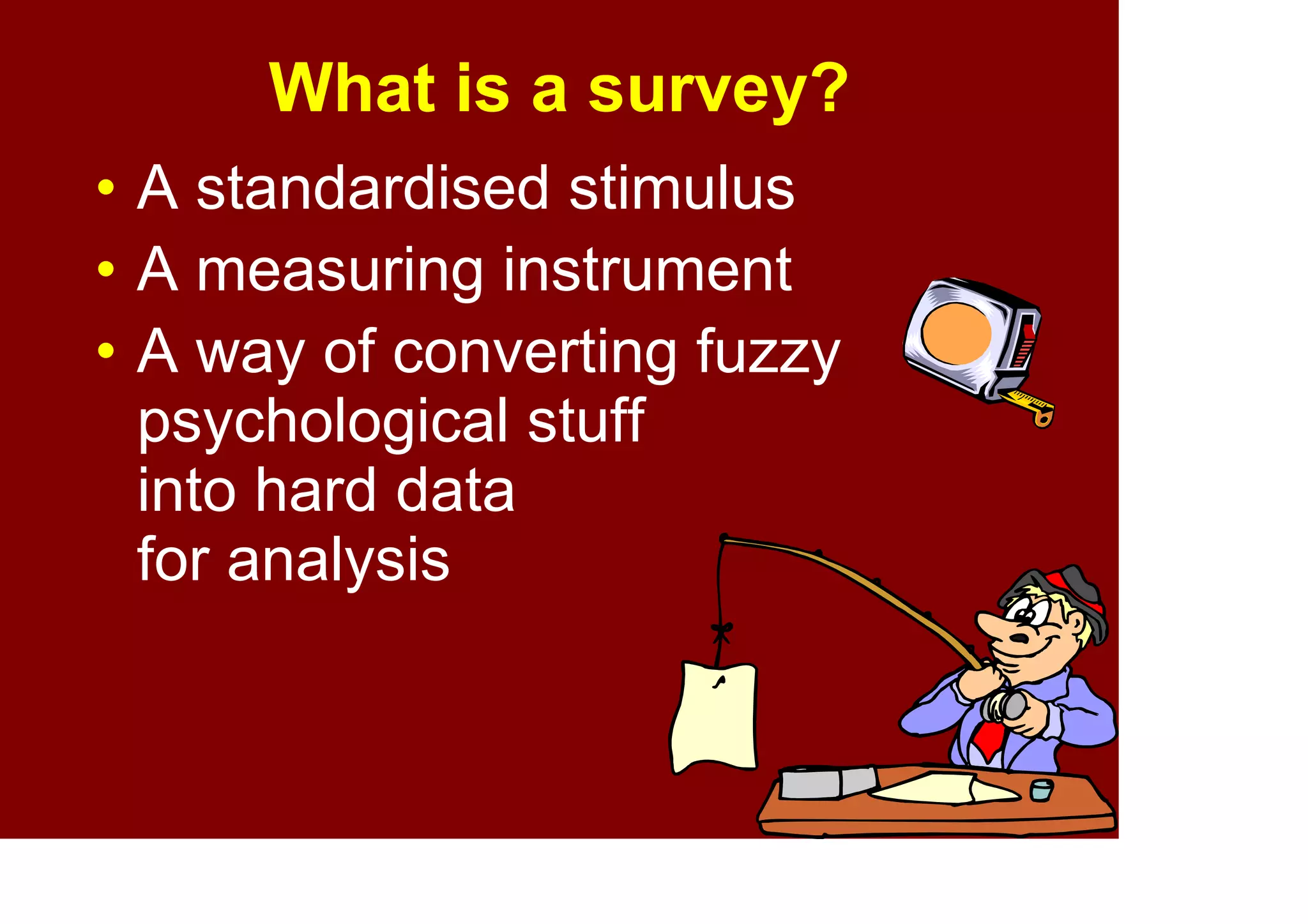
• A standardised stimulus
• A measuring instrument
• A way of converting fuzzy
psychological stuff
into hard data
for analysis
What is a survey?
23
History of Survey
Research
24
History of survey research
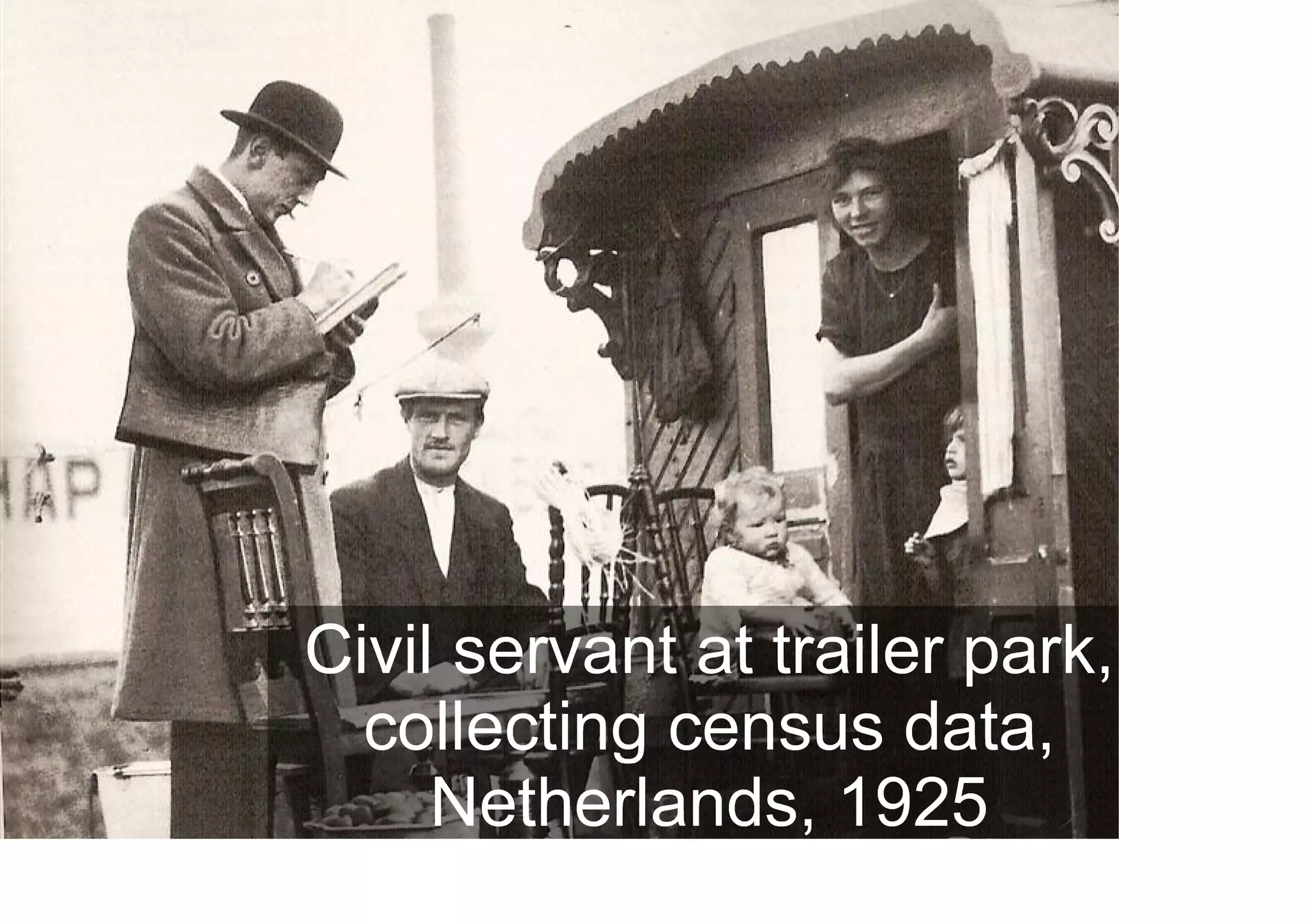
Civil servant at trailer park,
collecting census data,
Netherlands, 1925
25
History of survey research
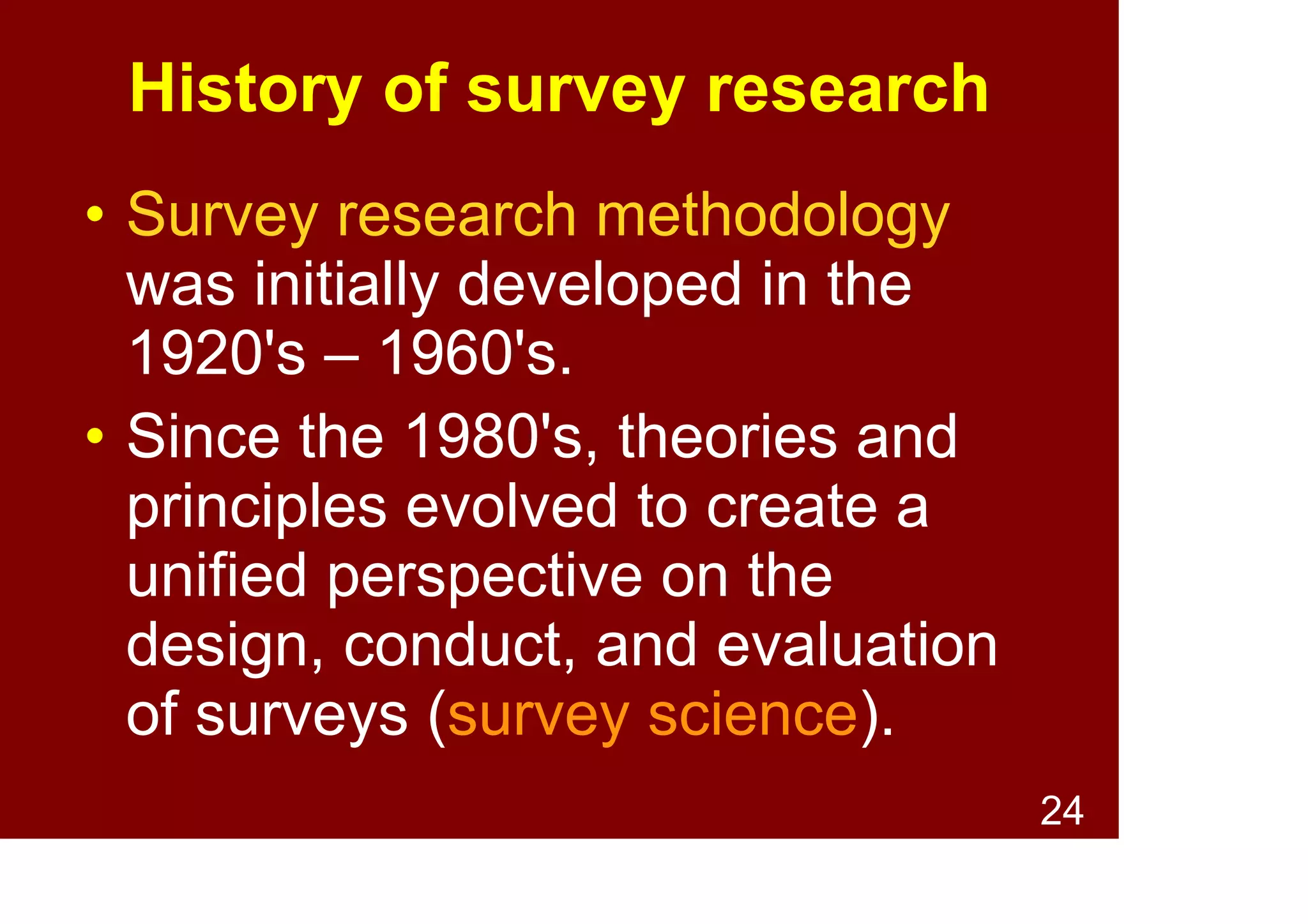
• Modern survey research
methodology was initially
developed during the 1920s.
• Since the 1980s, theories and
principles evolved to create a
unified perspective on the
design, conduct, and evaluation
of surveys (survey science).
26
Survey Research
Examples
27
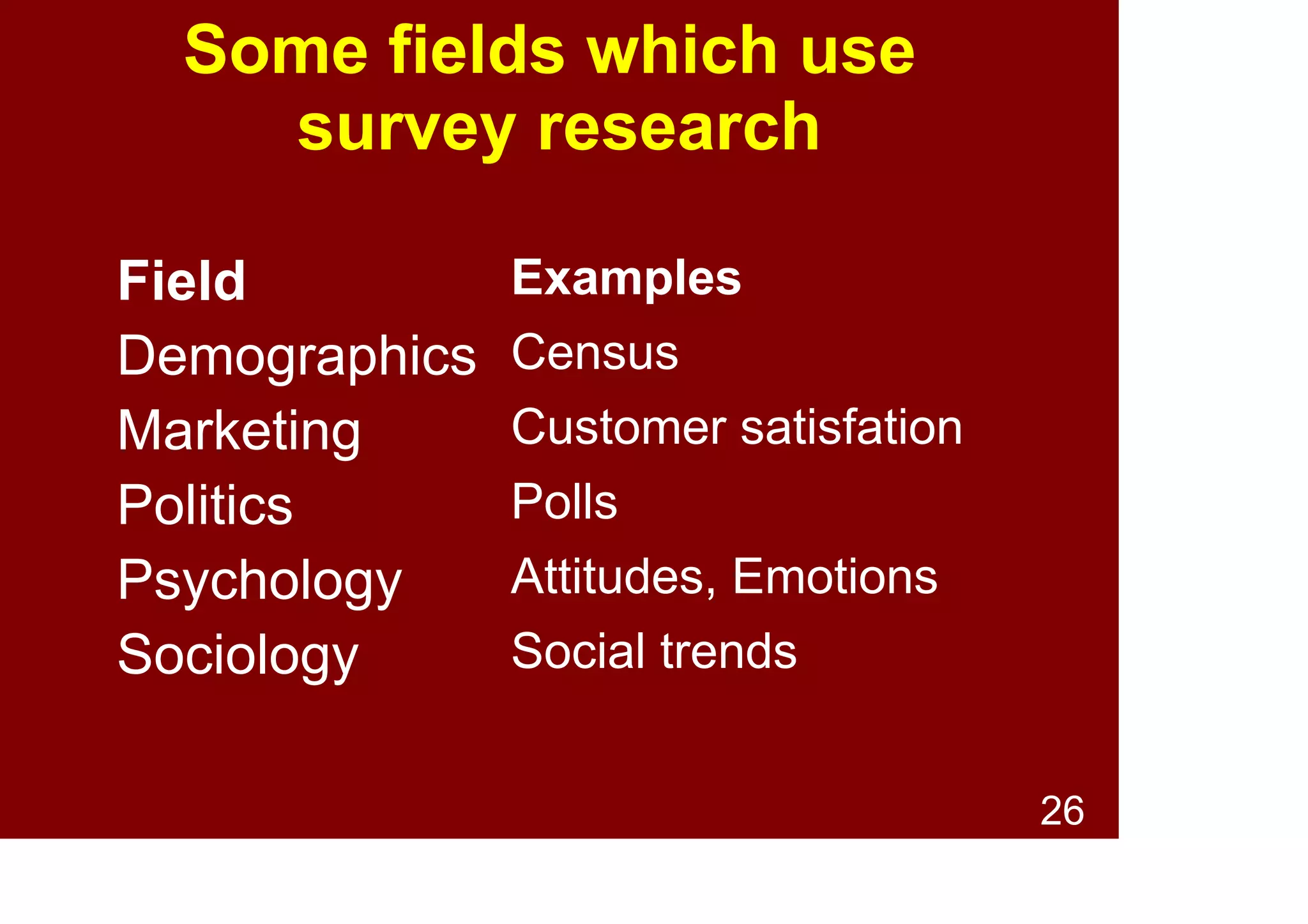
Some fields which use
survey research
Field Examples
Demographics Census
Epidemiology Health surveys
Marketing Customer satisfation
Politics Polls
Psychology Attitudes, Emotions
Sociology Social trends
28
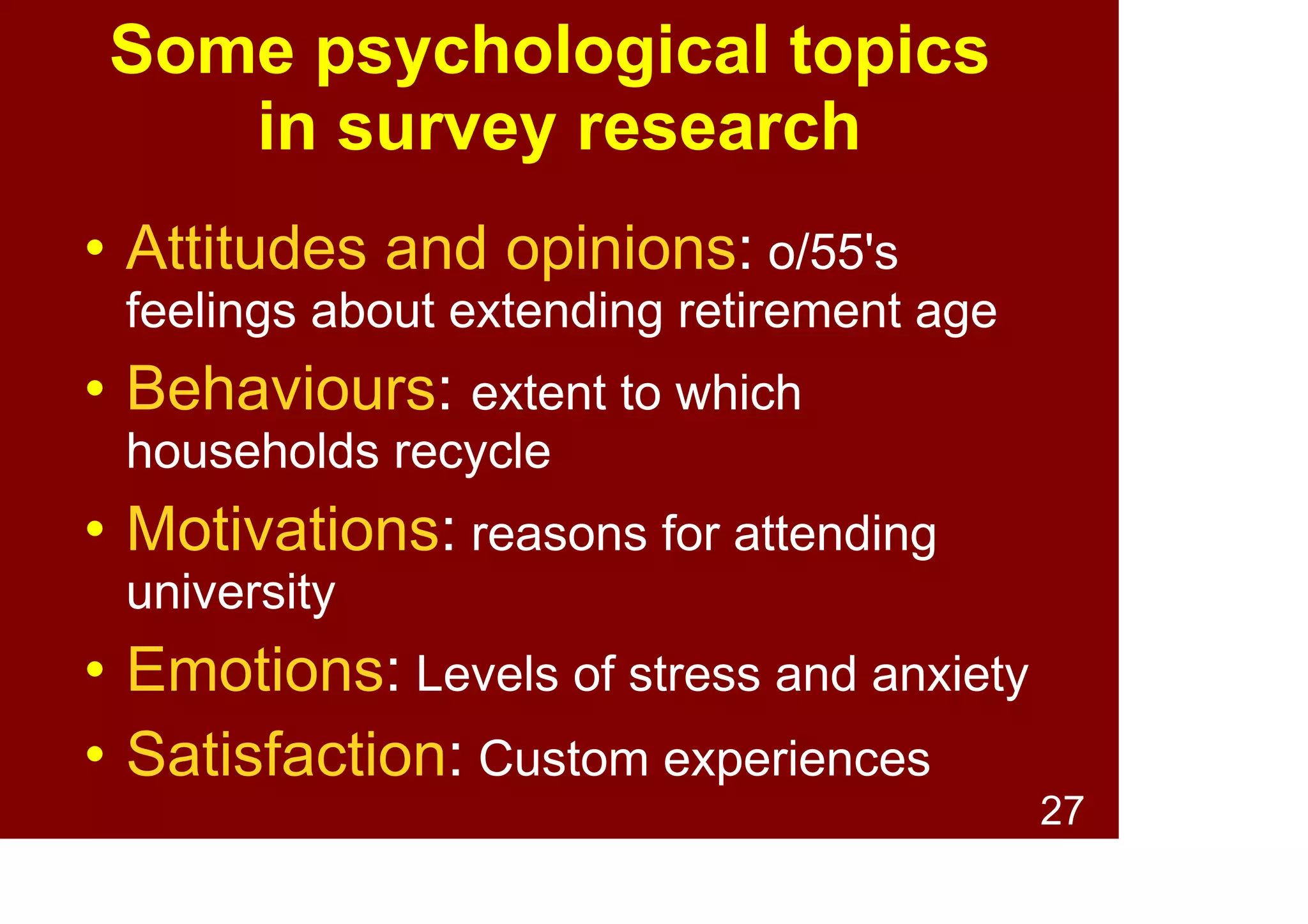
Psychological topics
investigated by survey research
• Attitudes and opinions: e.g., older
people's feelings about extending retirement
age
• Behaviours: e.g., extent to which
households recycle
• Motivations: e.g., reasons for attending
university
• Emotions: e.g., levels of stress and anxiety
• Satisfaction: e.g., custom experiences
29
Example survey research studies
• Environmental attitudes across
cultures
• Effect of working hours on family life,
depression & stress related health
problems
• Optimism & pessimism as predictors
of change in health after major life
events
30
Example survey research studies
• The effect of age on positive and
negative affect
• Are males satisfied with their body?
• Ethnicity, social deprivation and
psychological distress in adolescents
• Perceptions and attitudes towards
people with mental health problems
• Attitudes toward farm animal welfare
31
Survey Research
Characteristics
32
Survey research characteristics
• Usage: Surveys are widely used
in the social sciences.
• Systematic: Follow specific
procedures based on survey
science and the scientific
method.
• Replicable: Other people using
the same methods are likely to
get essentially the same results
33
Survey research characteristics
• Types: Administered via
interviews or questionnaires.
• Data: Often quantitative, but can
be qualitative.
• Impartial sampling: Selected
from target population without
preference, to be representative.
• Ecological validity: Can obtain in
situ, real-world samples.
34
Purposes of
Survey Research
35
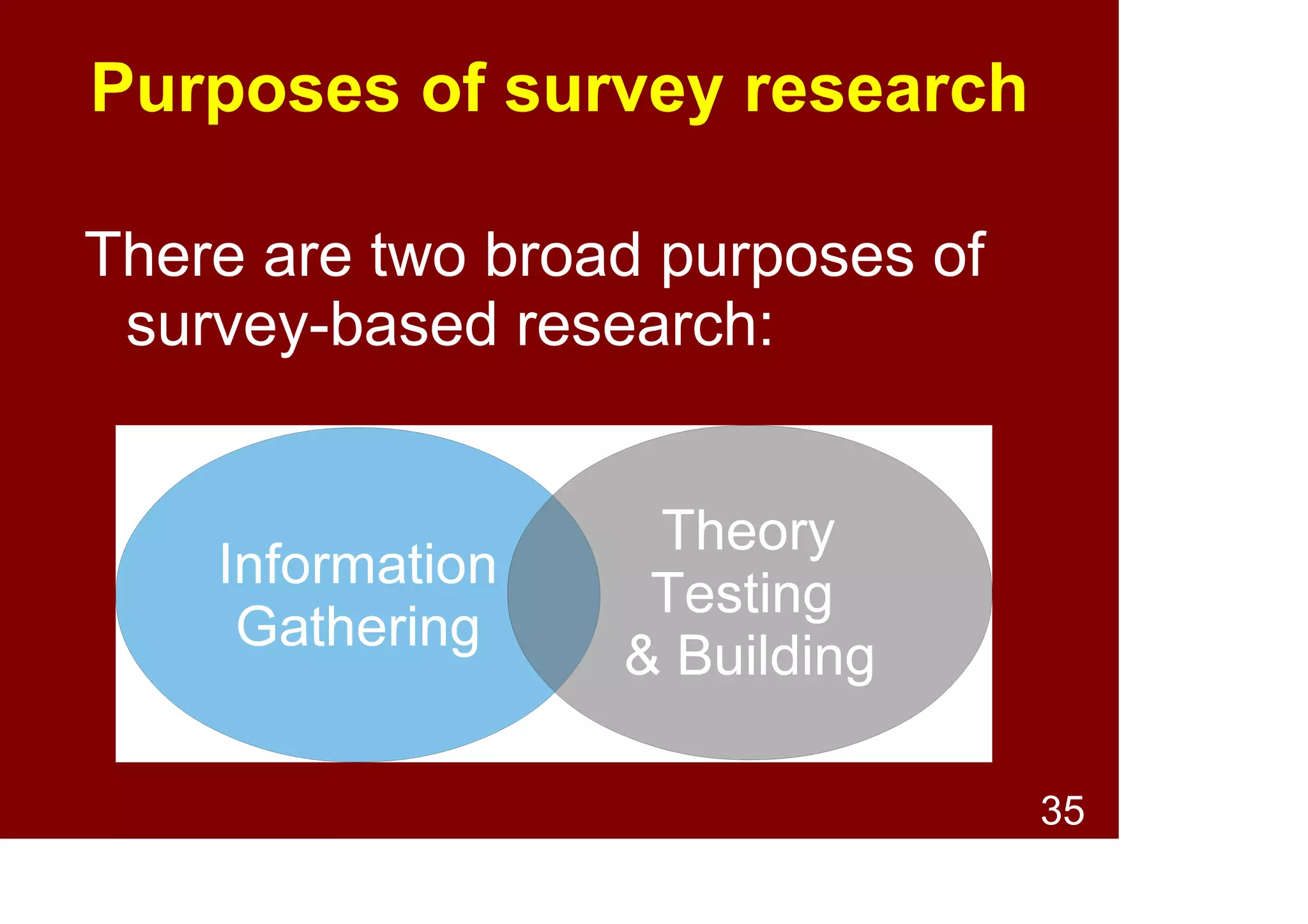
Purposes of survey research
Two broad purposes of survey-
based research:
Information
Gathering
Theory
Testing
& Building
36
Purposes of survey research
– Information gathering
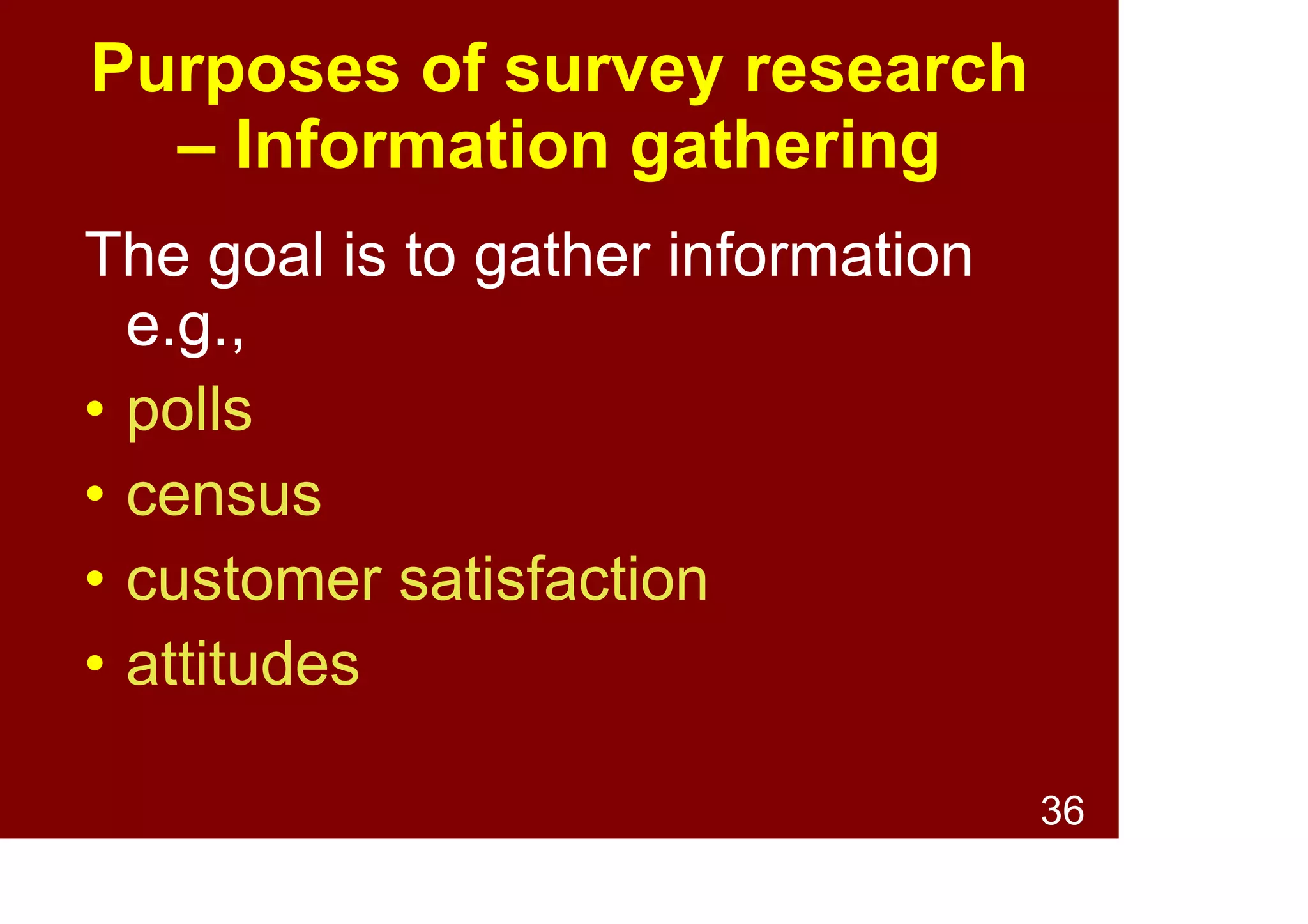
The goal is to gather information
e.g.,
• polls
• census
• customer satisfaction
• attitudes
37
Purposes of research –
Theory testing & building
The goal is to test and build theory
e.g.,
• Personality theories
• Social psychology theories
Often surveys do some info
gathering and some theory
testing.
38
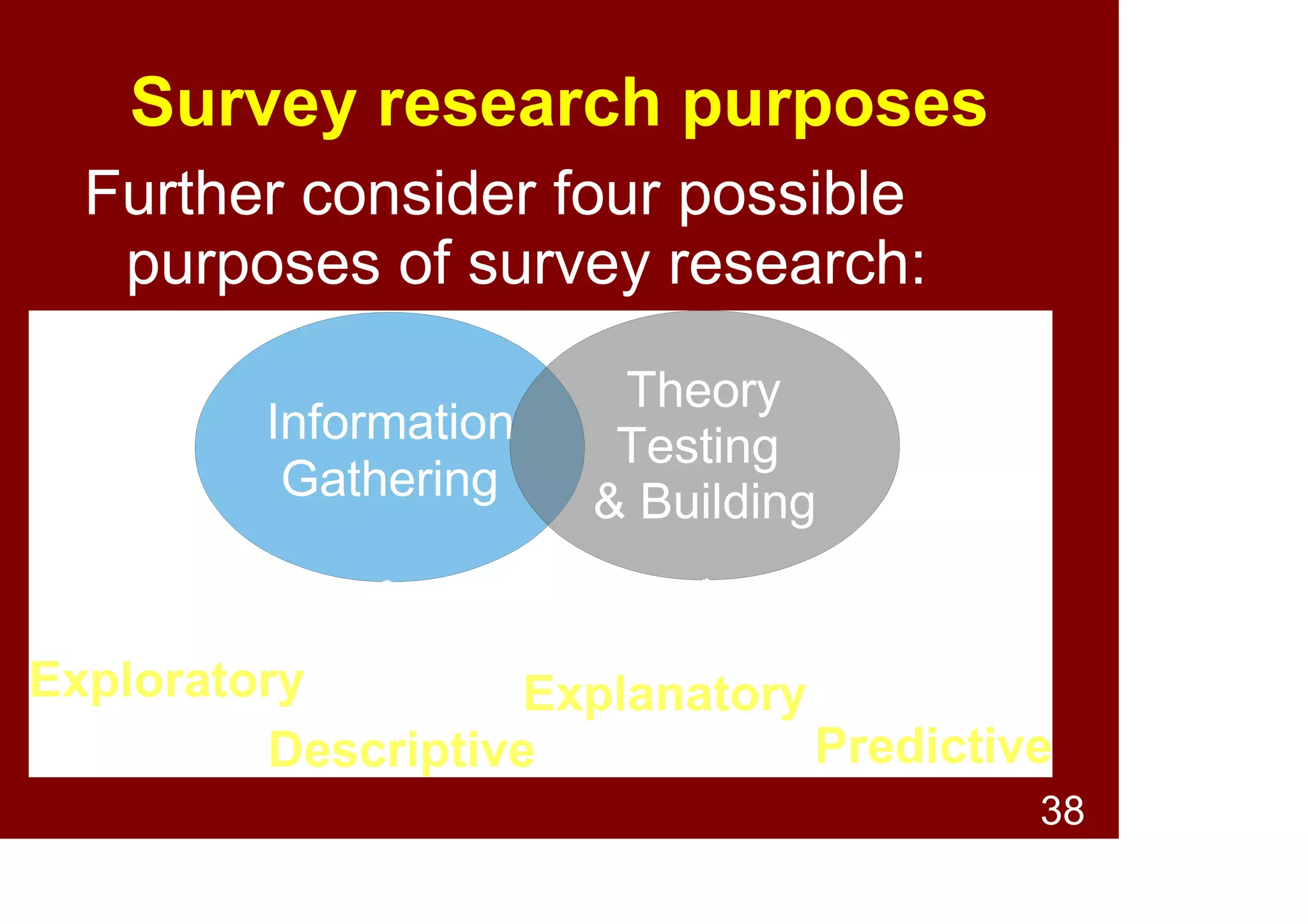
Survey research purposes
Further consider four purposes of
survey research:
Information
Gathering
Theory
Testing
& Building
Exploratory
Descriptive
Explanatory
Predictive
39
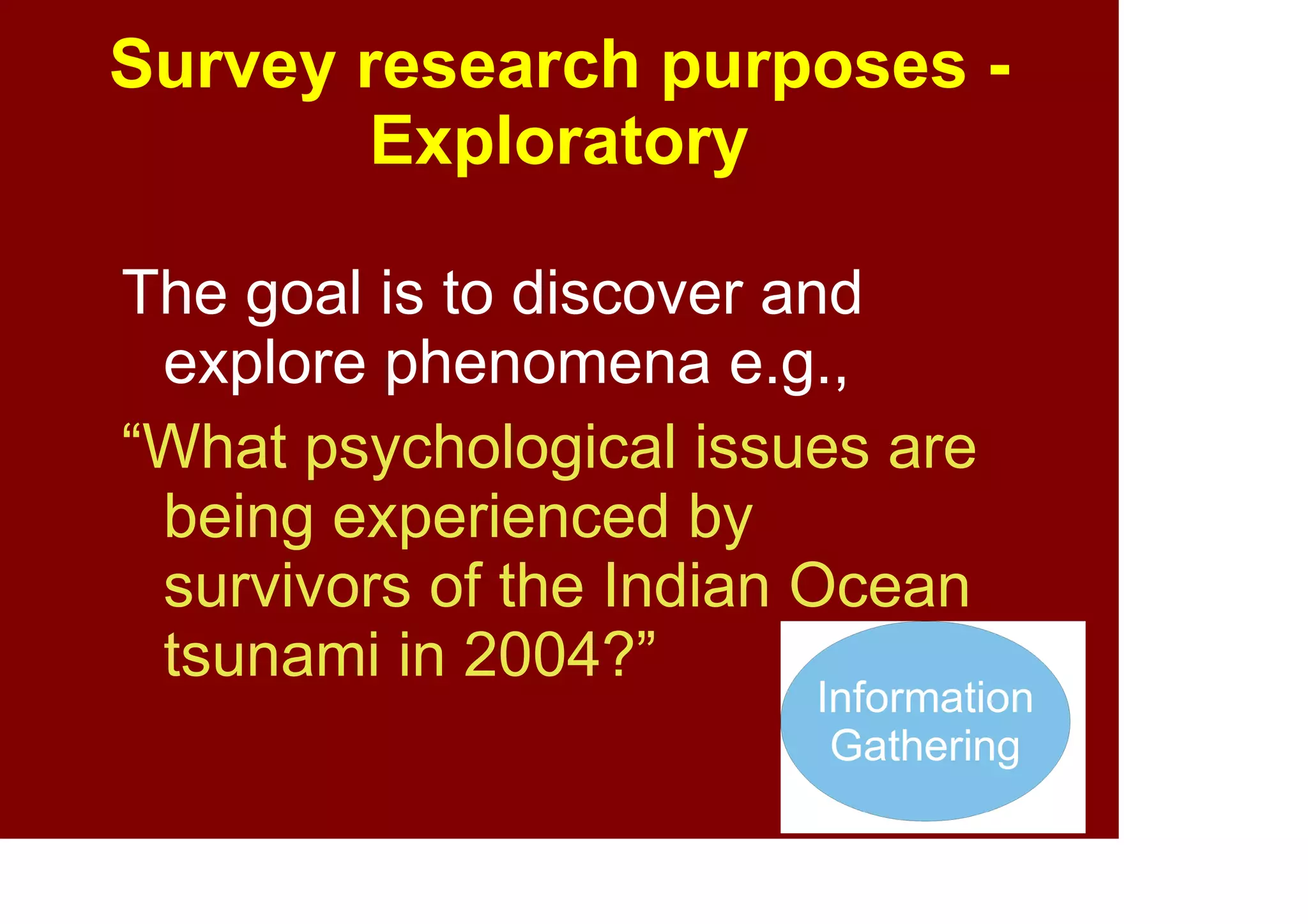
Survey research purposes -
Exploratory
The goal is to discover and
explore psychological
phenomena e.g.,
“What psychological issues are
experienced by survivors of
natural disasters?”
Information
Gathering
40
Survey research purposes -
Descriptive
The goal is to describe
phenomena e.g.,
• Consumer profiles (age, gender)
• Working conditions (hours, pay)
Information
Gathering
41
Survey research purposes -
Explanatory
The goal is to explain
phenomena by looking at the
relations between, and patterns
amongst, variables e.g.,
• Are extraverts happier than
introverts?
Why? (or why not?) Theory
Testing
& Building
42
Survey research purposes -
Predictive
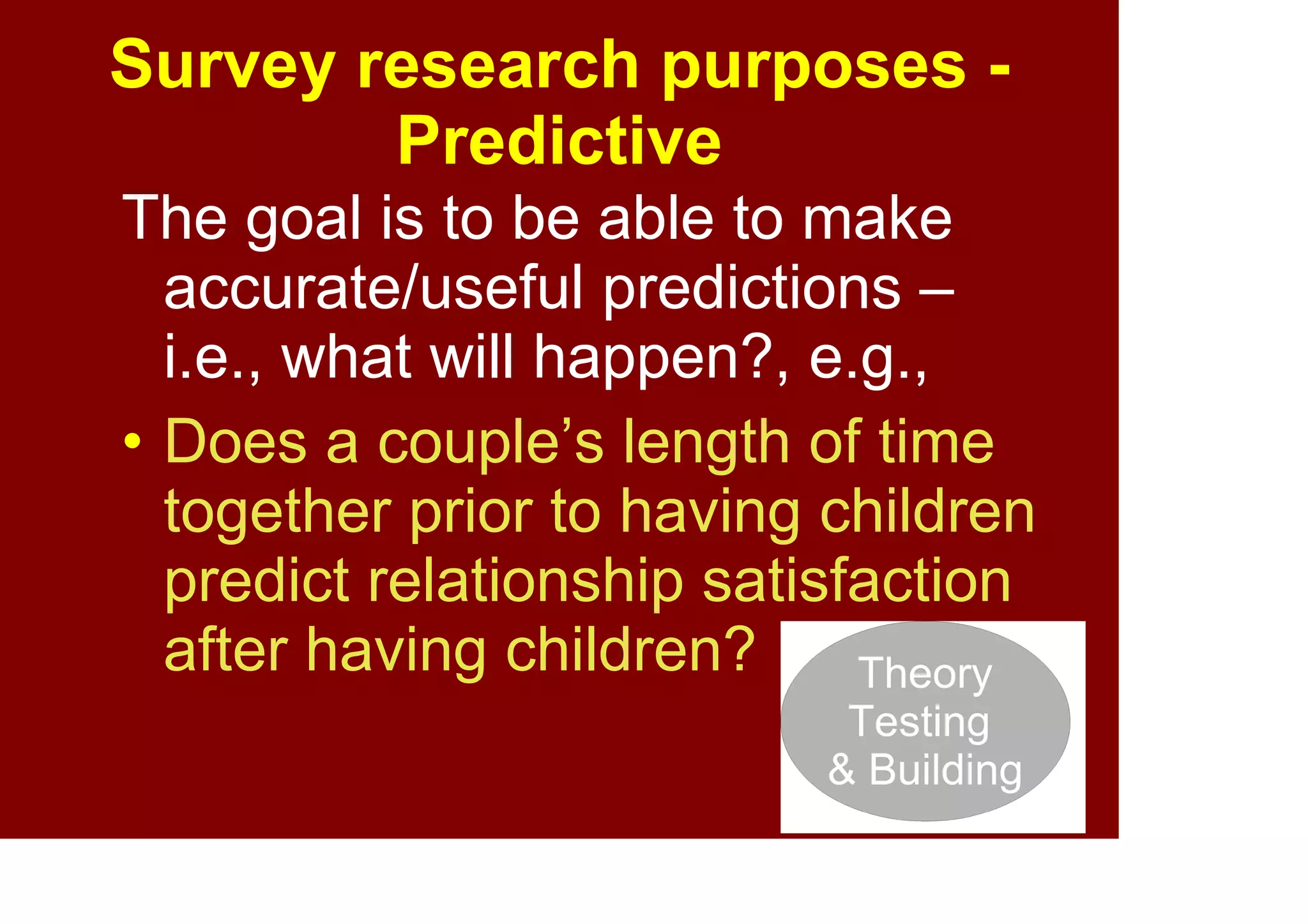
The goal is to be able to make
accurate/useful predictions –
i.e., what will happen?, e.g.,
• Does a couple’s length of time
together prior to having children
predict relationship satisfaction
after having children? Theory
Testing
& Building
43
Quiz question 4
What is the goal of this study?
A researcher lives in a religious commune
in order to learn about the social
psychological characteristics of cults.
• Exploratory
• Descriptive
• Explanatory
• Predictive
44
Quiz question 5
What is the goal of this study?
A researcher measures Australian people's
attitudes towards asylum seekers to
Australia.
• Exploratory
• Descriptive
• Explanatory
• Predictive
45
Quiz question 6
What is the goal of this study?
A researcher administers a happiness
survey and a personality survey in order to
examine the hypothesis that extraverts are
happier.
• Exploratory
• Descriptive
• Explanatory
• Predictive
46
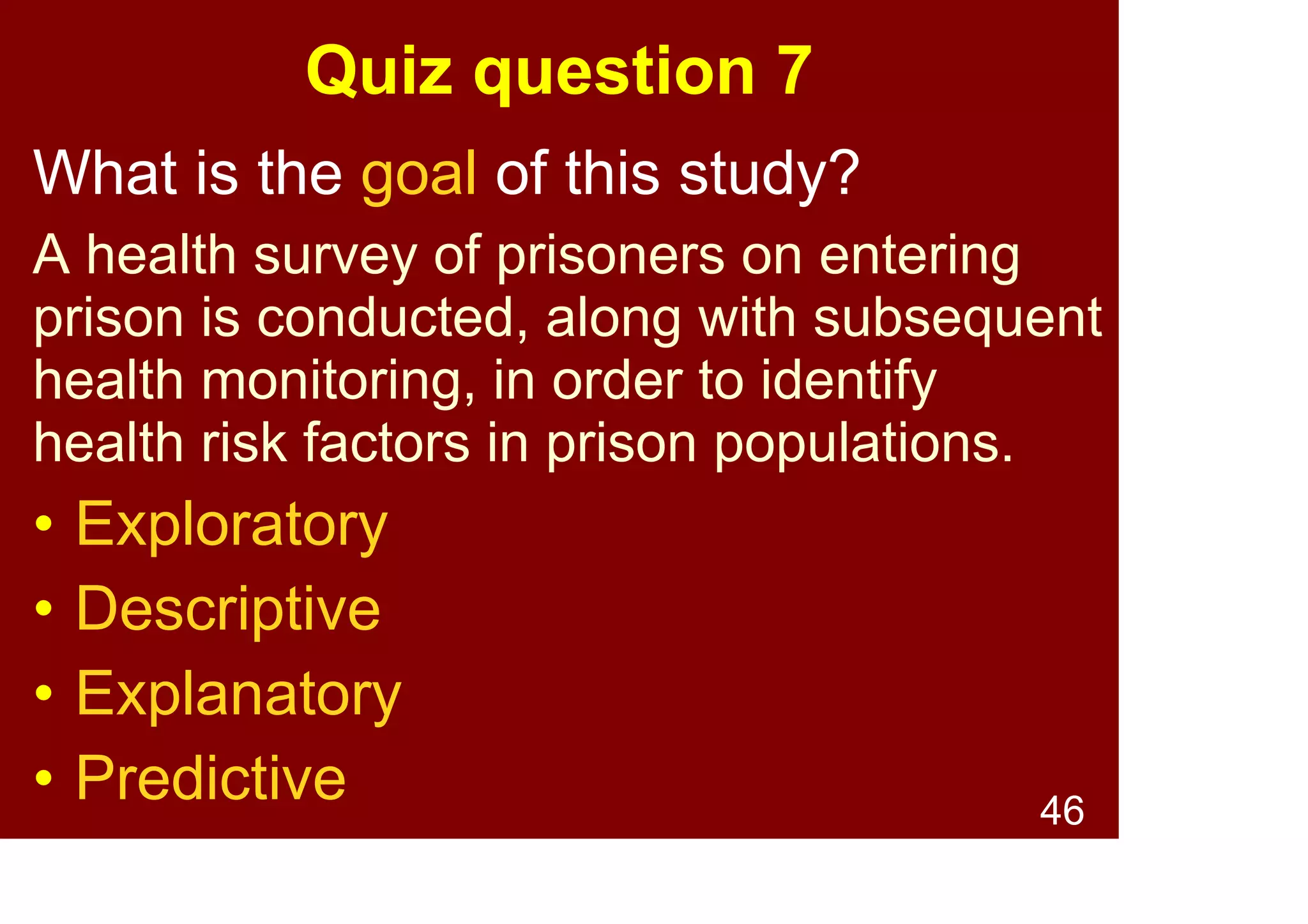
Quiz question 7
What is the goal of this study?
Post-deployment interviews with defence
personnel are used to identify risk factors
for PTSD. These risk factors are then
monitored in currently deployed personnel.
• Exploratory
• Descriptive
• Explanatory
• Predictive
47
Pros and Cons
of Survey
Research
48
Advantages of
survey-based research
● Ecological validity
● Access to wide range of
participants
● Potentially large amounts of data
● May be more ethical
(than experiments)
49
Disadvantages of
survey-based research
● Lack of control
→ less internal validity
● Data may be “superficial”
● Can be costly to obtain
representative data
● Self-report data only
● Potentially low compliance rates
50
Summary
51
Summary - 1
● Types of research:
● Experimental
● Quasi-experimental
● Non-experimental
● Surveys are used in all types,
especially non-experimental.
52
Summary - 2
● What is a survey?
● A standardised stimulus
designed to convert fuzzy
psychological phenomenon into
hard data.
● History
● Survey research has developed
into a popular research method
since the 1920's.
53
Summary - 3
● Purposes/goals of research:
● Information gathering
● Exploratory
● Descriptive
● Theory testing/building
● Explanatory
● Predictive
54
Summary - 4
Survey research
Pros include:
● Ecological validity
● Cost efficiency
● Can obtain lots of data
Cons include:
● Low compliance
● Reliance on self-report
55
References
Creative Research Systems (2009). Survey design: How
to begin your survey project.
Fowler, F. J., Jr. (2002). Designing questions to be good
measures. In In F. J. Fowler, Survey research methods
(3rd ed.) (pp. 76-103). Thousand Oaks, CA: Sage.
Howitt & Cramer (2014):
• Chapter 29 - Statistics and the analysis of experiments
(pp. 401-408)
• Chapter 34 - The analysis of a questionnaire / survey
project (pp. 476-484)
Nardi, P. (2006). Developing a questionnaire (Ch. 4). In
Doing survey research: A guide to quantitative methods
(2nd. ed.) (pp. 66-106). Boston, MA: Pearson.
Trochim, W. M. K. (2006). Survey research.
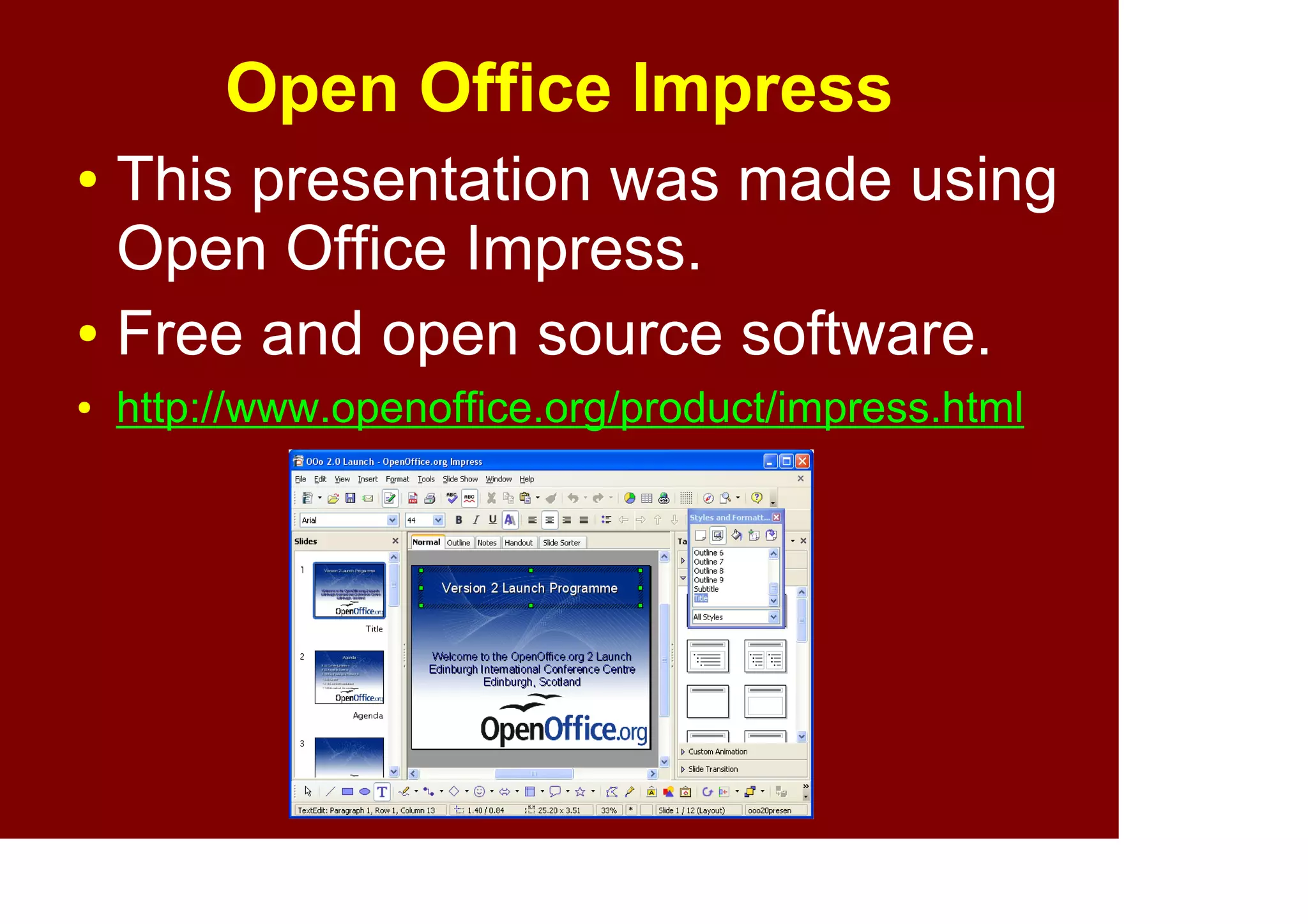
Open Office Impress
● This presentation was made using
Open Office Impress.
● Free and open source software.
● http://www.openoffice.org/product/impress.html

Introduction to Survey Research

  • 1.
    Lecture 1 Survey Research& Design in Psychology James Neill, 2017 Creative Commons Attribution 4.0 Introduction to Survey Research
  • 2.
    2 Overview 1. Readings 2. Scientificparadigm 3. Types of research 4. What is a survey? 5. History of survey research 6. Survey research examples 7. Survey research characteristics 8. Purposes of survey research 9. Pros and cons 10. Summary
  • 3.
  • 4.
    Creative Research Systems(2008) The steps in a survey project (Online article) http://www.surveysystem.com/sdesign.htm
  • 5.
    Fowler (2002) Designing questionsto be good measures (Book chapter)
  • 6.
    Howitt & Cramer(2014) Introduction to Statistics in Psychology (Book chapters) Ch 29 Statistics and the analysis of experiments Ch 34 The analysis of a questionnaire/survey project
  • 7.
    Nardi (2006) Developing aquestionnaire (Book chapter)
  • 8.
    Trochim (2006) Survey research (Onlinearticle) http://www.socialresearchmethods.net/kb/survey.php
  • 9.
  • 10.
    10 Positivism • A philosophyof science that confines itself to the data of experience (empirical evidence) • Excludes a priori or metaphysical speculations • Emphasises the achievements of science • Recurrent theme in the history of Western thought • Sources: Encyclopedia Brittanica, Wikipedia
  • 11.
    11 Empirical approach to psychosocialresearch assume that: 1. the world is made up of phenomena which have properties that are measurable 2. psychological phenomena can be measured, recorded, and analysed 3. interpretation of analysis can lead to valid insights about how people think, feel, and behave
  • 12.
    12 Scientific method Observe phenomenon Askquestions e.g., why Make hypothesis Conduct experiment Collect data Analyse data Interpret and conclude Apply findings
  • 13.
  • 14.
    14 Types of Research Threemain research methods: 1. Experimental 2. Quasi-experimental 3. Non-experimental Note: Surveys are widely used in non-experimental research, but also in quasi-experimental and experimental research.
  • 15.
    15 Types of Research- Experimental Characterised by: • Random assignment to groups • Control over extraneous variables Pros: • Powerful method Cons • Can be difficult to conduct • May not be ecologically valid
  • 16.
    16 Types of Research- Quasi-experimental Characterised by: • Use of “naturally occurring” groups – e.g., diseased vs. healthy • Assignment to groups is non-random • Some control over extraneous variables – e.g., match participants for age and lifestyle Pros: • Balances rigour of experimental and lack of control of non-experimental
  • 17.
    17 Types of Research- Non-experimental Characterised by: • No “groups” or “conditions” are used – e.g., students at a specific university Pros • Ecological validity Cons • Minimal control over extraneous variables
  • 18.
    18 Quiz question 1 Whattype of research is the following? A researcher surveys Australian community attitudes to eating non-traditional meats (e.g. venison, kangaroo). • Experimental • Quasi-experimental • Non-experimental
  • 19.
    19 Quiz question 2 Whattype of research is the following? A researcher compares study habits of university students who regularly use caffeine with uni students who do not regularly use caffeine. • Experimental • Quasi-experimental • Non-experimental
  • 20.
    20 Quiz question 3 Whattype of research is the following? A researcher randomly allocates participants to a morning or evening exercise routine and then compares the sleep patterns of the two groups. • Experimental • Quasi-experimental • Non-experimental
  • 21.
    21 What is aSurvey?
  • 22.
    22 • A standardisedstimulus • A measuring instrument • A way of converting fuzzy psychological stuff into hard data for analysis What is a survey?
  • 23.
  • 24.
    24 History of surveyresearch Civil servant at trailer park, collecting census data, Netherlands, 1925
  • 25.
    25 History of surveyresearch • Modern survey research methodology was initially developed during the 1920s. • Since the 1980s, theories and principles evolved to create a unified perspective on the design, conduct, and evaluation of surveys (survey science).
  • 26.
  • 27.
    27 Some fields whichuse survey research Field Examples Demographics Census Epidemiology Health surveys Marketing Customer satisfation Politics Polls Psychology Attitudes, Emotions Sociology Social trends
  • 28.
    28 Psychological topics investigated bysurvey research • Attitudes and opinions: e.g., older people's feelings about extending retirement age • Behaviours: e.g., extent to which households recycle • Motivations: e.g., reasons for attending university • Emotions: e.g., levels of stress and anxiety • Satisfaction: e.g., custom experiences
  • 29.
    29 Example survey researchstudies • Environmental attitudes across cultures • Effect of working hours on family life, depression & stress related health problems • Optimism & pessimism as predictors of change in health after major life events
  • 30.
    30 Example survey researchstudies • The effect of age on positive and negative affect • Are males satisfied with their body? • Ethnicity, social deprivation and psychological distress in adolescents • Perceptions and attitudes towards people with mental health problems • Attitudes toward farm animal welfare
  • 31.
  • 32.
    32 Survey research characteristics •Usage: Surveys are widely used in the social sciences. • Systematic: Follow specific procedures based on survey science and the scientific method. • Replicable: Other people using the same methods are likely to get essentially the same results
  • 33.
    33 Survey research characteristics •Types: Administered via interviews or questionnaires. • Data: Often quantitative, but can be qualitative. • Impartial sampling: Selected from target population without preference, to be representative. • Ecological validity: Can obtain in situ, real-world samples.
  • 34.
  • 35.
    35 Purposes of surveyresearch Two broad purposes of survey- based research: Information Gathering Theory Testing & Building
  • 36.
    36 Purposes of surveyresearch – Information gathering The goal is to gather information e.g., • polls • census • customer satisfaction • attitudes
  • 37.
    37 Purposes of research– Theory testing & building The goal is to test and build theory e.g., • Personality theories • Social psychology theories Often surveys do some info gathering and some theory testing.
  • 38.
    38 Survey research purposes Furtherconsider four purposes of survey research: Information Gathering Theory Testing & Building Exploratory Descriptive Explanatory Predictive
  • 39.
    39 Survey research purposes- Exploratory The goal is to discover and explore psychological phenomena e.g., “What psychological issues are experienced by survivors of natural disasters?” Information Gathering
  • 40.
    40 Survey research purposes- Descriptive The goal is to describe phenomena e.g., • Consumer profiles (age, gender) • Working conditions (hours, pay) Information Gathering
  • 41.
    41 Survey research purposes- Explanatory The goal is to explain phenomena by looking at the relations between, and patterns amongst, variables e.g., • Are extraverts happier than introverts? Why? (or why not?) Theory Testing & Building
  • 42.
    42 Survey research purposes- Predictive The goal is to be able to make accurate/useful predictions – i.e., what will happen?, e.g., • Does a couple’s length of time together prior to having children predict relationship satisfaction after having children? Theory Testing & Building
  • 43.
    43 Quiz question 4 Whatis the goal of this study? A researcher lives in a religious commune in order to learn about the social psychological characteristics of cults. • Exploratory • Descriptive • Explanatory • Predictive
  • 44.
    44 Quiz question 5 Whatis the goal of this study? A researcher measures Australian people's attitudes towards asylum seekers to Australia. • Exploratory • Descriptive • Explanatory • Predictive
  • 45.
    45 Quiz question 6 Whatis the goal of this study? A researcher administers a happiness survey and a personality survey in order to examine the hypothesis that extraverts are happier. • Exploratory • Descriptive • Explanatory • Predictive
  • 46.
    46 Quiz question 7 Whatis the goal of this study? Post-deployment interviews with defence personnel are used to identify risk factors for PTSD. These risk factors are then monitored in currently deployed personnel. • Exploratory • Descriptive • Explanatory • Predictive
  • 47.
    47 Pros and Cons ofSurvey Research
  • 48.
    48 Advantages of survey-based research ●Ecological validity ● Access to wide range of participants ● Potentially large amounts of data ● May be more ethical (than experiments)
  • 49.
    49 Disadvantages of survey-based research ●Lack of control → less internal validity ● Data may be “superficial” ● Can be costly to obtain representative data ● Self-report data only ● Potentially low compliance rates
  • 50.
  • 51.
    51 Summary - 1 ●Types of research: ● Experimental ● Quasi-experimental ● Non-experimental ● Surveys are used in all types, especially non-experimental.
  • 52.
    52 Summary - 2 ●What is a survey? ● A standardised stimulus designed to convert fuzzy psychological phenomenon into hard data. ● History ● Survey research has developed into a popular research method since the 1920's.
  • 53.
    53 Summary - 3 ●Purposes/goals of research: ● Information gathering ● Exploratory ● Descriptive ● Theory testing/building ● Explanatory ● Predictive
  • 54.
    54 Summary - 4 Surveyresearch Pros include: ● Ecological validity ● Cost efficiency ● Can obtain lots of data Cons include: ● Low compliance ● Reliance on self-report
  • 55.
    55 References Creative Research Systems(2009). Survey design: How to begin your survey project. Fowler, F. J., Jr. (2002). Designing questions to be good measures. In In F. J. Fowler, Survey research methods (3rd ed.) (pp. 76-103). Thousand Oaks, CA: Sage. Howitt & Cramer (2014): • Chapter 29 - Statistics and the analysis of experiments (pp. 401-408) • Chapter 34 - The analysis of a questionnaire / survey project (pp. 476-484) Nardi, P. (2006). Developing a questionnaire (Ch. 4). In Doing survey research: A guide to quantitative methods (2nd. ed.) (pp. 66-106). Boston, MA: Pearson. Trochim, W. M. K. (2006). Survey research.
  • 56.
    Open Office Impress ●This presentation was made using Open Office Impress. ● Free and open source software. ● http://www.openoffice.org/product/impress.html

Editor's Notes

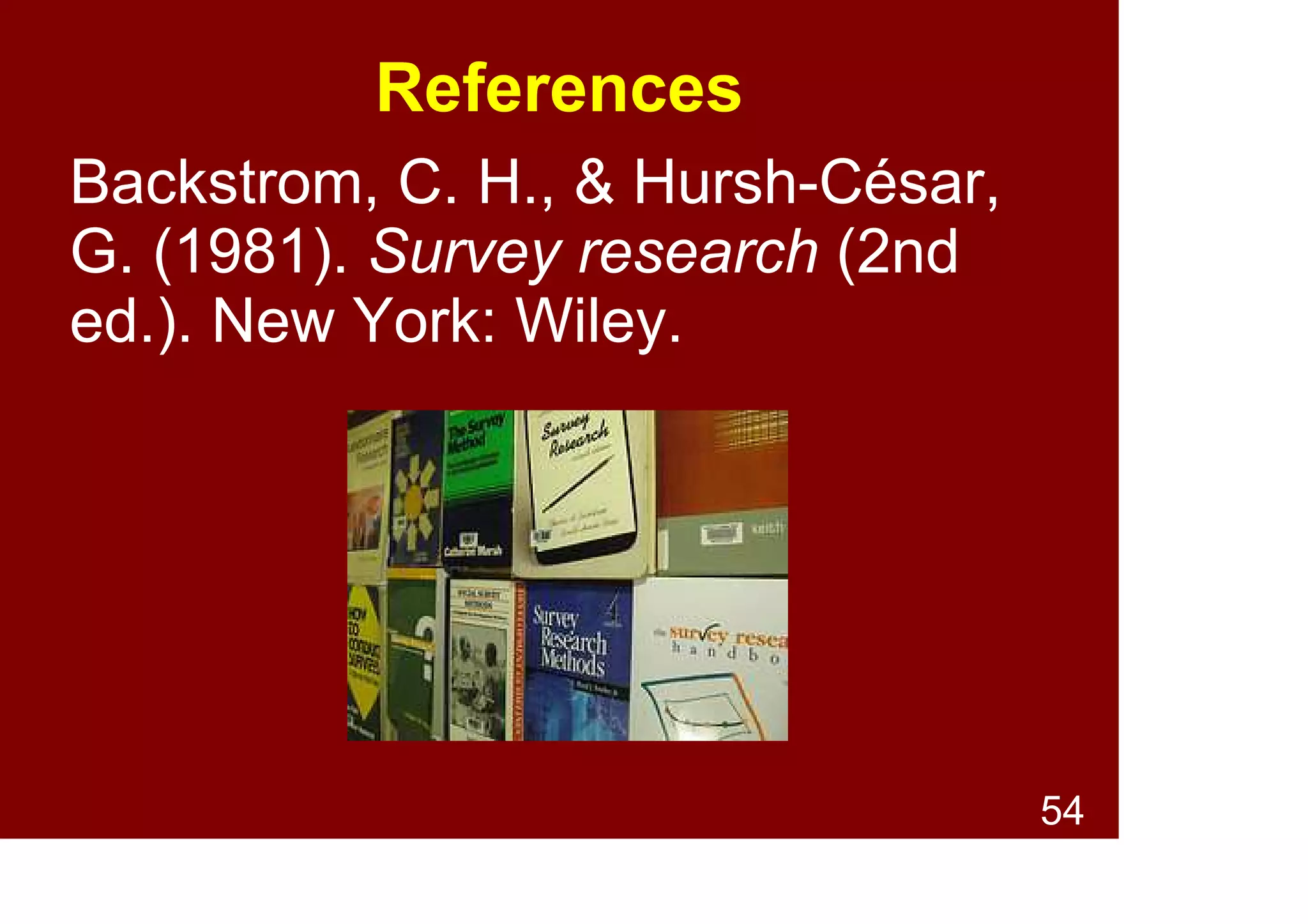
  • #2 7126/6667 Survey Research & Design in Psychology Semester 1, 2016, University of Canberra, ACT, Australia James T. Neill Description: An overview of, and introduction to, survey-based research in the social sciences. Home page: http://en.wikiversity.org/wiki/Survey_research_and_design_in_psychology Lecture page: http://en.wikiversity.org/wiki/Survey_research_and_design_in_psychology/Lectures/Survey_research Image sources: http://commons.wikimedia.org/wiki/File:Survey_Research_Books.jpg Image author: James Neill, http://commons.wikimedia.org/wiki/User:Jtneill Date of creation: 9 February 2009 Image license:Public domain, http://en.wikipedia.org/wiki/Public_domain
  • #3 Image source: http://commons.wikimedia.org/wiki/File:Information_icon4.svg License: Public domain Image source: http://commons.wikimedia.org/wiki/File:Autoroute_icone.svg License: CC-BY-A 2.5 Author: http://commons.wikimedia.org/wiki/User:Doodledoo
  • #4 <number>
  • #5 <number>
  • #6 <number>
  • #7 <number>
  • #8 <number>
  • #9 <number> Image source: http://www.socialresearchmethods.net/kb/survey.php
  • #10 Image source: http://www.flickr.com/photos/zarajay/2089922376/in/photostream/ By Zara http://www.flickr.com/photos/zarajay/ License: CC-by-SA 2.0 http://creativecommons.org/licenses/by-sa/2.0/deed.en
  • #13 For more information, see http://www.youtube.com/watch?v=BVfI1wat2y8
  • #15 Image source: http://en.wikiversity.org/wiki/File:Nuvola_apps_edu_science.svg License: GFDL
  • #16 Image source: http://commons.wikimedia.org/wiki/File:Nuvola_apps_edu_science.svg Image author: David Vignoni, http://en.wikipedia.org/wiki/David_Vignoni Image license: LGPL 3, http://www.gnu.org/licenses/lgpl.html Random assignment e.g., to an exercise condition and a non-exercise condition
  • #19 Answer: Non-experimental
  • #20 Answer: Quasi-experimental
  • #21 Answer:Experimental
  • #23 <number> Image source: Unknown.
  • #25 Image source: http://commons.wikimedia.org/wiki/File:Volkstelling_1925_Census.jpg License: Public domain
  • #26 Groves et al. (2004)
  • #30 These examples are based on the best survey research exercise summaries in 2010: http://learnonline.canberra.edu.au/mod/forum/view.php?id=276432
  • #31 These examples are based on the best survey research exercise summaries in 2010: http://learnonline.canberra.edu.au/mod/forum/view.php?id=276432
  • #33 Partially based on Backstrom & Hursh-César (1981, pp. 3-4)
  • #34 Partially based on Backstrom & Hursh-César (1981, pp. 3-4)
  • #36 Information-gathering Theory testing and building
  • #38 Image source: http://commons.wikimedia.org/wiki/File:Thumb_up_icon.svg License: GFDL
  • #39 Exploratory Descriptive Explanatory Predictive
  • #44 Answer: Exploratory
  • #45 Answer: Descriptive
  • #46 Answer: Explanatory
  • #47 Answer: Predictive
  • #49 Image source: http://commons.wikimedia.org/wiki/File:Crystal_Clear_action_edit_add.png License: GFDL
  • #50 Image source: http://commons.wikimedia.org/wiki/File:Crystal_Clear_action_edit_remove.png License: GFDL