Karim Elghanam
Faculty of Medicine, Menoufia
University
k.elghanam@med.menofia.edu.eg
September 15, 2015
Questionnaire
Development
& Validation
2
What’s the Q.?
Is a formalized set of questions to
obtain certain information from
certain respondents.
Questionnaire Development
3
Developing a good questionnaire
is NOT EASY!
• It takes time, time, and more time.
• You may end up writing multiple
drafts.
• It helps to work with others when
developing a questionnaire.Questionnaire Development
Some Definitions Before
Starting
4 Questionnaire Development
5
Types of Q.?
1- Self-
administrated
• Computer assisted
and Web-based
• Paper and pencil 2- Interviewer-
administrated
• Face to face
• Telephone
Questionnaire Development
6
• Self-administered
questionnaire
Advantages:
 Cheap and easy to administer
 Preserves confidentiality
 Completed at any time
 No influence by interviewer
 Allow for instant data coding
Questionnaire Development
7
• Self-administered
questionnaire
Disadvantages:
 Low response rate
 Questions can be
misunderstood
 No control by interviewer
Questionnaire Development
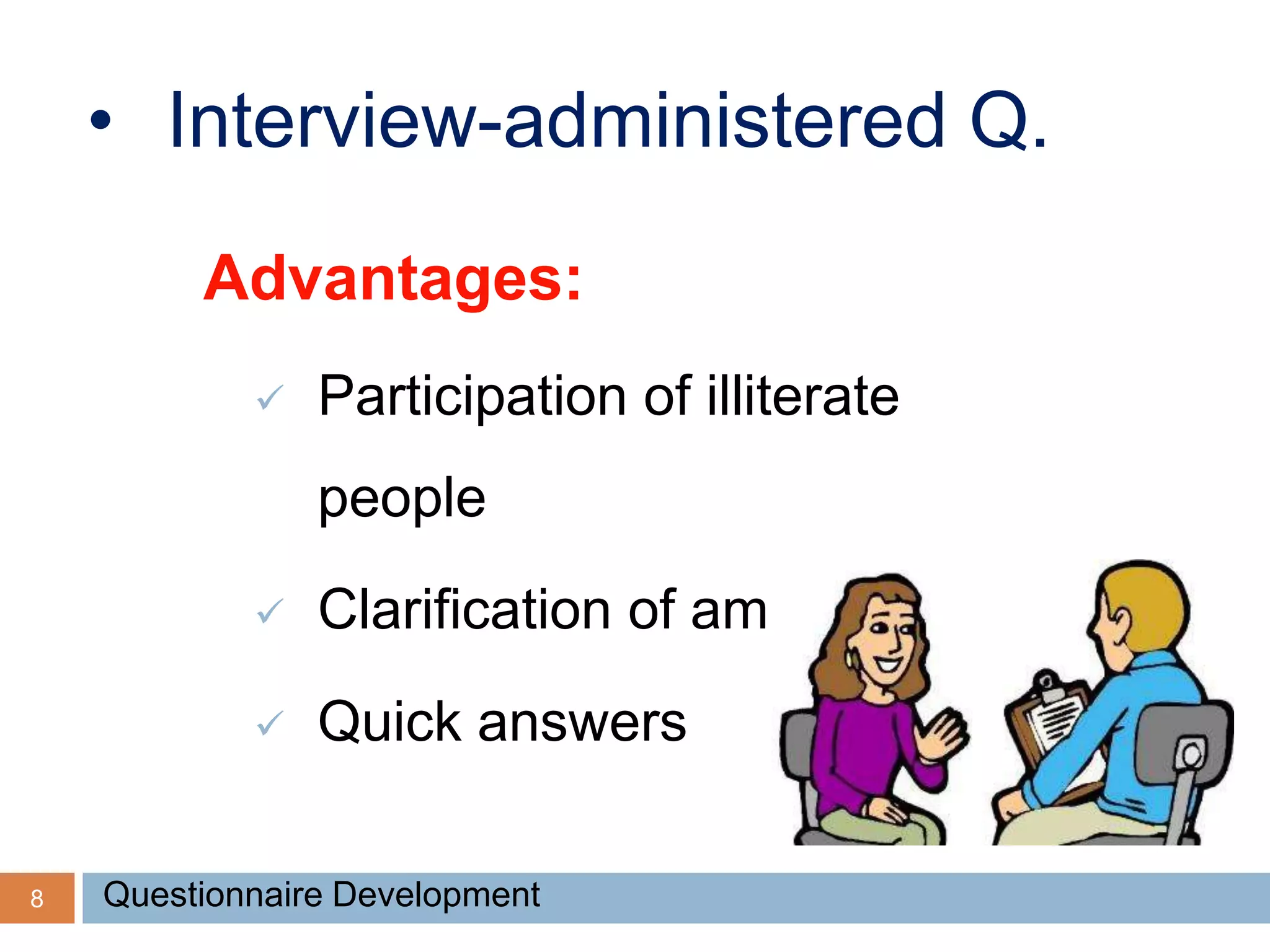
8
• Interview-administered Q.
Advantages:
 Participation of illiterate
people
 Clarification of ambiguity
 Quick answers
Questionnaire Development
9
• Interview-administered Q.
Disadvantages:
 Interviewer bias
 Needs more resources
 Only short questionnaires possible
especially on telephone
 Difficult for sensitive issues
Questionnaire Development
1- Formulations of idea
(Conceptualization)
11 Questionnaire Development
Clear Idea
Clear objectives ( primary and
secondary objectives )
You will be Strict to them.
Home Message
“Ask what you want to know,
not something else”
(Bradburn, 2004)
2- Literature Review
13 Questionnaire Development
Asking others for their own
questionnaires !
3- First draft
14 Questionnaire Development
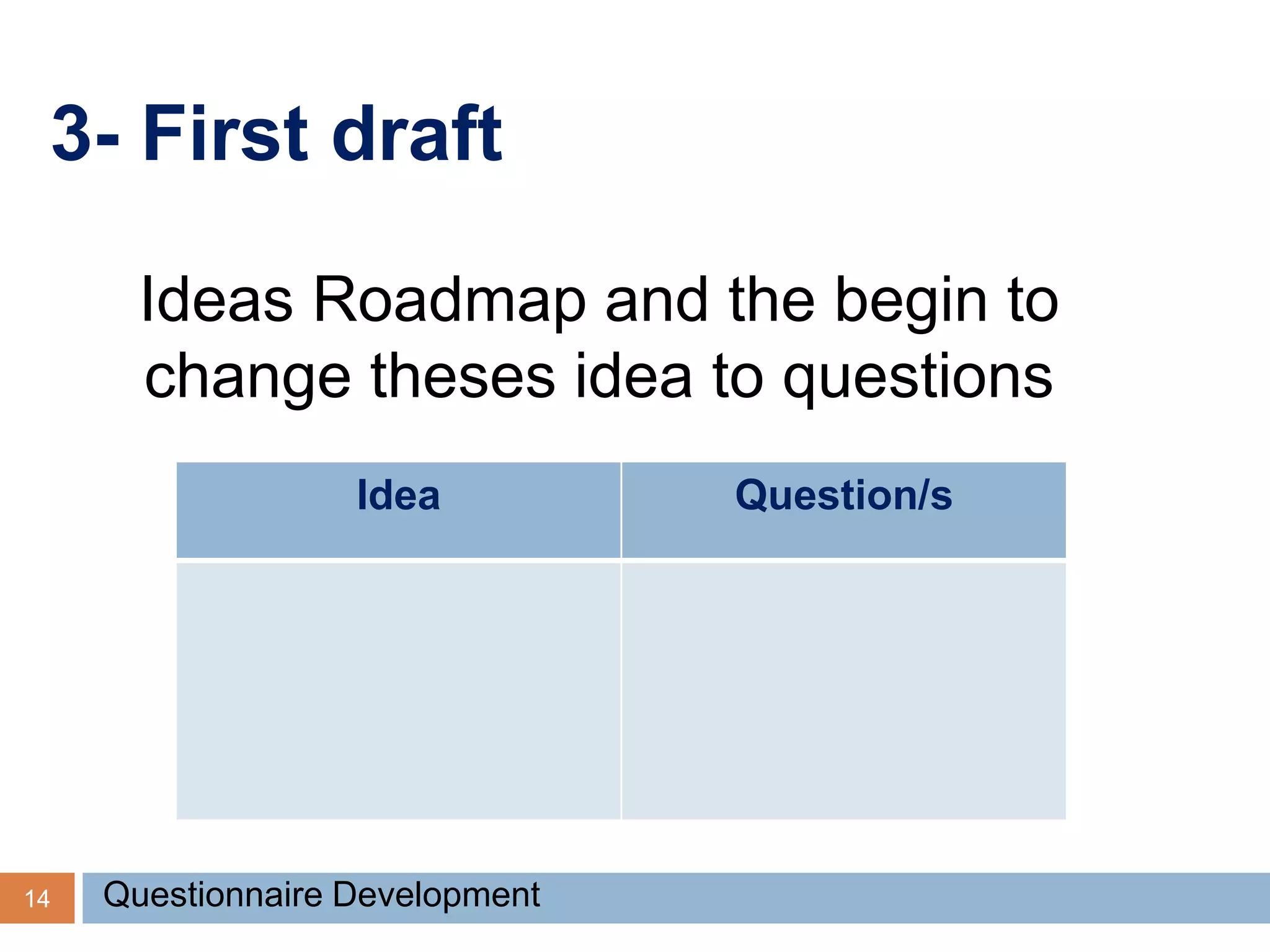
Ideas Roadmap and the begin to
change theses idea to questions
Idea Question/s
First Draft
15 Questionnaire Development
4- Condensed Literature
Review..!
16 Questionnaire Development
Another draft more specific than the
first one
Another Draft
17 Questionnaire Development
5- Detect .. ?
18 Questionnaire Development
1. Study design
2. Population
3. Sample size
4. Type of the Q. will you use ?
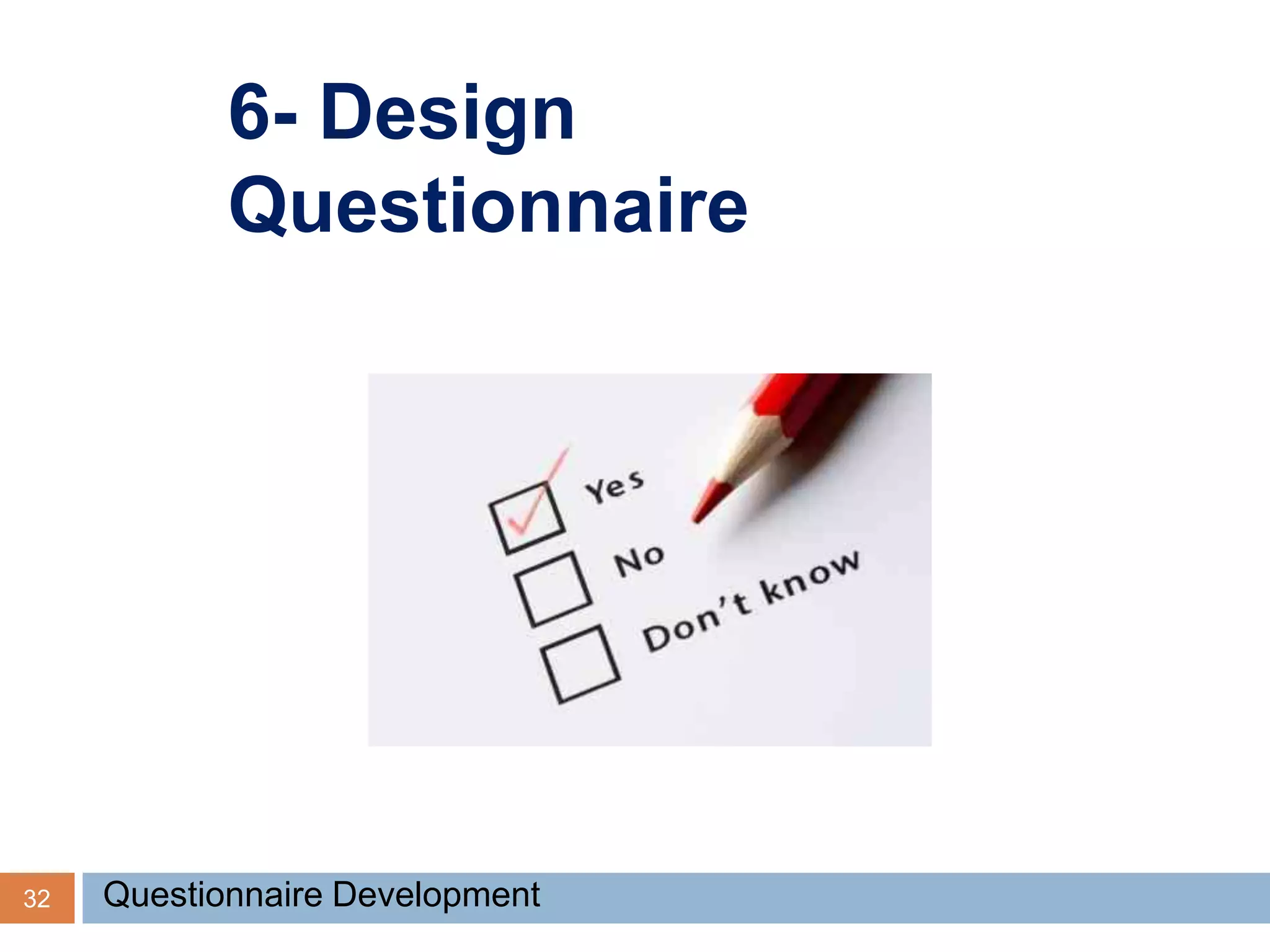
6- Design
Questionnaire
19 Questionnaire Development
20
Types of questions ?
1- Open-ended question
2- Closed-ended question
3- Contingency questions.
Questionnaire Development
21
1- Closed questions
You ask the respondent to choose, among a
possible number of answers, the response
that most closely represents his/her
viewpoint.
Questionnaire Development
22
Advantages of closed question
• The respondent is restricted to a certain
set of responses,
• They are easy to answer ( no hesitations
),
• Less time consuming,
• Easy to code, and
Questionnaire Development
23
 You will force the respondent to choose
between specific answers … BIAS
 You offer answers that otherwise would not
have come to his mind,
 They don’t allow for creativity and
generating ideas,
Disadvantages of closed
question
Questionnaire Development
24
They do not permit the respondent to qualify
the chosen response or express a more
complex or subtle meaning,
There is may a tendency for the respondent
to tick systematically either the first or last
answer,
May Select what may be considered as the
most socially desirable response,
Disadvantages of closed
question
Questionnaire Development
25
To answer all items in a list in the same
way
Disadvantages of closed
question
Questionnaire Development
26
2- Open-ended questions
Free-response questions are not followed
by any choices and the respondent must
answer by supplying a response, usually by
entering a number, a word, or a short text.
Questionnaire Development
27
Advantages of open-ended
 They allow respondents to express their
ideas spontaneously in their own
language.
 They are less likely to guide the answer
than closed questions .
 They can add new information when there
is very little existing information available
about a topic.
Questionnaire Development
28
 They may be difficult to answer
 They require effort and time from the
respondent,
 They require the development of a system of
coded categories with which to classify the
responses..!
 Can’t be coded !
Disadvantages of open-
ended
Questionnaire Development
29
 They require the respondent to have some
degree of writing ability
Disadvantages of open-
ended
Questionnaire Development
30
3- Contingency questions
Is a special case of a closed-ended
question because it applies only to a
subgroup of respondents…!
Questionnaire Development
31 Questionnaire Development
Types of closed questions
?
Scales ?
6- Design
Questionnaire
32 Questionnaire Development
33 Questionnaire Development
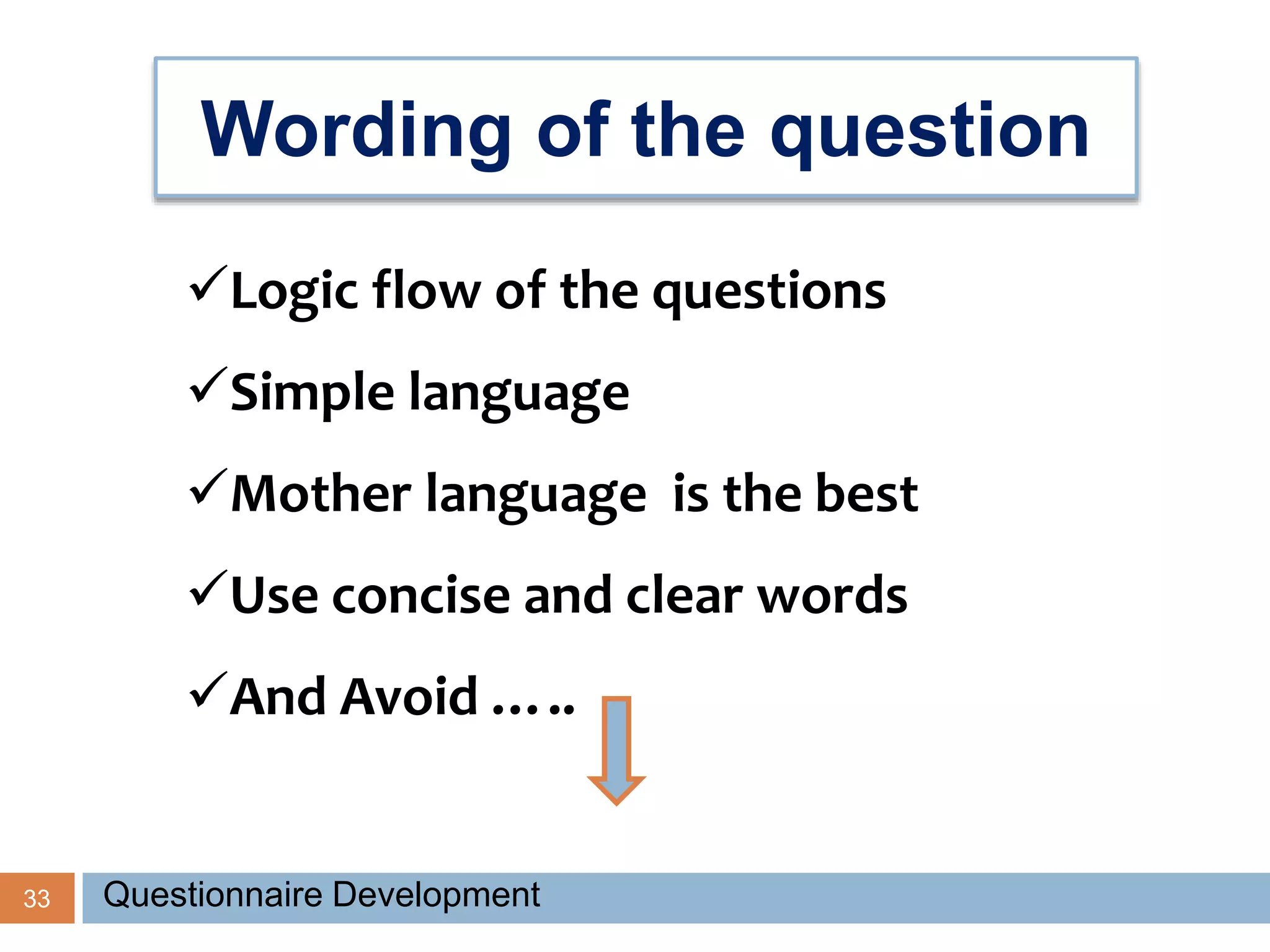
Wording of the question
Logic flow of the questions
Simple language
Mother language is the best
Use concise and clear words
And Avoid …..
34
Avoid
Questionnaire Development
35
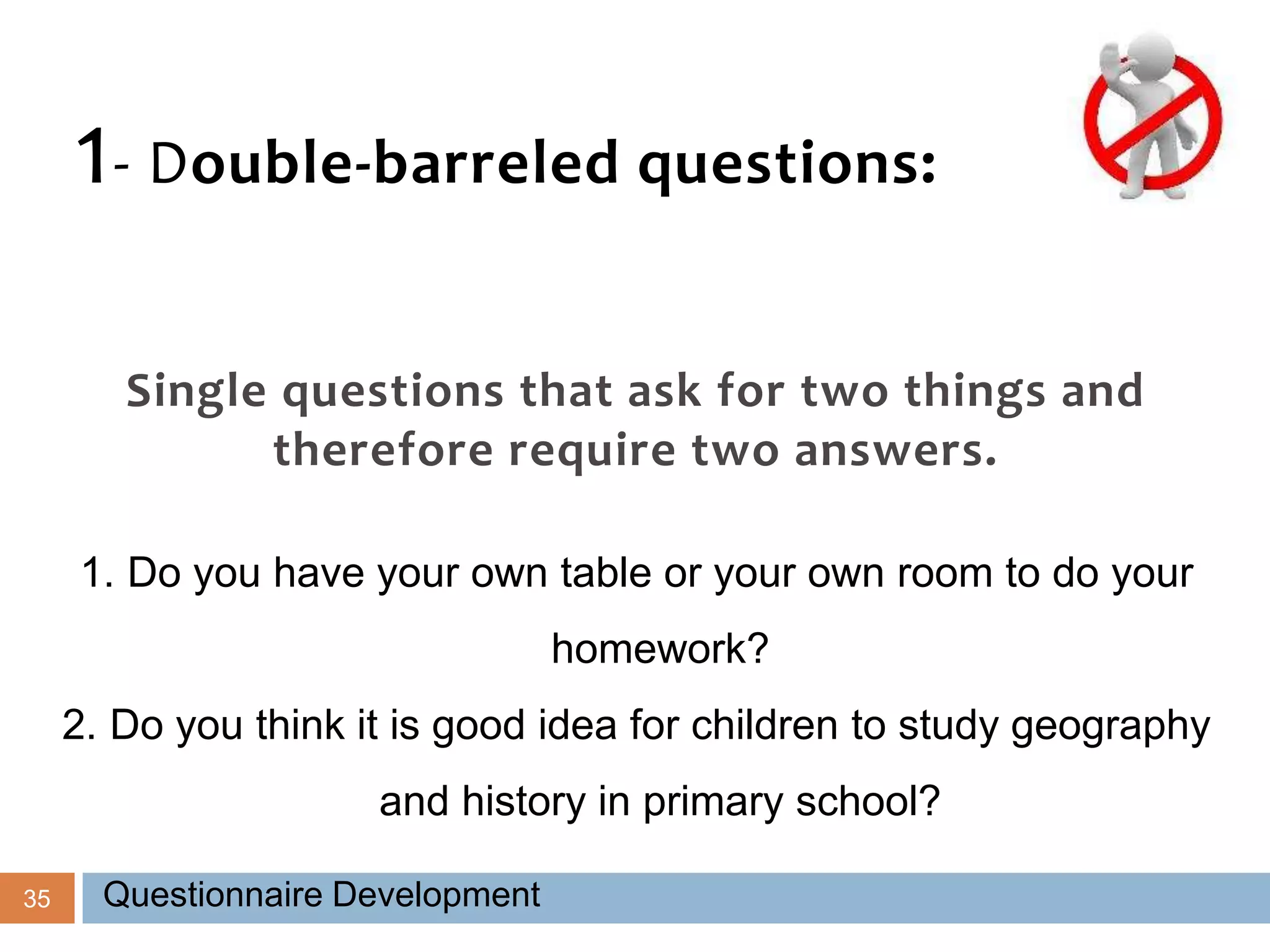
1- Double-barreled questions:
Single questions that ask for two things and
therefore require two answers.
1. Do you have your own table or your own room to do your
homework?
2. Do you think it is good idea for children to study geography
and history in primary school?
Questionnaire Development
36
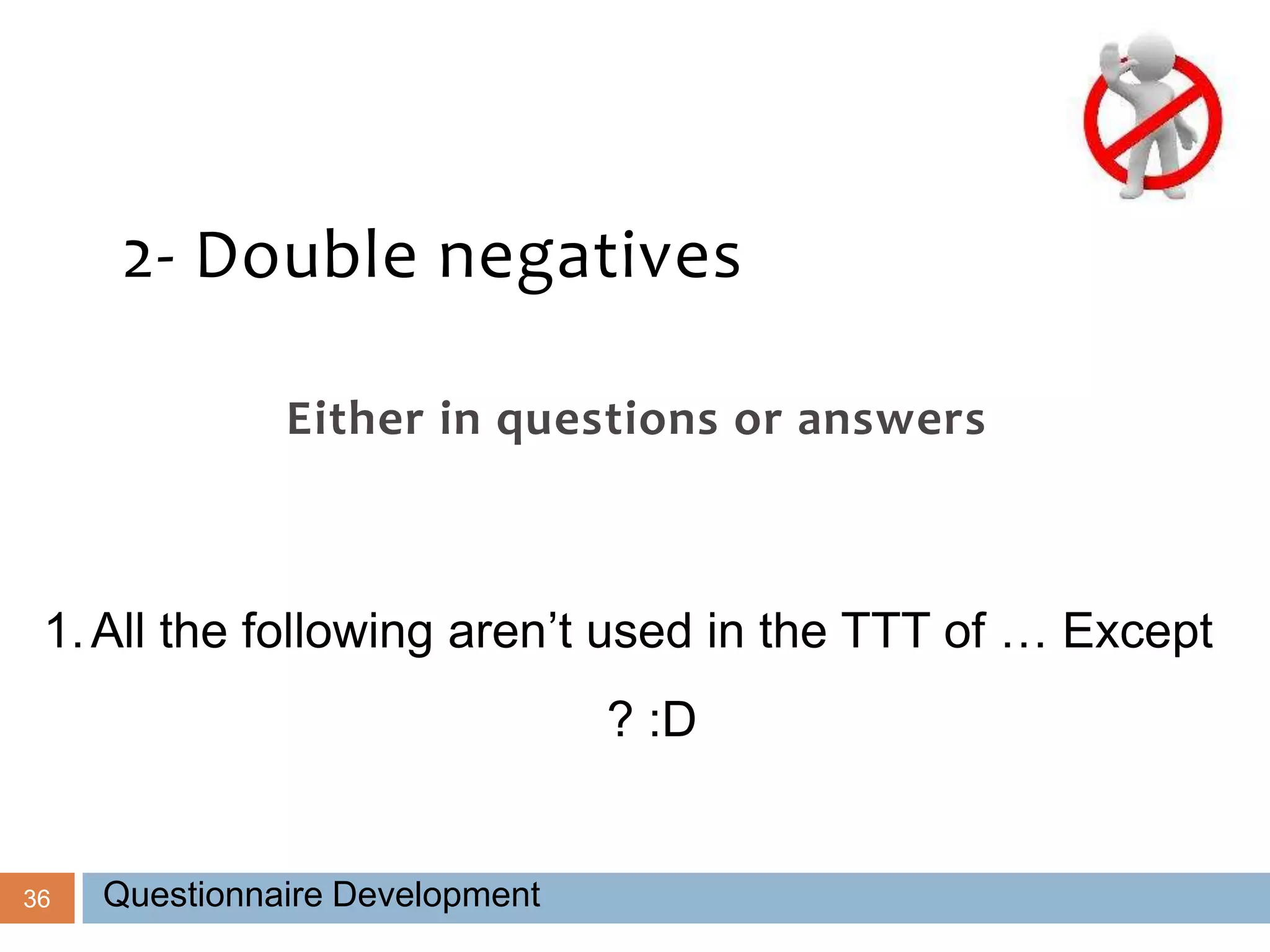
2- Double negatives
Either in questions or answers
1.All the following aren’t used in the TTT of … Except
? :D
Questionnaire Development
37
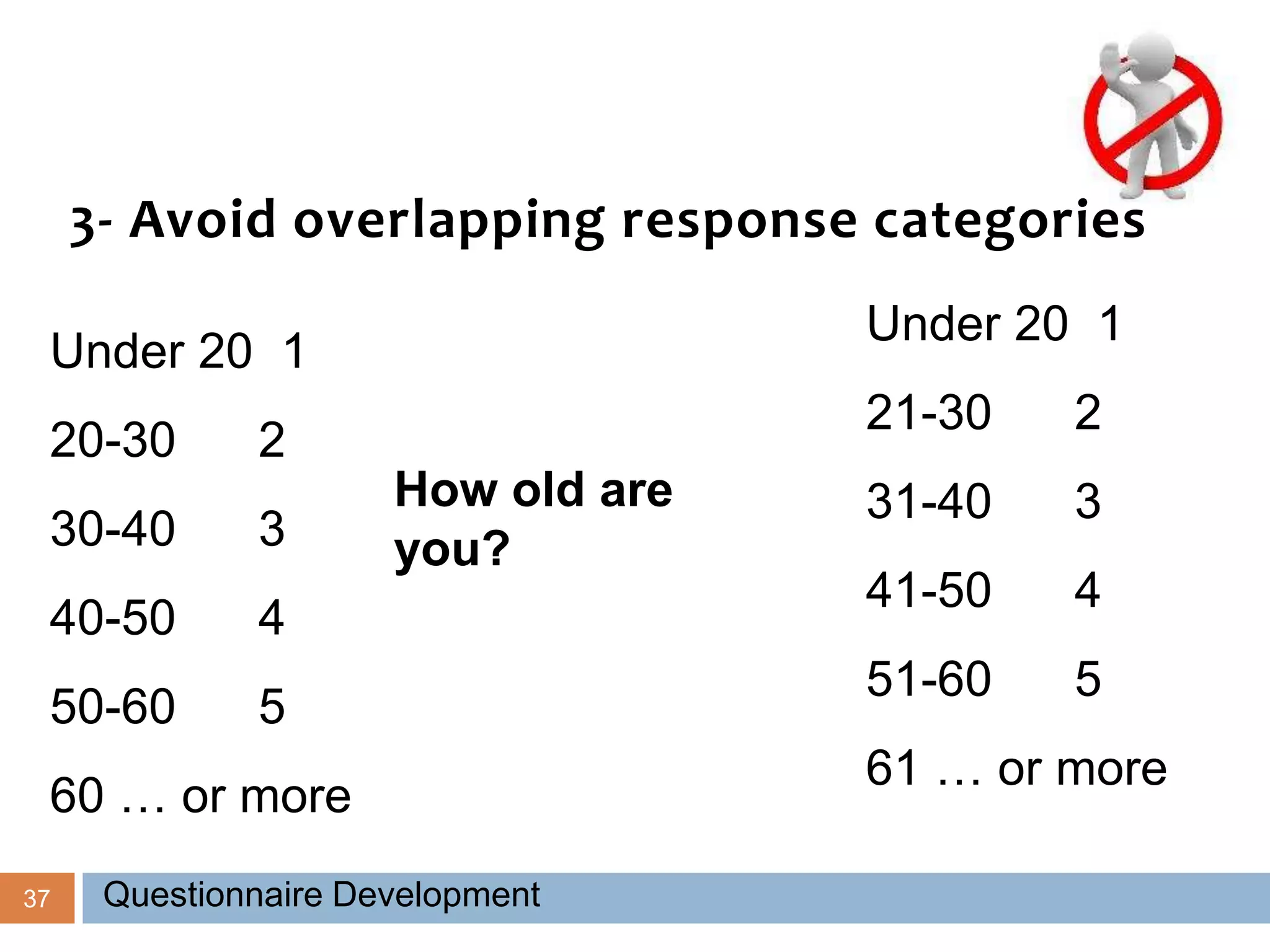
3- Avoid overlapping response categories
Under 20 1
20-30 2
30-40 3
40-50 4
50-60 5
60 … or more
How old are
you?
Under 20 1
21-30 2
31-40 3
41-50 4
51-60 5
61 … or more
Questionnaire Development
38
4- Leading questions
Would you say that you are not in favour of school
on Saturday morning??
Questionnaire Development
39
5- Overload the respondent’s memory
Would you say that you are not in favour of school
on Saturday morning??
Questionnaire Development
40
6- Long questions
Generally, it is recommended to hold
questions to 25 words or less.
If a longer sentence is used then it should be
broken up so that there will be several shorter
sentences.
Questionnaire Development
41
Avoid
7- Hypothetical questions
• Prediction of behavior and future
• “Would you use this resource in your class
if it were available..?”
• People are generally poor predictors.
Questionnaire Development
A new
Draft
42 Questionnaire Development
Testing
44
1. Informal tests
2.Experts review
3.Small-scale tests (pre test)
4.Functional or technical testing
5.Large-scale pilots and trials
Testing
45
1.Informal tests
Testing
A new
Draft
46 Questionnaire Development
47
1. …..
2. Experts review
Testing
A new
Draft
48 Questionnaire Development
49
Pre-pilot
Focusing
group
Pre-testing the
questionnaire
Questionnaire Development
50
Aims
Pre-testing the
questionnaire
Questionnaire Development
51
a. Is each item producing the kind of
information needed?
b. What role is the item going to play in the
proposed analysis?
c. Are the questions meaningful to the
respondents?
d. Are respondents easily able to understand
the items?
e. Can respondents use the response format
for each item?
Questionnaire Development
52
g. Was the question order logical and did the
interview flow smoothly?
h. Did some parts of the questionnaire arouse
suspicion?
I. Did other parts of the questionnaire seem
repetitive or boring?
j. Were interviewers able to read the questions
without difficulty?
k. Were respondents able to follow all
instructions?
l. Was the questionnaire too long?
Questionnaire Development
53
Select a sample similar in socio-economic
background and geographic location to the one
that will be used in the main study.
This sample will not be included in the final
survey.
 Not to be a convenience sample.
Character Of this group:
Questionnaire Development
A new
Draft
54 Questionnaire Development
55
1. ……
2.……
3. ……
4.Functional or technical testing
Testing
A new
Draft
56 Questionnaire Development
57
1. …….
2. …….
3. …….
4. …….
5.Large-scale pilots and trials
Testing
A new
Draft
58 Questionnaire Development
Reliability and validity
59
Validity: Concerns the degree to which a
question measures what it was intended to
measure and not something else.
• Content (or face) validity
• Empirical (or predictive) validity
• Concurrent validity
Questionnaire Development
60
Reliability: concerns the consistency of a
measure. That is, the tendency to obtain the same
results if the measure was to be repeated by using the
same subjects under the same conditions.
Kappa coefficient !
Questionnaire Development
61
Covering letters and
introductory paragraphs
 You must explain the objectives of the
survey,
 In an interview, one of the tasks of the
interviewer is to persuade the respondent to
co-operate.
 In a self-administered questionnaire, the
covering letter is the only instrument forQuestionnaire Development
62
 Identify the organization conducting the study.
 Explain the purpose of the study.
 Assure the respondent that information provided will
be managed in a strictly confidential manner.
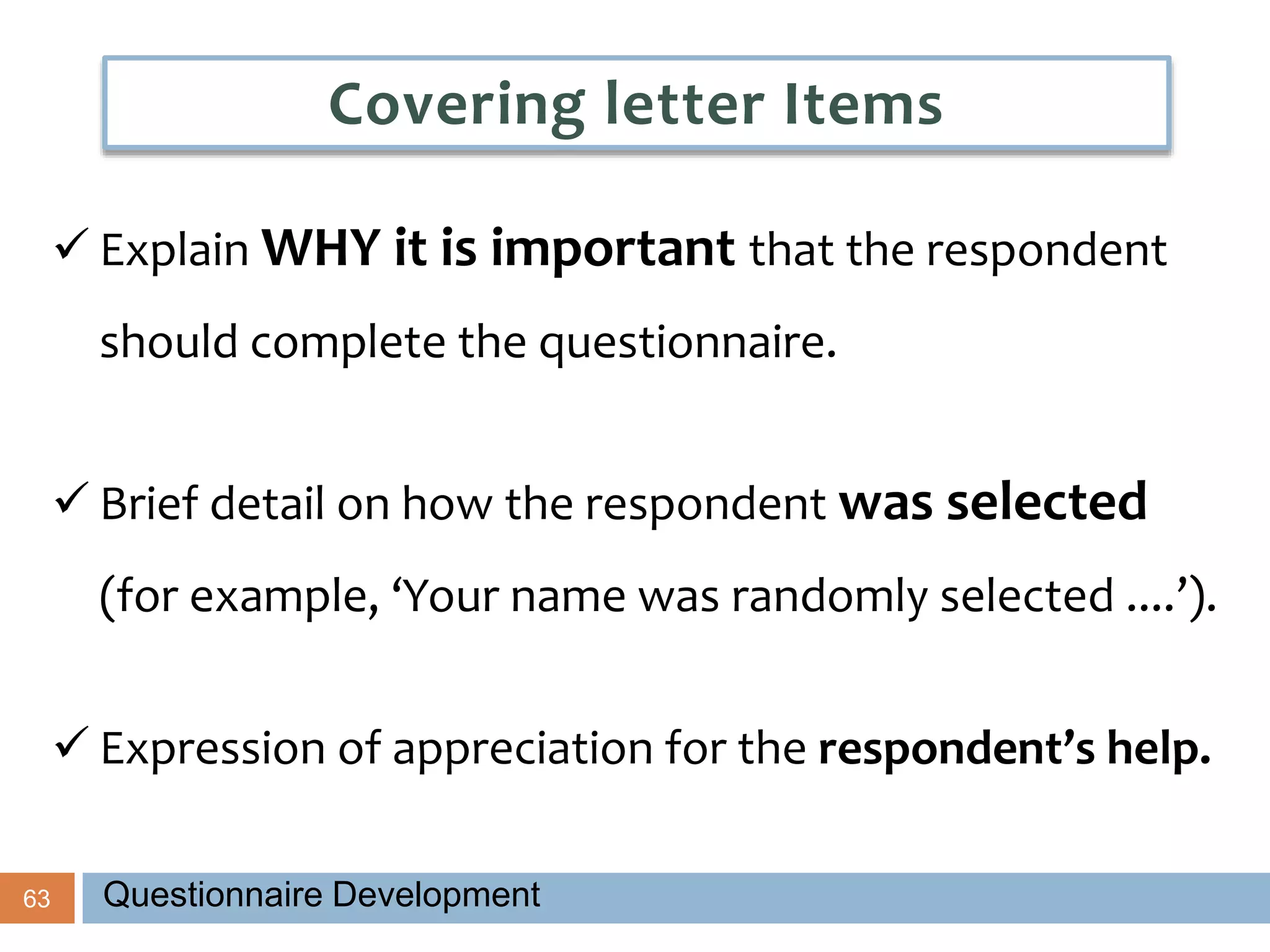
Covering letter Items
Questionnaire Development
63
 Explain WHY it is important that the respondent
should complete the questionnaire.
 Brief detail on how the respondent was selected
(for example, ‘Your name was randomly selected ....’).
 Expression of appreciation for the respondent’s help.
Covering letter Items
Questionnaire Development
64
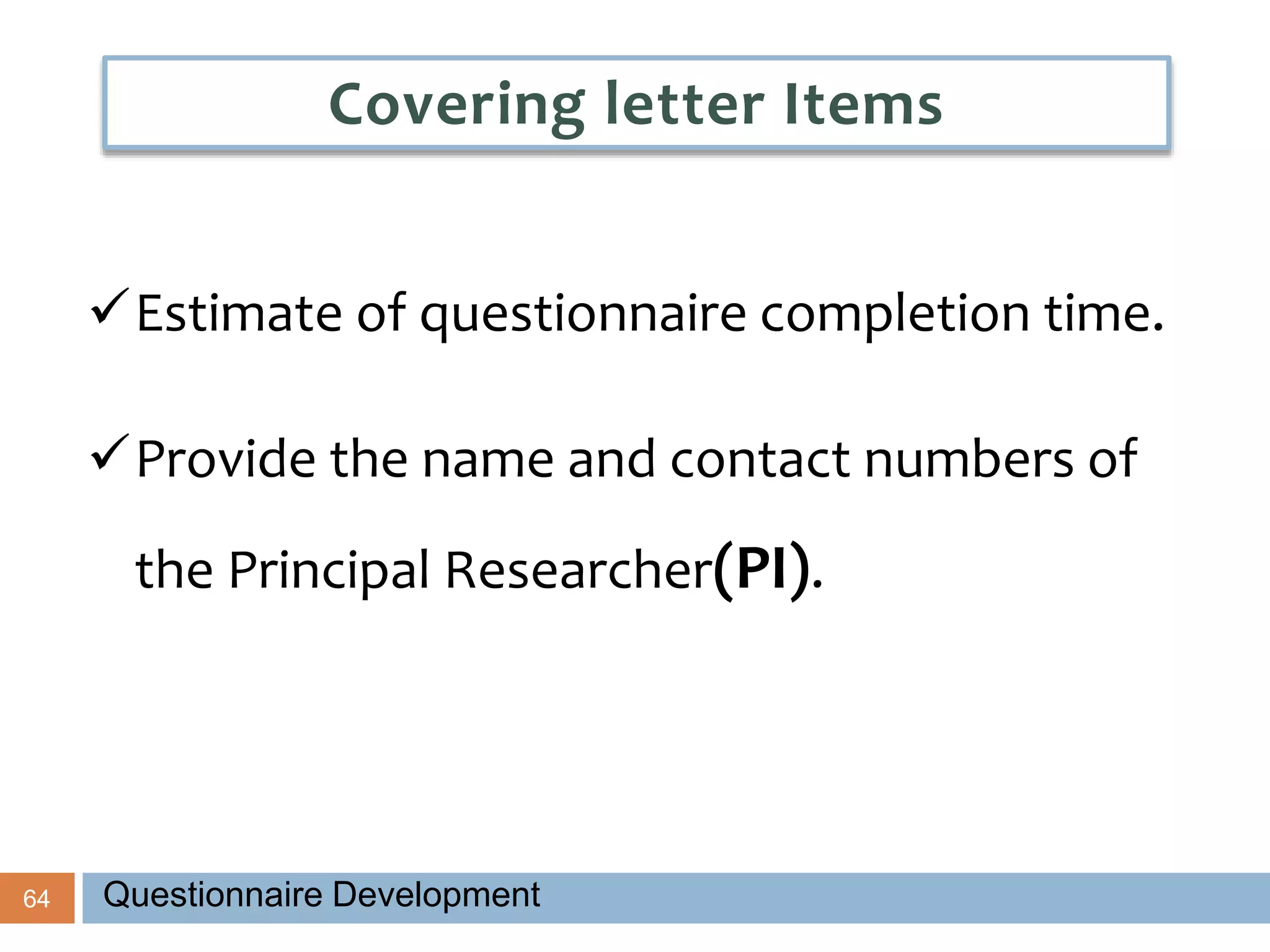
Estimate of questionnaire completion time.
Provide the name and contact numbers of
the Principal Researcher(PI).
Covering letter Items
Questionnaire Development
 k.elghanam@med.menofia.ed
u.eg
 01068950053
 FB: Karim Elghanam
Contact Me65
Hope Happiness finds you when you don’t Expect to find it
.

Questionnaire design and validation

  • 1.
    Karim Elghanam Faculty ofMedicine, Menoufia University k.elghanam@med.menofia.edu.eg September 15, 2015 Questionnaire Development & Validation
  • 2.
    2 What’s the Q.? Isa formalized set of questions to obtain certain information from certain respondents. Questionnaire Development
  • 3.
    3 Developing a goodquestionnaire is NOT EASY! • It takes time, time, and more time. • You may end up writing multiple drafts. • It helps to work with others when developing a questionnaire.Questionnaire Development
  • 4.
    Some Definitions Before Starting 4Questionnaire Development
  • 5.
    5 Types of Q.? 1-Self- administrated • Computer assisted and Web-based • Paper and pencil 2- Interviewer- administrated • Face to face • Telephone Questionnaire Development
  • 6.
    6 • Self-administered questionnaire Advantages:  Cheapand easy to administer  Preserves confidentiality  Completed at any time  No influence by interviewer  Allow for instant data coding Questionnaire Development
  • 7.
    7 • Self-administered questionnaire Disadvantages:  Lowresponse rate  Questions can be misunderstood  No control by interviewer Questionnaire Development
  • 8.
    8 • Interview-administered Q. Advantages: Participation of illiterate people  Clarification of ambiguity  Quick answers Questionnaire Development
  • 9.
    9 • Interview-administered Q. Disadvantages: Interviewer bias  Needs more resources  Only short questionnaires possible especially on telephone  Difficult for sensitive issues Questionnaire Development
  • 10.
  • 11.
    1- Formulations ofidea (Conceptualization) 11 Questionnaire Development Clear Idea Clear objectives ( primary and secondary objectives ) You will be Strict to them.
  • 12.
    Home Message “Ask whatyou want to know, not something else” (Bradburn, 2004)
  • 13.
    2- Literature Review 13Questionnaire Development Asking others for their own questionnaires !
  • 14.
    3- First draft 14Questionnaire Development Ideas Roadmap and the begin to change theses idea to questions Idea Question/s
  • 15.
  • 16.
    4- Condensed Literature Review..! 16Questionnaire Development Another draft more specific than the first one
  • 17.
  • 18.
    5- Detect ..? 18 Questionnaire Development 1. Study design 2. Population 3. Sample size 4. Type of the Q. will you use ?
  • 19.
  • 20.
    20 Types of questions? 1- Open-ended question 2- Closed-ended question 3- Contingency questions. Questionnaire Development
  • 21.
    21 1- Closed questions Youask the respondent to choose, among a possible number of answers, the response that most closely represents his/her viewpoint. Questionnaire Development
  • 22.
    22 Advantages of closedquestion • The respondent is restricted to a certain set of responses, • They are easy to answer ( no hesitations ), • Less time consuming, • Easy to code, and Questionnaire Development
  • 23.
    23  You willforce the respondent to choose between specific answers … BIAS  You offer answers that otherwise would not have come to his mind,  They don’t allow for creativity and generating ideas, Disadvantages of closed question Questionnaire Development
  • 24.
    24 They do notpermit the respondent to qualify the chosen response or express a more complex or subtle meaning, There is may a tendency for the respondent to tick systematically either the first or last answer, May Select what may be considered as the most socially desirable response, Disadvantages of closed question Questionnaire Development
  • 25.
    25 To answer allitems in a list in the same way Disadvantages of closed question Questionnaire Development
  • 26.
    26 2- Open-ended questions Free-responsequestions are not followed by any choices and the respondent must answer by supplying a response, usually by entering a number, a word, or a short text. Questionnaire Development
  • 27.
    27 Advantages of open-ended They allow respondents to express their ideas spontaneously in their own language.  They are less likely to guide the answer than closed questions .  They can add new information when there is very little existing information available about a topic. Questionnaire Development
  • 28.
    28  They maybe difficult to answer  They require effort and time from the respondent,  They require the development of a system of coded categories with which to classify the responses..!  Can’t be coded ! Disadvantages of open- ended Questionnaire Development
  • 29.
    29  They requirethe respondent to have some degree of writing ability Disadvantages of open- ended Questionnaire Development
  • 30.
    30 3- Contingency questions Isa special case of a closed-ended question because it applies only to a subgroup of respondents…! Questionnaire Development
  • 31.
    31 Questionnaire Development Typesof closed questions ? Scales ?
  • 32.
  • 33.
    33 Questionnaire Development Wordingof the question Logic flow of the questions Simple language Mother language is the best Use concise and clear words And Avoid …..
  • 34.
  • 35.
    35 1- Double-barreled questions: Singlequestions that ask for two things and therefore require two answers. 1. Do you have your own table or your own room to do your homework? 2. Do you think it is good idea for children to study geography and history in primary school? Questionnaire Development
  • 36.
    36 2- Double negatives Eitherin questions or answers 1.All the following aren’t used in the TTT of … Except ? :D Questionnaire Development
  • 37.
    37 3- Avoid overlappingresponse categories Under 20 1 20-30 2 30-40 3 40-50 4 50-60 5 60 … or more How old are you? Under 20 1 21-30 2 31-40 3 41-50 4 51-60 5 61 … or more Questionnaire Development
  • 38.
    38 4- Leading questions Wouldyou say that you are not in favour of school on Saturday morning?? Questionnaire Development
  • 39.
    39 5- Overload therespondent’s memory Would you say that you are not in favour of school on Saturday morning?? Questionnaire Development
  • 40.
    40 6- Long questions Generally,it is recommended to hold questions to 25 words or less. If a longer sentence is used then it should be broken up so that there will be several shorter sentences. Questionnaire Development
  • 41.
    41 Avoid 7- Hypothetical questions •Prediction of behavior and future • “Would you use this resource in your class if it were available..?” • People are generally poor predictors. Questionnaire Development
  • 42.
  • 43.
  • 44.
    44 1. Informal tests 2.Expertsreview 3.Small-scale tests (pre test) 4.Functional or technical testing 5.Large-scale pilots and trials Testing
  • 45.
  • 46.
  • 47.
    47 1. ….. 2. Expertsreview Testing
  • 48.
  • 49.
  • 50.
  • 51.
    51 a. Is eachitem producing the kind of information needed? b. What role is the item going to play in the proposed analysis? c. Are the questions meaningful to the respondents? d. Are respondents easily able to understand the items? e. Can respondents use the response format for each item? Questionnaire Development
  • 52.
    52 g. Was thequestion order logical and did the interview flow smoothly? h. Did some parts of the questionnaire arouse suspicion? I. Did other parts of the questionnaire seem repetitive or boring? j. Were interviewers able to read the questions without difficulty? k. Were respondents able to follow all instructions? l. Was the questionnaire too long? Questionnaire Development
  • 53.
    53 Select a samplesimilar in socio-economic background and geographic location to the one that will be used in the main study. This sample will not be included in the final survey.  Not to be a convenience sample. Character Of this group: Questionnaire Development
  • 54.
  • 55.
  • 56.
  • 57.
    57 1. ……. 2. ……. 3.……. 4. ……. 5.Large-scale pilots and trials Testing
  • 58.
  • 59.
    Reliability and validity 59 Validity:Concerns the degree to which a question measures what it was intended to measure and not something else. • Content (or face) validity • Empirical (or predictive) validity • Concurrent validity Questionnaire Development
  • 60.
    60 Reliability: concerns theconsistency of a measure. That is, the tendency to obtain the same results if the measure was to be repeated by using the same subjects under the same conditions. Kappa coefficient ! Questionnaire Development
  • 61.
    61 Covering letters and introductoryparagraphs  You must explain the objectives of the survey,  In an interview, one of the tasks of the interviewer is to persuade the respondent to co-operate.  In a self-administered questionnaire, the covering letter is the only instrument forQuestionnaire Development
  • 62.
    62  Identify theorganization conducting the study.  Explain the purpose of the study.  Assure the respondent that information provided will be managed in a strictly confidential manner. Covering letter Items Questionnaire Development
  • 63.
    63  Explain WHYit is important that the respondent should complete the questionnaire.  Brief detail on how the respondent was selected (for example, ‘Your name was randomly selected ....’).  Expression of appreciation for the respondent’s help. Covering letter Items Questionnaire Development
  • 64.
    64 Estimate of questionnairecompletion time. Provide the name and contact numbers of the Principal Researcher(PI). Covering letter Items Questionnaire Development
  • 65.
     k.elghanam@med.menofia.ed u.eg  01068950053 FB: Karim Elghanam Contact Me65 Hope Happiness finds you when you don’t Expect to find it .