This document discusses various methods and techniques for collecting data. It begins by defining data collection as the process of gathering quantitative and qualitative information on variables to evaluate outcomes. Some key methods covered include interviews, questionnaires, observation, and record analysis. The document provides details on each method, including their purposes, advantages, disadvantages, and specific tools or techniques used. It emphasizes that the appropriate data collection method depends on factors like the study topic, sample size, and available resources.
Introduces data collection processes and methods, defining data types and their roles in research.
Details methods of data collection (interviews, surveys, observations) and various sources including historical data.
Describes various data collection techniques and tools, including methods suited for specific research needs.
Discusses the use of records as data sources, outlining advantages and drawbacks for researchers.
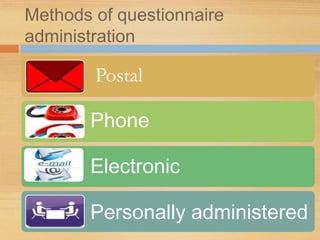
Defines questionnaires, their advantages, and potential downsides for effective data collection.Details the types of questionnaires (open vs. closed-ended) and administration methods for effective usage.
Guidelines for writing clear, unbiased, and effective questionnaire items to enhance validity.
Explains interviewing as a common qualitative method, types of interviews, and conducting interviews effectively.Details observational techniques, types, advantages, and limitations for data gathering in research.
Describes rating scales usage in research, their types, advantages, and challenges in data evaluation.
Explains Likert scales in quantitative research, their advantages, and limitations for measuring attitudes.Uses and construction of checklists for performance evaluation, including benefits and limitations.
Highlights biophysiological methods in nursing research, their purpose, advantages, and challenges of use.
Introduction to projective techniques and vignettes as qualitative tools for eliciting participant responses.Describes the importance of pilot studies in testing research methods and enhancing study design quality.Acknowledgment and references for further reading on nursing research topics.
Introduction
Data arethe observable and measurable facts
that provide information about the
phenomenon under study
Primary and secondary data
Data collection is the process of gathering
quantitative and qualitative information on
specific variables with the aim of evaluating
outcomes
3.
CONCEPT
• Data collectioninvolves gathering relevant data in
order to achieve an answer to the problem stated.
• Data collection is the process of gathering and
measuring information on variables of interest, in
an established systematic fashion that enables
one to answer stated research questions, test
hypotheses, and evaluate outcomes.
• There are various methods of data collection
which can be used by the investigator depending
upon the nature of study undertaken.
4.
Interview
Questioning
Observation
Bio physiological measurements
Psychosocial measurement scales
Record analysis
5.
PURPOSES OF DATACOLLECTION
reliable,
identify variables/facts
measure variable/ phenomena
describe behaviour
obtain empirical evidence (objective,
valid)
Data is meaningless as by itself it does not
explain or cause change, information does.
Therefore, the aim of gathering and summarizing
data is to transform this into information in order to:
6.
FIVE ‘W’s OFDATACOLLECTION
What data to collect? (Consideration on type of
data)
From whom data is to be collected
Who will collect data
From where the data will be collected
When is the data to be collected
7.
SOURCES OF DATA
Documentary- primary and secondary
Field sources
Include living persons who have a fund of
knowledge about or have been in intimate contact
with social conditions and changes over a
considerable period of time.
These people are in a position to describe not only
the existing state of affairs but also the observable
trends and significant milestones in a social
process.
8.
HISTORICAL DATA
Theseconsist of documents and various
historical sources to which the historian himself
has access.
Materials of cultural history and analytical
history.
Personal sources of authentic observers and
witnesses.
These can be oral, written evidence, artifacts
etc.
14.
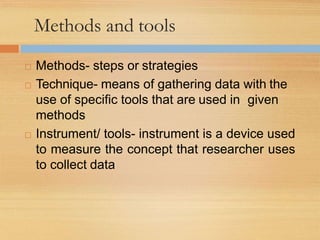
Methods and tools
Methods- steps or strategies
Technique- means of gathering data with the
use of specific tools that are used in given
methods
Instrument/ tools- instrument is a device used
to measure the concept that researcher uses
to collect data
15.
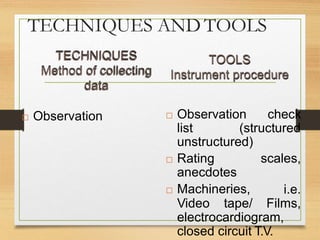
TECHNIQUES AND TOOLS
scales,Rating
anecdotes
Machineries, i.e.
Video tape/ Films,
electrocardiogram,
closed circuit T.V.
TOOLS
Instrument procedure
Observation check
list (structured
unstructured)
TECHNIQUES
Method of collecting
data
Observation
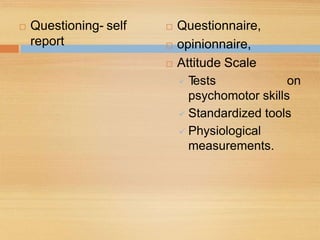
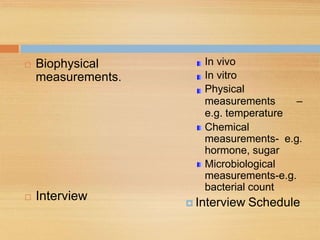
Biophysical
measurements.
Interview
Invivo
In vitro
Physical
measurements –
e.g. temperature
Chemical
measurements- e.g.
hormone, sugar
Microbiological
measurements-e.g.
bacterial count
Interview Schedule
18.
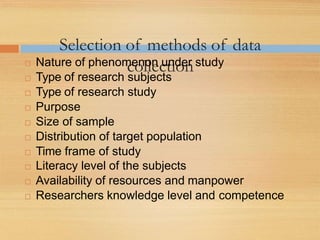
Selection of methodsof data
collection Nature of phenomenon under study
Type of research subjects
Type of research study
Purpose
Size of sample
Distribution of target population
Time frame of study
Literacy level of the subjects
Availability of resources and manpower
Researchers knowledge level and competence
19.
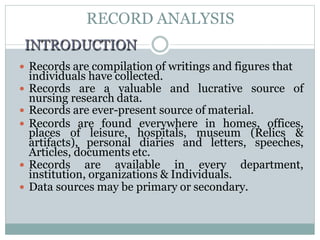
RECORD ANALYSIS
Recordsare a valuable and lucrative source of
nursing research data.
Records are ever-present source of material.
Records are found everywhere in homes, offices,
places of leisure, hospitals, museum (Relics &
artifacts), personal diaries and letters, speeches,
Articles, documents etc.
Records are available in every department,
institution, organizations & Individuals.
Data sources may be primary or secondary.
INTRODUCTION
Records are compilation of writings and figures that
individuals have collected.
20.
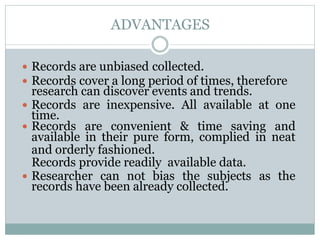
ADVANTAGES
Records areunbiased collected.
Records cover a long period of times, therefore
research can discover events and trends.
Records are inexpensive. All available at one
time.
Records are convenient & time saving and
available in their pure form, complied in neat
and orderly fashioned.
Records provide readily available data.
Researcher can not bias the subjects as the
records have been already collected.
21.
DISADVANTAGES
Amount ofinformation is limited to what is
available. Researcher can not get more data as
subjects are not present. If record is incomplete,
no way to complete it.
No one sure under which conditions data were
collected. Was more than one person involved in
compilation? How careful they were to handle
facts & figures.
No assurance of accuracy of the records,
People who presented the original records were
not aware whether it would be used for research.
Therefore, researcher has to admit any error into
the study that was built in the original records.
22.
PROBLEMS
Permission hasto be sought from concerned
People to study records.
Difficult to trace if not kept in order & well
organised.
Authorities/ Concerned people/ Officer may not
like their records to be disturbed for the fear of
misplacing, pulling out information (loss of
paper from files)
Organisation/ Institution may not like anyone to
go through their pvt. Files other than selected
individuals.
23.
QUESTIONNAIRE
Most commonresearch instrument
It is a paper-pencil approach to data collection
Comprised of a series of questions that are filled
in by all subjects in the sample.
May be distributed to subjects in the classroom,
on the streets, on campus, home or at work;
Can be mailed to those who live in a large
geographical area as it is expensive and time
consuming to reach individuals directly.
24.
ADVANTAGES
Relatively simplemethod of collecting data.
Items can be constructed easily by beginning
researcher.
Rapid and efficient method of gathering data
Collect data from a widely scattered
population
Inexpensive to distribute
Easy to tabulate data from close ended items
Respondents can remain anonymous
Simple procedure to explore a new topic
Easiest tool to test for validity & reliability
25.
DISADVANTAGES
Inability toprobe a topic in-depth unless the
questionnaire is lengthy.
Respondents may omit or disregard any item
that they choose without giving any explanation
response that are not their actual
Some items may force subjects to choose
Choice
Some items may be misunderstood.
Questionnaire use limited to literate.
Printing may be costly if questionnaire
Subjects can express their views/opinions better
while speaking than writing.
Close Ended
Afterquestions respondents are given a number
of alternatives to either mark a “Yes” or “No”,
check an item from list of suggested responses.
Items may be forced choice type e.g.
Do you still beat your wife? “Yes”
Advantage : Easy to fill, tabulate, analyze and
data suited many statistical analysis.
Disadvantage: Limited to specific topic to be
answered in a specific way.
28.
Open Ended Questions
Have no choices from which respondents
select their response. Respondent must
“Create” their response.
Example: Why did you choose to take your
graduate work at this university?
Advantage : Stimulate thought, solicit
suggestions, probe people’s memories.
29.
Disadvantage: Not suitedfor mailed
questionnaire
- Difficult to construct meaningful variables
for statistical analysis.
- Analysis is often problematic and time
consuming
Writing Good Questions
Use words that are simple, direct and familiar to all.
Question – Clear and Specific
Define or quality the term that can be easily be
misinterpreted.
Avoid double barreled questions.
Do you think that students should have more classes
about history and culture?
Beware of double negatives (Are you against not
allowing nurses to strike?)
Underline a word if you wish to indicate special
emphasis.
e.g. should all schools offer a modern foreign
language?
32.
Avoid questionsthat are leading or suggest the
expected answer.
e.g. you don’t approve of strikes, do you?
Be sure alternatives are enough and
appropriate.
Reason for asking personal question should be
given.
Problem words – lead to confusion in subject’s
mind.
e.g. How many patients did you care for last
week?
33.
Interview – Techniqueof Data Collection
• Second most common method of data collection
• Face to face interpersonal role situation.
• Interview schedule – structured, semi-
structured, unstructured.
• Interview schedule is an oral questionnaire that
is read to the respondent by the researcher
whereas interview guide provides ideas but
allows the interviewer freedom to pursue topics
in depth.
• Interviewer has an ability to control over the
level of questioning
34.
Conducting the Interview
•Interviews can be conducted by
Face to face meeting
Telephonically
Video-recording
• Conduct in a quiet peaceful atmosphere
• Subject to be seated in a comfortable position
• Subject should be informed before hand as to
how much time interview will take.
35.
Advantages
• Data fromeach interview are usable, whereas
not true for each questionnaire returned.
• In-depth data can be obtained, since researcher
can pursue any question of special interest.
• Interview offers protection against ambiguous or
confusing questions.
• Respondents are less likely to give “don’t know”
responses or leave a question unanswered
• Flexibility
• Permit greater control over the sample
36.
Disadvantages
• It istime consuming and costly
• Rapport and interpersonal relationships are
important aspect of this technique. Therefore,
element of bias can be from both interviewer
and interviewee.
• Interviewer usually has little or no choice in the
data or place of the interview
• Difficult to make a comparison of data collected
by one interviewer’s with another.
• Recording may be biased, incomplete or
selective
37.
Interviewing process
Preparationfor interview
Pre interview introduction
Developing rapport
Carrying the interviewforward
Recording the interview
Closing the interview
OBSERVATION TECHNIQUE
Itis one of the basic and oldest method to
gatherdata
Is systematically planned andrecorded.
It is a technique to acquire information
through occurrence that can be observed
through senses with or without mechanical
devices.
It is a two part process i.e. someone is
observing and there is something to observe
(observer; observed)
40.
Four Broad Questionsin observation
What should beobserved?
How should observation be recorded?
What procedures should be used to try to assure the
accuracy of observation?
What relationship should exist between the observer
and the observed, and how can such relationship be
established?
41.
Observation methods
Unstructuredobservation – is made to provide
as complete and non-selective a description as
possible of an event –or behaviour observed.
Techniques used for unstructured method of
observation :-
Participant observation – involves researcher
to participate in the functioning of social
group underinvestigation.
Researcher attempts not to interject his
views & meaning into the social situation
underobservation.
42.
Unstructured observation method
Provides rich and deep understanding of human
behaviour.
Observer bias and influence are prominent
difficulties
Memory distortions represent another possible
source of inaccuracy.
43.
Logs, Field Notes,Anecdotes
Logs – is a record of events & conversation,
maintained on dailybasis.
Field Notes – include daily log but tend to be
much broader, more analytic and include more
interpretation than mere listing of occurrences.
Essential to record simultaneously because of
memory failure.
Anecdotes – Focus on behaviour of particular
interest. Anecdote typically selects specific kind of
events and behaviours for observation before
hand. Observer objectively and accurately records
theobservation.
44.
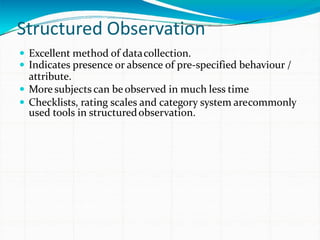
Structured Observation
Excellentmethod of datacollection.
Indicates presence or absence of pre-specified behaviour /
attribute.
More subjects can be observed in much less time
Checklists, rating scales and category system arecommonly
used tools in structuredobservation.
45.
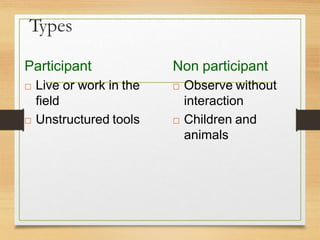
Types
Participant
Live orwork in the
field
Unstructured tools
Non participant
Observe without
interaction
Children and
animals
46.
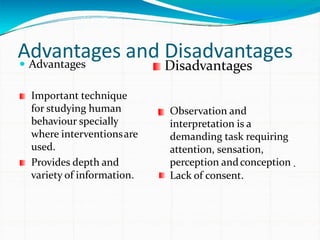
Advantages and DisadvantagesAdvantages Disadvantages
Important technique
for studying human
behaviour specially
where interventionsare
used.
Provides depth and
variety of information.
Observation and
interpretation is a
demanding task requiring
attention, sensation,
perception andconception
Lack of consent.
47.
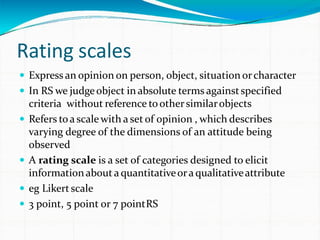
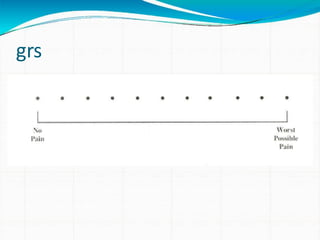
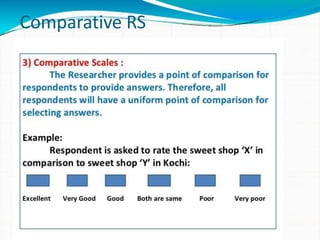
Rating scales
Expressan opinion on person, object, situation orcharacter
In RS we judgeobject in absolute terms againstspecified
criteria without reference toothersimilarobjects
Refers toa scale with a set of opinion , which describes
varying degree of the dimensions of an attitude being
observed
A rating scale is a set of categories designed to elicit
informationabout aquantitativeoraqualitativeattribute
eg Likertscale
3 point, 5 point or 7 pointRS
Adv
Easy toadminister andscore
Widely used in Nursingresearch
Easier to makeand less timeconsuming
Can be used fora largegroup
Also used in quantitativemethods
Evaluateskills
Adaptable and flexible
52.
Dis adv
Difficultanddangerous to fix rating about many
aspects of an individual
Misusecan result in decrease in objectivity
Chances of subjectivity- unscientific andunreliable
scales
53.
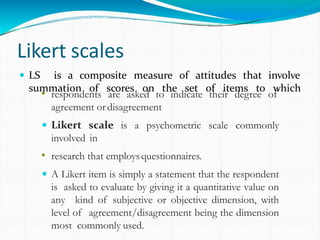
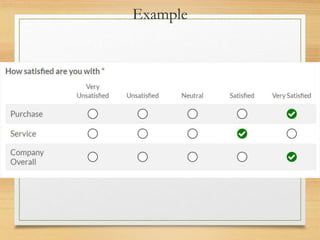
Likert scales
• respondentsare asked to indicate their degree of
agreement ordisagreement
Likert scale is a psychometric scale commonly
involved in
• research that employsquestionnaires.
A Likert item is simply a statement that the respondent
is asked to evaluate by giving it a quantitative value on
any kind of subjective or objective dimension, with
level of agreement/disagreement being the dimension
most commonly used.

LS is a composite measure of attitudes that involve
summation of scores on the set of items to which
Uses
Measureattitudes, valuesandfeelingsof peopleabout
specific concepts
Quantifying a qualitativeattribute
Opinionaboutan abstractconcept
56.
Adv
Easy toconstruct
More reliableand valid to measure psychosocial
variables
Easy toadministersince respondentsonly have to tick
Less timeconsuming forconstructionand
administration
57.
Dis adv
Forcedchoice
Real feelingsof the researchers may not beassessed
Difficulty in justifying the numberof categoriesand
numerical assignments to thesecategories
Casual approach can provide misleadingdata
58.
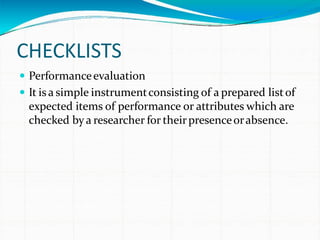
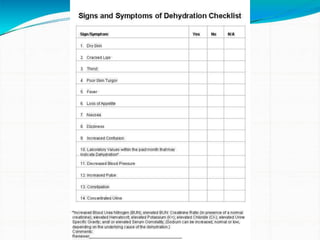
CHECKLISTS
Performanceevaluation
Itis a simple instrumentconsisting of a prepared listof
expected items of performance or attributes which are
checked bya researcher for theirpresenceorabsence.
60.
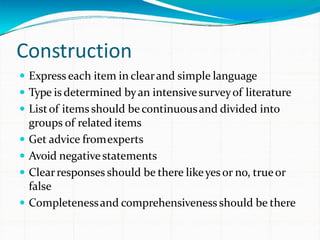
Construction
Express eachitem in clearand simple language
Type is determined byan intensivesurveyof literature
Listof items should becontinuousand divided into
groups of related items
Get advice fromexperts
Avoid negativestatements
Clearresponses should be there likeyesor no, trueor
false
Completenessand comprehensiveness should be there
61.
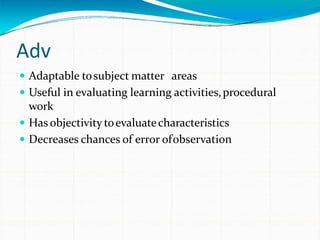
Adv
Adaptable tosubjectmatter areas
Useful in evaluating learning activities,procedural
work
Has objectivity toevaluatecharacteristics
Decreases chances of error ofobservation
62.
Dis adv
Doesnot indicate quality ofperformance
Limited use
Onlya limited componentof overall clinical
performance can beevaluated
Limited use in qualitativestudies
63.
Biophysiological methods
Purposes
Basic physiologywith relevance for nursing care
Ways that nursing actions or medicalinterventions
affect patient healthoutcomes
Evaluation of specific nursing proceduresor
interventions testing ahypothesis
Improving measurement and recording of bio
physiologic data collected byRN
Correlation of physiologic function in patientwith
health problems
64.
USE OF BIOPHYSIOLOGIC
MEASURESIN NURSING RESEARCH
Study of biophysiologicprocesses
Effect of nursing intervention on humanphysiological
process
Correlate physiologic functioning withhealth
outcomes
65.
Major types
Invivo
Measurements performed directlywith in oron living
organisms themselves
May use complex instrumentationsystem with
computers
May be simple – thermometer, pulseoximeter,
stethoscope
66.
In vitro
Measurements performed outside the organism’sbody
Specimens collected and tested outsidebody
Blood chemistries, microbiologic, cytologicspecimens
67.
ADVANTAGES
Accurate precise&sensitive
Objective
Instrumentused are valid and reliable
Biophysiologic measuresare notexpensive but there
can be expensivetests
68.
DISADVANTAGES
Interferences thatcreate artifacts inBiophysiologic
measures
High degree of interaction among themajor
Biophysiologicsystem
69.
Projective techniques
Rorschachinkblot test; thematic apperceptiontest
(tell a story based on a picture)
Eg
The associative imagery technique is aqualitative tool
with which researchers usecarefullyselected
photographs or images to trigger participants’
responses toexplaindifficult behavioural and social
concepts.
70.
Vignettes
Vignettes aresimulations of real events which can be
used in research studies to elicit subject's knowledge,
attitudesoropinionsaccording to how theystate they
would behave in the hypothetical situation depicted.
validity.
71.
Pilot study
Smallscale version or trial run designed to test the
methods to be used in a larger, more rigorousstudy
Purpose is topreventan expensive fiasco- that isa
costly but flawed large scalestudy
Called feasibilitystudies
72.
Functions
Adequacy ofstudy method andprocedures
Likelysuccessof a participant recruitmentstrategy
Appropriateness and quality of instruments-validity
and reliability of tools
Strengthof relationships between keyvariables so that
sample size can beestimated
Identification of confounding variables
Refine methodology
Plan for dataanalysis and interpretation