Normal Distribution and Hypothesis Testing  STR1K
 
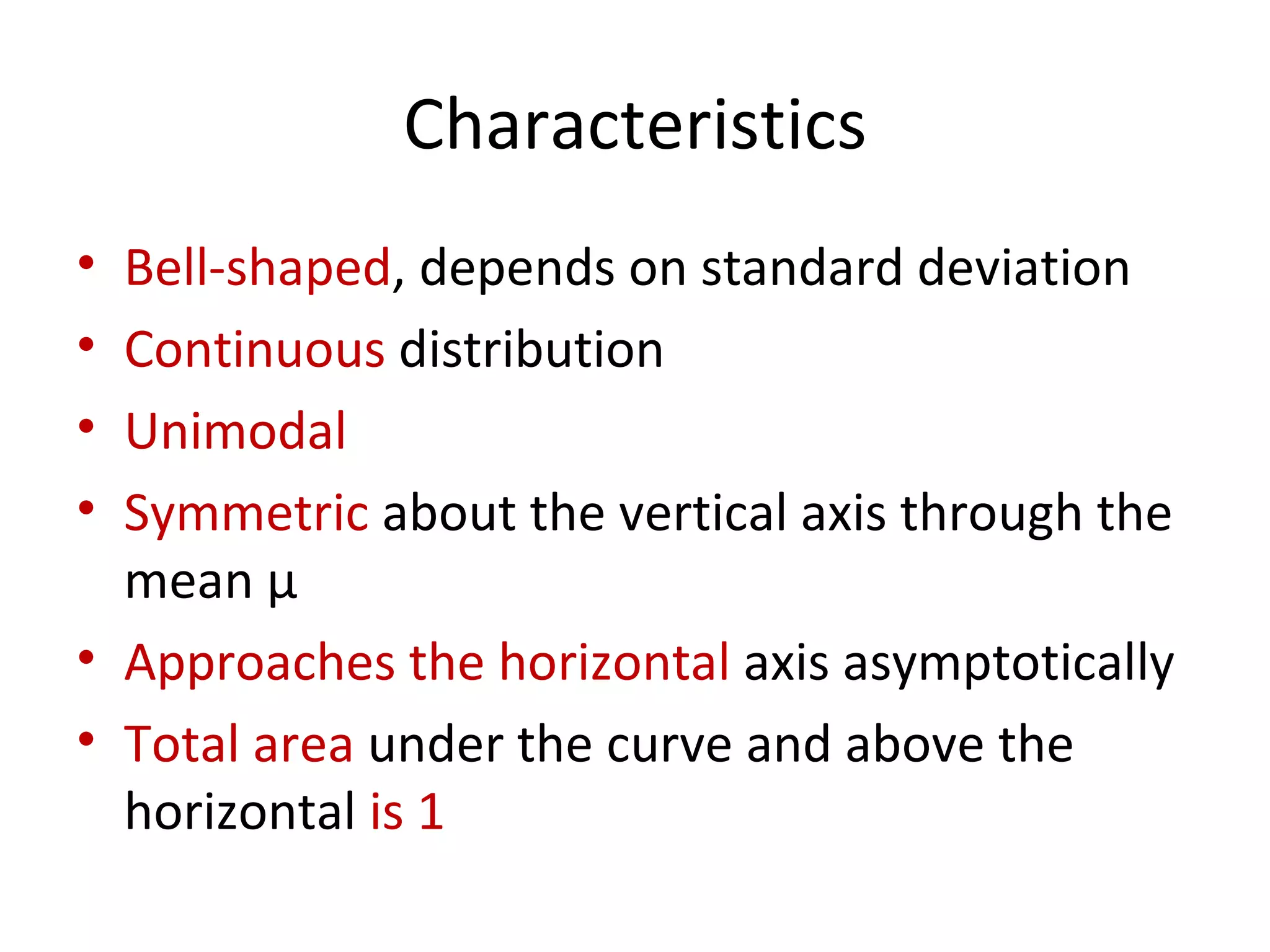
Characteristics Bell-shaped , depends on standard deviation Continuous  distribution Unimodal Symmetric  about the vertical axis through the mean  μ Approaches the horizontal  axis asymptotically Total area  under the curve and above the horizontal  is 1
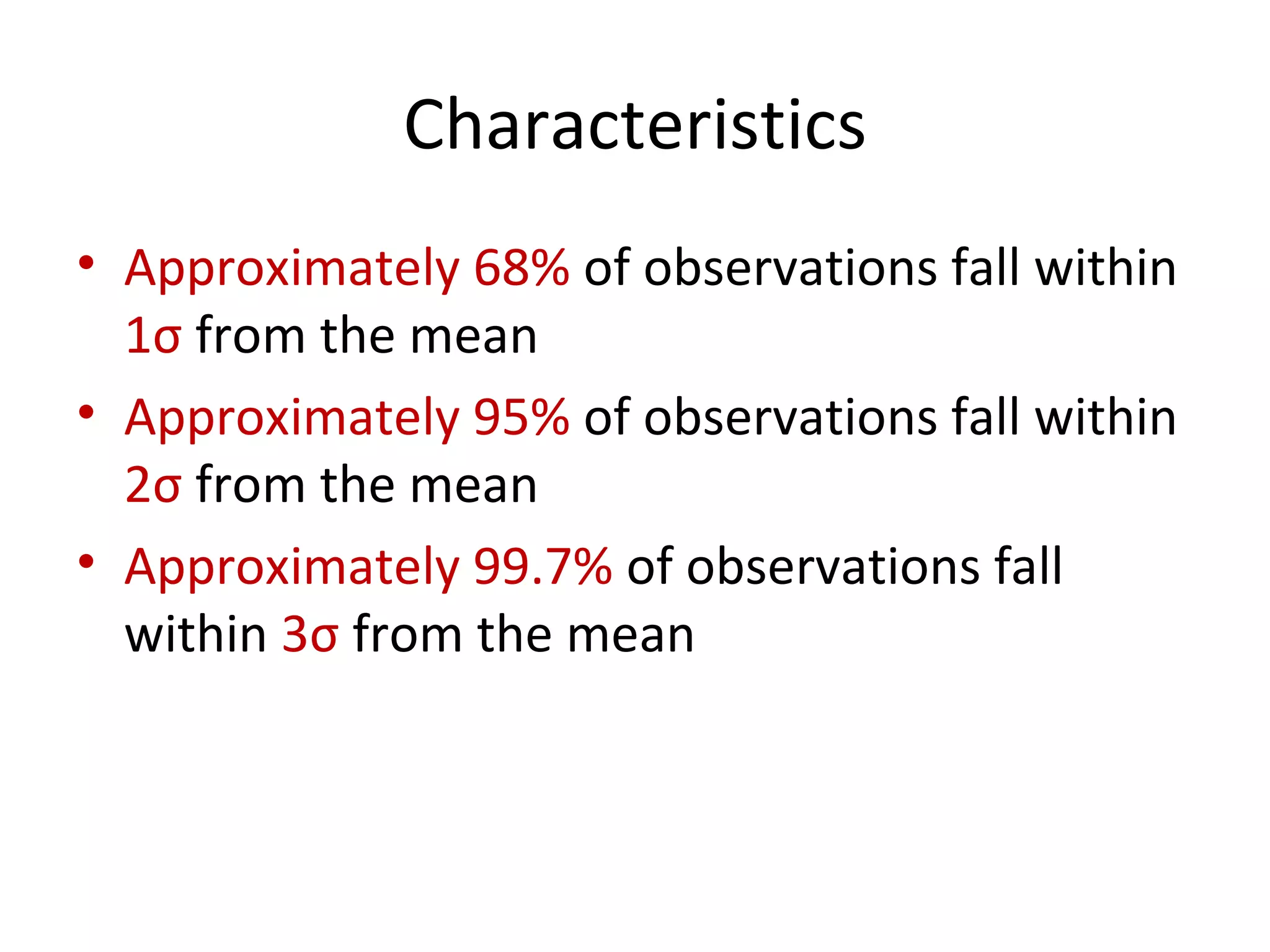
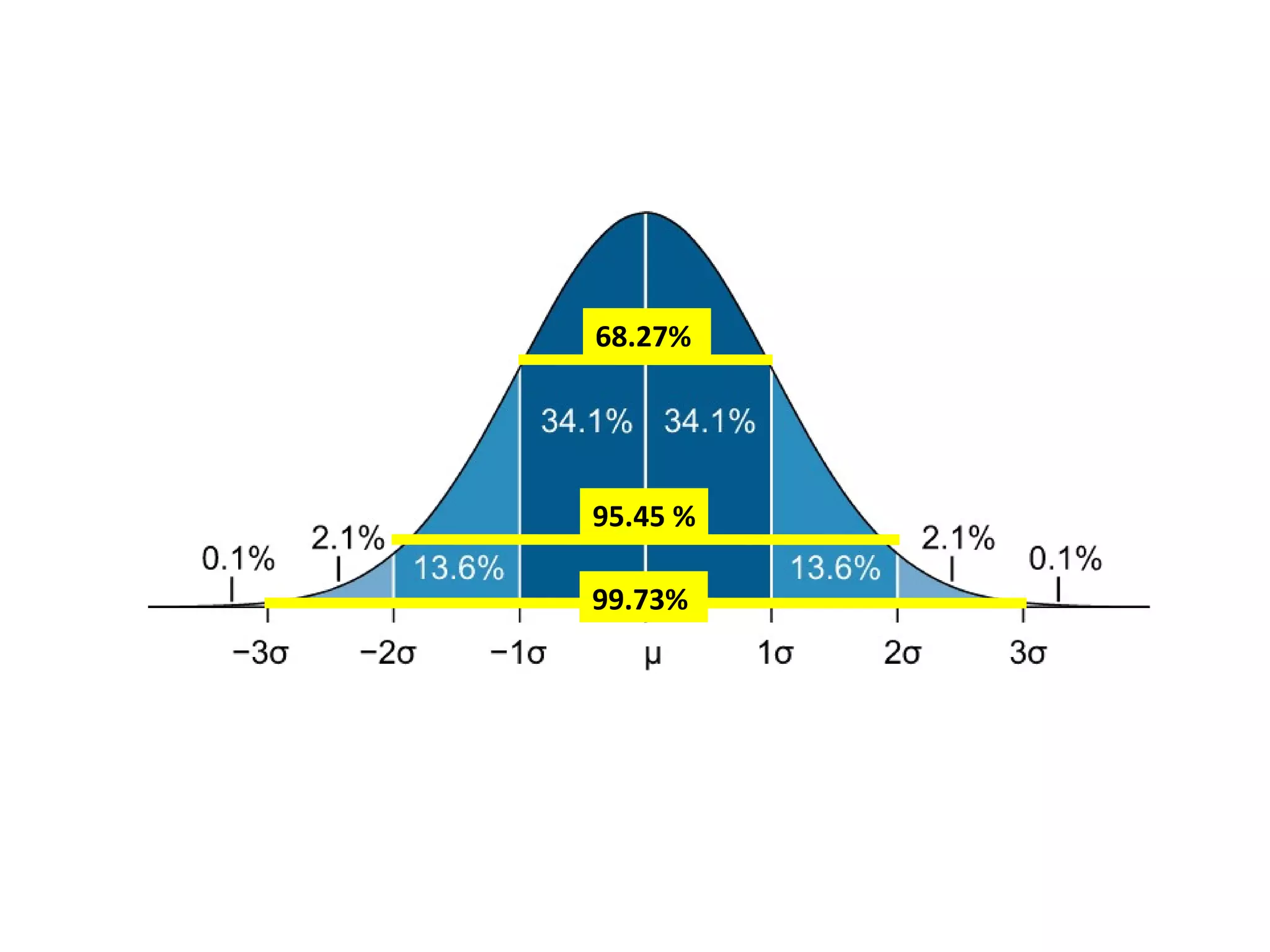
Characteristics Approximately 68%  of observations fall within  1 σ   from the mean Approximately 95%  of observations fall within  2 σ   from the mean Approximately 99.7%  of observations fall within  3 σ   from the mean
68.27%  95.45 % 99.73%
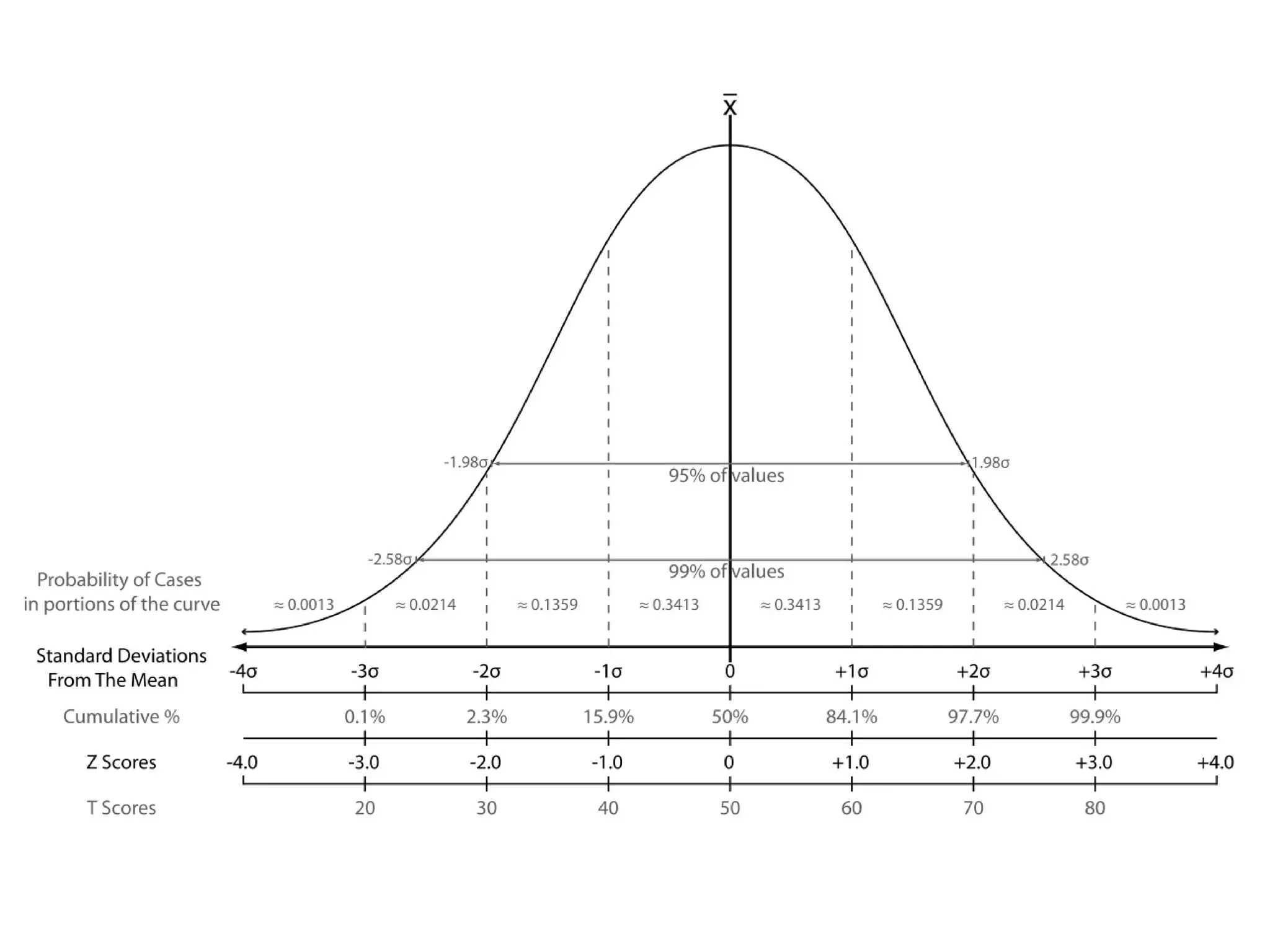
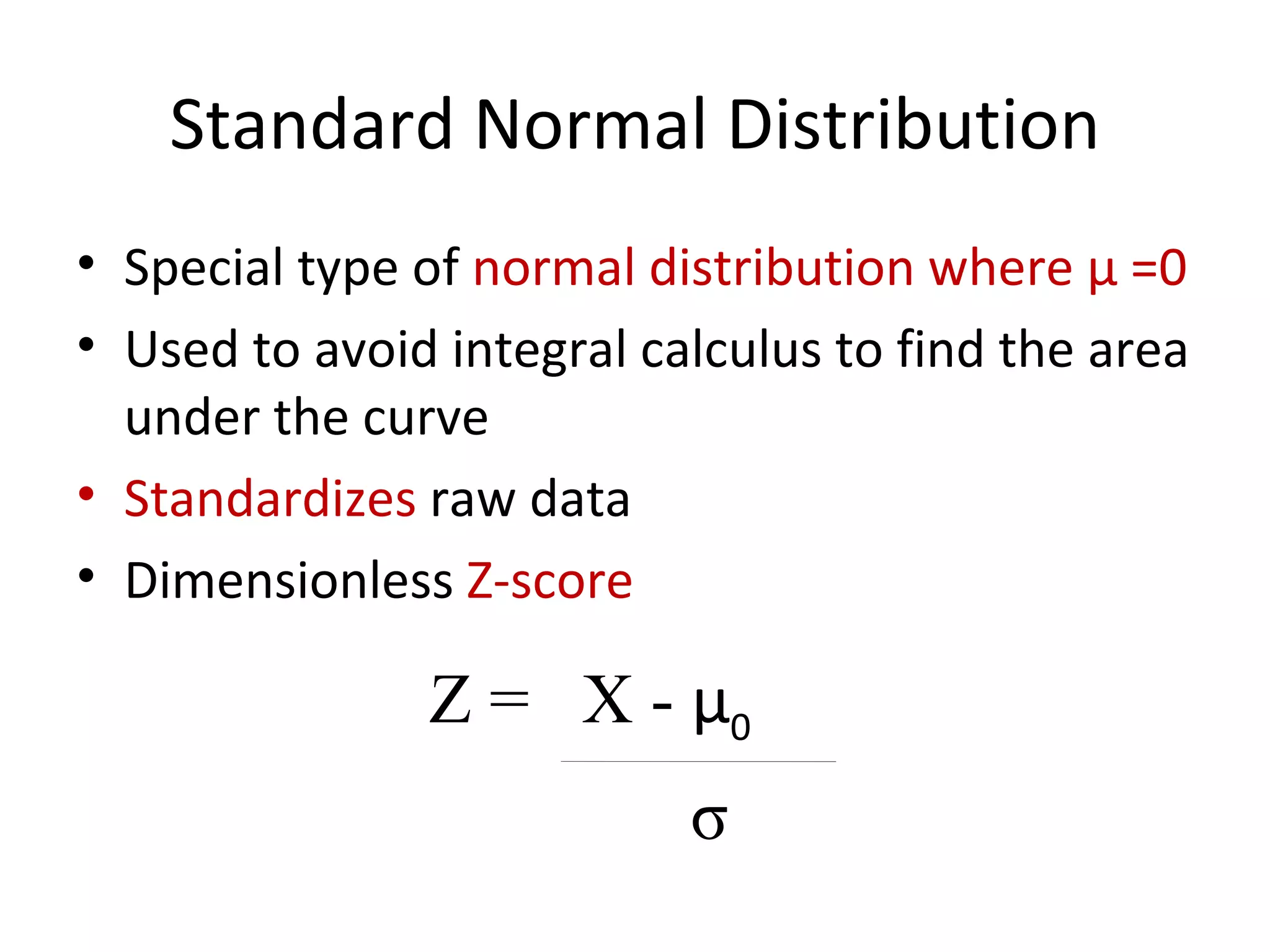
Standard Normal Distribution Special type of  normal distribution where  μ  =0 Used to avoid integral calculus to find the area under the curve Standardizes  raw data Dimensionless  Z-score Z =  X -  μ 0 σ
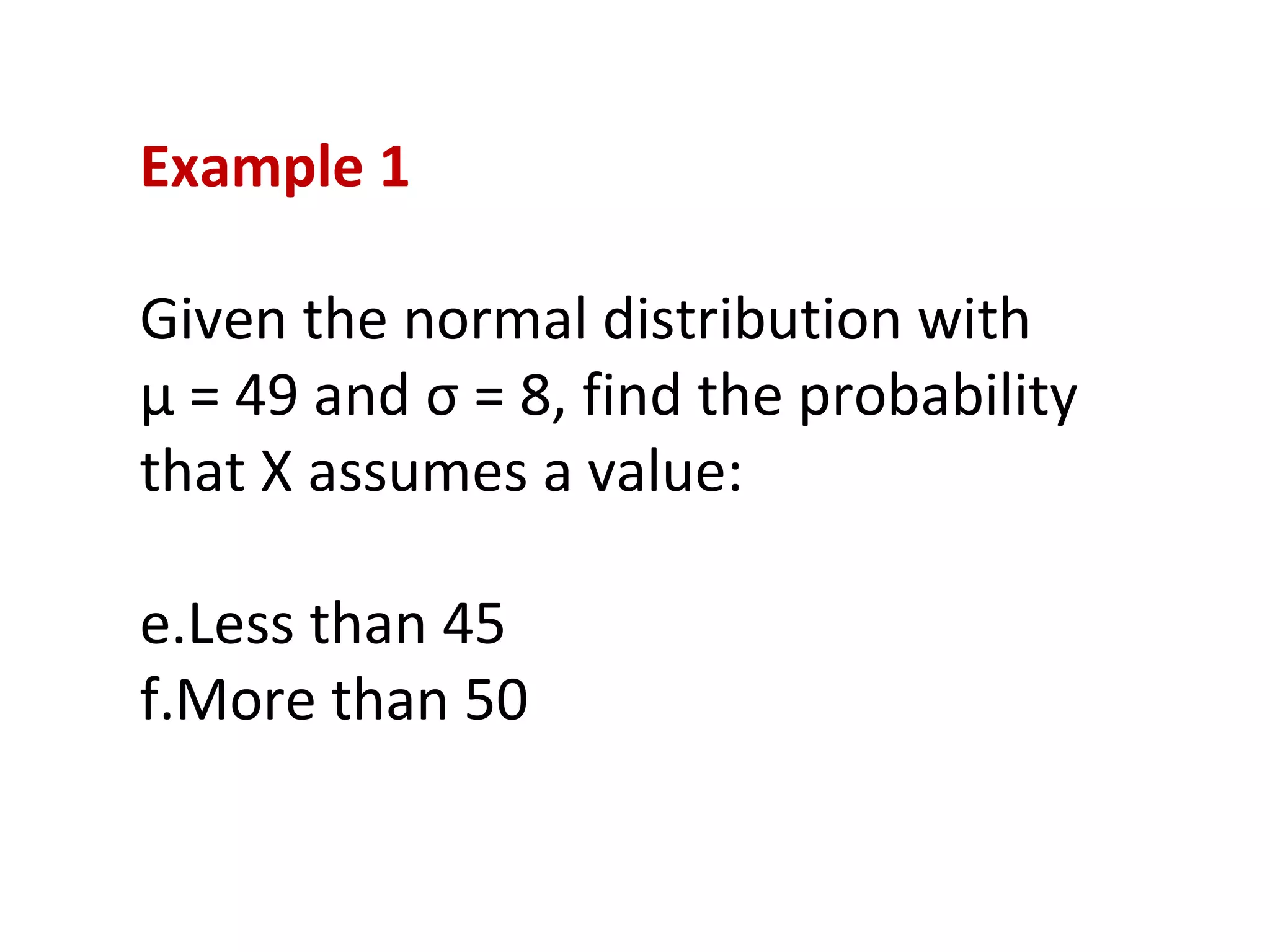
Example 1 Given the normal distribution with  μ  = 49 and  σ  = 8, find the probability that X assumes a value: Less than 45 More than 50
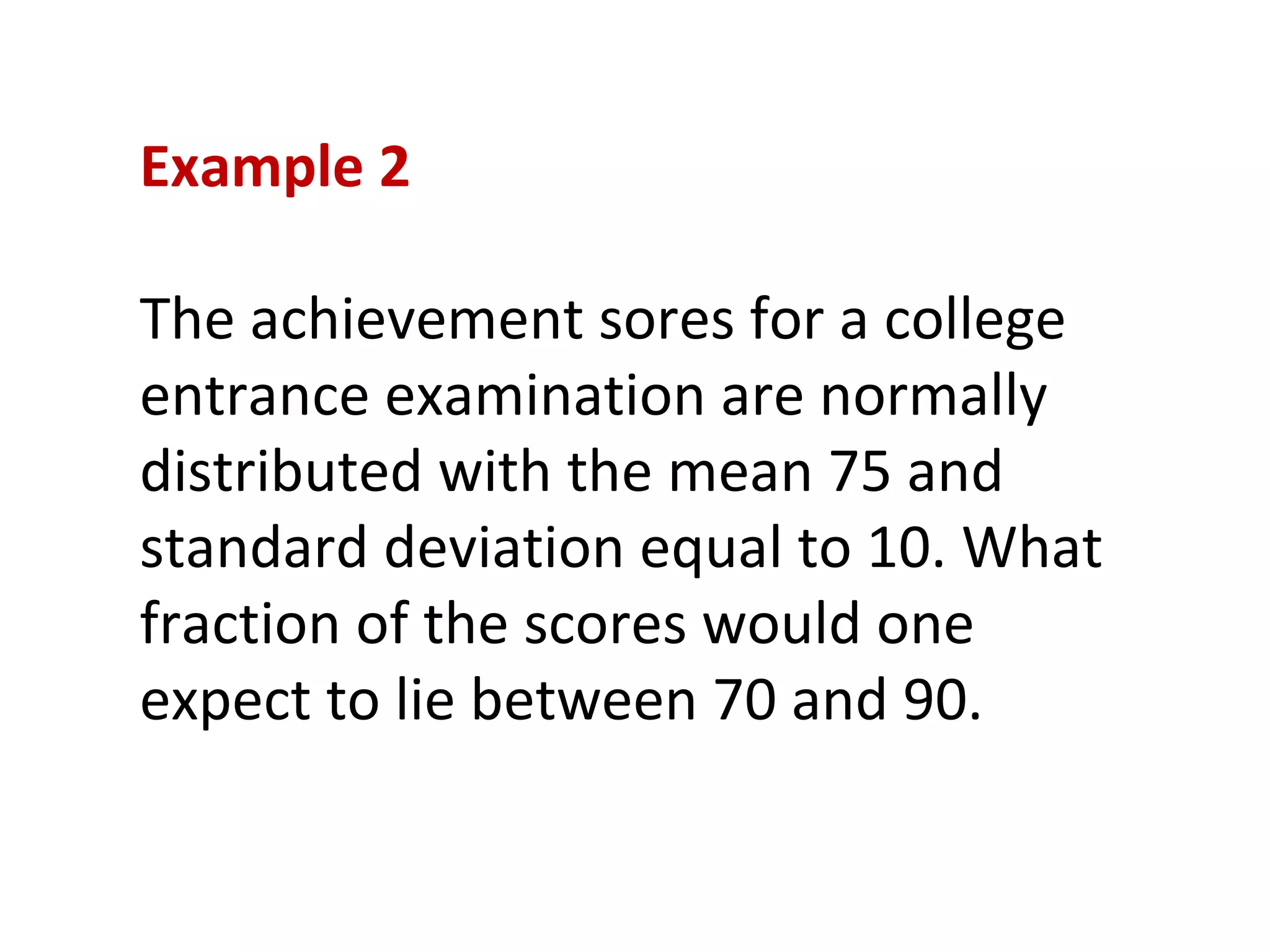
Example 2 The achievement sores for a college entrance examination are normally distributed with the mean 75 and standard deviation equal to 10. What fraction of the scores would one expect to lie between 70 and 90.
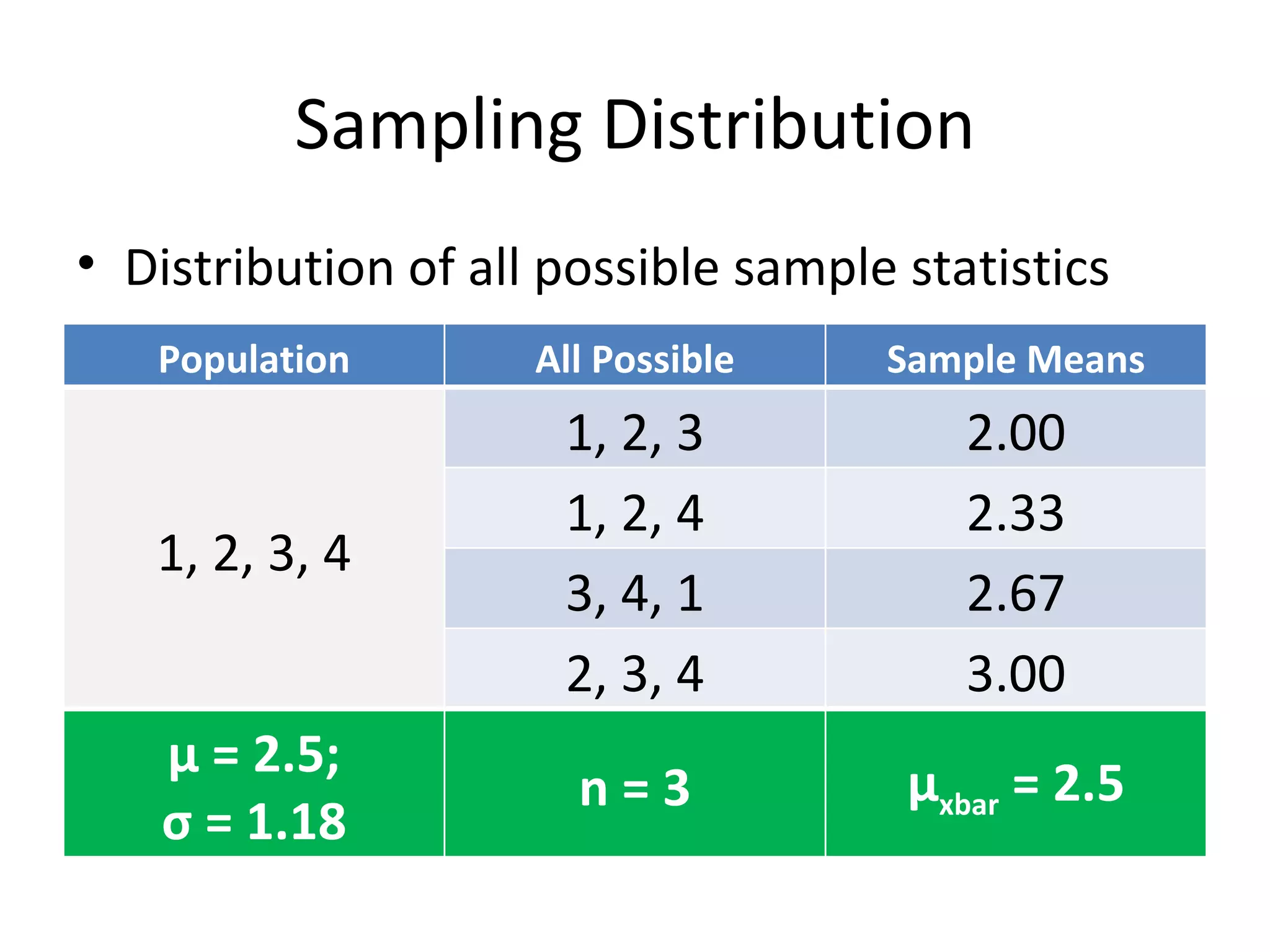
Sampling Distribution Distribution of all possible sample statistics Population All Possible Samples Sample Means 1, 2, 3, 4 1, 2, 3 2.00 1, 2, 4 2.33 3, 4, 1 2.67 2, 3, 4 3.00 μ  = 2.5; σ  = 1.18 n = 3 μ xbar  = 2.5
Central Limit Theorem Given a distribution with a  mean μ  and  variance σ² , the sampling distribution of the  mean approaches a normal distribution  with a mean (μ) and a variance σ²/N as N, the sample size, increases. 
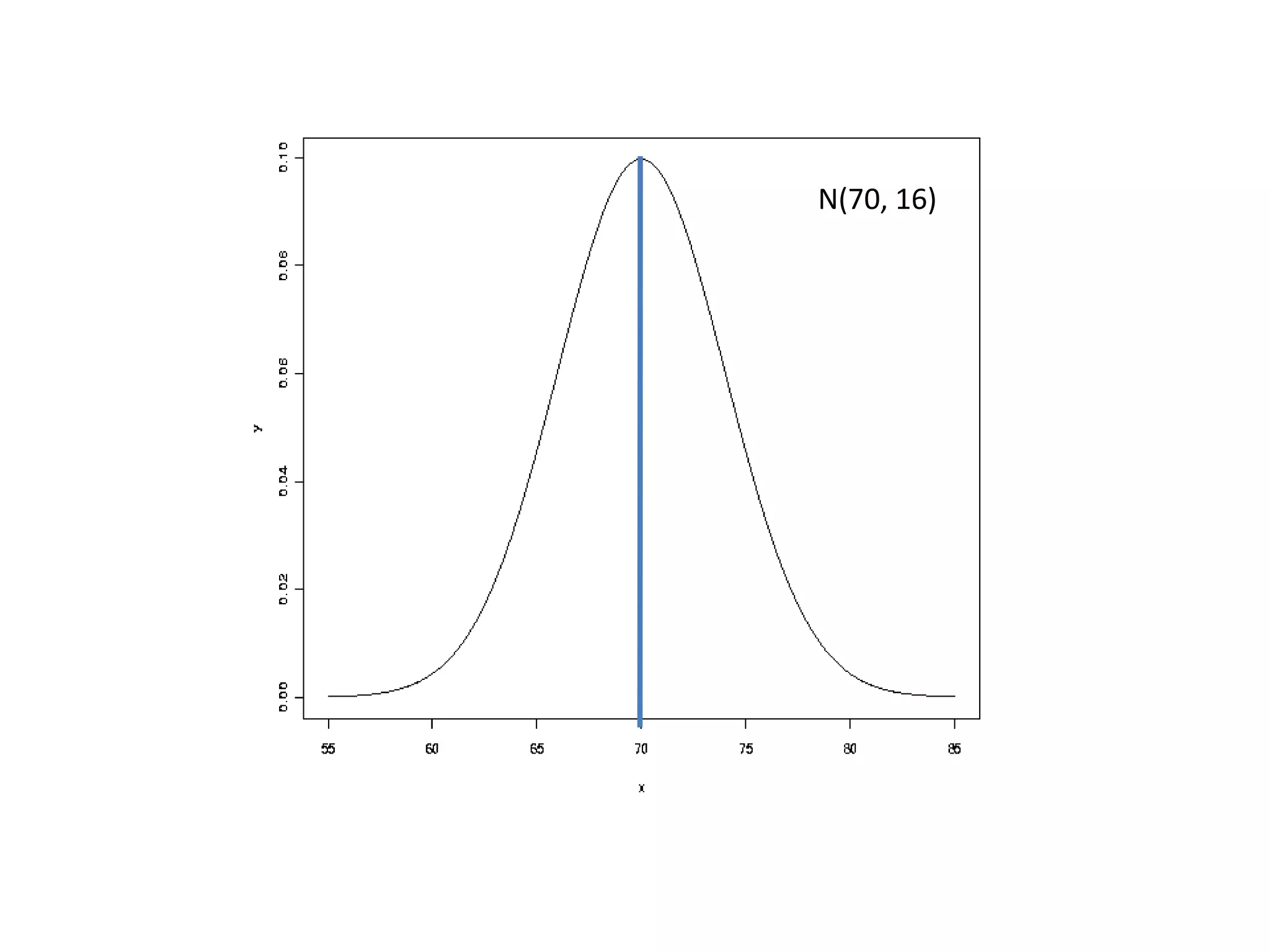
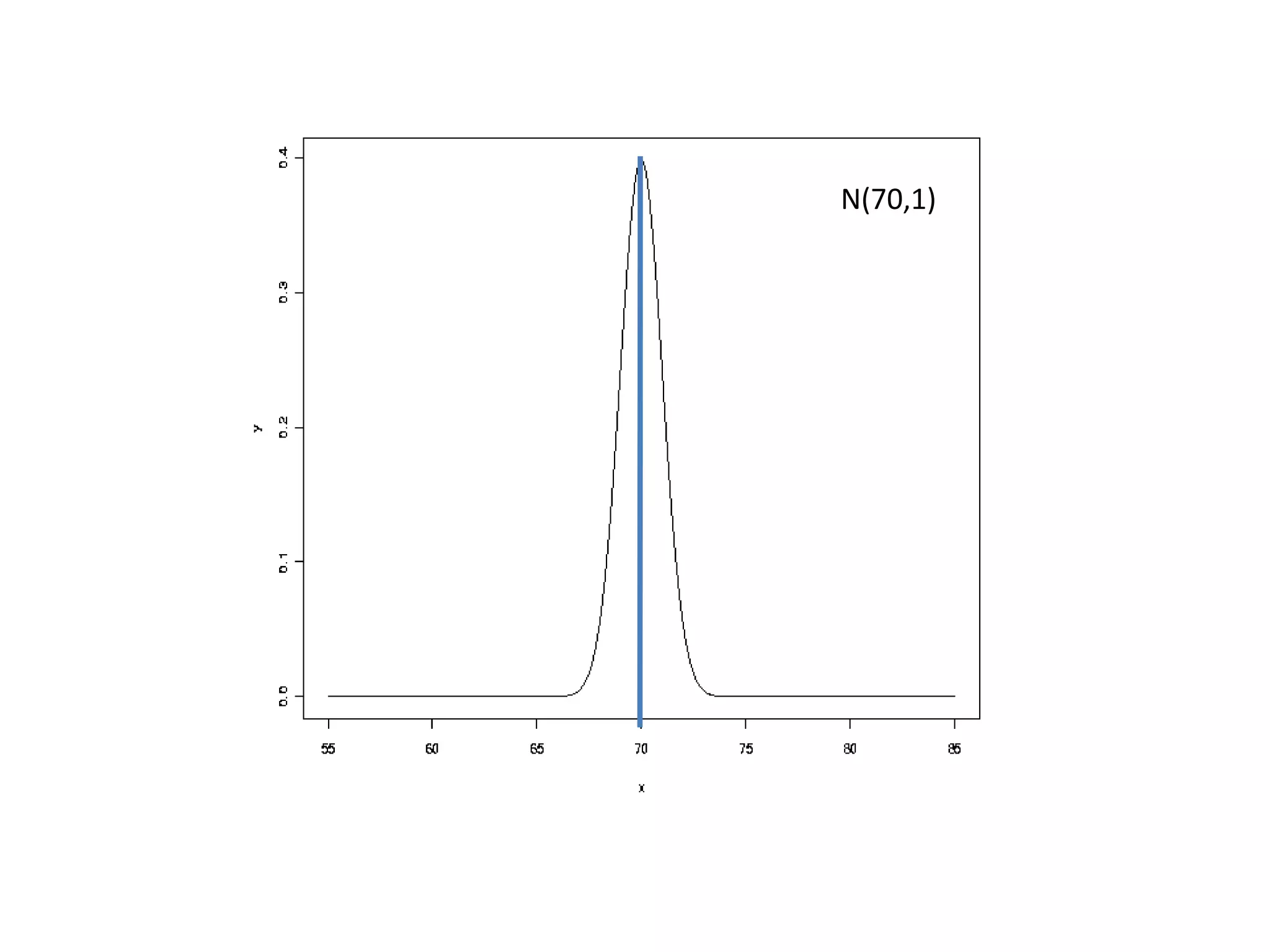
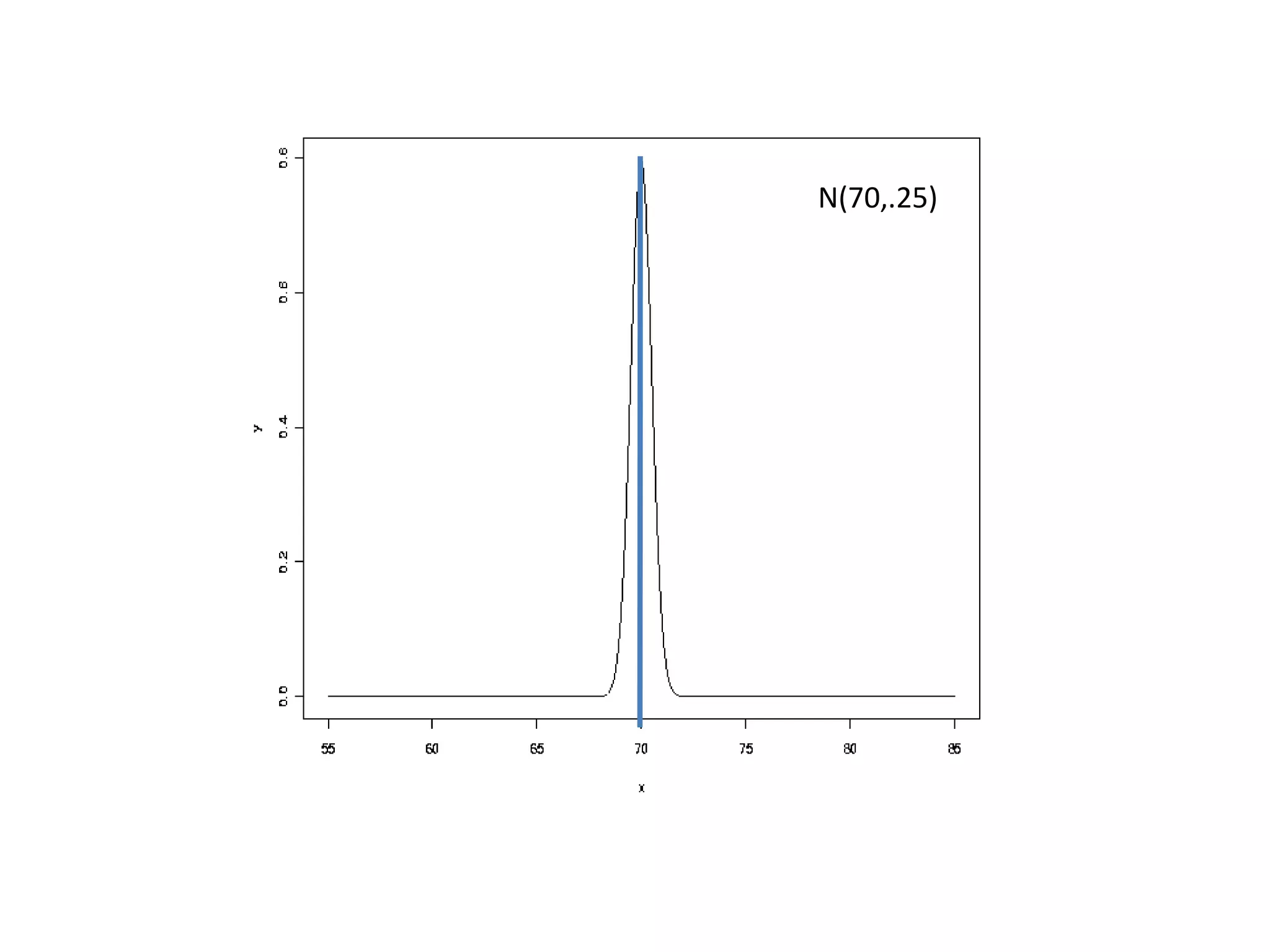
Characteristics The  mean of the population  and the  mean of the sampling distribution  of means will always have the  same value .   The  sampling distribution of the mean will be normal  regardless of the shape of the population distribution.
N(70, 16)
N(70,1)
N(70,.25)
Characteristics As the  sample size increases , the  distribution  of the sample average  becomes less and less variable. Hence the  sample average X bar  approaches  the value of the  population mean  μ . 
Example 3 An electrical firm manufactures light bulbs that have a length of life normally distributed with mean and standard deviation equal to 500 and 50 hours respectively. Find the probability that a random sample of 15 bulbs will have an average life ofless than 475 hours.
HYPOTHESIS TESTING Normal Distribution and Hypothesis Testing
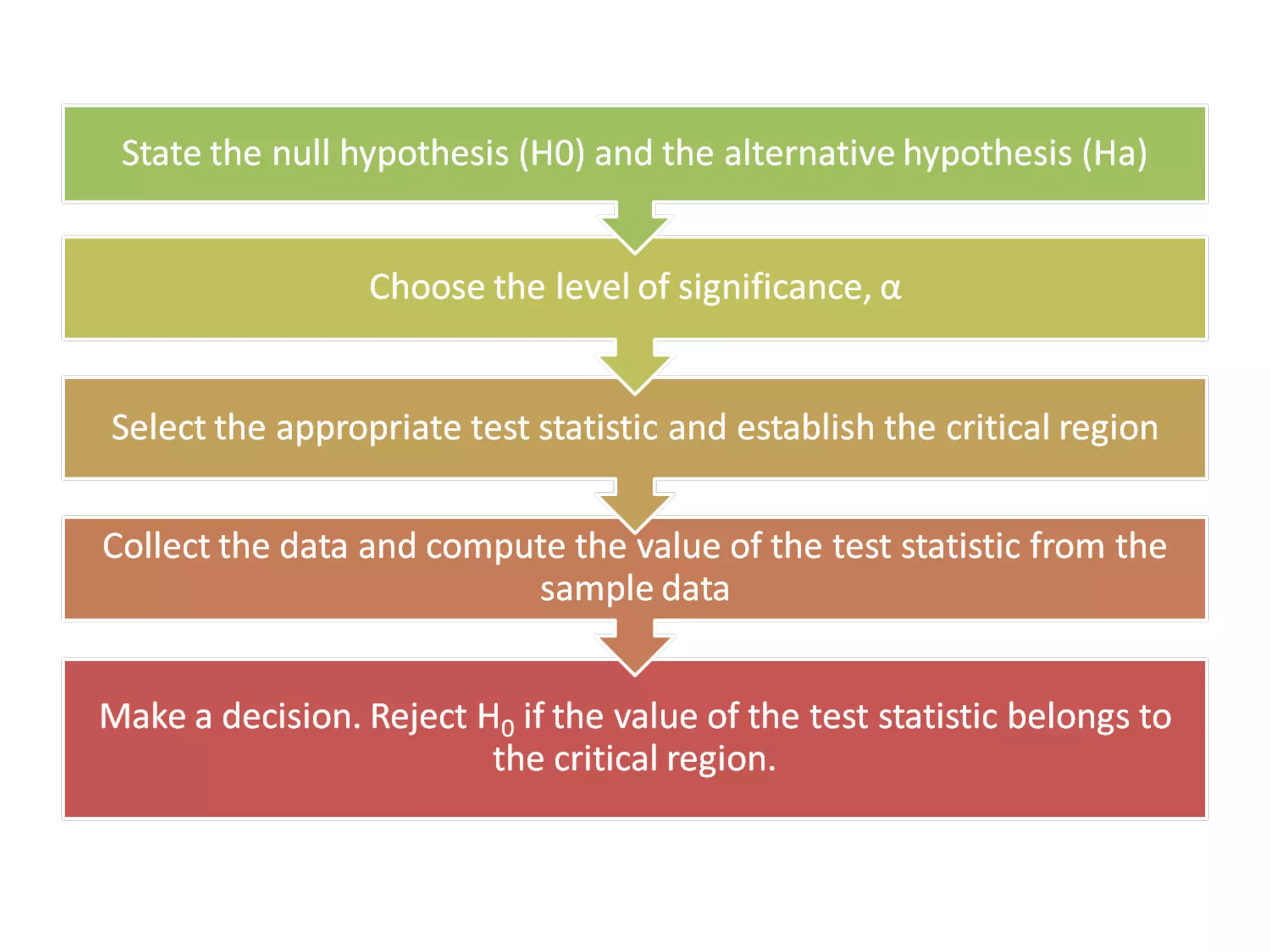
Hypothesis Testing A hypothesis is a  conjecture or assertion about a parameter Null v. Alternative hypothesis Proof by contradiction  Null hypothesis is the  hypothesis being tested Alternative hypothesis is the  operational statement of the experiment  that is believed to be true
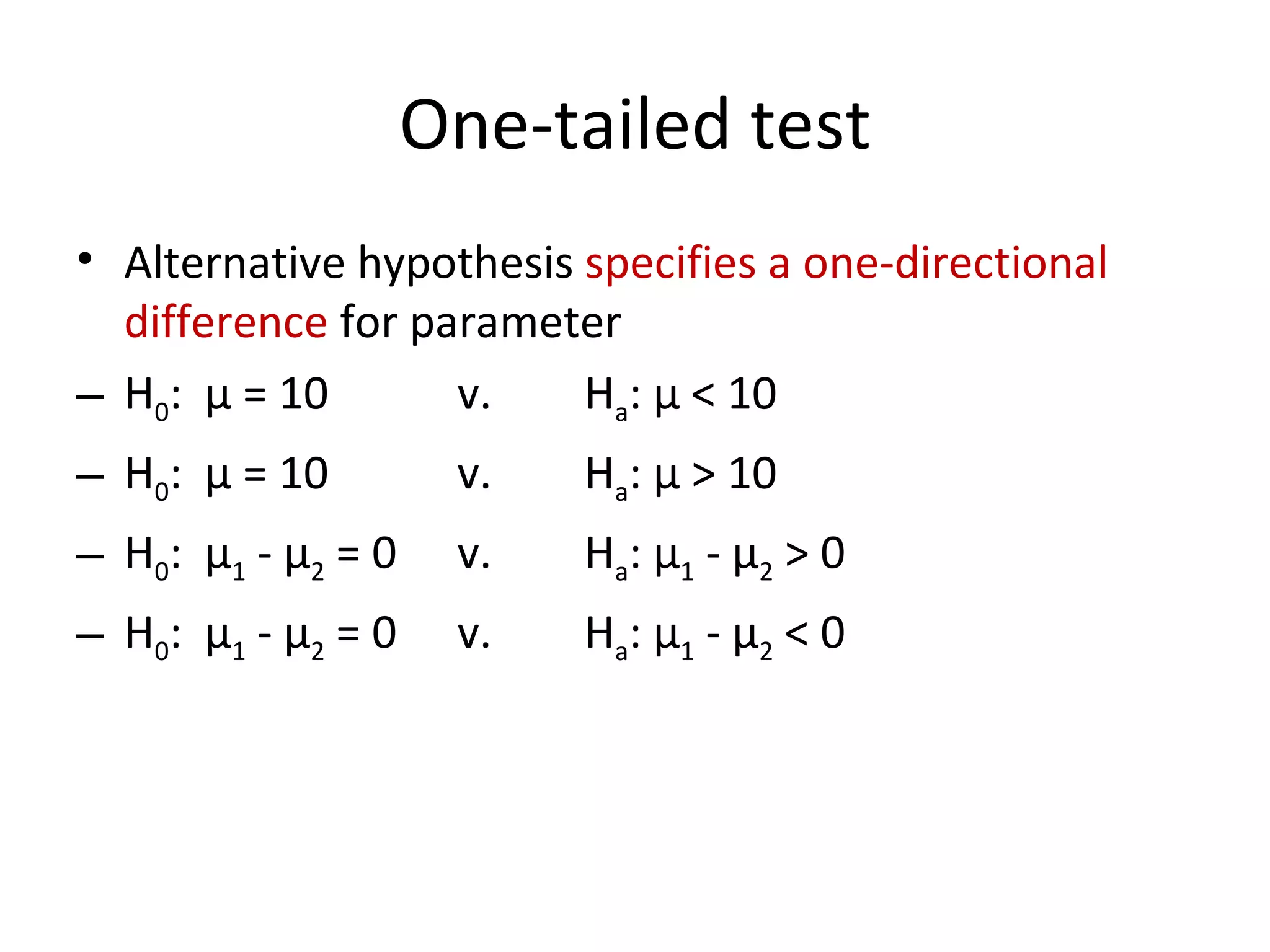
One-tailed test Alternative hypothesis  specifies a one-directional difference  for parameter H 0 :  μ  = 10 v. H a :  μ  < 10 H 0 :  μ  = 10 v. H a :  μ  > 10 H 0 :  μ 1  -  μ 2  = 0 v. H a :  μ 1  -  μ 2  > 0 H 0 :  μ 1  -  μ 2  = 0 v. H a :  μ 1  -  μ 2  < 0
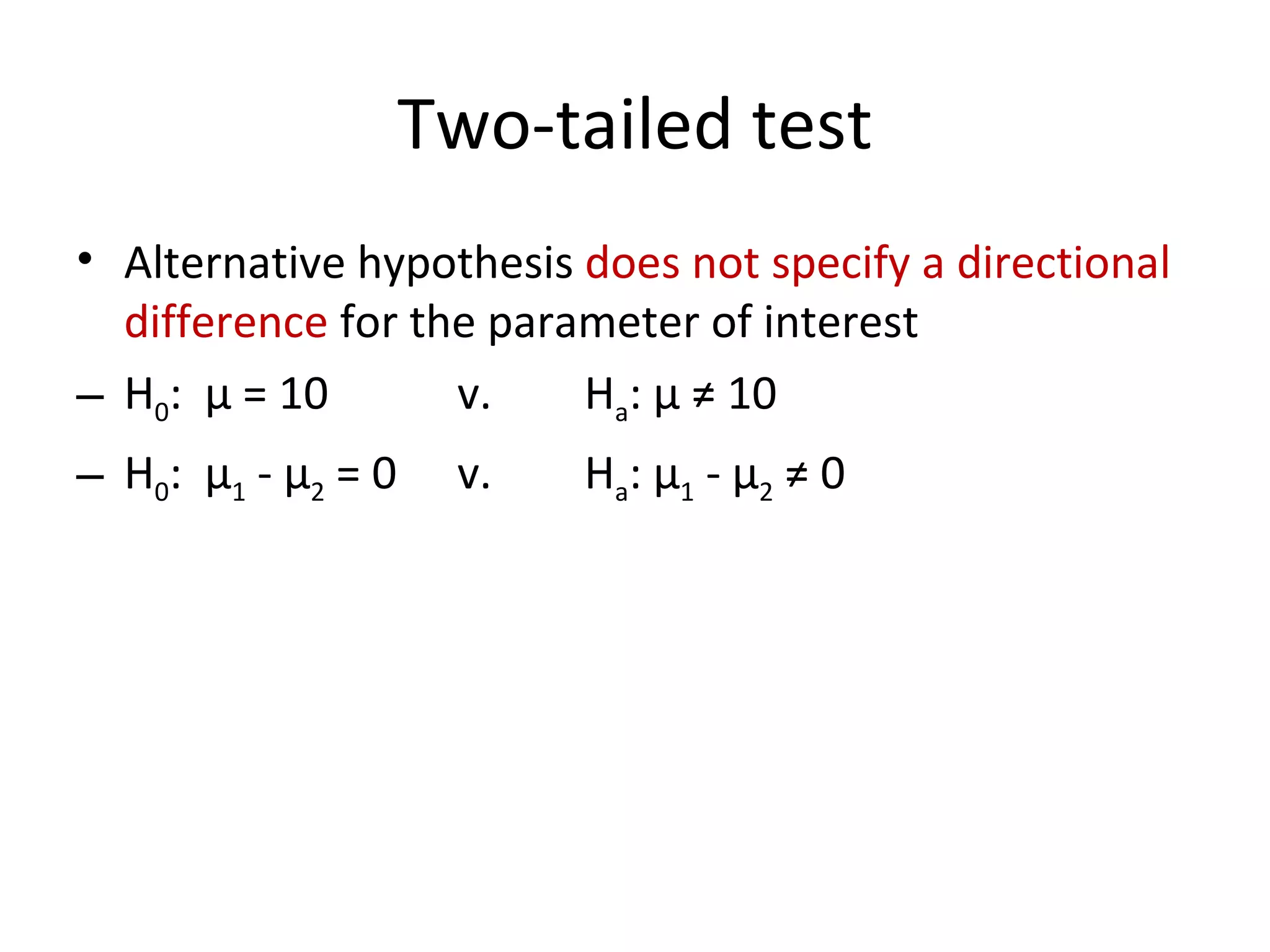
Two-tailed test Alternative hypothesis  does not specify a directional difference  for the parameter of interest H 0 :  μ  = 10 v. H a :  μ  ≠ 10 H 0 :  μ 1  -  μ 2  = 0 v. H a :  μ 1  -  μ 2  ≠ 0
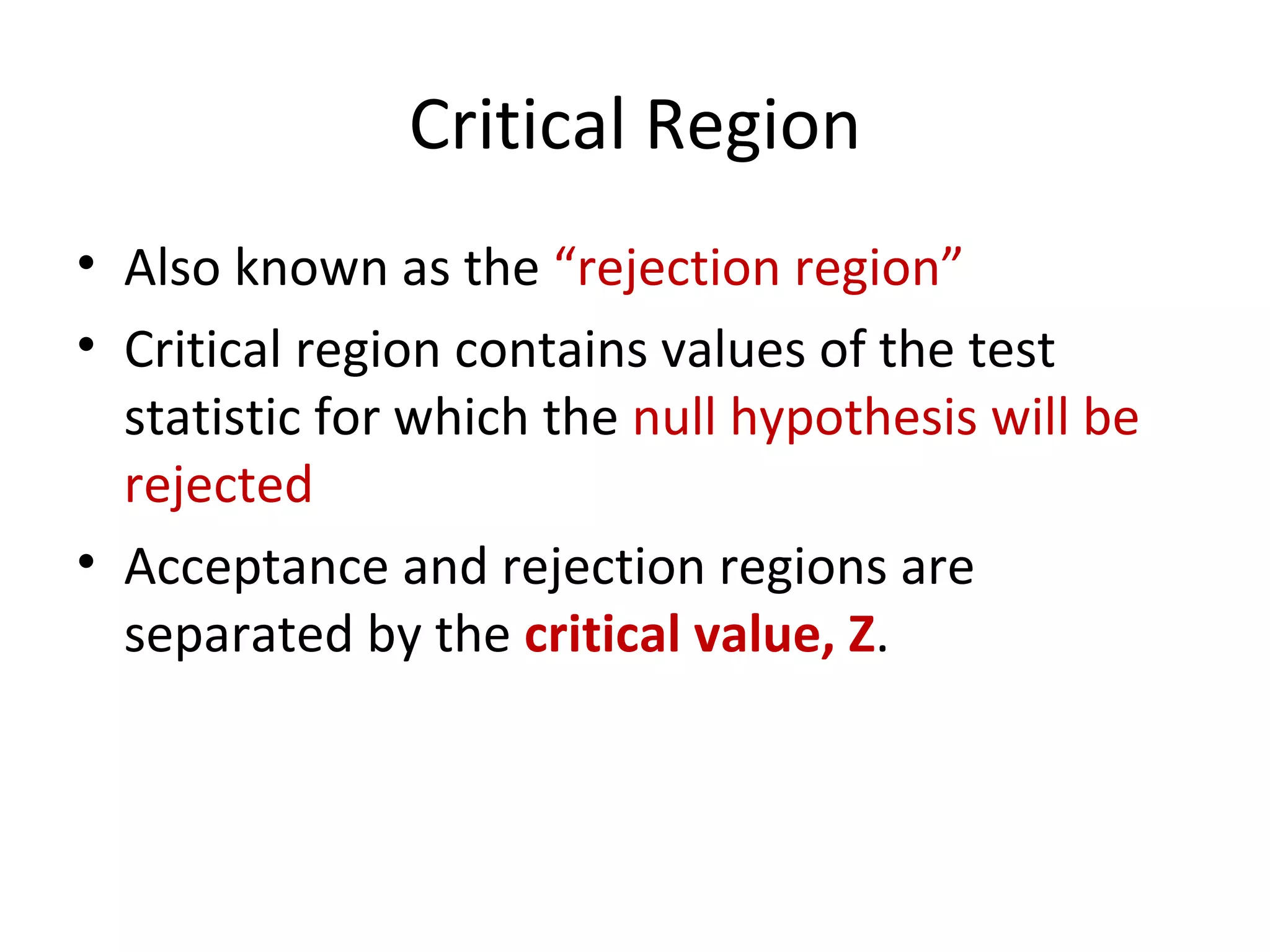
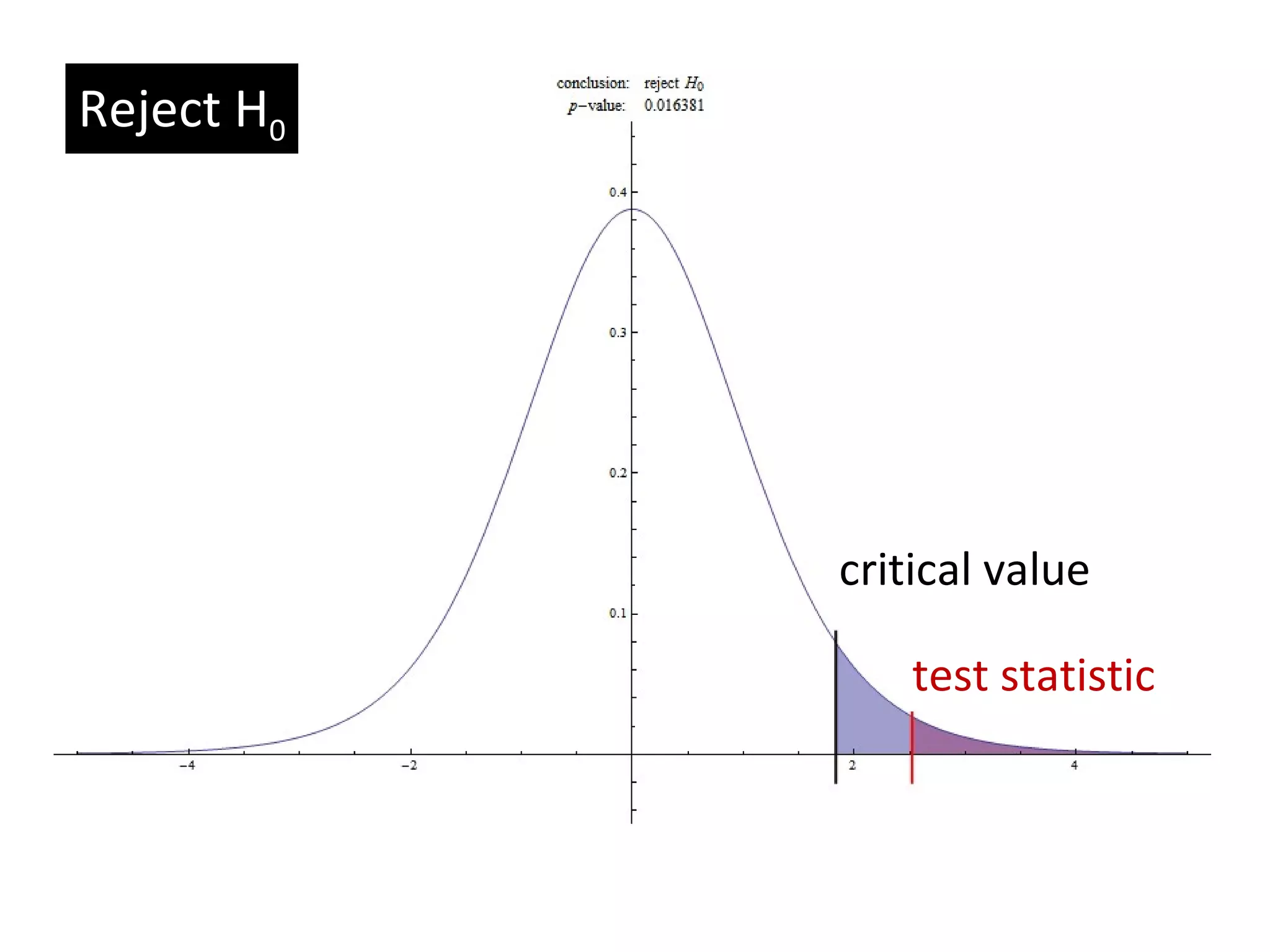
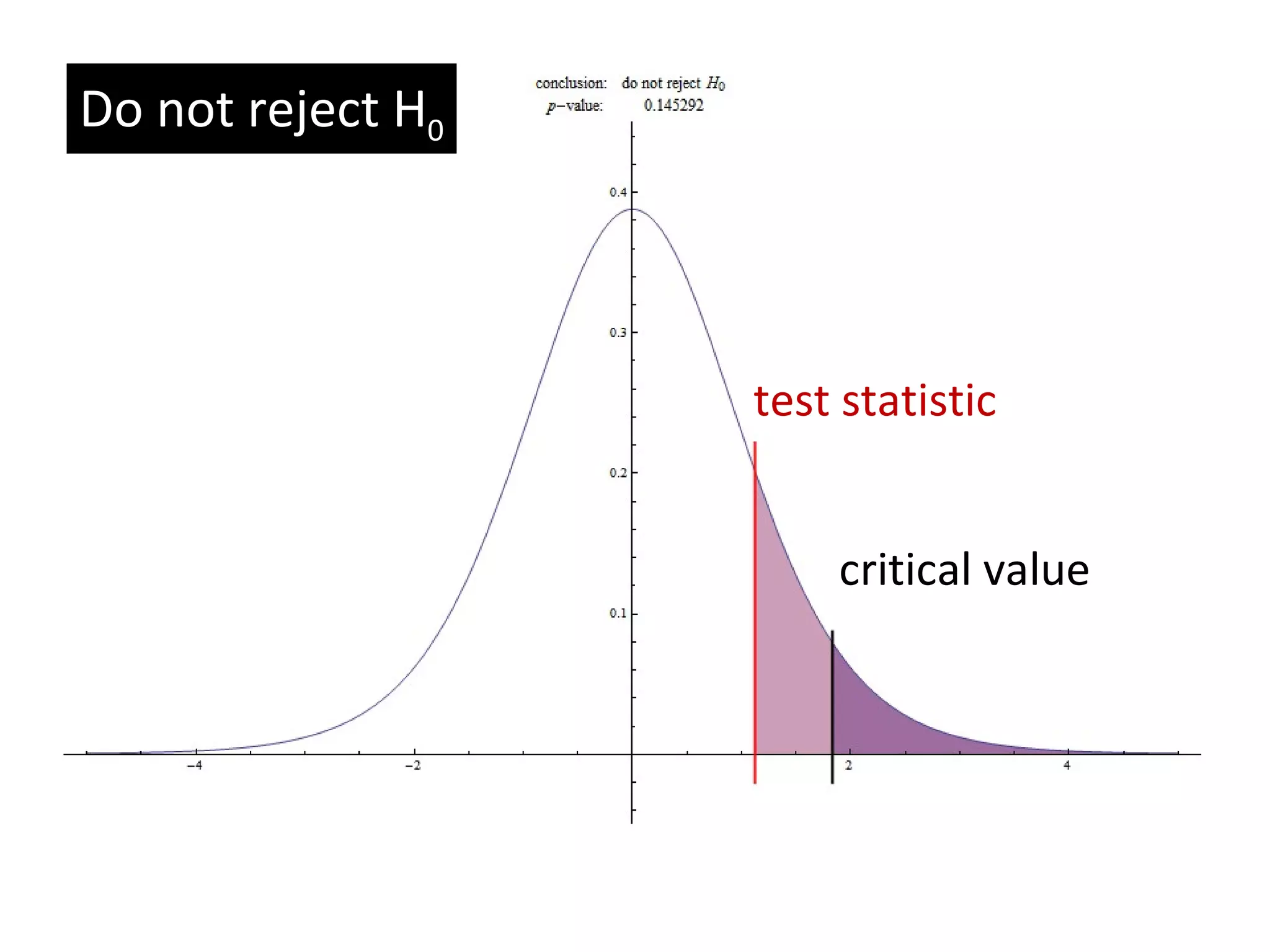
Critical Region Also known as the  “rejection region” Critical region contains values of the test statistic for which the  null hypothesis will be rejected Acceptance and rejection regions are separated by the  critical value, Z .
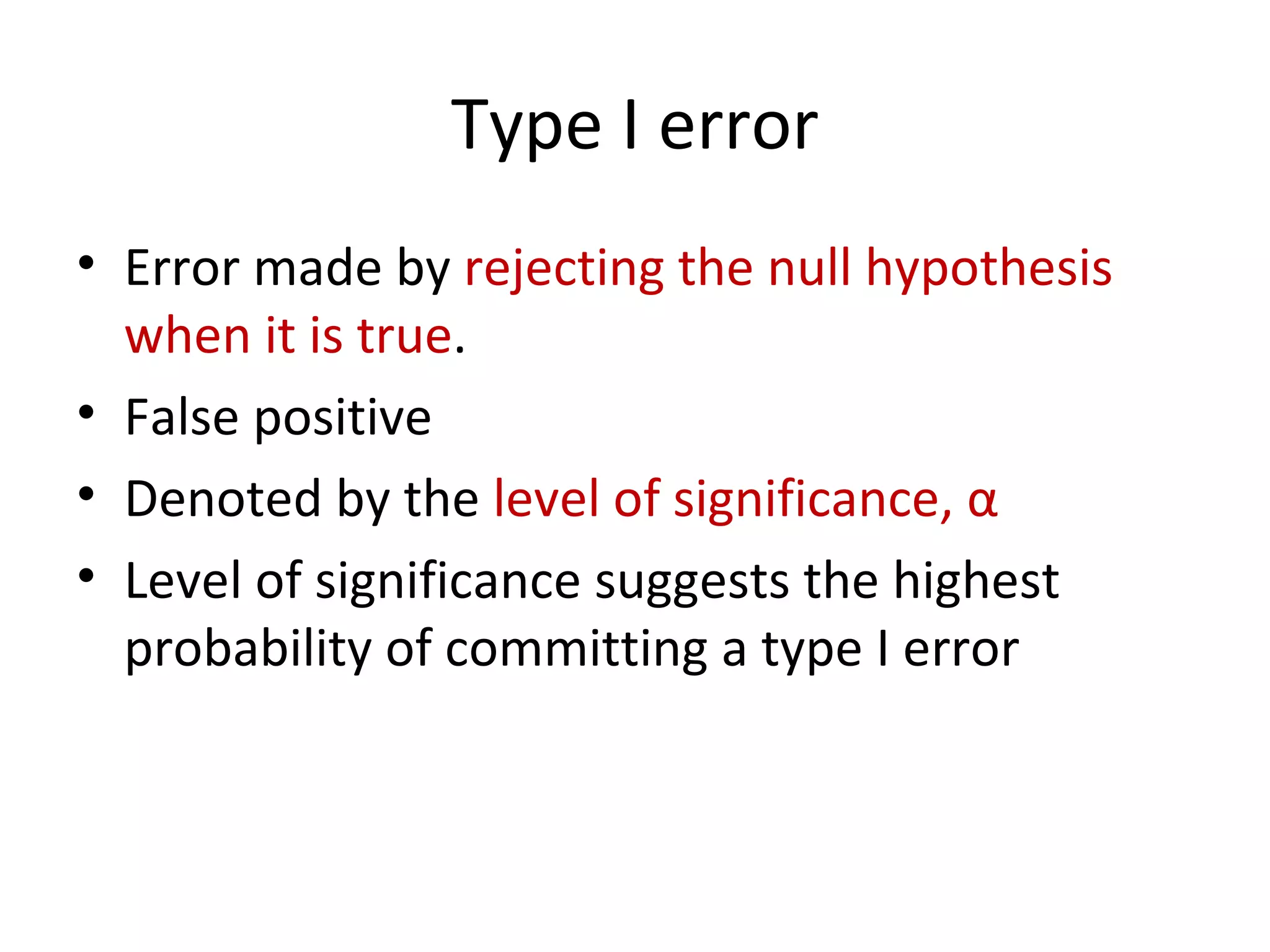
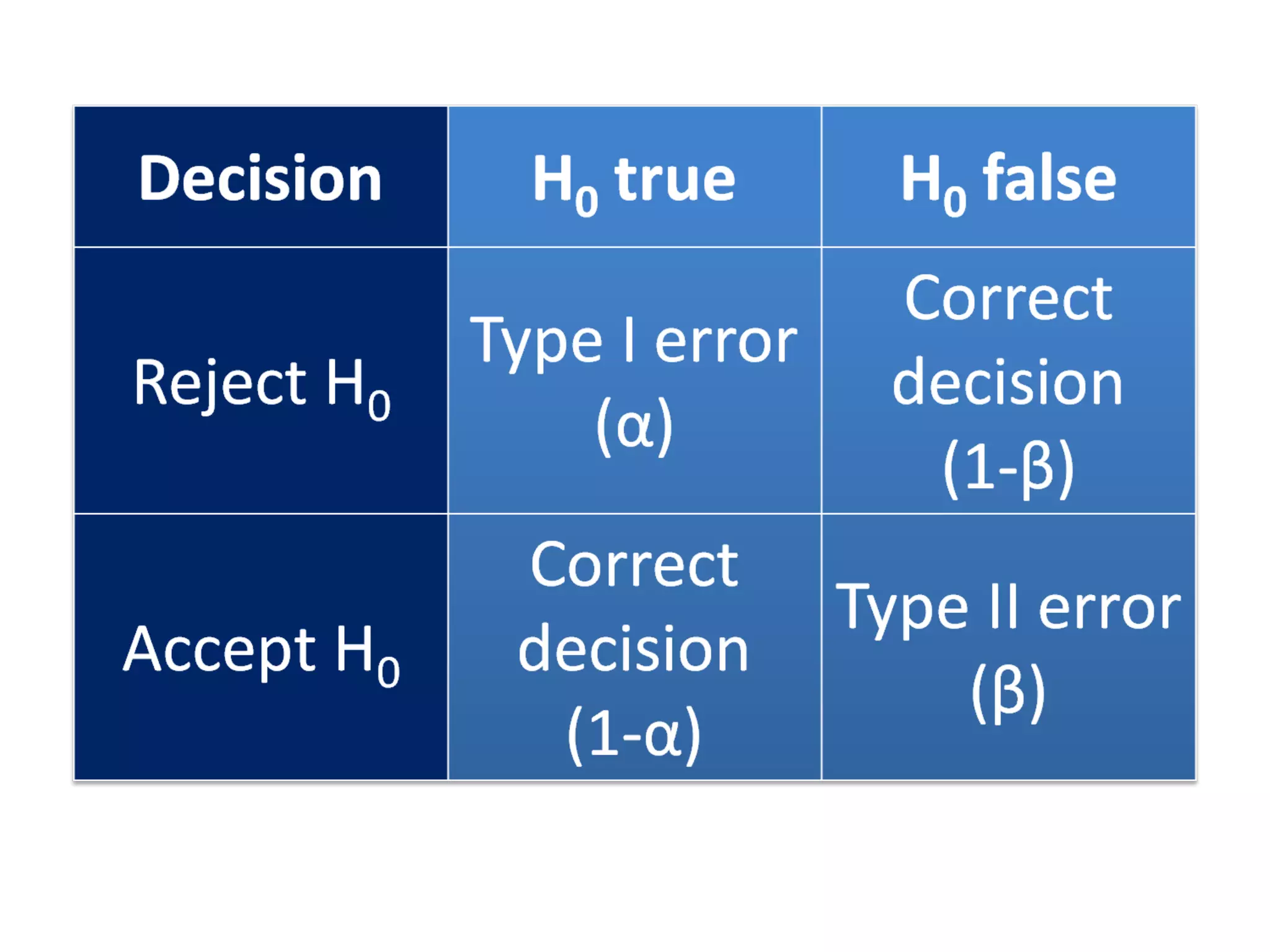
Type I error Error made by  rejecting the null hypothesis when it is true . False positive Denoted by the  level of significance,  α Level of significance suggests the highest probability of committing a type I error
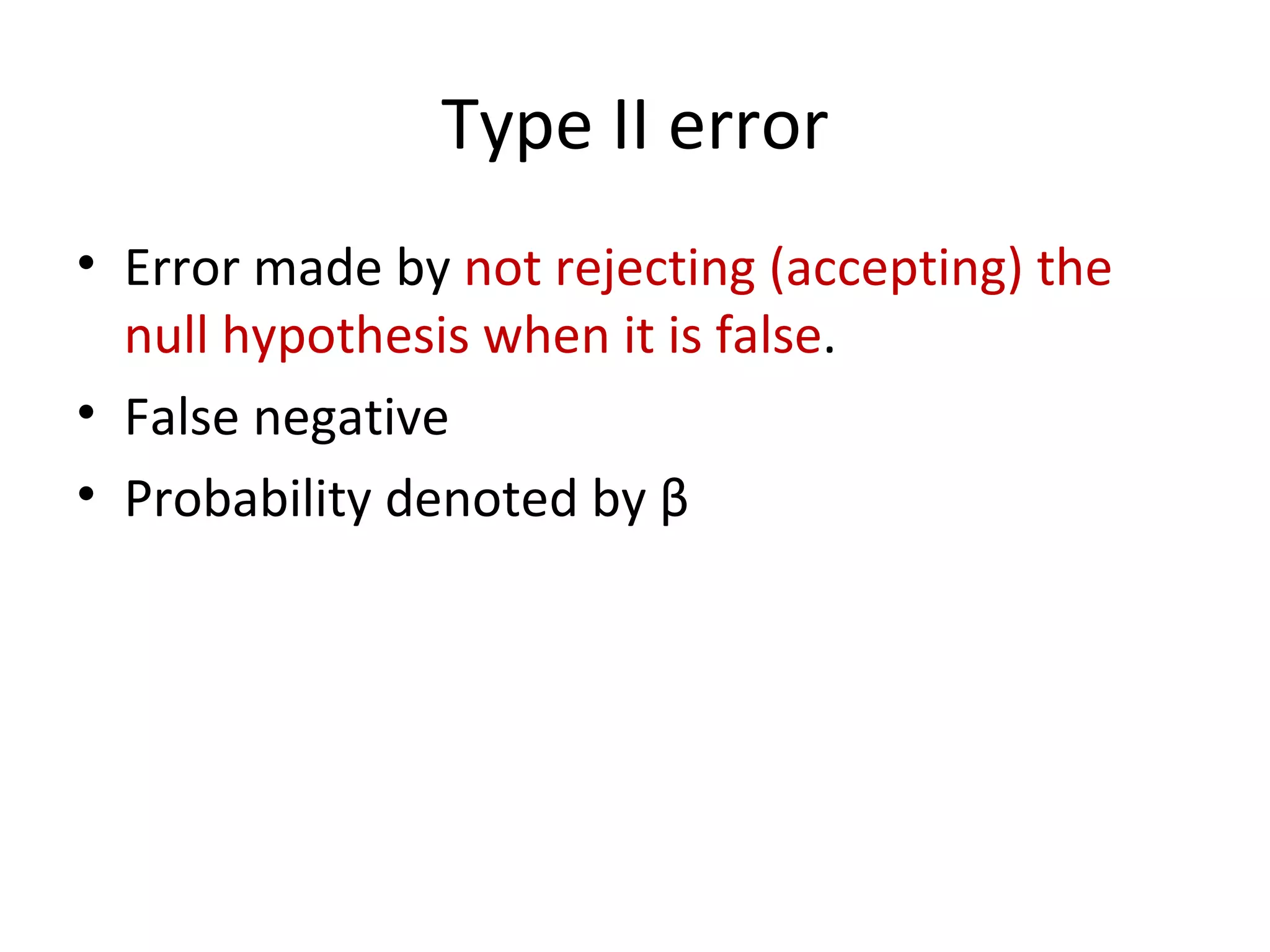
Type II error Error made by  not rejecting (accepting) the null hypothesis when it is false . False negative Probability denoted by  β
 
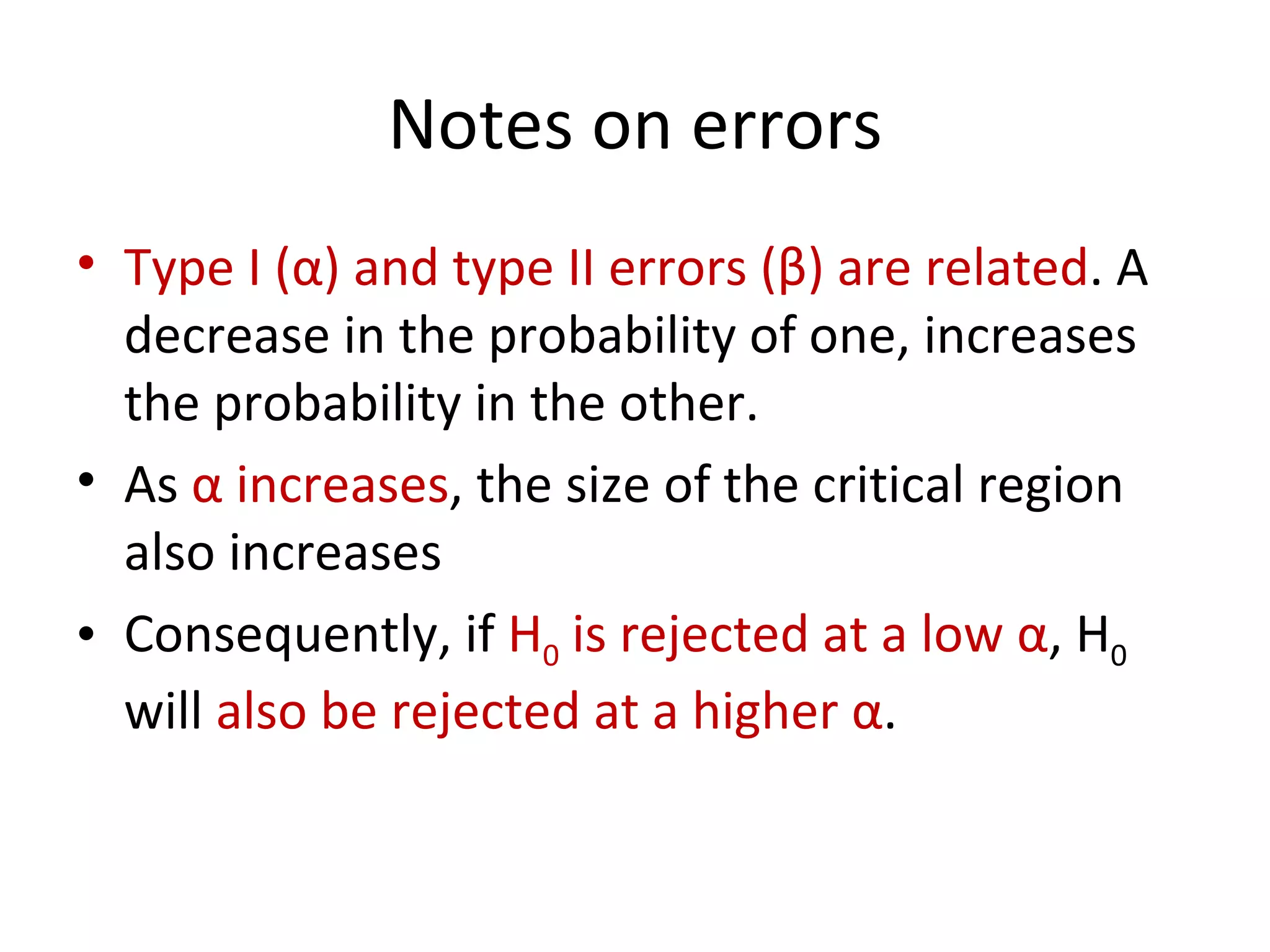
Notes on errors Type I ( α ) and type II errors ( β ) are related . A decrease in the probability of one, increases the probability in the other. As  α  increases , the size of the critical region also increases Consequently, if  H 0  is rejected at a low  α , H 0  will  also be rejected at a higher  α .
 
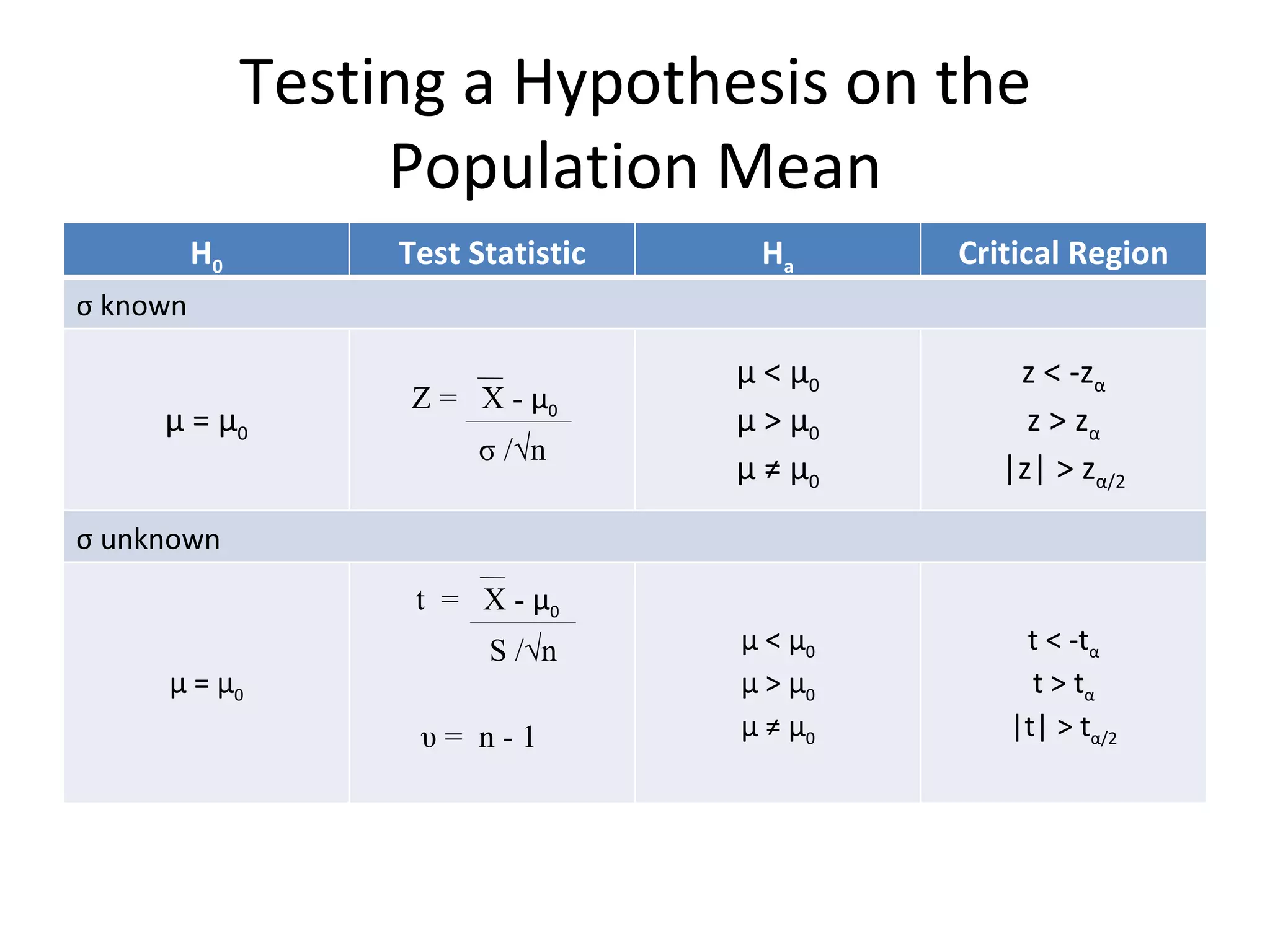
Testing a Hypothesis on the Population Mean Z =  X -  μ 0 σ  /√n t  =  X -  μ 0 S /√n υ  =  n - 1 H 0 Test Statistic H a Critical Region σ  known μ  =  μ 0 μ  <  μ 0 μ  >  μ 0 μ  ≠  μ 0 z < -z α z > z α |z| > z α /2 σ  unknown μ  =  μ 0 μ  <  μ 0 μ  >  μ 0 μ  ≠  μ 0 t < -t α t > t α |t| > t α /2
critical value test statistic Reject H 0
critical value test statistic Do not reject H 0
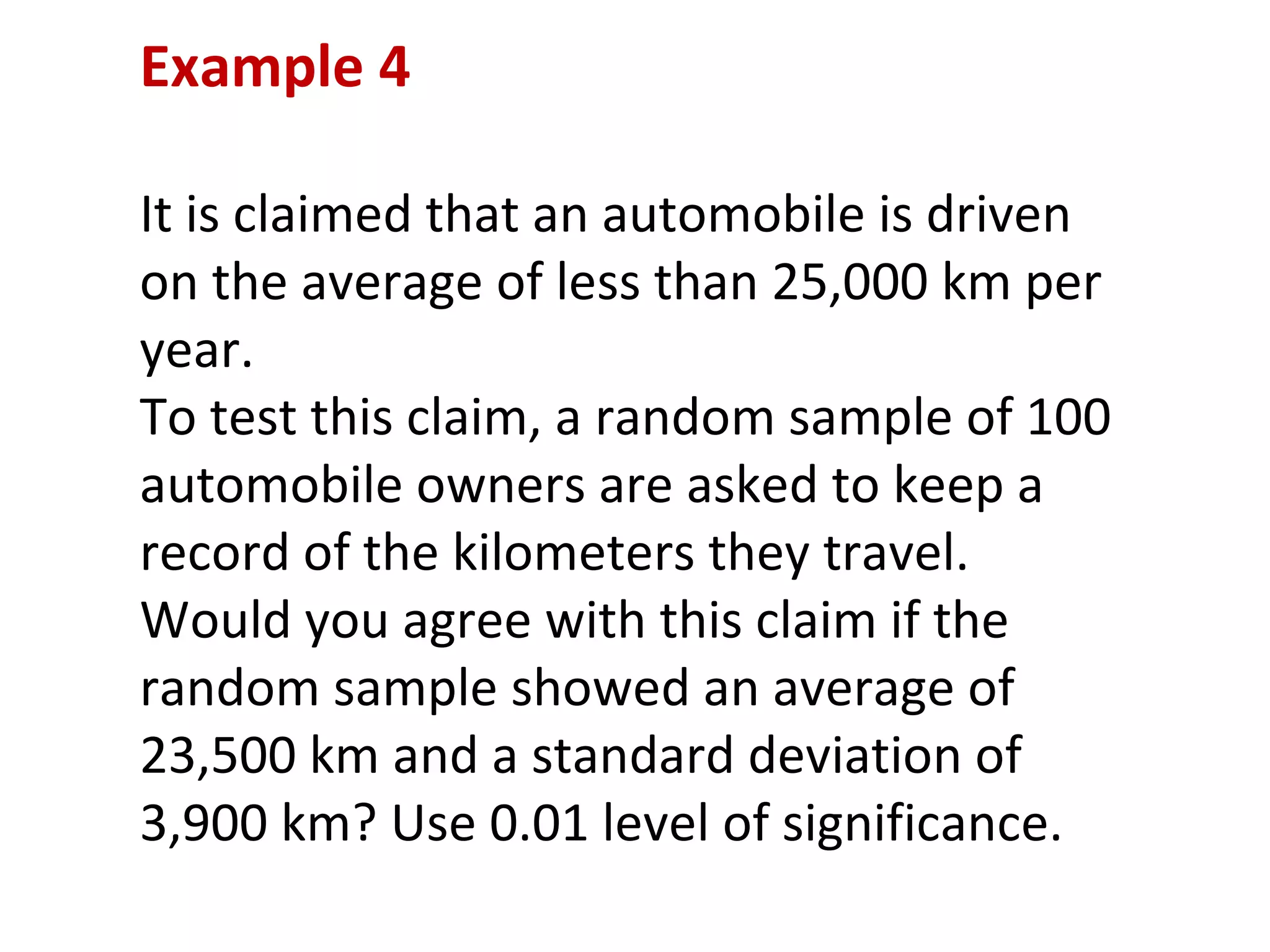
Example 4 It is claimed that an automobile is driven on the average of less than 25,000 km per year.  To test this claim, a random sample of 100 automobile owners are asked to keep a record of the kilometers they travel. Would you agree with this claim if the random sample showed an average of 23,500 km and a standard deviation of 3,900 km? Use 0.01 level of significance.

Hypothesis Testing

  • 1.
    Normal Distribution andHypothesis Testing STR1K
  • 2.
  • 3.
    Characteristics Bell-shaped ,depends on standard deviation Continuous distribution Unimodal Symmetric about the vertical axis through the mean μ Approaches the horizontal axis asymptotically Total area under the curve and above the horizontal is 1
  • 4.
    Characteristics Approximately 68% of observations fall within 1 σ from the mean Approximately 95% of observations fall within 2 σ from the mean Approximately 99.7% of observations fall within 3 σ from the mean
  • 5.
  • 6.
    Standard Normal DistributionSpecial type of normal distribution where μ =0 Used to avoid integral calculus to find the area under the curve Standardizes raw data Dimensionless Z-score Z = X - μ 0 σ
  • 7.
    Example 1 Giventhe normal distribution with μ = 49 and σ = 8, find the probability that X assumes a value: Less than 45 More than 50
  • 8.
    Example 2 Theachievement sores for a college entrance examination are normally distributed with the mean 75 and standard deviation equal to 10. What fraction of the scores would one expect to lie between 70 and 90.
  • 9.
    Sampling Distribution Distributionof all possible sample statistics Population All Possible Samples Sample Means 1, 2, 3, 4 1, 2, 3 2.00 1, 2, 4 2.33 3, 4, 1 2.67 2, 3, 4 3.00 μ = 2.5; σ = 1.18 n = 3 μ xbar = 2.5
  • 10.
    Central Limit TheoremGiven a distribution with a mean μ and variance σ² , the sampling distribution of the mean approaches a normal distribution  with a mean (μ) and a variance σ²/N as N, the sample size, increases. 
  • 11.
    Characteristics The mean of the population and the mean of the sampling distribution of means will always have the same value .  The sampling distribution of the mean will be normal  regardless of the shape of the population distribution.
  • 12.
  • 13.
  • 14.
  • 15.
    Characteristics As the sample size increases , the distribution of the sample average becomes less and less variable. Hence the sample average X bar approaches the value of the population mean  μ . 
  • 16.
    Example 3 Anelectrical firm manufactures light bulbs that have a length of life normally distributed with mean and standard deviation equal to 500 and 50 hours respectively. Find the probability that a random sample of 15 bulbs will have an average life ofless than 475 hours.
  • 17.
    HYPOTHESIS TESTING NormalDistribution and Hypothesis Testing
  • 18.
    Hypothesis Testing Ahypothesis is a conjecture or assertion about a parameter Null v. Alternative hypothesis Proof by contradiction Null hypothesis is the hypothesis being tested Alternative hypothesis is the operational statement of the experiment that is believed to be true
  • 19.
    One-tailed test Alternativehypothesis specifies a one-directional difference for parameter H 0 : μ = 10 v. H a : μ < 10 H 0 : μ = 10 v. H a : μ > 10 H 0 : μ 1 - μ 2 = 0 v. H a : μ 1 - μ 2 > 0 H 0 : μ 1 - μ 2 = 0 v. H a : μ 1 - μ 2 < 0
  • 20.
    Two-tailed test Alternativehypothesis does not specify a directional difference for the parameter of interest H 0 : μ = 10 v. H a : μ ≠ 10 H 0 : μ 1 - μ 2 = 0 v. H a : μ 1 - μ 2 ≠ 0
  • 21.
    Critical Region Alsoknown as the “rejection region” Critical region contains values of the test statistic for which the null hypothesis will be rejected Acceptance and rejection regions are separated by the critical value, Z .
  • 22.
    Type I errorError made by rejecting the null hypothesis when it is true . False positive Denoted by the level of significance, α Level of significance suggests the highest probability of committing a type I error
  • 23.
    Type II errorError made by not rejecting (accepting) the null hypothesis when it is false . False negative Probability denoted by β
  • 24.
  • 25.
    Notes on errorsType I ( α ) and type II errors ( β ) are related . A decrease in the probability of one, increases the probability in the other. As α increases , the size of the critical region also increases Consequently, if H 0 is rejected at a low α , H 0 will also be rejected at a higher α .
  • 26.
  • 27.
    Testing a Hypothesison the Population Mean Z = X - μ 0 σ /√n t = X - μ 0 S /√n υ = n - 1 H 0 Test Statistic H a Critical Region σ known μ = μ 0 μ < μ 0 μ > μ 0 μ ≠ μ 0 z < -z α z > z α |z| > z α /2 σ unknown μ = μ 0 μ < μ 0 μ > μ 0 μ ≠ μ 0 t < -t α t > t α |t| > t α /2
  • 28.
    critical value teststatistic Reject H 0
  • 29.
    critical value teststatistic Do not reject H 0
  • 30.
    Example 4 Itis claimed that an automobile is driven on the average of less than 25,000 km per year. To test this claim, a random sample of 100 automobile owners are asked to keep a record of the kilometers they travel. Would you agree with this claim if the random sample showed an average of 23,500 km and a standard deviation of 3,900 km? Use 0.01 level of significance.