Downloaded 339 times
![ The carrier signal is VcSin2πfct the modulating signal
is VmSin2πfmt. Balanced modulator produces the
product of these two signals.
(VmSin2πfmt)(VcSin2πfct)
Applying a trigonometric identity.
(VmSin2πfmt)(VcSin2πfct) = 1/2[Cos(2πfc - 2πfm)t -
Cos(2πfc + 2πfm)t]
these are the sum and difference frequencies or the
upper and lower side bands.
It is important to remember that a cosine wave is
simply a sine wave shifted by 90o A cosine wave has
exactly the same shape as a sine wave, but it occurs 90o](https://image.slidesharecdn.com/presentation1-141210234020-conversion-gate02/75/Generation-of-SSB-and-DSB_SC-Modulation-5-2048.jpg)
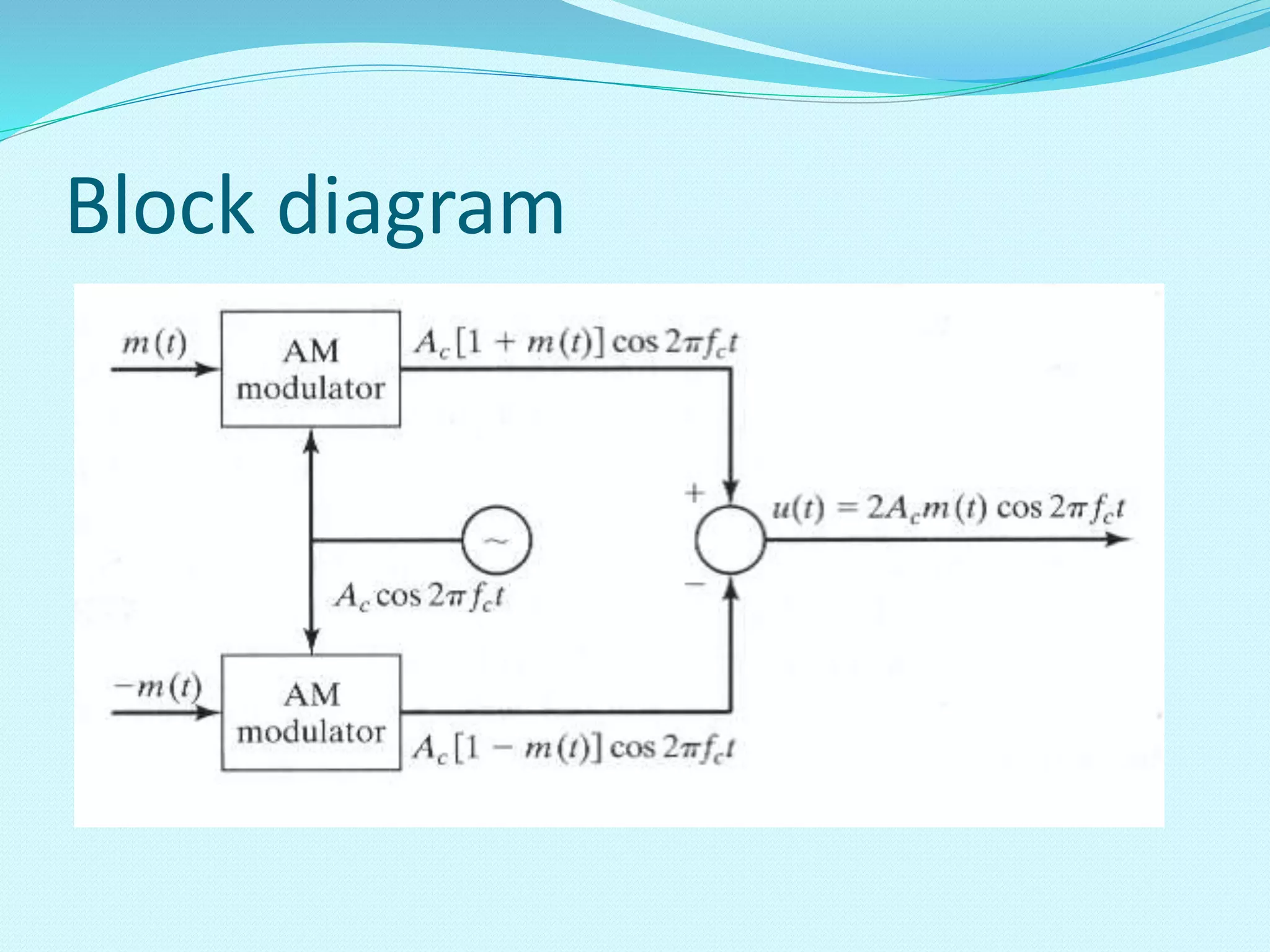
![Balance Modulator
A balance modulator consists of two standards
amplitude modulations arranged in a balanced
configuration, so as to suppers the
carrier wave, as shown in block.
S₁(t)=Ac[1+Kₐm(t)] cos(2πfᴄt)
S₂(t)=Ac[1-Kₐm(t)] cos(2πfᴄt)
S(t)= S₁(t)- S₂(t)=2KₐAc cos(2πfᴄt) m(t), which is equal
to the produced message signal](https://image.slidesharecdn.com/presentation1-141210234020-conversion-gate02/75/Generation-of-SSB-and-DSB_SC-Modulation-7-2048.jpg)


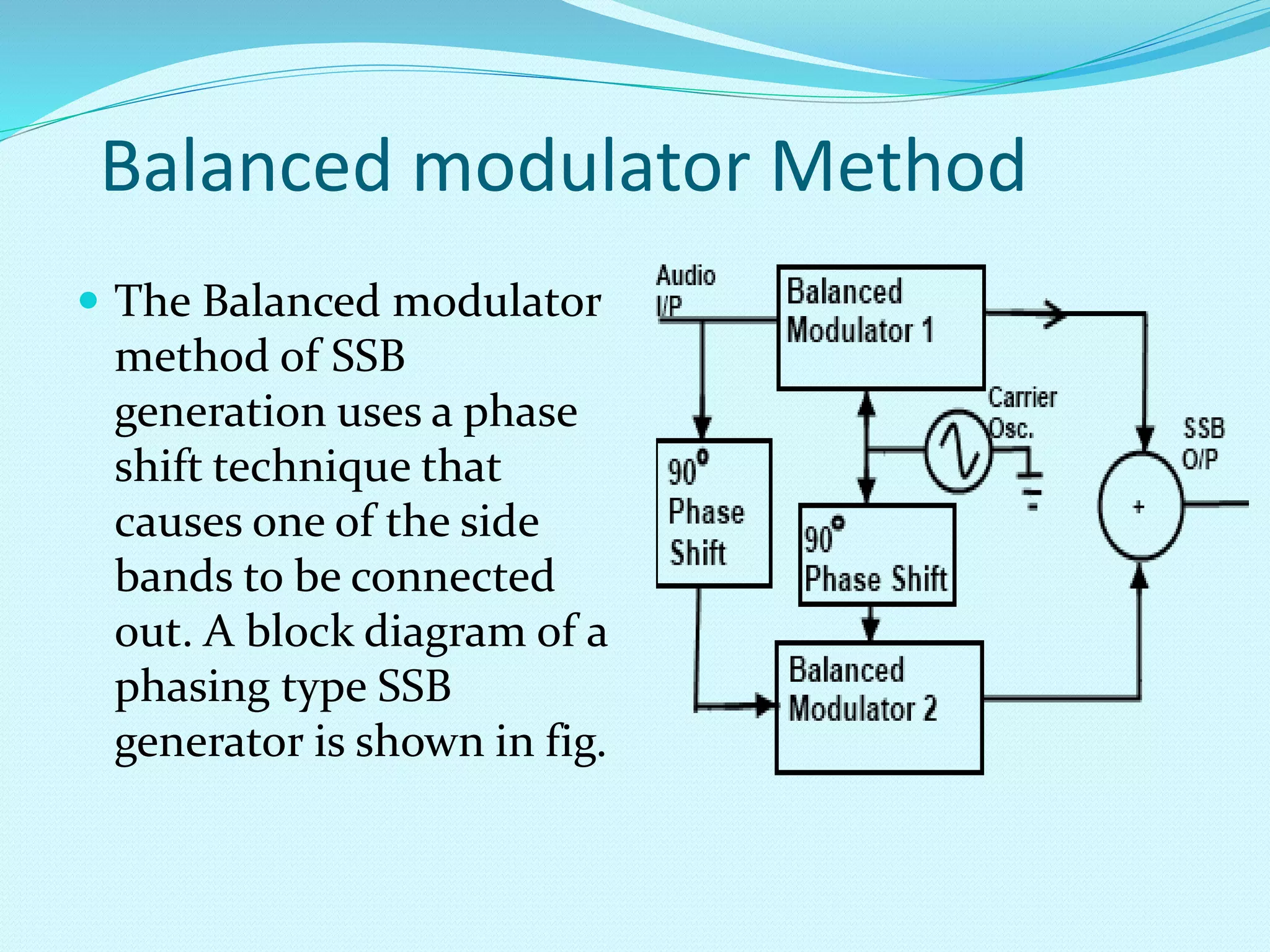
The document discusses two methods of single sideband (SSB) modulation and balanced modulator modulation. It explains that SSB modulation eliminates one sideband from an amplitude modulated wave. It then describes the balanced modulator method, which uses two balanced modulators and a 90 degree phase shift to cancel out one sideband. The document also provides a brief overview of double sideband suppressed carrier (DSB-SC) modulation and notes that it uses two methods: multiplier modulation and balanced modulator.
Presented by Joy Debnath and MD. Omar Faroque Tanzell, IDs 121-33-836 and 121-33-858.
SSB modulation eliminates components of one sideband; methods include Filter and Balanced modulator.
The balanced modulator method uses phase shifting to remove one sideband from an SSB signal.
Uses two balanced modulators to eliminate the carrier and produce SSB by algebraically combining outputs.
Modulated signal equation generates sum and difference frequencies for upper and lower sidebands.
DSB-SC modulation symmetrically spaces frequencies around carrier; composed with two methods: Multiplier and Balance.
Balance modulator suppresses the carrier by utilizing two amplitude modulations, producing the message signal.
A block diagram representation to visualize the modulation process.
Expresses thanks to the audience, concluding the presentation.


