By: John Eduard Carino
George Brayton
   Designed the first continuous ignition combustion
    engine (Brayton’s ready motor)

   The machine he invented introduced the process of
    continuous combustion (brayton cycle) which
    became the basis of for development of gas turbine.

   His machine made headlines in scientific journals of
    his time, but was superseded within a few years by
    Nikolaus Otto’s engine a more efficient and quieter
    design
Brayton Engine component
A Brayton-type engine consists of three
  components:

 A gas compressor
 A mixing chamber
 An expander
Brayton Cycle
   A thermodynamic cycle (also variously
    called the Joule or complete expansion
    diesel cycle) consisting of two constant-
    pressure (isobaric) processes
    interspersed with two reversible
    adiabatic (isentropic) processes.
Brayton Cycle


   Now, the Brayton cycle is used for gas
    turbines only where both the compression
    and expansion processes take place in
    rotating machinery.
Brayton Cycle Components:
 First, Fresh air is drawn into the
  compressor in which pressure and
  temperature are raised
 The high-pressure air proceeds into the
  combustion chamber, where the fuel
  is burned at constant pressure.
 The resulting high-temperature gases
  then enter the turbine, where they
  expand to the atmospheric pressure
  through a row of nozzle vanes
Brayton cycle components
   This expansion causes the turbine blade to
    spin, which then turns a shaft inside a
    magnetic coil. When the shaft is rotating
    inside the magnetic coil, electrical current is
    produced. The exhaust gases leaving the
    turbine in the open cycle are not re-
    circulated.
Processes and how they occur
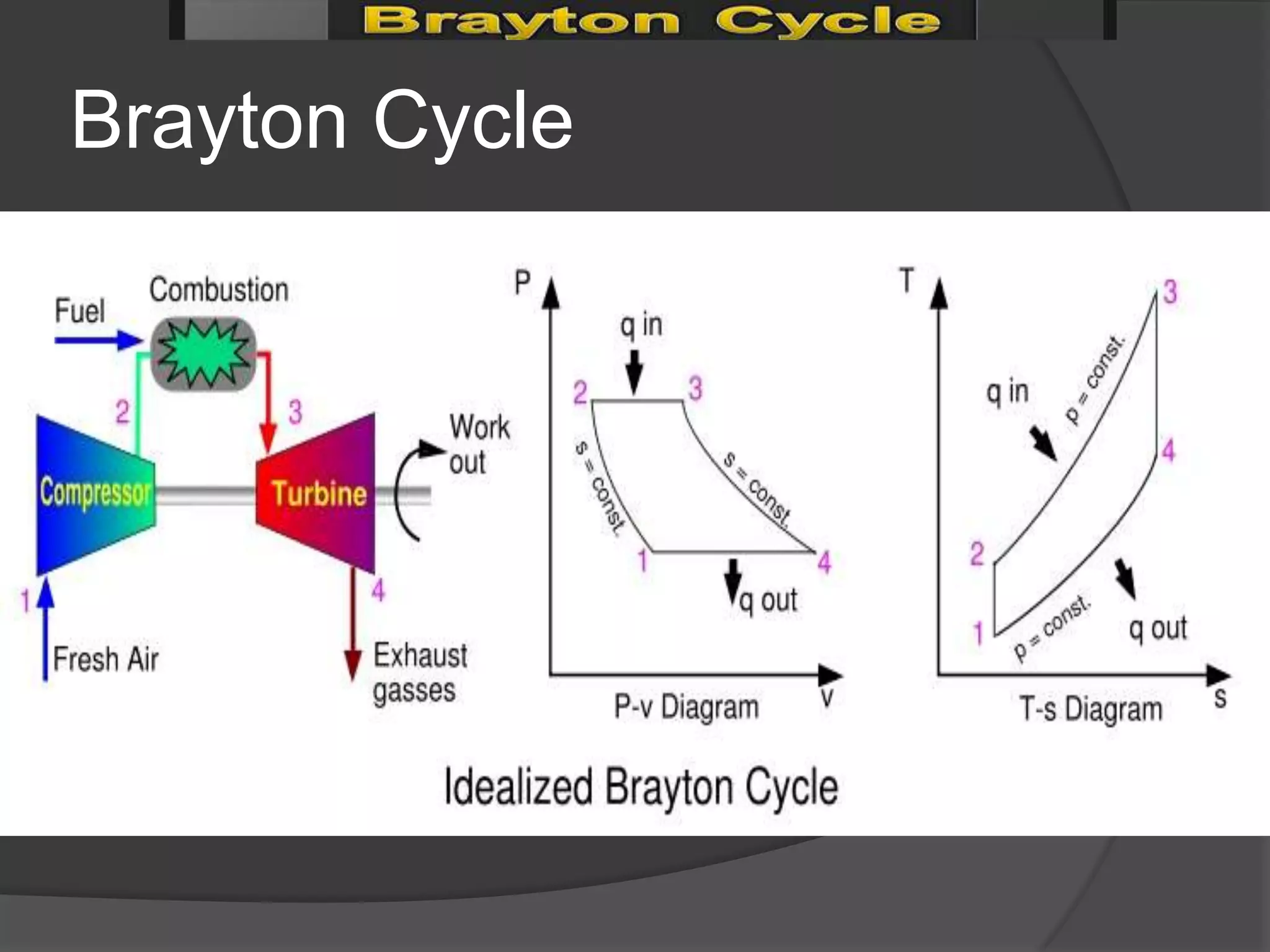
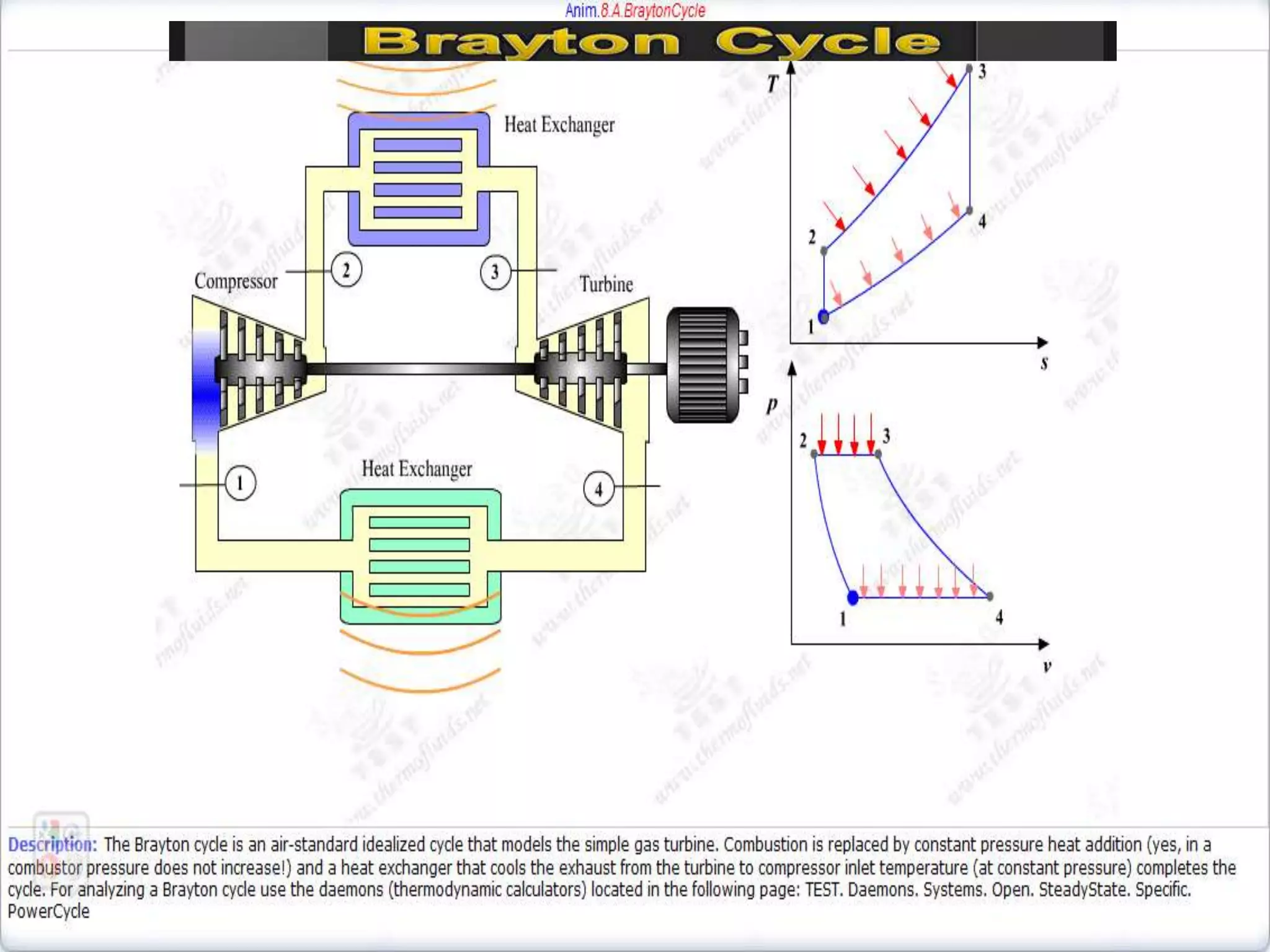
   Isentropic process - Ambient air is drawn into the
    compressor, where it is pressurized.

   Isobaric process - The compressed air then runs through
    a combustion chamber, where fuel is burned, heating that
    air—a constant-pressure process, since the chamber is
    open to flow in and out.

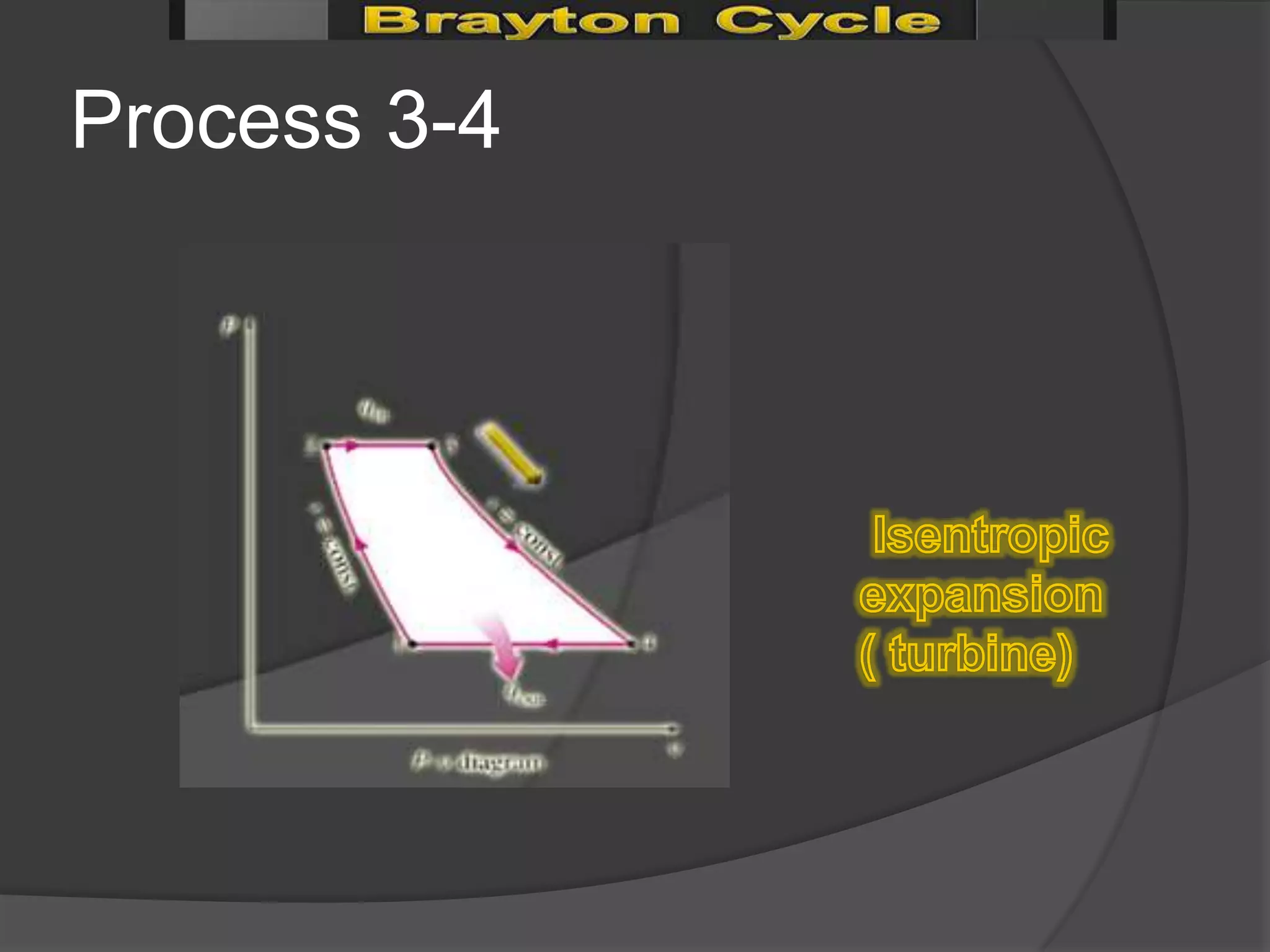
   Isentropic process - The heated, pressurized air then
    gives up its energy, expanding through a turbine (or series
    of turbines). Some of the work extracted by the turbine is
    used to drive the compressor.

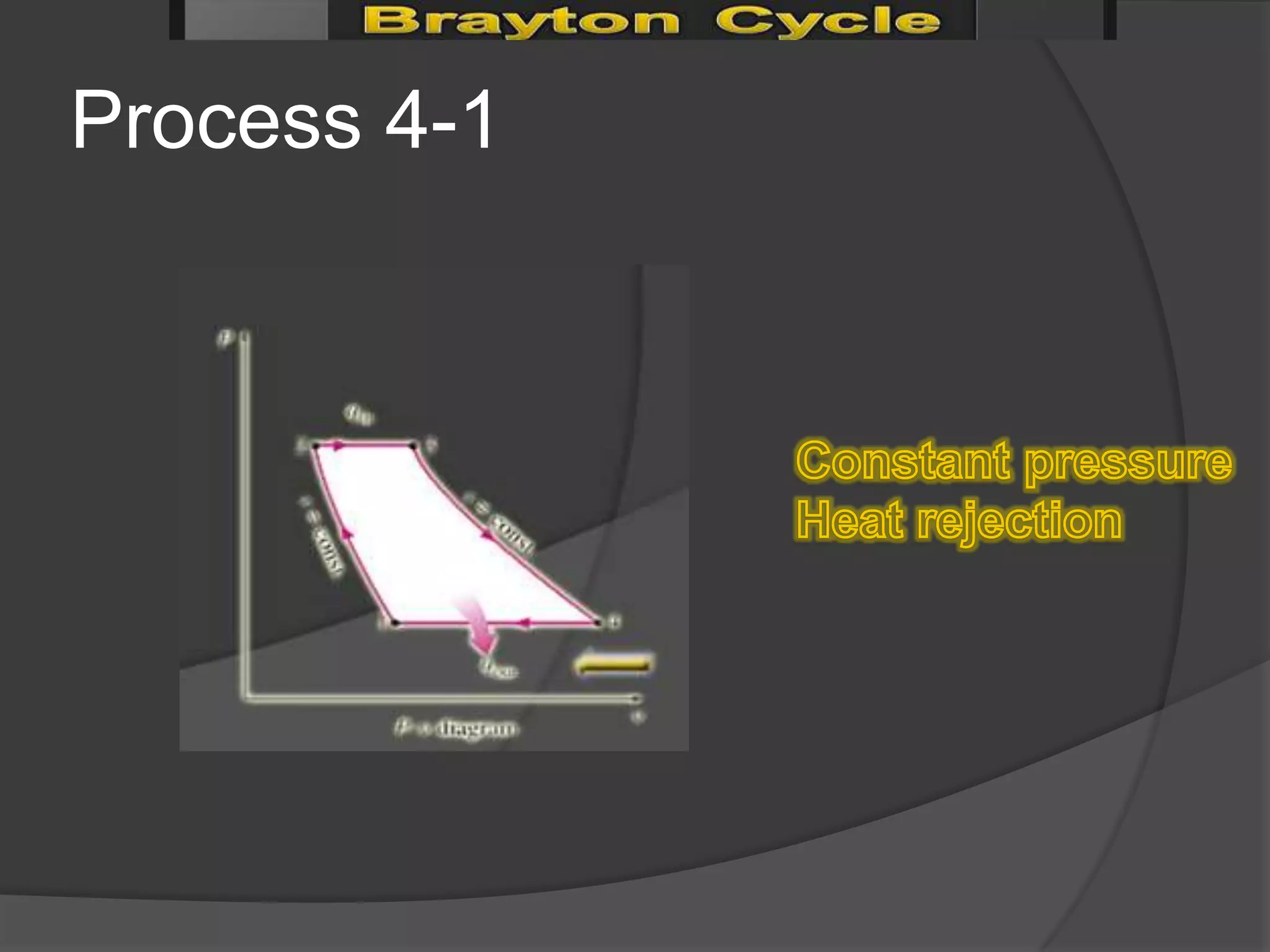
   Isobaric process - Heat rejection (in the atmosphere).
Differences to other cycles
   The thermal efficiency for a given gas, air, is
    solely a function of the ratio of compression.
    This is also the case with the Otto cycle. For the
    diesel cycle with incomplete expansion, the
    thermal efficiency is lower.

   The Brayton cycle, with its high inherent thermal
    efficiency, requires the maximum volume of gas
    flow for a given power output.
Differences to other cycles
   The Otto and diesel cycles require much lower gas flow
    rates, but have the disadvantage of higher peak pressures
    and temperatures. These conflicting elements led to many
    designs, all attempting to achieve practical compromises.
    With the development of fluid acceleration devices for the
    compression and expansion of gases, the Brayton cycle
    found mechanisms which could economically handle the
    large volumes of working fluid. This is perfected in the gas
    turbine power plant.
Brayton Cycle
Open cycle and Closed
cycle
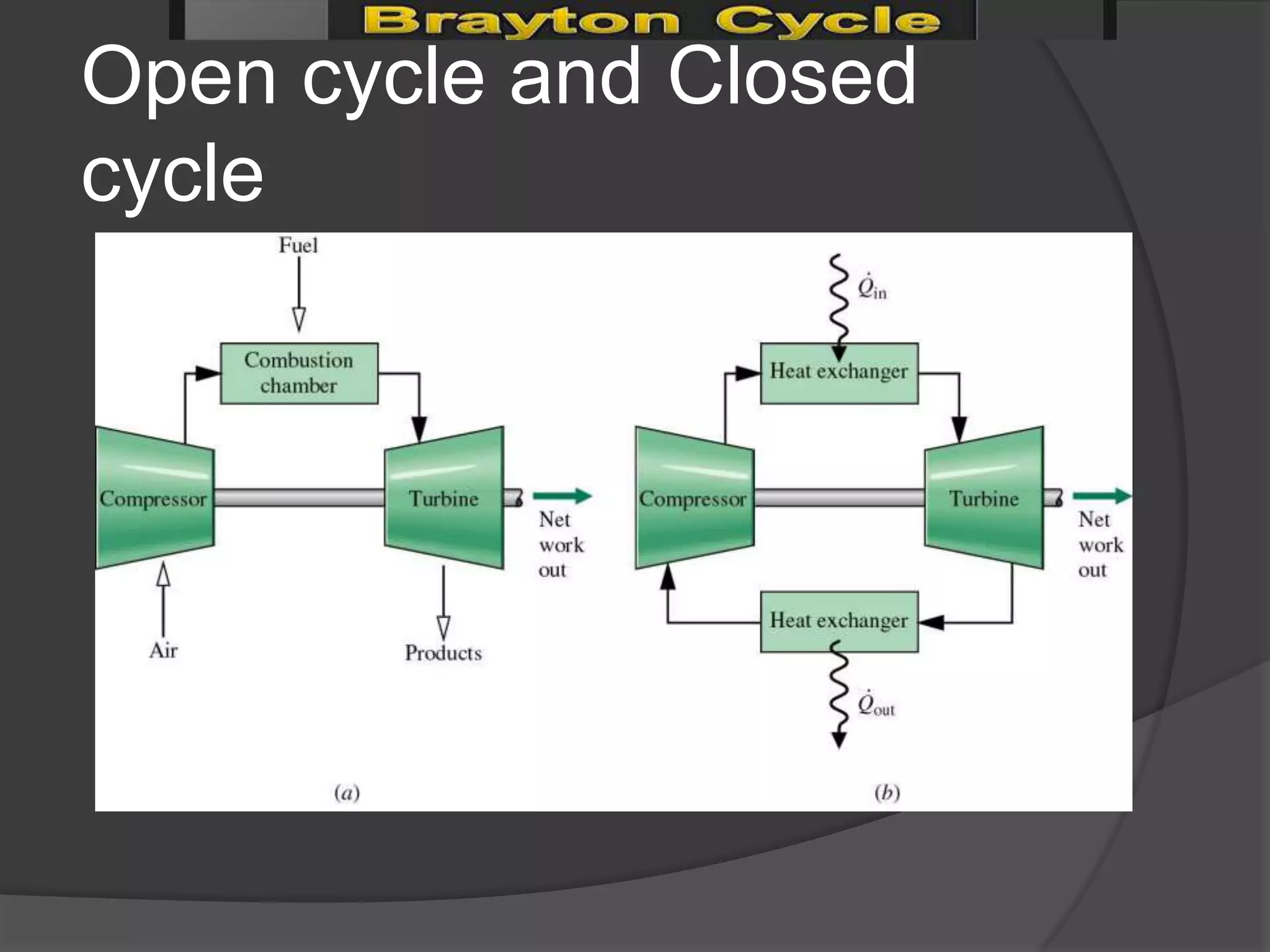
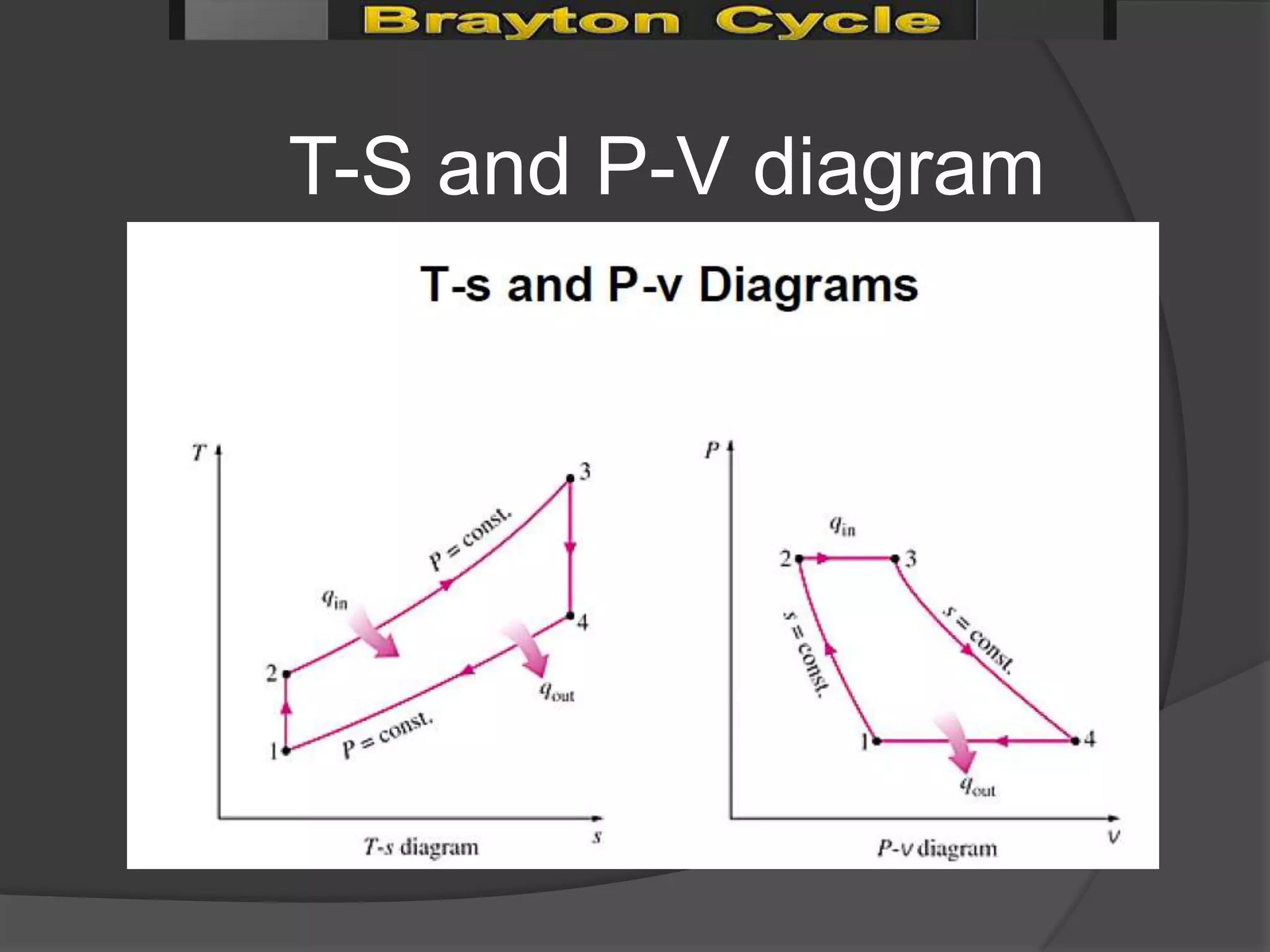
   The open gas-turbine cycle can be
    modelled as a closed cycle by
    utilizing the air-standard
    assumptions. Here the compression
    and expansion process remain the
    same, but a constant-pressure heat-
    rejection process to the ambient air
    replaces the combustion process.
T-S and P-V diagram
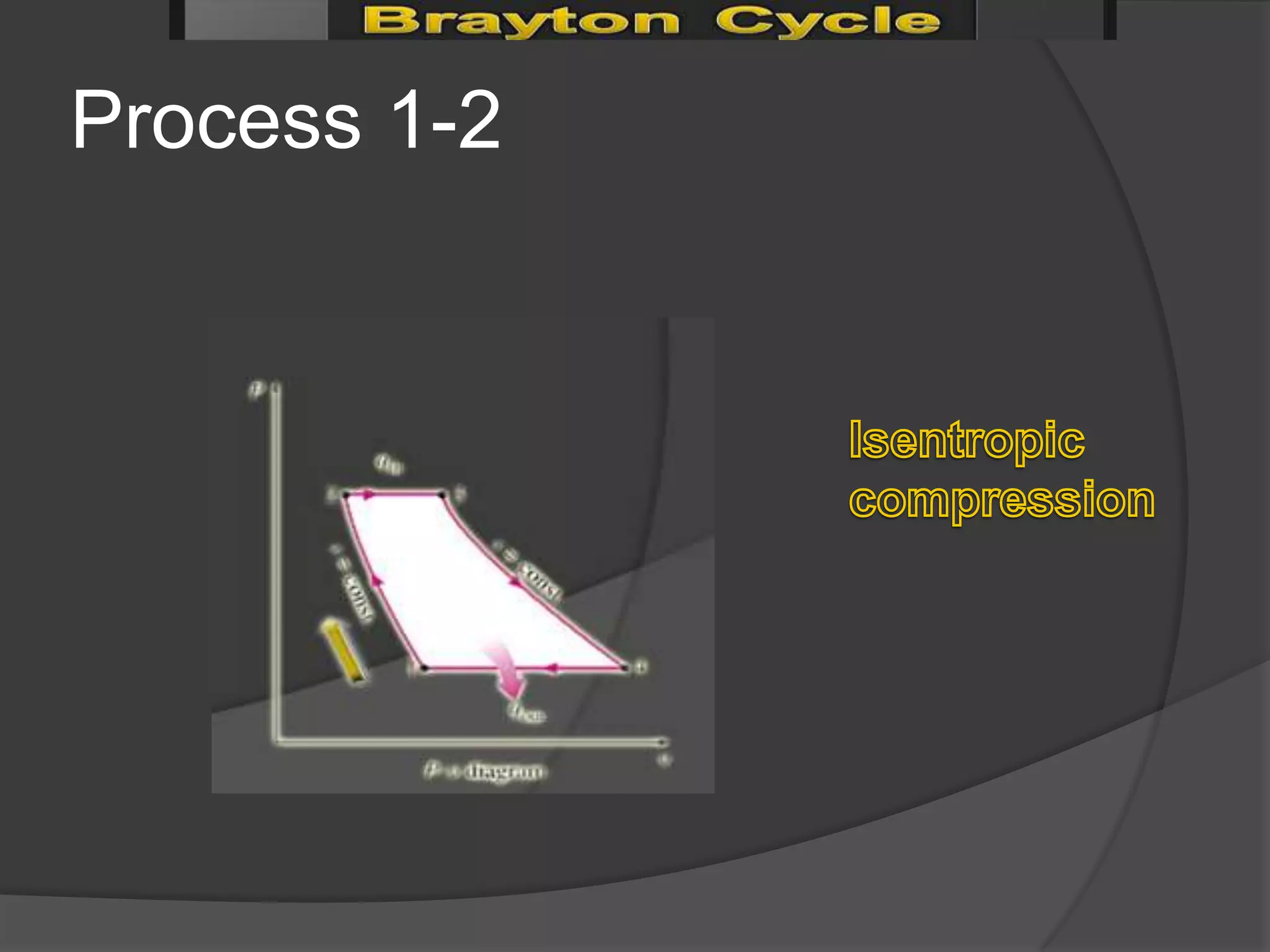
Process 1-2
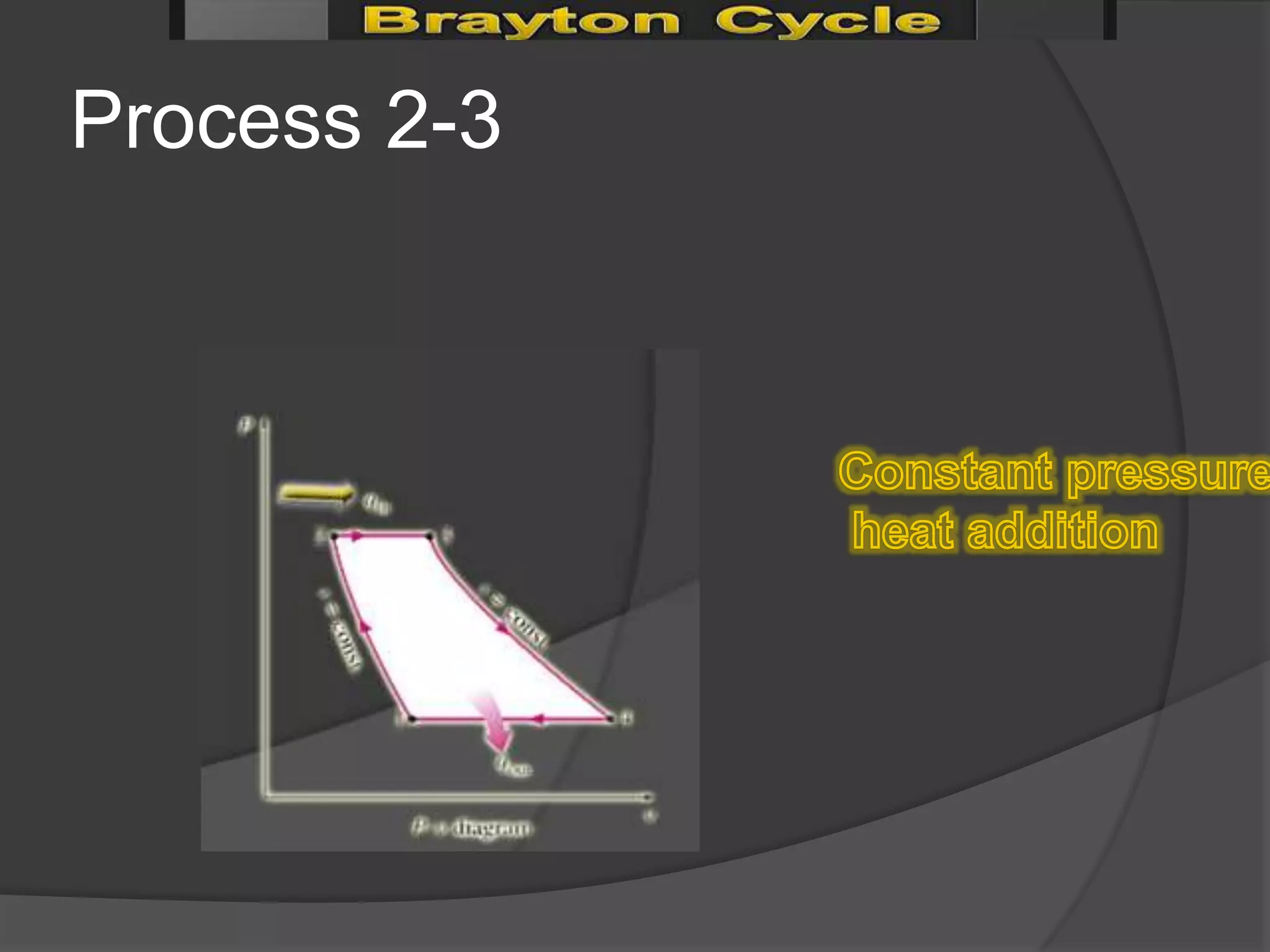
Process 2-3
Process 3-4
Process 4-1
Q added and Q rejected
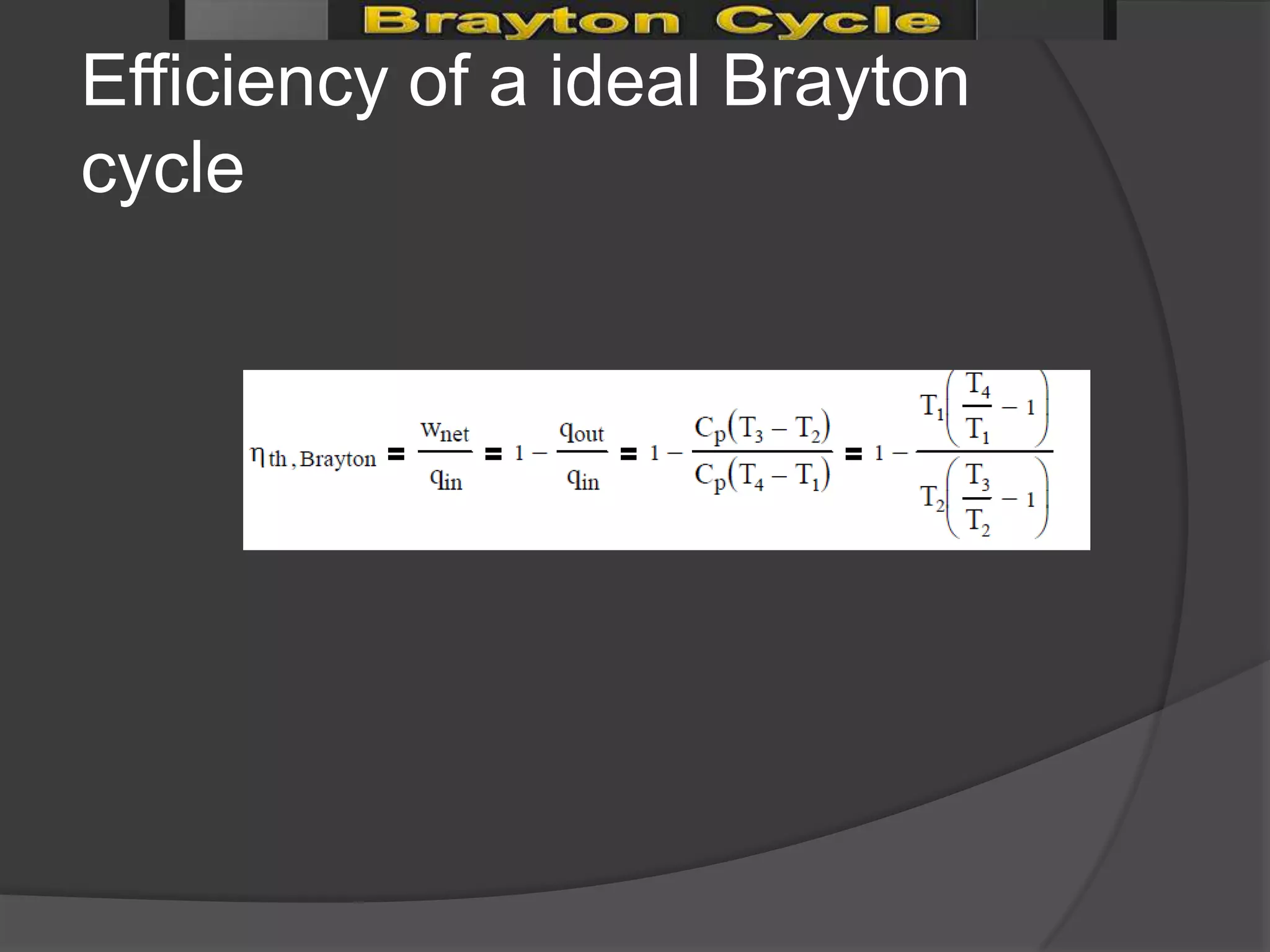
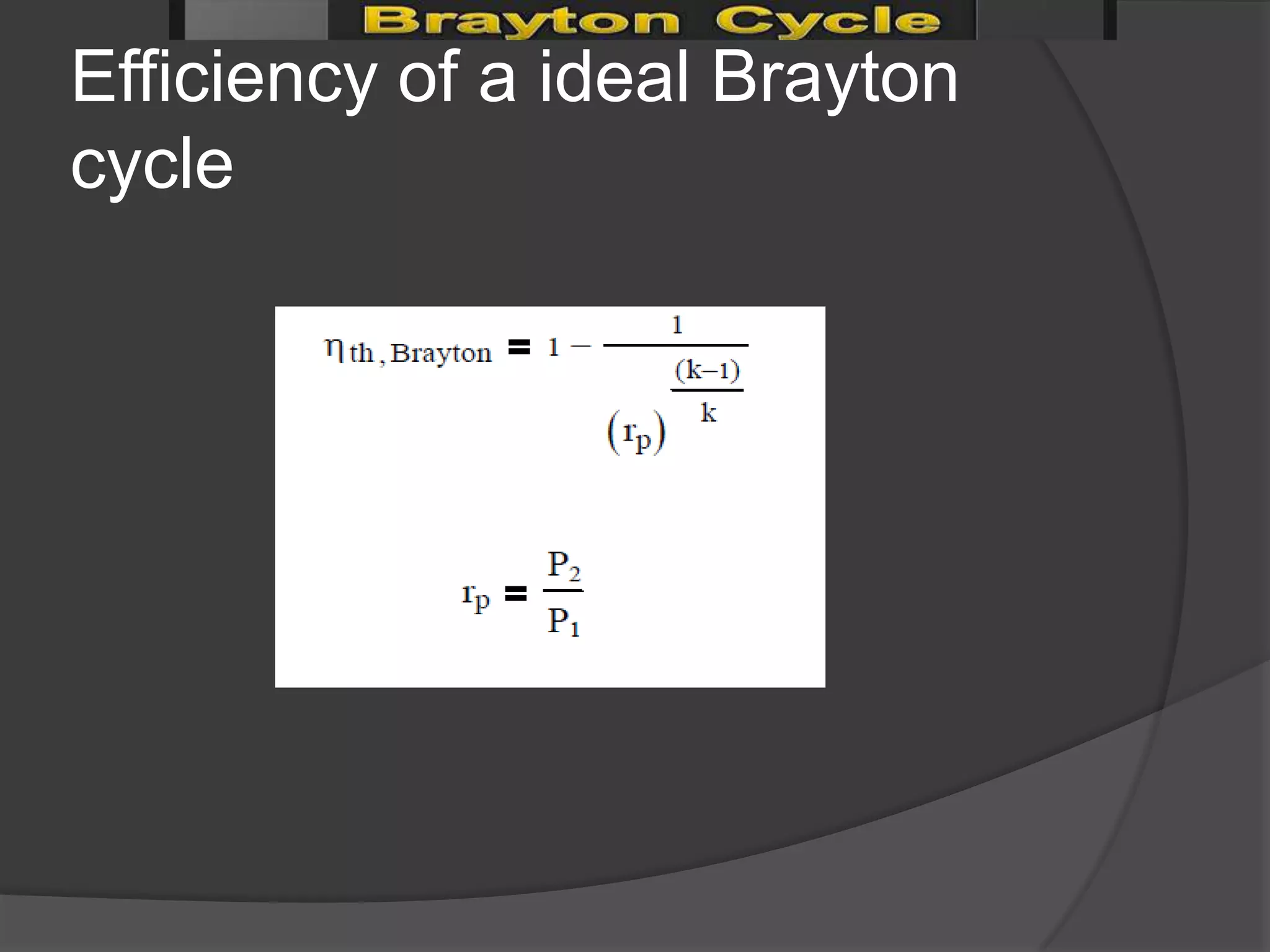
Efficiency of a ideal Brayton
cycle
Efficiency of a ideal Brayton
cycle

Brayton cycle

  • 1.
  • 3.
    George Brayton  Designed the first continuous ignition combustion engine (Brayton’s ready motor)  The machine he invented introduced the process of continuous combustion (brayton cycle) which became the basis of for development of gas turbine.  His machine made headlines in scientific journals of his time, but was superseded within a few years by Nikolaus Otto’s engine a more efficient and quieter design
  • 4.
    Brayton Engine component ABrayton-type engine consists of three components:  A gas compressor  A mixing chamber  An expander
  • 6.
    Brayton Cycle  A thermodynamic cycle (also variously called the Joule or complete expansion diesel cycle) consisting of two constant- pressure (isobaric) processes interspersed with two reversible adiabatic (isentropic) processes.
  • 7.
    Brayton Cycle  Now, the Brayton cycle is used for gas turbines only where both the compression and expansion processes take place in rotating machinery.
  • 9.
    Brayton Cycle Components: First, Fresh air is drawn into the compressor in which pressure and temperature are raised  The high-pressure air proceeds into the combustion chamber, where the fuel is burned at constant pressure.  The resulting high-temperature gases then enter the turbine, where they expand to the atmospheric pressure through a row of nozzle vanes
  • 10.
    Brayton cycle components  This expansion causes the turbine blade to spin, which then turns a shaft inside a magnetic coil. When the shaft is rotating inside the magnetic coil, electrical current is produced. The exhaust gases leaving the turbine in the open cycle are not re- circulated.
  • 11.
    Processes and howthey occur  Isentropic process - Ambient air is drawn into the compressor, where it is pressurized.  Isobaric process - The compressed air then runs through a combustion chamber, where fuel is burned, heating that air—a constant-pressure process, since the chamber is open to flow in and out.  Isentropic process - The heated, pressurized air then gives up its energy, expanding through a turbine (or series of turbines). Some of the work extracted by the turbine is used to drive the compressor.  Isobaric process - Heat rejection (in the atmosphere).
  • 13.
    Differences to othercycles  The thermal efficiency for a given gas, air, is solely a function of the ratio of compression. This is also the case with the Otto cycle. For the diesel cycle with incomplete expansion, the thermal efficiency is lower.  The Brayton cycle, with its high inherent thermal efficiency, requires the maximum volume of gas flow for a given power output.
  • 14.
    Differences to othercycles  The Otto and diesel cycles require much lower gas flow rates, but have the disadvantage of higher peak pressures and temperatures. These conflicting elements led to many designs, all attempting to achieve practical compromises. With the development of fluid acceleration devices for the compression and expansion of gases, the Brayton cycle found mechanisms which could economically handle the large volumes of working fluid. This is perfected in the gas turbine power plant.
  • 15.
  • 17.
    Open cycle andClosed cycle
  • 18.
    The open gas-turbine cycle can be modelled as a closed cycle by utilizing the air-standard assumptions. Here the compression and expansion process remain the same, but a constant-pressure heat- rejection process to the ambient air replaces the combustion process.
  • 19.
    T-S and P-Vdiagram
  • 20.
  • 21.
  • 22.
  • 23.
  • 25.
    Q added andQ rejected
  • 26.
    Efficiency of aideal Brayton cycle
  • 27.
    Efficiency of aideal Brayton cycle