AIR STANDARD
CYCLE
Idealizations Help Manage Analysis
of Complex Processes
(fig. 8-2)
8-1
The analysis of many complex processes can be reduced to a
manageable level by utilizing some idealizations
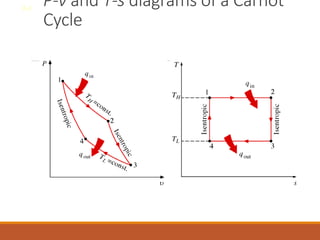
P-v and T-s diagrams of a Carnot
Cycle
8-2
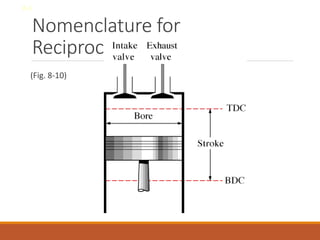
Nomenclature for
Reciprocating Engines
(Fig. 8-10)
8-3
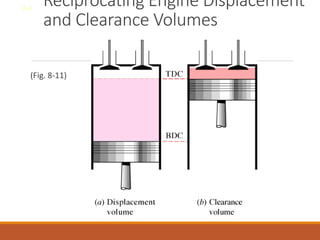
Reciprocating Engine Displacement
and Clearance Volumes
(Fig. 8-11)
8-4
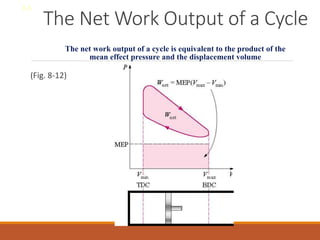
The Net Work Output of a Cycle
(Fig. 8-12)
8-5
The net work output of a cycle is equivalent to the product of the
mean effect pressure and the displacement volume
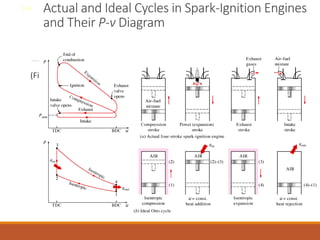
Actual and Ideal Cycles in Spark-Ignition Engines
and Their P-v Diagram
(Fig. 8-13)
8-6
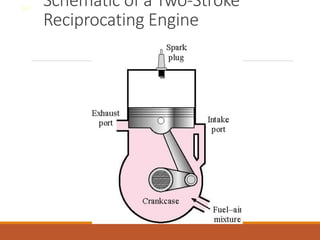
Schematic of a Two-Stroke
Reciprocating Engine
8-7
(Fig. 8-14)
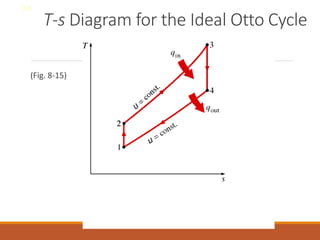
T-s Diagram for the Ideal Otto Cycle
(Fig. 8-15)
8-8
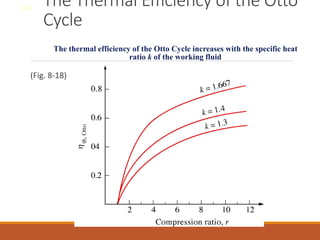
The Thermal Efficiency of the Otto
Cycle
(Fig. 8-18)
8-9
The thermal efficiency of the Otto Cycle increases with the specific heat
ratio k of the working fluid
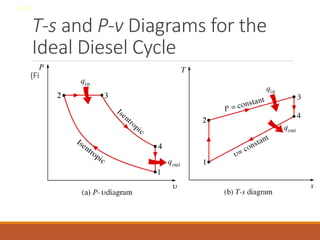
T-s and P-v Diagrams for the
Ideal Diesel Cycle
(Fig. 8-21)
8-10
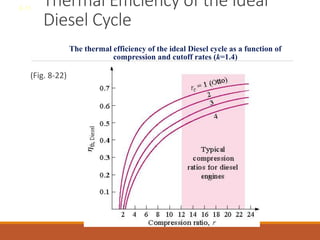
Thermal Efficiency of the Ideal
Diesel Cycle
(Fig. 8-22)
8-11
The thermal efficiency of the ideal Diesel cycle as a function of
compression and cutoff rates (k=1.4)
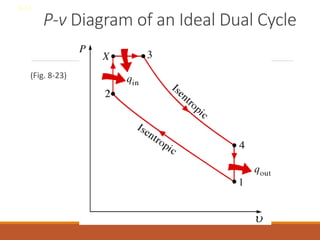
P-v Diagram of an Ideal Dual Cycle
(Fig. 8-23)
8-12
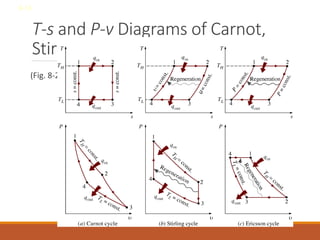
T-s and P-v Diagrams of Carnot,
Stirling, and Ericsson Cycles
(Fig. 8-26)
8-13
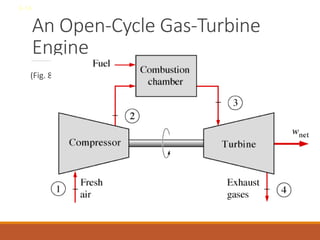
An Open-Cycle Gas-Turbine
Engine
(Fig. 8-29)
8-14
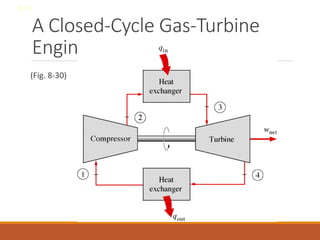
A Closed-Cycle Gas-Turbine
Engine
(Fig. 8-30)
8-15
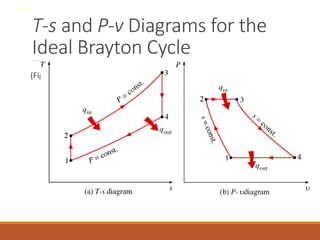
T-s and P-v Diagrams for the
Ideal Brayton Cycle
(Fig. 8-31)
8-16
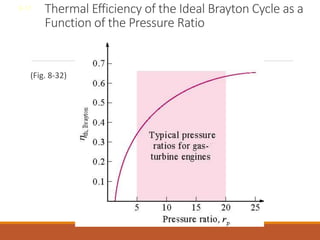
Thermal Efficiency of the Ideal Brayton Cycle as a
Function of the Pressure Ratio
(Fig. 8-32)
8-17
The Net Work of the Brayton Cycle
8-18
For fixed values of Tmin and Tmax, the net work of the Brayton cycle first
increases with the pressure ratio, then reaches a maximum at
rp=(Tmax/Tmin)k/[2(k-1)], and finally decreases
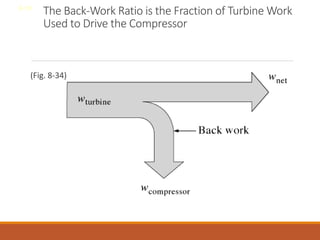
The Back-Work Ratio is the Fraction of Turbine Work
Used to Drive the Compressor
(Fig. 8-34)
8-19
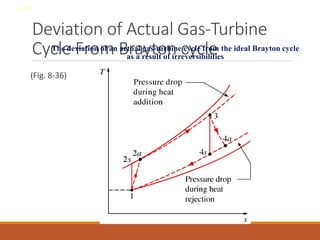
Deviation of Actual Gas-Turbine
Cycle From Brayton cycle
(Fig. 8-36)
8-20
The deviation of an actual gas-turbine cycle from the ideal Brayton cycle
as a result of irreversibilities
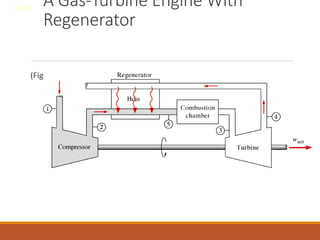
A Gas-Turbine Engine With
Regenerator
(Fig. 8-38)
8-21
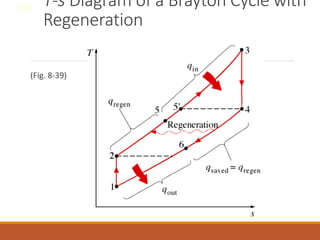
T-s Diagram of a Brayton Cycle with
Regeneration
(Fig. 8-39)
8-22
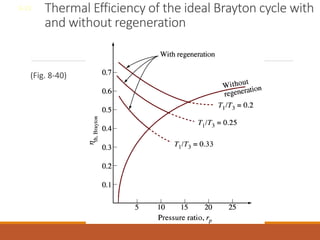
Thermal Efficiency of the ideal Brayton cycle with
and without regeneration
(Fig. 8-40)
8-23
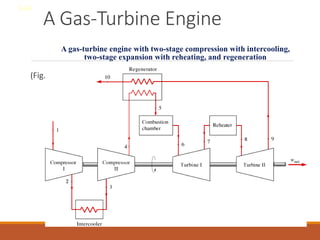
A Gas-Turbine Engine
(Fig. 8-43)
8-24
A gas-turbine engine with two-stage compression with intercooling,
two-stage expansion with reheating, and regeneration
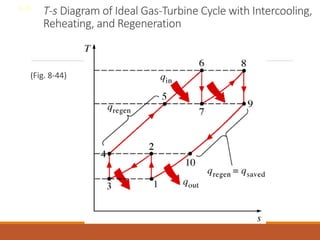
T-s Diagram of Ideal Gas-Turbine Cycle with Intercooling,
Reheating, and Regeneration
(Fig. 8-44)
8-25
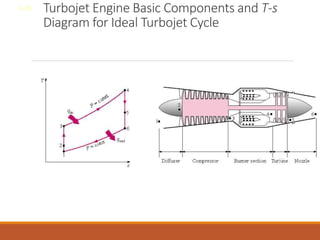
Turbojet Engine Basic Components and T-s
Diagram for Ideal Turbojet Cycle
8-26
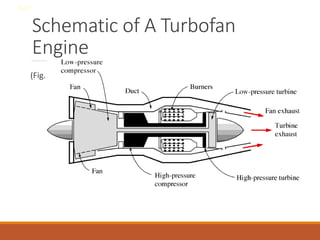
Schematic of A Turbofan
Engine
(Fig. 8-52)
8-27
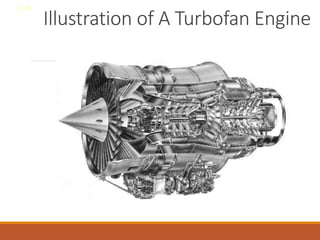
Illustration of A Turbofan Engine
8-28
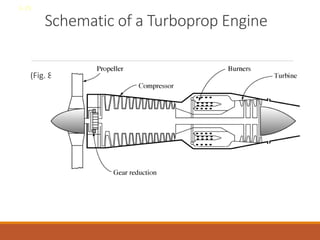
Schematic of a Turboprop Engine
(Fig. 8-54)
8-29
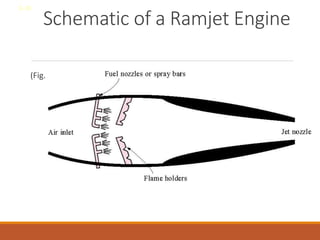
Schematic of a Ramjet Engine
(Fig. 8-55)
8-30
Chapter Summary
• A cycle during which a net amount of work is produced is
called a power cycle, and a power cycle during which the
working fluid remains a gas throughout is called a gas
power cycle.
8-31
Chapter Summary
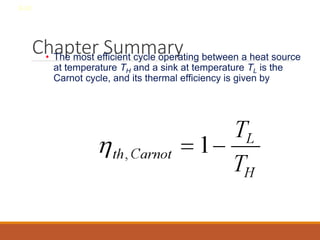
• The most efficient cycle operating between a heat source
at temperature TH and a sink at temperature TL is the
Carnot cycle, and its thermal efficiency is given by
8-32
Chapter Summary
• The actual gas cycles are rather complex. The approximations used to simplify the
analysis are known as the air-standard assumptions. Under these assumptions, all the
processes are assumed to be internally reversible; the working fluid is assumed to be
air, which behaves as an ideal gas; and the combustion and exhaust processes are
replaced by heat-addition and heat-rejection processes, respectively.
8-33
Chapter Summary
• The air-standard assumptions are called cold-air-
standard assumptions if, in addition, air is assumed to
have constant specific heats at room temperature.
8-34
Chapter Summary
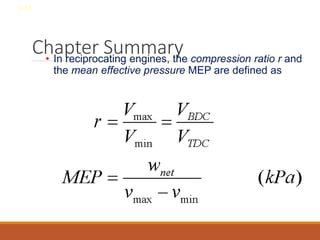
• In reciprocating engines, the compression ratio r and
the mean effective pressure MEP are defined as
8-35
Chapter Summary
• The Otto cycle is the ideal cycle for the spark-ignition reciprocating
engines, and it consists of four internally reversible processes:
isentropic compression, constant volume heat addition, isentropic
expansion, and con-stant volume heat rejection.
8-36
Chapter Summary
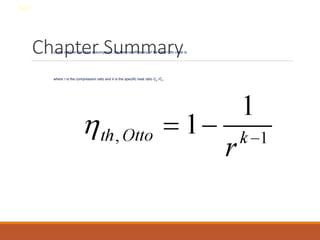
• Under cold-air-standard assumptions, the thermal efficiency of the ideal Otto cycle is
where r is the compression ratio and k is the specific heat ratio Cp /Cv.
8-37
Chapter Summary
• The Diesel cycle is the ideal cycle for the compression-ignition
reciprocating engines. It is very similar to the Otto cycle, except
that the constant volume heat-addition process is replaced by a
constant pressure heat-addition process.
8-38
Chapter Summary
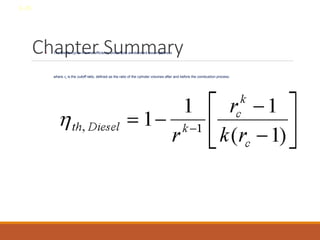
• The Diesel cycle thermal efficiency under cold-air-standard assumptions is
where rc is the cutoff ratio, defined as the ratio of the cylinder volumes after and before the combustion process.
8-39
Chapter Summary
• Stirling and Ericsson cycles are two totally reversible cycles that involve an isothermal heat-addition process at TH and
an isothermal heat-rejection process at TL. They differ from the Carnot cycle in that the two isentropic processes are
replaced by two constant volume regeneration processes in the Stirling cycle and by two constant pressure
regeneration processes in the Ericsson cycle. Both cycles utilize regeneration, a process during which heat is
transferred to a thermal energy storage device (called a regenerator) during one part of the cycle that is then
transferred back to the working fluid during another part of the cycle.
8-40
Chapter Summary
• The ideal cycle for modern gas-turbine engines is the Brayton
cycle, which is made up of four internally reversible processes:
isentropic compression, constant pressure heat addition,
isentropic expansion, and constant pressure heat rejection.
8-41
Chapter Summary
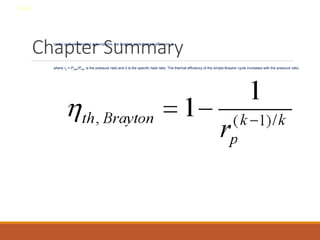
• Under cold-air-standard assumptions, the Brayton cycle thermal efficiency is
where rp = Pmax/Pmin is the pressure ratio and k is the specific heat ratio. The thermal efficiency of the simple Brayton cycle increases with the pressure ratio.
8-42
Chapter Summary
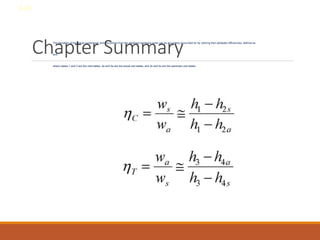
• The deviation of the actual compressor and the turbine from the idealized isentropic ones can be accurately accounted for by utilizing their adiabatic efficiencies, defined as
and
where states 1 and 3 are the inlet states, 2a and 4a are the actual exit states, and 2s and 4s are the isentropic exit states.
8-43
Chapter Summary
• In gas-turbine engines, the temperature of the exhaust gas leaving the
turbine is often considerably higher than the temperature of the air leaving
the compressor. Therefore, the high-pressure air leaving the compressor can
be heated by transferring heat to it from the hot exhaust gases in a counter-
flow heat exchanger, which is also known as a regenerator.
8-44
Chapter Summary
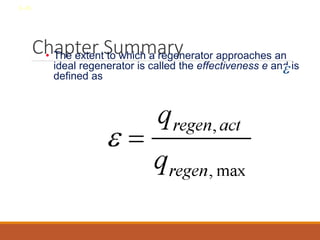
• The extent to which a regenerator approaches an
ideal regenerator is called the effectiveness e and is
defined as
8-45
Chapter Summary
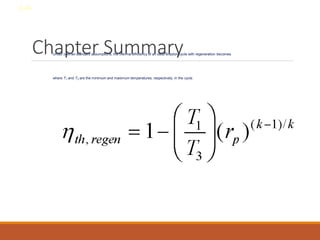
• Under cold-air-standard assumptions, the thermal efficiency of an ideal Brayton cycle with regeneration becomes
where T1 and T3 are the minimum and maximum temperatures, respectively, in the cycle.
8-46
Chapter Summary
• The thermal efficiency of the Brayton cycle can also be increased by utilizing
multistage compression with intercooling, regeneration, and multistage
expansion with reheating. The work input to the compressor is minimized
when equal pressure ratios are maintained across each stage. This
procedure also maximizes the turbine work output.
8-47
Chapter Summary
• Gas-turbine engines are widely used to power aircraft because they are light and
compact and have a high power-to-weight ratio. The ideal jet-propulsion cycle differs
from the simple ideal Brayton cycle in that the gases are partially expanded in the
turbine. The gases that exit the turbine at a relatively high pressure are subsequently
accelerated in a nozzle to provide the thrust needed to propel the aircraft.
8-48
Chapter Summary
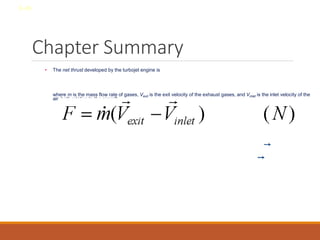
• The net thrust developed by the turbojet engine is
where m is the mass flow rate of gases, Vexit is the exit velocity of the exhaust gases, and Vinlet is the inlet velocity of the
air, both relative to the aircraft
8-49
Chapter Summary
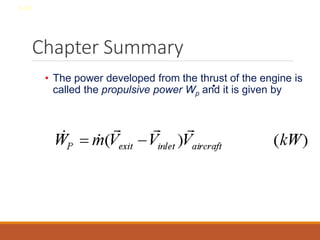
• The power developed from the thrust of the engine is
called the propulsive power Wp and it is given by
.
8-50
Chapter Summary
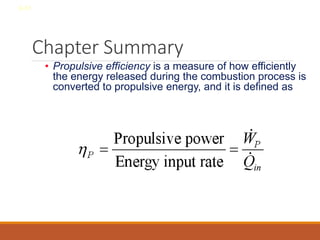
• Propulsive efficiency is a measure of how efficiently
the energy released during the combustion process is
converted to propulsive energy, and it is defined as
8-51
Chapter Summary
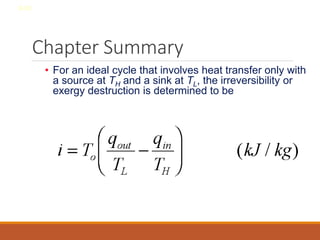
• For an ideal cycle that involves heat transfer only with
a source at TH and a sink at TL, the irreversibility or
exergy destruction is determined to be
8-52

AIR STANDARD CYCLE PPT.PPT

  • 1.
  • 2.
    Idealizations Help ManageAnalysis of Complex Processes (fig. 8-2) 8-1 The analysis of many complex processes can be reduced to a manageable level by utilizing some idealizations
  • 3.
    P-v and T-sdiagrams of a Carnot Cycle 8-2
  • 4.
  • 5.
    Reciprocating Engine Displacement andClearance Volumes (Fig. 8-11) 8-4
  • 6.
    The Net WorkOutput of a Cycle (Fig. 8-12) 8-5 The net work output of a cycle is equivalent to the product of the mean effect pressure and the displacement volume
  • 7.
    Actual and IdealCycles in Spark-Ignition Engines and Their P-v Diagram (Fig. 8-13) 8-6
  • 8.
    Schematic of aTwo-Stroke Reciprocating Engine 8-7 (Fig. 8-14)
  • 9.
    T-s Diagram forthe Ideal Otto Cycle (Fig. 8-15) 8-8
  • 10.
    The Thermal Efficiencyof the Otto Cycle (Fig. 8-18) 8-9 The thermal efficiency of the Otto Cycle increases with the specific heat ratio k of the working fluid
  • 11.
    T-s and P-vDiagrams for the Ideal Diesel Cycle (Fig. 8-21) 8-10
  • 12.
    Thermal Efficiency ofthe Ideal Diesel Cycle (Fig. 8-22) 8-11 The thermal efficiency of the ideal Diesel cycle as a function of compression and cutoff rates (k=1.4)
  • 13.
    P-v Diagram ofan Ideal Dual Cycle (Fig. 8-23) 8-12
  • 14.
    T-s and P-vDiagrams of Carnot, Stirling, and Ericsson Cycles (Fig. 8-26) 8-13
  • 15.
  • 16.
  • 17.
    T-s and P-vDiagrams for the Ideal Brayton Cycle (Fig. 8-31) 8-16
  • 18.
    Thermal Efficiency ofthe Ideal Brayton Cycle as a Function of the Pressure Ratio (Fig. 8-32) 8-17
  • 19.
    The Net Workof the Brayton Cycle 8-18 For fixed values of Tmin and Tmax, the net work of the Brayton cycle first increases with the pressure ratio, then reaches a maximum at rp=(Tmax/Tmin)k/[2(k-1)], and finally decreases
  • 20.
    The Back-Work Ratiois the Fraction of Turbine Work Used to Drive the Compressor (Fig. 8-34) 8-19
  • 21.
    Deviation of ActualGas-Turbine Cycle From Brayton cycle (Fig. 8-36) 8-20 The deviation of an actual gas-turbine cycle from the ideal Brayton cycle as a result of irreversibilities
  • 22.
    A Gas-Turbine EngineWith Regenerator (Fig. 8-38) 8-21
  • 23.
    T-s Diagram ofa Brayton Cycle with Regeneration (Fig. 8-39) 8-22
  • 24.
    Thermal Efficiency ofthe ideal Brayton cycle with and without regeneration (Fig. 8-40) 8-23
  • 25.
    A Gas-Turbine Engine (Fig.8-43) 8-24 A gas-turbine engine with two-stage compression with intercooling, two-stage expansion with reheating, and regeneration
  • 26.
    T-s Diagram ofIdeal Gas-Turbine Cycle with Intercooling, Reheating, and Regeneration (Fig. 8-44) 8-25
  • 27.
    Turbojet Engine BasicComponents and T-s Diagram for Ideal Turbojet Cycle 8-26
  • 28.
    Schematic of ATurbofan Engine (Fig. 8-52) 8-27
  • 29.
    Illustration of ATurbofan Engine 8-28
  • 30.
    Schematic of aTurboprop Engine (Fig. 8-54) 8-29
  • 31.
    Schematic of aRamjet Engine (Fig. 8-55) 8-30
  • 32.
    Chapter Summary • Acycle during which a net amount of work is produced is called a power cycle, and a power cycle during which the working fluid remains a gas throughout is called a gas power cycle. 8-31
  • 33.
    Chapter Summary • Themost efficient cycle operating between a heat source at temperature TH and a sink at temperature TL is the Carnot cycle, and its thermal efficiency is given by 8-32
  • 34.
    Chapter Summary • Theactual gas cycles are rather complex. The approximations used to simplify the analysis are known as the air-standard assumptions. Under these assumptions, all the processes are assumed to be internally reversible; the working fluid is assumed to be air, which behaves as an ideal gas; and the combustion and exhaust processes are replaced by heat-addition and heat-rejection processes, respectively. 8-33
  • 35.
    Chapter Summary • Theair-standard assumptions are called cold-air- standard assumptions if, in addition, air is assumed to have constant specific heats at room temperature. 8-34
  • 36.
    Chapter Summary • Inreciprocating engines, the compression ratio r and the mean effective pressure MEP are defined as 8-35
  • 37.
    Chapter Summary • TheOtto cycle is the ideal cycle for the spark-ignition reciprocating engines, and it consists of four internally reversible processes: isentropic compression, constant volume heat addition, isentropic expansion, and con-stant volume heat rejection. 8-36
  • 38.
    Chapter Summary • Undercold-air-standard assumptions, the thermal efficiency of the ideal Otto cycle is where r is the compression ratio and k is the specific heat ratio Cp /Cv. 8-37
  • 39.
    Chapter Summary • TheDiesel cycle is the ideal cycle for the compression-ignition reciprocating engines. It is very similar to the Otto cycle, except that the constant volume heat-addition process is replaced by a constant pressure heat-addition process. 8-38
  • 40.
    Chapter Summary • TheDiesel cycle thermal efficiency under cold-air-standard assumptions is where rc is the cutoff ratio, defined as the ratio of the cylinder volumes after and before the combustion process. 8-39
  • 41.
    Chapter Summary • Stirlingand Ericsson cycles are two totally reversible cycles that involve an isothermal heat-addition process at TH and an isothermal heat-rejection process at TL. They differ from the Carnot cycle in that the two isentropic processes are replaced by two constant volume regeneration processes in the Stirling cycle and by two constant pressure regeneration processes in the Ericsson cycle. Both cycles utilize regeneration, a process during which heat is transferred to a thermal energy storage device (called a regenerator) during one part of the cycle that is then transferred back to the working fluid during another part of the cycle. 8-40
  • 42.
    Chapter Summary • Theideal cycle for modern gas-turbine engines is the Brayton cycle, which is made up of four internally reversible processes: isentropic compression, constant pressure heat addition, isentropic expansion, and constant pressure heat rejection. 8-41
  • 43.
    Chapter Summary • Undercold-air-standard assumptions, the Brayton cycle thermal efficiency is where rp = Pmax/Pmin is the pressure ratio and k is the specific heat ratio. The thermal efficiency of the simple Brayton cycle increases with the pressure ratio. 8-42
  • 44.
    Chapter Summary • Thedeviation of the actual compressor and the turbine from the idealized isentropic ones can be accurately accounted for by utilizing their adiabatic efficiencies, defined as and where states 1 and 3 are the inlet states, 2a and 4a are the actual exit states, and 2s and 4s are the isentropic exit states. 8-43
  • 45.
    Chapter Summary • Ingas-turbine engines, the temperature of the exhaust gas leaving the turbine is often considerably higher than the temperature of the air leaving the compressor. Therefore, the high-pressure air leaving the compressor can be heated by transferring heat to it from the hot exhaust gases in a counter- flow heat exchanger, which is also known as a regenerator. 8-44
  • 46.
    Chapter Summary • Theextent to which a regenerator approaches an ideal regenerator is called the effectiveness e and is defined as 8-45
  • 47.
    Chapter Summary • Undercold-air-standard assumptions, the thermal efficiency of an ideal Brayton cycle with regeneration becomes where T1 and T3 are the minimum and maximum temperatures, respectively, in the cycle. 8-46
  • 48.
    Chapter Summary • Thethermal efficiency of the Brayton cycle can also be increased by utilizing multistage compression with intercooling, regeneration, and multistage expansion with reheating. The work input to the compressor is minimized when equal pressure ratios are maintained across each stage. This procedure also maximizes the turbine work output. 8-47
  • 49.
    Chapter Summary • Gas-turbineengines are widely used to power aircraft because they are light and compact and have a high power-to-weight ratio. The ideal jet-propulsion cycle differs from the simple ideal Brayton cycle in that the gases are partially expanded in the turbine. The gases that exit the turbine at a relatively high pressure are subsequently accelerated in a nozzle to provide the thrust needed to propel the aircraft. 8-48
  • 50.
    Chapter Summary • Thenet thrust developed by the turbojet engine is where m is the mass flow rate of gases, Vexit is the exit velocity of the exhaust gases, and Vinlet is the inlet velocity of the air, both relative to the aircraft 8-49
  • 51.
    Chapter Summary • Thepower developed from the thrust of the engine is called the propulsive power Wp and it is given by . 8-50
  • 52.
    Chapter Summary • Propulsiveefficiency is a measure of how efficiently the energy released during the combustion process is converted to propulsive energy, and it is defined as 8-51
  • 53.
    Chapter Summary • Foran ideal cycle that involves heat transfer only with a source at TH and a sink at TL, the irreversibility or exergy destruction is determined to be 8-52