“Dual Combustion Engine”
Presented To:
Sir Qazi Shehzad
Presented by:
 Jawaria Bint Faheem (12063122-008)
Areeba Malik (12063122-050)
Areeba Asif (12063122-070)
Hina Usman (12063122-077)
Beenish Hafeez (12063122-085)
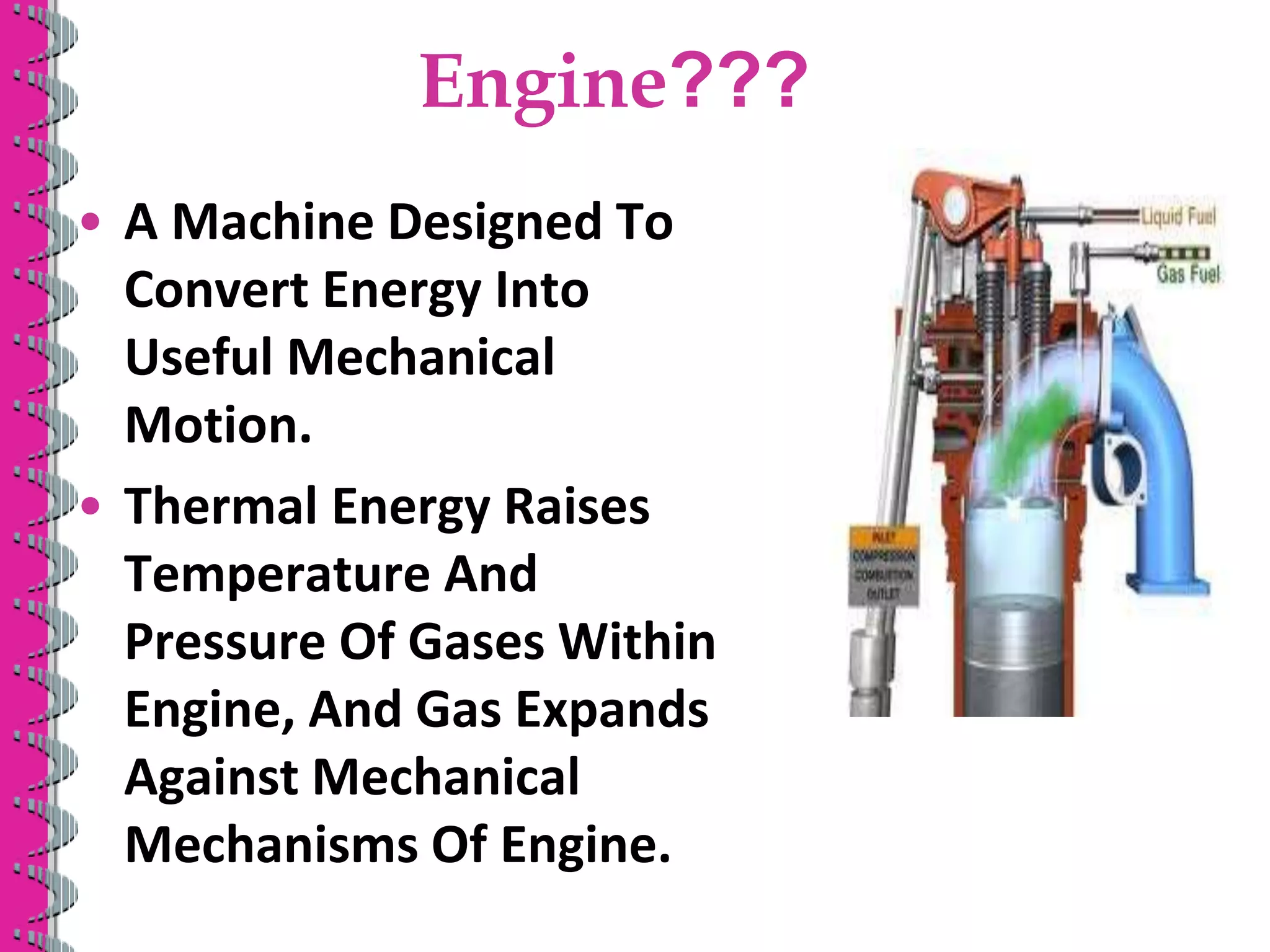
Engine???
• A Machine Designed To
Convert Energy Into
Useful Mechanical
Motion.
• Thermal Energy Raises
Temperature And
Pressure Of Gases Within
Engine, And Gas Expands
Against Mechanical
Mechanisms Of Engine.
History
• Oil Engine 1888.
• Ackroyd Staurt
(Automatic
Ignition).
• Rudolf Diesel Used
This Principle And
Developed Basis
Of Dual
Combustion
Engine.
Dual Combustion Engine
• It is an internal combustion four
stroke engine.
• “Dual” Because Combustion Takes
Place In Two Parts First At Constant
Pressure And Second At Constant
Volume.
• This makes it better than diesel
engine’s cycle.
Dual Combustion Cycle
• Also Known As The Limited Pressure Or Mixed
Cycle, Seiliger Cycle Or Sabathe Cycle.
• Thermal Cycle That Is A Combination Of The
Otto Cycle And The Diesel Cycle.
Characteristics
• It is a four stroke
engine.
• Improved and modern
form of old Diesel
engine’s cycles.
• Its one stroke is divided
into two parts allowing
it to carry out more
work..
• Have increased
efficiency.
Parts Of Engine
Stroke
• Each Cycle Of Piston Consists Of Two
Opposite Motions:
There Is A Motion In One Direction, And
Then A Motion Back In The Opposite
Direction. Each Of These Is Called A Stroke
• Stroke Is The Action Of A Piston Travelling
The Full Length Of Its Locomotive Cylinder Or
Engine Cylinder In One Direction.
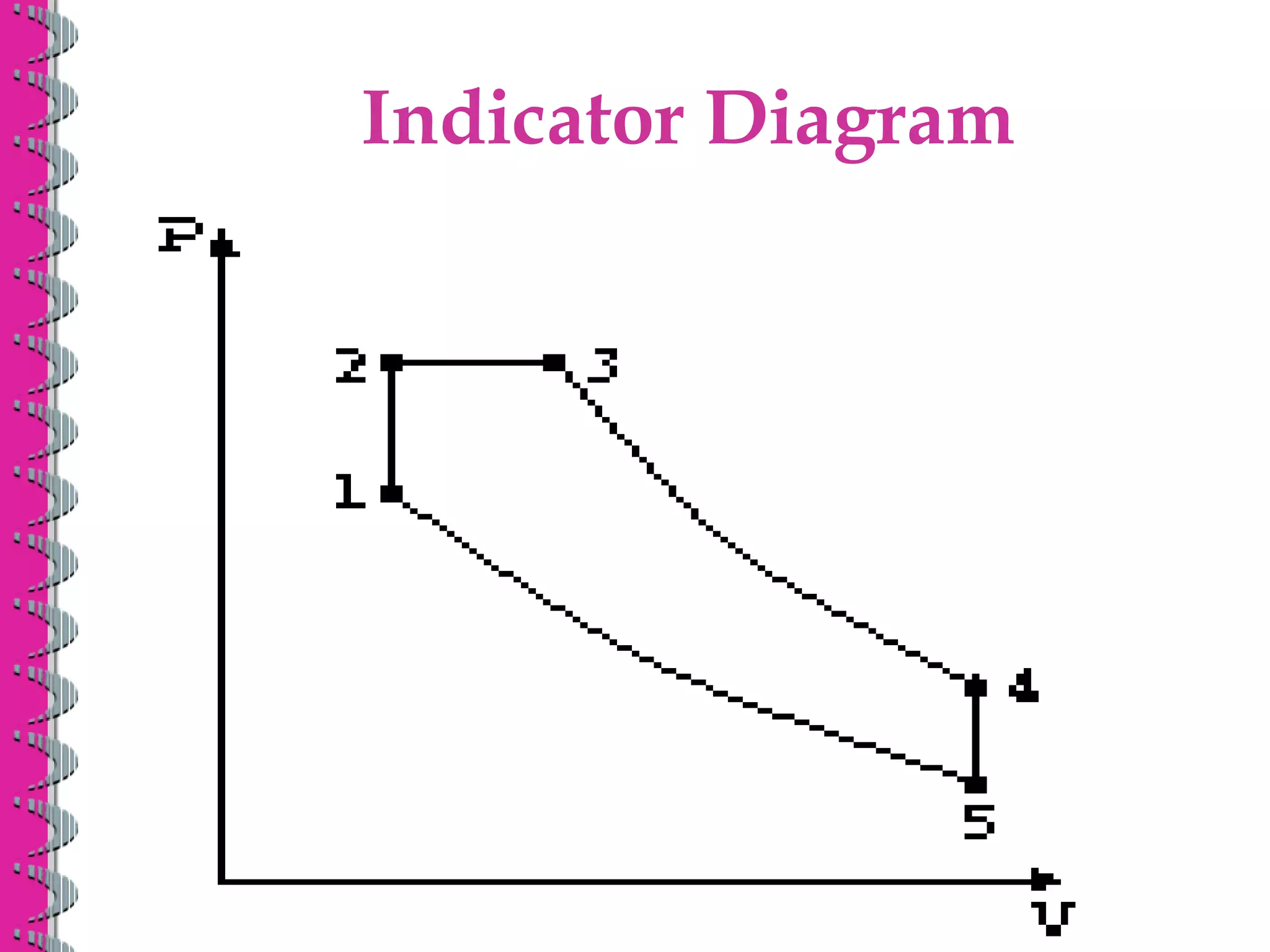
Indicator Diagram
Sequence of Operations
The dual cycle consists of following
operations:
• Adiabatic compression
• Addition of heat at constant volume.
• Addition of heat at constant pressure.
• Adiabatic expansion.
• Rejection of heat at constant volume.
Explanation
1)Adiabatic Compression:
Adiabatically compressed air, it turned
hot. Fuel injection starts before the point
of maximum compression.(ignition phase)
2) Constant Volume Phase:
After a short delay the fuel warms up to
the air temperature causing a sudden rise
in pressure.
Continued …
3) Constant Pressure Phase:
Further Injection Keeps The Fuel Burning As
Volume Increases
4) Adiabatic Expansion:
After Cut Off, Hot Air Expands Isentropically.
5)Constant Volume (End Stroke):
Exhaust Valve Opens Producing A Sudden
Drop In Pressure Getting Heat Out.
Efficiency
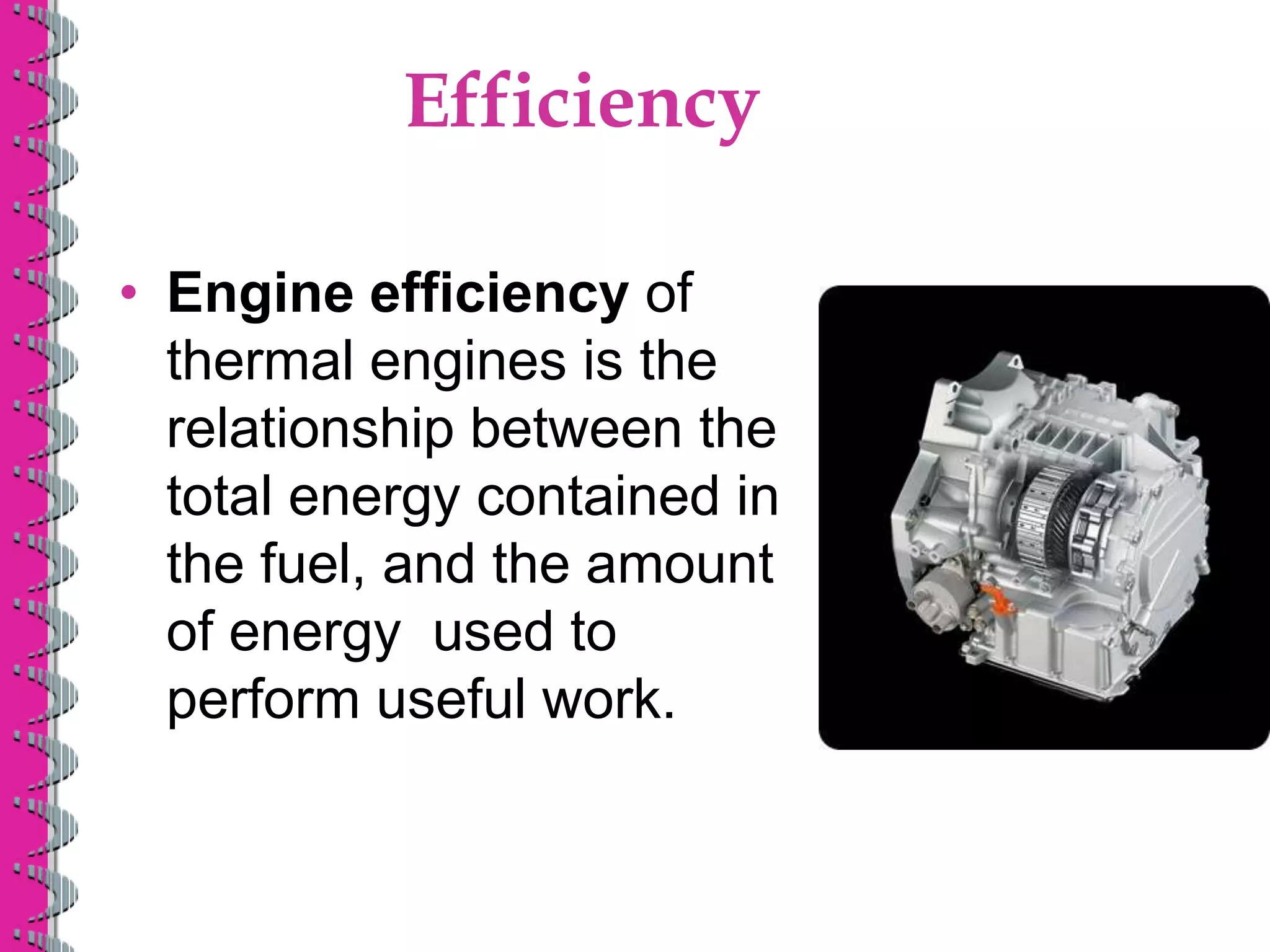
• Engine efficiency of
thermal engines is the
relationship between the
total energy contained in
the fuel, and the amount
of energy used to
perform useful work.
Expression For Efficiency
• From first law of thermodynamics
Q = ∆U + W
And..
• ∆W = Q1 – Q2
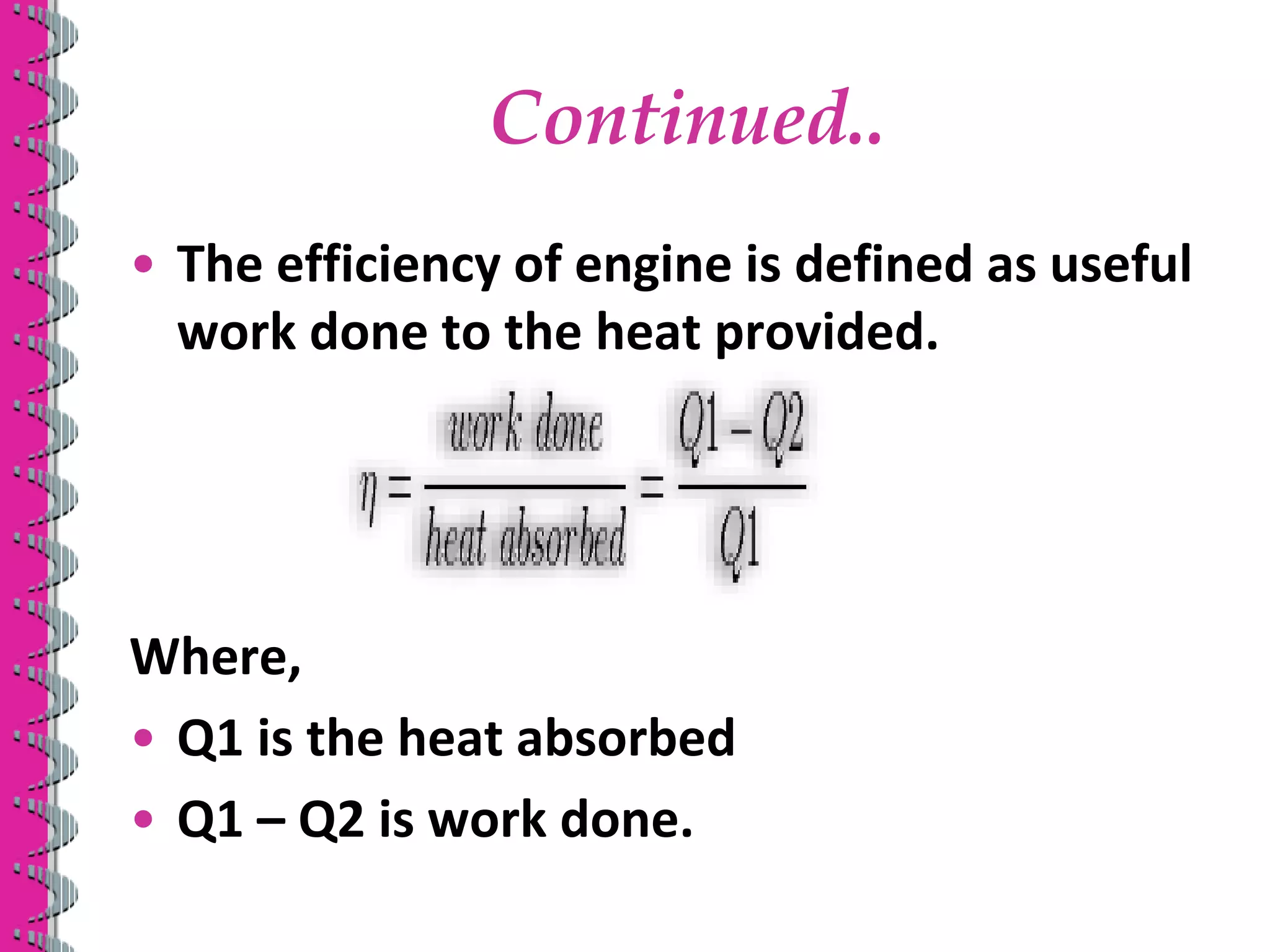
• The efficiency of engine is defined as
ƞ = Output / input
Continued..
• The efficiency of engine is defined as useful
work done to the heat provided.
Where,
• Q1 is the heat absorbed
• Q1 – Q2 is work done.
Efficiency of dual combustion engine
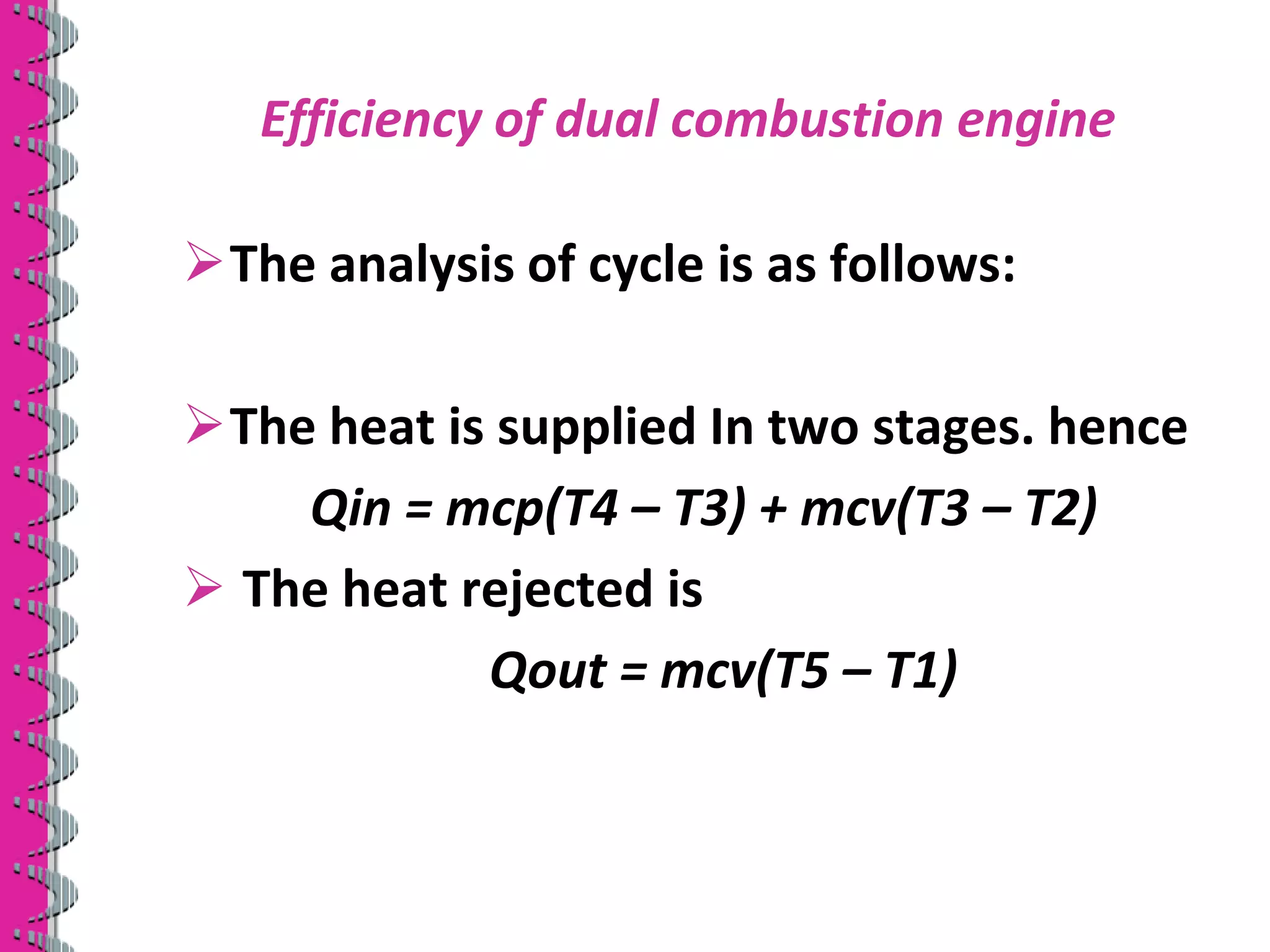
The analysis of cycle is as follows:
The heat is supplied In two stages. hence
Qin = mcp(T4 – T3) + mcv(T3 – T2)
 The heat rejected is
Qout = mcv(T5 – T1)
Simplification
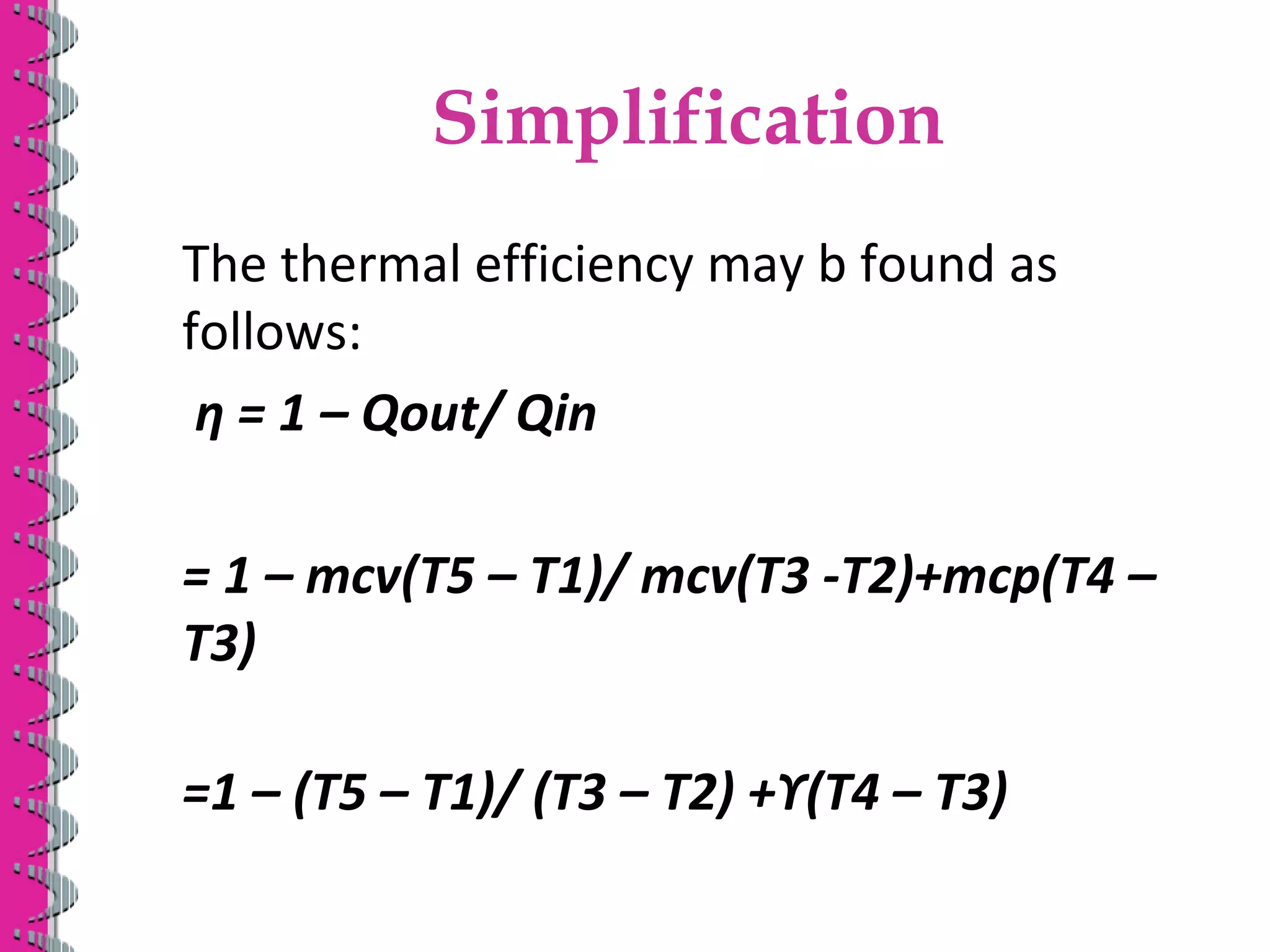
The thermal efficiency may b found as
follows:
ƞ = 1 – Qout/ Qin
= 1 – mcv(T5 – T1)/ mcv(T3 -T2)+mcp(T4 –
T3)
=1 – (T5 – T1)/ (T3 – T2) +ϒ(T4 – T3)
Simplification Of Formulae
• The formula can be further developed to
show that:
η = 1-(kβγ -1)/[(k-1) +γk(β-1)]rv
γ-1
• rv is the VOLUME COMPRESSION RATIO.
• rv = V1/V2
• β is the CUT OFF RATIO.
• β = V4/V3
• k is the ratio p3/p2.
• If k=1 then it becomes Otto cycle’s
efficiency.
“Applications”
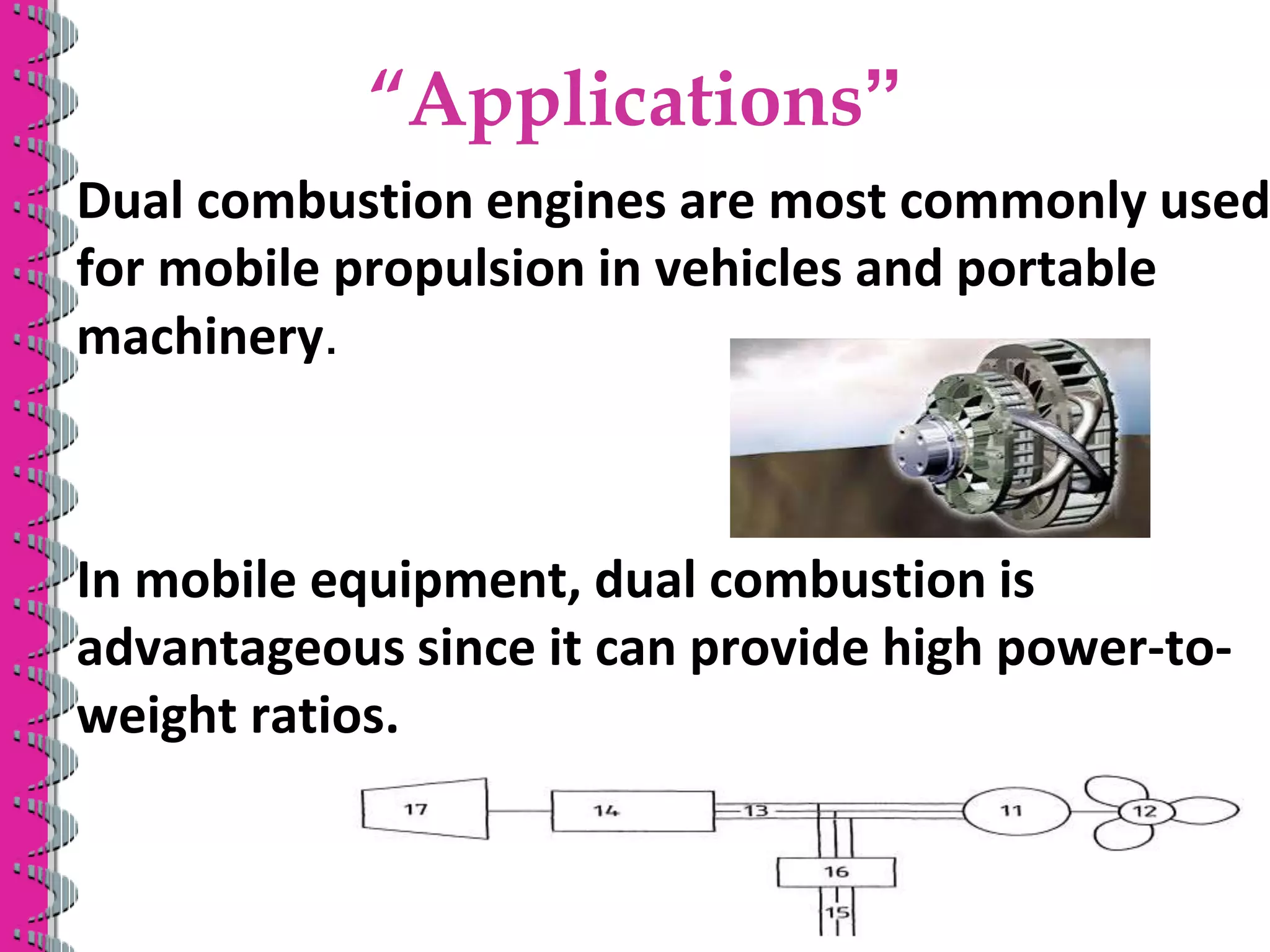
Dual combustion engines are most commonly used
for mobile propulsion in vehicles and portable
machinery.
In mobile equipment, dual combustion is
advantageous since it can provide high power-to-
weight ratios.
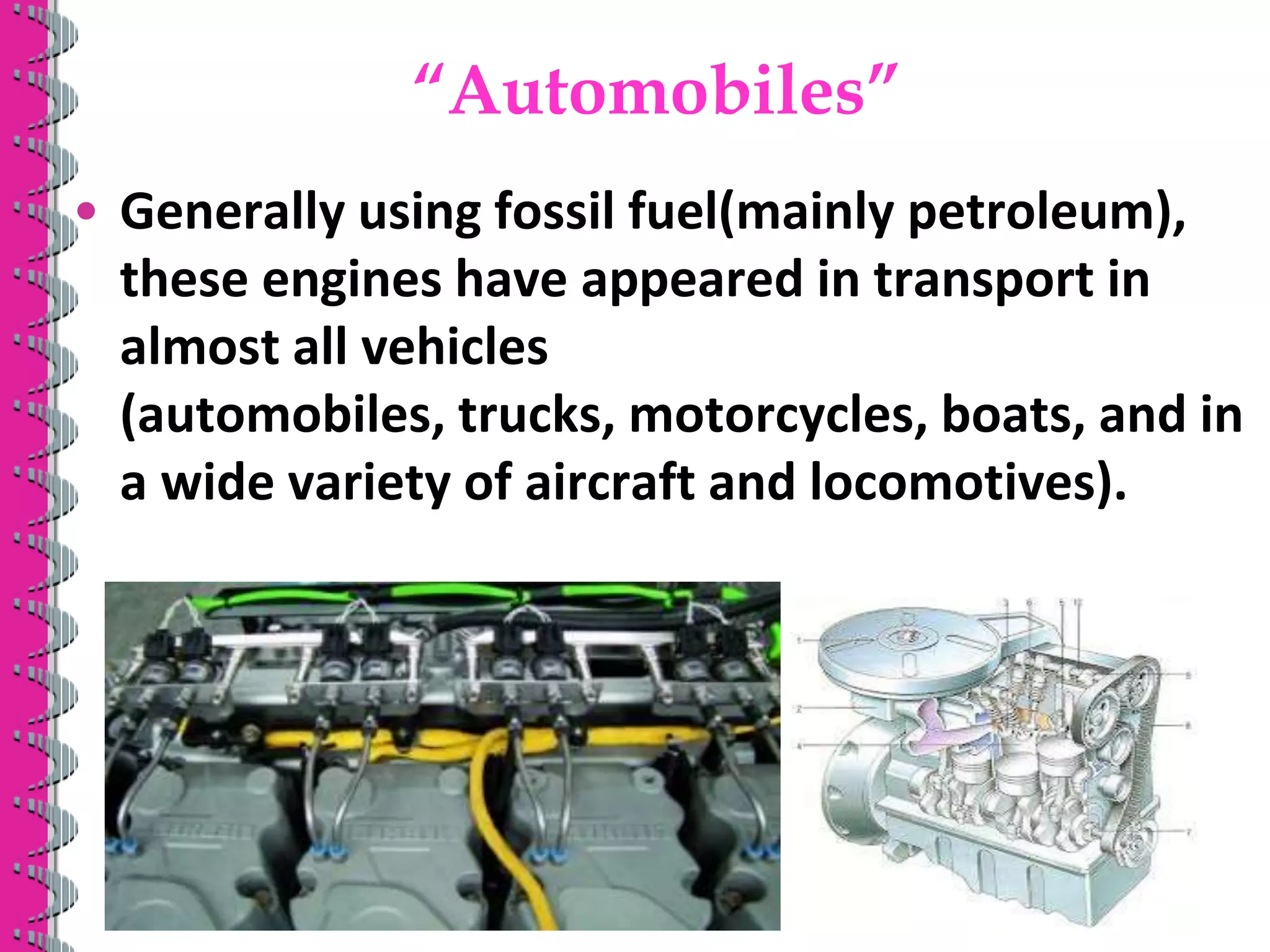
“Automobiles”
• Generally using fossil fuel(mainly petroleum),
these engines have appeared in transport in
almost all vehicles
(automobiles, trucks, motorcycles, boats, and in
a wide variety of aircraft and locomotives).
Generators/Aircrafts
• Very high power-to-weight ratios are
required, dual combustion engines appear in
the form of gas turbines. These applications
include jet aircraft, helicopters, large ships
and electric generators.
“Future Energy Use”
There is a role for Dual Combustion engines for
future energy use, because
– Dual combustion engine has high power to
weigh ratio.
– Relatively low cost.
– Flexible fuel use.
– Established manufacturing investment.
References
Text books:
By Mcconkey And Rajput.
Web sources:
• www.marineinfo.com
• www.freestudy.co.uk
• http://www.brighthubengineering.com/
• en.wikipedia.org
• www.wartsila.com
Research Pappers:
• Gas Power Cycles Prof. U.S.P. Shet ,and Prof. J.M
. Mallikarjuna
• Performance Analysis of a Dual Cycle Engine by
Ebrahimi
Dual combustion cycle

Dual combustion cycle

  • 2.
    “Dual Combustion Engine” PresentedTo: Sir Qazi Shehzad Presented by:  Jawaria Bint Faheem (12063122-008) Areeba Malik (12063122-050) Areeba Asif (12063122-070) Hina Usman (12063122-077) Beenish Hafeez (12063122-085)
  • 3.
    Engine??? • A MachineDesigned To Convert Energy Into Useful Mechanical Motion. • Thermal Energy Raises Temperature And Pressure Of Gases Within Engine, And Gas Expands Against Mechanical Mechanisms Of Engine.
  • 4.
    History • Oil Engine1888. • Ackroyd Staurt (Automatic Ignition). • Rudolf Diesel Used This Principle And Developed Basis Of Dual Combustion Engine.
  • 5.
    Dual Combustion Engine •It is an internal combustion four stroke engine. • “Dual” Because Combustion Takes Place In Two Parts First At Constant Pressure And Second At Constant Volume. • This makes it better than diesel engine’s cycle.
  • 6.
    Dual Combustion Cycle •Also Known As The Limited Pressure Or Mixed Cycle, Seiliger Cycle Or Sabathe Cycle. • Thermal Cycle That Is A Combination Of The Otto Cycle And The Diesel Cycle.
  • 7.
    Characteristics • It isa four stroke engine. • Improved and modern form of old Diesel engine’s cycles. • Its one stroke is divided into two parts allowing it to carry out more work.. • Have increased efficiency.
  • 8.
  • 9.
    Stroke • Each CycleOf Piston Consists Of Two Opposite Motions: There Is A Motion In One Direction, And Then A Motion Back In The Opposite Direction. Each Of These Is Called A Stroke • Stroke Is The Action Of A Piston Travelling The Full Length Of Its Locomotive Cylinder Or Engine Cylinder In One Direction.
  • 10.
  • 11.
    Sequence of Operations Thedual cycle consists of following operations: • Adiabatic compression • Addition of heat at constant volume. • Addition of heat at constant pressure. • Adiabatic expansion. • Rejection of heat at constant volume.
  • 12.
    Explanation 1)Adiabatic Compression: Adiabatically compressedair, it turned hot. Fuel injection starts before the point of maximum compression.(ignition phase) 2) Constant Volume Phase: After a short delay the fuel warms up to the air temperature causing a sudden rise in pressure.
  • 13.
    Continued … 3) ConstantPressure Phase: Further Injection Keeps The Fuel Burning As Volume Increases 4) Adiabatic Expansion: After Cut Off, Hot Air Expands Isentropically. 5)Constant Volume (End Stroke): Exhaust Valve Opens Producing A Sudden Drop In Pressure Getting Heat Out.
  • 14.
    Efficiency • Engine efficiencyof thermal engines is the relationship between the total energy contained in the fuel, and the amount of energy used to perform useful work.
  • 15.
    Expression For Efficiency •From first law of thermodynamics Q = ∆U + W And.. • ∆W = Q1 – Q2 • The efficiency of engine is defined as ƞ = Output / input
  • 16.
    Continued.. • The efficiencyof engine is defined as useful work done to the heat provided. Where, • Q1 is the heat absorbed • Q1 – Q2 is work done.
  • 17.
    Efficiency of dualcombustion engine The analysis of cycle is as follows: The heat is supplied In two stages. hence Qin = mcp(T4 – T3) + mcv(T3 – T2)  The heat rejected is Qout = mcv(T5 – T1)
  • 18.
    Simplification The thermal efficiencymay b found as follows: ƞ = 1 – Qout/ Qin = 1 – mcv(T5 – T1)/ mcv(T3 -T2)+mcp(T4 – T3) =1 – (T5 – T1)/ (T3 – T2) +ϒ(T4 – T3)
  • 19.
    Simplification Of Formulae •The formula can be further developed to show that: η = 1-(kβγ -1)/[(k-1) +γk(β-1)]rv γ-1 • rv is the VOLUME COMPRESSION RATIO. • rv = V1/V2 • β is the CUT OFF RATIO. • β = V4/V3 • k is the ratio p3/p2. • If k=1 then it becomes Otto cycle’s efficiency.
  • 20.
    “Applications” Dual combustion enginesare most commonly used for mobile propulsion in vehicles and portable machinery. In mobile equipment, dual combustion is advantageous since it can provide high power-to- weight ratios.
  • 21.
    “Automobiles” • Generally usingfossil fuel(mainly petroleum), these engines have appeared in transport in almost all vehicles (automobiles, trucks, motorcycles, boats, and in a wide variety of aircraft and locomotives).
  • 22.
    Generators/Aircrafts • Very highpower-to-weight ratios are required, dual combustion engines appear in the form of gas turbines. These applications include jet aircraft, helicopters, large ships and electric generators.
  • 23.
    “Future Energy Use” Thereis a role for Dual Combustion engines for future energy use, because – Dual combustion engine has high power to weigh ratio. – Relatively low cost. – Flexible fuel use. – Established manufacturing investment.
  • 24.
    References Text books: By McconkeyAnd Rajput. Web sources: • www.marineinfo.com • www.freestudy.co.uk • http://www.brighthubengineering.com/ • en.wikipedia.org • www.wartsila.com Research Pappers: • Gas Power Cycles Prof. U.S.P. Shet ,and Prof. J.M . Mallikarjuna • Performance Analysis of a Dual Cycle Engine by Ebrahimi

Editor's Notes

  • #4 Chemical Energy Is Converted To Thermal Energy By Combustion (Oxidation)
  • #5 Diesel's first engine used coal dust blasted into the combustion chamber with compressed air. This developed into blasting in oil with compressed air. The air standard cycle for these old fashioned engines was deemed to be as described above but with no constant volume process. This cycle is called the DIESEL CYCLE. http://www.engrailhistory.info/e089.html
  • #8 Four-stroke: four piston movements over two engine revolutions for each engine cycle Two-stroke: two piston movements over one revolution for each engine cycle 7/