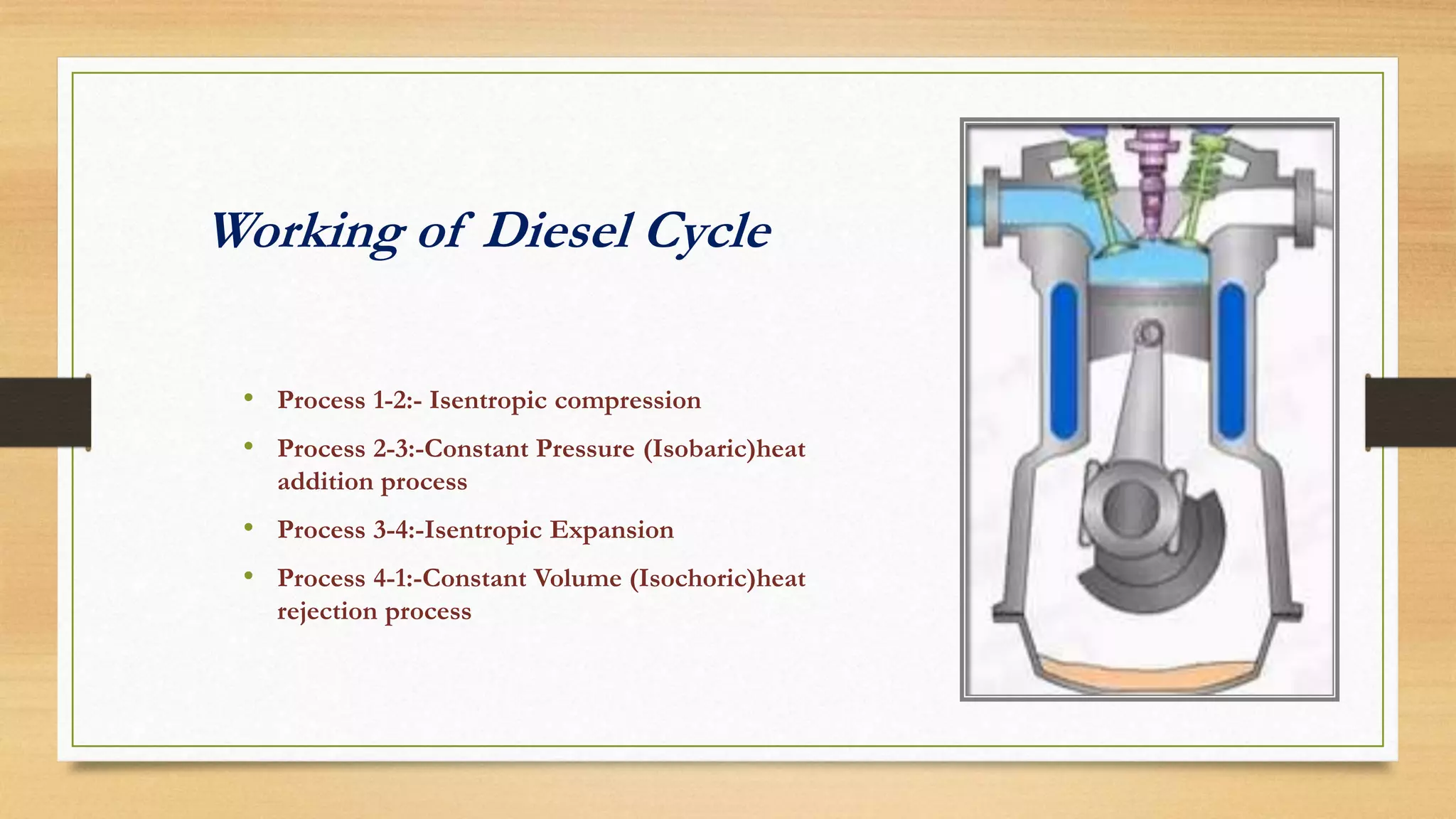
This document discusses the diesel cycle, which is an important thermodynamic cycle that diesel engines use. It consists of four processes: (1) isentropic compression, (2) constant pressure heat addition, (3) isentropic expansion, and (4) constant volume heat rejection. Diesel engines have higher efficiency than gasoline engines due to their high compression ratio. They are used widely in vehicles, power generation, ships and more. The document provides details on the p-v and T-s diagrams and explanations of each process in the diesel cycle.