PRESENTATION
ON
GAS POWER CYCLES
GUIDED BY:- Prof. Manjulata Pal
Engineering Thermodynamics
SUBMITTED BY:
HIMANSHI GUPTA(140120119057) / ME / A1
PRACHI SHARMA(140120119216) / ME / A1
VIDISHA VYAS(140120119253) / ME / A1
(2131905)
GA N D H IN A GA R IN STITU TE OF
TEC H N OLOGY
GAS POWER CYCLE
• The devices or systems used to produce a net power
output are often called engines, and the
thermodynamic cycles they operate on are called
power cycles.
• Thermodynamic cycles can also be categorized as gas
cycles and vapour cycles, depending on the phase of
the working fluid.
• In gas cycles, the working fluid remains in the gaseous
phase throughout the entire cycle, whereas in vapour
cycles the working fluid exists in the vapor phase
during one part of the cycle and in the liquid phase
during another part.
AIR STANDARD EFFICIENCY
• The efficiency of engine using air as the working
medium is known as Air Standard Efficiency
• The actual gas power cycles are rather complex.
To reduce the analysis to a manageable level, we
utilize the following approximations, commonly
known as the air-standard assumptions
AIR STANDARD ASSUMPTIONS
• The working fluid is air
• In the cycle, all the processes are reversible
• Mass of working fluid remains constant through
entire cycle
• The working fluid is homogenous throughout the
cycle and no chemical reaction takes place
• The air behaves as an ideal gas and its specific
heat is constant at all temperatures
• The cycle is considered closed with the same ‘air’
always remaining in the cylinder to repeat the
cycle
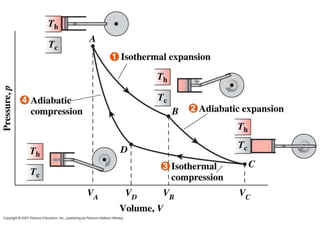
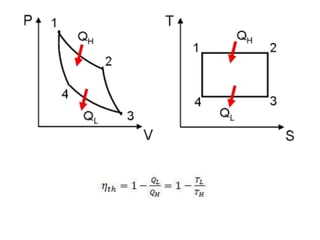
CARNOT CYCLE
• This cycle is a hypothetical cycle having
highest possible efficiency
• Consists of four simple operations namely:
1. Isothermal expansion
2. Adiabatic expansion
3. Isothermal compression
4. Adiabatic compression
ASSUMPTIONS MADE IN CARNOT CYCLE
• The piston moving in the cylinder does not
produce any friction during motion
• The cylinder head is arranged such a way that it
can be perfect heat conductor or insulator
• The walls of cylinder and piston are considered as
perfect insulators of heat
• Heat transfer does not affect the temperature of
source or sink
• Compression and expansion processes are
reversible
• Working medium is a perfect gas and has constant
specific heat
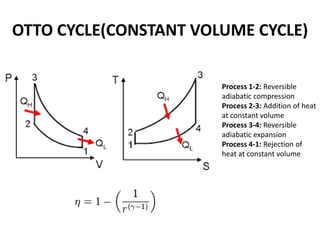
OTTO CYCLE(CONSTANT VOLUME CYCLE)
Process 1-2: Reversible
adiabatic compression
Process 2-3: Addition of heat
at constant volume
Process 3-4: Reversible
adiabatic expansion
Process 4-1: Rejection of
heat at constant volume
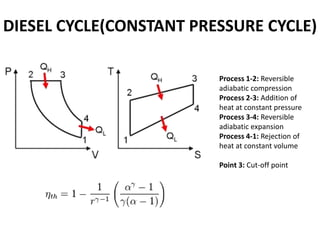
DIESEL CYCLE(CONSTANT PRESSURE CYCLE)
Process 1-2: Reversible
adiabatic compression
Process 2-3: Addition of
heat at constant pressure
Process 3-4: Reversible
adiabatic expansion
Process 4-1: Rejection of
heat at constant volume
Point 3: Cut-off point
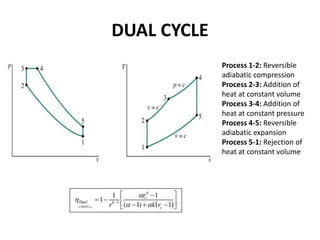
DUAL CYCLE
Process 1-2: Reversible
adiabatic compression
Process 2-3: Addition of
heat at constant volume
Process 3-4: Addition of
heat at constant pressure
Process 4-5: Reversible
adiabatic expansion
Process 5-1: Rejection of
heat at constant volume
COMPARISON OF OTTO, DIESEL AND
DUAL CYCLE
• Following are the important variable factors
which are used for comparison of these cycles:
1. Compression ratio
2. Maximum pressure
3. Heat supplied
4. Heat rejected
5. Net work
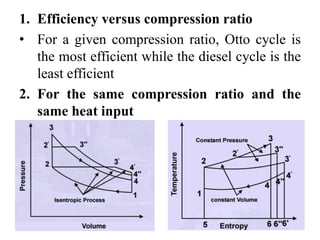
1. Efficiency versus compression ratio
• For a given compression ratio, Otto cycle is
the most efficient while the diesel cycle is the
least efficient
2. For the same compression ratio and the
same heat input
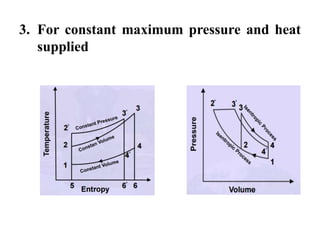
3. For constant maximum pressure and heat
supplied
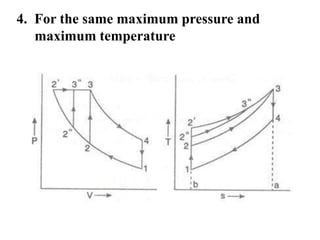
4. For the same maximum pressure and
maximum temperature
Gas power cycles

Gas power cycles

  • 1.
    PRESENTATION ON GAS POWER CYCLES GUIDEDBY:- Prof. Manjulata Pal Engineering Thermodynamics SUBMITTED BY: HIMANSHI GUPTA(140120119057) / ME / A1 PRACHI SHARMA(140120119216) / ME / A1 VIDISHA VYAS(140120119253) / ME / A1 (2131905) GA N D H IN A GA R IN STITU TE OF TEC H N OLOGY
  • 2.
    GAS POWER CYCLE •The devices or systems used to produce a net power output are often called engines, and the thermodynamic cycles they operate on are called power cycles. • Thermodynamic cycles can also be categorized as gas cycles and vapour cycles, depending on the phase of the working fluid. • In gas cycles, the working fluid remains in the gaseous phase throughout the entire cycle, whereas in vapour cycles the working fluid exists in the vapor phase during one part of the cycle and in the liquid phase during another part.
  • 3.
    AIR STANDARD EFFICIENCY •The efficiency of engine using air as the working medium is known as Air Standard Efficiency • The actual gas power cycles are rather complex. To reduce the analysis to a manageable level, we utilize the following approximations, commonly known as the air-standard assumptions
  • 4.
    AIR STANDARD ASSUMPTIONS •The working fluid is air • In the cycle, all the processes are reversible • Mass of working fluid remains constant through entire cycle • The working fluid is homogenous throughout the cycle and no chemical reaction takes place • The air behaves as an ideal gas and its specific heat is constant at all temperatures • The cycle is considered closed with the same ‘air’ always remaining in the cylinder to repeat the cycle
  • 5.
    CARNOT CYCLE • Thiscycle is a hypothetical cycle having highest possible efficiency • Consists of four simple operations namely: 1. Isothermal expansion 2. Adiabatic expansion 3. Isothermal compression 4. Adiabatic compression
  • 6.
    ASSUMPTIONS MADE INCARNOT CYCLE • The piston moving in the cylinder does not produce any friction during motion • The cylinder head is arranged such a way that it can be perfect heat conductor or insulator • The walls of cylinder and piston are considered as perfect insulators of heat • Heat transfer does not affect the temperature of source or sink • Compression and expansion processes are reversible • Working medium is a perfect gas and has constant specific heat
  • 9.
    OTTO CYCLE(CONSTANT VOLUMECYCLE) Process 1-2: Reversible adiabatic compression Process 2-3: Addition of heat at constant volume Process 3-4: Reversible adiabatic expansion Process 4-1: Rejection of heat at constant volume
  • 10.
    DIESEL CYCLE(CONSTANT PRESSURECYCLE) Process 1-2: Reversible adiabatic compression Process 2-3: Addition of heat at constant pressure Process 3-4: Reversible adiabatic expansion Process 4-1: Rejection of heat at constant volume Point 3: Cut-off point
  • 11.
    DUAL CYCLE Process 1-2:Reversible adiabatic compression Process 2-3: Addition of heat at constant volume Process 3-4: Addition of heat at constant pressure Process 4-5: Reversible adiabatic expansion Process 5-1: Rejection of heat at constant volume
  • 12.
    COMPARISON OF OTTO,DIESEL AND DUAL CYCLE • Following are the important variable factors which are used for comparison of these cycles: 1. Compression ratio 2. Maximum pressure 3. Heat supplied 4. Heat rejected 5. Net work
  • 13.
    1. Efficiency versuscompression ratio • For a given compression ratio, Otto cycle is the most efficient while the diesel cycle is the least efficient 2. For the same compression ratio and the same heat input
  • 14.
    3. For constantmaximum pressure and heat supplied
  • 15.
    4. For thesame maximum pressure and maximum temperature