ED8073-DESIGN OF PRESSURE VESSELS AND PIPING
NOTES
R-2013
YEAR: ME II YEAR SEM : III
KALAIGNAR KARUNANIDHI INSTITUTE OF TECHNOLOGY
KANNAMPALAYAM, COIMBATORE-641 402.
UNIT – I INTRODUCTION
1.1 PREREQUISITE DISCUSSIONS
Discussion of this gas power cycles will involve the study of those heat
engines in which the working fluid remains in the gaseous state throughout the
cycle. We often study the ideal cycle in which internal irreversibilities and
complexities (the actual intake of air and fuel, the actual combustion process, and
the exhaust of products of combustion among others) are removed. We will be
concerned with how the major parameters of the cycle affect the performance of
heat engines. The performance is often measured in terms of the cycle efficiency.
INTRODUCTION
 The cycle is defined as the repeated series of operation or processes
performed on a system, so that the system attains its original state. 
 The cycle which uses air as the working fluid is known as Gas power
cycles. 
 In the gas power cycles, air in the cylinder may be subjected to a series of
operations which causes the air to attain to its original position. 
 The source of heat supply and the sink for heat rejection are assumed to be
external to the air. 
 The cycle can be represented usually on p-V and T-S diagrams. 

1.2 POWER CYCLES
 Ideal Cycles, Internal Combustion 

 Otto cycle, spark ignition 

 Diesel cycle, compression ignition 

 Sterling & Ericsson cycles 

 Brayton cycles 

 Jet-propulsion cycle 

 Ideal Cycles, External Combustion 

 Rankine cycle 
Pipes connecting components have no
heat loss 

 Neglecting changes in kinetic
and potential energy (except
in nozzles & diffusers) 

1.4 GAS POWER CYCLES
 Working fluid remains a gas for the
entire cycle 

 Examples: 

 Spark-ignition engines 

 Diesel engines 

 Gas turbines 
Air-Standard Assumptions
 Air is the working fluid, circulated
in a closed loop, is an ideal gas 

 All cycles, processes are internally
reversible 

 Combustion process replaced by
heat-addition from external source 

 Exhaust is replaced by heat
rejection process which restores
working fluid to initial state 

1.5 ENGINE TERMS
 Top dead center 

 Bottom dead center 

 Bore 

 Stroke 
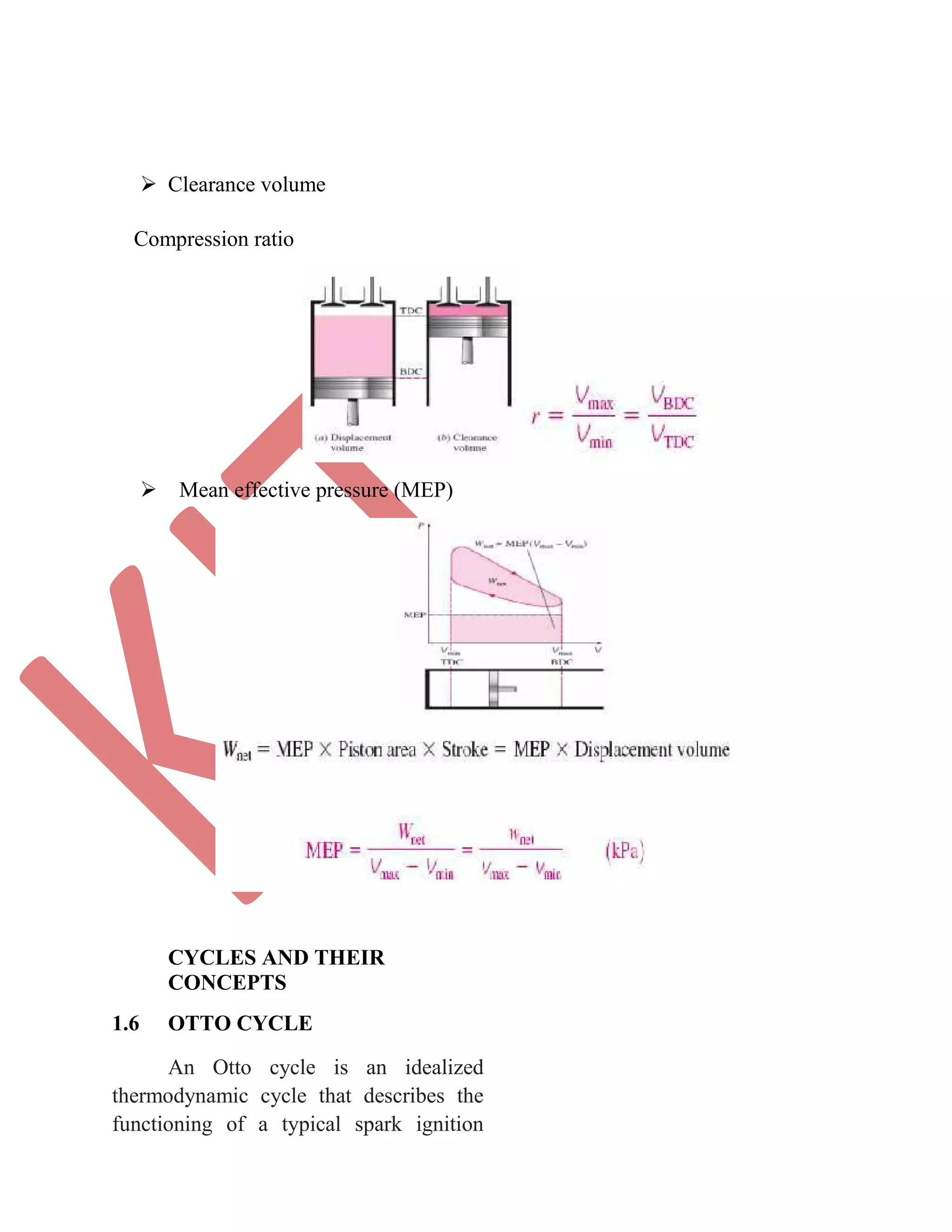
 Clearance volume 
Compression ratio
Mean effective pressure (MEP)
CYCLES AND THEIR
CONCEPTS
1.6 OTTO CYCLE
An Otto cycle is an idealized
thermodynamic cycle that describes the
functioning of a typical spark ignition
piston engine. It is the thermodynamic
cycle most commonly found in
automobile engines. The idealized
diagrams of a four-stroke Otto cycle Both
diagrams
1.7 PROCESS OF OTTO CYCLE
 Ideal Otto Cycle 

 Four internally reversible
processes o 1-2 Isentropic
compression 

o 2-3 Constant-volume heat
addition o 3-4 Isentropic
expansion 

o 4-1 Constant-volume heat
rejection 
Thermal efficiency of ideal Otto cycle:
Since V2= V3 and V4 = V 1
1.8 DIESEL CYCLE
The Diesel cycle is a co mbustion process of a reciprocating internal co
mbustion engine. In it, fuel is ignited by hea t generated during the compression
of air in the combustion chamber, into which fuel is t hen injected.
It is assumed to have constant pressure during the initial part of the
"combustion" phase
The Diesel engine is a heat engine: it converts heat into work.
During the
botto
m
isentropic processes (blue), energy is transferred into the system in the form
of work , but
by definition (isentropic) no ene rgy is transferred into or out of the system in the
form of heat. During the constant pressure ( red, isobaric) process, energy enters
the syste m as heat . During the top isentropic processes (yellow), energy is
transferred out of the sy stem in the form of , but by definition (isen tropic) no
energy is transferred into or out of the system in the form of heat. During the
constan t volume (green,isochoric) process, some of energy flows out of the system
as heat through the right depressurizing process . The wor k that leaves the
system is equal to the work that enters the system plus the difference between the
heat added to the system and the heat that lea ves the system; in other words, net
gain of wo rk is equal to the difference between the heat adde d to the system and
the heat that leaves the system.
1.9 PROCESSES OF DIESEL CYCLE:
 1-2 Isentropic com pression 

 2-3 Constant-Pres sure heat addition 

 3-4 Isentropic expansion 

 4-1 Constant-volume heat rejection 
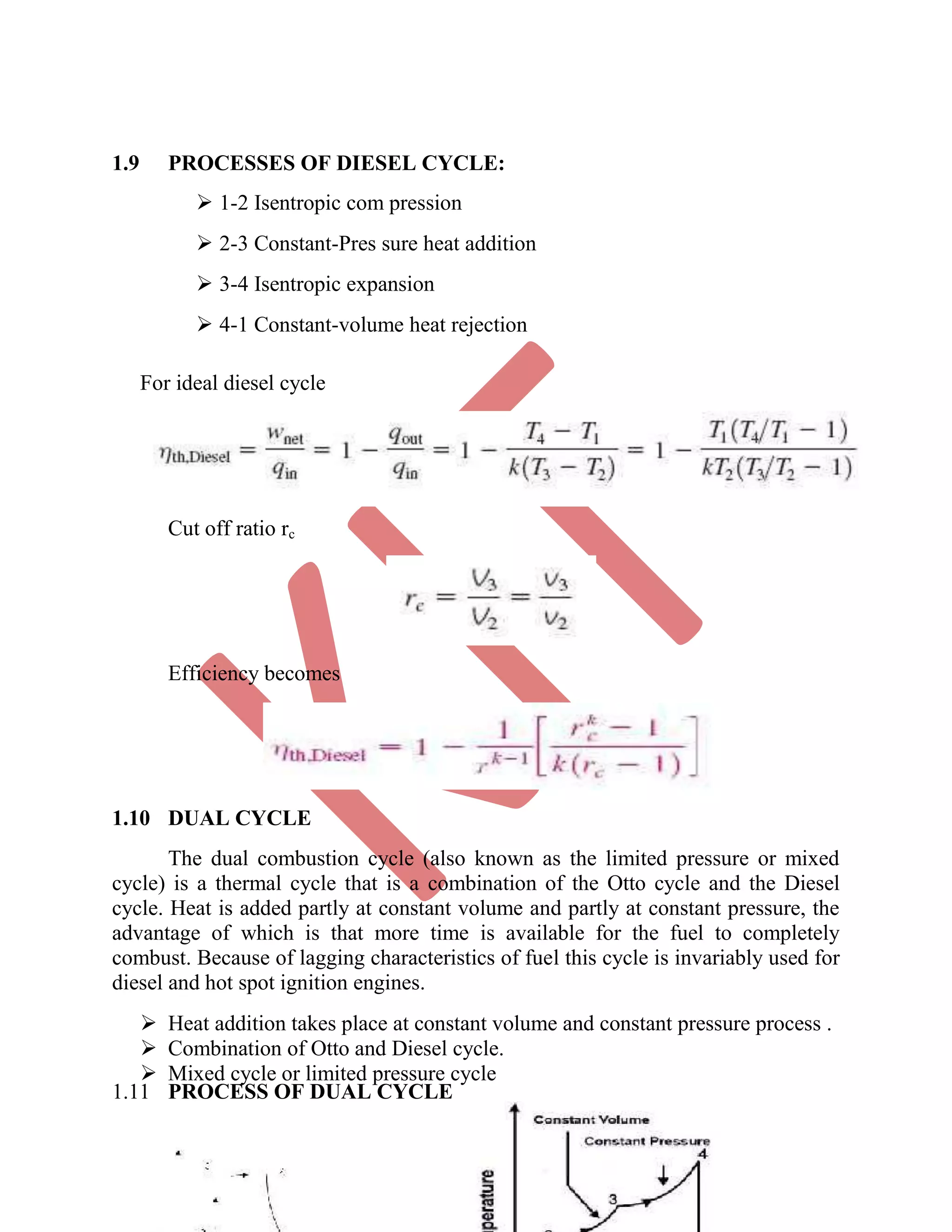
For ideal diesel cycle
Cut off ratio rc
Efficiency becomes
1.10 DUAL CYCLE
The dual combustion cycle (also known as the limited pressure or mixed
cycle) is a thermal cycle that is a combination of the Otto cycle and the Diesel
cycle. Heat is added partly at constant volume and partly at constant pressure, the
advantage of which is that more time is available for the fuel to completely
combust. Because of lagging characteristics of fuel this cycle is invariably used for
diesel and hot spot ignition engines.
 Heat addition takes place at constant volume and constant pressure process . 
 Combination of Otto and Diesel cycle. 
 Mixed cycle or limited pressure cycle 
1.11 PROCESS OF DUAL CYCLE
 Isentropic compression 

 Constant-volume heat rejection 

 Constant-pressure heat addition 

 Isentropic expansion 

 Constant-volume heat rejection 

The cycle is the equivalent air cycle for
reciprocating high speed compression ignition
engines. The P-V and T-s diagrams are shown in
Figs.6 and 7. In the cycle, compression and
expansion processes are isentropic; heat addition is
partly at constant volume and partly at constant
pressure while heat rejection is at constant volume
as in the case of the Otto and Diesel cycles. 


1.12 BRAYTON CYCLE
The Brayton cycle is a thermodynamic cycle that
describes the workings of a constant pressure heat engine.
Gas turbine engines and airbreathing jet engines use the
Brayton Cycle. Although the Brayton cycle is usually run
as an open system (and indeed must be run as such if
internal combustion is used), it is conventionally assumed
for the purposes of thermodynamic analysis that the
exhaust gases are reused in the intake, enabling analysis as
a closed system. The Ericsson cycle is similar to the
Brayton cycle but uses external heat and incorporates the
use of a regenerator.
 Gas turbine cycle 

 Open vs closed system model 
With cold-air-standard assumptions
Since processes 1-2 and 3-4 are isentropic, P2=
P3and P4= P1
Pressure ratio is
Efficiency of Brayton cycle is
1.13 REAL TIME APPLICATIONS
PETROL ENGINES
 Datsun Go 
 Hyundai Xcent 
 Maruti Suzuki Celerio 
 Volkswagen Vento 
 Nissan Terrano 
DIESEL ENGINES 

 Isuzu Diesel Cars 
 Datsun Diesel Cars 
 Ashok Leyland Diesel Cars 
GAS TURBINES 

 Indraprastha (Delhi) CCGT Power Station India 
 Kovilkalappal (Thirumakotai) Gas CCGT Power Station India 
 Lanco Tanjore (Karuppur) CCGT Power Plant India 

1.14 TECHNICAL TERMS
 TDC: Top Dead Center: Position of the piston where it forms the smallest
volume 
 BDC: Bottom Dead Center: Position of the piston where it forms the largest
volume 
 Stroke: Distance between TDC and BDC 
 Bore : Diameter of the piston (internal diameter of the cylinder) 
 Clearance volume: ratio of maximum volume to minimum volume
VBDC/VTDC 
 Engine displacement : (no of cylinders) x (stroke length) x (bore area)
(usually given in cc or liters) 
 MEP: mean effective pressure: A const. theoretical pressure that if
acts on piston produces work same as that during an actual cycle 
 Gas Power Cycles: Working fluid remains in the gaseous state through the
cycle. Sometimes useful to study an idealised cycle in which internal
irreversibilities and complexities are removed. Such cycles are called:Air
Standard Cycles 
 The mean effective pressure (MEP): A fictitious pressure that, if it were
applied to the piston during the power stroke, would produce the same
amount of net work as that produced during the actual cycle. 
 Thermodynamics: Thermodynamics is the science of the relations between
heat ,work and the properties of system 
 Boundary: System is a fixed and identifiable collection of matter enclosed
by a real or imaginary surface which is impermeable to matter but which
may change its shape or volume. The surface is called the boundary 
 Surroundings: Everything outside the system which has a direct
bearing on the system's behavior. 
 Extensive Property: Extensive properties are those whose value is the sum
of the values for each subdivision of the system, eg mass, volume. 
 Intensive Property: Properties are
those which have a finite value as the
size of the system approaches zero, eg
pressure, temperature, etc. 
 Equilibrium: A system is in
thermodynamic equilibrium if no
tendency towards spontaneous change
exists within the system. Energy
transfers across the system disturb the
equilibrium state of the system but may
not shift the system significantly from its
equilibrium state if carried out at low
rates of change. I mentioned earlier that
to define the properties of a system, they
have to be uniform throughout the
system. 
Therefore to define the state
of system, the system must be
in equilibrium. Inequilibrium
of course implies non-
uniformity of one or more
properties).
 Isentropic process: Isentropic process is
one in which for purposes of engineering
analysis and calculation, one may
assume that the process takes place from
initiation to completion without an
increase or decrease in the entropy of the
system, i.e., the entropy of the system
remains constant. 
 Isentropic flow: An isentropic flow is a
flow that is both adiabatic and
reversible. That is, no heat is added to
the flow, and no energy transformations
occur due to friction or dissipative
effects. For an isentropic flow of a
perfect gas, several relations can be
derived to define the pressure, density
and temperature along a streamline. 
 Adiabatic heating: Adiabatic heating
occurs when the pressure of a gas is
increased from work done on it by its
surroundings, e.g. a piston. Diesel
engines rely on adiabatic heating during
their compression. 
 Adiabatic cooling: Adiabatic cooling
occurs when the pressure of a substance
is decreased as it does work on its
surroundings. Adiabatic cooling occurs
in the Earth's atmosphere with
orographic lifting and lee waves, When
the pressure applied on a parcel of air
decreases, the air in the parcel is allowed
to expand; as the volume increases, the
temperature falls and internal energy
decreases. 


1.15 SOLVED PROBLEMS
1. In an Otto cycle air at 1bar and 290K is
compressed isentropic ally until the
pressure is 15bar The heat is added at
constant volume until the pressure rises to
40bar. Calculate the air standard efficiency
and mean effective pressure for the cycle.
Take Cv=0.717 KJ/Kg K and Runiv =
8.314KJ/Kg K.
Given Data:
Pressure (P1) = 1bar = 100KN/m2
Temperature(T1) = 290K
To Find:
i) Air Standard Efficien cy
(ηotto) ii) Mean Effective
Press ure (Pm)
Solution:
Here it is g Runiv = 8.314 KJ/Kg K
We know ,
Here Cp is unknown)
Runiv = M
Since For air ) moleccular weight (M) =
28.97
∴8.314=28.97
R = 0.2869
(Since gas constant R = Cp-Cv )
∴0.2869 = Cp –
0.717 Cp= 1.0039
KJ/Kg K
η
Here „r‟ is unknown.
We know that,
r= 6.919
ηotto
11
SCE Department Of Macha nical
Engineering
∴ ηotto = 3.87%
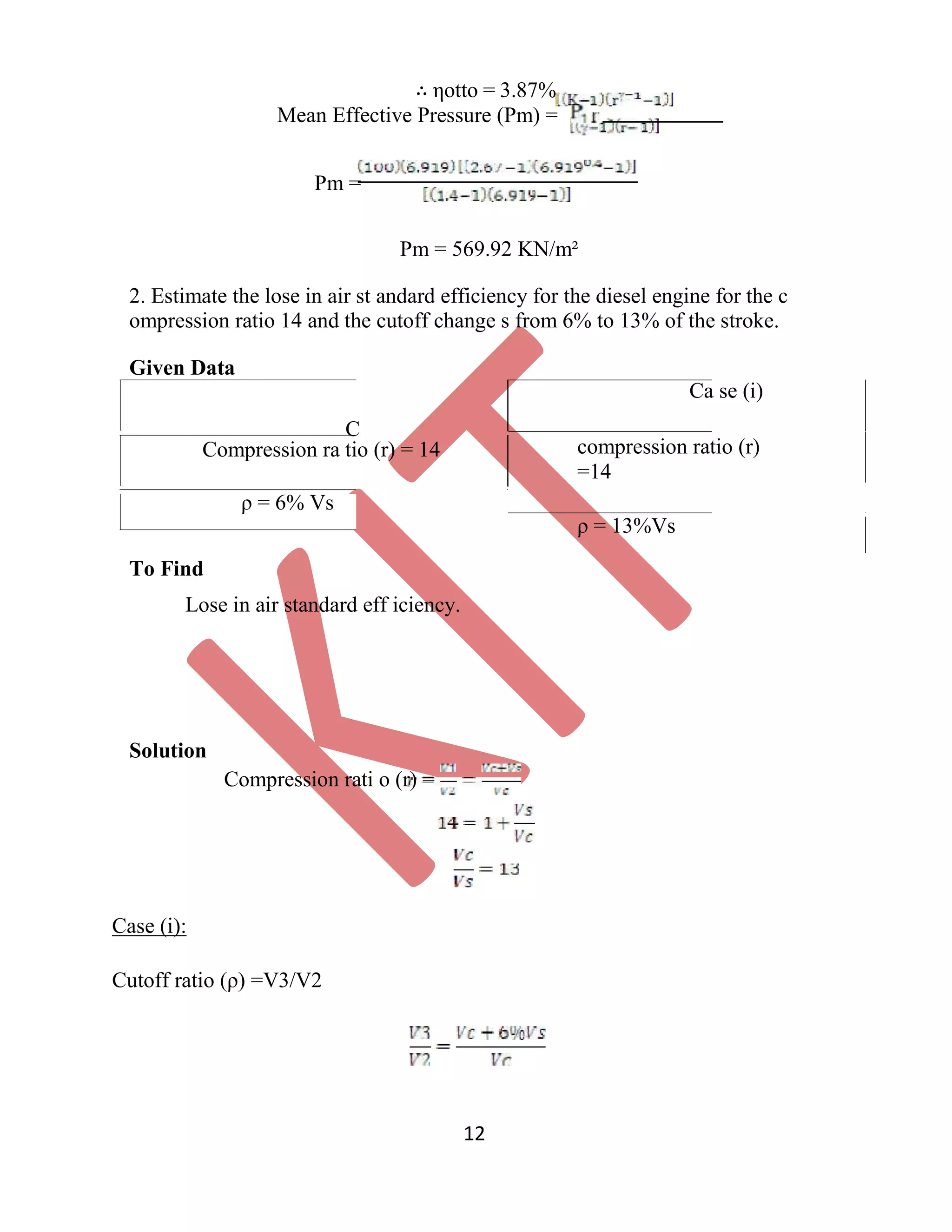
Mean Effective Pressure (Pm) =
Pm =
Pm = 569.92 KN/m²
2. Estimate the lose in air st andard efficiency for the diesel engine for the c
ompression ratio 14 and the cutoff change s from 6% to 13% of the stroke.
Given Data
C
Compression ra tio (r) = 14
ρ = 6% Vs
Ca se (i)
compression ratio (r)
=14
ρ = 13%Vs
To Find
Lose in air standard eff iciency.
Solution
Compression rati o (r) =
Case (i):
Cutoff ratio (ρ) =V3/V2
12
=49
=4.49%
3. The compression ratio o f an air standard dual cycle is 12 and the maximum
pressure on the cycle is limited to 70bar. Th e pressure and temperature of the
cycle at the b eginning of compression process are 1bar a nd 300K. Calculate the
thermal efficiency and M ean Effective Pressure. Assume cylinder bore = 250mm,
Stroke length = 300mm, Cp=1.005K J/Kg K, Cv=0.718KJ/Kg K.
Given data:
Assume Qs1 = Qs2
Compression ratio (r) = 12
Maximum pressure (P3) = (P4) = 7000 KN/m2
Temperature (T1) = 300 K
Diameter (d) = 0.25m
Stroke length (l) = 0.3m
To find:
Dual cycle efficiency (ηdual)
Mean Effective Pressure (P m)
Solution:
By Process 1-2:
= [r]γ-1
300[12
T2 = 810.58K
P2 = 3242.3KN/m2
By process 2-3:
T3 = 1750K
Assuming Qs1 = Qs2
mCv[T3-T2] = mCp[T4-T3]
0.718 [1750-810.58] = 1.005 [T4-1750] T4 = 2421.15K
By process 4-5:
We know that, = 1.38
T5 = 1019.3K
Heat supplied Qs = 2
Q s = 1349KJ/Kg
Heat rejected
T1
]
Qr
= 516.45 KJ/Kg
ηdual
η dual = 61.72%
Stroke volume (Vs) =
Vs = 0.0147m3
Mean Effective Pressure (Pm)
= 832.58/0.0147
Pm = 56535 KN/m2
4. A diesel engine
operating
30cmstroke.the clearance volu
me is the air standard
efficiency.
an air standard
diesel cycle has
20cm bore
and
420cm3
.if the fuel is injected at
5%
of the
stroke,find
Given Data:-
Bore diameter (d) =20cm=0.2mk
Stroke, (l) =30cm=0.3m
Clearance volume, (v2 ) =420cm3
=420/1003
= m3
Air standard efficiency, (diesel) Solution:-
Compression ratio, r = v1/v2
= (vc+vs)/vc
We know that,
Stroke vo lume, vs=area*length
=
= )
Vs=
Therefore,
Compression ratio, (r) =
r = 23.42
Cut off ratio, /
+5% ) /
We know the equation,
UNIT – II
STRESSES IN PRESSURE VESSELS
3.1 PREREQUISITE DISCUSSIONS
A steam turbine is basically an assembly of nozzles fixed to a stationary casing and
rotating blades mounted on the wheels attached on a shaft in a row-wise manner. In 1878, a
Swedish engineer, Carl G. P. de Laval developed a simple impulse turbine, using a convergent-
divergent (supersonic) nozzle which ran the turbine to a maximum speed of 100,000 rpm. In
1897 he constructed a velocity-compounded impulse turbine (a two-row axial turbine with a row
of guide vane stators between them.
Auguste Rateau in France started experiments with a de Laval turbine in 1894, and
developed the pressure compounded impulse turbine in the year 1900.
In the USA , Charles G. Curtis patented the velocity compounded de Lavel turbine in
1896 and transferred his rights to General Electric in 1901.
In England , Charles A. Parsons developed a multi-stage axial flow reaction turbine in
1884.
Steam turbines are employed as the prime movers together with the electric generators in
thermal and nuclear power plants to produce electricity. They are also used to propel large ships,
ocean liners, submarines and to drive power absorbing machines like large compressors,
blowers, fans and pumps.
Turbines can be condensing or non-condensing types depending on whether the back
pressure is below or equal to the atmosphere pressure.
STEAM NOZZLE
3.2 Introduction
A steam turbine converts the energy of high-pressure, high temperature steam produced
by a steam generator into shaft work. The energy conversion is brought about in the following
ways:
1. The high-pressure, high-temperature steam first expands in the nozzles emanates as a
high velocity fluid stream.
2. The high velocity steam coming out of the nozzles impinges on the blades mounted on a
wheel. The fluid stream suffers a loss of momentum while flowing past the blades that is
absorbed by the rotating wheel entailing production of torque.
3. The moving blades move as a result of the impulse of steam (caused by the change of
momentum) and also as a result of expansion and acceleration of the steam relative to
DPVP
3.3 Flow Through Nozzles
 A nozzle is a duct that increases the velocity of the flowing fluid at the expense
of pressure drop. 
 A duct which decreases the velocity of a fluid and causes a corresponding increase
in pressure is a diffuser . 
 The same duct may be either a nozzle or a diffuser depending upon the end conditions
across it. If the cross-section of a duct decreases gradually from inlet to exit, the duct is said to
be convergent. 
 Conversely if the cross section increases gradually from the inlet to exit, the duct is
said to be divergent. 
 If the cross-section initially decreases and then increases, the duct is called a
convergent-divergent nozzle. 
 The minimum cross-section of such ducts is known as throat. 
 A fluid is said to be compressible if its density changes with the change in pressure
brought about by the flow. 
 If the density does not changes or changes very little, the fluid is said to
be incompressible. Usually the gases and vapors are compressible, whereas
liquids are incompressible . 

3.4 Shapes of nozzles
1. At subsonic speeds (Ma<1) a decrease in area increases the speed of flow.
2. In supersonic flows (Ma>1), the effect of area changes are different.
Convergent divergent nozzles
53
3.5 SIGNIFICANCE OF STEAM TURBINES
 Large scale electrical energy production largely depends on the use of turbines. Nearly all
of the world's power that is supplied to a major grid is produced by turbines. 
 From steam turbines used at coal-burning electricity plants to liquid water turbines used
at hydro-electric plants, turbines are versatile and can be used in a number of
applications. 
 There are also gas turbines that combust natural gas or diesel fuel for use in remote
locations or where a large backup power supply is required. Most power plants use
turbines to produce energy by burning coal or natural gas. 
 The heat produced from combustion is used to heat water in boiler. The liquid water is
converted to steam upon heating and is exhausted through a pipe which feeds the steam
to the turbine. 
 The pressurized steam flow imparts energy on the blades and shaft of the turbine causing
it to rotate. 
 The rotational mechanical energy is then converted to electrical energy using a generator. 
STEAM TURBINES
3.6 Turbines
 We shall consider steam as the working fluid 
 Single stage or Multistage 
 Axial or Radial turbines 
 Atmospheric discharge or discharge below atmosphere in condenser 
 Impulse/and Reaction turbine 

3.7 Impulse Turbines
 Impulse turbines (single-rotor or multirotor) are simple stages of the turbines. 
 Here the impulse blades are attached to the shaft. 
 Impulse blades can be recognized by their shape. 
 The impulse blades are short and have constant cross sections. 
54
DPVP
DPVP
3.8 Schematic diagram of an Impulse Trubine
and = Inlet and outlet absolute velocity
and = Inlet and outlet relative velocity (Velocity relative to the rotor blades.)
U = mean blade speed
= nozzle angle, = absolute fluid angle at outlet
It is to be mentioned that all angles are with respect to the tangential velocity ( in the
direction of U )
3.9 Velocity diagram of an Impulse Turbine
55
DPVP
DPVP
And = Inlet and outlet blade angles
and = Tangential or whirl component of absolute velocity at inlet and outlet
and = Axial component of velocity at inlet and outlet
Tangential force on a blade,
(22.1)
(mass flow rate X change in velocity in tangential direction)
or,
(22.2)
Power developed = (22.3)
Blade efficiency or Diagram efficiency or Utilization factor is given by
or,
(22.4)
3.10 The Single-Stage Impulse Turbine
 The single-stage impulse turbine is also called the de Laval turbine after its inventor. 
 The turbine consists of a single rotor to which impulse blades are attached. 
 The steam is fed through one or several convergent-divergent nozzles which do not
extend completely around the circumference of the rotor, so that only part of the blades is
impinged upon by the steam at any one time. 
 The nozzles also allow governing of the turbine by shutting off one or more them. 
56
DPVP
DPVP
3.11 Compounding in Impulse Turbine
 If high velocity of steam is allowed to flow through one row of moving blades, it
produces a rotor speed of about 30000 rpm which is too high for practical use. 
 It is essential to incorporate some improvements for practical use and also to achieve
high performance. 
 This is called compounding. 
 Two types of compounding can be accomplished: (a) velocity compounding and (b)
pressure compounding 

3.12 The Velocity - Compounding of the Impulse Turbine
 The velocity-compounded impulse turbine was first proposed to solve the problems of a
single-stage impulse turbine for use with high pressure and temperature steam. 
 It is composed of one stage of nozzles as the single-stage turbine, followed by two rows
of moving blades instead of one. 
 These two rows are separated by one row of fixed blades attached to the turbine stator,
which has the function of redirecting the steam leaving the first row of moving blades
to the second row of moving blades. 



3.13 Pressure Compounding or Rateau Staging
 To alleviate the problem of high blade velocity in the single-stage impulse turbine, the total
enthalpy drop through the nozzles of that turbine are simply divided up, essentially in an
equal manner, among many single-stage impulse turbines in series,Such a turbine is called
a Rateau turbine. 
 The inlet steam velocities to each stage are essentially equal and due to a reduced Δh. 
3.14 Reaction Turbine
 A reaction turbine, therefore, is one that is constructed of rows of fixed and rows of
moving blades. 
 The fixed blades act as nozzles. 
 The moving blades move as a result of the impulse of steam received (caused by change
in momentum) and also as a result of expansion and acceleration of the steam relative to
them. 
 The pressure drops will not be equal. 
 They are greater for the fixed blades and greater for the high-pressure than the low-
pressure stages. 
 The absolute steam velocity changes within each stage as shown and repeats from stage
to stage. 
57
DPVP
DPVP
3.15 APPLICATIONS
 Locomotives 
 Power generations 
 Industrial application for producing steam 

3.16 Governing of Steam Turbine: The method of maintaining the turbine speed constant
irrespective of the load is known as governing of turbines. The device used for governing of
turbines is called Governor. There are 3 types of governors in steam turbine,
1. Throttle governing
2. Nozzle governing
3. By-pass governing
3.16.1 Throttle Governing:
Let us consider an instant when the load on the turbine increases, as a result the speed of the
turbine decreases. The fly balls of the governor will come down. The fly balls bring down the
sleeve. The downward movement of the sleeve will raise the control valve rod. The mouth of
the pipe AA will open. Now the oil under pressure will rush from the control valve to right side
of piston in the rely cylinder through the pipe AA. This will move the piston and spear towards
the left which will open more area of nozzle. As a result steam flow rate into the turbine
increases, which in turn brings the speed of the turbine to the normal range.
58
DPVP
DPVP
3.16.2 Nozzle Governing:
A dynamic arrangement of nozzle control governing is shown in fig.
In this nozzles are grouped in 3 to 5 or more groups and each group of nozzle is supplied steam
controlled by valves. The arc of admission is limited to 180º or less. The nozzle controlled
governing is restricted to the first stage of the turbine, the nozzle area in other stages remaining
constant. It is suitable for the simple turbine and for larger units which have an impulse stage
followed by an impulse reaction turbine.
3.17 Solved Problems:
1. A convergent divergent adiabatic steam nozzle is supplied with steam at 10 bar and
250°c.the discharge pressure is 1.2 bar.assuming that the nozzle efficiency is 100% and initial
velocity of steam is 50 m/s. find the discharge velocity.
Given Data:-
Initial pressure(p1)=10bar Initial
Temperature(T1)=250°c
Exit pressure(p2)=1.2 bar
59
DPVP
ME6404 THER MAL ENGINEERING
Nozzle efficiency(ηnozzle)=100%
Initial velocity of steam (v1)=50m/s
To Find:-
Discharge velocity (v2)
Solution:-
From steam table, For 10 bar, 250°c, h1=2943 KJ/kg s1=6.926 KJ/kgk
From steam table, For 1.2 bar,
hf2 =439.3 KJ/kg ; hfg2=2244.1 KJ/kg;
sf2=1.3 61 KJ/kg K ; sfg2=5.937 KJ/kgK.
Since s1=s2,
S1=sf 2+x2sfg2
6.926=1.361+x2(5.937)
X2=0 .9373
We know that,
h2=hf2+x2hfg2
= 439.3+(0.9373)2244.1
h2 = 2542KJ/Kg
Exit velocity (V2) =
= 896.91m/s.
2. Dry saturated steam at 6.5 bar with negligible velocity expands isentropically in a
convergent divergent nozzle to 1.4 bar and dryness fraction 0.956. De termine the final
velocity of steam from th e nozzle if 13% heat is loss in friction. Find th e % reduction in
the final velocity.
60
SCE Department of Mecha nical Engineering
ME6404 THER MAL ENGINEERING
Given data:
Exit pressure (P2) = 1.4 bar
Dryness fract ion (X2) = 0.956
Heat loss = 13%
To Find:
The percent reduction in final velocity
Solution:
From steam table for initial pressure P1 = 6.5bar, take values h1 =
h1 = 2758.8KJ/Kg
Similarly, at 1.4 bar,
hfg2 = 2231.9 KJ/Kg
hf2 = 458.4KJ/Kg
h2 = hf2 + X2 hfg2
= 458.4 + (0.956) 2231.6
h2 = 2592.1 KJ/Kg
Final velocit y (V2) =
= V2 =
577.39 m/s
Heat drop is 13%= 0.13
61
SCE Department of Mecha nical Engineering
ME6404 THER MAL ENGINEERING
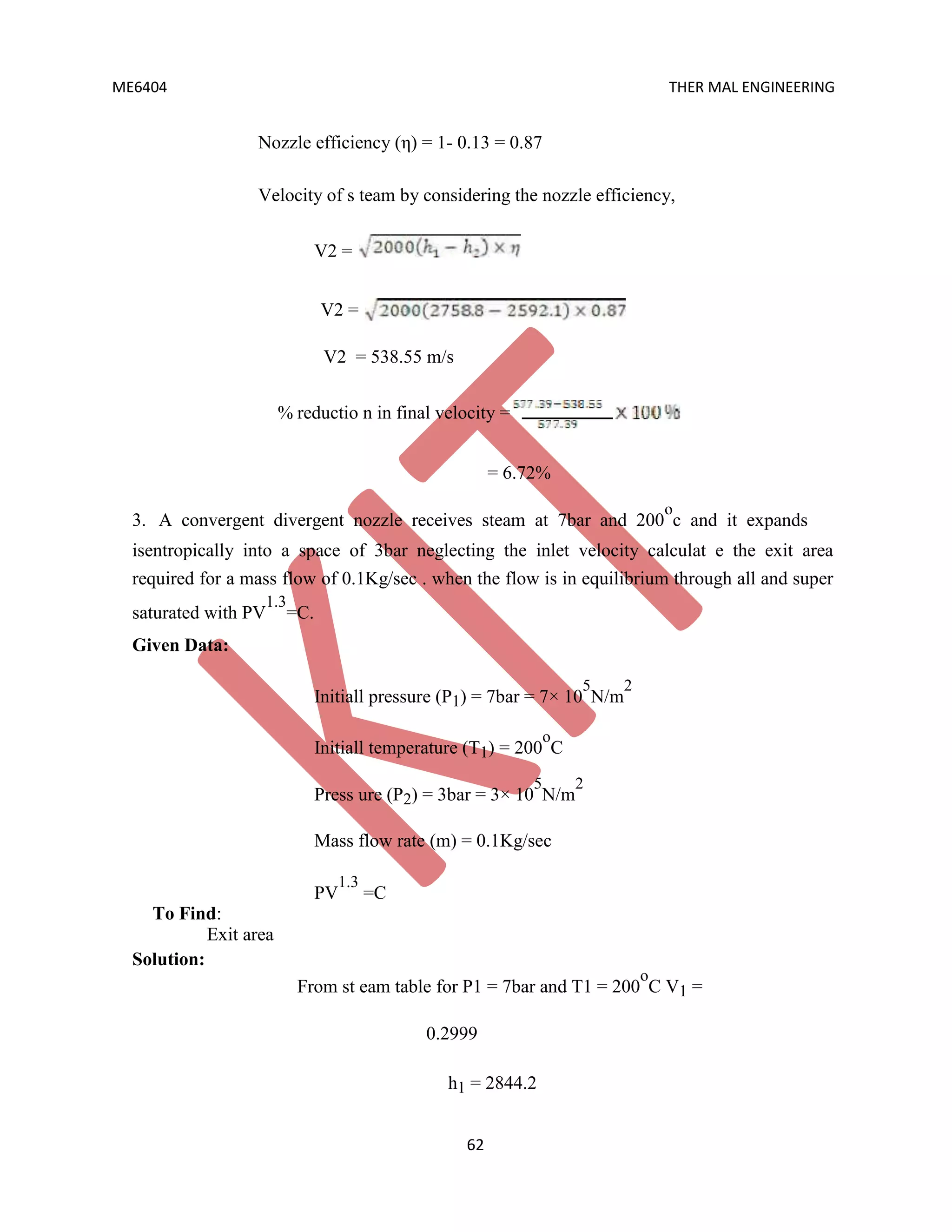
Nozzle efficiency (η) = 1- 0.13 = 0.87
Velocity of s team by considering the nozzle efficiency,
V2 =
V2 =
V2 = 538.55 m/s
% reductio n in final velocity =
= 6.72%
3. A convergent divergent nozzle receives steam at 7bar and 200
o
c and it expands
isentropically into a space of 3bar neglecting the inlet velocity calculat e the exit area
required for a mass flow of 0.1Kg/sec . when the flow is in equilibrium through all and super
saturated with PV
1.3
=C.
Given Data:
Initiall pressure (P1) = 7bar = 7× 10
5
N/m
2
Initiall temperature (T1) = 200
o
C
Press ure (P2) = 3bar = 3× 10
5
N/m
2
Mass flow rate (m) = 0.1Kg/sec
PV
1.3
=C
To Find:
Exit area
Solution:
From st eam table for P1 = 7bar and T1 = 200
o
C V1 =
0.2999
h1 = 2844.2
62
SCE Department of Mecha nical Engineering
ME6404 THER MAL ENGINEERING
S1 = 6.886
Similarly for P2 = 3bar
Vf2 = 0.001074 Vg2 = 0.60553 hf2 =
561.5 hfg2 = 2163.2
Sf2 = 1.672 Sfg2 = 5.319
We know that, S1 = S2 = St
S1 = Sf2 + X2 Sfg2
6.886 = 1.672 + X2 (5.319) X2 =
0.98
Similarly,
h2 = hf2 + X2 hfg2
h2 = 561.5 + 0.98 (2163.2)
(i) Flow is in equilibriu m through all:
V2 =
V2 = V2 =
569.56
ν2 = X2 × νg2
= 0.98× 0.60553 = 0.5934
63
SCE Department of Mecha nical Engineering
ME6404 THER MAL ENGINEERING
(ii) For saturated flow:
ν2 =
ν2 =
ν2 = 568.69 m/s
specific volume of steam at exit. For super saturated flow, P1 = P2
64
UNIT – III
DESIGN OF VESSELS
A pure substance is one that has homogeneous and invariable chemical composition. It may
exist in more than one phase, but chemical composition is same for all the phases. Thus, water,
mixture of water and ice and water and steam are all examples of pure substance. Sometimes a
mixture of gases e.g. air is considered as pure substance.
We have seen that two independent properties are sufficient to determine
thermodynamic state of a fluid when it is in equilibrium. Any other thermodynamic
property is a function of the chosen pair of independent properties. We shall first
consider the relation between the primary properties p, v and T, the equation expressing
this relation for any particular fluid being called the equation of state or characteristic
equation of the fluid.
p-v-T DATA OF WATER
Since we have three variables to consider, the obvious procedure is to measure the
variation of one with another while the third is kept constant and repeat this for a range
of values of the third variable.
Imagine unit mass of ice below the
T(K) F freezing point, enclosed in a
cylinder by a piston under a
D constant load of 1 atmosphere (1
373.15 E atm. = 1.01325 bar = 101.325
Vapourisation
kPa). If heat is added to the
277.15
Fusion
cylinder while keeping the pressure
constant, the temperature rises
273.15 B
C and ice expands until a
A
temperature of 273.15 K (0
0
C) is
V
reached (AB) as shown in Fig.
Further heating does not raise the
temperature of ice but causes a change to the liquid phase (BC). The change of phase
occurs at a constant temperature and by reduction of specific volume. The heat required
for this process is known as latent heat of fusion. Further heating results in a rise of
temperature of liquid and a further contraction in volume until the temperature is about
4
0
C and subsequent expansion until a temperature of 373.15 K (100
0
C) is reached
(point D). At this point a second phase change occurs at constant temperature with a
large increase in volume until the liquid has been vaporised (point E). The heat required
in this case is called the latent heat of vaporisation. When vaporisation is complete,
the temperature rises again on heating (line EF). The heat transferred to a substance
while the temperature changes is sometimes referred to as sensible heat. This
constant pressure lines are called isobars.
If the pressure is reduced, there is a slight rise in the melting point and also there is a
marked drop in the boiling point of water and a marked increase in the change in
volume, which accompanies evaporation. When the pressure is reduced to 0.006113
bar (0.6113 kPa), the melting point and boiling point temperatures become equal and
change of phase, ice-water-steam, are represented by a single line. The temperature at
which this occurs has been accepted internationally as a fixed point for the absolute
temperature scale and is by definition 273.16 K. Only at this temperature and pressure
of 0.6112 kPa, can ice, water and steam coexists in thermodynamic equilibrium in a
closed vessel and is known as triple point. If the pressure is reduced further, the ice,
instead of melting, sublimes directly into steam.
Consider now the behaviour at pressure above atmospheric. The shape of the curve is
similar to that of the atmospheric isobar, but there is a marked reduction in the change
in volume accompanying evaporation. At a sufficiently high pressure, this change in
volume falls to zero and the horizontal portion of the curve reduces to a point of
inflexion. This is referred to critical point. The values pressure and temperature of water
at which critical point reached are
pc = 221.2 bar = 22.12 MPa ; Tc = 647.3 K ; vc = 0.00317 m3/kg.
The pressure at which liquid vaporises or condenses is called saturation pressure
corresponding to a given temperature. Alternately, the temperature at which this
phenomena occur is called saturation temperature corresponding to the given
pressure.
A vapour in a state lying along the saturated vapour line is also called dry saturated
vapour and the vapour lying right of this line is called superheated vapour.
IMPORTANT POINTS TO BE REMEMBERED
7. Saturation temperature: Temperature at which a pure substance changes phase at a
given pressure.
8. Saturation pressure: Pressure at which a pure substance changes phase at a given
temperature.
9. Latent heat: The amount of energy absorbed or released during a phase-change.
Melting/freezing: Latent heat of fusion.
Evaporation/condensation: Latent heat of vaporization.
• Temperature at which water starts boiling depends on the pressure => if the pressure
is fixed, so is the boiling temperature.
TABLE OF PROPERTIES OF WATER
(i) Saturated Table
P ts vf vg uf ug hf hg sf sg
Now how many properties do we need to know to determine the thermodynamic state? For a
single phase we need to know only two independent properties like (P, T), (T, v), etc. For a
two-phase mixture, p and T are not independent. Hence, we require defining ―quality‖.
Quality or Dryness fraction: x =
mv
m +m
v l
Value of x varies from 0 to 1. For
saturated water, when water just
starts boiling, x = 0 and for
saturated vapour, when
vaporisation is complete, x = 1
and the vapour is called dry
saturated.
Let V be the total volume of a
liquid vapour mixture of quality x.
Vf the volume of saturated liquid
and Vg the volume of saturated vapour, the corresponding masses are m, mf, and mg
respectively.
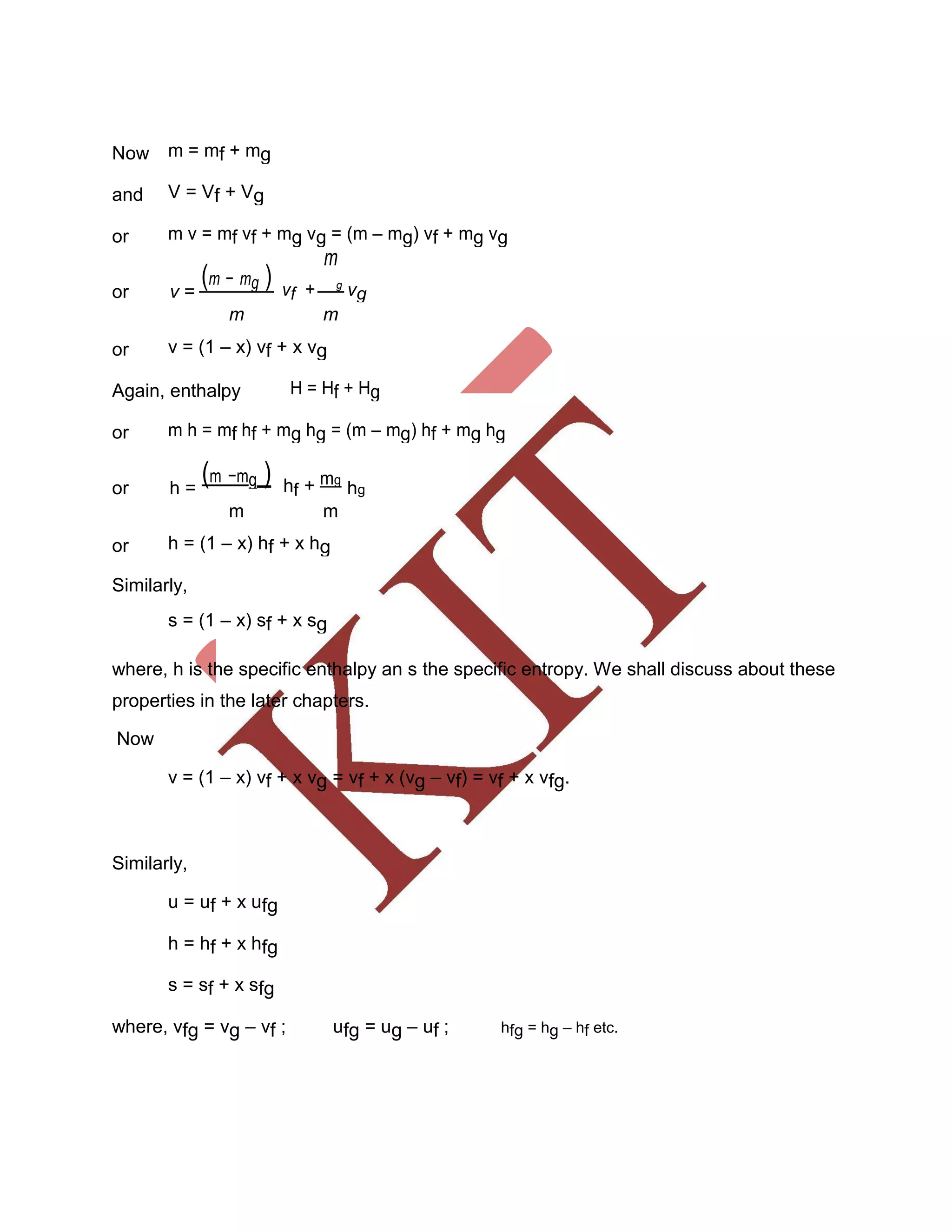
Now m = mf + mg
and V = Vf + Vg
or m v = mf vf + mg vg = (m – mg) vf + mg vg
(m − mg )
m
or v = vf + g
vg
m m
or v = (1 – x) vf + x vg
Again, enthalpy H = Hf + Hg
or m h = mf hf + mg hg = (m – mg) hf + mg hg
or h =
(m −mg ) hf + mg
hg
m m
or h = (1 – x) hf + x hg
Similarly,
s = (1 – x) sf + x sg
where, h is the specific enthalpy an s the specific entropy. We shall discuss about these
properties in the later chapters.
Now
v = (1 – x) vf + x vg = vf + x (vg – vf) = vf + x vfg.
Similarly,
u = uf + x ufg
h = hf + x hfg
s = sf + x sfg
where, vfg = vg – vf ; ufg = ug – uf ; hfg = hg – hf etc.
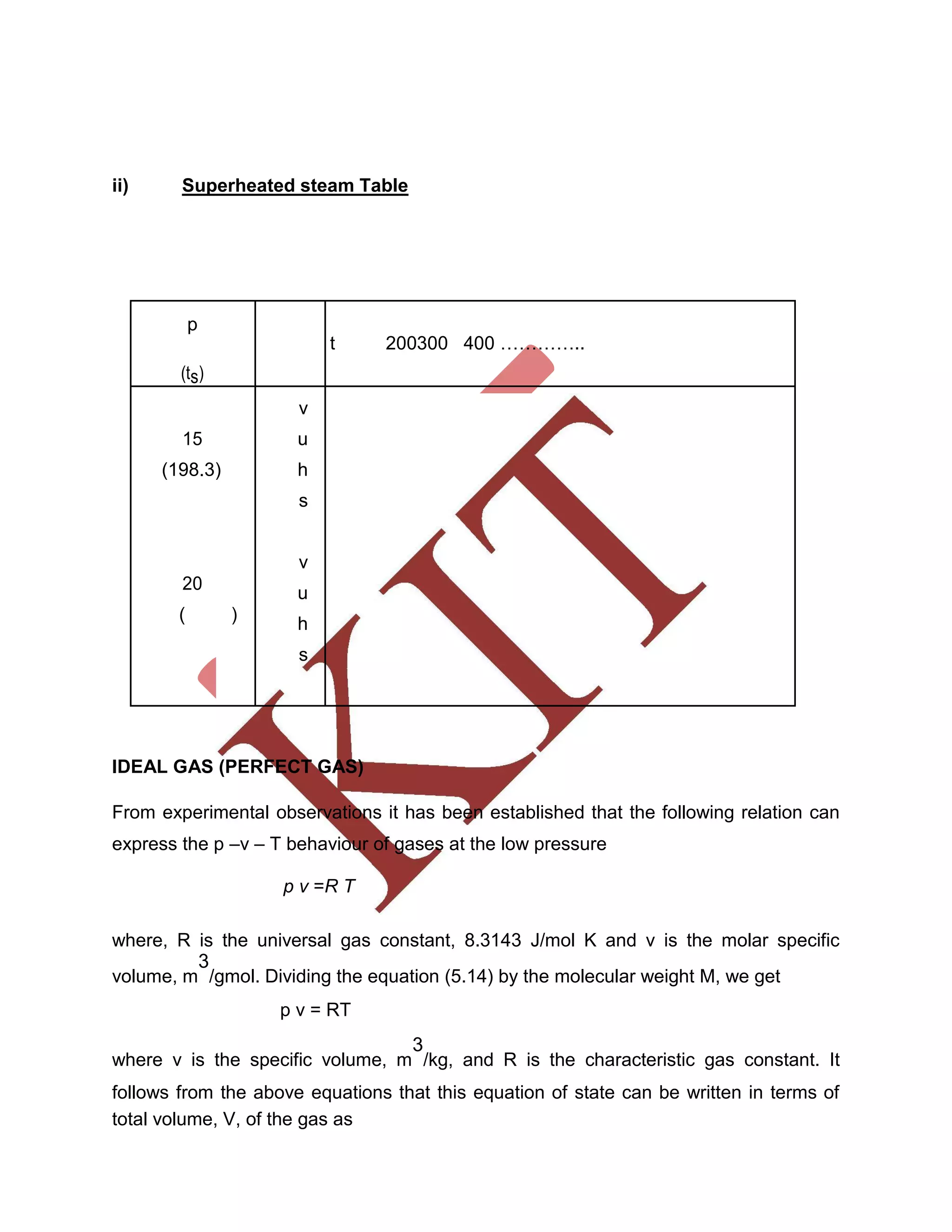
ii) Superheated steam Table
p
t 200300 400 …………..
(ts)
v
15 u
(198.3) h
s
v
20
u
( )
h
s
IDEAL GAS (PERFECT GAS)
From experimental observations it has been established that the following relation can
express the p –v – T behaviour of gases at the low pressure
p v =R T
where, R is the universal gas constant, 8.3143 J/mol K and v is the molar specific
volume, m
3
/gmol. Dividing the equation (5.14) by the molecular weight M, we get
p v = RT
where v is the specific volume, m
3
/kg, and R is the characteristic gas constant. It
follows from the above equations that this equation of state can be written in terms of
total volume, V, of the gas as
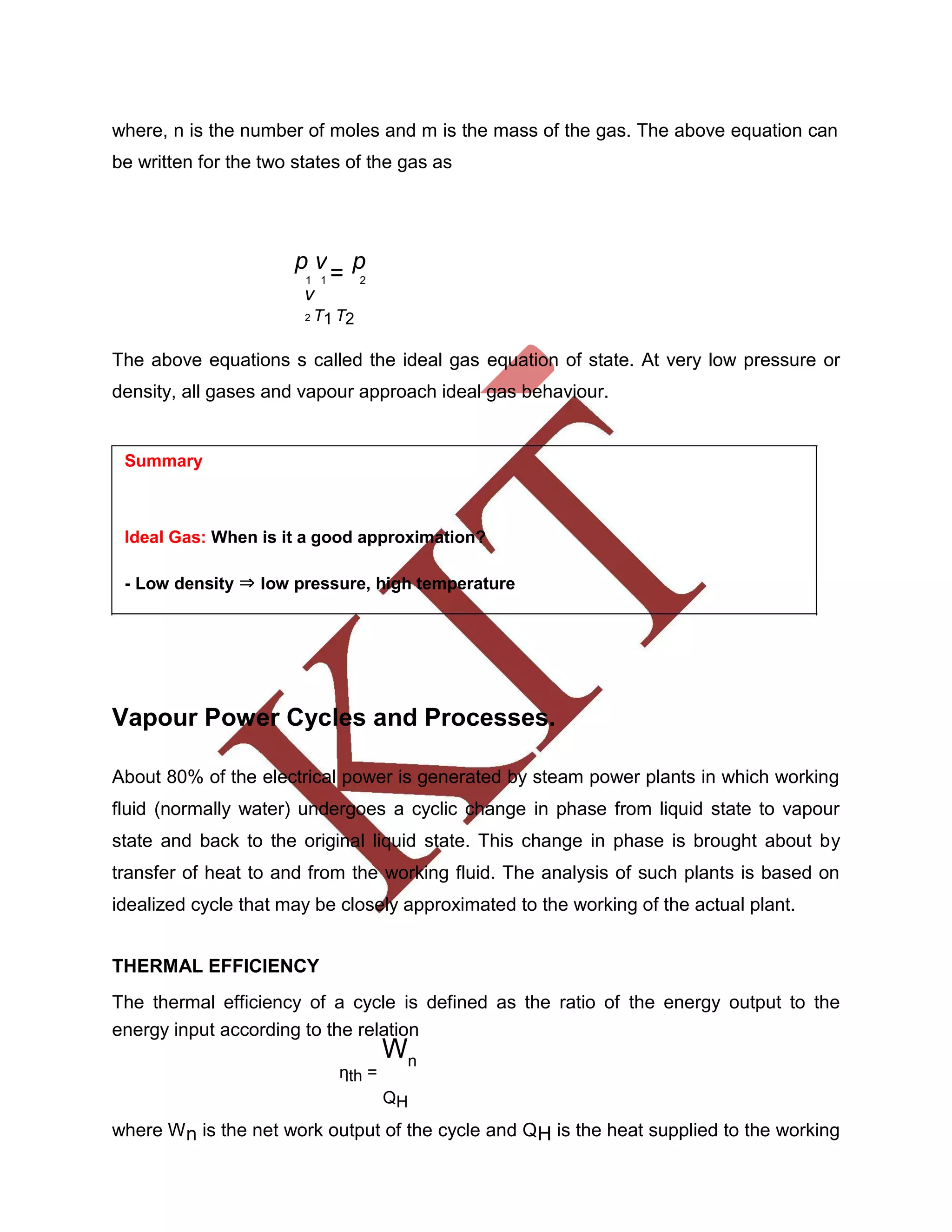
pV = n R T
p V = m R T
where, n is the number of moles and m is the mass of the gas. The above equation can
be written for the two states of the gas as
p v
=
p
1 1 2
v
2 T1 T2
The above equations s called the ideal gas equation of state. At very low pressure or
density, all gases and vapour approach ideal gas behaviour.
Summary
Ideal Gas: When is it a good approximation?
- Low density ⇒ low pressure, high temperature
Vapour Power Cycles and Processes.
About 80% of the electrical power is generated by steam power plants in which working
fluid (normally water) undergoes a cyclic change in phase from liquid state to vapour
state and back to the original liquid state. This change in phase is brought about by
transfer of heat to and from the working fluid. The analysis of such plants is based on
idealized cycle that may be closely approximated to the working of the actual plant.
THERMAL EFFICIENCY
The thermal efficiency of a cycle is defined as the ratio of the energy output to the
energy input according to the relation
ηth =
Wn
QH
where Wn is the net work output of the cycle and QH is the heat supplied to the working
fluid from the high temperature source.
In many situations, however, we like to evaluate the thermal efficiency of a certain
process, e.g. the efficiency of compression process in a compressor or the efficiency of
an expansion process in a turbine.
The compressor efficiency applied to a pump or compressor is defined as the ratio of
theoretical isothermal work WT (in case of reciprocating compressor) or isentropic work
Ws (in case of rotary compressor or pump) to the actual work, Wac
η = WT (for reciprocating compressor)
c W
ac
or η = Ws (for rotary compressor or pump).
c W
ac
The expansion efficiency applied to a turbine is defined as the ratio of the actual work
Wac to the isentropic work Ws
η = ac
T
Ws
Compressor or Pump Turbine
IDEALISED STEAM POWER CYCLE (CARNOT VAPOUR CYCLE)
The efficiency of the Carnot Cycle is maximum and it does not depend on the working
fluid. It is, therefore, natural to examine if a steam power plant can be operated on
Carnot cycle.
1-2 → Isentropic compression in pump.
2-3 → Constant Pressure heat addition
in boiler.
3-4 → Isentropic expansion in turbine.
4-1 → Constant pressure heat removal in
condenser.
The efficiency is given by
W
η = net = QH − QL =1− QL =1− TL
cycle
QH QH QH TH
where QH = heat transferred to
working fluid
QL = heat transferred from working fluid
Practical Problems
The constant pressure heat addition process 2-3 can be achieved in boiler. However,
for process
1 3-4 Turbine has to handle high moisture content. Liquid droplets can damage or
erode turbine blades.
12. 4-1 condensing process in condenser must be terminated at state 1, where the
working fluid is a mixture of liquid water and vapour. It is impossible to attain
such condensation.
11 1-2 Pump that handles two-phase fluid is not practical.
Due to these inherent practical difficulties, Carnot Cycle remains an ideal one.
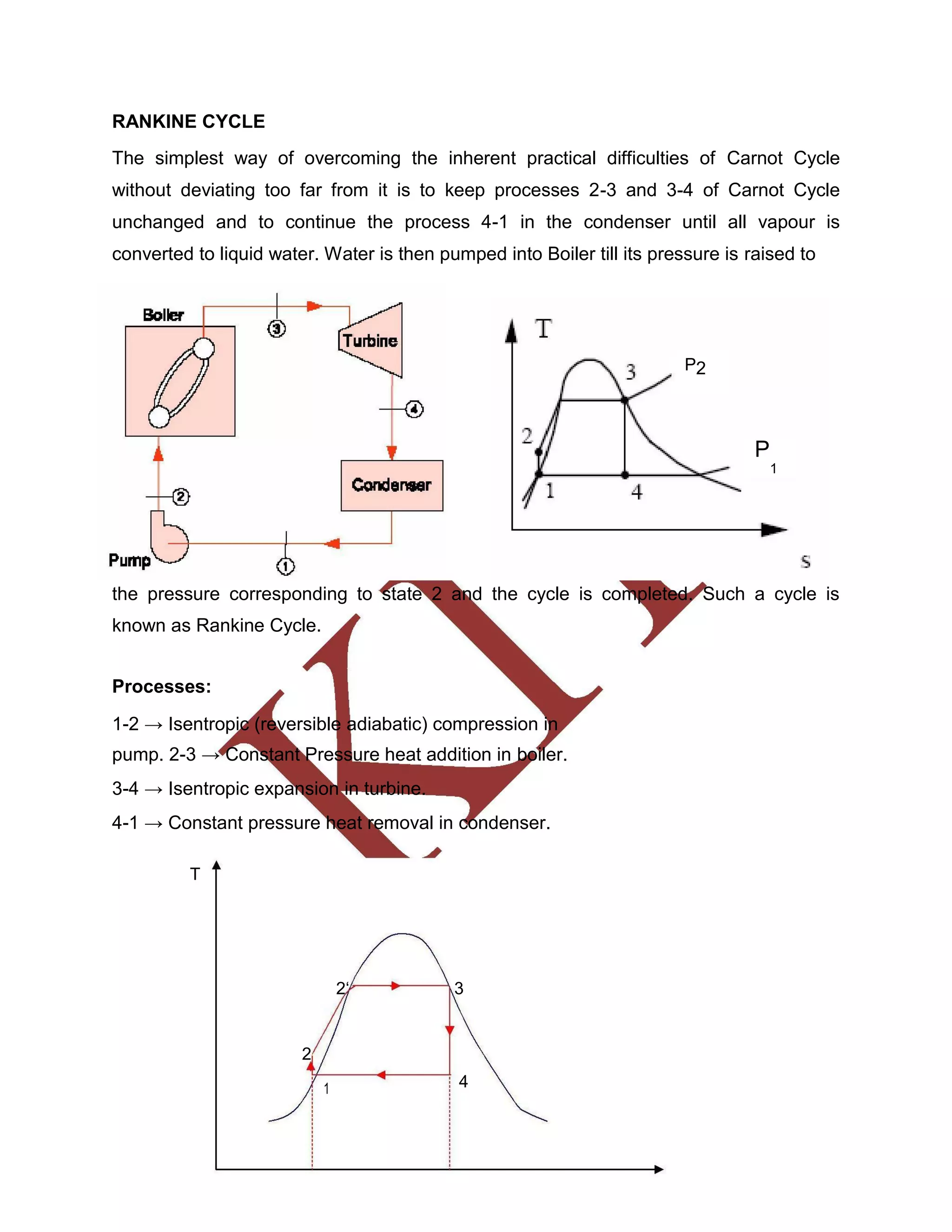
RANKINE CYCLE
The simplest way of overcoming the inherent practical difficulties of Carnot Cycle
without deviating too far from it is to keep processes 2-3 and 3-4 of Carnot Cycle
unchanged and to continue the process 4-1 in the condenser until all vapour is
converted to liquid water. Water is then pumped into Boiler till its pressure is raised to
P2
P
1
the pressure corresponding to state 2 and the cycle is completed. Such a cycle is
known as Rankine Cycle.
Processes:
1-2 → Isentropic (reversible adiabatic) compression in
pump. 2-3 → Constant Pressure heat addition in boiler.
3-4 → Isentropic expansion in turbine.
4-1 → Constant pressure heat removal in condenser.
T
2‘ 3
2
1 4
6 5
If changes in kinetic and potential energies are neglected, the area under the curve 2-3
i.e. area 2-2‘-3-5-6-2 represents the heat transfer to the working fluid in Boiler, which is
equal to (h3 – h2) and area under the curve 1-2 i.e. area 1-4-5-6-1 represents the heat
transferred from the working fluid in condenser, which is equal to (h4 – h1). The
difference between the two areas, namely area 1-2-2‘-3-4-1, represents the work
obtained from the cycle. The thermal efficiency of the cycle is given by
η = Wnet = area1− 2 − 2'−3 − 4 −1
th
area 2 − 2'− 3 − 5 − 6 − 2H
=(h 3 −h 2 ) − (h 4 −h1)
(h 3 − h 2 )
(h 3 −h 4 ) − (h 2 −h1) WT − WP
= (h −h ) = Q
3 2 H
where WT and WP are the turbine work and pump work respectively per kg of steam
flow through the cycle and h1, h2, h3, h4 are the specific enthalpies of the working fluid.
We know that the efficiency of the Carnot cycle depends only on the temperature levels
of high and low temperature reservoirs. Efficiency o the Rankine cycle similarly depends
on the average temperature at which the heat is transferred to and from the working
fluid. Any change that increases the average temperature at which heat is transferred to
the working fluid will increase the efficiency of the Rankine cycle. Similarly, any change
that decreases the average temperature at which heat is transferred from the working
fluid will increase the efficiency of the Rankine cycle.
An advantage of the Rankine cycle over all other power cycles is its low back work ratio,
which is expressed as the ratio of the pump work to the turbine work, i.e.
Back work ratio =
WP
WT
METHODS OF IMPROVING THE EFFICIENCY OF RANKINE CYCLE
The Rankine cycle efficiency is given by
η = (h 3 −h 4 ) − (h 2 −h1) =
W
T
− W
P
th
(h 3 −h2 ) QH
Since the pumping work is very small compared to the turbine work, it may be
neglected. Hence, the efficiency of the Rankine cycle can be approximated as
η = (
h
3
−h
4 ) ( h)s
th
(h 3 −h2 ) =(h 3 −h2 )
It can be seen that the Rankine efficiency depends on three values, h2, h3 and turbine
expansion work ( h)s. The enthalpy of the steam entering the turbine h3 is determined
by the pressure and temperature of the steam entering the turbine. The enthalpy of feed
water h2 is determined by the condenser pressure (as in this case h2 = h1 since the
pump work is negligible). The isentropic heat drop ( h)s in the turbine is determined by
the pressure and temperature at the entrance of steam turbine and the pressure at the
end of expansion in the turbine. That means the Rankine efficiency depends on
pressures P1 ( i.e. P4 ) , P2 (i.e. P3 ) and temperature T3.
2.1 Effect of Lowering Condenser pressure
By lowering the condenser pressure we can
achieve higher efficiency as the enthalpy of
the steam leaving the turbine decreases
thereby increasing heat drop ( h)s in the
turbine. However, there is a limit to which
the condenser pressure can be lowered and
this limit is the saturated pressure Psat
corresponding to the condenser
temperature.
2.3 Effect of Increasing Steam pressure in the Boiler
h
P2‘‘
P2‘
P2
T3
P4
( hs)
( hs)′
( hs)″ x4
x4‘
x4‖
s
In this analysis the maximum temperature of the steam T3 as well as the exhaust
pressure P4 are held constant.
P2, P2‘, P2‘‘ are the pressures of steam at the entrance of the turbine at temperature
T3 such that P2‘‘ > P2‘ > P2 . x4, x4‘,x4‘‘ are the qualities of steam at he exhaust
pressure P4 of the turbine, where x4>x4‘>4‘‘ .It is evident that as pressure n the Boiler
increases, the isentropic heat drop h)s increases with the result that the Rankine cycle
efficiency increases.
An adverse effect resulting from increasing the steam pressure in the Boiler is the
greater amount of moisture in the steam at the end of expansion in the turbine. If the
moisture content in the turbine exceeds ~10%, the turbine blades also get eroded which
leads to serious wear of the turbine blades.
c) Effect of Superheating
of Steam in the Boiler
The moisture in the steam at the
end of the expansion can be
reduced by superheating and
increasing the superheat temperature of steam, T3‘. Hence, it is natural to avoid the
erosion of the turbine blades by an increase of boiler pressure accompanied by
superheating at a higher temperature. By superheating to a higher temperature, the
heat drop in the turbine is increased from (h3 – h4) to (h3‘ – h4‘), thereby increasing the
efficiency of the Rankine cycle. However, the maximum temperature to which the steam
can be superheated is limited by materials.
d) Effect of Superheating &Reheating of Steam in the Boiler
We have noted earlier that the efficiency of the Rankine cycle can be increased by
P3 P4
h 3 5 Constant temperature
P6
4
6
s
increasing the steam pressure in the boiler. But this increases the moisture content of
the steam in the lower stages of the turbine, which may lead to erosion of the turbine
blades. The reheat cycle has been developed to take advantage of the increased
pressure of boiler, avoiding the excessive moisture of the steam in the low pressure
stage.
In the reheat cycle, the high pressure superheated steam after expansion in the high
pressure turbine is reheated at constant pressure, usually to the entrance temperature
of the steam in the high pressure turbine. After this, it expands in the low pressure
turbine to the exhaust pressure. Reheating has a two-fold advantage. Firstly, it reduces
excessive moisture in the low pressure stages of turbine, and secondly, a large amount
of work may be obtained at the cost of additional consumption of heat required for
reheating the steam. The net effect is an improvement in the thermal efficiency of the
cycle. Thus with reheat cycle, the efficiency of the cycle is increased without increase in
the maximum pressure or maximum temperature of the cycle.
The efficiency of the reheat cycle is given by
η =
WT − WP =
(h 3 −h 4 )+ (h5 −h 6 )− (h2 −h1)
th
QH (h3 −h2 ) + (h5 −h4 )
REAL RANKINE CYCLE: DEVIATION FROM IDEAL CYCLES
a) Turbine and pump losses
1-2s & 3-4s → Isentropic drop.
1-2 & 3-4 → irreversible drop.
b) Pump loses
a-b: friction loss → entropy increases
b-c: heat loss → entropy decreases.
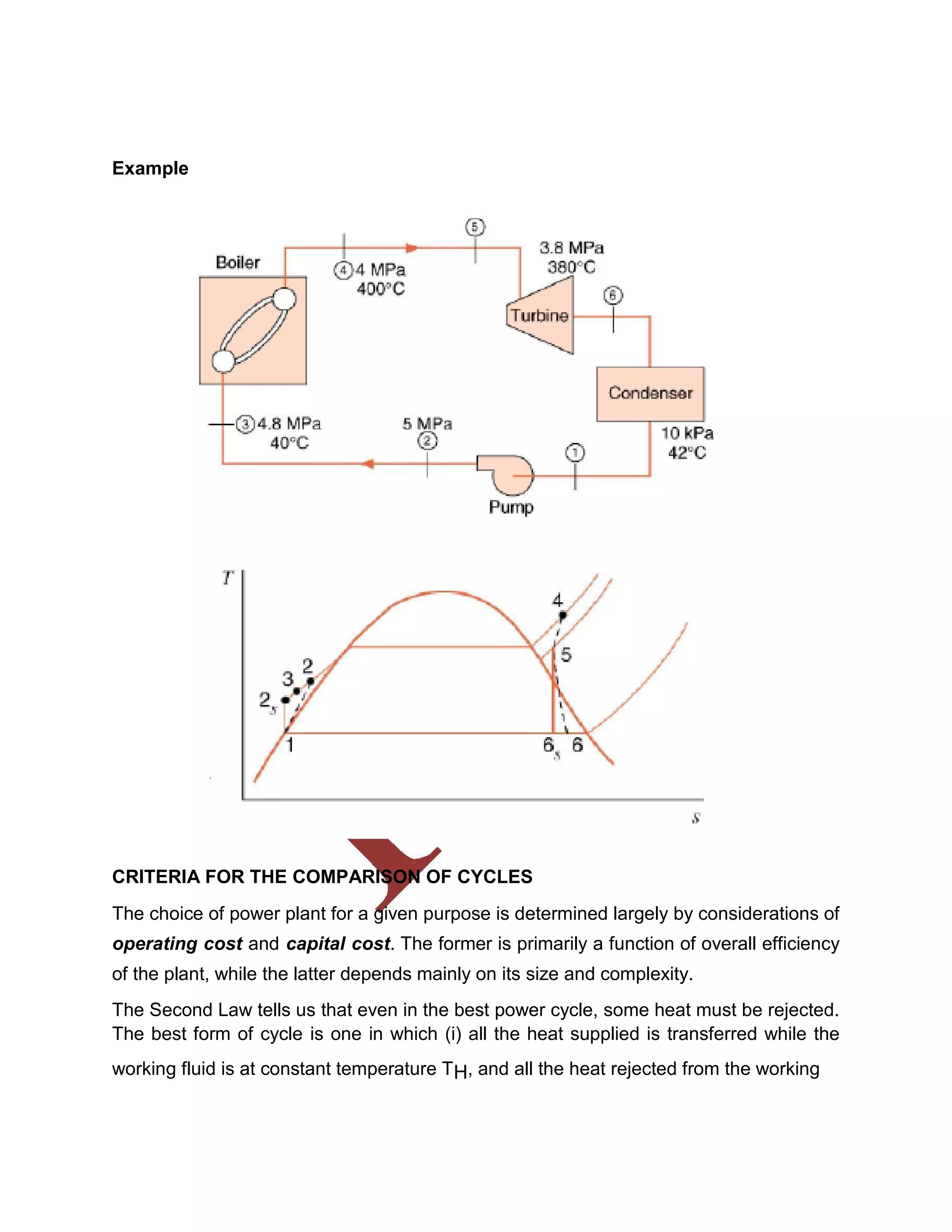
Example
CRITERIA FOR THE COMPARISON OF CYCLES
The choice of power plant for a given purpose is determined largely by considerations of
operating cost and capital cost. The former is primarily a function of overall efficiency
of the plant, while the latter depends mainly on its size and complexity.
The Second Law tells us that even in the best power cycle, some heat must be rejected.
The best form of cycle is one in which (i) all the heat supplied is transferred while the
working fluid is at constant temperature TH, and all the heat rejected from the working
fluid is at constant temperature TL; (ii) all processes are reversible. The efficiency of the
such cycle is
T
H
− T
L , which is known as ideal cycle efficiency or Carnot efficiency.
TH
However, all real processes are irreversible and irreversibility reduces cycle efficiency.
Hence the ratio of actual cycle efficiency to ideal cycle efficiency, i.e. the efficiency ratio
is one measure of comparison. Some cycles are more sensitive to irreversibilities than
others. That is, two cycles may have the same ideal cycle efficiencies, but allowing for
the process efficiencies, their actual cycle efficiencies may be markedly different.
Hence, Work Ratio rw is a criterion, which indicates the cycle sensitiveness to the
irreversibilities. Any cycle consists of both positive (turbine work) and negative (pump
work) work. The work ratio rw is defined as the ratio of net work to the positive work
done in the cycle. That is
W − w
r
w
=
TP
WT
If rw is near unity, then the effect of irreversibility on the cycle efficiency is less.
However, if rw is slightly greater than zero, quite a small amount of component
inefficiencies is sufficient to reduce the network output to zero thereby reducing the
actual cycle efficiency to zero.
Hence, we can say that a high ideal cycle efficiency together with high work ratio
provides a reliable indication that a real power plant will have a good overall efficiency.
The next consideration is some criterion which will indicate the relative size of plant for
a given power output. In general, the size of component depends on the amount of
working fluid, which has to be passed through them. A direct indication of relative sizes
of steam power plant is therefore provided by the Specific Steam Consumption (ssc)
i.e. mass flow of steam required per unit power output. If W is the net work output in
kJ/kg, then ssc can be found from
ssc =
1 kg
or
kg x 3600
s
=
3600 kg
W kJ kWs h W kWh
UNIT – IV
BUCKLING OF VESSELS
For small power plants, gas is ideally preferred as the working fluid. The gasoline
engines, diesel engines and gas turbines are common examples.
The analysis of the air-standard cycle is based on the assumptions that are far from
real. In actual internal combustion (IC) engines, chemical reaction occurs inside the
engine cylinder as a result of combustion of air-fuel mixture and. The IC engines are
actually operated on Open cycles in which the working fluid does not go through a
cycle. The accurate analysis of IC engine is very complicated. However, it is
advantageous to analyse the performance of an ideal closed cycle that closely
approximates the real cycle. One such approach is air-standard cycle, which is based
on certain assumptions. The assumptions for idealized air-standard cycles are:
1) The working fluid, air, is assumed to be an ideal gas. The equation of state is
given by the equation pv = RT and the specific heats are assumed to be
constant.
2) All processes that constitute the cycle are reversible.
3) No chemical reaction occurs during the cycle. Heat is supplied from a high
temperature reservoir (instead of chemical reaction) and some heat is rejected to
the low temperature reservoir during the cycle.
4) The mass of air within the system remains constant throughout the cycle.
5) Heat losses from the system to the atmosphere are assumed to be zero.
In this we shall discuss about the Brayton cycle, Otto cycle and Diesel cycle.
BRAYTON CYCLE
The Brayton cycle is widely used as the basis for the operation of Gas turbine.
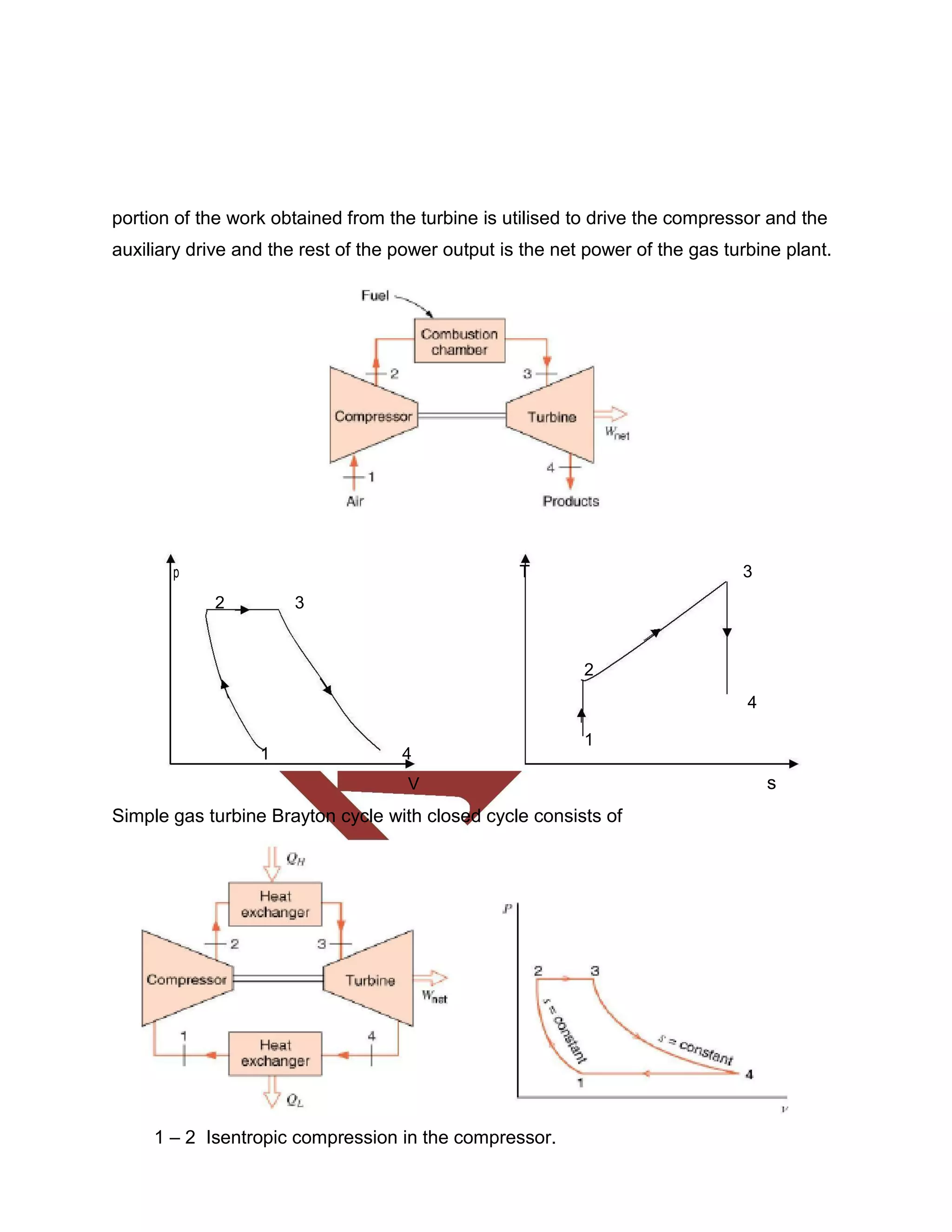
A schematic diagram of a simple gas turbine (open cycle) and the corresponding p-v
and T-s diagrams are shown below.
Air is drawn from he atmosphere into compressor, where it is compressed reversibly
and adiabatically. The relative high pressure air is then used in burning the fuel in the
combustion chamber. The air-fuel ratio quite high (about 60:1) to limit the temperature
burnt gases entering the turbine. The gases then expand isentropically in the turbine. A
portion of the work obtained from the turbine is utilised to drive the compressor and the
auxiliary drive and the rest of the power output is the net power of the gas turbine plant.
p T 3
2 3
2
4
1 4
1
V s
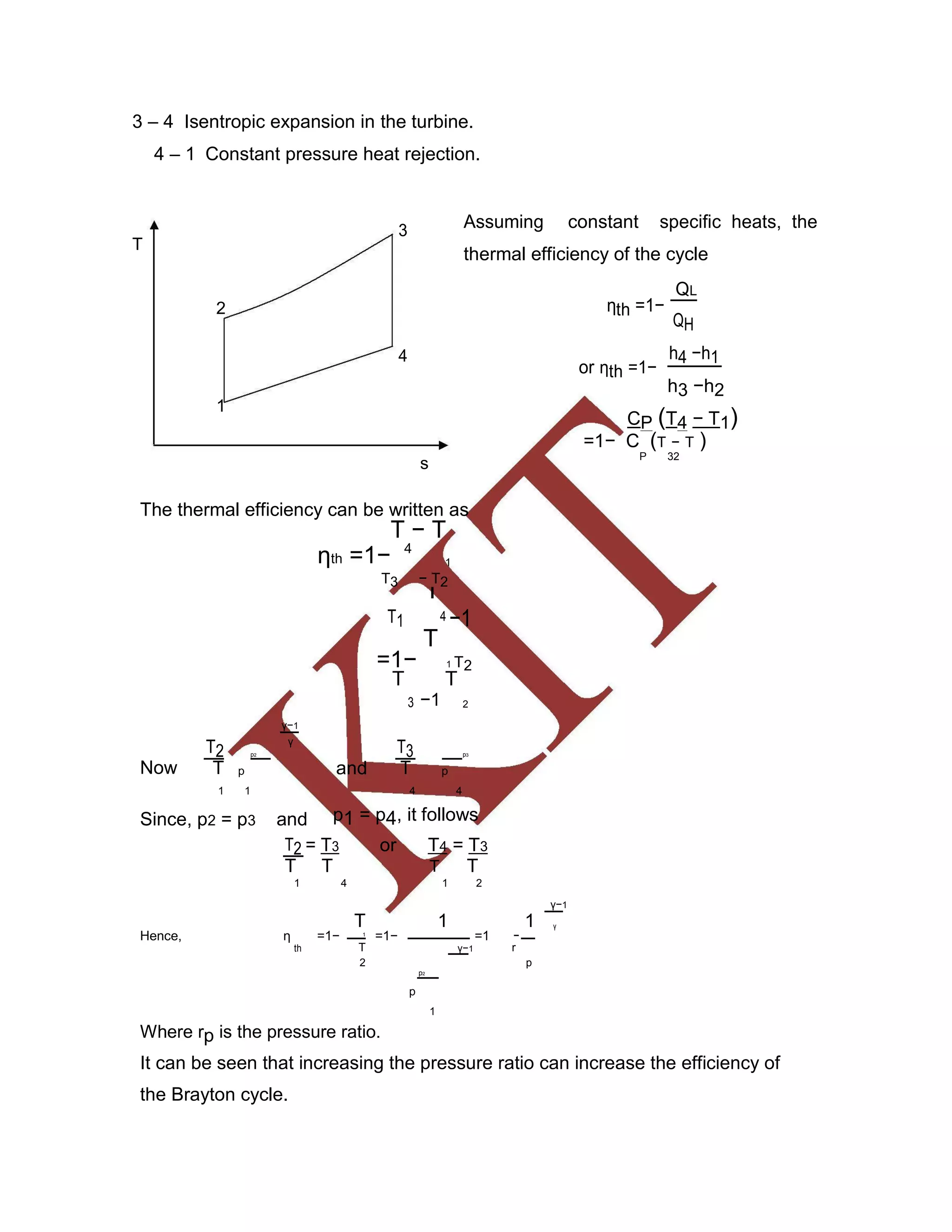
Simple gas turbine Brayton cycle with closed cycle consists of
1 – 2 Isentropic compression in the compressor.
2 – 3 Constant pressure heat addition.
3 – 4 Isentropic expansion in the turbine.
4 – 1 Constant pressure heat rejection.
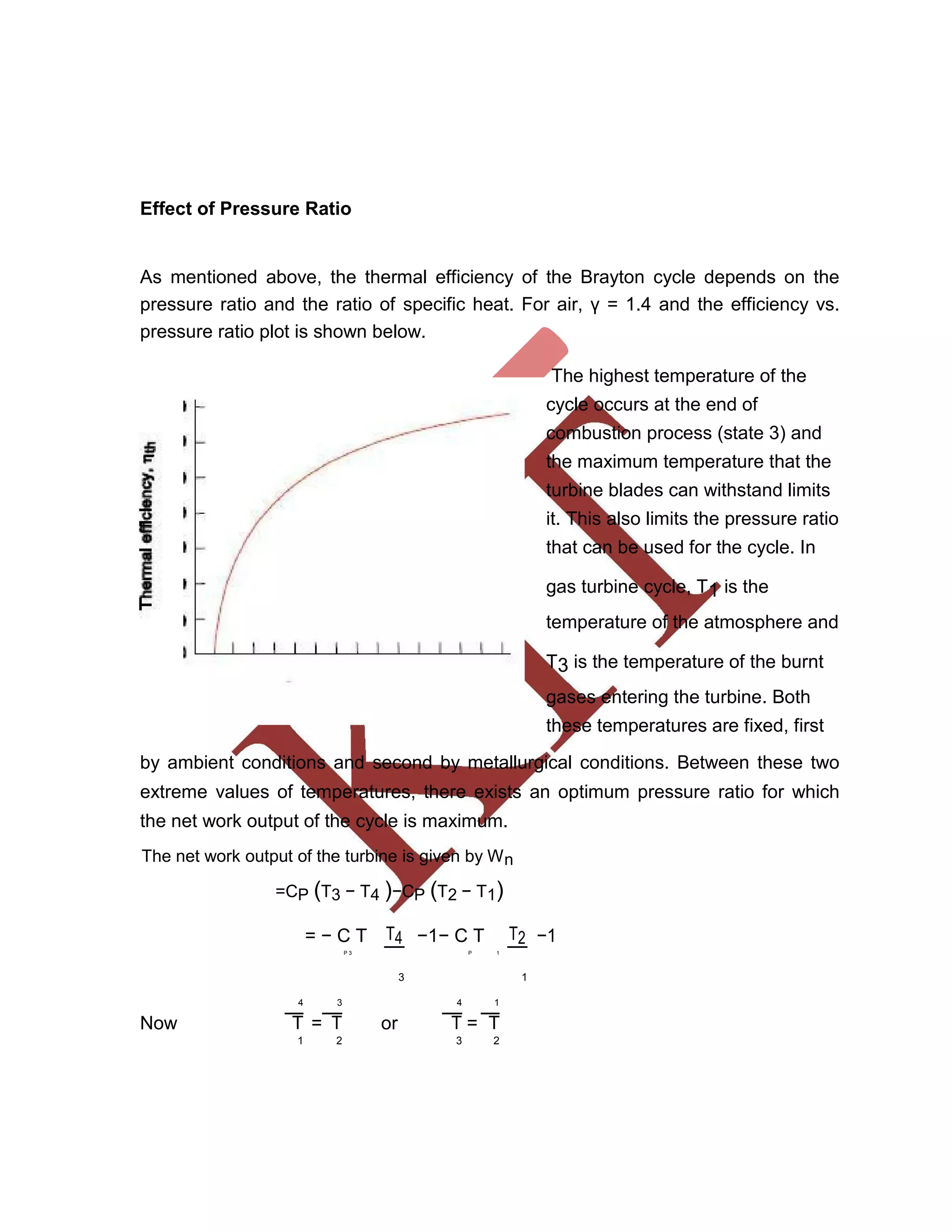
3 Assuming constant specific heats, the
T
thermal efficiency of the cycle
2 ηth =1−
QL
QH
4
or ηth =1−
h4 −h1
h3 −h2
1
CP (T4 − T1)
=1− C (T − T )
s
P 32
The thermal efficiency can be written as
T − T
ηth =1− 4
1
T3 − T2
T1
T
4 −1
T
=1− 1 T2
T T
3 −1 2
γ−1
T2
γ
T3p2 p3
Now andT p T p
1 1 4 4
Since, p2 = p3 and p1 = p4, it follows
T2 = T3 or T4 = T3
T T T T
1 4 1 2
γ−1
T 1 1 γ
Hence, η =1− 1
=1− =1 −
th T γ−1 r
2 p
p2
p
1
Where rp is the pressure ratio.
It can be seen that increasing the pressure ratio can increase the efficiency of
the Brayton cycle.
Effect of Pressure Ratio
As mentioned above, the thermal efficiency of the Brayton cycle depends on the
pressure ratio and the ratio of specific heat. For air, γ = 1.4 and the efficiency vs.
pressure ratio plot is shown below.
The highest temperature of the
cycle occurs at the end of
combustion process (state 3) and
the maximum temperature that the
turbine blades can withstand limits
it. This also limits the pressure ratio
that can be used for the cycle. In
gas turbine cycle, T1 is the
temperature of the atmosphere and
T3 is the temperature of the burnt
gases entering the turbine. Both
these temperatures are fixed, first
by ambient conditions and second by metallurgical conditions. Between these two
extreme values of temperatures, there exists an optimum pressure ratio for which
the net work output of the cycle is maximum.
The net work output of the turbine is given by Wn
=CP (T3 − T4 )−CP (T2 − T1)
= − C T T4 −1− C T T2 −1
P 3 P 1
3 1
4 3 4 1
Now = or =T T T T
1 2 3 2
∴ W = −C T T1 −1 − C T
T
2 −1
n P 3 P 1
2 1
γ−1
1 p2 γ
= − C T −1 − C T −1
P 3 γ−1 P 1
p
p 2 1
1
= − C T 1 −1 −C T (r ) γ
γ
−1
−1
P 3 γ−1 P 1 P
(rP ) γ
The optimum pressure ratio is obtained by differentiating the net work with respect
to pressure ratio, rP and putting the derivative as zero.
Let
γ −1
γ =n
1
Wn = −CP T3 rP n −1 −CP T1 [(rP )
n
−1]
( )
or dWn= −CP T3 [−n rP
−n−1
]−CP T1 [n rP
n−1
]
dr
P
or 0 =C T nr
−n−1
−C T n r
n−1
P 3 P P 1 P
or T nr−n−1 = T n r
n−1
3 P 1 P
or r( − n−1) − (n −1) = 1
TP
3
or r−2n = 1
P
T3
T
or r2n
=
3
P
T1
T 1
3 2n
i.e. (rP )optimum =
T
1
T3 2
γ (
γ −1
)
or (
r
P )optimum
=
T
UNIT –V
PIPING
Before 1830, few Am ericans used ice to refrigerate foods due to a lack of ice-
storehouses and iceboxes. As these two things became more widely available, individuals
used axes and saws to harvestt ice for their storehouses. This method proved to be difficult,
dangerous, and certainly did not resemble anything that could be du plicated on a
commercial scale.
Despite the difficulti es of harvesting ice, Frederic Tudor thought that he could
capitalize on this new commo dity by harvesting ice in New England and shipping it to the
Caribbean islands as well as the southern states. In the beginning, Tudor lost thousands of
dollars, but eventually turned a profit as he constructed icehouses in Charle ston, Virginia
and in the Cuban port town of Havana. These icehouses as well as better insulated ships
helped reduce ice wastage from 66% to 8%. This efficiency gain influen ced Tudor to
expand his ice market to othe r towns with icehouses such as New Orleans a nd Savannah.
This ice market further expan ded as harvesting ice became faster and cheap er after one of
Tudor‟s suppliers, Nathaniel Wyeth, invented a horse-drawn ice cutter in 1825. This
invention as well as Tudor‟s s uccess inspired others to get involved in the ice trade and the
ice industry grew.
Ice became a mass-m arket commodity by the early 1830s with the price of ice
dropping from six cents per pound to a half of a cent per pound. In New York City, ice
consumption increased from 12,000 tons in 1843 to 100,000 tons in 1 856. Boston‟s
consumption leapt from 6,00 0 tons to 85,000 tons during that same period. Ice harvesting
created a “cooling culture” as majority of people used ice and iceboxes to store their dairy
products, fish, meat, and ev en fruits and vegetables. These early cold storage practices
paved the way for many Ame ricans to accept the refrigeration technology that would soon
take over the country.
CONCEPT
5.2 CONCEPT OF REF RIGERATION
Refrigeration is a pro cess in which work is done to move heat from one location
to another. The work of heat trannsport is traditionally driven by mechanical work, but can
also be driven by heat, magnetism , electricity, laser, or other means.
How does it work?
91
DPVP
ME6404 THERMAL EN GINEERING
Thermal energy moves from left to right through five loops of heat trans fer:
1) Indoor air loop
2) Chilled water loop
3) Refrigerant loop
4) Condenser water loop
5) Cooling water loop
5.3 SIGNIFICANCE
Refrigeration has had a large importance on industry, lifestyle, a griculture and
settlement patterns. The idea of preserving food dates back to the ancien t Roman and
Chinese empires. However, refrigeration technology has rapidly evolved in the last
century, from ice harvesting to temperature-controlled rail cars. In order to avoid food
spoilage, refrigeration plays an important role in day to day life, similarly, Air conditioning
is also an important technological system to prevent the human from the hot atmosphere
during summer seasons.
5.4 CLASSIFICATION OF REFRIGERATION
SYSTEM Types of Refrigeratio n
• Vapour Compression Refrigeration (VCR): uses mechanical energy
• Vapour Absorption Re frigeration (VAR): uses thermal energy
5.5 VAPOUR COMPRESSION REFRIGERATION
• Highly compressed flu ids tend to get colder when allowed to expand
• If pressure high enough
• Compressed air hotter than source of cooling
• Expanded gas cooler than desired cold temperature
• Lot of heat can be rem oved (lot of thermal energy to change liquid to vapour)
• Heat transfer rate re mains high (temperature of working fluid mu ch lower than
what is being cooled)
92
DPVP
ME6404 THERMAL EN GINEERING
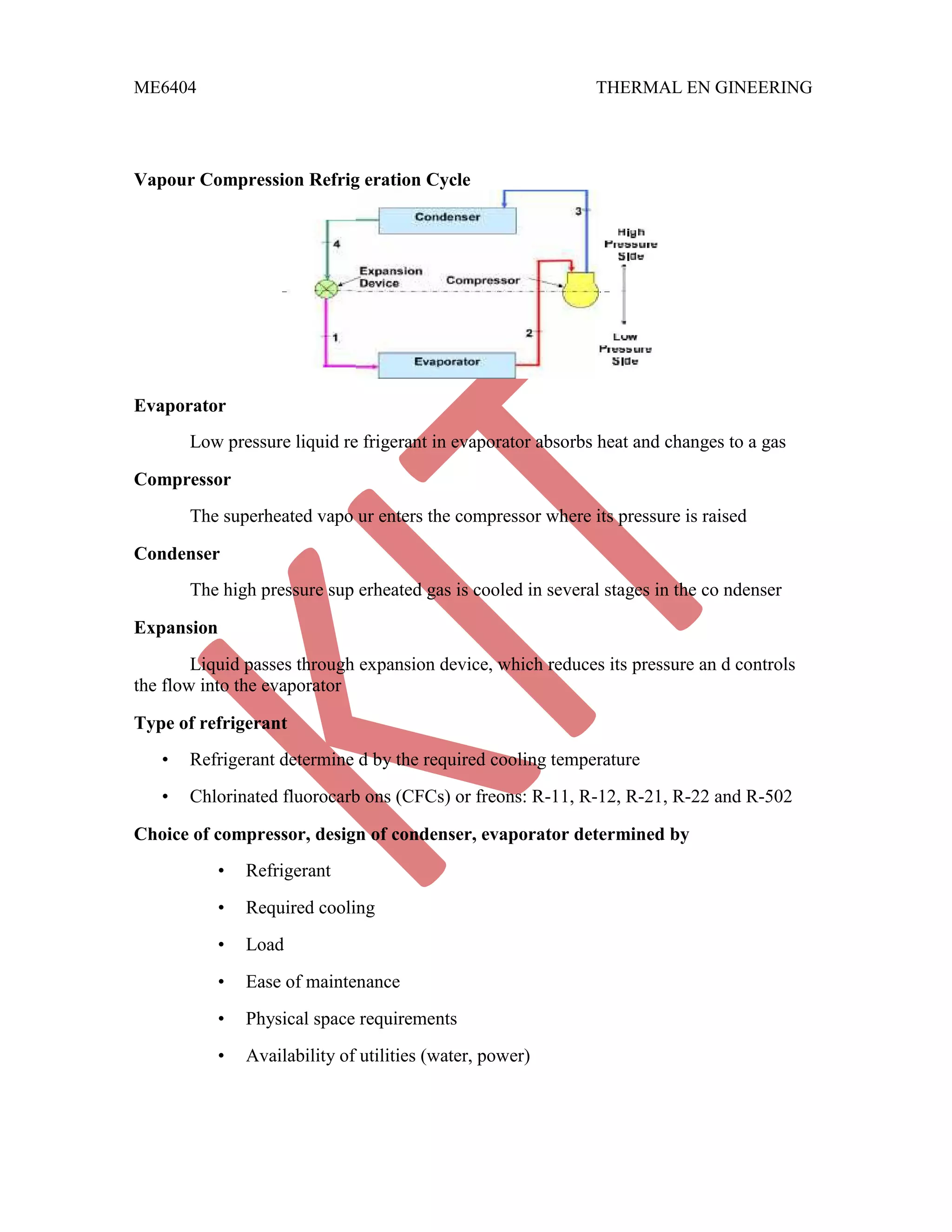
Vapour Compression Refrig eration Cycle
Evaporator
Low pressure liquid re frigerant in evaporator absorbs heat and changes to a gas
Compressor
The superheated vapo ur enters the compressor where its pressure is raised
Condenser
The high pressure sup erheated gas is cooled in several stages in the co ndenser
Expansion
Liquid passes through expansion device, which reduces its pressure an d controls
the flow into the evaporator
Type of refrigerant
• Refrigerant determine d by the required cooling temperature
• Chlorinated fluorocarb ons (CFCs) or freons: R-11, R-12, R-21, R-22 and R-502
Choice of compressor, design of condenser, evaporator determined by
• Refrigerant
• Required cooling
• Load
• Ease of maintenance
• Physical space requirements
• Availability of utilities (water, power)
93
DPVP
ME6404 THERMAL EN GINEERING
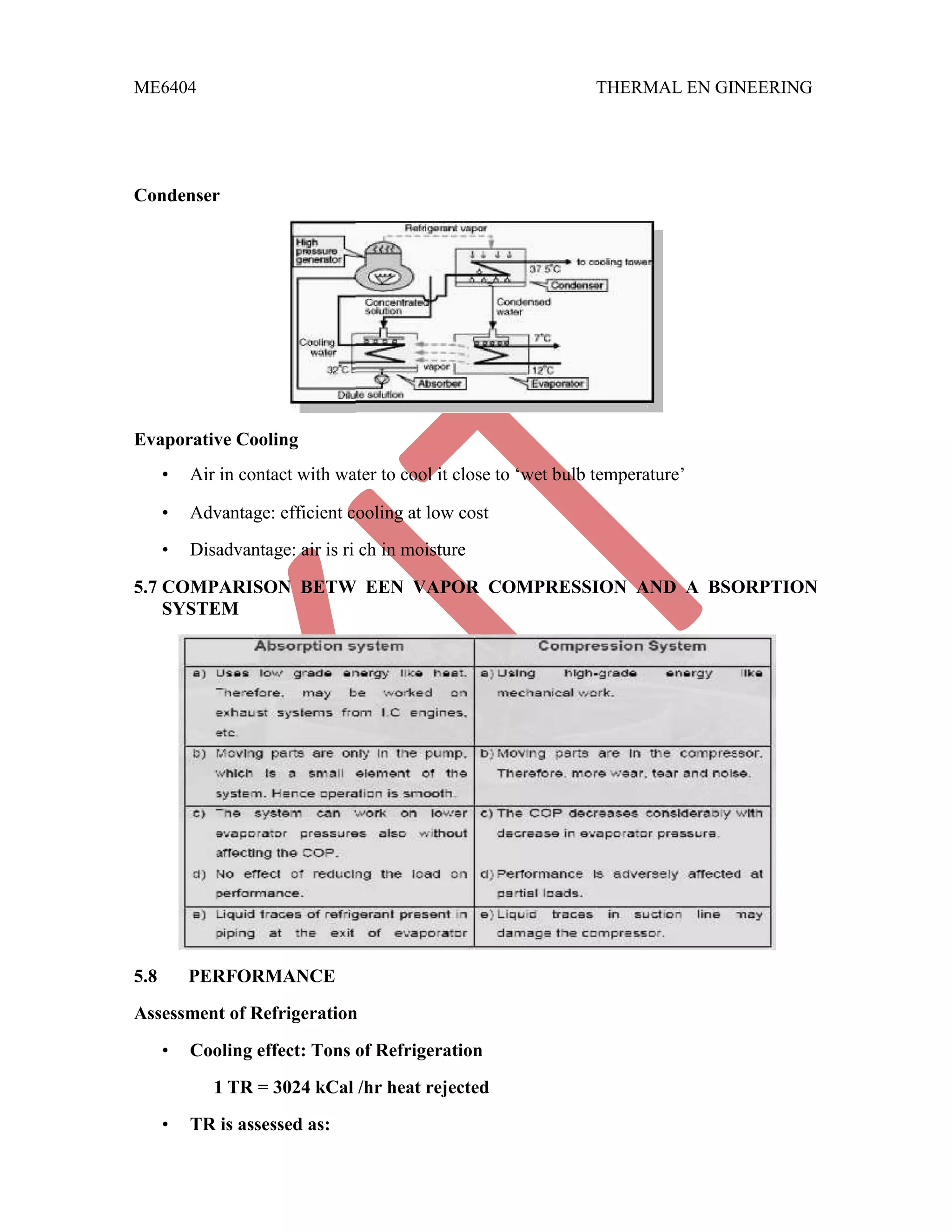
5.6 Vapour Absorption Refrigeration
Evaporator
Absorber
High pressure generator
94
DPVP
ME6404 THERMAL EN GINEERING
Condenser
Evaporative Cooling
• Air in contact with water to cool it close to „wet bulb temperature‟
• Advantage: efficient cooling at low cost
• Disadvantage: air is ri ch in moisture
5.7 COMPARISON BETW EEN VAPOR COMPRESSION AND A BSORPTION
SYSTEM
5.8 PERFORMANCE
Assessment of Refrigeration
• Cooling effect: Tons of Refrigeration
1 TR = 3024 kCal /hr heat rejected
• TR is assessed as:
TR = Q xCp x ( Ti – To) / 3024
95
DPVP
DPVP
Q = mass flow rate of coolant in kg/hr
Cp = is coolant specific heat in kCal /kg °C
Ti = inlet, temperature of coolant to evaporator (chiller) in 0°C To =
outlet temperature of coolant from evaporator (chiller) in 0°C
Specific Power Consumption (kW/TR)
• Indicator of refrigeration system‟s performance
• kW/TR of centralized chilled water system is sum of
• Compressor kW/TR
• Chilled water pump kW/TR
• Condenser water pump kW/TR
• Cooling tower fan kW/TR
Coefficient of Performance (COP)
• The performance of refrigerators and heat pumps is expressed in terms of
coefficient of performance (COP), defined as
•
Measure
• Airflow Q (m3/s) at Fan Coil Units (FCU) or Air Handling Units (AHU):
anemometer
• Air density  (kg/m3)
• Dry bulb and wet bulb temperature: psychrometer
• Enthalpy (kCal/kg) of inlet air (hin) and outlet air (Hout): psychrometric charts
5.9 APPLICATIONS OF REFRIGERATRION
 Metal workers 
 Oil refineries 
 Chemical plants 
 Petrochemical plants 
 Transporting temperature-sensitive foodstuffs 
 Dairy products 
96
DPVP
DPVP
AIR CONDITIONERS
5.10 CONCEPT OF AIR CONDITIONING
Air conditioning (often referred to as aircon, AC or A/C) is the process of altering
the properties of air (primarily temperatureand humidity) to more favourable conditions,
typically with the aim of distributing the conditioned air to an occupied space to improve
thermal comfort and indoor air quality.
5.11 TYPES OF AIR CONDITIONERS
• Room air conditioners
• Zoned Systems
• Unitary Systems
• Window Air-conditioning System
• Split Air-conditioning System
• Central air conditioning systems
5.11.1 ROOM AIR CONDITIONER
• Room air conditioners cool rooms rather than the entire home.
• Less expensive to operate than central units
• Their efficiency is generally lower than that of central air conditioners.
• Can be plugged into any 15- or 20-amp, 115-volt household circuit that is not
shared with any other major appliances
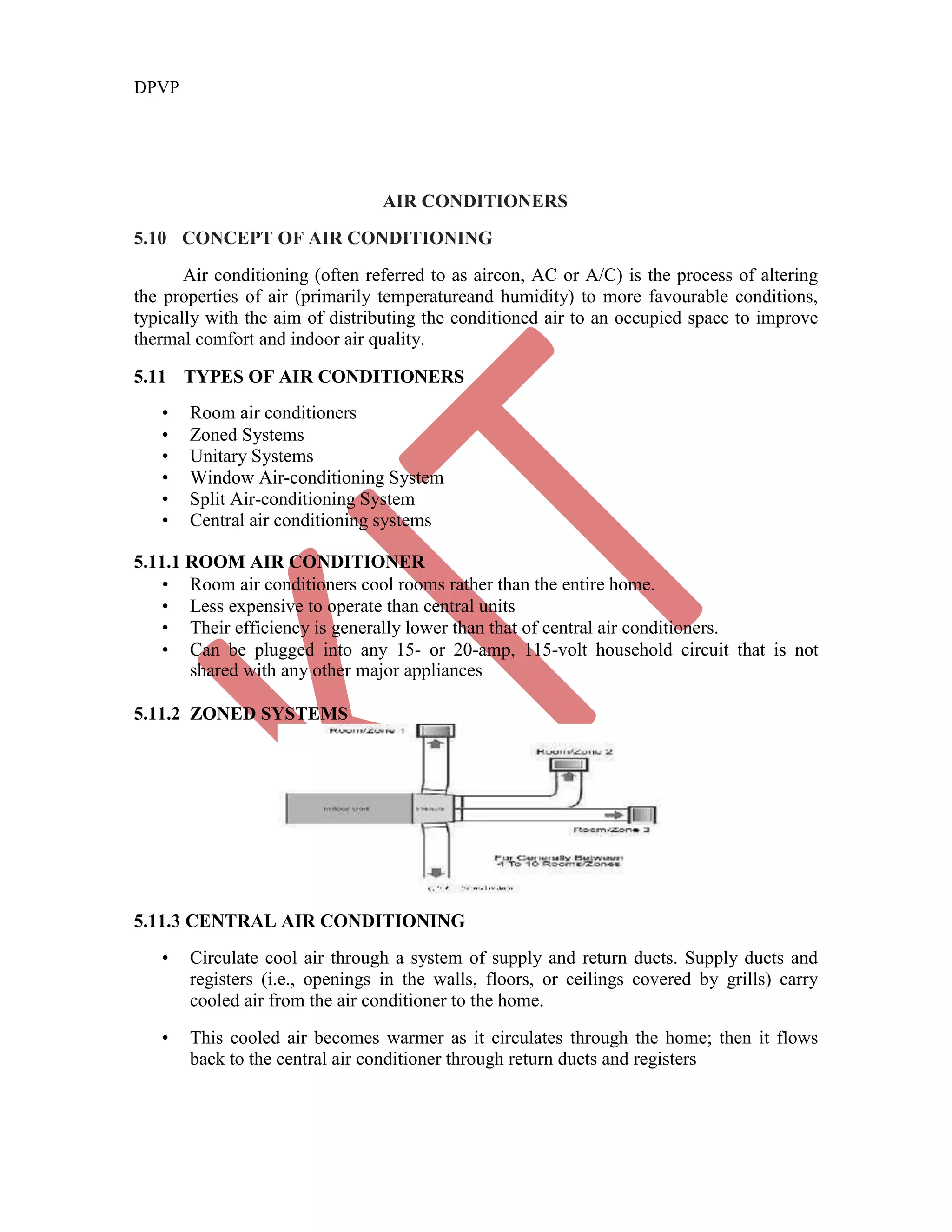
5.11.2 ZONED SYSTEMS
5.11.3 CENTRAL AIR CONDITIONING
• Circulate cool air through a system of supply and return ducts. Supply ducts and
registers (i.e., openings in the walls, floors, or ceilings covered by grills) carry
cooled air from the air conditioner to the home.
• This cooled air becomes warmer as it circulates through the home; then it flows
back to the central air conditioner through return ducts and registers
97
DPVP
DPVP
5.11.4 UNITARY SYSTEMS
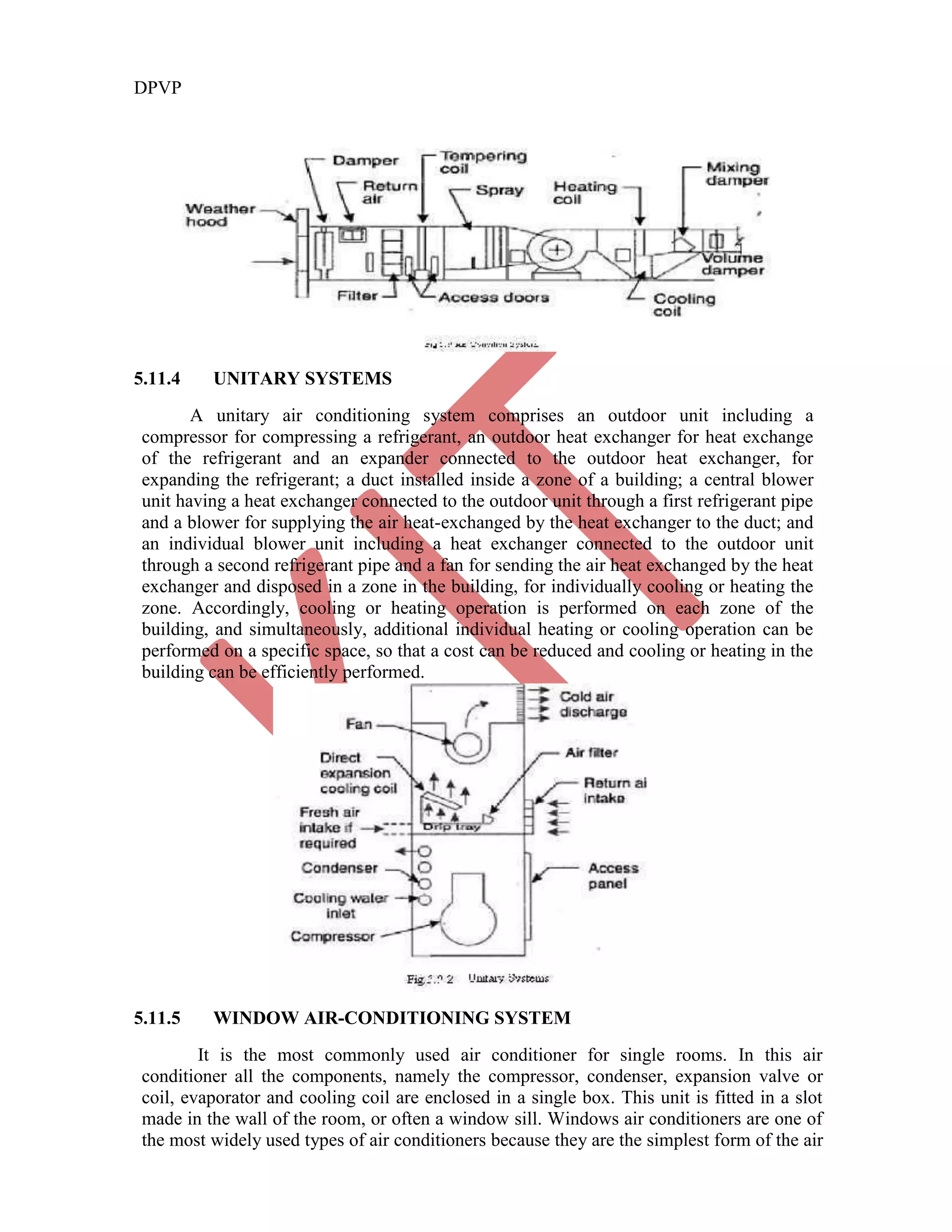
A unitary air conditioning system comprises an outdoor unit including a
compressor for compressing a refrigerant, an outdoor heat exchanger for heat exchange
of the refrigerant and an expander connected to the outdoor heat exchanger, for
expanding the refrigerant; a duct installed inside a zone of a building; a central blower
unit having a heat exchanger connected to the outdoor unit through a first refrigerant pipe
and a blower for supplying the air heat-exchanged by the heat exchanger to the duct; and
an individual blower unit including a heat exchanger connected to the outdoor unit
through a second refrigerant pipe and a fan for sending the air heat exchanged by the heat
exchanger and disposed in a zone in the building, for individually cooling or heating the
zone. Accordingly, cooling or heating operation is performed on each zone of the
building, and simultaneously, additional individual heating or cooling operation can be
performed on a specific space, so that a cost can be reduced and cooling or heating in the
building can be efficiently performed.
5.11.5 WINDOW AIR-CONDITIONING SYSTEM
It is the most commonly used air conditioner for single rooms. In this air
conditioner all the components, namely the compressor, condenser, expansion valve or
coil, evaporator and cooling coil are enclosed in a single box. This unit is fitted in a slot
made in the wall of the room, or often a window sill. Windows air conditioners are one of
the most widely used types of air conditioners because they are the simplest form of the air
conditioning systems. Window air conditioner comprises of the rigid base on which all
98
DPVP
DPVP
the parts of the window air conditioner are assembled. The base is assembled inside the
casing which is fitted into the wall or the window of the room in which the air conditioner
is fitted. The whole assembly of the window air conditioner can be divided into two
compartments: the room side, which is also the cooling side and the outdoor side from
where the heat absorbed by the room air is liberated to the atmosphere. The room side and
outdoor side are separated from each other by an insulated partition enclosed inside the
window air conditioner assembly. In the front of the window air conditioner on the room
side there is beautifully decorated front panel on which the supply and return air grills are
fitted (the whole front panel itself is commonly called as front grill). The louvers fitted in
the supply air grills are adjustable so as to supply the air in desired direction. There is also
one opening in the grill that allows access to the Control panel or operating panel in front
of the window air conditioner.
TYPES OF CENTRAL AC
• split-system
• An outdoor metal cabinet contains the condenser and compressor, and an
indoor cabinet contains the evaporator
• Packaged
• The evaporator, condenser, and compressor are all located in one cabinet.
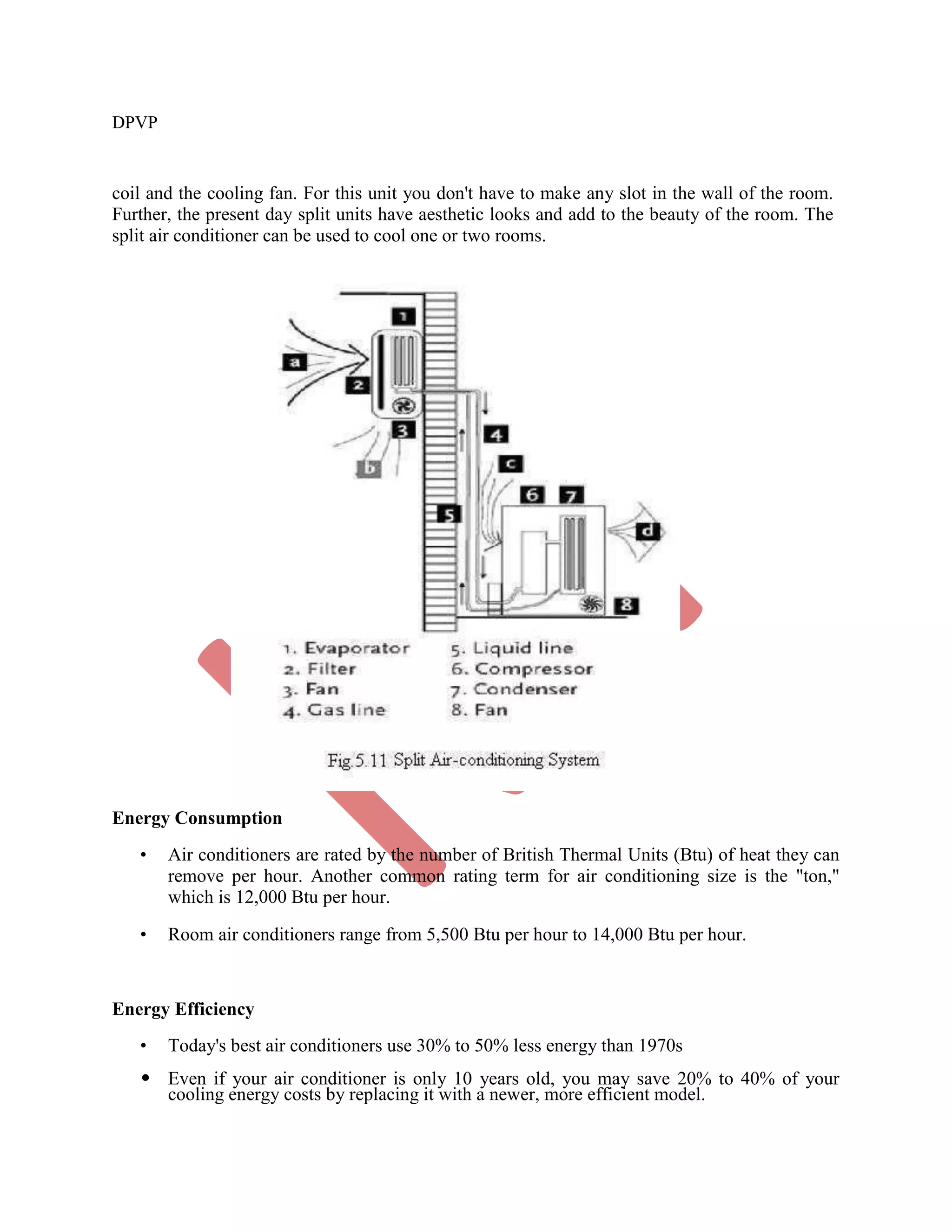
5.11.6 SPLIT AIR-CONDITIONING SYSTEM:
The split air conditioner comprises of two parts: the outdoor unit and the indoor
unit. The outdoor unit, fitted outside the room, houses components like the compressor,
condenser and expansion valve. The indoor unit comprises the evaporator or cooling
99
DPVP
DPVP
coil and the cooling fan. For this unit you don't have to make any slot in the wall of the room.
Further, the present day split units have aesthetic looks and add to the beauty of the room. The
split air conditioner can be used to cool one or two rooms.
Energy Consumption
• Air conditioners are rated by the number of British Thermal Units (Btu) of heat they can
remove per hour. Another common rating term for air conditioning size is the "ton,"
which is 12,000 Btu per hour.
• Room air conditioners range from 5,500 Btu per hour to 14,000 Btu per hour.
Energy Efficiency
• Today's best air conditioners use 30% to 50% less energy than 1970s
• Even if your air conditioner is only 10 years old, you may save 20% to 40% of your
cooling energy costs by replacing it with a newer, more efficient model.

ED8073 dpvp_notes

  • 1.
    ED8073-DESIGN OF PRESSUREVESSELS AND PIPING NOTES R-2013 YEAR: ME II YEAR SEM : III KALAIGNAR KARUNANIDHI INSTITUTE OF TECHNOLOGY KANNAMPALAYAM, COIMBATORE-641 402.
  • 2.
    UNIT – IINTRODUCTION 1.1 PREREQUISITE DISCUSSIONS Discussion of this gas power cycles will involve the study of those heat engines in which the working fluid remains in the gaseous state throughout the cycle. We often study the ideal cycle in which internal irreversibilities and complexities (the actual intake of air and fuel, the actual combustion process, and the exhaust of products of combustion among others) are removed. We will be concerned with how the major parameters of the cycle affect the performance of heat engines. The performance is often measured in terms of the cycle efficiency. INTRODUCTION  The cycle is defined as the repeated series of operation or processes performed on a system, so that the system attains its original state.   The cycle which uses air as the working fluid is known as Gas power cycles.   In the gas power cycles, air in the cylinder may be subjected to a series of operations which causes the air to attain to its original position.   The source of heat supply and the sink for heat rejection are assumed to be external to the air.   The cycle can be represented usually on p-V and T-S diagrams.   1.2 POWER CYCLES  Ideal Cycles, Internal Combustion    Otto cycle, spark ignition    Diesel cycle, compression ignition    Sterling & Ericsson cycles    Brayton cycles    Jet-propulsion cycle    Ideal Cycles, External Combustion    Rankine cycle 
  • 3.
    Pipes connecting componentshave no heat loss    Neglecting changes in kinetic and potential energy (except in nozzles & diffusers)   1.4 GAS POWER CYCLES  Working fluid remains a gas for the entire cycle    Examples:    Spark-ignition engines    Diesel engines    Gas turbines  Air-Standard Assumptions  Air is the working fluid, circulated in a closed loop, is an ideal gas    All cycles, processes are internally reversible    Combustion process replaced by heat-addition from external source    Exhaust is replaced by heat rejection process which restores working fluid to initial state   1.5 ENGINE TERMS  Top dead center    Bottom dead center    Bore    Stroke 
  • 4.
     Clearance volume Compression ratio Mean effective pressure (MEP) CYCLES AND THEIR CONCEPTS 1.6 OTTO CYCLE An Otto cycle is an idealized thermodynamic cycle that describes the functioning of a typical spark ignition
  • 5.
    piston engine. Itis the thermodynamic cycle most commonly found in automobile engines. The idealized diagrams of a four-stroke Otto cycle Both diagrams 1.7 PROCESS OF OTTO CYCLE  Ideal Otto Cycle    Four internally reversible processes o 1-2 Isentropic compression   o 2-3 Constant-volume heat addition o 3-4 Isentropic expansion   o 4-1 Constant-volume heat rejection 
  • 6.
    Thermal efficiency ofideal Otto cycle: Since V2= V3 and V4 = V 1 1.8 DIESEL CYCLE The Diesel cycle is a co mbustion process of a reciprocating internal co mbustion engine. In it, fuel is ignited by hea t generated during the compression of air in the combustion chamber, into which fuel is t hen injected. It is assumed to have constant pressure during the initial part of the "combustion" phase The Diesel engine is a heat engine: it converts heat into work. During the botto m isentropic processes (blue), energy is transferred into the system in the form of work , but by definition (isentropic) no ene rgy is transferred into or out of the system in the form of heat. During the constant pressure ( red, isobaric) process, energy enters the syste m as heat . During the top isentropic processes (yellow), energy is transferred out of the sy stem in the form of , but by definition (isen tropic) no energy is transferred into or out of the system in the form of heat. During the constan t volume (green,isochoric) process, some of energy flows out of the system as heat through the right depressurizing process . The wor k that leaves the system is equal to the work that enters the system plus the difference between the heat added to the system and the heat that lea ves the system; in other words, net gain of wo rk is equal to the difference between the heat adde d to the system and the heat that leaves the system.
  • 7.
    1.9 PROCESSES OFDIESEL CYCLE:  1-2 Isentropic com pression    2-3 Constant-Pres sure heat addition    3-4 Isentropic expansion    4-1 Constant-volume heat rejection  For ideal diesel cycle Cut off ratio rc Efficiency becomes 1.10 DUAL CYCLE The dual combustion cycle (also known as the limited pressure or mixed cycle) is a thermal cycle that is a combination of the Otto cycle and the Diesel cycle. Heat is added partly at constant volume and partly at constant pressure, the advantage of which is that more time is available for the fuel to completely combust. Because of lagging characteristics of fuel this cycle is invariably used for diesel and hot spot ignition engines.  Heat addition takes place at constant volume and constant pressure process .   Combination of Otto and Diesel cycle.   Mixed cycle or limited pressure cycle  1.11 PROCESS OF DUAL CYCLE
  • 9.
     Isentropic compression   Constant-volume heat rejection    Constant-pressure heat addition    Isentropic expansion    Constant-volume heat rejection   The cycle is the equivalent air cycle for reciprocating high speed compression ignition engines. The P-V and T-s diagrams are shown in Figs.6 and 7. In the cycle, compression and expansion processes are isentropic; heat addition is partly at constant volume and partly at constant pressure while heat rejection is at constant volume as in the case of the Otto and Diesel cycles.    1.12 BRAYTON CYCLE The Brayton cycle is a thermodynamic cycle that describes the workings of a constant pressure heat engine. Gas turbine engines and airbreathing jet engines use the Brayton Cycle. Although the Brayton cycle is usually run as an open system (and indeed must be run as such if internal combustion is used), it is conventionally assumed for the purposes of thermodynamic analysis that the exhaust gases are reused in the intake, enabling analysis as a closed system. The Ericsson cycle is similar to the Brayton cycle but uses external heat and incorporates the use of a regenerator.  Gas turbine cycle    Open vs closed system model 
  • 10.
    With cold-air-standard assumptions Sinceprocesses 1-2 and 3-4 are isentropic, P2= P3and P4= P1 Pressure ratio is Efficiency of Brayton cycle is
  • 11.
    1.13 REAL TIMEAPPLICATIONS PETROL ENGINES  Datsun Go   Hyundai Xcent   Maruti Suzuki Celerio   Volkswagen Vento   Nissan Terrano  DIESEL ENGINES    Isuzu Diesel Cars   Datsun Diesel Cars   Ashok Leyland Diesel Cars  GAS TURBINES    Indraprastha (Delhi) CCGT Power Station India   Kovilkalappal (Thirumakotai) Gas CCGT Power Station India   Lanco Tanjore (Karuppur) CCGT Power Plant India   1.14 TECHNICAL TERMS  TDC: Top Dead Center: Position of the piston where it forms the smallest volume   BDC: Bottom Dead Center: Position of the piston where it forms the largest volume   Stroke: Distance between TDC and BDC   Bore : Diameter of the piston (internal diameter of the cylinder)   Clearance volume: ratio of maximum volume to minimum volume VBDC/VTDC   Engine displacement : (no of cylinders) x (stroke length) x (bore area) (usually given in cc or liters)   MEP: mean effective pressure: A const. theoretical pressure that if acts on piston produces work same as that during an actual cycle   Gas Power Cycles: Working fluid remains in the gaseous state through the cycle. Sometimes useful to study an idealised cycle in which internal irreversibilities and complexities are removed. Such cycles are called:Air Standard Cycles   The mean effective pressure (MEP): A fictitious pressure that, if it were applied to the piston during the power stroke, would produce the same amount of net work as that produced during the actual cycle.   Thermodynamics: Thermodynamics is the science of the relations between
  • 12.
    heat ,work andthe properties of system   Boundary: System is a fixed and identifiable collection of matter enclosed by a real or imaginary surface which is impermeable to matter but which may change its shape or volume. The surface is called the boundary   Surroundings: Everything outside the system which has a direct bearing on the system's behavior.   Extensive Property: Extensive properties are those whose value is the sum of the values for each subdivision of the system, eg mass, volume. 
  • 13.
     Intensive Property:Properties are those which have a finite value as the size of the system approaches zero, eg pressure, temperature, etc.   Equilibrium: A system is in thermodynamic equilibrium if no tendency towards spontaneous change exists within the system. Energy transfers across the system disturb the equilibrium state of the system but may not shift the system significantly from its equilibrium state if carried out at low rates of change. I mentioned earlier that to define the properties of a system, they have to be uniform throughout the system.  Therefore to define the state of system, the system must be in equilibrium. Inequilibrium of course implies non- uniformity of one or more properties).  Isentropic process: Isentropic process is one in which for purposes of engineering analysis and calculation, one may assume that the process takes place from initiation to completion without an increase or decrease in the entropy of the system, i.e., the entropy of the system remains constant.   Isentropic flow: An isentropic flow is a flow that is both adiabatic and reversible. That is, no heat is added to the flow, and no energy transformations occur due to friction or dissipative effects. For an isentropic flow of a perfect gas, several relations can be derived to define the pressure, density and temperature along a streamline.   Adiabatic heating: Adiabatic heating occurs when the pressure of a gas is
  • 14.
    increased from workdone on it by its surroundings, e.g. a piston. Diesel engines rely on adiabatic heating during their compression.   Adiabatic cooling: Adiabatic cooling occurs when the pressure of a substance is decreased as it does work on its surroundings. Adiabatic cooling occurs in the Earth's atmosphere with orographic lifting and lee waves, When the pressure applied on a parcel of air decreases, the air in the parcel is allowed to expand; as the volume increases, the temperature falls and internal energy decreases.    1.15 SOLVED PROBLEMS 1. In an Otto cycle air at 1bar and 290K is compressed isentropic ally until the pressure is 15bar The heat is added at constant volume until the pressure rises to 40bar. Calculate the air standard efficiency and mean effective pressure for the cycle. Take Cv=0.717 KJ/Kg K and Runiv = 8.314KJ/Kg K. Given Data: Pressure (P1) = 1bar = 100KN/m2 Temperature(T1) = 290K To Find: i) Air Standard Efficien cy (ηotto) ii) Mean Effective Press ure (Pm) Solution: Here it is g Runiv = 8.314 KJ/Kg K We know ,
  • 15.
    Here Cp isunknown) Runiv = M Since For air ) moleccular weight (M) = 28.97 ∴8.314=28.97 R = 0.2869 (Since gas constant R = Cp-Cv ) ∴0.2869 = Cp – 0.717 Cp= 1.0039 KJ/Kg K η Here „r‟ is unknown. We know that, r= 6.919 ηotto 11 SCE Department Of Macha nical Engineering
  • 16.
    ∴ ηotto =3.87% Mean Effective Pressure (Pm) = Pm = Pm = 569.92 KN/m² 2. Estimate the lose in air st andard efficiency for the diesel engine for the c ompression ratio 14 and the cutoff change s from 6% to 13% of the stroke. Given Data C Compression ra tio (r) = 14 ρ = 6% Vs Ca se (i) compression ratio (r) =14 ρ = 13%Vs To Find Lose in air standard eff iciency. Solution Compression rati o (r) = Case (i): Cutoff ratio (ρ) =V3/V2 12
  • 17.
    =49 =4.49% 3. The compressionratio o f an air standard dual cycle is 12 and the maximum pressure on the cycle is limited to 70bar. Th e pressure and temperature of the cycle at the b eginning of compression process are 1bar a nd 300K. Calculate the thermal efficiency and M ean Effective Pressure. Assume cylinder bore = 250mm, Stroke length = 300mm, Cp=1.005K J/Kg K, Cv=0.718KJ/Kg K. Given data: Assume Qs1 = Qs2 Compression ratio (r) = 12 Maximum pressure (P3) = (P4) = 7000 KN/m2 Temperature (T1) = 300 K Diameter (d) = 0.25m Stroke length (l) = 0.3m To find: Dual cycle efficiency (ηdual) Mean Effective Pressure (P m) Solution: By Process 1-2: = [r]γ-1 300[12 T2 = 810.58K P2 = 3242.3KN/m2
  • 18.
    By process 2-3: T3= 1750K Assuming Qs1 = Qs2 mCv[T3-T2] = mCp[T4-T3] 0.718 [1750-810.58] = 1.005 [T4-1750] T4 = 2421.15K By process 4-5: We know that, = 1.38 T5 = 1019.3K
  • 19.
    Heat supplied Qs= 2 Q s = 1349KJ/Kg Heat rejected T1 ] Qr = 516.45 KJ/Kg ηdual η dual = 61.72% Stroke volume (Vs) = Vs = 0.0147m3 Mean Effective Pressure (Pm) = 832.58/0.0147 Pm = 56535 KN/m2 4. A diesel engine operating 30cmstroke.the clearance volu me is the air standard efficiency. an air standard diesel cycle has 20cm bore and 420cm3 .if the fuel is injected at 5% of the stroke,find Given Data:- Bore diameter (d) =20cm=0.2mk Stroke, (l) =30cm=0.3m Clearance volume, (v2 ) =420cm3 =420/1003 = m3
  • 20.
    Air standard efficiency,(diesel) Solution:- Compression ratio, r = v1/v2 = (vc+vs)/vc We know that, Stroke vo lume, vs=area*length = = ) Vs= Therefore, Compression ratio, (r) = r = 23.42 Cut off ratio, / +5% ) / We know the equation,
  • 21.
    UNIT – II STRESSESIN PRESSURE VESSELS 3.1 PREREQUISITE DISCUSSIONS A steam turbine is basically an assembly of nozzles fixed to a stationary casing and rotating blades mounted on the wheels attached on a shaft in a row-wise manner. In 1878, a Swedish engineer, Carl G. P. de Laval developed a simple impulse turbine, using a convergent- divergent (supersonic) nozzle which ran the turbine to a maximum speed of 100,000 rpm. In 1897 he constructed a velocity-compounded impulse turbine (a two-row axial turbine with a row of guide vane stators between them. Auguste Rateau in France started experiments with a de Laval turbine in 1894, and developed the pressure compounded impulse turbine in the year 1900. In the USA , Charles G. Curtis patented the velocity compounded de Lavel turbine in 1896 and transferred his rights to General Electric in 1901. In England , Charles A. Parsons developed a multi-stage axial flow reaction turbine in 1884. Steam turbines are employed as the prime movers together with the electric generators in thermal and nuclear power plants to produce electricity. They are also used to propel large ships, ocean liners, submarines and to drive power absorbing machines like large compressors, blowers, fans and pumps. Turbines can be condensing or non-condensing types depending on whether the back pressure is below or equal to the atmosphere pressure. STEAM NOZZLE 3.2 Introduction A steam turbine converts the energy of high-pressure, high temperature steam produced by a steam generator into shaft work. The energy conversion is brought about in the following ways: 1. The high-pressure, high-temperature steam first expands in the nozzles emanates as a high velocity fluid stream. 2. The high velocity steam coming out of the nozzles impinges on the blades mounted on a wheel. The fluid stream suffers a loss of momentum while flowing past the blades that is absorbed by the rotating wheel entailing production of torque. 3. The moving blades move as a result of the impulse of steam (caused by the change of momentum) and also as a result of expansion and acceleration of the steam relative to
  • 22.
    DPVP 3.3 Flow ThroughNozzles  A nozzle is a duct that increases the velocity of the flowing fluid at the expense of pressure drop.   A duct which decreases the velocity of a fluid and causes a corresponding increase in pressure is a diffuser .   The same duct may be either a nozzle or a diffuser depending upon the end conditions across it. If the cross-section of a duct decreases gradually from inlet to exit, the duct is said to be convergent.   Conversely if the cross section increases gradually from the inlet to exit, the duct is said to be divergent.   If the cross-section initially decreases and then increases, the duct is called a convergent-divergent nozzle.   The minimum cross-section of such ducts is known as throat.   A fluid is said to be compressible if its density changes with the change in pressure brought about by the flow.   If the density does not changes or changes very little, the fluid is said to be incompressible. Usually the gases and vapors are compressible, whereas liquids are incompressible .   3.4 Shapes of nozzles 1. At subsonic speeds (Ma<1) a decrease in area increases the speed of flow. 2. In supersonic flows (Ma>1), the effect of area changes are different. Convergent divergent nozzles 53
  • 23.
    3.5 SIGNIFICANCE OFSTEAM TURBINES  Large scale electrical energy production largely depends on the use of turbines. Nearly all of the world's power that is supplied to a major grid is produced by turbines.   From steam turbines used at coal-burning electricity plants to liquid water turbines used at hydro-electric plants, turbines are versatile and can be used in a number of applications.   There are also gas turbines that combust natural gas or diesel fuel for use in remote locations or where a large backup power supply is required. Most power plants use turbines to produce energy by burning coal or natural gas.   The heat produced from combustion is used to heat water in boiler. The liquid water is converted to steam upon heating and is exhausted through a pipe which feeds the steam to the turbine.   The pressurized steam flow imparts energy on the blades and shaft of the turbine causing it to rotate.   The rotational mechanical energy is then converted to electrical energy using a generator.  STEAM TURBINES 3.6 Turbines  We shall consider steam as the working fluid   Single stage or Multistage   Axial or Radial turbines   Atmospheric discharge or discharge below atmosphere in condenser   Impulse/and Reaction turbine   3.7 Impulse Turbines  Impulse turbines (single-rotor or multirotor) are simple stages of the turbines.   Here the impulse blades are attached to the shaft.   Impulse blades can be recognized by their shape.   The impulse blades are short and have constant cross sections.  54
  • 24.
  • 25.
    DPVP 3.8 Schematic diagramof an Impulse Trubine and = Inlet and outlet absolute velocity and = Inlet and outlet relative velocity (Velocity relative to the rotor blades.) U = mean blade speed = nozzle angle, = absolute fluid angle at outlet It is to be mentioned that all angles are with respect to the tangential velocity ( in the direction of U ) 3.9 Velocity diagram of an Impulse Turbine 55
  • 26.
  • 27.
    DPVP And = Inletand outlet blade angles and = Tangential or whirl component of absolute velocity at inlet and outlet and = Axial component of velocity at inlet and outlet Tangential force on a blade, (22.1) (mass flow rate X change in velocity in tangential direction) or, (22.2) Power developed = (22.3) Blade efficiency or Diagram efficiency or Utilization factor is given by or, (22.4) 3.10 The Single-Stage Impulse Turbine  The single-stage impulse turbine is also called the de Laval turbine after its inventor.   The turbine consists of a single rotor to which impulse blades are attached.   The steam is fed through one or several convergent-divergent nozzles which do not extend completely around the circumference of the rotor, so that only part of the blades is impinged upon by the steam at any one time.   The nozzles also allow governing of the turbine by shutting off one or more them.  56
  • 28.
  • 29.
    DPVP 3.11 Compounding inImpulse Turbine  If high velocity of steam is allowed to flow through one row of moving blades, it produces a rotor speed of about 30000 rpm which is too high for practical use.   It is essential to incorporate some improvements for practical use and also to achieve high performance.   This is called compounding.   Two types of compounding can be accomplished: (a) velocity compounding and (b) pressure compounding   3.12 The Velocity - Compounding of the Impulse Turbine  The velocity-compounded impulse turbine was first proposed to solve the problems of a single-stage impulse turbine for use with high pressure and temperature steam.   It is composed of one stage of nozzles as the single-stage turbine, followed by two rows of moving blades instead of one.   These two rows are separated by one row of fixed blades attached to the turbine stator, which has the function of redirecting the steam leaving the first row of moving blades to the second row of moving blades.     3.13 Pressure Compounding or Rateau Staging  To alleviate the problem of high blade velocity in the single-stage impulse turbine, the total enthalpy drop through the nozzles of that turbine are simply divided up, essentially in an equal manner, among many single-stage impulse turbines in series,Such a turbine is called a Rateau turbine.   The inlet steam velocities to each stage are essentially equal and due to a reduced Δh.  3.14 Reaction Turbine  A reaction turbine, therefore, is one that is constructed of rows of fixed and rows of moving blades.   The fixed blades act as nozzles.   The moving blades move as a result of the impulse of steam received (caused by change in momentum) and also as a result of expansion and acceleration of the steam relative to them.   The pressure drops will not be equal.   They are greater for the fixed blades and greater for the high-pressure than the low- pressure stages.   The absolute steam velocity changes within each stage as shown and repeats from stage to stage.  57
  • 30.
  • 31.
    DPVP 3.15 APPLICATIONS  Locomotives  Power generations   Industrial application for producing steam   3.16 Governing of Steam Turbine: The method of maintaining the turbine speed constant irrespective of the load is known as governing of turbines. The device used for governing of turbines is called Governor. There are 3 types of governors in steam turbine, 1. Throttle governing 2. Nozzle governing 3. By-pass governing 3.16.1 Throttle Governing: Let us consider an instant when the load on the turbine increases, as a result the speed of the turbine decreases. The fly balls of the governor will come down. The fly balls bring down the sleeve. The downward movement of the sleeve will raise the control valve rod. The mouth of the pipe AA will open. Now the oil under pressure will rush from the control valve to right side of piston in the rely cylinder through the pipe AA. This will move the piston and spear towards the left which will open more area of nozzle. As a result steam flow rate into the turbine increases, which in turn brings the speed of the turbine to the normal range. 58
  • 32.
  • 33.
    DPVP 3.16.2 Nozzle Governing: Adynamic arrangement of nozzle control governing is shown in fig. In this nozzles are grouped in 3 to 5 or more groups and each group of nozzle is supplied steam controlled by valves. The arc of admission is limited to 180º or less. The nozzle controlled governing is restricted to the first stage of the turbine, the nozzle area in other stages remaining constant. It is suitable for the simple turbine and for larger units which have an impulse stage followed by an impulse reaction turbine. 3.17 Solved Problems: 1. A convergent divergent adiabatic steam nozzle is supplied with steam at 10 bar and 250°c.the discharge pressure is 1.2 bar.assuming that the nozzle efficiency is 100% and initial velocity of steam is 50 m/s. find the discharge velocity. Given Data:- Initial pressure(p1)=10bar Initial Temperature(T1)=250°c Exit pressure(p2)=1.2 bar 59
  • 34.
  • 35.
    ME6404 THER MALENGINEERING Nozzle efficiency(ηnozzle)=100% Initial velocity of steam (v1)=50m/s To Find:- Discharge velocity (v2) Solution:- From steam table, For 10 bar, 250°c, h1=2943 KJ/kg s1=6.926 KJ/kgk From steam table, For 1.2 bar, hf2 =439.3 KJ/kg ; hfg2=2244.1 KJ/kg; sf2=1.3 61 KJ/kg K ; sfg2=5.937 KJ/kgK. Since s1=s2, S1=sf 2+x2sfg2 6.926=1.361+x2(5.937) X2=0 .9373 We know that, h2=hf2+x2hfg2 = 439.3+(0.9373)2244.1 h2 = 2542KJ/Kg Exit velocity (V2) = = 896.91m/s. 2. Dry saturated steam at 6.5 bar with negligible velocity expands isentropically in a convergent divergent nozzle to 1.4 bar and dryness fraction 0.956. De termine the final velocity of steam from th e nozzle if 13% heat is loss in friction. Find th e % reduction in the final velocity. 60
  • 36.
    SCE Department ofMecha nical Engineering
  • 37.
    ME6404 THER MALENGINEERING Given data: Exit pressure (P2) = 1.4 bar Dryness fract ion (X2) = 0.956 Heat loss = 13% To Find: The percent reduction in final velocity Solution: From steam table for initial pressure P1 = 6.5bar, take values h1 = h1 = 2758.8KJ/Kg Similarly, at 1.4 bar, hfg2 = 2231.9 KJ/Kg hf2 = 458.4KJ/Kg h2 = hf2 + X2 hfg2 = 458.4 + (0.956) 2231.6 h2 = 2592.1 KJ/Kg Final velocit y (V2) = = V2 = 577.39 m/s Heat drop is 13%= 0.13 61
  • 38.
    SCE Department ofMecha nical Engineering
  • 39.
    ME6404 THER MALENGINEERING Nozzle efficiency (η) = 1- 0.13 = 0.87 Velocity of s team by considering the nozzle efficiency, V2 = V2 = V2 = 538.55 m/s % reductio n in final velocity = = 6.72% 3. A convergent divergent nozzle receives steam at 7bar and 200 o c and it expands isentropically into a space of 3bar neglecting the inlet velocity calculat e the exit area required for a mass flow of 0.1Kg/sec . when the flow is in equilibrium through all and super saturated with PV 1.3 =C. Given Data: Initiall pressure (P1) = 7bar = 7× 10 5 N/m 2 Initiall temperature (T1) = 200 o C Press ure (P2) = 3bar = 3× 10 5 N/m 2 Mass flow rate (m) = 0.1Kg/sec PV 1.3 =C To Find: Exit area Solution: From st eam table for P1 = 7bar and T1 = 200 o C V1 = 0.2999 h1 = 2844.2 62
  • 40.
    SCE Department ofMecha nical Engineering
  • 41.
    ME6404 THER MALENGINEERING S1 = 6.886 Similarly for P2 = 3bar Vf2 = 0.001074 Vg2 = 0.60553 hf2 = 561.5 hfg2 = 2163.2 Sf2 = 1.672 Sfg2 = 5.319 We know that, S1 = S2 = St S1 = Sf2 + X2 Sfg2 6.886 = 1.672 + X2 (5.319) X2 = 0.98 Similarly, h2 = hf2 + X2 hfg2 h2 = 561.5 + 0.98 (2163.2) (i) Flow is in equilibriu m through all: V2 = V2 = V2 = 569.56 ν2 = X2 × νg2 = 0.98× 0.60553 = 0.5934
  • 42.
    63 SCE Department ofMecha nical Engineering
  • 43.
    ME6404 THER MALENGINEERING (ii) For saturated flow: ν2 = ν2 = ν2 = 568.69 m/s specific volume of steam at exit. For super saturated flow, P1 = P2 64
  • 44.
    UNIT – III DESIGNOF VESSELS A pure substance is one that has homogeneous and invariable chemical composition. It may exist in more than one phase, but chemical composition is same for all the phases. Thus, water, mixture of water and ice and water and steam are all examples of pure substance. Sometimes a mixture of gases e.g. air is considered as pure substance. We have seen that two independent properties are sufficient to determine thermodynamic state of a fluid when it is in equilibrium. Any other thermodynamic property is a function of the chosen pair of independent properties. We shall first consider the relation between the primary properties p, v and T, the equation expressing this relation for any particular fluid being called the equation of state or characteristic equation of the fluid. p-v-T DATA OF WATER
  • 45.
    Since we havethree variables to consider, the obvious procedure is to measure the variation of one with another while the third is kept constant and repeat this for a range of values of the third variable. Imagine unit mass of ice below the T(K) F freezing point, enclosed in a cylinder by a piston under a D constant load of 1 atmosphere (1 373.15 E atm. = 1.01325 bar = 101.325 Vapourisation kPa). If heat is added to the 277.15 Fusion cylinder while keeping the pressure constant, the temperature rises 273.15 B C and ice expands until a A temperature of 273.15 K (0 0 C) is V reached (AB) as shown in Fig. Further heating does not raise the temperature of ice but causes a change to the liquid phase (BC). The change of phase occurs at a constant temperature and by reduction of specific volume. The heat required for this process is known as latent heat of fusion. Further heating results in a rise of temperature of liquid and a further contraction in volume until the temperature is about 4 0 C and subsequent expansion until a temperature of 373.15 K (100 0 C) is reached (point D). At this point a second phase change occurs at constant temperature with a large increase in volume until the liquid has been vaporised (point E). The heat required in this case is called the latent heat of vaporisation. When vaporisation is complete, the temperature rises again on heating (line EF). The heat transferred to a substance while the temperature changes is sometimes referred to as sensible heat. This constant pressure lines are called isobars. If the pressure is reduced, there is a slight rise in the melting point and also there is a marked drop in the boiling point of water and a marked increase in the change in volume, which accompanies evaporation. When the pressure is reduced to 0.006113
  • 46.
    bar (0.6113 kPa),the melting point and boiling point temperatures become equal and change of phase, ice-water-steam, are represented by a single line. The temperature at which this occurs has been accepted internationally as a fixed point for the absolute temperature scale and is by definition 273.16 K. Only at this temperature and pressure of 0.6112 kPa, can ice, water and steam coexists in thermodynamic equilibrium in a closed vessel and is known as triple point. If the pressure is reduced further, the ice, instead of melting, sublimes directly into steam. Consider now the behaviour at pressure above atmospheric. The shape of the curve is similar to that of the atmospheric isobar, but there is a marked reduction in the change in volume accompanying evaporation. At a sufficiently high pressure, this change in volume falls to zero and the horizontal portion of the curve reduces to a point of inflexion. This is referred to critical point. The values pressure and temperature of water at which critical point reached are pc = 221.2 bar = 22.12 MPa ; Tc = 647.3 K ; vc = 0.00317 m3/kg.
  • 48.
    The pressure atwhich liquid vaporises or condenses is called saturation pressure corresponding to a given temperature. Alternately, the temperature at which this phenomena occur is called saturation temperature corresponding to the given pressure. A vapour in a state lying along the saturated vapour line is also called dry saturated vapour and the vapour lying right of this line is called superheated vapour. IMPORTANT POINTS TO BE REMEMBERED 7. Saturation temperature: Temperature at which a pure substance changes phase at a given pressure. 8. Saturation pressure: Pressure at which a pure substance changes phase at a given temperature. 9. Latent heat: The amount of energy absorbed or released during a phase-change.
  • 49.
    Melting/freezing: Latent heatof fusion. Evaporation/condensation: Latent heat of vaporization. • Temperature at which water starts boiling depends on the pressure => if the pressure is fixed, so is the boiling temperature. TABLE OF PROPERTIES OF WATER (i) Saturated Table P ts vf vg uf ug hf hg sf sg Now how many properties do we need to know to determine the thermodynamic state? For a single phase we need to know only two independent properties like (P, T), (T, v), etc. For a two-phase mixture, p and T are not independent. Hence, we require defining ―quality‖. Quality or Dryness fraction: x = mv m +m v l Value of x varies from 0 to 1. For saturated water, when water just starts boiling, x = 0 and for saturated vapour, when vaporisation is complete, x = 1 and the vapour is called dry saturated. Let V be the total volume of a liquid vapour mixture of quality x. Vf the volume of saturated liquid and Vg the volume of saturated vapour, the corresponding masses are m, mf, and mg respectively.
  • 50.
    Now m =mf + mg and V = Vf + Vg or m v = mf vf + mg vg = (m – mg) vf + mg vg (m − mg ) m or v = vf + g vg m m or v = (1 – x) vf + x vg Again, enthalpy H = Hf + Hg or m h = mf hf + mg hg = (m – mg) hf + mg hg or h = (m −mg ) hf + mg hg m m or h = (1 – x) hf + x hg Similarly, s = (1 – x) sf + x sg where, h is the specific enthalpy an s the specific entropy. We shall discuss about these properties in the later chapters. Now v = (1 – x) vf + x vg = vf + x (vg – vf) = vf + x vfg. Similarly, u = uf + x ufg h = hf + x hfg s = sf + x sfg where, vfg = vg – vf ; ufg = ug – uf ; hfg = hg – hf etc.
  • 51.
    ii) Superheated steamTable p t 200300 400 ………….. (ts) v 15 u (198.3) h s v 20 u ( ) h s IDEAL GAS (PERFECT GAS) From experimental observations it has been established that the following relation can express the p –v – T behaviour of gases at the low pressure p v =R T where, R is the universal gas constant, 8.3143 J/mol K and v is the molar specific volume, m 3 /gmol. Dividing the equation (5.14) by the molecular weight M, we get p v = RT where v is the specific volume, m 3 /kg, and R is the characteristic gas constant. It follows from the above equations that this equation of state can be written in terms of total volume, V, of the gas as
  • 52.
    pV = nR T p V = m R T
  • 53.
    where, n isthe number of moles and m is the mass of the gas. The above equation can be written for the two states of the gas as p v = p 1 1 2 v 2 T1 T2 The above equations s called the ideal gas equation of state. At very low pressure or density, all gases and vapour approach ideal gas behaviour. Summary Ideal Gas: When is it a good approximation? - Low density ⇒ low pressure, high temperature Vapour Power Cycles and Processes. About 80% of the electrical power is generated by steam power plants in which working fluid (normally water) undergoes a cyclic change in phase from liquid state to vapour state and back to the original liquid state. This change in phase is brought about by transfer of heat to and from the working fluid. The analysis of such plants is based on idealized cycle that may be closely approximated to the working of the actual plant. THERMAL EFFICIENCY The thermal efficiency of a cycle is defined as the ratio of the energy output to the energy input according to the relation ηth = Wn QH where Wn is the net work output of the cycle and QH is the heat supplied to the working
  • 54.
    fluid from thehigh temperature source. In many situations, however, we like to evaluate the thermal efficiency of a certain
  • 55.
    process, e.g. theefficiency of compression process in a compressor or the efficiency of an expansion process in a turbine. The compressor efficiency applied to a pump or compressor is defined as the ratio of theoretical isothermal work WT (in case of reciprocating compressor) or isentropic work Ws (in case of rotary compressor or pump) to the actual work, Wac η = WT (for reciprocating compressor) c W ac or η = Ws (for rotary compressor or pump). c W ac The expansion efficiency applied to a turbine is defined as the ratio of the actual work Wac to the isentropic work Ws η = ac T Ws Compressor or Pump Turbine IDEALISED STEAM POWER CYCLE (CARNOT VAPOUR CYCLE) The efficiency of the Carnot Cycle is maximum and it does not depend on the working fluid. It is, therefore, natural to examine if a steam power plant can be operated on Carnot cycle.
  • 56.
    1-2 → Isentropiccompression in pump. 2-3 → Constant Pressure heat addition in boiler. 3-4 → Isentropic expansion in turbine. 4-1 → Constant pressure heat removal in condenser. The efficiency is given by W η = net = QH − QL =1− QL =1− TL cycle QH QH QH TH where QH = heat transferred to working fluid QL = heat transferred from working fluid Practical Problems The constant pressure heat addition process 2-3 can be achieved in boiler. However, for process 1 3-4 Turbine has to handle high moisture content. Liquid droplets can damage or erode turbine blades. 12. 4-1 condensing process in condenser must be terminated at state 1, where the working fluid is a mixture of liquid water and vapour. It is impossible to attain such condensation. 11 1-2 Pump that handles two-phase fluid is not practical. Due to these inherent practical difficulties, Carnot Cycle remains an ideal one.
  • 57.
    RANKINE CYCLE The simplestway of overcoming the inherent practical difficulties of Carnot Cycle without deviating too far from it is to keep processes 2-3 and 3-4 of Carnot Cycle unchanged and to continue the process 4-1 in the condenser until all vapour is converted to liquid water. Water is then pumped into Boiler till its pressure is raised to P2 P 1 the pressure corresponding to state 2 and the cycle is completed. Such a cycle is known as Rankine Cycle. Processes: 1-2 → Isentropic (reversible adiabatic) compression in pump. 2-3 → Constant Pressure heat addition in boiler. 3-4 → Isentropic expansion in turbine. 4-1 → Constant pressure heat removal in condenser. T 2‘ 3 2 1 4
  • 58.
  • 59.
    If changes inkinetic and potential energies are neglected, the area under the curve 2-3 i.e. area 2-2‘-3-5-6-2 represents the heat transfer to the working fluid in Boiler, which is equal to (h3 – h2) and area under the curve 1-2 i.e. area 1-4-5-6-1 represents the heat transferred from the working fluid in condenser, which is equal to (h4 – h1). The difference between the two areas, namely area 1-2-2‘-3-4-1, represents the work obtained from the cycle. The thermal efficiency of the cycle is given by η = Wnet = area1− 2 − 2'−3 − 4 −1 th area 2 − 2'− 3 − 5 − 6 − 2H =(h 3 −h 2 ) − (h 4 −h1) (h 3 − h 2 ) (h 3 −h 4 ) − (h 2 −h1) WT − WP = (h −h ) = Q 3 2 H where WT and WP are the turbine work and pump work respectively per kg of steam flow through the cycle and h1, h2, h3, h4 are the specific enthalpies of the working fluid. We know that the efficiency of the Carnot cycle depends only on the temperature levels of high and low temperature reservoirs. Efficiency o the Rankine cycle similarly depends on the average temperature at which the heat is transferred to and from the working fluid. Any change that increases the average temperature at which heat is transferred to the working fluid will increase the efficiency of the Rankine cycle. Similarly, any change that decreases the average temperature at which heat is transferred from the working fluid will increase the efficiency of the Rankine cycle. An advantage of the Rankine cycle over all other power cycles is its low back work ratio, which is expressed as the ratio of the pump work to the turbine work, i.e. Back work ratio = WP WT METHODS OF IMPROVING THE EFFICIENCY OF RANKINE CYCLE The Rankine cycle efficiency is given by η = (h 3 −h 4 ) − (h 2 −h1) = W T − W P th (h 3 −h2 ) QH
  • 60.
    Since the pumpingwork is very small compared to the turbine work, it may be neglected. Hence, the efficiency of the Rankine cycle can be approximated as η = ( h 3 −h 4 ) ( h)s th (h 3 −h2 ) =(h 3 −h2 ) It can be seen that the Rankine efficiency depends on three values, h2, h3 and turbine expansion work ( h)s. The enthalpy of the steam entering the turbine h3 is determined by the pressure and temperature of the steam entering the turbine. The enthalpy of feed water h2 is determined by the condenser pressure (as in this case h2 = h1 since the pump work is negligible). The isentropic heat drop ( h)s in the turbine is determined by the pressure and temperature at the entrance of steam turbine and the pressure at the end of expansion in the turbine. That means the Rankine efficiency depends on pressures P1 ( i.e. P4 ) , P2 (i.e. P3 ) and temperature T3. 2.1 Effect of Lowering Condenser pressure By lowering the condenser pressure we can achieve higher efficiency as the enthalpy of the steam leaving the turbine decreases thereby increasing heat drop ( h)s in the turbine. However, there is a limit to which the condenser pressure can be lowered and this limit is the saturated pressure Psat corresponding to the condenser temperature.
  • 61.
    2.3 Effect ofIncreasing Steam pressure in the Boiler h P2‘‘ P2‘ P2 T3 P4 ( hs) ( hs)′ ( hs)″ x4 x4‘ x4‖ s In this analysis the maximum temperature of the steam T3 as well as the exhaust pressure P4 are held constant. P2, P2‘, P2‘‘ are the pressures of steam at the entrance of the turbine at temperature T3 such that P2‘‘ > P2‘ > P2 . x4, x4‘,x4‘‘ are the qualities of steam at he exhaust pressure P4 of the turbine, where x4>x4‘>4‘‘ .It is evident that as pressure n the Boiler increases, the isentropic heat drop h)s increases with the result that the Rankine cycle efficiency increases. An adverse effect resulting from increasing the steam pressure in the Boiler is the greater amount of moisture in the steam at the end of expansion in the turbine. If the moisture content in the turbine exceeds ~10%, the turbine blades also get eroded which leads to serious wear of the turbine blades. c) Effect of Superheating of Steam in the Boiler The moisture in the steam at the end of the expansion can be reduced by superheating and
  • 62.
    increasing the superheattemperature of steam, T3‘. Hence, it is natural to avoid the erosion of the turbine blades by an increase of boiler pressure accompanied by superheating at a higher temperature. By superheating to a higher temperature, the heat drop in the turbine is increased from (h3 – h4) to (h3‘ – h4‘), thereby increasing the efficiency of the Rankine cycle. However, the maximum temperature to which the steam can be superheated is limited by materials. d) Effect of Superheating &Reheating of Steam in the Boiler We have noted earlier that the efficiency of the Rankine cycle can be increased by P3 P4 h 3 5 Constant temperature P6 4 6 s increasing the steam pressure in the boiler. But this increases the moisture content of the steam in the lower stages of the turbine, which may lead to erosion of the turbine blades. The reheat cycle has been developed to take advantage of the increased pressure of boiler, avoiding the excessive moisture of the steam in the low pressure stage. In the reheat cycle, the high pressure superheated steam after expansion in the high pressure turbine is reheated at constant pressure, usually to the entrance temperature of the steam in the high pressure turbine. After this, it expands in the low pressure
  • 63.
    turbine to theexhaust pressure. Reheating has a two-fold advantage. Firstly, it reduces excessive moisture in the low pressure stages of turbine, and secondly, a large amount of work may be obtained at the cost of additional consumption of heat required for reheating the steam. The net effect is an improvement in the thermal efficiency of the cycle. Thus with reheat cycle, the efficiency of the cycle is increased without increase in the maximum pressure or maximum temperature of the cycle. The efficiency of the reheat cycle is given by η = WT − WP = (h 3 −h 4 )+ (h5 −h 6 )− (h2 −h1) th QH (h3 −h2 ) + (h5 −h4 ) REAL RANKINE CYCLE: DEVIATION FROM IDEAL CYCLES a) Turbine and pump losses 1-2s & 3-4s → Isentropic drop. 1-2 & 3-4 → irreversible drop. b) Pump loses a-b: friction loss → entropy increases b-c: heat loss → entropy decreases.
  • 64.
    Example CRITERIA FOR THECOMPARISON OF CYCLES The choice of power plant for a given purpose is determined largely by considerations of operating cost and capital cost. The former is primarily a function of overall efficiency of the plant, while the latter depends mainly on its size and complexity. The Second Law tells us that even in the best power cycle, some heat must be rejected. The best form of cycle is one in which (i) all the heat supplied is transferred while the working fluid is at constant temperature TH, and all the heat rejected from the working
  • 65.
    fluid is atconstant temperature TL; (ii) all processes are reversible. The efficiency of the such cycle is T H − T L , which is known as ideal cycle efficiency or Carnot efficiency. TH However, all real processes are irreversible and irreversibility reduces cycle efficiency. Hence the ratio of actual cycle efficiency to ideal cycle efficiency, i.e. the efficiency ratio is one measure of comparison. Some cycles are more sensitive to irreversibilities than others. That is, two cycles may have the same ideal cycle efficiencies, but allowing for the process efficiencies, their actual cycle efficiencies may be markedly different. Hence, Work Ratio rw is a criterion, which indicates the cycle sensitiveness to the irreversibilities. Any cycle consists of both positive (turbine work) and negative (pump work) work. The work ratio rw is defined as the ratio of net work to the positive work done in the cycle. That is W − w r w = TP WT If rw is near unity, then the effect of irreversibility on the cycle efficiency is less. However, if rw is slightly greater than zero, quite a small amount of component inefficiencies is sufficient to reduce the network output to zero thereby reducing the actual cycle efficiency to zero. Hence, we can say that a high ideal cycle efficiency together with high work ratio provides a reliable indication that a real power plant will have a good overall efficiency. The next consideration is some criterion which will indicate the relative size of plant for a given power output. In general, the size of component depends on the amount of working fluid, which has to be passed through them. A direct indication of relative sizes of steam power plant is therefore provided by the Specific Steam Consumption (ssc) i.e. mass flow of steam required per unit power output. If W is the net work output in kJ/kg, then ssc can be found from ssc = 1 kg or kg x 3600 s = 3600 kg W kJ kWs h W kWh
  • 66.
    UNIT – IV BUCKLINGOF VESSELS For small power plants, gas is ideally preferred as the working fluid. The gasoline engines, diesel engines and gas turbines are common examples. The analysis of the air-standard cycle is based on the assumptions that are far from real. In actual internal combustion (IC) engines, chemical reaction occurs inside the engine cylinder as a result of combustion of air-fuel mixture and. The IC engines are actually operated on Open cycles in which the working fluid does not go through a cycle. The accurate analysis of IC engine is very complicated. However, it is advantageous to analyse the performance of an ideal closed cycle that closely approximates the real cycle. One such approach is air-standard cycle, which is based on certain assumptions. The assumptions for idealized air-standard cycles are: 1) The working fluid, air, is assumed to be an ideal gas. The equation of state is given by the equation pv = RT and the specific heats are assumed to be constant. 2) All processes that constitute the cycle are reversible. 3) No chemical reaction occurs during the cycle. Heat is supplied from a high temperature reservoir (instead of chemical reaction) and some heat is rejected to the low temperature reservoir during the cycle. 4) The mass of air within the system remains constant throughout the cycle. 5) Heat losses from the system to the atmosphere are assumed to be zero. In this we shall discuss about the Brayton cycle, Otto cycle and Diesel cycle. BRAYTON CYCLE The Brayton cycle is widely used as the basis for the operation of Gas turbine. A schematic diagram of a simple gas turbine (open cycle) and the corresponding p-v and T-s diagrams are shown below. Air is drawn from he atmosphere into compressor, where it is compressed reversibly and adiabatically. The relative high pressure air is then used in burning the fuel in the combustion chamber. The air-fuel ratio quite high (about 60:1) to limit the temperature burnt gases entering the turbine. The gases then expand isentropically in the turbine. A
  • 67.
    portion of thework obtained from the turbine is utilised to drive the compressor and the auxiliary drive and the rest of the power output is the net power of the gas turbine plant. p T 3 2 3 2 4 1 4 1 V s Simple gas turbine Brayton cycle with closed cycle consists of 1 – 2 Isentropic compression in the compressor.
  • 68.
    2 – 3Constant pressure heat addition.
  • 69.
    3 – 4Isentropic expansion in the turbine. 4 – 1 Constant pressure heat rejection. 3 Assuming constant specific heats, the T thermal efficiency of the cycle 2 ηth =1− QL QH 4 or ηth =1− h4 −h1 h3 −h2 1 CP (T4 − T1) =1− C (T − T ) s P 32 The thermal efficiency can be written as T − T ηth =1− 4 1 T3 − T2 T1 T 4 −1 T =1− 1 T2 T T 3 −1 2 γ−1 T2 γ T3p2 p3 Now andT p T p 1 1 4 4 Since, p2 = p3 and p1 = p4, it follows T2 = T3 or T4 = T3 T T T T 1 4 1 2 γ−1 T 1 1 γ Hence, η =1− 1 =1− =1 − th T γ−1 r 2 p p2 p 1 Where rp is the pressure ratio. It can be seen that increasing the pressure ratio can increase the efficiency of the Brayton cycle.
  • 70.
    Effect of PressureRatio As mentioned above, the thermal efficiency of the Brayton cycle depends on the pressure ratio and the ratio of specific heat. For air, γ = 1.4 and the efficiency vs. pressure ratio plot is shown below. The highest temperature of the cycle occurs at the end of combustion process (state 3) and the maximum temperature that the turbine blades can withstand limits it. This also limits the pressure ratio that can be used for the cycle. In gas turbine cycle, T1 is the temperature of the atmosphere and T3 is the temperature of the burnt gases entering the turbine. Both these temperatures are fixed, first by ambient conditions and second by metallurgical conditions. Between these two extreme values of temperatures, there exists an optimum pressure ratio for which the net work output of the cycle is maximum. The net work output of the turbine is given by Wn =CP (T3 − T4 )−CP (T2 − T1) = − C T T4 −1− C T T2 −1 P 3 P 1 3 1 4 3 4 1 Now = or =T T T T 1 2 3 2
  • 71.
    ∴ W =−C T T1 −1 − C T T 2 −1 n P 3 P 1 2 1 γ−1 1 p2 γ = − C T −1 − C T −1 P 3 γ−1 P 1 p p 2 1 1 = − C T 1 −1 −C T (r ) γ γ −1 −1 P 3 γ−1 P 1 P (rP ) γ The optimum pressure ratio is obtained by differentiating the net work with respect to pressure ratio, rP and putting the derivative as zero. Let γ −1 γ =n 1 Wn = −CP T3 rP n −1 −CP T1 [(rP ) n −1] ( ) or dWn= −CP T3 [−n rP −n−1 ]−CP T1 [n rP n−1 ] dr P or 0 =C T nr −n−1 −C T n r n−1 P 3 P P 1 P or T nr−n−1 = T n r n−1 3 P 1 P or r( − n−1) − (n −1) = 1 TP 3 or r−2n = 1 P T3 T or r2n = 3 P T1 T 1 3 2n i.e. (rP )optimum = T 1 T3 2 γ ( γ −1 ) or ( r P )optimum = T UNIT –V PIPING
  • 72.
    Before 1830, fewAm ericans used ice to refrigerate foods due to a lack of ice- storehouses and iceboxes. As these two things became more widely available, individuals used axes and saws to harvestt ice for their storehouses. This method proved to be difficult, dangerous, and certainly did not resemble anything that could be du plicated on a commercial scale. Despite the difficulti es of harvesting ice, Frederic Tudor thought that he could capitalize on this new commo dity by harvesting ice in New England and shipping it to the Caribbean islands as well as the southern states. In the beginning, Tudor lost thousands of dollars, but eventually turned a profit as he constructed icehouses in Charle ston, Virginia and in the Cuban port town of Havana. These icehouses as well as better insulated ships helped reduce ice wastage from 66% to 8%. This efficiency gain influen ced Tudor to expand his ice market to othe r towns with icehouses such as New Orleans a nd Savannah. This ice market further expan ded as harvesting ice became faster and cheap er after one of Tudor‟s suppliers, Nathaniel Wyeth, invented a horse-drawn ice cutter in 1825. This invention as well as Tudor‟s s uccess inspired others to get involved in the ice trade and the ice industry grew. Ice became a mass-m arket commodity by the early 1830s with the price of ice dropping from six cents per pound to a half of a cent per pound. In New York City, ice consumption increased from 12,000 tons in 1843 to 100,000 tons in 1 856. Boston‟s consumption leapt from 6,00 0 tons to 85,000 tons during that same period. Ice harvesting created a “cooling culture” as majority of people used ice and iceboxes to store their dairy products, fish, meat, and ev en fruits and vegetables. These early cold storage practices paved the way for many Ame ricans to accept the refrigeration technology that would soon take over the country. CONCEPT 5.2 CONCEPT OF REF RIGERATION Refrigeration is a pro cess in which work is done to move heat from one location to another. The work of heat trannsport is traditionally driven by mechanical work, but can also be driven by heat, magnetism , electricity, laser, or other means. How does it work? 91 DPVP
  • 73.
    ME6404 THERMAL ENGINEERING Thermal energy moves from left to right through five loops of heat trans fer: 1) Indoor air loop 2) Chilled water loop 3) Refrigerant loop 4) Condenser water loop 5) Cooling water loop 5.3 SIGNIFICANCE Refrigeration has had a large importance on industry, lifestyle, a griculture and settlement patterns. The idea of preserving food dates back to the ancien t Roman and Chinese empires. However, refrigeration technology has rapidly evolved in the last century, from ice harvesting to temperature-controlled rail cars. In order to avoid food spoilage, refrigeration plays an important role in day to day life, similarly, Air conditioning is also an important technological system to prevent the human from the hot atmosphere during summer seasons. 5.4 CLASSIFICATION OF REFRIGERATION SYSTEM Types of Refrigeratio n • Vapour Compression Refrigeration (VCR): uses mechanical energy • Vapour Absorption Re frigeration (VAR): uses thermal energy 5.5 VAPOUR COMPRESSION REFRIGERATION • Highly compressed flu ids tend to get colder when allowed to expand • If pressure high enough • Compressed air hotter than source of cooling • Expanded gas cooler than desired cold temperature • Lot of heat can be rem oved (lot of thermal energy to change liquid to vapour) • Heat transfer rate re mains high (temperature of working fluid mu ch lower than
  • 74.
    what is beingcooled) 92 DPVP
  • 75.
    ME6404 THERMAL ENGINEERING Vapour Compression Refrig eration Cycle Evaporator Low pressure liquid re frigerant in evaporator absorbs heat and changes to a gas Compressor The superheated vapo ur enters the compressor where its pressure is raised Condenser The high pressure sup erheated gas is cooled in several stages in the co ndenser Expansion Liquid passes through expansion device, which reduces its pressure an d controls the flow into the evaporator Type of refrigerant • Refrigerant determine d by the required cooling temperature • Chlorinated fluorocarb ons (CFCs) or freons: R-11, R-12, R-21, R-22 and R-502 Choice of compressor, design of condenser, evaporator determined by • Refrigerant • Required cooling • Load • Ease of maintenance • Physical space requirements • Availability of utilities (water, power)
  • 76.
  • 77.
    ME6404 THERMAL ENGINEERING 5.6 Vapour Absorption Refrigeration Evaporator Absorber High pressure generator
  • 78.
  • 79.
    ME6404 THERMAL ENGINEERING Condenser Evaporative Cooling • Air in contact with water to cool it close to „wet bulb temperature‟ • Advantage: efficient cooling at low cost • Disadvantage: air is ri ch in moisture 5.7 COMPARISON BETW EEN VAPOR COMPRESSION AND A BSORPTION SYSTEM 5.8 PERFORMANCE Assessment of Refrigeration • Cooling effect: Tons of Refrigeration 1 TR = 3024 kCal /hr heat rejected • TR is assessed as:
  • 80.
    TR = QxCp x ( Ti – To) / 3024 95 DPVP
  • 81.
    DPVP Q = massflow rate of coolant in kg/hr Cp = is coolant specific heat in kCal /kg °C Ti = inlet, temperature of coolant to evaporator (chiller) in 0°C To = outlet temperature of coolant from evaporator (chiller) in 0°C Specific Power Consumption (kW/TR) • Indicator of refrigeration system‟s performance • kW/TR of centralized chilled water system is sum of • Compressor kW/TR • Chilled water pump kW/TR • Condenser water pump kW/TR • Cooling tower fan kW/TR Coefficient of Performance (COP) • The performance of refrigerators and heat pumps is expressed in terms of coefficient of performance (COP), defined as • Measure • Airflow Q (m3/s) at Fan Coil Units (FCU) or Air Handling Units (AHU): anemometer • Air density  (kg/m3) • Dry bulb and wet bulb temperature: psychrometer • Enthalpy (kCal/kg) of inlet air (hin) and outlet air (Hout): psychrometric charts 5.9 APPLICATIONS OF REFRIGERATRION  Metal workers   Oil refineries   Chemical plants   Petrochemical plants   Transporting temperature-sensitive foodstuffs   Dairy products 
  • 82.
  • 83.
    DPVP AIR CONDITIONERS 5.10 CONCEPTOF AIR CONDITIONING Air conditioning (often referred to as aircon, AC or A/C) is the process of altering the properties of air (primarily temperatureand humidity) to more favourable conditions, typically with the aim of distributing the conditioned air to an occupied space to improve thermal comfort and indoor air quality. 5.11 TYPES OF AIR CONDITIONERS • Room air conditioners • Zoned Systems • Unitary Systems • Window Air-conditioning System • Split Air-conditioning System • Central air conditioning systems 5.11.1 ROOM AIR CONDITIONER • Room air conditioners cool rooms rather than the entire home. • Less expensive to operate than central units • Their efficiency is generally lower than that of central air conditioners. • Can be plugged into any 15- or 20-amp, 115-volt household circuit that is not shared with any other major appliances 5.11.2 ZONED SYSTEMS 5.11.3 CENTRAL AIR CONDITIONING • Circulate cool air through a system of supply and return ducts. Supply ducts and registers (i.e., openings in the walls, floors, or ceilings covered by grills) carry cooled air from the air conditioner to the home. • This cooled air becomes warmer as it circulates through the home; then it flows back to the central air conditioner through return ducts and registers
  • 84.
  • 85.
    DPVP 5.11.4 UNITARY SYSTEMS Aunitary air conditioning system comprises an outdoor unit including a compressor for compressing a refrigerant, an outdoor heat exchanger for heat exchange of the refrigerant and an expander connected to the outdoor heat exchanger, for expanding the refrigerant; a duct installed inside a zone of a building; a central blower unit having a heat exchanger connected to the outdoor unit through a first refrigerant pipe and a blower for supplying the air heat-exchanged by the heat exchanger to the duct; and an individual blower unit including a heat exchanger connected to the outdoor unit through a second refrigerant pipe and a fan for sending the air heat exchanged by the heat exchanger and disposed in a zone in the building, for individually cooling or heating the zone. Accordingly, cooling or heating operation is performed on each zone of the building, and simultaneously, additional individual heating or cooling operation can be performed on a specific space, so that a cost can be reduced and cooling or heating in the building can be efficiently performed. 5.11.5 WINDOW AIR-CONDITIONING SYSTEM It is the most commonly used air conditioner for single rooms. In this air conditioner all the components, namely the compressor, condenser, expansion valve or coil, evaporator and cooling coil are enclosed in a single box. This unit is fitted in a slot made in the wall of the room, or often a window sill. Windows air conditioners are one of the most widely used types of air conditioners because they are the simplest form of the air
  • 86.
    conditioning systems. Windowair conditioner comprises of the rigid base on which all 98 DPVP
  • 87.
    DPVP the parts ofthe window air conditioner are assembled. The base is assembled inside the casing which is fitted into the wall or the window of the room in which the air conditioner is fitted. The whole assembly of the window air conditioner can be divided into two compartments: the room side, which is also the cooling side and the outdoor side from where the heat absorbed by the room air is liberated to the atmosphere. The room side and outdoor side are separated from each other by an insulated partition enclosed inside the window air conditioner assembly. In the front of the window air conditioner on the room side there is beautifully decorated front panel on which the supply and return air grills are fitted (the whole front panel itself is commonly called as front grill). The louvers fitted in the supply air grills are adjustable so as to supply the air in desired direction. There is also one opening in the grill that allows access to the Control panel or operating panel in front of the window air conditioner. TYPES OF CENTRAL AC • split-system • An outdoor metal cabinet contains the condenser and compressor, and an indoor cabinet contains the evaporator • Packaged • The evaporator, condenser, and compressor are all located in one cabinet. 5.11.6 SPLIT AIR-CONDITIONING SYSTEM: The split air conditioner comprises of two parts: the outdoor unit and the indoor
  • 88.
    unit. The outdoorunit, fitted outside the room, houses components like the compressor, condenser and expansion valve. The indoor unit comprises the evaporator or cooling 99 DPVP
  • 89.
    DPVP coil and thecooling fan. For this unit you don't have to make any slot in the wall of the room. Further, the present day split units have aesthetic looks and add to the beauty of the room. The split air conditioner can be used to cool one or two rooms. Energy Consumption • Air conditioners are rated by the number of British Thermal Units (Btu) of heat they can remove per hour. Another common rating term for air conditioning size is the "ton," which is 12,000 Btu per hour. • Room air conditioners range from 5,500 Btu per hour to 14,000 Btu per hour. Energy Efficiency • Today's best air conditioners use 30% to 50% less energy than 1970s • Even if your air conditioner is only 10 years old, you may save 20% to 40% of your cooling energy costs by replacing it with a newer, more efficient model.