BRAYTON CYCLE: THE IDEAL
CYCLE
FOR GAS-TURBINE ENGINES
Prepared By: Muhammad Sheeraz
B.E Student At MUET
&
Mansoor Ali
B.E Student At MUET
BRAYTON CYCLE: THE IDEAL CYCLE
FOR GAS-TURBINE ENGINES
• The Brayton cycle was first proposed by George Brayton for use in the
reciprocating oil-burning engine that he developed around 1870.
• It is used for gas turbines only where both the compression and expansion
processes take place in rotating machinery.
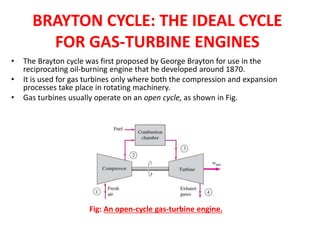
• Gas turbines usually operate on an open cycle, as shown in Fig.
Fig: An open-cycle gas-turbine engine.
• Fresh air at ambient conditions is drawn into the compressor, where its
temperature and pressure are raised. The highpressure air proceeds into
the combustion chamber, where the fuel is burned at constant pressure.
The resulting high-temperature gases then enter the turbine, where they
expand to the atmospheric pressure while producing power. The exhaust
gases leaving the turbine are thrown out (not recirculated), causing the
cycle to be classified as an open cycle.
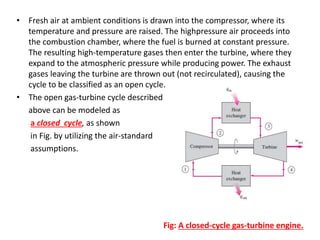
• The open gas-turbine cycle described
above can be modeled as
a closed cycle, as shown
in Fig. by utilizing the air-standard
assumptions.
Fig: A closed-cycle gas-turbine engine.
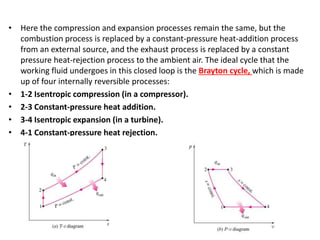
• Here the compression and expansion processes remain the same, but the
combustion process is replaced by a constant-pressure heat-addition process
from an external source, and the exhaust process is replaced by a constant
pressure heat-rejection process to the ambient air. The ideal cycle that the
working fluid undergoes in this closed loop is the Brayton cycle, which is made
up of four internally reversible processes:
• 1-2 Isentropic compression (in a compressor).
• 2-3 Constant-pressure heat addition.
• 3-4 Isentropic expansion (in a turbine).
• 4-1 Constant-pressure heat rejection.
Thankyou

Brayton cycle

  • 1.
    BRAYTON CYCLE: THEIDEAL CYCLE FOR GAS-TURBINE ENGINES Prepared By: Muhammad Sheeraz B.E Student At MUET & Mansoor Ali B.E Student At MUET
  • 2.
    BRAYTON CYCLE: THEIDEAL CYCLE FOR GAS-TURBINE ENGINES • The Brayton cycle was first proposed by George Brayton for use in the reciprocating oil-burning engine that he developed around 1870. • It is used for gas turbines only where both the compression and expansion processes take place in rotating machinery. • Gas turbines usually operate on an open cycle, as shown in Fig. Fig: An open-cycle gas-turbine engine.
  • 3.
    • Fresh airat ambient conditions is drawn into the compressor, where its temperature and pressure are raised. The highpressure air proceeds into the combustion chamber, where the fuel is burned at constant pressure. The resulting high-temperature gases then enter the turbine, where they expand to the atmospheric pressure while producing power. The exhaust gases leaving the turbine are thrown out (not recirculated), causing the cycle to be classified as an open cycle. • The open gas-turbine cycle described above can be modeled as a closed cycle, as shown in Fig. by utilizing the air-standard assumptions. Fig: A closed-cycle gas-turbine engine.
  • 4.
    • Here thecompression and expansion processes remain the same, but the combustion process is replaced by a constant-pressure heat-addition process from an external source, and the exhaust process is replaced by a constant pressure heat-rejection process to the ambient air. The ideal cycle that the working fluid undergoes in this closed loop is the Brayton cycle, which is made up of four internally reversible processes: • 1-2 Isentropic compression (in a compressor). • 2-3 Constant-pressure heat addition. • 3-4 Isentropic expansion (in a turbine). • 4-1 Constant-pressure heat rejection.
  • 5.