Lecture 7
Sound waves. Speed of sound.
Intensity.
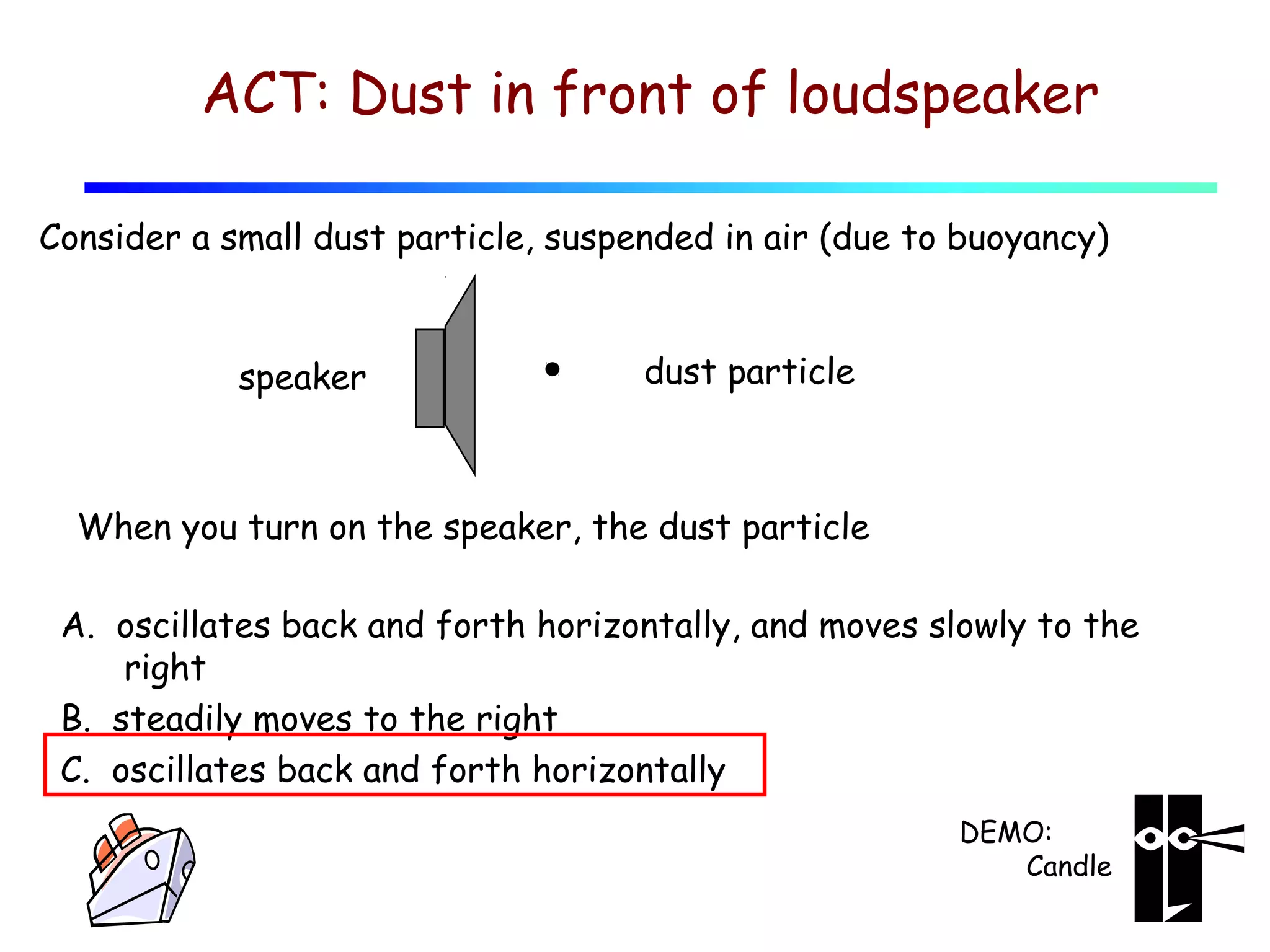
ACT: Dust in front of loudspeaker
Consider a small dust particle, suspended in air (due to buoyancy)

speaker

dust particle

When you turn on the speaker, the dust particle
A. oscillates back and forth horizontally, and moves slowly to the
right
B. steadily moves to the right
C. oscillates back and forth horizontally
DEMO:
Candle
Pressure/density oscillations
Gas in equilibrium: pressure and density are uniform.
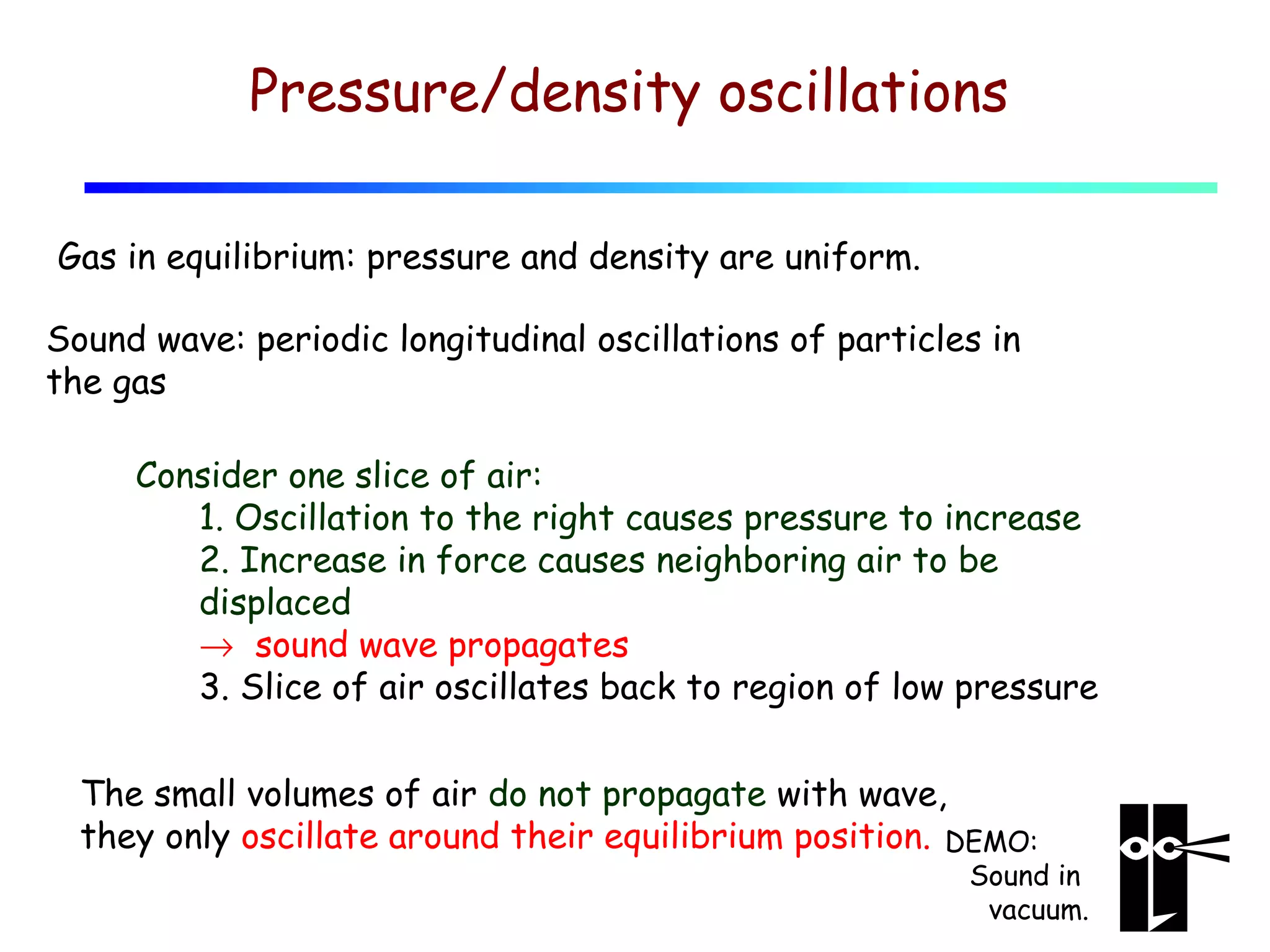
Sound wave: periodic longitudinal oscillations of particles in
the gas
Consider one slice of air:
1. Oscillation to the right causes pressure to increase
2. Increase in force causes neighboring air to be
displaced
→ sound wave propagates
3. Slice of air oscillates back to region of low pressure
The small volumes of air do not propagate with wave,
they only oscillate around their equilibrium position. DEMO:

Sound in
vacuum.
Harmonic longitudinal waves
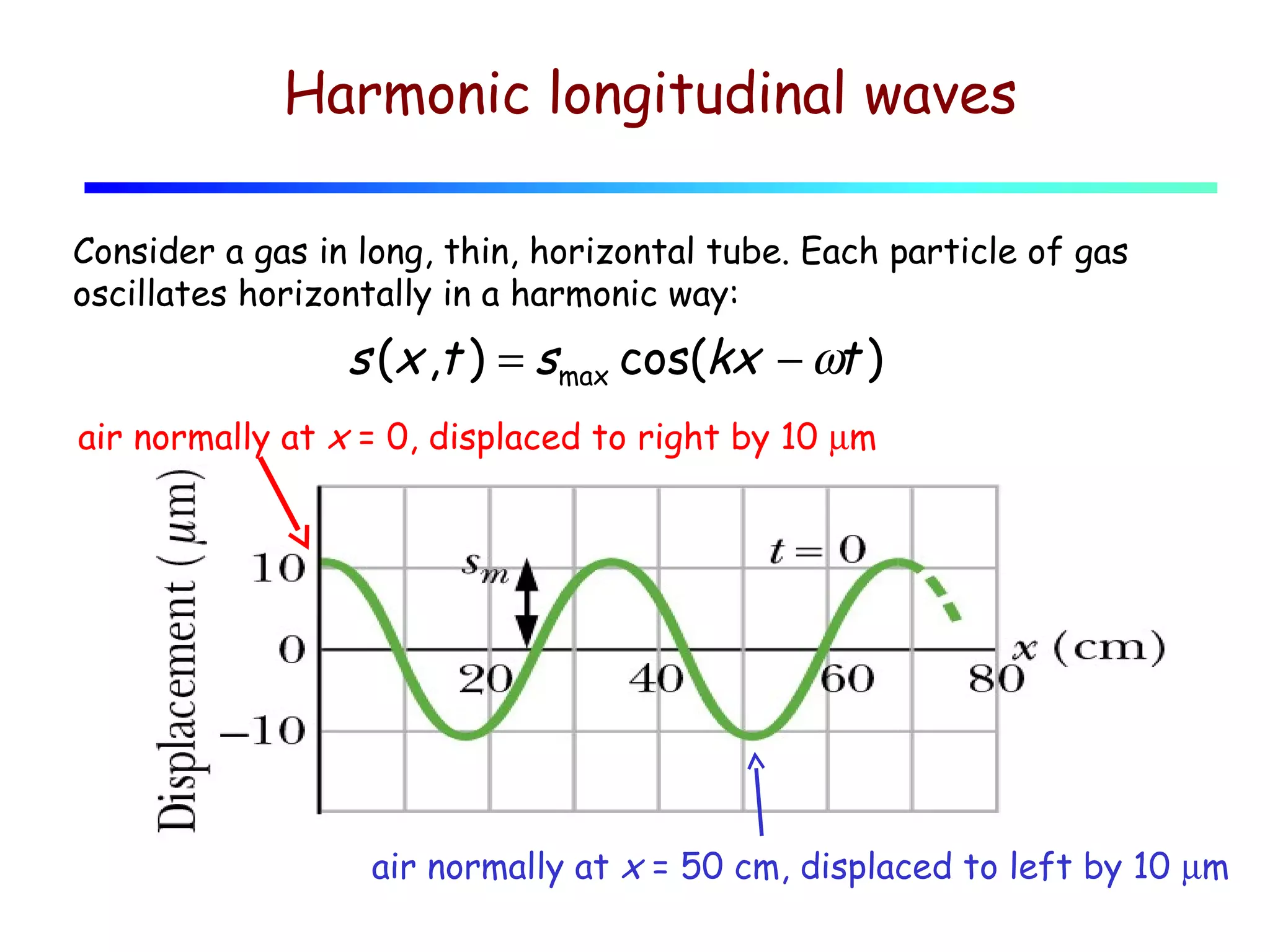
Consider a gas in long, thin, horizontal tube. Each particle of gas
oscillates horizontally in a harmonic way:

s (x ,t ) = smax cos(kx − ωt )
air normally at x = 0, displaced to right by 10 µm

air normally at x = 50 cm, displaced to left by 10 µm
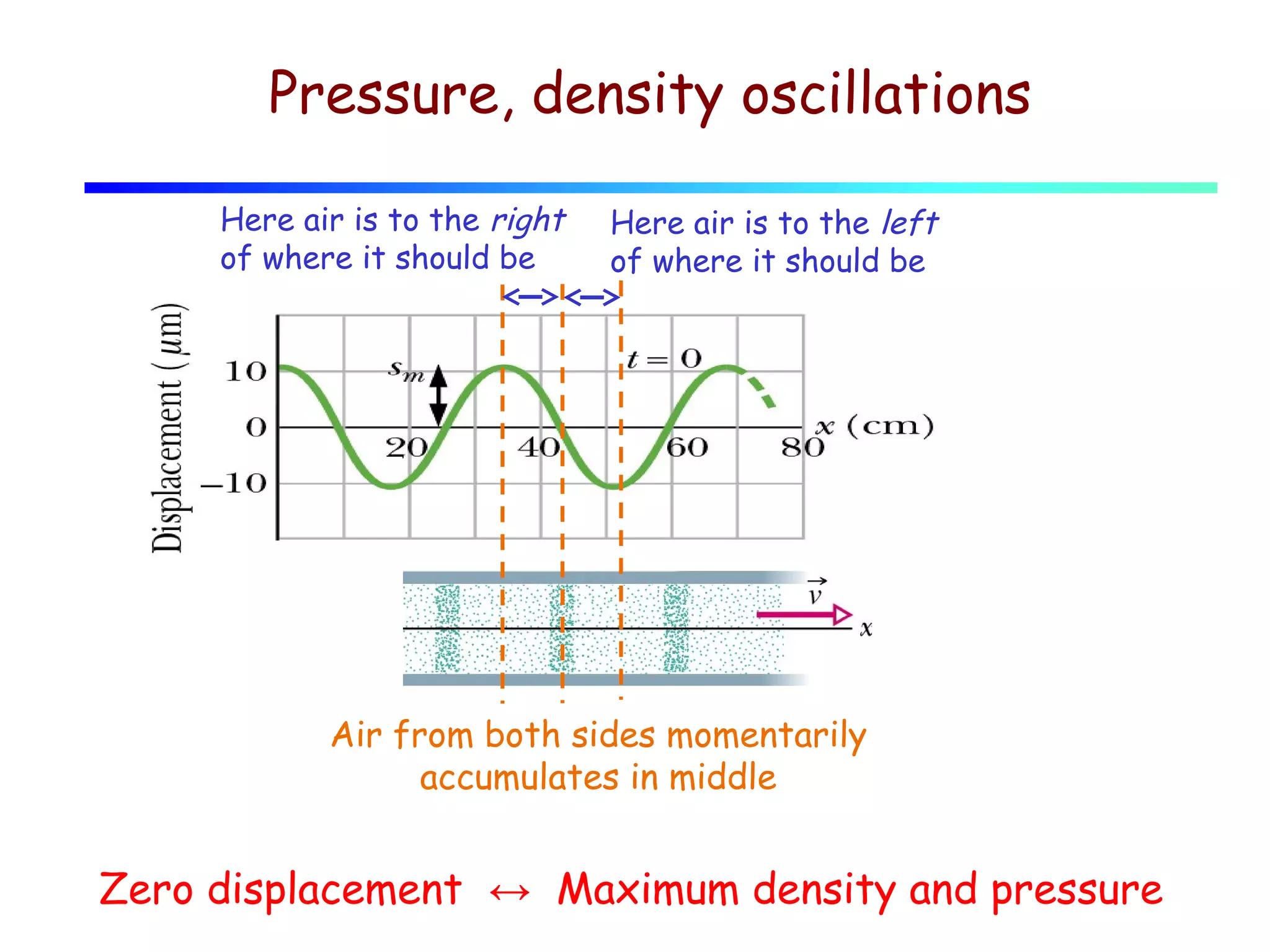
Pressure, density oscillations
Here air is to the right
of where it should be

Here air is to the left
of where it should be

Air from both sides momentarily
accumulates in middle

Zero displacement ↔ Maximum density and pressure
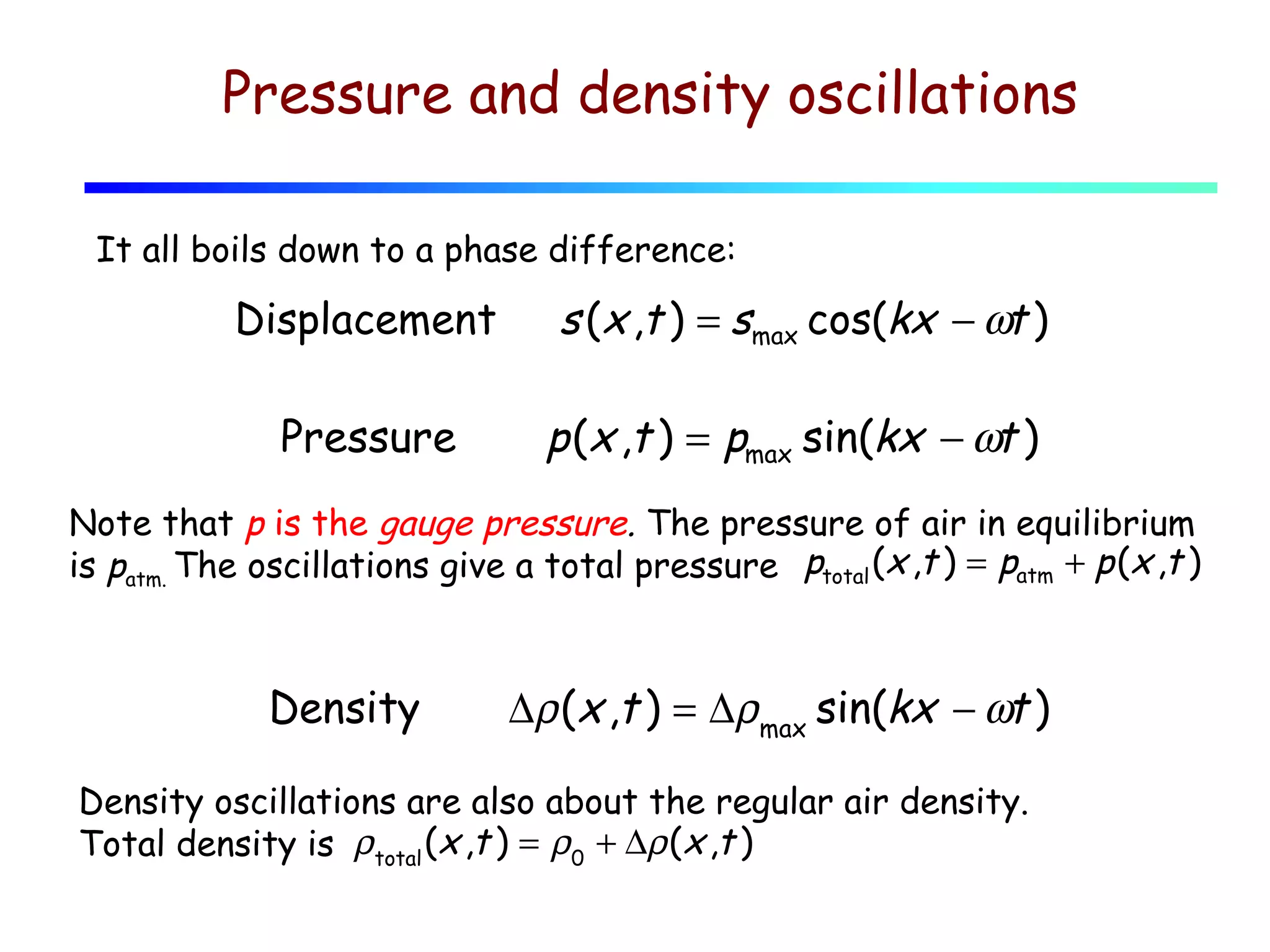
Pressure and density oscillations
It all boils down to a phase difference:

Displacement

s (x ,t ) = smax cos(kx − ωt )

Pressure

p (x ,t ) = pmax sin(kx − ωt )

Note that p is the gauge pressure. The pressure of air in equilibrium
is patm. The oscillations give a total pressure ptotal (x ,t ) = patm + p (x ,t )

Density

∆ρ (x ,t ) = ∆ρmax sin(kx − ωt )

Density oscillations are also about the regular air density.
Total density is ρtotal (x ,t ) = ρ0 + ∆ρ (x ,t )
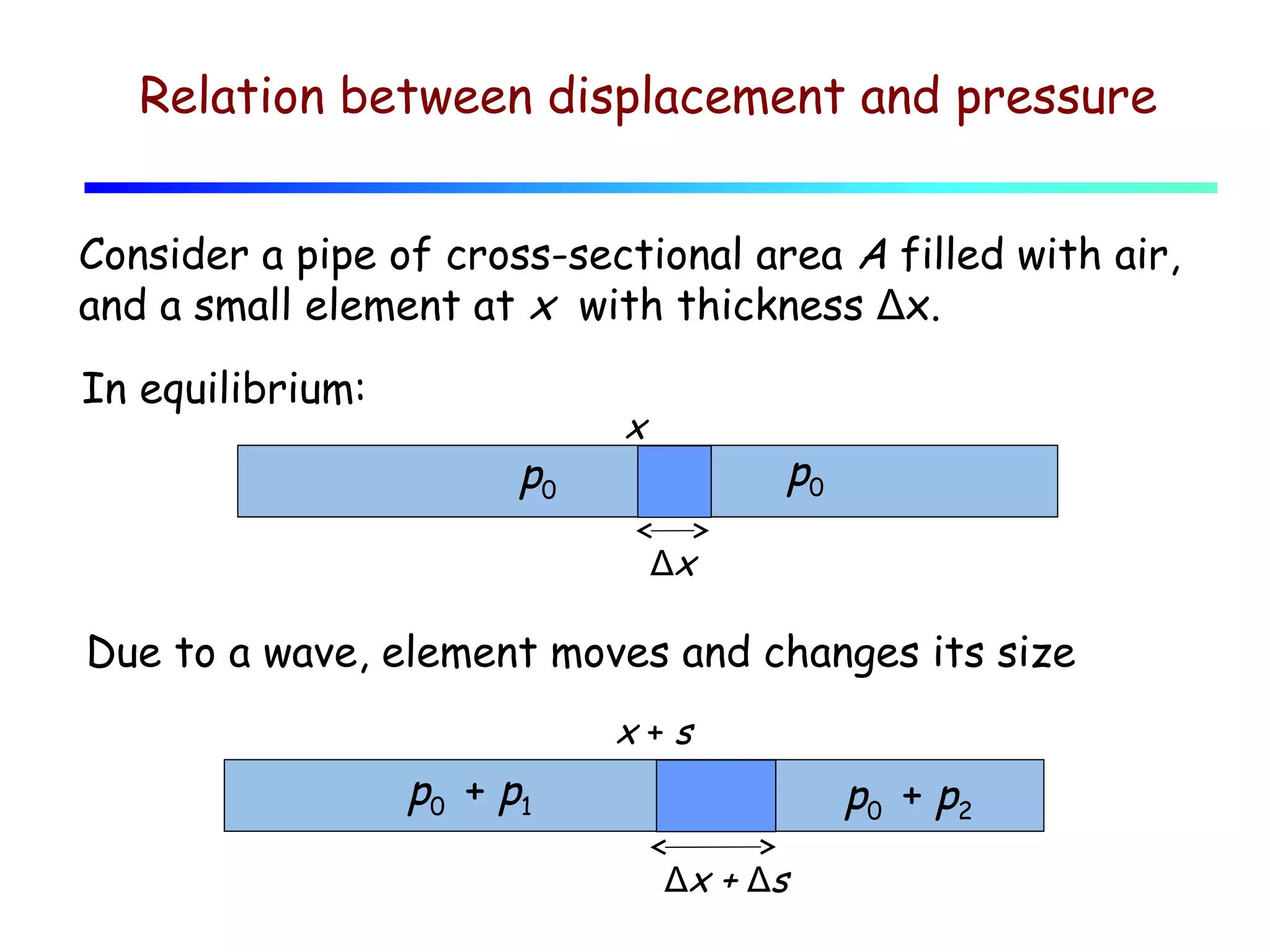
Relation between displacement and pressure
Consider a pipe of cross-sectional area A filled with air,
and a small element at x with thickness Δx.
In equilibrium:

p0

x

p0
Δx

Due to a wave, element moves and changes its size
x+s

p0 + p1

p0 + p2
Δx + Δs
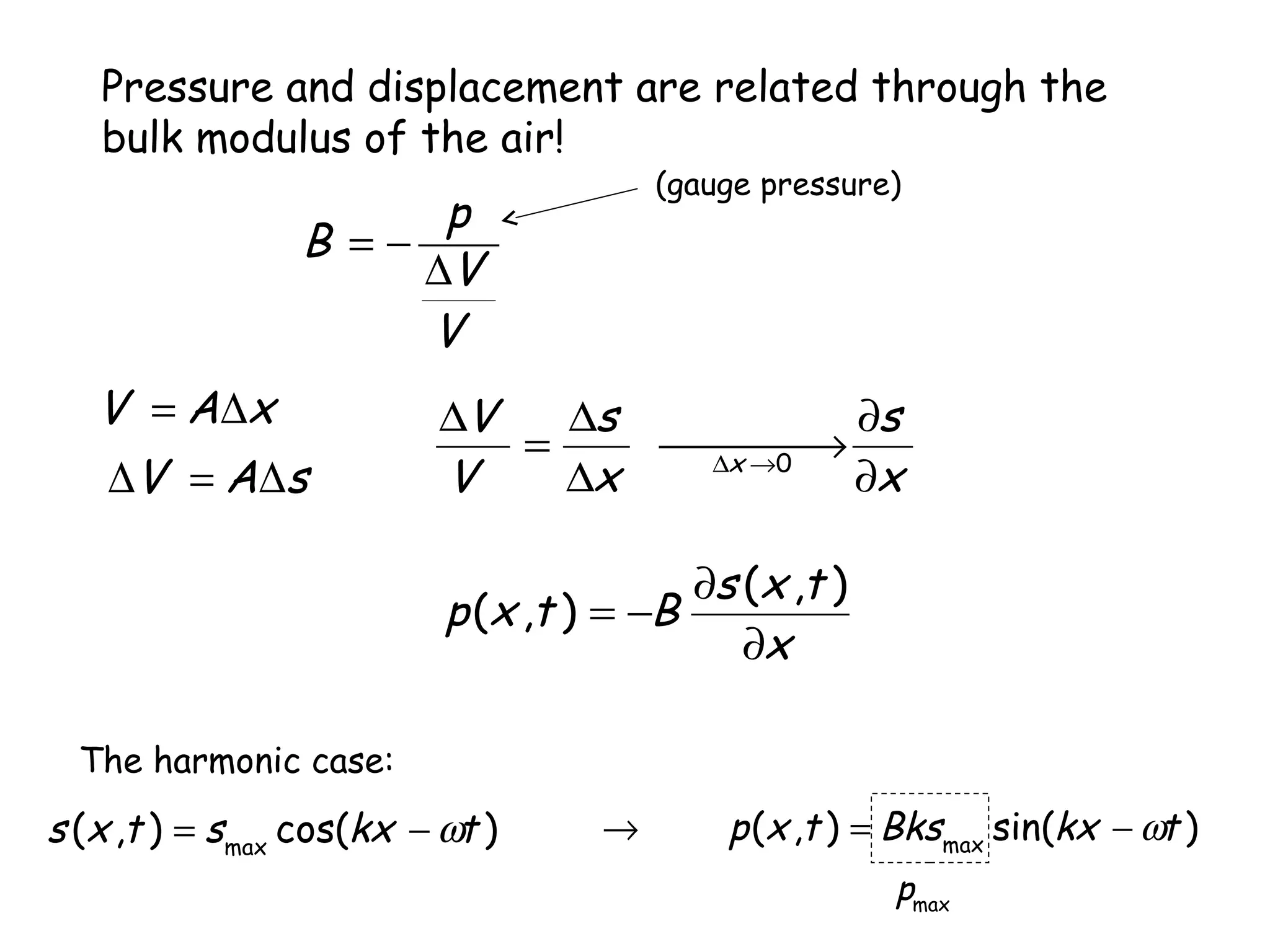
Pressure and displacement are related through the
bulk modulus of the air!
(gauge pressure)

p
B =−
∆V
V

V = A ∆x
∆V = A ∆s

∆V
∆s
∂s
=

→
∆x →0
V
∆x
∂x
∂s (x ,t )
p (x ,t ) = −B
∂x

The harmonic case:

s (x ,t ) = smax cos(kx − ωt )

→

p (x ,t ) = Bksmax sin(kx − ωt )
pmax
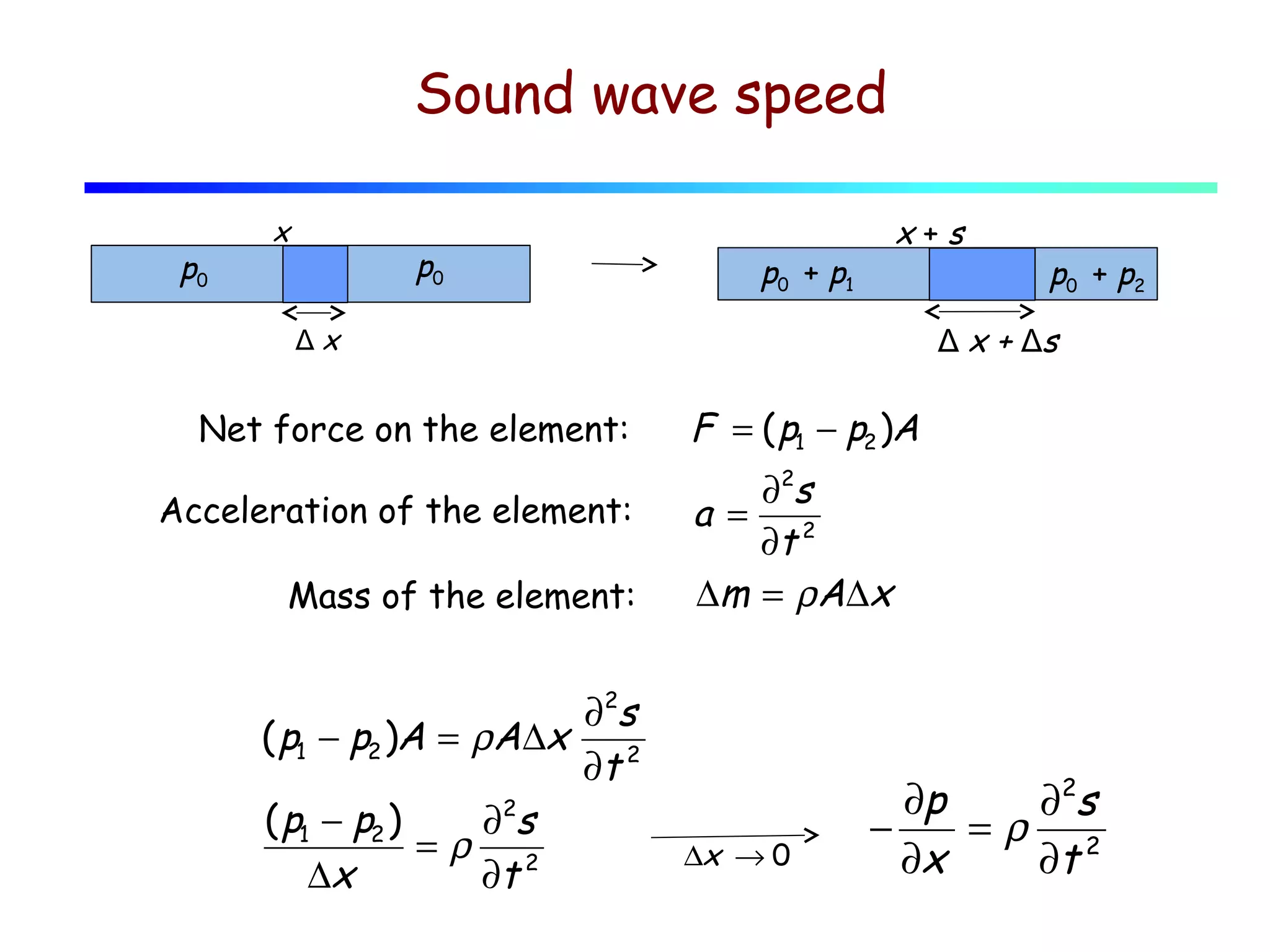
Sound wave speed
p0

x

p0

x+s

p0 + p1

Δ x + Δs

Δx

Net force on the element:
Acceleration of the element:
Mass of the element:

∂2s
( p1 − p2 )A = ρA ∆x
∂t 2
( p1 − p2 )
∂2s
=ρ 2
∆x
∂t

p0 + p2

F = ( p1 − p2 )A
∂2s
a = 2
∂t
∆m = ρ A ∆x

∆x → 0

∂p
∂2s
−
=ρ 2
∂x
∂t
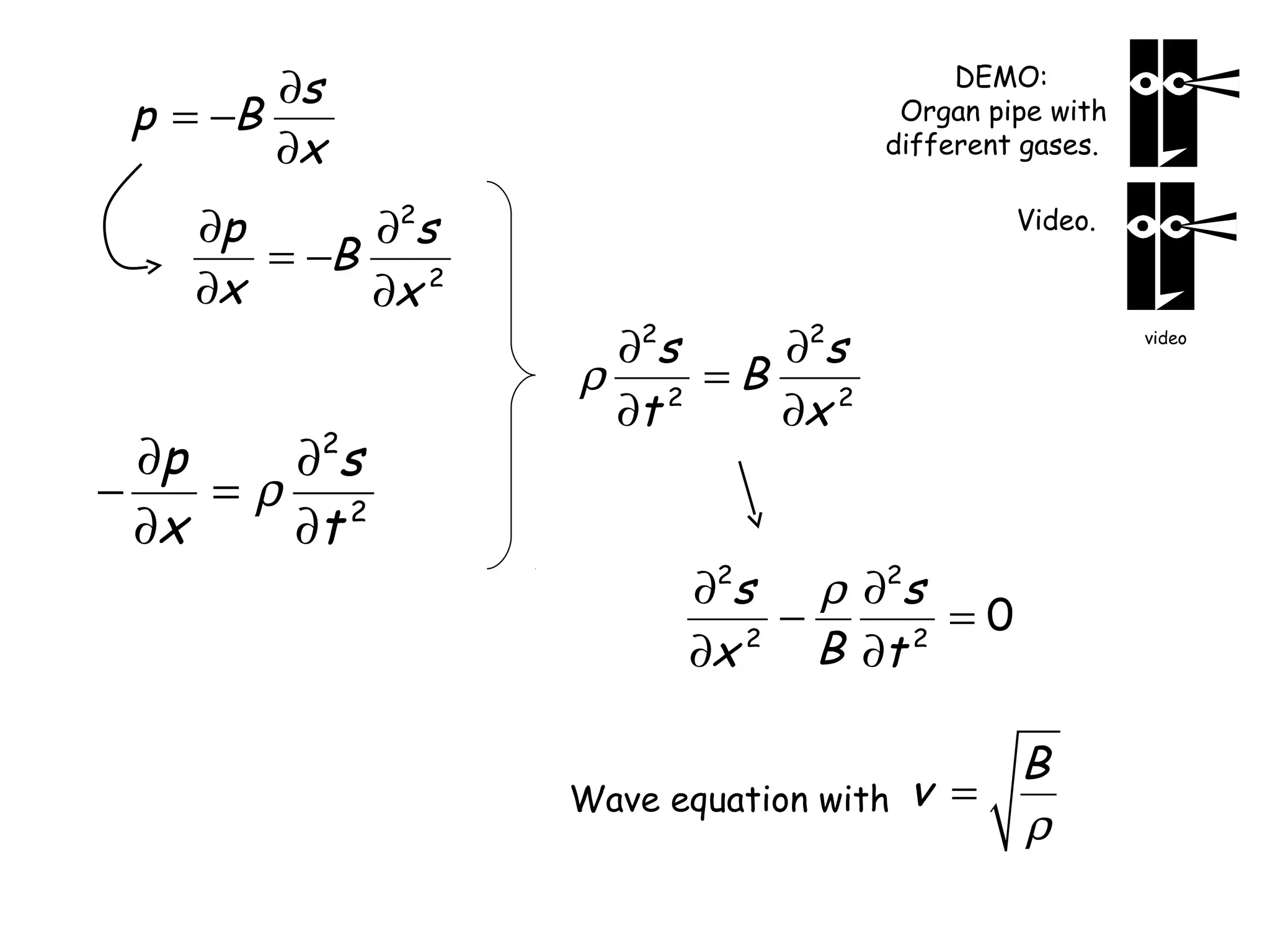
∂s
p = −B
∂x
∂p
∂2s
= −B
∂x
∂x 2

∂p
∂2s
−
=ρ 2
∂x
∂t

DEMO:
Organ pipe with
different gases.
Video.

∂2s
∂2s
ρ 2 =B
∂t
∂x 2

video

∂2s
ρ ∂2s
−
=0
2
2
B ∂t
∂x
Wave equation with

B
v =
ρ
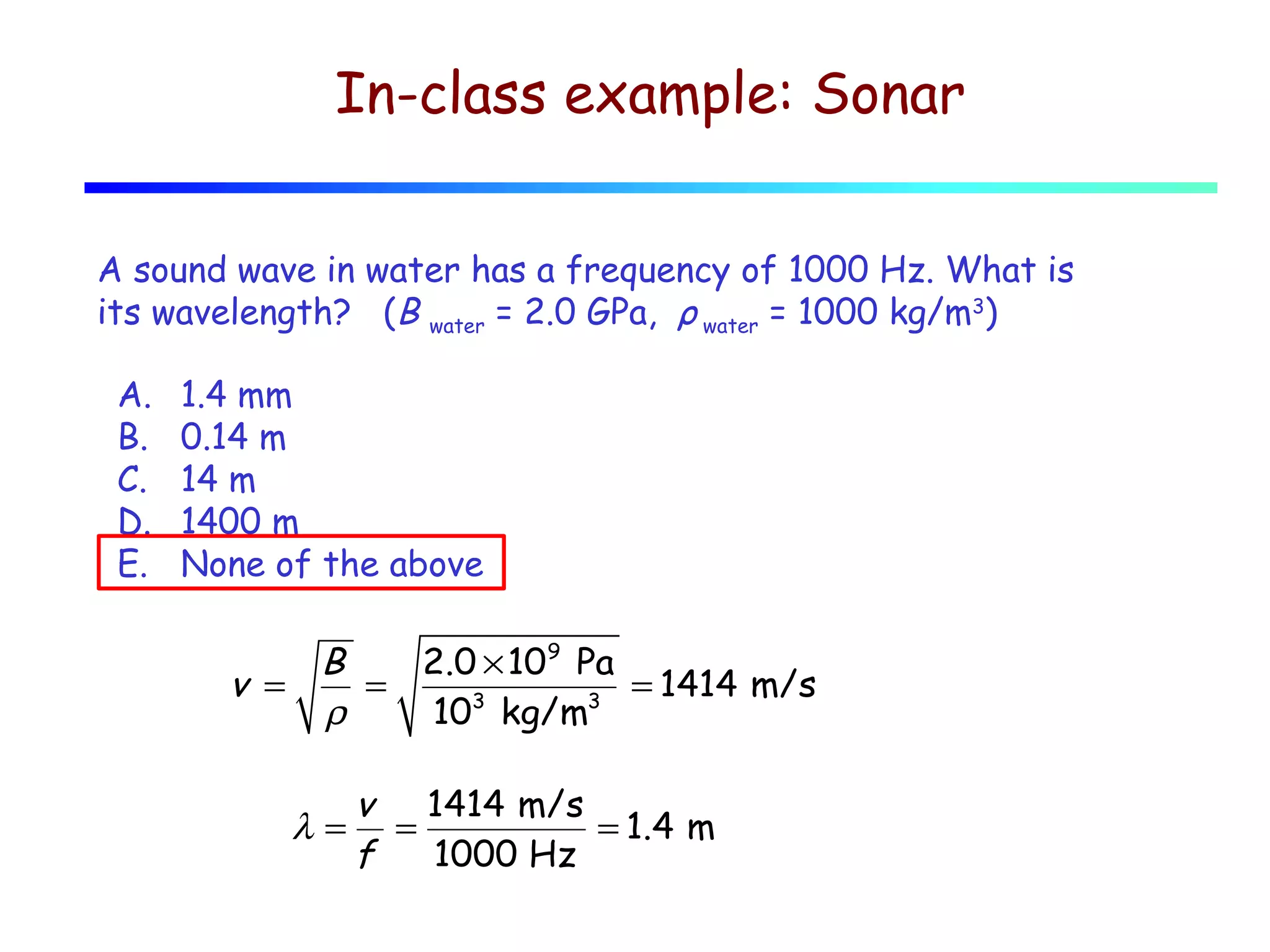
In-class example: Sonar
A sound wave in water has a frequency of 1000 Hz. What is
its wavelength? (B water = 2.0 GPa, ρ water = 1000 kg/m3)
A.
B.
C.
D.
E.

1.4 mm
0.14 m
14 m
1400 m
None of the above

B
2.0 × 10⁹ Pa
v =
=
= 1414 m/s
3
3
ρ
10 kg/m

λ=

v 1414 m/s
=
= 1.4 m
f
1000 Hz
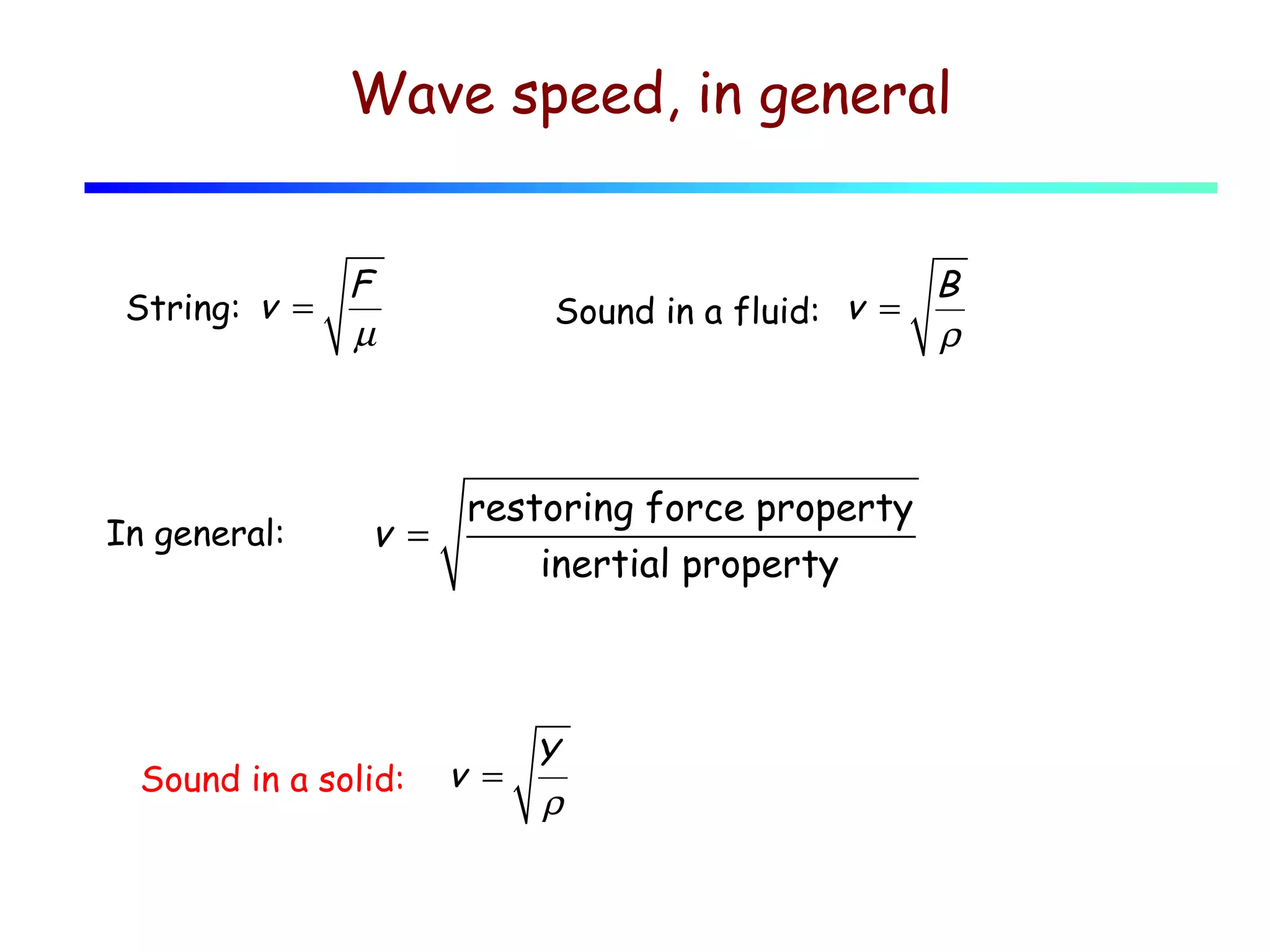
Wave speed, in general
F
String: v =
µ

In general:

Sound in a fluid: v =

restoring force property
v =
inertial property

Sound in a solid:

v =

Y
ρ

B
ρ
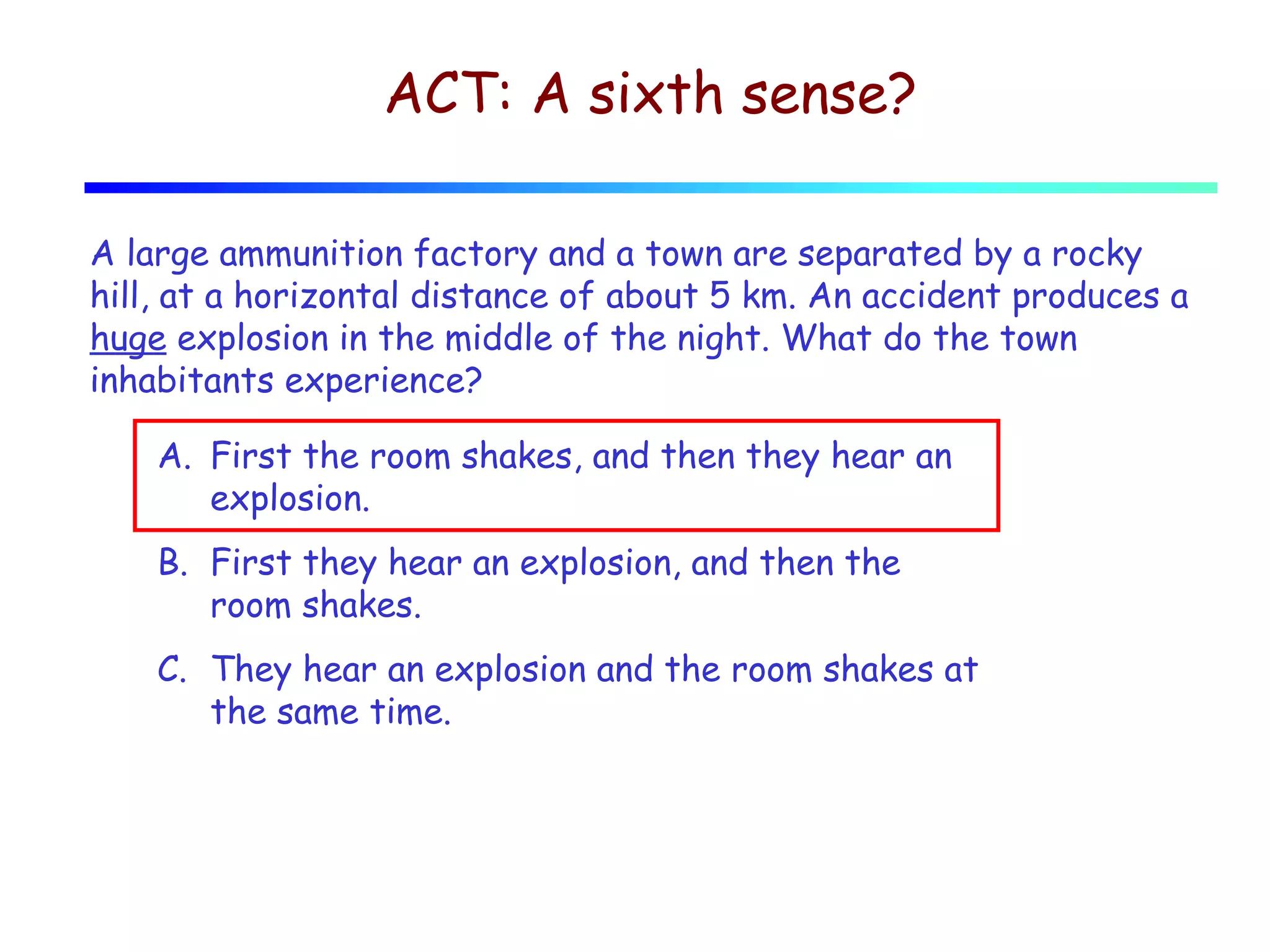
ACT: A sixth sense?
A large ammunition factory and a town are separated by a rocky
hill, at a horizontal distance of about 5 km. An accident produces a
huge explosion in the middle of the night. What do the town
inhabitants experience?
A. First the room shakes, and then they hear an
explosion.
B. First they hear an explosion, and then the
room shakes.
C. They hear an explosion and the room shakes at
the same time.
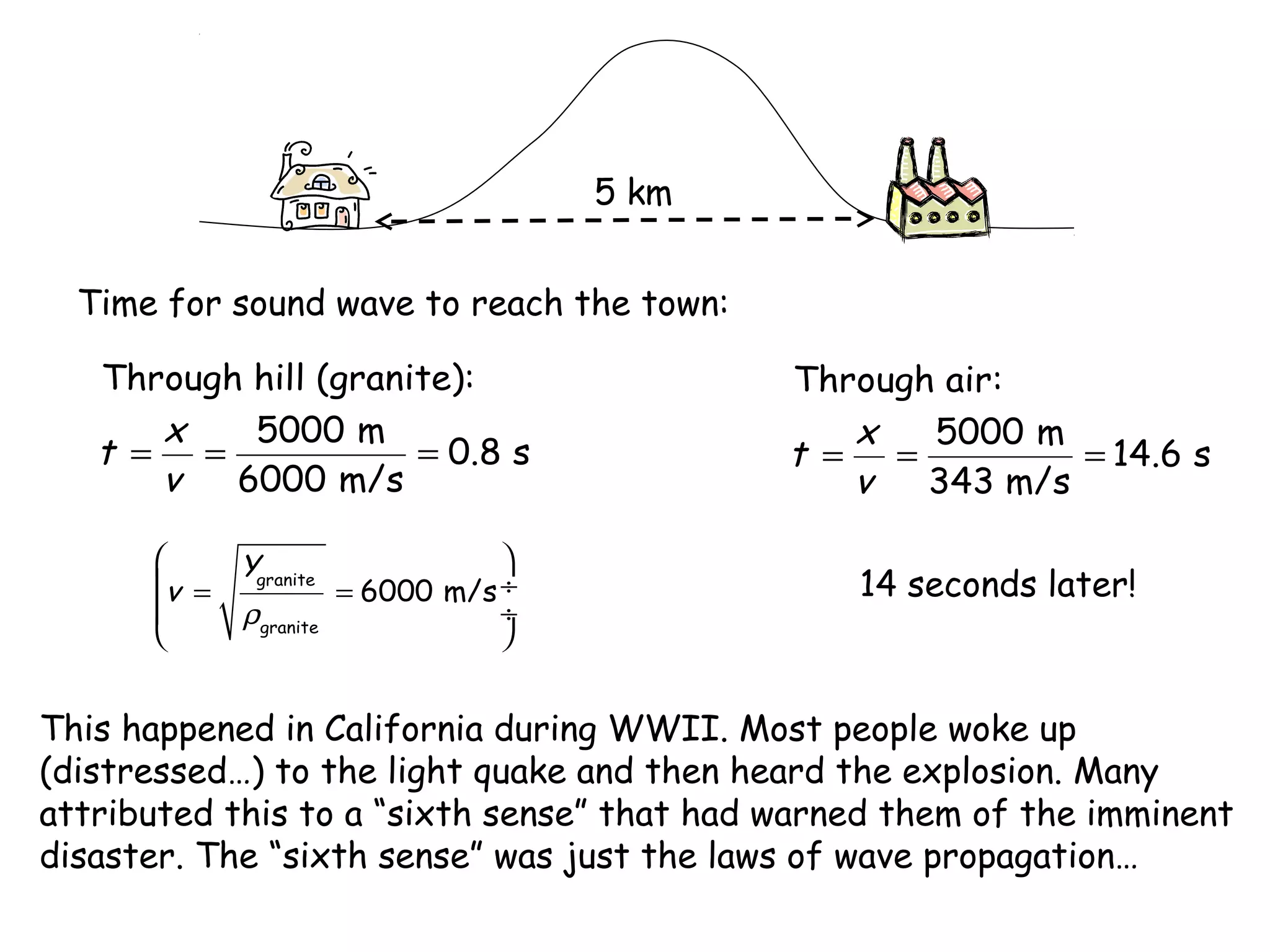
5 km
Time for sound wave to reach the town:
Through hill (granite):
x
5000 m
t = =
= 0.8 s
v
6000 m/s

v =



Ygranite

ρgranite


= 6000 m/s ÷
÷


Through air:
x
5000 m
t = =
= 14.6 s
v
343 m/s

14 seconds later!

This happened in California during WWII. Most people woke up
(distressed…) to the light quake and then heard the explosion. Many
attributed this to a “sixth sense” that had warned them of the imminent
disaster. The “sixth sense” was just the laws of wave propagation…
Intensity
P
I =
area

Average power (over time) in wave
Area of the surface where this power is distributed

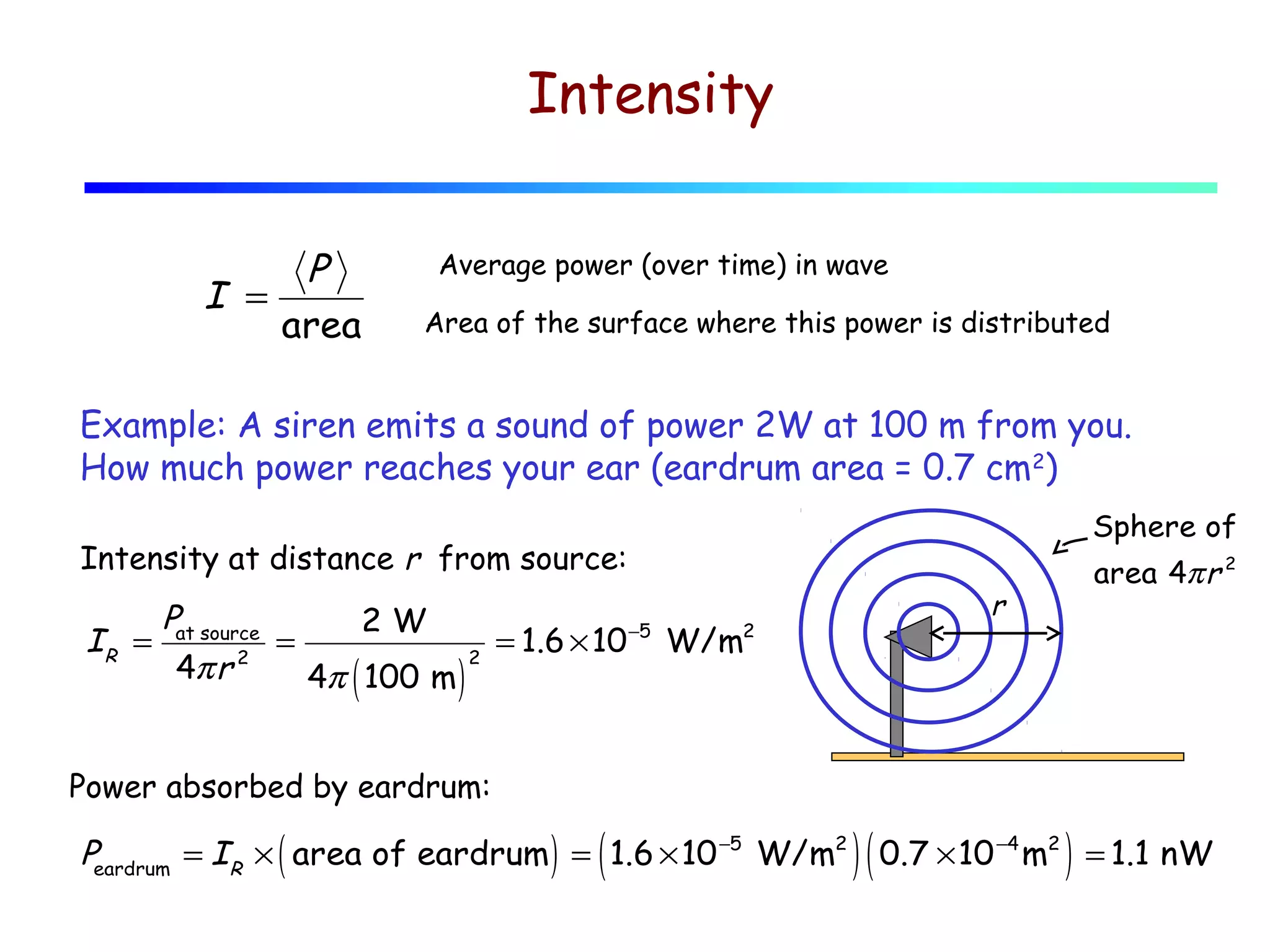
Example: A siren emits a sound of power 2W at 100 m from you.
How much power reaches your ear (eardrum area = 0.7 cm2)
Sphere of

Intensity at distance r from source:

area 4π r 2

r

P
2W
IR = at source =
= 1.6 × 10 −5 W/m2
2
4π r 2
4π ( 100 m )
Power absorbed by eardrum:

(

)(

)

Peardrum = IR × ( area of eardrum ) = 1.6 × 10 −5 W/m2 0.7 × 10 −4 m2 = 1.1 nW
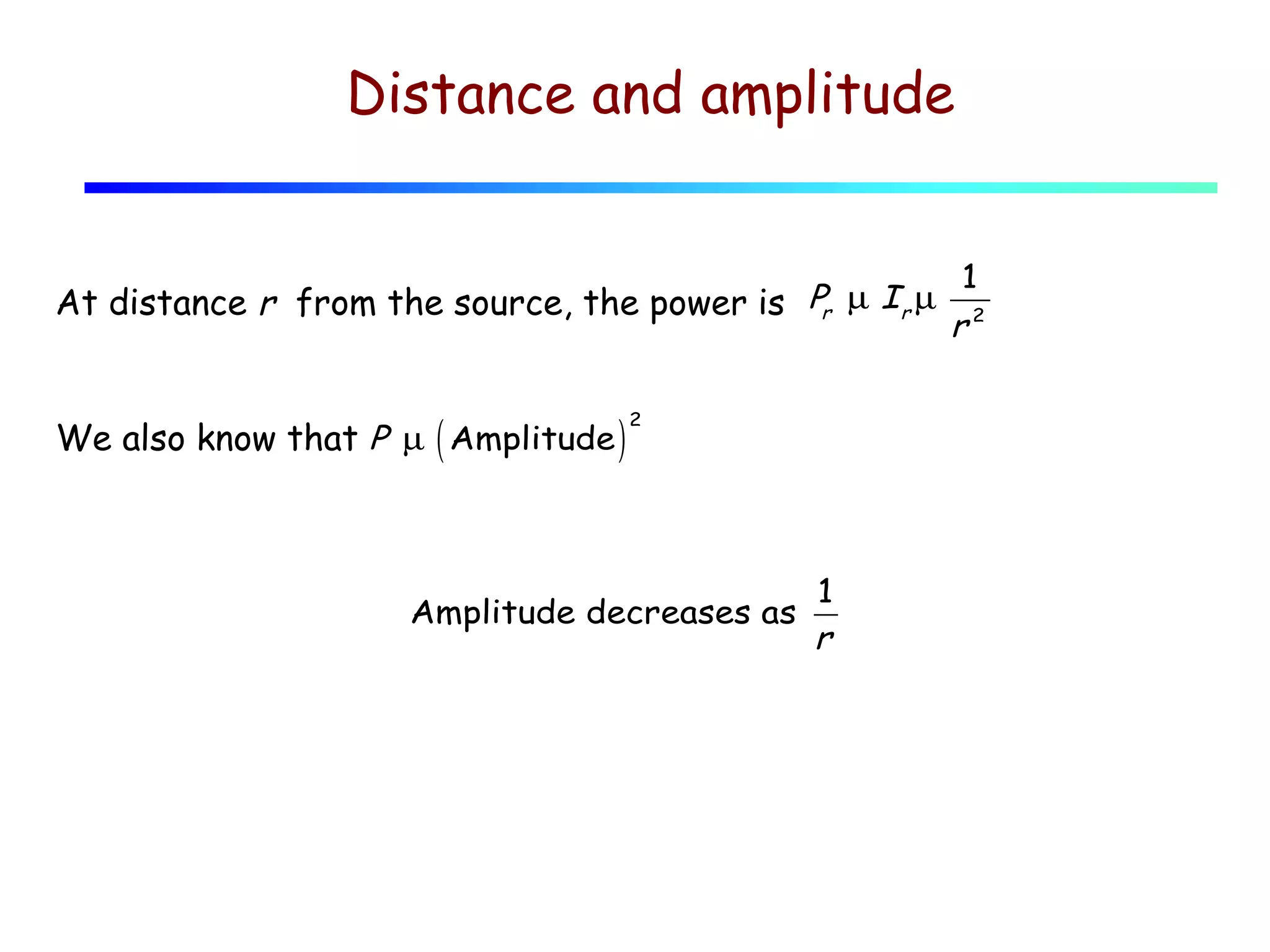
Distance and amplitude

At distance r from the source, the power is Pr µ Ir µ
We also know that P µ ( Amplitude )

2

Amplitude decreases as

1
r

1

r2
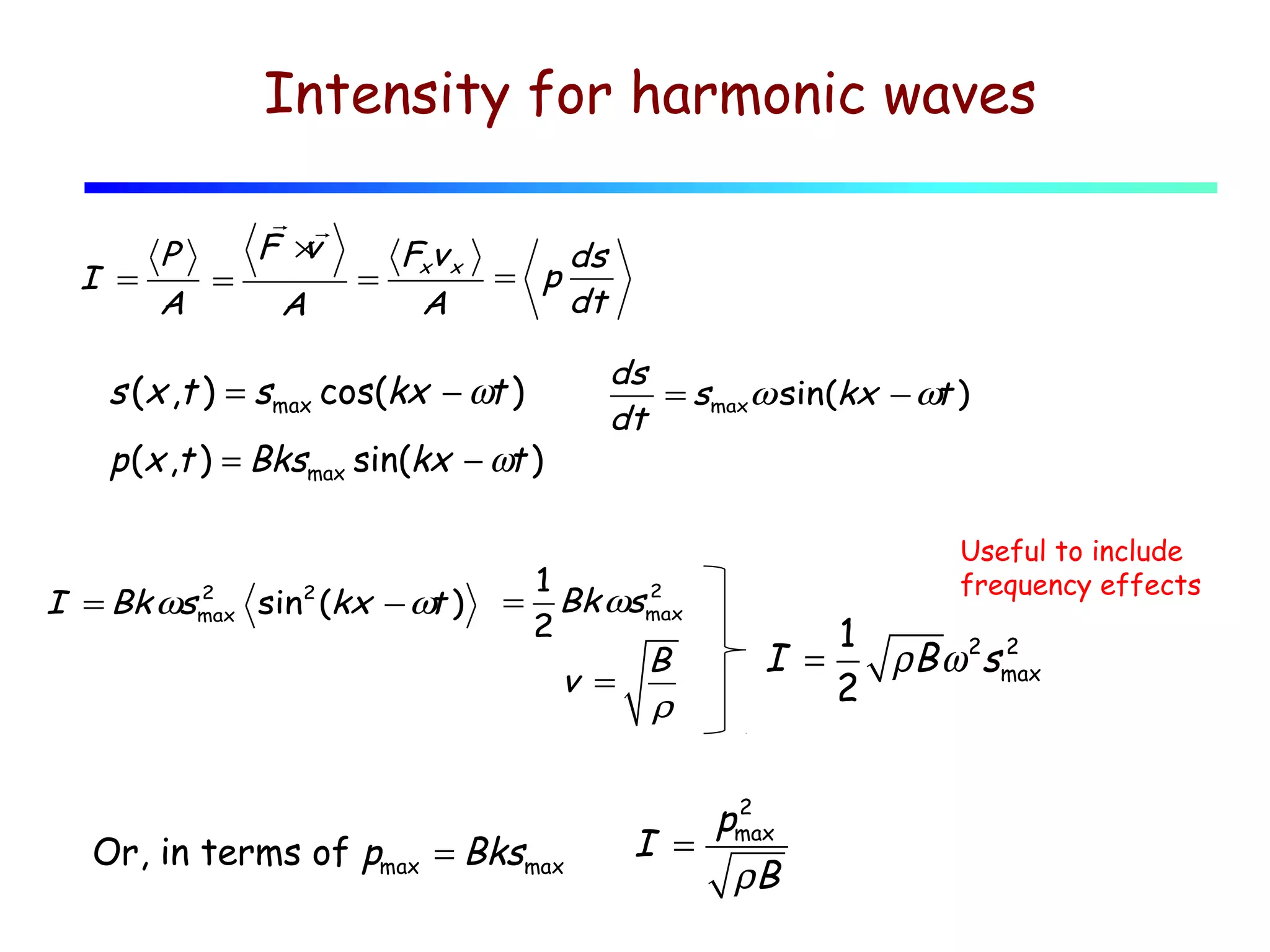
Intensity for harmonic waves
I =

P
=
A

r r
F ×
v

A

=

Fxv x
ds
= p
dt
A

s (x ,t ) = smax cos(kx − ωt )
p (x ,t ) = Bksmax sin(kx − ωt )

I = Bk ωs

2
max

sin (kx − ω )
t
2

=

ds
= smaxω sin(kx − ωt )
dt

1
2
Bk ωsmax
2
B
v =
ρ

Or, in terms of pmax = Bksmax

Useful to include
frequency effects

1
2
I =
ρ B ω 2smax
2

2
pmax
I =
ρB
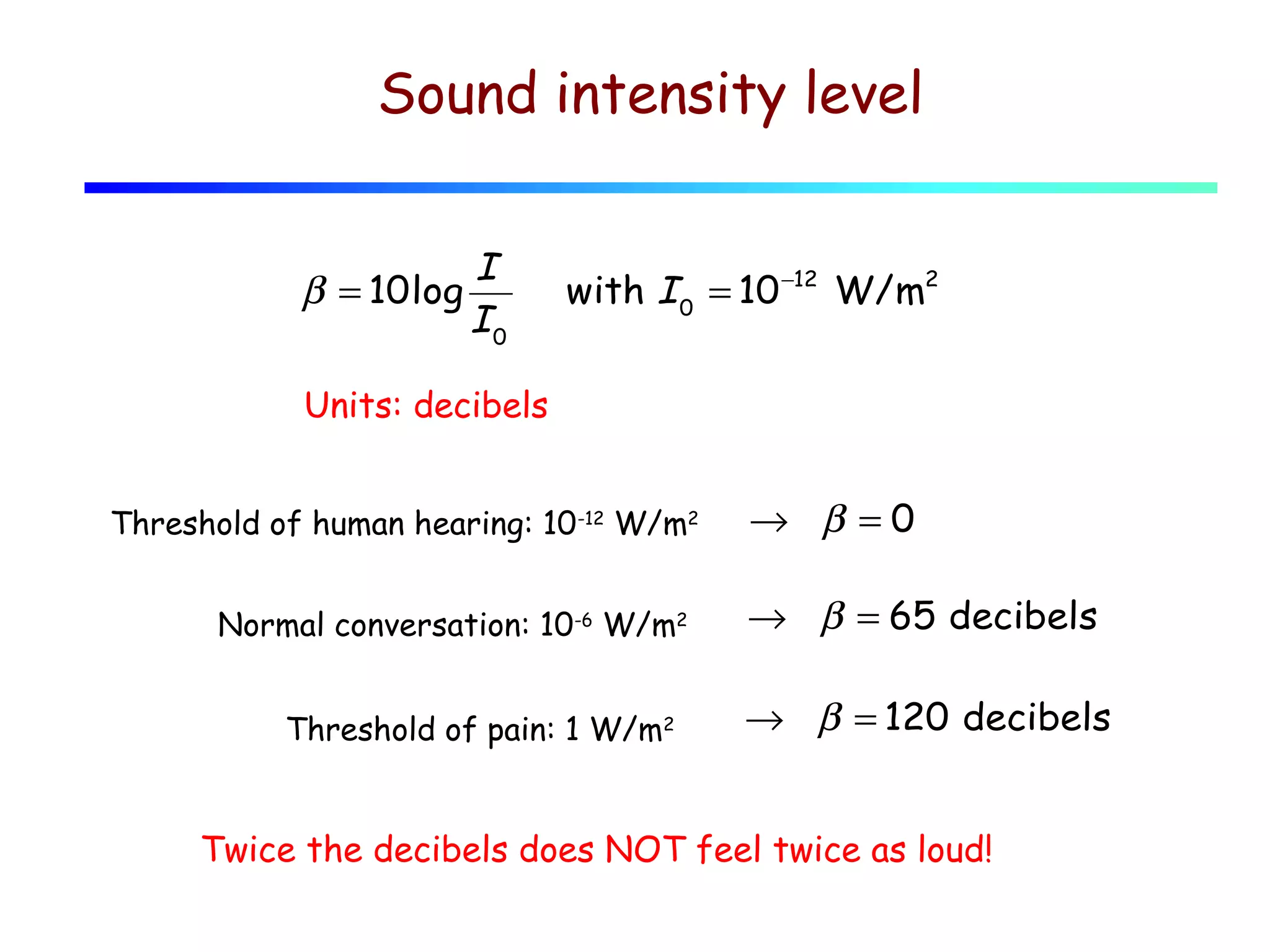
Sound intensity level
β = 10log

I
I0

with I 0 = 10 −12 W/m2

Units: decibels
Threshold of human hearing: 10-12 W/m2
Normal conversation: 10-6 W/m2
Threshold of pain: 1 W/m2

→ β =0
→ β = 65 decibels
→ β = 120 decibels

Twice the decibels does NOT feel twice as loud!

Lecture 07 sound waves. speed of sound. intensity.

  • 1.
    Lecture 7 Sound waves.Speed of sound. Intensity.
  • 2.
    ACT: Dust infront of loudspeaker Consider a small dust particle, suspended in air (due to buoyancy) speaker dust particle When you turn on the speaker, the dust particle A. oscillates back and forth horizontally, and moves slowly to the right B. steadily moves to the right C. oscillates back and forth horizontally DEMO: Candle
  • 3.
    Pressure/density oscillations Gas inequilibrium: pressure and density are uniform. Sound wave: periodic longitudinal oscillations of particles in the gas Consider one slice of air: 1. Oscillation to the right causes pressure to increase 2. Increase in force causes neighboring air to be displaced → sound wave propagates 3. Slice of air oscillates back to region of low pressure The small volumes of air do not propagate with wave, they only oscillate around their equilibrium position. DEMO: Sound in vacuum.
  • 4.
    Harmonic longitudinal waves Considera gas in long, thin, horizontal tube. Each particle of gas oscillates horizontally in a harmonic way: s (x ,t ) = smax cos(kx − ωt ) air normally at x = 0, displaced to right by 10 µm air normally at x = 50 cm, displaced to left by 10 µm
  • 5.
    Pressure, density oscillations Hereair is to the right of where it should be Here air is to the left of where it should be Air from both sides momentarily accumulates in middle Zero displacement ↔ Maximum density and pressure
  • 6.
    Pressure and densityoscillations It all boils down to a phase difference: Displacement s (x ,t ) = smax cos(kx − ωt ) Pressure p (x ,t ) = pmax sin(kx − ωt ) Note that p is the gauge pressure. The pressure of air in equilibrium is patm. The oscillations give a total pressure ptotal (x ,t ) = patm + p (x ,t ) Density ∆ρ (x ,t ) = ∆ρmax sin(kx − ωt ) Density oscillations are also about the regular air density. Total density is ρtotal (x ,t ) = ρ0 + ∆ρ (x ,t )
  • 7.
    Relation between displacementand pressure Consider a pipe of cross-sectional area A filled with air, and a small element at x with thickness Δx. In equilibrium: p0 x p0 Δx Due to a wave, element moves and changes its size x+s p0 + p1 p0 + p2 Δx + Δs
  • 8.
    Pressure and displacementare related through the bulk modulus of the air! (gauge pressure) p B =− ∆V V V = A ∆x ∆V = A ∆s ∆V ∆s ∂s =  → ∆x →0 V ∆x ∂x ∂s (x ,t ) p (x ,t ) = −B ∂x The harmonic case: s (x ,t ) = smax cos(kx − ωt ) → p (x ,t ) = Bksmax sin(kx − ωt ) pmax
  • 9.
    Sound wave speed p0 x p0 x+s p0+ p1 Δ x + Δs Δx Net force on the element: Acceleration of the element: Mass of the element: ∂2s ( p1 − p2 )A = ρA ∆x ∂t 2 ( p1 − p2 ) ∂2s =ρ 2 ∆x ∂t p0 + p2 F = ( p1 − p2 )A ∂2s a = 2 ∂t ∆m = ρ A ∆x ∆x → 0 ∂p ∂2s − =ρ 2 ∂x ∂t
  • 10.
    ∂s p = −B ∂x ∂p ∂2s =−B ∂x ∂x 2 ∂p ∂2s − =ρ 2 ∂x ∂t DEMO: Organ pipe with different gases. Video. ∂2s ∂2s ρ 2 =B ∂t ∂x 2 video ∂2s ρ ∂2s − =0 2 2 B ∂t ∂x Wave equation with B v = ρ
  • 11.
    In-class example: Sonar Asound wave in water has a frequency of 1000 Hz. What is its wavelength? (B water = 2.0 GPa, ρ water = 1000 kg/m3) A. B. C. D. E. 1.4 mm 0.14 m 14 m 1400 m None of the above B 2.0 × 10⁹ Pa v = = = 1414 m/s 3 3 ρ 10 kg/m λ= v 1414 m/s = = 1.4 m f 1000 Hz
  • 12.
    Wave speed, ingeneral F String: v = µ In general: Sound in a fluid: v = restoring force property v = inertial property Sound in a solid: v = Y ρ B ρ
  • 13.
    ACT: A sixthsense? A large ammunition factory and a town are separated by a rocky hill, at a horizontal distance of about 5 km. An accident produces a huge explosion in the middle of the night. What do the town inhabitants experience? A. First the room shakes, and then they hear an explosion. B. First they hear an explosion, and then the room shakes. C. They hear an explosion and the room shakes at the same time.
  • 14.
    5 km Time forsound wave to reach the town: Through hill (granite): x 5000 m t = = = 0.8 s v 6000 m/s  v =   Ygranite ρgranite  = 6000 m/s ÷ ÷  Through air: x 5000 m t = = = 14.6 s v 343 m/s 14 seconds later! This happened in California during WWII. Most people woke up (distressed…) to the light quake and then heard the explosion. Many attributed this to a “sixth sense” that had warned them of the imminent disaster. The “sixth sense” was just the laws of wave propagation…
  • 15.
    Intensity P I = area Average power(over time) in wave Area of the surface where this power is distributed Example: A siren emits a sound of power 2W at 100 m from you. How much power reaches your ear (eardrum area = 0.7 cm2) Sphere of Intensity at distance r from source: area 4π r 2 r P 2W IR = at source = = 1.6 × 10 −5 W/m2 2 4π r 2 4π ( 100 m ) Power absorbed by eardrum: ( )( ) Peardrum = IR × ( area of eardrum ) = 1.6 × 10 −5 W/m2 0.7 × 10 −4 m2 = 1.1 nW
  • 16.
    Distance and amplitude Atdistance r from the source, the power is Pr µ Ir µ We also know that P µ ( Amplitude ) 2 Amplitude decreases as 1 r 1 r2
  • 17.
    Intensity for harmonicwaves I = P = A r r F × v A = Fxv x ds = p dt A s (x ,t ) = smax cos(kx − ωt ) p (x ,t ) = Bksmax sin(kx − ωt ) I = Bk ωs 2 max sin (kx − ω ) t 2 = ds = smaxω sin(kx − ωt ) dt 1 2 Bk ωsmax 2 B v = ρ Or, in terms of pmax = Bksmax Useful to include frequency effects 1 2 I = ρ B ω 2smax 2 2 pmax I = ρB
  • 18.
    Sound intensity level β= 10log I I0 with I 0 = 10 −12 W/m2 Units: decibels Threshold of human hearing: 10-12 W/m2 Normal conversation: 10-6 W/m2 Threshold of pain: 1 W/m2 → β =0 → β = 65 decibels → β = 120 decibels Twice the decibels does NOT feel twice as loud!