Impulse
Prepared by: RG LUIS
VINCENT GONZAGA
Objectives
• Define impulse.
• Describe and show the relation between impulse and
momentum.
• Calculate Impulse.
What is impulse?
• impulse is the multiplication of applied force and time
interval it applied. Impulse is also a vector quantity
having both magnitude and direction. It has the same
direction with applied net force.
• Impulse=Force∙Time Interval
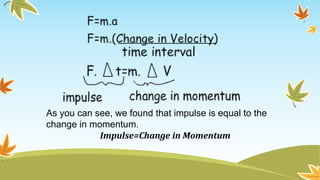
• Impulse and momentum are directly related to each
other. Let’s find this relation now.
As you can see, we found that impulse is equal to the
change in momentum.
Impulse=Change in Momentum
Example
• A 50 kg mass is sitting on a frictionless surface. An unknown
constant force pushes the mass for 2 seconds until the mass
reaches a velocity of 3 m/s.
• a) What is the initial momentum of the mass?
b) What is the final momentum of the mass?
c) What was the force acting on the mass?
d) What was the impulse acting on the mass?
•
a) What is the initial momentum of the mass?
• Momentum is mass times velocity. Since the mass is at
rest, the initial velocity is 0 m/s.
• momentum = m⋅v = (50 kg)⋅(0 m/s) = 0 kg∙m/s
b) What is the final momentum of the mass?
• After the force is finished acting on the mass, the
velocity is 3 m/s.
• momentum = m⋅v = (50 kg)⋅(3 m/s) = 150 kg⋅m/s
c) What was the force acting on the mass?
• ∆𝑣 = F∆t
• From parts a and b, we know mv0 = 0 kg⋅m/s and mv =
150 kg⋅m/s.
• 150 kg⋅m/s – 0 kg⋅m/s = Ft
150 kg⋅m/s = Ft
• Since the force was in effect over 2 seconds, t = 2 s.
• 150 kg⋅m/s = F ⋅ 2s
F = (15 kg⋅m/s) / 2 s
F = 75 kg∙m/s2
• Unit Fact: kg∙m/s2 can be denoted by the derived
SI unit Newton (symbol N)
• F = 75 N
d) What was the impulse acting on the mass?
• The impulse is the force multiplied by the time
passed. It is also equal to the change in
momentum over the same time period.
• Ft = 75 N ⋅ 2 s
Ft = 150 Ns or 150 kg⋅m/s
• The impulse was 150 Ns.
Thank You…
Quiz

Impulse

  • 1.
    Impulse Prepared by: RGLUIS VINCENT GONZAGA
  • 2.
    Objectives • Define impulse. •Describe and show the relation between impulse and momentum. • Calculate Impulse.
  • 3.
    What is impulse? •impulse is the multiplication of applied force and time interval it applied. Impulse is also a vector quantity having both magnitude and direction. It has the same direction with applied net force. • Impulse=Force∙Time Interval • Impulse and momentum are directly related to each other. Let’s find this relation now.
  • 4.
    As you cansee, we found that impulse is equal to the change in momentum. Impulse=Change in Momentum
  • 5.
    Example • A 50kg mass is sitting on a frictionless surface. An unknown constant force pushes the mass for 2 seconds until the mass reaches a velocity of 3 m/s. • a) What is the initial momentum of the mass? b) What is the final momentum of the mass? c) What was the force acting on the mass? d) What was the impulse acting on the mass? •
  • 6.
    a) What isthe initial momentum of the mass? • Momentum is mass times velocity. Since the mass is at rest, the initial velocity is 0 m/s. • momentum = m⋅v = (50 kg)⋅(0 m/s) = 0 kg∙m/s
  • 7.
    b) What isthe final momentum of the mass? • After the force is finished acting on the mass, the velocity is 3 m/s. • momentum = m⋅v = (50 kg)⋅(3 m/s) = 150 kg⋅m/s
  • 8.
    c) What wasthe force acting on the mass? • ∆𝑣 = F∆t • From parts a and b, we know mv0 = 0 kg⋅m/s and mv = 150 kg⋅m/s. • 150 kg⋅m/s – 0 kg⋅m/s = Ft 150 kg⋅m/s = Ft • Since the force was in effect over 2 seconds, t = 2 s. • 150 kg⋅m/s = F ⋅ 2s F = (15 kg⋅m/s) / 2 s F = 75 kg∙m/s2
  • 9.
    • Unit Fact:kg∙m/s2 can be denoted by the derived SI unit Newton (symbol N) • F = 75 N
  • 10.
    d) What wasthe impulse acting on the mass? • The impulse is the force multiplied by the time passed. It is also equal to the change in momentum over the same time period. • Ft = 75 N ⋅ 2 s Ft = 150 Ns or 150 kg⋅m/s • The impulse was 150 Ns.
  • 11.
  • 12.