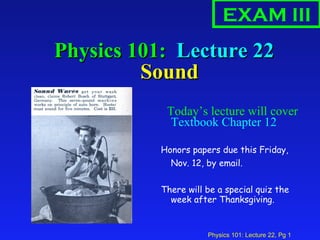
Physics 101:  Lecture 22  Sound Today’s lecture will cover  Textbook Chapter 12  Honors papers due this Friday, Nov. 12, by email. There will be a special quiz the week after Thanksgiving. EXAM III
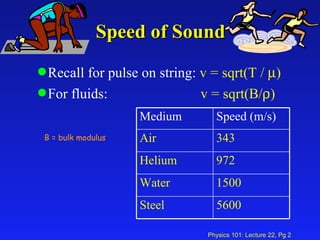
Speed of Sound Recall for pulse on string:  v = sqrt(T /   ) For fluids:  v = sqrt(B/  ) B = bulk modulus Medium Speed (m/s) Air 343 Helium 972 Water 1500 Steel 5600
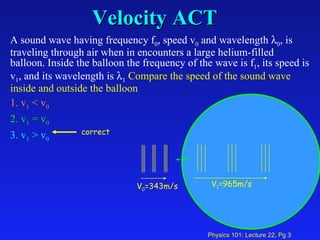
Velocity ACT A sound wave having frequency f 0 , speed v 0  and wavelength   0 , is traveling through air when in encounters a large helium-filled balloon. Inside the balloon the frequency of the wave is f 1 , its speed is v 1 , and its wavelength is   1   Compare the speed of the sound wave inside and outside the balloon   1. v 1  < v 0   2. v 1  = v 0   3. v 1  > v 0 V 1 =965m/s V 0 =343m/s correct
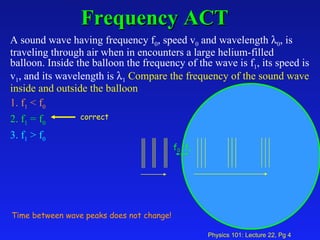
Frequency ACT A sound wave having frequency f 0 , speed v 0  and wavelength   0 , is traveling through air when in encounters a large helium-filled balloon. Inside the balloon the frequency of the wave is f 1 , its speed is v 1 , and its wavelength is   1   Compare the frequency of the sound wave inside and outside the balloon   1. f 1  < f 0   2. f 1  = f 0   3. f 1  > f 0 Time between wave peaks does not change! f 1 f 0 correct
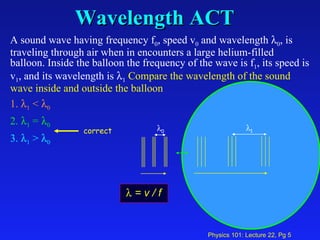
Wavelength ACT A sound wave having frequency f 0 , speed v 0  and wavelength   0 , is traveling through air when in encounters a large helium-filled balloon. Inside the balloon the frequency of the wave is f 1 , its speed is v 1 , and its wavelength is   1   Compare the wavelength of the sound wave inside and outside the balloon   1.   1  <   0   2.   1  =   0   3.   1  >   0  0  1 correct    = v / f
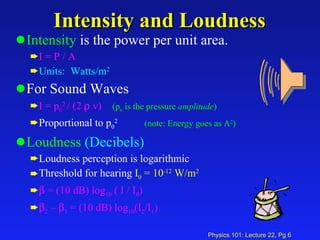
Intensity and Loudness Intensity  is the power per unit area.  I = P / A Units:  Watts/m 2 For Sound Waves I = p 0 2  / (2    v) (p o  is the pressure  amplitude ) Proportional to p 0 2   (note: Energy goes as A 2 ) Loudness   (Decibels) Loudness perception is logarithmic Threshold for hearing  I 0  = 10 -12  W/m 2    = (10 dB) log 10  ( I / I 0 )  2  –   1  = (10 dB) log 10 (I 2 /I 1 )
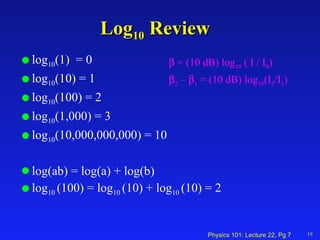
Log 10  Review  log 10 (1)  = 0 log 10 (10) = 1 log 10 (100) = 2 log 10 (1,000) = 3 log 10 (10,000,000,000) = 10 log(ab) = log(a) + log(b) log 10  (100) = log 10  (10) + log 10  (10) = 2 19    = (10 dB) log 10  ( I / I 0 )  2  –   1  = (10 dB) log 10 (I 2 /I 1 )
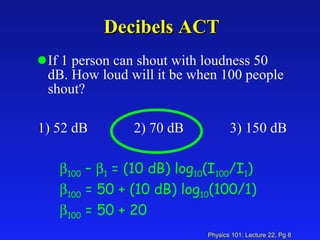
Decibels ACT If 1 person can shout with loudness 50 dB. How loud will it be when 100 people shout? 1) 52 dB 2) 70 dB 3) 150 dB  100  –   1  = (10 dB) log 10 (I 100 /I 1 )  100  = 50 + (10 dB) log 10 (100/1)  100  = 50 + 20
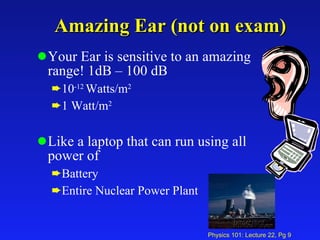
Amazing Ear (not on exam) Your Ear is sensitive to an amazing range! 1dB – 100 dB 10 -12  Watts/m 2 1 Watt/m 2 Like a laptop that can run using all power of Battery Entire Nuclear Power Plant
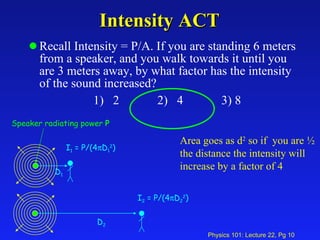
Intensity ACT Recall Intensity = P/A. If you are standing 6 meters from a speaker, and you walk towards it until you are 3 meters away, by what factor has the intensity of the sound increased? 1)  2 2)  4 3) 8 Area goes as d 2  so if  you are ½ the distance the intensity will increase by a factor of 4 Speaker radiating power  P I 1  = P/(4  D 1 2 ) D 1 I 2  = P/(4  D 2 2 ) D 2
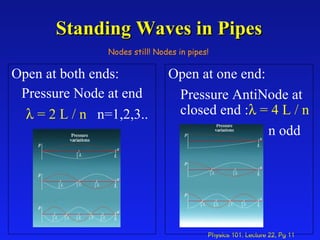
Standing Waves in Pipes Open at both ends: Pressure Node at end     = 2 L / n  n=1,2,3.. Open at one end: Pressure AntiNode at  closed end :   = 4 L / n n odd Nodes still! Nodes in pipes!
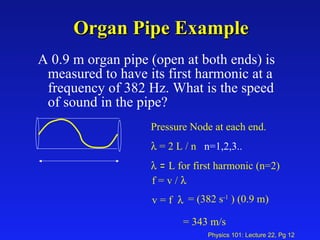
Organ Pipe Example A 0.9 m organ pipe (open at both ends) is measured to have its first harmonic at a frequency of 382 Hz. What is the speed of sound in the pipe? Pressure Node at each end.    = 2 L / n  n=1,2,3..    =  L for first harmonic (n=2) f = v /   v = f   = (382 s -1  ) (0.9 m)  = 343 m/s
Resonance ACT What happens to the fundamental frequency of a pipe, if the air (v=343 m/s) is replaced by helium (v=972 m/s)? 1) Increases 2) Same 3) Decreases  f =  v/ 
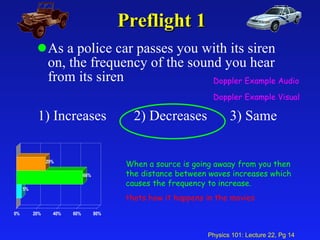
Preflight 1 As a police car passes you with its siren on, the frequency of the sound you hear from its siren 1) Increases 2) Decreases 3) Same Doppler Example Audio Doppler Example Visual When a source is going awaay from you then the distance between waves increases which causes the frequency to increase. thats how it happens in the movies
Doppler Effect  moving source  v s When source is coming toward you (v s  > 0) Distance between waves decreases Frequency is higher When source is going away from you (v s  < 0) Distance between waves increases Frequency is lower f o  = f s  / (1- v s /v) Knowing if Vo and Vs are negative or positive.
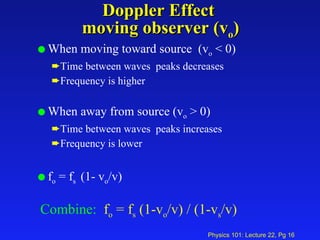
Doppler Effect  moving observer (v o ) When moving toward source  (v o  < 0) Time between waves  peaks decreases Frequency is higher When away from source (v o  > 0) Time between waves  peaks increases Frequency is lower f o  = f s  (1- v o /v) Combine:   f o  = f s  (1-v o /v) / (1-v s /v)
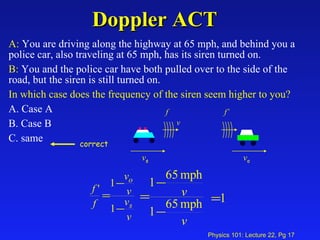
Doppler ACT A:  You are driving along the highway at 65 mph, and behind you a police car, also traveling at 65 mph, has its siren turned on. B:  You and the police car have both pulled over to the side of the road, but the siren is still turned on. In which case does the frequency of the siren seem higher to you?   A. Case A  B. Case B  C. same v s f v o f’ v correct
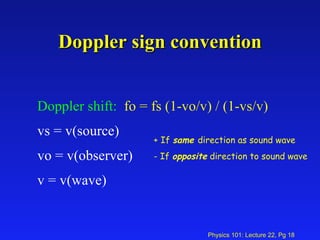
Doppler sign convention Doppler shift:   fo = fs (1-vo/v) / (1-vs/v)   vs = v(source)  vo = v(observer)  v = v(wave) + If  same  direction as sound wave - If  opposite  direction to sound wave
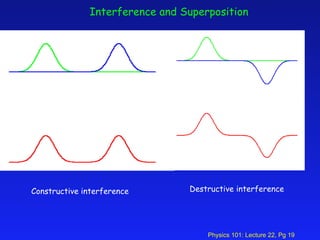
Constructive interference Destructive interference Interference and Superposition
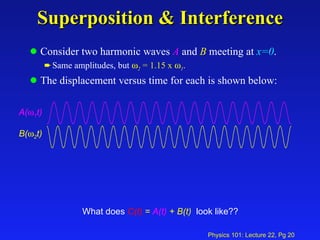
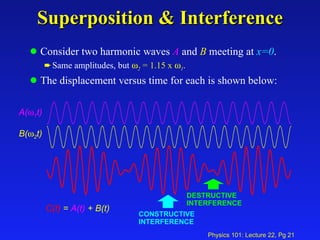
Superposition & Interference Consider two harmonic waves  A  and  B  meeting at  x=0 . Same amplitudes, but   2  = 1.15 x   1 . The displacement versus time for each is shown below: What does  C(t)  =   A(t)   +   B(t)   look like?? A(  1 t) B(  2 t)
Superposition & Interference Consider two harmonic waves  A  and  B  meeting at  x=0 . Same amplitudes, but   2  = 1.15 x   1 . The displacement versus time for each is shown below: A(  1 t) B(  2 t) C(t)  =   A(t)   +   B(t) CONSTRUCTIVE INTERFERENCE DESTRUCTIVE INTERFERENCE
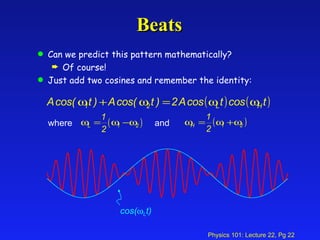
Beats Can we predict this pattern mathematically? Of course! Just add two cosines and remember the identity: where and cos(  L t)
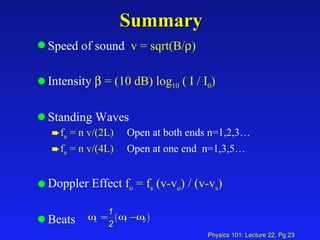
Summary Speed of sound  v = sqrt(B/  ) Intensity    = (10 dB) log 10  ( I / I 0 ) Standing Waves f n  = n v/(2L)   Open at both ends n=1,2,3… f n  = n v/(4L)   Open at one end  n=1,3,5… Doppler Effect  f o  = f s  (v-v o ) / (v-v s )   Beats

Lecture22

  • 1.
    Physics 101: Lecture 22 Sound Today’s lecture will cover Textbook Chapter 12 Honors papers due this Friday, Nov. 12, by email. There will be a special quiz the week after Thanksgiving. EXAM III
  • 2.
    Speed of SoundRecall for pulse on string: v = sqrt(T /  ) For fluids: v = sqrt(B/  ) B = bulk modulus Medium Speed (m/s) Air 343 Helium 972 Water 1500 Steel 5600
  • 3.
    Velocity ACT Asound wave having frequency f 0 , speed v 0 and wavelength  0 , is traveling through air when in encounters a large helium-filled balloon. Inside the balloon the frequency of the wave is f 1 , its speed is v 1 , and its wavelength is  1 Compare the speed of the sound wave inside and outside the balloon 1. v 1 < v 0 2. v 1 = v 0 3. v 1 > v 0 V 1 =965m/s V 0 =343m/s correct
  • 4.
    Frequency ACT Asound wave having frequency f 0 , speed v 0 and wavelength  0 , is traveling through air when in encounters a large helium-filled balloon. Inside the balloon the frequency of the wave is f 1 , its speed is v 1 , and its wavelength is  1 Compare the frequency of the sound wave inside and outside the balloon 1. f 1 < f 0 2. f 1 = f 0 3. f 1 > f 0 Time between wave peaks does not change! f 1 f 0 correct
  • 5.
    Wavelength ACT Asound wave having frequency f 0 , speed v 0 and wavelength  0 , is traveling through air when in encounters a large helium-filled balloon. Inside the balloon the frequency of the wave is f 1 , its speed is v 1 , and its wavelength is  1 Compare the wavelength of the sound wave inside and outside the balloon 1.  1 <  0 2.  1 =  0 3.  1 >  0  0  1 correct  = v / f
  • 6.
    Intensity and LoudnessIntensity is the power per unit area. I = P / A Units: Watts/m 2 For Sound Waves I = p 0 2 / (2  v) (p o is the pressure amplitude ) Proportional to p 0 2 (note: Energy goes as A 2 ) Loudness (Decibels) Loudness perception is logarithmic Threshold for hearing I 0 = 10 -12 W/m 2  = (10 dB) log 10 ( I / I 0 )  2 –  1 = (10 dB) log 10 (I 2 /I 1 )
  • 7.
    Log 10 Review log 10 (1) = 0 log 10 (10) = 1 log 10 (100) = 2 log 10 (1,000) = 3 log 10 (10,000,000,000) = 10 log(ab) = log(a) + log(b) log 10 (100) = log 10 (10) + log 10 (10) = 2 19  = (10 dB) log 10 ( I / I 0 )  2 –  1 = (10 dB) log 10 (I 2 /I 1 )
  • 8.
    Decibels ACT If1 person can shout with loudness 50 dB. How loud will it be when 100 people shout? 1) 52 dB 2) 70 dB 3) 150 dB  100 –  1 = (10 dB) log 10 (I 100 /I 1 )  100 = 50 + (10 dB) log 10 (100/1)  100 = 50 + 20
  • 9.
    Amazing Ear (noton exam) Your Ear is sensitive to an amazing range! 1dB – 100 dB 10 -12 Watts/m 2 1 Watt/m 2 Like a laptop that can run using all power of Battery Entire Nuclear Power Plant
  • 10.
    Intensity ACT RecallIntensity = P/A. If you are standing 6 meters from a speaker, and you walk towards it until you are 3 meters away, by what factor has the intensity of the sound increased? 1) 2 2) 4 3) 8 Area goes as d 2 so if you are ½ the distance the intensity will increase by a factor of 4 Speaker radiating power P I 1 = P/(4  D 1 2 ) D 1 I 2 = P/(4  D 2 2 ) D 2
  • 11.
    Standing Waves inPipes Open at both ends: Pressure Node at end   = 2 L / n n=1,2,3.. Open at one end: Pressure AntiNode at closed end :  = 4 L / n n odd Nodes still! Nodes in pipes!
  • 12.
    Organ Pipe ExampleA 0.9 m organ pipe (open at both ends) is measured to have its first harmonic at a frequency of 382 Hz. What is the speed of sound in the pipe? Pressure Node at each end.  = 2 L / n n=1,2,3..  = L for first harmonic (n=2) f = v /  v = f  = (382 s -1 ) (0.9 m) = 343 m/s
  • 13.
    Resonance ACT Whathappens to the fundamental frequency of a pipe, if the air (v=343 m/s) is replaced by helium (v=972 m/s)? 1) Increases 2) Same 3) Decreases f = v/ 
  • 14.
    Preflight 1 Asa police car passes you with its siren on, the frequency of the sound you hear from its siren 1) Increases 2) Decreases 3) Same Doppler Example Audio Doppler Example Visual When a source is going awaay from you then the distance between waves increases which causes the frequency to increase. thats how it happens in the movies
  • 15.
    Doppler Effect moving source v s When source is coming toward you (v s > 0) Distance between waves decreases Frequency is higher When source is going away from you (v s < 0) Distance between waves increases Frequency is lower f o = f s / (1- v s /v) Knowing if Vo and Vs are negative or positive.
  • 16.
    Doppler Effect moving observer (v o ) When moving toward source (v o < 0) Time between waves peaks decreases Frequency is higher When away from source (v o > 0) Time between waves peaks increases Frequency is lower f o = f s (1- v o /v) Combine: f o = f s (1-v o /v) / (1-v s /v)
  • 17.
    Doppler ACT A: You are driving along the highway at 65 mph, and behind you a police car, also traveling at 65 mph, has its siren turned on. B: You and the police car have both pulled over to the side of the road, but the siren is still turned on. In which case does the frequency of the siren seem higher to you? A. Case A B. Case B C. same v s f v o f’ v correct
  • 18.
    Doppler sign conventionDoppler shift: fo = fs (1-vo/v) / (1-vs/v) vs = v(source) vo = v(observer) v = v(wave) + If same direction as sound wave - If opposite direction to sound wave
  • 19.
    Constructive interference Destructiveinterference Interference and Superposition
  • 20.
    Superposition & InterferenceConsider two harmonic waves A and B meeting at x=0 . Same amplitudes, but  2 = 1.15 x  1 . The displacement versus time for each is shown below: What does C(t) = A(t) + B(t) look like?? A(  1 t) B(  2 t)
  • 21.
    Superposition & InterferenceConsider two harmonic waves A and B meeting at x=0 . Same amplitudes, but  2 = 1.15 x  1 . The displacement versus time for each is shown below: A(  1 t) B(  2 t) C(t) = A(t) + B(t) CONSTRUCTIVE INTERFERENCE DESTRUCTIVE INTERFERENCE
  • 22.
    Beats Can wepredict this pattern mathematically? Of course! Just add two cosines and remember the identity: where and cos(  L t)
  • 23.
    Summary Speed ofsound v = sqrt(B/  ) Intensity  = (10 dB) log 10 ( I / I 0 ) Standing Waves f n = n v/(2L) Open at both ends n=1,2,3… f n = n v/(4L) Open at one end n=1,3,5… Doppler Effect f o = f s (v-v o ) / (v-v s ) Beats

Editor's Notes

  • #2 1
  • #3 Comparison of speed in solid, liquid, gas, helium is fun here.
  • #17 Take Eric’s??? Combine into one slide.
  • #23 Check factor of ½ in w_L