Felix Bloch Edward PurcellJoseph Fourier Joseph Larmor
Raymond Damadian C Lauterbur Peter Mansfield Seiji OgawaRichard Ernst
The first Nuclear magnetic resonance
experiment was conducted
independently by two scientist in 1946.
Felix Bloch working at Stanford
University
Edward Purcell working at Harvard
University
Bloch and Purcell were awarded Nobel
Prize for Physics in1952
Joseph Fourier
1768- 1830
Joseph Larmor
1857-1942
Published his
collected papers on
electromagnetism
in 1900 in a famous
book entitled
“Aether and Matter”
In 1970 Raymond Damadian found
that it is possible to characterize
different body tissues using NMR
Technology
In 1977 he completed the
construction of the first MRI scanner
In 1978 he founded the FONAR
corporation which manufactured the
first commercial MRI
In 1973 Paul C Lauterbur discovered the
possibility to create a two dimensional
picture by introducing gradients in the
magnetic field. He used the back
projection technique to reconstruct the
image. He termed his new imaging
technique zeumatography. He shared
the 2003 Nobel prize for medicine with
Peter Mansfield
Peter Mansfield
developed the technique
of detecting the emitted
signals rapidly
mathematically analyzing
them and turning them
into an image.
He evolved a very fast
imaging technique known
as Echo Planar Imaging
In 1975 Richard Ernst
introduced 2D NMR
using phase and
frequency encoding
and the Fourier
transform instead of
Lauterbur’s back
projection technique
In 1992 Functional
MRI was developed
by Seiji Ogawa.
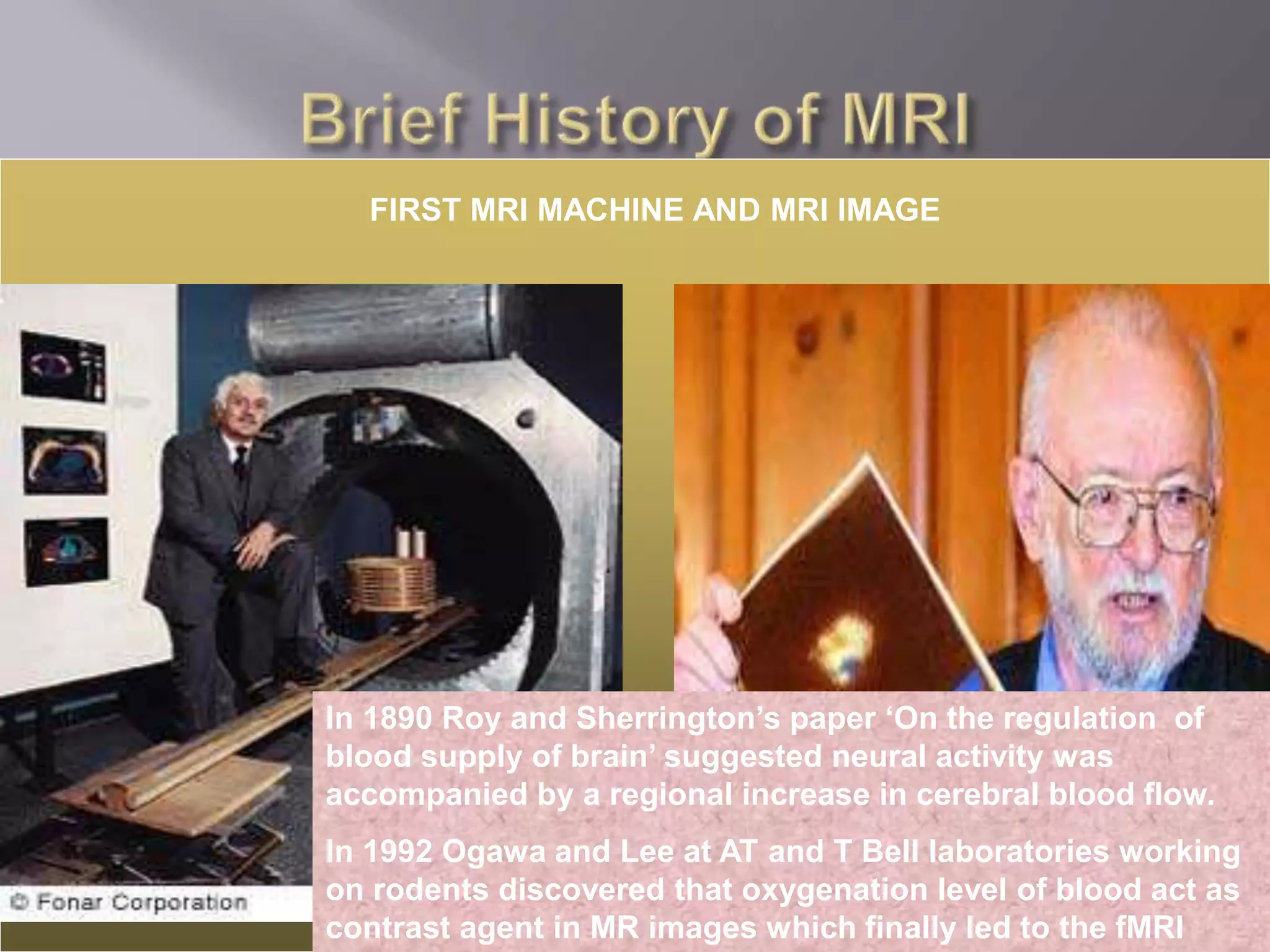
FIRST MRI MACHINE AND MRI IMAGE
In 1890 Roy and Sherrington’s paper ‘On the regulation of
blood supply of brain’ suggested neural activity was
accompanied by a regional increase in cerebral blood flow.
In 1992 Ogawa and Lee at AT and T Bell laboratories working
on rodents discovered that oxygenation level of blood act as
contrast agent in MR images which finally led to the fMRI
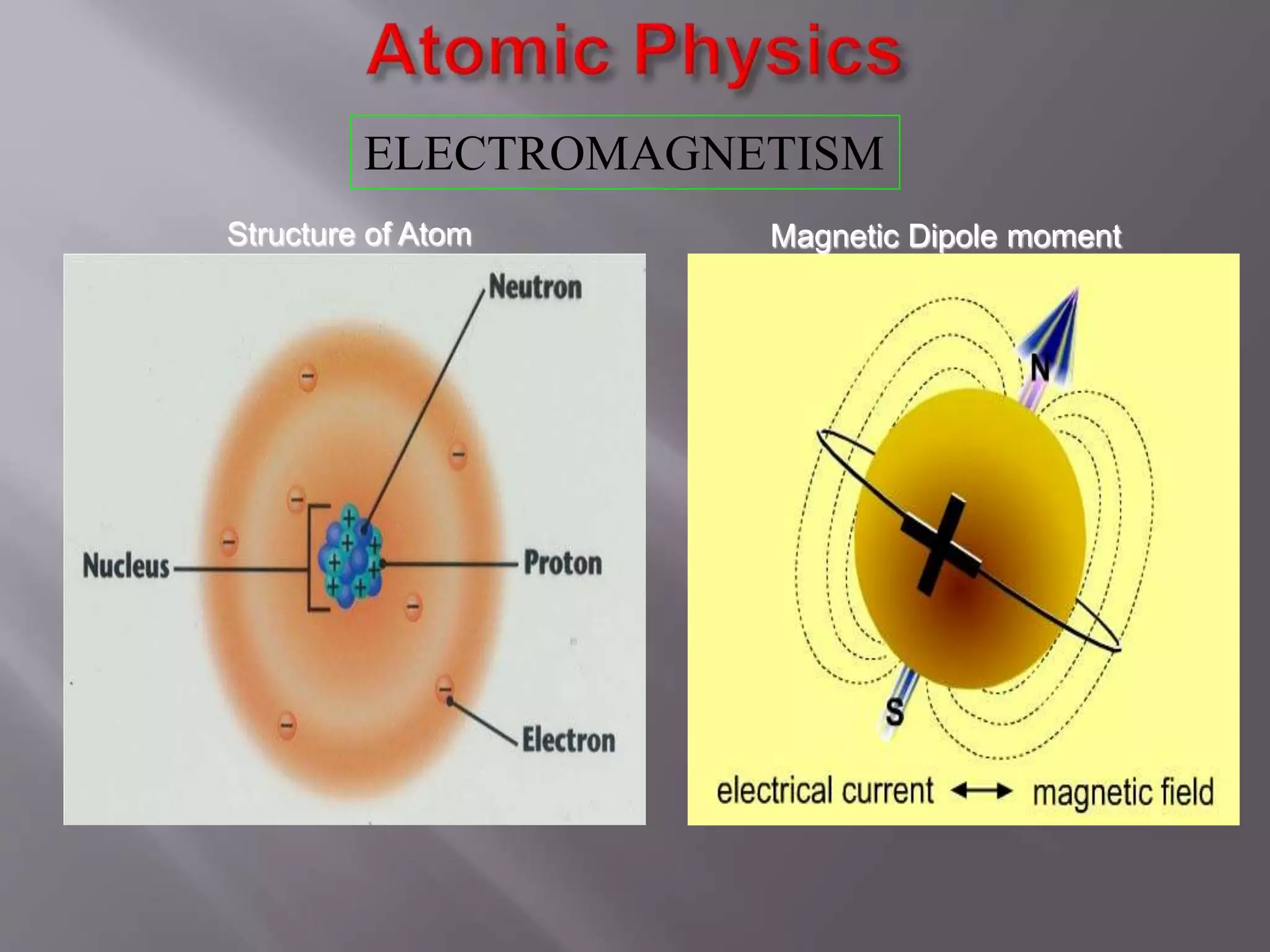
Structure of Atom Magnetic Dipole moment
ELECTROMAGNETISM
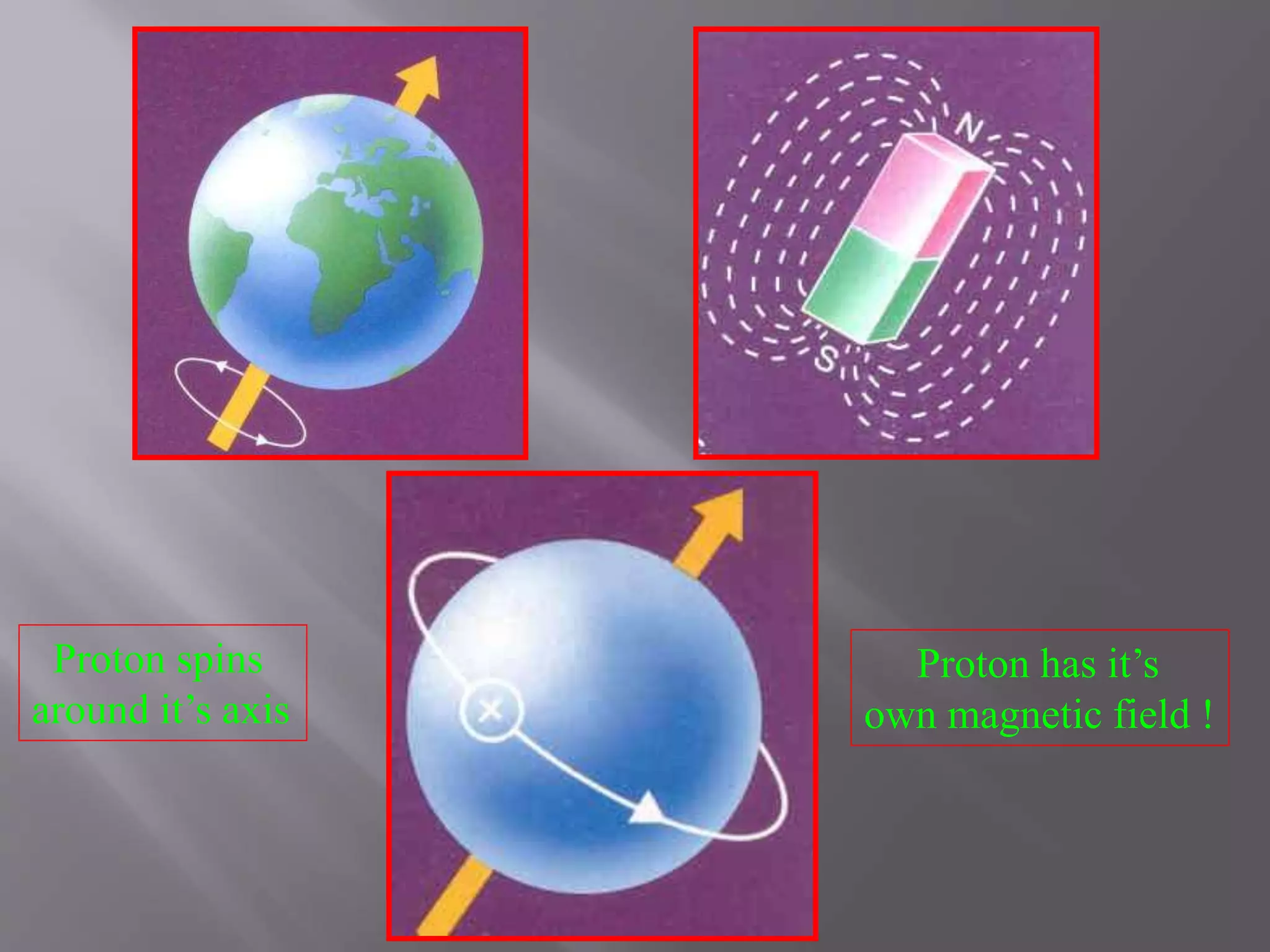
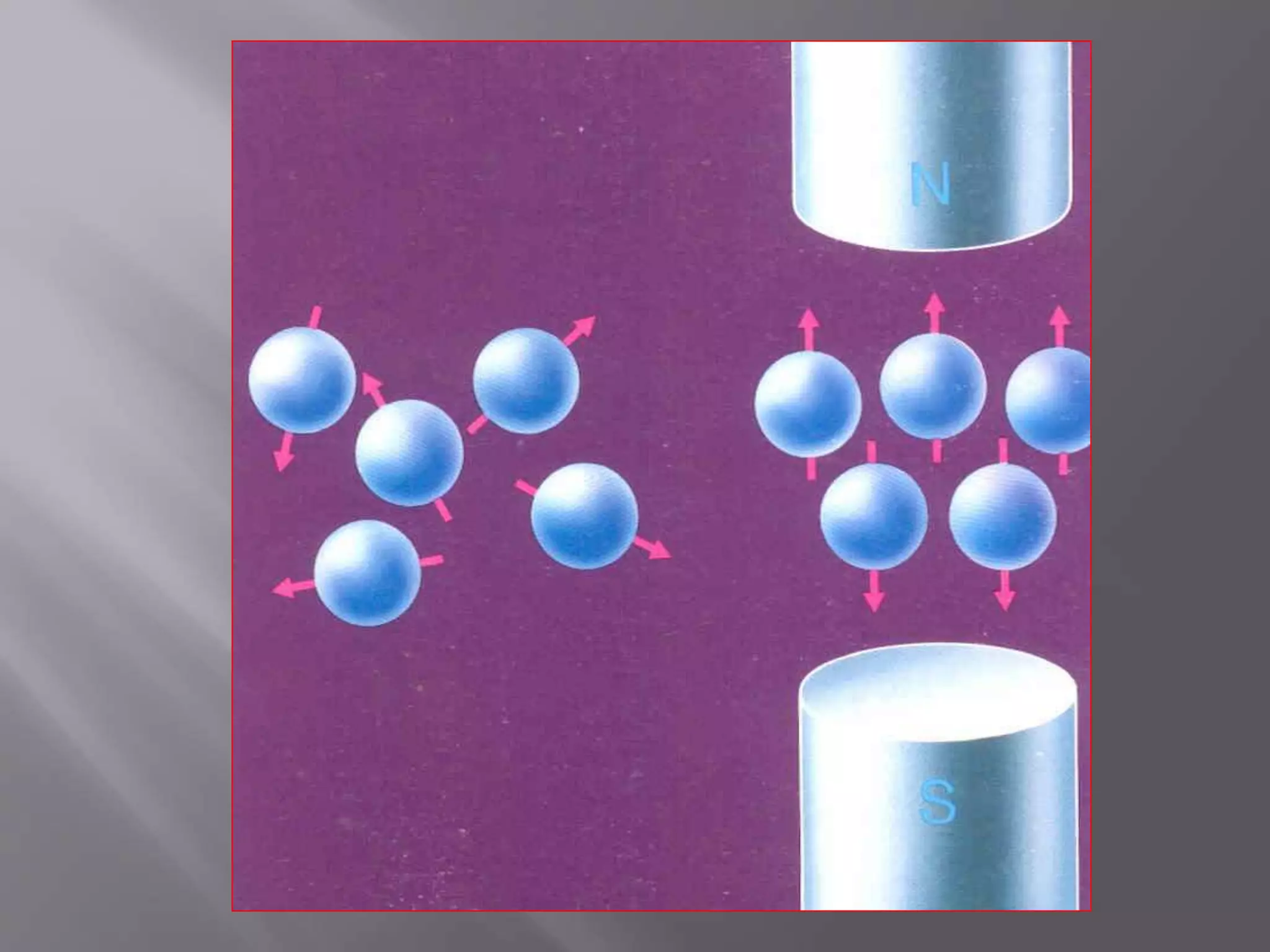
Proton has it’s
own magnetic field !
Proton spins
around it’s axis
History
Ogawa and lee?
Found
1. Neural activity is proportional to
oxygenation
2. O2 level acts as contrast agent
3. EP imaging technique
4. Experimented in human MR
imaging
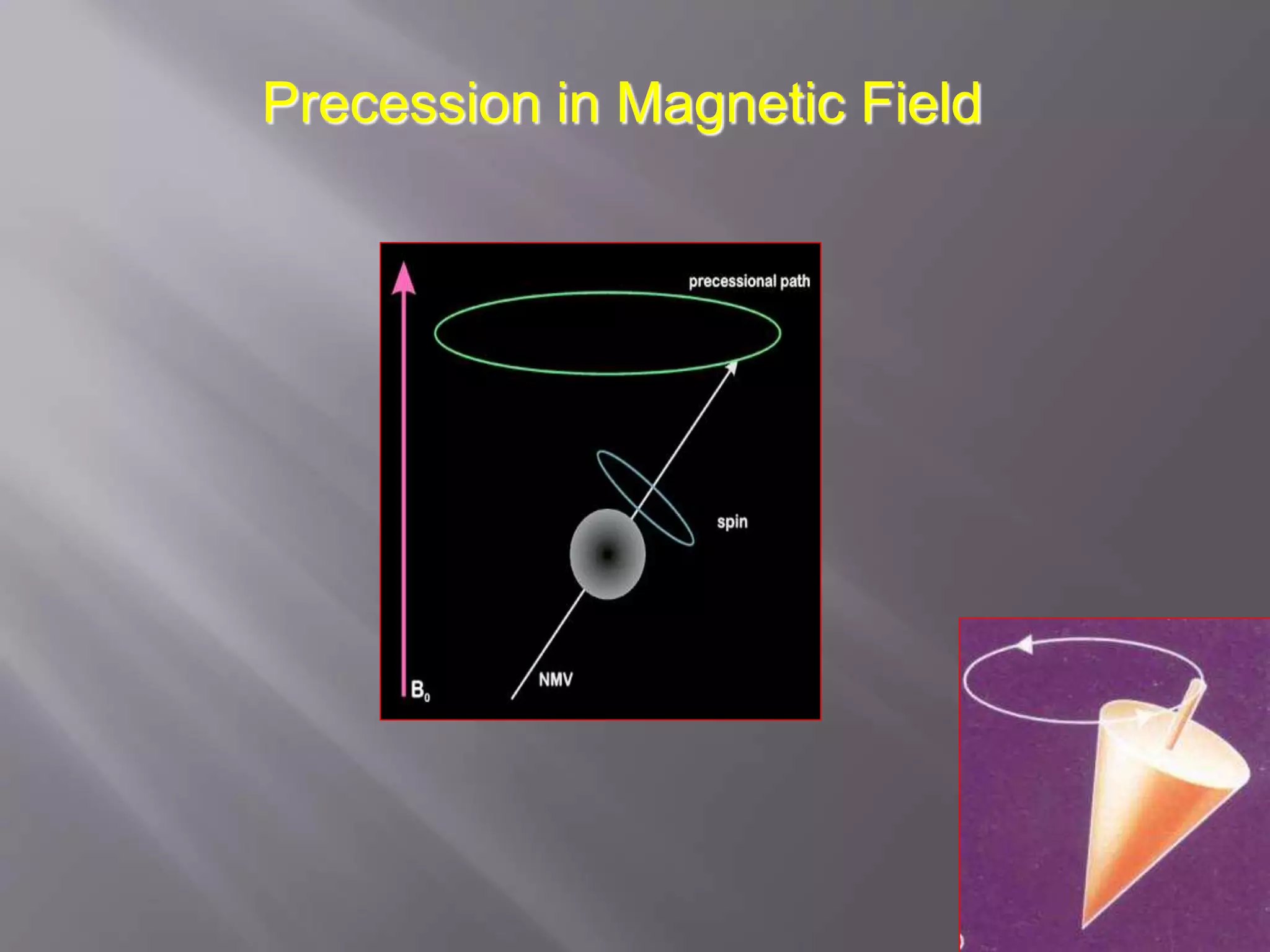
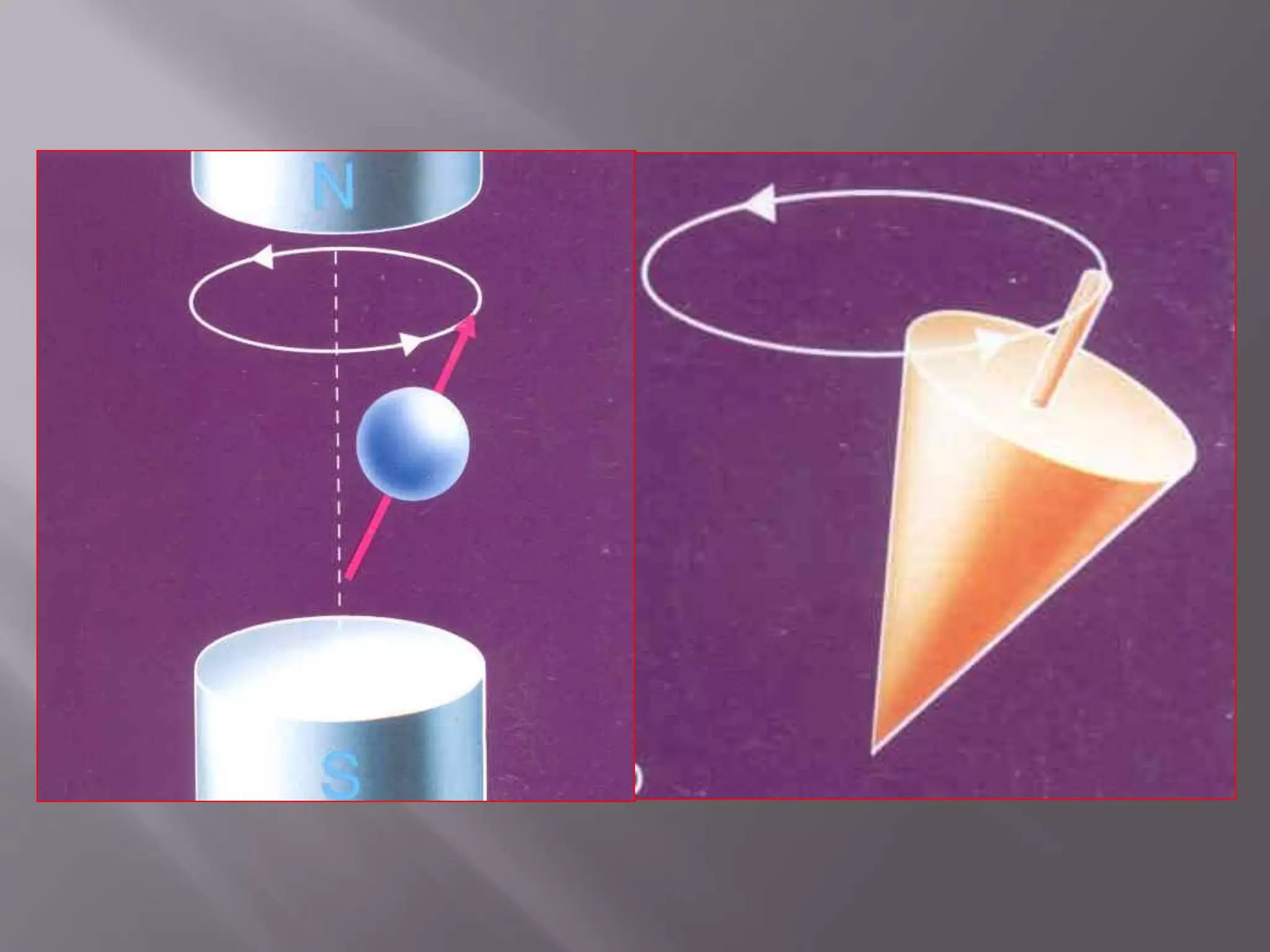
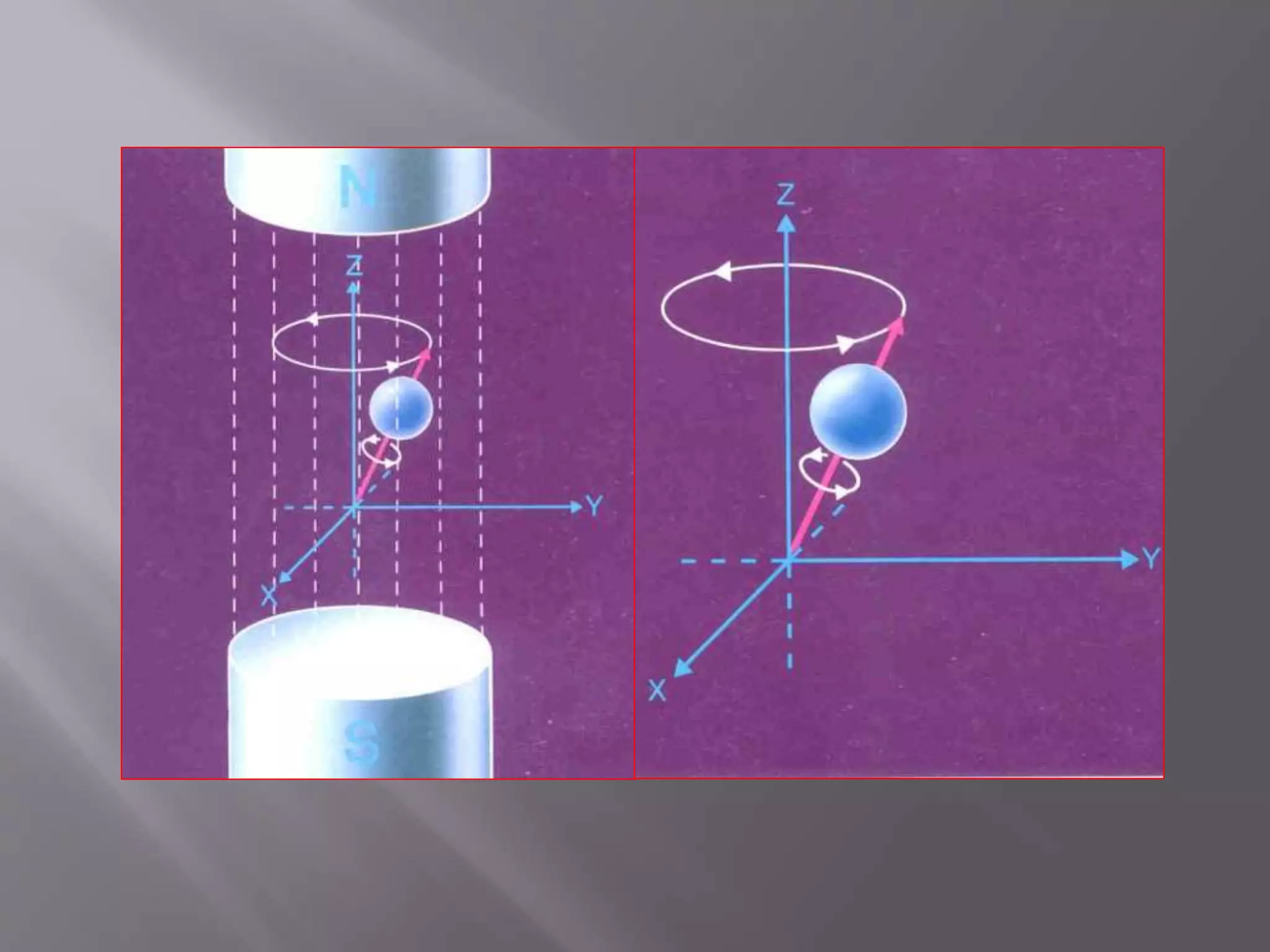
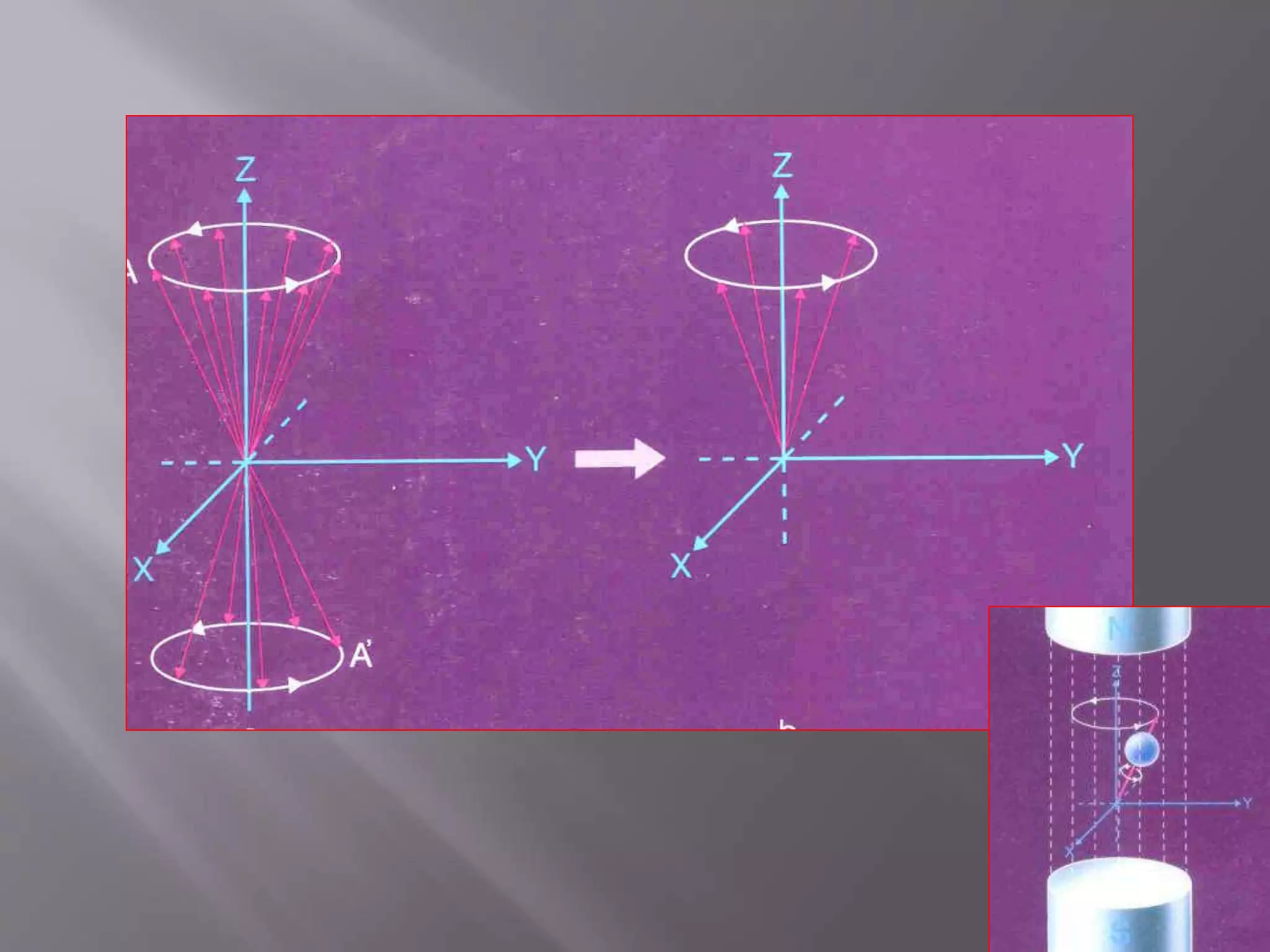
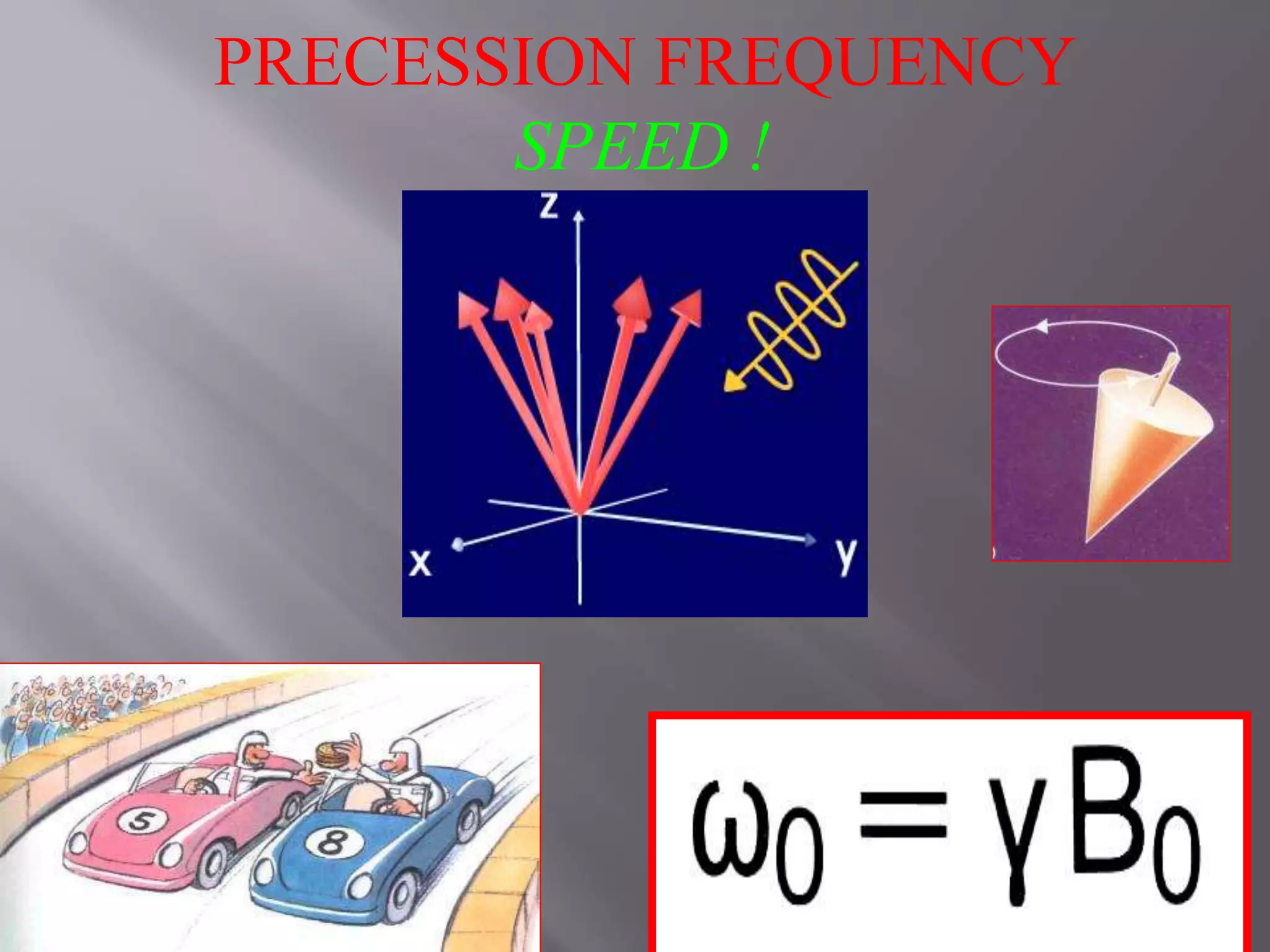
Precession in Magnetic Field
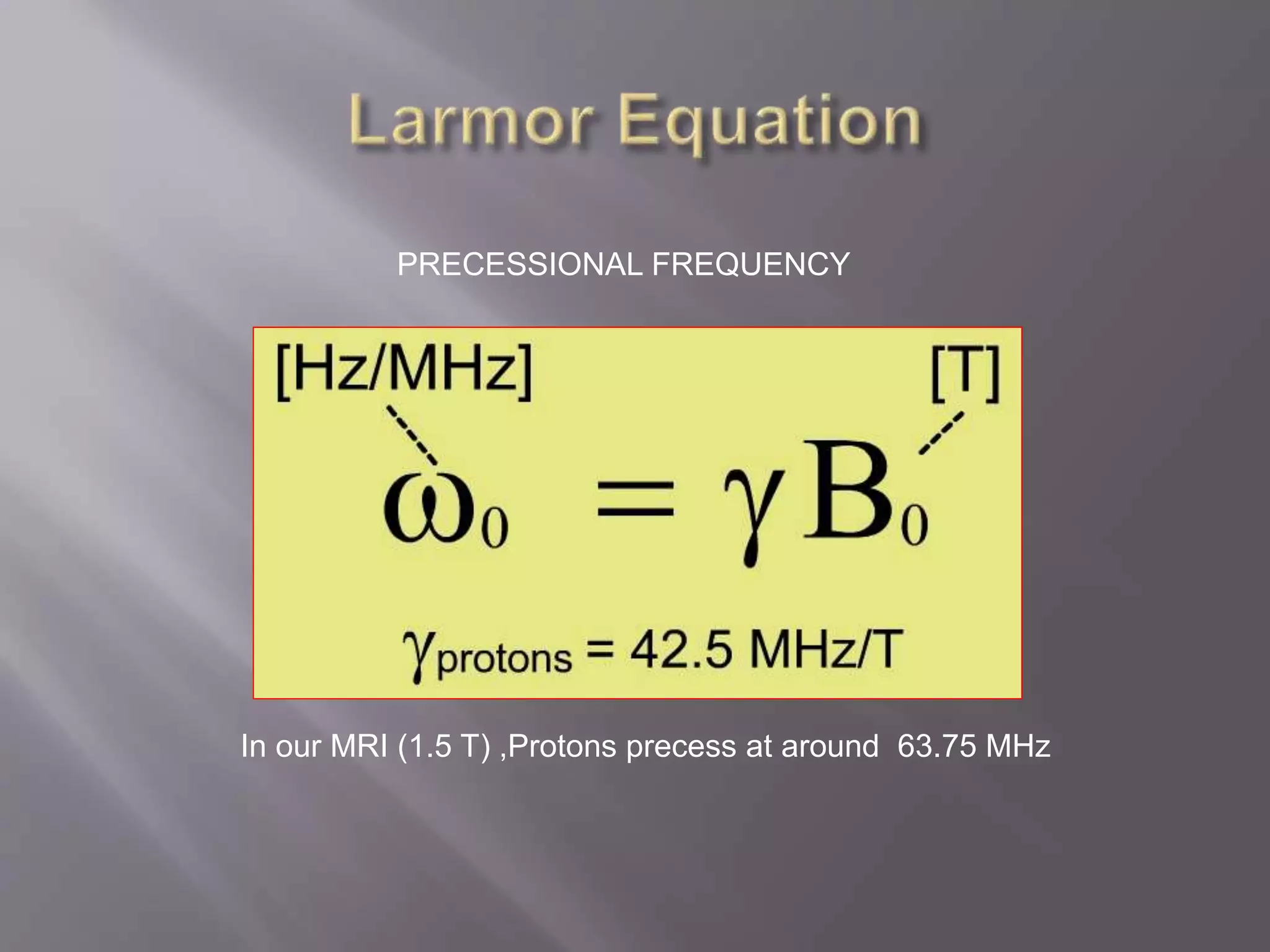
PRECESSIONAL FREQUENCY
In our MRI (1.5 T) ,Protons precess at around 63.75 MHz
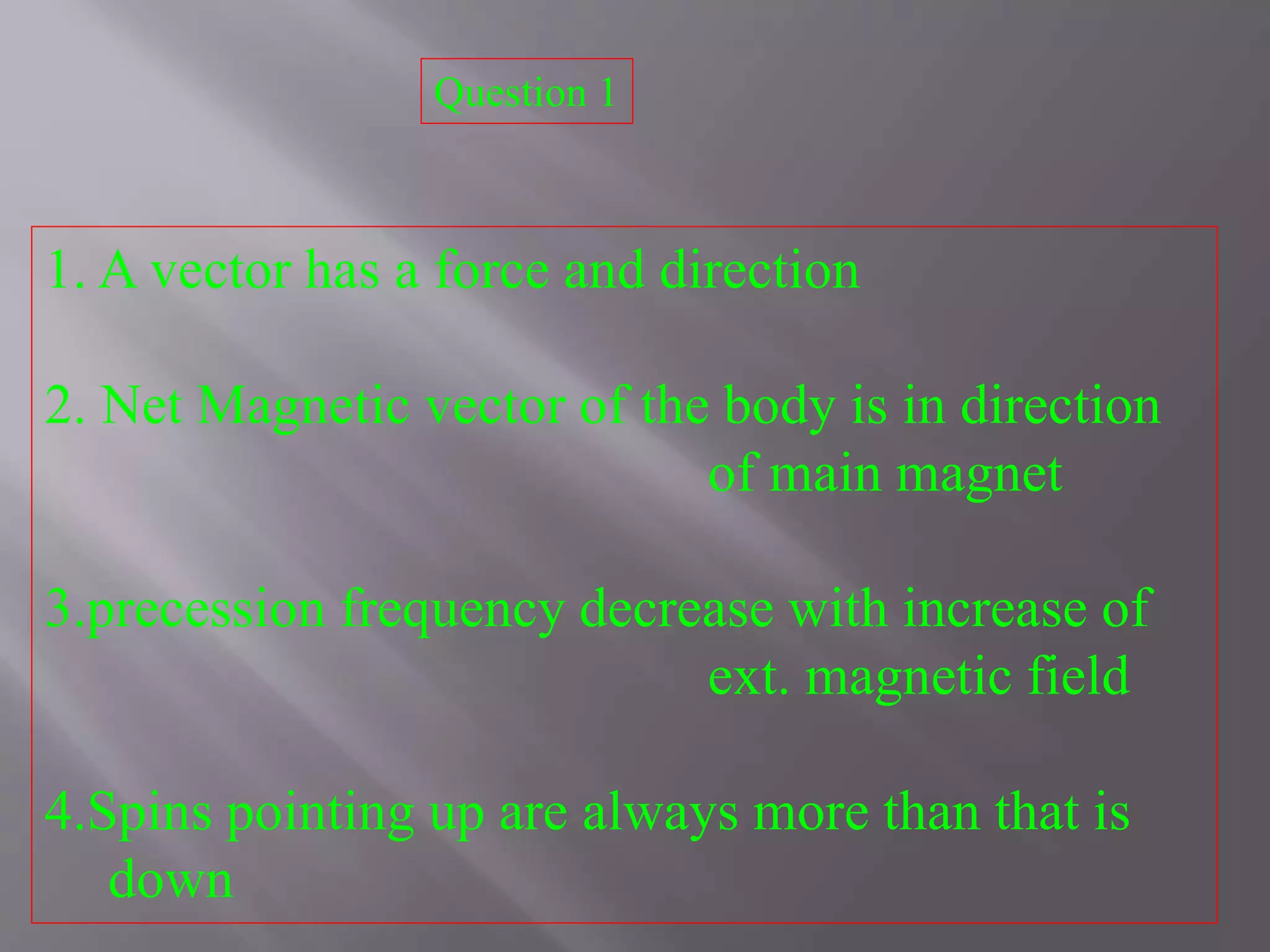
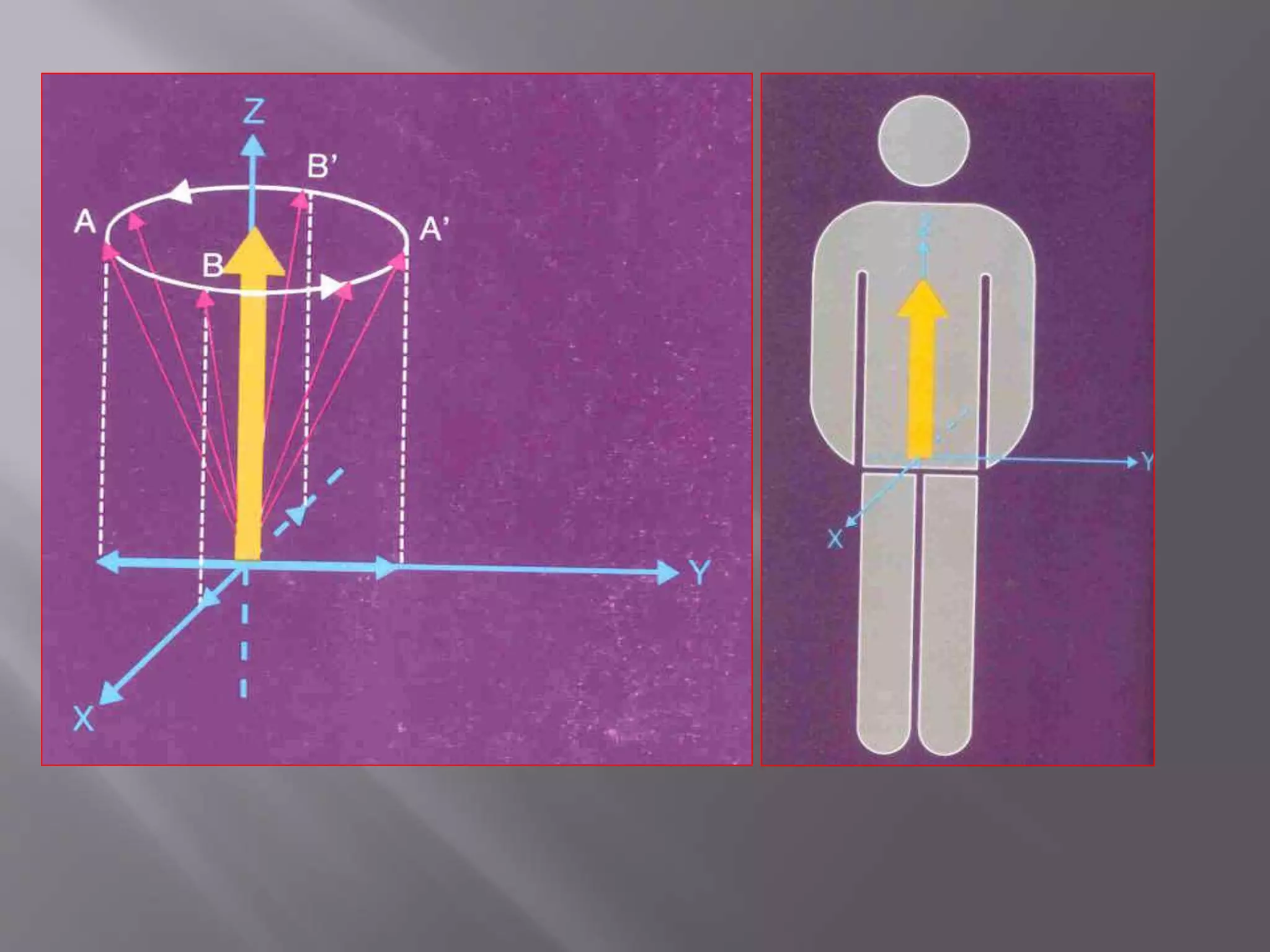
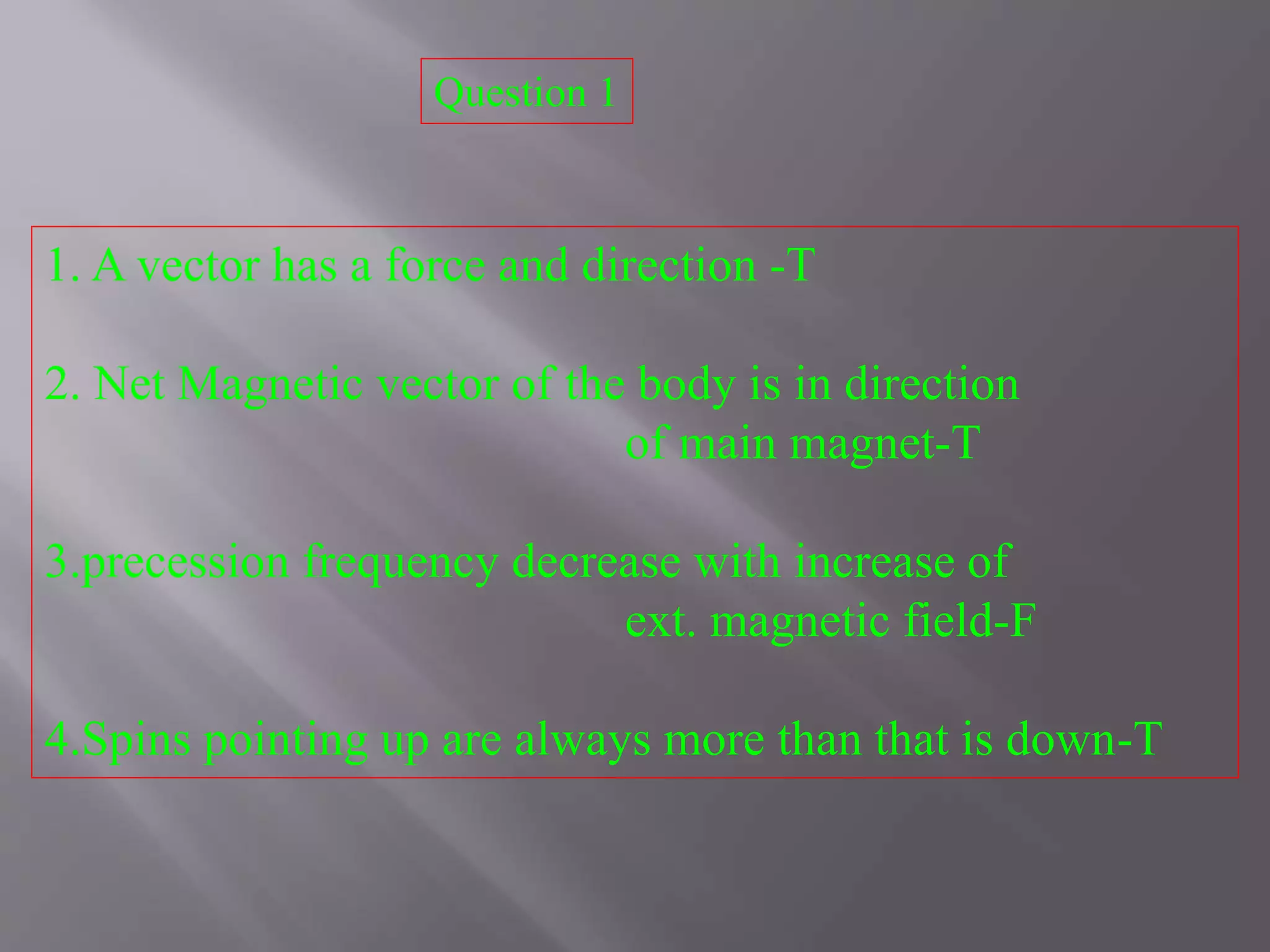
1. A vector has a force and direction
2. Net Magnetic vector of the body is in direction
of main magnet
3.precession frequency decrease with increase of
ext. magnetic field
4.Spins pointing up are always more than that is
down
Question 1
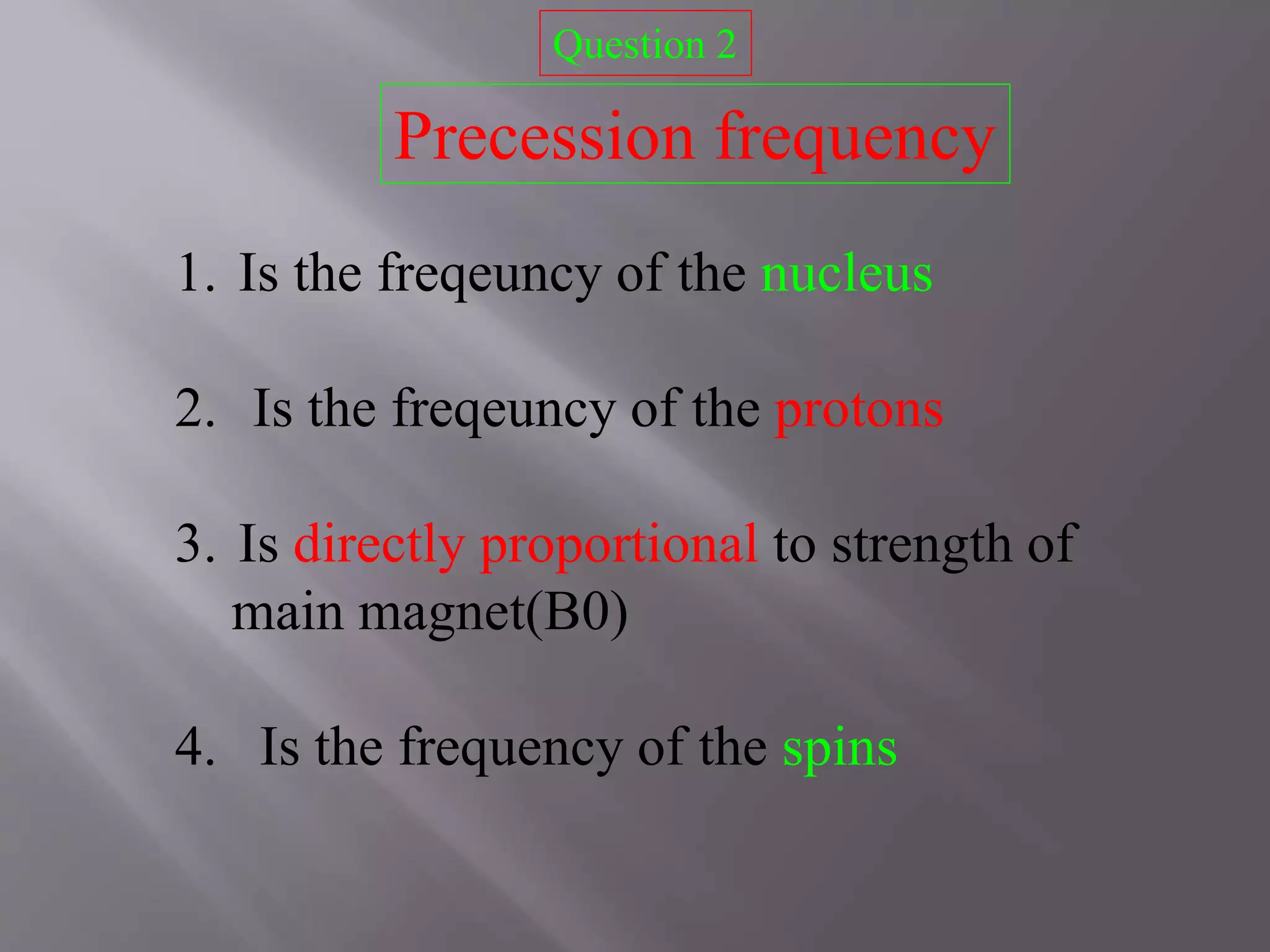
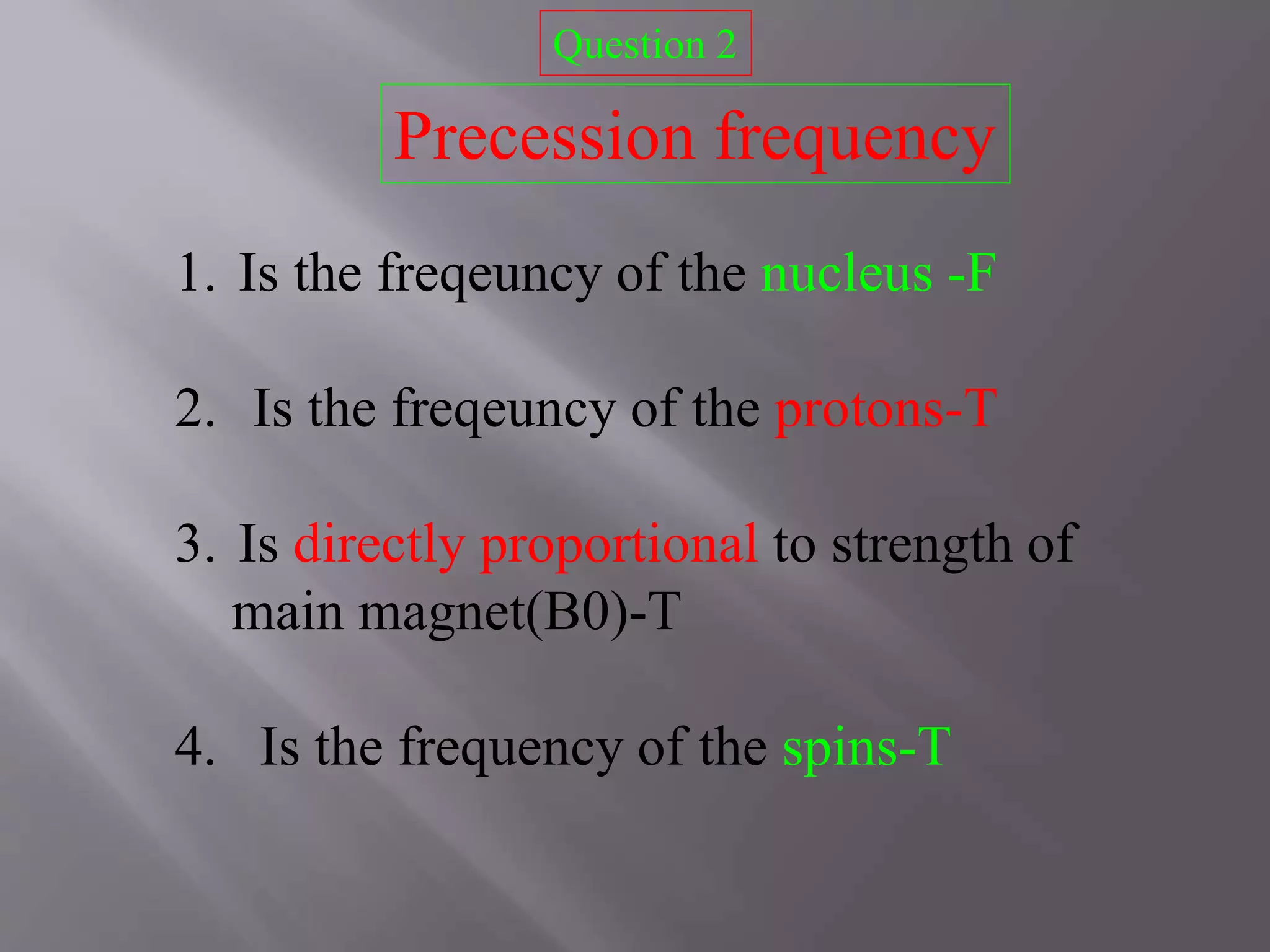
Precession frequency
1. Is the freqeuncy of the nucleus
2. Is the freqeuncy of the protons
3. Is directly proportional to strength of
main magnet(B0)
4. Is the frequency of the spins
Question 2
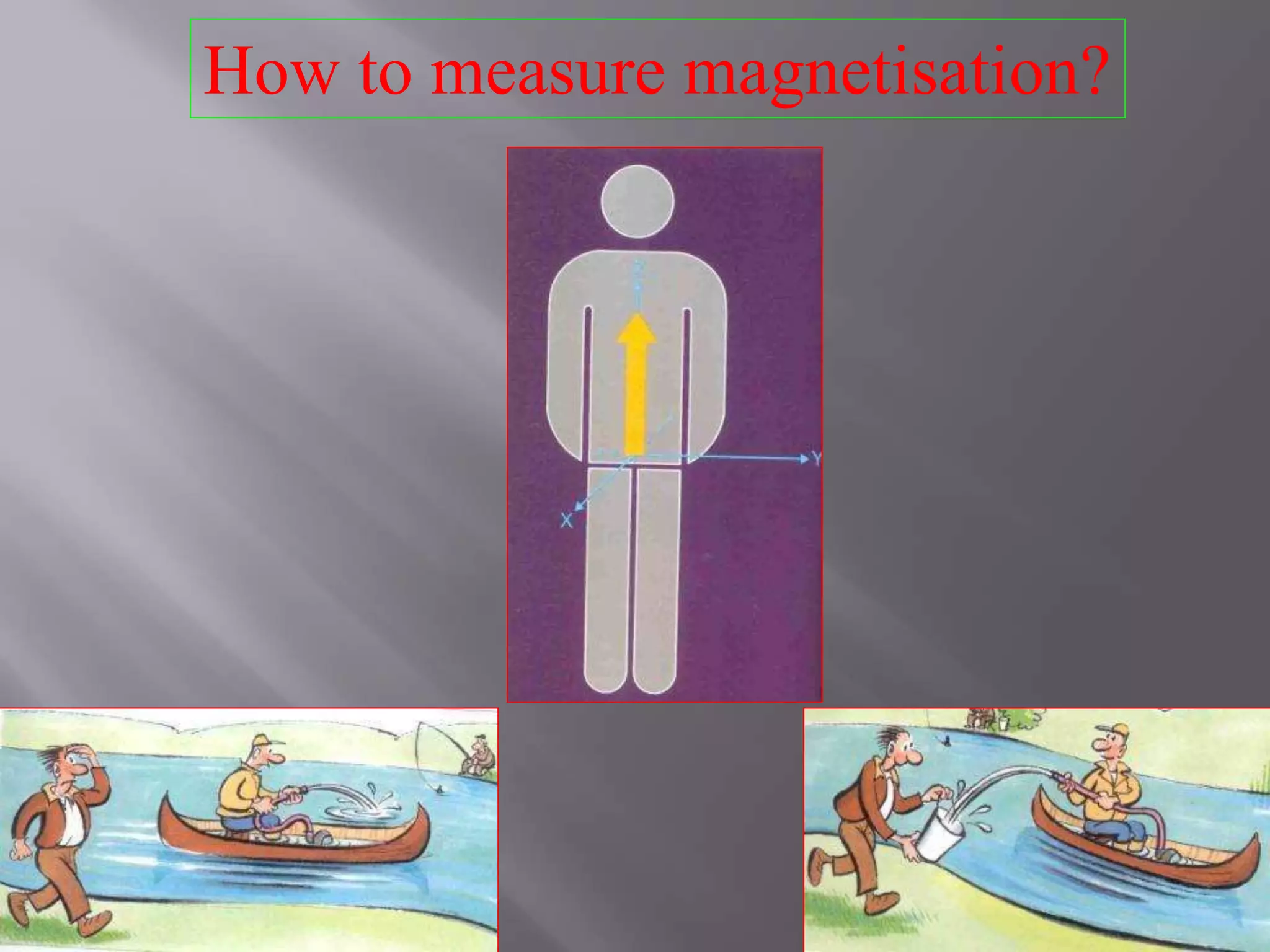
How to measure magnetisation?
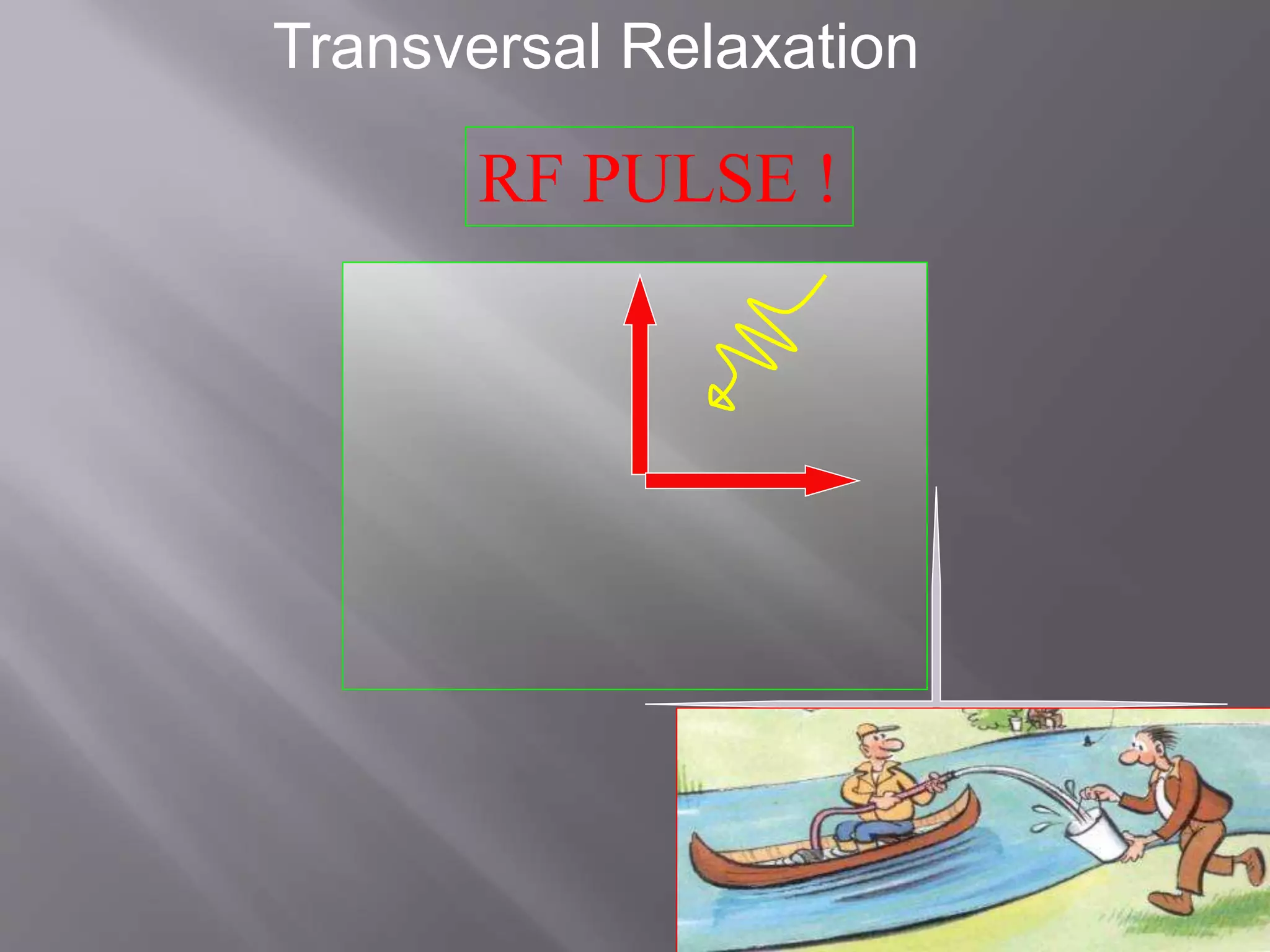
Transversal Relaxation
RF PULSE !
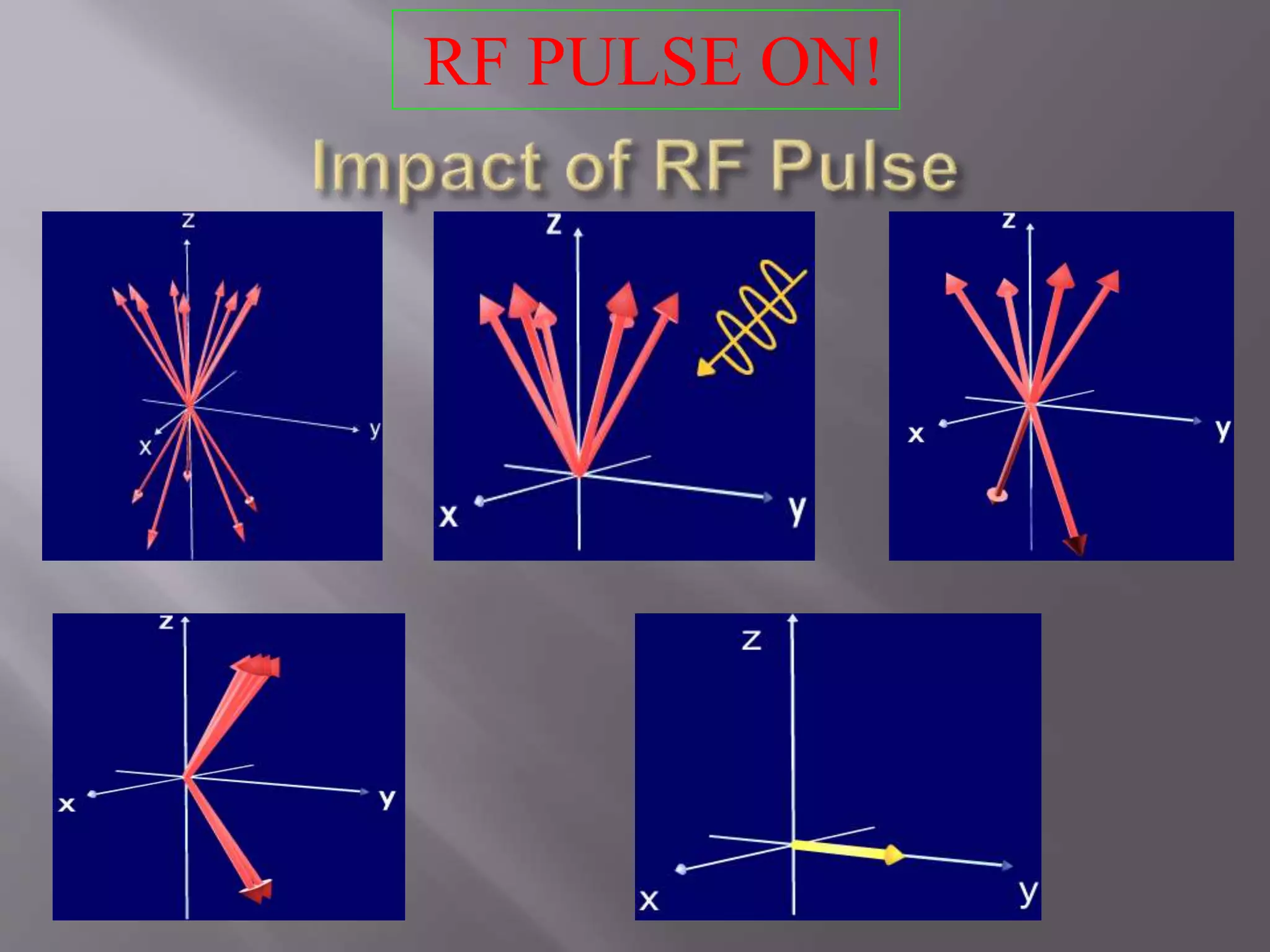
RF PULSE ON!
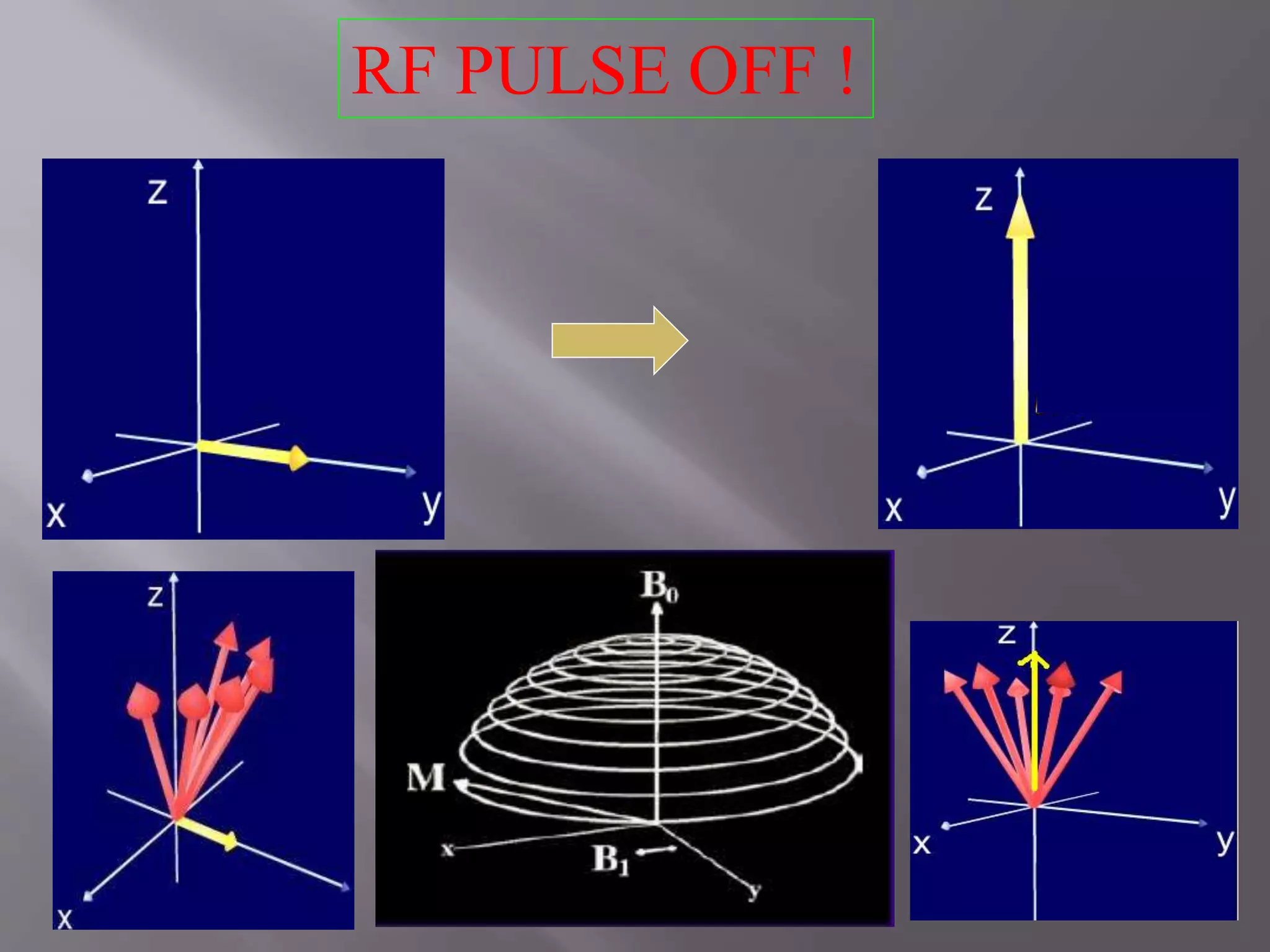
RF PULSE OFF !
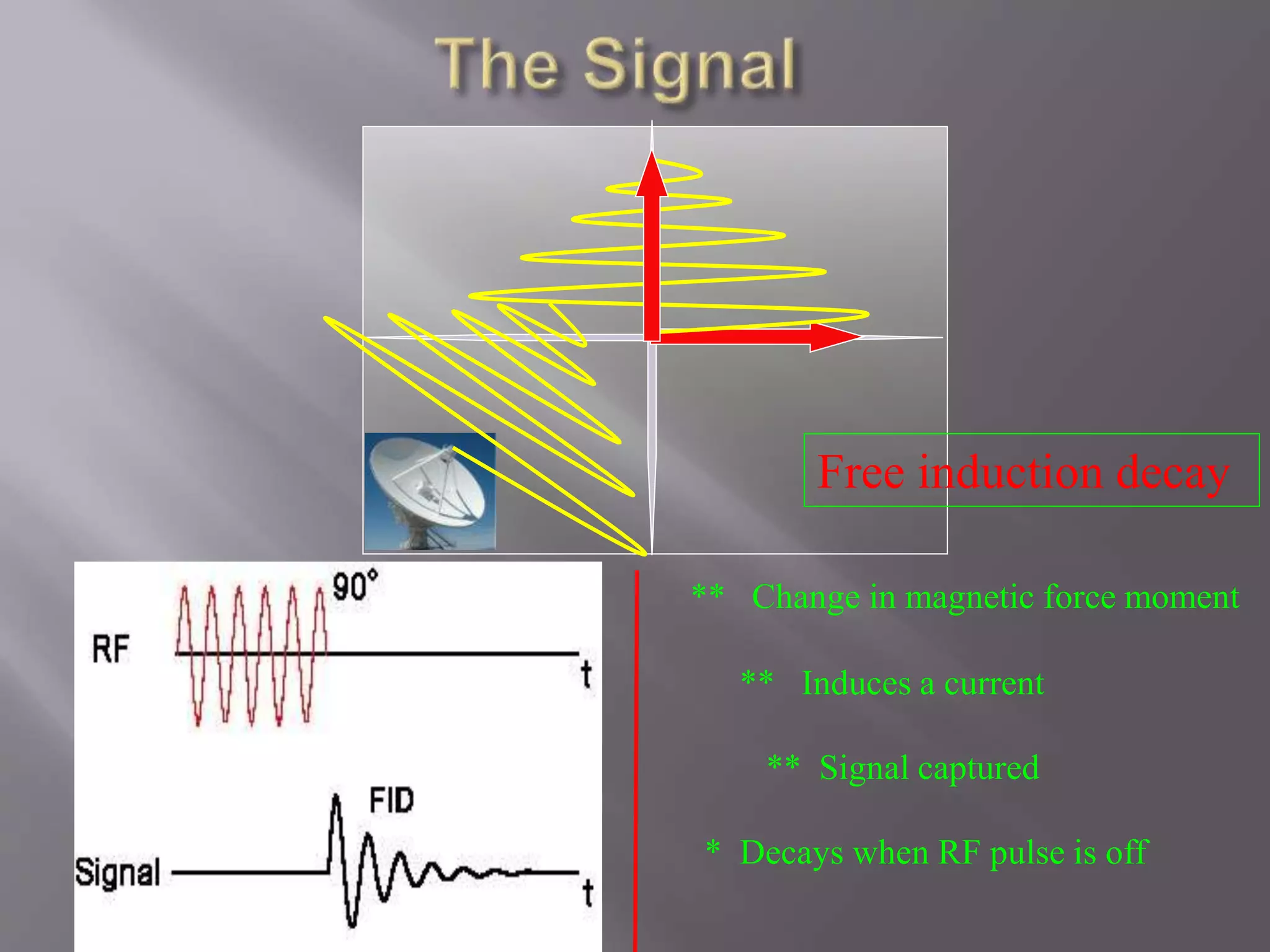
** Change in magnetic force moment
** Induces a current
** Signal captured
* Decays when RF pulse is off
Free induction decay
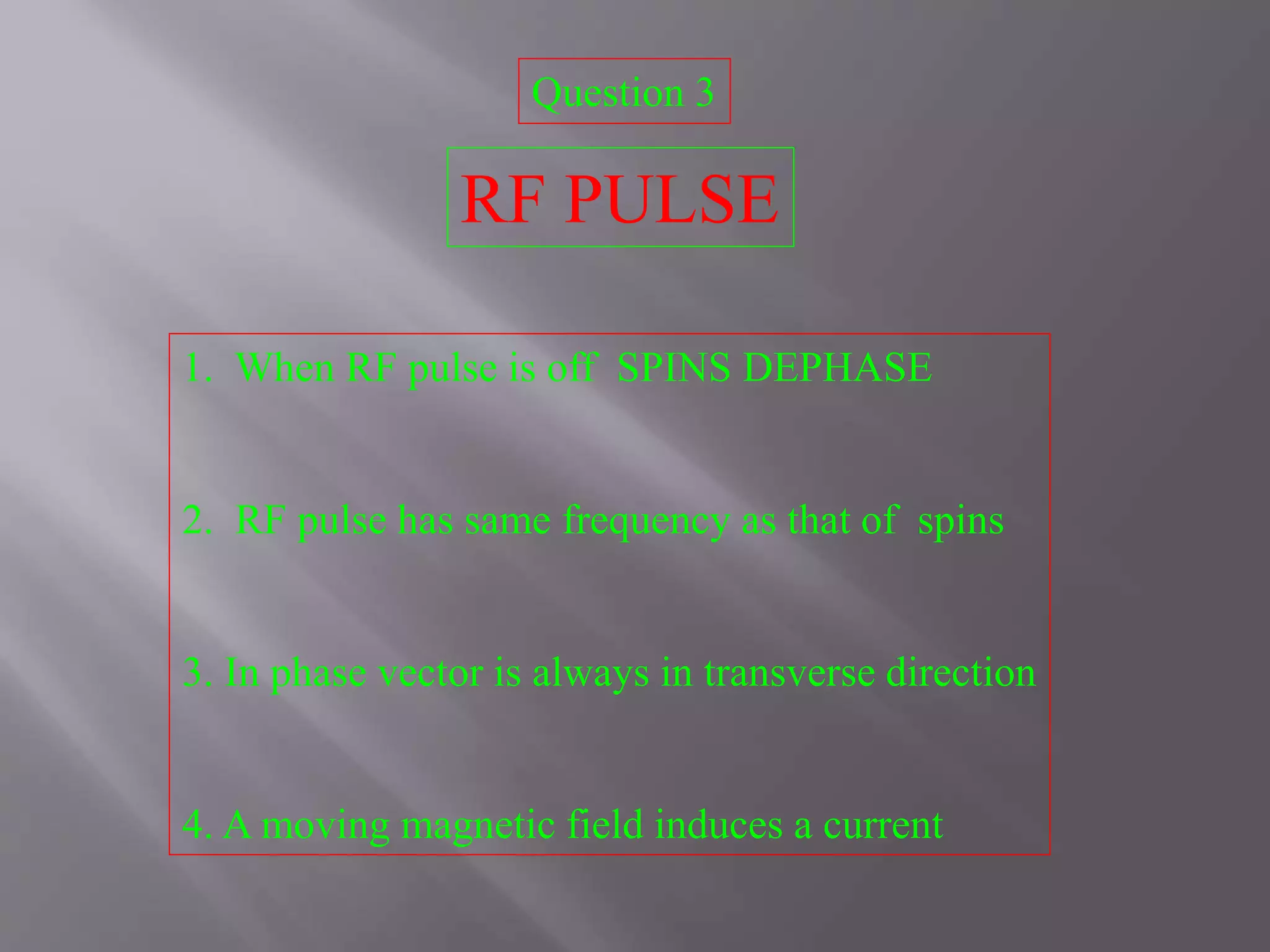
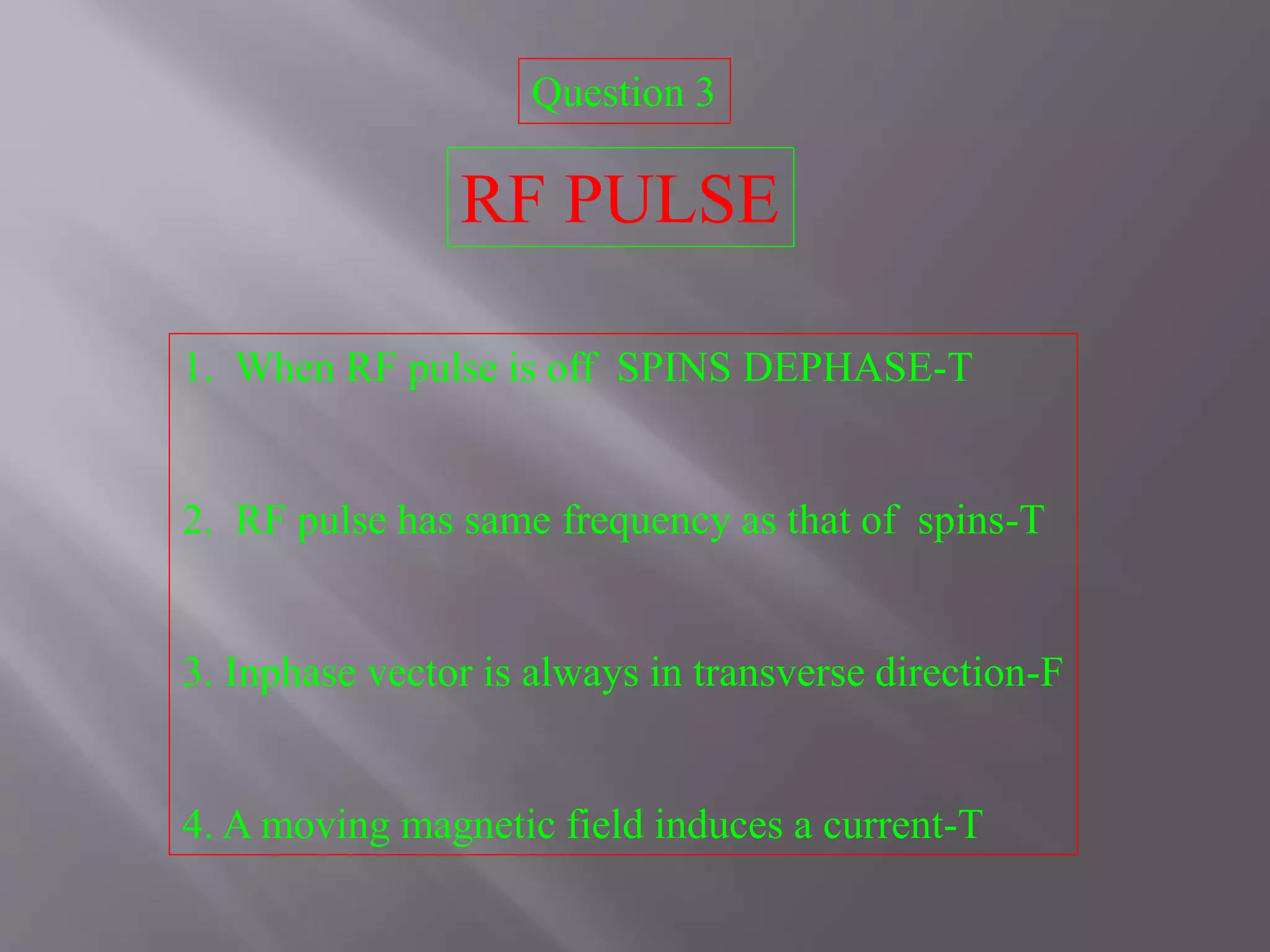
Question 3
RF PULSE
1. When RF pulse is off SPINS DEPHASE
2. RF pulse has same frequency as that of spins
3. In phase vector is always in transverse direction
4. A moving magnetic field induces a current
PRECESSION FREQUENCY
SPEED !
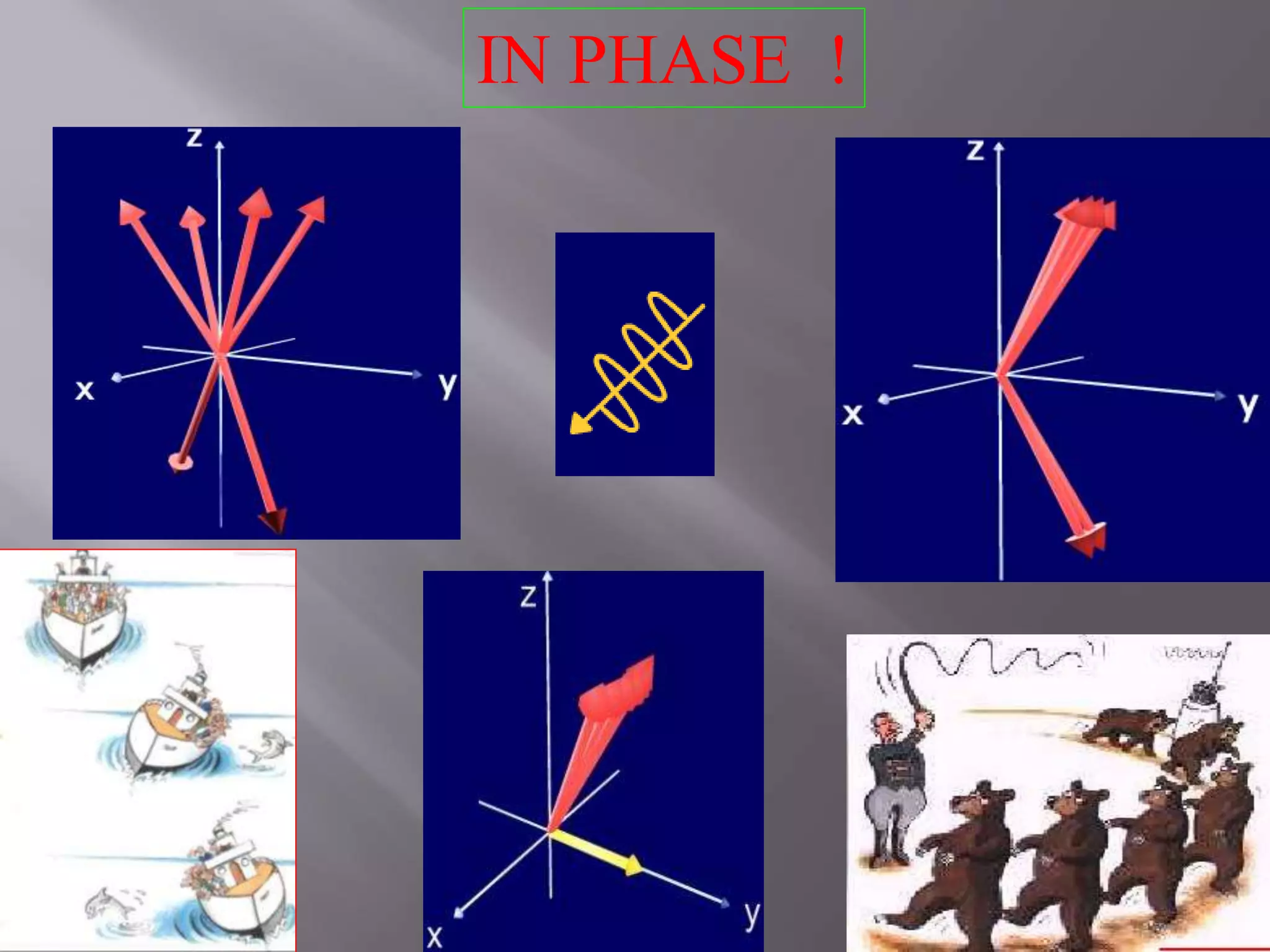
IN PHASE !
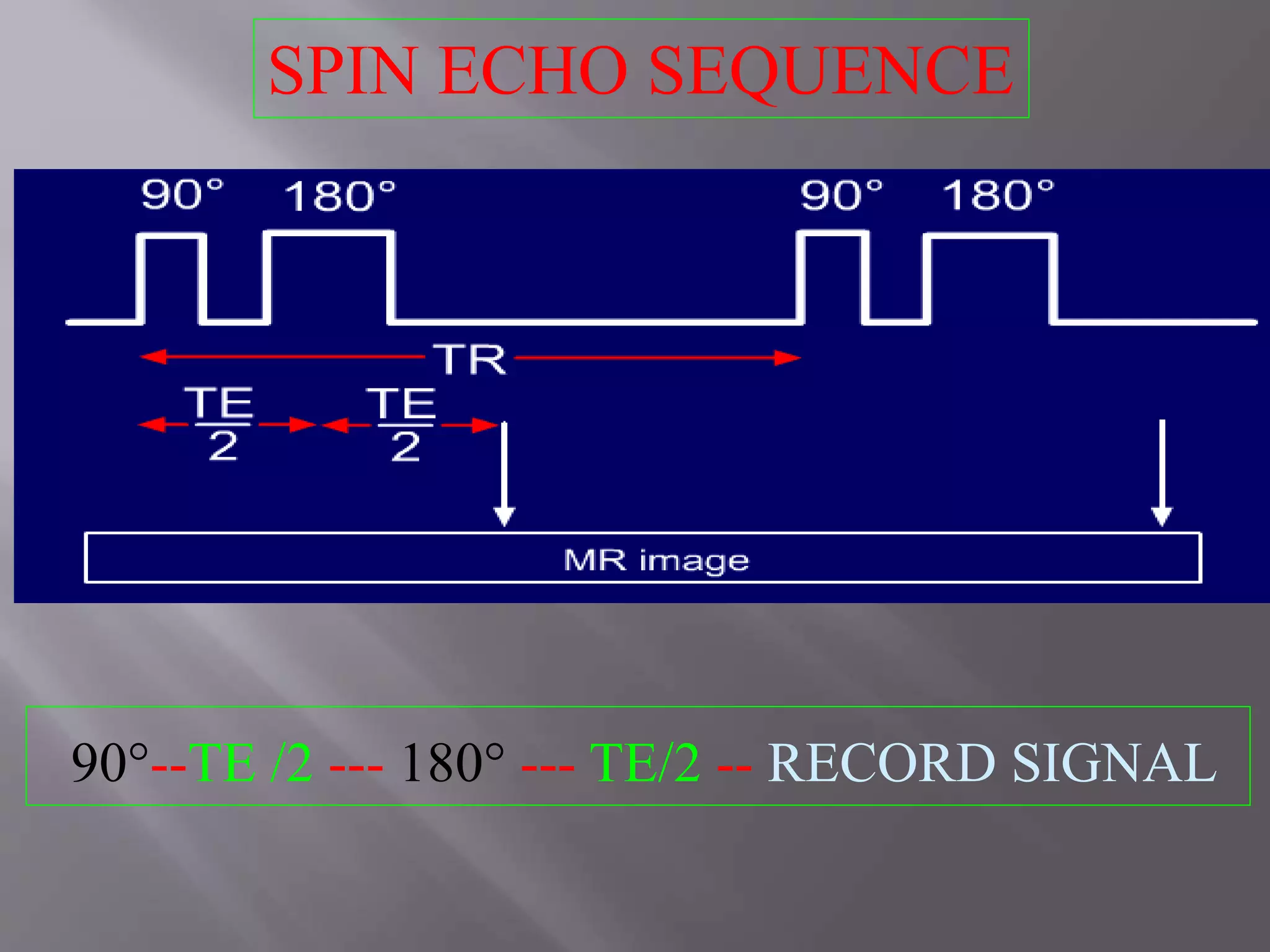
SPIN ECHO SEQUENCE
90°--TE /2 --- 180° --- TE/2 -- RECORD SIGNAL
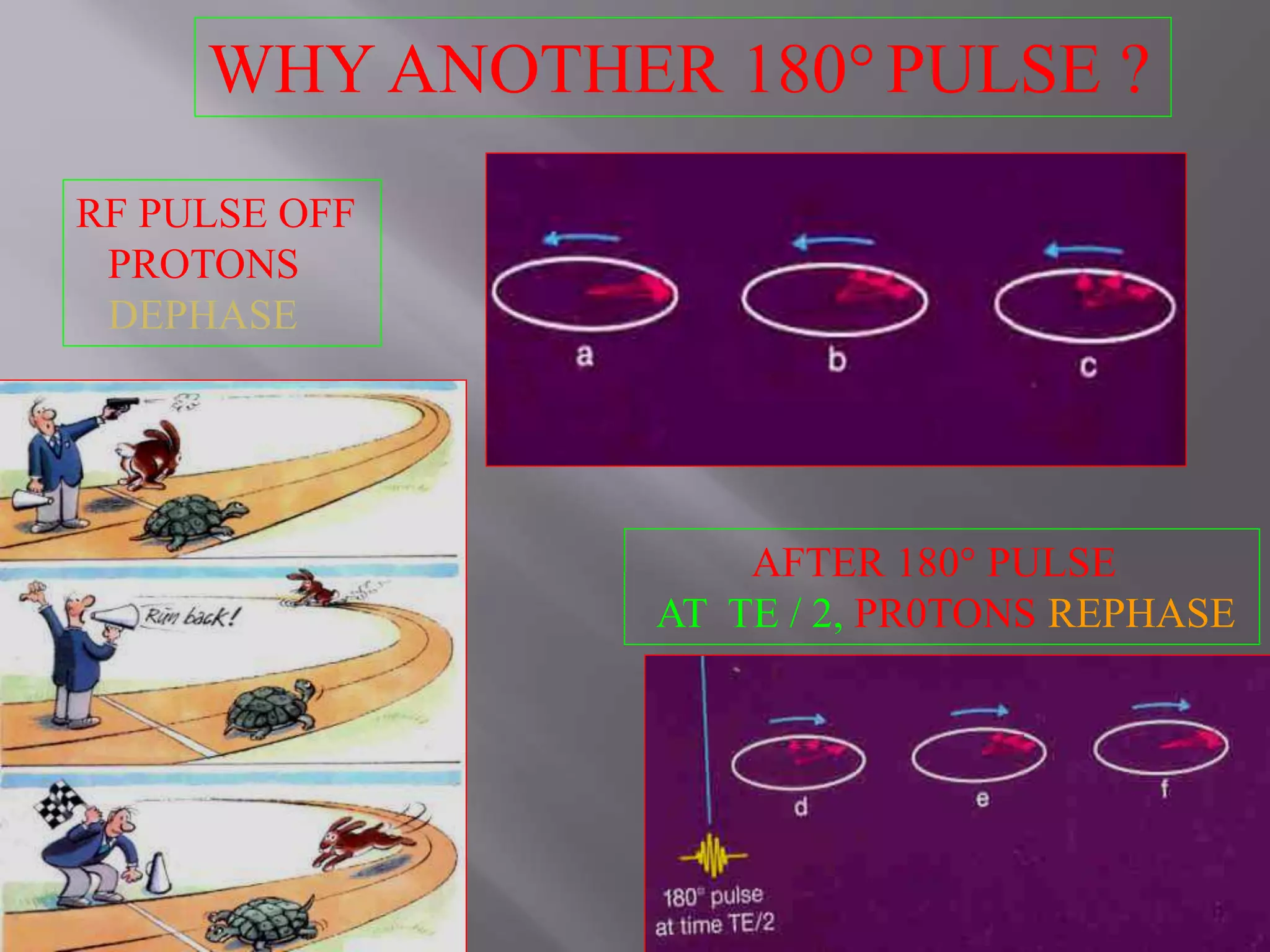
RF PULSE OFF
PROTONS
DEPHASE
AFTER 180° PULSE
AT TE / 2, PR0TONS REPHASE
WHY ANOTHER 180°PULSE ?
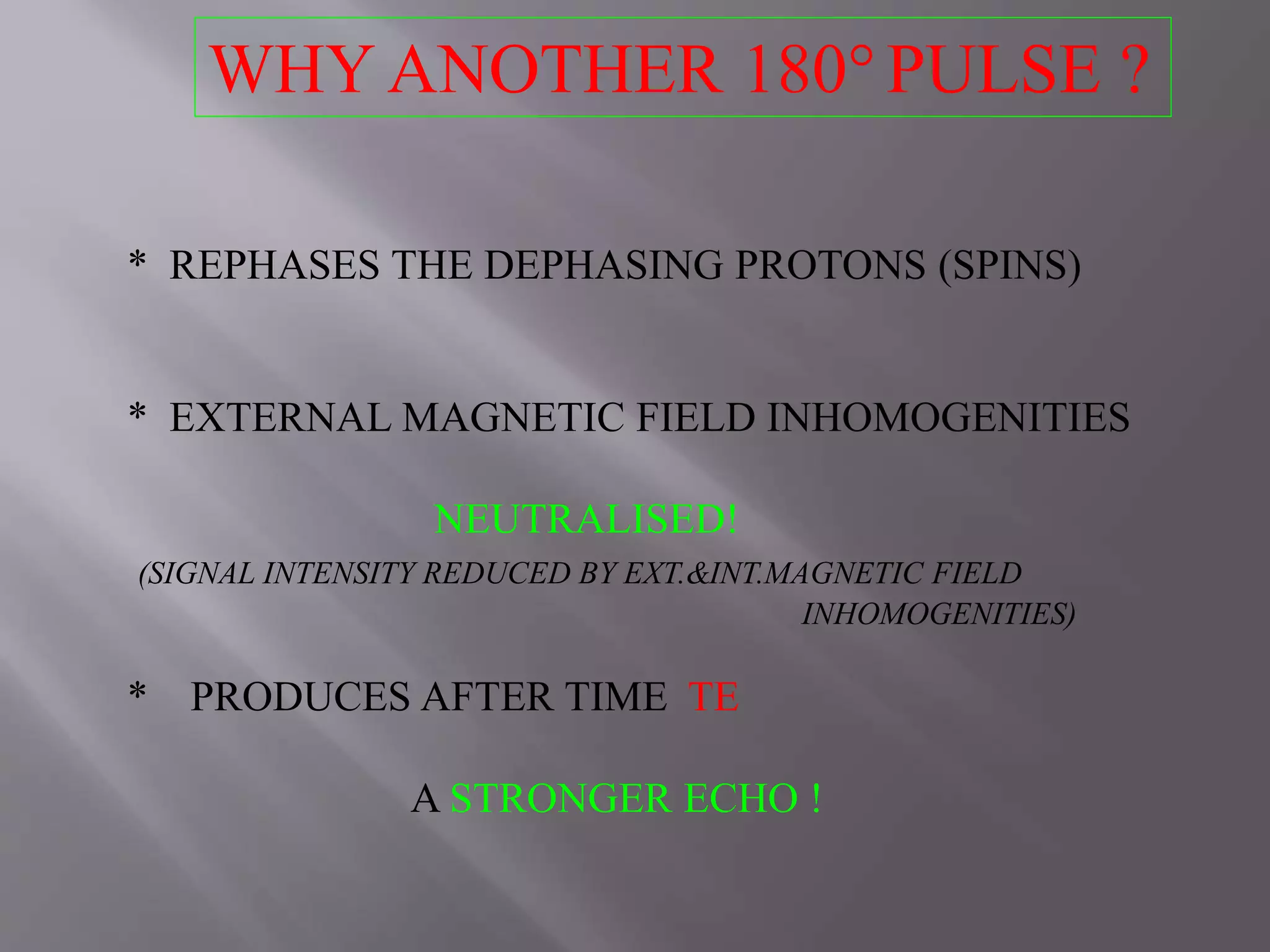
* REPHASES THE DEPHASING PROTONS (SPINS)
* EXTERNAL MAGNETIC FIELD INHOMOGENITIES
NEUTRALISED!
(SIGNAL INTENSITY REDUCED BY EXT.&INT.MAGNETIC FIELD
INHOMOGENITIES)
* PRODUCES AFTER TIME TE
A STRONGER ECHO !
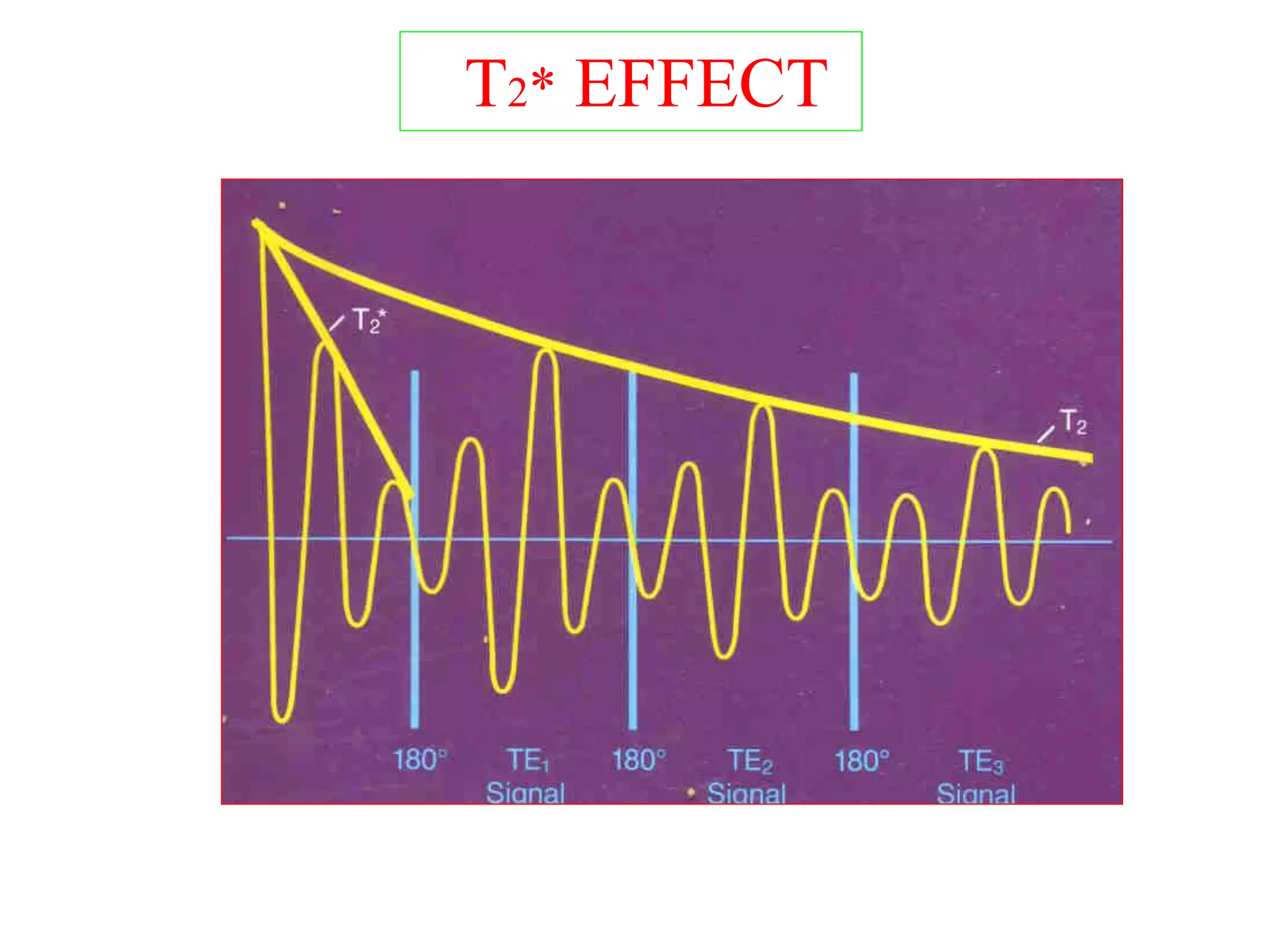
T2* EFFECT
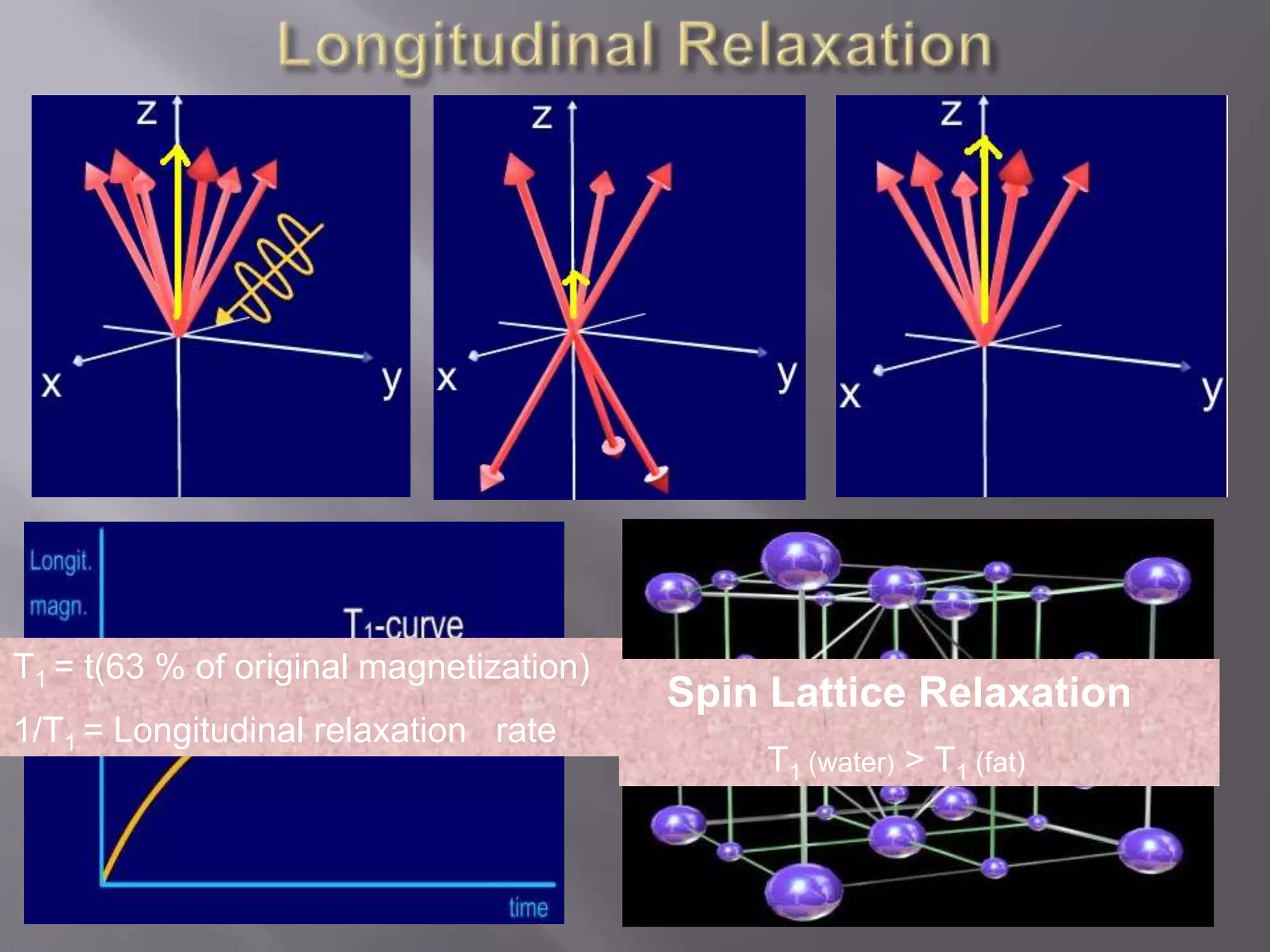
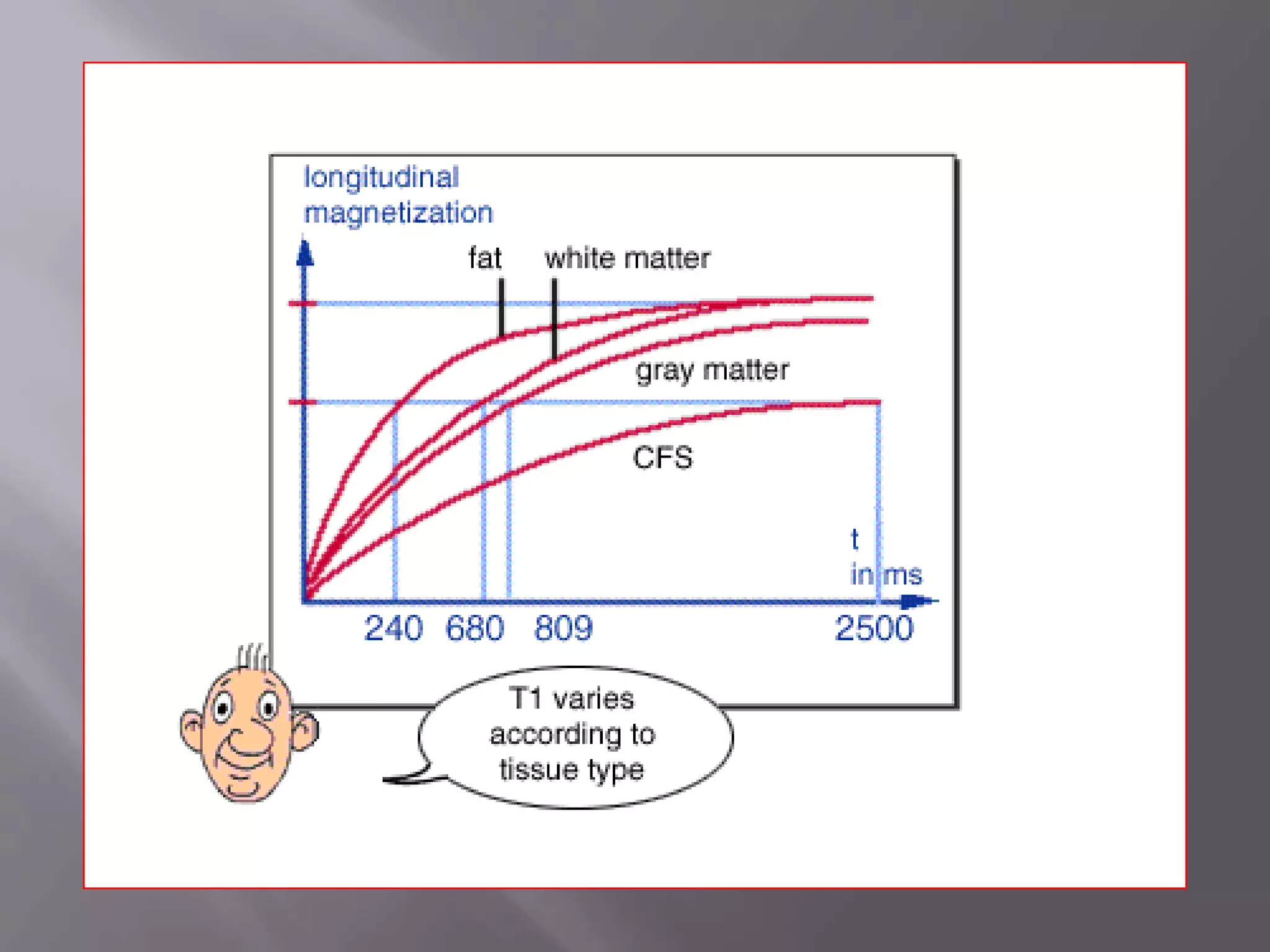
T1 = t(63 % of original magnetization)
1/T1 = Longitudinal relaxation rate
Spin Lattice Relaxation
T1 (water) > T1 (fat)
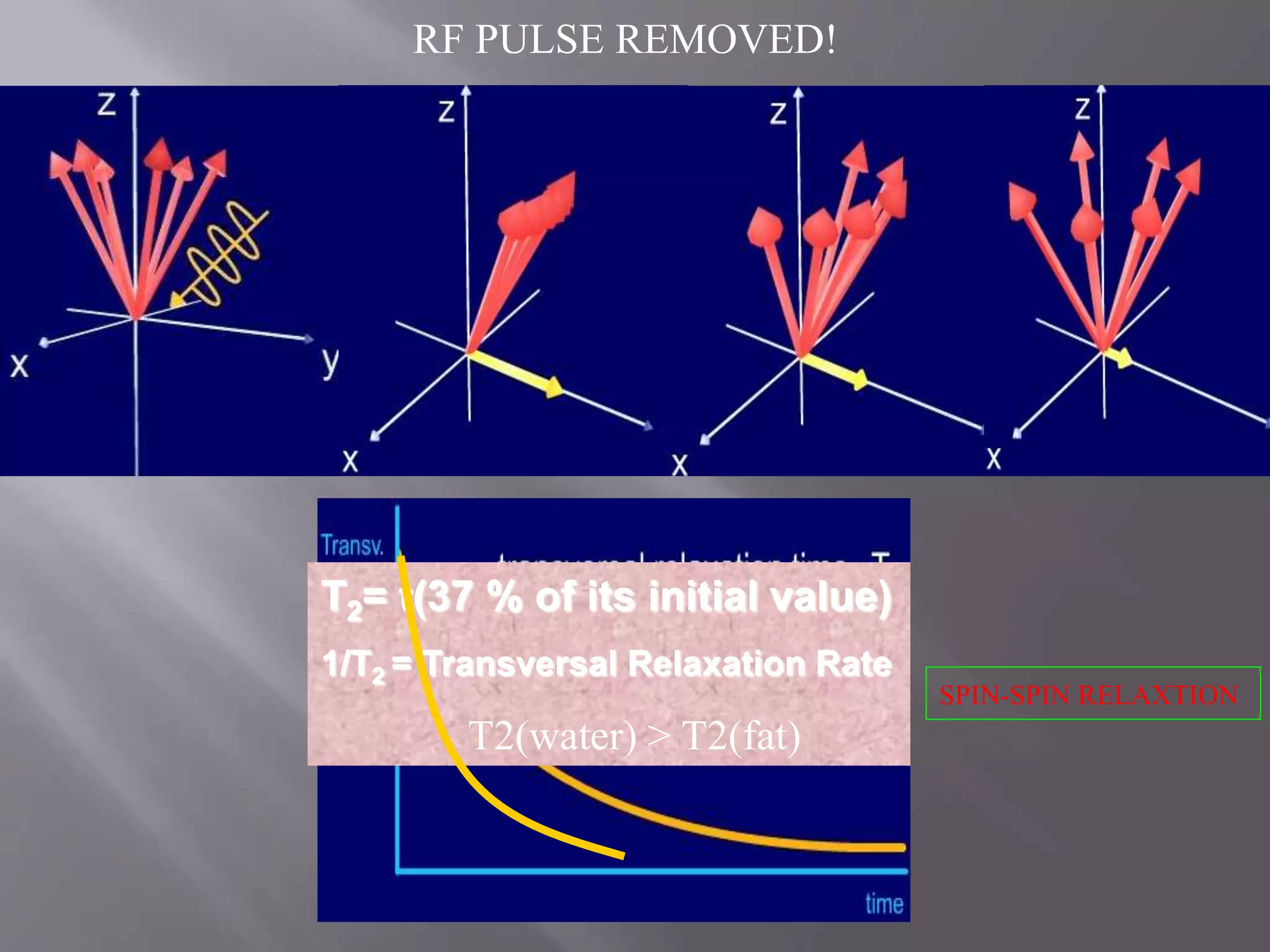
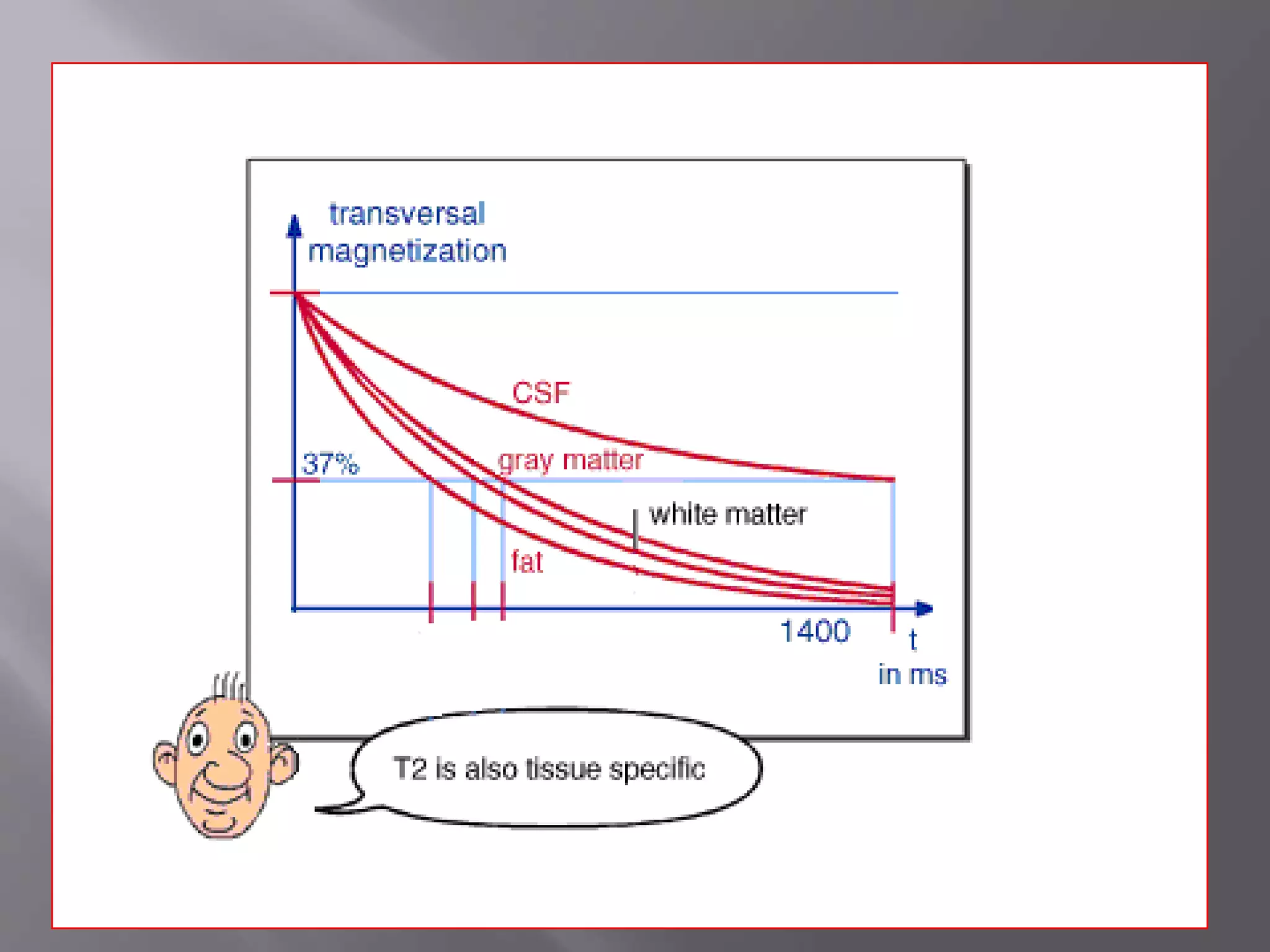
T2= t(37 % of its initial value)
1/T2 = Transversal Relaxation Rate
T2(water) > T2(fat)
RF PULSE REMOVED!
SPIN-SPIN RELAXTION
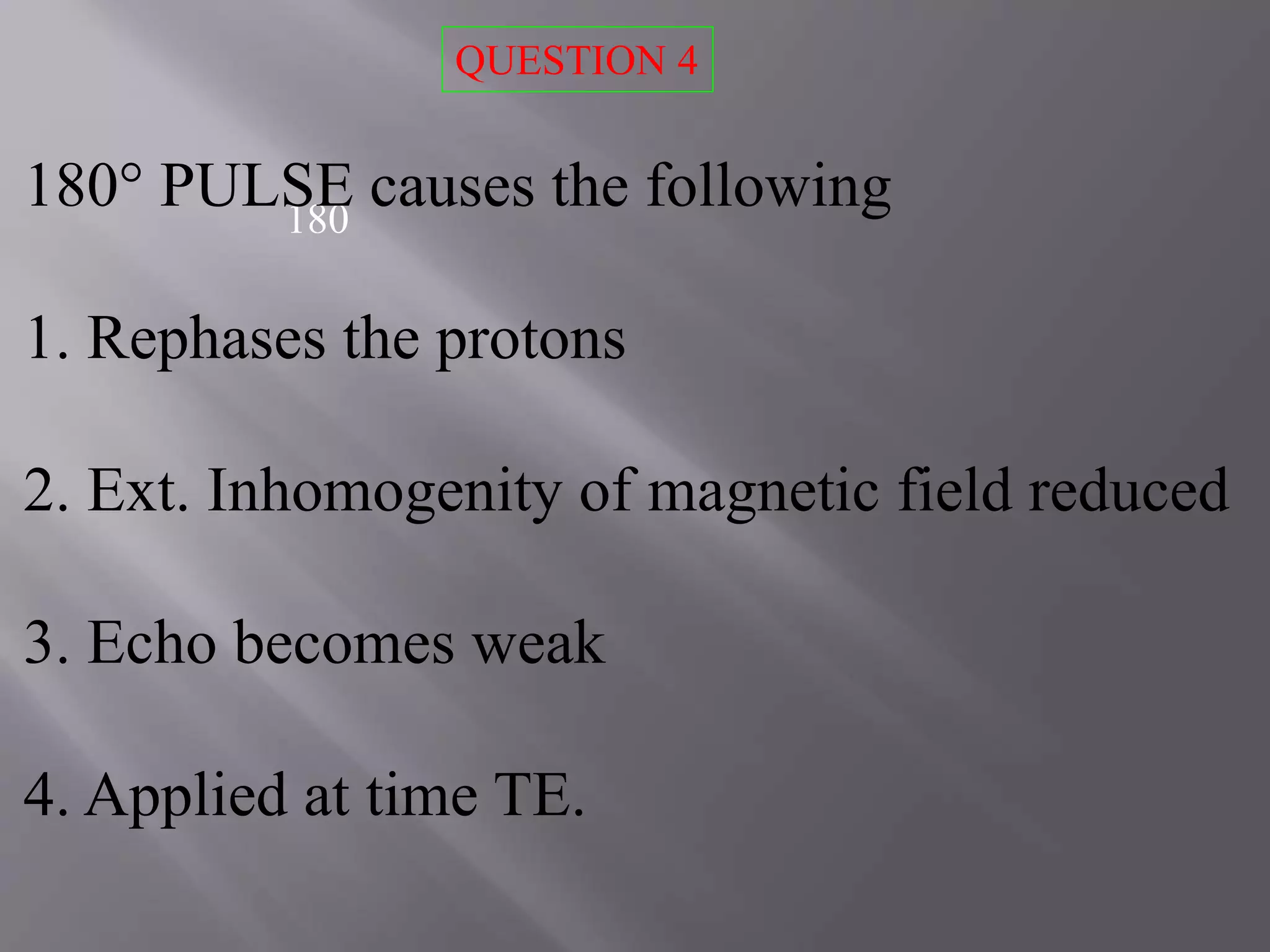
180
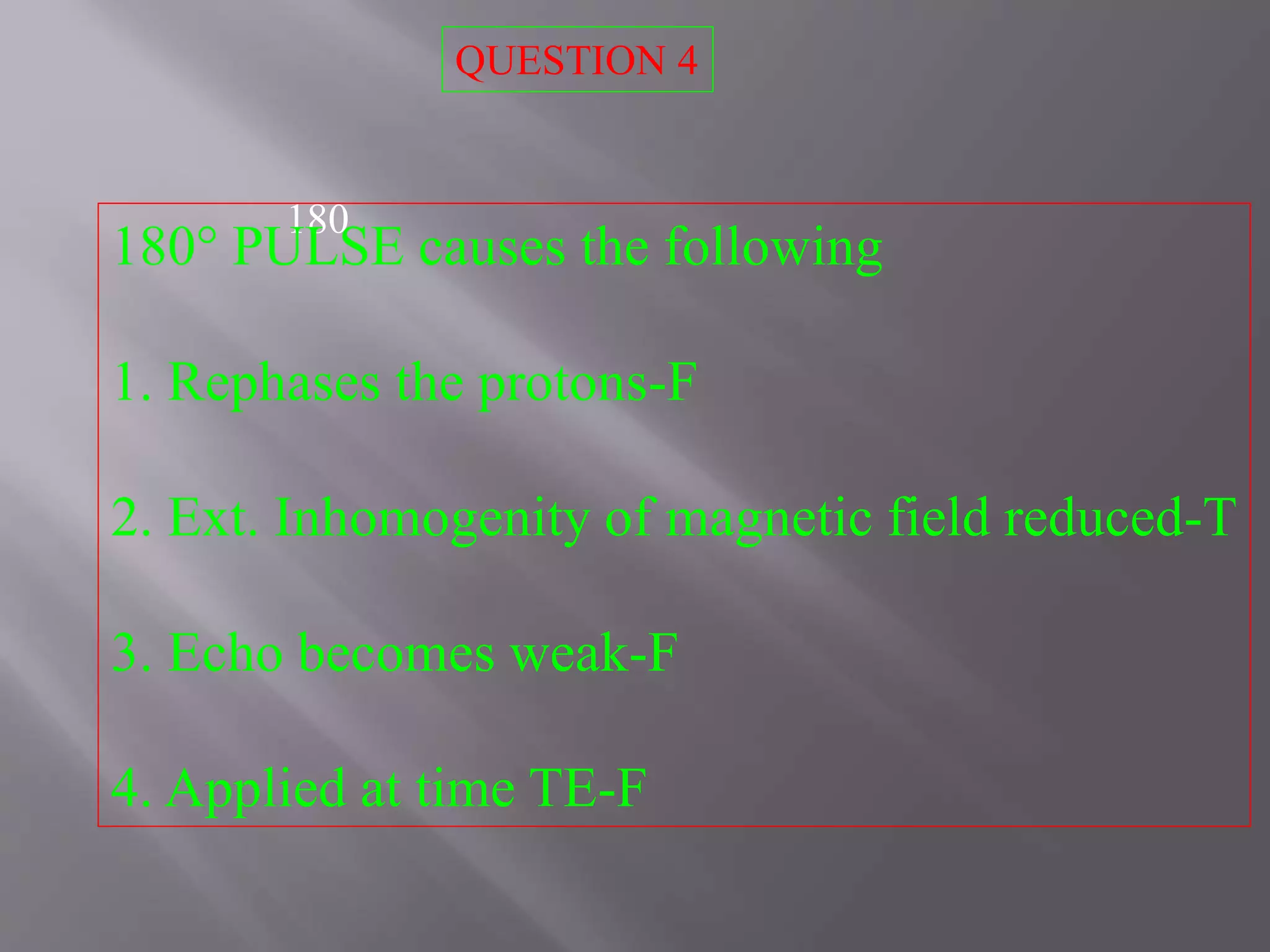
180° PULSE causes the following
1. Rephases the protons
2. Ext. Inhomogenity of magnetic field reduced
3. Echo becomes weak
4. Applied at time TE.
QUESTION 4
F
90 90TR
GΦ
TE/2
TE
GZ
GX
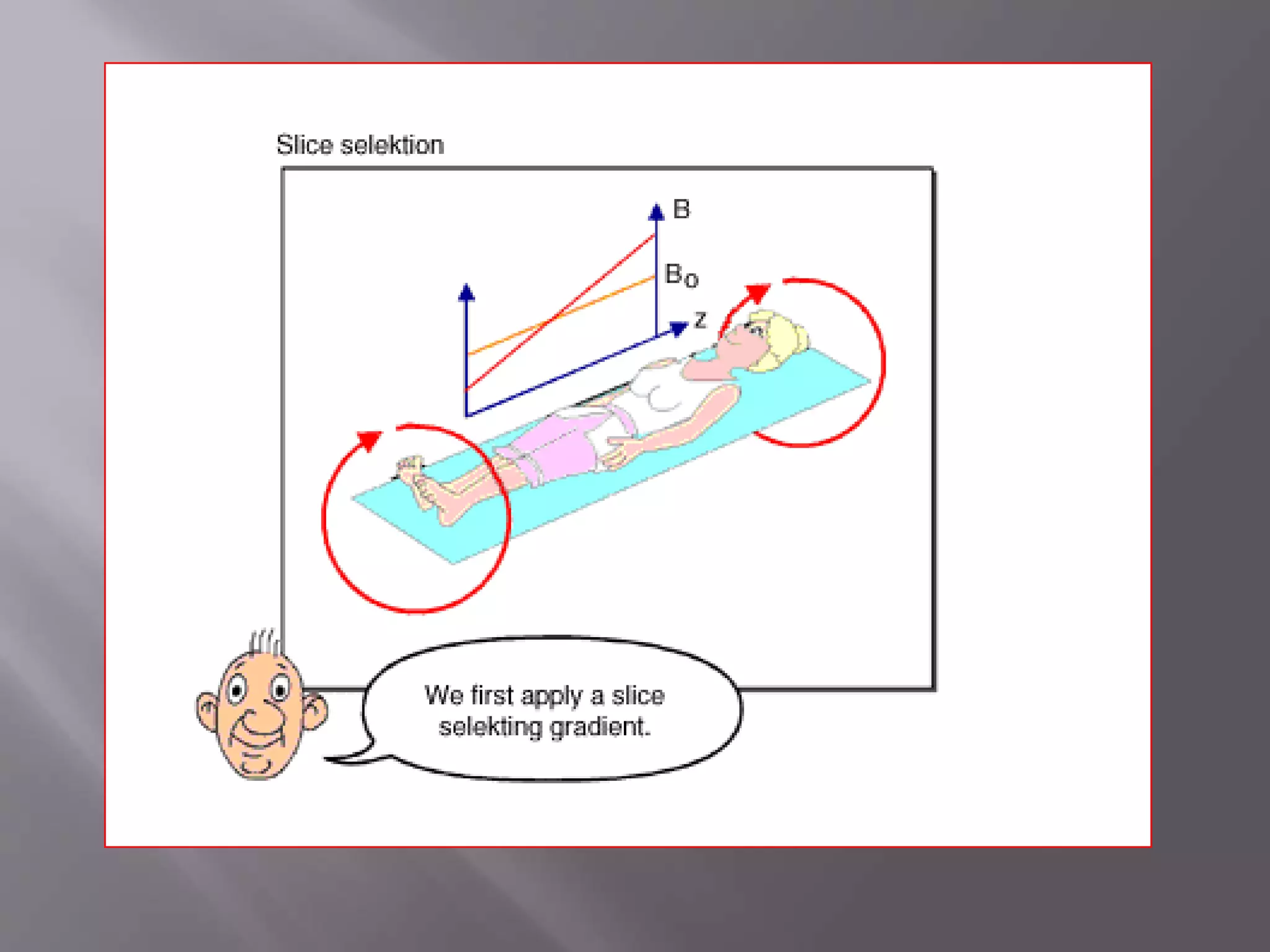
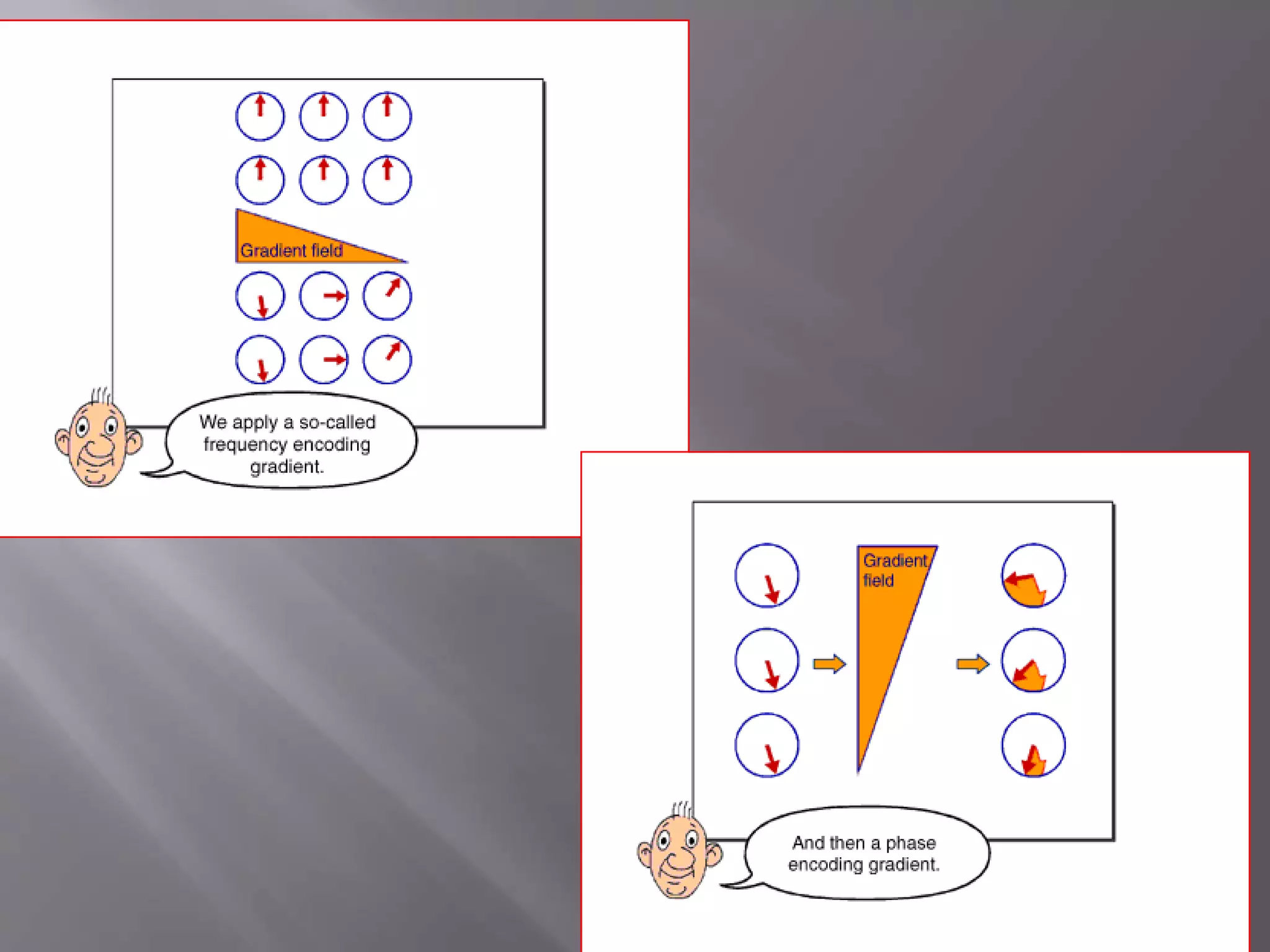
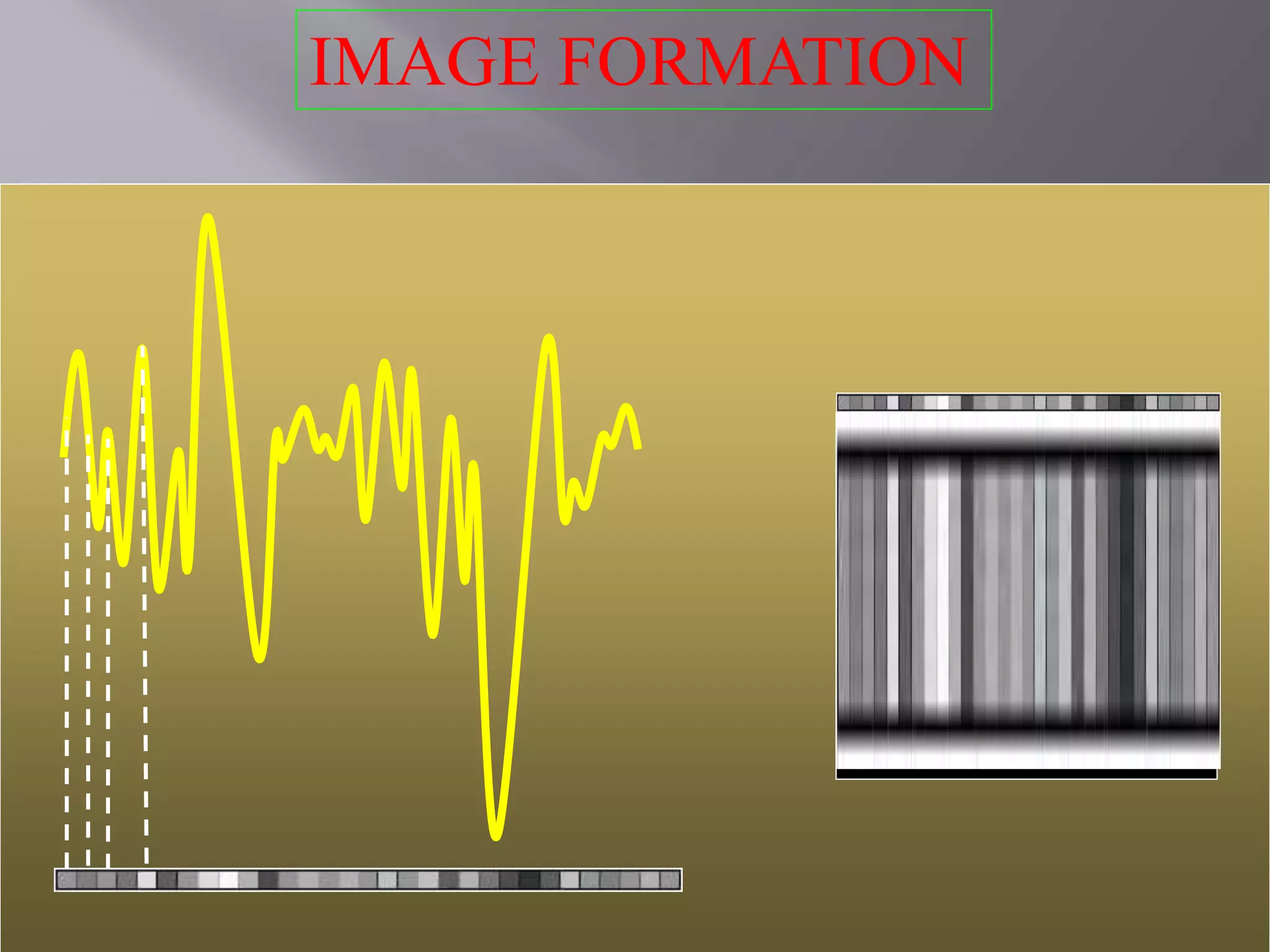
IMAGE FORMATION
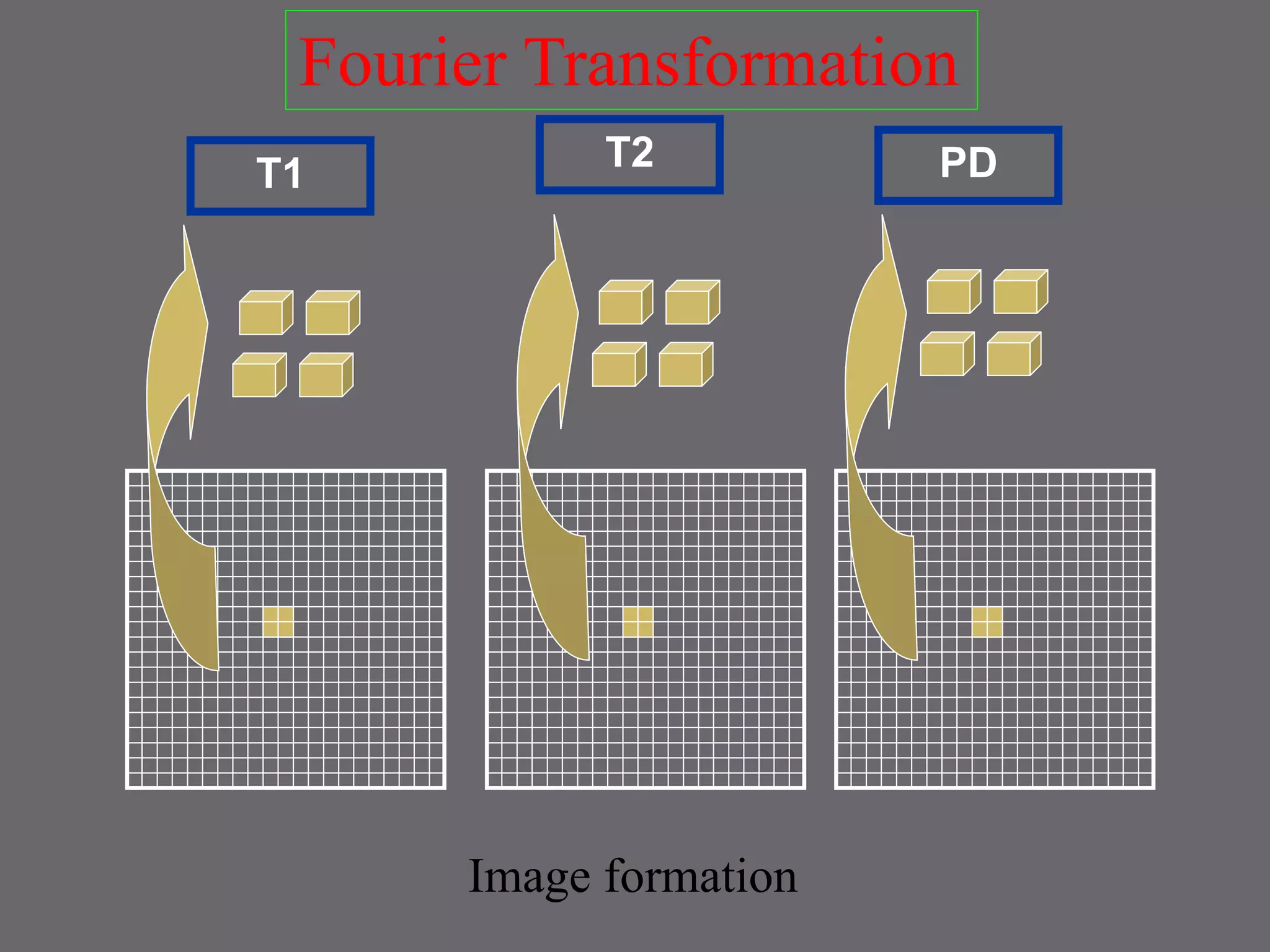
T1 T2 PD
Fourier Transformation
Image formation
GRADIENT
COILS
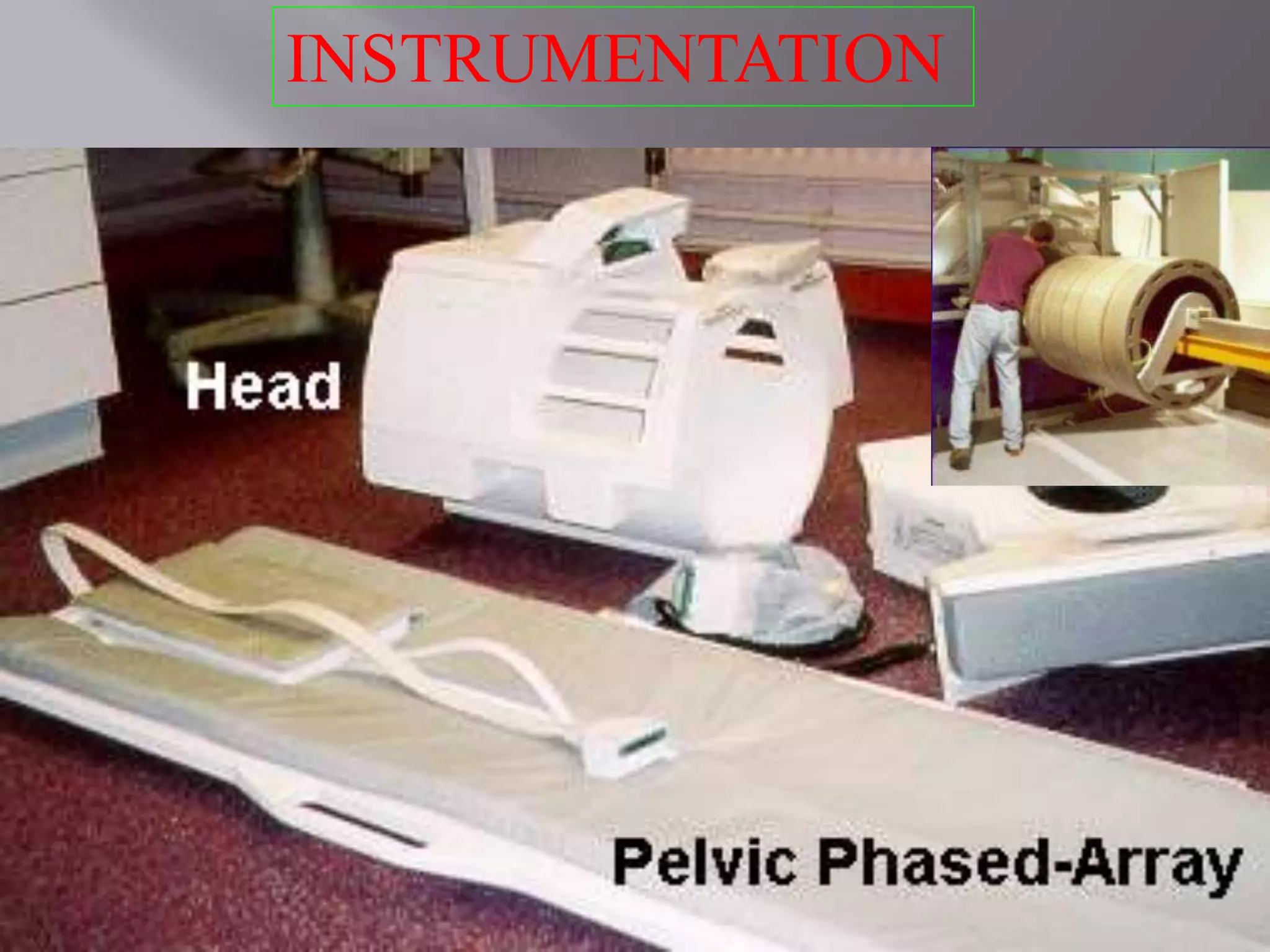
RF Coils
Depending on the working
-Transmit and Receive Coil
-Transmit only Coil
-Receive only Coil
Depending on the application
-Volume Coil
-Surface Coil
-Internal Coil
INSTRUMENTATION
1) Put subject in big magnetic field
2) Transmit radio waves into subject [about 3 ms]
3) Turn off radio wave transmitter
4) Receive radio waves re-transmitted by subject
5) Store measured radio wave data vs. time
– Now go back to step(2) to get some more data
6) Process raw data to reconstruct images
NUT SHELL!
1. A vector has a force and direction -T
2. Net Magnetic vector of the body is in direction
of main magnet-T
3.precession frequency decrease with increase of
ext. magnetic field-F
4.Spins pointing up are always more than that is down-T
Question 1
Precession frequency
1. Is the freqeuncy of the nucleus -F
2. Is the freqeuncy of the protons-T
3. Is directly proportional to strength of
main magnet(B0)-T
4. Is the frequency of the spins-T
Question 2
Question 3
RF PULSE
1. When RF pulse is off SPINS DEPHASE-T
2. RF pulse has same frequency as that of spins-T
3. Inphase vector is always in transverse direction-F
4. A moving magnetic field induces a current-T
180
180° PULSE causes the following
1. Rephases the protons-F
2. Ext. Inhomogenity of magnetic field reduced-T
3. Echo becomes weak-F
4. Applied at time TE-F
QUESTION 4
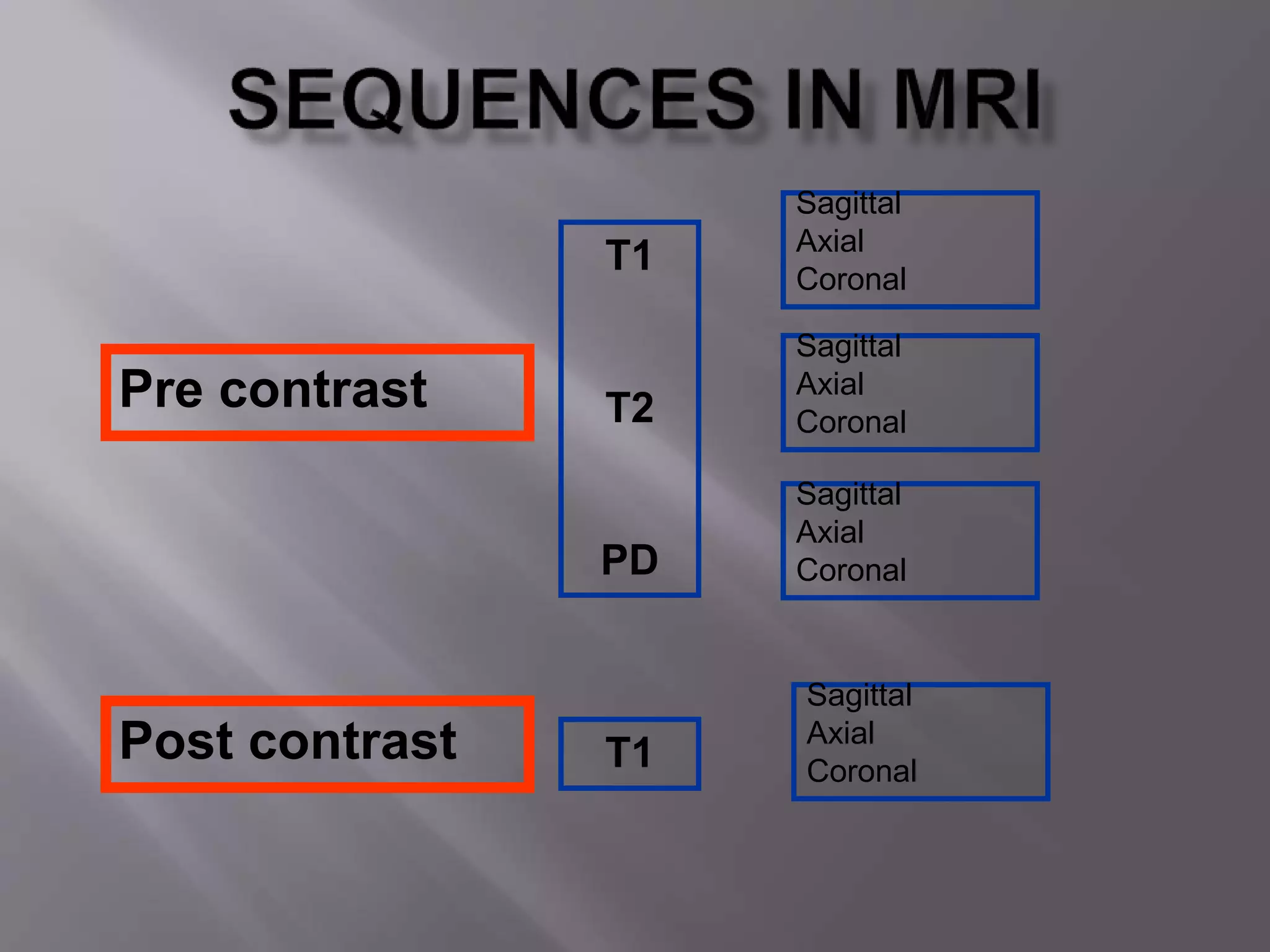
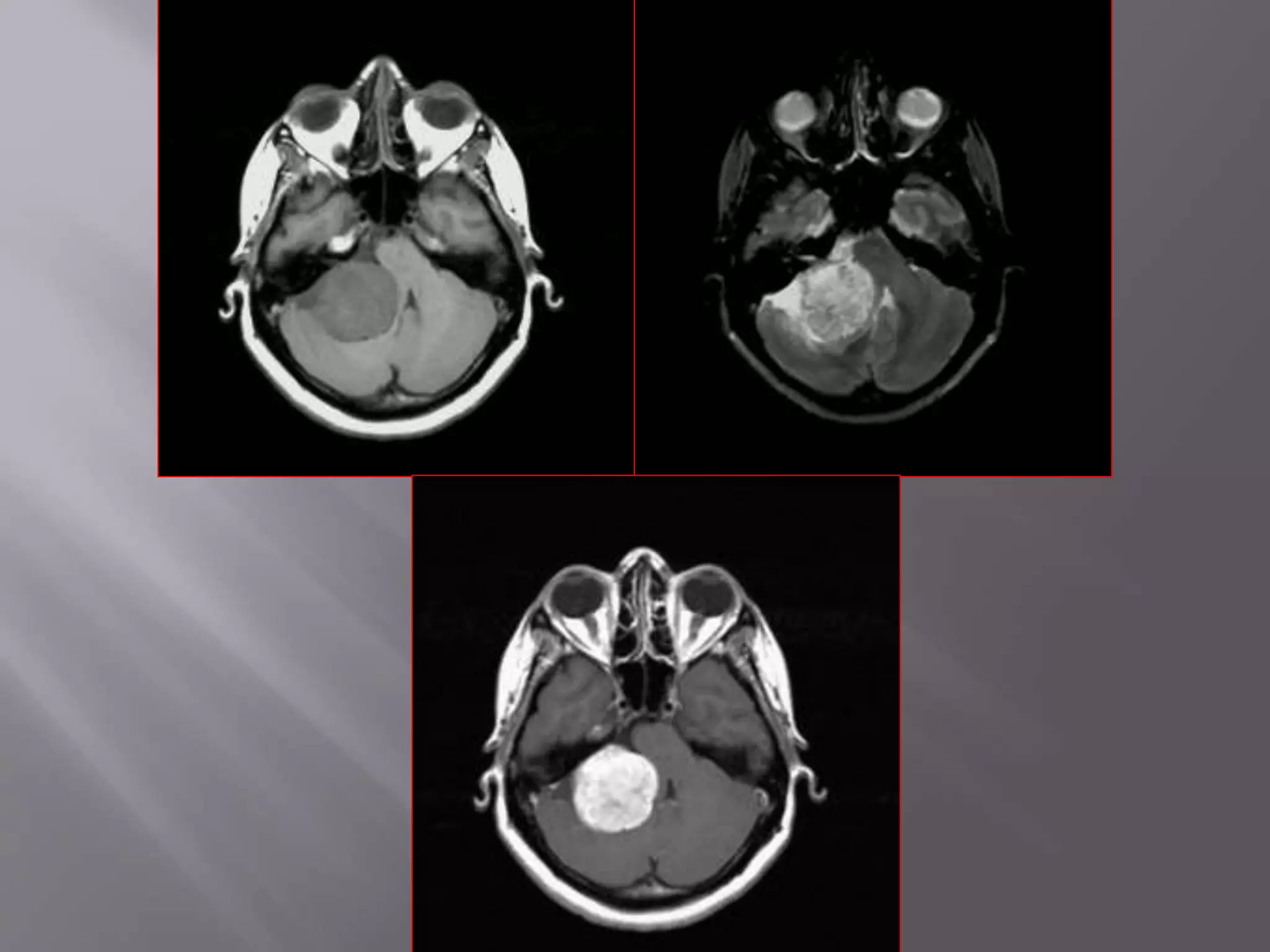
Pre contrast
T1
T2
PD
Post contrast T1
Sagittal
Axial
Coronal
Sagittal
Axial
Coronal
Sagittal
Axial
Coronal
Sagittal
Axial
Coronal
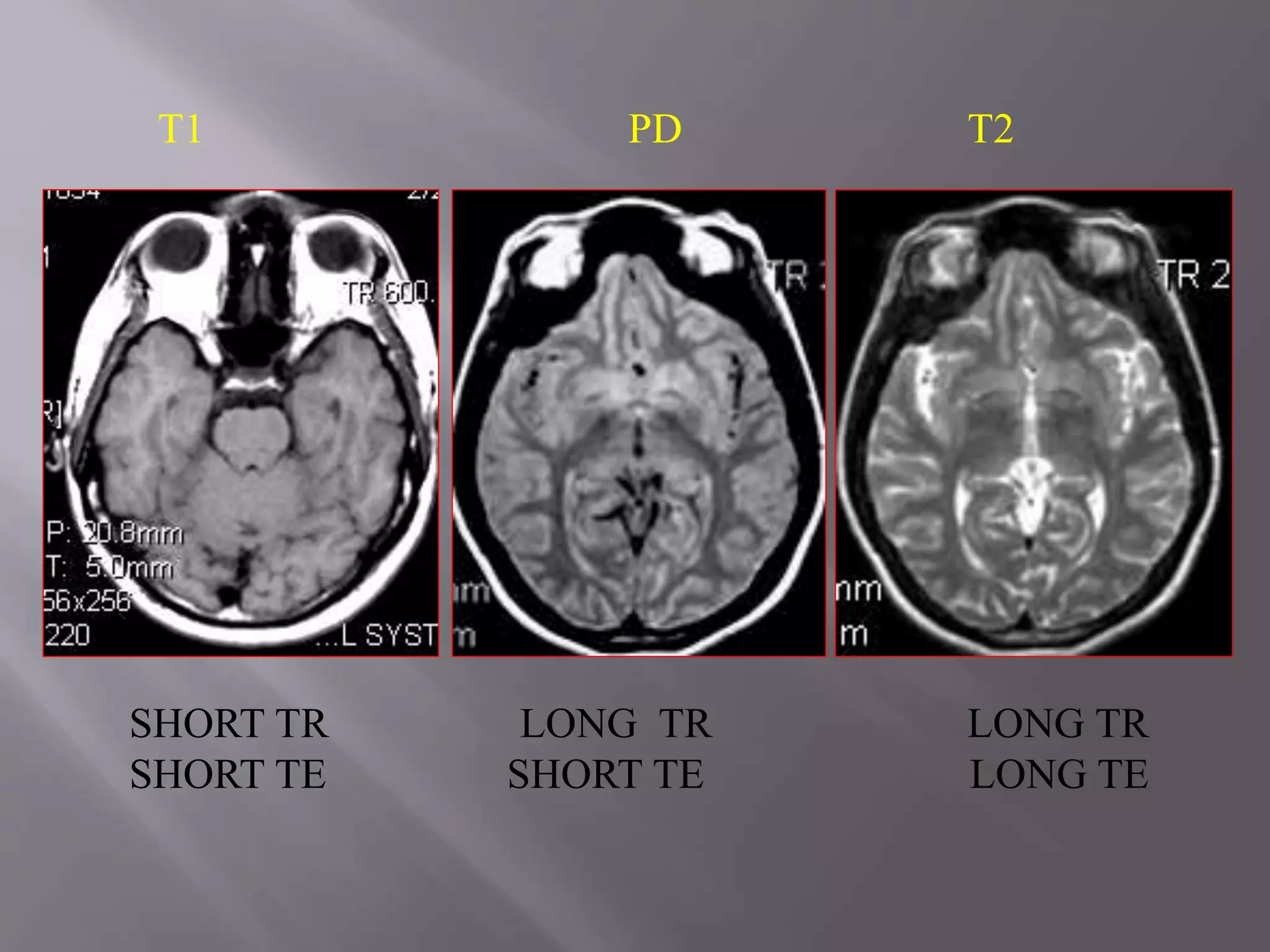
T1 PD T2
SHORT TR LONG TR LONG TR
SHORT TE SHORT TE LONG TE
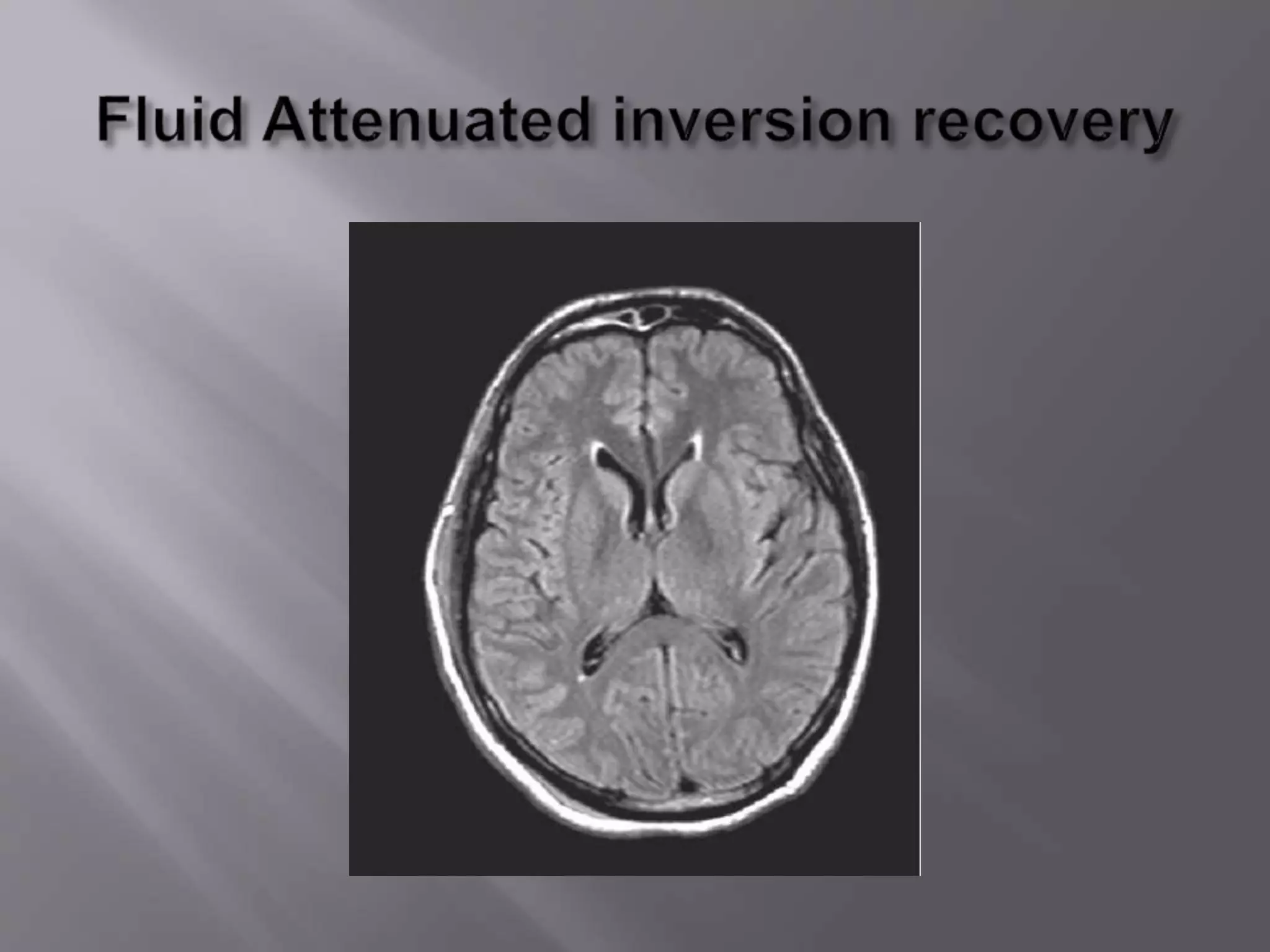
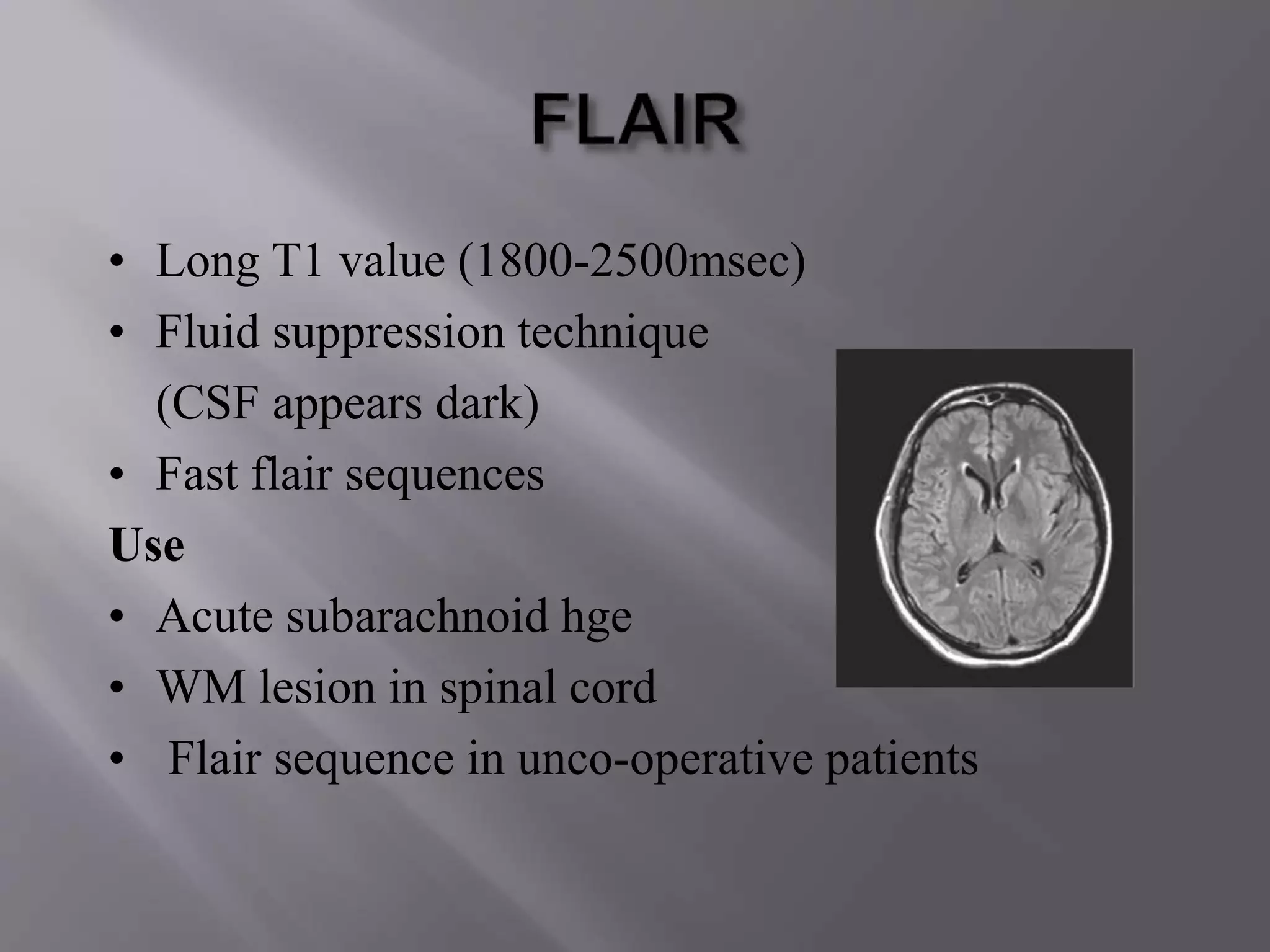
• Long T1 value (1800-2500msec)
• Fluid suppression technique
(CSF appears dark)
• Fast flair sequences
Use
• Acute subarachnoid hge
• WM lesion in spinal cord
• Flair sequence in unco-operative patients
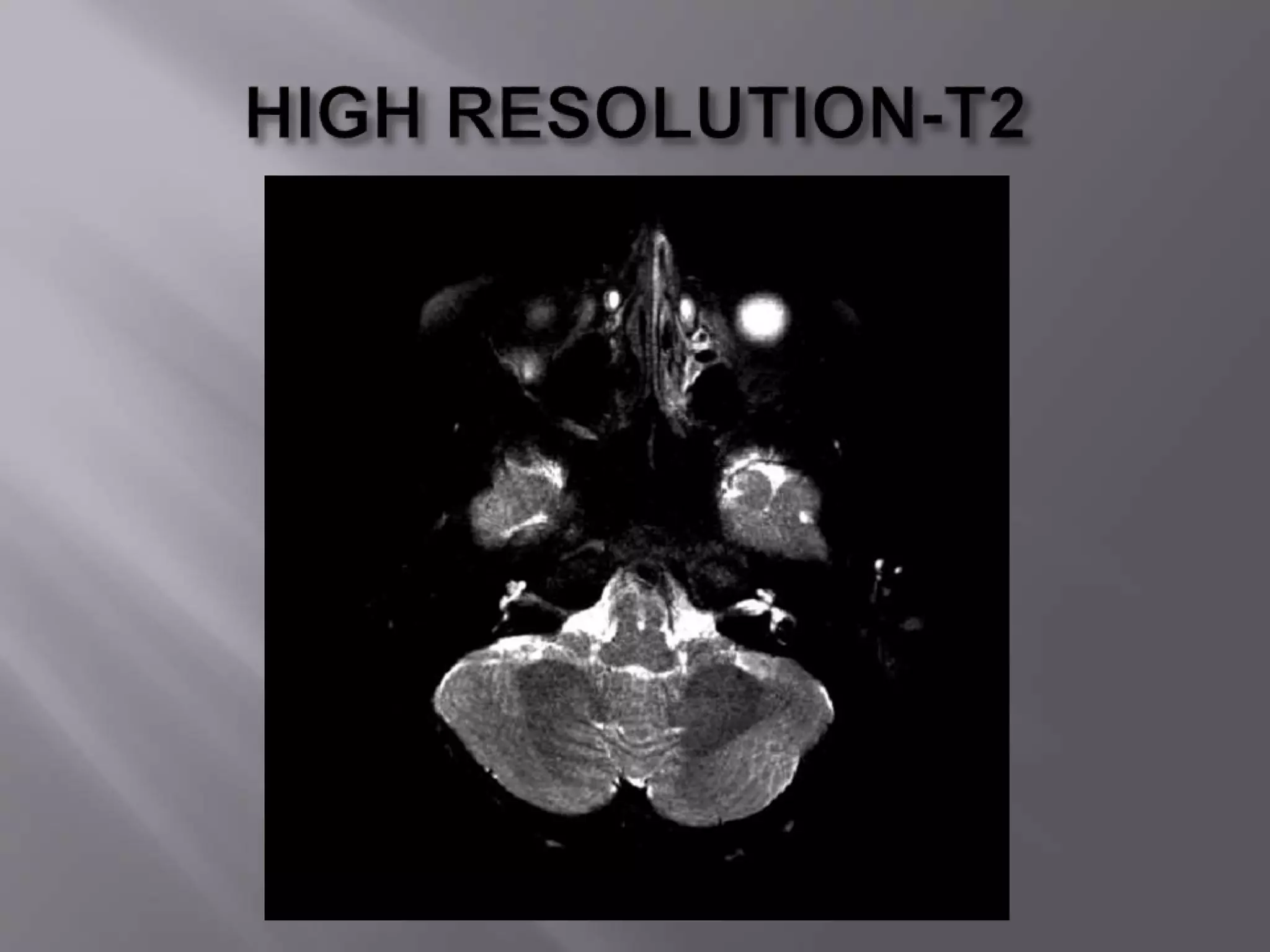
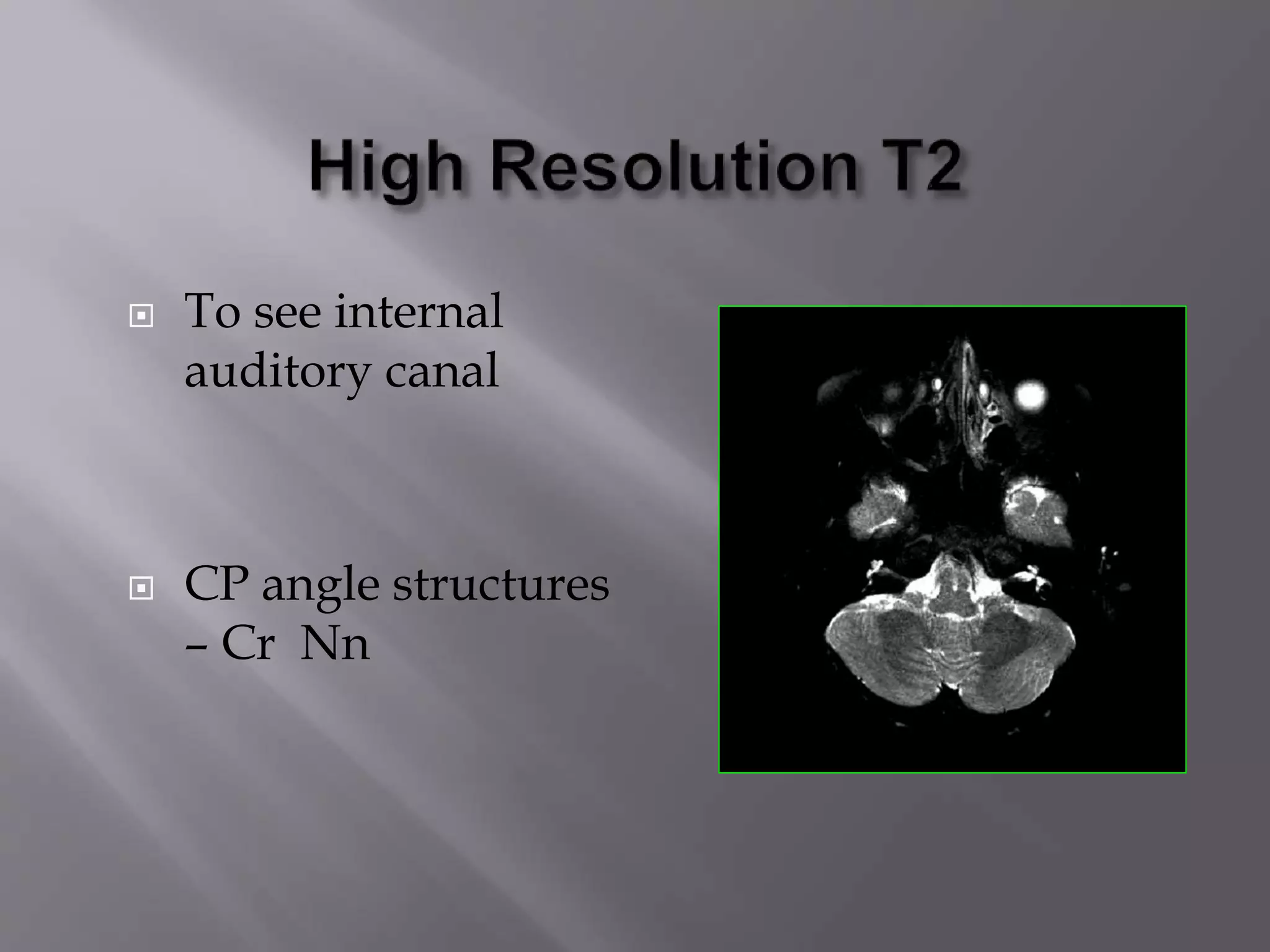
 To see internal
auditory canal
 CP angle structures
– Cr Nn
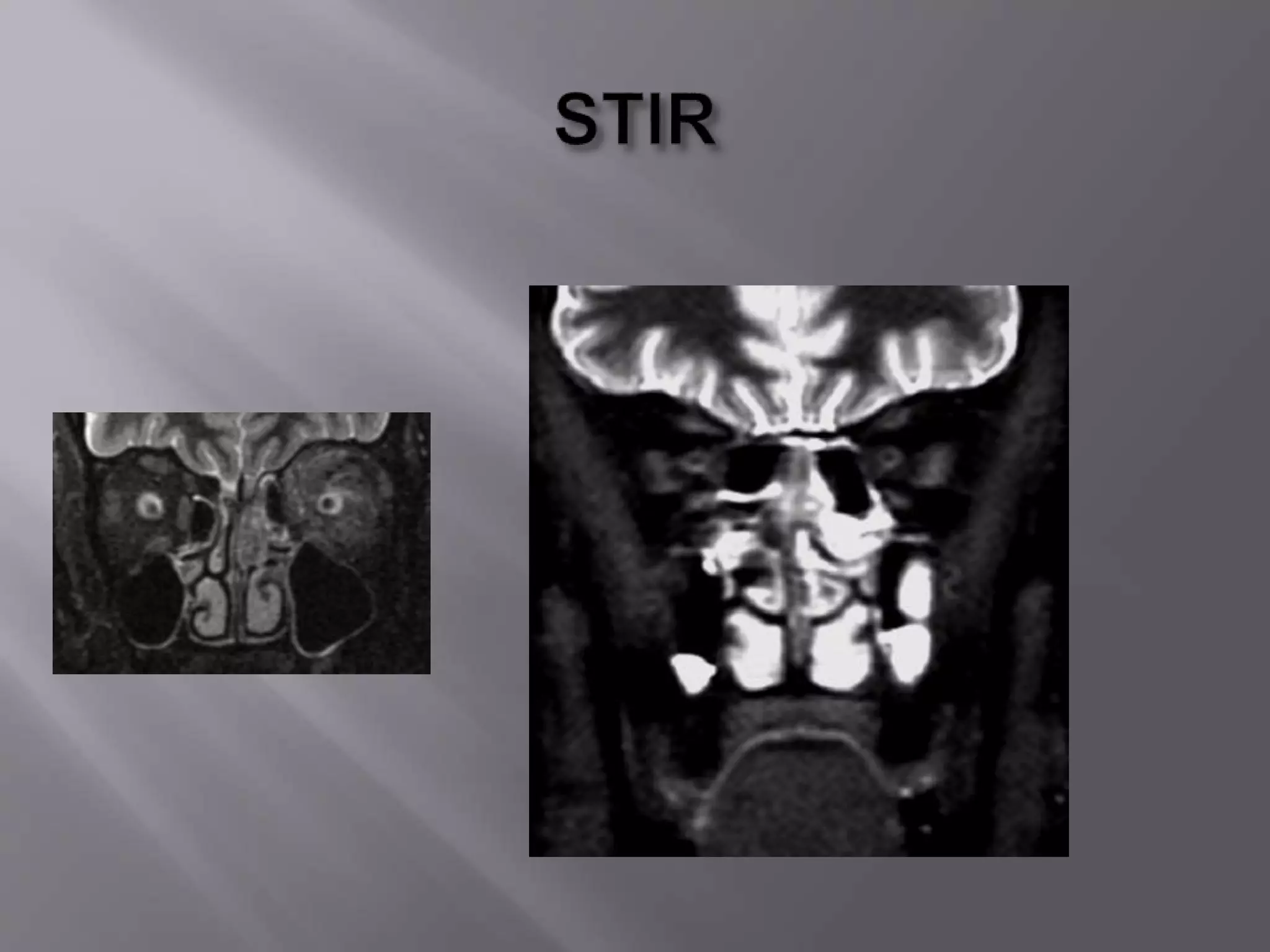
 Short T1 inversion recovery
 T1 – inversion time
 Fat suppression
 Useful in Orbit, Optic N
 Bone marrow imaging – Metastasis
 (BM & Fat suppressed – Met; lesion more
conspicuous)
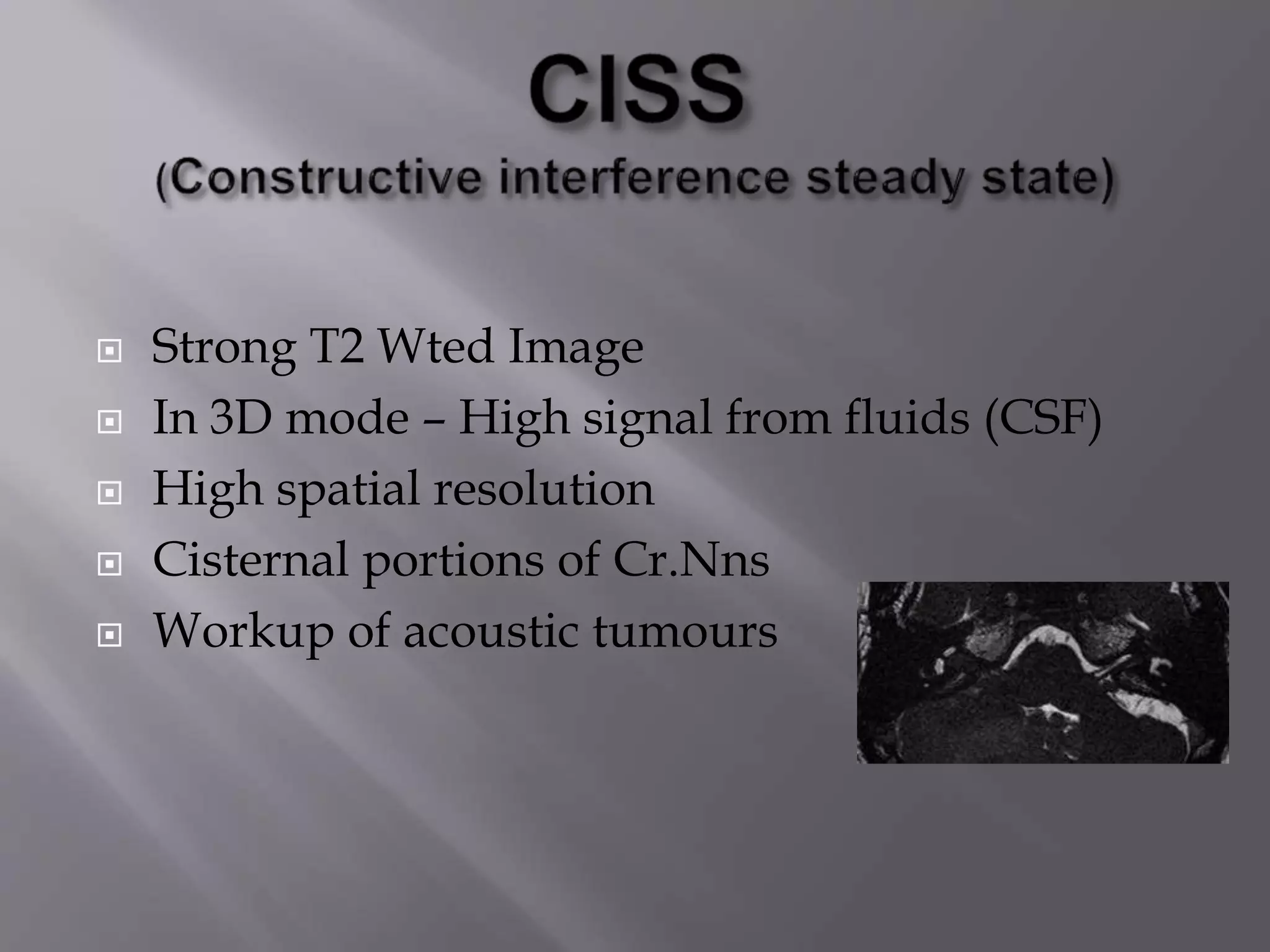
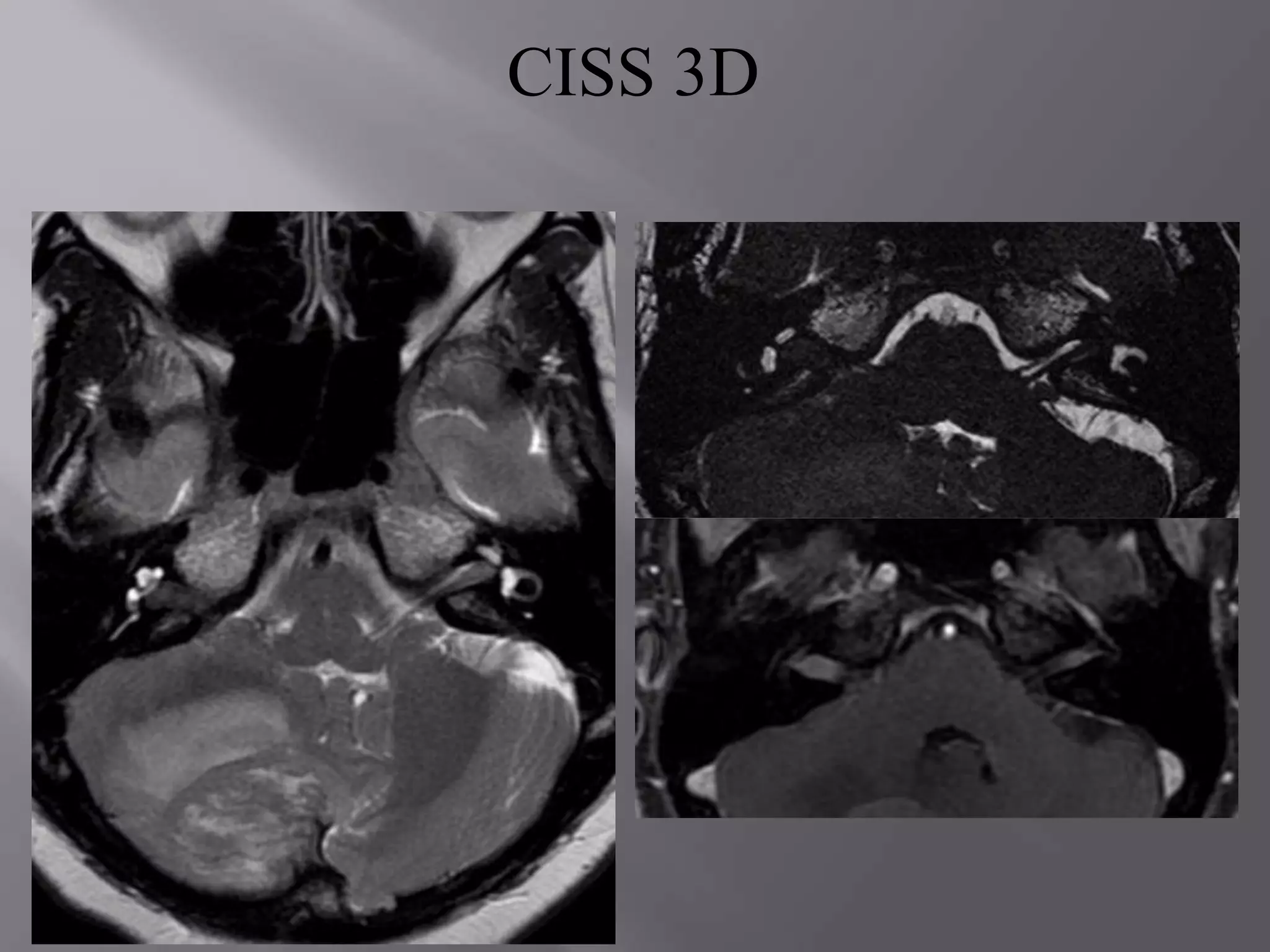
 Strong T2 Wted Image
 In 3D mode – High signal from fluids (CSF)
 High spatial resolution
 Cisternal portions of Cr.Nns
 Workup of acoustic tumours
CISS 3D
STIR
1. Is a FAT SUPPRESSED SEQUENCE
2. Ideal in CSF RHINORREA
3. FAT HAS SHORT TI VALUE
4. TISSUE WITH LONG T1 APPEAR DARK
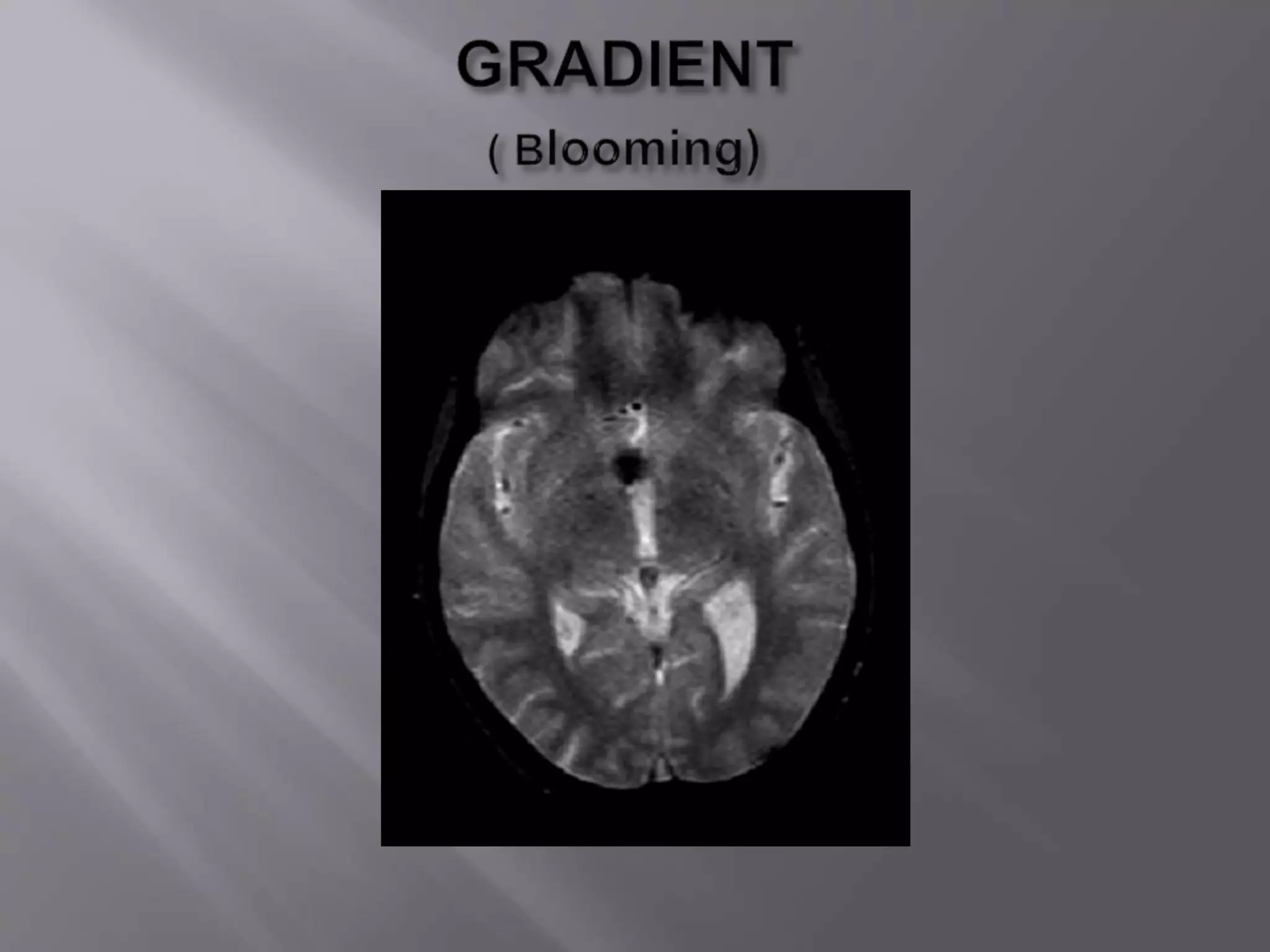
Hypo intensity in GRE
1. Haemorrhage – Deoxy Hb
Meth Hb
Ferritin (Haemosiderin other Iron forms)
2. Calcification – Diamagnetic ca salts
Associated paramagnetic ions
3. Air containing PNS
4. Normal brain iron
5. Intratumoral melanin
6. Paramagnetic devices, Fn bodies
7. Ferromagnetic devices, Fn bodies
8. Intravascular deoxygenated blood.
1. Fat (Biological / oil based contrast agent)
2. Very high non-paramagnetic Protein content
3. Paramagnetic or iodinated contrast agent
4. Calcification
5. Paramagnetic ions (associated with liver disease,
hyper alimentation, calcification, necrosis)
6. Mucinous material
7. Intraluminal melanin
8. Hypermyelination
9. Paramagnetic artefact
10. Slow flow
 Iron with out hemorrhage
 Calcification or bone
 Air
 Very high paramagnetic Protein content
 Deoxy Hb in patent veins
 Mucinous material
 Rapid or turbulent flow
 Ferromagnetic artefact
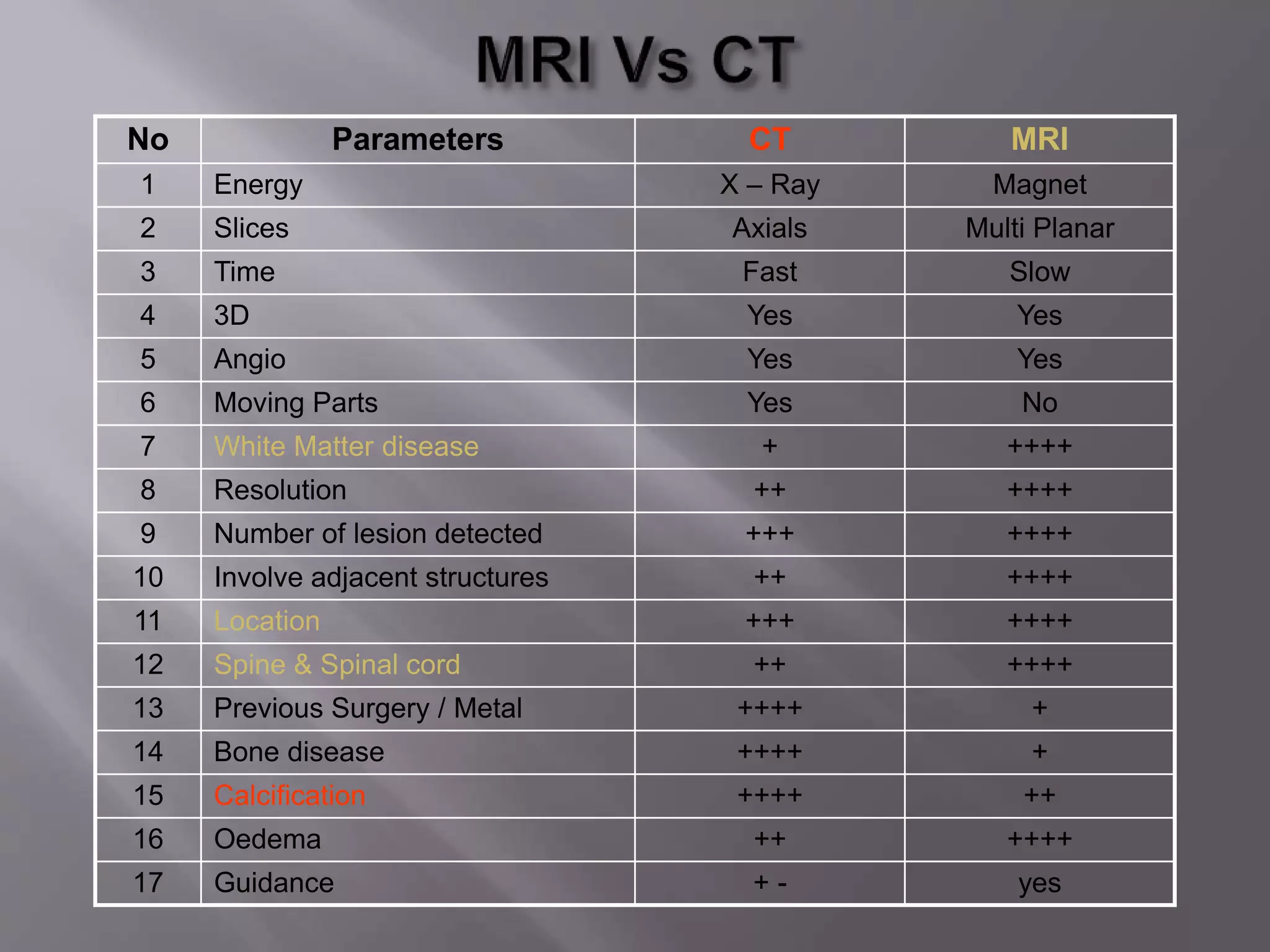
No Parameters CT MRI
1 Energy X – Ray Magnet
2 Slices Axials Multi Planar
3 Time Fast Slow
4 3D Yes Yes
5 Angio Yes Yes
6 Moving Parts Yes No
7 White Matter disease + ++++
8 Resolution ++ ++++
9 Number of lesion detected +++ ++++
10 Involve adjacent structures ++ ++++
11 Location +++ ++++
12 Spine & Spinal cord ++ ++++
13 Previous Surgery / Metal ++++ +
14 Bone disease ++++ +
15 Calcification ++++ ++
16 Oedema ++ ++++
17 Guidance + - yes
No Tissues T1 T2 CT
1 Water Hypo Hyper Iso
2 Fat Hyper Hypo/Iso Hypo
3
Hematoma
(Depends on
Stage)
Hyper Hyper Hyper
4 Bone Hypo Hypo Hyper
5 Flow Hypo Hypo Iso
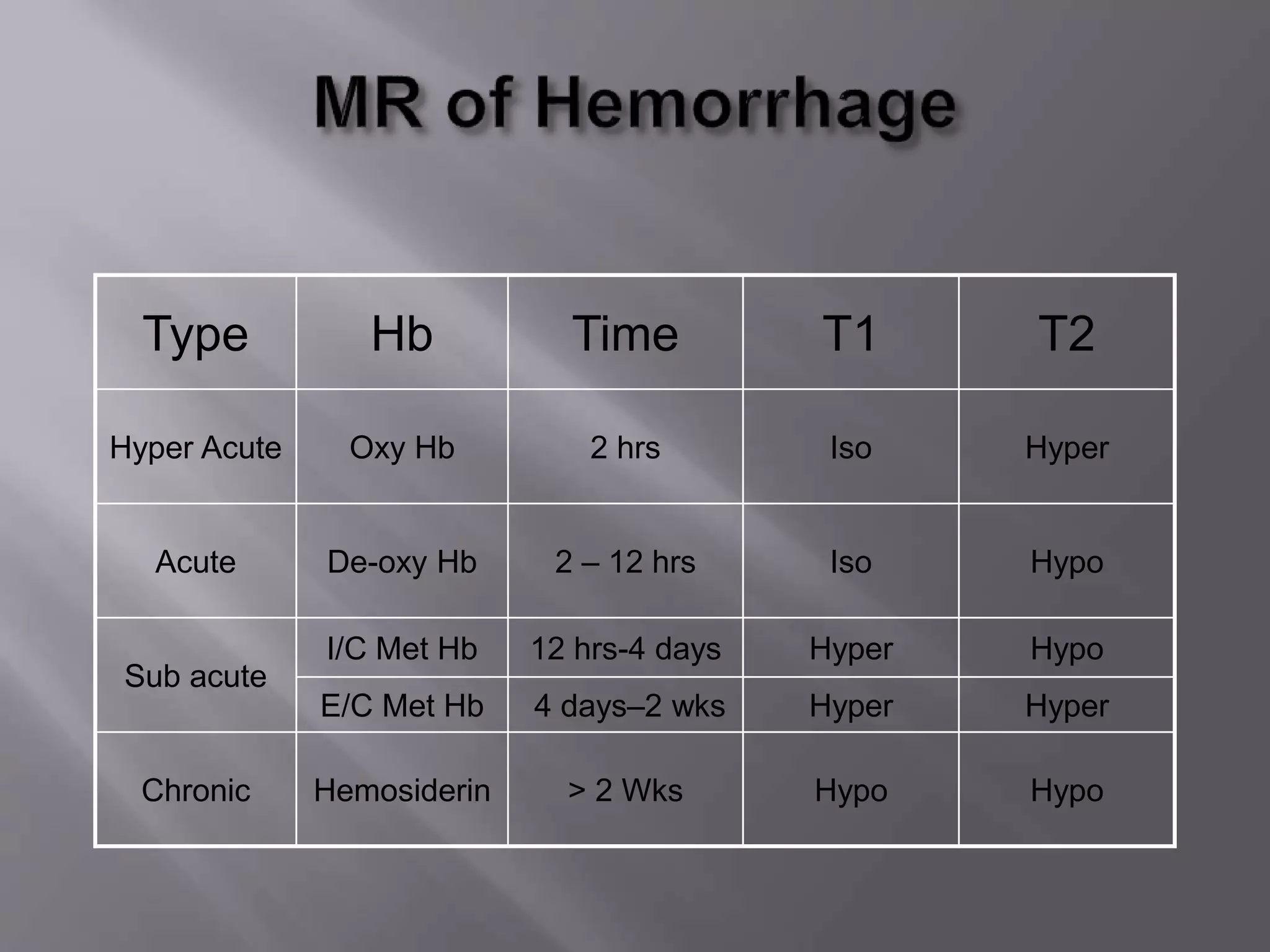
Type Hb Time T1 T2
Hyper Acute Oxy Hb 2 hrs Iso Hyper
Acute De-oxy Hb 2 – 12 hrs Iso Hypo
Sub acute
I/C Met Hb 12 hrs-4 days Hyper Hypo
E/C Met Hb 4 days–2 wks Hyper Hyper
Chronic Hemosiderin > 2 Wks Hypo Hypo
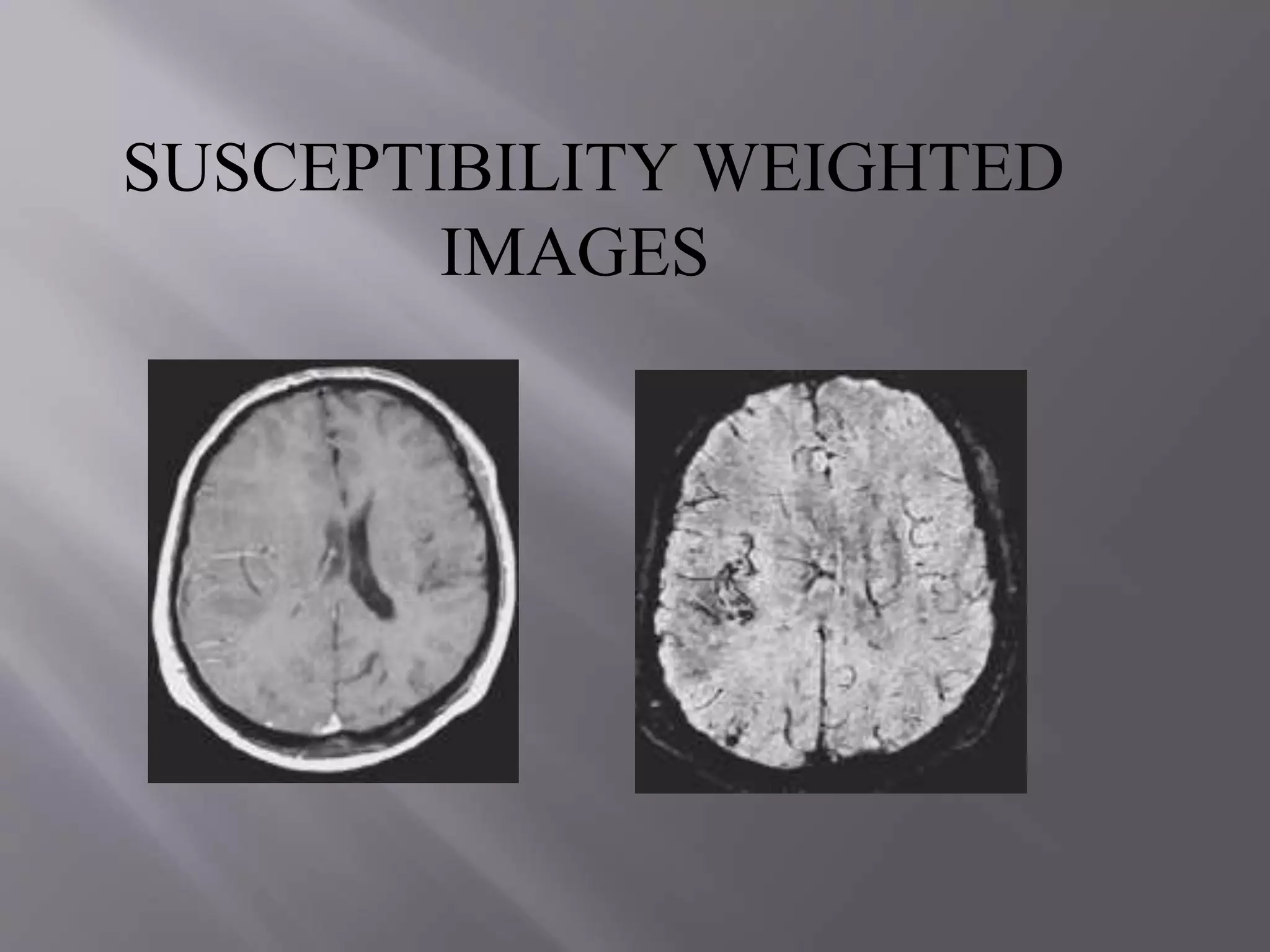
SUSCEPTIBILITY WEIGHTED
IMAGES
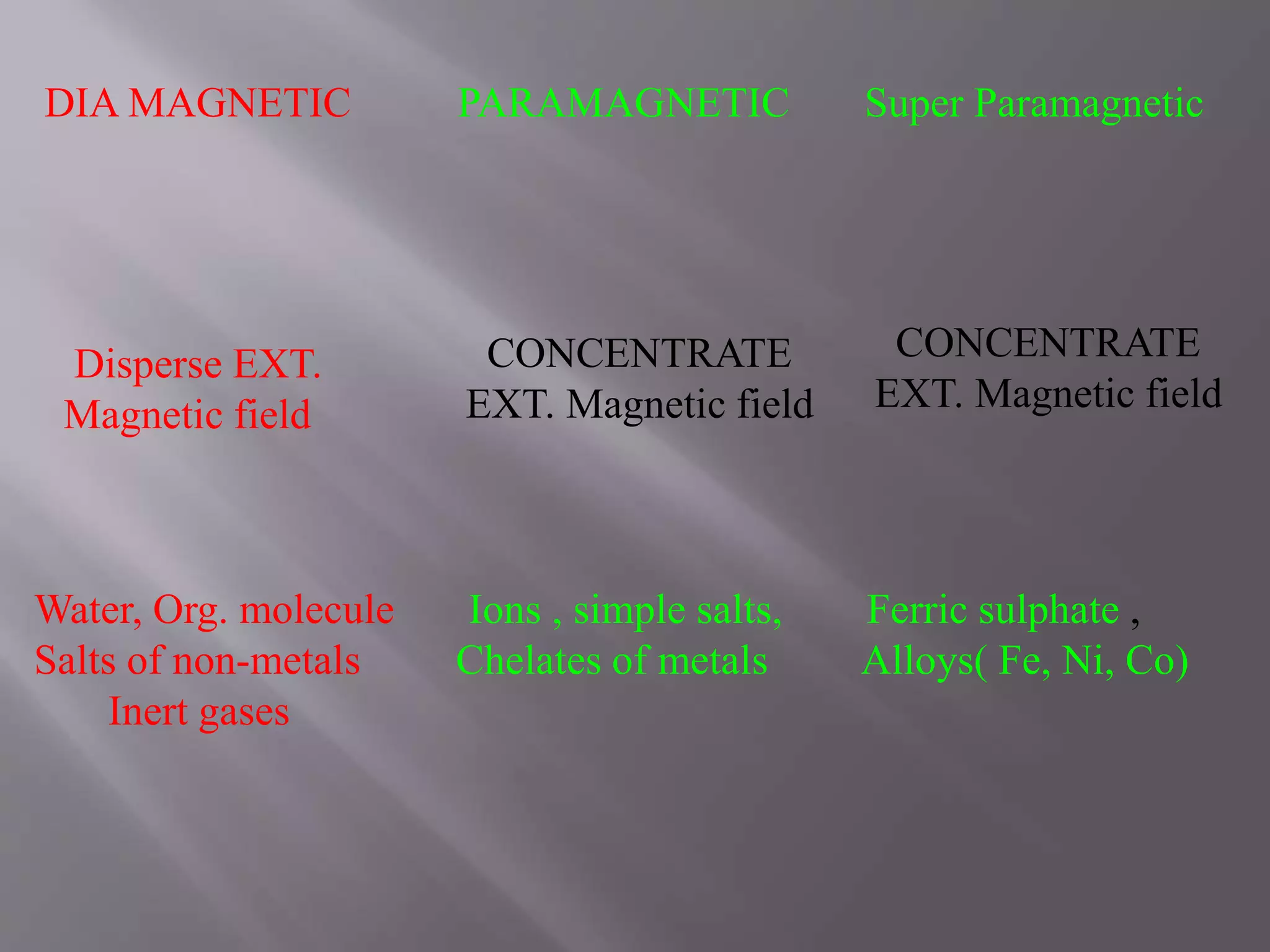
DIA MAGNETIC PARAMAGNETIC Super Paramagnetic
Disperse EXT.
Magnetic field
CONCENTRATE
EXT. Magnetic field
CONCENTRATE
EXT. Magnetic field
Water, Org. molecule Ions , simple salts, Ferric sulphate ,
Salts of non-metals Chelates of metals Alloys( Fe, Ni, Co)
Inert gases
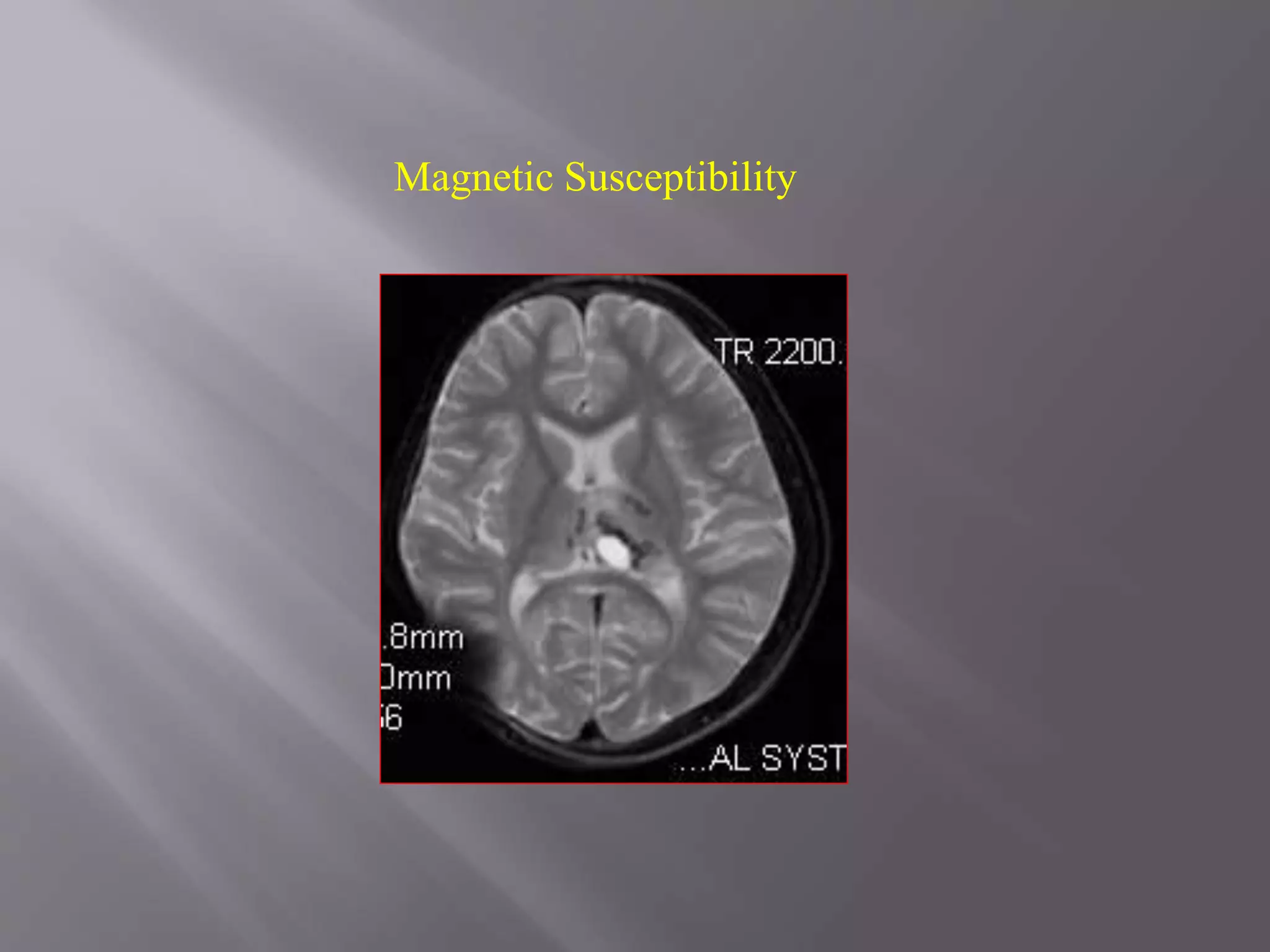
Magnetic Susceptibility
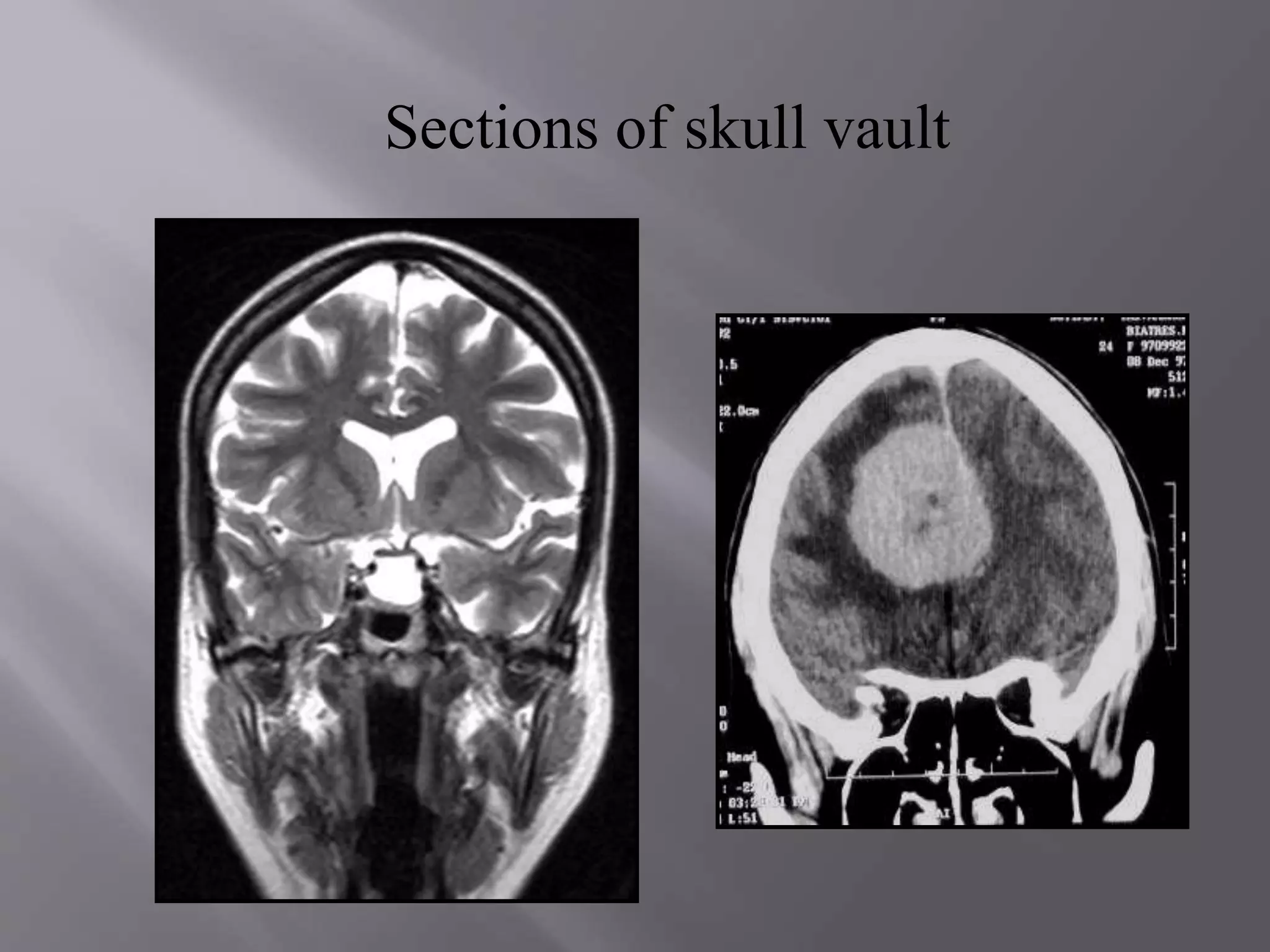
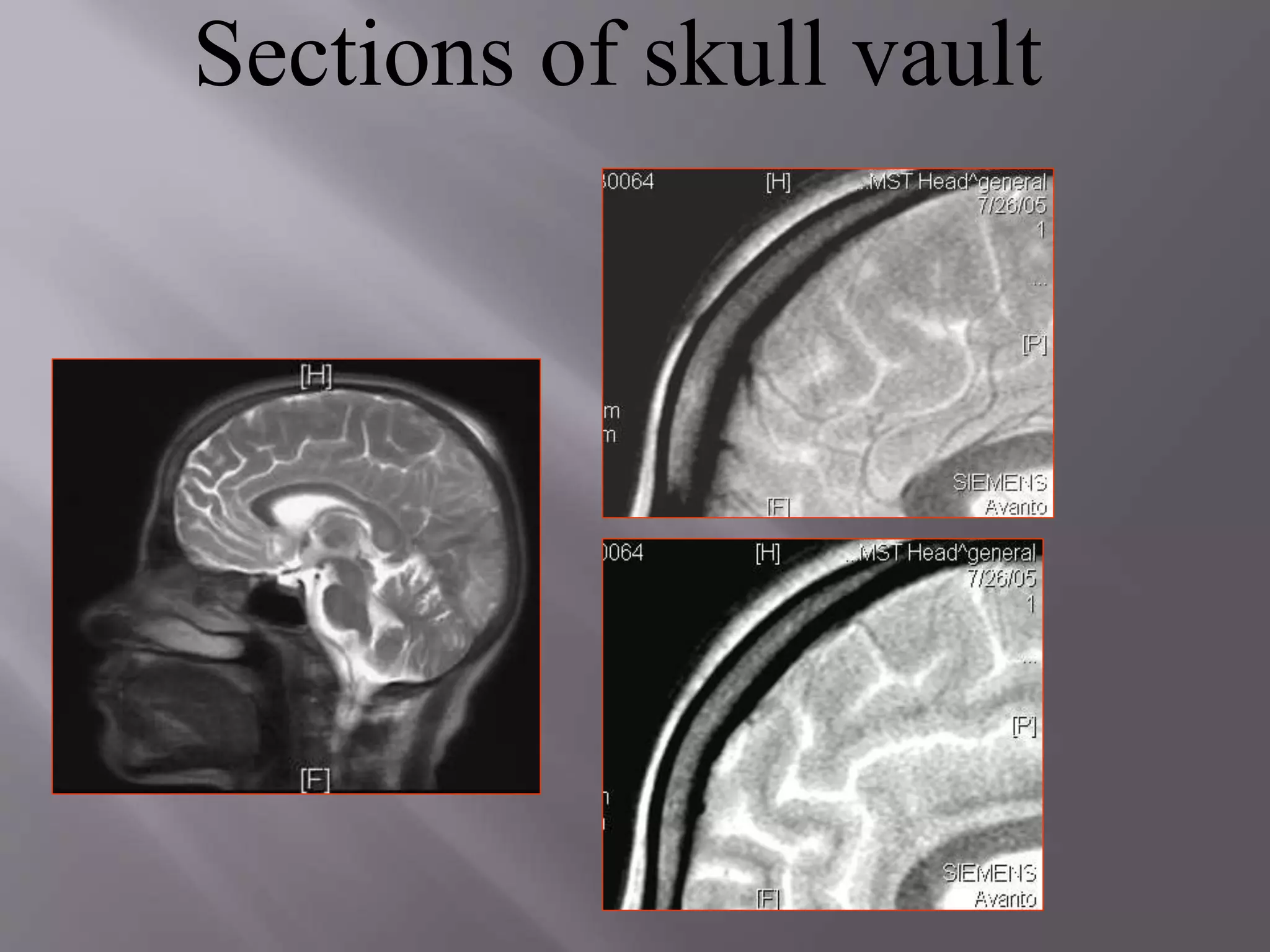
Sections of skull vault
MRI basics
http://pss100.psi.ch/~kuehne/MR_Basics.html
Basics MRI
http://howstuffworks.com/mri.htm
MRI Basics
http://www.wellweb.com/Diagnost/arnief/mri.htm
Magnetic Resonance Advisory Panel
http://www.giant.net.au/air/mrpanel.htm
MRI Education
http://www.mrieducation.com/usa.htm
MRI Review dotcom
http://www.mrireview.com/index2.html
Hesselink Basic Principles Of MRImaging
http://spinwarp.ucsd.edu/NeuroWeb/Text/br-100.htm
MRI Education
http://www.mrieducation.com/mainb.htm
A Selection of Slides on MRI Basics
http://porkpie.loni.ucla.edu/BMD_HTML/SharedCode/slides/
SlideFiles.html
Animated Basic MRI
http://www.t2star.com/basic_mr/Basic.html
THANKYOU

Mri basics

  • 2.
    Felix Bloch EdwardPurcellJoseph Fourier Joseph Larmor Raymond Damadian C Lauterbur Peter Mansfield Seiji OgawaRichard Ernst The first Nuclear magnetic resonance experiment was conducted independently by two scientist in 1946. Felix Bloch working at Stanford University Edward Purcell working at Harvard University Bloch and Purcell were awarded Nobel Prize for Physics in1952 Joseph Fourier 1768- 1830 Joseph Larmor 1857-1942 Published his collected papers on electromagnetism in 1900 in a famous book entitled “Aether and Matter” In 1970 Raymond Damadian found that it is possible to characterize different body tissues using NMR Technology In 1977 he completed the construction of the first MRI scanner In 1978 he founded the FONAR corporation which manufactured the first commercial MRI In 1973 Paul C Lauterbur discovered the possibility to create a two dimensional picture by introducing gradients in the magnetic field. He used the back projection technique to reconstruct the image. He termed his new imaging technique zeumatography. He shared the 2003 Nobel prize for medicine with Peter Mansfield Peter Mansfield developed the technique of detecting the emitted signals rapidly mathematically analyzing them and turning them into an image. He evolved a very fast imaging technique known as Echo Planar Imaging In 1975 Richard Ernst introduced 2D NMR using phase and frequency encoding and the Fourier transform instead of Lauterbur’s back projection technique In 1992 Functional MRI was developed by Seiji Ogawa. FIRST MRI MACHINE AND MRI IMAGE In 1890 Roy and Sherrington’s paper ‘On the regulation of blood supply of brain’ suggested neural activity was accompanied by a regional increase in cerebral blood flow. In 1992 Ogawa and Lee at AT and T Bell laboratories working on rodents discovered that oxygenation level of blood act as contrast agent in MR images which finally led to the fMRI
  • 3.
    Structure of AtomMagnetic Dipole moment ELECTROMAGNETISM
  • 4.
    Proton has it’s ownmagnetic field ! Proton spins around it’s axis
  • 5.
    History Ogawa and lee? Found 1.Neural activity is proportional to oxygenation 2. O2 level acts as contrast agent 3. EP imaging technique 4. Experimented in human MR imaging
  • 6.
  • 7.
    PRECESSIONAL FREQUENCY In ourMRI (1.5 T) ,Protons precess at around 63.75 MHz
  • 11.
    1. A vectorhas a force and direction 2. Net Magnetic vector of the body is in direction of main magnet 3.precession frequency decrease with increase of ext. magnetic field 4.Spins pointing up are always more than that is down Question 1
  • 15.
    Precession frequency 1. Isthe freqeuncy of the nucleus 2. Is the freqeuncy of the protons 3. Is directly proportional to strength of main magnet(B0) 4. Is the frequency of the spins Question 2
  • 16.
    How to measuremagnetisation?
  • 17.
  • 18.
  • 19.
  • 20.
    ** Change inmagnetic force moment ** Induces a current ** Signal captured * Decays when RF pulse is off Free induction decay
  • 21.
    Question 3 RF PULSE 1.When RF pulse is off SPINS DEPHASE 2. RF pulse has same frequency as that of spins 3. In phase vector is always in transverse direction 4. A moving magnetic field induces a current
  • 22.
  • 23.
  • 24.
    SPIN ECHO SEQUENCE 90°--TE/2 --- 180° --- TE/2 -- RECORD SIGNAL
  • 25.
    RF PULSE OFF PROTONS DEPHASE AFTER180° PULSE AT TE / 2, PR0TONS REPHASE WHY ANOTHER 180°PULSE ?
  • 26.
    WHY ANOTHER 180°PULSE? * REPHASES THE DEPHASING PROTONS (SPINS) * EXTERNAL MAGNETIC FIELD INHOMOGENITIES NEUTRALISED! (SIGNAL INTENSITY REDUCED BY EXT.&INT.MAGNETIC FIELD INHOMOGENITIES) * PRODUCES AFTER TIME TE A STRONGER ECHO !
  • 27.
  • 29.
    T1 = t(63% of original magnetization) 1/T1 = Longitudinal relaxation rate Spin Lattice Relaxation T1 (water) > T1 (fat)
  • 30.
    T2= t(37 %of its initial value) 1/T2 = Transversal Relaxation Rate T2(water) > T2(fat) RF PULSE REMOVED! SPIN-SPIN RELAXTION
  • 31.
    180 180° PULSE causesthe following 1. Rephases the protons 2. Ext. Inhomogenity of magnetic field reduced 3. Echo becomes weak 4. Applied at time TE. QUESTION 4
  • 36.
  • 37.
    T1 T2 PD FourierTransformation Image formation
  • 38.
    GRADIENT COILS RF Coils Depending onthe working -Transmit and Receive Coil -Transmit only Coil -Receive only Coil Depending on the application -Volume Coil -Surface Coil -Internal Coil INSTRUMENTATION
  • 39.
    1) Put subjectin big magnetic field 2) Transmit radio waves into subject [about 3 ms] 3) Turn off radio wave transmitter 4) Receive radio waves re-transmitted by subject 5) Store measured radio wave data vs. time – Now go back to step(2) to get some more data 6) Process raw data to reconstruct images NUT SHELL!
  • 40.
    1. A vectorhas a force and direction -T 2. Net Magnetic vector of the body is in direction of main magnet-T 3.precession frequency decrease with increase of ext. magnetic field-F 4.Spins pointing up are always more than that is down-T Question 1
  • 41.
    Precession frequency 1. Isthe freqeuncy of the nucleus -F 2. Is the freqeuncy of the protons-T 3. Is directly proportional to strength of main magnet(B0)-T 4. Is the frequency of the spins-T Question 2
  • 42.
    Question 3 RF PULSE 1.When RF pulse is off SPINS DEPHASE-T 2. RF pulse has same frequency as that of spins-T 3. Inphase vector is always in transverse direction-F 4. A moving magnetic field induces a current-T
  • 43.
    180 180° PULSE causesthe following 1. Rephases the protons-F 2. Ext. Inhomogenity of magnetic field reduced-T 3. Echo becomes weak-F 4. Applied at time TE-F QUESTION 4
  • 44.
    Pre contrast T1 T2 PD Post contrastT1 Sagittal Axial Coronal Sagittal Axial Coronal Sagittal Axial Coronal Sagittal Axial Coronal
  • 45.
    T1 PD T2 SHORTTR LONG TR LONG TR SHORT TE SHORT TE LONG TE
  • 47.
    • Long T1value (1800-2500msec) • Fluid suppression technique (CSF appears dark) • Fast flair sequences Use • Acute subarachnoid hge • WM lesion in spinal cord • Flair sequence in unco-operative patients
  • 49.
     To seeinternal auditory canal  CP angle structures – Cr Nn
  • 50.
     Short T1inversion recovery  T1 – inversion time  Fat suppression  Useful in Orbit, Optic N  Bone marrow imaging – Metastasis  (BM & Fat suppressed – Met; lesion more conspicuous)
  • 52.
     Strong T2Wted Image  In 3D mode – High signal from fluids (CSF)  High spatial resolution  Cisternal portions of Cr.Nns  Workup of acoustic tumours
  • 53.
  • 54.
    STIR 1. Is aFAT SUPPRESSED SEQUENCE 2. Ideal in CSF RHINORREA 3. FAT HAS SHORT TI VALUE 4. TISSUE WITH LONG T1 APPEAR DARK
  • 56.
    Hypo intensity inGRE 1. Haemorrhage – Deoxy Hb Meth Hb Ferritin (Haemosiderin other Iron forms) 2. Calcification – Diamagnetic ca salts Associated paramagnetic ions 3. Air containing PNS 4. Normal brain iron 5. Intratumoral melanin 6. Paramagnetic devices, Fn bodies 7. Ferromagnetic devices, Fn bodies 8. Intravascular deoxygenated blood.
  • 58.
    1. Fat (Biological/ oil based contrast agent) 2. Very high non-paramagnetic Protein content 3. Paramagnetic or iodinated contrast agent 4. Calcification 5. Paramagnetic ions (associated with liver disease, hyper alimentation, calcification, necrosis) 6. Mucinous material 7. Intraluminal melanin 8. Hypermyelination 9. Paramagnetic artefact 10. Slow flow
  • 59.
     Iron without hemorrhage  Calcification or bone  Air  Very high paramagnetic Protein content  Deoxy Hb in patent veins  Mucinous material  Rapid or turbulent flow  Ferromagnetic artefact
  • 63.
    No Parameters CTMRI 1 Energy X – Ray Magnet 2 Slices Axials Multi Planar 3 Time Fast Slow 4 3D Yes Yes 5 Angio Yes Yes 6 Moving Parts Yes No 7 White Matter disease + ++++ 8 Resolution ++ ++++ 9 Number of lesion detected +++ ++++ 10 Involve adjacent structures ++ ++++ 11 Location +++ ++++ 12 Spine & Spinal cord ++ ++++ 13 Previous Surgery / Metal ++++ + 14 Bone disease ++++ + 15 Calcification ++++ ++ 16 Oedema ++ ++++ 17 Guidance + - yes
  • 65.
    No Tissues T1T2 CT 1 Water Hypo Hyper Iso 2 Fat Hyper Hypo/Iso Hypo 3 Hematoma (Depends on Stage) Hyper Hyper Hyper 4 Bone Hypo Hypo Hyper 5 Flow Hypo Hypo Iso
  • 66.
    Type Hb TimeT1 T2 Hyper Acute Oxy Hb 2 hrs Iso Hyper Acute De-oxy Hb 2 – 12 hrs Iso Hypo Sub acute I/C Met Hb 12 hrs-4 days Hyper Hypo E/C Met Hb 4 days–2 wks Hyper Hyper Chronic Hemosiderin > 2 Wks Hypo Hypo
  • 68.
  • 69.
    DIA MAGNETIC PARAMAGNETICSuper Paramagnetic Disperse EXT. Magnetic field CONCENTRATE EXT. Magnetic field CONCENTRATE EXT. Magnetic field Water, Org. molecule Ions , simple salts, Ferric sulphate , Salts of non-metals Chelates of metals Alloys( Fe, Ni, Co) Inert gases
  • 70.
  • 71.
  • 72.
  • 74.
    MRI basics http://pss100.psi.ch/~kuehne/MR_Basics.html Basics MRI http://howstuffworks.com/mri.htm MRIBasics http://www.wellweb.com/Diagnost/arnief/mri.htm Magnetic Resonance Advisory Panel http://www.giant.net.au/air/mrpanel.htm MRI Education http://www.mrieducation.com/usa.htm MRI Review dotcom http://www.mrireview.com/index2.html Hesselink Basic Principles Of MRImaging http://spinwarp.ucsd.edu/NeuroWeb/Text/br-100.htm MRI Education http://www.mrieducation.com/mainb.htm A Selection of Slides on MRI Basics http://porkpie.loni.ucla.edu/BMD_HTML/SharedCode/slides/ SlideFiles.html Animated Basic MRI http://www.t2star.com/basic_mr/Basic.html
  • 75.