EET 3350 Digital Systems Design

    Textbook: John Wakerly
         Chapter 9: 9.1


                Memory
  Read-Only Memory: ROM, PROM, EPROM


                                       1
Memory
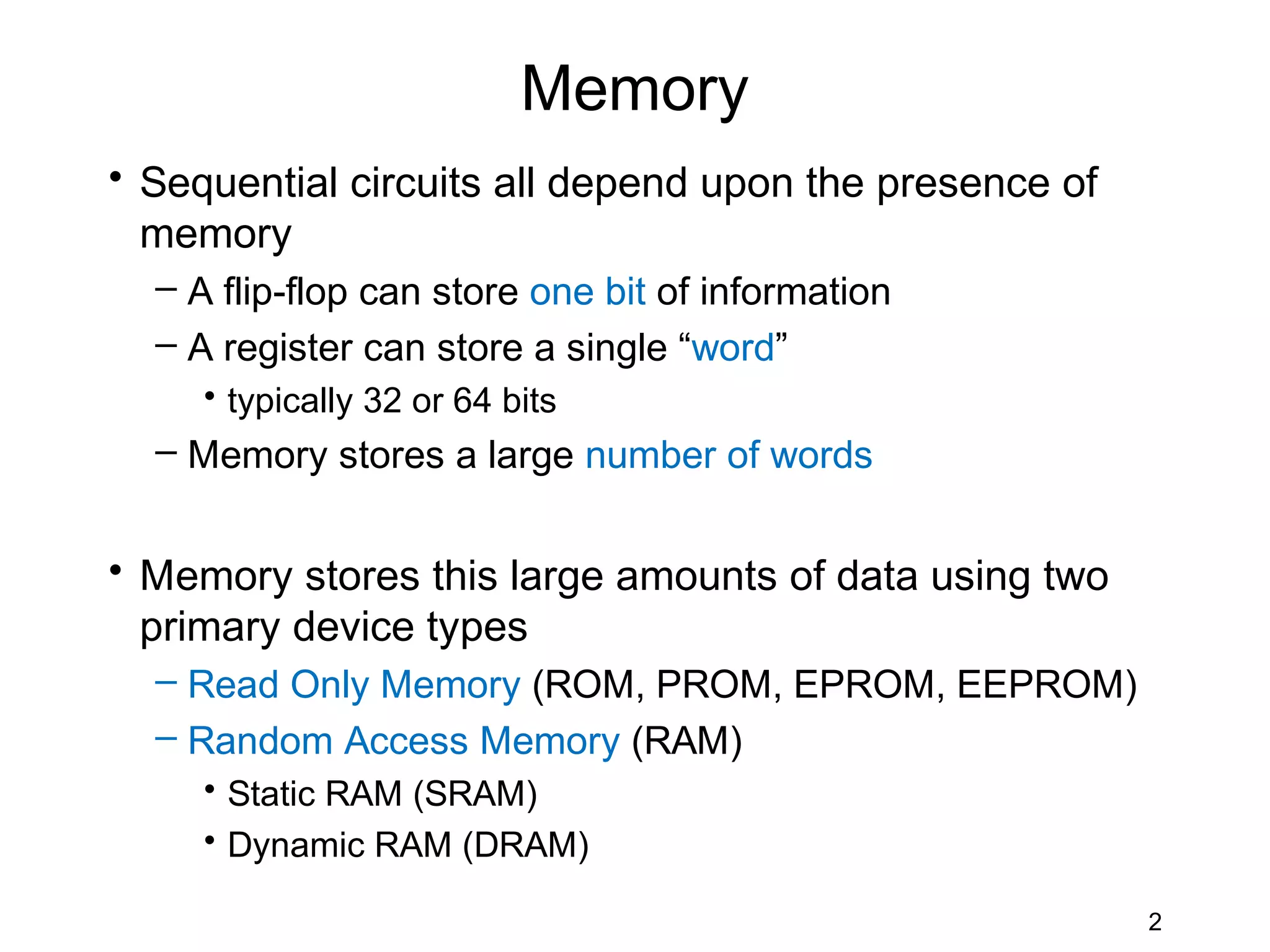
• Sequential circuits all depend upon the presence of
  memory
  – A flip-flop can store one bit of information
  – A register can store a single “word”
     • typically 32 or 64 bits
  – Memory stores a large number of words


• Memory stores this large amounts of data using two
  primary device types
  – Read Only Memory (ROM, PROM, EPROM, EEPROM)
  – Random Access Memory (RAM)
     • Static RAM (SRAM)
     • Dynamic RAM (DRAM)

                                                        2
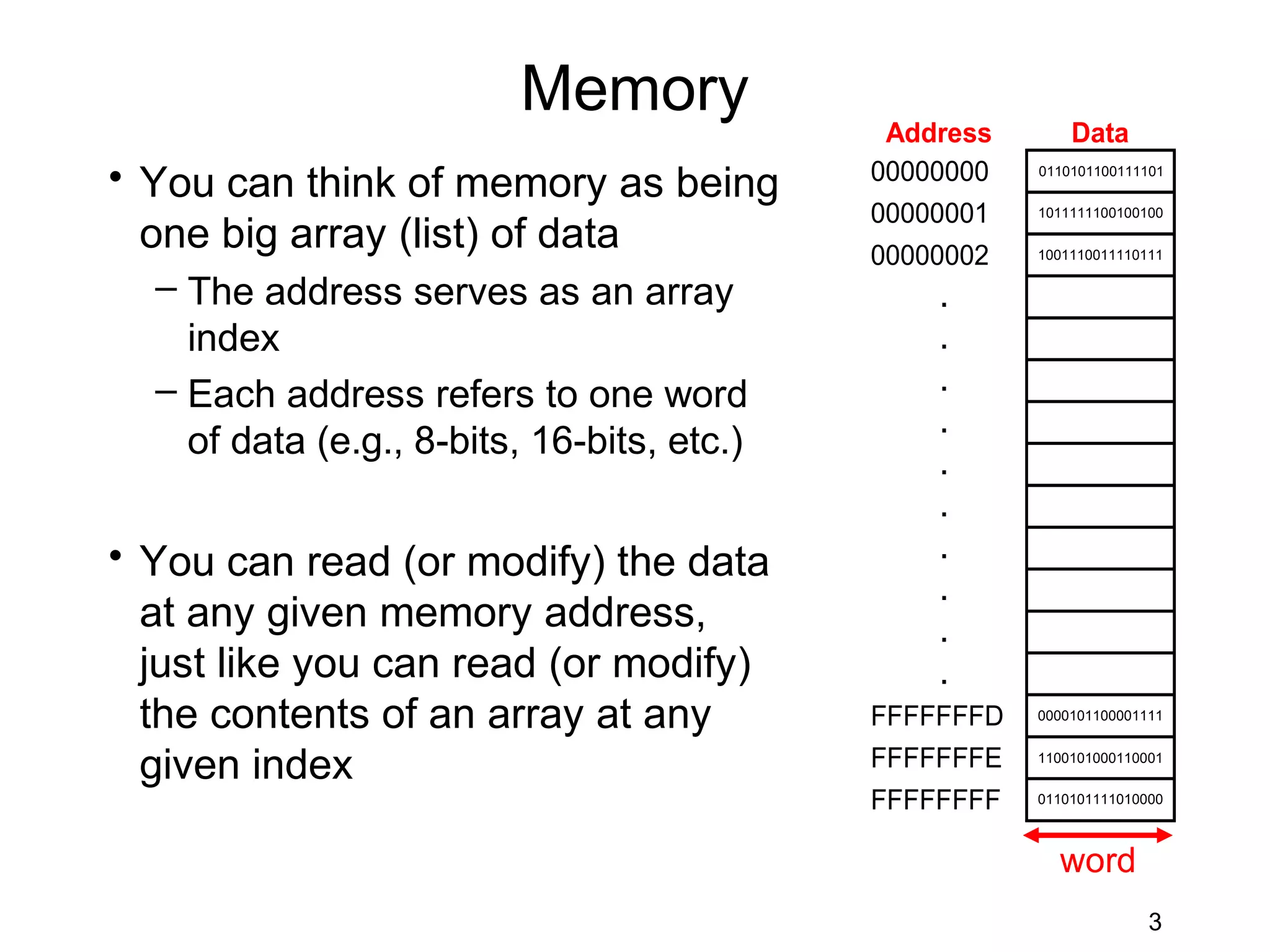
Memory
                                             Address       Data
• You can think of memory as being          00000000   0110101100111101


                                            00000001   1011111100100100

  one big array (list) of data              00000002   1001110011110111

  – The address serves as an array               .
    index                                        .
  – Each address refers to one word             .
                                                .
    of data (e.g., 8-bits, 16-bits, etc.)
                                                .
                                                .
• You can read (or modify) the data             .
                                                .
  at any given memory address,                  .
  just like you can read (or modify)            .
  the contents of an array at any           FFFFFFFD   0000101100001111


  given index                               FFFFFFFE   1100101000110001


                                            FFFFFFFF   0110101111010000


                                                         word
                                                                     3
Memory
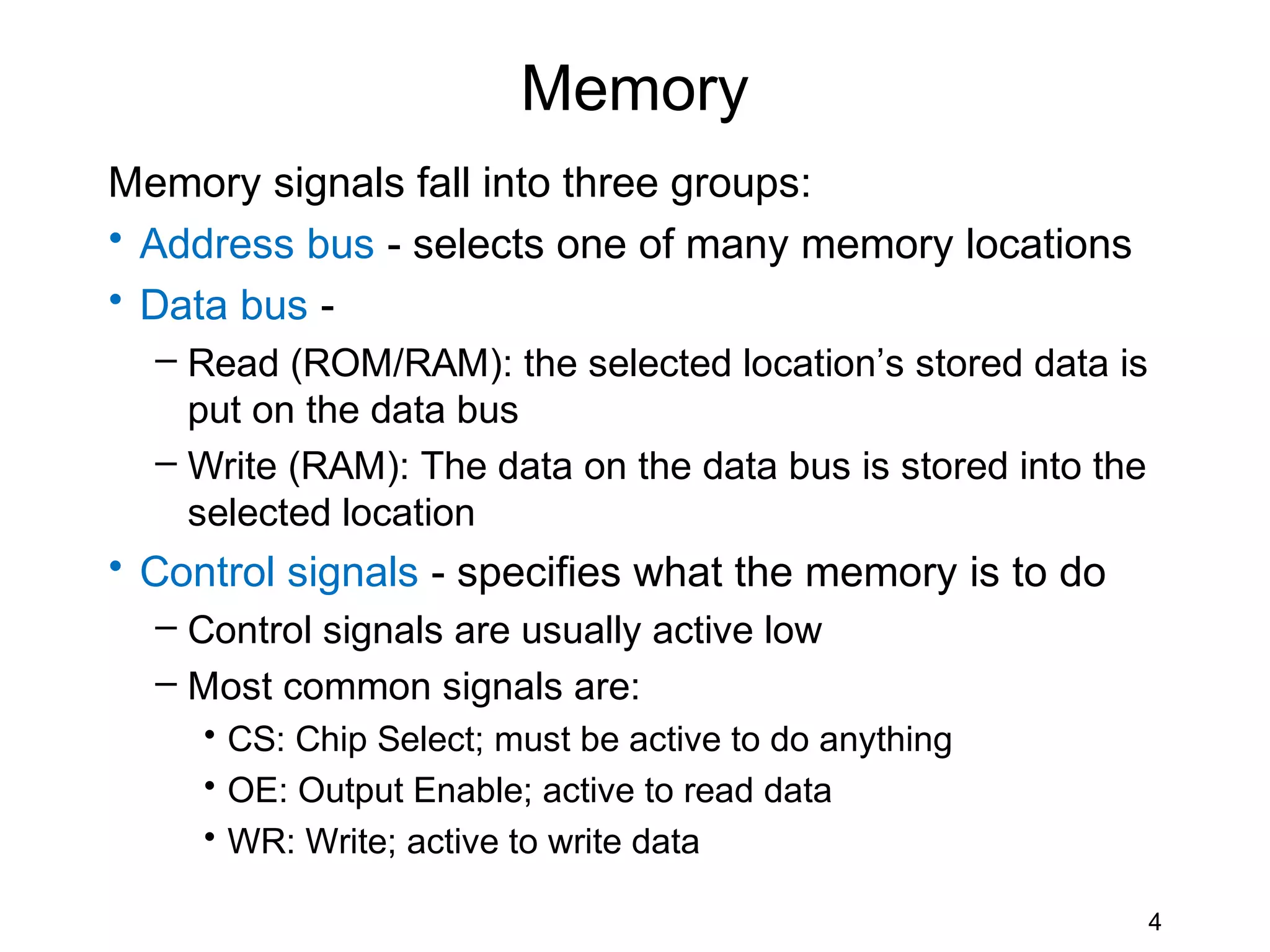
Memory signals fall into three groups:
• Address bus - selects one of many memory locations
• Data bus -
  – Read (ROM/RAM): the selected location’s stored data is
    put on the data bus
  – Write (RAM): The data on the data bus is stored into the
    selected location
• Control signals - specifies what the memory is to do
  – Control signals are usually active low
  – Most common signals are:
     • CS: Chip Select; must be active to do anything
     • OE: Output Enable; active to read data
     • WR: Write; active to write data

                                                               4
Memory
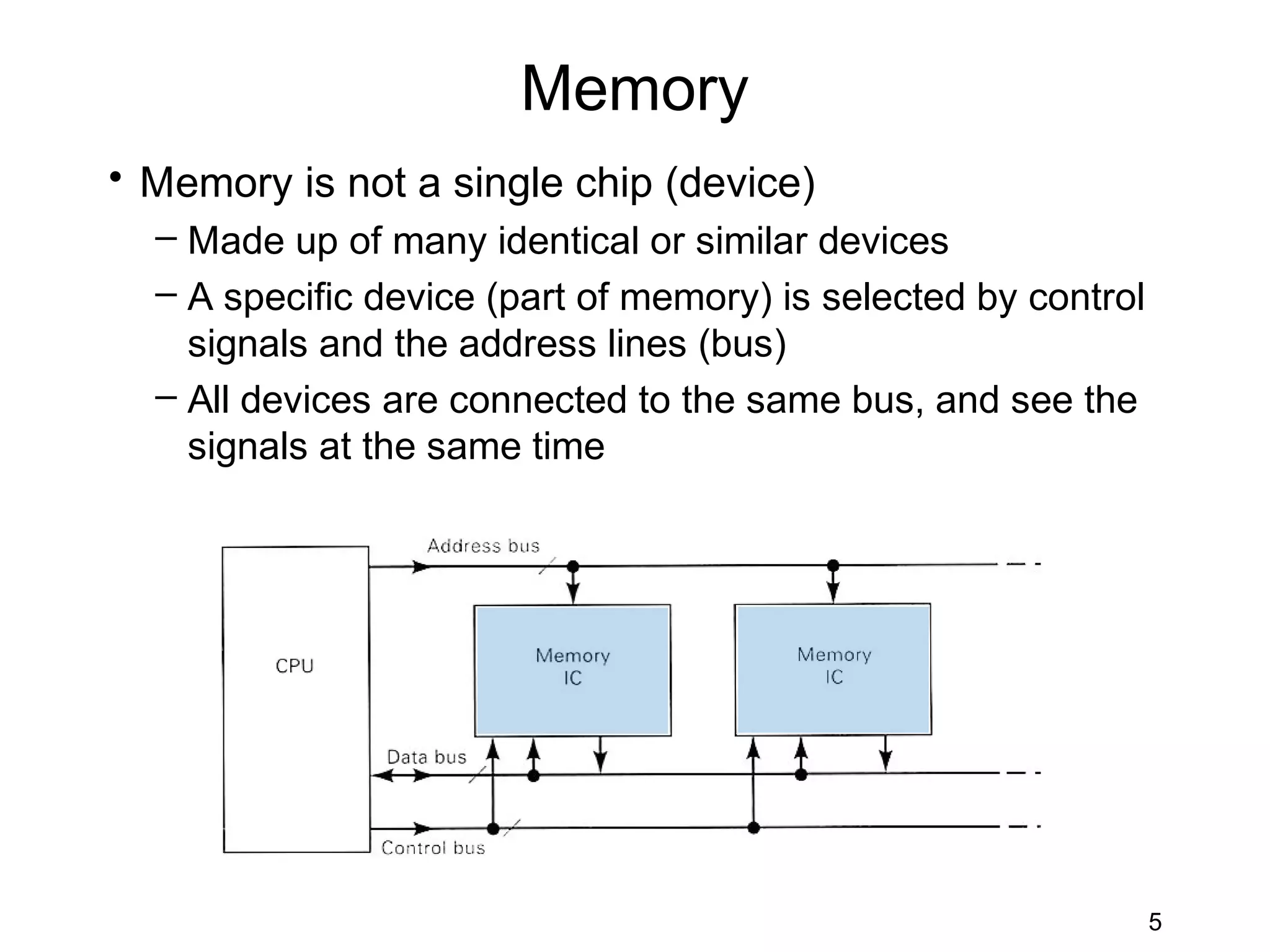
• Memory is not a single chip (device)
  – Made up of many identical or similar devices
  – A specific device (part of memory) is selected by control
    signals and the address lines (bus)
  – All devices are connected to the same bus, and see the
    signals at the same time


                                                                5
Memory
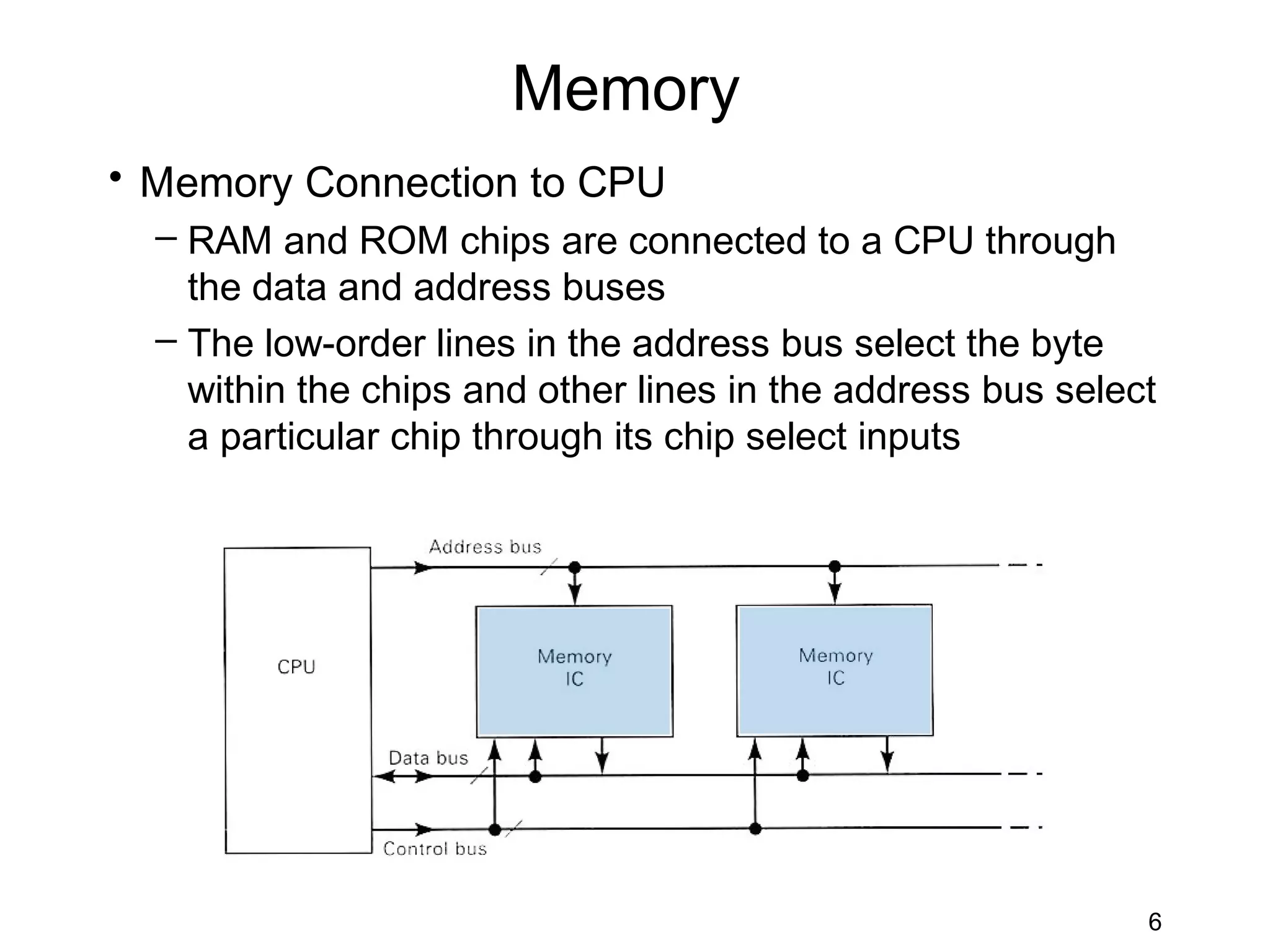
• Memory Connection to CPU
  – RAM and ROM chips are connected to a CPU through
    the data and address buses
  – The low-order lines in the address bus select the byte
    within the chips and other lines in the address bus select
    a particular chip through its chip select inputs


                                                             6
Memory
• Location - the smallest selectable unit in memory
  – Has 1 or more data bits per location
  – All bits in location are read/written together
  – Cannot manipulate single bits in a location
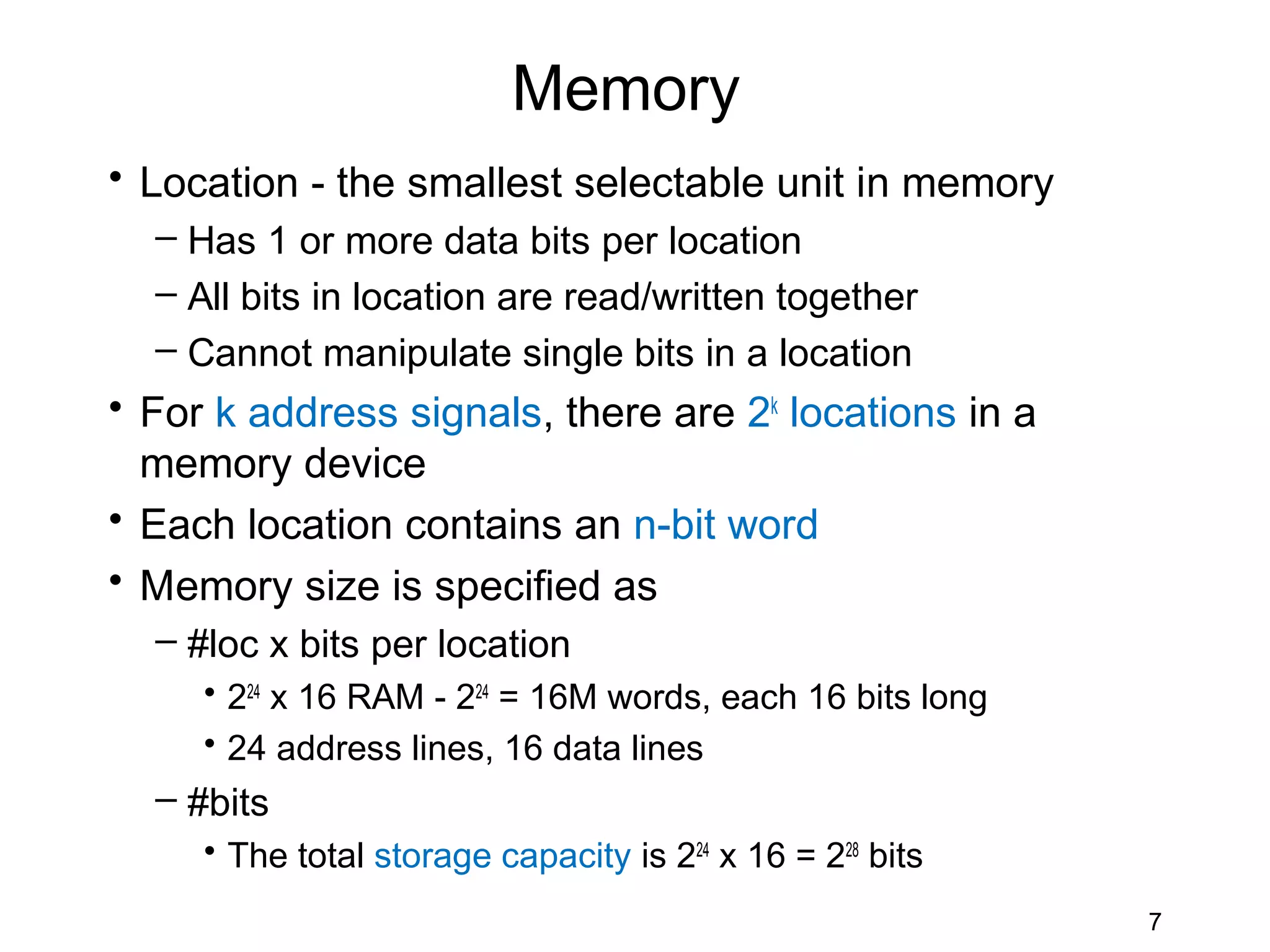
• For k address signals, there are 2k locations in a
  memory device
• Each location contains an n-bit word
• Memory size is specified as
  – #loc x bits per location
     • 224 x 16 RAM - 224 = 16M words, each 16 bits long
     • 24 address lines, 16 data lines
  – #bits
     • The total storage capacity is 224 x 16 = 228 bits
                                                           7
Memory
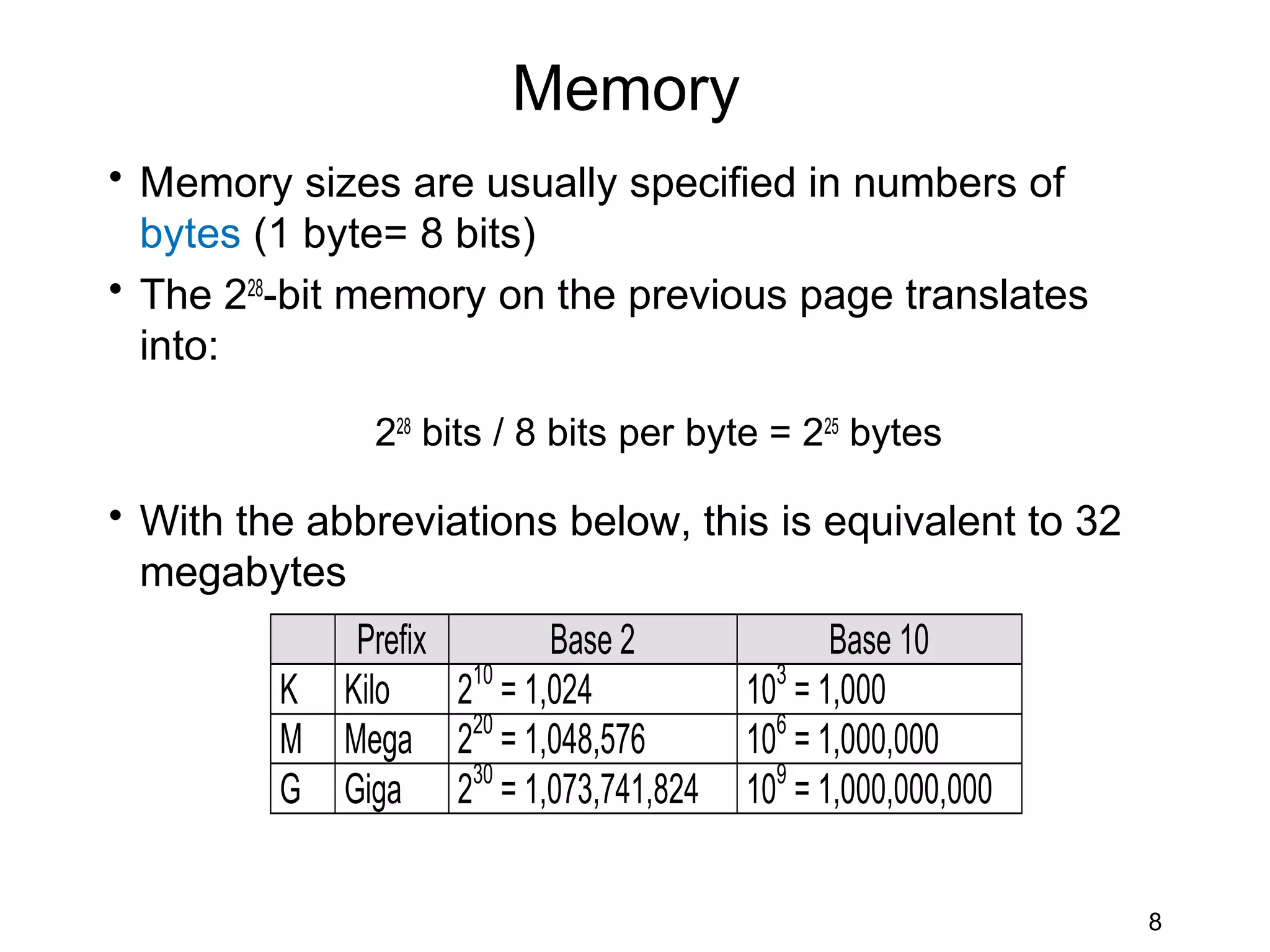
• Memory sizes are usually specified in numbers of
  bytes (1 byte= 8 bits)
• The 228-bit memory on the previous page translates
  into:

              228 bits / 8 bits per byte = 225 bytes

• With the abbreviations below, this is equivalent to 32
  megabytes
            Prefix         Base 2            Base 10
         K Kilo    210 = 1,024        103 = 1,000
         M Mega 220 = 1,048,576       106 = 1,000,000
         G Giga 230 = 1,073,741,824   109 = 1,000,000,000


                                                            8
Memory
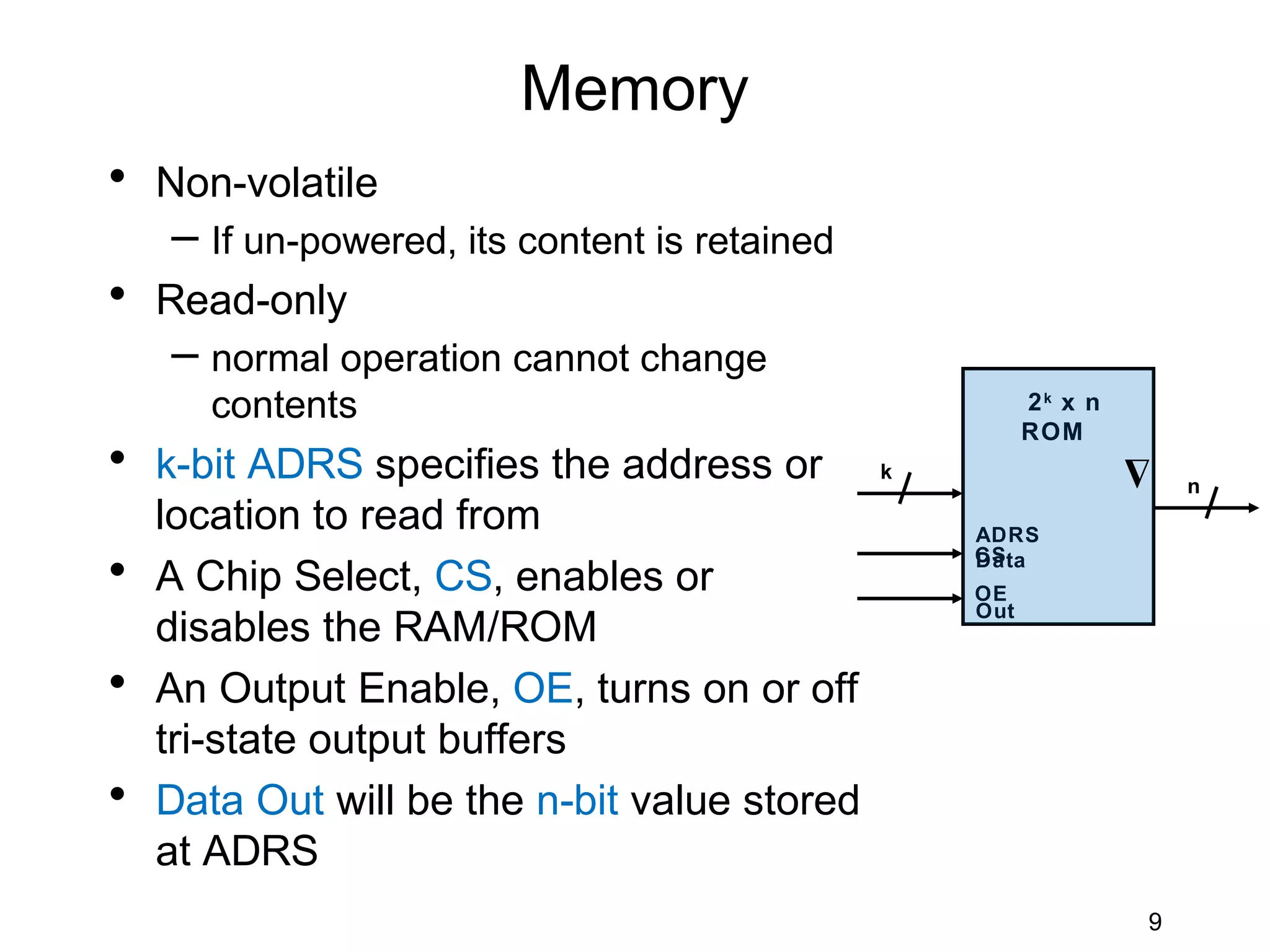
• Non-volatile
    – If un-powered, its content is retained
• Read-only
    – normal operation cannot change
       contents                                          2k x n
                                                         ROM
• k-bit ADRS specifies the address or          k
                                                                  Δ
                                                                      n
    location to read from                          ADRS
                                                   CS
•   A Chip Select, CS, enables or
                                                   Data
                                                   OE
                                                   Out
    disables the RAM/ROM
•   An Output Enable, OE, turns on or off
    tri-state output buffers
•   Data Out will be the n-bit value stored
    at ADRS
                                                                  9
Memory
• Content loading (programming) done many
  ways depending on device type
  – ROM: mask programmed, loaded at the factory
    • hardwired - can’t be changed
    • embedded mass-produced systems
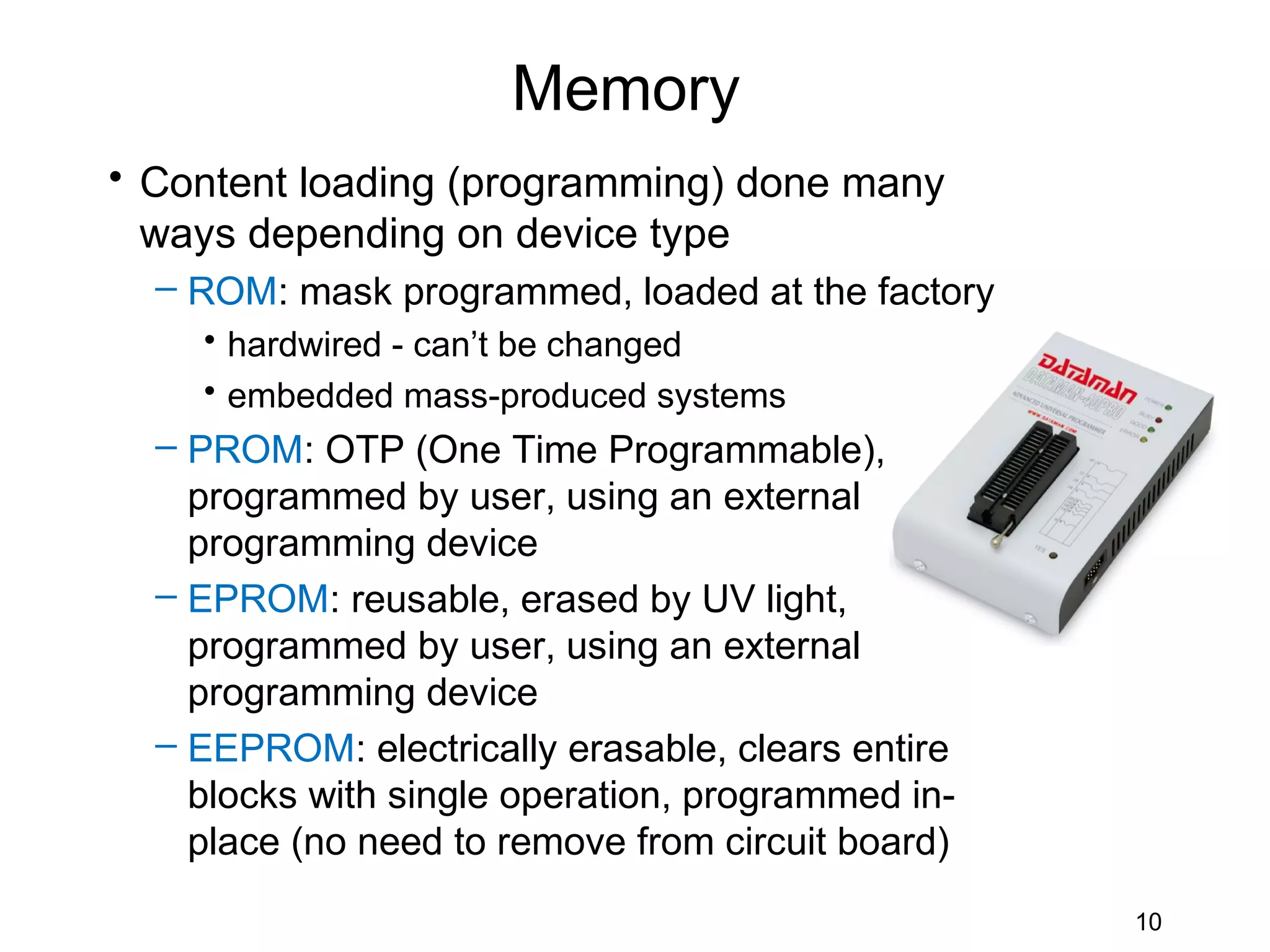
  – PROM: OTP (One Time Programmable),
    programmed by user, using an external
    programming device
  – EPROM: reusable, erased by UV light,
    programmed by user, using an external
    programming device
  – EEPROM: electrically erasable, clears entire
    blocks with single operation, programmed in-
    place (no need to remove from circuit board)
                                                   10
Read-Only Memories
• Definition
  – ROM consists of an array of semiconductor devices
    interconnected to store an array of memory data.
  – Data can only be read, it cannot be changed under
    normal operating conditions.

• Types of ROM
  – Mask programmable ROM (at the factory)
  – Field-Programmable ROM (PROM)
  – UV-Erasable and re-Programmable ROM (EPROM)
  – Electrically-Erasable and re-Programmable ROM
    (EEPROM)
  – Flash

                                                        11
Read-Only Memories
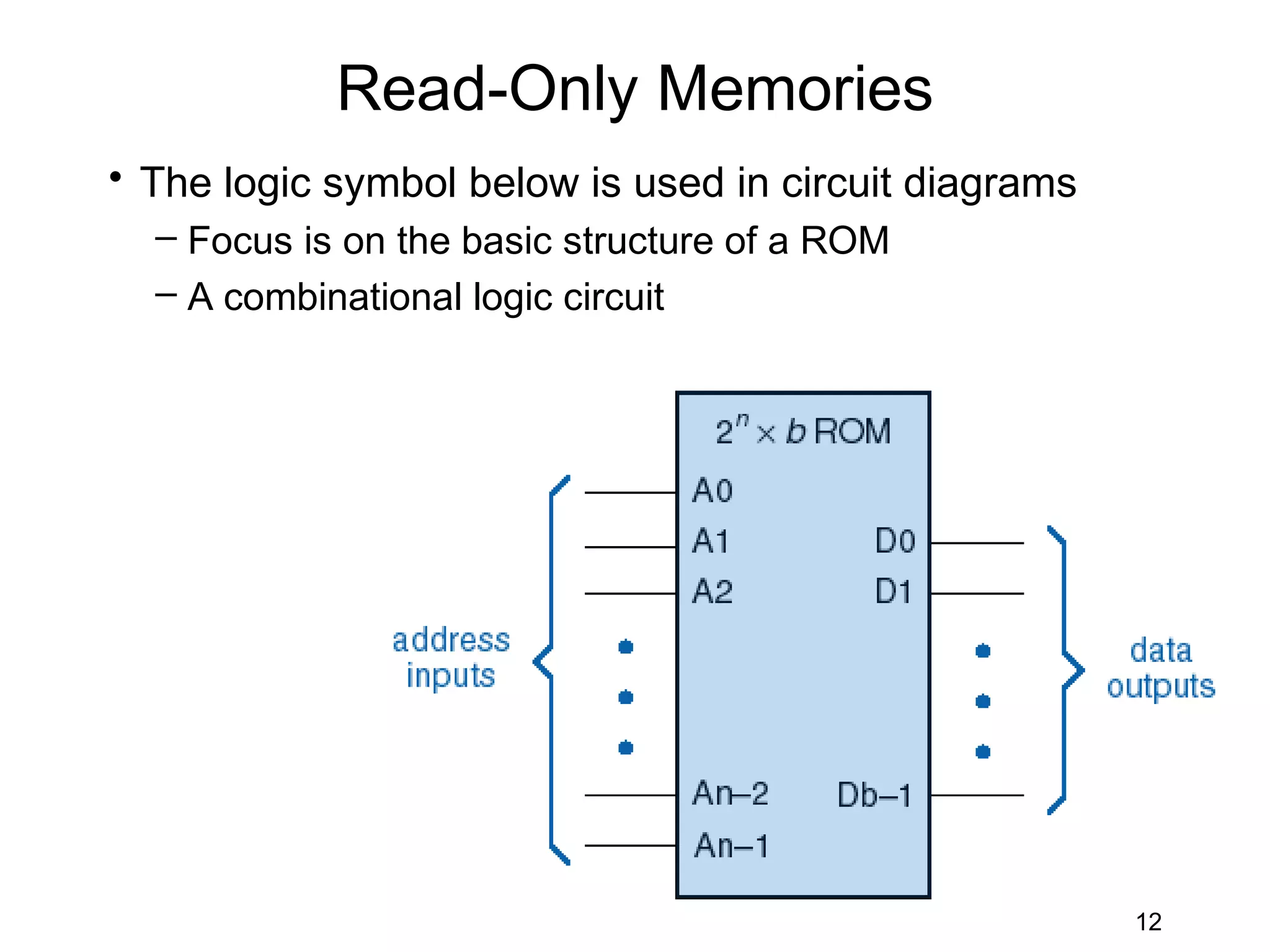
• The logic symbol below is used in circuit diagrams
  – Focus is on the basic structure of a ROM
  – A combinational logic circuit


                                                       12
Logic-in-ROM Example
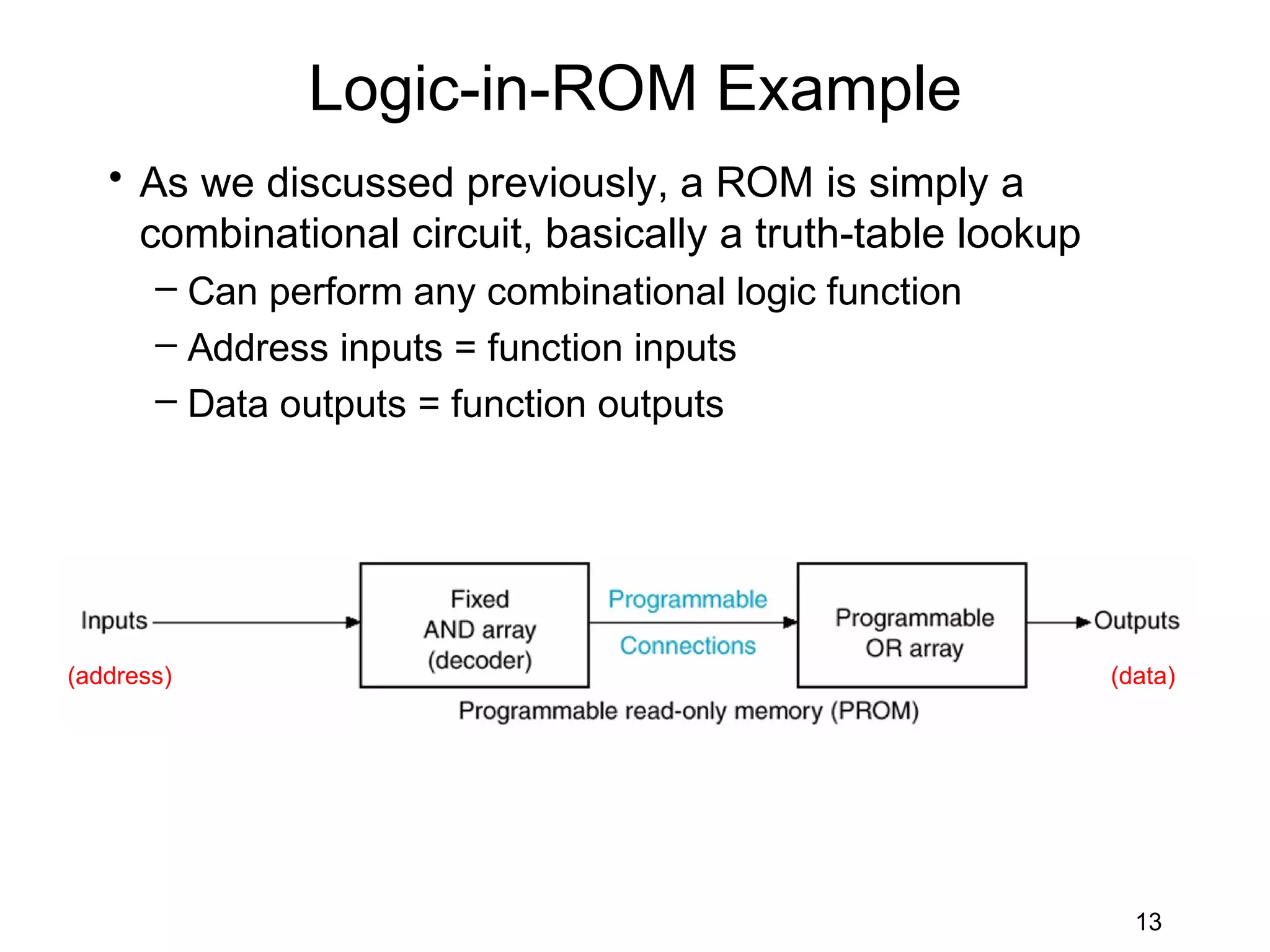
   • As we discussed previously, a ROM is simply a
     combinational circuit, basically a truth-table lookup
       – Can perform any combinational logic function
       – Address inputs = function inputs
       – Data outputs = function outputs


(address)                                                    (data)


                                                               13
Logic-in-ROM Example
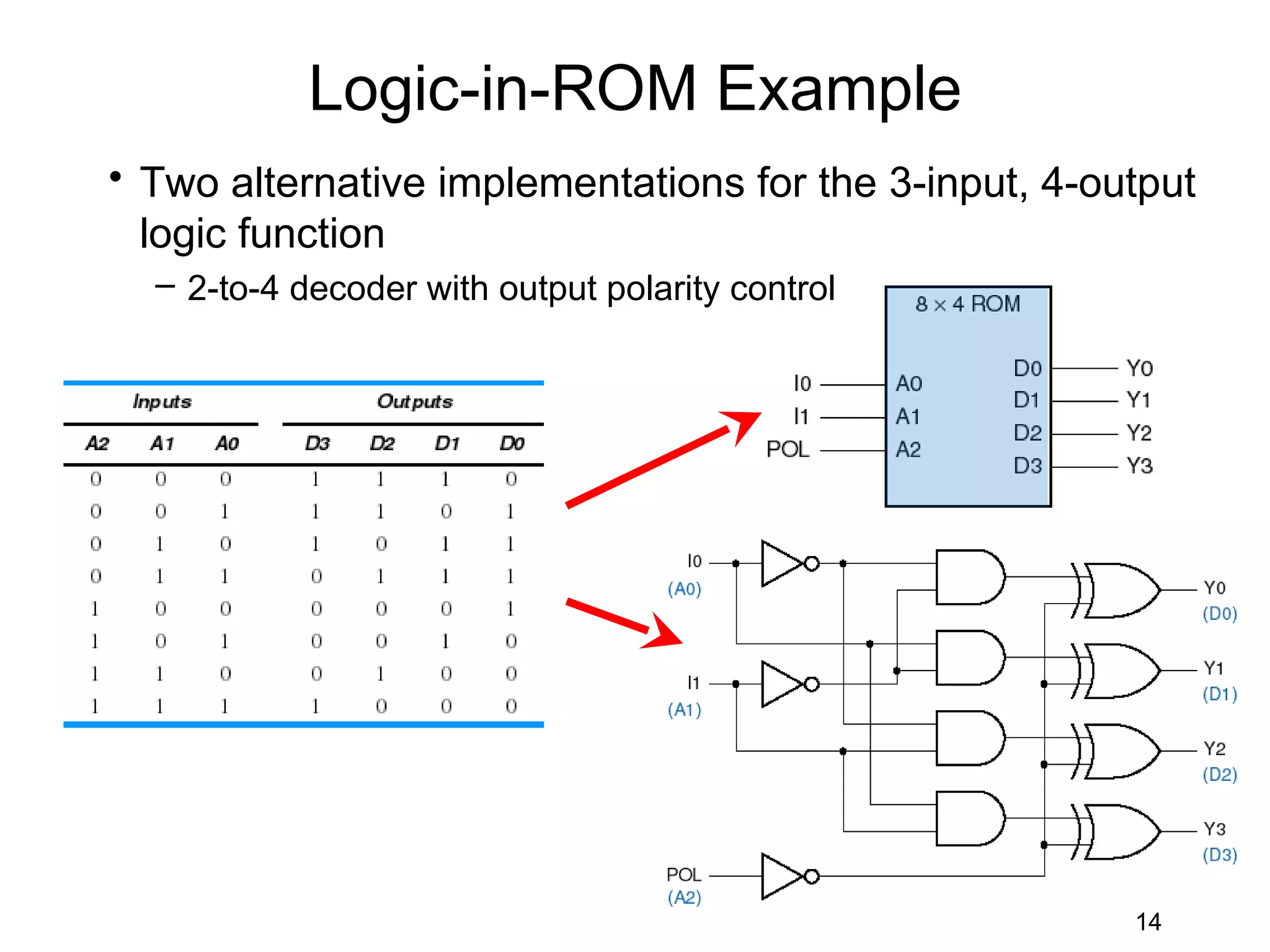
• Two alternative implementations for the 3-input, 4-output
  logic function
  – 2-to-4 decoder with output polarity control


                                                       14
4x4 Multiplier Example
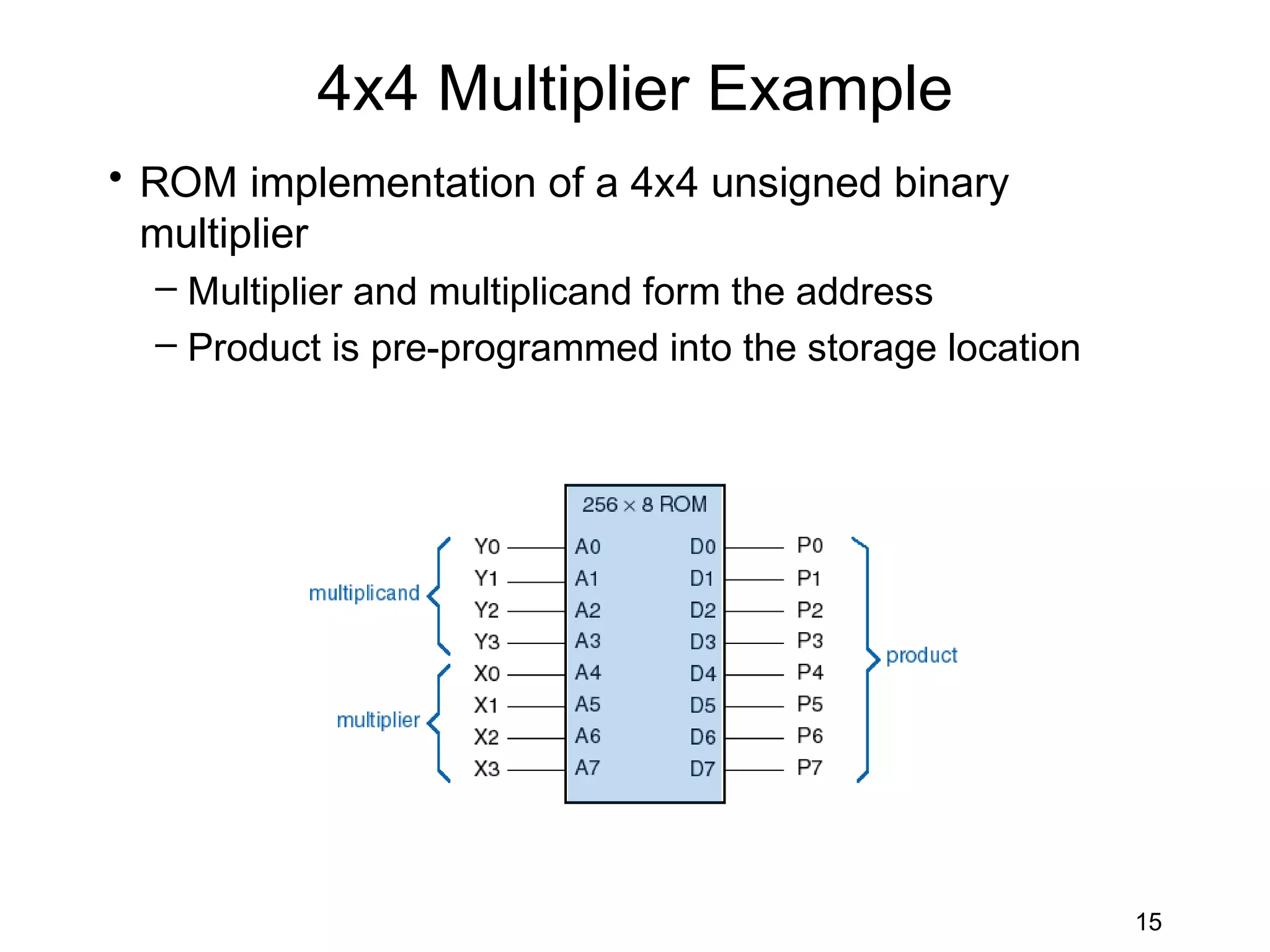
• ROM implementation of a 4x4 unsigned binary
  multiplier
  – Multiplier and multiplicand form the address
  – Product is pre-programmed into the storage location


                                                          15
4x4 Multiplier Example
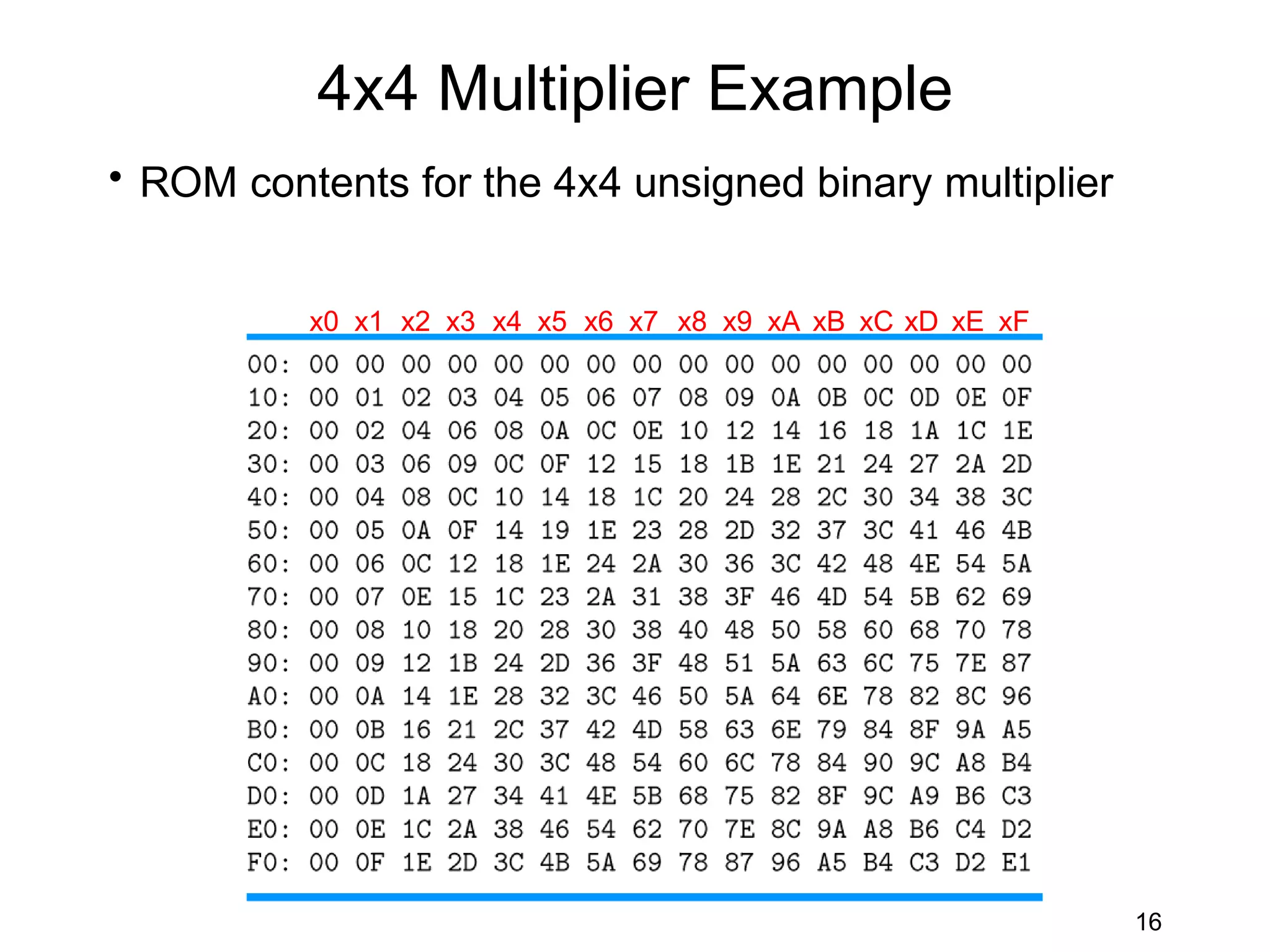
• ROM contents for the 4x4 unsigned binary multiplier


          x0 x1 x2 x3 x4 x5 x6 x7 x8 x9 xA xB xC xD xE xF


                                                            16
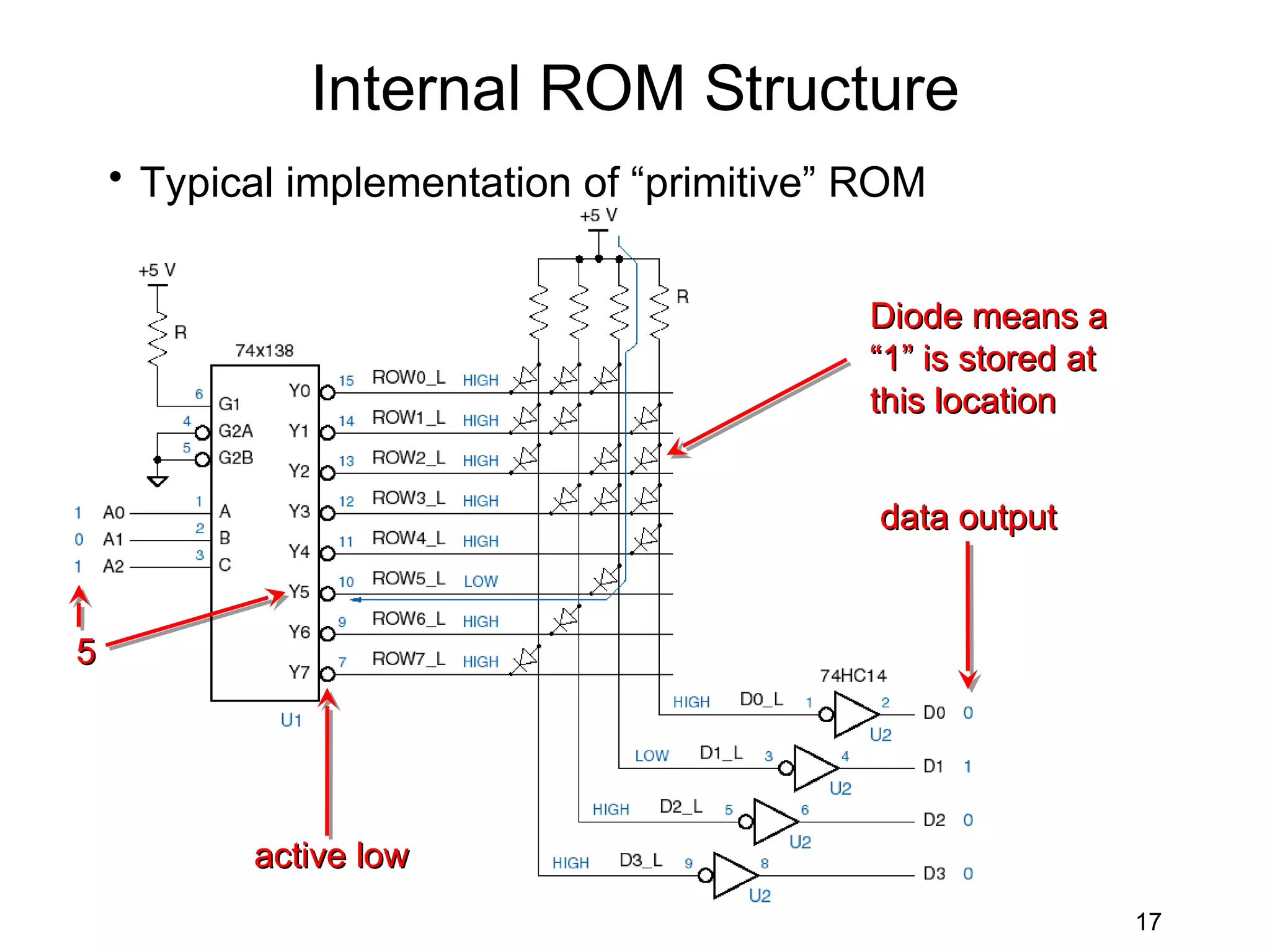
Internal ROM Structure
    • Typical implementation of “primitive” ROM


                                            Diode means a
                                            “1” is stored at
                                            this location


                                            data output


5


           active low
                                                               17
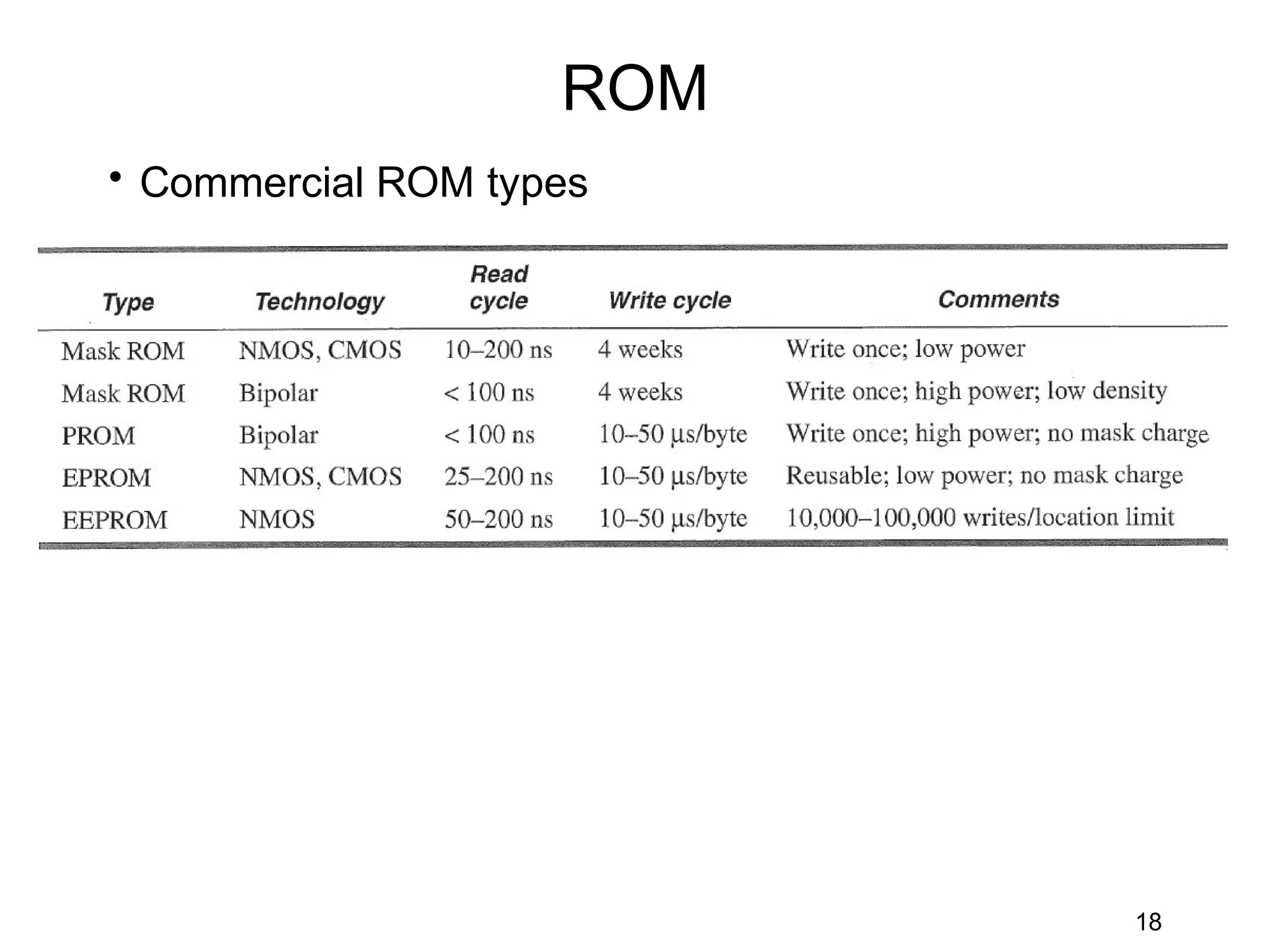
ROM
• Commercial ROM types


                          18
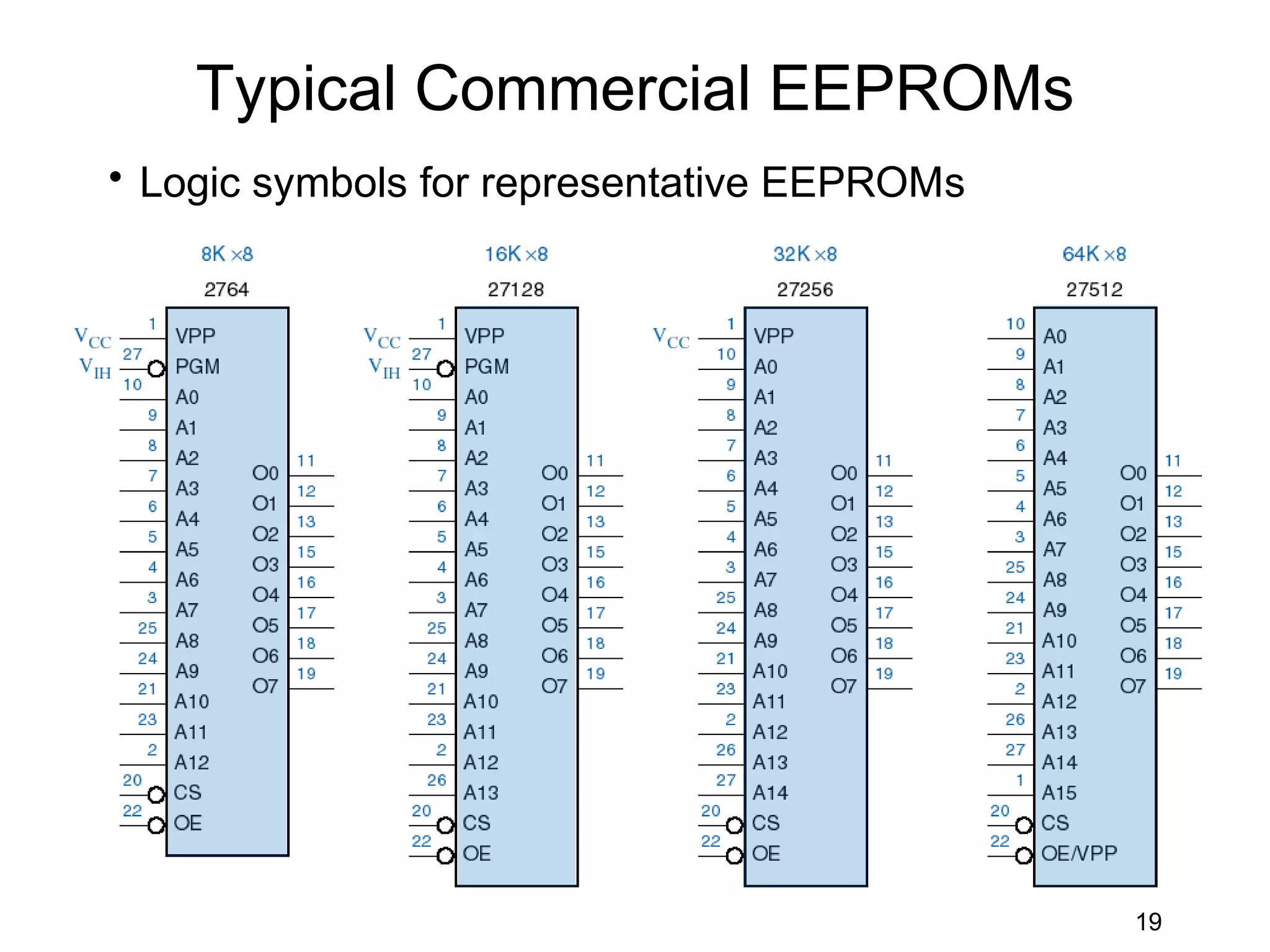
Typical Commercial EEPROMs
• Logic symbols for representative EEPROMs


                                             19
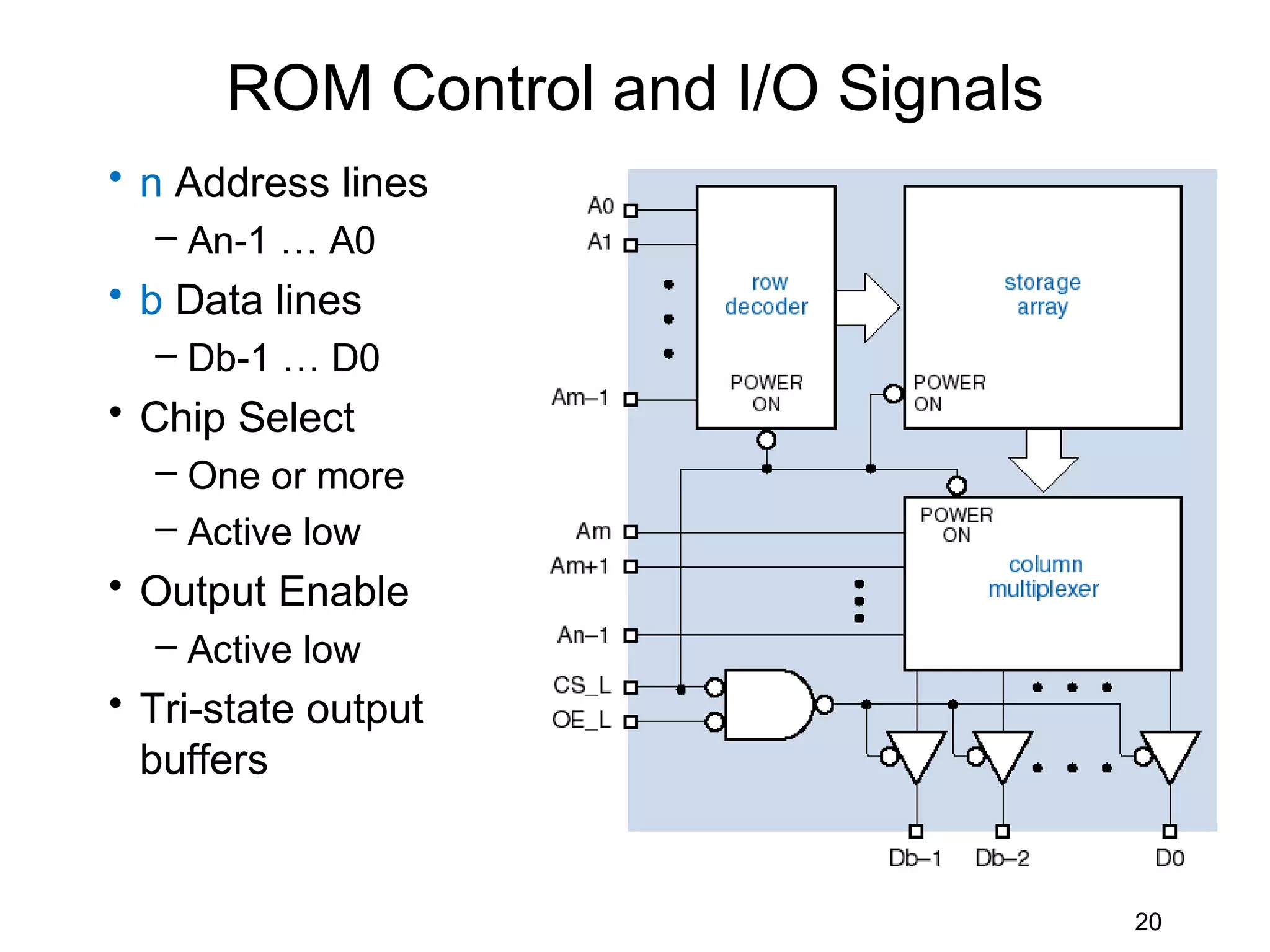
ROM Control and I/O Signals
• n Address lines
  – An-1 … A0
• b Data lines
  – Db-1 … D0
• Chip Select
  – One or more
  – Active low
• Output Enable
  – Active low
• Tri-state output
  buffers


                                    20
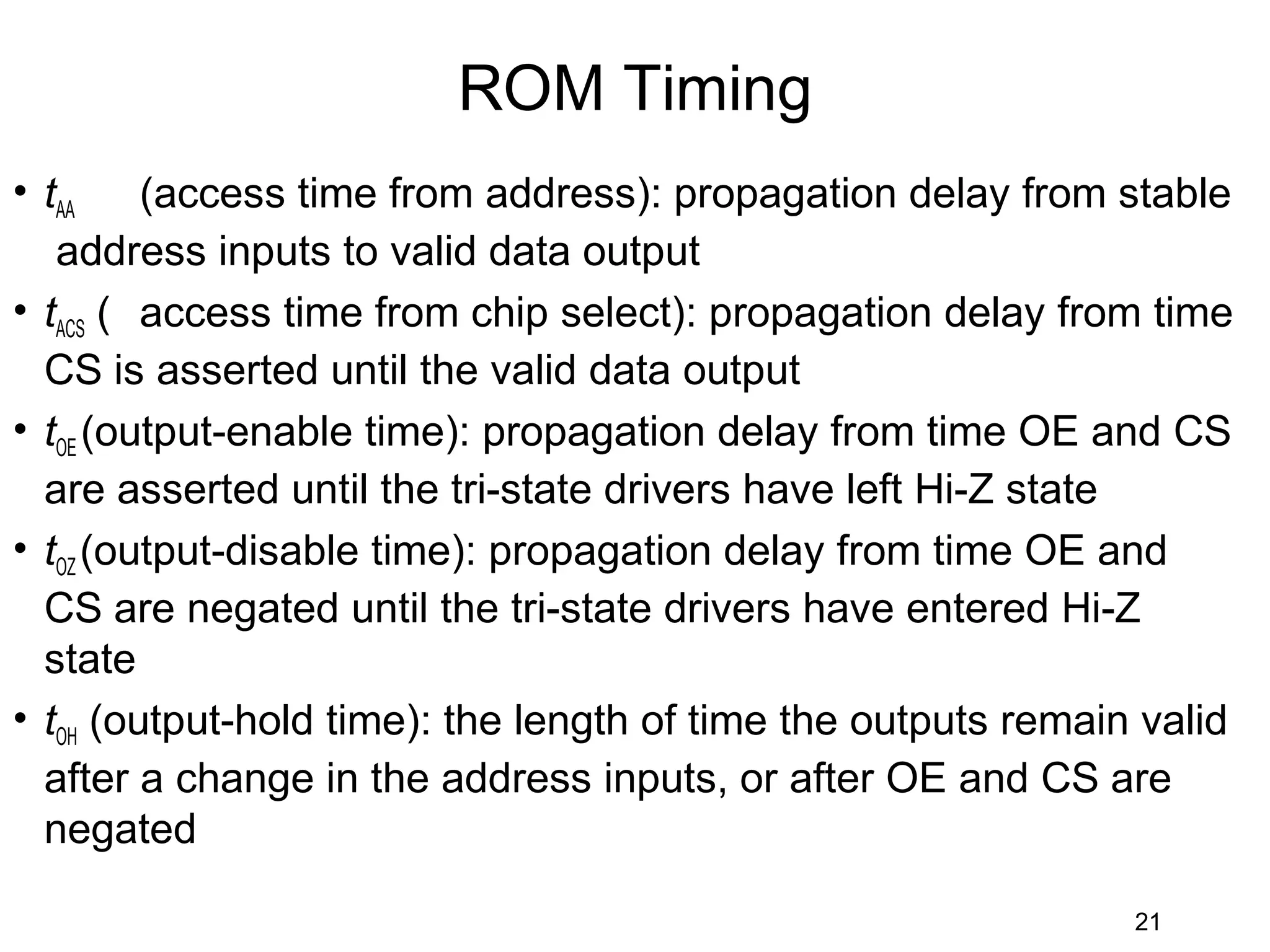
ROM Timing
• tAA    (access time from address): propagation delay from stable
   address inputs to valid data output
• tACS ( access time from chip select): propagation delay from time
  CS is asserted until the valid data output
• tOE (output-enable time): propagation delay from time OE and CS
  are asserted until the tri-state drivers have left Hi-Z state
• tOZ (output-disable time): propagation delay from time OE and
  CS are negated until the tri-state drivers have entered Hi-Z
  state
• tOH (output-hold time): the length of time the outputs remain valid
  after a change in the address inputs, or after OE and CS are
  negated

                                                               21
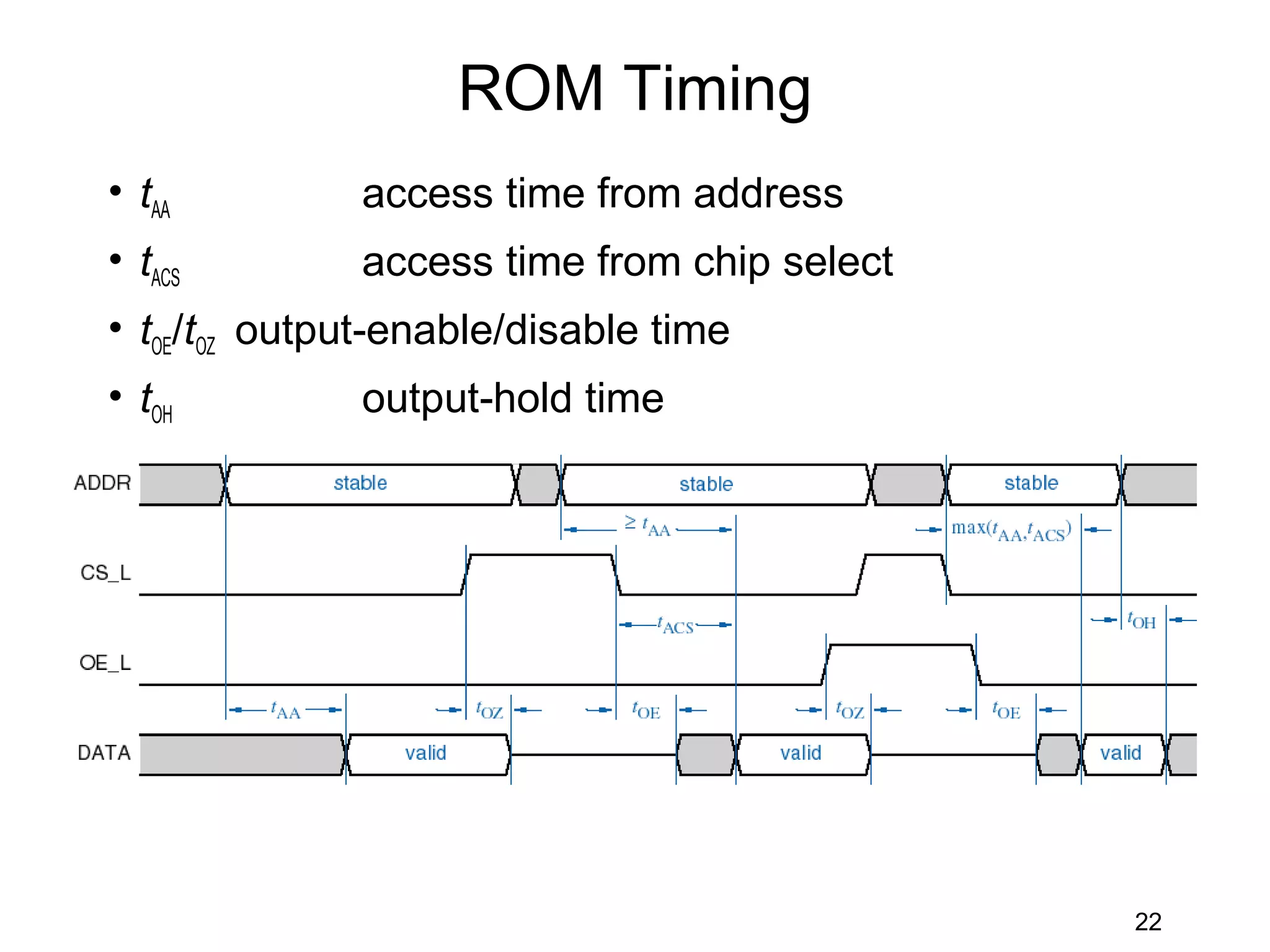
ROM Timing
• tAA         access time from address
• tACS        access time from chip select
• tOE/tOZ output-enable/disable time
• tOH         output-hold time


                                             22
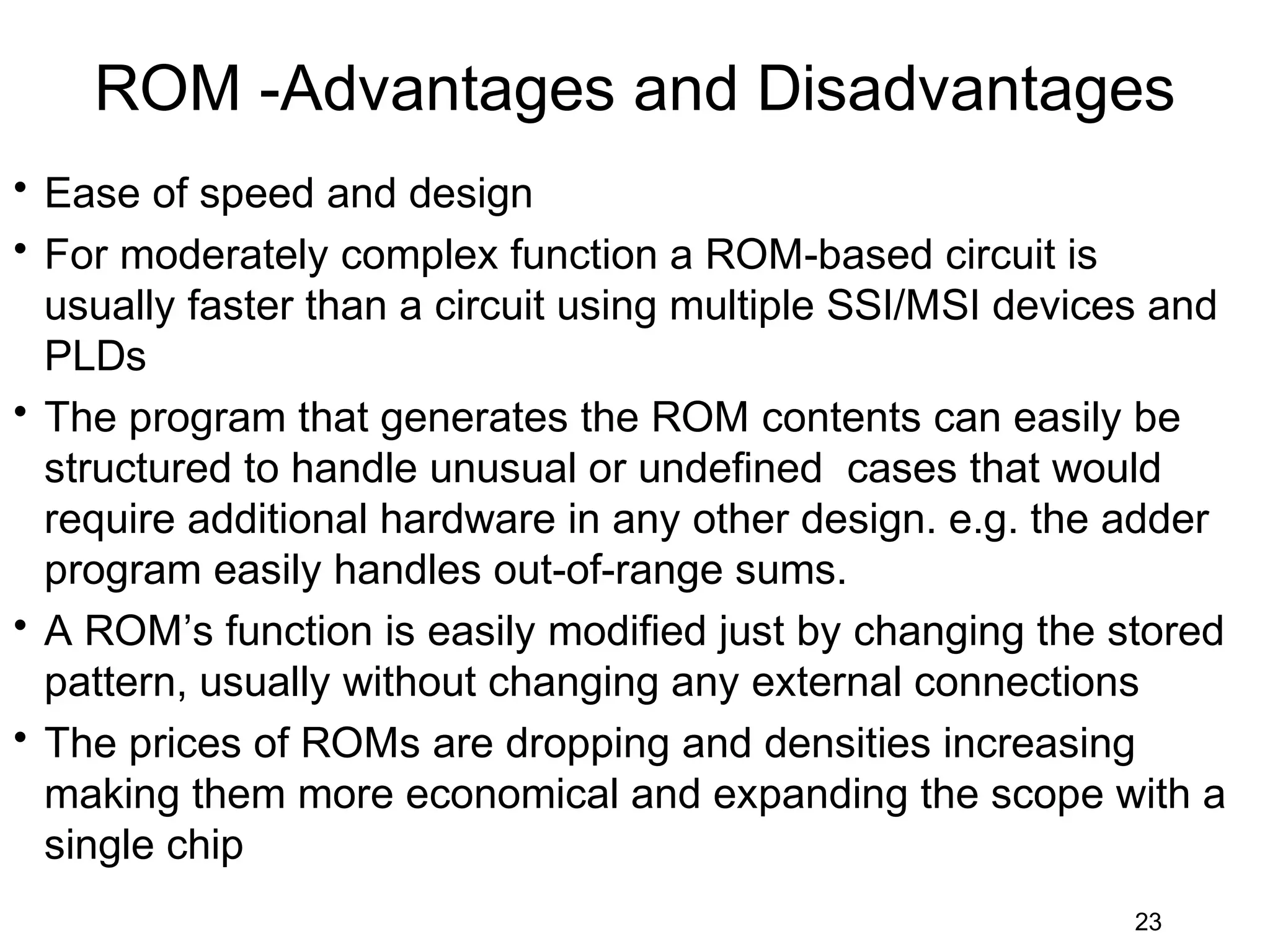
ROM -Advantages and Disadvantages
• Ease of speed and design
• For moderately complex function a ROM-based circuit is
  usually faster than a circuit using multiple SSI/MSI devices and
  PLDs
• The program that generates the ROM contents can easily be
  structured to handle unusual or undefined cases that would
  require additional hardware in any other design. e.g. the adder
  program easily handles out-of-range sums.
• A ROM’s function is easily modified just by changing the stored
  pattern, usually without changing any external connections
• The prices of ROMs are dropping and densities increasing
  making them more economical and expanding the scope with a
  single chip
                                                             23
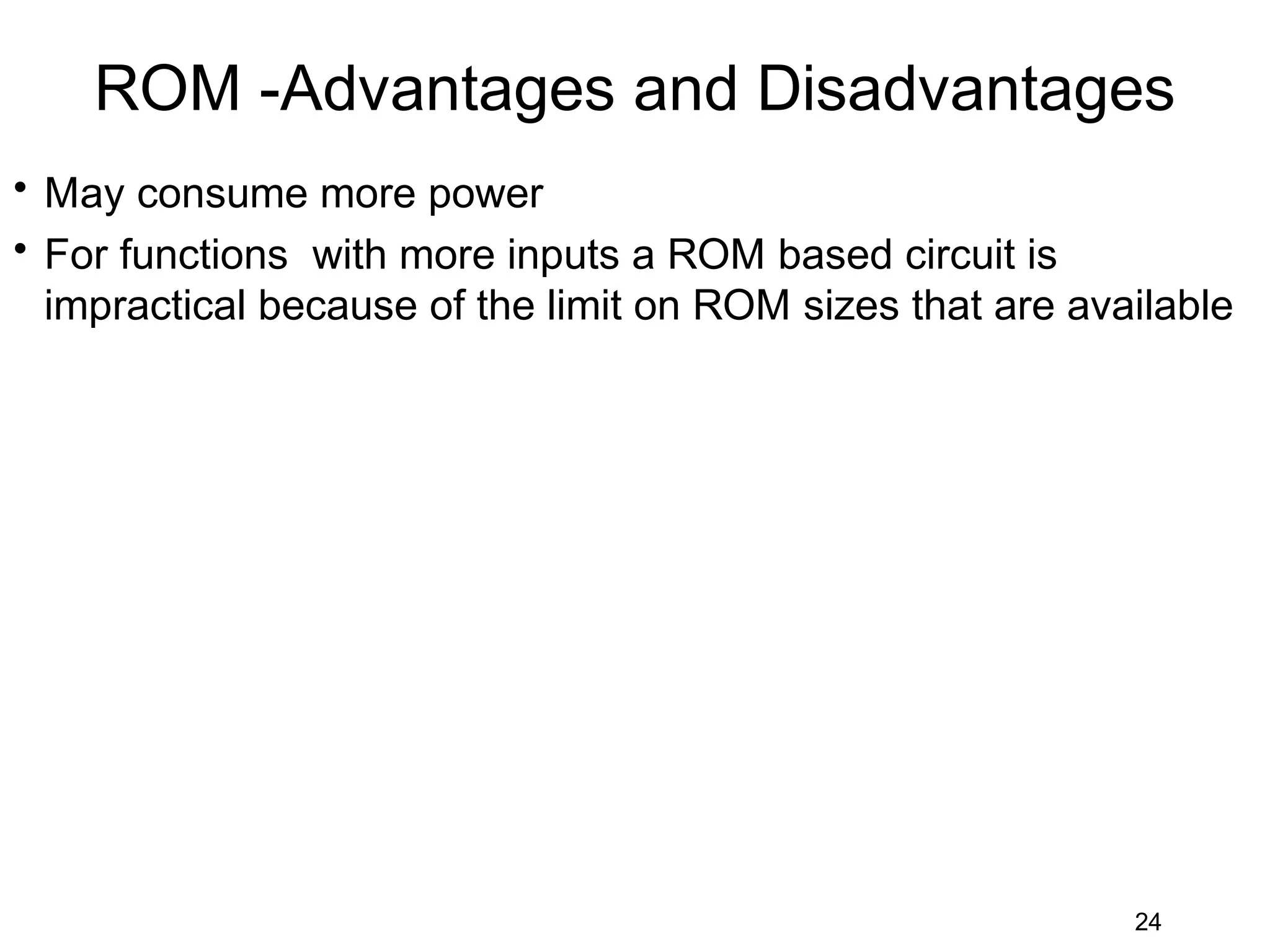
ROM -Advantages and Disadvantages
• May consume more power
• For functions with more inputs a ROM based circuit is
  impractical because of the limit on ROM sizes that are available


                                                            24

EPROM, PROM & ROM

  • 1.
    EET 3350 DigitalSystems Design Textbook: John Wakerly Chapter 9: 9.1 Memory Read-Only Memory: ROM, PROM, EPROM 1
  • 2.
    Memory • Sequential circuitsall depend upon the presence of memory – A flip-flop can store one bit of information – A register can store a single “word” • typically 32 or 64 bits – Memory stores a large number of words • Memory stores this large amounts of data using two primary device types – Read Only Memory (ROM, PROM, EPROM, EEPROM) – Random Access Memory (RAM) • Static RAM (SRAM) • Dynamic RAM (DRAM) 2
  • 3.
    Memory Address Data • You can think of memory as being 00000000 0110101100111101 00000001 1011111100100100 one big array (list) of data 00000002 1001110011110111 – The address serves as an array . index . – Each address refers to one word . . of data (e.g., 8-bits, 16-bits, etc.) . . • You can read (or modify) the data . . at any given memory address, . just like you can read (or modify) . the contents of an array at any FFFFFFFD 0000101100001111 given index FFFFFFFE 1100101000110001 FFFFFFFF 0110101111010000 word 3
  • 4.
    Memory Memory signals fallinto three groups: • Address bus - selects one of many memory locations • Data bus - – Read (ROM/RAM): the selected location’s stored data is put on the data bus – Write (RAM): The data on the data bus is stored into the selected location • Control signals - specifies what the memory is to do – Control signals are usually active low – Most common signals are: • CS: Chip Select; must be active to do anything • OE: Output Enable; active to read data • WR: Write; active to write data 4
  • 5.
    Memory • Memory isnot a single chip (device) – Made up of many identical or similar devices – A specific device (part of memory) is selected by control signals and the address lines (bus) – All devices are connected to the same bus, and see the signals at the same time 5
  • 6.
    Memory • Memory Connectionto CPU – RAM and ROM chips are connected to a CPU through the data and address buses – The low-order lines in the address bus select the byte within the chips and other lines in the address bus select a particular chip through its chip select inputs 6
  • 7.
    Memory • Location -the smallest selectable unit in memory – Has 1 or more data bits per location – All bits in location are read/written together – Cannot manipulate single bits in a location • For k address signals, there are 2k locations in a memory device • Each location contains an n-bit word • Memory size is specified as – #loc x bits per location • 224 x 16 RAM - 224 = 16M words, each 16 bits long • 24 address lines, 16 data lines – #bits • The total storage capacity is 224 x 16 = 228 bits 7
  • 8.
    Memory • Memory sizesare usually specified in numbers of bytes (1 byte= 8 bits) • The 228-bit memory on the previous page translates into: 228 bits / 8 bits per byte = 225 bytes • With the abbreviations below, this is equivalent to 32 megabytes Prefix Base 2 Base 10 K Kilo 210 = 1,024 103 = 1,000 M Mega 220 = 1,048,576 106 = 1,000,000 G Giga 230 = 1,073,741,824 109 = 1,000,000,000 8
  • 9.
    Memory • Non-volatile – If un-powered, its content is retained • Read-only – normal operation cannot change contents 2k x n ROM • k-bit ADRS specifies the address or k Δ n location to read from ADRS CS • A Chip Select, CS, enables or Data OE Out disables the RAM/ROM • An Output Enable, OE, turns on or off tri-state output buffers • Data Out will be the n-bit value stored at ADRS 9
  • 10.
    Memory • Content loading(programming) done many ways depending on device type – ROM: mask programmed, loaded at the factory • hardwired - can’t be changed • embedded mass-produced systems – PROM: OTP (One Time Programmable), programmed by user, using an external programming device – EPROM: reusable, erased by UV light, programmed by user, using an external programming device – EEPROM: electrically erasable, clears entire blocks with single operation, programmed in- place (no need to remove from circuit board) 10
  • 11.
    Read-Only Memories • Definition – ROM consists of an array of semiconductor devices interconnected to store an array of memory data. – Data can only be read, it cannot be changed under normal operating conditions. • Types of ROM – Mask programmable ROM (at the factory) – Field-Programmable ROM (PROM) – UV-Erasable and re-Programmable ROM (EPROM) – Electrically-Erasable and re-Programmable ROM (EEPROM) – Flash 11
  • 12.
    Read-Only Memories • Thelogic symbol below is used in circuit diagrams – Focus is on the basic structure of a ROM – A combinational logic circuit 12
  • 13.
    Logic-in-ROM Example • As we discussed previously, a ROM is simply a combinational circuit, basically a truth-table lookup – Can perform any combinational logic function – Address inputs = function inputs – Data outputs = function outputs (address) (data) 13
  • 14.
    Logic-in-ROM Example • Twoalternative implementations for the 3-input, 4-output logic function – 2-to-4 decoder with output polarity control 14
  • 15.
    4x4 Multiplier Example •ROM implementation of a 4x4 unsigned binary multiplier – Multiplier and multiplicand form the address – Product is pre-programmed into the storage location 15
  • 16.
    4x4 Multiplier Example •ROM contents for the 4x4 unsigned binary multiplier x0 x1 x2 x3 x4 x5 x6 x7 x8 x9 xA xB xC xD xE xF 16
  • 17.
    Internal ROM Structure • Typical implementation of “primitive” ROM Diode means a “1” is stored at this location data output 5 active low 17
  • 18.
  • 19.
    Typical Commercial EEPROMs •Logic symbols for representative EEPROMs 19
  • 20.
    ROM Control andI/O Signals • n Address lines – An-1 … A0 • b Data lines – Db-1 … D0 • Chip Select – One or more – Active low • Output Enable – Active low • Tri-state output buffers 20
  • 21.
    ROM Timing • tAA (access time from address): propagation delay from stable address inputs to valid data output • tACS ( access time from chip select): propagation delay from time CS is asserted until the valid data output • tOE (output-enable time): propagation delay from time OE and CS are asserted until the tri-state drivers have left Hi-Z state • tOZ (output-disable time): propagation delay from time OE and CS are negated until the tri-state drivers have entered Hi-Z state • tOH (output-hold time): the length of time the outputs remain valid after a change in the address inputs, or after OE and CS are negated 21
  • 22.
    ROM Timing • tAA access time from address • tACS access time from chip select • tOE/tOZ output-enable/disable time • tOH output-hold time 22
  • 23.
    ROM -Advantages andDisadvantages • Ease of speed and design • For moderately complex function a ROM-based circuit is usually faster than a circuit using multiple SSI/MSI devices and PLDs • The program that generates the ROM contents can easily be structured to handle unusual or undefined cases that would require additional hardware in any other design. e.g. the adder program easily handles out-of-range sums. • A ROM’s function is easily modified just by changing the stored pattern, usually without changing any external connections • The prices of ROMs are dropping and densities increasing making them more economical and expanding the scope with a single chip 23
  • 24.
    ROM -Advantages andDisadvantages • May consume more power • For functions with more inputs a ROM based circuit is impractical because of the limit on ROM sizes that are available 24