
Learning Outcomes –
Values and Attitudes











Recognize the need for
studying values
Describe the differences in
values between generations
and cultures
Explain the differences between
values and attitudes
Explain cognitive dissonance
Recognize the three
components of attitudes
Through self assessment, gain
a greater understanding of
one’s own values

Chapter 4

Copyright 2006,
Vandeveer, Menefee,
Sinclair

1
Values and Attitudes


If you want to
understand a
person’s behavior,
you must understand
his or her values.

Chapter 4

Copyright 2006,
Vandeveer, Menefee,
Sinclair

2
Values and Attitudes


Values are basic
convictions (notions)
about what is right and
wrong.

Chapter 4

Copyright 2006,
Vandeveer, Menefee,
Sinclair

3
Values and Attitudes




Importance of values –
Values generally influence
attitudes and behavior.
Value system is a
hierarchy based on a ranking
of an individual’s values in
terms of one’s intensity.

Chapter 4

Copyright 2006,
Vandeveer, Menefee,
Sinclair

4
Values and Attitudes


Source of our Value
Systems
A significant portion is
genetically determined.
 Other factors include
national culture, parents,
teachers, friends, and
similar environmental
influences.


Chapter 4

Copyright 2006,
Vandeveer, Menefee,
Sinclair

5
Values and Attitudes
Values are
relatively stable
and enduring.
 If we know an
individual’s values,
we are better able to
predict a behavior in a
particular situation.


Chapter 4

Copyright 2006,
Vandeveer, Menefee,
Sinclair

6
Values
Values differ between
generations.
 Values differ between
regions.
 Values differ between
cultures.


Chapter 4

Copyright 2006,
Vandeveer, Menefee,
Sinclair

7
Values




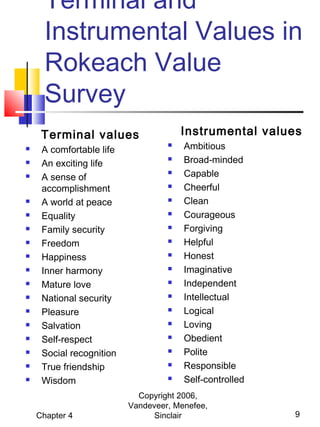
Terminal values are
the end-state we hope to
achieve in life.
Instrumental values
are means of achieving
these terminal values.

Chapter 4

Copyright 2006,
Vandeveer, Menefee,
Sinclair

8
Terminal and
Instrumental Values in
Rokeach Value
Survey
Instrumental values

Terminal values



















A comfortable life
An exciting life
A sense of
accomplishment
A world at peace
Equality
Family security
Freedom
Happiness
Inner harmony
Mature love
National security
Pleasure
Salvation
Self-respect
Social recognition
True friendship
Wisdom
Chapter 4




















Ambitious
Broad-minded
Capable
Cheerful
Clean
Courageous
Forgiving
Helpful
Honest
Imaginative
Independent
Intellectual
Logical
Loving
Obedient
Polite
Responsible
Self-controlled

Copyright 2006,
Vandeveer, Menefee,
Sinclair

9
Attitudes


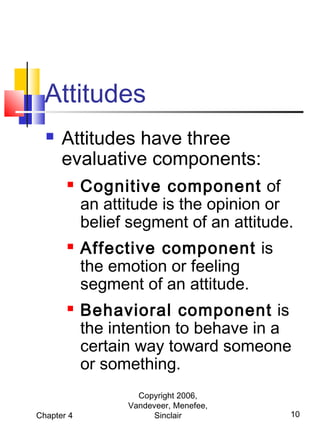
Attitudes have three
evaluative components:






Chapter 4

Cognitive component of
an attitude is the opinion or
belief segment of an attitude.
Affective component is
the emotion or feeling
segment of an attitude.
Behavioral component is
the intention to behave in a
certain way toward someone
or something.
Copyright 2006,
Vandeveer, Menefee,
Sinclair

10
Attitudes
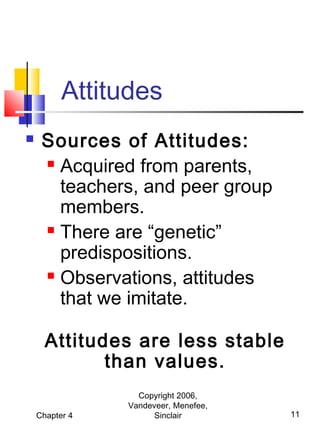
Sources of Attitudes:
 Acquired from parents,
teachers, and peer group
members.
 There are “genetic”
predispositions.
 Observations, attitudes
that we imitate.





Attitudes are less stable
than values.

Chapter 4

Copyright 2006,
Vandeveer, Menefee,
Sinclair

11
Cognitive Dissonance


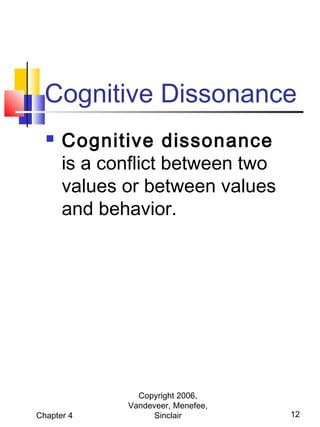
Cognitive dissonance
is a conflict between two
values or between values
and behavior.

Chapter 4

Copyright 2006,
Vandeveer, Menefee,
Sinclair

12
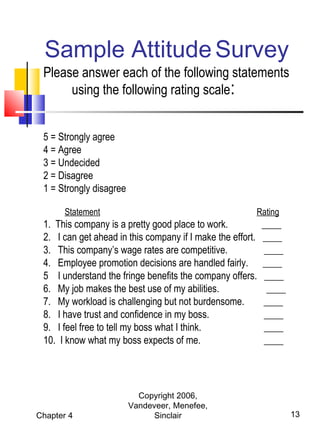
Sample Attitude Survey
Please answer each of the following statements
using the following rating scale:
5 = Strongly agree
4 = Agree
3 = Undecided
2 = Disagree
1 = Strongly disagree
Statement

Rating

1. This company is a pretty good place to work.
2. I can get ahead in this company if I make the effort.
3. This company’s wage rates are competitive.
4. Employee promotion decisions are handled fairly.
5 I understand the fringe benefits the company offers.
6. My job makes the best use of my abilities.
7. My workload is challenging but not burdensome.
8. I have trust and confidence in my boss.
9. I feel free to tell my boss what I think.
10. I know what my boss expects of me.

Chapter 4

Copyright 2006,
Vandeveer, Menefee,
Sinclair

____
____
____
____
____
____
____
____
____
____

13
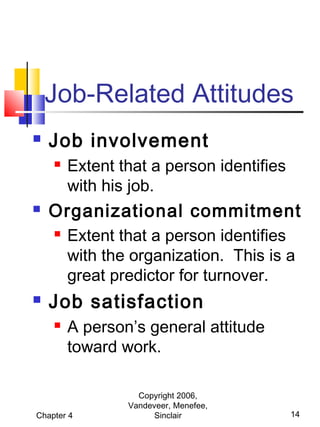
Job-Related Attitudes


Job involvement




Organizational commitment




Extent that a person identifies
with his job.
Extent that a person identifies
with the organization. This is a
great predictor for turnover.

Job satisfaction


A person’s general attitude
toward work.

Chapter 4

Copyright 2006,
Vandeveer, Menefee,
Sinclair

14
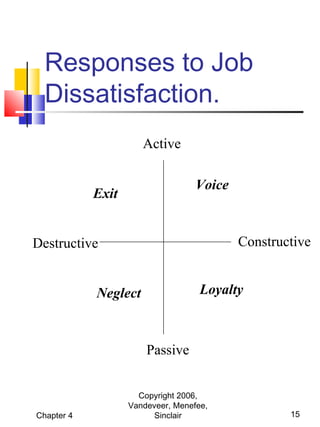
Responses to Job
Dissatisfaction.
Active
Voice

Exit

Constructive

Destructive

Loyalty

Neglect

Passive

Chapter 4

Copyright 2006,
Vandeveer, Menefee,
Sinclair

15
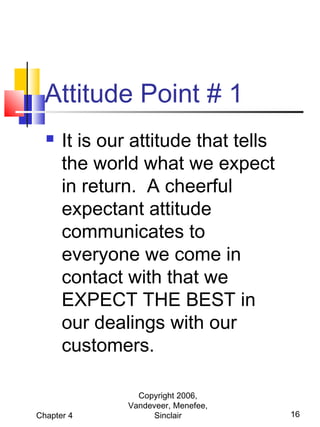
Attitude Point # 1


It is our attitude that tells
the world what we expect
in return. A cheerful
expectant attitude
communicates to
everyone we come in
contact with that we
EXPECT THE BEST in
our dealings with our
customers.

Chapter 4

Copyright 2006,
Vandeveer, Menefee,
Sinclair

16
Attitude Point # 2




It is our attitude toward
life that determines life’s
attitude toward us. A
simple cause and effect.
It is your attitude toward
others that determines
other’s attitude toward
you.

Chapter 4

Copyright 2006,
Vandeveer, Menefee,
Sinclair

17
Attitude Point # 3


To achieve and find the
life you want, you must
think, act, talk, and
conduct yourself as would
the person you want to
become.


Chapter 4

For example, if one wants
to be successful, he or she
must think, act, talk, and
conduct himself as would a
successful person.
Copyright 2006,
Vandeveer, Menefee,
Sinclair

18
Attitude Point # 4




The higher you go up in
any organization of
value, the greater the
attitude you will find.
A great attitude is not the
result of success; rather
success is the result of a
great attitude.

Chapter 4

Copyright 2006,
Vandeveer, Menefee,
Sinclair

19
Finally!!


The greatest
discovery of my
generation is that a
human being CAN
alter his life by
changing his attitude.
William James

And so it is with you – you are
in charge of your attitude.

Chapter 4

Copyright 2006,
Vandeveer, Menefee,
Sinclair

20
Summary




Values are the basic
notion/convictions of what is
right and wrong and values
are fairly stable over time.
Attitudes have three
components:




Chapter 4

cognitive component.
affective component.
behavioral component.

Copyright 2006,
Vandeveer, Menefee,
Sinclair

21
Summary




Cognitive dissonance is a
conflict between two
values or between values
and behavior.
Attitudes are feelings and
moods that affect behavior
and may change
frequently.

Chapter 4

Copyright 2006,
Vandeveer, Menefee,
Sinclair

22

Values attitude

  • 1.
    Learning Outcomes – Valuesand Attitudes       Recognize the need for studying values Describe the differences in values between generations and cultures Explain the differences between values and attitudes Explain cognitive dissonance Recognize the three components of attitudes Through self assessment, gain a greater understanding of one’s own values Chapter 4 Copyright 2006, Vandeveer, Menefee, Sinclair 1
  • 2.
    Values and Attitudes  Ifyou want to understand a person’s behavior, you must understand his or her values. Chapter 4 Copyright 2006, Vandeveer, Menefee, Sinclair 2
  • 3.
    Values and Attitudes  Valuesare basic convictions (notions) about what is right and wrong. Chapter 4 Copyright 2006, Vandeveer, Menefee, Sinclair 3
  • 4.
    Values and Attitudes   Importanceof values – Values generally influence attitudes and behavior. Value system is a hierarchy based on a ranking of an individual’s values in terms of one’s intensity. Chapter 4 Copyright 2006, Vandeveer, Menefee, Sinclair 4
  • 5.
    Values and Attitudes  Sourceof our Value Systems A significant portion is genetically determined.  Other factors include national culture, parents, teachers, friends, and similar environmental influences.  Chapter 4 Copyright 2006, Vandeveer, Menefee, Sinclair 5
  • 6.
    Values and Attitudes Valuesare relatively stable and enduring.  If we know an individual’s values, we are better able to predict a behavior in a particular situation.  Chapter 4 Copyright 2006, Vandeveer, Menefee, Sinclair 6
  • 7.
    Values Values differ between generations. Values differ between regions.  Values differ between cultures.  Chapter 4 Copyright 2006, Vandeveer, Menefee, Sinclair 7
  • 8.
    Values   Terminal values are theend-state we hope to achieve in life. Instrumental values are means of achieving these terminal values. Chapter 4 Copyright 2006, Vandeveer, Menefee, Sinclair 8
  • 9.
    Terminal and Instrumental Valuesin Rokeach Value Survey Instrumental values Terminal values                  A comfortable life An exciting life A sense of accomplishment A world at peace Equality Family security Freedom Happiness Inner harmony Mature love National security Pleasure Salvation Self-respect Social recognition True friendship Wisdom Chapter 4                   Ambitious Broad-minded Capable Cheerful Clean Courageous Forgiving Helpful Honest Imaginative Independent Intellectual Logical Loving Obedient Polite Responsible Self-controlled Copyright 2006, Vandeveer, Menefee, Sinclair 9
  • 10.
    Attitudes  Attitudes have three evaluativecomponents:    Chapter 4 Cognitive component of an attitude is the opinion or belief segment of an attitude. Affective component is the emotion or feeling segment of an attitude. Behavioral component is the intention to behave in a certain way toward someone or something. Copyright 2006, Vandeveer, Menefee, Sinclair 10
  • 11.
    Attitudes Sources of Attitudes: Acquired from parents, teachers, and peer group members.  There are “genetic” predispositions.  Observations, attitudes that we imitate.   Attitudes are less stable than values. Chapter 4 Copyright 2006, Vandeveer, Menefee, Sinclair 11
  • 12.
    Cognitive Dissonance  Cognitive dissonance isa conflict between two values or between values and behavior. Chapter 4 Copyright 2006, Vandeveer, Menefee, Sinclair 12
  • 13.
    Sample Attitude Survey Pleaseanswer each of the following statements using the following rating scale: 5 = Strongly agree 4 = Agree 3 = Undecided 2 = Disagree 1 = Strongly disagree Statement Rating 1. This company is a pretty good place to work. 2. I can get ahead in this company if I make the effort. 3. This company’s wage rates are competitive. 4. Employee promotion decisions are handled fairly. 5 I understand the fringe benefits the company offers. 6. My job makes the best use of my abilities. 7. My workload is challenging but not burdensome. 8. I have trust and confidence in my boss. 9. I feel free to tell my boss what I think. 10. I know what my boss expects of me. Chapter 4 Copyright 2006, Vandeveer, Menefee, Sinclair ____ ____ ____ ____ ____ ____ ____ ____ ____ ____ 13
  • 14.
    Job-Related Attitudes  Job involvement   Organizationalcommitment   Extent that a person identifies with his job. Extent that a person identifies with the organization. This is a great predictor for turnover. Job satisfaction  A person’s general attitude toward work. Chapter 4 Copyright 2006, Vandeveer, Menefee, Sinclair 14
  • 15.
  • 16.
    Attitude Point #1  It is our attitude that tells the world what we expect in return. A cheerful expectant attitude communicates to everyone we come in contact with that we EXPECT THE BEST in our dealings with our customers. Chapter 4 Copyright 2006, Vandeveer, Menefee, Sinclair 16
  • 17.
    Attitude Point #2   It is our attitude toward life that determines life’s attitude toward us. A simple cause and effect. It is your attitude toward others that determines other’s attitude toward you. Chapter 4 Copyright 2006, Vandeveer, Menefee, Sinclair 17
  • 18.
    Attitude Point #3  To achieve and find the life you want, you must think, act, talk, and conduct yourself as would the person you want to become.  Chapter 4 For example, if one wants to be successful, he or she must think, act, talk, and conduct himself as would a successful person. Copyright 2006, Vandeveer, Menefee, Sinclair 18
  • 19.
    Attitude Point #4   The higher you go up in any organization of value, the greater the attitude you will find. A great attitude is not the result of success; rather success is the result of a great attitude. Chapter 4 Copyright 2006, Vandeveer, Menefee, Sinclair 19
  • 20.
    Finally!!  The greatest discovery ofmy generation is that a human being CAN alter his life by changing his attitude. William James And so it is with you – you are in charge of your attitude. Chapter 4 Copyright 2006, Vandeveer, Menefee, Sinclair 20
  • 21.
    Summary   Values are thebasic notion/convictions of what is right and wrong and values are fairly stable over time. Attitudes have three components:    Chapter 4 cognitive component. affective component. behavioral component. Copyright 2006, Vandeveer, Menefee, Sinclair 21
  • 22.
    Summary   Cognitive dissonance isa conflict between two values or between values and behavior. Attitudes are feelings and moods that affect behavior and may change frequently. Chapter 4 Copyright 2006, Vandeveer, Menefee, Sinclair 22