ATTITUDES & VALUES
CONCEPT & NATURE OF VALUES
• Milton Rokeach has defined values as global
beliefs that guide actions and judgments in
different situations.
• Contain a judgmental element.
• Content and intensity attributes.
Characteristics
• Central to the core of a person
• Relatively permanent and resistant to change.
• Attributes-content and intensity
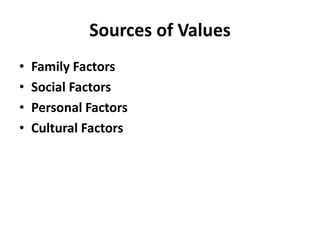
Sources of Values
• Family Factors
• Social Factors
• Personal Factors
• Cultural Factors
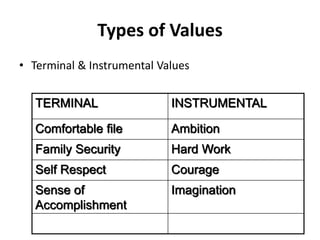
Types of Values
• Terminal & Instrumental Values
TERMINAL INSTRUMENTAL
Comfortable file Ambition
Family Security Hard Work
Self Respect Courage
Sense of
Accomplishment
Imagination
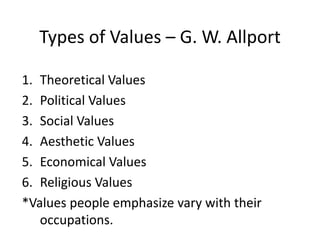
Types of Values – G. W. Allport
1. Theoretical Values
2. Political Values
3. Social Values
4. Aesthetic Values
5. Economical Values
6. Religious Values
*Values people emphasize vary with their
occupations.
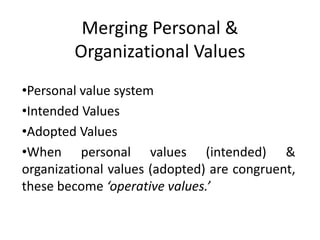
Merging Personal &
Organizational Values
•Personal value system
•Intended Values
•Adopted Values
•When personal values (intended) &
organizational values (adopted) are congruent,
these become ‘operative values.’
Values Vs Attitude
• Values are general beliefs about life, whereas
attitudes are directed towards specific objects,
events or people.
• Of course, values influence our attitudes
towards those objects.
Story – You can Win
There was a man who made a living selling
balloons at a fair. He had all colours of balloons,
including red, yellow, blue and green. Whenever
business was slow, he would release a helium –
filled balloon into the air and then the children
saw it go up. And the sales would also improve.
He continued this process all day. One day he
felt some one tugging at his jacket.
He turned around and saw a little boy who
asked “If you release a black balloon, would that
also fly?”
You Can Win
Moved by the boy’s concern, the man replied
with empathy, “Son, it is not the colour of the
balloon, it is what is inside that makes it go
up.”
You Can Win
The same thing applies to our lives. It is what is
inside that counts. The things inside of us go
up is our attitude.
Have you ever wondered why some
individuals, organizations or countries are
more successful than others?
ATTITUDE
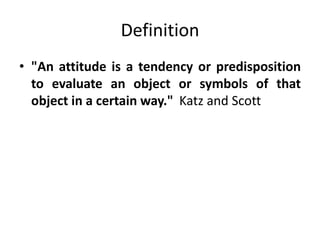
Definition
• "An attitude is a tendency or predisposition
to evaluate an object or symbols of that
object in a certain way." Katz and Scott
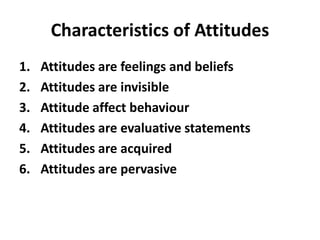
Characteristics of Attitudes
1. Attitudes are feelings and beliefs
2. Attitudes are invisible
3. Attitude affect behaviour
4. Attitudes are evaluative statements
5. Attitudes are acquired
6. Attitudes are pervasive
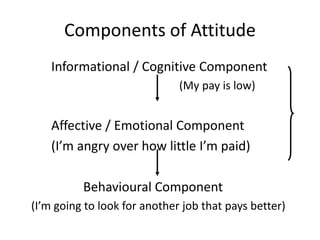
Components of Attitude
Informational / Cognitive Component
(My pay is low)
Affective / Emotional Component
(I’m angry over how little I’m paid)
Behavioural Component
(I’m going to look for another job that pays better)
SOURCES OF ATTITUDES
• Direct Personal Experience
• Association
• Social Learning or Modelling
• Institutional Factors
• Mass Media
• Economic Status and Occupations
Work Attitudes
1. Job Satisfaction
a) Job satisfaction and productivity
b) Job satisfaction and absenteeism
c) Job satisfaction and employee turnover
2. Job Involvement - refers to the degree with
which an individual identifies psychologically
with his or her job and perceives his or her
performance level important to self worth.
Work Attitudes
3. Organizational Commitment –
Job involvement refers to one's attachment to a
job whereas organizational commitment implies
an employee's identification with a particular
organization and its goals.
© 2005 Prentice Hall Inc. All
rights reserved.
3–19
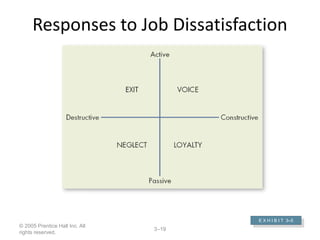
Responses to Job Dissatisfaction
E X H I B I T 3–5
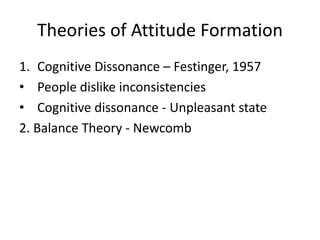
Theories of Attitude Formation
1. Cognitive Dissonance – Festinger, 1957
• People dislike inconsistencies
• Cognitive dissonance - Unpleasant state
2. Balance Theory - Newcomb
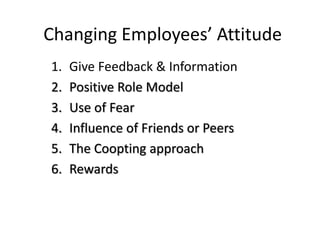
Changing Employees’ Attitude
1. Give Feedback & Information
2. Positive Role Model
3. Use of Fear
4. Influence of Friends or Peers
5. The Coopting approach
6. Rewards
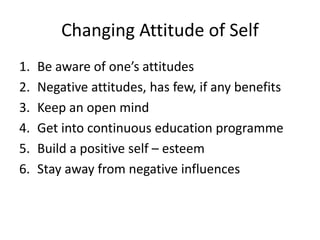
Changing Attitude of Self
1. Be aware of one’s attitudes
2. Negative attitudes, has few, if any benefits
3. Keep an open mind
4. Get into continuous education programme
5. Build a positive self – esteem
6. Stay away from negative influences
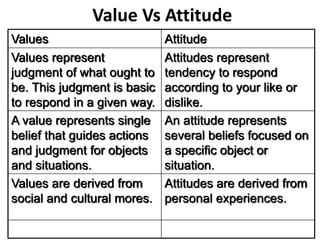
Value Vs Attitude
Values Attitude
Values represent
judgment of what ought to
be. This judgment is basic
to respond in a given way.
Attitudes represent
tendency to respond
according to your like or
dislike.
A value represents single
belief that guides actions
and judgment for objects
and situations.
An attitude represents
several beliefs focused on
a specific object or
situation.
Values are derived from
social and cultural mores.
Attitudes are derived from
personal experiences.
THANK
YOU

Attitudes & values

  • 1.
  • 2.
    CONCEPT & NATUREOF VALUES • Milton Rokeach has defined values as global beliefs that guide actions and judgments in different situations. • Contain a judgmental element. • Content and intensity attributes.
  • 3.
    Characteristics • Central tothe core of a person • Relatively permanent and resistant to change. • Attributes-content and intensity
  • 4.
    Sources of Values •Family Factors • Social Factors • Personal Factors • Cultural Factors
  • 5.
    Types of Values •Terminal & Instrumental Values TERMINAL INSTRUMENTAL Comfortable file Ambition Family Security Hard Work Self Respect Courage Sense of Accomplishment Imagination
  • 6.
    Types of Values– G. W. Allport 1. Theoretical Values 2. Political Values 3. Social Values 4. Aesthetic Values 5. Economical Values 6. Religious Values *Values people emphasize vary with their occupations.
  • 7.
    Merging Personal & OrganizationalValues •Personal value system •Intended Values •Adopted Values •When personal values (intended) & organizational values (adopted) are congruent, these become ‘operative values.’
  • 8.
    Values Vs Attitude •Values are general beliefs about life, whereas attitudes are directed towards specific objects, events or people. • Of course, values influence our attitudes towards those objects.
  • 9.
    Story – Youcan Win There was a man who made a living selling balloons at a fair. He had all colours of balloons, including red, yellow, blue and green. Whenever business was slow, he would release a helium – filled balloon into the air and then the children saw it go up. And the sales would also improve. He continued this process all day. One day he felt some one tugging at his jacket. He turned around and saw a little boy who asked “If you release a black balloon, would that also fly?”
  • 10.
    You Can Win Movedby the boy’s concern, the man replied with empathy, “Son, it is not the colour of the balloon, it is what is inside that makes it go up.”
  • 11.
    You Can Win Thesame thing applies to our lives. It is what is inside that counts. The things inside of us go up is our attitude. Have you ever wondered why some individuals, organizations or countries are more successful than others?
  • 12.
  • 13.
    Definition • "An attitudeis a tendency or predisposition to evaluate an object or symbols of that object in a certain way." Katz and Scott
  • 14.
    Characteristics of Attitudes 1.Attitudes are feelings and beliefs 2. Attitudes are invisible 3. Attitude affect behaviour 4. Attitudes are evaluative statements 5. Attitudes are acquired 6. Attitudes are pervasive
  • 15.
    Components of Attitude Informational/ Cognitive Component (My pay is low) Affective / Emotional Component (I’m angry over how little I’m paid) Behavioural Component (I’m going to look for another job that pays better)
  • 16.
    SOURCES OF ATTITUDES •Direct Personal Experience • Association • Social Learning or Modelling • Institutional Factors • Mass Media • Economic Status and Occupations
  • 17.
    Work Attitudes 1. JobSatisfaction a) Job satisfaction and productivity b) Job satisfaction and absenteeism c) Job satisfaction and employee turnover 2. Job Involvement - refers to the degree with which an individual identifies psychologically with his or her job and perceives his or her performance level important to self worth.
  • 18.
    Work Attitudes 3. OrganizationalCommitment – Job involvement refers to one's attachment to a job whereas organizational commitment implies an employee's identification with a particular organization and its goals.
  • 19.
    © 2005 PrenticeHall Inc. All rights reserved. 3–19 Responses to Job Dissatisfaction E X H I B I T 3–5
  • 20.
    Theories of AttitudeFormation 1. Cognitive Dissonance – Festinger, 1957 • People dislike inconsistencies • Cognitive dissonance - Unpleasant state 2. Balance Theory - Newcomb
  • 21.
    Changing Employees’ Attitude 1.Give Feedback & Information 2. Positive Role Model 3. Use of Fear 4. Influence of Friends or Peers 5. The Coopting approach 6. Rewards
  • 22.
    Changing Attitude ofSelf 1. Be aware of one’s attitudes 2. Negative attitudes, has few, if any benefits 3. Keep an open mind 4. Get into continuous education programme 5. Build a positive self – esteem 6. Stay away from negative influences
  • 23.
    Value Vs Attitude ValuesAttitude Values represent judgment of what ought to be. This judgment is basic to respond in a given way. Attitudes represent tendency to respond according to your like or dislike. A value represents single belief that guides actions and judgment for objects and situations. An attitude represents several beliefs focused on a specific object or situation. Values are derived from social and cultural mores. Attitudes are derived from personal experiences.
  • 24.