Submitted by :
Rachit Suri
Manvi Nagi
Balpreet Kaur
Rashi Kaushal
Objective
❑ To understand and discuss the various components and aspects of Attitude and Job Satisfaction through the
vision of Organizational Behavior.
 Introduction of attitudes
 Components of attitudes
 ABC Model
 Factors of Attitude Formation
 Measuring Attitudes
 Identifying Employees with Bad Attitudes
 Attitude Change
 Cognitive Dissonance
 Benefits of Having Positive Attitude
 Job Satisfaction & Its theories
 Causes and Measures of Job Satisfaction
 Impact of Job Dissatisfaction
 Organizational Commitment
❑ To study the case of dissatisfied employees committing suicides in Foxconn industry.
What is Attitude ?
Attitudes are basically the beliefs, feelings, emotions and action tendencies of an individual or
a group towards ideas, objects and people.
Definition of attitude is as follows:
"An attitude is a mental state of readiness, learned and organized through experience, exerting
specific influence on person's response to people, object and situations with which it is related."
Here are few pointers about attitudes:
❖ Attitudes are evaluative statements – either favorable or unfavorable.
❖ They reflect how we feel about something.
❖ Attitudes are learned.
❖ Attitudes are organized and are core to an individual.
❖ Everyone, irrespective of their status or intelligence, hold attitudes.
Components of Attitudes
In order to fully understand attitudes, we need to consider it’s components. There are three components
of attitude:
❖ A cognitive element – opinions, beliefs, knowledge held by an individual
❖ An affective component – sentiments, moods, emotions and feelings about some person, idea or
object
❖ A behavioral component – predispositions to get on a favorable or unfavorable evaluation of
something
An attitude represents the interplay of a person's affective, cognitive and behavioral tendencies with
regard to a person, group or an issue.
Example -
❖ Cognitive component - "My pay is low."
❖ Affective component - "I am angry over how little I'm paid."
❖ Behavioral component - "I'm going to look for another job that pays better."
In this example, these three statements reflect an employee's attitude.
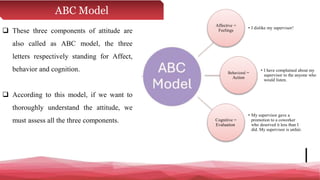
ABC Model
 These three components of attitude are
also called as ABC model, the three
letters respectively standing for Affect,
behavior and cognition.
 According to this model, if we want to
thoroughly understand the attitude, we
must assess all the three components.
Affective =
Feelings
• I dislike my supervisor!
Behavioral =
Action
• I have complained about my
supervisor to the anyone who
would listen.
Cognitive =
Evaluation
• My supervisor gave a
promotion to a coworker
who deserved it less than I
did. My supervisor is unfair.
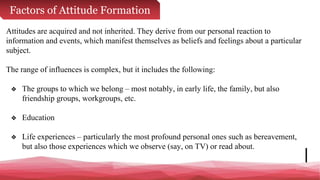
Factors of Attitude Formation
Attitudes are acquired and not inherited. They derive from our personal reaction to
information and events, which manifest themselves as beliefs and feelings about a particular
subject.
The range of influences is complex, but it includes the following:
❖ The groups to which we belong – most notably, in early life, the family, but also
friendship groups, workgroups, etc.
❖ Education
❖ Life experiences – particularly the most profound personal ones such as bereavement,
but also those experiences which we observe (say, on TV) or read about.
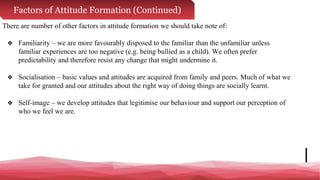
Factors of Attitude Formation (Continued)
There are number of other factors in attitude formation we should take note of:
❖ Familiarity – we are more favourably disposed to the familiar than the unfamiliar unless
familiar experiences are too negative (e.g. being bullied as a child). We often prefer
predictability and therefore resist any change that might undermine it.
❖ Socialisation – basic values and attitudes are acquired from family and peers. Much of what we
take for granted and our attitudes about the right way of doing things are socially learnt.
❖ Self-image – we develop attitudes that legitimise our behaviour and support our perception of
who we feel we are.
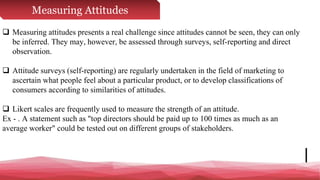
Measuring Attitudes
 Measuring attitudes presents a real challenge since attitudes cannot be seen, they can only
be inferred. They may, however, be assessed through surveys, self-reporting and direct
observation.
 Attitude surveys (self-reporting) are regularly undertaken in the field of marketing to
ascertain what people feel about a particular product, or to develop classifications of
consumers according to similarities of attitudes.
 Likert scales are frequently used to measure the strength of an attitude.
Ex - . A statement such as "top directors should be paid up to 100 times as much as an
average worker" could be tested out on different groups of stakeholders.
Measuring Attitudes (Continued)
Operational methods for attitude surveys generally seek to measure five components for each belief. Attitudes to
work could be measured as follows:
❖ Strength of feeling about the job itself -The strength with which various attitudes are held about different
aspects of the job, measured on, say, a seven-point scale, from "agree totally" through neutral to "disagree
totally".
❖ Value of job to self
❖ Social factors - Attitudes and behaviour do not depend on inner perceptions alone, but also upon surrounding
social pressures – the person's perceptions of what others think he or she should do.
❖ Overall attitude
❖ Intended behaviour - Potential reactions to different scenarios about the job or its context. Although
hypothetical, this prediction makes an interesting correlation with actual behaviour.
Identifying Employees with Bad Attitudes
To spot these negative minded employees, look out for ones who:
❖ Undermine the authority of management, criticising decisions made.
❖ Complain frequently about the business, their workload, customers or colleagues.
❖ Exaggerate problems or mistakes made by either the company or other members of staff.
❖ Gossips about other employees or management to cause tension between staff members.
Attitude Change
Here are a few tips that can help create better attitudes among workers:
❖ Increase opportunities for growth
❖ Create a career development program
❖ Improve the physical work environment
❖ Simplify the digital employee experience
❖ Invest in management and leadership training
❖ Help employees find meaning in their work
❖ Lead by example
❖ Boost social connection in the workplace
Cognitive Dissonance
A significant obstacle to attitudinal change may be that the new (attitude or belief) challenges the old or existing
(attitudes and beliefs), and produces feelings of psychological discomfort or tension.
This mismatch between the feelings produced by evidence for the new state and the old beliefs is referred to by
Festinger (1957) as cognitive dissonance.
A classic example of this is the impact on cigarette smokers of evidence linking smoking with various diseases,
such as lung cancer, high blood pressure, stroke and cardiovascular disease. There are a number of strategies
which can be adopted to overcome cognitive dissonance:
❖ Cognitive in support of the existing belief, through distorting or devaluing the evidence – "It is only
statistical"; "It won't happen to me"; "I don't believe it“.
❖ Behavioural in support of continued smoking – such as avoiding the evidence, not reading newspapers
where it is likely to be published, turning off the television or radio if medical programmes are being
shown or broadcast, etc
Cognitive Dissonance (Continued)
❖ Cognitive in support of the new belief with the intention of giving up smoking – "I'll
give up next week", or "I'll give up when the tax is increased"
❖ Behavioural in support of the new belief – actually giving up or cutting down the
number of cigarettes smoked.
Trying to change beliefs or attitudes by information alone is likely to be unsuccessful, unless
lack of information is the only barrier. For strongly held beliefs, a cognitive movement
towards consonance is more likely than a behavioural one – it is, apparently, much easier to
mean to do something than to actually do it.
Benefits of having positive attitude
When all the employees in an organization have positive attitudes, it can bring lots of
benefits for an organization. Few of the benefits are:
❖ Increase in the productivity
❖ Fosters teamwork
❖ Solves problems
❖ Improves quality of the work
❖ Increases loyalty
❖ Increase profits
❖ Better relationships with other employees and employers
❖ Reduces stress
❖ Makes for a pleasing personality
Job Satisfaction
There are two work related attitudes:
❖ Job Satisfaction
❖ Organizational Commitment
Job Satisfaction
• Job satisfaction refers to the general attitude of employees towards their jobs. When the attitude of an employee
towards his or her job is positive, there exists job satisfaction. Dissatisfaction exists when the attitude is negative.
• Job satisfaction is often a collection of attitudes about specific factors of the job.
• Employee can be satisfied with some elements of the job while simultaneously dissatisfied with other.
• For example - Satisfied with the salary but dissatisfied with supervisor.
Theories of Job Satisfaction
Herzberg’s two factor Theory
o Herzberg and his associates basically discovered that the factors that contributed to job satisfaction were
different from the factors that contributed to job dissatisfaction.
o Dissatisfaction was associated with conditions surrounding the jobs rather than the work itself. These are
referred to as hygiene (or maintenance factors).
o By contrast, satisfaction was associated with factors associated with work itself or to outcomes directly
derived from it. These are called as motivators.
Locke’s Value Theory
o This theory shows that job satisfaction is the relationship between job outcomes realized as compared to
those desired.
o In other words, satisfaction is high when an employee receives outcomes which he/she values high, and
satisfaction is less when the outcomes received are valued less by an employee.
o So, the key to satisfaction is the discrepancy between those aspects of the job one has and those one
wants; the greater the discrepancy, lesser the satisfaction.
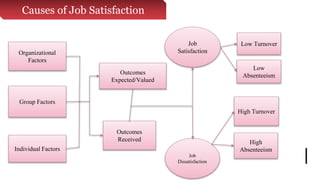
Causes of Job Satisfaction
Organizational
Factors
Group Factors
Individual Factors
Outcomes
Expected/Valued
Outcomes
Received
Job
Satisfaction
Job
Dissatisfaction
Low Turnover
Low
Absenteeism
High Turnover
High
Absenteeism
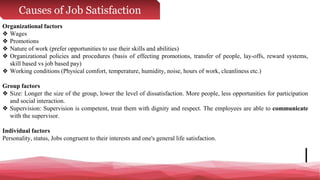
Causes of Job Satisfaction
Organizational factors
❖ Wages
❖ Promotions
❖ Nature of work (prefer opportunities to use their skills and abilities)
❖ Organizational policies and procedures (basis of effecting promotions, transfer of people, lay-offs, reward systems,
skill based vs job based pay)
❖ Working conditions (Physical comfort, temperature, humidity, noise, hours of work, cleanliness etc.)
Group factors
❖ Size: Longer the size of the group, lower the level of dissatisfaction. More people, less opportunities for participation
and social interaction.
❖ Supervision: Supervision is competent, treat them with dignity and respect. The employees are able to communicate
with the supervisor.
Individual factors
Personality, status, Jobs congruent to their interests and one's general life satisfaction.
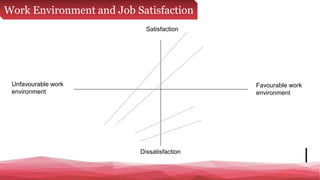
Work Environment and Job Satisfaction
Satisfaction
Dissatisfaction
Unfavourable work
environment
Favourable work
environment
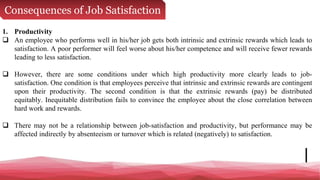
Consequences of Job Satisfaction
1. Productivity
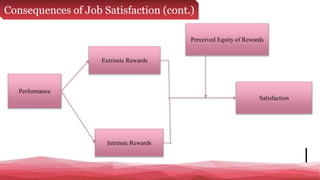
 An employee who performs well in his/her job gets both intrinsic and extrinsic rewards which leads to
satisfaction. A poor performer will feel worse about his/her competence and will receive fewer rewards
leading to less satisfaction.
 However, there are some conditions under which high productivity more clearly leads to job-
satisfaction. One condition is that employees perceive that intrinsic and extrinsic rewards are contingent
upon their productivity. The second condition is that the extrinsic rewards (pay) be distributed
equitably. Inequitable distribution fails to convince the employee about the close correlation between
hard work and rewards.
 There may not be a relationship between job-satisfaction and productivity, but performance may be
affected indirectly by absenteeism or turnover which is related (negatively) to satisfaction.
Consequences of Job Satisfaction (cont.)
Performance
Extrinsic Rewards
Intrinsic Rewards
Perceived Equity of Rewards
Satisfaction
Lawler-Porter Model of Satisfaction
Consequences of Job Satisfaction (cont.)
2. Employee Turnover
 High employee turnover is of considerable concern for employers because it disrupt normal
operations, causes morale problems for those who stick on, and increases the cost involved in
selecting and training replacements. The employer does whatever possible to minimize turnover,
making the employees feel satisfied on their jobs, being one such.
 It has been demonstrated that workers who have relatively low levels of job - satisfaction are the most
likely to quit their jobs and that organizational units with the lowest average satisfaction levels tend to
have the highest turnover rates.
 However, the withdrawal behavior of employees is modified by certain factors. Loyalty to the
organization is one such. Some employees cannot imagine themselves working elsewhere, however
dissatisfied they are in their present jobs. Availability of other places of employment also influences
turnover.
Consequences of Job Satisfaction (cont.)
3. Absence
 Absenteeism is high when satisfaction is low. As in turnover, absenteeism is subject to modification by
certain factors.
 Employees who feel that their work is important tend to clock in regular attendance.
 Besides, it is important to remember that while high job - satisfaction will not necessarily result in low
absenteeism, low satisfaction is likely to bring about high absenteeism.
4. Safety
 When people are discouraged about their jobs, company, and supervisors, they are more liable to experience
accidents. An underlying reason for such accidents is that discouragement may take one's attention away
from the task at hand. Inattention leads directly to accidents.
 For example, many hand injuries from power tools can be attributed to the operator Rot paying careful
attention.
Consequences of Job Satisfaction (cont.)
5. Job Stress
 Job stress is the body's response to any job-related factor that threatens to disturb the person's
equilibrium.
 Prolonged stress can cause the employee serious ailments such as heart disease, lower back pain, and
muscle aches.
 Chronic job-dissatisfaction is a powerful source of job stress. The employee may see no satisfactory
short-term solution to escaping this type of stress. An employee trapped in a dissatisfying job may
withdraw by such means as high absenteeism and tardiness; or the employee may quit. These
employees are costly to the management in terms of time lost due to frequent absences and increased
payments towards medical reimbursements.
Consequences of Job Satisfaction(cont.)
6. Unionization
 Dissatisfaction with wages, job security, chances for promotion and treatment by
supervisors are reasons which make employees join unions.
 Another dimension is that job dissatisfaction can have an impact on the tendency to act
within the union, such as filing grievances or striking.
Other factors of Job Satisfaction:
In additions to the above, it has been claimed that satisfied employees tend to have better
mental and physical health and learn new job-related tasks more quickly.
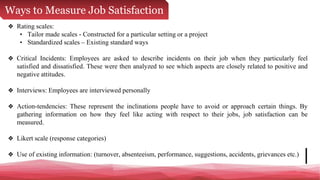
Ways to Measure Job Satisfaction
❖ Rating scales:
• Tailor made scales - Constructed for a particular setting or a project
• Standardized scales – Existing standard ways
❖ Critical Incidents: Employees are asked to describe incidents on their job when they particularly feel
satisfied and dissatisfied. These were then analyzed to see which aspects are closely related to positive and
negative attitudes.
❖ Interviews: Employees are interviewed personally
❖ Action-tendencies: These represent the inclinations people have to avoid or approach certain things. By
gathering information on how they feel like acting with respect to their jobs, job satisfaction can be
measured.
❖ Likert scale (response categories)
❖ Use of existing information: (turnover, absenteeism, performance, suggestions, accidents, grievances etc.)
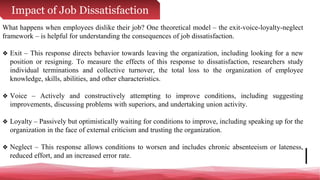
Impact of Job Dissatisfaction
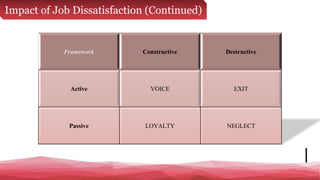
What happens when employees dislike their job? One theoretical model – the exit-voice-loyalty-neglect
framework – is helpful for understanding the consequences of job dissatisfaction.
❖ Exit – This response directs behavior towards leaving the organization, including looking for a new
position or resigning. To measure the effects of this response to dissatisfaction, researchers study
individual terminations and collective turnover, the total loss to the organization of employee
knowledge, skills, abilities, and other characteristics.
❖ Voice – Actively and constructively attempting to improve conditions, including suggesting
improvements, discussing problems with superiors, and undertaking union activity.
❖ Loyalty – Passively but optimistically waiting for conditions to improve, including speaking up for the
organization in the face of external criticism and trusting the organization.
❖ Neglect – This response allows conditions to worsen and includes chronic absenteeism or lateness,
reduced effort, and an increased error rate.
Impact of Job Dissatisfaction (Continued)
Framework Constructive Destructive
Active VOICE EXIT
Passive LOYALTY NEGLECT
Organizational Commitment
Organizational Commitment refers to the strength of an employee’s involvement in the organization and
identification with it.
❏ Affective commitment is an employee’s intention to remain in an organization because of a strong desire to
do so. It consists of:
● A belief in the goals and values of the organization
● A willingness to put forth effort on behalf of the organization
● A desire to remain a member of the organization
❏ Continuous Commitment is an employee’s tendency to remain in an organization because the person cannot
afford to leave. Alternative to leaving the organization is probably securing a less lucrative job or remaining
jobless.
❏ Normative Commitment is a perceived obligation to remain with the organization. Individuals who
experience normative commitment stay with the organization because they feel they should do.
Affective and normative commitments are related to lower rates of absenteeism, higher quality of work, increased
productivity and several different types of performance.
Building Organizational Commitment
 Job Characteristics affect organizational commitment considerably. The most valuable
ingredients for organizational commitment are positive and equitable work experiences.
 New hires must believe that that organization is fulfilling its obligations. Organizational
commitment tends to suffer when employee are overworked, not accompanied by
commensurate rewards but senior executives enjoy perks disproportionate to their
contribution to the success of the organization.
 Employees need to feel some permanence in the employment relationship.
 The other factors that contribute to organizational commitment include pay, relationship
with supervisor and co-workers, working conditions and so on.
Building Organizational Commitment (cont.)
Overtime, organizational commitment tends to become stronger because:
 As more time passes, individuals develop deeper ties with the organization and
co-workers.
 Seniority often develops more positive work attitude.
 Opportunities in the job market may decrease over age; causing workers to
become more strongly attached to their current jobs.
FOXCONN: An
Alarming
Management Style
Introduction
❖ Our civilization has seen various turning points, which have brought about a ginormous rise in human standards. One of
those points was the invention of Computers. IT revolution has changed the world order by skyrocketing employment
opportunities and boosting per capita income of those economies that have indulged in this new age trend.
❖ Apple Inc. has been a major player in this revolution and Hon Hai Precision Industry Co. Ltd. (FOXCONN) has been a great
asset to it in this endeavor. However, with great scale comes greater challenges, and the biggest and harshest challenge that
Foxconn and Apple have faced is that of keeping acceptable standards of consumer social responsibility.
❖ Even though, Apple tries to optimize its social, environmental, cultural, and labor impacts through indices such as GRI G3.1
and performance indicators like EN 26 but still both companies have been struggling to keep up with an increase in suicide
rates amongst their employees due to 70-hour long work weeks, extremely hectic schedules, and alleged tough working
conditions. They have also been reported to have employed child labor into their workforce which has led to Apple’s negative
publicity.
In this report, we will study the timeline of all the events, their impact on Apple and Foxconn’s relationship, and we will also be
looking into various solutions that might have saved both companies from this disgrace.
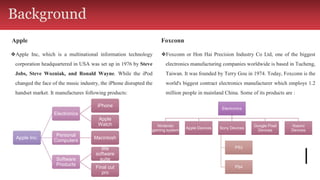
Apple
❖Apple Inc, which is a multinational information technology
corporation headquartered in USA was set up in 1976 by Steve
Jobs, Steve Wozniak, and Ronald Wayne. While the iPod
changed the face of the music industry, the iPhone disrupted the
handset market. It manufactures following products:
Background
Foxconn
❖Foxconn or Hon Hai Precision Industry Co Ltd, one of the biggest
electronics manufacturing companies worldwide is based in Tucheng,
Taiwan. It was founded by Terry Gou in 1974. Today, Foxconn is the
world's biggest contract electronics manufacturer which employs 1.2
million people in mainland China. Some of its products are :
Apple Inc.
Electronics
iPhone
Apple
Watch
Personal
Computers
Macintosh
Software
Products
ilife
software
suite
Final cut
pro
Electronics
Nintendo
gaming system
Apple Devices Sony Devices
PS3
PS4
Google Pixel
Devices
Xiaomi
Devices
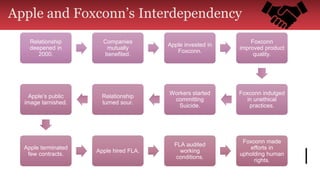
Relationship
deepened in
2000.
Companies
mutually
benefited.
Apple invested in
Foxconn.
Foxconn
improved product
quality.
Foxconn indulged
in unethical
practices.
Workers started
committing
Suicide.
Relationship
turned sour.
Apple’s public
image tarnished.
Apple terminated
few contracts.
Apple hired FLA.
FLA audited
working
conditions.
Foxconn made
efforts in
upholding human
rights.
Apple and Foxconn’s Interdependency
Throughout a period of 12 long years, Apple and Foxconn have faced impenetrable challenges, which have led to social defamation
and monetary loss. Most of the challenges have been a result of internal mismanagement and Foxconn’s drive towards obtaining as
much output from their workers as they can. Some of the persistent issues that were reported from the factories were:
⮚ Strenuous working conditions that ultimately led to some of the workers committing suicide.
⮚ Indulging in unethical practice of child labor.
⮚ Discrimination practiced by Taiwanese superiors against Chinese workers.
⮚ Noncompliance with ESG practices.
⮚ Poor internal management.
⮚ Violation of human rights.
⮚ Lack of transparency in reporting sustainability practices.
This report will focus on addressing solutions to these issues.
Objectives
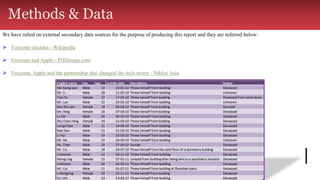
We have relied on external secondary data sources for the purpose of producing this report and they are referred below:
⮚ Foxconn suicides - Wikipedia
⮚ Foxconn and Apple - PHDessay.com
⮚ Foxconn, Apple and the partnership that changed the tech sector - Nikkei Asia
Methods & Data
Results and Discussions
⮚ Taxing work environment destroyed employee morale.
⮚ Foxconn indulged itself in an unethical practice of hiring children under the
legal age of 16 and made them work the long stressful hours.
⮚ Main triggering event was the psychological impact of poor working
conditions.
⮚ Dissatisfied workers thought of committing suicide as last resort.
⮚ String of suicides at Foxconn affected Apple’s public image.
⮚ This shows the level of brutal impact it had on their mental health.
⮚ There were no proper communication channels within the organizational
structure which ultimately led to employees being unable to share their feelings
and workload with their immediate supervisors.
⮚ Human and worker rights were reported to be grossly violated where 20-30
people were cramped into a sharing 3-bedroom apartment, workers were
forced to clean toilets and exhausting workloads and deadlines were
imposed.
⮚ They were also warned to not discuss their work with journalist or researchers
unless allowed by supervisors.
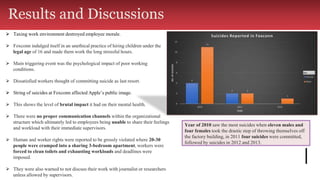
Year of 2010 saw the most suicides when eleven males and
four females took the drastic step of throwing themselves off
the factory building, in 2011 four suicides were committed,
followed by suicides in 2012 and 2013.
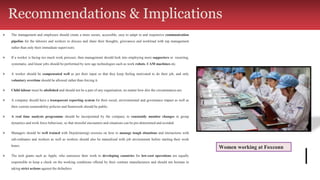
⮚ The management and employers should create a more secure, accessible, easy to adapt to and responsive communication
pipeline for the laborers and workers to discuss and share their thoughts, grievances and workload with top management
rather than only their immediate supervisors.
⮚ If a worker is facing too much work pressure, then management should look into employing more supporters or recurring,
systematic, and linear jobs should be performed by new age technologies such as work robots, CAM machines etc.
⮚ A worker should be compensated well as per their input so that they keep feeling motivated to do their job, and only
voluntary overtime should be allowed rather than forcing it.
⮚ Child labour must be abolished and should not be a part of any organisation, no matter how dire the circumstances are.
⮚ A company should have a transparent reporting system for their social, environmental and governance impact as well as
their current sustainability policies and framework should be public.
⮚ A real time analysis programme should be incorporated by the company to constantly monitor changes in group
dynamics and work force behaviour, so that stressful encounters and situations can be pre-determined and avoided.
⮚ Managers should be well trained with Dojo(training) sessions on how to manage tough situations and interactions with
sub-ordinates and workers as well as workers should also be naturalised with job environment before starting their work
hours.
⮚ The tech giants such as Apple, who outsource their work to developing countries for low-cost operations are equally
responsible to keep a check on the working conditions offered by their contract manufacturers and should not hesitate in
taking strict actions against the defaulters.
Women working at Foxconn
Recommendations & Implications
Attitudes and Job Satisfaction Updated .pptx

Attitudes and Job Satisfaction Updated .pptx

  • 1.
    Submitted by : RachitSuri Manvi Nagi Balpreet Kaur Rashi Kaushal
  • 2.
    Objective ❑ To understandand discuss the various components and aspects of Attitude and Job Satisfaction through the vision of Organizational Behavior.  Introduction of attitudes  Components of attitudes  ABC Model  Factors of Attitude Formation  Measuring Attitudes  Identifying Employees with Bad Attitudes  Attitude Change  Cognitive Dissonance  Benefits of Having Positive Attitude  Job Satisfaction & Its theories  Causes and Measures of Job Satisfaction  Impact of Job Dissatisfaction  Organizational Commitment ❑ To study the case of dissatisfied employees committing suicides in Foxconn industry.
  • 3.
    What is Attitude? Attitudes are basically the beliefs, feelings, emotions and action tendencies of an individual or a group towards ideas, objects and people. Definition of attitude is as follows: "An attitude is a mental state of readiness, learned and organized through experience, exerting specific influence on person's response to people, object and situations with which it is related." Here are few pointers about attitudes: ❖ Attitudes are evaluative statements – either favorable or unfavorable. ❖ They reflect how we feel about something. ❖ Attitudes are learned. ❖ Attitudes are organized and are core to an individual. ❖ Everyone, irrespective of their status or intelligence, hold attitudes.
  • 4.
    Components of Attitudes Inorder to fully understand attitudes, we need to consider it’s components. There are three components of attitude: ❖ A cognitive element – opinions, beliefs, knowledge held by an individual ❖ An affective component – sentiments, moods, emotions and feelings about some person, idea or object ❖ A behavioral component – predispositions to get on a favorable or unfavorable evaluation of something An attitude represents the interplay of a person's affective, cognitive and behavioral tendencies with regard to a person, group or an issue. Example - ❖ Cognitive component - "My pay is low." ❖ Affective component - "I am angry over how little I'm paid." ❖ Behavioral component - "I'm going to look for another job that pays better." In this example, these three statements reflect an employee's attitude.
  • 5.
    ABC Model  Thesethree components of attitude are also called as ABC model, the three letters respectively standing for Affect, behavior and cognition.  According to this model, if we want to thoroughly understand the attitude, we must assess all the three components. Affective = Feelings • I dislike my supervisor! Behavioral = Action • I have complained about my supervisor to the anyone who would listen. Cognitive = Evaluation • My supervisor gave a promotion to a coworker who deserved it less than I did. My supervisor is unfair.
  • 6.
    Factors of AttitudeFormation Attitudes are acquired and not inherited. They derive from our personal reaction to information and events, which manifest themselves as beliefs and feelings about a particular subject. The range of influences is complex, but it includes the following: ❖ The groups to which we belong – most notably, in early life, the family, but also friendship groups, workgroups, etc. ❖ Education ❖ Life experiences – particularly the most profound personal ones such as bereavement, but also those experiences which we observe (say, on TV) or read about.
  • 7.
    Factors of AttitudeFormation (Continued) There are number of other factors in attitude formation we should take note of: ❖ Familiarity – we are more favourably disposed to the familiar than the unfamiliar unless familiar experiences are too negative (e.g. being bullied as a child). We often prefer predictability and therefore resist any change that might undermine it. ❖ Socialisation – basic values and attitudes are acquired from family and peers. Much of what we take for granted and our attitudes about the right way of doing things are socially learnt. ❖ Self-image – we develop attitudes that legitimise our behaviour and support our perception of who we feel we are.
  • 8.
    Measuring Attitudes  Measuringattitudes presents a real challenge since attitudes cannot be seen, they can only be inferred. They may, however, be assessed through surveys, self-reporting and direct observation.  Attitude surveys (self-reporting) are regularly undertaken in the field of marketing to ascertain what people feel about a particular product, or to develop classifications of consumers according to similarities of attitudes.  Likert scales are frequently used to measure the strength of an attitude. Ex - . A statement such as "top directors should be paid up to 100 times as much as an average worker" could be tested out on different groups of stakeholders.
  • 9.
    Measuring Attitudes (Continued) Operationalmethods for attitude surveys generally seek to measure five components for each belief. Attitudes to work could be measured as follows: ❖ Strength of feeling about the job itself -The strength with which various attitudes are held about different aspects of the job, measured on, say, a seven-point scale, from "agree totally" through neutral to "disagree totally". ❖ Value of job to self ❖ Social factors - Attitudes and behaviour do not depend on inner perceptions alone, but also upon surrounding social pressures – the person's perceptions of what others think he or she should do. ❖ Overall attitude ❖ Intended behaviour - Potential reactions to different scenarios about the job or its context. Although hypothetical, this prediction makes an interesting correlation with actual behaviour.
  • 10.
    Identifying Employees withBad Attitudes To spot these negative minded employees, look out for ones who: ❖ Undermine the authority of management, criticising decisions made. ❖ Complain frequently about the business, their workload, customers or colleagues. ❖ Exaggerate problems or mistakes made by either the company or other members of staff. ❖ Gossips about other employees or management to cause tension between staff members.
  • 11.
    Attitude Change Here area few tips that can help create better attitudes among workers: ❖ Increase opportunities for growth ❖ Create a career development program ❖ Improve the physical work environment ❖ Simplify the digital employee experience ❖ Invest in management and leadership training ❖ Help employees find meaning in their work ❖ Lead by example ❖ Boost social connection in the workplace
  • 12.
    Cognitive Dissonance A significantobstacle to attitudinal change may be that the new (attitude or belief) challenges the old or existing (attitudes and beliefs), and produces feelings of psychological discomfort or tension. This mismatch between the feelings produced by evidence for the new state and the old beliefs is referred to by Festinger (1957) as cognitive dissonance. A classic example of this is the impact on cigarette smokers of evidence linking smoking with various diseases, such as lung cancer, high blood pressure, stroke and cardiovascular disease. There are a number of strategies which can be adopted to overcome cognitive dissonance: ❖ Cognitive in support of the existing belief, through distorting or devaluing the evidence – "It is only statistical"; "It won't happen to me"; "I don't believe it“. ❖ Behavioural in support of continued smoking – such as avoiding the evidence, not reading newspapers where it is likely to be published, turning off the television or radio if medical programmes are being shown or broadcast, etc
  • 13.
    Cognitive Dissonance (Continued) ❖Cognitive in support of the new belief with the intention of giving up smoking – "I'll give up next week", or "I'll give up when the tax is increased" ❖ Behavioural in support of the new belief – actually giving up or cutting down the number of cigarettes smoked. Trying to change beliefs or attitudes by information alone is likely to be unsuccessful, unless lack of information is the only barrier. For strongly held beliefs, a cognitive movement towards consonance is more likely than a behavioural one – it is, apparently, much easier to mean to do something than to actually do it.
  • 14.
    Benefits of havingpositive attitude When all the employees in an organization have positive attitudes, it can bring lots of benefits for an organization. Few of the benefits are: ❖ Increase in the productivity ❖ Fosters teamwork ❖ Solves problems ❖ Improves quality of the work ❖ Increases loyalty ❖ Increase profits ❖ Better relationships with other employees and employers ❖ Reduces stress ❖ Makes for a pleasing personality
  • 15.
    Job Satisfaction There aretwo work related attitudes: ❖ Job Satisfaction ❖ Organizational Commitment Job Satisfaction • Job satisfaction refers to the general attitude of employees towards their jobs. When the attitude of an employee towards his or her job is positive, there exists job satisfaction. Dissatisfaction exists when the attitude is negative. • Job satisfaction is often a collection of attitudes about specific factors of the job. • Employee can be satisfied with some elements of the job while simultaneously dissatisfied with other. • For example - Satisfied with the salary but dissatisfied with supervisor.
  • 16.
    Theories of JobSatisfaction Herzberg’s two factor Theory o Herzberg and his associates basically discovered that the factors that contributed to job satisfaction were different from the factors that contributed to job dissatisfaction. o Dissatisfaction was associated with conditions surrounding the jobs rather than the work itself. These are referred to as hygiene (or maintenance factors). o By contrast, satisfaction was associated with factors associated with work itself or to outcomes directly derived from it. These are called as motivators. Locke’s Value Theory o This theory shows that job satisfaction is the relationship between job outcomes realized as compared to those desired. o In other words, satisfaction is high when an employee receives outcomes which he/she values high, and satisfaction is less when the outcomes received are valued less by an employee. o So, the key to satisfaction is the discrepancy between those aspects of the job one has and those one wants; the greater the discrepancy, lesser the satisfaction.
  • 17.
    Causes of JobSatisfaction Organizational Factors Group Factors Individual Factors Outcomes Expected/Valued Outcomes Received Job Satisfaction Job Dissatisfaction Low Turnover Low Absenteeism High Turnover High Absenteeism
  • 18.
    Causes of JobSatisfaction Organizational factors ❖ Wages ❖ Promotions ❖ Nature of work (prefer opportunities to use their skills and abilities) ❖ Organizational policies and procedures (basis of effecting promotions, transfer of people, lay-offs, reward systems, skill based vs job based pay) ❖ Working conditions (Physical comfort, temperature, humidity, noise, hours of work, cleanliness etc.) Group factors ❖ Size: Longer the size of the group, lower the level of dissatisfaction. More people, less opportunities for participation and social interaction. ❖ Supervision: Supervision is competent, treat them with dignity and respect. The employees are able to communicate with the supervisor. Individual factors Personality, status, Jobs congruent to their interests and one's general life satisfaction.
  • 19.
    Work Environment andJob Satisfaction Satisfaction Dissatisfaction Unfavourable work environment Favourable work environment
  • 20.
    Consequences of JobSatisfaction 1. Productivity  An employee who performs well in his/her job gets both intrinsic and extrinsic rewards which leads to satisfaction. A poor performer will feel worse about his/her competence and will receive fewer rewards leading to less satisfaction.  However, there are some conditions under which high productivity more clearly leads to job- satisfaction. One condition is that employees perceive that intrinsic and extrinsic rewards are contingent upon their productivity. The second condition is that the extrinsic rewards (pay) be distributed equitably. Inequitable distribution fails to convince the employee about the close correlation between hard work and rewards.  There may not be a relationship between job-satisfaction and productivity, but performance may be affected indirectly by absenteeism or turnover which is related (negatively) to satisfaction.
  • 21.
    Consequences of JobSatisfaction (cont.) Performance Extrinsic Rewards Intrinsic Rewards Perceived Equity of Rewards Satisfaction Lawler-Porter Model of Satisfaction
  • 22.
    Consequences of JobSatisfaction (cont.) 2. Employee Turnover  High employee turnover is of considerable concern for employers because it disrupt normal operations, causes morale problems for those who stick on, and increases the cost involved in selecting and training replacements. The employer does whatever possible to minimize turnover, making the employees feel satisfied on their jobs, being one such.  It has been demonstrated that workers who have relatively low levels of job - satisfaction are the most likely to quit their jobs and that organizational units with the lowest average satisfaction levels tend to have the highest turnover rates.  However, the withdrawal behavior of employees is modified by certain factors. Loyalty to the organization is one such. Some employees cannot imagine themselves working elsewhere, however dissatisfied they are in their present jobs. Availability of other places of employment also influences turnover.
  • 23.
    Consequences of JobSatisfaction (cont.) 3. Absence  Absenteeism is high when satisfaction is low. As in turnover, absenteeism is subject to modification by certain factors.  Employees who feel that their work is important tend to clock in regular attendance.  Besides, it is important to remember that while high job - satisfaction will not necessarily result in low absenteeism, low satisfaction is likely to bring about high absenteeism. 4. Safety  When people are discouraged about their jobs, company, and supervisors, they are more liable to experience accidents. An underlying reason for such accidents is that discouragement may take one's attention away from the task at hand. Inattention leads directly to accidents.  For example, many hand injuries from power tools can be attributed to the operator Rot paying careful attention.
  • 24.
    Consequences of JobSatisfaction (cont.) 5. Job Stress  Job stress is the body's response to any job-related factor that threatens to disturb the person's equilibrium.  Prolonged stress can cause the employee serious ailments such as heart disease, lower back pain, and muscle aches.  Chronic job-dissatisfaction is a powerful source of job stress. The employee may see no satisfactory short-term solution to escaping this type of stress. An employee trapped in a dissatisfying job may withdraw by such means as high absenteeism and tardiness; or the employee may quit. These employees are costly to the management in terms of time lost due to frequent absences and increased payments towards medical reimbursements.
  • 25.
    Consequences of JobSatisfaction(cont.) 6. Unionization  Dissatisfaction with wages, job security, chances for promotion and treatment by supervisors are reasons which make employees join unions.  Another dimension is that job dissatisfaction can have an impact on the tendency to act within the union, such as filing grievances or striking. Other factors of Job Satisfaction: In additions to the above, it has been claimed that satisfied employees tend to have better mental and physical health and learn new job-related tasks more quickly.
  • 26.
    Ways to MeasureJob Satisfaction ❖ Rating scales: • Tailor made scales - Constructed for a particular setting or a project • Standardized scales – Existing standard ways ❖ Critical Incidents: Employees are asked to describe incidents on their job when they particularly feel satisfied and dissatisfied. These were then analyzed to see which aspects are closely related to positive and negative attitudes. ❖ Interviews: Employees are interviewed personally ❖ Action-tendencies: These represent the inclinations people have to avoid or approach certain things. By gathering information on how they feel like acting with respect to their jobs, job satisfaction can be measured. ❖ Likert scale (response categories) ❖ Use of existing information: (turnover, absenteeism, performance, suggestions, accidents, grievances etc.)
  • 27.
    Impact of JobDissatisfaction What happens when employees dislike their job? One theoretical model – the exit-voice-loyalty-neglect framework – is helpful for understanding the consequences of job dissatisfaction. ❖ Exit – This response directs behavior towards leaving the organization, including looking for a new position or resigning. To measure the effects of this response to dissatisfaction, researchers study individual terminations and collective turnover, the total loss to the organization of employee knowledge, skills, abilities, and other characteristics. ❖ Voice – Actively and constructively attempting to improve conditions, including suggesting improvements, discussing problems with superiors, and undertaking union activity. ❖ Loyalty – Passively but optimistically waiting for conditions to improve, including speaking up for the organization in the face of external criticism and trusting the organization. ❖ Neglect – This response allows conditions to worsen and includes chronic absenteeism or lateness, reduced effort, and an increased error rate.
  • 28.
    Impact of JobDissatisfaction (Continued) Framework Constructive Destructive Active VOICE EXIT Passive LOYALTY NEGLECT
  • 29.
    Organizational Commitment Organizational Commitmentrefers to the strength of an employee’s involvement in the organization and identification with it. ❏ Affective commitment is an employee’s intention to remain in an organization because of a strong desire to do so. It consists of: ● A belief in the goals and values of the organization ● A willingness to put forth effort on behalf of the organization ● A desire to remain a member of the organization ❏ Continuous Commitment is an employee’s tendency to remain in an organization because the person cannot afford to leave. Alternative to leaving the organization is probably securing a less lucrative job or remaining jobless. ❏ Normative Commitment is a perceived obligation to remain with the organization. Individuals who experience normative commitment stay with the organization because they feel they should do. Affective and normative commitments are related to lower rates of absenteeism, higher quality of work, increased productivity and several different types of performance.
  • 30.
    Building Organizational Commitment Job Characteristics affect organizational commitment considerably. The most valuable ingredients for organizational commitment are positive and equitable work experiences.  New hires must believe that that organization is fulfilling its obligations. Organizational commitment tends to suffer when employee are overworked, not accompanied by commensurate rewards but senior executives enjoy perks disproportionate to their contribution to the success of the organization.  Employees need to feel some permanence in the employment relationship.  The other factors that contribute to organizational commitment include pay, relationship with supervisor and co-workers, working conditions and so on.
  • 31.
    Building Organizational Commitment(cont.) Overtime, organizational commitment tends to become stronger because:  As more time passes, individuals develop deeper ties with the organization and co-workers.  Seniority often develops more positive work attitude.  Opportunities in the job market may decrease over age; causing workers to become more strongly attached to their current jobs.
  • 32.
  • 33.
    Introduction ❖ Our civilizationhas seen various turning points, which have brought about a ginormous rise in human standards. One of those points was the invention of Computers. IT revolution has changed the world order by skyrocketing employment opportunities and boosting per capita income of those economies that have indulged in this new age trend. ❖ Apple Inc. has been a major player in this revolution and Hon Hai Precision Industry Co. Ltd. (FOXCONN) has been a great asset to it in this endeavor. However, with great scale comes greater challenges, and the biggest and harshest challenge that Foxconn and Apple have faced is that of keeping acceptable standards of consumer social responsibility. ❖ Even though, Apple tries to optimize its social, environmental, cultural, and labor impacts through indices such as GRI G3.1 and performance indicators like EN 26 but still both companies have been struggling to keep up with an increase in suicide rates amongst their employees due to 70-hour long work weeks, extremely hectic schedules, and alleged tough working conditions. They have also been reported to have employed child labor into their workforce which has led to Apple’s negative publicity. In this report, we will study the timeline of all the events, their impact on Apple and Foxconn’s relationship, and we will also be looking into various solutions that might have saved both companies from this disgrace.
  • 34.
    Apple ❖Apple Inc, whichis a multinational information technology corporation headquartered in USA was set up in 1976 by Steve Jobs, Steve Wozniak, and Ronald Wayne. While the iPod changed the face of the music industry, the iPhone disrupted the handset market. It manufactures following products: Background Foxconn ❖Foxconn or Hon Hai Precision Industry Co Ltd, one of the biggest electronics manufacturing companies worldwide is based in Tucheng, Taiwan. It was founded by Terry Gou in 1974. Today, Foxconn is the world's biggest contract electronics manufacturer which employs 1.2 million people in mainland China. Some of its products are : Apple Inc. Electronics iPhone Apple Watch Personal Computers Macintosh Software Products ilife software suite Final cut pro Electronics Nintendo gaming system Apple Devices Sony Devices PS3 PS4 Google Pixel Devices Xiaomi Devices
  • 35.
    Relationship deepened in 2000. Companies mutually benefited. Apple investedin Foxconn. Foxconn improved product quality. Foxconn indulged in unethical practices. Workers started committing Suicide. Relationship turned sour. Apple’s public image tarnished. Apple terminated few contracts. Apple hired FLA. FLA audited working conditions. Foxconn made efforts in upholding human rights. Apple and Foxconn’s Interdependency
  • 36.
    Throughout a periodof 12 long years, Apple and Foxconn have faced impenetrable challenges, which have led to social defamation and monetary loss. Most of the challenges have been a result of internal mismanagement and Foxconn’s drive towards obtaining as much output from their workers as they can. Some of the persistent issues that were reported from the factories were: ⮚ Strenuous working conditions that ultimately led to some of the workers committing suicide. ⮚ Indulging in unethical practice of child labor. ⮚ Discrimination practiced by Taiwanese superiors against Chinese workers. ⮚ Noncompliance with ESG practices. ⮚ Poor internal management. ⮚ Violation of human rights. ⮚ Lack of transparency in reporting sustainability practices. This report will focus on addressing solutions to these issues. Objectives
  • 37.
    We have reliedon external secondary data sources for the purpose of producing this report and they are referred below: ⮚ Foxconn suicides - Wikipedia ⮚ Foxconn and Apple - PHDessay.com ⮚ Foxconn, Apple and the partnership that changed the tech sector - Nikkei Asia Methods & Data
  • 38.
    Results and Discussions ⮚Taxing work environment destroyed employee morale. ⮚ Foxconn indulged itself in an unethical practice of hiring children under the legal age of 16 and made them work the long stressful hours. ⮚ Main triggering event was the psychological impact of poor working conditions. ⮚ Dissatisfied workers thought of committing suicide as last resort. ⮚ String of suicides at Foxconn affected Apple’s public image. ⮚ This shows the level of brutal impact it had on their mental health. ⮚ There were no proper communication channels within the organizational structure which ultimately led to employees being unable to share their feelings and workload with their immediate supervisors. ⮚ Human and worker rights were reported to be grossly violated where 20-30 people were cramped into a sharing 3-bedroom apartment, workers were forced to clean toilets and exhausting workloads and deadlines were imposed. ⮚ They were also warned to not discuss their work with journalist or researchers unless allowed by supervisors. Year of 2010 saw the most suicides when eleven males and four females took the drastic step of throwing themselves off the factory building, in 2011 four suicides were committed, followed by suicides in 2012 and 2013.
  • 39.
    ⮚ The managementand employers should create a more secure, accessible, easy to adapt to and responsive communication pipeline for the laborers and workers to discuss and share their thoughts, grievances and workload with top management rather than only their immediate supervisors. ⮚ If a worker is facing too much work pressure, then management should look into employing more supporters or recurring, systematic, and linear jobs should be performed by new age technologies such as work robots, CAM machines etc. ⮚ A worker should be compensated well as per their input so that they keep feeling motivated to do their job, and only voluntary overtime should be allowed rather than forcing it. ⮚ Child labour must be abolished and should not be a part of any organisation, no matter how dire the circumstances are. ⮚ A company should have a transparent reporting system for their social, environmental and governance impact as well as their current sustainability policies and framework should be public. ⮚ A real time analysis programme should be incorporated by the company to constantly monitor changes in group dynamics and work force behaviour, so that stressful encounters and situations can be pre-determined and avoided. ⮚ Managers should be well trained with Dojo(training) sessions on how to manage tough situations and interactions with sub-ordinates and workers as well as workers should also be naturalised with job environment before starting their work hours. ⮚ The tech giants such as Apple, who outsource their work to developing countries for low-cost operations are equally responsible to keep a check on the working conditions offered by their contract manufacturers and should not hesitate in taking strict actions against the defaulters. Women working at Foxconn Recommendations & Implications