Chapter 9
Perfect Competition

1
Market






Defined as the institutional relationship between
buyers and sellers.
Interaction between buyers and sellers of a good (or
service) at a mutually agreed upon price.
Such interaction may be at a particular place, or may
be over telephone, or even through the Internet!
Sellers and buyers may meet each other personally,
or may not ever see each other, as in E-commerce.
Thus market may be defined as a place, a function, a
process.

2
Market Morphology


Markets may be characterized on the basis of following
parameters:




Nature of competition: number, size and distribution of sellers in any
market
Nature of product: whether the product is homogeneous or
differentiated
Number and size of buyers:







large number of buyers but small size of individual buyer, the market
will be evenly balanced between buyers and sellers.
small number of buyers but their size is large, the market is driven by
buyers’ preferences.

Freedom to enter into or exit from the market: absence or presence
of financial, legal and technological constraints

Broad structures:





Perfect Competition
Monopoly
Monopolistic competition
oligopoly
3
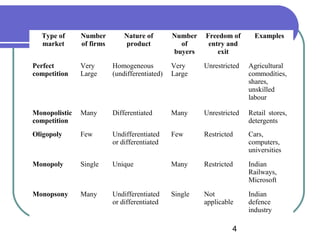
Type of
market

Number
of firms

Nature of
product

Number
of
buyers

Freedom of
entry and
exit

Examples

Perfect
competition

Very
Large

Homogeneous
(undifferentiated)

Very
Large

Unrestricted

Agricultural
commodities,
shares,
unskilled
labour

Monopolistic
competition

Many

Differentiated

Many

Unrestricted

Retail stores,
detergents

Oligopoly

Few

Undifferentiated
or differentiated

Few

Restricted

Cars,
computers,
universities

Monopoly

Single

Unique

Many

Restricted

Indian
Railways,
Microsoft

Monopsony

Many

Undifferentiated
or differentiated

Single

Not
applicable

Indian
defence
industry

Market Morphology

4
Perfect Competition



A market where infinite number of sellers sell homogeneous good
to infinite number of buyers and buyers, and sellers have perfect
knowledge of market conditions
Features
 Presence of large number of buyers and sellers
 Homogeneous product
 Freedom of entry and exit
 Perfect knowledge
 Perfectly elastic demand curve
 Perfect mobility of factors of production
 No governmental intervention
 Firm is a price taker

5
Demand and Revenue of a Firm
Marginal Revenue (MR) =P……(1)
Firms are price takers and can supply as much as they want at the
existing price in the market, thus:
AR= MR= P…………(2)
TC
TR
Revenue,
Cost, Profit

B

Profit
A

Q1

Q*

Q2

Output

Maximum
Profit

Π

Q1

Q*

Q2

6

Output
Market Demand Curve and Firm’s
Demand Curve







The market demand curve for the whole industry is a
standard downward sloping curve.
An individual buyer is able to get the maximum
amount of output at each existing price, at a given
time.
The demand curve for an individual firm is a horizontal
straight line showing that the firm can sell infinite
volume of output at the same price.
The market demand curve is the horizontal summation
of individual demand curves.

7
Demand Curve for Firm

Price

INDUSTR
Market Y

D

Demand

Price
S

Market
Supply

FIR
M

E

P*

S

P=AR=MR

D

O
Q*

Output

O

Output

8







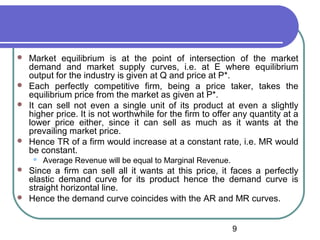
Market equilibrium is at the point of intersection of the market
demand and market supply curves, i.e. at E where equilibrium
output for the industry is given at Q and price at P*.
Each perfectly competitive firm, being a price taker, takes the
equilibrium price from the market as given at P*.
It can sell not even a single unit of its product at even a slightly
higher price. It is not worthwhile for the firm to offer any quantity at a
lower price either, since it can sell as much as it wants at the
prevailing market price.
Hence TR of a firm would increase at a constant rate, i.e. MR would
be constant.






Average Revenue will be equal to Marginal Revenue.

Since a firm can sell all it wants at this price, it faces a perfectly
elastic demand curve for its product hence the demand curve is
straight horizontal line.
Hence the demand curve coincides with the AR and MR curves.
9
Equilibrium of Firm


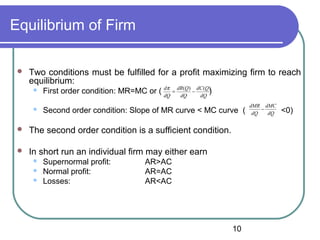
Two conditions must be fulfilled for a profit maximizing firm to reach
equilibrium:


dπ
First order condition: MR=MC or ( dQ = dR(Q) − dC (Q)
)
dQ
dQ



Second order condition: Slope of MR curve < MC curve (



The second order condition is a sufficient condition.



In short run an individual firm may either earn




Supernormal profit:
Normal profit:
Losses:

AR>AC
AR=AC
AR<AC

10

dMR dMC
−
dQ
dQ

<0)
Calculus Corner: Equilibrium of Firm











Total cost function of a competitive firm selling its product at Rs.
640 per unit is TC=240Q–20Q2 + Q3. Find the profit maximizing
output and the value of maximum profit.
Solution:
TC = 240Q–20Q2 + Q3
MC = 240 – 40Q + 3Q2
For profit maximization MR = MC.
Since this firm is in perfect competition P=MR=AR= 640
Solving for Q we get Q= - 20/3 (rejected) and 20 (accepted)
The equation for total profit is: Π = R(Q)-C(Q)= P.Q – 240Q–20Q 2
+ Q3
Substituting Q =20 in this equation we get: Π =16,000

11
Supernormal Profit


Pri
ce

MC

P
*A

A
C




E

AR=
MR

B




O

Q*

Quan
tity

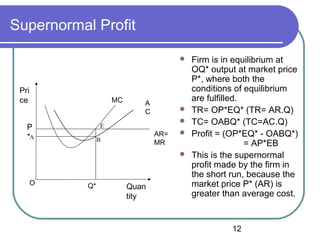
Firm is in equilibrium at
OQ* output at market price
P*, where both the
conditions of equilibrium
are fulfilled.
TR= OP*EQ* (TR= AR.Q)
TC= OABQ* (TC=AC.Q)
Profit = (OP*EQ* - OABQ*)
= AP*EB
This is the supernormal
profit made by the firm in
the short run, because the
market price P* (AR) is
greater than average cost.

12
Normal Profit


Pri
ce

MC

P
*

A
C

E

AR=
MR






O

Q*

Quan
tity

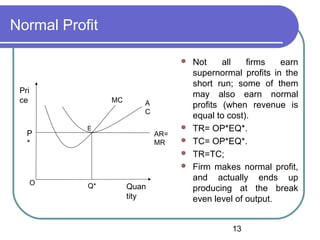
Not
all
firms
earn
supernormal profits in the
short run; some of them
may also earn normal
profits (when revenue is
equal to cost).
TR= OP*EQ*.
TC= OP*EQ*.
TR=TC;
Firm makes normal profit,
and actually ends up
producing at the break
even level of output.
13
Subnormal Profit (or Loss)



Pri
ce


MC

A

P
*

O

B

A
C
AR=
MR

E

Q*



Quan
tity

TR= OP*EQ*
TC= OABQ*.
Profit (Loss)= P*ABE
= OP*EQ* - OABQ*
The firm incurs loss or
subnormal profit in the
short run because the
average cost of producing
this output is more than
the ruling market price
hence TR<TC.

14
Shut Down of Production


FIRM
Pri
ce

P*

M
C

A

A
C


AV
C

AR=
MR





O

Q*

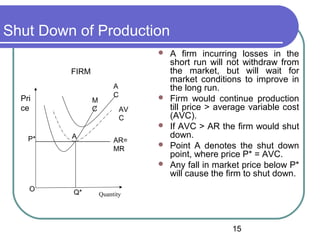
A firm incurring losses in the
short run will not withdraw from
the market, but will wait for
market conditions to improve in
the long run.
Firm would continue production
till price > average variable cost
(AVC).
If AVC > AR the firm would shut
down.
Point A denotes the shut down
point, where price P* = AVC.
Any fall in market price below P*
will cause the firm to shut down.

Quantity

15
Market Supply Curve and Firm’s Supply
Curve







Condition I: If Price<minimum AVC, then shut down
For such price, the supply curve would coincide with the
vertical axis.
Condition II: If Price≥ minimum AVC, then choose any
output that would maximize profit.
For any price above minimum AVC, the firm would
choose an output level that would satisfy the conditions
of profit maximization.
The supply curve of the firm would be identical to the
short run marginal cost curve above the minimum point
of the AVC curve.

16
Long Run Equilibrium









In the long run perfectly competitive firms earn only normal profits.
AR=MR=MC=AC
The reason is the unrestricted entry into and exit of firms from the
industry in the long run.
When existing firms enjoy supernormal profits in the short run new
firms are attracted to the industry to gain profits.
The supply of the commodity in the market increases. Assuming no
change in the demand side, this lowers the price level.
When firms are making losses in the short run, some may be forced
to leave the industry in the long run.
Their exit from the industry causes a reduction in the supply of the
product and as a result the equilibrium price rises.
This process of adjustment continues up to the point where the price
line becomes tangential to the AC curve.

17
Long Run Equilibrium

Pric
e

P1

LMC1

O

LM
C

E1

P*

LAC1

AR=M
R

E

Q1

Q*

LA
C

Quanti
ty

18
Summary












A market is a place / process of interaction between sellers and buyers that facilitates
exchange of goods and services at mutually agreed upon prices.
Perfect competition is defined as a market structure which has many sellers selling
homogeneous products at the market price.
The equilibrium price is determined by demand and supply in the market
Each firm sells a very small portion of the total industry output; hence it can not affect
the price in the market and has to accept the price given to it by the market. As such,
it is regarded as a “price taker”.
A firm faces a perfectly elastic demand curve; hence average revenue is constant
and is equal to marginal revenue.
Profit maximizing output is that where marginal cost is equal to marginal revenue
while marginal cost is increasing.
In the short run firms can earn supernormal profits, or normal profits, or even loss.
This depends on the position of the short run cost curves.
The supply curve of the firm would be identical to the short run marginal cost curve
above the minimum point of the AVC curve.
The industry supply curve is obtained by the horizontal summation of the supply
curves of all firms in the industry.
In the long run perfectly competitive firms earn only normal profits. If firms are making
supernormal profits in the short run, this would attract new firms and if firms are
incurring losses; some firms would exit the market, leaving existing firms with normal
profits in either case.

19

Perfect competition

  • 1.
  • 2.
    Market      Defined as theinstitutional relationship between buyers and sellers. Interaction between buyers and sellers of a good (or service) at a mutually agreed upon price. Such interaction may be at a particular place, or may be over telephone, or even through the Internet! Sellers and buyers may meet each other personally, or may not ever see each other, as in E-commerce. Thus market may be defined as a place, a function, a process. 2
  • 3.
    Market Morphology  Markets maybe characterized on the basis of following parameters:    Nature of competition: number, size and distribution of sellers in any market Nature of product: whether the product is homogeneous or differentiated Number and size of buyers:     large number of buyers but small size of individual buyer, the market will be evenly balanced between buyers and sellers. small number of buyers but their size is large, the market is driven by buyers’ preferences. Freedom to enter into or exit from the market: absence or presence of financial, legal and technological constraints Broad structures:     Perfect Competition Monopoly Monopolistic competition oligopoly 3
  • 4.
    Type of market Number of firms Natureof product Number of buyers Freedom of entry and exit Examples Perfect competition Very Large Homogeneous (undifferentiated) Very Large Unrestricted Agricultural commodities, shares, unskilled labour Monopolistic competition Many Differentiated Many Unrestricted Retail stores, detergents Oligopoly Few Undifferentiated or differentiated Few Restricted Cars, computers, universities Monopoly Single Unique Many Restricted Indian Railways, Microsoft Monopsony Many Undifferentiated or differentiated Single Not applicable Indian defence industry Market Morphology 4
  • 5.
    Perfect Competition  A marketwhere infinite number of sellers sell homogeneous good to infinite number of buyers and buyers, and sellers have perfect knowledge of market conditions Features  Presence of large number of buyers and sellers  Homogeneous product  Freedom of entry and exit  Perfect knowledge  Perfectly elastic demand curve  Perfect mobility of factors of production  No governmental intervention  Firm is a price taker 5
  • 6.
    Demand and Revenueof a Firm Marginal Revenue (MR) =P……(1) Firms are price takers and can supply as much as they want at the existing price in the market, thus: AR= MR= P…………(2) TC TR Revenue, Cost, Profit B Profit A Q1 Q* Q2 Output Maximum Profit Π Q1 Q* Q2 6 Output
  • 7.
    Market Demand Curveand Firm’s Demand Curve     The market demand curve for the whole industry is a standard downward sloping curve. An individual buyer is able to get the maximum amount of output at each existing price, at a given time. The demand curve for an individual firm is a horizontal straight line showing that the firm can sell infinite volume of output at the same price. The market demand curve is the horizontal summation of individual demand curves. 7
  • 8.
    Demand Curve forFirm Price INDUSTR Market Y D Demand Price S Market Supply FIR M E P* S P=AR=MR D O Q* Output O Output 8
  • 9.
        Market equilibrium isat the point of intersection of the market demand and market supply curves, i.e. at E where equilibrium output for the industry is given at Q and price at P*. Each perfectly competitive firm, being a price taker, takes the equilibrium price from the market as given at P*. It can sell not even a single unit of its product at even a slightly higher price. It is not worthwhile for the firm to offer any quantity at a lower price either, since it can sell as much as it wants at the prevailing market price. Hence TR of a firm would increase at a constant rate, i.e. MR would be constant.    Average Revenue will be equal to Marginal Revenue. Since a firm can sell all it wants at this price, it faces a perfectly elastic demand curve for its product hence the demand curve is straight horizontal line. Hence the demand curve coincides with the AR and MR curves. 9
  • 10.
    Equilibrium of Firm  Twoconditions must be fulfilled for a profit maximizing firm to reach equilibrium:  dπ First order condition: MR=MC or ( dQ = dR(Q) − dC (Q) ) dQ dQ  Second order condition: Slope of MR curve < MC curve (  The second order condition is a sufficient condition.  In short run an individual firm may either earn    Supernormal profit: Normal profit: Losses: AR>AC AR=AC AR<AC 10 dMR dMC − dQ dQ <0)
  • 11.
    Calculus Corner: Equilibriumof Firm          Total cost function of a competitive firm selling its product at Rs. 640 per unit is TC=240Q–20Q2 + Q3. Find the profit maximizing output and the value of maximum profit. Solution: TC = 240Q–20Q2 + Q3 MC = 240 – 40Q + 3Q2 For profit maximization MR = MC. Since this firm is in perfect competition P=MR=AR= 640 Solving for Q we get Q= - 20/3 (rejected) and 20 (accepted) The equation for total profit is: Π = R(Q)-C(Q)= P.Q – 240Q–20Q 2 + Q3 Substituting Q =20 in this equation we get: Π =16,000 11
  • 12.
    Supernormal Profit  Pri ce MC P *A A C   E AR= MR B   O Q* Quan tity Firm isin equilibrium at OQ* output at market price P*, where both the conditions of equilibrium are fulfilled. TR= OP*EQ* (TR= AR.Q) TC= OABQ* (TC=AC.Q) Profit = (OP*EQ* - OABQ*) = AP*EB This is the supernormal profit made by the firm in the short run, because the market price P* (AR) is greater than average cost. 12
  • 13.
    Normal Profit  Pri ce MC P * A C E AR= MR     O Q* Quan tity Not all firms earn supernormal profitsin the short run; some of them may also earn normal profits (when revenue is equal to cost). TR= OP*EQ*. TC= OP*EQ*. TR=TC; Firm makes normal profit, and actually ends up producing at the break even level of output. 13
  • 14.
    Subnormal Profit (orLoss)   Pri ce  MC A P * O B A C AR= MR E Q*  Quan tity TR= OP*EQ* TC= OABQ*. Profit (Loss)= P*ABE = OP*EQ* - OABQ* The firm incurs loss or subnormal profit in the short run because the average cost of producing this output is more than the ruling market price hence TR<TC. 14
  • 15.
    Shut Down ofProduction  FIRM Pri ce P* M C A A C  AV C AR= MR    O Q* A firm incurring losses in the short run will not withdraw from the market, but will wait for market conditions to improve in the long run. Firm would continue production till price > average variable cost (AVC). If AVC > AR the firm would shut down. Point A denotes the shut down point, where price P* = AVC. Any fall in market price below P* will cause the firm to shut down. Quantity 15
  • 16.
    Market Supply Curveand Firm’s Supply Curve      Condition I: If Price<minimum AVC, then shut down For such price, the supply curve would coincide with the vertical axis. Condition II: If Price≥ minimum AVC, then choose any output that would maximize profit. For any price above minimum AVC, the firm would choose an output level that would satisfy the conditions of profit maximization. The supply curve of the firm would be identical to the short run marginal cost curve above the minimum point of the AVC curve. 16
  • 17.
    Long Run Equilibrium         Inthe long run perfectly competitive firms earn only normal profits. AR=MR=MC=AC The reason is the unrestricted entry into and exit of firms from the industry in the long run. When existing firms enjoy supernormal profits in the short run new firms are attracted to the industry to gain profits. The supply of the commodity in the market increases. Assuming no change in the demand side, this lowers the price level. When firms are making losses in the short run, some may be forced to leave the industry in the long run. Their exit from the industry causes a reduction in the supply of the product and as a result the equilibrium price rises. This process of adjustment continues up to the point where the price line becomes tangential to the AC curve. 17
  • 18.
  • 19.
    Summary           A market isa place / process of interaction between sellers and buyers that facilitates exchange of goods and services at mutually agreed upon prices. Perfect competition is defined as a market structure which has many sellers selling homogeneous products at the market price. The equilibrium price is determined by demand and supply in the market Each firm sells a very small portion of the total industry output; hence it can not affect the price in the market and has to accept the price given to it by the market. As such, it is regarded as a “price taker”. A firm faces a perfectly elastic demand curve; hence average revenue is constant and is equal to marginal revenue. Profit maximizing output is that where marginal cost is equal to marginal revenue while marginal cost is increasing. In the short run firms can earn supernormal profits, or normal profits, or even loss. This depends on the position of the short run cost curves. The supply curve of the firm would be identical to the short run marginal cost curve above the minimum point of the AVC curve. The industry supply curve is obtained by the horizontal summation of the supply curves of all firms in the industry. In the long run perfectly competitive firms earn only normal profits. If firms are making supernormal profits in the short run, this would attract new firms and if firms are incurring losses; some firms would exit the market, leaving existing firms with normal profits in either case. 19